




Abstract
This article builds on the idea that senior tourists’ decision making is a staged process in which the different choices are sequential, interrelated, and interdependent. These decisions are “whether to take a vacation," “whether to opt for an international trip," “whether to use an organized tour," and “whether to use publicly subsidized travel.” Considering the social character of many trips offered to seniors, the fourth decision of the proposed process makes it unique. No research has empirically considered using a staged decision making in the context of senior travelers, and the proposed model quantifies the effect of each variable based on the decision the individual is dealing with; also, the way a variable changes its effect even within the same decision stage depending on the individual is analyzed by including heterogeneity into the modeling. The results find that senior tourists follow the proposed four-staged decision-making process rather than the basic two-stage decision-making process.
Keywords
Introduction
The World Tourism Organization (UNWTO) has estimated that by 2050 the population aged 60 and older will make more than 2 billion international trips per year (Patterson 2006). This estimate is largely accounted for by the aging of the population, which is occurring mainly in the developed regions, and notably in Europe. The population of elderly people in the European Union (EU-27) will almost double from 87.5 million in 2010 to 152.6 million in 2060, although this increase will not be uniform across all member states (European Commission 2014). One of the highest increases will be seen in Spain, where the aging of the population will accelerate to the extent that by 2050, for every 76 people aged 65 and older, there will be only 100 people aged between 20 and 64. This proportion currently stands at 30 people aged 65 and over for every 100 people aged between 20 and 64. This will make Spain the second oldest country in the Organization for Economic Co-operation and Development (OECD), after Japan (OECD 2017).
The growth in the size and importance of the senior segment has led to an increased interest in analyzing the travel behavior of its members in recent years (Lu et al. 2016; Sedgley, Pritchard, and Morgan 2011; Reinaldo et al. 2018; Ruiz-Gómez, Navío-Marco, J. and Rodríguez-Hevía 2018). Analyzing this market segment’s behavior is important for destinations to be able to design suitable facilities and use the appropriate resources for making themselves attractive to senior tourists (Borges et al. 2016; Bornhorst, Brent Ritchie, and Sheehan 2010; Cooper and Hall 2008). This is even more significant when considering the importance of public and private partnerships when it comes to serving this market segment (Buhalis 2000).
Having established the scale and attractiveness of the mature market, one of its most important features is that it is “full of contradictions” (Faranda and Schmidt 2000, p. 7), as strong inconsistencies have been found in the literature in terms of establishing common behavior patterns (Patuelli and Nijkamp 2016). When analyzing the behavior of senior travelers, scholars have looked at key variables that determine behavioral patterns, among which travel choices and their determinants play an especially important role (Borges et al. 2016; Lu et al. 2016; Jang et al. 2009). For example, Bai et al. (2001), in their study on Canadian tourists, noted that they preferred staying in Canada (or, at the most, going to the United States) because of the convenience of transportation. Pettersson and Schmöcker (2010), for their part, found that female seniors traveled more than male seniors. Another clear example of contrasts is found regarding the main barriers that seniors face when traveling. Blazey (1992), McGuire (1984), Romsa and Blenman (1989), Schröder and Widmann (2007), and Nyaupane, McCabe and Andereck (2008) indicated that the lack of money and time were the main obstacles, whereas other studies indicated that purchasing power and free time were major strengths of this segment (Fleischer and Pizam 2002; Gibson 2006; Tréguer and Segati 2005). Therefore, a broad range of behaviors has been observed within this segment in terms of traveling (Javalgi, Thomas, and Rao 1992; Ryan and Trauer 2005; Schröder and Widmann 2007; C. M. E. Wu 2003), clearly influenced by the stage of the life cycle they are in, their sociocultural characteristics (mainly, by the perception of their economic status), the time available to travel, and their health situation (Losada, Alén, and de Carlos-Villamarín 2017).
Most of these studies focused on either a particular decision or on several decisions made by seniors that were analyzed in isolation. However, the literature on tourists’ decision-making processes shows that the various decisions adopted in the tourism context make them more difficult to analyze (Eymann and Ronning 1992; Fesenmaier and Jeng 2000). This article argues that tourists’ decision making is a staged process in which the different choices are sequential, interrelated, and interdependent (Dellaert, Borgers, and Timmermans 1997; Fesenmaier and Jeng 2000). The literature has also noted that the degree of complexity of tourists’ decisions is contingent on the services involved (Nysveen 2003), which may make some information search strategies more predominant than others. Thus, this article suggests that analyzing senior tourists’ choices should reflect a staged decision-making process, and that the determinant variables may have a differential influence on each stage.
Based on the literature, this article tests the sequential decision process of senior tourists by looking at the effects of several dimensions on a number of decisions where senior tourist decision making is assumed to be a sequential process. These decisions are “whether to take a vacation," “whether to opt for an international trip (vs. a national one)," “whether to use an organized tour (vs. independent travel)," and “whether to use publicly subsidized travel.” Their analysis would identify possible behavior patterns that may make it easier to determine how seniors mentally process information when making their travel plans. Note that as our purpose is not to propose a general consumer decision process like Engel, Kollat, and Blackwell’s (1968) model, we put forth a decision process with specific decisions (decisions that are made before the trip). Also, observe that while sequential decision processes have been proven theoretically, when it comes to their empirical applications (with the exception of a few studies), most studies have focused on a specific decision or on different decisions studied separately. Consequently, there is a gap, especially in the senior market, related to previous studies not recognizing that there are interrelationships and interdependences among choices that, in turn, might follow a sequence.
Theoretical Framework: A Staged Decision-Making Process
While several studies have analyzed the choice behavior of senior travelers (Borges et al. 2016; Lu et al. 2016), none have empirically considered using a decision-making framework approach to analyze the complex processes involved in their staged decision making (Dellaert, Borgers, and Timmermans 1997; Jeng and Fesenmaier 2002).
The initial assumption that individuals use their full analytical ability to make their choices rationally led to the application of empirical models (Morley 1994a, 1994b). It also resulted in proposed decision-making models in which tourists were able to consider the complete set of alternatives simultaneously, together with all the determinant variables of each alternative. Bargeman and van der Poel’s (2006) research appears to rest on the assumption that travel decisions are thoroughly planned. They conclude that vacation decision-making processes are much less extensive and far more routinized than described in the rational choice models. However, based on Simon’s (1955) theories of people’s limited cognitive capacity and the cost–benefit trade-off of cognitive deliberation, Steinbruner (2002) proposed the cybernetic model of decision making, whereby the individual breaks down a problem into different sections, and a set of selected relevant variables are used to reach the final choice through a staged decision-making process based on heuristics. Decisions are sequential in nature and are affected by a number of internal and external variables (Sirakaya and Woodside 2005).
Based on these postulates, Eymann and Ronning (1992), Eymann (1995), and Park et al. (2013) showed that tourists follow a hierarchy of decisions: as there are different types of alternatives (e.g., a domestic vs. an international destination), their degree of similarity varies and, consequently, not all the alternatives should be treated as being at the same decision-making level. For example, the effect of a determinant variable might be different depending on each stage (Sirakaya and Woodside 2005). The fact that people use a staged approach to make decisions allows them to reduce the inherent uncertainty of tourism products and the complexity of the decision-making processes involved (Decrop and Snelders 2005). According to these authors, individuals tend to group the different alternatives into distinct levels, giving rise to a staged process.
This study holds that the analysis of senior tourists’ decision making involves considering the various steps a staged process entails. A four-stage model is proposed, in which the following decisions will be considered: “whether to take a vacation,” “whether to opt for an international trip (vs. a national one),” “whether to use an organized tour (vs. independent travel),” and “whether to use publicly subsidized travel.”
The initial choice as to “whether to take a vacation” is the basic one that triggers the entire decision-making process and will define the subsequent choices: the decision to take an international trip, an important step that will determine the degree of uncertainty and the involvement of the tourist (Eymann and Ronning 1992; Eymann 1995); the decision on how to organize the trip (choosing a package tour as opposed to independent travel), particularly important to senior travelers on account of the ease with which they can handle the organization of the different aspects of the trip; and the decision to use publicly subsidized travel, which in the case of senior segments plays a central role, considering the public–private partnership involved and its markedly social character. For example, the Imserso program in Spain, sponsored by the Ministry of Health and Social Services and based on agreements with tourism firms, provides access to subsidized national trips for senior citizens (which help tourism businesses reduce the effects of seasonality). These programs are managed by the Institute for Social Services and for the Elderly (known by its Spanish initials as Imserso), and focus on social care provision and vacation programs for the aged, including organized trips that cover transportation, lodging, and meals.
Based on Simon’s (1955) theory of people’s limited cognitive capacity and the cost-benefit trade-off of cognitive deliberation, and Steinbruner’s (2002) cybernetic decision model, this study will test whether these four decisions made by senior travelers follow a staged four-step process. This will be compared to the basic two-staged decision-making structure where, after making a decision to take a vacation, tourists face all the available alternatives at the same time (see Figure 1): national independent travel, national standard package tour, national publicly subsidized travel, international package tour, and international independent travel. Accordingly, we state the following research question:
Research question 1: A four-staged decision-making process represents better the way senior tourists select their alternatives than the basic two-stage decision-making process.
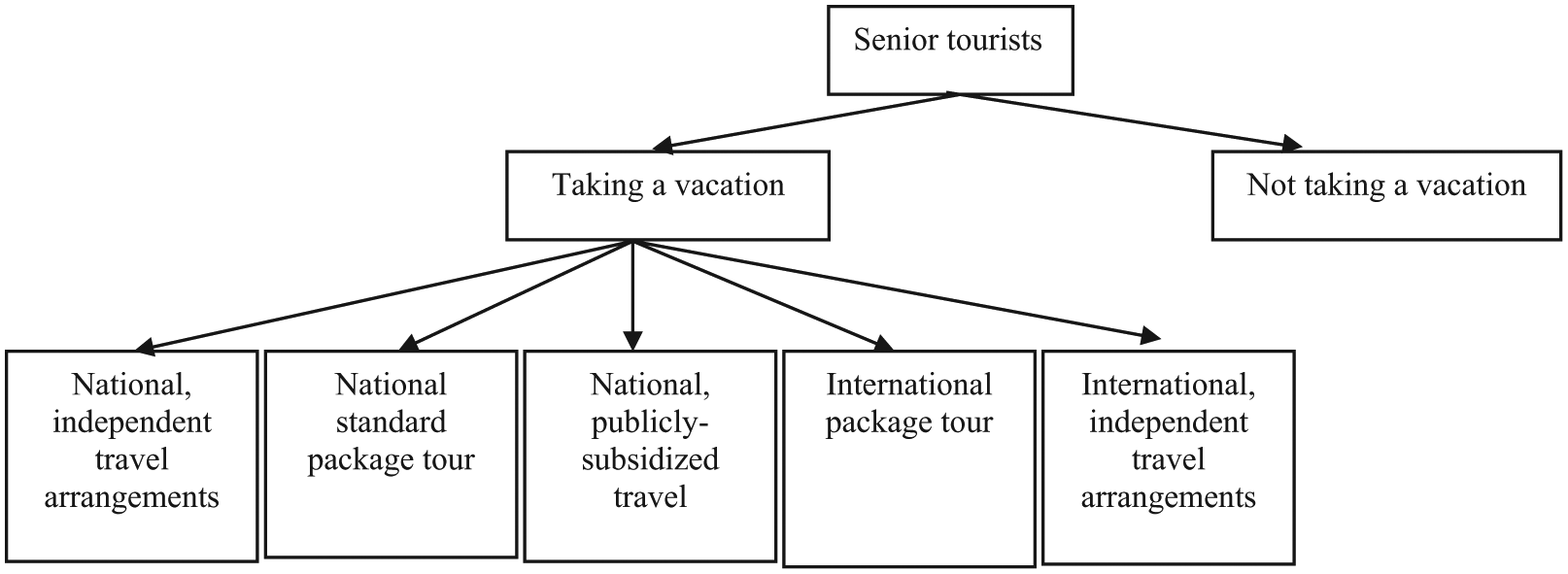
Basic decision structure.
It is important to note that the first and fourth decisions are fixed. The first one involves whether or not to take a vacation (Mansfeld 1992); obviously, in the absence of an affirmative response, no other decision would be made, as the individual would not go on vacation. The fourth decision on the use of publicly subsidized travel is a particular case applicable only to national vacation packages. However, even though the two central decisions ("whether to opt for an international trip” and “whether to use an organized tour") are located on different levels, their sequential order is not known, and therefore this becomes more of an empirical issue. Accordingly, two alternative sequential processes will be tested (see Figure 2):
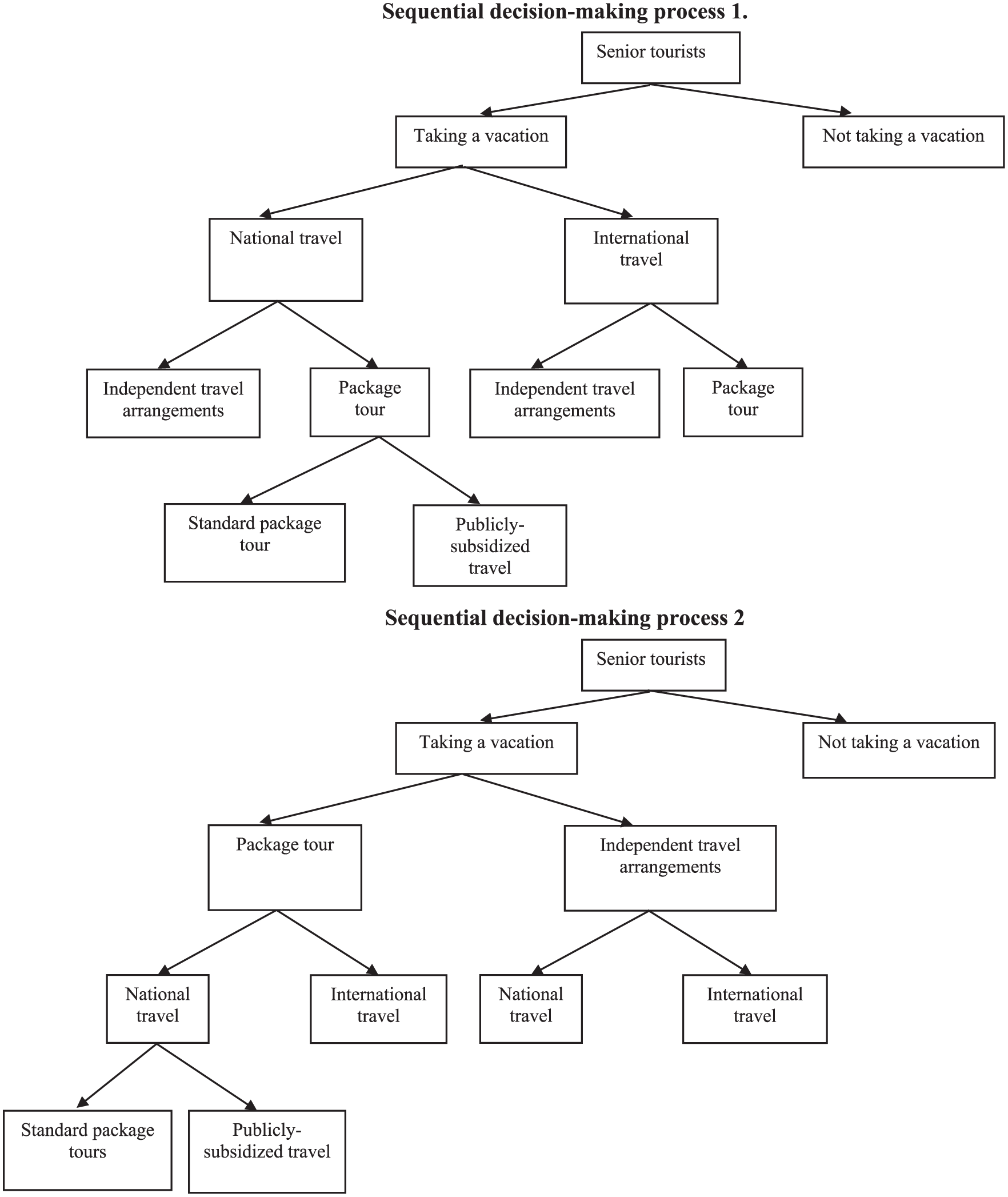
Alternative sequential decision-making processes.
Sequential Decision Process 1
Process 1 involves “whether to take a vacation,” “whether to opt for an international trip (vs. a national one),” “whether to use an organized tour (vs. independent travel),” and “whether to use publicly subsidized travel.” The choice in the first phase is whether or not to take a vacation; those who opt for taking a vacation go on to a second phase, in which they decide whether to purchase an international trip versus a national one. In the third phase, people decide on how to organize their trip (organized tour vs. independent travel), and in the fourth phase, if they opted for a national package tour in the second phase and a package tour in the third stage, they choose whether to use publicly subsidized travel.
Sequential Decision Process 2
The stages involved in process 2 are “whether to take a vacation,” “whether to use an organized tour,” “whether to opt for an international trip” and “whether to use publicly subsidized travel.” This structure is analogous to the previous one except for the two central decisions, which are in reverse order.
After introducing the four-staged decision making among senior tourists, and considering the diversity encountered within the senior segment, we use a series of critical variables that might have an influence on each stage. Some of these variables are specific to a time and place, while others intervene either as facilitators or inhibitors on each stage of the decision-making process (Decrop and Snelders 2005). These variables are self-perceived health, self-perceived economic status, self-perceived time available, gender, income, and traveling alone. Note that these variables are introduced to make the model operative and to illustrate, first, the way senior tourists make their sequential decisions, and second, the potential differentiated effect of each variable on each stage.
In general terms, age in seniors was found to affect the willingness to travel negatively (Bernini and Cracolici 2015). This decrease in the percentage of seniors traveling is particularly visible in the 80+ age group (Omelan, Podstawski, and Raczkowski 2016; Bak 2012). When making the decision as to whether to take a vacation (or not), seniors are influenced by self-perceived time and by their economic status as the main barriers to travel (Huang 2007; Nyaupane, McCabe and Andereck 2008; Ferrer et al. 2016) in addition to self-perceived health (Blazey 1992; Romsa and Blenman 1989; Schröder and Widmann 2007; H. Kim, Woo, and Uysal 2015; Gu et al. 2016; Melon et al. 2018). Huber, Milne, and Hyde’s (2018) results show that health plays a significant role that can constrain or even block tourism participation, because seniors are more likely to be limited by physical factors and health than other groups (Grzelak-Kostulska, Holowiecka, and Kwiatkowski 2011). The studies by Blazey (1992) and McGuire (1984) showed that individuals who do not travel because of lack of time tend to have higher income levels. This appears to be a contradiction, because as income increases, there is also a growing tendency to travel (Faranda and Schmidt 2000; Huh 2006). Jang and Ham (2009), Nyaupane, McCabe and Andereck (2008), and Zimmer, Brayley, and Searle (1995) corroborated this statement, and also identified the lack of a companion to travel with as a barrier. In addition, several studies have shown that the gender variable has a clear influence on senior tourists’ decisions (Barros and Machado 2010; Meng and Uysal 2008; Melon et al. 2018). Hu, Wang, and Wang (2013) demonstrated that travel rates differ between men and women.
Regarding the decision to travel nationally or internationally, while there is a paucity of studies on seniors’ choice of a destination, in general they have found that elderly people tend to travel to national destinations more than to international destinations (Litrell, Paige, and Song 2004; C. M. E. Wu 2003), as international trips tend to be longer (C. L. Wu and Carson 2008). Moreover, with increased age domestic destinations become more popular among the elderly (Huber, Milne, and Hyde 2018). However, when they travel internationally, a determinant factor is their self-perceived economic and health status (Fodness 1994; Hwang and Lee 2018).
Concerning the trip organization, the selection of organized tours and, specifically, package tours are among the preferred options for elderly travelers in contrast to younger travelers (Javalgi, Thomas, and Rao 1992; Bai et al. 1999; Hwang and Lee 2018), as they provide arrangements for single, widowed, or divorced seniors to travel as part of a group (Patterson 2006; Kazeminia, Del Chiappa, and Jafari 2015; Gao and Kerstetter 2016) and as a result, to mingle with other people (M. Kim and Kim 2018). Several studies show that variables such as gender, income, and type of companion play a part (Bai et al. 2001; Javalgi, Thomas, and Rao 1992). Still, some elderly people also like to travel independently (Alén et al. 2014; Bai et al. 2001; Batra 2009; Van den Berg, Arentze, and Timmermans 2011), particularly single, widowed, or divorced seniors (Patterson 2006). The ways in which they decide to travel are wide-ranging (Javalgi, Thomas, and Rao 1992; Le Serre and Chevalier 2012; Ryan and Trauer 2005; Van den Berg, Arentze, and Timmermans 2011; C. M. E. Wu 2003), where employment status, household structure and composition, and companionship, among others, will lead to different types of travel being chosen (Alén, Losada, and Domínguez 2016).
Finally, the decision to use publicly subsidized trips or standard organized tours. Alén, Losada, and Domínguez (2016) showed that elderly people prefer to opt for organized tours, both in the form of package tours (Harssel and Theobald 1995) and through public programs such as the IMSERSO in Spain, as they provide greater security (Patterson 2006) because of their traveling within an organized, set program. This allows seniors with different income levels, especially lower-income groups (less than €12,000 a year), to be able to travel. In addition, this type of travel arrangement promotes active and healthy aging (Morgan, Pritchard, and Sedgley 2015; Medaric, Gabruc, and Sedmak 2016; Melon et al. 2018). Alén, Losada, and Domínguez (2016) find that Spanish seniors who use IMSERSO programs usually travel alone.
Method and Data
Methodology
The methodology employed sought to identify the optimum decision-making structure and to estimate the different effects that each dimension has on the distinct phases of the decision-making process among senior tourists. In particular, estimations were made for the two-stage decision-making process (Figure 1) and for the four-stage decision-making processes (Figure 2).
A Multidimensional Random Coefficient Multinomial Logit model (MRCLM) was used for this purpose, as it provides enough flexibility to accommodate any pattern of interdependence and correlations between choice alternatives, and consequently, is able to represent different staged structures (Brownstone and Train 1998, p. 113; McFadden and Train 2000, p. 448). In particular, the individual t’s utility function of alternative i was assumed:

where Xit is the set of the attributes of alternative i and the characteristics of consumer t; β t represents the parameters that capture the effects of Xit for each individual; and ε it is an identical and independently extreme value-distributed error term. The resulting probabilistic model is expressed as having the following probability (Train 2009):
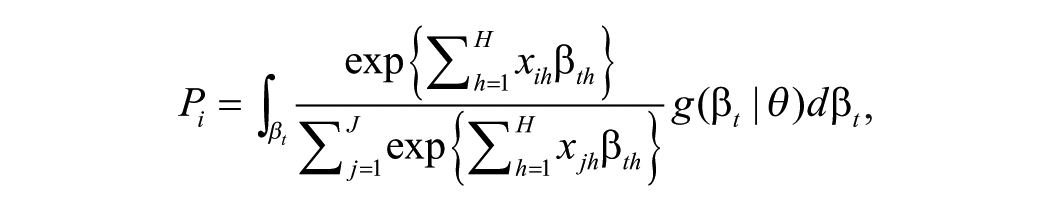
where J is the set of choices, and θ is the mean and variance of the parameters that describe density function g. The maximum likelihood function was applied to estimate the parameters:
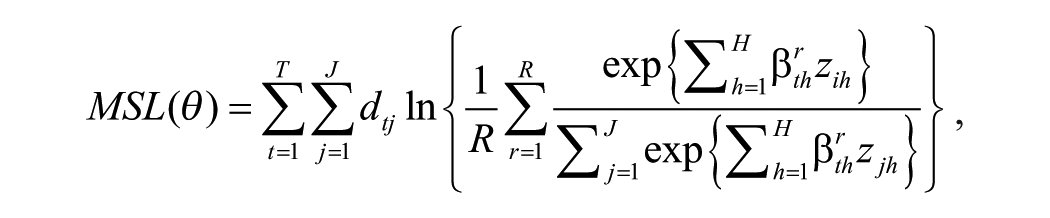
where dtj = 1 if tourist t selects alternative j, and zero otherwise, and R is the total number of draws from the density function.
Regarding the aforementioned flexibility of this model, observe that different correlation patterns among nonindependent alternatives can be captured. Brownstone and Train (1999, p. 113) show that this model resembles a nested logit model in that it puts together the alternatives into nests by strategically including the variables in the utility function in order to indicate which nest an alternative belongs to. Note that defining a sequence implies characterizing the “nests” wherein the choice alternatives are included; the intuition of the methodological approach consists of estimating the similarity (or dissimilarity) among those alternatives and detecting which nest they belong to. As the sequence is conditional on how the nests are defined (and in turn, the specific choice alternatives included in them), the estimation of the optimal combination of the latter allows us to find the optimal sequence.
From a technical viewpoint, having a common random parameter across alternatives in the same nest drives a covariance matrix with nonzero elements outside the diagonal, which mimics correlation structures obtained via nested models. For the context of this study, let us assume that the utility function of alternative i is Uit=βxt+µtzi+εin, where µ is a vector of random terms with zero mean and variance σ2 µ , and εit is the independently and identically distributed extreme value with variance σ2 ε . The nonobserved random part of the utility is ηi=µtzi+εin, which can be correlated with other alternatives depending on the specification of zi. For example, assume that five alternatives “national, independent travel arrangements” (A), “national, standard package tour” (B), “national publicly subsidized travel” (C), “international, independent ravel arrangements” (D) and “international package tour” (E) have the following utility functions:





If two alternatives D and E are correlated, we obtain a covariance that is
Sample and Data
A quantitative analysis was conducted of data collected through a telephone survey of Spanish residents aged 55 and older. The age variable (55 years old) was used to determine the people who were considered senior. It was based on the studies carried out by Cooper et al. (2007), Plog (2005), and Prideaux, Wei, and Ruys (2001), which established this average age to segment senior tourists, as it coincides with the “baby boomer” generation. According to INE data (2010), in Spain those older than 55 years were 27.6% of the total population (12,990,731 people), and of these, according to the IET, 44.19% (5,741,452 people) made at least one trip with overnight at the destination during 2010. A two-stage probabilistic sampling method was implemented for data collection in order to ensure there were no bias due to the residence of the respondents. In the first stage, subpopulations were established as a result of the division of the target population according to their geographical area of residence. The geographical unit selected was the province, which was used to create clusters. In the second stage, the number of travelers per province was determined based on the number of people aged 55 and older per province (INE 2010) and the total number of travelers aged 55 and older per Autonomous Region (IET 2010). When these data were linked to the theoretical size of the sample, the necessary number of responses per province was obtained based on the proportional number of travelers. We had a database of telephone numbers by provinces, and the respondents were chosen using a table of random numbers that assigned a number to each record. The records were subsequently sorted in ascending order according to their corresponding random number. The calls were made following the order achieved after this process. Of the questionnaires obtained (620), 124 were eliminated because of incomplete information. The remaining 496 valid questionnaires were coded for data analysis. Therefore, for a sample size of 496, a sample proportion of 50%, a total population of 5,741,452, and a 95% confidence interval, the sample error is 4.4%, which, according to Dillman, Smyth, and Christian (2014), is considered as an acceptable standard for telephone surveys.
To operationalize this revealed-preference choice model, we define the dependent and independent variables:
Dependent variables. To build the dependent variable, we look at those individuals who take vacation and combine questions 9 and 10 in the questionnaire (see Appendix), so that we know whether they opted for national versus international destinations as well as the type of trip organization (self-organized, package tour or Imserso program). Accordingly, we generate different combinations that represent the set of alternatives available to the senior tourist: “national, independent travel arrangements” (26.21% opted for this alternative), “national, standard package tour” (5.65%), “national publicly subsidized travel” (12.90%), “international, independent travel arrangements” (5.85%), “international package tour” (4.84%), and the alternative “not to take vacations” (44.56%).
Independent variables. For the variables self-perceived health (SPH), self-perceived economic status (SPES), and self-perceived available time (SPTA), a 1- to 5-point Likert-type scale is employed. A dichotomous variable is used for gender (1=woman; 0=man) and for traveling alone (1=traveling alone; 0=traveling with more people), and an ordinal variable for annual income (Income 1 = up to €8,000 per year; Income 2 = between €8,000 and €12,000; Income 3 = between €12,000 and €16,000; Income 4 = between €16,000 and €20,000; Income 5 = between €20,000 and €24,000; and Income 6 = more than 24,000).
Consequently, for individual t and alternative i, the empirical model is as follows:

Results
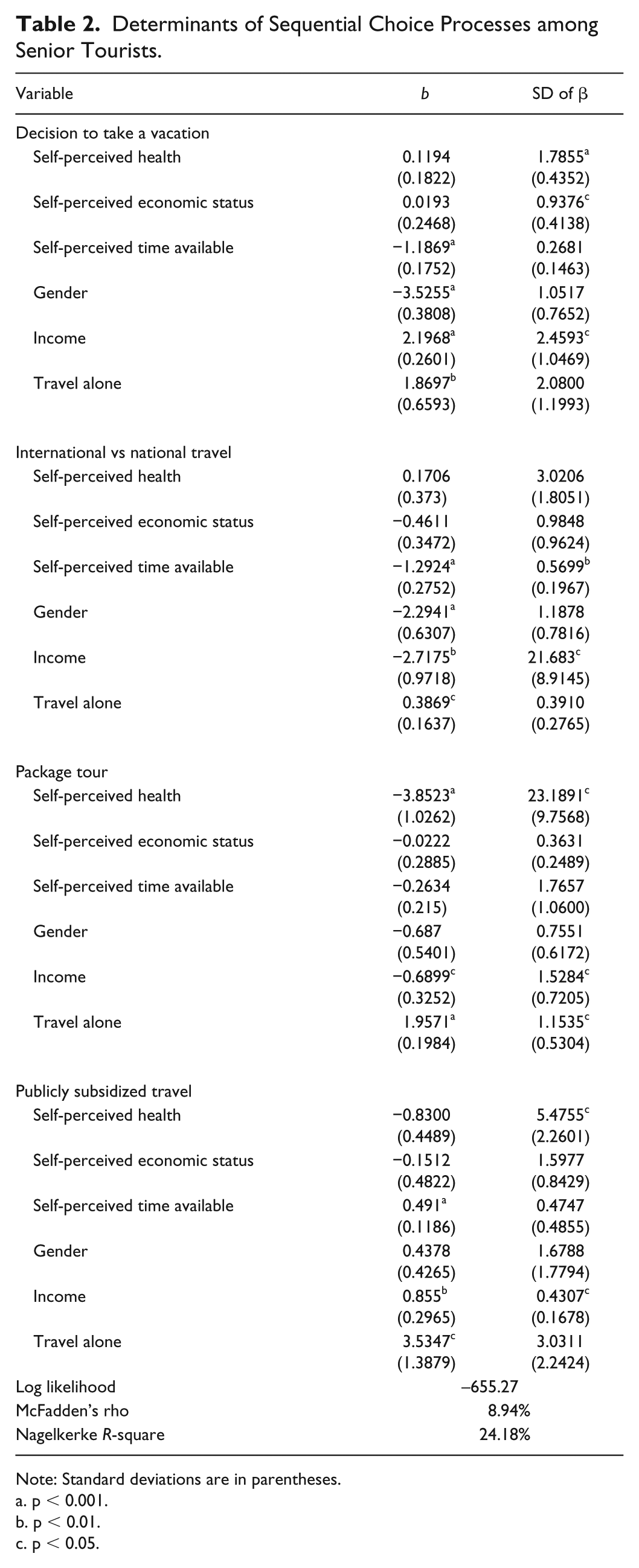
The test related to the senior tourists’ choice processes (a two-stage process in Figure 1 and two four-stage processes in Figure 2) involved the estimation of several Random Coefficient Multinomial Logit models, as presented in Tables 1 and 2.
Log Likelihood of Sequential Decision-Making Processes.

Note: SIC = Schwarz information criterion; AIC = Akaike information criterion.
p < 0.001.
Determinants of Sequential Choice Processes among Senior Tourists.
Note: Standard deviations are in parentheses.
p < 0.001.
p < 0.01.
p < 0.05.
Table 1 shows the results of the likelihood functions and the Schwarz (SIC) and Akaike (AIC) information criteria of the decision-making processes. All three values (log-likelihood, SIC and AIC) lead to the same conclusion: the two-stage decision-making process is significantly lower at 1% than the two four-stage decision-making processes (the Wald test for the comparison between the four-stage decision process 1 and the two-stage decision process is 163.86 [p value < 0.001] and for the comparison between the four-stage decision process 2 and the two-stage decision process is 163.86 [p value < 0.001]). Therefore, in response to research question 1, the results prove that the four-stage decision-making process outstands the two-stage process, and that individuals do not consider all of the alternatives simultaneously; rather, they seemed to break down the complex decision-making process into several phases, in line with Steinbruner’s (2002) theoretical model, and with Eymann and Ronning’s (1992), Eymann’s (1995), and Park et al.’s (2013) empirical applications. Therefore, the four-stage process allows people to analyze all the information, even if they have limited cognitive capacity to process all the information simultaneously, in a step-by-step way. In other words, rather than considering all national and international destinations, and all organized and independent travels, all at once, they discompose this complex task into different groups of decisions to arrive at the final choice.
Sequential decision-making process 1, which includes the sequence “whether to take a vacation,” “international trip,” “organized tour,” and “publicly subsidized travel,” is superior (Wald test = 78.64; p value < 0.001) to that of the sequential decision-making process 2, which includes the sequence “whether to take a vacation,” “organized tour,” “international trip,” and “publicly subsidized travel.” This result means that the optimal sequential process that portrays the senior tourist decision sequence is decision-making process 1, with an initial phase in which people make the decision as to whether or not to take a vacation. The second phase consists of making a decision between international and national destinations; the third phase includes whether or not to choose a package tour; and the fourth stage, for (Spanish) national trips, determines if the participants opt for using publicly subsidized travel. More importantly, this outcome shows that senior tourists’ choices undergo a complex process that can be broken down into four phases: the decision as to whether to take a vacation; whether to travel nationally or internationally; whether to choose an organized tour / independent travel arrangements; and whether or not to use publicly subsidized travel.
Table 2 presents the parameter estimates. Regarding the goodness of fit, we obtain 8.94% for McFadden’s rho and 24.18% for Nagelkerke R-square. These numbers are not high and certainly leave something to be desired. Still, considering that McFadden’s rho represents the percentage increase in the log-likelihood function above the value taken at zero parameters (Train 2009, p. 68), Hensher and Johnson (1981, p. 51) point out that values between 20% and 40% would be considered “extremely good fits.” Consequently, we can say that we obtained moderate goodness of fit; thus, additional variables should be looked for in case the model had to be used for prediction.
The first stage (taking a vacation) shows that, while self-perceived health and economic status are not significant, the standard deviations of both parameters are significant. 1 It means that, for 52.66% of the sample, f(0.1194/1.7855) = 0.5266, the self-perceived health has a positive effect, and for 50.82% of the sample, f(0.0.0193/0.0.9376) = 0.5082, the self-perceived economic status has a positive impact. While this duality is unexpected—for some people these dimensions have a positive effect and for some others a negative impact—the results are in line with Nyaupane, McCabe and Andereck (2008) and Schröder and Widmann (2007). Interestingly, self-perceived time available has a negative effect on the decision to take a vacation. It seems that perceiving more time available does not necessarily lead people to focus exclusively on travel, so more time available might imply embarking on a greater variety of activities. Finally, while being a woman reduces the probability of taking a vacation (Barros and Machado 2010; Meng and Uysal 2008), higher incomes and traveling alone increases it significantly, which is as expected and in agreement with Huh (2006) and Jang and Ham (2009).
Concerning the second stage (international vs. national travel), self-perceived health and self-perceived economic status are not significant, while self-perceived time available has a negative effect also for this second decision. While these results are different from Fodness’s (1994) findings, it is important to remember that these inconsistencies remain within the senior segment as a result of these types of contradictions (Faranda and Schmidt 2000). Gender has a significant negative effect: women tend to choose international travel less often than men, and traveling alone is not significant. Income shows interesting effects: while its mean is significant and negative, there is a proportion of 45.01% of people for whom this variable has the expected positive effect on the decision to travel abroad, f(–2.7175/21.683) = 0.4501, in line with Fodness (1994) and C. L. Wu and Carson (2008).
As for the third stage (whether or not to buy a package tour), self-perception of health is negatively significant: the greater the self-perception of health, the lower the probability of choosing a package tour. It seems that good heath allows them more freedom to independently organize their trip. Still, the standard deviation of the parameter is significant, so for 43.40% of the sample, f(–3.8523/23.1891) = 0.4340, this effect is positive. Self-perceived economic status and time available do not have an effect on this decision. Gender is not significant, a significant and positive parameter is found for travel alone, and a significant and negative parameter is obtained for income as it seems that more monetary resources lead to less probability of opting for a package tour in line with Alén, Losada, and Domínguez (2016).
Regarding the fourth decision (use of publicly subsidized travel), self-perception of economic status is not significant, while self-perception of time available was significantly positive. Self-perception of health has a mean parameter estimate around zero, with a significant standard deviation; therefore, for 43.97% of the sample, f(–0.8300/5.4755) = 0.4397, this variable has a positive impact. Gender is not significant, and income and travel alone are significantly positive, in line with Alén, Losada, and Domínguez (2016).
Beyond the specific effect of each variable, an important result of this empirical approach is the different impact of each variable on each decision: take, for example, self-perceived time available that has a negative effect on the decision to take a vacation and to choose international travel, but it exerts a positive impact on publicly subsidized options and nonsignificant effect on package tour. Considering its significant standard deviations for the decision to take a vacation and to travel internationally, this variable shows a clear disparity in terms of behavior. Therefore, no clear pattern emerges, which proves the senior segment to be extremely diverse (Faranda and Schmidt 2000). Likewise, being a woman has a negative effect on the decision to take a vacation and international trips, and is not significant on the decisions “package tour” and “publicly subsidized travel.” Income has a positive effect on the decision to take a vacation and on the choice of publicly subsidized travel, but has a negative impact on choosing international trips and vacation packages.
Conclusions
The senior citizens’ market is clearly important to the tourism industry. Ignoring it would be a major loss of competitive advantage, because it represents a broad segment that will grow in the medium and the long term. However, one of the great problems with this segment is its great diversity, as proven in this study. This makes it difficult to establish clear patterns of behavior that would enable destination marketing organizations (DMOs) to design tourism products to meet the needs and demands of senior travelers. One of the major contributions of this study resides on the fact that while several studies have analyzed the choice behavior of senior travelers and there is a substantial amount of work done on tourist decision making, none has empirically considered using a staged decision making in the context of senior travelers. This is even more relevant considering the contradictions found in the literature regarding the impact of variables because with just one model—without having to estimate different models for each decision with the consequent loss of consistency in the parameter estimates that it would entail—we can quantify the differentiated effect of a variable depending on the decision the individual is dealing with; and also, we can observe the way a variable changes its effect even within the same decision stage depending on the individual (remember the dual effects found in several variables). Complex process studies open up our understanding of consumer decision making, their effect on choice behavior, and the influence of contextual factors on these rules and actions (Sirakaya, McLellan and Uysal 1996). These techniques help identify and obtain greater insights into consumers’ decision making and the circumstances in which it takes place, observing the different parts of the process. “A complex process approach accommodates both rationality and irrationality, because it makes no assumptions about the rationality of individuals” (Smallman and Moore 2010, p. 417).
It is found that senior people who choose to travel are positively influenced mainly by income and traveling alone and, interestingly, by self-perceived health and economic status in a dual manner (for some people, these dimensions have a positive effect and for some others a negative impact).
On the second stage of their decision-making process, whether to choose national or international travel, different behavior is observed, as women are less likely to make international trips and income presents mixed results, with positive and negative effects within the sample. Regarding the third stage, package tours are favored by people who prefer traveling alone and negatively influenced by self-perception of health and income (the healthier they are and the higher income they have, the greater the probability of opting for an independently organized trip). As for the use of publicly subsidized travel, traveling alone has a positive effect, and self-perception of health shows a dual effect.
DMOs are facing a great challenge: rather than designing homogeneous products, they are compelled to adapt their offering to the travel choices made by seniors. One way to optimize resources and design more effective strategies could come from the structuring of decision-making phases and, on account of the diversity of results and the dual effects (one variable might have positive and negative effects on different proportions of the sample), a segmentation strategy within the senior market emerges as a critical strategy. Accordingly, finding those individuals for whom self-perceived health and economic status have a positive effect on their decision to take a vacation would be fundamental as they are more willing to travel and are less sensitive to prices. Regarding the proposal of national versus international trips, high-incomers do not necessarily opt for international trips, so there is an interesting market of affluent seniors with a preference toward national trip. Note, however, that these people with more monetary resources are less predisposed to package tours, so they are more inclined toward independently organized trips. Finally, for publicly subsidized travels, those who travel alone are an interesting market segment. This diversity of approaches entails managing different alternatives, according to the decision-making processes engaged in by senior travelers, but seen individually, they could greatly facilitate the satisfaction of the tourism needs of the elderly.
Despite the interesting results obtained in this study, there are several limitations to be considered. We use cross-section data, so panel data would help generalizability. Also, while the decision process proposed might be more general, the results of the individual variable are less generalizable as the individual characteristics and the services offered are not homogeneous across different countries. Based on this, it would be interesting to further the analysis in order to provide additional insights into the patterns of behavior of senior travelers from countries other than Spain.
Supplemental Material
APPENDIX – Supplemental material for The Staged Nature of Decision Making among Senior Tourists
Supplemental material, APPENDIX for The Staged Nature of Decision Making among Senior Tourists by Juan Luis Nicolau, Nieves Losada, Elisa Alén and Trinidad Domínguez in Journal of Travel Research
Footnotes
Declaration of Conflicting Interests
The author(s) declared no potential conflicts of interest with respect to the research, authorship, and/or publication of this article.
Funding
The author(s) received no financial support for the research, authorship, and/or publication of this article.
Notes
Supplemental Material
Supplemental material for this article is available online.

Author Biographies
References
Supplementary Material
Please find the following supplemental material available below.
For Open Access articles published under a Creative Commons License, all supplemental material carries the same license as the article it is associated with.
For non-Open Access articles published, all supplemental material carries a non-exclusive license, and permission requests for re-use of supplemental material or any part of supplemental material shall be sent directly to the copyright owner as specified in the copyright notice associated with the article.
