



Abstract
Despite the increasing attention given to tourism regulation in recent years, great ambiguity surrounds this concept and no valid and reliable instrument exists to measure tourism market regulation (TMR). This study uses multi-step mixed methods to develop a measurement scale of TMR from the perspective of tourists. In the first step, interviews and focus groups are undertaken to formulate a clear definition of TMR and its attributes. In the second step, a scale development procedure is adopted to analyze two rounds of data for dimension exploration via exploratory factor analysis and confirmation via confirmatory factor analysis. Through these analyses, five dimensions are generated: regulatory oversight, truth in advertising, tourism contract compliance, fulfilling tourism contracts, and travel feedback processing. The reliable and valid results contribute to refining TMR in the context of China. They also provide a useful tool for tourists and destination marketing organizations to measure and govern TMR in other regions/countries.
Keywords
Introduction
In recent years, the tourism industry has developed rapidly in China. In 2018, the number of Chinese domestic tourist arrivals reached 5.53 billion, alongside 141.20 million inbound tourists, and generated a total income of RMB 5,970 billion, which was 10.5% higher than the total income in 2017 (MCT 2019). Employment opportunities increased directly and indirectly by the tourism industry account for 10.29% of the total employment in China (MCT 2019). Clearly, the tourism industry plays an important role in the Chinese economy. However, parasitic phenomena, such as zero-commission tours (Zhang, Heung, and Yan 2009; Zhang, Yan, and Li 2009), free-of-charge or even negative-charge tours (Fu 2010; Jia, He, and Cui 2006; Wei and Yang 2011), “ripping off” tourists (Harris 2012; Ling 2014), and unethical marketing practices (Cavicchi and Santini 2011; King, Dwyer, and Prideaux 2006; March 2008), are accompanying the booming development of tourism.
Such malpractices in China’s tourism market are severely harmful to the consumers of tourism products and disturb the regulation of the tourism market as well as the sustainability of the tourism industry. This situation has drawn considerable attention among and criticism from the Chinese public. Every year after public holidays, disputes involving all kinds of tourism enterprises cause heated media and public debates. Tourism regulations include wide-ranging issues, such as tourism experience, environmental impacts, social cohesion, local culture, and livelihood of local residents. Tourism market regulation (TMR) has become a focus of concern in the society owing to the inconsistencies and abuse in the tourism market. The tourism industry is defined as a series of goods and services that depend on the tourism consumed by tourists (Frechtling 1999; Frechtling 2010; Smeral 2006). Systematically establishing a set of standards to assess the situation of market regulation from the perspective of tourists is fundamental to the protection of tourist rights and the preservation of the tourism industry’s ethical integrity.
Many countries and areas have established laws and regulations to regulate their tourism market (Grant 1996; March 2008; Zhang, Yan, and Li 2009). For instance, the European Commission (EC) Package Travel Regulations 1992 (SI 1992 No. 3288) launched clauses to protect consumers (Grant 1996). The European Parliament and the Council of the European Union (EU) composed Directive (EU) 2015/2302, which stipulates important consumer rights in relation to package travel and linked travel arrangements (The European Parliament and the Council of European Union 2015). Japan passed the Tourism Nation Promotion Basic Law, Travel Agent Law, and Hotel Law to create an environment conducive to travel. Australia created the Regulation of Travel Agents Act to promote fair terms of trading. Hong Kong enacted Travel Agent Ordinance and Travel Agents Regulations to control and regulate travel agents, including the Travel Industry Compensation Fund Rules, which provide consumers with a procedure for ex gratia payment and regulate the amount of ex gratia payment and financial penalty. Travel Industry Ordinance (No. 37 of 2018) sets detailed regulations for the whole travel industry (Legislative Council of Hong Kong SAR 2018). Moreover, mainland China has laws and regulations that aim to protect tourists, such as the Tourism Law, Travel Agency Ordinance, Contract Law, Consumer Protection Law, Advertising Law, and Criminal Law.
The tourism system is a combination of intangible service products with tangible aspects. It has a reasonable number of laws and regulations to monitor tangible aspects of the industry, such as tourism service contracts, quality of products, and refund procedures. However, such laws and regulations have not effectively banned activities that disturb the intangible aspects of the tourism market, such as zero-commission tours that lead to forced shopping, overpricing, and implicit misleading advertising. Regulations for illegal and law-breaking practices likewise exist, but unethical but lawful practices, such as price-cutting and unethical shopping practices, are difficult to monitor and regulate using existing authorized laws and regulations. These activities have great negative impacts on tourists’ experiences and destination image (March 2008), easily drawing substantial attention and spreading negative word of mouth on social media. In addition, while existing tourism regulation studies emphasize the leading role of the destination government and service operators (Kohl and Greenlaw 1983; Qu, Ennew, and Sinclair 2005; Thomas and Thomas 1992), the role and viewpoints of tourists, as service receivers, are largely overlooked in the consultation and execution stages.
Statistics show that tourism complaints in China in 2018 are categorized into six areas: aviation (24%), hotels (29.92%), travel agencies (27.88%), tourism attractions (4.93%), and tour guides (1.89%) (The People’s Daily 2019). The refund and change of ticket, inconsistency between travel contract and itinerary, forced shopping by tour leaders, and poor service attitude are the most frequent complaints (The People’s Daily 2019). TMR is frequently referenced in tourism information and policies, but what exactly is TMR? What are its dimensions? How should it be evaluated considering unethical—rather than merely illegal—activities from the perspective of tourists? Despite the rapid growth of China’s tourism market, no valid and reliable instrument is available to measure the situation of TMR. For the reasons discussed above, evaluating TMR has become an important issue for the tourism industry.
To fill the research gap, this study investigates TMR by defining the construct and developing a measurement scale. First, it uses an inductive approach to conceptualize TMR and specify its domain, as recommended by Hinkin, Tracey, and Enz (1997). Through qualitative methods, a theoretical framework and conceptualization of TMR are established by delineating its conceptual domain and highlighting its subcomponents (Riefler, Diamantopoulos, and Siguaw 2012). The wording and content validity of TMR measurement items extracted from the literature review and qualitative research are assessed. Second, this study analyzes two rounds of quantitative data with exploratory factor analysis (EFA) and confirmatory factor analysis (CFA), respectively. The findings are then used to develop a multidimensional scale of TMR. Consequently, this study can enrich TMR research and provide a useful tool for the government and destination marketing organizations (DMOs) to measure and manage TMR from the perspective of tourists.
Literature Review
Market Regulation
Scientific assessment of the situation of market regulation is the foundation to improve market regulation (Research Group on the Evaluation of Market Regulation 1998). To date, most research on market regulation adopts an economics perspective. Prominent contributions include spontaneous order theory, which is based on economic liberalism. Proposed by Hayek (1967), spontaneous order theory points out that market order is the result of irresistible spontaneous evolution rather than a process of top–down central planning or a well-organized design. According to Hayek’s Sensory Order, market regulation can be perceived by consumers (Hayek 1952). Smith (1776) considered the “invisible hand” of price and competition mechanisms as the foundation of market regulation. Marx (1887) believed that market regulation is the evolution of society and history. Commons (1931) developed Marx’s thought on market regulation by considering it as a state of collective action that controls individual actions.
Hong (2005) defined market regulation as market norms, institutions, and corresponding compliance. Regulation is generally accepted as consisting of authoritative rules issued by the state but pluralized in important ways (Drahos 2017). New institutional economics, as represented by Coase (2012) and North (1990), asserts that the formation and development of market regulation depend on the spontaneous evolution of the market and the intervention by the government supplying the applicable institutions. The government has three possible roles in different stages of economic development: active involvement, creating an “enabling environment” to support the development of the sector but not taking any commercial role, and benign neglect where it does not directly support but neither discriminate. Powell (1990) and Williamson (1996) further developed institutional economics and explored the mechanism of the network in the formation of market regulation. The literature clearly indicates that views on market regulation stem from the market economy.
Tourism Market Regulation
TMR is an important criterion for measuring the condition of regional tourism development (CNTA 2016). However, researchers have paid minimal attention to “regulatory theory” (Randle and Hoye 2016). Studies on TMR have mostly focused on specific events and social phenomena in the tourist market, such as assessing tourists’ reactions to an unethical destination incident (Breitsohl and Garrod 2016). The phenomena of zero commission, “ripping off” tourists, and unethical marketing practices, all of which disrupt TMR, have gained more attention (Cavicchi and Santini 2011; Harris 2012; King, Dwyer, and Prideaux 2006; March 2008; Zhang, Heung, and Yan 2009). Zhang, Yan, and Li (2009) demystified the mechanism of zero-commission tours and analyzed factors causing this negative event. Zero-based activities have mainly been attributed to the government’s failure to properly regulate (Kim and Gerber 2005).
According to the regulatory theory proposed by Baldwin, Cave, and Lodge (2011), the primary reason for regulation in most countries is consumer protection. For instance, the EC Package Travel Regulations 1992 (SI 1992 No. 3288) launched clauses for holidaymakers to be compensated for any breach of contract by the tour operator. The European Parliament and the Council of European Union amended Regulation (EC) No. 2006/2004 and Directive 2011/83/EU and enacted Directive (EU) 2015/2302 on package travel and linked travel arrangements to contribute to the proper functioning of the internal market and a high level of consumer protection, particularly with regard to information requirements and the liability of traders (The European Parliament and the Council of European Union 2015). For more than 15 years, the Hong Kong Tourism Board has promoted accredited “Quality Tourism Services” and resolved complaints from tourists to reinforce Hong Kong’s image as a destination offering quality tourism services and products. In 2018, China amended its Tourism Law to protect the lawful rights and interests of tourists and tourism operators as well as regulate the order of the tourism market (Standing Committee of the National People’s Congress 2018b). Laws that do not mention tourism services specifically but certainly encompass all service offerings also exist, including the Constitution, civil and commercial laws such as the Contract Law, the Company Law, economic laws, the Criminal Law, and so on. China has issued a series of policy documents, including regulations that aim to rectify market order.
However, the existing government regulations do not cover the various services offered in China, such as zero-commission tours and unethical marketing practices. Partial laws are not adequate or implemented properly, such as the Tourism Law (Tang 2013). The main reasons for the illegal and unethical behaviors in China’s tourism market are immaturity of the market environment, noncredit transactions of tourism enterprises, and an improper supervision and management system (Du 2012). The regulatory environment of a destination is an important dimension of TMR, and improved regulation can typically reduce the extent of unethical practices (March 2008). Another factor is the quality of tourism services, which is the source of tourist dissatisfaction and even outrage (Crotts, Pan, and Raschid 2008), such as tour guides “ripping off” tourists (Harris 2012; Ling 2014). As Mak, Wong, and Chang (2011) pointed out, the factors influencing the service quality of tour guides include unhealthy business practices of travel agencies, immaturity of the tourism market, unfair exploitative measures, and the assurance mechanism. Institutionalizing the protection of tourist rights should be an indispensable condition of the tourism development strategy (Viktorovna et al. 2014).
With every country facing the challenge of sustainable development, effective regulatory plans are required (Drahos 2017). Prior to such plans, developing a tool that can evaluate the state of TMR is necessary. Many tourism associations and governments have their own codes of conduct to ensure members are protected by laws and regulations (Mak, Wong, and Chang 2011). Regulation poses challenges for commercial tourism. The three models of intervention in tourism development are central planning and control by the government, self-regulation by the tourism industry (Randle and Hoye 2016), and public–private partnerships taking charge of regulation (Huybers and Bennett 1997; Wilson, Nielsen, and Buultjens 2009). Laws, regulations, and state intervention can regulate illegal activities and law breaking. However, unethical but legal behaviors should be self-regulated by tourism enterprises or organizations. For example, the Association of British Travel Agents have a Code of Conduct and guidance on the application to self-regulate members for tourist protection; the Code governs areas such as accurate advertising changes to bookings and managing customer complaints (Association of British Travel Agents 2018). There are other self-regulatory organizations, such as National Tour Association, Japan Association of Travel Agents, and National Association of Travel Agents Singapore. China Tourism Association and China Association of Travel Services began to self-regulate independently after decoupling from the government in 2016 and 2017, respectively. Self-regulatory organizations may well develop codes of conduct for tourists and practitioners, but they do not make the laws of the land. Codes of conduct introduce ethical rather than legal parameters and cannot punish unethical but legal business behavior. Nevertheless, they identify approved behaviors and set up self-disciplines, which are effective supplements to legal regulation. Are all the regulatory plans above effective? What is the condition of TMR in a destination? What do tourists care most about when traveling? How can TMR be evaluated from the perspective of tourists? Tourists’ role and viewpoints are fundamental to regulation making and implementation. Thus, a set of standards that can assess the situation of TMR must be systematically established.
Strategies regulating commercial tourism from a stakeholder perspective have been found to be effective, which can increase the trust and support of stakeholders for government regulation (Randle and Hoye 2016). Meanwhile, the government needs to deliver the policy and planning framework. Hall (2012) stated that the government plays an important role in shaping the regulatory and policy structures that influence medical tourism. For instance, it can create an enabling environment by establishing supportive legislation or regulations that help tourism develop (Jenkins 2012). Through quality standards in tourism, health care, food, and housing, regulation can enhance tourists’ well-being, provide consumer protection, and safeguard tourists’ security and rights (Drahos 2017). A scale must therefore be developed that considers illegal practices and unethical behaviors from the perspective of tourists. Although studies have been conducted on the economics paradigm of market regulation, these mainly concerned general commodity markets. TMR has unique characteristics that distinguish it from general commodity regulation because of its service and experiential nature. Therefore, additional focus on TMR is needed.
Methodology
This study followed an eight-step procedure for developing the measurement scale proposed by Churchill (1979). The scale has been widely used in previous studies (e.g., DeVellis 2012; Ghosh and Mandal 2018; Hung and Petrick 2010; Yen, Tsaur, and Tsai 2018). Churchill (1979) proposed that researchers should demonstrate flexibility when applying his procedures (Zhang et al. 2016). In the present study, the eight steps involved are as follows. (1) Specify the domain of the construct: TMR is defined by precisely delineating which content is included and which is excluded (Churchill 1979). (2) Item generation: This step involves the initial items extracted from literature review and qualitative approach. Through literature review and content analysis of the in-depth interviews and focus group data as well as documents of relevant laws and policies, items were obtained across five dimensions. (3) Item purification and content validity: This study reviewed wording and content validity through a panel of experts to refine the measurement items. (4) Collect data: Data were collected through an online survey and offline fieldwork to prevent the systematic research bias that may result from data collection through a single channel. (5) Explore dimensionality: EFA was used to generate dimensions. (6) Collect data: Second-round data were also collected through an online survey and offline fieldwork. (7) Assess reliability: Reliability was assessed through coefficient alpha and composite reliability. (8) Confirm dimensionality: CFA was conducted to test the validity of the scale (Table 1).
Procedure for Developing the Measurement Instrument.
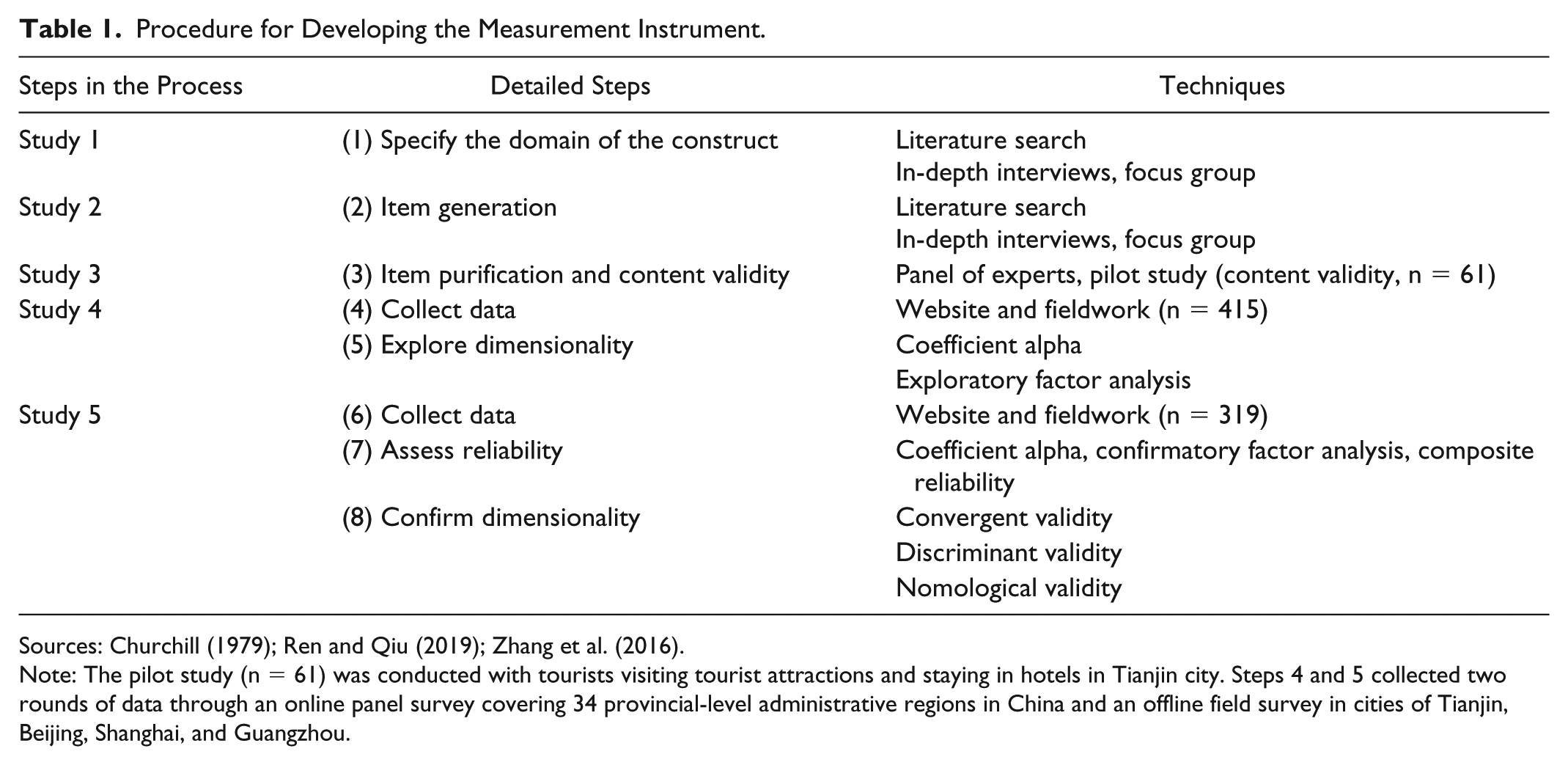
Sources: Churchill (1979); Ren and Qiu (2019); Zhang et al. (2016).
Note: The pilot study (n = 61) was conducted with tourists visiting tourist attractions and staying in hotels in Tianjin city. Steps 4 and 5 collected two rounds of data through an online panel survey covering 34 provincial-level administrative regions in China and an offline field survey in cities of Tianjin, Beijing, Shanghai, and Guangzhou.
Data Collection
The qualitative data were collected through in-depth interviews and focus group, while the quantitative data were collected through an online panel survey covering 34 provincial-level administrative regions in China and an offline field survey in cities of Tianjin, Beijing, Shanghai, and Guangzhou. The entire data collection duration was September 2017 to September 2018. Following the multistage design outlined above, this study explored the conceptual construct of TMR, generated items, and then purified those items through face and content validity tests. The purified items were then displayed in detail in scale development. After these three steps, a questionnaire comprising 27 initial items was confirmed (Appendix A). To obtain a reliable and valid measurement scale, two rounds of data were collected before dimensionality was assessed through EFA and CFA.
In the questionnaire, tourists were asked to make an objective analysis of TMR on the basis of their latest travel experience. For tourists, it is to evaluate both the outcomes and process-based issues of TMR. Evaluating the outcomes of TMR is a difficult task for tourists. A screening question (“Have you had a travel experience in the past 12 months?”) was designed to identify eligible respondents (Wang, Hung, and Li 2018). Only tourists who answered “Yes” were selected. The questionnaire comprised four parts: instructions to respondents, travel details, measurement items, and demographic questions. In the first part, the instructions explained the purpose of the survey and how to evaluate TMR. The second part comprised two multiple-choice questions asking respondents to identify the following: “The area where you traveled most recently” (possible answers included 34 provincial-level administrative regions in China and abroad) and “The type of tourism enterprises that recently provided you with products or services.” The purpose of these questions was to guide respondents in completing the questionnaire basing on their latest travel experience. The third part collected data through items evaluating TMR. The last part collected the tourists’ demographic information, following the approach in CNTA (2017).
The online survey was conducted by a survey company named Wenjuanxing (www.wjx.cn). The company was responsible for randomly distributing the questionnaire to tourists online. The offline fieldwork survey was conducted in tourist attractions and hotels with the assistance of travel agencies in China. Through sampling, a total of 500 questionnaires were distributed, 300 through the online survey, and 200 through fieldwork from December 2017 to April 2018. In total, 415 valid questionnaires were obtained. The item ratio was 15.4:1, which is higher than the standard 10:1 recommended by Hair et al. (2010), Kline (2005), and Nunnally (1994). The second round of data for CFA was collected in the same way from May to September in 2018. Of the 400 questionnaires distributed, 319 valid questionnaires were returned.
Data Analysis
Qualitative research data were analyzed using content analysis following the approaches of Holsti (1968) and Strauss (1987). According to the data from the quantitative questionnaire, the first analytical step was data cleaning. This step was conducted by detecting invalid questionnaires with missing items, obvious inconsistencies, and clear signs that a respondent did not take the survey seriously, such as assigning the same value to all answers and missing data. Descriptive statistics, including means, standard deviations, skewness, and kurtosis, were used to test the normality of the data. Cronbach’s alpha and item-total statistics were calculated to assess the reliability of the TMR scale. Data collected in the first round (n = 415) were analyzed by EFA to explore the dimensionality of the construct. To further validate the underlying structure and confirm the scale’s dimensionality, the second-round data (n = 319) were analyzed using CFA with AMOS 24.0. The composite reliability (CR), discriminant validity, nomological validity, and goodness-of-fit statistics of the model were statistically evaluated.
Scale Development
Study 1: Conceptualization
Specify the Construct Domain of TMR
The first step for scale development is to specify the construct domain (Churchill 1979). When exploring a concept that is not clearly defined, an inductive approach is recommended (Hinkin, Tracey, and Enz 1997). Therefore, a qualitative pre-study was undertaken to explore the conceptualization and basic dimensions of TMR using primary and secondary data. The secondary data included exploration in greater detail of the laws, policies, and enforcement capabilities to determine whether there are regulations to deal with what tourists cared most about when traveling. From a policy research standpoint, this can ensure such findings from best practices. As shown in Table 2, interviews were conducted with 20 practitioners from September to October in 2017, comprising tourists, tourism experts, tourism enterprise managers, and tourism administrators, to explore their different views on TMR to ensure triangulation. The respondents were selected via snowball sampling. The research demonstrates flexibility with interviews and focus groups so as to obtain in-depth data. The researchers collected and continuously analyzed data until no new dimensions were generated, which indicated information saturation (Small 2009).
Interviewee Profiles.
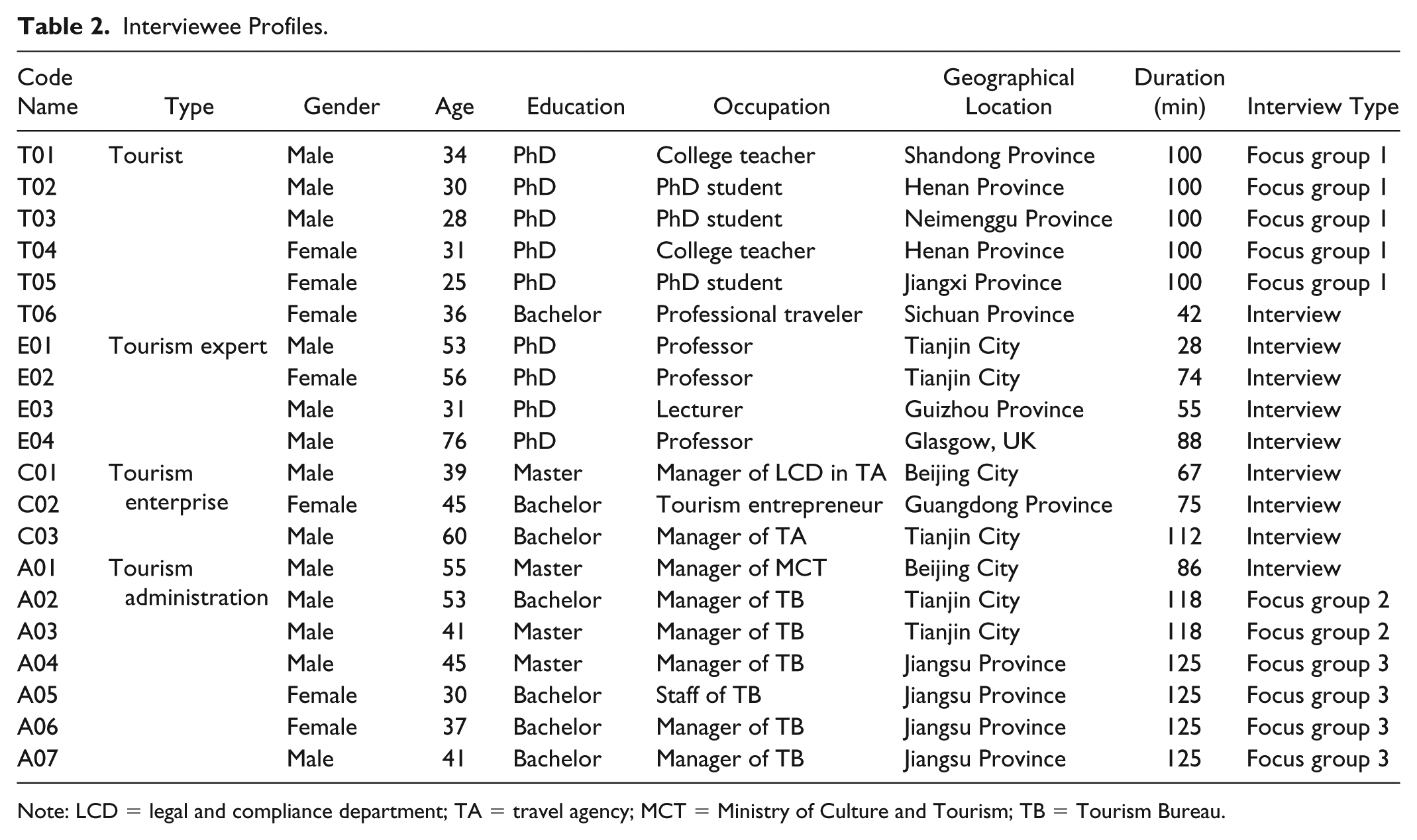
Note: LCD = legal and compliance department; TA = travel agency; MCT = Ministry of Culture and Tourism; TB = Tourism Bureau.
The interviews mainly focused on three open questions. The first question asked about the concept of TMR, including its dimensions and characteristics. The second question concerned the items the interviewees cared most about when traveling. Firstly, it is to identify problems affecting consumers in the tourism sector; secondly, to identify the regulatory response from the government through legislation; and third, to identify whether tourists were aware of the legislation and what impact it had had on their tourist activities. For instance, have they experienced any illegal activity or unethical practice? If so, how can the industry legislate and regulate against such activities or practices? The third question inquired about the interviewees’ opinions on the current situation of TMR at the destination, including their views on current problems, the internal and external causes, and regulatory response. Qualitative research data were analyzed following the approaches proposed by Holsti (1968) and Strauss (1987).
According to the scale development procedures proposed by Churchill (1979) and Rossiter (2002), TMR is defined by eliciting attributes from tourists and stakeholders. To ascertain the opinions of tourists and other stakeholders about TMR, the interview data, categories, properties, and dimensions were analyzed. The main point mentioned by the interviewees is that TMR in most countries serves to protect consumers. For instance, consumers should have the right to recover compensation for breach of contract. The following comments are enlightening: People complain of being cheated by tour operators or other service providers. If there was proper regulation of the market, then you wouldn’t have things like lawsuits or complaints over a situation. If tourists are abused by the tour operator or tour guides, there will be a mechanism to get redress against companies. (E01–male, University, China) If we want to encourage the tourism industry, we’ve got to protect our customers, the tourists. (A04–male, TB, China)
Another point extracted from the interviews is that TMR shows whether or not various market stakeholders comply with market rules. TMR requires legislations against illegal activity and self-regulation against unethical practice. Relevant comments include the following: You see, that’s hugely unethical behavior, but apparently, it’s not illegal. For instance, the tour guide turned around and said, I didn’t force them, I just told them there’s a place for the best souvenir market or supermarket. If you think of the zero commission, it’s also not illegal but really unethical. It is essential to overcome these civilian practices. (E04–male, University, UK) TMR referred to a “customer protection” and is as relevant to travel agencies as to hotels, transport, theme parks, and other attractions, covering all constituent parts of the tourism sector. TMR aimed to impose obligations on all the tourism suppliers to provide what they promise to do. (E04–male, University, UK)
On the basis of qualitative analysis of the secondary and primary data, we define TMR as follows: “Tourism market regulation is an evolving process and a state in which market rules are complied with and adjusted by various market stakeholders in the context of an institutional environment designed to protect tourists.” From the perspective of tourists, the state of TMR depends on whether stakeholders can provide compliant tourism information in the pretravel period, sign a compliant contract, fulfill tourism contracts during the travel period, and deal with tourists’ feedback in the posttravel period according to the law and market rules. From tourists’ perspective, TMR involves processive steps obtained from the tourists’ whole experience. Tourists’ travel experience depends on the services provided by various market stakeholders.
TMR Dimensions from Tourists’ Perspective
According to the open coding, axial coding, and selective coding suggested by Strauss (1987), TMR comprises five dimensions: regulatory oversight, truth in advertising, tourism contract compliance, fulfilling tourism contracts, and travel feedback processing.
Regulatory oversight is the basis for the formation of the TMR. Formal institutions, informal institutions, and implementation mechanisms constitute the institutional environment (Coase 2012; Helmke and Levitsky 2004; North 1990). Schultz (1968) defined an institution as a set of behavioral rules that define people’s behavior patterns and restrict their mutual relations. From the perspective of tourists, regulatory oversight includes whether market transactions are fair and whether regulatory authorities can ensure the tourism market is regulated and tourists’ interests are protected (Yao and Liu 2019). The government’s role is to create an enabling environment by passing legislation, including that pertaining to tourism. The government and organizations should pass regulations promoting the development of the tourism industry, including rebuilding regulations, access regulations, and regulations governing tourist services. Relevant comments about this dimension include the following: Institutions are very important because you need to know, as a tourist, that if you buy a product from one of these companies, it is guaranteed by the government or an association. It should really be a situation where the tourists’ interests are protected. Governments can legislate for that. (A01–male, MCA, China) In the UK, there are organizations such as Air Transport Operation License and Association of British Travel Agents that take away licenses from members or suspend membership regulations, which means tourists are unlikely to buy a tour from that operator because there’s no protection. (E04–male, University, UK)
Truth in advertising is an important dimension for tourists to evaluate TMR. Travels can be risky because of the intangibility of tourism products and the unfamiliarity of tourists with a new destination (Gitelson and Crompton 1983). Thus, tourists want to receive extensive compliance information (Coromina and Camprubí 2016). They usually buy products based on the information supplied by the tourism enterprises or the DMOs. Therefore, it is important to provide true tourism information and marketing publicity that do not violate laws and regulations (Yao and Hou 2017). From the interviewees’ perspective, the factors that disrupt TMR are false advertising and misleading information. As tourism transactions precede the purchased experience, previously publicized information is an important dimension for tourists to choose a travel product and judge whether the tourism market is regulated. One interviewee provided the following useful example: Let’s assume you go to London for two weeks. You book this hotel because it claimed to have a Chinese restaurant, to be located just five minutes’ walk from the underground, and to provide a shuttle from the hotel to the airport. These three things persuade you to book this hotel. When you get there, these things don’t exist, and that is not information compliance. So, Truth in advertising simply means the information that you provide to tourists is true. In the UK, we have something called the Advertising Standards Authority. You have to be very careful with the publicity brochure. (E04–male, University, UK)
Tourism contract compliance is another important dimension for evaluating TMR. As one informant mentioned: The tourism contract is what we call a meeting of two minds. One thing that determines what this means is what you promised me, and if I accept, then we agree in the contract. If you buy a tour, then that is your contract with the tour operator or whoever is selling it. The tour operator is responsible for the delivery of the tour. (C03–male, CA, China)
Especially when booking through a travel agency, the signed travel contract should clearly state the contained product and what must be self-financed. As one respondent shared: Although tourists do not always sign a formal contract when purchasing a tourism product, such as when reserving a hotel room or visiting a tourism attraction, the document provided by the hotel and signed by the tourist on arrival, which specifies the accommodation level, room specifications, check-in time, departure time, etc., is also a kind of contract. Another kind of contract is the tourist tickets purchased from a tourism attraction. (C01–male, LCD of TA, China)
Fulfilling tourism contracts is important because various businesses in the tourism market provide profit-making services according to the signed contracts. As one expert argued, If they offer you a holiday or a flight, they have to comply with what they say they’re offering, as tourists are expecting what they’ve been promised will be delivered according to the tourism contract. (E04–male, University, UK)
Therefore, whether a tourism contract is fulfilled is primarily determined by the tourists’ expectations, according to which they evaluate whether the tourism company performs its contractual obligations. This evaluation includes whether the tourism products provided are consistent with the signed contract, whether the travel services meet the service standards agreed on by both parties, and whether the tourism enterprise or service staff does not deceive the tourists and force them to consume.
Feedback, of course, might be normal if you buy something. And if negative, people really know they’ve got a problem. (T06-M, PT, China) To me, the channel of complaints provided should be unobstructed and convenient. If the relevant regulatory authorities or company can respond to my complaint within 24 hours, I am very satisfied. If they just handle it, I am satisfied already. (T05-F, Student, China)
Thus, from the perspective of tourists, travel feedback processing concerns whether regulators quickly respond to complaints, whether regulatory authorities and tourism enterprises quickly resolve complaints according to the law, whether the tourism feedback channel is unobstructed, and whether complaint-handling procedures are regulated.
Study 2: Item Generation
Churchill (1979) identified several ways to generate the initial items: literature search, experience surveys, focus groups, critical incident techniques, and insight-stimulating examples. In the present study, items were generated from the literature review and qualitative research (Churchill 1979; Hinkin, Tracey, and Enz 1997). An extensive literature review was conducted to identify items relevant to TMR. This method yielded 11 items that were subsequently adopted as items of our TMR measurement scale. (Table 3 presents the items after subsequent revisions to improve content and face validity.) Through content analysis of the interview data and detailed documents of the laws, policies, and enforcement capabilities, together with TMR dimensions from tourists’ perspective in the Conceptualization step, additional 24 items were obtained across five dimensions. The literature review and qualitative approach generated 35 items in total.
Initial Constructs and Items Evaluating Tourism Market Regulation From the Perspective of Tourists.
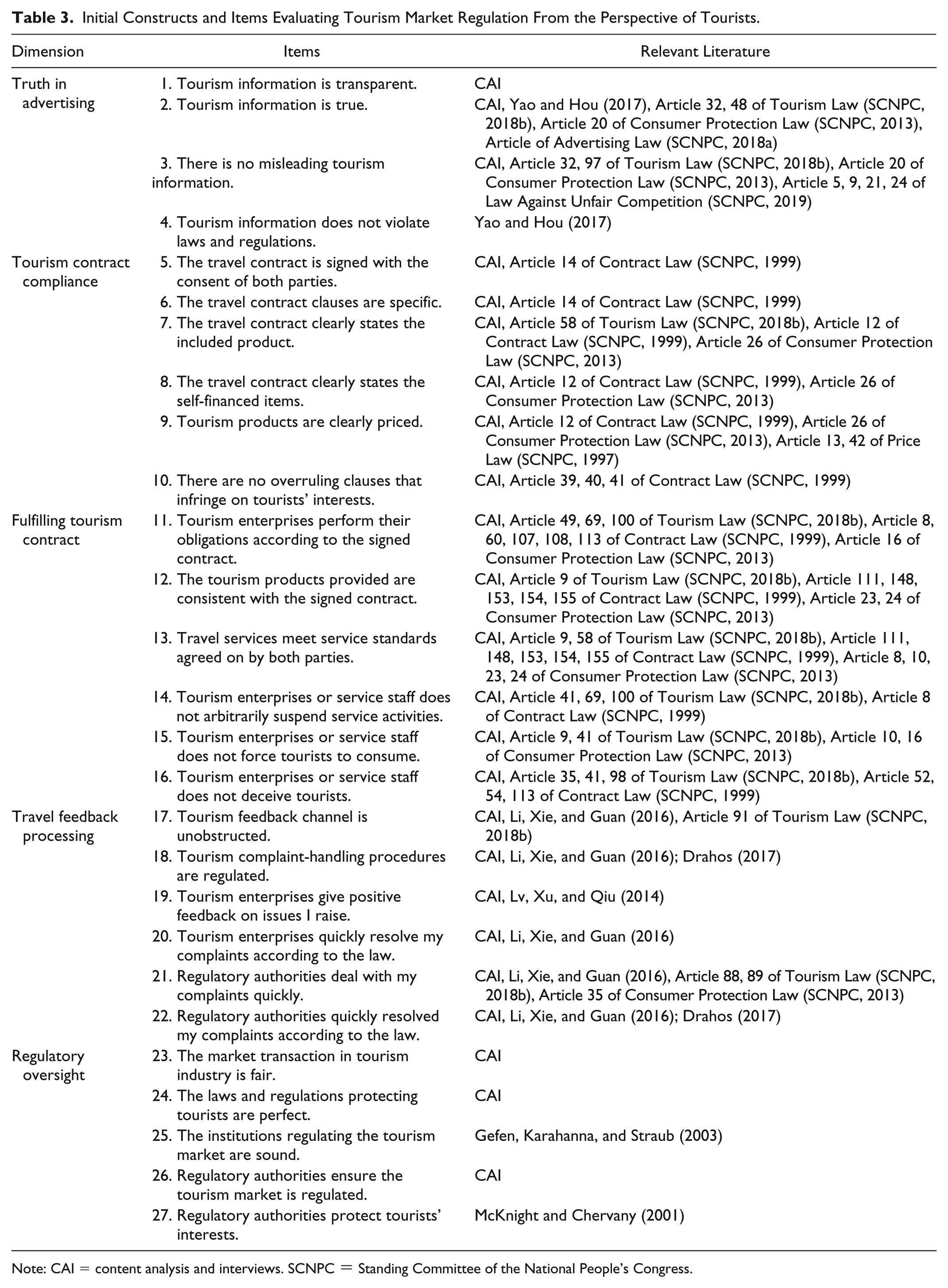
Note: CAI = content analysis and interviews. SCNPC = Standing Committee of the National People’s Congress.
Study 3: Item Purification and Content Validity
Content validity refers to the appropriateness for and consistency of the items with the measurement dimensions (Hair et al. 2010). After developing the initial items, the authors reviewed the wording and content validity to remove measurement items that did not satisfy the concept. As employed in previous scale-development research (Busser and Shulga 2018; Fetscherin and Stephano 2016; Kim et al. 2015), the most basic validity types are face and content validity (Chu and Murrmann 2006; Zikmund 1997). Ten experts were invited to examine the items with the aim of improving the content validity, specificity, clarity, conciseness, and readability of the scale (Busser and Shulga 2018; DeVellis 2012; Netemeyer, Bearden, and Sharma 2003). The experts comprised six university teachers specializing in tourism markets and four PhD candidates. Following West and Crompton (2013), the experts were asked to complete content validity tasks to derive the final scale items. For each initial item, they were asked to judge the item’s relevance to TMR and whether it can measure each dimension (using a five-point Likert scale from strongly disagree = 1 to strongly agree = 5). They were also asked to suggest additional items that would improve the scale’s simplicity and content validity. Only items with an average score of 3 or higher were retained (Fetscherin and Stephano 2016; Sharma 2009). For example, the item “tourism services personnel not asking for tips” scored below 3. Although mainland China prohibits tour guides and tour leaders from asking for tips from tourists, under the Tourism Law (Standing Committee of the National People’s Congress 2018b), this item is not appropriate for other countries. Through several rounds of discussions with the experts, 27 of the initial items were retained.
Next, a focus group of six PhD students specializing in tourism management was invited to revise the conciseness and readability of the items. The aim was to ensure that tourists would be able to clearly understand the meaning of each measurement item when completing the questionnaire. A pre-study scale was issued to a small sample to collect suggestions from tourists and modify the wording of the items accordingly before a large-scale investigation was conducted. In total, 61 questionnaires were distributed to tourists visiting the tourist attractions of Tianjin ancient cultural street, the Five Avenues, Tianjin Italian style street, Happy Valley, and water park as well as to tourists staying in hotels in Tianjin city in November 2017. The tourist respondents were mainly asked whether they could understand the items and if they had any suggestions to improve them. Several adjustments were made based on the feedback from the students and tourists to ensure that visitors would understand the meaning of each item. Finally, the validities of the 27 initial items were confirmed. Table 3 presents the 27 items in the finalized questionnaire.
Study 4: Scale Purification and Dimensionality
Sample Size and Analysis
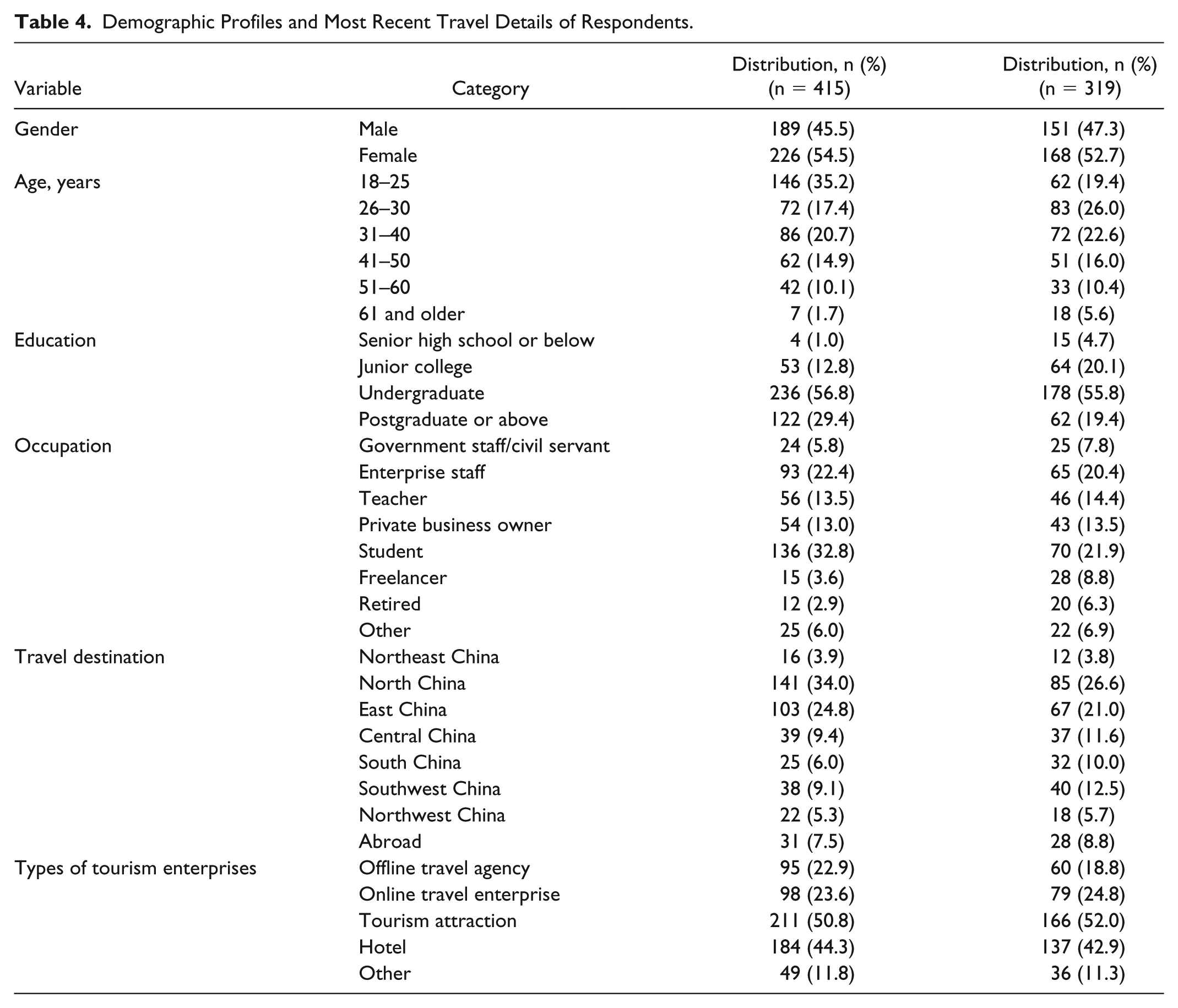
The first round of data collection yielded 415 valid questionnaires from the 500 distributed. The demographic profiles of the respondents are reported in Table 4. Females outnumbered males (54.5% vs. 45.5%), and the largest age group was 18–25 years (35.2%). Regarding education, 56.8% had an undergraduate degree, and as regards occupation, the largest group was students (32.8%), followed by enterprise staff (22.4%). The travel details report the destination the tourists last traveled to and the type of tourism enterprise that most recently provided them tourism products or services. Geographically, China’s 34 provincial-level administrative areas are divided into seven major regions: Northeast China (3, representing the number of provincial-level administrative areas in the region), North China (5), East China (8), Central China (3), South China (5), Southwest China (5), and Northwest China (5). As Table 4 shows, 34.0% of the respondents last traveled to North China.
Demographic Profiles and Most Recent Travel Details of Respondents.
Exploratory Factor Analysis
The items were generated through a qualitative approach and literature review. Hence, EFA was conducted to purify the items representing the conceptualized domain of the construct and identify the latent factor structure. Before EFA was performed, descriptive statistics, homogeneity analysis, Kaiser–Meyer–Olkin (KMO), and Bartlett’s test of sphericity (BTS) were used to determine the appropriateness of the 415 valid first-round questionnaires. First, descriptive statistics were used to test the sufficiency of discrimination in the scale. The standard deviation was above 1 for all 27 items, indicating good discrimination (Appendix C). The univariate skewness and kurtosis values all ranged near −1 to +1, indicating normality and thus appropriateness for factor analysis (Hair et al. 2010; Kline 2005). Second, homogeneity analysis was conducted using reliability statistics and item-total statistics. The Cronbach’s alpha was 0.946, higher than the recommended value of 0.7 (Nunnally 1994). Corrected item-total correlations all exceeded 0.40 (Thompson 2004), and the index “Cronbach’s alpha if item deleted” did not increase (Field 2013). These findings all demonstrated the reliability and internal consistency of the scale. Third, the KMO index was 0.940, which exceeded the threshold of 0.50 (Kaiser 1974). Bartlett’s index (approx. chi-square = 7252.495, df = 351, p < 0.000) was significant. These findings indicated that the sample had sufficient correlations to conduct factor analysis.
The principal components analysis with eigenvalues greater than 1.0 (Kaiser’s criterion) and maximum variable rotation was used in the EFA process to explore dimensionality. The aim was to specify the observed items and the assumed underlying factors. Five dimensions with eigenvalues above 1 were identified, which explained 66.78% of the total variance. Items with a factor loading below 0.50, high cross loading on another factor (>0.5), and low commonalities (<0.30) were eliminated (Hair et al. 2010). Furthermore, with the use of the index “Cronbach’s alpha if item deleted,” items were removed if deleting them raised the reliability coefficient of their dimension (Field 2013). As recommended by prior research (Kim et al. 2015; Kline 2005; Raubenheimer 2004), at least three items were retained for each dimension. The application of these criteria omitted 4 items. EFA was again conducted on the remaining 23 items. Table 5 presents the results. The KMO was 0.925 and the BTS (χ2 = 5953.20, p < 0.000) was significant. Rotation converged in six iterations, and the 23 items were classified into five factors that explained 68.93% of the total variance. Cronbach’s alpha ranged from 0.781 to 0.902 and was above the cut-off value of 0.70 (Nunnally 1994). All the indicators showed that the explored dimensions had internal consistency reliability. On the basis of the literature review and the results of the inductive approach, the five dimensions were labeled as follows: regulatory oversight (RO, five items, α = .894); fulfilling tourism contract (FTC, five items, α = .883); travel feedback processing (TFP, five items, α = .902); tourism contract compliance (TCC, four items, α = .781); and truth in advertising (TIA, four items, α = .801).
Exploratory Factor Analysis Results for Tourism Market Regulation (N = 415).
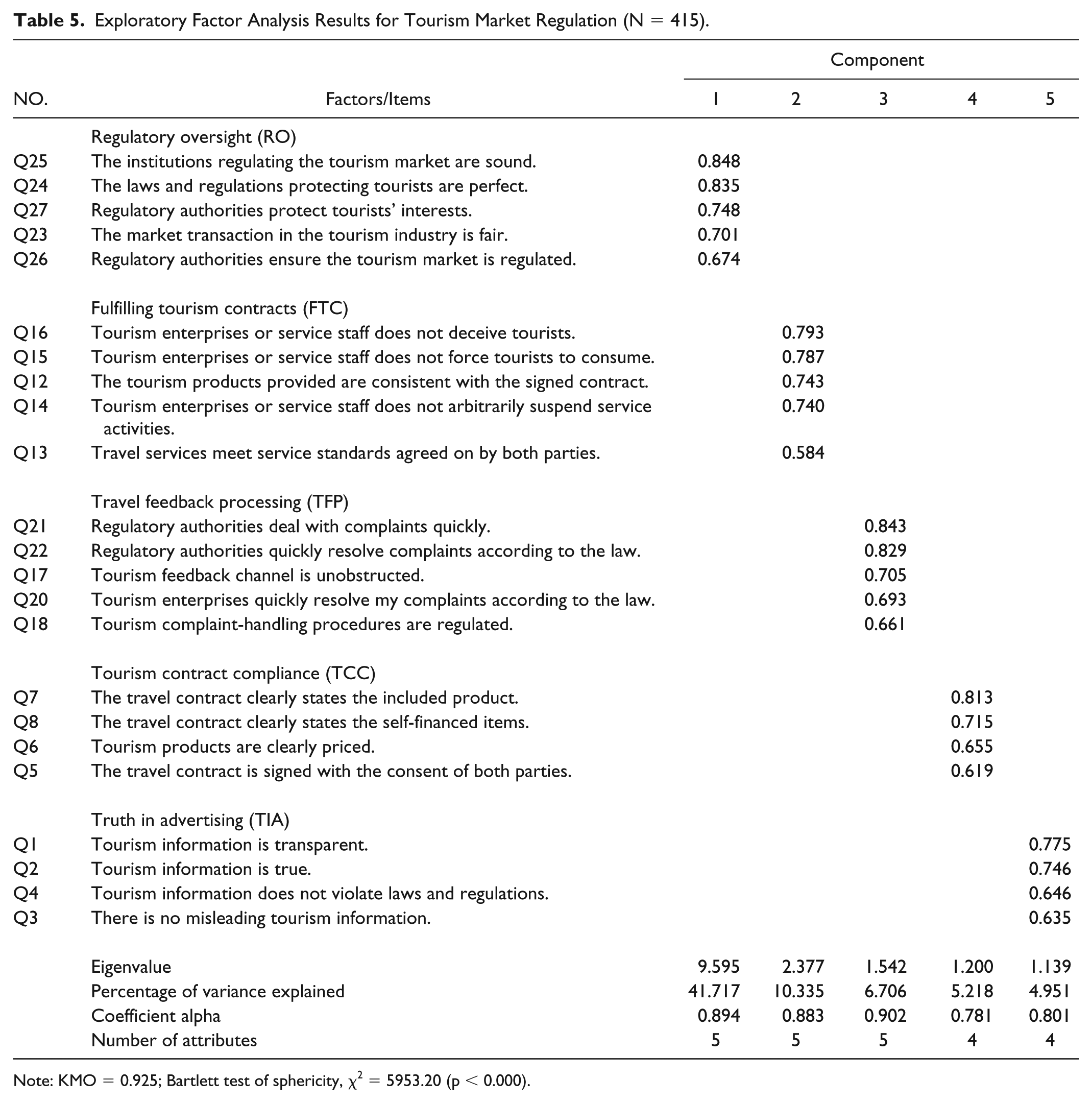
Note: KMO = 0.925; Bartlett test of sphericity, χ2 = 5953.20 (p < 0.000).
Study 5: Scale Validation
Sample Size and Analysis
CFA was conducted to further validate the underlying structure and confirm the dimensionality of the scale. Factor analysis can be approached in two ways. One is to randomly split a data sample into two convenience subsamples for EFA and CFA, as demonstrated in previous scale-development research (e.g., Busser and Shulga 2018; Chen, Bao, and Huang 2014; Wang, Hung, and Li 2018). The other, which Churchill (1979) recommended, is to explore dimensionality with the first round of data and then collect and analyze a new data sample with the purified questionnaire. As a means of assessing reliability and construct validity, this second approach has been widely used to develop improved measures (e.g., Chu and Murrmann 2006; Fetscherin and Stephano 2016; Liu et al. 2017; Wen et al. 2018). The current study followed Churchill’s recommendation, which yielded 319 valid questionnaires from the 400 distributed (Appendix B). The item ratio was 13.9:1, higher than the standard 10:1 (Hair et al. 2010; Kline 2005; Nunnally 1994).
The demographic profiles and most-recent travel details of the respondents are shown in Table 4. Females slightly outnumbered males (52.7% vs. 47.3%, respectively). The largest age group was 26–30 years (26.0%), and the majority of participants had an undergraduate degree (55.8%). Regarding occupation, the largest group was students (21.9%), followed by enterprise staff (20.4%). The destinations the tourists last traveled to were distributed among all 34 provincial-level administrative areas and abroad. The standard deviation was above 1 for all 23 items. The univariate skewness and kurtosis values ranged from −1 to +1, except the item “the travel contract is signed with the consent of both parties” (Appendix D), which did not range outside −3 to +3. The results confirmed the appropriateness of factor analysis (Hair et al. 2010; Kline 2005).
Confirmatory Factor Analyses
The 319 valid responses were analyzed with CFA using AMOS 24.0 to assess the model’s reliability and validity. Specifically, the analysis aimed to establish whether TMR can be effectively measured through regulatory oversight, truth in advertising, tourism contract compliance, fulfilling tourism contracts, and travel feedback processing. The model was statistically evaluated by several goodness-of-fit statistics, including chi-squared to degrees of freedom ratio (χ²/df), comparative fit index (CFI > 0.90), incremental fit index (IFI > 0.90), Tucker–Lewis index (TLI > 0.90), and root mean square error of approximation (RMSEA < 0.08) (Busser and Shulga 2018; Hair et al. 2010). The results were as follows: χ2 = 592.932, df = 220, χ2/df = 2.695, CFI = 0.908, IFI = 0.909, TLI = 0.894, and RMSEA = 0.073. The modification indices and covariances reveal that three items were omitted because of high error and Modification I ndices (M.I.) with other items: “travel services meet service standards agreed by both parties,” “tourism complaints handling procedures are regulated,” and “the travel contract is signed with the consent of both parties.” The goodness-of-fit statistics were as follows: χ2 = 352.750, df = 160 χ2/df = 2.205, CFI = 0.943, IFI = 0.944, TLI = 0.932, and RMSEA = 0.062. These findings indicate that the five-factor structural model with 20 items has better-fitting degree than the model with 23 items.
Reliability refers to the degree of consistency of the results when the same object is repeatedly measured (Hair et al. 2010). Cronbach’s alpha and CR were used to test the scale’s internal consistency. CR concerns the internal consistency of a composite factor comprising more than one item (Fornell and Larcker 1981). Cronbach’s alpha for each of the five dimensions ranged between 0.738 and 0.887, while the CR of the five latent variables was between 0.748 and 0.898 (Table 6), therefore exceeding the cut-off value of 0.6 (Bagozzi and Yi 1988).
Confirmatory Factor Analysis Results for the Final Model of Tourism Market Regulation (N = 319).
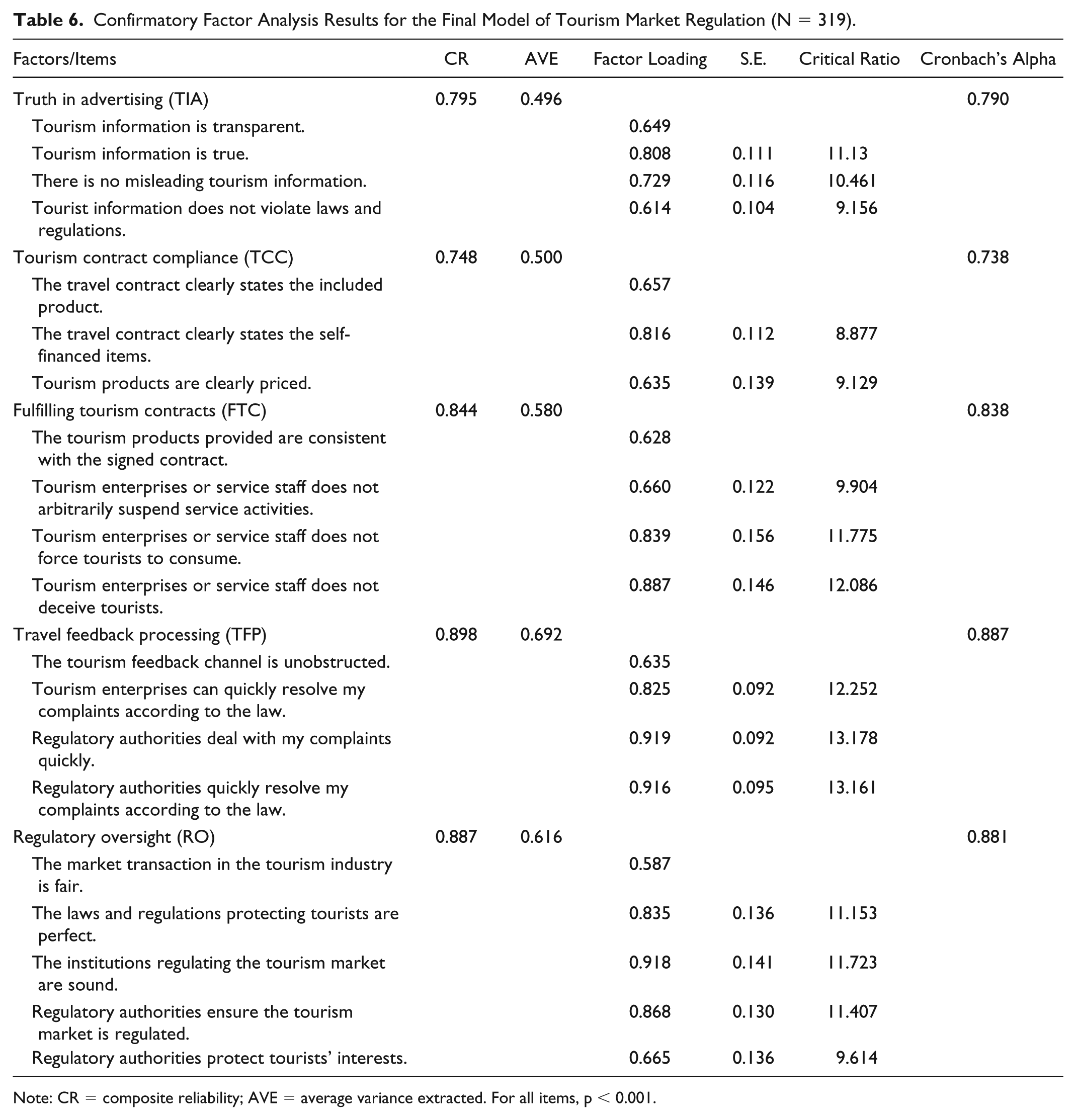
Note: CR = composite reliability; AVE = average variance extracted. For all items, p < 0.001.
Convergent validity was evaluated by calculating the factor loadings of all the items (FL > 0.5) (Hair et al. 2010) and the average variance extracted (AVE > 0.50) (Fornell and Larcker 1981). Table 6 shows that all items had significant loadings between 0.587 and 0.919, thus exceeding the criterion of 0.5. The AVE of the five dimensions ranged between 0.496 and 0.692, higher than the 0.45 threshold of a newly development scale recommended by Netemeyer, Bearden, and Sharma (2003). Overall, the scale is considered to have good convergent validity between the constructs.
Discriminant validity refers to the low correlation or significant difference between the potential dimension and the other dimensions (Hair et al. 2010). If the square root of the AVE value is higher than the correlation coefficient among the constructs, then good discriminant validity is indicated (Fornell and Larcker 1981). Kline (2005) also recommended that the correlation coefficient between constructs should not exceed 0.85. As shown in Table 7, the differences in the chi-squared values among the various dimensions all reach a significant level. The correlation coefficients of the five latent variables range from 0.214 to 0.670, less than the square root of the AVE value of the five dimensions. The correlations between the constructs were all below 0.85. Thus, all the indicators showed good discriminant validity. Furthermore, the normalized regression coefficients for the five factors were significant at p < 0.001, indicating that the five factors can effectively measure TMR with nomological validity.
Correlations and Square Roots of Average Variance Extracted (AVE) (N = 319).
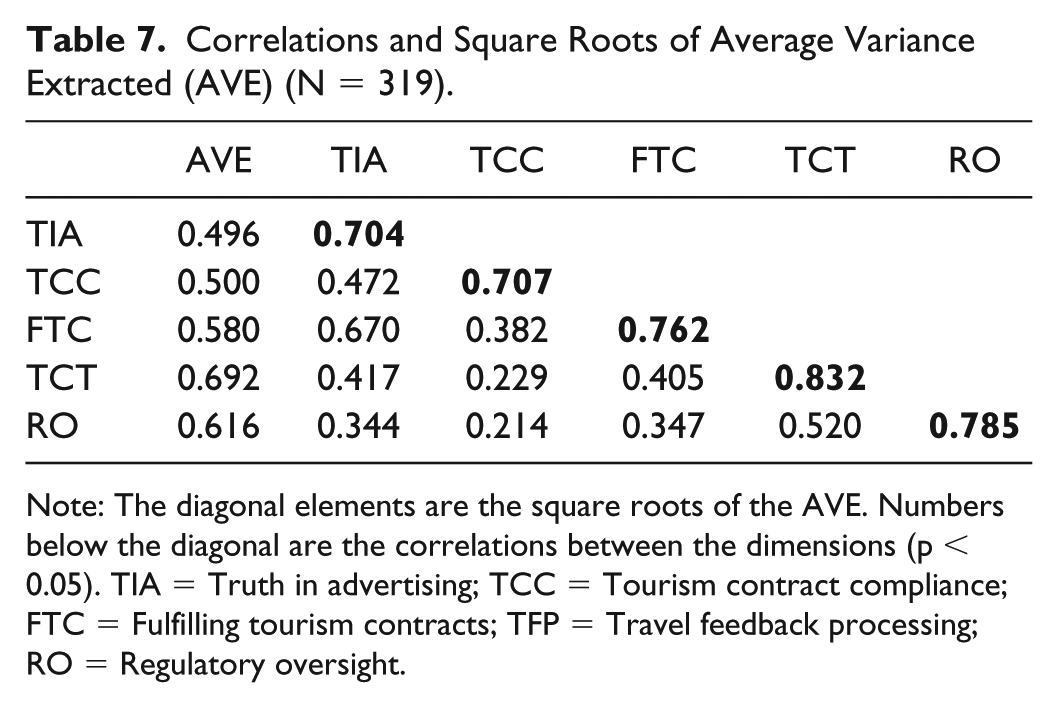
Note: The diagonal elements are the square roots of the AVE. Numbers below the diagonal are the correlations between the dimensions (p < 0.05). TIA = Truth in advertising; TCC = Tourism contract compliance; FTC = Fulfilling tourism contracts; TFP = Travel feedback processing; RO = Regulatory oversight.
Discussion and Implications
Despite the rapid growth of China’s tourism market and the increasing importance of TMR to protect tourists, great ambiguity still surrounds the conceptualization of TMR and how it should be measured. This study developed a set of standards to evaluate TMR to protect the rights of tourists and preserve the ethical integrity of the industry. The generated scale covers illegal practices and unethical behaviors, both of which impact the experience and overall satisfaction of tourists. This study developed a measurement scale to monitor these two parts.
The theoretical implications are summarized as follows. First, this study provides a theoretical framework for TMR, which is a multi-dimensional concept. Second, from the perspective of tourists, this study delineates the conceptual domain of TMR by identifying five dimensions. Regulatory oversight is the most important dimension because the institutional environment is the foundation for reflecting on whether the tourism market is regulated (Coase 2012; North 1990; Williamson 1996). The following dimension tourists care the most about is fulfilling tourism contracts, for if every company can comply with the contract to deliver products and services, then the tourism market will be well regulated. The other dimensions are travel feedback processing, tourism contract compliance, and truth in advertising. In the pretravel period, truth in advertising is an important dimension because tourists always acquire and select information at different stages of their decision-making before starting a journey (Coromina and Camprubí 2016; Fodness and Murray 1999; Gitelson and Crompton 1983). As Sirakaya and Woodside (2005) state, “a tourist is expected to be highly involved in the information search for tourism service purchases compared to many other product or service purchases, because of unfamiliarity and high-perceived risk.” Therefore, tourism information should be transparent, true, and should not violate laws or regulations. The other dimensions are tourism contract compliance and fulfilling tourism contracts in the travel period and travel feedback processing in the posttravel period. From the perspective of tourists, these dimensions of TMR are sequential. Third, the present study is the first attempt to develop a measurement scale of TMR from the perspective of tourists. Tourists tend to have the best insight on the extent to which a tourism market is regulated, and they can evaluate TMR according to their travel experiences. Thus, this study provides a new research perspective and a reliable measurement tool for follow-up empirical research and enactment of legislation to address deficiencies in laws affecting tourism activity. It also provides theoretical foundations for the in-depth study of TMR in China and other destinations.
The conceptualization of TMR and the TMR measurement scale also have valuable practical implications. A disordered tourism market has become a serious obstacle to the healthy development of the tourism industry, especially in developing countries such as China. This problem necessitates research into the concept of TMR and its subcomponents. The multidimensional TMR scale proposed herein is a useful tool for tourists, DMOs, and other stakeholders to measure and govern TMR. First, for tourists, the scale can provide information on TMR when they select and compare tourism products according to the standard of the items. The scale can be used to assess the perceived order of the tourism market before, during, and after traveling. For tour operators or other tourism enterprises, soliciting such information from tourists can help them identify what improvements are needed. They can use the scale in their training menu, such as employee training rules and employee performance appraisal, among other aspects. They can self-regulate and cultivate informal institutions to ensure product quality and further improve market competitiveness. For tourism administration and DMOs, soliciting such information from tourists can help them measure the status of TMR in destinations within their jurisdiction, enabling them to identify what regulations are needed to regulate the market. Second, the conceptualization identifies that the status of institutions and the compliance with the rules of market stakeholders are key criteria for determining the status of TMR. Therefore, these standards should be used to measure and govern TMR. Third, tourism administrations and DMOs can consider putting the items into laws and regulations. For example, regarding regulatory oversight, as the immaturity of the market environment is a main reason for the lack of regulation in China’s tourism market (Du 2012), tourism administrations and DMOs should cooperate to perfect the formal institutions, informal institutions, and implementation mechanisms for creating a fair institutional environment. The government needs to upgrade the relevant laws and regulations in the tourism industry and provide more detailed clauses for improved implementation of the laws.
Conclusion and Limitations
This study refined the domain of TMR and developed a measurement scale of TMR from the perspective of tourists by using a mixed-method and multi-step procedure. Qualitative research, including interviews and focus groups, was conducted to provide a clear definition of TMR and its sub-components. Face and content validity tests were performed to purify the items, thereby finalizing the 27 items for the questionnaire. Through the quantitative approach, EFA and CFA were used with two rounds of data, 20 items across five dimensions were verified with satisfactory reliability and validity. The extracted dimensions of TMR from the perspective of tourists included regulatory oversight, truth in advertising, tourism contract compliance, fulfilling tourism contract, and travel feedback processing.
Although this research provides timely theoretical contributions for TMR and practical implications for the tourism market, it has several limitations. First, even with all the data collected in China, cross-cultural reliability and validity (Knight 1997) were not tested in this study (Liu et al. 2017). To further validate the scale, future research could replicate the current study using data from other cultural contexts. With a specific focus on China, it is our intention in follow-up research to examine and compare the Chinese position with selected tourist-receiving countries and identify gaps in tourism consumer protection regulations and recommend where further action may be needed to improve coverage in China. Second, this study only explores measurements of TMR from the perspective of tourists. Future research can further develop the measurement scale by considering the perspectives of other stakeholders (e.g., tourism enterprises, DMOs, etc.), thereby enriching TMR research. Third, this study develops the items from the perspective of tourists by following Hayek’s Sensory Order, according to which market regulation can be perceived by consumers. We acknowledge that some measurement items may be difficult for tourists to make an informed response, for example, “the laws and regulations protecting tourists are perfect” and “the institutions regulating the tourism market are sound.” Future research can be considered to further refine the survey instruments. Additionally, the influence of TMR on tourists’ behavior and psychological outcomes, including first-time travel intention, willingness to travel again, and destination loyalty, can be investigated. Another study could examine on a compare and contrast basis China’s existing tourism market regulations with other countries to discern discrepancies in coverage and recommend further improvements.
Supplemental Material
Supplementary_file – Supplemental material for Evaluating Tourism Market Regulation from Tourists’ Perspective: Scale Development and Validation
Supplemental material, Supplementary_file for Evaluating Tourism Market Regulation from Tourists’ Perspective: Scale Development and Validation by Yixue Liu, Yanbo Yao and Daisy X.F. Fan in Journal of Travel Research
Footnotes
Acknowledgements
I wish to express my special appreciation to Prof. Hanqin Qiu for her encouragement and invaluable guidance, and to Prof. Carson L. Jenkins, special expert to International Tourism and tourism policy, for his thoughtful and constructive comments on this manuscript. Thanks to all the informants and interviewees who kindly spent time in sharing their invaluable views on the research topic. Furthermore, I’d like to express my sincere gratitude to the editor, Prof. Geoffrey Crouch, and the three anonymous reviewers for all the constructive feedbacks and insightful comments that have substantially improved this paper. This empirical research of tourism market regulation was based on extensive longitudinal research and fieldwork, conducted as a part of my PhD dissertation.
Declaration of Conflicting Interests
The author(s) declared no potential conflicts of interest with respect to the research, authorship, and/or publication of this article.
Funding
The author(s) disclosed receipt of the following financial support for the research, authorship, and/or publication of this article: Grants from the National Social Science Foundation of China (No. 17BGL121), key Research Support Program for Professional Postgraduates from Ministry of Culture and Tourism, Postgraduates Innovation Improvement Project of Nankai University (No. A080).

Supplemental Material
Supplemental material for this article is available online.
Author Biographies
References
Supplementary Material
Please find the following supplemental material available below.
For Open Access articles published under a Creative Commons License, all supplemental material carries the same license as the article it is associated with.
For non-Open Access articles published, all supplemental material carries a non-exclusive license, and permission requests for re-use of supplemental material or any part of supplemental material shall be sent directly to the copyright owner as specified in the copyright notice associated with the article.
