




Abstract
Underpinned by complexity theory, this study investigates whether the influence of social and physical servicescape on international travelers’ dissatisfaction and misbehavior differs between two characteristically different international airports in Iran. Partial least squares (PLS) and multi-group analysis (MGA) were employed to test the conceptual model. The results revealed significant differences between the effects of physical servicescape on travelers’ dissatisfaction and misbehavior across both airports. However, the results did not support any differences between the effects of social servicescape on travelers’ dissatisfaction and misbehavior between both airports. Additionally, using fuzzy-set qualitative comparative analysis (fsQCA), this study identified multiple configurations of physical and social servicescape dimensions leading to traveler dissatisfaction and misbehavior. In doing so, the results highlighted the conditions leading to low traveler dissatisfaction and misbehavior scores, confirming the applicability of complexity theory in explaining international traveler behavior in airports, providing implications and directions for future research in the process.
Keywords
Introduction
The travel sector has boasted virtually uninterrupted recent growth, with worldwide international tourist arrivals increasing from 674 million (2000) to 1.2 billion (2016) in less than two decades. Air transport has grown at a faster pace than surface transport, with more than half (55%) of all overnight visitors now traveling to their destination by air (UNWTO 2017). According to Clarkson (2015), the 20 busiest international airports moved more than 700 million travelers in 2014. Travelers therefore share the environment with others, which can lead to misbehavior, with verbal aggression and physical violence witnessed in airports across the world (Moody 2017). In some instances, faced with poor service, dissatisfied travelers damaged computers and furniture and fought with law enforcement (Blanchard 2008). Long lines at security gates, delays in baggage reclaim, frustration at poorly explained flight delays, and abrupt diversions and cancellations remain the most prominent reasons for traveler dissatisfaction at airports, resulting in deliberate acts of misbehavior (SKYTRAX 2016). To this end, the International Air Transport Association (IATA) annually receives around 10,000 serious complaints worldwide pertaining to unruly travelers (Hunter 2016).
Yet, customer satisfaction and behavior are shaped by the evaluation of various service attributes. Herzberg (1996) proposed “satisfaction” and “dissatisfaction” as conflicting constructs, with customer misbehavior typified by its physical, psychological, and financial cost to service providers, staff, and other customers (Daunt and Harris 2012). Nonetheless, few studies have examined the antecedents of customer misbehavior in distinct contexts (e.g., international airports) that provide various services to travelers. Ferguson and Johnston (2011) synthesized extant customer (dis)satisfaction response behaviors and stated that there are opportunities to extend customer (dis)satisfaction literature. As such, theoretical and methodological advances can enhance existing knowledge of traveler behavior in international airports within developing countries.
Nonetheless, limited attention has been given to the service characteristics of airports in influencing misbehavior (Prather and Steele 2015). As identified by Olya and Al-ansi (2018), travelers typically consider multiple criteria before taking any action, indicating the complexity of their behaviors. As such, they argued that complexity theory can explain combinations of predictors (i.e., causal recipes) that can stimulate desired behaviors in travelers. Thus, this study aims to comprehensively evaluate the influence of servicescape dimensions on travelers’ dissatisfaction and misbehavior at two international airports with dissimilar characteristics. It applied complexity theory to support the development of structural and configurational models, indicating traveler behaviors and servicescape elements therein. In doing so, it is believed the study contributes theoretically, methodologically, and contextually to extant knowledge of travelers’ behavioral responses to service environment characteristics by investigating the following:
Question 1: What servicescape factors affect traveler dissatisfaction and misbehavior in two Iranian international airports?
Question 2: Do the effects of servicescape factors on dissatisfaction and misbehavior differ across two Iranian international airports?
Question 3: How do combinations of physical and social servicescape characteristics explain conditions leading to dissatisfaction and misbehavior?
Question 4: What are the necessary conditions to achieve low traveler dissatisfaction and misbehavior scores in two Iranian airports?
Literature Review
Physical Servicescape
Mari and Poggesi (2013) suggested that the terms atmospherics and servicescape can be used to describe physical service environments. Kotler (1973, p. 50) considered atmospherics as “the design of buying environments to produce specific emotional effects in the buyer that enhance his/her purchase probability,” whereas Bitner (1992, p. 58) defined servicescape as “the man-made physical environment where service products are delivered.” Physical servicescapes have been operationalized as being composed of two elements, layout and atmosphere, which can contribute to customer perceptions of quality (Dong and Siu 2013). These can be both tangible and intangible, and significant in captive settings, where satisfaction stems from the service environment’s functional characteristics (Ali, Kim, and Ryu 2016). Various on-site elements can influence satisfaction, including accessibility, cleanliness, comfort, food availability, ease of parking, signage clarity, and the quality of restrooms (Getz, O’Neill, and Carlsen 2001; Yalinay et al. 2018). Physical servicescape quality has been found to be influenced by customers’ responses to layout, where a clear and easy-to-follow layout can hold principal value (Lee et al. 2014). Logistic considerations, such as perspicuous signage and comprehensible queuing instructions, can also stimulate satisfaction (Jensen, Li, and Uysal 2017), particularly within an airport setting where the scope, accessibility, and accuracy of terminal information are important (Brida, Moreno-Izquierdo, and Zapata-Aguirre 2016).
Further, aesthetic aspects of servicescape design can improve customer satisfaction (Hosany and Witham 2010). Hence, furniture, interior design, and the general attractiveness of a space have been found to influence customer perceptions of its quality (Alfakhri, Nicholson, and Harness 2018). In airports, these elements should reinforce the “identity” of the airport, where compatibility between design elements and services provided can satisfy travelers (Mattila and Wirtz 2001). Atmosphere has also been found to be important, where ambience, scent, lighting, and music can contribute to how pleasing visitors consider the servicescape (Harris and Ezeh 2008). Successful servicescapes can help to stimulate congruence among these elements by carefully designing them to complement each other (Mattila and Wirtz 2001). When coupled with the functional and aesthetic elements of servicescape design, atmosphere has been found to contribute to customers’ perceptions of service quality (Reimer and Kuehn 2005).
Social Servicescape
The service environment does not exist in isolation, and social considerations can contribute to perceptions of quality. These are primarily concerned with how consumers identify and respond to others’ behaviors (Grove and Fisk 1997). In tourism, this social environment typically comprises fellow travelers and employees (Choo and Petrick 2014) and is important as travelers seek environments that encourage socialization and provide opportunities for interaction (Gannon et al. 2017; Sheng, Simpson, and Siguaw 2017). Individuals are more likely to respond positively when their interactions with fellow travelers are positive (Grove and Fisk 1997), which can intensify their satisfaction and loyalty (Lee et al. 2014). However, the behavior of others and the quality of customer-to-customer interactions can significantly detract from satisfaction and relaxation (Getz, O’Neill, and Carlsen 2001), as it can exacerbate dissatisfaction with irksome activities such as queuing (Grove and Fisk 1997).
As conduct is influenced by the behavior of others, servicescapes can be designed to amplify this by providing opportunities for positive social interactions (Colm, Ordanini, and Parasuraman 2017). Yet, contextual norms have been found to be important in servicescape evaluation (Hanks, Line, and Kim 2017), and the captive nature of the airport environment may fuel a greater number of customer-customer interactions (Ali, Kim, and Ryu 2016). While these interactions are generally encouraged (Colm, Ordanini, and Parasuraman 2017), the airport’s transient nature may result in a greater degree of misbehavior because of a perceived lack of responsibility (Grove and Fisk 1997), which may dissatisfy other travelers (Reynolds and Harris 2009).
Further, customer–staff interactions can influence servicescape evaluations (Jensen, Li, and Uysal 2017). Employees’ attitudes, enthusiasm, and communication style have also been found to be important in shaping perceptions of service environment quality (Reimer and Kuehn 2005). The helpfulness of staff can hence contribute to satisfaction, where there is an expectation that customer needs and issues should be addressed professionally (Harris and Ezeh 2008). Staff behavior can also influence customers’ cognitive experience (Woo and Jun 2017), and satisfaction with staff performance, behavior, and perceived competence can engender loyalty and trust (Harris and Ezeh 2008).
Together, the physical and social servicescape can contribute to perceived service environment quality (Grove and Fisk 1997). However, within the airport context there is another paramount consideration—the perceived security of the environment (Getz, O’Neill, and Carlsen 2001). Considerations surrounding how security-conscious the airport appears and how it deals with unruly travelers can contribute to perceptions of airport vulnerability (Daunt and Harris 2012). The physical and social elements of the airport service environment can also be influenced by employees. If staff project notions of safety, this may improve customers’ perceptions of the airport servicescape, increasing their satisfaction with regard to airport security (Brida, Moreno-Izquierdo, and Zapata-Aguirre 2016; Osman, Johns, and Lugosi 2014).
Dissatisfaction
Kano et al. (1984) postulated that various service attributes can influence customer satisfaction. However, the absence of these attributes does not necessarily lead to dissatisfaction. Ferguson and Johnston (2011) synthesized customer (dis)satisfaction response behaviors and suggested that there are opportunities to extend existing customer (dis)satisfaction literature. Prior studies have largely focused on (dis)satisfaction antecedents (expectations, performance, affect, and equity), whereas few have emphasized the consequences of (dis)satisfaction (Kim, Kim, and Yoonjoung 2019).
Service environment dissatisfaction has also been found to be contingent on customers’ evaluation of each element of the servicescape, individually and in totality (Reynolds and Harris 2009). It can be born from unmet expectations, where customers feel underwhelmed by either the physical or social elements of the servicescape. Basic provisions such as food and comfort can also drive satisfaction, and insufficient quality in this regard can have a significant impact on customer experiences and loyalty (Ali, Kim, and Ryu 2016). Further, functional elements of the servicescape can also contribute to dissatisfaction, where poor signage, uncleanliness, and a lack of information can displease customers (Reynolds and Harris 2009). Dissatisfaction can also be derived from social interactions with fellow customers (Sheng et al. 2017), or from customers’ perceptions of their dealings with employees (Bitner 1992). Various staff-related aspects have also been found to contribute to dissatisfaction, contingent on how unfriendly or unhelpful customers perceive staff to be; whether customers feel staff lack competence or knowledge; and staff availability at times of need (Getz, O’Neill, and Carlsen 2001). As such, dissatisfaction born from the social servicescape can serve as a key stimulant of customer misbehavior (Reynolds and Harris 2009).
Traveler Misbehavior
While satisfaction has been found to stimulate positive behaviors, dissatisfaction often engenders negative behaviors, including complaints, negative word of mouth, and misbehavior (Daunt and Harris 2012; Go and Kim 2008; Tsaur, Cheng, and Hong 2019). To this end, customer dissatisfaction can impact service providers significantly more than satisfaction. Hoffman and Chung (1999) suggested that while 38% of satisfied customers share their positive experiences, 75% of dissatisfied customers engage in negative word of mouth, reinforcing the importance of understanding the antecedents and consequences of customer dissatisfaction. Most consumer behavior literature assumes that customers behave in a normative and functional manner during service exchanges (Daunt and Harris 2012). This contrasts with emergent literature showcasing customers’ routine activities in an alternate light (Reynolds and Harris 2009), where their own actions (not those of the service provider) are presented as the source of service failures and consequent dissatisfaction (Zourrig, Chebat, and Toffoli 2009).
Consumer misbehavior has been defined as “behavioral acts by consumers, which violate the generally accepted norms of conduct in consumption situations, and thus disrupt the consumption order” (Fullerton and Punj 2004, p. 1239). This not only includes acts that are intentional, but also those performed unintentionally out of an ignorance of norms or in response to the deviant behavior of others. Misbehavior occurs frequently, with severe consequences for employees, fellow customers, and organizations (Ro 2015). It emerges in a number of ways and can be active or passive. Passive misbehavior is typically inward-focused, including actions such as failing to tell an employee when a mistake has been made in the recipient’s favor (Daunt and Harris 2012). The impact of this misbehavior does not typically extend beyond the parties directly involved (Go and Kim 2008; Tsaur, Cheng, and Hong 2019). Conversely, active misbehavior is more egregious (Reynolds and Harris 2009), and includes vandalism, physical violence, theft, and extreme discourtesy (Daunt and Harris 2012). This is more conspicuous and likely to have a greater impact on others within the servicescape (Reynolds and Harris 2009).
Therefore, consumer misbehavior can be stimulated by dissatisfaction with elements of the servicescape (Reynolds and Harris 2009). As consumer experiences can be influenced by the behavior of others (Colm, Ordanini, and Parasuraman 2017), misbehavior may be driven by social factors, such as the conduct of fellow customers (Grove and Fisk 1997), or in response to the perceived ineptitude or unhelpfulness of staff (Daunt and Harris 2014). This may be exacerbated due to the captive nature of the airport setting, where individuals are more likely to intermingle and interact, often not through choice (Ali, Kim, and Ryu 2016), and therefore poorly designed airport servicescapes may engender misbehavior (Colm, Ordanini, and Parasuraman 2017). Further, the transient nature of the airport servicescape may also result in a lack of individual accountability, due to being “out-of-town,” which may increase misbehavior (Grove and Fisk 1997).
Conversely, the airport servicescape may reduce traveler misbehavior, as increased security, lack of escape routes, and social expectations can produce a physical environment with diminished opportunities for extreme misbehavior (Daunt and Greer 2015). Nonetheless, functional considerations such as longer lines at security, delays in baggage reclaim, flight delays with insufficient information provided by airlines, and cancellations can contribute to traveler dissatisfaction at airports, possibly leading to deliberate acts of misbehavior (SKYTRAX 2016). Traveler misbehavior can lead to service disruption in the travel, hospitality, and tourism context, with reports attributing fights, vandalism, and deliberate damage within the airport setting to traveler dissatisfaction with flight delays and cancellations (Go and Kim 2008; Harris and Reynolds 2004; Tsaur, Cheng, and Hong 2019).
Theory and Conceptual Model
Consistent with the above, this study uses “servicescape” to describe the physical and social components of the service encounter which together characterize the service environment. The impact of the service environment on customer experience has been discussed within environmental psychology and marketing literature (Bitner 1992; Mari and Poggesi 2013). Mehrabian and Russell (1974) suggested that environmental psychology theory can be used to understand the sequential interactions between environmental stimulus, emotional states, and response. Environmental stimulus includes physical (layout, atmosphere, physical environment) and social (fellow customers, employee service, and vulnerability) servicescape. This suggests that servicescape can influence customer evaluations (satisfaction/dissatisfaction) and affect their behavioral responses (misbehavior).
Several studies have adopted Bitner’s (1992) concept to explore the effects of servicescape on dissatisfaction and consumer behavior (cf. Daunt and Greer 2015; Daunt and Harris 2012, 2014; Ferguson and Johnston 2011). However, it can be argued that past methods have been insufficient in explaining the complex process of traveler behavior influenced by environmental conditions. This study therefore draws on “complexity theory” to evaluate the influence of servicescape on traveler misbehavior. Complexity theory has been used in various subdisciplines of social sciences including hospitality and tourism, and marketing (cf. Olya and Mehran 2017; Ragin 2008; Urry 2005; Woodside 2014). It posits that a combination of antecedents, not a net effect of a single factor, can be used as a causal solution for indicating complex social phenomena. Complexity theory can explain complex causal relationships, and the outcomes of these relationships are often influenced by many causal factors (Woodside 2017). As such, combinations of causal factors can lead to a specific outcome and the same causal factor may have different (possibly even contrasting) effects depending on the context (Ragin 2008; Stacey, Griffin, and Shaw 2000). Accordingly, the same cause can produce different effects (i.e., there is a nonlinear relationship between variables) (Urry 2005).
Complexity theory can help to describe the nonlinear, heterogonous, and dynamic interaction between antecedents/motivations and the attitudinal/behavioral responses of travelers (Woodside 2017). This study contends that the relationship between servicescape dimensions and traveler responses is a complex adaptive system composed of a wide range of antecedents, which vary based on the needs, preferences, and demands of the individual (Ragin 2008; Urry 2005). For example, Grove and Fisk (1997) found that meeting the requirements for social servicescape may not necessarily lead to desired customer behaviors. This heterogeneity can be explained by a tenet of complexity theory (recipe principle), which argues that a set combination of factors (not the net effect of one factor) can describe complex conditions leading to an outcome (Stacey, Griffin, and Shaw 2000), thus acknowledging “that no simple condition is the cause of an outcome of interest” (Wu et al. 2014, p. 1666).
Further, the role of each predictor can be defined based on the attributes of other predictors. Each factor may play a positive or negative role in predicting a given outcome, and this depends on the features of other predictors (Olya, Shahmirzdi, and Alipour 2019). For example, airport atmosphere may contribute to travelers’ dissatisfaction either positively or negatively. The positive/negative effect of atmosphere can be determined by the attributes of the other indicators (e.g., environment quality) in the causal recipe. Complexity theory postulates that alternative causal models can explain conditions resulting in expected outcomes. This tenet (equifinality principle) offers a pragmatic insight into complex phenomena by covering the views of individuals, including contrarian cases, with different perceptions. For instance, a group of travelers may believe the lack of specific physical servicescape aspects led to their dissatisfaction and misbehavior, while other groups may believe that the physical servicescape was satisfactory, and instead the low quality of the social servicescape led to the above undesired outcomes.
As such, traveler attitudes and behaviors in airports are nuanced, and complexity theory can be used to understand the nonlinear interactions of servicescape components and traveler behaviors in this context (Pappas and Papatheodorou 2017). The complexity of associating servicescape dimensions in international airports with traveler behavior is derived from their inherent self-service, remote, and interpersonal characteristics. As travelers can compare servicescapes with those previously visited, this study suggests that the formulation process of international traveler behaviors based on airport servicescapes is likely to be dynamic and complex. It is rare that two international airports are physically and socially identical. Thus, the traveler experiences may be unpredictable or unique—further driving complex behaviors.
Accordingly, complexity theory has been used to understand the behavior of customers. Woodside (2014) described the key tenets of complexity theory and discussed how this theory can explain the complexity of a given environment. In a service context, Wu et al. (2014) used complexity theory to assess consumer behavior in the spa industry; Olya and Mehran (2017) employed it to explore factors underpinning tourism expenditures; Dekker, Cilliers, and Hofmeyr (2011) used it to investigate human error in the aviation industry; and Pappas and Papatheodorou (2017) applied it to decision-making processes during the recent refugee crisis in Greece.
Drawing on Woodside’s (2014) six tenets of complexity theory, this study suggests that complexity theory can be used to develop greater understanding of traveler misbehavior in airports. The proposed conceptual model consists of physical servicescape, social servicescape, dissatisfaction, and misbehavior (Figure 1). Complexity theory can help in explaining the contrarian role played by physical and social servicescape dimensions in predicting traveler dissatisfaction and misbehavior. Complexity theory can therefore enable researchers to explain why causal recipes for satisfaction and desired traveler behavior are not simply mirror images of the causal recipes stimulating dissatisfaction and misbehavior.

Proposed structural and configurational models.
Research Methodology
In line with the research questions, this study investigated the factors predicting traveler dissatisfaction and misbehavior using path analysis (Q1). Multigroup analysis (MGA) was then conducted in order to assess differences between the airports (Q2). Next, fuzzy set qualitative comparative analysis (fsQCA) was performed to explore combinations of factors leading to traveler dissatisfaction and misbehavior (Q3). Finally, necessary condition analysis (NCA) was conducted in order to identify the conditions that can predict low scores of traveler dissatisfaction and misbehavior (Q4). This study echoes Kotler (1967, p. 1), who stated, “marketing decisions must be made in the context of insufficient information about processes that are dynamic, nonlinear, lagged, stochastic, interactive, and downright difficult.” Thus, recognizing that hypotheses are mainly used for symmetrical analysis (i.e., regression and structural equation modeling), the multi-analysis approach adopted in this study instead developed and assessed distinct research questions. This was deemed appropriate as two of the analytical approaches used (i.e., fsQCA and NCA) are exploratory in nature and cannot be used to test hypotheses (Woodside 2017).
Data Collection and Context
Surveys were conducted “face-to-face” with international travelers at two prominent international airports in Iran in 2017. Using nonprobability judgmental sampling (Wells et al. 2016), only those waiting for return flights to their home country and who had already experienced the airports’ services and facilities were invited to participate in this study. These international travelers were asked to compare their experiences in the Iranian airport(s) with their prior experiences elsewhere.
The purpose of the study was explained to willing participants, who were also informed that their responses would remain anonymous in order to minimize social desirability bias and to make them more comfortable with sharing their true feelings (Podsakoff et al. 2003). Each respondent was instructed to answer the questionnaire anywhere they desired within the airport, and return it in a sealed envelope (provided separately) to the data collection team in order to avoid reticence in sharing misbehavior. The survey was pilot tested with 20 participants at each airport. Based on participant feedback gathered at this juncture, some items were modified to avoid language confusion or misinterpretation. All surveys were conducted in English.
Data were collected from two high-traffic international airports in Iran. At their request, all identifiable information has been anonymized. Therefore, they are labeled as airport A and B. Both contain several different service characteristics (Prather and Steele 2015). Airport A has more than double the number of international travelers, international flights, and terminal area compared to airport B (IAC 2017). Airport A was ranked in the lower limit (scale of 1-5) on average transportation cost, whereas airport B was ranked in the higher limit (scale of 1-5) of the top 10 high-traffic airports in Iran (Adibi and Razmi 2015). Travelers perceived airport A as having very low service quality, reputation, and social responsibility, whereas airport B was perceived very highly in these three areas (Olfat et al. 2016). Olya, Alipour, and Gavilyan (2018) suggest that face-to-face surveys can help to achieve higher participation acceptance than remote alternatives. To this end, the research team directly approached 416 travelers at airport A and 413 travelers at airport B, with a total of 800 travelers (400 per airport) agreeing to participate in the survey. Overall, 591 useable questionnaires were returned, constituting a 71.3% response rate, which is considered acceptable by Tabachnick and Fidell (2013). Table 1 provides a summary of the profile of participants in both airport A and airport B.
Respondent Profile.

The mean replacement technique was used to overcome missing values across the data set. According to Tabachnick and Fidell (2013), the mean replacement technique can overcome missing values across the data set if <5% of data is incomplete. In this study, the percentage of missing values was 1.032%. This approach “replaces the missing values for a variable with the mean value of that variable calculated from all responses” (Hair et al. 2010, p. 53) and does not change the sample size or mean of variables. Sarstedt, Ringle, and Hair (2017, p. 203) suggested that “PLS-SEM can calculate an accurate estimation when the size of missing values is small (<15%).” Garson (2016) also proposed that missing values significantly impact structural models when >5% of values are missing. Thus, it is believed that missing values did not have a significant impact on this study. The Skewness and Kurtosis values for each scale item fell within the acceptable range (±3); suggesting normal data distribution (Wells et al 2015). Finally, early and late versions of the survey were compared in order to test for nonresponse bias (Armstrong and Overton 1977). The results indicated no significant differences (p > .05); therefore, nonresponse bias was not believed to be a concern for this study.
Measures
All items were adapted from extant research and participants were asked to indicate their level of agreement or disagreement with each statement using a 7-point Likert-type scale (1 = strongly disagree to 7 = strongly agree). All measures and underlying items are presented in Table 2. Physical servicescape and social servicescape were operationalized as second-order composites stemming from latent variable scores (Henseler, Ringle, and Sarstedt 2016; Hernandez-Perlines 2016) as underlying first-order composites for their respective higher-order composites (physical servicescape and social servicescape) are uncorrelated (Henseler, Ringle, and Sarstedt 2016). As each first-order “composite captures a different aspect ratio, the composites are not interchangeable” (Hernandez-Perlines 2016, p. 6).
Metric Invariance Test with Permutation-Based Procedure for MGA.

To measure physical servicescape, three underlying first-order composites adapted from Dagger and Danaher (2014) were used: layout (six items), atmosphere (five items), and environment quality (three items). To measure social servicescape, this study employed three underlying first-order composites: fellow travelers (six items), employee service (six items), and airport vulnerability (four items), adapted from Daunt and Harris (2012). Traveler dissatisfaction was measured with four items adapted from Reynolds and Harris (2009), and the form of traveler misbehavior undertaken by respondents was self-nominated in accordance with seven items outlined by Daunt and Harris (2012). All items were adapted to match the airport context. For example, Dagger and Danaher (2014, p. 78) used “the furniture at this store is comfortable” to capture retail store layout, whereas this study used “the furniture at this airport is comfortable” (Table 2).
Common Method Variance (CMV)
Independent and dependent constructs were placed in different areas within the survey in order to reduce the potential for CMV. Harman’s single-factor test was used to test CMV by entering all constructs into a principal components analysis (PCA) (Dedeoğlu et al. 2020; Podsakoff et al. 2003). For airport A, the eigenvalue unrotated PCA solution identified six factors; the highest portion of variance explained by one single factor was 33.2%. For airport B also, six factors were detected; the largest portion of variance for a single factor was 31.4%. Following Min, Park, and Kim (2016), this study undertook the unmeasured method factor approach. The average variance of indicators and method factor were assessed. The average variance illustrated by indicators for airport A was 66%, whereas the average method-based variance was 1.6% (41:1). For airport B, the average variance explained by indicators was 58%, while the average method-based variance was 1.5% (38:1). Therefore, CMV was not believed to be a concern for this study.
Analytical Approaches
Partial Least Squares structural equation modeling (PLS-SEM) was employed to test the conceptual model as it has been suggested to be appropriate in the primary stages of theory building with models comprised of various indicators (Rasoolimanesh et al. 2019; Wells et al. 2016). Wetzels et al. (2009, p. 190) argued “model complexity does not pose as severe a restriction to PLS path-modeling as to covariance-based SEM, since PLS path-modeling at any moment only estimates a subset of parameters.” PLS-SEM has been posited as suitable for formative, reflective, and second-order models (Hair et al. 2017). For the estimation and assessment of the model, consistent partial least squares (PLSc) was employed as an advancement of conventional PLS (Dijkstra and Henseler 2015). PLSc “solves the consistency problem, path coefficients, construct correlations, and indicator loadings [and] avoids the issue of overestimation and underestimation of parameters” (Dos Santos et al. 2016, p. 1093). Hence, SmartPLS 3.2.4 was used to analyze the conceptual model. A nonparametric bootstrapping technique was tested with 591 cases, and 5,000 subsamples were randomly generated (Hair et al. 2017).
Symmetrical analyses dominate extant analysis of traveler behavior. Using symmetrical analysis, scholars have attempted to identify associations between predictor (e.g., social servicescape) and outcome variables (e.g., misbehavior). Such tests assume high or low predictor (X) scores link with high or low outcome (Y) scores. However, recent tourism studies contend that predictors and outcomes are not necessarily symmetrically associated (Olya, Shahmirzdi, and Alipour 2019). As the effects of combinations of predictors may influence travelers to behave or misbehave, an asymmetrical relationship between X and Y may emerge. This means that a causal model leading to a high “outcome” score is unique and different to a causal model that obtains a low “outcome” score. Thus, both high and low degrees of “X” may contribute in predicting high degrees of an outcome. The role of X therefore depends on other predictors in a given causal model (Olya and Mehran 2017).
The PLS-SEM results informed the net effect of social and physical servicescape on the model outcomes. As modeling traveler dissatisfaction and misbehavior is complex, research must identify how to combine physical and social servicescape dimensions to combat dissatisfaction and misbehavior. Fuzzy-set Qualitative Comparative Analysis (fsQCA) was used to investigate sufficient combinations of factors (causal recipes) for predicting dissatisfaction and misbehavior in both airports. Physical and social servicescape indicators were used as configurations to predict the study outcomes. In fsQCA, coverage and consistency are two probabilistic measures that advise sufficient causal recipes leading to outcomes, which are analogous to the coefficient of determination (R2) and correlation in symmetrical analyses (Wu et al. 2014).
In fsQCA, data are transformed from crisp-set values (Likert-type scale data, ranged 1–7) to fuzzy-set membership values (0: non–full membership to 1: full membership). fsQCA has been suggested to bridge quantitative and qualitative methods, combatting the drawbacks of symmetrical analyses such as data normality and multicollinearity. It is a pragmatic and set-theoretic method used for knowledge generation as it provides exploratory models for predicting desired outcomes. This can provide deeper insight into phenomena by calculating the combination of factors predicting model outcomes. NCA is typically used to identify the factors required to attain an expected outcome. NCA using fsQCA software was therefore performed in order to identify the necessary conditions for achieving the model outcomes (Dul 2016).
Results
Assessment of Measurement Model and Invariance Measurement across Two Airports
The measurement model was assessed by testing construct reliability, convergent validity, and discriminant validity for first-order reflective variables within both airports (Hair et al. 2017). The reliability of first-order constructs was tested using composite reliability (CR), Cronbach’s alpha (α), and Dijkstra-Henseler’s rho (ρA). CR, α, and ρA values exceeded 0.70, which supported scale reliability (Table 3). Convergent and discriminant validity were also tested. First, the square roots of the average variance extracted (AVE) of all first-order constructs was found to surpass all other cross correlations for PLS and PLSc (Table 3). Second, all AVEs exceeded 0.50 (Table 3). Third, correlations among all first-order constructs were below 0.70. Fourth, all factor loadings exceeded 0.60, with significant t values for PLS and PLSc (Table 3). Finally, following Henseler, Ringle, and Sarstedt (2015), heterotrait-monotrait ratio of correlation (HTMT) was used. All HTMT values for first-order constructs were below 0.85 (airport A: 0.260 to 0.601; and airport B: 0.132 to 0.587), confirming the discriminant validity of the scales.
Reliability, Convergent, and Discriminant Validity of Reflective Constructs.
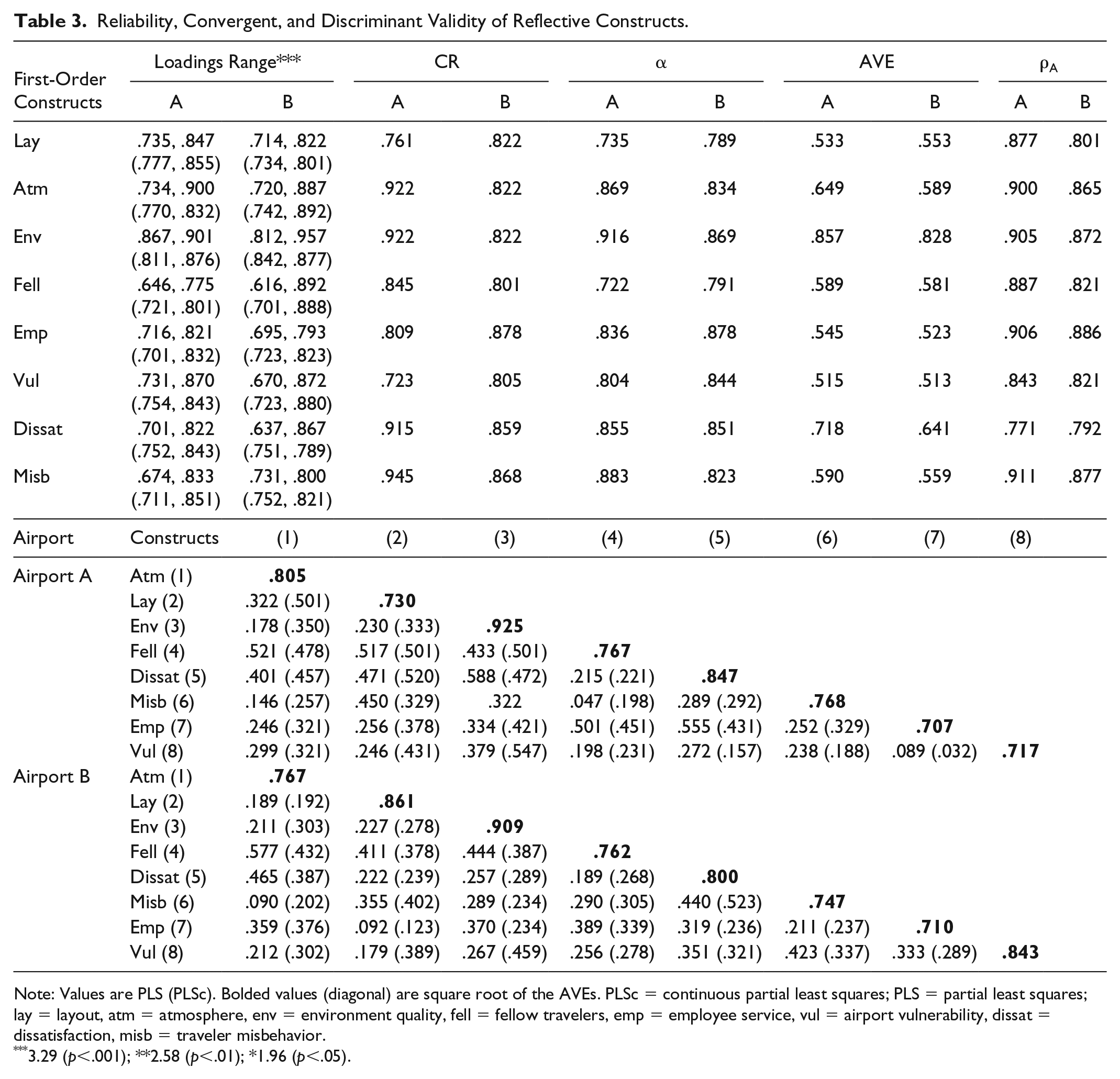
Note: Values are PLS (PLSc). Bolded values (diagonal) are square root of the AVEs. PLSc = continuous partial least squares; PLS = partial least squares; lay = layout, atm = atmosphere, env = environment quality, fell = fellow travelers, emp = employee service, vul = airport vulnerability, dissat = dissatisfaction, misb = traveler misbehavior.
3.29 (p<.001); **2.58 (p<.01); *1.96 (p<.05).
Higher-order constructs were validated through the weights of first-order constructs, the significance of weights, and multicollinearity (Becker, Klein, and Wetzels 2012; Hernandez-Perlines 2016). The weights of underlying dimensions to their respective higher-order constructs were significant, and all variance inflation factor (VIF) values were below 5 (Hair et al. 2017). Thus, there was believed to be no evidence of multicollinearity (Table 4).
Multicollinearity and Weights of First-Order Constructs on Second-Order Construct.
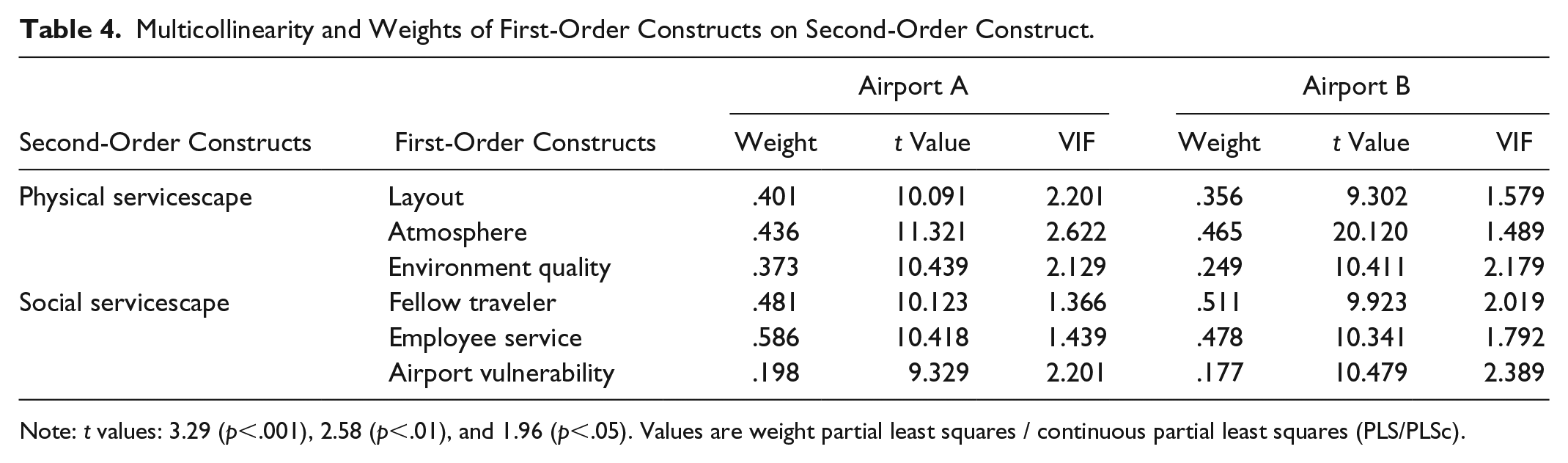
Note: t values: 3.29 (p<.001), 2.58 (p<.01), and 1.96 (p<.05). Values are weight partial least squares / continuous partial least squares (PLS/PLSc).
Interconstruct relationships through PLS were calculated in various ways, via (1) cross-validation communality and redundancy indices, (2) R2 values of the endogenous variables, and (3) standardized root mean square residual (SRMR) (Mikalef and Pateli 2017). The findings supported the model’s predictive relevance as all R2 values for endogenous constructs exceeded .28. Using blindfolding in SmartPLS, all Stone-Geisser’s Q2 values were greater than zero for each construct, suggesting predictive relevance (Hair et al. 2017). For airport A, the R2 value was 28.3% for dissatisfaction and 64.2% for misbehavior; the Q2 value was .321 for dissatisfaction and .401 for misbehavior. For airport B, the R2 value was 38.1% for dissatisfaction and 60.7% for misbehavior; the Q2 value was .178 for dissatisfaction and .472 for misbehavior. The PLS-SRMR value was .061 (airport A) and .067 (airport B), and the PLSc-SRMR value was .058 (airport A) and .061 (airport B)—below the threshold of .08 (Mikalef and Pateli 2017).
The findings supported the reliability, convergent validity, and discriminant validity of each measurement model for both airports. Multicollinearity and weights of first-order constructs on second-order constructs were also calculated. Prior to conducting MGA to compare path coefficients between the airports, measurement invariance was assessed (Rasoolimanesh et al. 2017). Henseler, Ringle and Sarstedt’s (2016) measurement invariance of composite models (MICOM) three-step procedure was employed, consisting of (1) configural invariance, (2) compositional invariance, and (3) scalar invariance. Table 2 shows the metric invariance assessment permutation algorithm for MGA. The analysis of differences in loadings between groups for all items under their underlying constructs indicated that the differences between all factorial loads in both airports were nonsignificant (Welch-Statterthwaite and permutation tests p value >.05). Table 5 displays compositional and scalar invariance, guaranteeing “full measurement invariance.”
Results of Compositional Invariance and Scalar Invariance.

Note: CI = confidence interval; Lay: layout; Atm = atmosphere; Env = environment quality; Fell = fellow travelers; Emp = employee service; Vul = airport vulnerability; Dissat = dissatisfaction; Misb = traveler misbehavior.
Assessment of Structural Models
Two nonparametric approaches to testing multigroup differences were conducted. Following Henseler, Ringle, and Sinkovics’s (2009) PLS-SEM MGA, the p value of path coefficient estimates between groups should be <.05. Further, Chin and Dibbern (2010) and Rasoolimanesh et al.’s (2017) permutation approach were employed. This technique uses p values to test differences across two groups. The results demonstrated significant (if p<.05) differences between both airports (Table 6).
MGA Findings.

p<.001; **p<.01; *p<.05.
Assessment of Configurational Models
The fsQCA results for predicting dissatisfaction are presented in Table 7. Regarding physical servicescape, two causal models were found to sufficiently predict dissatisfaction in airport A (coverage: .742, consistency: .858). Model 1 indicated that a combination of high layout quality and low environment quality stimulated traveler dissatisfaction in airport A. This suggested that although travelers rated layout as “high” in airport A, the low score for environment quality resulted in dissatisfaction. According to model 2, high layout and low atmosphere stimulated dissatisfaction among travelers. In airport B, one causal model explained the sufficient conditions for dissatisfaction (coverage: .873, consistency: .808). Model 1 demonstrated that low scores for atmosphere and environment quality resulted in dissatisfaction.
The Results of fsQCA for Predicting Dissatisfaction and Misbehavior in Two Airports.
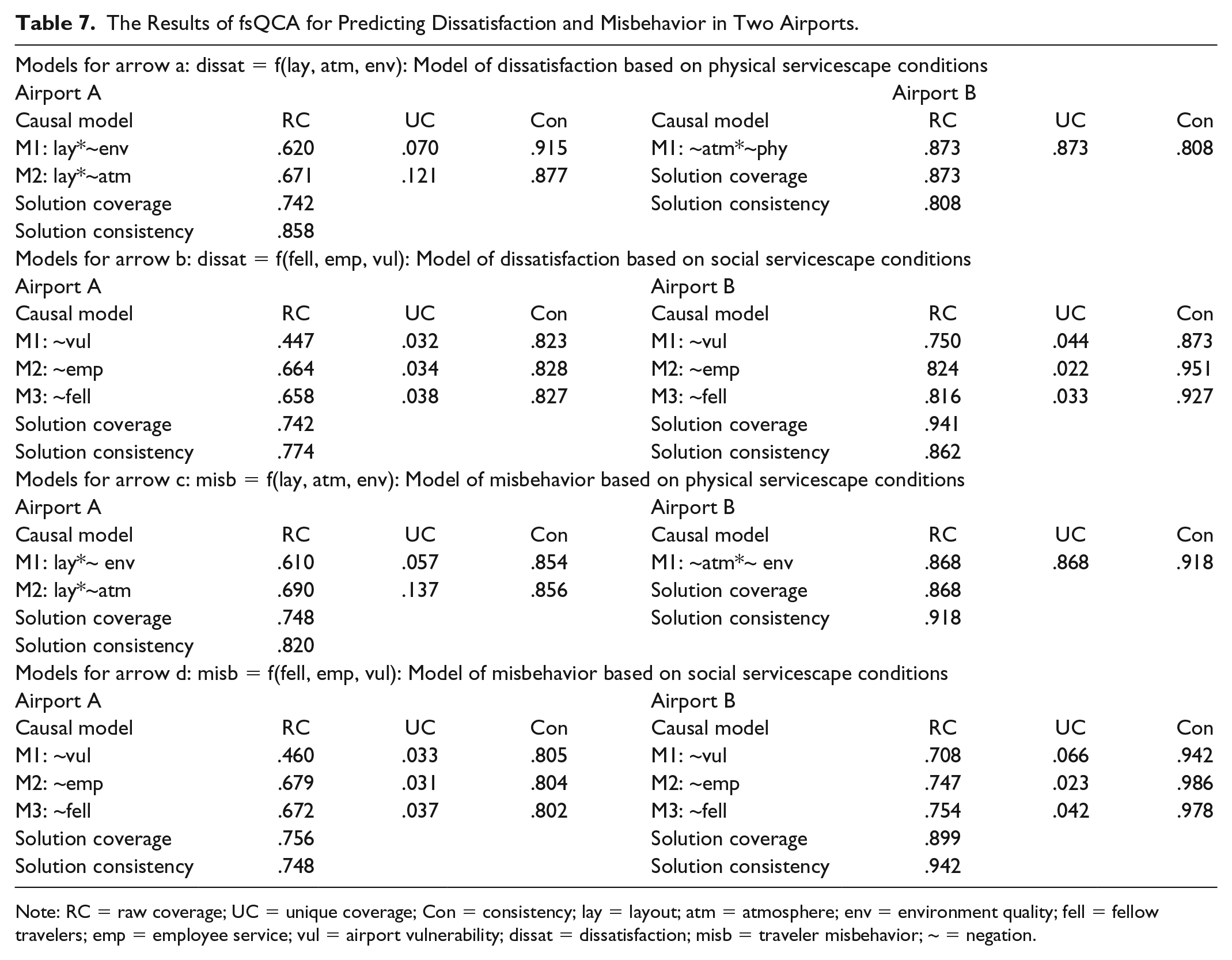
Note: RC = raw coverage; UC = unique coverage; Con = consistency; lay = layout; atm = atmosphere; env = environment quality; fell = fellow travelers; emp = employee service; vul = airport vulnerability; dissat = dissatisfaction; misb = traveler misbehavior; ~ = negation.
Regarding social servicescape, three causal models (similar in both airports) were identified to describe conditions stimulating dissatisfaction (Table 7). Model 1 indicated that a single condition (airport vulnerability) led to dissatisfaction. In model 2, dissatisfaction occurred when employee service was low. A low score for “fellow traveler” behavior resulted in dissatisfaction. The fsQCA results revealed that conditions for predicting misbehavior based on social and physical servicescape were analogous to causal models for predicting dissatisfaction. As displayed in Table 7, two causal models in airport A and one causal model in airport B described conditions of traveler misbehavior. As with dissatisfaction, three single conditions sufficiently explained misbehavior in airport A and B. This suggests that similar causal conditions stimulated dissatisfaction and misbehavior in both airports.
Table 8 presents the fsQCA results using a combination of physical and social servicescape conditions to predict dissatisfaction (arrow e; Figure 1). Six causal models explained the complex conditions of dissatisfaction in airport A (coverage: .809, consistency: .808). Model 1 suggests high scores for layout, fellow travelers, and airport vulnerability, with low scores for atmosphere and environment quality, engendered traveler dissatisfaction. Model 2 indicated that while scores for layout, atmosphere, environment quality, and employee services were high, low levels of airport vulnerability can lead to dissatisfaction. Model 3 stated that low scores for fellow travelers with high scores of layout, atmosphere, environment quality, and employee service resulted in dissatisfaction.

Note: RC = raw coverage; UC = unique coverage; Con = consistency; lay = layout; atm = atmosphere; env = environment quality; fell = fellow travelers; emp = employee service; vul = airport vulnerability; dissat = dissatisfaction; misb = traveler misbehavior. ~ = negation.
Alternatively, dissatisfaction was caused by low scores of environment quality along with high scores of layout, fellow travelers, employee service, and airport vulnerability (model 4, airport A). Model 5 advised that low scores of atmosphere, along with high scores of layout, fellow travelers, employee service, and airport vulnerability led to dissatisfaction. High scores of layout, atmosphere, environment quality, fellow travelers and airport vulnerability, with low scores of employee service, resulted in traveler dissatisfaction in airport A (model 6, Table 8).
The complex conditions of dissatisfaction in airport B differed from airport A. Three causal models predicted dissatisfaction among travelers of airport B (coverage: .699, consistency: .957). Model 1 suggested that low scores of atmosphere, environment quality, fellow travelers, employee service, and airport vulnerability increased dissatisfaction. In model 2, high scores of layout with low scores of atmosphere, environment quality, fellow travelers, and employee service resulted in dissatisfaction. Model 3 indicated that high scores of fellow travelers and employee service with low scores of atmosphere, environment quality, and airport vulnerability heightened dissatisfaction in airport B (Table 8).
Table 8 also provides causal models for predicting misbehavior based on physical and social servicescape conditions (arrow f, Figure 1). Five causal models explored the complex conditions of misbehavior in airport A (coverage: .836, consistency: .831). Model 1 indicated that while layout, atmosphere, environment quality, and vulnerability had high scores, when coupled with dissatisfaction this led to misbehavior. According to model 2, dissatisfaction and low scores of atmosphere and environment quality with high scores of layout, fellow travelers, and airport vulnerability resulted in traveler misbehavior.
Model 3 suggested that misbehavior is caused by low environment quality scores and high scores in layout, atmosphere, fellow travelers, employee service, and airport vulnerability. A low score for atmosphere and high scores for layout, environment quality, fellow travelers, employee service, and airport vulnerability resulted in misbehavior in airport A (model 4). In model 5, a low score for airport vulnerability with high scores of layout, atmosphere environment quality, fellow travelers, and employee service explained a causal condition of misbehavior.
Three causal models were identified to describe conditions in which travelers misbehaved at airport B (coverage: .590, consistency: .998). In model 1, dissatisfaction with low scores of atmosphere, environment quality, fellow travelers, employee service, and airport vulnerability resulted in misbehavior. According to model 2, misbehavior occurred when dissatisfaction and layout scores were high and atmosphere, environment quality, fellow travelers, and employee service were low. Model 3 advised that high scores of dissatisfaction, layout, fellow travelers, and employee service with low scores of atmosphere, environment quality, and airport vulnerability led to high misbehavior in airport B (Table 8). The results of the structural and configurational model tests advised sufficient factors and sufficient combinations of factors (causal recipes) respectively (Olya and Mehran 2017). The next subsection introduces the necessary conditions required to achieve the desired outcomes of the models.
Assessment of Necessary Conditions
The necessary conditions for obtaining low scores of dissatisfaction and misbehavior in the studied airports are provided in Table 9. The results suggested that the necessary conditions for low dissatisfaction in airport A differ from airport B. Specifically, layout, environment quality, and airport vulnerability were necessary to achieve low levels of dissatisfaction in airport A. In airport B, employee behavior was considered a necessary condition of low dissatisfaction as the level of consistency was close to the recommended cut-off (consistency >.9). The necessary conditions for low misbehavior differed from those that resulted in low dissatisfaction. In airport A, layout and airport vulnerability were identified as two consistent necessary conditions. While in airport B, four conditions (layout, fellow travelers, employee service, and low dissatisfaction) were necessary for low misbehavior (Table 9).
Results of NCA for Achieving Low Dissatisfaction and Misbehavior in Both Airports.

Note: lay = layout; atm = atmosphere; env = environment quality; fell = fellow travelers; emp = employee service; vul = airport vulnerability; dissat = dissatisfaction; misb = traveler misbehavior; ~ = negation.
Discussion and Implications
This study used path analysis to assess whether social and physical servicescape dimensions can be used to predict traveler dissatisfaction and misbehavior in airports (Q1). Further, MGA was used to evaluate possible differences in all hypothesized relationships across two characteristically different airports (number of flights, traveler demographics, service quality, service satisfaction, terminal area size, reputation, and CSR) (Q2). As per Figure 1, a Venn diagram was employed to draw a configurational model for exploring sufficient factor combinations (i.e., physical servicescape and social servicescape with their underlying dimensions) leading to dissatisfaction and misbehavior among travelers (Q3). The fsQCA results revealed how airport managers can consider complex combinations of social/physical servicescape elements in order to understand the conditions where customers expressed their dissatisfaction through misbehavior. This is important as airports are multifaceted systems and the configurational modeling results provided insight into the physical and social servicescape dimensions that stimulated traveler dissatisfaction and misbehavior. Finally, while MGA and fsQCA focus on sufficiently distinct combinations of servicescape factors, the NCA identified the factors required to achieve low scores of dissatisfaction and misbehavior among travelers in both airports (Q4).
Theoretical Contributions
It is believed that this study advances understanding of how servicescapes influence international travelers’ dissatisfaction and misbehavior by extending the previous understanding of environmental psychology (Mehrabian and Russell 1974) in a complex context. This study applied complexity theory (Olya and Mehran 2017) to develop and test structural and configurational models for traveler dissatisfaction and misbehavior. It first evaluated distinct elements of physical and social servicescape on traveler’s dissatisfaction and misbehavior using a symmetrical approach (PLS) in two characteristically different airports in Iran. It then explored complex combinations of servicescape factors on the above outcomes using an asymmetrical method (fsQCA). It is thus believed that this study contributes to current understanding of traveler behavior by identifying the servicescape factors that aid in managing international traveler misbehavior. This study tested the proposed conceptual models in both airports in order to confirm whether traveler dissatisfaction and misbehavior varied. Hence, this study evaluated the results of configurational model testing with key tenets of complexity theory and identified the relationships between social and physical factors of servicescape that resulted in traveler misbehavior.
With regards to theoretical contribution, the study first evaluated the effects of social and physical servicescape characteristics on travelers’ dissatisfaction and misbehavior using symmetrical path analysis (PLS). In doing so, it confirmed social servicescape and physical servicescape as higher-order constructs, echoing extant research (Ali, Kim, and Ryu 2016). Further, it is believed that this study can extend current knowledge of traveler behavior as it identified the complex interactions of physical and social servicescape configurations that can affect dissatisfaction and misbehavior within the airport setting. It thus demonstrated that dimensions of social and physical servicescape can combine to influence traveler behavior and should not solely be considered as distinct variables in isolation (Ali, Kim, and Ryu 2016; Osman, Johns, and Lugosi 2014). Therefore, the findings reflect previous studies, which have suggested that dissatisfaction can lead to misbehavior, albeit in different consumption contexts (Colm, Ordanini, and Parasuraman 2017; Dagger and Danaher 2014; Daunt and Greer 2015; Grove and Fisk 1997; Reynolds and Harris 2009).
To this end, whereas previous research often focuses on the satisfaction and loyalty of travelers in general (Lee et al. 2014), this empirical study is one of the few to investigate traveler dissatisfaction and misbehavior within airports. As such, the findings also suggested that consumer dissatisfaction and misbehavior can vary by context (cf. Jensen, Li, and Uysal 2017; Reynolds and Harris 2009), with servicescape configurations leading to traveler outcomes (e.g., dissatisfaction and misbehavior) in airport A often differing from those in airport B (Table 6). This suggests that while opportunities for service settings to retain any unique characteristics remain (e.g., aesthetics, destination-specific characteristics) (Harris and Ezeh 2008; Osman, Johns, and Lugosi 2014), focus should nonetheless be placed on developing and improving the more rudimentary physical and social servicescape characteristics that are more likely to reduce traveler misbehavior and dissatisfaction (e.g., signage, employee service, transit information) (Brida, Moreno-Izquierdo, and Zapata-Aguirre 2016).
Further, the findings suggested that layout, atmosphere, and physical environment negatively influenced international travelers’ dissatisfaction and misbehavior more for airport A compared to B. Traveler dissatisfaction positively influenced traveler misbehavior for both airports. Such relationships were strong for both airports (Table 6) and were thus consistent with previous studies (Ali, Kim, and Ryu 2016; Go and Kim 2008; Harris and Reynolds 2004; Ryu, Lee, and Kim 2012; Tsaur, Cheng, and Hong 2019). These findings highlighted that managing customer expectations and perceptions of service quality can play an important role in shaping (mis)behavior within the airport context. However, the findings did not identify a significant difference between airport A and B with regard to the effect of social servicescape on traveler dissatisfaction and misbehavior (Choo and Petrik 2014).
Finally, by combining three different advanced statistical methods (i.e., MGA, fsQCA, and NCA), this study also contributed methodologically to extant knowledge of travelers’ behavioral responses to service environment characteristics within the context of travel and tourism. The fsQCA and NCA results reinforced and refined the outcomes obtained from the MGA. More specifically, the MGA results assessed differences between travelers at two airports, whereas the fsQCA results explored combinations of factors leading to traveler dissatisfaction and misbehavior therein. The NCA findings then identified the conditions managers should focus on in order to attain low scores of traveler dissatisfaction and misbehavior in each airport. This combined methodological approach provided a more in-depth understanding of traveler dissatisfaction and misbehavior within the complex airport context than if any of the analytical techniques were conducted in isolation (Gannon, Taheri, and Olya 2019).
Evaluation of Complexity Theory
The results were evaluated based on the principles of complexity theory (Olya and Mehran 2017; Woodside 2017). According to the first tenet of complexity theory, it is rare that a single antecedent (e.g., layout) can sufficiently predict dissatisfaction and behavior. This is supported by the fsQCA results for physical servicescape. While this was not supported based on social configurations of servicescape as a simple antecedent (e.g., employee service), it was found to be sufficient to indicate dissatisfaction and misbehavior (Table 7). The second tenet of complexity theory (recipe principle) posits that combinations of two or more antecedents can sufficiently explain conditions leading to an expected outcome. As per Table 8, more than two antecedents described the complex conditions of traveler dissatisfaction and misbehavior, supporting tenet 2.
The fsQCA results provided evidence of the equifinality principle (tenet three). As per Table 8, a causal model (e.g., model 1) sufficiently predicted dissatisfaction, but is not necessary as there were alternative models (five for airport A and two for airport B) that sufficiently explained the complex conditions underpinning dissatisfaction. According to tenet 4 of complexity theory, antecedents can play both positive and negative roles in contributing to given outcomes. This is determined by the attributes of other antecedents in the causal model. The fsQCA results supported this tenet of complexity theory. As per Table 9, atmosphere negatively contributed in models 2 and 4 in predicting traveler misbehavior in airport A, while it played a positive role in models 1, 3, and 5 for airport B.
Practical Implications
This study may provide interesting and important implications for practitioners and managers within airport settings. As the results highlighted, conventional cause-and-effect assessments (e.g., correlations, multiple regression, and PLS) cannot wholly identify the extent to which antecedent factors influence dissatisfaction and misbehavior as they only offer a single interpretation of travelers’ evaluations of their airport experience (Woodside 2017). Thus, managers should consider multiple pathways in order to better evaluate the conditions leading to consumer dissatisfaction and misbehavior. Underpinned by complexity theory, the fsQCA results can provide managers with an overview of how multiple different combinations of servicescape dimensions can result in dissatisfaction and misbehavior, serving as a toolkit and key reference point of “what to avoid” when designing service solutions and strategies within the complex airport environment.
In doing so, this study theorized international airports as environments where travelers may encounter low-quality servicescapes or service failure. However, travelers may perceive the service environment differently if they do not experience poor service. Therefore, managers should endeavor to collect and operationalize information relating to traveler needs and desires, irrespective of service failure. This study therefore provides insight into airport environment evaluation and how managers should act upon customer complaints to improve service quality and counteract traveler misbehavior. More specifically, it contends that the antecedents of international travelers’ dissatisfaction and misbehavior vary. For example, specific to this study, heterogeneity is intensified by the sophistication of the servicescapes within the airport setting. Based on this, a series of practical implications emerged, which can help decision makers to nullify and manage the misbehavior of international travelers in airport settings.
First, the study findings indicated that poor airport layout may lead to dissatisfaction (airport A) and misbehavior (airports A and B). Thus, airport managers should pay careful attention to the design and cleanliness of the interior space, with comfortable furniture freely available throughout. airport A also demonstrated the importance of the physical environment in avoiding traveler dissatisfaction. This again suggests that airport managers should increase the quality of the physical airport environment with regard to accessibility, aesthetics, and privacy in order to increase the likelihood of stimulating favorable traveler behaviors.
Second, concerning social servicescape, the results suggested that the behavior of fellow travelers stimulated misbehavior in airport B. Hence, managers must endeavor to gain a more in-depth understanding of why some travelers may opt to behave in an unpleasant and inappropriate fashion within the highly regulated and complex airport environment. This echoed extant research, which highlights the substantive impact that the social environment can have on travel experiences (Cordina, Gannon, and Croall 2019). The results emerging from airport B suggested that misbehavior and dissatisfaction partly stem from poor employee service. Airport employees—specifically those who interact directly with travelers—should regularly undertake training focused on (1) how to build strong relationships with travelers, (2) how to address travelers’ problems in satisfactory manner, and (3) how their demeanor and enthusiasm is perceived by travelers.
Third, the results suggested that a degree of servicescape standardization across international airports may reduce instances of misbehavior and dissatisfaction, clarifying traveler expectations and reducing traveler confusion regarding the machinations of these (often unfamiliar) service environments in the process. While complaint-handling procedures should be customized and tailored specific to traveler needs, the process of delivering typical airport services should conform to the protocols and criteria set by recognized international authorities (e.g., Airport Council International; International Civil Aviation Organization [ICAO]). This can develop consistency across international airports, shaping service expectations, and potentially limiting traveler misbehavior and dissatisfaction born from unfamiliar airport practices and processes. Further, managers and employees should attend international courses (e.g., ACI Global Training classes) where classroom activities can be supplemented by practical exercises delivered on-site to allow staff to practice (culturally specific) auditing approaches under real conditions while receiving guidance and coaching in applying International Standards and Recommended Practices (SARPs).
Further, airport managers and employees are advised to visit leading world-class airports (e.g., Incheon in Seoul, S. Korea) to learn how best to design their physical and social servicescape in order to meet traveler standards. This should allow for a better understanding of how servicescape characteristics influence traveler satisfaction and behavior, further contextualizing the results of this study in the process. Alternatively, international experts should be invited to advise airport managers on how to improve their social and physical servicescapes, in line with the recipes identified in this study.
However, the results demonstrated that the conditions leading to traveler misbehavior differed across the studied airports. Specifically, the physical servicescape in airport A was considered more multifaceted than airport B. Therefore, managers must understand the complexity of the physical airport servicescape in which a combination of factors (e.g., layout and atmosphere) can result in traveler dissatisfaction and misbehavior. Although social dimensions of servicescape appeared simpler than their physical counterparts, airport managers must understand how each dimension of social servicescape can drive dissatisfaction and misbehavior among international travelers.
Finally, it is important to distinguish the necessary conditions required to manage dissatisfaction and misbehavior. This study demonstrated that the necessary physical and social servicescape conditions that predict low levels of dissatisfaction and misbehavior differ across airports. For airport A, layout, environment quality, and vulnerability were necessary to reduce traveler dissatisfaction and misbehavior. While fellow travelers, employee service, and dissatisfaction were necessary to gain desired behavioral responses from travelers at airport B. Given this heterogeneity, airport managers must regularly ask international travelers to rate the servicescape of their airport, supported by appropriate incentive programs.
Limitations and Future Research
While this study contributed to extant understanding of servicescape and traveler misbehavior, it contains some limitations. First, future studies should consider the role of other contextual variables in shaping dissatisfaction and misbehavior. This could include coping behavior (Strizhakova, Tsarenko, and Ruth 2012); behavioral intentions (Ajzen and Driver 1992); culture and Lean for airport services (Syltevik et al. 2018). Second, the context was restricted to Iranian airports. Future studies should test the relationships studied in different contexts and provide cross-cultural comparisons (cf. Taheri et al. 2019). Third, the sampling technique is somewhat limited and future studies should adopt probability sampling in order to conduct longitudinal studies. As traveler dissatisfaction and misbehavior were compared across two airports, a paired sample could be sought to ensure the same respondents rated the servicescape of both airports. Fourth, future research could employ a qualitative approach to further investigate the relationships between constructs. Fifth, the survey was conducted in English. Future studies should use other languages (e.g., French, German, or Arabic) in order to collect a wider and more varied range of responses. Finally, this study was limited by the self-reporting of misbehavior by respondents, which may raise issues related to the reliability of the findings. However, it is important to acknowledge that research into consumer misbehavior is limited, with almost all studies adopting self-reporting methods for data collection.
Footnotes
Declaration of Conflicting Interests
The author(s) declared no potential conflicts of interest with respect to the research, authorship, and/or publication of this article.
Funding
The author(s) received no financial support for the research, authorship, and/or publication of this article.
