




Abstract
In the past two decades, research in tourism has explored the shift to the experiential economy in which consumers (visitors) seek memorable experiences. While prior studies converge toward the idea that immersion is a critical dimension of the tourism experience, research on immersion remains scarce, particularly the conditions under which immersion is achieved and its consequences on visitor evaluations. To fill this gap, this research builds on the experiential and flow literature to propose a model where immersion derives from autonomy and leads to greater visitor satisfaction through the underlying mechanism of temporal dissociation. Additionally, it is proposed that reactance moderates the relationship between autonomy and temporal dissociation. Two empirical studies—a field study in an experiential wine museum and an experiment involving a zoo visit—provide robust evidence of these effects, fostering theoretical progress on immersion and subsequent temporal dissociation as important dimensions of the tourism experience.
Introduction
Following the emergence of the experience economy concept (Pine and Gilmore 1998), the consumer experience is now widely recognized as the cornerstone of tourism (Tussyadiah 2014). The perception of tourists as active and emotional actors looking for immersive experiences when visiting museums, zoos, theme parks, heritage sites, or art galleries (Handler and Gable 1997; Hansen and Mossberg 2013) has led tourism managers to pay particular attention to the design of their settings. Considerable resources are dedicated to designing complex, thematic, and refined environments (Bonn et al. 2007; Sherry 1998) that lead to an immersive, enjoyable, and memorable escape from reality for visitors (Morgan, Elbe, and de Esteban Curiel 2009; Otto and Richie 1996; Ritzer 1999). This trend is exemplified by the Burns Birthplace Museum in Ayrshire, where visitors can put on 3D glasses and walk into a digital recreation of the Battle of Bannockburn. Similarly, virtual reality and augmented reality applications for smartphones increasingly allow immersive visit of cities, castles, and museums. Another example is the proliferation of IMAX theatres showcasing 3D immersive cinematography making visitors feel part of the film, rather than just passive observers (Stuart 2006).
Although recognized as a powerful emotional state by marketers (Carù and Cova 2007; Novak, Hoffman, and Yung 2000), such immersion—or the psychological state in which visitors are fully engrossed in the environment and absorbed in their activities (Chang 2018)—has only recently been the focus of tourism research (Lindberg, Hansen, and Eide 2014; Vo Thanh and Kirova 2018). A consequence is that the factors that may induce feelings of immersion in a tourism setting, and the mechanisms that explain why an immersive experience contributes to visitor satisfaction (Hansen and Mossberg 2013), remain unexplored. This lack of research on the effects of immersion is surprising given that visitor satisfaction—likely an outcome of their immersion—drives various desirable behaviors (i.e., repurchasing and repatronage intention; Szymanski and Henard 2001).
To fill this gap, this article builds on the experiential (Pine and Gilmore 1998; Carù and Cova 2006) and flow literature streams (Csikszentmihalyi 1990) to propose that the degree of autonomy that visitors perceive during a visit explains their propensity to immerse themselves, and their satisfaction with the experience. Although autonomy—or the freedom to choose or behave as wanted (Levav and Zhu 2009)—is a fundamental aspect of the motivation to engage in tourism experiences in general (Smith 1994; Li, Chung, and Kim 2018), and in museum experiences in particular (Silverman 1995), knowledge of its effects in tourism settings remains scarce (Caruana and Crane 2011). Considering this gap, this research examines whether and how such autonomy can affect immersion and satisfaction. In addition, this article investigates the mechanisms that explain why immersion may lead to an increase in visitor satisfaction. Although prior studies provide evidence of this direct effect (Cuny, Fornerino, and Helme-Guizon 2015; Fornerino and Helme-Guizon 2008), the mechanisms that explain how immersion drives satisfaction remain unclear. Relying on the temporal processing (Block 1990) literature, we propose that the temporal dissociation phenomenon—that is, “the inability to register the passage of time while engaged in interaction” (Agarwal and Karahanna 2000, p. 673)—explains why immersion is likely to enhance visitor satisfaction.
Further, we address the question of whether all visitors respond positively to the level of perceived autonomy. This question is important since tourism providers sometimes struggle to find the right level of autonomy they should grant visitors. For instance, Ponsignon, Durrieu, and Bouzdine-Chameeva (2017) report that the designers of an experiential cultural organization gave visitors complete autonomy to explore a 3,000-m2 space in any way they liked. While the majority of visitors reported enjoying the freedom inherent in the experience, some declared their unease and a frustrating (e.g., “I fear I may have missed something interesting”) or confusing experience (e.g., “I do not know if I visited the various thematic areas in the right order”). Research is therefore needed to provide a better understanding of the individual factors that can explain why visitors react either positively or negatively to autonomy, and the impact of autonomy on the visitor experience. In this research, we propose reactance—that is, a motivational state experienced in response to threatened freedom (Brehm and Brehm 1981; Wicklund 1974)—as such a variable. Building on reactance theory (Brehm 1966), we posit that visitors differ in their responses to autonomy, with greater temporal dissociation emerging as a response to autonomy only when people exhibit a high level of reactance.
In what follows, we present a series of hypotheses addressing the effect of immersion on visitor satisfaction that we test in two studies. The first study, performed in a leading experiential wine museum, shows that the higher the degree of autonomy that visitors perceive, the greater the feelings of immersion and satisfaction. Importantly, this study also identifies temporal dissociation as the underlying mechanism that explains why immersion increases satisfaction. Our second study replicates these findings in another context using an experimental design. Drawing on Winer (1999, p. 350), who states that external validity involves “generalizing the results to other settings and population beyond the current research setting,” the second study was conducted in the context of a zoo. To provide external validity for our model and results, our studies were thus performed in two tourism settings (a wine museum and a zoo) using different research designs (a field study and an experiment), measures (shortened and full-length scales), and samples (actual visitors vs. online participants). In so doing, this research allows a deeper investigation of the effects of autonomy and strengthens the external validity. In addition, the experiment offers a further contribution by showing that reactance moderates the effects of autonomy on the consequence of immersion, temporal dissociation, and more specifically, that only for highly reactant visitors, autonomy leads to greater feelings of losing track of time.
Theoretical Background
Tourism Experience and Immersion
The emergence of the experience economy (Pine and Gilmore 1998) has triggered a shift in the marketing discipline, leading to a plethora of research dedicated to understanding consumer experiences (e.g., Carù and Cova 2006; Holbrook 2006a, 2006b, 2006c; Gentile, Spiller, and Noci 2007). This shift has been beneficial to the tourism discipline, with more research specifically focused on how to design and manage the tourist experience (Quan and Wang 2004; Tussyadiah 2014; Yuan and Wu 2008). Prior studies suggest that consumers value extraordinary and memorable experiences and that tourism providers increasingly focus on the provision of such experiences (Oh, Fiore, and Jeoung 2007; Hosany and Witham 2010).
The concept of immersion is central to the creation and consumption of memorable tourism experiences (Lindberg and Østergaard 2015; Carù and Cova 2006). When the environment is designed in such a way that visitors are encouraged to physically (e.g., touching, smelling, walking) or mentally (i.e., thinking or watching) connect with a given event or performance, they are able to immerse themselves in the experience and become “physically (or virtually) a part of the experience itself” (Pine and Gilmore 1999, p. 31). For instance, McIntyre (2009, p. 165) shows that museums and art galleries providing a mix of space types (e.g., contemplative and participative) enable visitors to immerse themselves in a meaningful experience of learning and discovering. More generally, tourism settings that make visitors feel engrossed and deeply engaged with the activities at hand captivate visitors and are consensually viewed as highly immersive (Hosany and Witham 2010). The extent to which tourists or visitors feel immersed in the experience is particularly important since immersive experiences tend to be more memorable than ordinary experiences (Tung and Ritchie 2011).
Immersion thus represents a process whereby the individual disconnects from the real world, a disconnection that is either a sudden dive or a more gradual envelopment in the experiential environment (Fornerino and Helme-Guizon 2008). In addition to this process-oriented perspective, immersion also refers to a state characterized as “an intense moment experienced by the consumer and the result of a partial or complete process of appropriation” (Carù and Cova 2006, p. 60). Immersed consumers have all their senses fully engaged in the activity performed (Agarwal and Karahanna 2000). They are described as detached and highly concentrated on the activity at hand that becomes the focal point of their thoughts and feelings (Brown and Cairns 2004). Immersion is thus related but also conceptually distinct from the flow construct. Flow considers a broad set of psychological states as it includes affective and cognitive dimensions. In particular, enjoyment is widely seen as a core dimension of flow experiences (Drengner, Steffen, and Furchheim 2018). The focus of immersion is, however, centered on a person’s concentration on the task at hand (i.e., a cognitive dimension). The immersion concept is hence more focused.
How Autonomy Can Prompt Immersion: An Appropriation Perspective
Since immersion occurs when the distance is minimal between the consumer and the context in which the experience takes place (Carù and Cova 2006), the concept of distance is central in the immersion process. One way to reduce distance and facilitate immersion is an “operation of appropriation” that Carù and Cova (2006, p. 6) define as “the mark of a fundamental psychological system of action on the context of experience in order to transform and personalize it.” More specifically, three major appropriation operations are often distinguished (Fischer and Atkin-Etienne 1997; Mifsud, Cases, and N’Goala 2015). The first is “nesting,” a process whereby visitors try to control the place, such that they can feel at home. The second is “investigating,” an operation during which visitors try to explore and identify new products or activities to develop points of anchorage and control (signposts). By investigating, visitors aim to enhance their knowledge of the experience setting and extend their territory. The third and last appropriation operation is “stamping,” describing a meaning-making process whereby visitors attribute a specific and personal meaning to an experience.
In this set of operations that aim to facilitate the appropriation of—and subsequent immersion in—the experience, consumers need a certain degree of freedom. In other words, since appropriation refers to the consumers’ ability to make the place their own, it may require a certain degree of autonomy. Consumers need the freedom to choose how to behave in the focal environment in order to be able to act on that environment, to personalize it, and make it feel like home. Such freedom is consensually labeled as autonomy (e.g., Levav and Zhu 2009; Markus and Schwartz 2010). As the belief that one can freely choose how to behave in a specific situation (Deci and Ryan 1985; White 1959), autonomy refers to the extent to which people feel free to initiate their own actions (Deci and Ryan 2000).
Visitor autonomy is an important consideration in the design of tourism experiences (Caruana and Crane 2011). As tourists are often presented with a range of options, the experience of exploring a tourism site involves a series of decisions of where to go and what to do or see next (Smith 1994). Reisinger (2013) notes that tourists tend to relish the opportunity to choose what to do and how to do it by themselves. Similarly, Bianchi (2016) shows that freedom of choice is a key driver of satisfaction for the solo tourist. This effect is due to the increased level of control that autonomous individuals can exert over the activities performed to achieve their goals (Deci and Ryan 2000). In high-autonomy situations, visitors perceive a great sense of control over the situation, as they make their own decisions to participate or not in any given activity. Carù and Cova (2006) explain that consumers who perceive a sufficient degree of control are able to familiarize themselves with the environment in which the experience takes place. According to these authors, this familiarity is a prerequisite for consumers to become immersed. Drawing on human–computer interactions research, Ghani and Deshpande (1994) provide empirical support for the notion that perceived autonomy influences feelings of immersion. Their study shows that videogame players are more likely to be captivated by games that give them full control over their actions.
In a tourism context, autonomous visitors may familiarize themselves with the range of activities or attractions available, which may put them in a position to select the ones they feel most attracted to based on personal relevance or preference. Such visitors are also able to spend the desired amount of time in the attraction. The empirical study of Minkiewicz, Evans, and Bridson (2013) conducted in museums supports this view, showing that when visitors are given the opportunity to personalize their visit, they are able to immerse themselves in the experience. We therefore posit that visitors are more likely to focus intensely on an experience that they have purposefully chosen. In contrast, visitors with limited autonomy may not invest sufficient time and effort to dive straight and fully into an experience that is imposed on them. Rather, they may be more easily distracted by other features of the environment, which may inhibit their ability to concentrate on the experience. As freedom may be needed for visitors to engage in operations of appropriation, which facilitates immersion, we propose the following hypothesis:
Hypothesis 1: The greater the degree of autonomy perceived by the visitor, the greater the feeling of immersion.
Immersion as a Disconnection That Contributes to the Experience
When immersing themselves in an event, performance, or place, individuals disconnect from the real world (Carù and Cova 2006). Hence, visitors who are deeply immersed in an experiential environment may forget about—and even lose consciousness of—the real world, focusing on the experience taking place (Fornerino and Helme-Guizon 2008). Such loss of consciousness is a key element in Csikszentmihalyi’s (1990) description of the flow experience where the autotelic nature of the activity results in individuals losing track of time. A time distortion phenomenon might thus occur when people are immersed and lose consciousness of the external world. Such distortion refers to the notion of temporal dissociation, or “the inability to register the passage of time while engaged in interaction” (Agarwal and Karahanna 2000, p. 673).
It is important to note that immersion is conceptually distinct from the temporal dissociation construct. Immersion specifically relates to an attention state where the target is the activity (i.e., the person’s attention is totally focused on the activity). Temporal dissociation only relates to a person’s time consciousness, that is, the (in)ability to register the passage of time. Hence, the targets of the two concepts are different: immersion is focused on an activity and temporal dissociation relates to time consciousness, a lack of awareness of time passing by. These two constructs have been identified as uncorrelated in prior research, for instance, by Agarwal and Karahanna (2000).
Previous research on temporal processing provides theoretical support for the notion of immersion as a source of temporal dissociation. As visitors become immersed, they focus entirely on the activity being performed. Their attention may therefore be directed toward some nontemporal processing, which involves thinking about things that are unrelated to the passage of time during the target interval (Bailey and Areni 2006). A decrease in attention to temporal information results in less encoded information on the passage of time (Block 1990), and as less temporal information is encoded, the subjective experience of the interval reduces and estimates of duration decrease. Therefore, as they become immersed, visitors may estimate the time as less than the time actually spent during their immersion. They may thus experience a phenomenon of temporal dissociation. Hence, we posit:
Hypothesis 2: The greater the degree of immersion perceived by the visitor, the greater the feeling of temporal dissociation.
Hypothesis 3: Immersion will positively mediate the indirect effect of visitor autonomy on temporal dissociation.
Since immersion is often described as a key component of flow-type or optimal experiences (Csikszentmihalyi 1997), and as flow refers to a state of particular enjoyment, there is reason to believe that immersion generates increased satisfaction for visitors. Research showing that enjoyment can result from participating in immersive activities or processes that offer a sense of escape from everyday monotony (Mathwick, Malhotra, and Rigdon 2001) supports this reasoning. Additional theoretical evidence from consumer culture research highlights the consumer’s quest to experience immersion in thematic settings, rather than merely focusing on the quality and attributes of finished products (Firat and Venkatesh 1995). However, the question remains as to how visitors respond to the temporal dissociation phenomenon that follows immersion, and more specifically, whether such temporal dissociation is beneficial to satisfaction. One answer can be drawn from the temporal processing literature and attentional models. In the field of time perception in service settings, some authors—such as Lopez and Malhotra (1991) and Cameron et al. (2003)—find that respondents’ time estimates are negatively correlated with their reported liking of the service setting. This suggests that when time is perceived as longer, satisfaction decreases. Therefore, by reducing the time perception, temporal dissociation may increase the liking of the experience, or more broadly, visitor satisfaction. We thus propose the following hypothesis:
Hypothesis 4: The greater the degree of temporal dissociation perceived by the visitor, the greater the level of visitor satisfaction.
Hypothesis 5: Immersion and temporal dissociation will serially mediate the indirect effect of autonomy on visitor satisfaction.
The subsequent study is designed to test these five hypotheses.
Study 1: The Field Study
The goal of study 1 was to test hypotheses 1−3 in the real world, and thus provide evidence for the notion that visitor immersion and temporal dissociation serially mediate the effects of autonomy on satisfaction.
The field study is conducted in an experience-centric wine museum. Research on museums has a long tradition in the tourism literature. Scholars have explored a diversity of phenomena, such as the museum image formation process (Moreno and Ritchie 2009), the impact of a museum on the attractiveness of an area (Brida, Meleddu, and Pulina 2012), and their role as dark tourism sites (Cohen 2011). While a curatorial orientation focused on visitor information and object preservation is notable in early research endeavors (Uriely 2005), a shift toward the visitor experience has been observed over the past three decades (Falk and Dierking 2016). Accordingly, research focused on understanding visitor characteristics and expectations, and examining the dimensions of the visitor experience (Antón, Camarero, and Garrido 2018; McIntyre 2009; Rowley 1999) has grown significantly (Sheng and Chen 2012). The present study thus falls within the realm of tourism research examining the conditions under which visitors have a successful experience.
Procedure and Sample
We selected as the setting for our field study a recently opened experience-centric wine museum (the ‘Permanent Tour’ of La Cité du Vin 1 ) that offers visitors a unique and multisensory adventure. The Permanent Tour welcomed 445,000 paying visitors in 2017, which makes it the most popular tourist attraction in southwestern France. The experiential museum is situated in an open space consisting of 20 individual themed areas that address a variety of wine-related topics. These modules collectively provide a good balance of physical (e.g., pressing pear-shaped atomizers to release wine-related aromas) and mental activities (e.g., watching diverse vine landscapes filmed from a helicopter on extra-large mural screens) along the visitor journey. The museum setting is enclaved, thematic, and secure for visitors, making it conducive to immersive experiences (Carù and Cova 2007), and therefore appropriate for this study (see Appendix 1 for a map of the permanent tour). As they needed assistance in designing and implementing a visitor satisfaction study, the Cité du Vin management team contacted the authors.
The field study took place over three consecutive days in February 2018. Visitors were asked at the entrance of the museum if they wanted to participate in a study about their experience, and those who agreed were invited to wear a wristband so that the researchers would know exactly whom to interview once visitors exited the museum space. They were also asked to go to the top floor of the museum at the end of the visit to respond to a questionnaire. Four students were hired, trained, and remunerated to facilitate the administration of the questionnaire, as attendance data suggested that many customers visit the museum at the same time and for a similar duration, leading to large numbers of visitors to interview at the same time. Hence, six people—researchers included—administered the surveys using digital tablets to minimize the risk of data entry and processing errors. In total, 394 customers agreed to participate and completed the survey. Data from customers under the age of 18 years were removed. The final sample was thus composed of 384 visitors. Regarding the sociodemographic characteristics, 204 visitors were women (53%), and the mean age was 47.15 (SD =15.85). The vast majority (90.6%) reported being first-time visitors.
Measures
All the measures used in the questionnaire were drawn from prior research. Nevertheless, as the executives at the museum explicitly asked that visitors not be bothered by a long questionnaire, several multi-item scales were shortened. More specifically, visitors first rated their satisfaction with the visit using a three-item scale adapted from Machleit, Kellaris, and Eroglu (1994): “I was satisfied with my experience in the museum,” “I enjoyed visiting that museum,” and “Visiting that museum made me feel happy”; α = .85. This measure was included up-front to avoid any common method variance bias (Podsakoff et al. 2003). Then, visitors completed a three-item measure of temporal dissociation adapted from Agarwal and Karahanna (2000): “Time appeared to go by very quickly,” “I lost track of time,” and “Time flew”; α = .70. Visitors then rated their feelings of immersion using a two-item scale adapted from Agarwal and Karahanna (2000): “I was able to block out most other distractions” and “I was absorbed in what I am doing”; α = .80. Visitors then rated how much autonomy they perceived having in the museum on a two-item scale adapted from Song and Zinkhan (2008) to fit the context of the current study: “I was able to choose to which area of the museum to go” and “I could choose freely what area I wanted to explore”; α = .73. All the statements were rated on Likert-type scales (1 = strongly disagree, 10 = strongly agree). The 1-10 scale was chosen by Cité du Vin’s management team.
To test for the convergent validity of the scales, we used the procedure of Hair et al. (2005) where the variance extracted from among a set of construct items must be higher than 0.5. All the multi-item scales showed convergent validity (Table 1).
The Measures Used in the Studies and Their Psychometric Properties (Studies 1 and 2).

Note: The items slightly differed across studies 1 and 2, as they were adapted to fit the museum and zoo settings.
To test the discriminant validity among the constructs, we used the procedure that Fornell and Larcker (1981) suggest. In spite of some significant correlations among the constructs, the average variance extracted for each was higher than the squared correlation between these constructs and any other construct, supporting the discriminant validity of the measures (Table 2).
Squared Correlations, Means, and Standard Deviations (Studies 1 and 2).
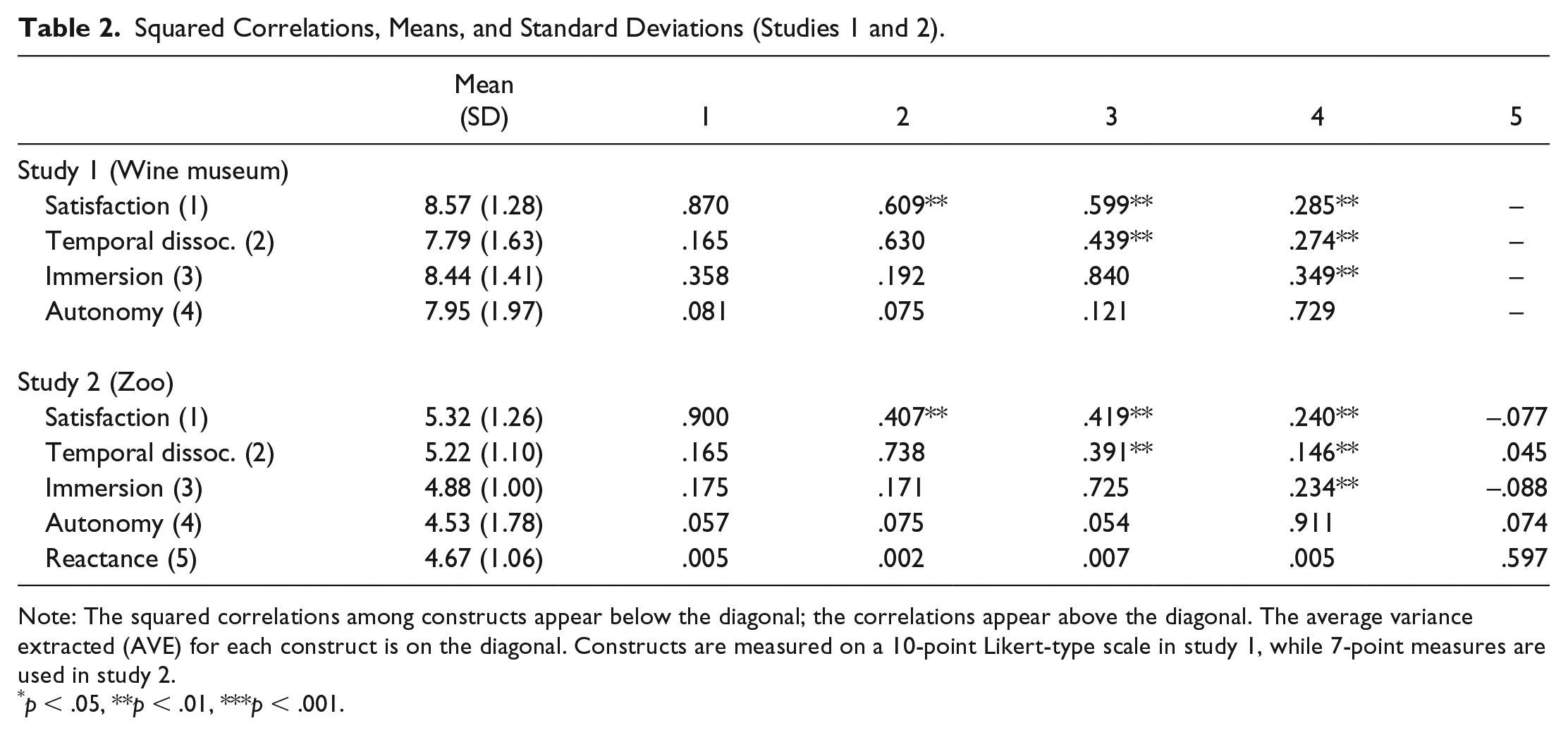
Note: The squared correlations among constructs appear below the diagonal; the correlations appear above the diagonal. The average variance extracted (AVE) for each construct is on the diagonal. Constructs are measured on a 10-point Likert-type scale in study 1, while 7-point measures are used in study 2.
p < .05, **p < .01, ***p < .001.
Results
To test hypotheses 1–3, we performed a mediation analysis using the Process macro and 5,000 bootstrap samples. Here, autonomy served as the independent variable, immersion as the mediating variable, and temporal dissociation as the dependent variable. The results show a significant indirect effect of autonomy on temporal dissociation (β = .07, 95% CI = .039, .114). More specifically, autonomy has a positive effect on immersion (β = .25, p < .001), which then increases temporal dissociation (β = .29, p < .001). Of note, autonomy has a direct positive effect on temporal dissociation (β = .11, p < .01; Figure 1). Overall, these results support hypotheses 1–3, and the notion that immersion mediates the effect of visitor autonomy on temporal dissociation.
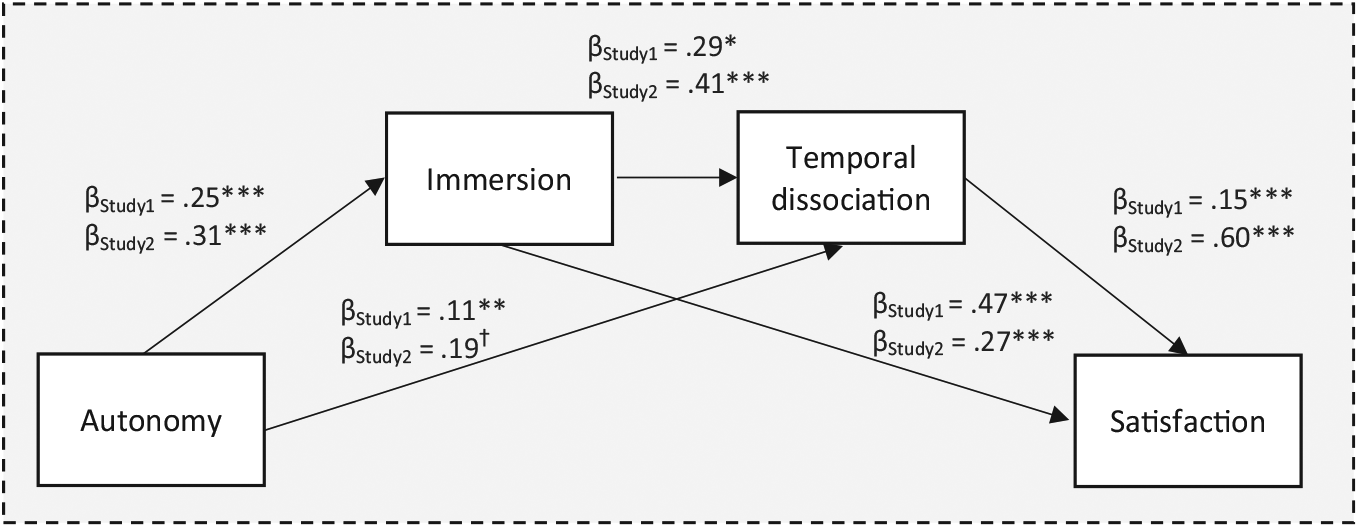
The mediating effects of immersion and temporal dissociations in the autonomy–satisfaction relationship (studies 1 and 2).
Turning now to hypotheses 4 and 5, we performed a serial mediation (Process Macro, 5,000 bootstrap samples). Here, autonomy served as the independent variable, immersion and temporal dissociation as the mediating variables, and satisfaction as the dependent variable. The results show significant serial mediation (β = .12, 95% CI = .004, .022), thus supporting the prediction that immersion and temporal dissociation serially mediate the effect of autonomy on satisfaction. In this serial mediation, both immersion (β = .47, p < .001) and temporal dissociation (β = .15, p < .001) have a positive effect on satisfaction. Autonomy has no significant effect (p > .10). Overall, these results support hypotheses 4 and 5.
Discussion
Study 1 provides support for the notion that visitor immersion and temporal dissociation serially mediate the positive effect of autonomy on satisfaction. Put differently, visitors who feel they can freely choose how to behave and live their experience reported greater feelings of immersion than visitors who felt less autonomous, and because they were more immersed in the experience, they exhibited greater loss of track of time and their satisfaction in turn increased.
Although we identify autonomy as an antecedent of immersion, our first study did not address the question of whether all visitors react the same way to such autonomy. Extant theory posits that this may not be the case, as different people seek and enjoy different kinds of experiences (Cohen 1979). This proposition has garnered empirical support in the literature. In particular, in their qualitative study, Uriely, Yonay, and Simchai (2002) found that backpackers constitute a highly heterogeneous tourist population in terms of psychological attributes, such as their travel motivations and their perceptions of the travel experience. Similarly, Bianchi (2016) suggests that researchers take into account personal factors or traits to explore and understand differences in individual perceptions of the tourism experience. Since autonomy refers to the ability to choose how to behave (White 1959; Deci and Ryan 2000), visitors—and more broadly individuals—who value such freedom may react more positively to autonomy. In this regard, research shows that one particular construct tackles this value of freedom of choice: reactance. Brehm (1966) defines reactance as a motivational state to reassert lost freedom of choice. Reactance theory explains human behavior in response to the perceived loss of freedom in an environment, and more specifically, assumes that individuals cherish their ability to choose from among alternatives such that whenever an alternative is threatened or eliminated, reactance occurs, and the motivation to pursue the restricted freedom increases dramatically (Brehm 1966). As research supports the notion that individuals value their freedom of choice (Fitzsimons 2000; Moore and Fitzsimons 2014), one could argue that such reactance is a common trait observed at a high level in every individual. However, research does not support this view, and rather shows that individuals vary in trait reactance, a personality trait that defines how much people value their freedom of choice and react negatively when such freedom is threatened. Research on trait reactance shows a positive association between autonomy and trait reactance, where highly reactant individuals routinely rebel against authority figures (Dowd et al. 1994). Such highly reactant individuals (vs. less reactant individuals) are particularly motivated to re-establish the threatened freedom (Brehm 1966; Wicklund 1974).
Hence, we suggest that in the context of experiential tourism settings, visitors who are highly reactant—and thus who value being able to visit a place or site autonomously—may exhibit stronger positive responses than those who do not place such weight on autonomy. One potential response of interest for this research lies in temporal dissociation. This proposition builds on time perception research showing that when people experience states of positive feelings, they tend to underestimate how much time has elapsed. For instance, people with arachnophobia reported longer estimates of a short interval spent observing a spider compared to those who did not report such phobia (Watts and Sharrock 1984). Another experiment shows that people who make eye contact with a person with a negative facial expression report longer time estimates than those who make eye contact with a person with a positive facial expression (Thayer and Schiff 1975). Considering these results showing that time estimates are lower when people feel positive states, we propose that the autonomy given to visitors with a high (vs. low) trait reactance leads them to underestimate the time spent in the tourist setting due to the positive state that results from their autonomy. In other words, as such visitors may particularly value their autonomy, their positive feelings may lead to greater temporal dissociation. Hence, we propose:
Hypothesis 6: Customer reactance will moderate the effect of autonomy on temporal dissociation. More specifically, for highly reactant customers, autonomy will lead to higher levels of temporal dissociation than for less reactant customers.
The addition of this hypothesis leads to the following complete theoretical model (Figure 2).
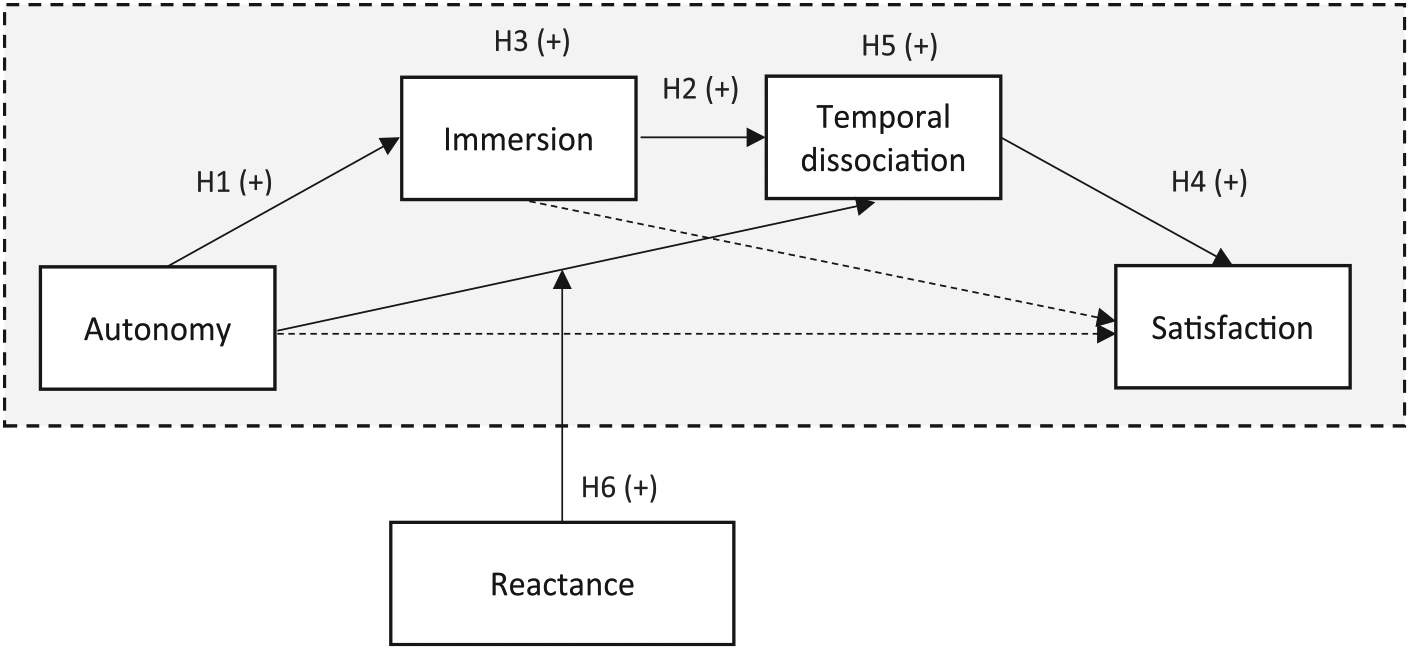
The theoretical model.
Study 2: The Zoo Experiment
Beyond replicating the results observed in study 1, study 2 aims to examine whether all visitors react the same way to autonomy. More specifically, study 2 explores reactance as an individual trait able to explain when customers benefit from autonomy.
This experimental study is conducted in a zoo setting. Zoos make an important contribution to the development of the tourism sector by simultaneously playing the role of tourism attractions and conservation organizations (Driml, Ballantyne, and Packer 2017). Tourism research on zoos has explored a range of phenomena including the characteristics of on-site and off-site conservation activities (Turley 1999), the financial impact of a new attraction (Driml, Ballantyne, and Packer 2017), and the mission of zoos as sustainable eco-tourism destinations. Previous visitor-oriented research has focused on exploring visitor motivations (Klenosky and Saunders 2007), visitor preferences, and animal attractiveness (Carr 2016). Recently, an experience-centric approach has begun to explore the dimensions of the visitor experience, examining the relationship between experience quality, visitor satisfaction, and loyalty (Wu, Cheng, and Hong 2017). The present study is positioned in this visitor and experience-centric perspective.
Participants, Design, and Procedure
A panelist recruited 375 US individuals (55.5% female, MAge = 42.88, SD = 9.62, ranging from 28 to 65) online to participate in this study. In terms of occupation, 57.6% are employed, 16.8% are self-employed, 10.9% are unemployed, and 4.8% are retired. Students and other occupations represent 9.3% of the sample. Statistics provided by the US Association of Zoos & Aquariums show that visitors are primarily women/mothers, aged 25–35 years, 1 suggesting that our sample is reasonably representative of the target population, and thus suitable for the study. To test the notion that autonomy leads to increasing immersion and consequently satisfaction, we manipulated autonomy as a between-subjects factor (low vs. high). In both the low and high autonomy conditions, the respondents were asked to read a scenario about visiting a zoo, to project themselves in the situation described by the scenario, and to carefully inspect a map of the zoo. However, as in previous studies (Chen and Sengupta 2014; Zhang et al. 2011), in the low-autonomy condition the scenario constrained individual choice, as participants were told they had to follow a compulsory path that they could not deviate from (see Appendix 2 for the maps and scenarios). The respondents were presented with a map showing this compulsory path with green dots. Importantly, to avoid any confounding effects, the compulsory path included the most popular animals, exactly the same animals as in the high-autonomy condition. In this latter condition, the scenario did not constrain individual choice, and no mention was made of any compulsory path either in the scenario or the map.
After reading the scenario and inspecting the map, participants were asked to complete a questionnaire. We set a quality check as a means to ensure the validity of the data. We formulated and inserted in the questionnaire an attention filter (addressing common method bias) as “if you read this please check “strongly disagree.” Responses that did not meet this specification (n = 29) were removed from the dataset. The measures were the same as in study 1, but adapted to the context of this study (see Table 1). Also, unlike in study 1 where some items had to be dropped, study 2 employs the complete measurement scales. Specifically, and as in study 1, participants first rated their satisfaction with the visit using the same three-item scale (α = .94). They then completed the same measure of temporal dissociation used in study 1, but here using four items (α = .87). They then rated their immersion, using the three-item scale of Agarwal and Karahanna (2000; α = .80). For manipulation check purposes, participants rated how much autonomy they would perceive having in the zoo using three items from Song and Zinkham (2008) (α = .95). All the statements were rated on Likert-type scales (1 = strongly disagree, 7 = strongly agree).
Finally, to test the predicted moderating role of trait reactance, participants completed the Hong and Faedda (1996) reactance scale. The factorial analysis revealed the scale as bidimensional, with two eigenvalues greater than 1 (Hair et al. 2005). After a close look at the factorial structure and the items loading on each dimension, it appeared that the first dimension—composed of the four items “I resist the attempts of others to influence me,” “It makes me angry when another person is held up as a model for me to follow,” “I become frustrated when I am unable to make free and independent decisions,” and “I become angry when my freedom of choice is restricted”—was the most closely related to reactance and its essential notion of choice restriction. This four-item scale proved reliable (α = .77; 7-point scale from “not at all” to “extremely”) and was thus retained for further analyses. Here again, all the multi-item scales exhibited convergent and discriminant validity (Tables 1 and 2).
Manipulation Check
To ensure that the manipulation of autonomy was successful, we conducted a t-test for the independent samples with the autonomy treatment condition as the independent variable and the measure of autonomy as the dependent variable. As expected, the result shows a significant difference of autonomy across conditions, with perceived autonomy rated higher in the high-autonomy condition (M = 5.80) than in the low-autonomy condition (M = 3.31, t = −18.93, p < .001).
Results
Turning to the test of the notions that autonomy affects immersion and that immersion mediates the effect of autonomy on temporal dissociation, we performed two analyses. The first analysis tested hypothesis 1 and involved a t-test for the independent samples. Manipulation of autonomy served as the independent variable and the measure of visitor immersion as the dependent variable. The results show a significant difference of immersion across the conditions of autonomy, the latter variable rated higher when autonomy is high (M = 5.04) compared to low (M = 4.73, t = −3.06, p < .01). This result supports hypothesis 1.
Then, we performed a mediation analysis to test hypotheses 2 and 3 using the Process macro (model 4, 5,000 bootstrap samples). Here, manipulation of autonomy served as the independent variable, immersion as the mediating variable, and temporal dissociation as the dependent variable. As in study 1, the results show a significant indirect effect of autonomy on temporal dissociation (95% CI = .049, .230). More specifically, autonomy has a positive effect on immersion (β = .31, p < .01), which then increases temporal dissociation (β = .41, p < .001). Hypotheses 2 and 3 are thus supported.
Turning to the serial mediation, we followed the same procedure as in study 1, but here with manipulation of autonomy as the independent variable. Again, a significant serial mediation effect is found (95% CI = .030, .145), whereby the aforementioned positive effects of autonomy and immersion are followed by a positive effect of temporal dissociation on satisfaction (β = .60, p < .001). Of note, autonomy only has a marginal effect on temporal dissociation (β = .19, p = .07), and no direct effect on satisfaction (β = −.00, p < .01). Immersion has a positive effect on satisfaction (β = .27, p < .001). Overall, these results support hypotheses 4 and 5 and the notion that immersion and temporal dissociation mediate the effect of visitor autonomy on satisfaction.
The last analysis pertained to the predicted moderating role of reactance in the effect of autonomy on temporal dissociation. To avoid any loss of statistical power, we chose not to dichotomize the reactance measure (Fitzsimons 2008) and performed a floodlight analysis (Spiller et al. 2013) using the Process macro and 5,000 bootstrap samples. Here, the autonomy condition served as the independent variable, temporal dissociation as the dependent variable, and the measure of reactance as moderator. The results show no main effects of autonomy and reactance (all p’s > .10), but as expected, their interaction is significant (β = .21, p < .05). We plot this interaction in Figure 3, using the Johnson-Neyman technique for identifying regions in the range of the moderator variable in which the effect of the independent variable on the dependent variable is and is not significant (Hayes and Matthes 2009). The Johnson-Neyman point for the reactance moderator occurs at the value 4.31. This value indicates that a high level of autonomy results in significantly higher levels of temporal dissociation for values of reactance greater than 4.31. These results thus support Hypothesis 6 and the notion that reactance moderates the effect of autonomy on temporal dissociation, with highly reactant customer experiencing greater temporal dissociation when autonomous (vs. not).

The moderating role of reactance in the autonomy–temporal dissociation relationship.
Discussion
Study 2 replicates the results of study 1 showing that autonomy leads to higher visitor satisfaction, since being autonomous leads customers to more fully immerse and consequently lose track of time to a greater extent. Moreover, and of importance, study 2 identifies reactance as an individual trait that explains why visitors react positively or negatively to autonomy. More specifically, our results show that when visitors are highly reactant—and thus do not appreciate having their freedom constrained—being autonomous has a positive effect and leads to strong levels of temporal dissociation, while not being autonomous leads to lower perceptions of losing track of time.
General Conclusion
This research examines how the degree of perceived autonomy facilitates visitor immersion in the experience, and how such immersion can affect their satisfaction with the visit. Through a field study and an experiment, we first demonstrate that visitors are more immersed and exhibit more satisfaction when they can experience their visit autonomously. Importantly, we identify temporal dissociation as the underlying mechanism that explains why being more immersed in a tourism activity can lead to an increase in satisfaction. In other words, as immersion makes visitors lose track of time, such immersion fosters greater satisfaction in their experience. Further, we demonstrate the moderating role of trait reactance in the effects of autonomy on immersion, whereby highly reactant visitors experience more temporal dissociation when they can visit the tourism setting autonomously.
Theoretical Implications
The results we obtained in two different settings offer several important theoretical contributions. A first contribution relates to extending the still-scarce literature on immersion by demonstrating that a way to help visitors achieve an immersive state lies in autonomy. Immersion is shown to result from the visitor’s interaction with an enclosed, safe, thematic experiential context (Carù and Cova 2006), but its emergence as a response to autonomy remained unidentified. The identification of immersion as a result of high levels of autonomy is important for two reasons. First, immersive states are consensually seen as a required condition for enjoyment and experiential value (Chung et al. 2017). We provide an explanation for why autonomy can help visitors derive higher value from their tourism experiences: providing visitors with greater freedom of choice is beneficial to engaging in immersive states, which is helpful to better understand the emergence of visitor value. Second, autonomy has been shown to exert positive effects on motivation and learning (Levesque et al. 2004), but its ability to help visitors immerse themselves in the experience remained unexamined. Our research thus contributes by identifying immersion as a novel outcome of autonomy.
Second, turning to temporal dissociation as an effect of immersion, our research identifies trait reactance as a variable that helps distinguish between visitors who exhibit greater or lesser temporal dissociation as a reaction to their freedom. This result helps to reconcile previous inconsistent findings in the literature on museum experiences, which suggests either directing visitors and referring them to key activities and exhibits (Goulding 2000), or enabling visitors to create their own personal journeys (Minkiewicz, Evans, and Bridson 2013). Our study shows under what conditions it is appropriate to provide or restrict the visitors’ freedom of choice. Specifically, the results show that visitors who are high in reactance—and thus enjoy being able to choose how to behave—exhibit greater temporal dissociation as a response to their autonomy than visitors who are low in reactance. This latter group may be subject to the “tyranny of choice” syndrome, also referred to as choice overload, describing situations where freedom of choice is seen as a form of tyranny (Schwartz 2000): having to choose from among a variety of options is a demotivating factor for certain individuals (Iyengar and Lepper 2002) who prefer having their freedom of choice constrained. Reactance has been shown to moderate a wide array of behaviors—from goal pursuit (Chartrand, Dalton, and Fitzsimons 2007) to choice of unhealthy food products (Fitzsimons and Lehmann 2004)—but its identification as a moderating variable of the effects of autonomy is new, showing that autonomy is beneficial only for visitors who are highly reactant.
In addition, this research contributes to the wide tourism literature that focuses on how visitor satisfaction is formed (e.g., Heung and Cheng 2000; Hui, Wan, and Ho 2007). In the current work, we show that satisfaction is not directly affected by immersion, but indirectly. More precisely, visitor satisfaction results from the feelings of immersion induced by autonomy, through the mediating effect of temporal dissociation. By identifying this serial mediation linking autonomy, immersion, temporal dissociation, and satisfaction, our research explains the emergence of satisfaction and the sequence whereby autonomy can lead visitors to become satisfied with their experience. Furthermore, this sequence highlights the mediating role played by temporal dissociation in the relationship between immersion and satisfaction. The current research thus contributes to the growing literature on immersion in tourism settings (e.g., Hosany and Witham 2010; Oh, Fiore, and Jeoung 2007; Rasmi et al. 2014) by showing that temporal dissociation explains the positive effect of immersion on visitor satisfaction.
Implications for Tourism Managers
The results of the studies presented in this article have important implications for managers involved in the design and management of tourism experiences. Specifically, they address the important question of how to design an environment that enables visitors to immerse themselves in the experience. The results suggest how tourism managers can configure their operations to support the creation of immersive, fast-flying, and satisfying visitor experiences. The concept of autonomy appears to be central to facilitating the emergence of feelings of immersion, timelessness, and positive perceptions of the overall experience. Thus, we recommend that managers adopt autonomy (freedom of choice) as a key principle in designing tourism experiences. This involves giving visitors sufficient freedom to explore a tourism site or place without having to follow a predefined sequence of activities or exhibits at a predetermined pace.
Furthermore, the results provide guidance for managers who face the difficult design decision of either giving visitors complete autonomy to explore a given site or place, or restrict their autonomy. Consider, for instance, the free-choice learning strategy adopted by many museums. Our study clearly shows that “no one size fits all visitors” when it comes to freedom of choice. Visitors who embrace freedom relish the opportunity to create and personalize their own experiences, which facilitates the achievement of immersive and fast-flying tourism experiences. On the contrary, visitors who do not like to make free and independent decisions find it difficult to immerse themselves in the experience and do not lose track of time. Such individuals are likely to value recommendations and suggestions that help them explore a given site or destination. Following research demonstrating that individuals whose autonomy is threatened attempt to restore their freedom, one important general recommendation for tourism sites lies in refraining from providing mandatory paths or routes, and allowing visitors to behave freely within the site or attraction. Giving visitors full autonomy over their experience should be the default configuration to minimize the risk of alienating highly reactant visitors. Moreover, we propose a straightforward, practical, and reliable way to identify visitors exhibiting different degrees of reactance. We recommend that managers of tourist attractions ask visitors a single question to assess the extent to which they value and embrace freedom in general and, consequently, guide them toward the right kind of experience. Such question, based on an item exhibiting high facial validity within the reactance measurement scale, could be formulated as follows: “I dislike being told what to see or where to go when I visit a tourism destination/attraction.” Visitors could be asked this question directly by an operator or indirectly (e.g., online or self-service machine) when requesting information, booking places, or buying tickets. Based on the response obtained, low reactant visitors would be offered the opportunity to take a guided, directed, or recommended tour. In this case, visitors would accept giving up some freedom if they have confidence in the attraction’s capacity to provide them with an optimized experience (e.g., visitors can make the most of their available time). By contrast, highly reactant visitors could be offered a fully autonomous experience. Such a contingent approach would be beneficial for visitors and tourism providers. Most visitors would be in a position to derive maximum value from their visit, as they would be offered an experience that matches their personality traits and preferences.
Finally, from an operations management perspective, the impact of autonomy on congestion levels and on the subsequent visitor experience should not be underestimated. Autonomous visitors are likely to spend an extended period of time on site because of the serial relationship linking the concepts of autonomy, immersion, and temporal dissociation. When all visitors are given complete freedom to explore a site, congestion issues are more likely to occur. This may in turn have a negative impact on the visitor experience, since perceptions of social density affect experience quality (Goulding 2000). More specifically, visitors entering a congested area may feel that their freedom is reduced as they are unable to see and do what they want when they want. This issue is likely to be more salient in peak season when attendance levels are high. On such occasions, the freedom of some visitors may well interact with the freedom of fellow visitors (Caruana and Crane 2011). It is therefore important for tourism managers to consider the effects of visitor autonomy on crowding levels. For instance, it may be relevant to propose several experiences with varying degrees of visitor autonomy to ensure a smooth and regular flow of visitors and avoid excessive crowding levels. To illustrate, while visitors taking a directed option are guided in the same direction, autonomous visitors are free to go where they want and explore the space at their own pace. In addition to offering a tailored experience to all visitors, offering distinct types of visits could therefore reduce the risk of congestion and queues, a major source of dissatisfaction.
Limitations and Avenues for Future Research
This study has some limitations that provide opportunities for future research. First, we focus on visitor satisfaction as the sole dependent variable. While a range of attitudinal and behavioral variables could have been included in the theoretical model, our choice finds justification in the available evidence in the literature. Specifically, empirical research in the tourism literature broadly supports the existence of a direct and positive relationship between experience quality, satisfaction, and loyalty (e.g., Baker and Crompton 2000; Chen and Chen 2010; Chi and Qu 2008). This suggests that visitor satisfaction is a critical concept in tourism research that is central to understanding how visitors evaluate their experience, and predicting visitor loyalty. A second limitation of the present research is that it does not take into account visitor motivations. Research shows that motivations can deeply affect how people react to service environments (Kaltcheva and Weitz 2006), suggesting that autonomy in a tourism setting can differently affect satisfaction depending on visitor motivations. Two main motivations are usually distinguished to explain the visit to a setting: utilitarian and recreational (Babin, Darden, and Griffin 1994). One question pertaining to motivations thus relates to the level of immersion that visitors exhibit as a response to the interaction between their autonomy and their motivations. For utilitarian and thus task-oriented visitors, their motivation to reach a specific goal might lead them to exhibit more positive responses to autonomy, which may help them in their quest. Nevertheless, one may wonder if autonomy is always beneficial for such utilitarian visitors, especially if they do not have the required competence or knowledge to benefit from such autonomy. Consider a visitor to a museum who aims to learn more about a specific topic, autonomy may here be beneficial only if the visitor has sufficient knowledge of the museum to visit it autonomously in such a way that this autonomy enables him or her to optimize the visit. Further research is thus needed to explore the question of the effects of autonomy for tourists with specific motivations.
Furthermore, the recent boom in the use of personalized recommendation systems in the form of digital platforms and assistants is notable in the tourism sector. These smart tools strive to support the creation of tailored visits by providing visitors with a recommended path or journey according to their personal preferences or fatigue levels, real-time crowding levels, and peer ratings (Rodríguez-Díaz and Pulido-Fernández 2018; Zheng, Liao, and Qin 2017). Although intended to help visitors optimize their experiences, personal planners reduce, at least partly, visitors’ autonomy. Since they follow individualized recommendations prompting attending specific sections in a predetermined order, visitors are less likely to visit the site in an exploratory manner. This suggests the need for scholars to investigate the relationship between smart companions in tourism settings, consumers’ autonomy, and experience quality.
Finally, it would be interesting to examine how first-time and non–first-time visitors differ in their responses to autonomy and the resulting impact on immersion. Such difference may be observed as visitors who are familiar with a place are more likely to wish to behave freely in any tourism setting. Previous research in the consumer behavior domain suggests that those who are familiar with their immediate consumption environment find it easier to fully access the experience and are more likely to become immersed in that experience (Carù and Cova 2006).
Footnotes
Appendix 1: Map of the Permanent Tour of Cité du Vin (Study 1)
Appendix 2: Maps and Scenarios of the Zoo (Study 2)
To manipulate the level of perceived autonomy, participants were randomly assigned to one of the following two scenarios and maps about a hypothetical experience visiting a zoo:
Declaration of Conflicting Interests
The author(s) declared no potential conflicts of interest with respect to the research, authorship, and/or publication of this article.
Funding
The author(s) received no financial support for the research, authorship, and/or publication of this article.
