



Abstract
This study explores the asymmetric effect of exchange rate volatility on tourism demand in India from January 2006 to April 2018. Tourism demand is captured from a twin perspective—quantity and value. While quantity is represented by foreign tourist arrival in India, earnings from foreign tourists are used to represent value. The study is unique from a methodological point of view as it makes the first ever application of the nonlinear autoregressive distributed lag model of Shin, Yu, and Greenwood-Nimmo (2014), in the tourism demand literature to capture nonlinearity simultaneously in the short- as well as long-run. Results of our analysis show that tourism demand in India responds asymmetrically to both nominal and real exchange rate volatility. Also, the long-run effects of exchange rate uncertainty are shown to be more damaging than the short-run effects. Our findings are fairly robust to alternative specifications.
Introduction
Tourism as a key stimulator of economic growth has gained significant importance in the recent past (De Vita and Kyaw 2016). However, the realization of the full potential and the benefits of the tourism sector in improvising the economic well-being of the destination country depends, to a large extent, on the behavior of exchange rates (e.g., Croes and Vanegas 2005; De Vita and Kyaw 2013; De Vita 2014; Mangion, Durbarry, and Sinclair 2005; Patsouratis, Frangouli, and Anastasopoulos 2005; Webber 2001). In the post–Bretton Woods era, the behavior of exchange rates has changed significantly from a less volatile to a highly volatile variable. Higher volatility in exchange rates between the currency of the destination nation with that of the origin country or other international currencies adversely impacts the aggregate tourist inflow and thereby negatively affects the total foreign exchange earnings. If there is a devaluation or depreciation of the destination country’s currency, international tourism becomes less expensive and, subsequently, leads to increased tourist inflows to that country. This is mainly because of the reason that international tourists are more concerned about the currency exchange rates than prices (cost of living) in the destination country. International tourists generally use the current exchange rate as the best proxy for the cost of their travel decision to other countries (Martin and Witt 1988). Therefore, steady and less volatile exchange rate is a key determinant of tourist inflows and foreign exchange earnings (De Vita and Kyaw 2013).
It is being increasingly suggested in the tourism-growth literature that economic growth of a destination nation responds asymmetrically to tourist inflow. For example, Wang (2012) argues that there indeed exists a nonlinear relationship between economic growth and tourism demand. In a similar line, by using a Quantile-Quantile approach, Shahzad et al. (2017) find that positive influence of tourism activity on economic growth varies across quantiles among top 10 tourist destination countries. Similarly, international trade is also found to be nonlinearly linked with exchange rate volatility (e.g., Sharma and Pal 2018). Therefore, it seems plausible that tourism demand would also react in an asymmetric manner to volatile exchange rates. However, we do not find any study exploring asymmetric linkage of tourism demand with volatility of exchange rate.
To fill this gap, we set the hypothesis to test: whether tourism demand reacts asymmetrically to volatility of exchange rate. Following Martins, Gan, and Ferreira-Lopes (2017), we capture tourism demand from a twin perspective—quantity and value. While quantity is represented by foreign tourist arrival, earnings from foreign tourists are used to capture value. We use the nonlinear autoregressive distributed lag (NARDL) model of Shin, Yu, and Greenwood-Nimmo (2014) to ascertain a possible nonlinear link between exchange rate volatility and tourism demand. NARDL is an extension of the ARDL of Pesaran, Shin, and Smith (2001) in the context of asymmetric relationship. While there is increasing use of the NARDL model in the field of international economics (Sharma and Pal 2018) as well as natural resources (e.g., Pal and Mitra 2015, 2016), to our knowledge, this study is one of the earliest attempts using NARDL framework for uncovering the complex asymmetric association of tourism demand with a volatile exchange rate.
We test our hypothesis in the context of a developing nation: India. Selection of India as a sample nation was not random; rather, it was guided by the fact that India is one of the most improved nations in the Travel and Tourism Competitiveness Index 2017 that improved its ranking to as high as 12 over the earlier ranking of 2015 (WEF 2017), referring India as one of the popular destinations of international tourists. Second, in 2017, travel and tourism contributed US$91.3 billion to India’s Gross Domestic Product (WTTC 2018), signifying the paramount importance of the tourism industry to the Indian economy. However, the tourism demand from foreign tourists in India has been fluctuating a lot (see Figure S1 in the supplementary material) in recent times, and it seems that uncertainty in time-variant factors, that is, the macroeconomic environment, has a great influence on the trend. Finally, the exchange rate of the Indian rupee (INR) has remained volatile, with all leading currencies, namely, US dollar (USD), Euro, and the Great Britain pound (GBP). This makes the study of nonlinear dynamics between a volatile exchange rate and international tourism demand in India timely and relevant.
The article contributes to the literature in several important ways: first, previous literature tests the effect of exchange rate movement on tourism. However, the recent trade literature shows that international trade is majorly affected by volatile exchange rate, generating uncertainty in business. We specifically investigate the volatility effects of the exchange rate on foreign tourism. Toward this end, we employ novel generalized autoregressive conditional heteroskedasticity (GARCH) based models, which measure volatility more accurately than the traditional approach based on unconditional heteroscedasticity. Second, we also differ from the existing literature in our use of nonlinear ARDL model that offers crucial benefits over conventional ARDL models by covering asymmetric aspects of the inter-relationship simultaneously in the short and long run. Finally, we find corroborative evidence that nominal and real exchange rate volatility not only has a significant effect on the long- and short-run tourism demand in India, but the effect is also reported to be asymmetric. Furthermore, the long-run asymmetric effects of exchange rate volatility on tourism are more intense than those in the short-run.
The next section briefly reviews the literature. In the third section, we explain the data. The fourth section outlines the procedure of measuring the exchange rate volatility. In the fifth section, we outline the econometric specification of our empirical analysis. In the sixth section, we offer a detailed discussion on our results. The final section concludes with plausible policy implications.
Literature Review
Over the last few decades, scholars have investigated the effect of exchange rate volatility on tourism demand. Among the pioneers in the field, Bond, Cohen, and Schachter (1977) explored the influence of exchange rate volatility on international tourism demand and found that since 1970 exchange rate volatility had significantly affected the regional distribution of international tourist inflow among the Organization for Economic Co-operation and Development (OECD) nations. Little (1980) also found the exchange rate to be a significant determinant of tourist inflow in the United States. Similarly, analyzing both annual and monthly data spreading over 1960–1980 and June 1977–December 1979, respectively, Arbel and Ravid (1985) unearthed a strong dampening effect of unfavorable exchange rate fluctuation on the number of visits to US amusement parks. Working on time series data of annual frequency ranging between 1965 and 1980, Martin and Witt (1987) suggested that the justification of including exchange rate as a determinant of tourism demand was that foreign tourists were more aware of the exchange rate fluctuation than the cost of living in a destination country. In the same lines, Chadeeand and Mieczkowski (1987) found a modest effect of exchange rate fluctuations on US travelers to Canada. Using annual data ranging from 1965 to 1980, Martin and Witt (1988) found exchange rate as one of the key variables affecting tourists traveling from the United Kingdom to Austria. Similarly, Crouch (1992) suggested that as an unfavorable exchange rate inflates the cost of travel, travelers do consider exchange rate variations before deciding their touring destinations. Toh, Khan, and Ng (1997) also indicated that higher the value of Singaporean currency, lower the tourism demand in Singapore. On examining Australian tourist outflow during 1983:Q1–1997:Q4, Webber (2001) found that a volatile exchange rate had a strong dampening impact on Australian tourists traveling to the Philippines, Singapore, Thailand, and Malaysia.
Using a panel data of 17 nations from 1985 to 1995, Garian-Munäoz and Amaral (2000) also noted that currency devaluation stimulated tourism demand for Spain. Analyzing annual data from 1973 to 2000, Song and Wong (2003) found that exchange rate–adjusted relative cost of living significantly influence tourism demand among the Mediterranean nations. Working on annual data over 1975–2000, Croes and Vanegas (2005) found exchange rate to be playing an important role in promoting Aruban tourism demand from Venezuela. In the same lines, Patsouratis, Frangouli, and Anastasopoulos (2005) argued that one of the prime determinants of Greece’s international tourist inflow was the exchange rate. Similarly, using annual data for the period 1960–2001, Roselló-Villalonga, Aguiló-Pérez, and Riera (2005) suggested that tourists traveling to Balearic Islands from Germany and the United Kingdom gather information on exchange rate volatility. Likewise, using annual data during 1976–2006, Thompson and Thompson (2010) identified a significant dampening effect of currency appreciation on the amount of tourist inflows to Greece. On analyzing tourist outflows from OECD nations during 1995–2004, Santana-Gallego, edesma-Rodríguez, and Pérez-Rodríguez (2010) were also of the view that the less volatile exchange rate promotes tourism. Similarly, Yang, Lin, and Han (2010) identified that a depreciating Chinese Yen in relation to the currency of the origin nation augmented China’s tourism demand. Using an annual data set, Schiff and Becken (2011) estimated that a 10% rise in the New Zealand dollar/Japanese Yen exchange rate would result in an annual 15.5% drop in tourist inflow in New Zealand from Japan. In the same lines, by analyzing quarterly data during 2003–2010, Saayman and Saayman (2013) identified that exchange rate volatility carries a severe dampening effect on foreign tourists’ spending in South Africa. Working on quarterly data collected from German tourists to Turkey over 1996–2009, De Vita and Kyaw (2013) suggested that volatile exchange rate acts as a deterrent for tourist arrivals from Germany to Turkey. In another study, using a panel of 27 OECD nations from 1980 to 2011, De Vita (2014) found that a relatively stable exchange rate stimulates international tourism demand. Using quarterly dataset spanning over 1994:Q4–2012:Q4, Agiomirgianakis, Serenis, and Tsounis (2014) found an adverse impact of exchange rate volatility on the tourism demand of Turkey. Similarly, using annual data over 1985–2011, Lin, Liu, and Song (2015) could find a significant effect of the exchange rate on outbound tourist flow from China. With a relatively shorter data span, i.e., 28 winter months over 2006–2012, Falk (2015) has used pooled mean group estimator to suggest that Swiss winter tourists visiting Austrian mountain villages are greatly sensitive to exchange rate volatility. Working on a cross-sectional data set of 84 nations, Chiu and Yeh (2016) found the exchange rate to be a major factor affecting tourism demand. Among the latest investigations, using a panel of 218 nations spreading over 1995 to 2012, Martins, Gan, and Ferreira-Lopes (2017) found exchange rate as a significant determinant for world tourism demand. Upon synthesizing quarterly data over 2000:Q1–12014:Q3, Kim and Lee (2017) also identified exchange rate to be playing a significant role in attracting tourists from South Korea to Japan. Similarly, Lee, Lee, and Huang (2018) identified a significant effect of exchange rate variation on the tourism demand of Taiwan. Assaf et al. (2018) also found corroborative evidence of significant effect of exchange rate fluctuations on tourist inflows on nine Southeast Asian nations. Similar influence of exchange rate movements on tourism demand had also been suggested by Croes, Ridderstaat, and Rivera (2018), for Aruba and Barbados. In another recent study, Athanasopoulos, Song, and Sun (2018) also identified exchange rate as one of the prime predictors of cross-border tourist inflow in Australia.
However, there are dissenting voices that did not find exchange rate volatility to be a significant factor that influences tourism demand. For example, Quayson and Var (1982) suggest that tourism demand in Okanagan, BC, was weakly correlated with exchange rate volatility. Similarly, Quadri and Zheng (2010) suggested that exchange rate fluctuations have a minor role in impacting international tourist inflow in Italy. Pham, Nghiem, and Dwyer (2017) also found exchange rate to be insignificant in affecting Australia’s tourism demand from China.
In terms of model specification, empirical investigations estimating tourism demand have majorly used log-log (multiplicative) form on three major macroeconomic determinants—per capita income, relative prices, and exchange rate. On the methodological front, time series modeling within a vector error correction framework (e.g., Webber 2001; Roselló-Villalonga, Aguiló-Pérez, and Riera 2005; Schiff and Becken 2011; De Vita and Kyaw 2013; Agiomirgianakis, Serenis, and Tsounis 2014; Kim and Lee 2017; Pham, Nghiem, and Dwyer 2017) as well as panel error correction model (Falk 2015; Martins, Gan, and Ferreira-Lopes 2017) has been mostly used for empirical inquiry. Additionally, investigations have also used time-varying models (Song and Wong 2003), pooled ordinary least squares regression (Yang, Lin, and Han 2010), meta-analysis (Crouch 1992,1995, 1996; Lim 1997, 1999; Peng et al. 2015), system generalized methods of moments (De Vita 2014), as well as autoregressive distributed lag model (Saayman and Saayman 2013).
More recently, scholars have used artificial intelligence and big data analytics to forecast tourism demand (Jiao and Chen 2018). For example, Pai, Hung, and Lin (2014) have introduced a novel hybrid system to forecast tourism demand in Taiwan and Hong Kong. Similarly, Pan and Yang (2017) with the help of big data analytics have forecasted the weekly hotel occupancy rate. Using Google-trend data, Park, Lee, and Song (2017) also identified a significant role of exchange rate in forecasting tourist inflow to South Korea from Japan. Among others, Rivera (2016) has also used a dynamic linear model on Google-trend data to forecast hotel occupancy in Puerto Rico.
This work distinguishes from the earlier contributions in the following ways. First of all, the majority of the existing literature examines the response of tourism demand to exchange rate fluctuations. In contrast, we assess the plausible effect of exchange rate volatility on tourism demand as recent literature on international trade shows that cross-border trade is greatly affected by exchange rate volatility rather than exchange rate fluctuations. For accurately measuring the exchange rate volatility, we have used GARCH-based models. Second, we explore the possible asymmetric impact of exchange rate volatility on tourism demand. To capture asymmetric aspects among the underlying variables, we use a nonlinear ARDL model, which offers critical benefits over conventional ARDL models used by existing scholarly investigations. To our belief, this study is one of the earliest attempts at unraveling the asymmetric impact of exchange rate volatility on tourism demand using nonlinear ARDL.
Data
For the purpose of our empirical analysis, we use monthly data of numbers of foreign tourist arrivals in India from January 2006 to April 2018. Since a change in exchange rate may cause a change in the spending pattern of tourist, we also use alternate measures of tourism demand in India, that is, the earnings from foreign tourists. To estimate the volatility of the exchange rate, we use two alternate measures: Real Effective Exchange Rate (REER) and Nominal Effective Exchange Rate (NEER). These are trade-weighted indices constructed using 36 countries’ information on currency exchange and prices against Indian Rupee. To capture the income effect on tourist demand, we use the index of World Gross Domestic Product (WGDP). Consumer Price Index (CPI) of India is used to include a price-factor in the empirical models. As the literature shows that relative price is one of the potential determinants of foreign tourism demand, we also include this variable in alternative models. Specifically, India’s CPI divided by the weighted average of CPI of the 15 largest countries in terms of India’s tourist source. Definitions, source, and time range of the underlying variables are presented in Table S1 (in the supplementary material), while a descriptive statistic is reported in Table S2 (in the supplementary material).
Measuring Exchange Rate Volatility
An increasing number of scholarly investigations (e.g., De Vita and Abbott 2004; De Vita and Kyaw 2013; Saayman and Saayman 2013) have followed a generalized autoregressive conditional heteroskedasticity (GARCH) approach for estimating the exchange rate volatility. Given that GARCH-based models of Bollerslev (1986) integrate the time-varying conditional variance, they are found to be more useful to capture volatility. As the literature is inconclusive on the use of volatility in a nominal or real exchange rate, we, for ensuring that our results are not biased to any one volatility measure, have developed models based on a nominal effective exchange rate (NEER) as well as a real effective exchange rate (REER) volatility measures. The monthly data of alternative exchange rates, that is, the REER and NEER, covering the period from January 2006 to April 2018 is used for volatility measurement.
As an uncertainty in the exchange rate is not directly observable, we need to estimate it through volatility forecasting. Prior to volatility measurement, we apply augmented Dickey–Fuller (ADF) test for testing the stationarity. The data series of both the exchange rates along with all other underlying variables in their logarithmic form is found to be nonstationary at that level; however, it became stationary at first differences (Table S3 in the supplementary material).
Along with GARCH, to capture plausible asymmetric impact, we also test the suitability of exponential-GARCH (EGARCH) suggested by Nelson (1991) and Eagle and Ng (1993) as well as the threshold-GARCH (TGARCH) model of Glosten, Jagannathan, and Runkle (1993) and Zakoian (1994) for determining volatility in the exchange rate. For both the nominal and real exchange rates, to choose a particular model from the three alternatives of GARCH, exponential GARCH, and threshold GARCH models, we primarily used Akaike information criterion (AIC) along with Bayesian information criterion (BIC) scores. Besides, we have tested the out-of-sample forecasting accuracy of all three alternative models over a pseudo-sample period during January 2006–April 2017. All three alternative GARCH models are estimated over January 2006–April 2017 for forecasting the variance in exchange rate returns over May 2017–April 2018. The forecasting accuracy of each model is assessed through three indicators—the Theil inequality coefficient (TIC), mean absolute error (MAE), and root mean square error (RMSE).
In the case of NEER, the criterion for model selection shows conflicting results (Table S4 in the supplementary material). GARCH is suitable for AIC as well as BIC, but TARCH is preferred for TIC. For NEER, we opted for the EGARCH model because it is advocated by RMSE and MAE. In case of REER, all criteria, except TIC, indicate the EARCH model’s suitability.
We estimate both nominal and real exchange rate volatility using the EGARCH specification as follows

where the log of monthly exchange rate changes are likely to trail a random walk; within GARCH specification, the conditional variance (
Following eq. 1, in Table 1, we offer the estimation results of EGARCH model for bilateral nominal as well as real exchange rate during January 2006–April 2018. Figures 1 and 2 portray the nominal exchange rate- and real exchange rate-based volatility, respectively.
Results of the EGARCH Model for Nominal and Real Exchange Rate for January 2006–April 2018.

Note: These are results of estimation of equation (1). Standard errors are in parentheses. Period of analysis: January 2006–April 2018. The null hypothesis of the ARCH-LM test is that there is no ARCH effect.
p < 0.10, **p < 0.05.
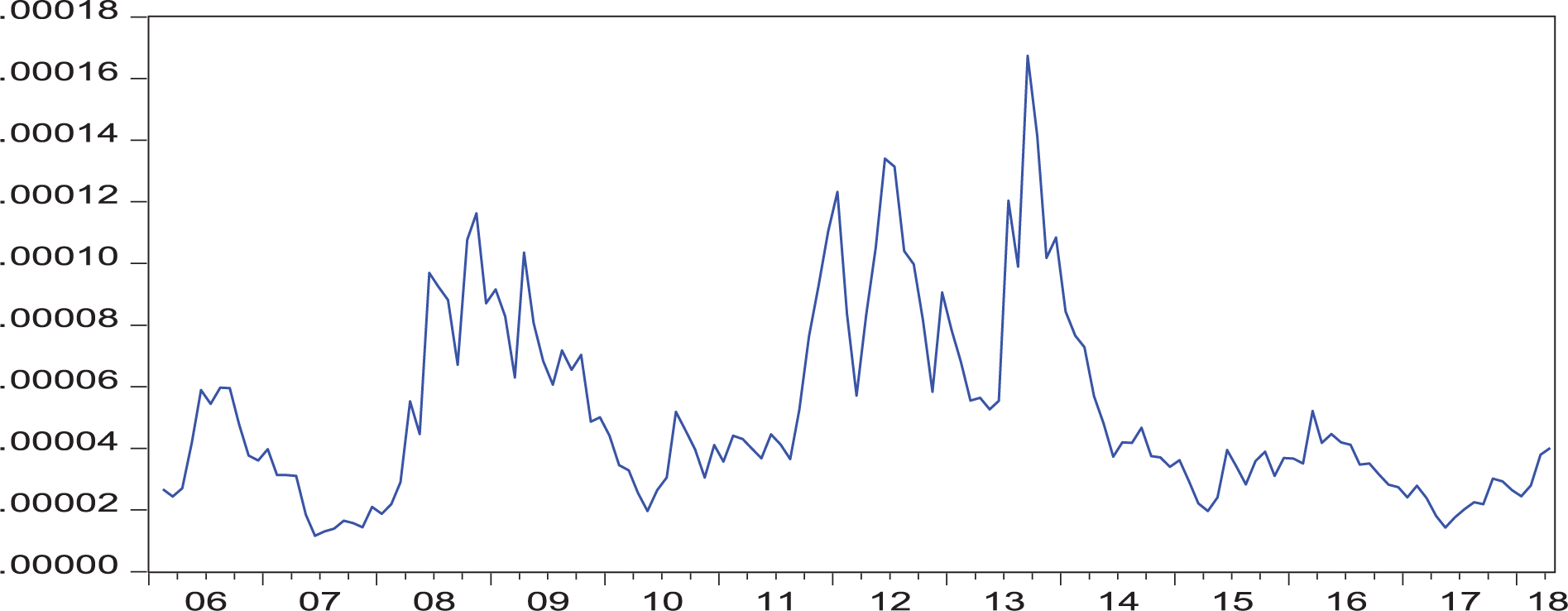
Nominal exchange rate–based estimated volatility.

Real exchange rate-based estimated volatility.
Econometric Specification
Following Martins, Gan, and Ferreira-Lopes (2017), we capture tourism demand using two proxies—the number of arrivals of and foreign exchange earnings from foreign tourists in India. The role of the exchange rate in determining the tourism demand model is widely discussed in the theoretical and empirical literature. Following De Vita and Kyaw (2013) and Saayman and Saayman (2013), we include volatility in the nominal exchange rate proxied by NEER volatility. Studies have identified price effect on tourism demand. Some studies (e.g., Schiff and Becken 2011) have used destination price level, while others have utilized relative price, that is, the ratio of domestic prices to foreign prices (e.g., Webber 2001; De Vita 2014). The relative price ratio is inducted in tourism demand estimation to check whether tourists favor visiting domestic destinations to traveling abroad because of variations in the inflation level. However, the model that includes both the exchange rate and relative prices is expected to encounter both multicollinearity and modeling bias problems (see Dogru, Sirakaya-Turk, and Crouch 2017). Quite often, the high level of association is present between relative prices and exchange rates as the theory of purchasing power parity asserts that the long-run exchange rate reflects the cost of living across nations (Gordon 1981). Furthermore, it is also likely that relative price volatility induces the exchange rate volatility. To avoid such a problem of multicollinearity, only Indian price index is used in the models. Additionally, following the literature, we adopt alternate specifications for incorporating the relative price—a ratio of the price of the destination country to the price of the source nations. This measures the prices in the destination nation as compared to prices in the source nation and identifies the impact of price differences across two nations. The related literature (e.g., Martins, Gan, and Ferreira-Lopes 2017) has shown that income effect is the most prominent factor in the demand model; therefore, we proxy it with the index of world Gross Domestic Product (WGDP). 1
Following Martins, Gan, and Ferreira-Lopes (2017), we specify the tourism demand model as follows:


where
Following Pesaran, Shin, and Smith (2001), equation (2) is expressed in an error correction form of an autoregressive distributed lag (ARDL) model as follows:

where ∆ denotes the first difference;
For assessing the possible nonlinear effect of the volatile exchange rate on tourism demand, following the nonlinear ARDL, we present the estimated NEER volatility (


where
Now, for equation (10), the decomposed estimated VNEER on foreign tourist arrival in India (TARRIVAL) is presented in terms of NARDL as follows:

The presence of long-run cointegration in equation (12) is assessed by testing the null hypothesis
Similarly, models under equations (3) to (9) have also been expressed in an error correction form of an ARDL, and then the decomposed estimated volatility of effective exchange rate is captured in terms of the NARDL model for estimation.
Results and Discussion
Test for Nonlinearity
To ascertain the nonlinear relationship, we conduct BDS nonlinearity tests to check time-based dependence, as developed by Broock et al. (1996). It is adopted for checking plausible deviations from independence covering both linear and nonlinear dependence besides chaos. We run all our models using ordinary least squares (OLS) estimator, and the estimated error series of each model is tested for a nonlinearity. Table S5 (in the supplementary material) presents results which show that in all cases, there is a nonlinear relationship among the underlying variables. The null hypothesis that there exist linear dependencies in these variables is convincingly rejected in all cases. Thus, we go ahead and employ the NARDL estimator on our models.
Nonlinear Cointegration Results
To test for cointegration, the bounds test for nonlinear cointegration developed by Pesaran, Shin, and Smith (2001) is conducted. For the foreign tourist arrival model, NEER- as well as REER-based models show a cointegration relationship among the underlying variables. Similarly, for the foreign tourist expenditure model, the null of no cointegration is also been rejected. These outcomes are an indication of the long-run economic relationship among the underlying variables (see Table S6 in the supplementary material).
Normalized Equations and Long-Run Elasticities
The results of estimated normalized equations are useful in understanding the long-run association among the underlying explanatory variables of exchange rate volatility, world income, and price level and the dependent variables of foreign tourist arrival and foreign exchange earnings from foreign tourists. 2 In this context, explanatory variables are denoted by their negative and positive partials. These indicators are normalized on the foreign tourist arrival or foreign exchange earnings from foreign tourist in India. These estimates offer the long-run elasticities of the respective explanatory variables and reflect percentage changes in tourism demand due to a unit change in the explanatory variables. Table 2 offers the results of the effects of positive and negative movements of explanatory variables on foreign tourist arrival. Estimated volatility in NEER is used as an explanatory variable in the model. We present results of the models with alternative price indicators. In both cases, results indicate for a long-run nonlinear impact of exchange rate volatility. However, positive and negative effects are not turned out to be statistically significant. In case of the effect of world income on foreign tourist arrival, positive asymmetric effect is estimated to be statistically significant. While the effect of negative asymmetry of income in the long run is statistically significant in the CPIR model (panel B) but not in the CPI model (panel A). The price indicator is established to have a positive asymmetric effect on foreign tourist arrival in India and as expected, it has a negative sign on tourism. The short-run effects of NEER volatility, as well as world income and price indicator on foreign tourist arrival in India, could not be well established. Portmanteau test and Breusch-Pagan statistics indicate for no autocorrelation and heteroscedasticity problems in estimation.
Results of Foreign Tourist Arrival Model—NARDL Estimator with Nominal Effective Interest Rate.

Note: Period of analysis: January 2006–April 2018. Dependent variable: TARRIVAL. VNEER is the estimated volatility of NEER based on the results persented in Table 1. Except VNEER, all variables are in logarithmic form and seasonally adjusted. Refer to Table S1 (in the supplementary material) for a description of the variables.
p < 0.10, **p < 0.05.
After testing NEER-based exchange rate volatility, we investigate the effects of uncertainty in the real exchange rate (REER) on foreign tourist arrival in India (Table 3). Models with CPI and CPIR results are not very different (see Panels A and B). Results suggest that volatility has a long-run asymmetric effect on tourism demand. Specifically, the long-run downward effect is found to have a positive impact on tourism demand. The world GDP also has an asymmetric effect on foreign tourist arrival in India. Importantly, both upward and downward income fluctuation is found to have a boosting effect on tourism, implying that increasing and decreasing income have positive and negative effects, respectively, yet at varying degrees. Results also indicate that the positive movement in price causes a negative effect on foreign tourist arrivals; this seems plausible as a higher price in India obviously discourages foreign tourists to visit India. However, the short-run effect is not validated by our analysis. This is in line with the expectation as the real exchange rate is primarily corresponding to the long-run, not to the short-run. No serious autocorrelation and heteroscedasticity problem is detected. Although, in hypothesis testing, the normality issue does have a concern, it is not insurmountable.
Results of Foreign Tourist Arrival Model: NARDL Estimator with a Real Effective Interest Rate.

Note: Period of analysis: January 2006–April 2018. Dependent variable: TARRIVAL. VNEER is the estimated volatility of REER based on the results presented in Table 1. Except VREER, all variables are in a logarithmic form and seasonally adjusted. Refer to Table S1 (in the supplementary material) for a description of the variables.
p < 0.10, **p < 0.05.
To test the robustness of our results on foreign tourist arrival in India, we use earnings from foreign tourists in India as an indicator of tourism demand in the country. We repeat our analysis for the earning models. Results of the NEER-based model (Table 4) point out a positive, sizable, as well as statistically significant effect of long-run negative exchange rate volatility. But there is no sign of the positive asymmetric impact of NEER volatility on the earnings from foreign tourists. The world income represented by WGDP also turned out to be positive as well as significant as expected. Importantly, both positive and negative asymmetric effects emerged to be statistically significant, yet the negative asymmetry is dominant over the positive one in terms of size, suggesting that a negative change in income of the source country has a much higher impact on the earnings from foreign tourists in India than that of a positive change. We do find some effects of price indicators are well. Specifically, the positive asymmetric effect of CPI and both asymmetric effects of CPIR are observed in results. Similar to previous results, the short-run effect could not be established. Estimated statistics of Portmanteau and Breusch-Pagan indicate that autocorrelation and heteroscedasticity have not affected the results.
Results of Foreign Exchange Earnings From Foreign Tourists Model—NARDL Estimator with a Nominal Effective Interest Rate.

Note: Period of analysis: January 2006–April 2018. Dependent variable: TEARN. VNEER is estimated volatility of NEER based on results of Table 1. Except VNEER, all variables are in logarithmic form and seasonally adjusted. Refer to Table S1 (in the supplementary material) for a description of the variables.
p < 0.10, **p < 0.05.
Finally, we estimate the effects of real exchange rate-based volatility on foreign exchange earnings from foreign tourists in India (Table 5). The estimated results show a boosting effect of the positive long-run real exchange rate volatility on the earnings and a dampening effect of negative long-run real exchange rate volatility. As expected, income has turned out to be positive and significant on foreign exchange earnings from foreign tourists in India for positive effects when CPI is included in the model. However, Panel B results show no sign of the income effect on the earnings. We also do not find any short-run effect of income on the foreign exchange earnings from foreign tourists in India. The price indicators (CPI and CPIR) are found to have, as expected, a dampening effect for the positive asymmetry. The results of Table 5 demonstrate some inconsistency because perhaps the real exchange rate volatility also reflects the price effect in the model. Diagnostic tests do not fully validate the specification of the empirical models and show marginal concern regarding normality and heteroscedasticity (in Panel B). However, these issues are not insurmountable.
Results of Foreign Exchange Earnings from Foreign Tourists Model: NARDL Estimator with a Real Effective Interest Rate.

Note: Period of analysis: January 2006–April 2018. Dependent variable: TEARN. VREER is the estimated volatility of REER based on the results presented in Table 1. Except VREER, all variables are in logarithmic form and seasonally adjusted. Refer to Table S1 (in the supplementary material) for a description of the variables.
p<0.10, **p<0.05.
Asymmetric ARDL in Error Correction Model
After presenting the long-run and short-run asymmetric relationship, we present results of error correction models. It is noteworthy that the normalized equation results for all the models in consideration show a somewhat unnoticeable effect of the variables. We still present results of short-run effects of error correction to understand the short-run dynamic, especially the pace of the error correction of the deviation.
Table 6 presents estimation results for the model with foreign tourist arrival. Results for the NEER-based model indicate that a negative volatility in exchange rate has a significant and dampening effect on tourist arrival; however, a positive volatility in exchange rate is not found to be statistically significant. The first difference of volatility and its lags also could not clear the hypothesis test. Furthermore, we do find a boosting effect of positive asymmetric fluctuation and dampening effect of negative asymmetric movement of the source countries’ income on foreign tourist arrivals in India. The positive asymmetric effect of price is estimated to have a significant and dampening effect on foreign tourist arrival. The price is not found to have a noticeable impact on the foreign tourist arrival across the models. Results of REER-based volatility model is not much different from that of the NEER-based model. The only major difference is that income is not found to have any significant effect in one case. It is noteworthy that the lag term of the dependent variable (TARRIVAL(t − 1)) is estimated to be negative and statistically significant, implying that a convergence process is operating and deviation from the long-run equilibrium will disappear within a course of time.
Results of Error Correction Model—Foreign Tourist Arrival Model.

Note: Dependent variable: TARRIVAL. Refer to Table S1 (in the supplementary material) for a description of the variables. Volatility is the estimated volatility of the exchange rate. In panels A and B, VNEER and VREER are the respective volatility measures. Both series are estimated based on the results presented in Table 1. Models utilize up to four lags; however, a maximum of one lag is reported as higher lags are not found to be statistically significant. The + and – signs indicate positive and negative impact, respectively. “d.” indicates first difference.
p < 0.10, **p < 0.05.
It is noteworthy that first difference of variables and their lags seem to have no recognizable impact implying that overall effects of variables in the model, that is, past exchange rate volatility, income, as well as price effect, do not have a noticeable effect on the foreign tourist arrival in India.
Table 7 presents the estimated error correction model of foreign exchange earnings from foreign tourists in INR. The results are notably different from the foreign tourist arrival models. Focusing on volatility effects on foreign exchange earnings from foreign tourists, results of all models indicate that the downward asymmetry of volatility is negative and statistically significant; however, the same is not true for the upward asymmetry. There is no effect of the income across the models. Nevertheless, the price and relative prices are significant and negative in all cases.
Results of Error Correction Model—Foreign Exchange Earnings from Foreign Tourists Model.

Note: Dependent variable: TEARN. Refer to Table S1 (in the supplementary material) for a description of the variables. Volatility is the estimated volatility of exchange rates. In panels A and B, VNEER and VREER are the respective volatility measures. Both series are estimated based on the results presented in Table 1. Models utilize up to four lags; however, a maximum of one lag is reported as higher lags are not found to be statistically significant. The + and – signs indicate positive and negative impact, respectively. “d.” indicates first difference.
p < 0.10, **p < 0.05.
Quite similar to the arrival results, here too the first difference of variables and their lags seem to have no recognizable impact, implying that the overall effects of variables in the model, that is, the past exchange rate volatility, income, as well as price, do not have a noticeable effect on the earnings from foreign tourists in India.
Discussion
Our findings regarding exchange rate volatility seem to be crucial in affecting tourism demand. Our results confirm the long-run impact of a volatile exchange rate on tourism demand in India. However, it is easily noticeable that there are some variations in the results when we employ different measures of tourism demand in India. Specifically, it is evident that a difference is present in the estimated elasticities of the macroeconomic determinants when we use quantity (tourist arrivals) and value (foreign exchange earnings). The difference is quite visible, especially in the short-run. 3 Precisely, models based on foreign exchange earnings demonstrate a comparatively larger effect of volatility of exchange rate, price, and income. It implies that these macroeconomic factors affect the decision regarding the level of spending by foreign tourists in the destination nation more directly and intensely than the decision to travel. It is also noteworthy that lags of uncertainty or risk in exchange rate dealing and other macroeconomic factors have some impact on foreign exchange earnings from foreign tourists, while, on the arrival, it is only contemporary factors that are carrying significant effect. These results corroborate the findings of Martins, Gan, and Ferreira-Lopes (2017) that also find that earnings from foreign tourists as a proxy work better for tourism demand analysis.
We find that uncertainty in the nominal and real exchange rate impacting demand for tourism in India, in the long- and short-run. While results regarding the asymmetric relationship show a mixed picture, there is some evidence that indicate asymmetric effects of the volatility. However, the price effect is found to be weaker, and this is not surprising considering the close linkage between exchange rate and price. Previous studies, such as Cheng, Kim, and Thompson (2013), Tang (2013), Saayman and Saayman (2013) and Martins, Gan, and Ferreira-Lopes (2017), have found some impact, albeit lower, of the nominal or real exchange rate on tourism. Our findings indicate that if we choose the risk factor of exchange rate instead of the movement of exchange rate, it will demonstrate much better explanatory power, especially on foreign exchange earnings from foreign tourists in India. As shown by earlier investigations that income is usually the key determinant of tourism demand (Crouch 1992, 1994), our findings confirm such impact. Additionally, our results show evidence for asymmetric effects of income. In fact, it points toward a differential impact when income increases and decreases. Earlier studies (e.g., Crouch 1994; Lim 1997, 1999; Dogru, Sirakaya-Turk, and Crouch 2017) have included a lagged dependent variable that allows to capture habit, word-of-mouth, travel expenses, varying travel preferences, and marketing overheads in the empirical model. Our results also confirm these findings, as the lag term of dependent variables is found to be significant in all models.
Conclusion
We explored the asymmetric effect of exchange rate volatility on tourism demand in India during the period January 2006 to April 2018. We used the nonlinear autoregressive distributed lag model that allows testing the potential nonlinear effect in the long- as well as short-run horizon. There has been limited use of exchange rate volatility in tourism demand models, and its role is found to be very mixed and unclear when used along with relative prices (e.g., Webber 2001; De Vita and Kyaw 2013; Martins, Gan, and Ferreira-Lopes 2017). Some recent studies (Sharma and Pal 2018) have shown it is not the exchange rate but the volatility in exchange rate that affects international transaction and trade. Motivated by such findings, we test the effect of nominal and real exchange rate volatility on tourism demand in India. Findings of our study evidently show that volatility in exchange rate does affect foreign tourist arrival as well as foreign exchange earnings from foreign tourists in India. Our results show that nominal and real exchange rate volatility not only affects tourism demand in India in both the long- and short-run, the impact is also found to be asymmetric. Moreover, the long-run impact of exchange rate volatility on tourism demand in India is more intense than that of the short-run.
The estimates of asymmetric effects in comparison with the general symmetric long-run equilibrium models revealed more key information from a policy standpoint. The symmetric models’ interpretation is restricted as the positive and negative movements in the regressors would average out, consequently, seriously controlling the forecasting ability of the model. This, in turn, is a loss of the relevance of results for managerial and policy formulations. Our results show a mixed outcome for asymmetric effects; however, there is some evidence suggesting that when the volatility or uncertainty of exchange rates goes down, foreign tourism in India flourishes. On the other hand, the effects of positive asymmetry are marginal. Furthermore, we also obtain evidence that demonstrates dominance of the negative effect of exchange rate volatility over the positive impact.
Our results have several important implications for policy makers and managers not only in India but also for other, diverse developing economies. The implications are mainly strong with respect to exchange rate volatility. Considering the fact that exchange rate volatility is important for modeling India’s tourism demand function, any tourism promotion and development initiated by the government could be ineffective under volatile exchange rates. Often the exchange rate in developing countries is adjusted for export promotion, import substitution, and for attracting capital inflows. However, such an initiative leads to higher volatility in the exchange rate, which has serious consequences for the tourism sector. It is noteworthy that the tourism sector is unfairly ignored from the exchange rate policy perspective despite the fact that it is immensely important from foreign exchange earnings, contribution to economic growth and employment generation viewpoints. Therefore, an important outcome of our study is that policy makers should consider exchange rate management from the foreign tourism perspective even in developing countries like India.
Our attempt in this research offers new analytical and empirical evidence supporting the asymmetric effect of income and exchange rate volatility on tourism demand in India. This article is not free from limitations; the most notable is the use of aggregated data. For better accuracy of results, future research may take into account the disaggregated-level and origin-destination data in the analysis, which are likely to reveal more information and have direct policy implications. Also, nonlinear evidence of exchange rate volatility may be tested for other developing countries.
Supplemental Material
Appendix – Supplemental material for Exchange Rate Volatility and Tourism Demand in India: Unraveling the Asymmetric Relationship
Supplemental material, Appendix for Exchange Rate Volatility and Tourism Demand in India: Unraveling the Asymmetric Relationship by Chandan Sharma and Debdatta Pal in Journal of Travel Research
Footnotes
Acknowledgements
This article has significantly benefited from the valuable inputs from the Editor and three anonymous referees. However, the authors are responsible for any errors that remain.
Declaration of Conflicting Interests
The author(s) declared no potential conflicts of interest with respect to the research, authorship, and/or publication of this article.
Funding
The author(s) received no financial support for the research, authorship, and/or publication of this article.

Supplemental Material
Supplemental material for this article is available online.
Notes
Author Biographies
References
Supplementary Material
Please find the following supplemental material available below.
For Open Access articles published under a Creative Commons License, all supplemental material carries the same license as the article it is associated with.
For non-Open Access articles published, all supplemental material carries a non-exclusive license, and permission requests for re-use of supplemental material or any part of supplemental material shall be sent directly to the copyright owner as specified in the copyright notice associated with the article.
