



Abstract
Effectiveness of destination advertising to potential tourists has been enhanced with the use of personalized orientation. After an online search for information about a destination, individuals are exposed to advertisements related to the destination on their social media newsfeed. However, further understanding is warranted in terms of how these destination messages should be crafted. Thus, our research aims to uncover how destination advertising design, message appeal type, and language abstraction level interact with a message recipient’s psychological distance to his or her trip to influence consumer response to the advertising. Based on construal level theory, we conducted a scenario-based experiment, using manipulated messages and psychological distance state to assess message effectiveness. The findings show that the type of message design respondents favor can vary either by perceived temporal distance to their travel plans or spatial distance to the travel destination.
Keywords
Introduction
As social media becomes ubiquitous, consumers are developing a complex relationship with online marketing-oriented contents. According to a survey conducted with the millennial generation (Rapt Media 2016), 95% of the survey respondents take actions to avoid seeing ads online, while 42% of the respondents simply do not trust these marketing messages. However, a well-crafted message that is customized to consumers’ interests can attract their attention. In the same survey, more than half of the respondents were found to be willing to spend more time with marketing contents when they fit their interests.
Advanced algorithm-based social media marketing functions, including personalized content display, are suitable to satisfy such consumer needs. For example, Facebook’s “dynamic ads for travel” allows hospitality and travel advertisers to target potential customers with relevant ads based on the specific dates, destination, and other details of their trip (Sârbu, Alecu, and Dina 2018). Referred to as social media advertising (SMA), these customized messages appear directly in a user’s newsfeed on social media. They greatly increase the ad’s relevance to potential tourists. For instance, based on a person’s hotel reservation in Cancun, he or she is likely to see SMA related to their trip on Facebook, such as an advertisement on activities in Cancun.
Despite its importance, much is yet to be known as to how SMA content needs to be designed to more effectively accompany such algorithmic precision in targeting. Because of the intangible nature of vacation as a product (i.e., not being able to be experienced prior to purchase), potential travelers are greatly influenced by external information (Kotler et al. 2016). In fact, a destination marketing message on social media was found to be effective in arousing positive behavioral intention from potential travelers when the message is relevant to the users (Kim et al. 2017). SMA can be highly suitable to address such needs in line with its capacity in exposing marketing messages to users based on their interests and other information, such as where they are interested in traveling to or when they will travel. In this sense, SMA message design can be very important in terms of enhancing personal relevancy. It is against this background that our research set out to investigate how SMA message design could enhance the effectiveness of destination marketing.
The notion of psychological distance is appropriate in illuminating consumer psychology related to SMA’s function of message tailoring based on traveler’s trip planning situations (such as time horizon and location). Psychological distance explains the subjective experience that something is close or far away in terms of time, space, social distance, and hypotheticality (Trope and Liberman 2010). One’s level of psychological distance could influence the persuasiveness of a message (Lee and Aaker 2004). Despite the congruence in concept between psychological distance and nature of SMA including “dynamic ads for travel,” not much has been explored regarding the question of how individuals respond to different destination advertising designs by their psychological distance to their point of travel.
In SMA, a message design that is compatible with one’s psychological distance may enhance the effectiveness of the message. However, there is insufficient knowledge as to how these two variables may interact to impact consumer response, especially in the destination marketing context. This research investigated two types of destination message designs, namely, “abstract or concrete message appeal type” and “language abstraction.” We assessed how these two design factors could possibly work in line with psychological distance.
Given this background, this study set out to address the following research objectives: (1) to explore the interplay of traveler psychological distance with message appeal types on message recipients’ response to destination SMA and (2) to investigate the interactive effect of variations in language abstraction of destination SMA and traveler psychological distance on the message recipients’ responses to destination SMA. For this research, Facebook is chosen as the case study since Facebook is the market leader with the most users among other social media platforms (2.2 billion monthly active users as of 2018) (Statista 2018). The prevalence of destination marketing ads on Facebook, featured by dynamic ads for travel, further underscores the need for investigating how hospitality and travel marketers can most optimally employ SMA on Facebook.
Literature Review
Destination Social Media Marketing
Social media has been noted as one of the most popular and effective means to directly communicate with potential travelers (Belch and Belch 2014). The majority of potential travelers search for information from social media for their trip planning (Leung et al. 2013). Destination-generated marketing contents individuals encounter during information search have been found to be effective in delivering information and in enhancing consumer attitude toward a destination (Kiráľová and Pavlíčeka 2015).
The SMA message needs to be appropriately designed to be helpful for potential travelers’ trip planning activities. For instance, in line with the intangible nature of travel experience, a destination advertising that evokes the message recipient’s mental imagery of the trip can be effective. This is why the majority of destination advertising tends to be focused on images (Kim, Kim, and Bolls 2014). Moreover, as travel tends to be perceived as a product high in uncertainty, it has been argued that an endorser who is high in credibility, such as a social influencer, tends to be an effective endorser in destination advertising (Xu and Pratt 2018).
In a destination social media content, Kim et al. (2017) noted that the relevancy of the information provided is important in enhancing a respondent’s positive cognitive and affective destination image. Despite its importance, little is known about how a destination message content with high personal relevancy should be designed in order to maximize its effectiveness. SMA has increasingly facilitated information relevancy to the potential consumers as the social media algorithms allow marketers to specifically target their message to those who showed interest to travel to their destination or who have booked a trip to the destination. However, there is a lack of understanding regarding destination SMA and its message content design.
Given this, this research explores how SMA should be designed to optimally elicit positive responses from potential travelers, specifically in association with a unique psychology, that is, consumer psychological distance.
Psychological Distance and Information Processing
Psychological distance, one’s perception of when an event occurs, where it occurs, to whom it occurs, and whether it occurs, influences individuals’ thoughts, responses, and behaviors (Trope and Liberman 2010). There are four dimensions of psychological distance: temporal distance, spatial distance, social distance, and hypothetical distance (Liberman, Trope, and Stephan 2007). When the psychological distance increases, an individual perceives the event to take place further in the future, in a farther space, less likely to take place, and less likely to occur to people that are close to them (Rachlin, Brown, and Cross 2000). Psychological distance is found to impact how individuals process incoming information.
Construal level theory (CLT) explains the relationship between one’s psychological distance and the level at which they process incoming information. According to CLT, psychologically distant objects are construed at a high and abstract level while psychologically near objects are construed at a low and concrete level (Trope and Liberman 2010). When the psychological distance is large, individuals use broader categories in classifying objects than when they construct information at a lower level of abstraction for the near future (Liberman, Sagristano, and Trope 2002).
The motivational state of processing information lends support to understanding the relationship between psychological distance and construal level. For a psychologically distant event, people are likely to construe events in terms of desirability (e.g., why is this activity important). For a psychologically close event, the feasibility of the event (e.g., how to perform this activity) becomes more salient (Trope et al. 2007). The cognitive processing of why pertains to high-level construal whereas the thinking about how pertains to low-level construal. Thus, the level of psychological distance individuals engage in prompts them to prefer different information (why or how).
Although limited in research scope, the existing tourism literature acknowledges that psychological distance plays an important role throughout the various phases of a trip. At the decision-making phase, Zhang, Seo, and Lee (2013) concluded that medical tourists, especially for relatively minor disease, would choose to travel to a destination with low psychological distance as they feel that they have more concrete knowledge about the destination. During the trip, Massara and Severino (2013) observed that tourists in a high psychological distance condition internalized their heritage experience at an abstract level while those in a low psychological distance condition processed their experience at a concrete level. In their post-trip reminiscence, tourists who perceived themselves to be culturally distant to the destination had abstract memories while culturally proximate tourists’ memories were more concrete (Prentice 2006).
In line with the idea of CLT, these findings corroborate with the notion that tourists process information that corresponds with their mental representation, which leads to a positive evaluation of the event (Tsai and McGill 2010). As individuals process information that is consistent with their mental state, they are likely to experience a sense of fluency or feeling right (Reber, Schwarz, and Winkielman 2004). On the other hand, people are less likely to pay attention to information that is inconsistent with their mental state since they are less likely to encounter fluency (Petty and Wegener 1998). As such, individuals’ construal levels significantly impact their preference for the information and purchase decisions (Schwarz and Clore 1983) and this can be argued to be true in a tourism setting.
The correspondence between construal level induced by the psychological distance to an event and message design has been found to be important in effectively delivering marketing messages. For example, Zhao and Xie (2011) noted that individuals perceive a message that conforms with their construal level to be persuasive. In their study, recommendations that were high in abstraction level were perceived to be more persuasive for respondents making a decision in a distant future than respondents who were making a decision in a near future (ibid.). This linkage, however, has yet to be fully understood in the hospitality and tourism field. Zhang (2014) found that consumers exhibit a positive attitude and behavioral intention when their construal level corresponds with the processing fluency level aroused by hotel corporate social responsibility messages. Kim et al. (2016) also concluded that the abstractness or concreteness of a message that matches consumers’ psychological distance to their stay in a hotel determines their preference for the hotel. In addition, Tan (2017) argued that tourists search for information more intensely as the temporal distance to their trip decreases, in which they prefer to receive concrete information including safety.
While the above findings offer valuable insights in understanding the importance of match between tourists’ psychological distance and the nature of message received, our understanding is lacking regarding the specific design of destination advertising beyond the message being either concrete or abstract. One of the very few studies that addressed this gap is the work of Chou and Lien (2012). By examining matching effects of psychological distance with two message elements including incentive types and appeal types, they found that when tourists are spatially distant to their travel destination, they prefer nonmonetary incentive and promotion-framed messages. On the other hand, tourists prefer monetary incentive and prevention-framed messages when they perceive a travel destination to be spatially close. Other message design effectiveness remains to be explored in relation to psychological distance dimensions.
Beyond spatial distance, destination advertising research has paid little attention to temporal distance. As a result of sophisticated algorithms, today’s destination SMA is equipped with functions to personalize SMA by tourists’ temporal distance to their trip. To fully capitalize this technology affordance, we need to further understand how these messages should be curated to be effective. Thus, this study examined both temporal distance and spatial distance, respectively. Specifically, temporal distance was explored in study 1 and spatial distance in study 2. For each study, effectiveness of two message design factors that have not been considered in the existing literature in line with psychological distance, namely, language abstraction level and benefit/attribute message appeal, were investigated.
Language Abstraction
Language abstraction denotes the use of different levels of abstract language to describe behavior or an event (Douglas and Sutton 2006). Language abstraction is focused on the general linguistic aspects of language use rather than the subjective meaning of the content (Semin and Fielder 1988). Linguistic Category Model (LCM), which the language abstraction level distinction is based on, categorizes the language abstraction level by the use of verbs and adjectives that describe the behavior as outlined in the work of Schellekens, Verlegh, and Smidts (2010): At the most concrete level are Descriptive Action Verbs (DAV), which convey non-interpretative descriptions of single, observable events (e.g., “Kirk hits Matt”). At the second level, Interpretive Action Verbs (IAV) refer to a more general class of specific observable behaviors. IAVs do not preserve the perceptual features of an action (e.g., “Kirk hurts Matt”). State Verbs (SV) form the third category. They describe an enduring unobservable (mental) state of the actor, and not a specific behavior (e.g., “Kirk hates Matt”). The most abstract category consists of Adjectives (Adj), which describe only the sentence subject and generalize the behavior to the trait level, which is presumably stable across events (e.g., “Kirk is aggressive”). (p. 21)
As such, LCM is a systematic means to differentiate abstractness or concreteness of description using language. LCM has mostly been used in studying verbal communication in interpersonal behavior, including assessments of how people differ in their use of the language abstraction level conditioned in various psychological distances. Findings suggest that one’s psychological distance can influence the degree of language abstraction employed. For example, in the work of Semin and Fiedler (1988), individuals were found to use more abstract language when describing others’ actions (psychologically distant) than when describing their own actions (psychologically proximate). Similarly, people were found to use more abstract language than concrete language when depicting spatially distant interactions (Fujita et al. 2006). Since people are less certain and less knowledgeable about distant or unlikely events, they tend to depict those distant events in a more abstract fashion (Wakslak et al. 2006). Therefore, the greater one’s perceived distance to an object/event being described, the more abstract language is used by the describer.
Although limited, there are a few studies that have attempted to understand how different language abstraction levels of a message impacts individuals’ message processing. For instance, the work of Schellekens, Verlegh, and Smidts (2010) studied language abstraction in delivering commercial product information. They noted that concrete language was more effective than abstract language when used in negative Word of Mouth (WOM). Furthermore, the positive WOM led message recipients to exhibit a more favorable response when abstract language is used as compared to when concrete language is used. The research conducted by De Angelis et al. (2017) also tested the effectiveness of language abstraction on people’s responses when employed in written messages of customer referrals. They concluded that in the context of financial and medical services, messages framed with abstract language are more effective than concrete language when the message recipients have prior knowledge about a service (ibid.).
Although language abstraction level in a message has the potential to drive message effectiveness, research on this topic has been very limited in the context of destination advertising. The work of J. Kim et al. (2016), one of the very few studies that examined the effectiveness of message abstractness/concreteness with psychological distance in a hotel advertising, found that the fit between abstract/concrete message and high/low psychological distance enhances message effectiveness. While their findings lend support to the proposition that the match between language abstraction and psychological distance could be important in increasing message effectiveness, the study focused on concreteness/abstractness of pictorial content rather than language use.
As noted above, the existing literature suggests that the match between psychological distance toward an event and the level at which individuals construe the event can lead to enhanced message effectiveness (e.g., Kim, Zhang, and Li 2008). As such, we propose that the language abstraction level should be aligned with potential tourists’ psychological distance in destination SMA. Our research complements the existing literature by applying the theoretical framework of LCM in designing concrete/abstract language messages. Existing research, including the work of Kim et al. (2016), have relied on the researchers’ subjective judgment of message abstractness in message design, rather than being guided by a theory to ensure abstractness or concreteness of the message. Based on the above literature review on spatial psychological distance, we developed the following six hypotheses.
Hypothesis 1: When a destination SMA features “high language abstraction,” as compared to “low language abstraction,” tourists planning to travel in the temporally distant future will exhibit (a) more favorable attitudes toward the message and (b) more favorable attitudes toward the destination.
Hypothesis 2: When a destination SMA features “low language abstraction,” as compared to “high language abstraction,” tourists planning to travel in the temporally near future will develop (a) more favorable attitudes toward the message and (b) more favorable attitudes toward the destination.
Hypothesis 3: When a destination SMA features “high language abstraction,” as compared to “low language abstraction,” tourists planning to travel to a spatially distant destination will exhibit (a) more favorable attitudes toward the message and (b) more favorable attitudes toward the destination.
Hypothesis 4: When a destination SMA features “low language abstraction,” as compared to “high language abstraction,” tourists planning to travel to a spatially near destination will develop (a) more favorable attitudes toward the message, and (b) more favorable attitudes toward the destination.
Message Appeal Type
Advertisement message effectiveness is found to be influenced by message appeal types (Hernandez, Wright, and Ferminiano Rodrigues 2015). A message that employs attribute message appeal focuses on highlighting the concrete features or characteristics of a product whereas benefit message appeal emphasizes the holistic values that the product experience could offer (Lancaster 1971). What appeal strategy to use in a message may need to correspond to consumers’ construal level in processing incoming messages. According to CLT, the fit between message design and the message recipients’ construal level determines message effectiveness (Zhang 2014). A message framed in a benefit appeal would be construed at a high-level abstraction as it emphasizes abstract and global cognition, and thus, it will be effective for a psychologically distant event (Gutman 1982). For a psychologically near event, attribute appeal messages—ones that focus on concrete and detailed cognition—will be effective because this type of message leads to low-level abstraction. In confirming this proposition, Hernandez, Wright, and Ferminiano Rodrigues (2015) found that attribute message appeal was more effective for consumers who planned on making a purchase in the near future while benefit message appeal elicited better consumer response for those who planned to make a purchase in the distant future. However, limited studies have investigated the interactive effect of message appeal type and individuals’ psychological distances in destination advertising.
In the tourism literature, one of the most studied form of message appeal type include rational/emotional advertising. Specifically, emotional destination marketing messages have been found to be more effective than rational messages, one possible explanation is that the hedonic nature of tourism products is compatible with emotional appeal (Wang, Kim, and Agrusa 2018). Other message appeal types including benefit or attribute message appeals are less explored. For example, Pan and Fesenmaier (2006) found that potential tourists seek for concrete information prior to their trip (e.g., ticket price of an attraction). However, it is not well understood as to how benefit or attribute appeals may work in destination advertising. As we know, tourists do seek global benefits from their trip including enhancement of happiness and well-being (e.g., Lehto 2013; Chen, Lehto, and Cai 2013), so benefit appeal advertising could be attractive. As information on both concrete and abstract benefits of a destination can be important, under what condition each framing may be effective could further our understanding.
Little is known about the effect of attribute or benefit appeals in the destination advertising context, especially with regard to how these two appeal types may interact with message recipients’ information processing construal level. This study seeks to expand the current knowledge in this regard. As indicated in the general advertising literature, message effectiveness can be dependent on the congruency between message appeal type and message recipient’s construal level in processing incoming messages. Specifically, as one’s construal level is dependent on how distant or near the event is, destination message appeal type can be predicted to work with a potential tourist’s psychological distance toward a trip to influence message effectiveness. Thus, the following hypotheses are proposed.
Hypothesis 5: When a destination SMA features “benefit appeal,” as compared to “attribute appeal,” tourists planning to travel in the temporally distant future will show (a) more favorable attitudes toward the message and (b) more favorable attitudes toward the destination.
Hypothesis 6: When a destination SMA features “attribute appeal,” as compared to “benefit appeal,” tourists planning to travel in the temporally near future will develop (a) more favorable attitudes toward the message and (b) more favorable attitudes toward the destination.
Hypothesis 7: When a destination SMA features “benefit appeal,” as compared to “attribute appeal,” tourists planning to travel to the spatially distant destination will show (a) more favorable attitudes toward the message and (b) more favorable attitudes toward the destination.
Hypothesis 8: When a destination SMA features “attribute appeal,” as compared to “benefit appeal,” tourists planning to travel to a spatially near destination will develop (a) more favorable attitudes toward the message and (b) more favorable attitudes toward the destination.
Method
In order to address the proposed hypotheses, two scenario-based studies were designed. Study 1 intended to examine interactions among message appeal types, language abstraction levels, and vacation temporal distance on message recipients’ responses to destination SMA.
Therefore, study 1 adopted a 2 (appeal type: attribute vs. benefit) × 2 (language abstraction: high vs. low) × 2 (temporal distance: near vs. distant) between-subject design. The study subjects were given one of the eight conditions. Specifically, they were given one of the two temporal distance conditions and one of the four types of destination advertisements designed to reflect on language abstraction levels (high vs. low) and appeal types (benefit vs. attribute). Regarding data analysis for study 1, a 2 (message appeal: benefit vs. attribute) × 2 (language abstraction: high vs. low) × 2 (temporal distance: high vs. low) multivariate analysis of variance (MANOVA) was conducted with the dependent variables being attitude toward advertisement and attitude toward destination.
Study 2 aimed to examine the interactional effects of message appeal types, language abstraction levels, and spatial distances on message recipients’ response to destination SMA. Thus, a 2 (appeal type: attribute vs. benefit) × 2 (language abstraction: high vs. low) × 2 (spatial distance: near home vs. distant from home) between-subject design was adopted. One of the eight conditions were presented to each survey respondent. The condition comprised of one of the two spatial distance levels and one of the four types of destination advertisements described in study 1. For study 2, a 2 (message appeal: benefit vs. attribute) × 2 (language abstraction: high vs. low) × 2 (spatial distance: high vs. low) MANOVA was performed on attitude toward advertisement and attitude toward destination to explore how each message appeal type and language abstraction level interacts with spatial distance regarding the two dependent variables.
Procedure and Experimental Treatment Materials
A scenario-based online survey was developed to examine the proposed hypotheses. The surveys were distributed on Amazon Mechanical Turk (MTurk), responses from which have been found to be relatively reliable compared to other online data collection mechanisms (Paolacci, Chandler, and Ipeirotis 2010). A total of 420 respondents were recruited for this study. Half of the respondents were for study 1 (temporal distance conditions) and half were for Study 2 (spatial distance conditions). The two surveys distributed to each group were identical except that the respondents in study 1 were induced to think about the amount of time left until their trip while those in study 2 were triggered to think about the distance to the travel destination.
In the first part of the questionnaire, respondents were randomly selected to engage in either distant or near perceptions regarding travel temporal distance. Respondents in the temporally distant condition were given one of the two following descriptions: “Please imagine that you will be travelling tomorrow” (low temporal distance) or “Please imagine that you will be travelling a year from now” (high temporal distance). For respondents in the spatial distance condition, one of the two following descriptions were provided: “Please imagine that you will be going on a vacation trip to a nearby location where you could drive within 2 hours” (low spatial distance) or “Please imagine that you will be going on a vacation trip to an international location where you have to take an airplane for 12 hours” (high spatial distance).
In the second part of the questionnaire, one of the four types of advertisements on Facebook was randomly shown to the respondents. It should be noted that these advertisements were hypothetically designed within a Facebook interface. These four types of messages were crafted based on varying language abstraction levels and message appeal types. Specifically, the four types are high language abstraction–benefit message appeal; high language abstraction–attribute message appeal; low language abstraction–benefit message appeal; and low language abstraction–attribute message appeal. These crafted messages are presented in the appendix. Each message consists of two sentences in which a high or low language abstraction level was incorporated in the first sentence while either benefit or attribute message appeal was embodied in the second part of the message.
In accordance with the guideline of the Linguistic Category Model (LCM) (Schellekens, Verlegh, and Smidts 2010), phrases were constructed to represent two levels of language abstractness. According to LCM, a message with concrete language tends to be composed of descriptive action verbs that represent noninterpretative descriptions of an event or a context. That is, this type of language abstraction tends to display an objective manner in delivering information. Thus, in this research, a message with a low language abstraction level, composed of language in which no judgmental tone was incorporated, would be as follows: “Destination A provides various water sports activities.” On the other hand, high language abstraction tends to be composed of adjectives, which are highly interpretive. Therefore, this research created the high language abstraction message condition in which the language used implies subjective judgment and used adjectives: “Destination A is an exciting water sports destination.”
By referencing how each benefit and attribute message appeal has been manipulated in past research, two message appeal types were crafted. In order to convey a benefit appeal, past research focused on conveying the values that individuals can enjoy by consuming products and services (Hernandez, Wright, and Ferminiano Rodrigues 2015). Therefore, our benefit message was designed in a way that describes benefits that can be obtained by visiting the destination. Specifically, the message was, “Get a sample of what the new season brings to destination A!” Additionally, outlining concrete offerings has been the convention in previous works to represent attribute appeal (Meeds and Farnall 2018). Thus, the attribute appeal message crafted for this research consisted of listing activities that can be enjoyed at the destination. This message was, “Try our new surfing and kayaking program at destination A!”
Following the exposure to one of these four messages, respondents were asked questions on their attitude toward the message and their attitude toward the destination. All the questions started with the statement of “After seeing this advertisement on Facebook . . . ” to make sure that respondents would respond based on their exposure to the Facebook message. All variables were measured on a 5-point (1 = strongly agree and 5 = strongly disagree) Likert-type scale. “Attitude toward message” was measured by “The advertisement was” (followed by attractive, appealing, good, favorable, pleasant, desirable, and persuasive) (Drolet, Williams, and Lau-Gesk 2007; Lam and Hsu 2006; Muehling and Laczniak 1988). Respondents’ attitude toward destination were measured by asking whether respondents think the destination was good, positive, pleasant, and favorable (Lam and Hsu 2006). It should be noted that in the analysis, items were averaged to operationalize the two attitudinal measures (message and destination). Lastly, demographic information including gender, age, and education level was gathered.
To test for reliability of the measurements, Cronbach’s alpha was used. The findings of the reliability test showed that all values ranged from .85 to .92, which is in accordance with the cut-off of .70 as suggested by previous research (Sekaran 1984). For temporal distance, the Cronbach’s alpha values were .85 for attitude toward the message and .88 for the attitude toward destination. With spatial distance, the Cronbach’s alpha values were .92 for attitude toward the message and .89 for the attitude toward destination.
Manipulation Check
Two manipulation checks were conducted to ensure validity of the psychological distance and advertising message scenarios designed for this research. In the designing stage, four professors and graduate students in the communications and linguistics fields were consulted to ensure face validity of the scenario and advertisement messages. Modifications were made based on the feedback provided.
A pilot test was conducted with 60 respondents recruited from Amazon MTurk to examine whether individuals perceive different message types as designed. With language abstraction level, respondents were asked to indicate on a five-point Likert-type scale the degree to which they perceived the message to be concrete (1) or abstract (5). The average score for a message with high language abstraction was 3.89, indicating that it is perceived to be relatively abstract. A low mean score was yielded for the message with low language abstraction (M=2.10), signifying that the message was perceived to be relatively concrete. The mean difference between the two language abstraction types was significant at the p <.001 level. Thus, both types of messages with different language abstraction levels were designed as intended.
In order to examine the message appeal manipulation, respondents were given the attribute message–benefit message and asked to mark the degree to which they perceived the message to be concrete (1) or abstract (5) on a five-point Likert-type scale. According to a pilot test conducted by Hernandez, Wright, and Ferminiano Rodrigues (2015), the benefit appeal message was perceived to be abstract while the attribute appeal message was perceived to be concrete. In line with this finding, the pilot test of this research found that the average score of this question for the benefit message appeal was higher (M=3.65) than the average score for the attribute message appeal (M=2.24). It should be noted that the mean difference between the two message appeal types was significant at the p <.001 level. The pilot test therefore showed that these messages were designed as intended.
Results
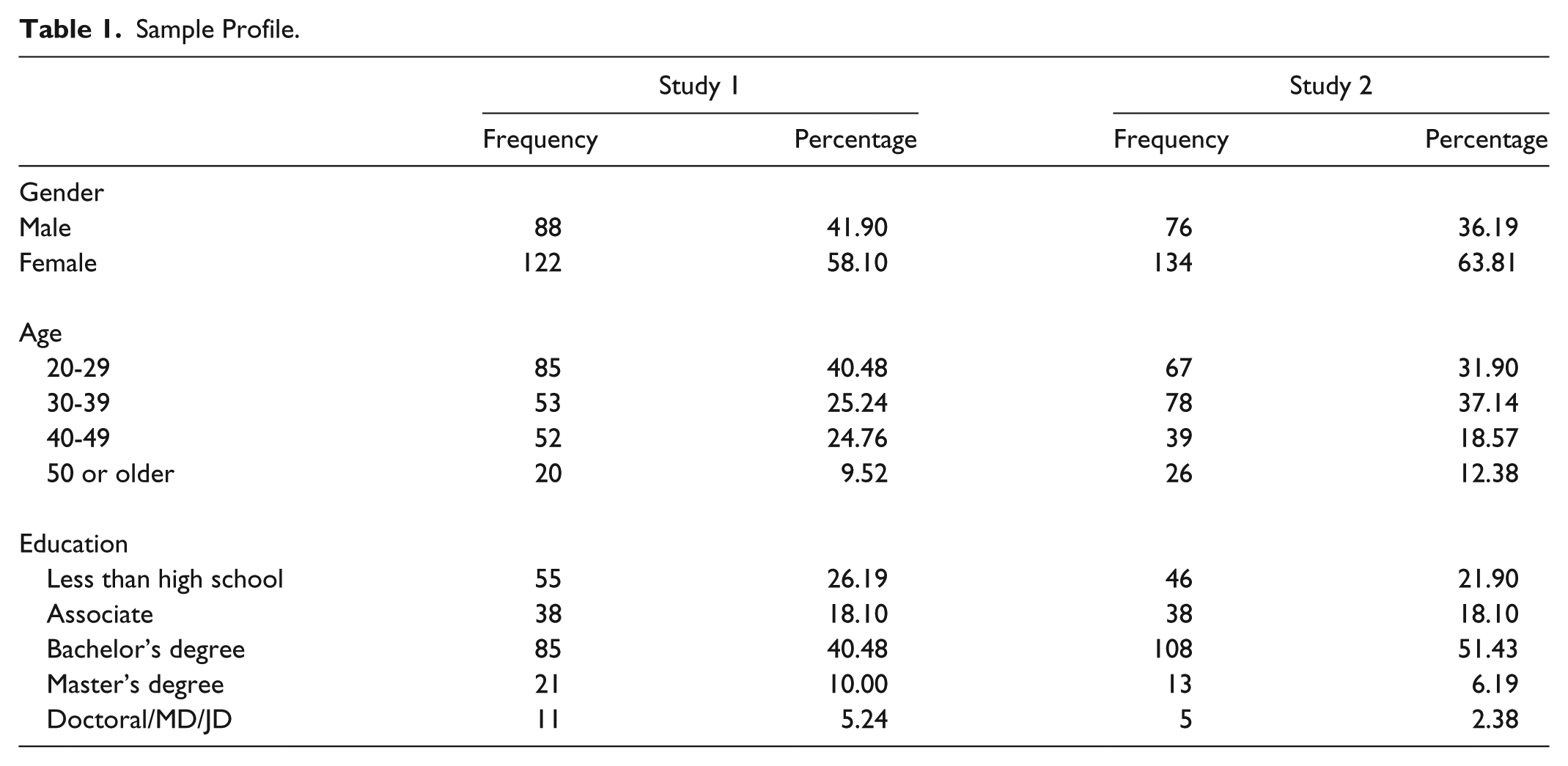
More than half of the respondents were female for both study 1 (58.10%) and study 2 (63.81%). While the plurality of respondents were in their 20s for study 1 (40.48%), the highest percentage of the respondents were found to be in their 30s for study 2 (37.14%). Most of the respondents had at least a bachelor’s degree for both study 1 (55.71%) and study 2 (60%). Respondents’ demographic information is detailed in Table 1.
Sample Profile.
Study 1. Temporal Distance
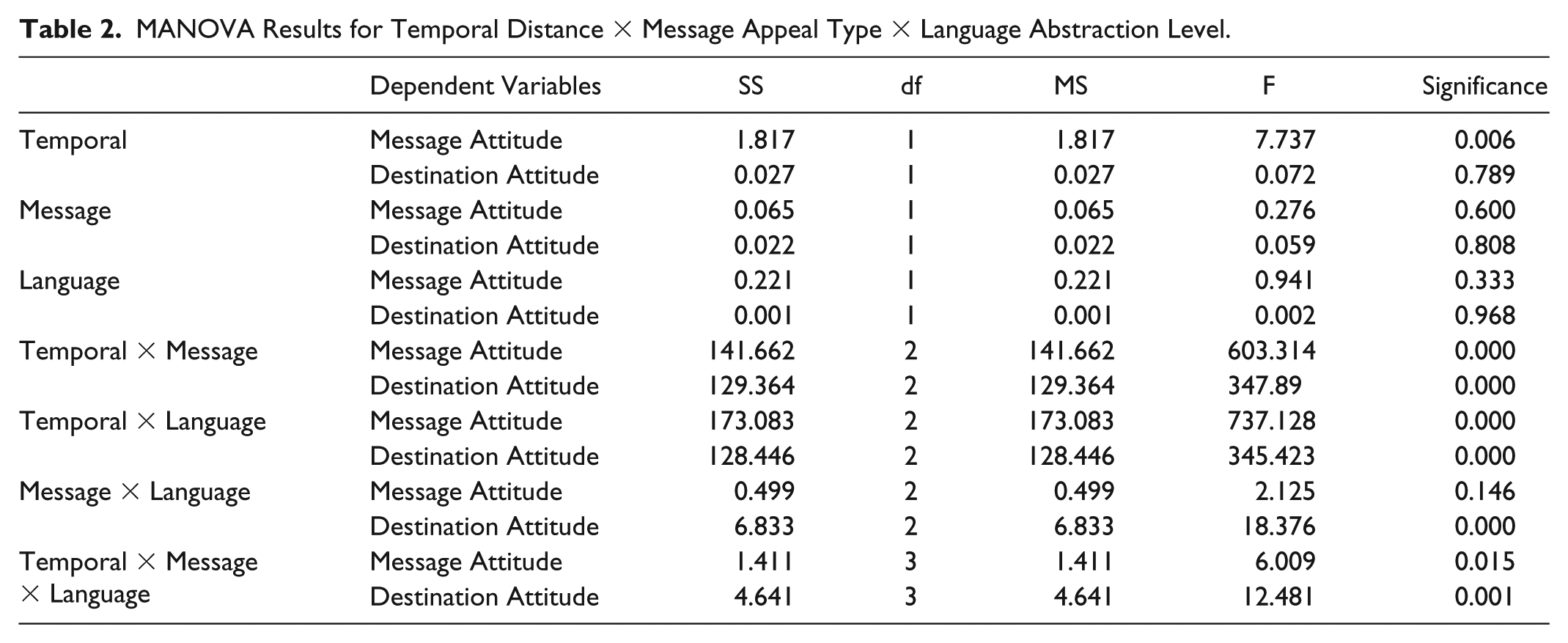
The three-way MANOVA test showed a significant main effect for temporal distance on attitude toward advertisement (F=7.74, p < .001). Specifically, the respondents in the near future distance condition exhibited higher mean scores in their message attitude than those in the further future distance condition. There was a significant two-way interaction effect between the temporal distance and the language abstraction level on message attitude (F=737.12, p < .001) and destination attitude (F=345.42, p < .001). A significant two-way interaction effect between the temporal distance and the message appeal type on message attitude (F=603.31, p < .001) and destination attitude (F=347.89, p < .001) was also detected. Moreover, a significant two-way interaction effect was detected between the message appeal type and the language abstraction level on destination attitude (F=18.38, p < .001). Lastly, a significant three-way interaction was found for destination attitude (F=12.48, p < .001). These results are summarized in Table 2.
MANOVA Results for Temporal Distance × Message Appeal Type × Language Abstraction Level.
To test the hypotheses 1 and 2, a follow-up simple effect test was conducted on the significant two-way interaction effect between the temporal distance and the language abstraction level. It was found that when respondents were in a high temporal distance condition, a significantly higher mean score of message attitude and destination attitude was found for the message with high language abstraction than with the message with low language abstraction (p < .001), supporting hypothesis 1. Further, for respondents in the low temporal distance mode, a significantly higher mean score of message attitude and destination attitude was noted for the message featuring low language abstraction than for the message with high language abstraction (p < .001). Thus, hypothesis 2 was supported. Figure 1 and 2 illustrate these relationships.
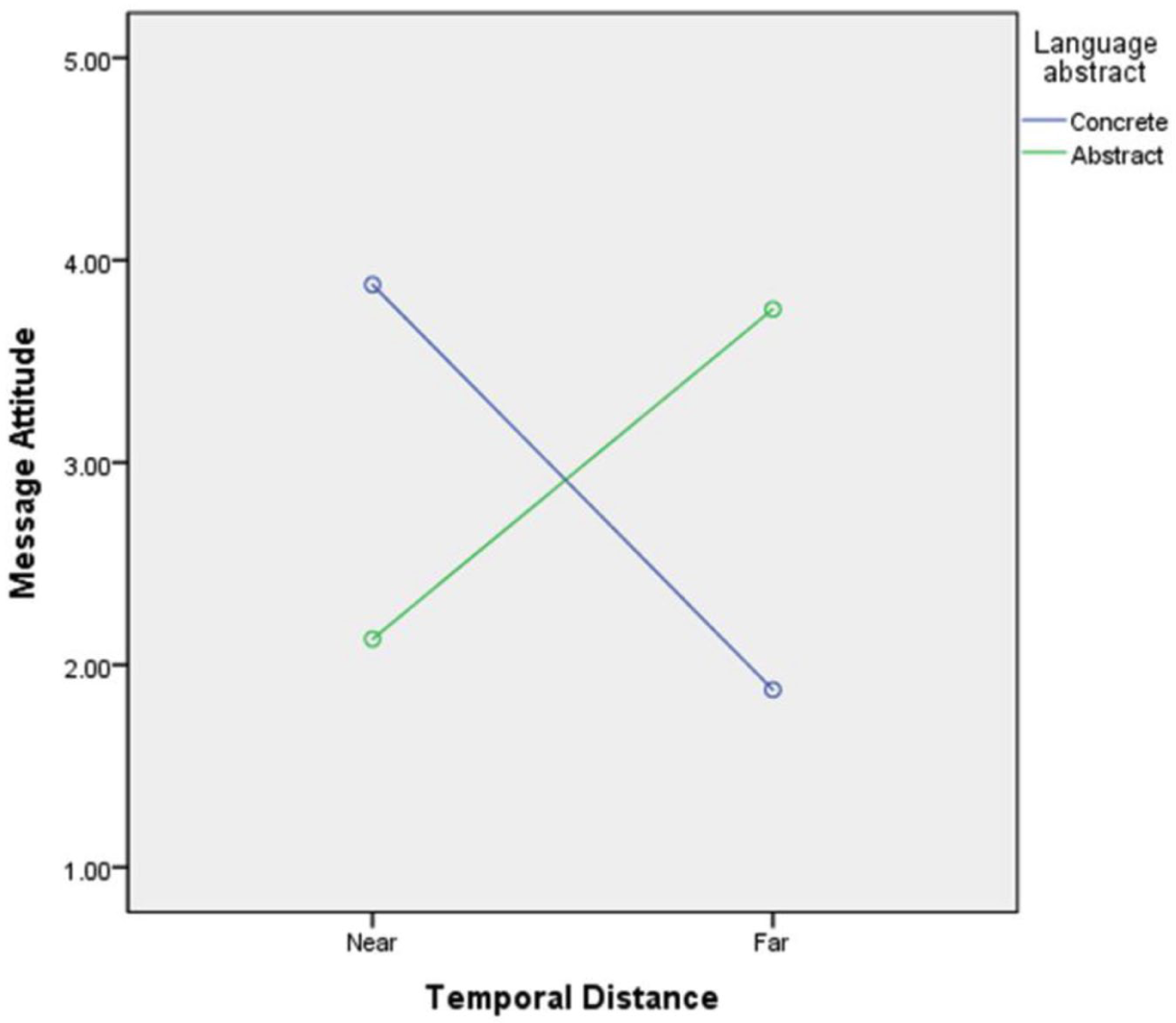
Temporal Distance × Language Abstraction Level in attitude toward message.
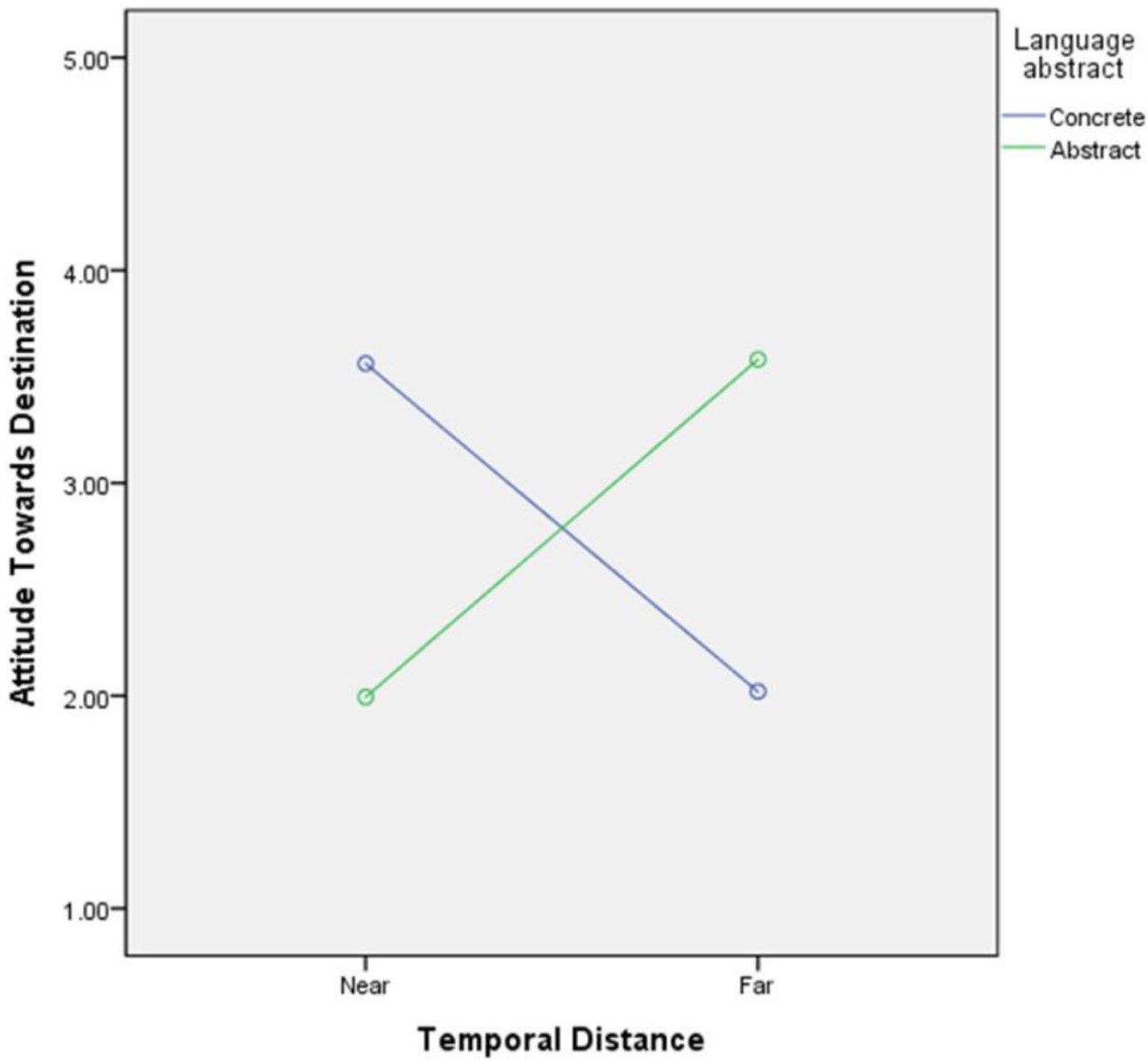
Temporal Distance × Language Abstraction Level in attitude toward destination.
Following significant two-way interaction (temporal distance × message appeal), a simple effect test was executed. For respondents placed in the high temporal distance mode, attitude toward message and attitude toward destination were significantly higher for a benefit appeal message than the attribute appeal message (p < .001). Therefore, hypothesis 5 was supported. Further, when individuals were induced to engage in the low temporal distance mode, a significantly higher mean score was found for the attribute message appeal than for the benefit message appeal on attitude toward message and attitude toward destination (p < .001). Thus, hypothesis 6 was supported. These relationships are shown in Figures 3 and 4.
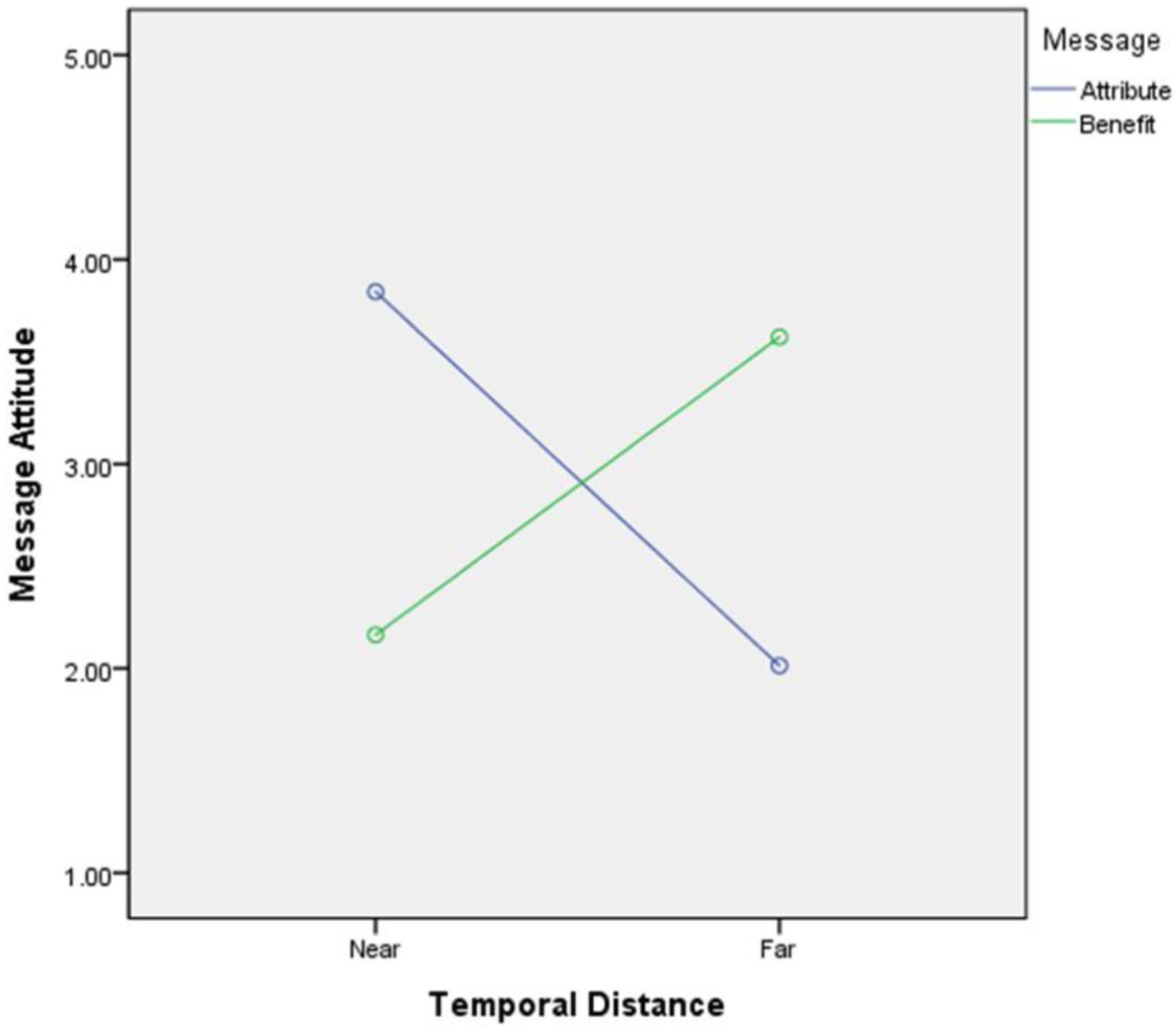
Temporal Distance × Message Appeal Type in attitude toward message.
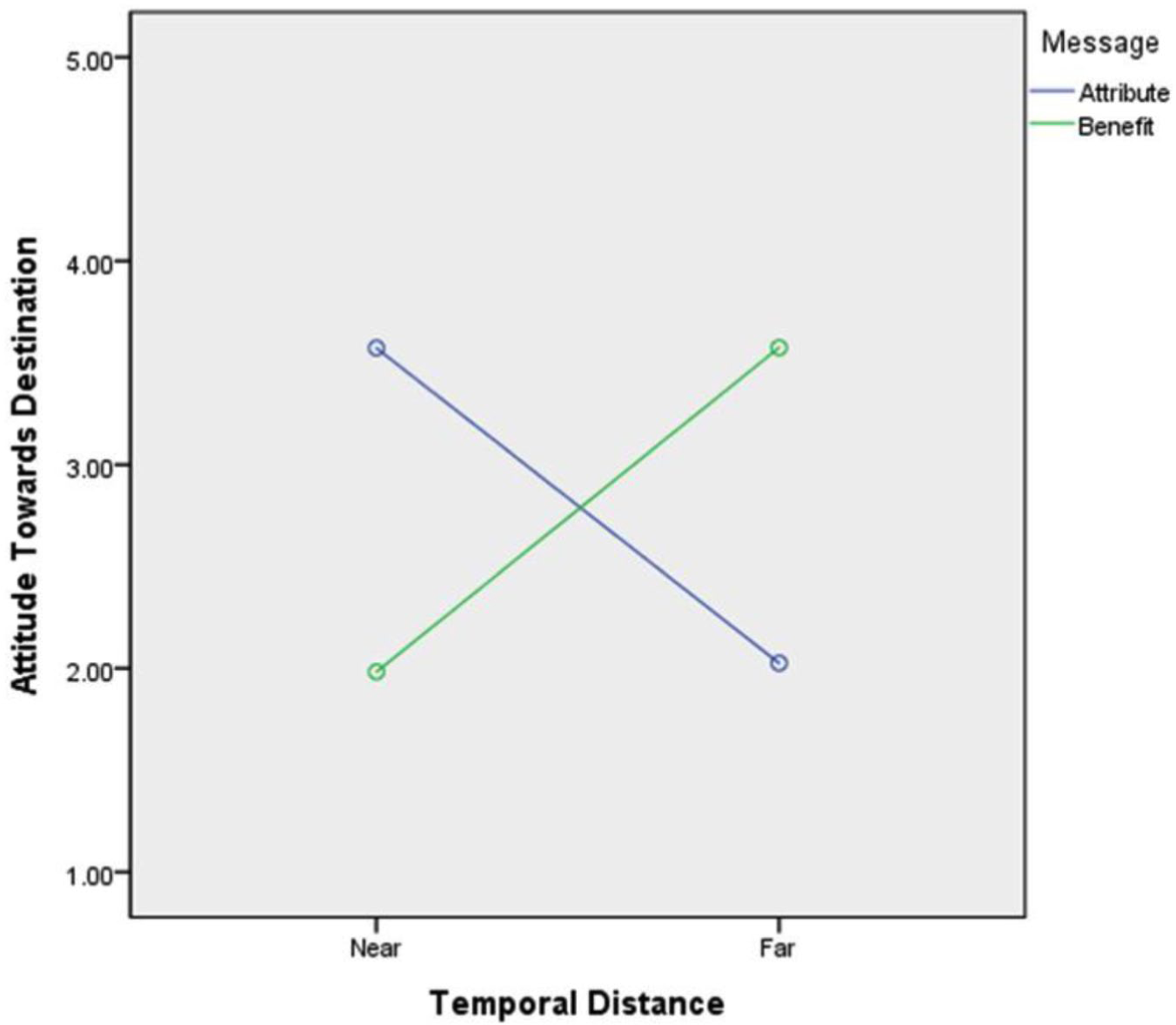
Temporal Distance × Message Appeal Type in attitude toward destination.
Study 2. Spatial Distance
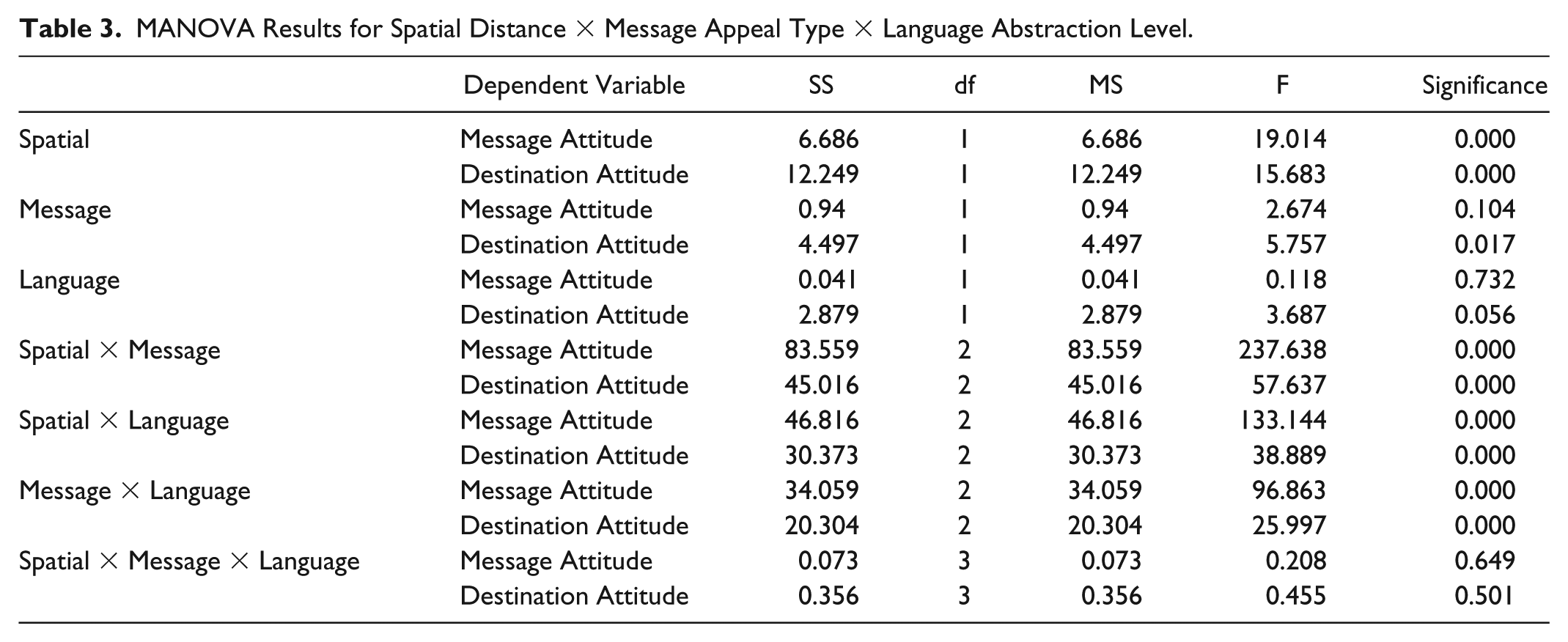
The three-way MANOVA test revealed a significant main effect for spatial distance on attitude toward advertisement (F=19.01, p < .001) and attitude toward destination (F=15.68, p < .001). Specifically, the mean scores were higher when respondents were in the proximal spatial distance condition than respondents in the far spatial distance mode for both message attitude and destination attitude. Significant two-way interaction effect between the spatial distance and the language abstraction on message attitude (F=133.15, p < .001) and destination attitude (F=38.89, p < .001) was detected. There was also a significant two-way interaction effect between the spatial distance and the message appeal type on message attitude (F=237.64, p < .001) and destination attitude (F=57.64, p < .001). Additionally, a significant two-way interaction effect was found between the message appeal type and the language abstraction level on message attitude (F=96.86, p < .001) and destination attitude (F=25.99, p < .001). The three-way interaction was not statistically significant. These findings are outlined in Table 3.
MANOVA Results for Spatial Distance × Message Appeal Type × Language Abstraction Level.
In order to test hypotheses 3 and 4, a simple effect test of two-way interaction between the language abstraction and the spatial distance was conducted. When respondents were in the high spatial distance condition, mean scores on message attitude and destination attitude were found significantly higher for the message featuring high language abstraction than that of low language abstraction (p < .001). Therefore, hypothesis 3 was supported. On the other hand, when respondents were in the low spatial distance mode, the message featuring low language abstraction showed a significantly higher mean score for both message attitude and destination attitude than the message with high language abstraction (p < .001). Accordingly, hypothesis 4 was supported. These associations are shown in Figure 5 and 6.
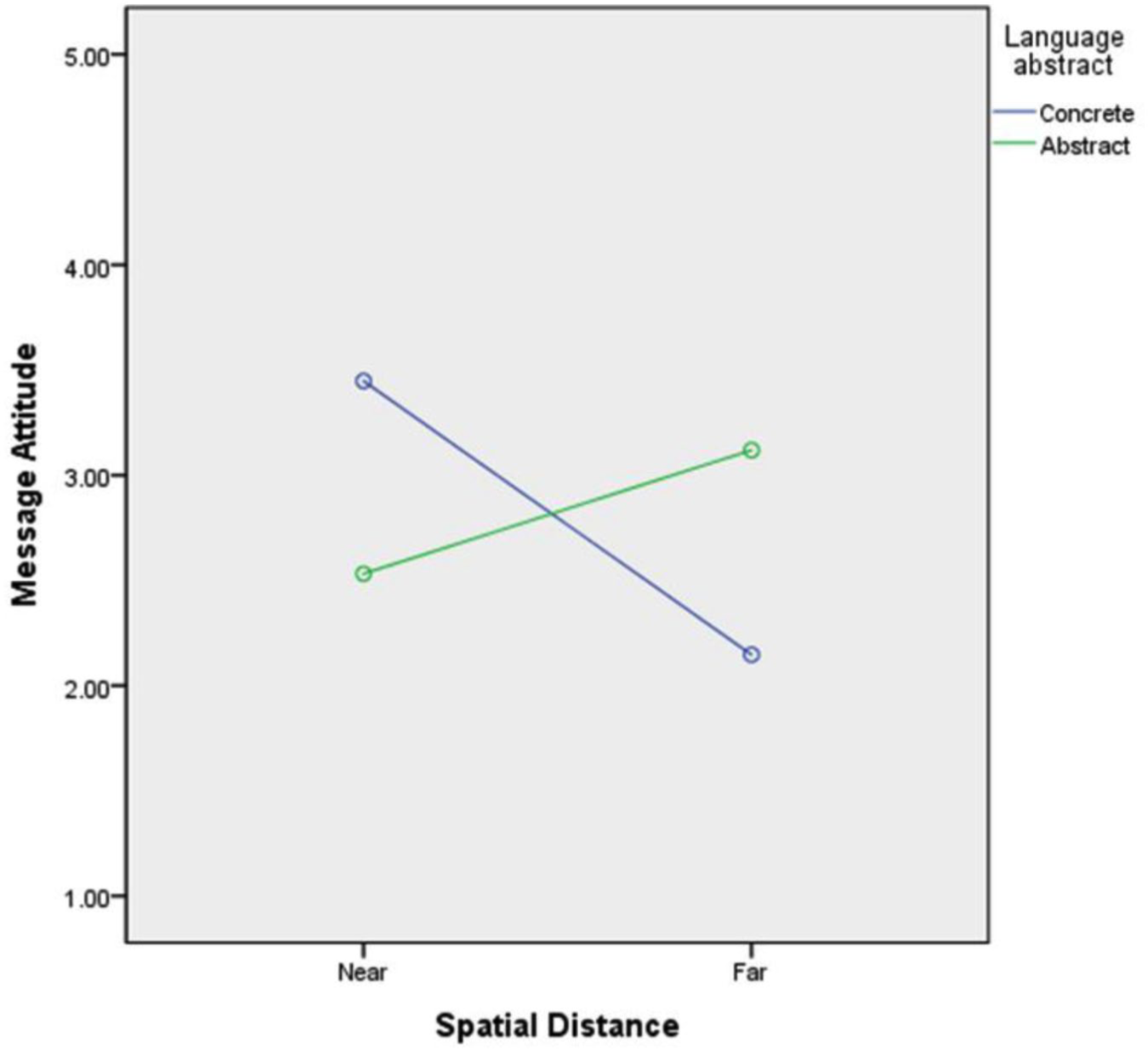
Spatial Distance × Language Abstraction Level in attitude toward message.
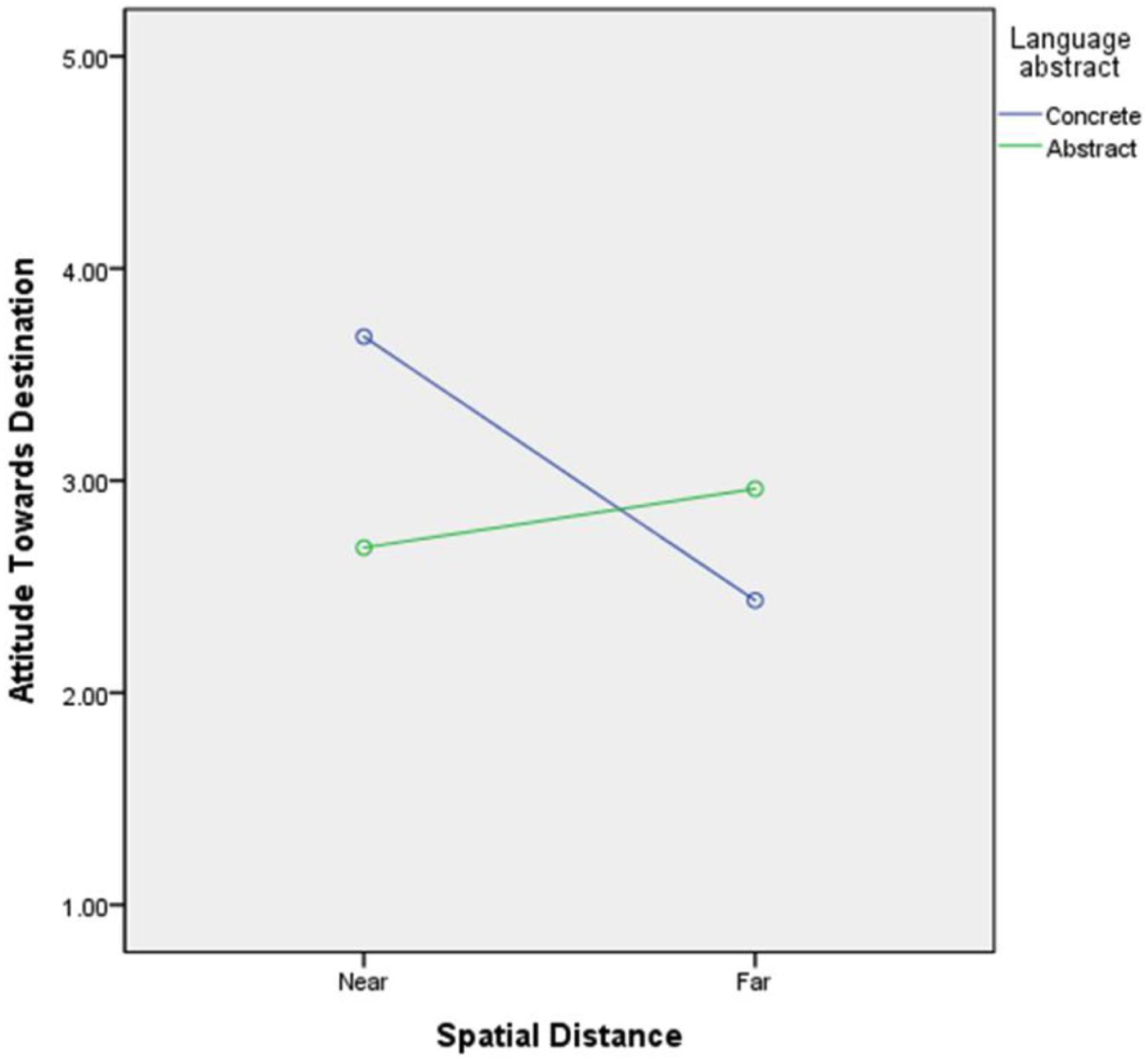
Spatial Distance × Language Abstraction Level in attitude toward destination.
A follow-up simple effect test was conducted to study the two-way interaction between message attributes and spatial distance. When respondents were placed in the high spatial distance condition, significantly higher mean score on attitude toward message and attitude toward destination were detected for the benefit appeal message than the attribute appeal message, supporting hypothesis 7 (p < .001). Lastly, when respondents were in the low spatial distance mode, a significantly higher mean score was found for the attribute message appeal than the benefit message appeal on attitude toward message and attitude toward destination (p < .001). Therefore, hypothesis 8 was supported. The interactions are depicted in Figures 7 and 8.

Spatial Distance × Message Appeal Type in attitude toward message.
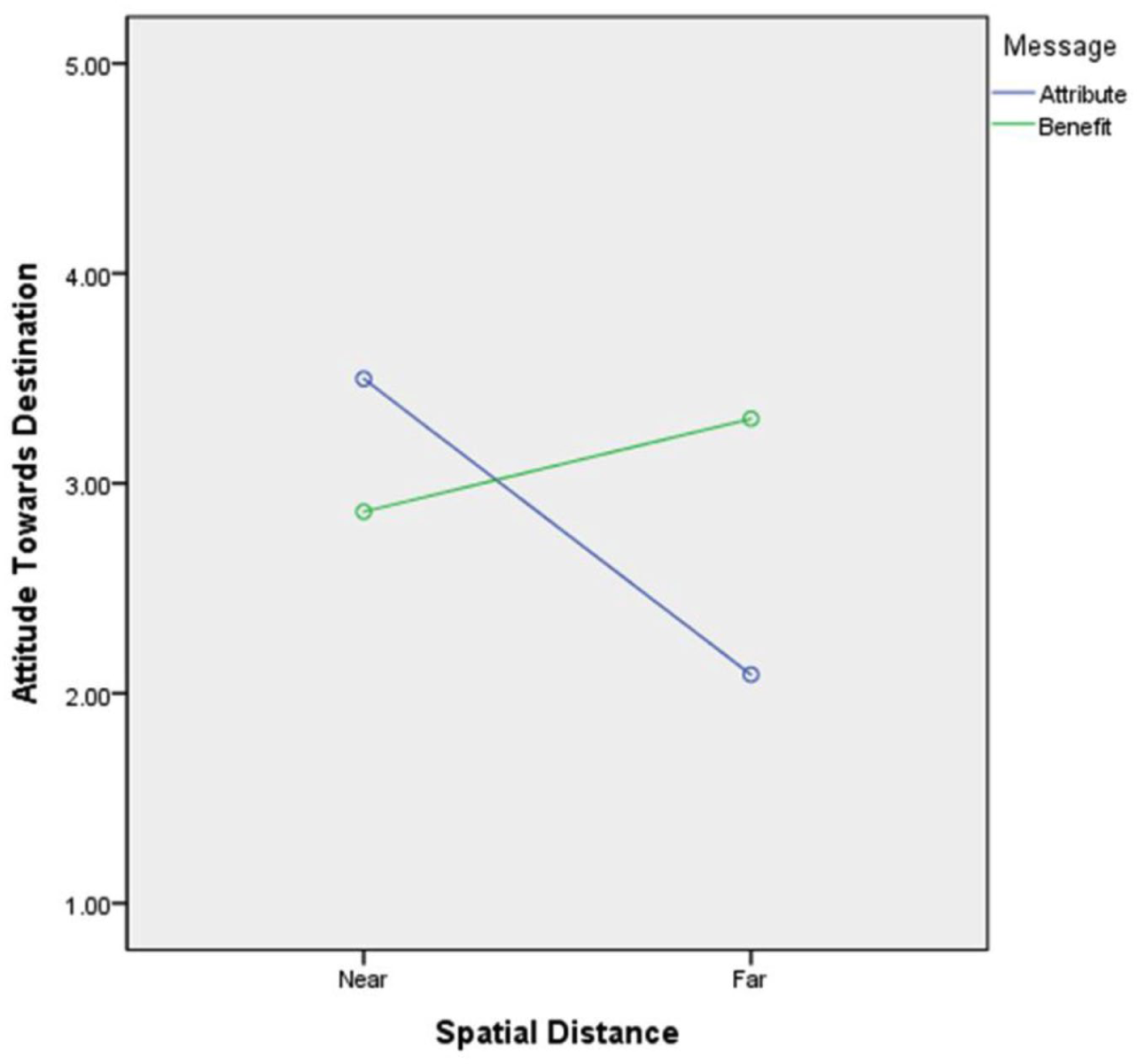
Spatial Distance × Message Appeal Type in attitude toward destination.
Discussions and Conclusion
With billions of active users worldwide, social media is one of the most popular platforms to reach potential customers today. Effectiveness of SMA has been advanced by mechanisms that match advertisement contents with a specific target audience. Thus, marketing messages on social media are delivered to users according to their needs and wants based on their activities online. While it is important to identify the high-potential target markets that are interested in the offerings advertised, appropriate message design can play a role in further enhancing SMA effectiveness. For instance, while the promotional content of Las Vegas can draw the attention of any individuals who have shown interest in traveling to Las Vegas, creating this message according to consumer characteristics, such as when they plan to travel, could be useful in enhancing advertisement effectiveness. However, little attention has been paid to how customized messages should be designed in association with consumer psychological state, especially regarding a destination advertisement (Sofi 2018). In other words, while locating the right audience is facilitated well by social media algorithms, the art of message crafting needs to be better understood. It is in this context that our research contributes to the literature of destination social media marketing. Our study has provided theory-based understanding into whether and how consumers’ responses toward SMA can differ based on interaction between consumer psychological distance and message design approaches.
The findings indicate that SMA featuring high language abstraction is more effective than the SMA with low language abstraction when individuals plan for a vacation in the distant future or to a further away destination. Conversely, individuals planning a vacation in the near future or to a near destination will perceive SMA featuring low language abstraction to be more persuasive. This follows the existing knowledge that language abstraction level is associated with one’s psychological distance (Fujita et al. 2006). Additionally, we found that when individuals think about going on a vacation trip in the distant future or to a distant destination, SMA framed with benefit appeal is more effective than SMA framed with attribute appeal. On the other hand, when individuals plan on a vacation trip in a near future or to a proximate destination, an attribute appeal message is more effective than a benefit appeal message in SMA. Such findings are in line with the argument from previous research in that individuals exhibit a positive attitude toward an advertisement when the level at which they are induced to process information matches their psychological distance (Hernandez, Wright, and Ferminiano Rodrigues 2015).
Theoretical Implications
The findings of this research offer significant theoretical implications. First of all, this research enriches our understanding regarding how a marketing message could influence attitudes of individuals who have shown an initial interest to travel to a destination. Existing literature has mostly been focused on investigating how destination marketing messages can be curated in a way that enhances individuals’ attitudes who have yet to make a decision regarding their trip (Wang, Kim, and Agrusa 2018). This study broadens our understanding by suggesting that marketing messages are also capable of augmenting people’s favorability toward the destination who have already made the decision to travel to the destination. That is, marketing messages should not only be utilized as a means to prompt individuals to develop awareness of a destination or to attract their interest but also serve as a facilitator in enhancing tourists’ attitudes toward the destination they are about to travel to.
Because of the intangible nature of a trip as a product, travel cannot be experienced prior to purchase (Loda 2011). Tourists could be anxious about their travel decision as this poses a risk for them. Thus, it is important that the tourists have a positive attitude toward and a realistic expectation of the destination prior to their trip. In this case, appropriately designed marketing messages could assist in reducing trip uncertainty and enhancing pretrip engagement with a destination. As demonstrated in this research, a message design that arouses high construal is more effective for individuals planning to travel in the distant future while messages that elicit low construal work better for those planning to travel in the near future. Taking psychological distance toward a planned vacation into consideration proves to be a useful parameter to consider when social media advisors craft and place their advertising messages.
Moreover, our investigation on the effect of the Linguistic Category Model (LCM) in the destination management context broadens the horizon in which this model can be applied. While LCM has mostly been applied in studying individuals’ verbal interpersonal behavior, very limited works have been conducted in a written communication context such as advertising on social media. The findings of this study validate that linguistic framing using the Linguistic Category Model can be applicable in enhancing the effectiveness of a written message, specifically in the context of a destination advertisement in social media. Given that the limited tourism literature on the effectiveness of abstract or concrete message strategies has employed a theoretical guideline, our application of LCM as a valid construct in manipulating language abstractness in messages advances the current literature. This study reveals that high language abstraction can work in line with high psychological distance that arouses a high-level construal, whereas low language abstraction could work well with low psychological distance that leads individuals to process messages at a low-level construal.
This research also advances the current knowledge of message appeal effect. In confirming the proposition of framing theory that individuals are induced to respond in a certain way depending on how information is framed or presented (Goffman 1974), our research supports the notion that SMA messages framed in a certain way can influence how people respond to the message they receive. Specifically, the outcomes of this research suggest that neither benefit-oriented message appeal nor attribute-oriented message appeal is a better framing strategy on their own. Rather, both message appeal types can be effective in varying conditions. To a degree, this finding is in line with the inconsistent conclusion of the existing studies that neither benefit nor attribute appeal messages can be an absolute superior choice over the other in terms of eliciting positive responses from message recipients. That is, both message appeal strategies can work well in advertisement messages and the matter of which message appeal type is more effective could be dependent on external variables, such as individuals’ psychological distance to a travel event.
Additionally, the results of this research suggest that individuals’ attitude toward a destination could differ among individuals who are exposed to different types of message design. Specifically, as our results attest, people’s attitude can differ as a result of a message design that matches their spatial or temporal distance to an event. This suggests that an SMA message appropriately designed for an intended recipient can be effective (Priester et al. 2004).
Lastly, this research contributes to the literature of personalized marketing communication. The line of inquiry on the effectiveness of marketing messages that considers message recipient’s psychological distance advances the current research in this area. As we have discussed prior, there have been increasing practices of online advertising messages being tailored to people’s online activities (e.g., a destination advertisement appearing on one’s newsfeed based on the person’s search for hotels in the area). As such, there is a need for understanding how the effectiveness of marketing messages may be in part dependent on a social media user’s personal condition. However, limited understanding exists regarding this issue. In bridging this gap, our research suggests that psychological distance, including temporal and spatial distances, could be an appropriate theoretical construct to apply in investigating advertising that is personally relevant to individuals.
Specifically, this research validates the proposition that the fit between the construal state of the individual and the message leads consumers to perceive messages to be more persuasive and the marketed products (destinations) to be attractive. In other words, abstract information could be more attractive for individuals who are psychologically distant to an advertised event while concrete information could be more useful for people who are psychologically close to the event. Designs that consider these alignments, in turn, can prompt individuals to experience cognitive fluency—the sense of feeling right in receiving a message. In line with this argument, the fit between psychological distance and a message design strategy has been found to be important for the appropriate use of both message appeals and language abstraction level.
Practical Implications
The results of this research suggest possible courses of action for destination marketers in designing advertisements in social media. The study suggests that effective personalized SMA is not only about reaching individuals who have searched for hotels or booked an airline ticket for their destination, but also about presenting appropriately designed messages. Destinations should not only pay attention to reaching the right people who are interested in traveling to the destination but also understand the right timing to communicate their marketing messages. Moreover, message recipients’ locations can also play an important role in devising an appropriate marketing message. Our research suggests that for destination advertising in social media, it is important to consider message design parameters of message appeal, language abstraction, and consumer psychological distance toward a travel event as well as the interactional effects that these factors may present.
Following the findings from this study, advertisement messages need to be designed based on how distant or near a consumer’s plan for trips are from the point they see the advertisement. Individuals are likely to prefer information that matches their motivational state depending on their level of psychological distance from the travel event. When marketers target potential tourists planning for a trip in the distant future, messages that apply a benefit appeal or language that is high in abstraction may be effective. On the other hand, for potential consumers that plan for a trip in the near future, destinations may consider crafting messages with attribute appeals or more concrete languages. As such, creation of a marketing message strategy should consider the variations of trip characteristics of the target audiences. For instance, a traveler preparing to leave for a vacation to Cancun the following morning is likely to need concrete pieces of information related to feasibility of the vacation such as how to get to the destination, tips for speedy check-in for international flights, weather condition at the destination, or how to pack for Cancun. On the other hand, messages about the value or benefits of a trip to Cancun, such as how Cancun can be a perfect place for family bonding (a high-level, abstract piece of information that is related to desirability of the vacation), would be valuable for individuals planning the same trip occurring in six months.
This study also alludes to the importance of communicating with customers who already have travel plans to a specific destination. Destination marketers should not only focus on using marketing messages to attract potential travelers who are not certain yet whether they will travel to the destination; they should also stay connected with travelers who have booked their trip. Such communications between a destination and an impending traveler can be an effective means to reduce traveler anxiety. With individuals not being able to experience what their trip will be like in advance, appropriate information that matches their psychological distance could be helpful to provide them with additional resources to refer to in creating expectations about their trip. Moreover, as it was found that there are message designs that are more effective in eliciting positive destination attitude of these travelers, destination marketers should utilize such types of messages to continuously communicate with travelers who have plans to travel to their destination. According to the argument from existing literature, individuals’ attitude developed from indirect experiences with the product, such as seeing advertisements, influences their satisfaction level with the product purchase (Oliver 1977). Thus, when their destination attitude is positive prior to travel, they could be satisfied with their travel experience. This pre-trip experience management can be an important job of the destination practitioners. During the course of this communication, extra efforts are warranted from the destination practitioners’ end in understanding what specific information is the most relevant and helpful to tourists who are about to travel to their destinations.
Lastly, the results of this research are also valuable in that they suggest a cost-effective marketing strategy for destination marketers. While designing a completely new advertisement for each target may be costly, implementing variations in language is relatively less costly and simple compared to other means, such as having to make different types of videos. Since spending marketing budget efficiently in attracting potential tourists and encouraging their actual visit to the destination is an important responsibility of the destination marketers, maximizing return-on-investment with a cost-efficient yet effective marketing strategy is a critical issue.
Limitations
While the findings from this study offer valuable insights, there are several limitations. First of all, the age distribution of the respondents in this research is concentrated in the 20s and 30s, which could call to question about sample representativeness. Future studies should attempt to obtain a more diversified sample. Although there are additional psychological distance constructs, including social distance and hypothetical distance, only two psychological constructs were explored in this research. Thus, future research could investigate whether the other psychological distance constructs also interact with the message design types to influence the message recipients’ responses. Furthermore, while this study focused on the effectiveness of the message design itself, future studies could consider other factors of SMA in their study design such as effectiveness of the message by frequency of message exposure.
Moreover, future research could maximize the realism of this type of research by considering contextual effects. Social media advertising tends to appear in between other posts, such as among posts of user’s friends rather than on its own. Thus, studies that incorporate personal posts (e.g., exposing an advertisement message to a consumer in between posts of his or her friends) could provide more realistic results. Another context future research can consider is that the effect of social media advertising could differ when various types of message precede one another, such as an abstract language message appearing right before or after a concrete language message. In addition, future studies could examine how effective a written message is compared to other types of contents. For example, comparisons of effectiveness of an abstract textual message versus an abstract image message may be a meaningful topic to explore.
Lastly, it is worth noting that although the authors made their best attempt to design different messages according to language abstraction level by systematically following the guideline as provided by Linguistic Category Model (LCM) (Schellekens, Verlegh, and Smidts 2010), as well as through manipulations and pilot tests, respondents from different groups could perceive these message abstraction levels differently. As research on language abstraction–based message design in the context of SMA is at its early stage of development in the existing literature, future studies are warranted in terms of how to best design messages to accurately reflect the nature of language abstraction in a message.
Footnotes
Appendix
Declaration of Conflicting Interests
The author(s) declared no potential conflicts of interest with respect to the research, authorship, and/or publication of this article.
Funding
The author(s) received no financial support for the research, authorship, and/or publication of this article.
