



Abstract
Informed by the psychological theory of mindsets, we establish how “fixed” and “growth” mindsets divergently influence luxury travel behaviors. Across three experiments, we found that the relative preference for luxury travel is higher when consumers adopt a fixed rather than growth mindset (studies 1a and 1b). The effect of mindsets is also evident within consumer evaluations of luxury hotel advertisements. Specifically, providing detailed information about the luxury hotel’s facilities via advertising improves evaluations when travelers adopt a growth mindset, but such information has no effect when they adopt a fixed mindset (study 2). Moreover, while fixed mindsets show more positive evaluations of luxury hotels when an advertisement employs affective language, employing cognitive language results in more positive evaluations among growth mindsets (study 3). Taken together, these results illustrate that fixed mindsets value luxury travel for self-enhancement benefits, while growth mindsets – for superior quality.
Introduction
The luxury tourism and hospitality industry was estimated to be worth €190 million in 2018, delivering an average growth of 7% year after year (D’Arpizio, Prete, and Montgolfier 2018). Against this backdrop, there has been an increasing research interest in various issues pertaining to luxury travel. Previous studies explored the perceived value and attributes of luxury travel experiences (Hwang and Han 2014; Correia, Kozak, and Kim 2019), the sources of satisfaction with luxury hotels (Lai and Hitchcock 2016, 2017), and the relationship between brand equity and the financial performance of luxury travel providers (H. B. Kim and Kim 2005).
Despite this interest, extant theory regarding how consumers engage in luxury travel behaviors is underdeveloped (Correia, Kozak, and Kim 2019). On the one hand, several studies assert that luxury travel offers a means for self-enhancement—that is, travelers can create an idealized self-image and impress others by embarking on luxury travel (Danziger 2006; Correia, Kozak, and Kim 2019). These self-enhancement benefits are considered to be the dominant motivation behind luxury consumption (Vigneron and Johnson 1999; Seo and Buchanan-Oliver 2019), and obtaining such benefits is especially dependent on luxury providers having a strong and positive brand image (Correia, Kozak, and Kim 2019; H. B. Kim and Kim 2005; Hwang and Han 2014). On the other hand, luxury travel conveys superior product and service quality—that is, travelers choose to stay in luxury hotels because such properties offer larger rooms, pleasing physical surroundings, and higher standards of service quality (Wu and Liang 2009; Correia and Kozak 2012). Thus, given that there are different types of value perceptions that may influence consumers to embark on luxury travel, it is important to consider how these perceptions influence travel behaviors. Furthermore, there are currently limited insights about the effectiveness of advertising strategies (Li, Huang, and Christianson 2017) that can maximize consumer attitudes toward luxury travel providers. In particular, it is unclear whether advertising strategies for luxury hotels should be any different from those that are employed by less affluent accommodation providers.
Our study addresses the aforementioned issues from the perspective of psychological research on mindsets (Murphy and Dweck 2016; Park and John 2010; Yorkston, Nunes, and Matta 2010; Kwon, Seo, and Ko 2016). Mindsets refer to implicit knowledge structures, also known as “implicit theories,” which people possess about the malleability of their personal qualities (Park and John 2010; Yorkston, Nunes, and Matta 2010; Price et al. 2017). Previous research distinguishes between two forms of opposing mindsets, fixed versus growth (Murphy and Dweck 2016; Dweck and Leggett 1988; Elliott and Dweck 1988). A fixed mindset reflects lay beliefs that an individual cannot change her or his personal qualities, whereas a growth mindset believes that personal qualities can be (and should be) changed by applying personal effort. Previous research in consumer psychology suggests that these two types of mindsets can influence divergent forms of judgments and behaviors, including consumption choices and advertising attitudes (Park and John 2010; Kwon, Seo, and Ko 2016).
The purpose of our study is twofold. First, we explore whether mindsets influence consumer preferences for luxury travel. Specifically, does adopting a fixed (as opposed to growth) mindset result in a higher relative preference for luxury hotels? Second, and consequently, we explore how mindsets can be leveraged to increase the effectiveness of advertising strategies for luxury travel providers. That is, do different advertising features (e.g., hotel information, language style) vary in terms of their persuasiveness when travelers adopt a fixed or growth mindset? Overall, our study aims to offer a novel perspective about how mindsets influence luxury travel.
Literature Review and Hypothesis Development
Luxury Travel
Previous research on luxury tourism asserts that developing positive brand associations, such as prestige and style, can contribute to the successful financial performance of luxury travel providers (H. B. Kim and Kim 2005). For instance, Hwang and Han (2014) found that brand prestige enhances travelers’ well-being perceptions, brand identification, and that it fosters brand loyalty in the luxury cruise industry. In the same vein, Jin, Line, and Merkebu (2016) note that brand prestige exerts significant influence on trust, customer satisfaction, and that it reduces perceived risk associated with the consumption of luxury tourism. Most recently, Correia, Kozak, and Kim (2019) note that the combination of emotional attachment, fashion leadership, prestige sensitivity, and social value influences tourists to shop for luxury brands.
Therefore, prior research attribute the positive effects of luxury branding to consumers believing that the attractive imagery of luxury travel can signal positive perceptions about their users (Hwang and Han 2014; Correia, Koazak, and Kim 2019). That is, by going on luxury cruise vacations and staying in upscale hotels, travelers can develop and convey more positive (e.g., sophisticated, glamorous) self-perceptions in line with the brand’s prestige and personality (Vigneron and Johnson 1999). In this vein, there are many studies that have discussed that purchasing luxury brands enables consumers to avoid similarity with others, heighten personal uniqueness, and to display social status (Correia, Kozak, and Reis 2016; Correia, Kozak, and Kim 2019; Choi et al. 2018).
Mindsets and Luxury Travel
A stream of research in social psychology, however, shows that such positive “rub off” effects from the brand’s image to the user’s self-concept may not apply to all people equally. That is, people’s mindsets regarding their personalities was found to play a key role in determining whether the appealing personalities of brands can be transferred successfully to the brand user’s self-concept and, therefore, contribute to self-enhancement (Park and John 2010; Kwon, Seo, and Ko 2016). Here, mindsets refer to lay beliefs that an individual develops about the malleability of personal qualities, such as intelligence, personality, and self-concept (Dweck et al. 1995; Park and John 2010; Yorkston, Nunes, and Matta 2010; Price et al. 2017). There are two types of mindsets that represent the focus of our study, “fixed” and “growth.” 1 When individuals adopt a fixed mindset (fixed mindsets), they view personal qualities—such as personality and intelligence—to be fixed; that is, fixed mindsets believe that their personal qualities cannot be improved through their own direct efforts. In contrast, when individuals adopt a growth mindset (growth mindsets), they view their personal qualities as malleable, and that they can (and should) improve themselves through their own efforts (Dweck 2000; Park and John 2010). Previous psychological studies show that fixed mindsets are more likely to perceive attractive brands as a means to enhance their self-concept and to believe that they can communicate positive associations about themselves through the consumption of attractive brands, whereas growth mindsets do not display this tendency (Park and John 2010; Kwon, Seo, and Ko 2016).
The key reason why fixed and growth mindsets display divergent preferences for using favorable brands as a means for self-enhancement is because they endorse opposed ways of achieving positive self-perceptions (Dweck and Leggett 1988; Elliott and Dweck 1988). Growth mindsets construe positive perceptions about themselves when they engage in effortful learning and self-improvement (Mathur, Chun, and Maheswaran 2016). As Park and John (2010, p. 656) note, “because incremental theorists [growth mindsets] believe that their personal qualities can be improved if they exert effort to do so, they seek out ways to become a better person through opportunities for learning, self-improvement, and growth.” On the other hand, fixed mindsets do not believe that their personalities can be changed by applying direct effort. Thus, they tend to form positive self-perceptions from seeking out “external” opportunities that can signal positive personal qualities (Dweck and Leggett 1988; Elliott and Dweck 1988; Mathur, Chun, and Maheswaran 2016).
Extant studies on luxury consumption note that the modern concept of luxury is predominately consumed for what it (symbolically) means rather than for what it actually (materially) constitutes (Seo and Buchanan-Oliver 2019). In the same vein, luxury travel is often discussed as an opportunity for travelers to signal positive perceptions about themselves (Correia, Koazak, and Kim 2019; Hwang and Han 2014). Against this backdrop, we posit that this form of social self-enhancement is likely to be more accessible and valued by fixed rather than growth mindsets. Consequently, all other things being equal, we would expect that the relative preference for luxury travel would be higher when consumers adopt a fixed rather than growth mindset:
Hypothesis 1: When people adopt a fixed (vs. growth) mindset, they will show more preference to stay in in a luxury hotel.
Mindsets and Advertising Strategies
In developing predictions for hypothesis 1, we assumed that adopting the fixed mindset increases—whereas adopting the growth mindset diminishes—the perceived value of luxury travel as an opportunity for self-enhancement. In particular, since this value of luxury travel is more congruent with how fixed (rather than growth) mindsets achieve positive self-perceptions, we hypothesized that adopting a fixed mindset would result in a relatively higher preference for luxury travel. However, while luxury hotels do indeed offer attractive symbolic resources for creating an idealized self-image and impressing others (Hwang and Han 2014), it is also true that such hotels possess higher functional quality, such as enhanced rooms and facilities (Wu and Liang 2009; Correia and Kozak 2012). Accordingly, while growth mindsets may not value staying at luxury hotels as an opportunity for self-enhancement, these travelers may appreciate the superior quality characteristics of luxury hotels. Furthermore, as this alternative value of luxury travel is contrasted away from the dominant value of self-enhancement, it is likely to be more congruent with the goals and behaviors of growth mindsets (Kwon, Seo, and Ko 2016).
In this section, we extend our theoretical argument to consider how underscoring the specific value perceptions of luxury travel via advertising messages can increase the appeal of luxury travel in light of the roles played by mindsets. In particular, we posit that employing purposive advertising strategies that heighten the desired value of luxury travel (i.e., self-enhancement vs. quality) would make luxury travel more or less attractive for different mindsets. For the purposes of this study, we focus on advertising message strategies, that is, the executional techniques of designing an advertising message that can be applied to different types of advertisements, including print ads, TV commercials, and social media. Specifically, we draw attention to the role of two particular advertising strategies—providing (vs. not providing) detailed information about the luxury hotel’s facilities, and using cognitive (vs. affective) advertising language styles within advertisements. These advertising strategies were chosen based on previous research, which shows that they are especially effective ways to accentuate either the self-enhancement or quality perceptions among consumers (e.g., Byun and Jang 2015; Ford, Smith, and Swasy 1990).
The Role of Hotel Information
An important consideration for developing advertising strategies is the decision about how much information should be included about the advertised products or services within advertisements (Ford, Smith, and Swasy 1990). Previous studies show that, all other things being equal, the functional quality perceptions can be enhanced by offering more detailed information, especially in the case of high-priced products (Ford, Smith, and Swasy 1990). For the purposes of our study, this suggests two things. First, providing detailed information about the hotel’s facilities (e.g., room features, amenities, and guest services) within advertisements may improve attitudes when travelers adopt a growth mindset. This is because having such information underscores the superior quality of luxury travel, which can make it more appealing for growth mindsets (Kwon, Seo, and Ko 2016). On the one hand, such functional information offers less (if any) perceived benefits for self-enhancement (Seo and Buchanan-Oliver 2019) valued by fixed mindsets. Therefore, we would not expect this strategy to elicit higher evaluations when travelers adopt a fixed mindset. These conceptual relationships are hypothesized below, as follows:
Hypothesis 2: The functional hotel information will moderate the relationship between mindsets and luxury hotel attitudes. Providing detailed information about the hotel’s facilities will improve evaluations when travelers adopt a growth mindset, but not when they adopt a fixed mindset.
The Role of Language Style
Another important consideration for developing tourism advertising is the style of language employed within advertisements. Previous research shows that that the choice of language style could increase advertising effectiveness depending on the “perceived fit” with the type of tourism destination being advertised (Byun and Jang 2015). In particular, Byun and Jang (2015) have categorized language style as being either affective or cognitive. Affective language refers to the figurative expressions that are used to describe feelings (e.g., “the view blows your mind away”), whereas cognitive language refers to the literal expressions that are associated with rational contexts (e.g., “the view is excellent”). For instance, while affective language was found to elicit more positive attitudes for hedonic destinations that are perceived to be fun and sensorial (e.g., Venice), cognitive language elicited more positive attitudes for utilitarian destinations that are considered to be functional, sensible, and useful (e.g., Berlin) (Byun and Jang 2015). Such match-up effects occur because of the perceived positive congruence between advertising language styles and different travel destination types, whereby “affective language was found to be more effective in hedonic product advertisements, whereas cognitive language [was] more effective in utilitarian product advertisements” (Drolet, Williams, and Lau-Gesk 2007, as cited in Byun and Jang 2015, p. 33).
In the context of luxury consumption, the motives for consuming luxury brands for self-enhancement are largely satisfied by the hedonic characteristics of luxury brands (Seo and Buchanan-Oliver 2019). This suggests that framing an advertising message in affective language (i.e., emphasizing its hedonic features) could “nudge” travelers to evaluate luxury hotels in terms of their perceived value for self-enhancement. Thus, such advertisement should elicit more positive attitudes among fixed mindsets. On the other hand, if an advertising message employs cognitive language, then it would encourage travelers to consider the functional aspects of luxury hotels, such as their superior quality of rooms and facilities. Consequently, this advertisement would be more favorable among growth mindsets. We formally combine these predictions as follows:
Hypothesis 3: Advertising language style will moderate the relationship between mindsets and luxury hotel attitudes. Fixed (growth) mindsets will show more positive attitudes when advertisement is framed in affective (cognitive) language.
In order to test our hypotheses, we conducted three experiments that provide causal evidence for the relationship between mindsets, luxury travel, and advertising strategies. Studies 1a and 1b establishes that when consumers adopt a fixed mindset, they show a significantly higher relative preference to stay in luxury hotel. Importantly, we found that this effect occurs because the value of luxury travel as an opportunity for self-enhancement is generally more accessible for fixed mindsets. In study 2, we offer evidence for hypothesis 2. In particular, we show that when an advertising message for a luxury hotel features detailed hotel information, it yields more positive luxury hotel attitudes for growth mindsets; however, this advertising strategy has no effect when travelers adopt a fixed mindset. In doing so, we show that growth mindsets are more likely to be influenced by the superior quality perceptions of luxury hotels. Finally, in study 3, we offer evidence for hypothesis 3. That is, we illustrate that fixed (growth) mindsets show more positive attitudes when a luxury travel advertisement is framed in affective (cognitive) language. Taken together, the findings illustrate that fixed mindsets value luxury travel for self-enhancement benefits, while growth mindsets, for superior quality.
In the following sections, we report the findings of four empirical studies supporting our key tenet: that the preference for luxury travel and the effectiveness of hotel advertising varies as the factor of mindsets.
Study 1a
In this study, we show that adopting a fixed (vs. growth) mindset increases the preference to stay in a luxury hotel. In addition, we illustrate that this effect of mindsets is mediated by the perceived value of luxury travel as self-enhancement.
Method
Participants for this and all other subsequent studies were recruited from a heterogeneous online panel in the United States through Amazon Mechanical Turk (Kees et al. 2017). In each experiment, responses were automatically recorded using a web-based randomized survey that was developed using Qualtrics survey software. In total, 618 respondents participated across four studies (study 1a N = 116; study 1b N = 177; study 2 N = 163; study 3 N = 162). This method has been used extensively in previous tourism studies that employed psychological experiments (Byun and Jang 2015; J. Kim, Kim, and Kim 2018a; J. Kim et al. 2016). An overview of participants’ demographic information is presented in Table 1.
Profile of Participants.
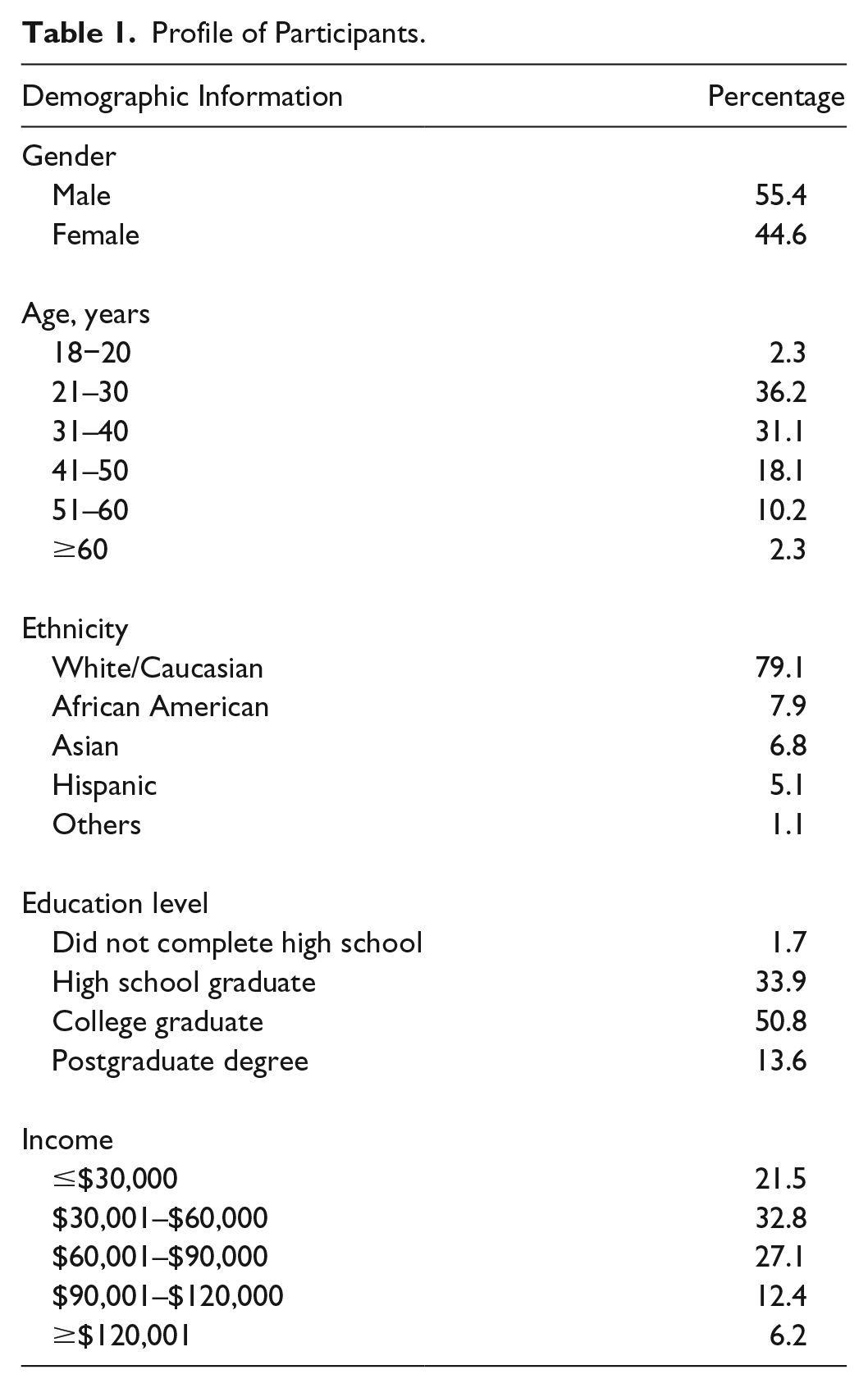
A total of 116 (female = 57.8%; Mage = 31.20, SD = 10.18) participants were randomly assigned to one of two mindset activation conditions (fixed vs. growth) in a between-subjects experimental design. During this experiment, participants were told that they were completing several purportedly unrelated tasks. In the first task, we situationally activated mindsets using a priming technique that has been extensively used in social psychology (Chiu, Hong, and Dweck 1997). This technique is based on the established view that although people display a general, chronic, tendency to have either a fixed or growth mindset in their everyday lives, external influences and cues can temporarily activate and make one mindset to be more accessible and dominant than the other (Dweck et al. 1995; Chiu, Hong, and Dweck 1997; Hong et al. 1999). Simply put, mindsets can be situationally primed.
Informed by this view, we told participants that the purpose of their first task was to test reading comprehension and memory. Participants were instructed to read a paragraph containing concepts, which they would be tested on later in the session. What follows are the key excerpts in the two paragraphs (for more details, see Chiu, Hong, and Dweck 1997): [Fixed mindset activation] In his talk at the American Psychological Association’s annual convention held at Washington D.C. in August, Dr. George Medin argued that “in most of us, by the age of ten, our character has set like plaster and will never soften again.” He reported numerous large longitudinal studies showing that people “age and develop, but they do so on the foundation of enduring dispositions.” He also reported research findings showing that people’s personality characteristics are fixed and cannot be changed. [Growth mindset activation] In his talk at the American Psychological Association’s annual convention held at Washington D.C. in August, Dr. George Medin argued that “no one’s character is as ‘hard as a rock’ so that it cannot be changed. Only for some, greater effort and determination are needed to effect changes.” He reported numerous large longitudinal studies showing that people can mature and change their character. He also reported research findings showing that people’s personality characteristics can change, even in their late sixties.
Each participant saw only one version of these two mindset-activating paragraphs. On the following page, participants were asked to type in the space provided what they remembered from this paragraph to increase the effectiveness of priming. Next, they responded to eight statements that measured their activated mindset (e.g., “Everyone is a certain kind of person, and there is not much that they can do to really change that”) on seven-point scales (1 = strongly disagree, 7 = strongly agree; α = .92), using implicit-self scales developed by Levy et al. (1998). Manipulation checks showed that the manipulation of mindset activation was successful (Mfixed = 4.22, SD = 1.17; Mgrowth = 5.16, SD = 1.00; F(1, 115) = 21.53, p =.000).
In the second purportedly unrelated task, participants were asked to imagine that they were planning a holiday trip for three days and were looking for a hotel to stay. Afterward, participants were asked to choose one hotel out of the two given options: Hotel A, a luxury brand hotel; or Hotel B, an upscale quality hotel (Appendix A). The price of Hotel A was slightly higher than that of Hotel B. Manipulation checks using two statements “Is Hotel A (Hotel B) a luxury hotel?” on a 7-point scale (1 = strongly disagree, 7 = strongly agree) showed that Hotel A was perceived to be more luxurious than Hotel B (Mluxury_A = 5.96, SD = 0.77; Mluxury_B = 5.44, SD = 0.94; t(115) = 6.01, p =.000). Next, we measured the perceived value of luxury consumption as self-enhancement using two statements “Luxury brands help me to communicate my self-identity” and “Luxury brands reflect the kind of person I see myself to be” on seven-point scales (1 = strongly disagree, 7 = strongly agree; α = .89), adopted from previous studies (Park and John 2010; Wilcox, Kim, and Sen 2009).
Results
To test hypothesis 1, we investigated the percentage of participants choosing the luxury hotel option (Hotel A) against the non-luxury one (Hotel B). The results showed a significant effect of mindset activation on the preference for the luxury hotel (χ2(1) = 4.79, p = .029). Consistent with our prediction, the luxury hotel option was selected more frequently by participants in the fixed mindset activation condition (28.1% [=16/57]) than by those in the growth mindset activation condition (11.9% [=7/59]).
In order to test whether the effect of mindset on the preference for luxury travel does indeed occur because the value of luxury travel as an opportunity for self-enhancement is more attractive when the fixed (vs. growth) mindset is activated, we conducted a mediation analysis with PROCESS macros (model 4, 5,000 bootstrap samples) (Hayes 2013). In this analysis, the independent variable was “mindset activation,” the mediator was “luxury as self-enhancement,” and the dependent variable was “hotel choice” (i.e., mindset activation → luxury as self-enhancement → hotel choice). The results showed that the indirect effect of luxury as self-enhancement was significant (Effect = 0.16, se = 0.11, 95% confidence interval [CI] = 0.02, 0.36), whereas the direct effect of mindset on hotel choice became non-significant (Effect = 0.41, se = 0.27, z = 1.54, p = .12, 95% CI = −0.03, 0.85). Thus, these results support our proposition that the effect of mindset activation on the luxury hotel choice is driven by the perceived value of luxury travel as an opportunity for self-enhancement.
Study 1b
In this study, we corroborate the results of study 1a by using a “moderation-of-process” approach, which is commonly used in consumer behavior and social psychology (Spencer, Zanna, and Fong 2005; J. Kim et al. 2018). The moderation-of-process is an alternative approach (to mediation analysis) that elicits the underlying mechanism by directly manipulating the focal mediator (Spencer, Zanna, and Fong 2005). Specifically, we predicted that fixed (vs. growth) mindsets are more likely to choose a luxury hotel, because the value of luxury travel as self-enhancement is more readily accessible for fixed (vs. growth) mindsets. If this underlying mechanism is correct, we would expect that the effect of mindset activation on the preference for a luxury hotel will be reduced when situational factors heighten the need for self-enhancement. For instance, this may occur when travelers are trying to impress someone with their hotel choice and, therefore, engage in impression management (Bearden and Etzel 1982). Empirically, this means that when impression management is not manipulated, our prediction should hold: fixed (vs. growth) mindsets will show higher preference for a luxury hotel. However, if we manipulate a need to engage in impression management, then all travellers, irrespective of their mindsets, should show similar preferences for a luxury hotel.
Method
A total of 177 (female = 44.6%; Mage = 37.25, SD = 11.12) participants were randomly assigned to a 2 (mindset activation: growth vs. fixed) × 2 (travel scenario: neutral vs. impression management) between-subjects experimental design. Consistent with study 1a, participants were told that they were completing several purportedly unrelated tasks. In the first task, they were primed with either fixed or growth mindset (Chiu, Hong, and Dweck 1997). Manipulation checks (α = .95) showed that the manipulation of mindset activation was successful (Mfixed = 4.21, SD = 1.49; Mgrowth = 4.70, SD = 1.49; F(1, 176) = 4.81, p = .030).
In the second task, participants were randomly assigned to one of the two travel scenarios. The “neutral” control scenario was identical to study 1a. In the “impression management” scenario, they were asked to imagine that they were planning a holiday with their friend, and were looking for a hotel to impress their friend. Afterward, all participants were asked to choose one hotel out of the two given options that were presented in study 1a: Hotel A, a luxury brand hotel; or Hotel B, an upscale quality hotel (Appendix A). Manipulation checks revealed that Hotel A and B varied in terms of their luxury perceptions (Mluxury_A = 5.82, SD = 1.00; Mluxury_B = 5.28, SD = 1.27; t(1, 176) = 4.59, p = .000).
The purpose of introducing the “impression management” scenario in this experiment was to test the underlying mechanism by directly manipulating the mechanism and simultaneously testing the effect of mindset activation using a moderation-of-process approach (Spencer, Zanna, and Fong 2005; J. Kim et al. 2018). That is, since the value of luxury consumption for self-enhancement is higher when consumers try to impress others (Bearden and Etzel 1982), under such situational conditions, it should be more readily accessible and result in the assimilation effect even among growth mindsets. Thus, we would expect that the interaction effect between mindset activation and scenario conditions should result, precisely, because of two reasons. First, a higher proportion of growth mindsets should choose a luxury hotel in the impression management condition compared to the generic condition, because the value of luxury travel as self-enhancement would be more readily accessible for growth mindsets in the impression management condition (but not in the neutral condition). Second, there should be relatively less or no difference between the proportion of fixed mindsets choosing a luxury hotel in the impression management and generic conditions, because fixed mindsets show a high tendency to value luxury travel as a means for positive self-enhancement irrespective of their situational needs to impress others. Our results confirmed that this was, indeed, the case.
Results
To test hypothesis 1, we used PROCESS macros (model 1, 5,000 bootstrap samples) (Hayes 2013), whereby we conducted the moderated (two-way) logistic regression of Mindset × Scenario on the hotel choice. The analysis yielded a significant two-way interaction effect of Mindset × Scenario (β = −0.42, se = 0.16, z = −2.62, p = .01, 95% CI = −0.74, −0.11). As we expected, the effect of mindset activation on the preference for a luxury hotel was significant in the neutral scenario (β = 0.64, se = 0.24, z = 2.64, p = .01, 95% CI = 0.17, 1.12), where a higher proportion of fixed mindsets chose the luxury hotel option (51.2% [22/43]) compared to growth mindsets (22.5% [9/40]). On the other hand, the effect of mindset activation in the impression management scenario was not significant (β = −0.21, se = 0.21, z = −0.97, p = .34, 95% CI = −0.62, 0.21), with a similar proportion of fixed mindsets (34.7% [17/49]) and growth mindsets (44.4% [=20/45]) choosing to stay in the luxury hotel (Figure 1).
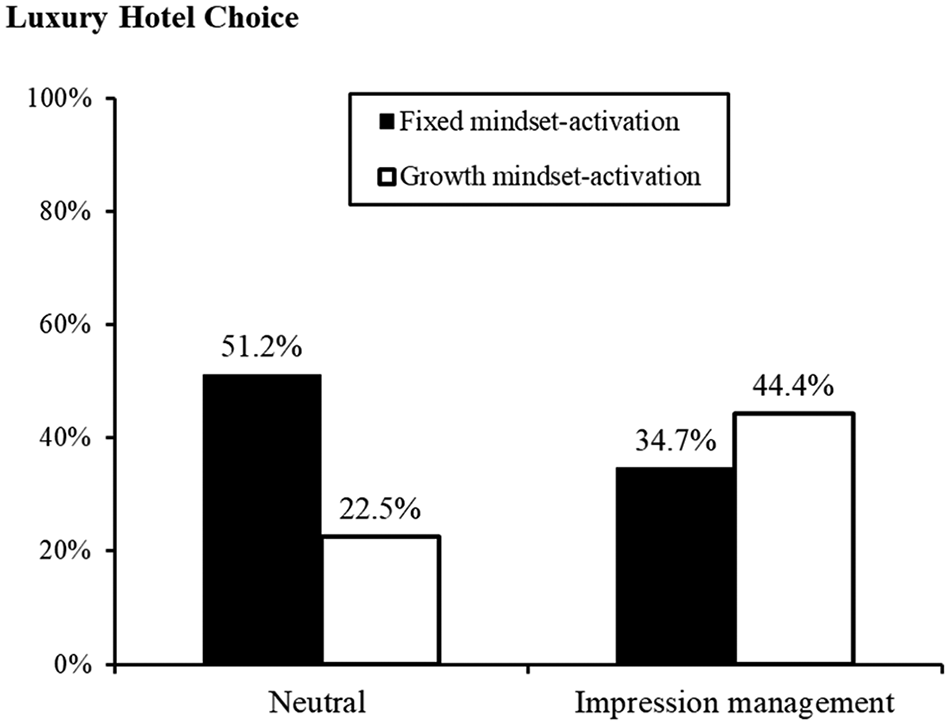
Results of study 1b.
To test the underlying mechanism further, we have conducted an alternative analysis of simple effects within each mindset-activation condition. As predicted, we found that the effect of scenario type on the hotel choice was not significant among fixed mindsets (β = −0.34, se = 0.21, z = 1.59, p = .11, 95% CI = −0.08, 0.76), where a similar proportion of fixed mindsets chose the luxury hotel option across both the neutral (51.2% [22/43]) and impression management (34.7% [17/49]) scenarios. On the other hand, within the growth-mindset activation condition, the effect of scenario was significant (β = −0.51, se = 0.24, z = −2.10, p = .04, 95% CI = −0.98, 0.03), with a significantly higher proportion of growth mindsets choosing the luxury hotel option within the impression management condition (44.4% [20/45]) compared to the neutral condition (22.5% [9/40]). Thus, this confirmed our predictions regarding the underlying mechanism.
Discussion
Studies 1a and 1b establish that mindsets play an important role in determining consumer preferences for luxury travel from the perspective of self-enhancement. In particular, our findings illustrate that, in general, fixed mindsets show a higher preference for luxury travel than growth mindsets. Importantly, we show that this effect is driven by the perceived value of luxury travel as self-enhancement, which is more accessible for fixed rather than growth mindsets. We establish this underlying mechanism with a mediation analysis in study 1a and using a moderation-of-process approach in study 1b.
In the remaining two studies, we build on the results of studies 1a and 1b to test the role of mindsets within consumer evaluations of luxury travel advertising. Specifically, we show how underscoring the specific value perceptions of luxury travel (i.e., self-enhancement vs. quality) via advertising messages can increase the appeal of luxury travel in light of the roles played by mindsets. In this endeavor, we establish that while fixed mindsets value luxury travel for self-enhancement benefits, growth mindsets value the superior quality of luxury travel.
Study 2
Study 2 achieves two purposes. First, it replicates the results of studies 1a and 1b in the context of luxury travel advertising. That is, we show that, in general neutral conditions, adopting a fixed mindset yields more positive attitudes toward a luxury hotel than adopting a growth mindset (hypothesis 1). Second, and more importantly, we illustrate that growth mindsets can be encouraged to develop comparably positive attitudes with fixed mindsets through the use of advertising messages that feature detailed information about the hotel’s facilities and amenities (hypothesis 2). Thus, we offer an initial evidence for our proposition that growth mindsets may value the superior quality of luxury travel.
Method
A total of 163 (female = 50.9%; Mage = 36.75, SD = 12.16) participants were randomly assigned to a 2 (mindset activation: growth vs. fixed) × 2 (hotel information: neutral vs. detailed information) between-subjects experimental design. The study consisted of two parts. In the first part, participants were surveyed about their general demographic information, previous traveling experiences, and destinations they had visited—as potential confounding factors. However, these factors did not influence the results of our findings and will not be further discussed.
In the second and main part, participants were told that a luxury hotel chain, the Ritz-Carlton, was designing a new advertisement for its hotel in Singapore, and that they were going to see a mock-up of this advertisement. In a separate pretest with 106 participants (female = 52.8%; Mage = 35.95, SD = 8.91), we conducted manipulation checks by asking participants to rate whether the Ritz-Carlton was a luxury hotel (1 = strongly disagree, 7 = strongly agree). One-sample t test showed that participants perceived the Ritz-Carlton to be a luxury hotel as intended (M = 6.27, SD = 0.98 vs. neutral point, i.e., “4”; t(105) = 23.85, p <.05).
They were then shown one of the two mock slogans that described the brand personality of the Ritz-Carlton. These slogans were aimed to activate either fixed or growth mindset and were based on those developed in previous studies (Yorkston, Nunes, and Matta 2010; Kwon, Seo, and Ko 2016). In the fixed mindset activation condition, participants read, “At the Ritz Carlton, we are committed to consistency and unwavering steadfastness. Ask yourself how our stability can fit your lifestyle. Your personality and ideals stay the same and the Ritz Carlton stays there with you”; whereas the growth mindset-activating slogan read, “At the Ritz Carlton, we are evolving. We ask ourselves how we can adapt to fit your lifestyle. You change and the Ritz Carlton is changing with you.” Next, participants were asked to write down their thoughts about the slogan that they read to increase the effect of priming. Similarly to studies 1a and 1b, we then asked respondents to rate eight statements that measured their activated mindset on seven-point scales (1 = strongly disagree, 7 = strongly agree; α = .92), using implicit-self scales developed by Levy et al. (1998). One-way analysis of variance (ANOVA) showed that the manipulation of mindset activation using slogans was successful and as intended (Mfixed = 3.60, SD = 1.09; Mgrowth = 4.45, SD = 1.37; F(1, 162) = 7.85, p = .01).
Next, participants saw one of the two predesigned mock advertisements for the Ritz-Carlton hotel (Appendix B). Both advertisements included the same graphics and design, but varied in terms of how much information about the hotel’s facilities was provided. In the neutral condition, the advertisement provided no information about the hotel’s facilities and amenities, whereas in the detailed information condition, the advertisement detailed the hotel’s facilities, such as rooms and services. In a separate pretest with 146 participants (female = 57.5%; Mage = 35.18, SD = 10.74), we conducted manipulation checks by randomly assigning participants to view one of the two advertisements and asking them to rate whether the advertisement was perceived to offer detailed information about the hotel (1 = strongly disagree, 7 = strongly agree). One-way ANOVA showed that the manipulation of hotel information was successful and as intended (Mneutral = 3.63, SD = 1.41; Mdetailed_info = 5.74, SD = 1.00; F(1, 145) = 109.67, p <.05).
Thus, study 2 had four conditions differing on the two between-subjects factors (i.e., mindset-activating slogan and hotel information). Finally, respondents were asked to answer three statements that measured their attitudes toward the hotel on a 9-point scale (–4 = dislike/unfavorable/negative, 4 = like/favorable/positive). Responses to these three items were integrated into a single scale (α = .92). Participants were then thanked and debriefed.
Results
A 2 (mindset activation: growth vs. fixed) × 2 (hotel information: neutral vs. detailed information) ANOVA yielded a significant two-way interaction effect (F(1, 162) = 6.44, p = .02, η2 = .039). Planned comparisons revealed that consistent with the results of studies 1a and 1b, in the neutral control condition, participants who saw a fixed mindset-activating slogan (M = 2.83, SD = 1.10) showed more positive attitudes toward the luxury hotel compared to those who saw a growth mindset-activating slogan (M = 2.10, SD = 1.58, F(1, 162) = 5.37, p =.02, η2 = .033). On the other hand, when detailed information was provided, the attitudes toward the luxury hotel were similarly positive for both fixed (M = 2.43, SD = 1.42) and growth (M = 2.82, SD = 1.36, F(1, 162) = 1.59, p =.21, η2 = .010) mindset-activation conditions. These results are illustrated in Figure 2.
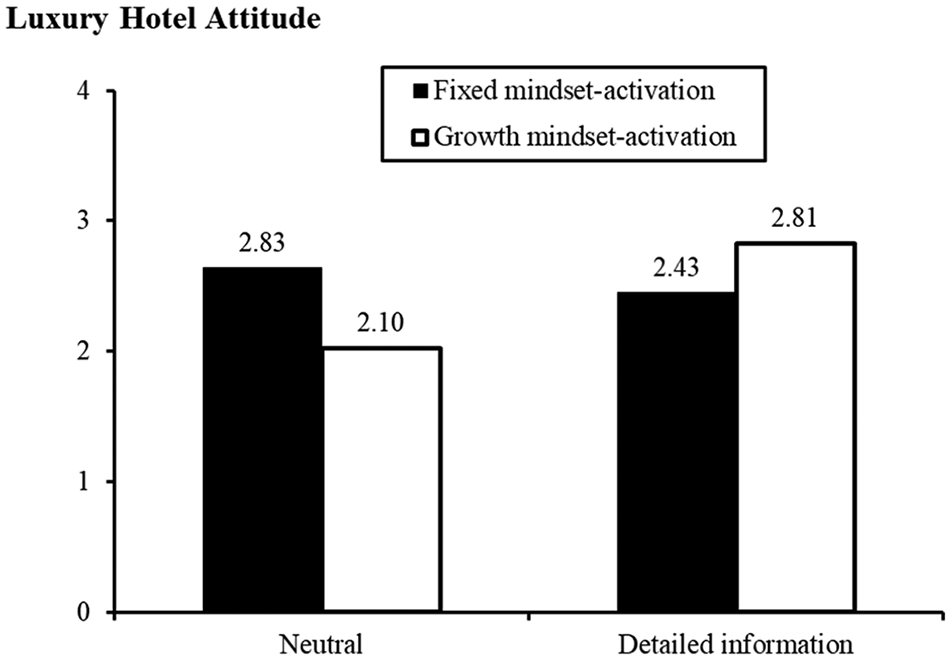
Results of study 2.
In order to probe the interaction effect further, we conducted an alternative analysis of simple effects. The results showed that the attitudes toward the luxury hotel for participants in the fixed mindset activation condition were positive, and nonsignificantly different between the neutral and detailed information conditions (Mneutral = 2.83 vs. Mdetailed_info = 2.44, F(1, 162) = 1.47, p =.23, η2 = .009). However, for participants in the growth mindset activation condition, the advertisement that contained detailed information about the hotel’s features yielded more positive attitudes toward the luxury hotel than the neutral condition (Mneutral = 2.10, Mdetailed_info = 2.82; F(1, 162) = 6.04 p =.015, η2 = .037). In other words, the interaction effect between mindsets and hotel information occurred because offering more information about the hotel’s features was evaluated more positively by growth mindsets, whereas this advertising strategy had no effect on fixed mindsets. Together, these results provide support for hypothesis 2. That is, growth mindset travelers show more positive attitudes toward luxury hotels when an advertising message offers detailed hotel information. On the other hand, the amount of hotel information does not seem to influence how travelers with a fixed mindset evaluate luxury hotels.
Discussion
The findings of study 2 further confirm that the travelers’ evaluation of luxury hotels varies as a factor of their mindsets. Importantly, for the mindsets manipulation, we used a different priming technique (from studies 1a and 1b) that involved exposing our participants to the hotel’s advertising slogans (Yorkston, Nunes, and Matta 2010; Kwon, Seo, and Ko 2016) that were congruent with either a fixed or growth mindset. This offers a more practical way for travel marketers to purposively activate the desired mindsets. More importantly, this study shows how featuring (vs. not featuring) detailed hotel information in advertisements moderates the influence of mindsets. The findings illustrate that featuring detailed information makes luxury hotels more attractive among growth mindsets, but it does not have an effect on fixed mindsets. Therefore, we offer support for our proposition that growth mindsets value the superior quality of luxury travel.
Study 3
Study 3 achieves three purposes. First, we corroborate the results of previous studies using the measures rather than the manipulations of mindsets. Second, we offer support for our remaining H3 regarding the role of language style in luxury travel advertising. That is, we show that advertising language style can be used to moderate the relationship between mindsets and luxury hotel attitudes, whereby fixed (growth) mindsets show more positive attitudes when advertisement is framed in affective (cognitive) language. As per our theoretical development, and consistent with studies 1a, 1b, and 2, these results support our tenet that fixed mindsets value luxury travel for self-enhancement and growth mindsets for superior quality, using a single experimental design.
Finally, we address an important limitation of study 2. Specifically, while the Ritz-Carlton is an established representative luxury hotel (H. B. Kim and Kim 2005), it is unclear whether the results observed in study 2 are indeed due to the perceived luxuriousness of this hotel or due to some other extraneous characteristics. In study 3, we address these limitations by using another luxury hotel brand, and contrasting the observed effects between luxury and nonluxury hotels. Specifically, we posit that the effect of mindsets will be evident only in the context of luxury hotels. This is because generic (i.e., nonluxury) hotels convey neither substantial symbolic properties for self-enhancement, valued by fixed mindset travelers, nor superior quality, valued by growth mindset travelers. Hence, in the case of nonluxury hotel, whether an advertisement is more aligned with self-enhancement or superior quality will have a little differential impact on fixed and growth mindsets. In so doing, we aim to show that our hypothesized effect of mindsets has unique relevance for luxury travel. We formally combine this prediction as follows:
Hypothesis 3a: The moderating effect of language style described in hypothesis 3 will be evident for luxury hotels, but not for nonluxury hotels.
Method
A total of 162 (female = 48.3%; Mage = 32.86, SD = 14.09) participants were randomly assigned to a 2 (hotel: luxury vs. nonluxury) × 2 (language: cognitive vs. affective) between-subjects experimental design. The study followed similar procedures to those that we used in study 2, except for that we measured rather than manipulated the mindsets. In the first part, participants were surveyed about their general demographic information, their previous traveling experiences, and destinations visited. However, these factors did not influence the results of our findings and will not be further discussed. During this stage, they also responded to eight statements on 7-point scales (1 = strongly disagree, 7 = strongly agree, α = .86) that measured their chronic mindset orientation (Levey et al. 1998).
Next, participants were told that they will be asked to evaluate an advertisement for a hotel in Auckland, New Zealand (Appendix C). Each respondent saw only one of the four predesigned mock advertisements. All advertisements featured the same graphics and design, but varied in terms of (a) the hotel’s brand and (b) the language style. In the luxury condition, an advertisement featured Four Seasons, whereas in the nonluxury condition, Holiday Inn. In a separate pretest with 106 participants (female = 52.8%; Mage = 35.95, SD = 8.91), we conducted manipulation checks by asking participants to rate whether each hotel was a luxury hotel (1 = strongly disagree, 7 = strongly agree). Paired-samples t test showed that participants perceived Four Seasons to be more luxurious than Holiday Inn (Mfour_seasons = 5.28, SD = 1.46; Mholiday_inn = 3.01, SD = 1.44; t(105) = 11.26, p <.05). Furthermore, whereas participants perceived Four Seasons to be a luxury hotel (M = 5.28, SD = 1.46 vs. neutral point, i.e., “4”; t(105) = 9.05, p <.05), Holiday Inn was not perceived as a luxury hotel (M = 3.01, SD = 1.44 vs. neutral point, i.e., “4”; t(105) = −7.06, p <.05).
Furthermore, in the affective language condition, participants read, “Stay at the heart of Auckland,” whereas in the cognitive condition, participants read, “Stay in the center of Auckland.” The choice of wording for affective and cognitive language styles was based on previous research (Byun and Jang 2015). In a separate pretest with 146 participants (female = 57.5%; Mage = 35.18, SD = 10.74), we conducted manipulation checks by randomly assigning participants to view one of the two advertising slogans and asking them to rate whether the slogan was perceived to be affective or cognitive (1 = affective, 7 = cognitive). One-way ANOVA showed that the manipulation of language style was successful and as intended (Mcogn = 4.48, SD = 1.70; Maffect = 3.81, SD = 1.38; F(1, 145) = 7.04, p <.05).
Thus, study 3 had four conditions differing on the two between-subjects factors (i.e., hotel: luxury vs. nonluxury; and language: cognitive vs. affective). Finally, respondents were asked to answer three statements that measured their attitudes toward the hotel: –4 = dislike/unfavorable/negative; 4 = like/favorable/positive. Responses to these three items were integrated into a single scale (α = .95). Participants were then thanked and debriefed.
Results
To test hypothesis 3, we used PROCESS macros (Model 3, 5,000 bootstrap samples) (Hayes 2013), whereby we conducted the moderated-moderation (three-way) analysis of “hotel” × “language” × “mindsets,” with mindsets being a measured continuous variable. The analysis yielded a significant three-way interaction effect (β = −0.27, se = 0.11, t(1, 154) = −2.48, p = .01, 95% CI = −0.48, −0.05). Further investigation revealed that the two-way interaction of “language” X “mindsets” was significant for the luxury hotel condition (F(1, 154) = 11.21, p = .00), but it was not significant for the nonluxury hotel (F(1, 154) = 0.13, p = .71). These results suggest that the effect of mindsets applies only in the context of luxury hotels.
When we probed the two-way interaction effect between language styles and mindsets further, we found that growth (vs. fixed) mindsets yielded more positive attitudes toward the luxury hotel when an advertisement featured cognitive language (t = −2.39, p = .018, 95% CI = −0.92, −0.09). In contrast, when an advertisement featured affective language, the effect was opposite and significant. That is, fixed (vs. growth) mindset travelers showed more positive attitudes toward the luxury hotel (t = 2.35, p = .02, 95% CI = 0.07, 0.83). Thus, we found support for hypothesis 3 regarding the moderating role of advertising language style on the relationship between mindsets and the attitude toward luxury hotels. In Figure 3, we illustrate these results with a spotlight analysis (Fitzsimons 2008), which contrasts attitudes toward the hotel at one standard deviation above the mean value of mindsets (growth mindset) and one standard deviation below the mean value of mindsets (fixed mindset) within each experimental condition.
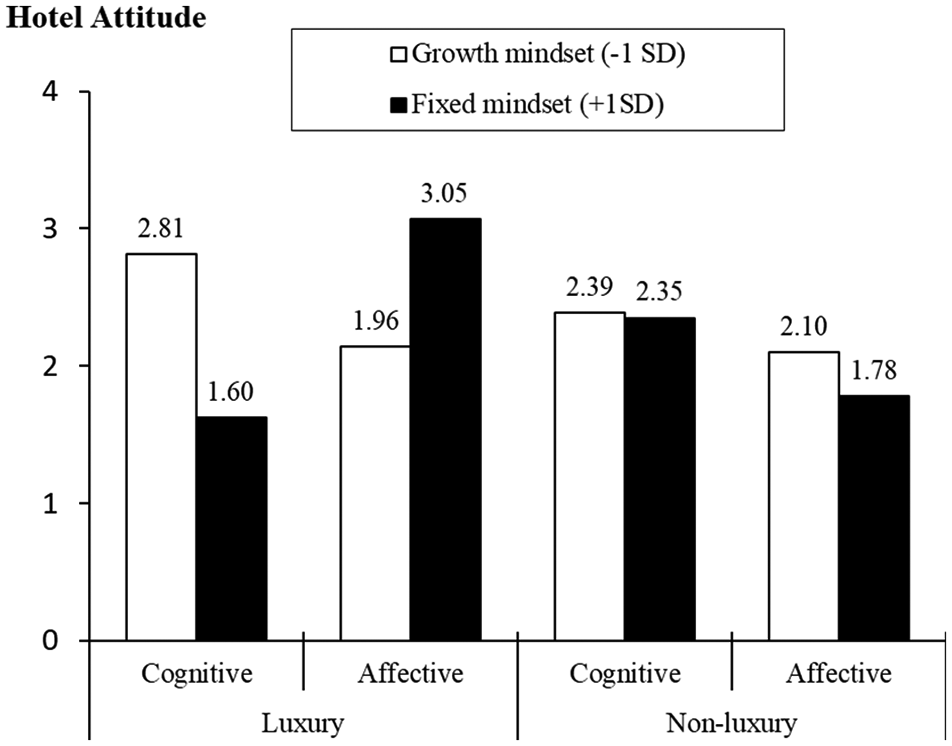
Results of study 3.
Discussion
In this study, we measured travelers’ chronic mindsets, and explored its influence on the attitudes toward luxury hotels. We found that while fixed mindsets express more positive attitudes when an advertisement is presented in affective language, cognitive language is more effective for targeting growth mindsets. Furthermore, we show that this effect is salient for luxury hotels, and it does not apply for generic nonluxury accommodation providers. Accordingly, these results offer additional support for our tenet that fixed mindsets value luxury travel for self-enhancement benefits and growth mindsets for superior quality.
General Discussion
Theoretical Contributions
Our article offers several theoretical contributions to research on luxury travel research and managerial practice. First, with the exception of sociodemographic characteristics, such as the level of disposable income (Hay and Beaverstock 2016), there are limited insights into understanding the reasons why some people might be more willing than others to pay premium prices to stay at luxury travel providers (Correia and Kozak 2012). Indeed, while the concept of luxury has been traditionally considered to be a privilege of the wealthiest echelons of society (Berry 1994), contemporary luxury travel is now becoming affordable to a broader market of less-affluent consumers (Okonkwo 2009; Correia and Kozak 2012; Seo and Buchanan-Oliver 2019). This means that luxury hotels must think beyond the level of wealth when they profile and target their potential customers.
Our study assists tourism managers in this endeavor by showing how activating the desired mindset (Dweck et al. 1995; Chiu, Hong, and Dweck 1997; Hong et al. 1999) can exert significant influence on the travelers’ evaluation of luxury hotels. That is, we show that, when people hold a mindset that their personalities are fixed, they are likely to show more preference for luxury travel. On the other hand, when people believe that their personalities are malleable, they generally show less preference for luxury travel. This effect occurs because fixed mindsets are more likely to use the appealing images of luxury travel as an opportunity on self-enhancement. However, we also illustrate that growth mindsets may find more value in the superior quality of luxury travel.
Second, we use the psychological mechanism described above to design and test empirically the effectiveness of divergent advertising strategies for luxury hotels. In this endeavor, we show that, although there is a general tendency for fixed mindsets to respond more positively to luxury travel advertising, this relationship can be expanded by using certain features in advertising messages, such as providing detailed hotel information and changing the language style. That is, in study 2, we found that when travelers adopt a growth mindset, they can be encouraged to show more positive evaluations of luxury hotels by using advertising messages that offer detailed information about the hotel’s rooms and facilities. Notably, this advertising strategy does not diminish the value of luxury hotels for fixed mindsets. Thus, our results extend previous research that explored merely which advertising messages are more preferable for fixed (vs. growth) mindsets (e.g., Kwon, Seo, and Ko 2016) by considering how to make luxury travel more appealing for growth mindsets without alienating fixed mindsets.
Third, the results of study 3 show that whereas advertising messages using affective language (Byun and Jang 2015) are influential for targeting fixed mindsets, the same advertisements presented in cognitive language will be more appealing to growth mindsets. We found that this moderating effect of language style applies only in the context of luxury hotels, but not for nonluxury hotel providers. This is significant because it illustrates that our hypothesized effect of mindsets has unique relevance for luxury travel.
Fourth, the combined results of study 1b and studies 2 and 3 shed light on two different paths to “nudge” growth mindsets to forming positive evaluations of luxury travel. Specifically, studies 2 and 3 establish that growth mindsets can be encouraged to show higher preference for luxury travel by emphasizing the superior quality characteristics of luxury hotels. On the other hand, study 1b shows that the preference for luxury hotels among growth mindsets increases when situational factors (e.g., trying to impress someone) require them to convey positive qualities about themselves. These findings are consistent with recent studies, which show that activating a growth mindset increases cognitive flexibility in decision making (Bullard, Penner, and Main 2019), and suggest that depending on other situational factors (e.g., traveling alone vs. family vs. romantic partner, etc.), growth mindsets are more likely to deviate from their chronic tendencies in order to maximize their situational goals.
Fifth and finally, while previous research has focused largely on identifying various attributes and characteristics associated with luxury tourism, such as brand prestige (Hwang and Han 2014), superior quality (Wu and Liang 2009), and status motivations (Correia and Kozak 2012), our study shows that the relative importance of these characteristics can vary depending on the mindsets and external influences. Thus, we concur that “there is no singular, uncontested or essential version of a luxury brand” (Roper et al. 2013, p. 393) and that consumers use different interpretive strategies to organize their perceptions about luxury travel. We extend this position by highlighting that with the knowledge about mindsets, these interpretive strategies can be purposively activated by tourism managers through advertising.
Managerial Implications
We offer several managerial implications for developing effective luxury travel advertising. First, we encourage managers look beyond the level of disposable income of prospective customers, to consider their personality characteristics and mindsets, while paying particular attention to whether people believe their own personal traits to be fixed or malleable. This understanding may shed light on different ways in which luxury tourism can be perceived—as potential opportunities to signal positive personal qualities or as properties offering superior quality.
Second, we show how the relative salience of particular mindsets and, thereby, the evaluation of luxury hotels can be purposively activated to increase the effectiveness of advertising appeals. Specifically, when developing a brand positioning, travel providers should consider whether they emphasize a fixed or growth mindset, and then choose their advertising strategies that are congruent with the chosen mindset positioning. If a brand endorses a fixed mindset, then presenting advertisements in affective language would be an effective strategy. However, if a brand endorses a growth mindset, then presenting advertisements in cognitive language and detailing information about the hotel’s facilities would be a more effective strategy. This is also relevant for travel providers that have limited capacity to change their brand personalities. For instance, if a luxury hotel has established its reputation for tradition and historicity (i.e., it is fixed mindset-congruent), then this brand should use affective language. On the other hand, if a hotel is relatively new or if it is considered to be innovative (i.e., growth mind-set congruent), then using cognitive language and offering detailed hotel information (e.g., about rooms and facilities) will be more effective.
Overall, managers should take advantage of the matching effects between travelers’ mindsets and advertising message features to develop effective luxury travel advertising strategies.
Limitations and Suggestions for Future Research
Despite these important contributions, however, several limitations of our study should be acknowledged. First, we used online panels whose distribution might not be exactly the same as the target population. However, previous studies in tourism have shown that online panels are, in fact, comparable to general public (Buhrmester, Kwang, and Gosling 2011; Goodman and Paolacci 2017), and many previous studies using experimental methods have used the specific nationwide panel that we used in this study (e.g., Byun and Jang 2015; J. Kim, Kim, and Kim 2018a; J. Kim et al. 2016). In addition, we used mainly the scenario-based method in our empirical investigation. Even though this method is well-established, and frequently used in tourism research (e.g., J. H. Kim and Jang 2014; J. Kim, Kim, and Kim 2018b), we acknowledge that it may have weaknesses in terms of external validity, as it could mean that participants do not fully immerse themselves in the given situation (Byun and Jang 2015). Future research could endeavor to conduct field studies involving the actual behaviors of tourists.
Our study offers a platform for fruitful future research. For instance, while we explored the effect of hotel information and language style, there could be other advertising features that exert influence on the relationship between luxury travel and travelers’ mindsets, such as narrative transportation (Escalas 2004), brand familiarity (Kent and Allen 1994), and visual format (S. B. Kim, Kim, and Bolls 2014; MacKay and Fesenmaier 1997). Finally, the purpose of a trip—business, leisure, or family—and travelers’ previous experiences with hotels could be other important factors that are related with the concept of luxury tourism and mindsets. This was especially evident in study 1b, where the introduction of “impression management” scenario moderated the effect of mindsets on luxury travel preferences.
In summary, we hope that this study, with its emphasis on mindsets, luxury travel, and advertising strategies, will offer new insights for researchers and practitioners who are interested in luxury tourism.
Supplemental Material
JTR_888280_Appendix – Supplemental material for It Is All in the Mind(set)! Matching Mindsets and Luxury Tourism
Supplemental material, JTR_888280_Appendix for It Is All in the Mind(set)! Matching Mindsets and Luxury Tourism by Yuri Seo, Dongwoo Ko and Jungkeun Kim in Journal of Travel Research
Footnotes
Declaration of Conflicting Interests
The author(s) declared no potential conflicts of interest with respect to the research, authorship, and/or publication of this article.
Funding
The author(s) received no financial support for the research, authorship, and/or publication of this article.

Supplemental Material
Supplemental material for this article is available online.
Notes
Author Biographies
References
Supplementary Material
Please find the following supplemental material available below.
For Open Access articles published under a Creative Commons License, all supplemental material carries the same license as the article it is associated with.
For non-Open Access articles published, all supplemental material carries a non-exclusive license, and permission requests for re-use of supplemental material or any part of supplemental material shall be sent directly to the copyright owner as specified in the copyright notice associated with the article.
