



Abstract
This conceptual article reconsiders the formation of destination and place brands. It proposes that brands initiate people’s meaning making over the place directly involving them in the branding process. Using a combination of process-based approaches to brands and places, the article substantiates the argument that the place brand’s quintessence lies in the constant alterations it causes to the meaning of the place as stakeholders interact, thereby keeping the brand active and in constant formation. The distinction between conceived, perceived, and lived dimensions of a place brand is used to conceptualize the brand as open-ended, allowing for different interpretations to occur and different meanings to develop. This makes the brand rather elusive. The article accounts for the implications of the elusiveness of place brands for place brand management and proposes the ATLAS wheel of place brand management as a tool to follow and influence the place brand in its on-going formation.
Introduction
Underlying most scholarship in destination branding is the understanding of branding as the planned communication of a stable and unique identity that differentiates the destination from its competitors (e.g., Qu, Hyunjung Kim, and Hyungjung Im 2011; Morgan, Pritchard, and Pride 2002). Early on, Ritchie and Ritchie (1998, p. 103) defined a destination brand as “a name, symbol, logo, word mark or other graphic that identifies and differentiates the destination.” However, destination brands also promise a memorable travel experience uniquely associated with the destination and consolidate pleasurable memories of the destination experience (Ritchie and Ritchie 1998; Blain, Levy, and Ritchie 2005). Recent conceptualizations point to the destination brand not as isolated perception or simply a sign (Saraniemi and Komppula 2019). Destination brands—like all place brands—are heavily charged with symbolic meanings (Ekinci, Sirakaya-Turk, and Preciado 2013; Morgan, Pritchard, and Pride 2011) serving as lifestyle statements and elements of individual identity construction. Tourists can indicate their lifestyle and express their identity through the places they visit (Morgan, Pritchard, and Pride 2002). This is a function performed by the place brand as “consumers use places and the stories and cultural meanings that come with them as brands to construct themselves as individuals” (Hjortegraad-Hansen 2010, p. 270). This understanding is reflected in Gnoth’s (2007) definition of a destination brand as “a name or symbol that represents the core values of the place offered for tourism consumption” (p. 348) and operates at a functional, experiential, and symbolic level. He added that the brand “captures the place’s essential and living values on the cultural, social, natural and economic dimensions and utilizes it as the destination’s capital” (p. 348).
The main aim of this article is to elaborate on the process of destination and place brand formation and reassess the way in which place brands operate as meaning-making processes. The article undertakes a reconsideration of the ontology of destination brands by calling into question their understanding simply as promotional devices, their reliance on visual expressions, and their presumed rigidity. Instead, we propose a processual view of brand formation that centers on the ongoing creation and alteration of brand meaning and highlights the open-ended nature of destination brands. It is important and topical to undertake this reconsideration because substantial amounts of public money are invested by destination marketing organizations in the “design of logos, development of slogans, publication of brochures, creation of websites, organization of events and the implementation of a variety of additional branding efforts” (Chekalina, Fuchs, and Lexhagen 2018, p. 31). A better understanding of what destination brands are and how they function helps consolidate this investment and is essential for improved practice.
To contribute to that end, the article undertakes four tasks. First, it synthesizes contemporary approaches to brands as cultural processes with theories of space and place, allowing a deeper examination of the nature of place brands and their formation. Particularly, we extend the understanding of place as fluid, open, and dynamic (e.g., Massey 1994; Ingold 2011) to place brands. Secondly, the article builds on the idea of brands as facilitators of meaning creation as they prompt elaborations of the destination and its identity. Brands are seen to initiate people’s meaning-making process and get them directly involved in branding the destination, something that also leads us to argue that the place brand and the destination brand are inseparable and can only be examined simultaneously. Thirdly, the article describes brand formation as it occurs through people’s meaning-making interactions over conceived, perceived, and lived aspects of the place brand, using Lefebvre’s (1991) triad of the production of space. This leads to the conceptualization of the place brand as open-ended and elusive rather than fixed and unambiguous. We discuss the elusiveness of place brands inspired by John Steinbeck’s description of the elusiveness of words. In his Journal of a Novel: The East of Eden Letters (p. 122), Steinbeck writes: “Words [Brands] are strange elusive things and no man may permanently stick them on pins or mount them in glass cases. The academies have tried that and only succeeded in killing the words [brands].” This elusiveness of place brands leads to the suggestion that the task of branding lies in facilitating the creation of brand meaning by others rather than defining and projecting a fixed meaning as determined by managers. The fourth task undertaken is to account for the implications of this line of thought for place brand management, proposing a participatory place branding process depicted in the ATLAS wheel of place brand management. In this way, the article’s contribution is that it integrates established knowledge from separate parts of the literature into a novel conceptualization of destination brand formation with clear implications for destination brand management.
Brands and Place
Despite the popularity of destination branding, it is argued that there is a paramount need for a better understanding of destinations and their brands (Morgan, Pritchard, and Pride 2011; Zenker, Braun, and Petersen 2017). The challenge for destination branding as a form of branding lies in the fact that destinations are living entities, they are open systems that constantly evolve (Gnoth 2007), and much of the discussion around product or corporate brands is of little relevance to places. The criticism is raised that the role of DMOs has been overemphasized in the mainstream literature on destination marketing (Saraniemi and Komppula 2019). Place and destination branding are also often criticized for promoting simplified perspectives of places (e.g., Ren and Blichfeldt 2014; Zenker and Braun 2017) even though their geographical nature (Pike 2011) denotes multiplicity of meaning (Kavaratzis and Hatch 2013) and their existence under negotiations and changes (Saraniemi and Komppula 2019). Morgan, Pritchard, and Pride (2011) call for destination branding practices that will lead to more authentic brands, reflective of the destinations and their constituencies, and Saraniemi (2011, p. 252) calls for more “stakeholder-focused destination branding with views of dynamic branding processes” asserting that “building an image for customers remains only a narrow aspect of branding.” To follow this direction, it is useful to consider cultural and processual approaches to both brands and places.
Brands fulfil a social and cultural function by producing, reproducing, and circulating meaning (Schroeder 2009) something that points to an appreciation of brands as cultural practices (Cayla and Arnould 2008). Following a service-dominant logic of marketing (Vargo and Lusch 2004; Grönroos 2008), the idea of brand cocreation suggests the existence of brands within a process of dialogue over their meaning (Hatch and Schultz 2010). Brand cocreation researchers argue that value and brands emerge from interactions among stakeholders such as managers, employees, consumers, intermediaries, and communities (e.g., Gregory 2007; Hatch and Schultz 2010). Producers are seen as facilitators of the value and experience cocreation process, through the provision of necessary resources for value fulfillment (Grönroos 2008). Consumers are seen as value generators who themselves bring their own resources that are also vital for cocreation situations, or as Prebensen, Vitterso, and Dahl (2013, p. 242) put it, participate “in the value creation process by bringing various types of customer resources and efforts into the experience value scene.” The cocreation of brand value happens through interactions in the network relationships defining a stakeholder’s ecosystem (Mertz, He, and Vargo 2009), where stakeholders “continuously negotiate and redefine brand meaning through their discursive activities” (Vallaster and von Wallpach 2013, p. 1507). Regarding place brands, such a cocreational and processual analysis remains undertheorized (Saraniemi and Kylanen 2011), despite recent efforts (notably Prebensen, Vitterso, and Dahl 2013; Chekalina, Fuchs, and Lexhagen 2018). As Kavaratzis and Kalandides (2015) note, it is particularly useful for a better understanding of place brands to examine processual views of place.
What constitutes place has been a long-standing debate among geographers. Traditional definitions of place assume a single place identity defined by specific place qualities (such as the place’s history) and accept definite place boundaries that separate the inside from the outside. Against such understandings, there are several arguments in favor of more complex conceptualizations (Massey 1994; Ingold 2011). For instance, for Agnew (1987), place has three elements: “locale,” which is the setting where social relations occur; “location,” which is the geographically bounded area where processes of social interaction occur; and “sense of place,” which is the feeling structure regarding a specific place. The particularity of places emerges from the way in which the three aspects complement each other. Massey (2005) argues that places can be thought of as intersections of trajectories and that it is not any particular qualities of the specific locale that make a place special but, rather, the particularity of its links to the outside, which are themselves part of the place’s constitution. Thus, places are social constructs that always form through social relations within a social context and “are not essences or essential components of spatial surroundings but processes” (Elkington and Gammon 2015, p. 2). Place users such as residents and visitors define place meaning through being there, through their practices and their interactions, making places “storehouses of meanings” (Snepenger et al. 2007). Therefore, place meanings are neither static nor objective; rather, they are individually experienced and understood through embodied experiences and performances (Rakic and Chambers 2012) something that needs to be considered when examining place brands (Rabbiosi 2016). Places, then, are constructed by people doing things and, therefore, are never “finished” but are constantly being performed (Cresswell 2004). This means that places come into existence via people’s actions and interactions and their interpretations. The triad of the production of space (Lefebvre 1991) helps in clarifying the processes involved.
Lefebvre (1991) described that space is generated via the interaction of the three aspects of perceived space (or spatial practices), conceived space (or representations of space) and lived space (or spaces of representations). Perceived space is a product of a specific society at a specific time, and it determines the uses of space and the accompanying social formations (Meethan 2001). For Lefebvre (1991), perceived space comprises people’s practices such as their daily routines and everyday concrete experience. Conceived space is the domain of planners and other technocrats; a space of planning from elevated points, a space of geometry and quantitative ordering (Miles 2007). Conceived space consists of abstraction and is imbued in power (Colombino 2009). This includes “the production of certain forms of narratives, which encapsulate selected readings of the environment, as in promotional literature, brochures, itineraries and so on” (Meethan 2001, p. 37) thus making it also the realm of place branding in its traditional view. Lived space (or representational spaces) is “space as directly lived through its associated images and symbols” (Lefebvre 1991, p. 39). Lived spaces are partly imagined and encompass sets of meanings derived from experience. They are the spaces of emotions and imagination (Colombino 2009) and the realm of personal meaning production through desires, memories, and associations that reorder spaces (Miles 2007). Lived spaces are rooted in collective cultural traditions and memories but also have roots in the memories and dreams of individuals (Colombino 2009). Of course, for Lefebvre (1991) the three aspects exist simultaneously, interact and overlap. For example, conceived space will always be interrupted by constantly re-made meanings of the space-in-use or lived space (Miles 2007). This reminds us that “space is simultaneously made of many temporalities and of everyday experience, conceptualization and representation, emotions and imagination” (Colombino 2009, p. 285).
The Ongoing Formation of the Place Brand
The combination of the conceived, perceived, and lived aspects is relevant to place branding as it helps clarify the complexity of places as objects of branding. Hjortegraad-Hansen (2010, p. 271) implies the distinction when suggesting that “a place brand is perceived subjectively and will be combined by experiences where possible and/or stem from a conception about the [place]” (our emphasis). Also, Colombino (2009) has usefully adopted a Lefebvrian understanding in her analysis of people’s encounters with place marketing images. The distinction between the three aspects helps clarify what Campelo (2017, p. 81) describes as “in place branding value is cocreated in a more intangible level (with place image and meanings) and in a very tangible level through an embedded experience of the place.” What the simultaneity of the three aspects means is that place brands acquire meaning in a complex environment of intense interactions between stakeholders.
Importantly, a Lefebvrian understanding points to the fact that for a specific place, the place brand and the destination brand are inseparable. They have, of course, a different target audience but this relates more to the managerial intention rather than the reality of brand formation. The combinations of conceptions, perceptions and lived experiences, occur at the same time for residents, visitors, managers and all other stakeholders. Failing to understand that they are all jointly influenced by branding, harms its efficiency (Zenker, Braun, and Petersen 2017). The processes that create both the place and destination brand are simultaneous, interrelated, and based on the same physical and symbolic stimuli (Kavaratzis and Hatch 2013). For this reason, Selby (2004) prefers the term “place consumers” to “visitors” and “non visitors,” “as residents also consume the representations and landscapes of tourism destinations” (p. 168). Therefore, we do not separate in our discussion the destination brand and the place brand. In this, we are in total agreement with Rabbiosi (2016), who finds that the distinction between place and destination is reductive as “tourist destinations are fully places” (p. 156, emphasis in original). To reinforce this argument, Campelo et al. (2014) have convincingly connected destination branding with sense of place, which in turn is of great importance for place branding (e.g., Kavaratzis and Hatch 2013) and Elliot, Papadopoulos, and Kim (2015) argued that destination image and place image need to be studied in an integrative manner. Furthermore, Zenker, Braun, and Petersen (2017) showed that destination branding needs to embrace the full complexity of the place if it is to be successful. Making the connection between branding the place and branding the destination is not only advisable (as also argued by Elliot, Papadopoulos, and Kim 2015) but inevitable (e.g., Campelo et al. 2014; Rabbiosi 2016; Zenker, Braun, and Petersen 2017).
Brand associations arise in confrontation with publicly available symbolic material that is either already embedded in brand symbolism (i.e., induced meaning-making elements as suggested by brand managers) or in wider branding activities (i.e., organic meaning-making elements suggested by expressions of meaning distributed among stakeholders). For the sake of clarity, we use Hanna and Rowley’s (2015) note that place brand stakeholders include residents, activities groups, local and national businesses, employees, other places, all scales of government and visitors. Gunn (1972) was the first to distinguish between “organic” images (i.e., based on sources of information not aimed at promoting the place, such as novels, films, news or documentaries) and “induced” images of destinations (i.e., based on sources of information with a commercial interest in promoting a place, such as brochures and other promotional material, travel agents and guidebooks). Tourists face representations of a destination in news reports, the internet and popular culture (i.e., organic images) as well as by word of mouth. As Schroeder (2009, p. 125) puts it, the meanings ascribed to brands “are not only the result of a projected brand identity—a process of negotiation also takes place in and between the marketing milieu, the cultural surround and the social environment.” Various instances of such negotiation can occur. For instance, through the interaction between locals and tourists, the place acquires new meanings for its own inhabitants (Gnoth 2007).
Drawing extensively on Lefebvre’s (1991) analysis, Figure 1 shows how the interactions between conceptions by managers (conceived brand), perceptions by individuals (perceived brand), and their own experiences (lived brand) keep the brand in a constant process of formation (as the outer circle of the figure depicts). The associations that people hold as a result are used as organic or induced elements (the middle circle) that are combined with expressions of place and self-identity as shown in the center of the figure. The open processes of elaboration over the meaning of the place brand are interlaced with individual and place identity processes; therefore, the interactions that occur are also partly identity construction processes (Kavaratzis and Hatch 2013). What links the two (i.e., identity and branding) lies in elaborations that occur through the interactions of stakeholders with each other while engaging with the brand. Changes in the meanings of associations have roots in both identity and branding, so identity elements become brand elements and vice versa. In this sense, the desired distinctiveness of the brand cannot rely on expressing a brand identity that is a result of a managerial branding process. Instead, it stems from harnessing the place’s identity and “sense of place” (Campelo et al. 2014), which is a sociocultural process.
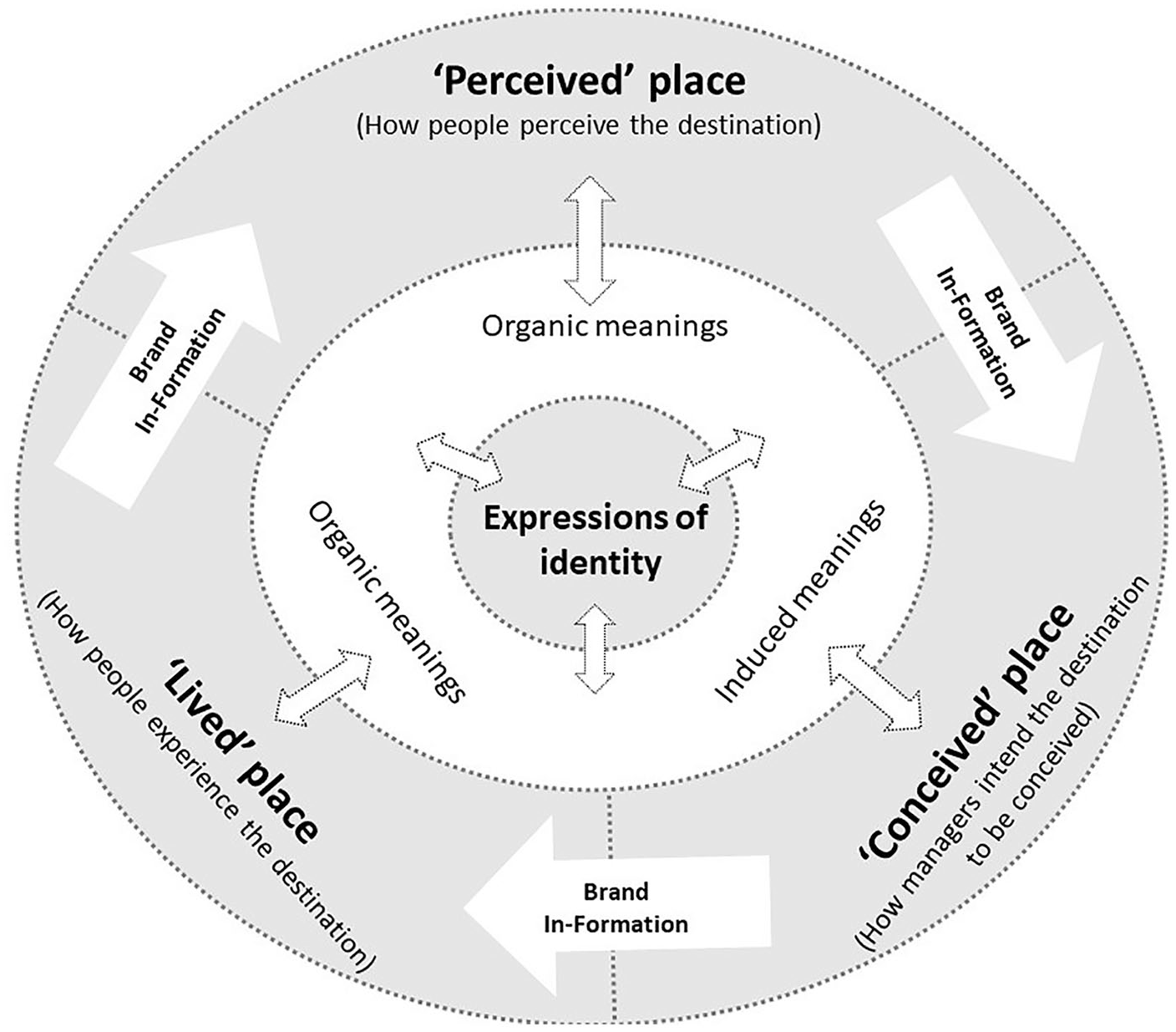
The ongoing formation of the place brand.
In this way, conceptions, perceptions, experiences, and identity instances keep combining, forming a new temporal version of the place brand until the next brand encounter and the next performative instance. These instances “do not release a pre-existing meaning that lies dormant. Rather, the instance is itself constitutive. Meaning is always in the present; in the here-and-now” (Bruner 1986, p. 11). Rakic and Chambers (2012) point to this creation of meaning in situ when they note that “at the point of experiencing or visiting a place there is no dichotomy between consumption and construction of places and these processes are dual, active and indistinguishable” (p. 1614). Thus, experience and brand value are “becoming” through cocreation processes (Prebensen, Vitterso, and Dahl 2013). As people have their next encounter with the place brand from near or far, directly or indirectly, through senses or affect, from official brand communications or other media, they keep engaging with its creation. This engagement is active meaning-making through interpretation. Thus, interactions define the brand in a tentative way at any given moment. We conclude about place brands what Oliver (2016) concludes about place identities: since place brands are inherently subject to change with new experiences, temporal versions of place brands exist—tentative brands that will change with the next experience, remaining in ongoing formation. That is why the term place brand should perhaps only be used in plural; there is never only one.
An Illustration
An example might be useful to illustrate the proposition made in Figure 1. Taking as a starting point the efforts of destination managers, we can examine the brand “We love the Gong” which was initiated and developed by the Destination Marketing Organization of the city of Wollongong in Australia (for details, see Kerr, Dombkins, and Jelley 2012). This campaign aimed both at attracting visitors and at instilling community pride in the city’s residents. As Kerr, Dombkins, and Jelley (2012, p. 272) state, the campaign “was a reaction to place identity and place image problems.” The campaign used the common heart symbol that we find in several place branding campaigns following the success of the “I Love New York” logo. The management-initiated brand proposition (in this case, “we love the Gong”) goes through the elaborating processes as a conception of the place. As soon as any one consumer or user encounters it, it is actively interpreted and combined with their perceptions, first, of the “we love the Gong” logo itself and, secondly, of the various other stimuli and encounters they have with the city. Therefore, the induced meaning-making element that is the logo is elaborated and its meaning, inevitably, changes. This is combined with the lived experiences of the city that each person has (whether firsthand or virtual etc.). In this way, the meaning of the “we love the Gong” brand proposition is enriched over and over again. Kerr, Dombkins, and Jelley (2012) conclude that the campaign was successful in that the community has embraced it. This success might have been a result of the brand proposition being open enough to allow everyone to understand it differently and use it in the way that made sense for them. Obviously, what we describe about the tagline in this case occurs for all brand propositions. Infrastructure-based propositions (whether effective transportation or perhaps the Sky-Park Infinity Pool on the 58th floor of Marina Bay Sands Hotel in Singapore) form parts of the conceived place that is elaborated. Place making elements (such as public areas or urban regeneration projects) or aesthetic propositions such as the newly painted multicolored houses of the Kampung Pelangi village (known as Indonesia’s Rainbow Village) also form conceptions to be elaborated. User-generated content in social media or a souvenir bought in a particular destination are perceived elements that are combined in the elaboration process. Photographs made at a destination and the memories they invoke also form parts of the lived destination that people use and thus the brand remains in formation.
Of course, the distinction between the conceived, perceived and lived dimensions is analytical rather than “real”: all three dimensions are simultaneous and cannot be separated. For Lefebvre (1991), the conceived space is always interrupted by lived space and, similarly, the brand as conceived by place brand managers is always interrupted by constantly remade meanings and associations derived from perceptions and lived experiences. This is what gives to the place brand fluid meaning. This is very important for destination managers and place marketers as “without fluidity there would be no opportunity to influence or change perceptions” (Oliver 2016, p. 43). In other words, it is precisely the fluidity of meaning and the temporality of the brand-in-formation that allow marketers to interfere and attempt to alter the meaning of the next brand-in-formation. It is also important to note that Figure 1 refers to a wide range of elaborations and meaning negotiations that occur in people’s minds due to various initiations and through a variety of media. However, contemporary destination brands are affected very extensively by the use of social media (e.g., Munar and Steen Jacobsen 2014), which has certainly accentuated these processes, making our conceptualization even more relevant. As Morgan, Pritchard, and Pride (2011, p. 6) note, “In our disintermediated world dominated by social media, it is the consumer who is increasingly shaping the brand and the media, so whilst DMOs never controlled the product, now they can’t even pretend to control the message.” Not only do social media provide more effective means and additional opportunities for the elaboration of place brand meaning shown in Figure 1, they also provide increased motivation for all stakeholders to participate in it.
The Elusive Place Brand
A Lefebvrian, processual approach as described above has significant conceptual implications for place brands, suggesting that to understand place brand formation, we need to think of the wider destination brand experience (Barnes, Mattsson, and Sorensen 2014) and how the destination brand is actually practiced and performed (Rabbiosi 2016). Brands play out in social actuality and their meaning develops with the participation of consumers and other stakeholders who negotiate the brand’s meaning beyond what managers intend. Therefore, brands might be conceived as elaborating symbols (Ortner 1973). Their main function—and the heart of any creative place-branding activity—lies in allowing for the development of various place meanings and the enactment of various aspects of the place. This questions the deep-rooted belief in the need for managerial control and consistency (see also Ind and Todd 2011) because place brands are involved in a process of change, precisely like places. What brand managers communicate intentionally, remains latent and can only be regarded as a brand when activated by the consumers. The conceived initiations of the process that marketers formulate in brand propositions are precisely propositions and are—very often—mistakenly called “brands.” They haven’t been given their form and meaning by stakeholders and remain words printed on promotional posters (or, to go back to John Steinbeck, “mounted in glass cases”). That is what makes Saraniemi and Komppula (2019) favor a multistakeholder orientation in branding instead of DMO-centric activities. As Hatch (2012, p. 891) argues, “brands may begin their lives as statements made by companies but if they succeed in attracting stakeholders, brands are transmuted by those stakeholders into expressions . . . of all contributing stakeholders’ values, ideas and identities.” In this sense, destination branding—like all forms of place branding—is “done” by many people at many places and times. It is as much a practice and set of activities by officials and authorities who actually call what they do “branding,” as it is a practice and set of activities by people who don’t call what they do “branding” but many other things, including “everyday life.” Thus, it is not reasonable to expect any individual brand element (such as visual aspects of design or singular claims of place identity) to sustain the whole place branding effort. Such brand propositions contribute to place brand formation but cannot determine alone what the brand will be in people’s minds, where different elaborations of the brand occur.
The meaning elaboration over the perceived, conceived and lived aspects suggests that the place brand might be better conceptualized (and, therefore, also better managed) as elusive and open-ended. The place brand can be seen not as the formulation of a fixed answer but as an open-ended question that allows for various possible answers around the meaning of the place. Therefore, place brands are perhaps best understood as distributive phenomena (Rodseth 1998), which implies that, while shared among people, they are not shared equally. The idea of a place brand does not imply homogeneity of belief about what constitutes that brand. Precisely as “not . . . every item of culture is in the possession or consciousness of every member of that culture” (Borowsky et al. 2001, p. 439), not every aspect of the place brand is in the possession or consciousness of every stakeholder in the same way or to the same degree. What is more, for a single individual this might change over time—not necessarily over long periods but possibly within moments of experiencing the place brand from near or far through a variety of media. That is because brand experiences allow consumers to “broaden their personal base of experience to include experiences of others even as they themselves contribute to that base” (Hatch 2012, p. 891). In this sense, the brand might be found not in the content of associations people hold with it and with the branded entity (in this case, the place) as suggested by general branding theory (e.g., Aaker 1996; Kapferer 2008), but, rather, in the movement between associations. Brand associations remain in a state of flux as they are activated by and influence each other (Schnittka, Sattker, and Zenker 2013) and as they—in complementary or conflicting ways—act as sources for each other (Boyle 2007). This active alteration of associations occurs continuously as any person holding brand associations interacts with the brand’s ever-changing object (i.e., the destination) and with other people who engage the brand (Kavaratzis and Kalandides 2015) and shows that the brand is formed not in but between associations. This distributive view helps to imagine why it is never possible to finally define the brand of a place, precisely because its meaning is distributed among its stakeholders making the brand not one but many ever-changing things. Hatch (2012) makes a relevant argument using Dewey’s ([1934] 1980) idea of “progressive reformation” (i.e., the way in which inner and outer material combine to build up an expressive act) to argue that stakeholders’ inner experiences with the brand interpenetrate the public materials from which brand symbolism is constituted. In her words, Pushing the idea of progressive reformation further, one could claim that vibrant brands constantly welcome into their outer forms more inner meaning by inviting others to provide additional brand material and by using the brands in their expressive acts. A corollary is that when progressive reformation subsides, a brand withers and starts to die. (Hatch 2012, p. 890)
In other words, a place brand that excludes ambiguity and does not invite elaborations of its meaning can be thought of as a “dead” brand. This implies an important realignment of the aim of the place branding effort: from “talking to” and persuasion of stakeholders to “listening” and inclusivity of stakeholders. It also points to the need to facilitate a constant reexamination of brand meaning and of all brand propositions. This is particularly important as recent research shows that the evolvement of destination brand experiences is also determined by the tourists’ needs and mental and physiological condition (Gnoth and Matteucci 2014; Kay Smith and Diekman 2017). Therefore, such a conceptualization of place brand formation implies significant changes in the nature and spirit of place brand management, which we examine in the following sections.
Managing the Elusive Place Brand
The elusiveness of place brands does not diminish but alters the value and meaning of brand management. Place brand managers can suggest aspects of the place that they want to highlight, and they can use the elusive place brand as the basis not for predetermined meanings but for future revisions of the meanings of the place. To examine the implications of our conceptualization for place brand management, we start with a brief review of the significant accumulated knowledge around the potential steps of a place branding process or model (e.g., Hankinson 2004; Gnoth 2007; Kavaratzis 2004; Moilanen and Rainisto 2009; Hanna and Rowley 2011; Garcia et al. 2012; Konecnik Ruzzier and de Chernatony 2013). Although it is not the aim of this article to review in detail all available frameworks, it is useful to attempt a synthesis, as this knowledge remains fragmentary.
Place/Destination Branding Frameworks
A first model that was proposed by Cai (2002) treats branding as a recursive process that revolves around an axis formed by brand element mix, brand identity, and brand image building. Brand elements are chosen to identify the place and to start the formation of brand associations that reflect three components of an image: attributes (the perceptual tangible and intangible features of the place), affective (personal value and benefits attached to the attributes), and attitudes (overall evaluation and motivation for action). The framework also includes the image projected by Destination Marketing Organizations through these components and suggests that image-building takes place mainly through marketing communications. In another, more linear attempt, Moilanen and Rainisto (2009) have proposed their Process Model of Destination Brand Development. The process starts with the analysis of the current state of the destination brand including consumer perceptions, competitor analysis and analysis of internal perceptions. This process leads to the definition of the destination brand’s promise and identity that are based on emotional and functional values. The process continues with supporting the brand identity through the parallel development of service process (of the various organizations constituting the destination), communication strategy (with internal and external audiences) and physical infrastructure (visual and physical evidence of the brand identity in the place). Consumer interaction and contact with all these creates a holistic brand image of the place.
Another proposition of a place branding model is Hanna and Rowley’s (2011) Strategic Place Brand Management Model, which consists of nine components. Their starting point is the brand infrastructure and stakeholder engagement components. As they explain, brand infrastructure refers to the place’s functional (e.g., built environment, public spaces) and experiential attributes (e.g., leisure, tourist, and service facilities), which need to be aligned with the brand identity and brand communications. Therefore, brand leaders need to work with all relevant stakeholders (i.e., residents, activities groups, local and national businesses, employees, other places, all scales of government and visitors). All these relationships and interactions lead to brand identity. The component of place brand architecture describes the interactions between the various brands associated with the place. The next components are viewed as core to branding and are as follows: brand articulation (the presentation of the brand through marketing media, including its visual and verbal identity, expressed through the name, logo, colors, etc.) and brand communication (all activities that communicate the brand identity, including the promotional mix). For Hanna and Rowley (2011), all above components influence the next one, namely, the consumers’ brand experience, which in turn influences word of mouth. Finally, brand evaluation assesses brand experience (Hanna and Rowley 2015).
Focusing on place brand identity, Konecnik Ruzzier and de Chernatony (2013) have proposed a comprehensive model that includes the core elements of mission (understood as a statement of purpose), vision (understood as a more forward-looking statement especially regarding the social environment), values (derived from culture and history and shared amongst stakeholders), personality (the traits of the people who constitute and live the brand), distinguishing preferences (seen as the attractions and attributes of the place) and benefits (the rewards that people think the place offers). As the authors suggest, these elements are in a constant interaction and their model helps surface, communicate and enact the elements of place brand identity. The model by Gnoth (2007) links successfully the capital that a destination has to the tourist experience through the selected brand values and brand architecture. The model distinguishes between three brand levels, which are the functional, the experiential, and the symbolic and four capital dimensions (natural, social, cultural and economic). For Gnoth (2007), destination branding consists of four iterative processes related to brand values: identification (capturing the core living values of the place in terms of their natural, social, cultural, and economic dimensions), choice (selecting the values that are essential, comprehensive, truthful, and robust), operationalization (finding out and monitoring when, where, and how tourists experience the chosen values), and experience/evaluation (understanding the fit between values and tourist experience and the impact of the values on tourist experience).
The Phases of the Place Branding Process
In order to start a synthesis of the above frameworks, it is useful to note that they indicate various phases of the branding process. These can be effectively summarized (Figure 2) as the Analytical Phase (research and analysis of the place, its resources, its image and perceptions), the Strategic Phase (development of strategic actions and tactical measures to create or influence the place brand), the Articulative phase (expression and communication of brand identity and other elements) and the Participatory phase (engagement with various groups of stakeholders). Figure 2 depicts the influence of each phase on the dimensions of the place brand discussed above, indicating the changes implied by our conceptualization and providing the basis for further elaboration on the practical implications of understanding place brands as open-ended and elusive. One of these implications is that the participatory phase is given more prominence (compared to previous framework) and changes its focus—as also done explicitly in the models by Hanna and Rowley (2011) and by Konecnik Ruzzier and de Chernatony (2013). For example, while the significance of local residents in place branding is widely accepted (e.g., Baker 2007; Braun, Kavaratzis, and Zenker 2013), the common suggestion is to craft campaigns that will target citizens and get them “on board” or even “educate” them on the importance of the selected brand values and help them internalize those values (Kemp et al. 2011, p. 123). Thus, it is suggested to undertake special efforts to advocate the destination brand internally (WTO 2007) and to “instill” the brand values within local communities (WTO 2007; Kemp, Williams and Bordelon 2011). On the contrary, in our conceptualization, it is essential that the branding process allows citizens to use and elaborate on the proposed brand, thus instilling their own values into the brand rather than the other way around. This participatory phase is there to ensure that the negotiations of meaning that we have seen above do not only happen organically but are also undertaken consciously, which is the real meaning of brand leadership. Furthermore, our conceptualization of the elusive brand emphasizes the need to incorporate place making in any place brand management process. Whereas in traditional views of place branding, the articulative phase might be considered prominent, in our conceptualization, the four phases are equally important and together form the basis of place brand management. They intend to influence the formation of the place brand through the interplay of the conceived place brand (through brand propositions), the perceived (through perceptions), and the lived place brand (through experience).
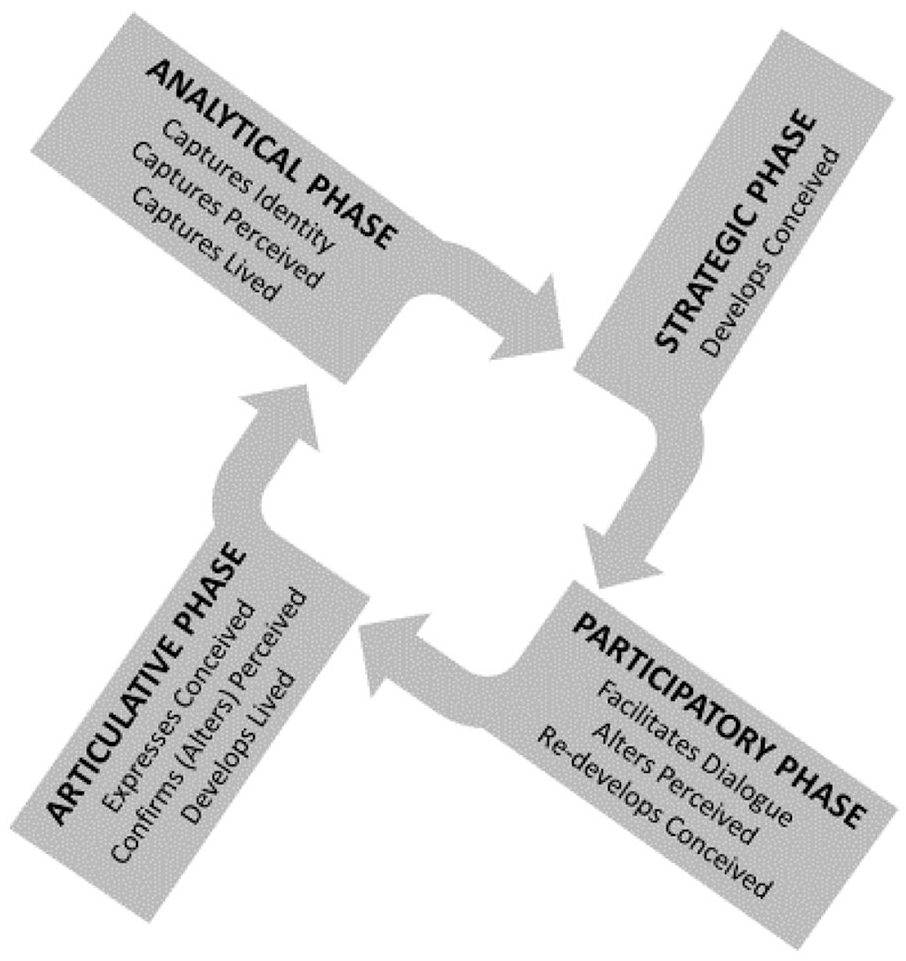
The phases of managing the elusive place brand.
The ATLAS Wheel of Place Brand Management
Effective place branding implementation, then, needs to accommodate the brand-in-formation by facilitating brand meaning-making. In order to provide a clear link between our conceptualization and place brand management practice, it is necessary to discuss in more concrete terms how the elusive brand might be managed through a participatory place brand management process. In Figure 3, we use the acronym ATLAS to depict five overlapping stages of such a process. All ATLAS steps belong to the four place branding phases (i.e., analytical, strategic, articulative, and participatory) and aim at understanding, tracking and influencing the three aspects of the place brand (i.e., conceived, perceived, and lived).
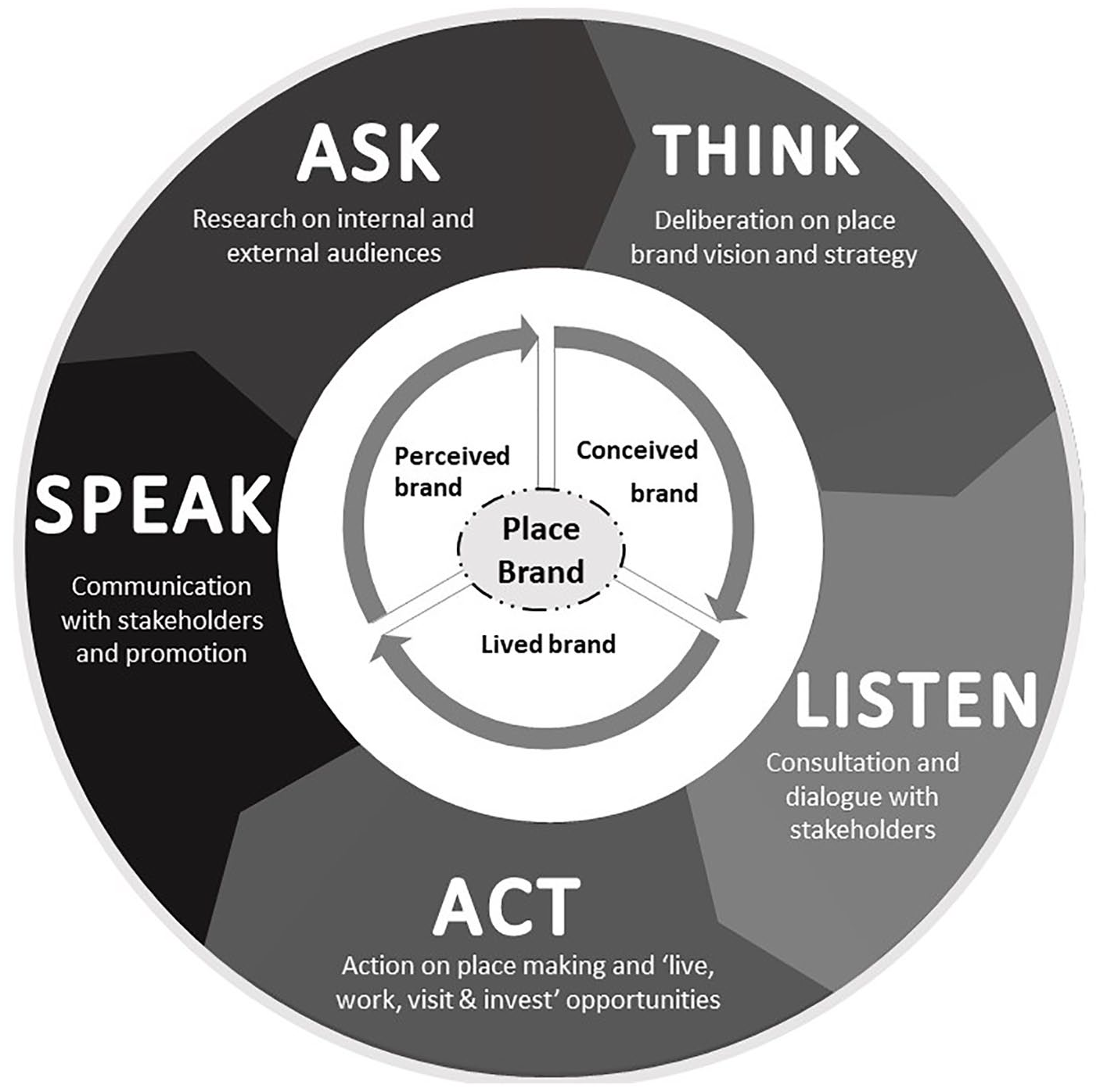
The ATLAS wheel of place brand management.
The research (ASK) step is an analytical step that captures the perceived and lived aspects. This is where the analytical aspects of place branding projects come to the fore. This might involve accounts of the available resources, investigations of the external and internal environmental factors, identity and perception studies etc. It also includes monitoring all branding activities. The deliberation (THINK) step is a strategic step that specifically develops the conceived aspect. In this stage, the core group of stakeholders discuss and propose a strategic vision for the place. These stakeholders might include local authorities, tourism offices, the local chamber of commerce and/or industry, directly involved sectors (e.g., retailers, leisure, transportation, etc.), and any external consultants or experts. Given the fluidity and elusiveness of the brand, it is not the aim of this stage to create a final vision of the future but, rather, to formulate and articulate a meaningful proposition of such a vision. The consultation (LISTEN) step is a participatory step that facilitates the negotiation of the place brand meaning and influences the perceived aspect. This is when the vision proposition developed earlier can be used as the basis of a dialogue about the future. Extensive discussions and consultations with local communities are required in order to refine the vision and strategy. Furthermore, this stage includes the seeking of synergies with organizations, institutions, and other places that might be mutually beneficial. The next two steps belong to the articulation phase and express the conceived brand, (dis)confirm the perceived brand, and frame the lived brand. The action (ACT) step is where measures are taken that include infrastructure development and improvement, regeneration initiatives, and initiatives aiming at enriching the “opportunities” offered to the several place audiences (opportunities for residence, work, leisure, education, investment, and general quality of life). In this sense, this stage of the branding process relies on “place making.” The communication (SPEAK) step aims to wrap up all above efforts and communicate them in an appealing manner. In this sense, the previous stages of the process provide this last stage with the content of communication.
It is very important to note that the stages of the ATLAS process are not independent of each other, but they are overlapping and happen simultaneously. For analytical and planning reasons, it is useful to consider the different aims of the stages and the different activities they include. However, in the actual implementation of place branding projects and strategies, the stages are interdependent and overlapping to a great extent in both content and time frame. One implication of this is that old brand propositions remain under scrutiny and elaboration. When a DMO, for instance, decides to discontinue an old brand proposition, this does not happen automatically. The discontinued brand proposition remains in people’s minds and in many other brand encounters and is still influential as an element of the brand elaboration. This leads to another implication, namely, that the branding activities that help the elaborations of brand meaning are the ones aiming to stimulate people to talk to each other rather than trying to turn them into brand ambassadors for the sole purpose of “promoting” the destination (see also Zenker, Braun, and Petersen 2017). The examples of films or promotional campaigns based on residents’ or tourists’ personal stories about the place and its brand might be a good start, especially if they are not limited to a single campaign but are complemented by a series of events, campaigns, activities and opportunities for conversation (Morgan, Pritchard, and Pride 2011). Working with the elusive place brand, marketers are tasked to facilitate elaboration and provide content for such elaboration through their choice of place representations and their organizing of activities that facilitate brand meaning-making within a network of stakeholders. Such activities can vary from private discussions to public consultations and might include research projects, workshops, or online platforms that foster participation in the branding process. In this sense, even logos can become valuable brand management tools in the place brand site if treated as opportunities for stakeholder engagement and as parts of the process of elaboration of the meaning of the open-ended and elusive brand. The ATLAS process is iterative and, precisely as brand meaning, it is always in motion, much like a wheel as depicted in Figure 3.
The processual, Lefebvrian view we adopt here informs the ATLAS wheel directly in several ways. First, it incorporates the need to revisit the brand vision (part of the THINK step) and consider it a proposition, a basis for further dialogue (in the LISTEN step) rather than a steadfast commitment. The vision for the future of the place and the strategy to achieve this vision are not finalized at the second stage but they are only propositions that need to be revisited at regular intervals. This is necessary in order not only to accommodate changes in the wider environment but also to account for the changes brought about by the branding process itself. Secondly, by expanding on the understanding that all activities are branding activities, they all send powerful messages about the place and its brand. For instance, research does not happen “before” branding starts but it is part of the branding process, it is itself a branding measure. The stage of consultation aims neither at clarifying the meaning of the brand before this is captured in other actions nor at getting people “on board” the established brand. It is in and of itself an integral part of the branding effort in that it sends important messages about the nature and content of the place’s brand. Place making (part of the ACT step) is also a part of the branding process and not a separate activity as it also sends very powerful messages about the place brand. As Selby (2004) notes, the landscape consists of physical environment elements experienced firsthand by place consumers but “although landscapes have a physical reality, their meaning is always contested” (p. 166). Thirdly, it does so by highlighting the need not only to distinguish a participatory phase but also to integrate all phases with stakeholder engagement and participation. The search for the constantly evolving place brand meaning is only possible with a continuous interaction with place stakeholders. Fourthly, by linking the brand management process and the brand formation process, it can show how the two affect each other, something that has not been attempted in the literature. As the figure shows, the place brand management wheel circles around the elusive place brand as it remains in ongoing formation.
Implications and Conclusion
This article developed a dynamic and processual view of place and destination brands based on their inherent elusiveness and explicated a proposition of place brand management through the ATLAS wheel. Our theoretical perspective emphasizes a shift from a DMO-centric orientation to multistakeholder orientation as discussed above. Furthermore, while it is common to think of place branding as a process of reduction, a process that distils the essence of a place, we approach it here as a process of elaboration, a process that enriches the meaning of the place for individuals. In this sense, the place brand works as an organizing principle for the process rather than being its outcome. A direct implication of our conceptualization, as developed in the first part of this article, is that the brand management process needs to constantly follow the ongoing place brand formation process. The search for the elusive brand is what directs the brand management process and thus structures it, and that is why we depict it as a moving wheel. This constitutes the main difference between the ATLAS wheel of place brand management and the other existing frameworks, which adopt a more linear view and consider the place brand as a direct outcome of the branding process.
Using the ATLAS wheel, place brand managers can keep searching for the place brand, can keep following the elusive brand, and can keep influencing its ongoing formation. Our conceptualization goes against a static view of place brands that seems to be trapped in what Ingold (1993) terms a “logic of inversion”: “a way of conceiving place that turns the pathways along which life is lived into boundaries within which it is enclosed” (Elkington 2015, p. 28). In this “inverted logic,” the place brand attempts to delineate the place experience; it is offered as ready-set boundaries within which the place/destination experience might be enclosed. Instead, a more dynamic point of view is developed here, which sees the brand as an offer of fertile ground for the place experience—an open suggestion of multiple and crossing pathways along which individuals will build their own experience of the place. We concur with Gnoth and Matteucci (2014), who claim that the important question is not what particular mode or phase is more important for an experience but “whence and where-to does the tourist’s experience evolve?” (p. 18). This comes closer to capturing the processes of change in which places exist. Thus, the place brand changes from being descriptive (indicating what the place consists of) to being evocative (indicating what the place might mean for individuals) and from being prescriptive (indicating what we are allowed to think of the place) to being organic (it develops gradually through inclusive processes).
Naturally, this is a conceptual contribution and would benefit from empirical research. An interesting research line would be a combination of social media settings, where the processes might be more accessible, with other platforms, including in situ place experience. Future studies could assess the precise role and relative significance of the conceived, perceived, and lived aspects, as well as the precise way they combine. Furthermore, it would be important to investigate directly and “put to the test” our concept of the elusiveness of place brands. A relevant line of research would be to try and capture the temporal versions of place brands that individuals might have in their minds, according to our conceptualization, perhaps through longitudinal studies of individual residents and visitors. It is also important to note that the ATLAS wheel is proposed as a “midrange” theory, a framework that has clear implications for practice but remains moderately abstract. It would be important to elaborate on the suitability of the theory for different contexts and conditions. For instance, overtourism conditions would make a very suitable context in which to examine the evolving destination brand, particularly as locals might be experiencing significant pressure under its success. Future research should also identify in more detail the specific methods and actions that would operationalize the ATLAS wheel. Particularly important in this sense would be to examine in detail the role and effect of conceived elements so that a clearer picture can be gained of the effectiveness of brand management techniques and those brand elements that are indeed facilitating brand meaning creation. Assessing the precise effect of personal, individual circumstances on these processes might also be a useful line of research.
At the heart of place brand management lies the effort to provide people with the opportunities and the means to participate in the dialogue over and negotiation of the meaning of the place brand, in other words, to keep the ATLAS wheel moving. This points toward the facilitation of a polyphonic discourse around the place and its brand where brand leadership is an enthusiastic engagement with the brand’s stakeholders, their dialogue, and their elaborations. This is what makes the place brand elusive and resistant to the control of brand managers but more relevant to people’s lives.
Footnotes
Declaration of Conflicting Interests
The author(s) declared no potential conflicts of interest with respect to the research, authorship, and/or publication of this article.
Funding
The author(s) received no financial support for the research, authorship, and/or publication of this article.
