



Abstract
Despite its increased recognition among tourism planners and destination governments, a lacuna exists regarding the motivation of diaspora tourists travelling to a destination they regard as an ancestral homeland. Thus, in the current research, we seek to develop and validate a scale that measures the motivations of diaspora tourists. The result of a rigorous seven-stage scale development procedure generates a five-factor structure for diaspora tourists’ motivations. The scale is successfully verified through various reliability and validity tests. This multidimensional scale of diaspora tourist motivations contributes to our understanding of the nature of diaspora tourism.
Introduction
Diaspora tourism has only recently attracted some research attention and is still lacking, with several unexplored questions (Gijanto 2011; Hall and Duval 2004; Huang, Haller, and Ramshaw 2013; Huang, Ramshaw, and Norman 2016). Meanwhile, diaspora tourism is particularly favorable to an older generation of tourists and is as relevant to other ethnic diasporas as it is to those of the African diaspora (Li and McKercher 2016; Weaver, Kwek, and Wang 2017). Some researchers boldly project that it has the potential to be the engine of growth for future tourism (Huang, Haller, and Ramshaw 2013). Therefore, it is important to understand the concept of diaspora in the context of tourism.
Despite the extant body of research devoted to tourist motivations, it is evident that a lacuna exists for specific segments. A case of interest within this study is the motivation of the diaspora tourist segment. First, the travel motivations for diaspora tourists have not been actively investigated. Previous studies focused on migration (Huang, Hung, and Chen 2018), cultural identity (Li and McKercher 2016; Uriely 1994), well-being (Li and Chan 2017), and cultural connectedness (Weaver, Kwek, and Wang 2017). Yet the study of motivation is crucial to understanding the diaspora tourist typology (Murdy, Alexander, and Bryce 2018; Prayag and Lee 2019). Second, some have suggested that it is particularly difficult to identify the motivations of diaspora tourists, and the current literature on this topic displays a lack of consensus on which motivational factors are meaningful in determining diaspora travel (Huang, Ramshaw, and Norman 2016; Kluin and Lehto 2012; Li and McKercher 2016; Murdy, Alexander, and Bryce 2018). Third, there have been only limited efforts to identity historical linkages between the African homeland and the African diaspora community, consisting of more than 140 million people worldwide (African Development Bank 2018; Gregorius 2016).
Based on the above research gaps, this study was designed to address three major objectives. The first is to identify the dimensions of diaspora tourist motivation. The second is to develop and verify a valid and reliable scale to measure diaspora tourist motivation. The third is to test the predictive validity of the diaspora tourist motivation scale for a detailed explanation of destination image, future intention, satisfaction, and attachment using a sample of mature diaspora tourists. It is hoped that through our findings we will contribute to the current understanding of the nature of the demand for diaspora tourism. It is also expected that through the study we will provide cues to understanding the relationship between diaspora tourist motivations and destination assessments, including satisfaction, destination image, and future intentions.
Literature Review
Diaspora Tourism as a Bricolage of Tourism Types
Diaspora tourism encompasses a complex range of tourism types associated with ancestral roots and diasporic identity. These include heritage tourism (Poria, Butler, and Airey 2003), ethnic tourism (King 1994), ancestral tourism (Alexander, Bryce, and Murdy 2017), dark tourism (Stone and Sharpley 2008), genealogy tourism (Santos and Yan 2010; Ray and McCain 2012), legacy tourism (McCain and Ray 2003), pilgrimage tourism (Collins-Kreiner 2016), roots tourism (Pelliccia 2018), memory tourism (Godis and Nilsson 2018), and nostalgia tourism (S. Kim, Kim, and Petrick 2019). While researchers employ diaspora tourism as a generic term for travel to the ancestral homeland (Coles and Timothy 2004; Huang, Ramshaw, and Norman 2016; Iorio and Corsale 2013; Smith and Jackson 1999), the various connections that diaspora tourism shares with other kinds of tourism suggests that the study of diaspora tourists’ motivations is also critical in coming to an understanding of other related types of tourism experience.
Meanwhile, the literature records two broad spectrums of diaspora tourists. The first consists of persons with roots traced to an ancestry land but resident in a country as a result of birth (Coles and Timothy 2004; Hall and Duval 2004; Scheyvens 2007). In this regard, Scheyvens (2007) describes diaspora tourism as a variant of domestic tourism. The second relates to persons who are nonpermanently in the diaspora community or hold multiple nationalities. They have lawful permanent residency or are temporal legal migrants living in the diaspora community. Thus, in the context of ethnic and migration studies, they are referred to as expatriates (e.g., Cohen 2011) or sojourners (e.g., Choi and Fu 2018; Uriely 1994). Expatriates and sojourners possess a sense of multilocality and biculturalism so that a desire to visit their home countries is axiomatic. In the study of Choi and Fu (2018), these two terms were applied interchangeably. The demographic cohort included within the scope of this study are those with ancestral connections to the African homeland. These represent the ‘core’ group of diaspora tourists. Citizenship is not considered in this study because in the United States, Israel, and Canada, for example, a person’s second citizenship can be revoked by law.
Discovering Identity in Diaspora Tourism
Diaspora tourism literature challenges the solipsistic focus of tourism studies on pleasure motivations as the literature contends that tourists do not identity with pleasurable experiences as much as they identify with painful but veritable experiences at ancestral homelands (Coles and Timothy 2004; Weaver, Kwek, and Wang 2017). Questions of social identity, such as “Who are we?” “Why are we here?” and “Where did we come from?” are crucially important to the study of diaspora tourists’ motivations. Drawing on social identity theory (G. Chen, Zhao, and Huang 2019; Tajfel and Turner 1985), this paper develops a conceptual discourse on the motivations of diaspora tourists, demonstrating the ways in which questions of social identity motivate travel to an ancestral homeland. According to this theory, social identity influences the kinds of social activities that a person pursues (Agbiboa 2015; G. Chen, Zhao, and Huang 2019). The outcomes of pursuing such socially oriented goals reinforce the antecedents of identification. Social identity theory emphasizes that a sense of shared values, culture, history, ancestry, or community are important components of social identity that drives action (G. Chen, Zhao, and Huang 2019).
Diaspora tourists possess shared cultural and ancestral identities; hence, an understanding of their travel motivations needs to be situated within the social identity discourse. For the diaspora tourist, the possession of a shared “self” within a wider circle of social membership creates the desire to discover the other “self.” For example, diaspora tourists tend to have a sense of self-discovery during travel to an ancestral homeland. This type of travel has a personal meaning linked to their identity within the host community (Arnett 2000; Huang, Ramshaw, and Norman 2016; Li and McKercher 2016; Ray and McCain 2012). Ultimately, the motivation of diaspora tourists is linked to their social identity found within the diaspora community (push factor) and, more importantly, in their ancestral homeland (pull factor).
Travel Motivation
Motivation is the underlying psychological or mental force that drives a person toward certain courses of action (S. Kim, Lee, and Klenosky 2003). For tourism researchers, exploring motivation helps to identify the needs of tourists and enables them to accurately match types of tourism with different destination attributes (Albayrak and Caber 2018). Tourist motivation has been described as a predictor of destination loyalty, image, and future behavior (Albayrak and Caber 2018; Prayag and Lee 2019; Savinovic, Kim, and Long 2012). Motivation has become critical for understanding tourist typologies and cohorts, helping to differentiate between types of tourism and the demand and products associated with each (Otoo and Kim, 2020).
Approaching Maslow’s needs-based motivation theory from a travel career ladder (TCL) perspective, Pearce and Lee (2005) proposed a five-step model of travel motivations. A general conclusion of TCL is that needs are hierarchically structured according to relaxation, safety and security, relationship, self-esteem and development, and fulfilment. The order and importance of these travel needs are dependent on stage in life, access to information, financial status, well-being, and the level on travel engagement (Pearce and Lee 2005). The fluctuation of needs as postulated in TCL, however, makes it difficult to measure the causal relationship between motivation and actual behavior (Park et al. 2019). In addition, travel motivations are also influenced by cohort effects and generational gaps (Otoo and Kim, 2020).
Therefore, tourism scholars commonly adopt the two-dimensional push–pull model to elucidate the rationales to travel to a destination (pull) or from the home country (push) (S. Kim, Lee, and Klenosky 2003; Murdy, Alexander, and Bryce 2018). Others, however, diverge from the simplicity of the push–pull motivation theory, arguing that micro- as well as macro-level factors are often overlooked (Otoo and Kim, 2020; Park et al. 2019). They advocate for a context-driven approach in measuring travel motivation. This latter line of reasoning makes it necessary to develop appropriate contextual scales to measure travel motivations, in this case, diaspora travel motivations.
Diaspora Tourism Motivation
Based on a thorough review of previous literature on the topic of diaspora tourism, research on the motivational pull for diaspora tourism can be discussed as follows: First, a body of literature pertaining to nostalgia-seeking among diaspora tourists exists. There is the nascent desire in tourism literature regarding individuals’ yearning to relive or re-enact past experiences, otherwise termed nostalgia tourism. As explained by Huang, Ramshaw, and Norman (2016), the concept of “diaspora” provokes emotions of nostalgia and homeliness. Deeply rooted in the diaspora community is the desire to both re-live, re-visit, and even re-locate to places and times in its past. Nostalgia acts as a mechanism that enables individuals to maintain their identity despite the apparent evolution of major life transitions, from childhood into adulthood (Davis 1979). Batcho (2013) views nostalgia as some missing aspects of a personal past. Nostalgia connotes a remembrance of the past that is imbued with positive feelings such as pleasure, joy, satisfaction, and goodness (S. Kim, Kim, and Petrick 2019). Similarly, Muller and O’Cass (2001) identified elements of nostalgia in their study, including making pilgrimages to places, visiting places of family roots, and reliving good memories and times from the past.
Second, a feeling of connecting and reconnecting to one’s roots exist for diaspora tourists. For many people in the diaspora community, taking a trip to the land of their ancestry is a once-in-a-lifetime experience propelled by a sense of reestablishing some relationship with their homeland. For others, a trip back home is an annual pilgrimage from the diaspora community to their homeland (Kasinitz et al. 2008). Huang, Ramshaw, and Norman (2016) view this journey from a dual perspective. In the first instance, migrants return to their home countries. For such travelers, a sense of loyalty toward the homeland is imperative (Huang, Ramshaw, and Norman 2016; Savinovic, Kim, and Long 2012). To the second group, traveling to the diaspora homeland is a pilgrimage obligated for persons in the diaspora community who feel alienated in their current host societies. For this group, the diasporic community enables them to connect to their roots, and a feeling of returning to their ancestral home is the principal drive in their travel. A study by Di Giovine (2009) found that travel to the Jewish homeland reinforced the connection between Jewish diaspora communities around the world. A sense of longing for one’s hometown was reported by Oxfeld and Long (2004).
Third, emotional connectedness is an important motivation for diaspora tourists. Scholars identify the important role of emotions in generating tourism demand and for evaluating destinations experiences (Otoo, Badu-Baiden, and Kim 2019; Savinovic, Kim, and Long 2012). Otoo, Badu-Baiden, and Kim (2019) explain tourists’ emotions as the expression of sentiments that reflect tourists’ intrapsychic feelings. The emotional motivations ascribed within diaspora entails a positive desire to visit a memorable homeland or a deep longing to visit a tragic past (Di Giovine 2009; Huang, Ramshaw, and Norman 2016; Oxfeld and Long 2004; Weaver, Kwek, and Wang 2017). Such emotions are evoked prior to travel and become the epiphany for subsequent emotional reactions rather than being serendipitous (Cary 2004; Huang, Haller, and Ramshaw 2013; Savinovic, Kim, and Long 2012). The emotional drive to embark on the journey to one’s ancestral land is “instantaneously personal” (Weaver, Kwek, and Wang 2017).
Fourth, another set of motivations identified in the diaspora literature is discovery. Because diaspora tourism transcends geography, it provides an authentic platform for the discovery of cultures, experiences, tourist moments, and self-identity. The sense of discovery is seen in specific motives including discovering one’s identity (Arnett 2000; Huang, Ramshaw, and Norman 2016), discovering one’s roles in the greater society (Arnett 2000), discovering one’s religion or spirituality (Ioannides and Ioannides 2004), experiencing a once-in-a-lifetime experience (Shuval 2000), searching for an authentic experience (Huang, Ramshaw, and Norman 2016), and making sense of the past (Huang, Haller, and Ramshaw 2013; Schramm 2004).
Fifth, a sense of pride is an important motivation for visiting the land of one’s ancestry. For diaspora tourists, the motivation of connecting with ancestry is to form an “emotional community” with the ancestral land. According to Wang (1999), diaspora tourists are not merely searching for the authentic. They are in search of the authenticity of, and between, themselves. Alienation in the host country (Shuval 2000), a sense of pride (Huang, Ramshaw, and Norman 2016), a sense of nationalism (Louie 2000), feeling of completing family rituals (Long 2004), and even the desire to contribute materially (Louie 2000) are reported in the literature. In the study of Lev Ari and Mittelberg (2008), participants who expressed interest in traveling to the Jewish homeland showed a higher sense of pride and belongingness to their Jewish ancestry than nonparticipants.
Sixth, with regard to ties to the homeland or land of ancestry, family reunion is reported in some studies as being a key motivator in the decision for visitation. The specific motives garnered from the study include visiting friends and relatives (Huang, Ramshaw, and Norman 2016), return to family origins (Huang, Ramshaw, and Norman 2016), and participate in an ethnic family reunion (Uriely 1994). This motivation is particularly valuable to people in the diaspora community who have discovered their ancestry. This type of motivation is at times referred to as family history tourism (Coles and Timothy 2004; Weaver, Kwek, and Wang 2017).
The Rationale for a Diaspora Tourists’ Motivation Scale (DTMS)
While there are indications that diaspora tourists are significant to the tourism supply trade, available literature shows a lack of specific inquiry into the motivation of this segment. As shown in Table 1, only few studies have cursorily mentioned aspects of diaspora tourists’ motivation. As a result, varying motives have been identified within the realm of diaspora tourism, yet no study has specifically identified suitable dimensions for measuring motivation.
Previous Studies on Diaspora Tourists’ Motivation.

Meanwhile, investigating diaspora tourists’ motivation has several implications for understanding tourists’ destination image, attachment, satisfaction, and future intention. The lack of a validated scale to measure diaspora tourists’ motivation has been noted by previous scholars who iterate the need for a more quantitative research that identifies the underlying motivational dimensions and measures the effect of diaspora tourists’ motivation across certain variables (Huang, Hung, and Chen 2018; Li and McKercher 2016).
Method
A seven-step procedure proposed by past researchers (Choe and Kim 2019; Hinkin 1998; Churchill 1979; DeVellis 2017) was pursued in the development of a diaspora tourists’ motivation scale. They are diagrammatically depicted in Figure 1.

Procedures for developing the Diaspora Tourists’ Motivation Scale.
Specification of Definition and Dimensions of the Constructs
It is important for researchers to determine which items to include or exclude by defining and conceptualizing (Churchill 1979; DeVellis 2017; Hinkin 1998). A content analysis of past studies regarding diaspora tourism was conducted. First, literature related to diaspora motivations was identified via scholarly repositories including Web of Science and Scopus. Terms related to diaspora, motivation, and ancestry were sought. Second, motivations for engaging in diaspora travel were identified and filtered by the first and second authors. Third, a professor of tourism from the authors’ university who specialized in the subject of diaspora tourism was called on to further verify the identified items. Because a detailed development of items has not been undertaken in previous diaspora literature, items from both qualitative and quantitative studies were extracted by means of a content review. To ensure external validity, two reviewers were solicited to verify the validity accuracy of the domains through systematic proofing of texts. Subsequently, a panel discussion was held with the reviewers to confirm items and conceptualizations.
As a result, diaspora motivation is the drive to travel from a diasporic community to a place of one’s ancestry (Coles and Timothy 2004; Huang, Ramshaw, and Norman 2016; Huang, Hung, and Chen 2018; Murdy, Alexander, and Bryce 2018). Altogether, six dimensions were generated from the content analysis procedure. Homeland connection is the motivation to relate or bond with one’s ancestral homeland. Roots or heritage are the motivation to travel to an ancestral homeland to trace one’s heritage. Emotive motivation is the desire to travel to an ancestral homeland for sentimental or affective values. Discovery or experiential drive is the motivation to explore aspects of one’s roots in an ancestral homeland. Sense of actualization or pride refers to the desire for a feeling of self-esteem to be gained from engaging in travel to one’s ancestral homeland. Family reunion motivation is defined as the desire to engage in a visit to friends/family in an ancestral homeland.
Generation of a Pool of Items and Determination of the Format for Measurement
The next step involves an item generation procedure that captures the dimensions specified (Churchill 1979). The current authors adopted qualitative approaches including in-depth interview and analysis of open-ended questions to generate appropriate themes and to obtain an understanding of the constructs beyond the review of the literature. The qualitative approach helped to ensure content validity. Overall, 49 items were generated from a review of 16 studies, as shown in Table 1. Seven potential dimensions were identified. The items were homeland connection (10 items), roots/heritage motivation (7 items), emotion motivation (7 items), discovery/experiential motivation (11 items), sense of actualization/pride (5 items), family reunion (7 items), and others (2 items). From these, the diaspora motivation scale was hypothesized as multidimensional.
Experts’ Review of the Initial Pool of Items
An experienced nonprobability judgment sample of “persons who can offer some ideas and insights into the phenomenon” is required (Churchill 1979, p. 67). The purpose is to extract relevant items and garner new ones (DeVellis 2017). In-depth interviews were conducted with 10 mature diaspora residents contacted via international African diaspora associations between March and April 2018. The following screening criteria were applied: First, the targets for the interviews resided in the African diaspora. Second, the persons were aged upward of 40 years. Third, interviewees had traveled to the African homeland within the past year. The backgrounds of interviewees were diverse and included professors, restaurant managers, engineers, and postdoctoral students.
The interviewees were asked to recall a trip to the African homeland within the past year. To guarantee content validity of each measurement item, the list of generated initial items was reviewed by the interviewees to evaluate the extent to which they related with the measurement instrument and to provide suggestions for amendment. On the basis of consensus across more than half of the interviewees, redundant, ambiguous, or less representative items were excluded. New items that had not been derived from the literature but emerged at this stage were included. The results of the interviews were analyzed and interviewees were again invited to review the new set of items. As a result, 13 items were newly added, 26 were revised or merged, 2 were retained, and 4 were deleted. Thus, 45 items emerged for subsequent exploration. Six broad themes may be deduced: homeland connection, roots/heritage drive, emotional drive, discovery/experiential drive, actualization/pride, and family reunion.
Pretest and Pilot Test
To purify the measurement items, a pretest was carried out for 40 international doctoral students who majored in tourism and had a membership with diaspora student unions. This helped to further determine the content validity of the measurement instrument. Also, the students were knowledgeable about the process of scale development and provided insights to improve the scale. The items were measured on a five-point Likert-type scale. Four items were removed for their lack of clarity among more than half of the respondents. Further, items were rephrased for clarity and conciseness. Forty-one items were retained after the procedure.
Following the pretest, a pilot study was conducted to, first, validate the content of the research instrument and, second, identify challenges related to the design of the instrument and data collection. Persons of African descent resident in the diaspora community who visited Ghana in May 2018 were sampled for this process. Overall, 80 persons participated in the pilot study. The profile of respondents comprised the following: 51.3% were aged between 45 and 50 years, 56.3% were females, 56.3% were married, 43.8% had obtained college-level education, and 37.5% were employed as professionals. Slightly more than half of the respondents (53.8%) were from the United States, followed by Jamaica (15%) and United Kingdom (6.3%). Nearly half of the respondents (48.8%) were first-generation diaspora tourists. About 26% of them earned from US$79,000 to US$89,999 and US$90,000 to US$109,999, each.
Exploratory factor analysis (EFA) using principal axis factor extraction method and promax rotation method was applied to identify the underlining dimensionality to measure the motivations of diaspora tourists (Hair et al. 2010). Eigenvalues greater than 1.0, communalities greater than .45, and factor loadings greater than .40 were set as cut-off points for dimension and item inclusions respectively (Hair et al. 2010; Stevens 2002). Six items with communalities below the .45 criteria were removed. The Kaiser-Meyer-Olkin (KMO) measure of sampling adequacy (.839) and Bartlett’s test of sphericity (χ2 = 2313.659, p = .000) supported the factorability of the data. Consequently, five dimensions were extracted through the EFA procedure and comprised 28 items. The five-factor solution accounted for 77.3% of the variance on the motivation of diaspora tourists. Cronbach’s alpha reliability for each dimension was higher than .83, indicating internal consistency.
Data Collection
Before conducting the main survey, a pretest was conducted with 40 doctoral students to purify the measurement items and to guarantee content validity. All 40 doctoral students belonged to various African diaspora student associations. Applicability of the items were measured and checked for consistency and clarity. After the pretest, a pilot test was undertaken to identify whether the purified measurement items were identifiable among a sample of actual diaspora tourists and to simulate onsite conditions during the main survey. For the pilot test, 80 diaspora tourists who had traveled to Ghana were identified with the help of the official onsite tour guides at the Cape Coast Castle. Tourists who had ancestry to the African diaspora community overseas were involved in this phase. The participants made some important modifications, such as replacement of the words “slaves,” “older,” and “slave ship.”
For the main survey, data were collected in Ghana between July and September 2018. Ghana is regarded as one of the most important diaspora homelands for people of African ancestry. The timing of the main survey coincided with the annual Pan African Historical Festival (PANAFEST) and Emancipation Day, which are the two most important events for persons living in the African diaspora. The data were collected at the Cape Coast and Elmina Castles in the Central Region of Ghana. Both monuments are former slave holding points that receive the bulk of visitors to Ghana (Otoo, Badu-Baiden, and Kim 2019) and are marked UNESCO World Heritage sites. At both sites, diaspora tourists are commonly put into one tour group. During this main data collection, official onsite tour guides were again valuable to recognizing diaspora groups or individuals and approaching respondents soon after their onsite tour.
Age, nationality/place of birth, interest in African heritage, and link to African ancestry were the four screening criteria used. Only persons older than 45 years, born outside Africa, who traveled for purposes that included interest in African heritage, and who had African ancestry were considered for the analysis. A sample above 400 was decided because the sample should be large enough to generalize (Cudeck and Browne 1983; Hair et al. 2010) and to split into two halves for cross-validation (Kline 2016). Five hundred questionnaires were distributed at the study sites with consideration of the sampling approach to secure the representativeness of diaspora tourists to Ghana.
Tests for normality of the data were conducted where 25 of the cases were found to have significant missing data and were thus removed. After potential outliers were also removed, the data collection yielded 419 usable questionnaires.
Findings
Demographic and Travel-Related Profiles
The demographics of respondents are as follows: 54.2% of respondents were aged between 45 and 50 years, 57.8% were females, and 50.1% were married. Nearly 48% had attained university-level education and 21.7% were employed in the education sector, whereas 19.1% were professionals. More than half (58.2%) were Americans, whereas 11.5% were from Jamaica. Eleven percent of the respondents were African diaspora including Guyana, Barbados, St. Kitts and Nevis, Dominican Republic, Haiti, Surinam, and the Bahamas. More than 64% indicated they were first-generation diasporics. About 21% of them fell into the US$70,000 to US$89,999 income category. The travel-related results show that close to two-thirds (62.1%) were first-time visitors. Regarding the number of nights spent in Ghana, approximately 32% of the respondents indicated a travel period of 7–14 nights, while 24.1% reported travel periods of 11–14 nights. With regard to travel purpose, 80.7% of them indicated interest in African culture/heritage.
Cross-Validation of Data
Many studies set off as one-off studies that do not involve cross validation because the requirement for large samples hinders the ability to replicate analyses (Kline 2016). To ameliorate this concern, a preventive method is to split the sample into two parts (Cudeck and Browne 1983). Using the split cases option in SPSS, the data were randomly split into two halves followed by an estimation of factor models for the two data subsets. According to DeVellis (2017), replication of the factor solutions ensures generalizability and reliability. EFA was conducted for the first sample (n = 209) to determine the underlying domains. Confirmatory factor analysis (CFA) was likewise conducted for the second data set, which comprises 210 samples. After the validation process, the overall measurement model was tested with the entire sample (N = 419).
EFA of the Measurement Model on Diaspora Tourists
Principal axis factor extraction method and promax rotation method were used for the EFA process involving the first sample (n = 209). Eight items with communalities below .45 were excluded, whereas only factors with eigenvalues of 1.0 or higher were considered. Scree plot confirmed the factor structure (Hair et al. 2010). Table 2 depicts the results of the EFA on diaspora tourists’ motivation using the remaining 28 items. The dimensions extracted were labeled as follows: (1) achieving a sense of pride and learning, (2) escaping, (3) seeking connectedness, (4) attending diaspora events and exploring and spirituality, and (5) seeking a memorable experience.
Exploratory Factor Analysis Results on the Diaspora Tourists’ Motivation Scale (n = 209).

EFA was also conducted for three resultant variables—involvement, satisfaction, and future intention—on the entire data set (n = 419) to check the predictive validity of the DTMS. Four items on destination image were adopted from the study of Hwang, Lee, and Chen (2005). Three items indicating satisfaction were by Veasna, Wu, and Huang (2013). The four items to measure future intention were retrieved from previous studies (C. F. Chen and Tsai 2007; Prayag 2009). Three items on attachment were from Yuksel, Yuksel, and Bilim (2010). The EFA generated a single-factor solution, with each factor accounting for 70.92%, 88.41%, 70.52%, and 80.82% of the variance, respectively (Table 3).
Exploratory Factor Analysis Results on Other Constructs (N = 419).

CFA of the Measurement Model on Diaspora Tourists
CFA was used to analyze the measurement model with the second sample (n = 210) to confirm the extracted dimensions from the EFA. Fit indices examined include chi-square statistic, normed-chi-square (χ2/df), goodness-of-fit index (GFI), root mean square error of approximation (RMSEA), comparative fit index (CFI), Tucker-Lewis index (TLI), p-close, and standardized root mean square residual (SRMR). Overall, all fit indices showed a satisfactory level of fit, that is, χ2/df = 2.07; CFI = .91; TLI = .90; RMSEA = .07; GFI = .82; p-close = .00, and SRMR = .69 (Browne and Cudeck 1993; Hair et al. 2010; Kline 2016). Proceeding from this, CFA was conducted for the entire data set (N = 419). As a prerequisite, all standardized factor loadings were above the .50 threshold, indicating convergent reliability (Hair et al. 2010).
Consequently, CFA was carried for the whole data set (N = 419). The CFA result indicates overall support for the measurement model with the exception of chi-square statistic (χ2 = 755.94, df = 325, p = .000). However, because chi-square is sensitive to sample size (Hair et al. 2010), other indices are better indicators of model fit. The results show that indices were satisfactory (normed χ2 = 2.33; CFI = .94; TLI = .93; RMSEA = .06). In terms of overall fit, GFI was moderate at .89.
For convergent reliability, a standardized factor loading range from .54 to .96 was identified. In terms of average variance extracted (AVE), all variables showed values greater than .50. Values for AVE included seeking pride and learning (.51), seeking escape (.66), seeking connectedness (.51), event and spirituality (.51), and seeking memorable experience (.53). Composite construct reliability (CCR) of all constructs were greater than the threshold .7 (Hair et al. 2010). They included seeking pride and learning (.89), seeking escape (.92), seeking connectedness (.83), event and spirituality (.84), and seeking memorable experience (.81). Thus, both discriminant and convergent validity were satisfied.
Model Comparison of Diaspora Tourists’ Motivation Scale
Four alternative models to confirm the best conceptualization of the five-dimension diaspora tourist motivation scale were compared, as shown in Figure 2. The first model comprised one first-order factor model composed of 28 diaspora motivation indicators. The second model indicated five-dimension first-order correlated factors. The third model represented one second-order factor (diaspora motivation) with five first-order factors (seeking pride and learning, seeking escape, seeking connectedness, event, and spirituality, and seeking memorable experience). The fourth model indicates two second-order correlated factors and five first-order factors on diaspora motivation. The two second-order model was estimated in keeping with social identity theory by combining connection and event and spirituality as one second-order factor and memorable experience, escaping, and pride and learning as the other second-order factor.
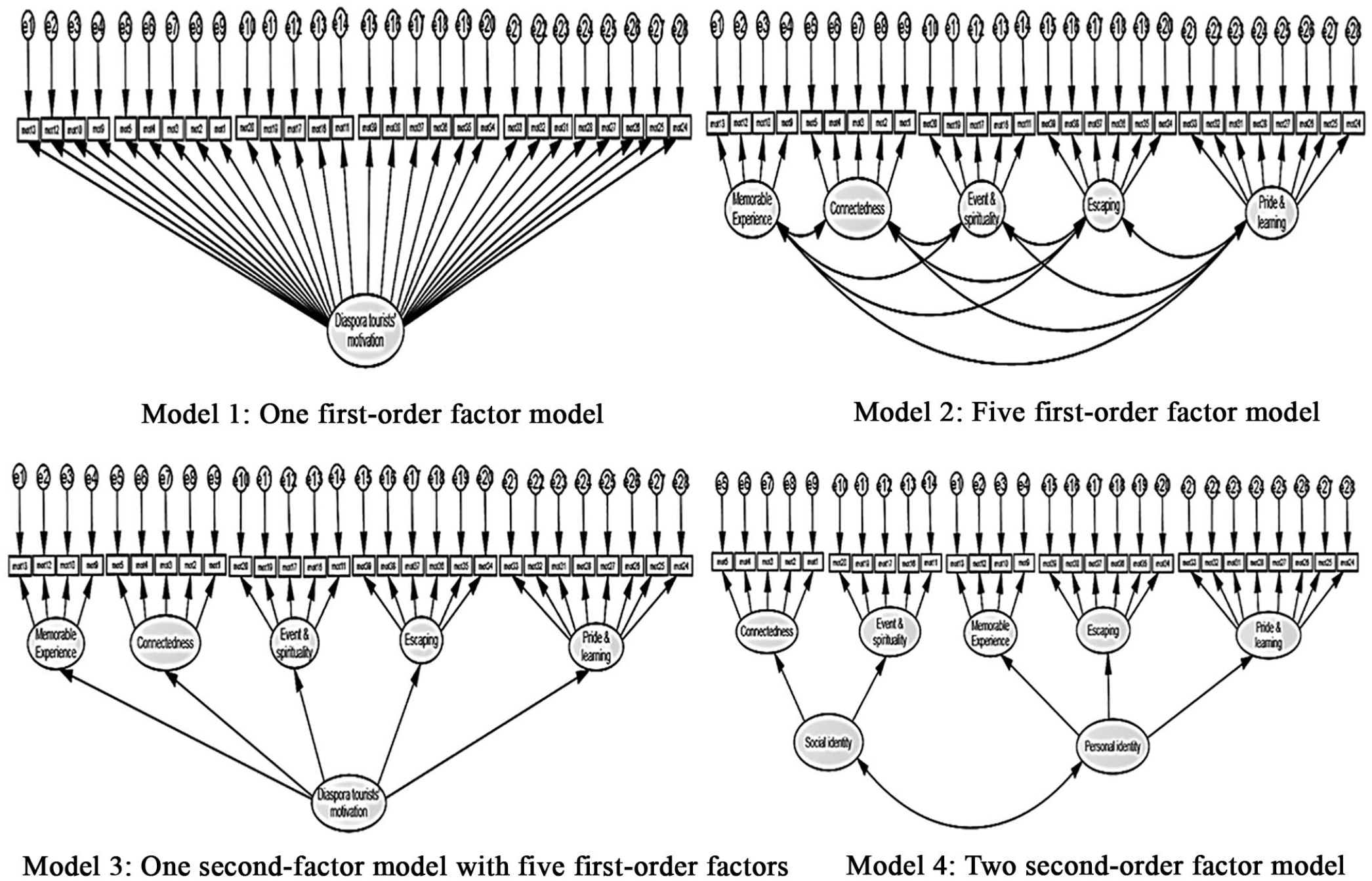
Model comparison of diaspora tourists’ motivation.
Although models 2, 3, and 4 showed the same RMSEA, the overall higher goodness-of-fit and lower chi-square for model 2 indicated a better fit. Ultimately, model 1 indicated the poorest fit for operationalizing diaspora motivation scale. The fit indices for the four models are presented in Table 4.
Model Comparison for the Dimensionality of the DTMS.

Note: DTMS = Diaspora Tourists’ Motivation Scale; GFI = goodness-of-fit index; AGFI = adjusted goodness-of-fit index; RMSEA = root mean square error of approximation; RMR = root mean square residual; TLI = Tucker–Lewis Index; CFI = comparative fit index; IFI = incremental fit index; NFI = normed fit index.
Factor Invariance Test
As a criterion to increase the robustness of measurement items, it is required to examine the equality of the factor loadings across confirmatory and validation samples (Choe and Kim 2019; J. H. Kim, Ritchie and McCormick 2010). Three invariance tests using CFA were conducted. As shown in Table 5, the samples comprised first-time and repeat visitors, nationality based on US and others, and a randomly divided sample. For the first sample, the chi-square differences between the unconstrained model and the constrained model were not significant, Δχ2(Δ = 28) = 39.16, p = .079. Again, there was no significant difference between the US visitors and non-US visitors, Δχ2 (Δ = 28) = 38.48, p = .090. The result of the chi-square test across the randomly split sample showed no difference between the unconstrained model and full metric invariance model, Δχ2(Δ= 28) = 34.34, p = .191. The three invariance tests confirmed the validity of the five-dimensional structure of the diaspora motivation scale.
Model Comparison for Measurement Invariance Test.

Note: GFI = goodness-of-fit index; AGFI = adjusted goodness-of-fit index; RMSEA = root mean square error of approximation; RMR = root mean square residual; TLI = Tucker–Lewis Index; CFI = comparative fit index; IFI = incremental fit index; NFI = normed fit index.
Internal Consistency of the Scale
It was noted in previous studies that cross-national differences can influence people’s psychological decision-making processes (Choe and Kim 2019; Louie 2000). Therefore, internal consistency was checked for each of the five dimensions of the data set (N = 419) and for the US sample (n = 244) and non-US sample (n = 175). The internal consistency of the diaspora motivation scale was analyzed by means of coefficient alpha. The results of Cronbach’s alpha values ranged from .82 to .94, indicating a high degree of internal consistency for all the samples and for the national groupings.
Nomological Validity
Nomological validity refers to the ability of empirical evidence of relationships between measures to conceptually support theoretical evidence of embedded constructs (Churchill 1979; Hair et al. 2010). In anticipation of a static theoretical relationship to make for accurate predictions of other concepts, the domains of diaspora tourists’ motivation scale were correlated with other four constructs and were included in the model. All correlated relationships were significant at the .001 level as presented in Table 6.
Nomological Validity of Diaspora Tourists’ Motivation Scale.

Note: 1 = escaping, 2 = seeking connectedness, 3 = seeking memorable experience, 4 = attending diaspora events and exploring and spirituality, 5 = achieving a sense of pride and learning, 6 = destination image, 7 = future intention, 8 = satisfaction, 9 = attachment.
p < .001.
Predictive Validity
To demonstrate the predictive validity of the proposed DTMS, four constructs that comprised four dependent variables were considered using correlation and multiple regression analyses. The results of correlation analyses between five domains of the DTMS scale and destination image, future intention, satisfaction, and attachment ranging across all five diaspora motivation domains were highly correlated with the four constructs, thus indicating predictive validity. Second, a series of multiple regression analyses were undertaken to examine whether the developed DTMS provided incremental predictive validity. As noted by Hair et al. (2010), multicollinearity concerns exist where VIF values exceed 4.0, or tolerance levels are lower than .2. Because a tolerance value higher than .38 and a VIF score lower than 3.0 were shown, a concern of multicollinearity across all regression models was dissipated.
The result of the multiple regression analyses demonstrated varying significant differences at the .05 level. Adjusted R2 ranging from .16 to .52 indicate that the explanatory power to explain each dependent variable by the four independent variables was 16% to 52%. In general, the results show a high level of predictive validity. The results are shown in Table 7.
Effect of Diaspora Tourist Motivation on Four Dependent Variables.

Note: DV = dependent variable; IV = independent variable.
p < .001, **p < .01, *p < .05.
Discussion and Conclusion
The main purpose of this study was to develop and validate a measurement for diaspora tourists’ motivation. Having revealed the multidimensionality of the DTMS, the following are discussed based on the findings: first, a five-factor model was extracted from conducting EFA, and the factor structure was confirmed by performing a CFA. The model demonstrated a high level of validity in terms of content, convergent, discriminant, and predictive validity. The results of Cronbach’s alpha depicted an internal consistency across all the data sets. The external validity was ensured by exploring the model across two subsamples of diaspora tourists, US and non-US participants.
From the five-factor structure, the dimensions labeled “Seeking memorable experience” indicated the highest mean score from respondents (grand mean = 4.36). The result is supported in some previous literature in which it was suggested that seeking a memorable experience was an important motivation for engaging in diaspora tourism. As noted in the literature, memory is an important driver underpinning the diasporic/roots tourism niche and overlaps with personal memory tourism (Marschall 2015; Santos and Yan 2010). Marschall (2015) affirms that travel related to memory is characterized by a unique tourist gaze, defined by the creation of personal memory. Memorable experience seeking entices the diaspora tourist to return. Given the identified importance of memorable experience seeking, aspects of memorable experiences, including the sales of memorabilia, should be promoted for diaspora destinations.
The dimension “achieving a sense of pride and learning” (grand mean = 4.32) highlights the value of pride and learning among diaspora tourists (Huang, Ramshaw, and Norman 2016; Louie 2000; Schramm 2004). Among the various studies, a feeling of pride in gaining a personal or social identity with one’s ancestral home and the opportunity to learn one’s ancestral heritage can be advertised for the diaspora community. Therefore, an individual’s social identity becomes one of the more powerful forces bridging the “us versus them” gap. Identifying with the African homeland accords diaspora tourists a sense of pride, a fundamental element of social identity theory.
The motivation “seeking connectedness” showed the third highest mean value on the DTMS (grand mean = 4.27). This type of motivation was found to exist distinctly among diaspora tourists (Huang, Haller, and Ramshaw 2013; Huang, Ramshaw, and Norman 2016). Li and McKercher (2016) point out that as people migrate in a spatially and temporarily different framework, they seek to establish a connection with their roots. One way of promoting this type of motivation is to associate diaspora festival events as “flagship,” which emboldens identity with the homeland (Cohen 2011). Diaspora tourism studies show that social identity is an important element in the motivations of diaspora tourists (Huang, Hung, and Chen 2018; Kluin and Lehto 2012; Murdy, Alexander, and Bryce 2018). Thus, social identity, consisting of connections to the diaspora homeland, can be considered a sound basis for distinguishing between different diaspora groups, while the motivation to engage in diaspora tourism can be demonstrated to result from a bricolage of shared identities and connections with the diaspora homeland, as posited by social identity theory.
A relatively high score was recorded for the dimension “attending diaspora events and exploring and spirituality” (grand mean = 3.85) on the DTMS. There are indications of the relative importance of this dimension among diaspora tourists. Issues of religion, pilgrimage, and spirituality have been identified as common indicators of this motivation (Cohen 2011; Coles and Timothy 2004). Cohen (2011), for example, observed that attending cultural events in an ancestral home generates greater fulfillment among diaspora tourists because of the absence of a feeling of compulsion. Other scholars iterate that cultural and spiritual events become the single most important avenue by which the diaspora community maintains a differentiated recognition (Young 1989). This motivation dimension is unique as it highlights the value of diaspora events in drawing visitors from the diaspora community.
The dimension labeled “escaping” generally reported the least mean score on the DTMS (grand mean = 3.80). Although an in-depth exploration of this motivation within the literature remains to be undertaken, Arnone (2011) submits that some diaspora tourists want to break off from routines in their society. This motivation, on the one hand, is more connected to leisure than diaspora tourism. On the other hand, travel to one’s ancestral home is a means of escaping alienation in the diaspora community. Escape-motivated diaspora tourists prefer the feeling of being at the other “home” (Coles and Timothy 2004). Because this motivation is pertinent to leisure, it suggests that leisure issues within one’s ancestral homeland should not be ignored by destination marketers.
Theoretical Contribution
This study provides a valuable contribution to the extant literature in various ways. Tourism researchers are devoting increasing attention to the study of diaspora tourism. However, there has been limited research devoted to examining the dimensionality of diaspora motivation. This study represents the first attempt to develop a scale to measure the motivation of diaspora tourists. By identifying and validating the structure and dimensionality of diaspora travel motivation, this study makes a significant contribution to the body of knowledge on diaspora tourism, particularly regarding the questions of “Who are they?” and “Why are they here?” As these are important questions within the social identity discourse, they are of great relevance to discovering why diaspora tourists travel. The five-dimension diaspora motivation could be used to unpack the motivation of different typologies of diaspora tourists and to evaluate the various factors that cause people from different cultural backgrounds to visit their ancestral homelands.
The scale was effective in explaining destination image, future intention, satisfaction, and attachment. A general limitation of many scale development studies is a failure to evaluate the predictive power of developed measurement scales. One of the valuable merits, ipso facto, is the fact that the relationships between motivation and behavioral responses have been well examined in the tourism literature. Hence, this study satisfies a robust analytical requirement that further serves to validate the scale.
Moreover, the scale is useful for comparison and generalization across diverse groupings. First, the dimensionality of the data was confirmed in the CFA using a random sample. Second, the results were explored across a sample of US diaspora tourists as well as other national samples. Thus, it provides a cross-cultural perspective of the motivations of diaspora tourists across these two samples while also providing evidence of the predictive ability of the measurement scale. The predictive validity indicated some differences in the effects of diaspora tourist motivations in the general sample as well as across US and non-US samples.
Practical Contribution
This study has some practical implications. Its findings are meaningful to governments, diaspora institutions and offices, tourism policy makers, marketers, and practitioners. The motivation domains identified in this study could be of great use in the promotion of destination attributes including festivals, pilgrimages, and other historic events. The study found that specific motivation dimensions are built on the availability of activities to commemorate the past and highlights the need to market specific attributes of the diaspora homeland. The general support for sentiments, for example, “To take part in an organized celebration/ritual,” illustrates this view, as well as demonstrating the tendency of diaspora tourists to contribute to their homelands by establishing business connections (Li and McKercher 2016; Wang 1999).
Understanding diaspora tourists’ motivations can be useful for the purposes of competitive destination positioning and attracting diaspora tourists. For example, travel to the diaspora homeland promotes a sense of pride and learning about one’s ancestral homeland. Hence, marketing campaigns can identify and promote elements that promote pride, including a sense of nationalism and pride from material contribution to the diaspora homeland (Huang, Ramshaw, and Norman 2016; Louie 2000). For this, a sense of social and cultural identity can be useful to create and strengthen the bond between the diaspora community and the homeland. A practical campaign message could stress the “oneness” or the “we are one” message with which persons in the diaspora community can identify. This “oneness” erodes superficial differences and brings out the black experience.
Diaspora tourism can ultimately be a tool to address social and cultural gaps between the diaspora homeland and the diaspora community. The desire to return home is often limited by forces in the homeland, including perceptions about the standard of living, traditional and social norms, and politics (Iorio and Corsale 2013; Smith and Jackson 1999). As found in this study, diaspora tourists possess a great sense of loyalty to the African homeland, even a sense of obligation. It is this social identity that the African diaspora homeland ought to realize, express, and explore through cinematic representations.
Limitations and Future Research
First, although the items were repeatedly refined throughout various stages of research, there is a need for further validation in different ethnic samples. It is therefore necessary to determine whether the DTMS is consistent in other settings. Second, a qualitative insight into understanding the dimensionality of the DTMS is suggested. A qualitative software such as NVivo can provide a more robust content analysis. Third, a point of interest for a future study is to evaluate an integrative model to identify the relationships between the DTMS and constructs such as destination evaluation, involvement, and emotional experience. Fourth, the DTMS needs to be validated on a sample of tourists younger than 45 years.
Footnotes
Declaration of Conflicting Interests
The author(s) declared no potential conflicts of interest with respect to the research, authorship, and/or publication of this article.
Funding
The author(s) received no financial support for the research, authorship, and/or publication of this article.
