




Abstract
This article advocates for originality in tourism research and the quest on how to achieve it.
The research discipline of tourism has grown tremendously over the last two decades, and doubled in the last 10 years to now more than 340 journals (McKercher 2018). Likewise, impact factors of the “top three” (i.e., Annals of Tourism Research, Journal of Travel Research, and Tourism Manage-ment) are constantly rising, ranging between 5 and 6 for 2018. One would expect that such academic prosperity generates a significant number of adventurous and innovative studies. Yet, the contrary is observable: While more and more papers are published in tourism journals, the number of original and courageous research remains considerably low (McKercher 2018; Tribe 2018). In a similar vein, Beritelli et al. (2016, p. 1) note that “more researchers publishing more work in more journals is not necessarily equivalent to more relevant knowledge being created.” While original papers are very welcomed by most journals, the biggest concern of many journal editors in tourism is the low number of highly original research submitted to the respective journal (Sánchez, Makkonen, and Williams 2019). This shortage has been explained as the consequence of the nowadays high pressure to constantly publish in top-tier journals in order to get promoted. While this observation is certainly valid, it is paradoxical because originality is the essential criterion to publish in top tier journals (Sánchez, Makkonen, and Williams 2019). Hence, if publication pressures increase and originality is the “prime standard” to publishing in top-tier journals, why do we see less, and not more, original research published?
Our answer to this question is straightforward, yet surprisingly, it has very rarely been discussed: We see so few original papers because coming up with courageous ideas is the most difficult thing in research (Smith 2003). Indeed, originality is “perhaps the biggest challenge facing tourism researchers” (Tribe 2018, p. 18). While intuitive, this notion has largely been ignored in studies analyzing the dearth of and advocating for more originality. In fact, an often underlying assumption is that if the contextual factors that inhibit originality are revised, original research will naturally follow as a “deus ex machina.” However, great ideas are the scarcest resource in academia. If originality is lacking in tourism research and one of the most difficult things to achieve in research excellence, a case has to be made for why so few guidelines exist on helping researchers to generate original and courageous research ideas.
While a number of tourism researchers do not need help to be interesting, especially for early- and midcareer researchers, it can be very difficult to act on generic advices such as “be more critical,” “make sure that your topic is relevant,” and “think outside the box.” Also, while a lot can be learned from reading articles in the top-tier journals, authors, when elegantly motivating their study, hardly ever explain how they arrived at their research idea. Coming up with original ideas is the most difficult (while probably most needed) thing in research, and we as a research field rarely explain how such ideas can be generated, and still more rarely publish guidelines on it. In response, this research develops the OBC model (observe, bridge, challenge) for courageous research that bears concrete hands-on guidelines to generate original research ideas. Each of the three strategies to courageous research is theoretically grounded, made actionable through a methodology, and is illustrated by examples from tourism research.
It is important to mention that this article is not written with an individualistic agenda in mind that propagates originality and creativity while neglecting publication realities. The first author of this article is in his early career, and therefore knows firsthand about the pressure and expectations that young researchers face. Yet, we believe that originality and innovation is the best way to meet these expectations, to build an academic career, and to have a real impact on creating tourism knowledge and contributing to tourism practice. This standpoint cannot be emphasized enough because about half of early- and midcareer researchers feel a need to choose projects that can be completed quickly, and hence are likely to lack in originality (Tung and McKercher 2017). Responding to this observation, this research directly connects with, and takes point of departure in studies that focus, implicitly or explicitly, on originality in tourism research and the quest on how to achieve it (Sánchez, Makkonen, and Williams 2019; Tribe 2018).
The OBC Framework to Courageous Research Ideas
The OBC framework orchestrates three fundamental strategies to develop courageous research ideas along the three operators observe, bridge, and challenge. Each of the three strategies can be executed independently or even combined in order to unfold its full potential. The strategies are now developed and discussed in detail following the same outline, which includes a theoretical discussion of the strategy, a methodology how to execute it (thus, strictly speaking, the OBC framework is a meta-methodology), an illustration by tourism research examples, and concludes with caveats to bear in mind when following the respective strategy. The Venn diagram (Figure 1) provides an overview of the three strategies (I, II, and II) and fusions between them that constitute strategies themselves (IV, V, VI, and VII). Throughout the article, it serves as a guiding frame and visual taxonomy of the introduced strategies.
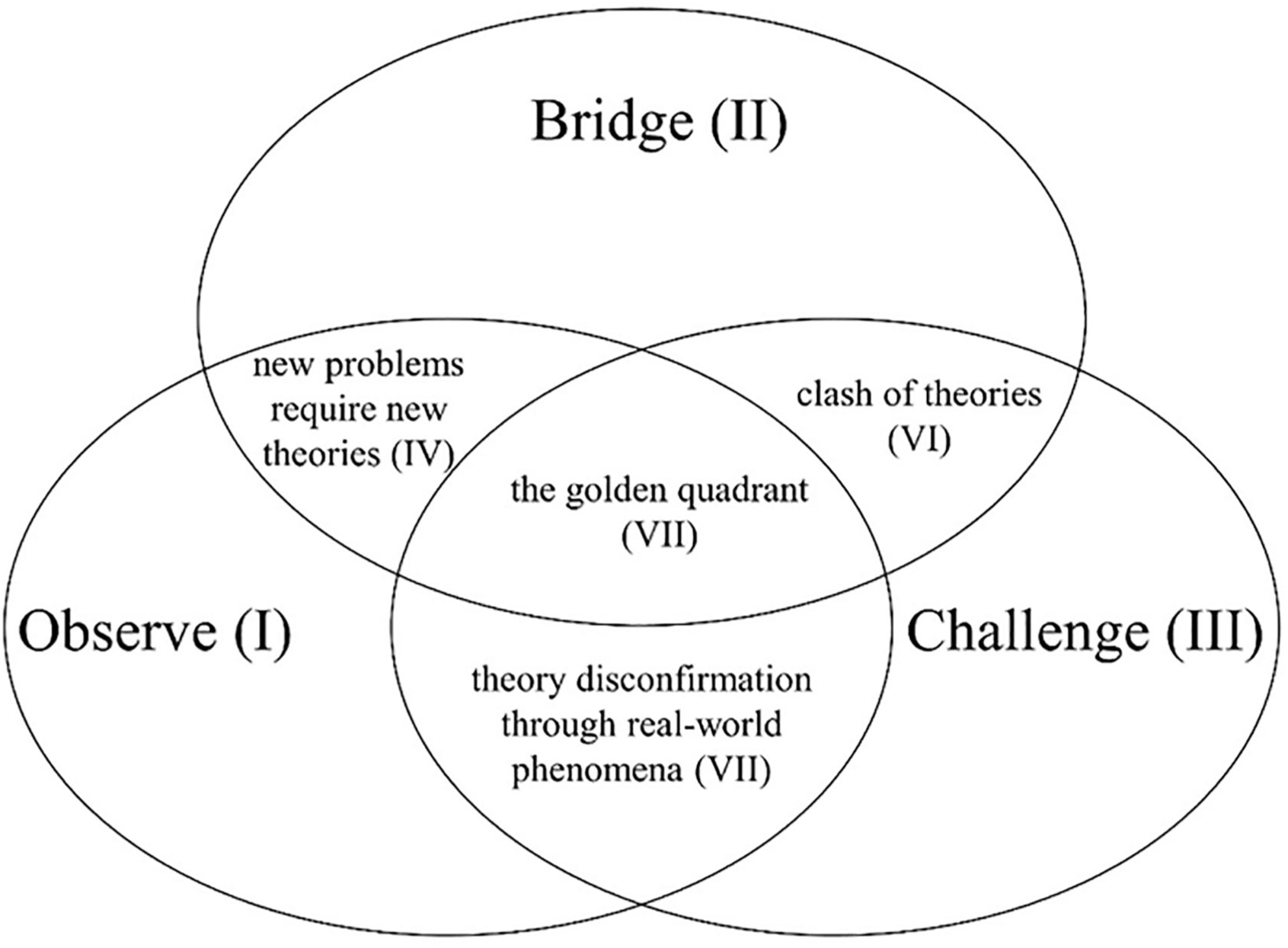
The OBC framework as a Venn diagram.
Strategy I: Observe the World
Concepts and theories really matter only if they are grounded in a compelling and interesting real-world observation. Hence, a paper’s theoretical and practical importance is proportional to the vividness and relevance of the phenomenon that it can explain. According to this notion, highly original research ideas may therefore be better gathered from life than from other journal publications. A main purpose of such phenomenon-based research is to “capture, describe and document, as well as conceptualise, a phenomenon so that appropriate theorising and the development of research designs can proceed” (Von Krogh, Rossi-Lamastra, and Haefliger 2012, p. 278). However, existing tourism research is often lacking in developing research questions from life. This notion can be exemplified by Beritelli et al. (2016, p. 6), who state that “there appears to be a focus on reinvestigating certain research questions again and again, rather than on discovering new, exciting phenomena in tourism.” Motivating a research question from a vivid phenomenon, instead of doing “research on research,” is a very strong argument for the contribution that the study is intended to make. The goal of the “observe the world” approach is to identify an aspect of life that has yet to be given serious study. However, the identification of such a phenomenon only constitutes a courageous research idea if the researcher can provide evidence that the identified phenomenon is real and that studying it is important (Day and Montgomery 1999). Hence, the researcher has to provide compelling arguments that the phenomenon does not only bear originality but also significance to the domain of tourism.
Developing a research idea through the observation of a phenomenon bears three significant benefits. First, it allows researchers to develop a research question that they are clearly passionate about. Indeed, choosing a project that one loves is a vital precondition to come up with creative ideas that often require deep thought (Levy and Grewal 2007). We as researchers are in a highly privileged position where we (in most cases) can research what we want; it would be a waste of creativity to swap this “freedom to think” with uninspiring diligence work on incremental contributions. Second, motivating the research from an observed phenomenon allows the researcher to clearly and convincingly communicate the purpose and contribution of the undertaken research to a nonscientific audience. This aspect, which can be coined the “grandmother” paradigm, is of utmost importance to achieve impact beyond the academic discipline. In addition, it is also of tremendous help to master the key academic challenge to explain difficult content in easy words, thereby contributing to readability of journal articles, which importance cannot be overstated (Dolnicar and Chapple 2015). Third, this approach elegantly enables the author to explain who will be impacted by and benefit from the findings of the study. This point is crucial because many studies fail to explicitly explain which stakeholders will benefit from the research (Ladik and Stewart 2008).
Now, how exactly can researchers derive research ideas from observing the world? We develop three approaches to it. The first approach observes phenomena in the world and how they, potentially, bear relevance for and impact the “tourism world.” An exemplary research that has used this “outside-in” approach (i.e., a phenomenon that is brought into tourism from the outside) is the study by Kock, Josiassen, and Assaf (2019) in which the authors started out by asking how the recent political upheavals of growing xenophobia (i.e., a real-world phenomenon of broad significance) impacts tourist travel behavior. The second approach observes phenomena that are immanent to the tourism world but reach far beyond it, thus bearing broad relevance, labeled the inside-out approach. A recent example is overtourism, which motivates a growing number of research (e.g., Oklevik et al. 2019). The third approach observes a novel phenomenon that is original to the tourism world and mostly bears relevance to the tourism discipline, with only limited relevance for other disciplines. This approach is labeled inside-in. An example is the examination of tourism-related stress among residents (Jordan, Lesar, and Spencer 2019). While being original and novel, the phenomenon is inherent in and originates from the tourism world.
After a significant phenomenon has been introduced through one of the three outlined approaches, the researcher has to identify a suitable theoretical lens that is then used to examine the phenomenon. While each researcher is necessarily biased in the theory to be selected (because of her expertise in certain theoretical areas as well as methodological preferences), the identified phenomenon should generally determine which theory to be used. The selection of theory to investigate the phenomenon can be a long and challenging process as it requires the researcher to have a broad and deep understanding of both the phenomenon and appropriate theory. It many cases, the most appropriate theories to examine the respective phenomenon may not be within the researcher’s core expertise but requires reading beyond disciplines. The strategy to analyze a novel phenomenon with theories that go beyond the tourism literature can be formalized as the “new problems require new theories” strategy (IV in Figure 1).
While “observing the world” is an excellent strategy to come up with courageous research ideas, it is important to raise some caveats. Discussing these potential risks should not discourage the researcher from using this approach but to establish a realistic expectation. The most important caveat is that it can seduce a researcher to dedicate oneself to something that is beyond the researcher’s current ability. In particular, examining an identified phenomenon may require the researchers to dive into a completely new literature stream, something that is effortful and requires persistence. Particularly for young researchers, “spreading themselves too thin” is a concrete danger that might be fueled by too many too tempting phenomena to be investigated. Hence, we suggest to scrutinize the potential of each identified phenomenon, and then execute the most promising with the highest priority. A second caveat important to mention is not to be caught in a phenomenological singularity, that is, a phenomenon that appears in a very narrow context and is rather exotic. Such phenomena are tempting but often lack in significance because research on such topics may only have limited implications for a limited audience. An example brought forward by McKercher (2018) is the research on special interest tourism whose importance may have often been exaggerated.
Strategy II: Bridging Disciplines
The second strategy to generate courageous research ideas is by joining two or more disciplines. Academic bridging can be defined as the “intentional effort to draw on the human, theoretical, methodological, and/or empirical resources of a related discipline to shed new light on one’s own discipline” (Joireman and Van Lange 2015, p. 82). Bridging can lead to the development of courageous ideas as well as new theory construction when theories are redesigned to fit the new discipline. Similarly, Fiske (2004, p. 135) notes that “innovative theory building occurs at the boundaries between disciplines and subdisciplines.” However, most researchers only immerse themselves in their own discipline for idea inspiration. This is understandable because they have invested significant resources in becoming an expert in their respective area. However, staying in one’s ‘comfort zone’ can hinder the identification of courageous research ideas and has the consequence that each domain reproduces its own commonsense theories, mindsets, and assumptions. This is because the presence of commonsense views (often referred to as ideology) may lead to the suppression and partial exclusion of other worldviews, consequently inhibiting critical reflection (Tribe 2008). Tourism lends itself to bridging or “stretching” (as referred to by Xin, Tribe, and Chambers 2013) for two reasons. First, tourism is by its very nature a multidisciplinary field (Crouch and Perdue 2015) that is open to bridging with new disciplines. Second, tourism is a fairly complex domain with multifaceted research problems whose solution would often benefit from expertise of other disciplines (Darbellay and Stock 2012).
Now, how exactly can researchers develop courageous ideas through bridging? To start bridging, read beyond your own discipline. In particular, we recommend to start with exposing yourself to the top-tier journals in other disciplines that relate to your approach to research and that you are intrinsically interested in. Doing this on a regular basis exposes you to new ways of thinking that may lay the basis for a courageous research idea. Then, the challenge is to identify those theoretical or methodological resources in other disciplines that can enhance a significant tourism phenomena (Strategy IV: new problems require new theories), enhance or challenge existing tourism theory (Strategy VI: clash of theories), or even set the foundation for a new tourism research agenda. This is achieved through the process of recontextualization of the borrowed theory. In this process, the original theory is refined or redesigned so as to be applicable to the research issues of the new discipline (i.e., tourism). Hence, the mere introduction of a new theory, without its meaningful application to enhance tourism research, and the uncritical generalization to tourism does not constitute a courageous idea but is mediocre research at best. The uncritical and uninspiring adoption of theories is also mentioned by Beritelli et al. (2016, p. 2), who note that “the tourism research community rarely challenges conclusions drawn in other disciplines, despite the fact that the tourism context can be very different from many other production and consumption contexts in which theories have originally been developed.” Importantly, and as the following example will outline, bridging disciplines is not limited to two but can involve more than two disciplines.
To illustrate how bridging can generate a myriad of courageous research hypotheses for tourism we refer to two studies that bridge tourism and evolutionary psychology (Crouch 2013; Kock, Josiassen, and Assaf 2018). In both studies, the point of departure is a highly influential stream of research conducted in another, yet related, discipline. Evolutionary psychology is interdisciplinary research itself that uses insights from biology (evolution and ecology) and psychology to examine human behavior. In both studies, the authors set out to bridge evolutionary psychology with tourism by redesigning the original theories and applying them to significant tourism contexts. Hence, the discipline is not only introduced but concretely applied to specific tourism phenomena. A high level of originality can be achieved by combining strategy I and II, hence, bridging theory and applying/redesigning it to investigate a new phenomenon in tourism. This strategy is labelled “new problems require new theories” (IV) in Figure 1. An excellent example is the recent study by Pearce and Wang (2019) that bridges ethology (which itself blends biology and psychology) and tourism research to examine the timely phenomenon of tourist posing on social media.
Notwithstanding the benefits of bridging, a few caveats have to be highlighted. First, the key hurdle to bridging, and the reason why it is rather rarely executed, is that it requires the researcher to be very conversant in not only one but all disciplines that the study draws on, including the literature, methodology, and terminology used in each discipline. Hence, it is not advisable to constantly jump between disciplines or flirt with numerous hot topics (referred to as “pet theories”) but rather to build up one or two domains of deep expertise outside of tourism. This view is supported by research arguing that highly original work is more likely to be produced by those researchers who have a deep understanding of and extensive training in the domain they publish in (Ladik and Stewart 2008). Second, the label bridging implies that a two-sided exchange between the newly bridged disciplines is intended. However, applied disciplines such as tourism are often derivative of other disciplines (Sánchez, Makkonen, and Williams 2019); hence, reality is often better described as a one-sided borrowing (Oswick, Fleming, and Hanlon 2011). It is therefore important to note that theories should not be merely borrowed, because this would discourage theory building in tourism, but that researchers redesign or further develop theories for their own domain. Such efforts can then lead to original tourism theories that also have the potential to enhance the originating disciplines from which the theory was derived.
Strategy 3: Challenge Assumptions and Theories
The third path to courageous research ideas is to challenge assumptions and theories on which prior studies rely, thereby “pushing the boundaries” of one’s discipline. In his seminal study, Davis (1971) argues what makes research interesting is that it is seen as challenging or disconfirming the assumptions or theories of the journal’s audience. Unfortunately, most research published in tourism, including the top-tier journals, does not challenge existing assumptions but often rather uncritically builds on consolidated beliefs, thereby reinforcing them. The key reason is that the established, and widely accepted, way for arriving at research ideas is to spot or construct gaps in existing literatures rather than to challenge their assumptions. This approach to generating research ideas is critically referred to as incremental gap-spotting (Alvesson and Sandberg 2011).
When using gap-spotting, a researcher refers positively or mildly critically to existing research with the aim of identifying, or constructing, and filling a gap therein. This approach is the most dominant way of creating research questions in the social sciences, including tourism, and can tend to overproblematize research gaps and underproblematize existing research, consequently reinforcing existing assumptions. Hence, research disciplines indeed “discipline” researchers in the sense that they internalize their discipline’s assumptions and often uncritically reproduce them. Similarly, less interesting hypotheses are those that are consistent with existing research and hence are deemed “intuitive,” often motivating an editor or reviewer to ask the widely feared “So what?” question. Instead, courageous ideas are developed by stepping back from the obvious theoretical layer and identifying questionable core assumptions on which most prior studies rely. We join Tribe’s (2018) call for more critical assessments of existing theories and provide guidelines on how to execute them.
How can researchers overcome incremental gap-spotting and instead engage in a continuous questioning of the assumptions and theories we work with? Challenging assumptions requires an “endeavour to know how and to what extent it might be possible to think differently, instead of legitinating what is already known” (Foucault 1985, p. 9). The quote highlights that this path to courageous research requires an ability to think differently and critically. In recent years, tourism researchers (Tribe 2008) have started to highlight the dearth of critical research and advocated for research orientations that problematize existing theories and assumptions, such as postmodernism or critical theory. These orientations are well discussed by Tribe (2008) and hence not the focus of this section. Instead, we explain how this call for more critical research can be put in action by suggesting a concrete methodology along with two approaches that researchers can engage in in order to become better at challenging and questioning existing research. Challenging assumptions and theories in tourism research is best executed when following a methodology of problematization (Alvesson and Sandberg 2013). Following this methodology allows the researcher to critically reflect on one’s own familiar assumptions and to start using different stances to question one another. We now discuss the different steps of the problematization methodology and weave two approaches that allow the reader to comprehend this strategy in connection with the two former strategies given in this study.
The five principles of problematization (in chronological order) are (1) selection of a domain of literature, (2) identification of assumptions underlying this domain, (3) critical evaluation of the assumptions, (4) development of an alternative assumption ground; and (5) evaluation and testing of the alternative assumption ground. This methodology was, for example, followed in a study by Kock, Josiassen, and Assaf (2016). In this study, the authors selected the extensive domain of “destination image” (1) and identified a questionable assumption on which most studies in tourism relied: The assumption that destination image (or then called destination imagery) does not qualitatively vary from individual to individual (2). Applying cognitive psychology, this assumption was critically evaluated (3) and an alternative assumption was developed (4). Finally, this assumption was empirically evaluated in quantitative studies (5).
The most difficult step in this methodology is the identification of a questionable assumption (step 2). It requires counterfactual reasoning, which is referred to as imagining alternatives to existing theoretical assumptions through contrastive questioning (Tsang and Elsaesser 2011). Unfortunately, how counterfactual reasoning is best executed has not been discussed in the literature. Hence, we now suggest two concrete approaches to identify questionable assumptions that we link with strategy 1 and 2. We refer to the first approach as “clash of theories” (VI in Figure 1). Here, two (or more) theories with adverse standpoints are pitted against each other in order to highlight a questionable assumption (in at least one of the theories). Clash of theories connects very well with the “bridging disciplines” advice because it is often theories from different disciplines that challenge each other. Identifying such theories and motivating a critical assessment thereof can generate intriguing research questions and may result in substantial changes or new theory development. The second methodology that we suggest is called “theory disconfirmation through real-world phenomena” (VII in Figure 1). Sometimes, we witness a phenomenon that is counter to the assumptions and conclusions of our research. This approach combines strategy I and III by pitting the identified phenomenon against an existing theory or assumption that it challenges. Such phenomena are excellent starting points because they serve as anecdotal evidence that a particular theory is questionable or at least does not hold in all contexts, hence serving as the opener for challenging an existing literature. If the phenomenon indicates that the theory does not hold in particular contexts, this is a strong indicator for conducting a moderation analysis.
To conclude with, each of the three strategies (I, II, and III) observe, bridge, and challenge, enabling researchers to generate courageous and original research ideas. While each strategy can be practiced independently, synergy effects are realized when two strategies are combined (i.e., strategies IV, V, and VI). Yet, we also highlight the possibility to combine all three strategies in order to land in the “golden quadrant” (strategy VII, see Figure 1). This, arguably most difficult approach, is realized when (1) a relevant real-world phenomenon is articulated, (2) examined by bridging literature from another discipline, and (3) then used to challenge existing assumptions and thereby advance tourism research.
Conclusion
Despite all the rigorous and meticulous research being produced in tourism, there is a dearth of courageous and daring research ideas. While most researchers intuitively know that originality and creativity is of utmost importance, it often remains unclear to the individual researcher how to write original papers. In particular, how to come up with innovative, courageous, and relevant ideas is not clearly explicated in existing research. This aspect is crucial because when the research idea development is done poorly, the research is likely to be doomed to mediocrity. The present paper addresses this unsatisfying situation.
Creative research is under threat due to an (often externally) imposed change in academic culture in universities, and this trend is likely to continue (Brauer, Dymitrow, and Tribe 2019). It could be suggested that the institutional conditions and publication pressures are a tight system difficult to break away from for the individual researcher. While the explanation that the system is contributing to the lack of daring research is potentially valid, it is rather partial, and we argue that our system is in many places not as constraining or dogmatic as often mentioned. Indeed, it has recently been documented that top-tier journal editors welcome adventurous and original research but are rather worried about the lack of original manuscripts submitted (Sánchez, Makkonen, and Williams 2019). Taking this notion into account, we have written this article with the aim in mind to revitalize researchers’ creativity, courage, and imagination. While many studies have called for more courageous research, hardly any provides researchers with advice on how to overcome this unsatisfying state. The present study developed and organized courageous research methodologies, and practically discussed these ready-to-use research paths. Importantly, we propose that originality and innovation should not be pitted against top-tier publications and research productivity anymore, and publication pressures should not be used as an “excuse” anymore. All tourism researchers should do their utmost to produce original research and this study is intended to serve as its starting point.
We note that the guidelines developed herein may neither be complete nor universal. They are, similar to the mere assessment of originality, subjective and a theory-based elaboration on how original research can be developed. Importantly, in this study we refrain from discussing “strategic advice” and “marketing” the research. For example, when discussing bridging (strategy II), a “strategic” benefit is that it is easier for reviewers to judge a contribution that is based on a recontextualized theory than to anticipate the contribution of a new theory, hence potentially increasing the probability of acceptance. While such considerations are valid, relevant, and may indeed help the research to be published, they have been comprehensively discussed elsewhere (e.g., Sánchez, Makkonen, and Williams 2019; Tribe 2019), and we hence advise the reader to consult these excellent studies. While tourism has “almost unlimited research options” (McKercher 2018, p. 1235), we point out that these options are rarely seized. This study, and the developed OBC framework with its three key and four blended strategies, is intended to provide guidelines for researchers to boost creative and original research in tourism.
Footnotes
Declaration of Conflicting Interests
The author(s) declared no potential conflicts of interest with respect to the research, authorship, and/or publication of this article.
Funding
The author(s) received no financial support for the research, authorship, and/or publication of this article.
