



Abstract
Using the “Computers are social actors” paradigm, this study brings the concept of power to human–computer interactions in tourism. Building on theories of social power and deliberate practice, the authors examine psychological effects of expert power of online travel review platforms (influencer) and its interaction effects with the power of users (influenced). Two expert platform attributes are conceptualized: specialization and experience. A significant interaction effect was identified between platform specialization, platform experience, and user power on perceived information-task fit using a 2 × 2 × 2 between-subjects experiment. When users are powerful, specialization affected perceived information-task fit for low-experience platforms; no significant effect was evident for high experience platforms. When users are powerless, specialization did not affect perceived information-task fit, regardless of experience condition. Perceived information-task fit mediated the effect of specialization on intention to use. The findings contribute to power discourses by exploring the workings of expert power.
Introduction
In the contemporary era of digital transformation, social media are vital communication platforms for presenting consumers with tourism and hospitality options and influencing their choices (Alaei, Becken, and Stantic 2019; Leung et al. 2013; X. Liu et al. 2019). Tourists not only receive information through established media (e.g., TV, radio, and magazine) but are also exposed to extensive online information sources (Murphy and Chen 2016). Given the special attention that Millennials give to social media platforms (H. Liu, Wu, and Li 2019; Luna-Cortés, López-Bonilla, and López-Bonilla 2019), the influence of the latter on tourism is likely to increase. Across diverse social media, the role of online review platforms (the terms online review platform and platform will henceforth be used interchangeably) in tourist decision making is particularly noteworthy (Lui et al. 2018; Phillips et al. 2017; Y. Zhang et al. 2018). Recent research has shown that approximately 80% of tourists have read hotel reviews online prior to travel, and 53% do not proceed to booking a hotel in the absence of reviews (Tsao et al. 2015). Research supports the proposition that Web 2.0 technical features (e.g., comment thread, collective evaluation, and recommendation system) are powerful tactics for enhancing the credibility of online review platforms (Munar and Jacobsen 2013; Schuckert, Liu, and Law 2015).
The success of reputation management (O’Connor 2010; Rose and Blodgett 2016) and marketing practices (Fotis, Buhalis, and Rossides 2012) of service providers is influenced by the effectiveness of their use of online review platforms. The use of online review platforms by service providers and tourists has expanded, and businesses, including those in tourism, have benefitted from the continuous introduction of new platforms in the past decade. As competition intensifies, many platforms declare their capabilities by emphasizing the uniqueness of their domain of information content or geographical scope, or their longevity to extend their influence beyond what can be enjoyed in other platforms.
According to the “Computers are Social Actors” (CASA) paradigm (Nass and Moon 2000; Reeves and Nass 1996), prospective consumers apply social rules and manners to evaluate the credibility of computer, machine, and media sources. According to Koh and Sundar (2010a, p. 900), “the media equation literature . . . has attributed the tendency for treating computers as if they are human to the overuse of human social categories (e.g., gender, social status, and ethnicity) while interacting with computers.” As an example, the term expert is a social characteristic that may be applied to the source credibility of humans and computers. Nonhuman actors, including online review platforms, may be viewed as social actors that possess expert power, and certain technical features may influence users’ perceptions about such platforms.
Power is a fundamental social science concept for explaining human relationships (Russell 1938), although it is arguably the least discussed topic in social media studies (Ngai, Tao, and Moon 2015). Given that power explains the influence of one over another, theories of power may be adopted to explain the psychological mechanism of how an online review platform and its technical features influence tourists’ perceptions and decision making. Power may be defined “in terms of influence, and influence in terms of psychological change . . . at a level of generality which includes changes in behavior, opinions, attitudes, goals, needs, values, and all other aspects of the person’s psychological field” (French and Raven 1959, p. 260). According to social power theory, if a social actor possesses at least one of five types of power (reward, coercive, legitimate, referent, expert), he or she can influence the perceptions and further behaviors of others. Each type of power has its own mechanisms that stimulate distinct psychological effects on individuals. The present study focuses on the working mechanism of expert power when it is applied to online review platforms.
Expert power is present when a social actor “is seen as having superior knowledge or ability in very specific areas” (French and Raven 1959, p. 268). One should commonly possess certain attributes (e.g., a specific university degree and work experience) to be perceived as an expert. In considering application to nonhuman actors, it is meaningful to identify the technical attributes that enhance the expert power of online review platforms. According to social power theory, those who are perceived to possess certain domain expertise are also perceived as individuals who can provide credible recommendations and information (information-task fit). The latter refers to the quality of task-oriented information (Dedeke 2016). The information-task fit of a social actor (an online review platform in the case of the present study) then becomes the mediator of influence with an ultimate effect on behavioral intentions.
Drawing upon deliberate practice theory (Ericsson, Krampe, and Tesch-Römer 1993), this study articulates two attributes of expert power that may be applied to online review platforms: specialization and experience. According to the theory, the more the time allocated to a certain skill or sector by an agent, the greater the relevant expertise acquired. Similarly, online review platforms offering greater experience and a particular specialization may possess a higher level of expert power.
When a specific information domain is the focus, specialist review platforms (e.g., OpenRice in the restaurant sector) may be perceived as possessing more “knowledge” (information) and consequently are more expert than generalists about a given area (Carnabuci and Bruggeman 2009). Online review platforms with several years of experience may be perceived as more “knowledgeable” and more expert than their recently established counterparts. Although whether expertise is a subdimension or is an outcome of specialization and experience is an ongoing debate, the connotation between the three concepts is unequivocal (Jacoby et al. 1986; Ullén, Hambrick, and Mosing 2016). Koh and Sundar (2010a), for instance, recommended the use of perceived expertise to check the manipulation of generalist or specialist websites.
Intuitively, it seems fair to assume that specialization and experience should be attributes of expert power. However, the interaction between the two attributes has not been tested in either tourism or in other disciplines. Moreover, power is a relational phenomenon (Tseng and Seidman 2007). The power of an influencer also interacts with the power of the influenced party (French and Raven 1959). The psychology literature has explained how individuals in powerful or powerless conditions react differently to given information. Tourists’ subjective perceptions about their own power (“user power” hereafter) may influence how each attribute of an online review platform’s expert power affects their perceptions and behavioral intentions toward this platform. This background prompts the following research question: What are the relationships between platform experience, platform specialization, and user power?
This study investigates the working mechanism of how specialization and experience influence the expert power of online review platforms and tests its psychological effects on tourists’ perceptions and behavioral intentions. In particular, the aims of the study are (1) to test the interaction effects between platform specialization, platform experience, and user power on perceived information-task fit and (2) to examine the role of perceived information-task fit in mediating the effects of specialization on behavioral intentions.
This study has theoretical and managerial significance for tourism research and practice. Despite the profound impact of digital technologies on tourism ecosystems, researchers have largely overlooked the CASA paradigm in tourism and hospitality. Power is a fundamental concept that governs many social rules. Given that the latter may be applied to online review platforms, testing their effects on tourists and service providers is timely. The number of studies on the role of power in media and promotion is substantial (Morgan and Pritchard 1998), but media specialists have mainly discussed the power of organizations and of human actors (Jasperson et al. 2002). Previous studies have overlooked the possibility that online review platforms may possess and exercise a particular type of power over service providers and tourists, namely, expert power.
This study contributes to the tourism literature by proposing an innovative and comprehensive model that explains a working mechanism of the expert power of online review platforms with potential applications to other disruptive technologies that are emerging in tourism. This model incorporates and extends three elements, namely, the CASA paradigm, social power theory, and deliberate practice theory. It also considers relational power discourse to show the natures of interactions between the power of influencer (i.e., an online review platform) and the influenced (i.e., a tourist). In addition, this study adopts an exemplary method to examine the power of platforms.
From a managerial perspective, this study contributes to tourism by illustrating a potential scope of activities for online review platforms and potentially effective marketing strategies. Specifically, it provides insights for tourism service providers about the best suited platforms (e.g., specialist or generalist, new or experienced, specialist and experienced, or specialist though inexperienced) for targeting tourists. The study also provides platform managers with insights about the kinds of tourist who may be receptive to their marketing messages.
Literature Review
Specialization and Experience as Key Attributes of Expert Power
In social relations, experts are generally believed to influence other members of society (Kurz-Milcke and Gigerenzer 2004). Expert power manifests when an individual possesses certain attribute(s) that affect(s) others’ perceptions toward his or her expertise (Raven and French 1958). Deliberate practice theory (Ericsson, Krampe, and Tesch-Römer 1993) suggests that expertise is achieved through a systematic and purposeful practice by a social agent. Specifically, the more time and effort one spends in a certain area, the more expertise is acquired. For example, the expertise of a senior scholar who has been practicing research for several years will be perceived as higher than that of a less experienced and more junior scholar. Psychology scholars have suggested that expertise is acquired through the “process of specialization, in which an individual invests time, effort, and neural resources in order to optimize the performance of a limited set of tasks” (Ullén, Hambrick, and Mosing 2016). Being an expert is not only about experience (time devoted to practice), but also about specialization (the skills that are developed during this time). In extending the previous analogy, a junior scholar may possess the same or an even higher level of expertise (compared to a more senior scholar) in a specific research area. Thus, experience and specialization can be articulated as attributes of expert power.
In applying this discussion to online review platforms, some may position themselves as specialized in a specific subsector of tourism, whereas others can be more general and include reviews about various types of product and service. For example, OpenRice has a narrow specialization in the restaurant sector, whereas TripAdvisor includes reviews about sectors across the tourism domain, including restaurants, hotels, and activities. The Yelp site has even broader coverage with reviews of various service sectors, such as cleaners, landscapers, painters, and hospitality. Compared with generalist (non-specialized) platforms, those specializing in the restaurant or hotel sector may be perceived to have greater expert power in their respective area. The expertise of platforms also varies according to years of operation. Compared with their newer platform counterparts, those with greater experience will be perceived as possessing higher expert power.
Effects of specialization on perceived information-task fit
The concept of specialization originated primarily from differences between generalists and specialists (Makarevich 2018). For example, distinctions can be made between specialist doctors and doctors of general practice. The former (e.g., eye doctor) have high expertise in a narrow field, whereas the latter have broader medical knowledge. Social scientists have drawn parallels and proceed to apply the concepts in various contexts, including education, career paths, and firms. As stated by Prasad (2009, p. 381), “agents who have a relative advantage in one task are called specialists, whereas agents who are equally able at several tasks are called generalists.”
Specialization has been long applied in the realms of technologies and digital media in business, but it has received minimal scholarly interest (Koh and Sundar 2010a). An example is the use of Kindle to replace generalist devices, such as PDAs. The popularity of specialist platforms, such as weather.com (weather forecasting website) and hotels.com (hotel room reservation online travel agency) has been recently increasing. Koh and Sundar (2010a) investigated the psychological effects of specialization in media websites on audiences. They concluded that specialist media are perceived to have greater expertise than generalist ones. Similar findings have been observed when humans interact with generalist or specialist robots (Sah, Yoo, and Sundar 2011).
Two academic papers (Y. Choi, Hickerson, and Kerstetter 2018; Lim and Yoo 2012) have discussed the differences between specialist and generalist media in tourism. Lim and Yoo (2012) conceptualized specialization in terms of geographical region by comparing a generalist tourism website (TripAdvisor) with a specialist one (NYCGO.com). They suggested that the fundamental differences are associated with technical assets and the scale of the relevant websites. Y. Choi, Hickerson, and Kerstetter (2018) defined specialization on the basis of information provided on the website and compared the psychological effects of generalist and tourism-specialist websites. Their findings suggest that tourists consider specialized tourism websites as more credible when making destination selections.
Within the wider business domain, specialization is a scope strategy. Organizations that adopt a generalist strategy focus on multiple tasks and aim to harness the benefits of being a “one-stop shop” by offering a spectrum of products and services (Chatain and Zemsky 2007). By contrast, firms that deploy a specialist strategy “do only one type of task and have an organizational design optimized for that task” (Chatain and Zemsky 2007, p. 563). Although the alternative strategies have strengths and weaknesses, specialists have an absolute advantage over generalists for information, and knowledge on a certain task in which the agent is specialized (Prasad 2009).
The construct of information-task fit offers a dimension of website quality (Loiacono, Watson, and Goodhue 2002). It may be useful compared with its broader concept—information quality. As argued by Dedeke (2016, p. 543), information-task fit construct “focuses on the contextual dimension of information quality.” It refers to the extent to which users believe that the information provided in the website is appropriate and meets their needs (Loiacono, Watson, and Goodhue 2002). Information-task fit concerns the quality of task-oriented information (Dedeke 2016). Relevant discussions among scholars and practitioners have clearly illustrated that for relevant consumer tasks, the quality of task-oriented information will be perceived as better in the case of specialist review platforms than for generalists. Tourists rely on various sources of information for recommendations about suitable places to eat, particularly in unfamiliar destinations. Specialist restaurant review platforms will be perceived as having a higher information-task fit than generalist platforms in such contexts.
Moderating role of experience
Experience is another crucial attribute of expert power along with specialization. Review platforms with multiple years of experience, either specialist or generalist, can affect information-task fit substantially. Founded in 2004, Yelp is a good example of a generalist provider offering reviews on a variety of services and products while enjoying a high reputation on restaurant-specific information. Given that specialization and experience are key attributes of expert power and are anticipated to influence information-task fit, the question then becomes how their effects interact.
Ericsson (2004) suggested that an individual can only accumulate a certain level of expertise through practice. Specifically, expertise may only be maintained and not necessarily increased 10 years into a career (although this varies on the basis of industry/sector). Gompers, Kovner, and Lerner (2009) examined the effect of specialization on firm performance and concluded that “when the individual investment professionals are highly specialized themselves, the marginal effect of increasing overall firm specialization is much weaker” (Gompers, Kovner, and Lerner 2009, p. 817). Z. Q. Zhang, Zhang, and Yang (2016) investigated the effect of self-styled “expert reviews” in an online review platform. They found that although expert reviews affect rating behaviors positively, the effect grows only marginally when the number of expert reviews increases. Collectively, these studies have implied that the effect of expert power is not linearly increasing but may reach a maximum threshold. Once tourist perceptions are increased by specific attribute(s) of an expert, further enhancements become progressively difficult. On this basis, the interaction between specialization and experience may be hypothesized as follows. If tourists’ perceptions (in terms of information-task fit) toward an experienced review platform are already high, then specialization will have only a minor or trivial effect on perceived information-task fit. However, in the case of a platform that is lacking in experience, tourists’ perceptions (in terms of information-task fit) will be lower, and, thus, the effect of specialization will be higher.
Moderating Role of User Power
Psychological state of power is crucial in determining how and whether consumers will be influenced (S. Choi et al. 2016). The power of individuals may be defined as asymmetric control in relation to other people (S. Q. Liu and Mattila 2017; Rucker, Dubois, and Galinsky 2010). Several tourism studies (C. Choi and Mattila 2016; S. Choi et al. 2016; S. Q. Liu and Mattila 2017; L. Zhang 2015; L. Zhang and Hanks 2015) have identified a moderating role for tourists’ sense of power relative to influence in various settings. One explanation for such moderation is that the powerful and the powerless process and react to information differently (Smith and Trope 2006). The psychology literature has indicated that the powerless tend to make more neutral evaluations, whereas the powerful state their opinions more confidently about what they (dis)like and react to informational cues accordingly (Kim 2018; Magee, Galinsky, and Gruenfeld 2007). Possessing a sense of power facilitates positive and negative decisions when reacting to given information. The powerful are more likely to take concrete actions when treated unjustly, whereas the powerless are less sensitive (Sawaoka, Hughes, and Ambady 2015). Studies have also shown that powerful people are inclined to make judgments by relying on first impressions, whereas the powerless are more conservative (Briñol, Petty, and Stavraki 2012). The psychology literature has provided ample evidence that perceptions by the powerful toward the quality of task-oriented information in expert versus nonexpert platforms differ substantially. Powerless people, however, tend to have neutral reactions and mindsets. Specialization and experience have lesser effects on perceptions of information-task fit when users are powerless. This removes the occurrence of two-way interactions between experience and specialization for powerless people.
The preceding section demonstrates that powerful people tend to use first impressions to judge the quality of task-oriented information in expert and nonexpert platforms. The nonlinear effect of expert power may occur when users are powerful. Experience works as an attribute of expert power. Powerful people perceive platforms with more experience as being expert. Thus, their perceptions of the information-task fit of experienced platforms will be high, and expert power may reach a threshold. In this case, the effect of specialization will be trivial. On the contrary, if the platform has low experience, then the perception of powerful people toward the information-task fit of such platforms will be low, and expert power may not manifest with experience. Instead, platform specialization will work as expert power and have a significant effect on information-task fit. On these grounds, the interaction between experience and specialization may occur when users are powerful. Table 1 summarizes the aforementioned literature and discussions supporting the three-way interaction. The research hypothesis is as follows:
Hypothesis 1: A significant three-way interaction will take place between platform experience, platform specialization, and user power on perceived information-task fit. Specifically, a two-way interaction between platform experience and platform specialization will occur only when users are in a powerful condition but not when they are in a powerless condition.
Hypothesis 1a: When users are powerful, the effect of specialization on perceived information-task fit will be higher in low platform experience (compared to high experience).
Hypothesis 1b: When users are powerless, the effect of platform specialization on perceived information-task fit will not be significant in both platform experience conditions.
Summary of Rationale and Supporting Studies for the Three-Way Interaction.

Mediating Role of Perceived Information-Task Fit
According to social power theory, expert power affects target individuals’ perceptions and behavioral intentions (French and Raven 1959). This study operationalizes behavioral intentions as prospective tourists’ intentions to use a specific online review platform during their trip. Previous studies have shown that specialization affects behavioral intentions (Y. Choi, Hickerson, and Kerstetter 2018; Gompers, Kovner, and Lerner 2009). Koh and Sundar (2010b) also found that specialist media are more persuasive than generalist media. Likewise, tourists will have a higher intention to make use of specialist websites compared with generalist websites.
The effect of information-task fit on behavioral intentions has also been confirmed in various contexts. Dedeke (2016) supported the notion that tourist purchase intentions are affected by information-task fit. Goodhue and Thompson (1995) argued that the fitness of a technology to a task is decisive in determining whether a given technology will be used. Cooper and Zmud (1990) showed that a high compatibility (fit) between technology and task leads to acceptance of the technology. Chen, Gillenson, and Sherrell (2002) confirmed that fit is the strongest determinant of usage behavior in the case of virtual stores. Lee et al. (2012, p. 1592) confirmed that technology will be used “if the functions of technology support users’ tasks, or are appropriate to those tasks.” The aforementioned studies have clearly shown a strong positive association between information-task fit and usage behavior.
According to social power theory (French and Raven 1959), individuals perceive experts to be more “fit to the task” of giving recommendations in their respective areas of expertise. Consequently, when individuals have a question or uncertainty, they approach experts to request recommendations. Given that restaurant-specialist review platforms are seen as “expert platforms,” tourists will have a higher intention to use a specialist than a generalist review platform because tourists have higher perceptions toward the information-task fit of the former. Thus, the mediation role of perceived information-task fit is hypothesized. The proposed conceptual model with hypotheses is presented in Figure 1.
Hypothesis 2: Perceived information-task fit will mediate the effect of specialization on intention to use.
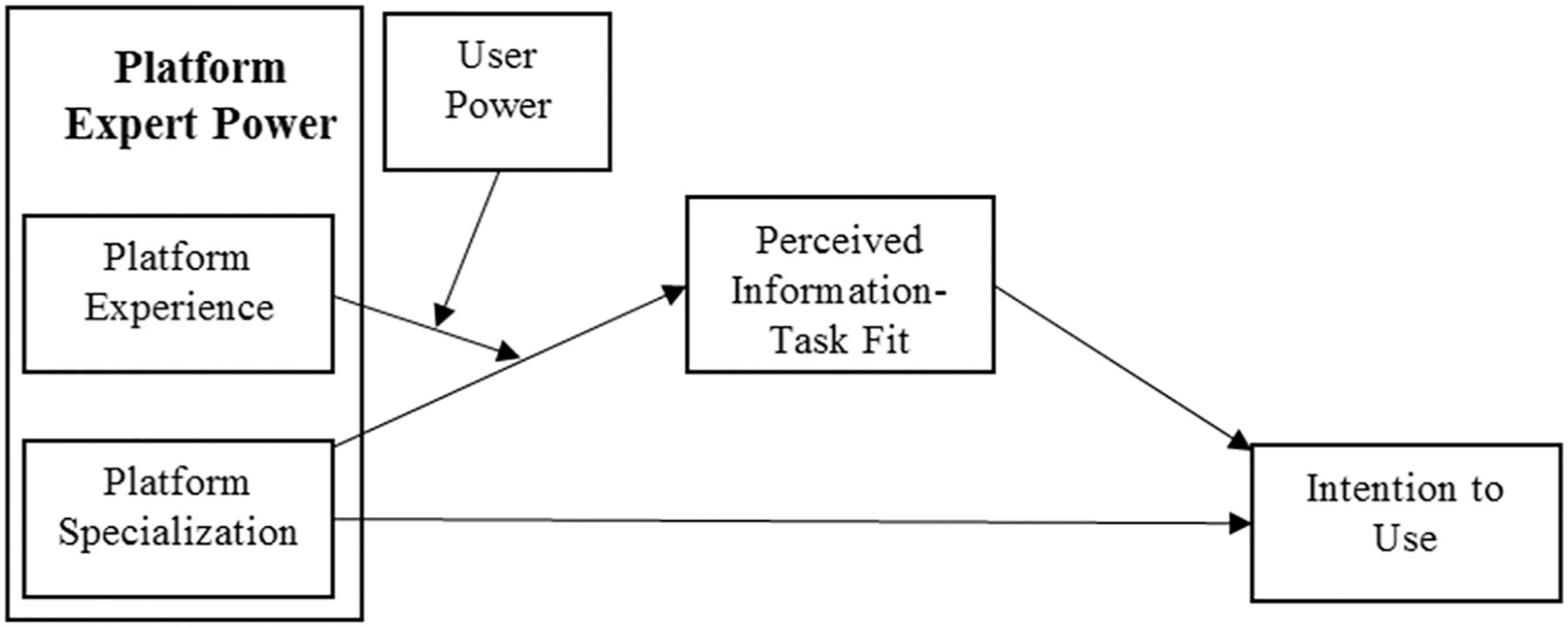
Conceptual model.
Methodology
An experimental approach was considered appropriate for the purposes of testing the causal psychological effects of expert power. First, a pilot study was conducted to determine lower or higher levels of experience and develop the stimuli. A main study was then performed to examine the interaction of experience, specialization, and user power.
Pilot Study
Given that social media platforms are relatively new and no testing of platform experience levels has been performed, engaging in the sensitive development of the stimuli that are intended to manipulate the experience of a review platform is important. The difference in years between new and experienced platforms should be realistic and applicable to the experience profiles of existing review platforms. A pilot study with a 1 × 2 (platform experience: low vs. high) between-subjects experiment is conducted to test the psychological effects of platform experience. A total of 101 US residents were recruited as participants via MTurk and 50 cents were given to each participant as compensation. MTurk has recently become a popular source of data in tourism research (Y. Choi, Hickerson, and Kerstetter 2018; S. Q. Liu and Mattila 2017) owing to its reliability, validity, and time and cost effectiveness (Buhrmester, Kwang, and Gosling 2011; Casler, Bickel, and Hackett 2013; Hauser and Schwarz 2016; Paolacci, Chandler, and Ipeirotis 2010).
Participants were asked to imagine that they were traveling to an unfamiliar destination. While thinking about places to eat, they noticed a Facebook advertisement about a review platform. They were further asked to visit the website and make a careful examination of its features. Participants were randomly exposed to an advertisement of a review platform with either low or high experience. To manipulate the extent of experience, the logo of the platform stated either “Since 2017” or “Since 2008.” Respective messages indicating that the given website was celebrating its “1st” or “10th” anniversary were added to the advertisement (see Appendix A). The earliest review platforms in hospitality and restaurant contexts were founded in the mid-late 2000s (e.g., Yelp). On this basis, 10 years of experience was employed in this study to represent a high experience of the platform. Also, 10 years seems high compared with 1 year of experience.
Following their exposure to the stimuli, participants were asked to answer questions related to the platform. Two questions were asked to check the manipulation: “The website has several years of experience in what they do” and “The website reflects expertise.” Perceived realism of the stimuli was measured using two items adapted from Sparks and Browning (2011): “I think the advertisement was realistic” and “I could imagine seeing this advertisement in a real world.” For perceived information-task fit, three items were adopted from Dedeke (2016): “The information on the website is pretty much what I need to carry out my tasks,” “The website adequately meets my information needs,” and “The information on the website is effective.” All measures used a five-point Likert-type scale (1 = strongly disagree, 5 = strongly agree).
Participants in the low experience condition (M = 2.12, SD = 1.24) provided significantly lower ratings (t = −10.66, p < 0.01) than those in high experience conditions (M = 4.25, SD = 0.71) in response to manipulation check questions about the level of experience in terms of years. Similarly, participants in high experience conditions provided significantly higher ratings (t = 2.4, p < 0.01) on the expertise of the website (M = 3.71, SD = 0.94) compared with those in low experience conditions (M = 3.25, SD = 0.10). This finding suggests that the manipulation was effective. Cronbach’s alpha of perceived realism and information-task fit were 0.74 and 0.84, respectively. The realism of both scenarios was high, with no significant differences (t = −1.04, p = 0.3) between the low experience (M = 3.84, SD = 0.72) and high experience conditions (M = 3.98, SD = 0.62). Moreover, participants’ perceptions toward information-task fit differed significantly (t = −2.10, p < 0.05) between the low experience (M = 3.55, SD = 0.81) and high experience conditions (M = 3.85, SD = 0.66).
Main Study Design and Participants
To test the effects of experience, specialization, and user power, a 2 (platform experience: low or high) × 2 (platform specialization: generalist or specialist) × 2 (user power: powerful or powerless) between-subjects experiment was conducted containing eight cells. A total of 411 participants living in United States were recruited via MTurk and given a compensation of 50 cents.
Procedure and Stimuli
The psychology literature has proposed a number of ways to measure or manipulate participants’ sense of power. Scholars have associated power with sociocultural factors and personality variables (Anderson, John, and Keltner 2012). For example, the sense of power among those occupying management positions is generally higher than what applies to subordinates (Georgesen and Harris 1998). However, studies have increasingly shown that sense of power is not always static or permanently fixed but rather dynamic (Rucker, Galinsky, and Dubois 2012). For example, the power of a manager may decrease when confronted by his or her superior. “A state of low or high power can be quickly and simply elicited by assigning individuals to an actual hierarchal role of a boss/employee for a single task” (Rucker, Galinsky, and Dubois 2012, p. 355). Put otherwise, it can be manipulated. Although measuring and manipulating power are widely prevalent in the literature, the latter approach has been adopted in the current study. After agreeing to participate in the experiment, respondents were randomly assigned to one of the two manipulations for user power. First, participants’ sense of power (user power) was manipulated using S. Q. Liu and Mattila’s (2017) two-step manipulation guideline. Participants were instructed to recall a specific incident where they were powerful (or powerless) and then asked to describe it. They were subsequently asked to make a grammatically correct sentence with two given sets of words that are related to either having power or being powerless. The psychology literature has given widespread support to the reliability of such methods manipulating the power of participants (Galinsky, Gruenfeld, and Magee 2003; Magee, Galinsky, and Gruenfeld 2007). After participants’ sense of power was manipulated, the respondents were asked to imagine another unrelated scenario: they were on a trip in an unfamiliar destination and found a Facebook advertisement about a review platform while considering somewhere to eat. Participants were instructed to visit the platform and make a careful examination of the features of the website. They were then assigned randomly to one of the four platform scenarios: low experience and generalist, low experience and specialist, high experience and generalist, and high experience and specialist. Similar to the treatment in study 1, platform experience was manipulated with a logo of either “Since 2017” or “Since 2008.” The advertisement also displayed a message stating that platform will soon celebrate its 1st (or 10th) anniversary. In the manipulation of specialization, the review categories of a generalist platform were adapted from Yelp.com with the presentation of relevant pictures in each category (Appendix A). The specialist platform was a specialist in restaurant reviews and was confined to categories of cuisine (e.g., burgers and sushi) (Appendix B). Consistent with these characteristics, the platform was named either “A Recommender” or a “Food Recommender.”
Measures
To check the manipulation of user power, one question was asked to participants to measure the extent to which they felt powerful (1 = not at all powerful, 5 = extremely powerful). To check the manipulation of specialization, participants were asked to indicate how strongly they disagree/agree with the following items on a five-point Likert scale (1 = strongly disagree, 5 = strongly agree): “The website is specialized in restaurant reviews.” For experience manipulation, participants were asked: “The website has several years of experience in what they do.” Following Koh and Sundar’s (2010a) recommendation, this study also added a manipulation check question for perceived expertise: “The website reflects expertise.”
Perceived information-task fit was measured with three items adopted from Dedeke (2016). Intention to use was measured with three items adapted from Ayeh, Au, and Law (2013): “I would intend to search for restaurants and evaluate them through this website,” “I would not hesitate to search for restaurants and evaluate them through this website,” and “I would be very likely to search for restaurants and evaluate them through this website.” Perceived platform attractiveness was included as a covariate to eliminate the effect of any visual and aesthetic appeals that could derive from color and/or picture differences between generalist and specialist websites. Three of the items that were deployed were adapted from Harris and Goode (2010): “The website is visually attractive,” “The website is aesthetically appealing,” and “I like the way the website looks.” A five-point Likert scale (1 = strongly disagree, 5 = strongly agree) was used to measure items of users’ perceptions and intention to use.
Results
Demographic Profile
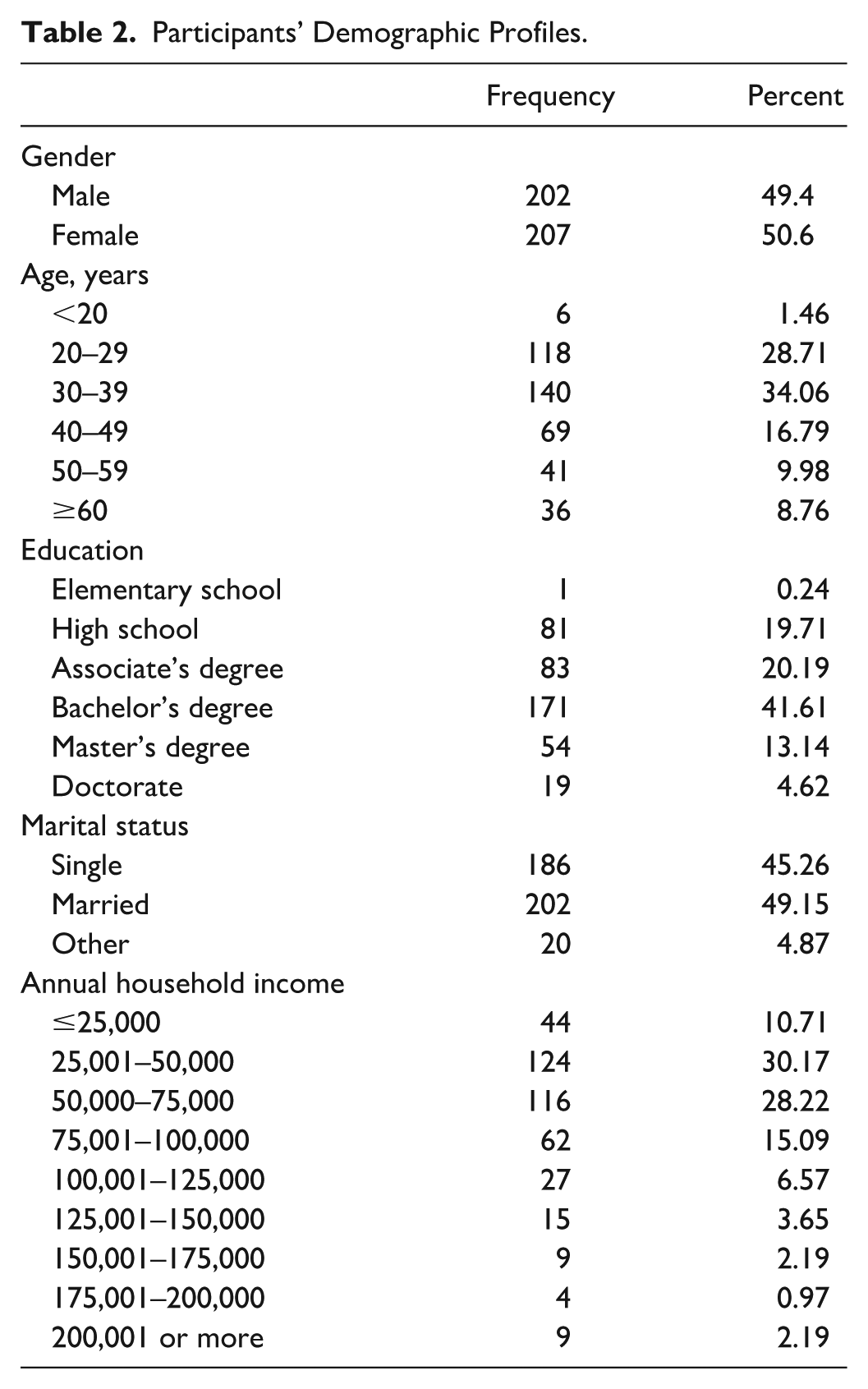
A close to even distribution of male and female participants was observed (49.4/50.6 percent). Most participants were in the 30–39-year age group (34.1%), were married (49.2%), had a bachelor’s degree (41.6%), and an annual household income of USD 25,000–50,000 (28.2%). The demographic characteristics of participants are presented in Table 2.
Participants’ Demographic Profiles.
Manipulation Check
In terms of perceived sense of power, the empowered (M = 2.78, SD = 1.04) scored significantly higher (t = 4.75, p < 0.01) than those in powerless condition (M = 2.29, SD = 1.08). Participants exposed to an advertisement by an experienced platforms rated significantly higher (t = 23.82, p < 0.01, M = 4.10, SD = 0.74) on manipulation check questions on platform experience than those exposed to a low experience platform advertisement (M = 1.96, SD = 1.06). Participants in specialist platform conditions rated significantly higher on specialization (t = 16.08, p < 0.01, M = 4.20, SD = 0.72) than those in generalist platform conditions (M = 2.66, SD = 1.18). Finally, the expertise of the platform was perceived to be significantly higher (t = 5.73, p < 0.01) for those in high-experience conditions (M = 3.84, SD = 0.91) than by those in low-experience conditions (M = 3.31, SD = 0.98). Similarly, those exposed to specialist platforms also rated a significantly higher (t = 3.35, p < 0.01) on perceived expertise (M = 3.73, SD = 0.88) compared with those exposed to a generalist one (M = 3.41, SD = 1.06). All three manipulations were successful. Specialist (compared with generalist) and experienced (compared with nonexperienced) platforms were perceived to be an expert platform.
Perceived Information-Task Fit
To test hypothesis 1, a three-way analysis of covariance (ANCOVA) was performed on perceived information-task fit with perceived attractiveness included as a covariate. Platform experience, platform specialization, user power, and their two-way and three-way interactions were included as independent variables. Means and standard deviations for each condition are given in Table 3. The result of ANCOVA is presented in Table 4.
Means and Standard Deviations of Perceived Information-Task Fit.

Note: The covariates appearing in the model are evaluated at the following value: perceived attractiveness = 3.49.
ANCOVA on Perceived Information-Task Fit.

Note: ANCOVA = analysis of covariance; DF = degrees of freedom; MS = mean square.
p < 0.01, **p < 0.001.
The main effects of platform experience, F(1, 402) = 11.998 (p < 0.001), and platform specialization, F(1, 402) = 18.507 (p < 0.001), were significant. Importantly, a significant three-way interaction effect among user power, platform experience, and platform specialization, F(1, 402) = 8.039 (p < 0.01), was found. The data set was then divided into two to acquire a stronger insight into the interaction effect. One sub–data set included only participants in powerful condition, whereas the other sub–data set included only those in powerless condition. A two-way ANCOVA was conducted separately with perceived attractiveness as a covariate. As presented in Figure 2, a significant two-way interaction effect was found for the powerful between platform experience and platform specialization, F(1, 199) = 10.181 (p < 0.01). Specialization had a significant positive impact on perceived information-task fit in low-experience conditions, F(1, 199) = 26.372 (p < 0.01), whereas the effect of specialization was insignificant in high-experience conditions, F(1, 199) = 0.338 (p = 0.56). The two-way interaction between platform experience and platform specialization was not significant when participants were in powerless condition, F(1, 202) = 0.436 (p = 0.51). The impact of specialization on perceived information-task fit was insignificant in low-experience conditions, F(1, 202) = 0.904 (p = 0.34), whereas marginally significant in high experience conditions, F(1, 202) = 3.558 (p = 0.06). Thus, the findings support hypothesis 1, suggesting that user power moderates the moderation effect of platform experience on the relationship between platform specialization and perceived information-task fit.
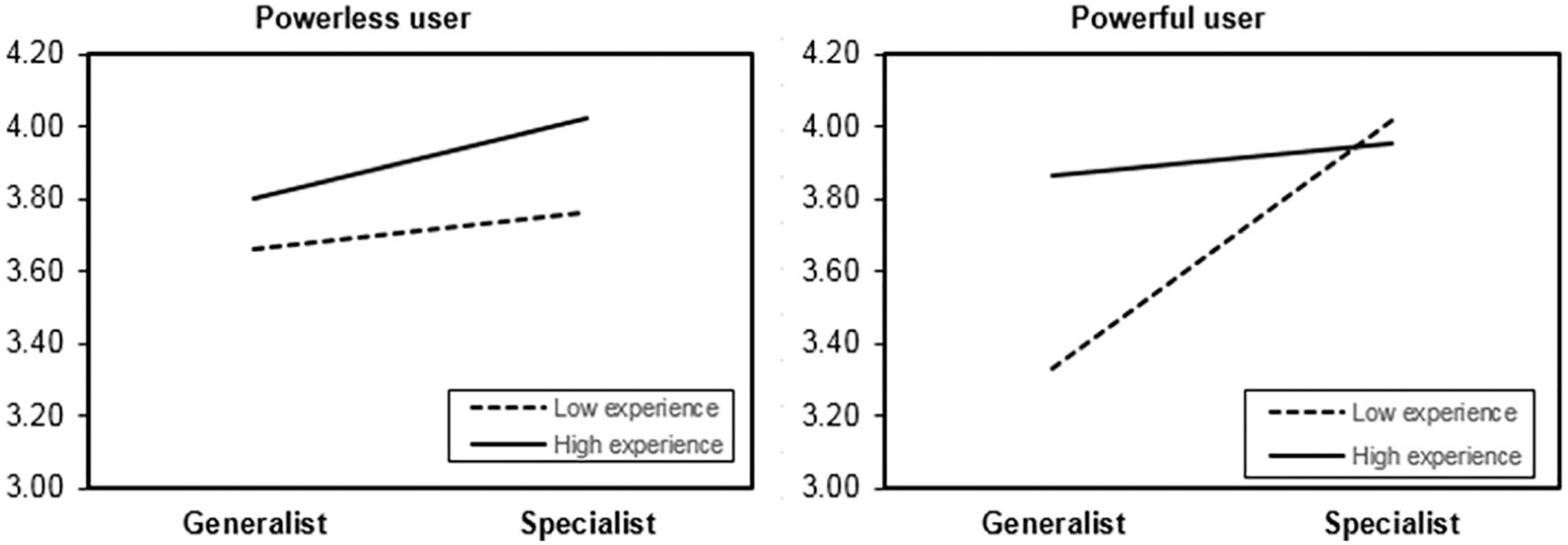
Three-way interaction effect between user power, platform experience, and platform specialization on perceived information-task fit.
Mediation Analysis
A moderated moderated mediation analysis was conducted to test hypothesis 2, following the guidelines by Hayes (2013) (bootstrap = 5000, model 11). Platform specialization was entered as the predictor variable (X), platform experience as the level 1 moderator (W), user power as the level 2 moderator (Z), intention to use as the outcome variable (Y), perceived information-task fit as the mediator variable (M), and perceived attractiveness as the covariate. Consistent with the ANCOVA results, the three-way interaction was significant between user power, platform experience, and platform specialization on perceived information-task fit, b = −0.71, t(402) = −2.84 (p < 0.01). Perceived information-task fit was positively related with intention to use, b = 0.67, t(407) = 13.67 (p < 0.001) (Table 5). Perceived information-task fit mediated the effect of three-way interaction between user power, platform experience, and platform specialization on intention to use (index of moderated moderated mediation = −0.48, 95% CI = −0.85 to −0.15). Specifically, the effect of specialization on intention to use through perceived information-task fit was significant only when users are powerful and platform experience is low (b = 0.46, 95% CI = 0.27 to 0.68). The effect was insignificant in other three conditions (Table 6).
Regression Coefficients of Moderated Moderated Mediation Analysis.
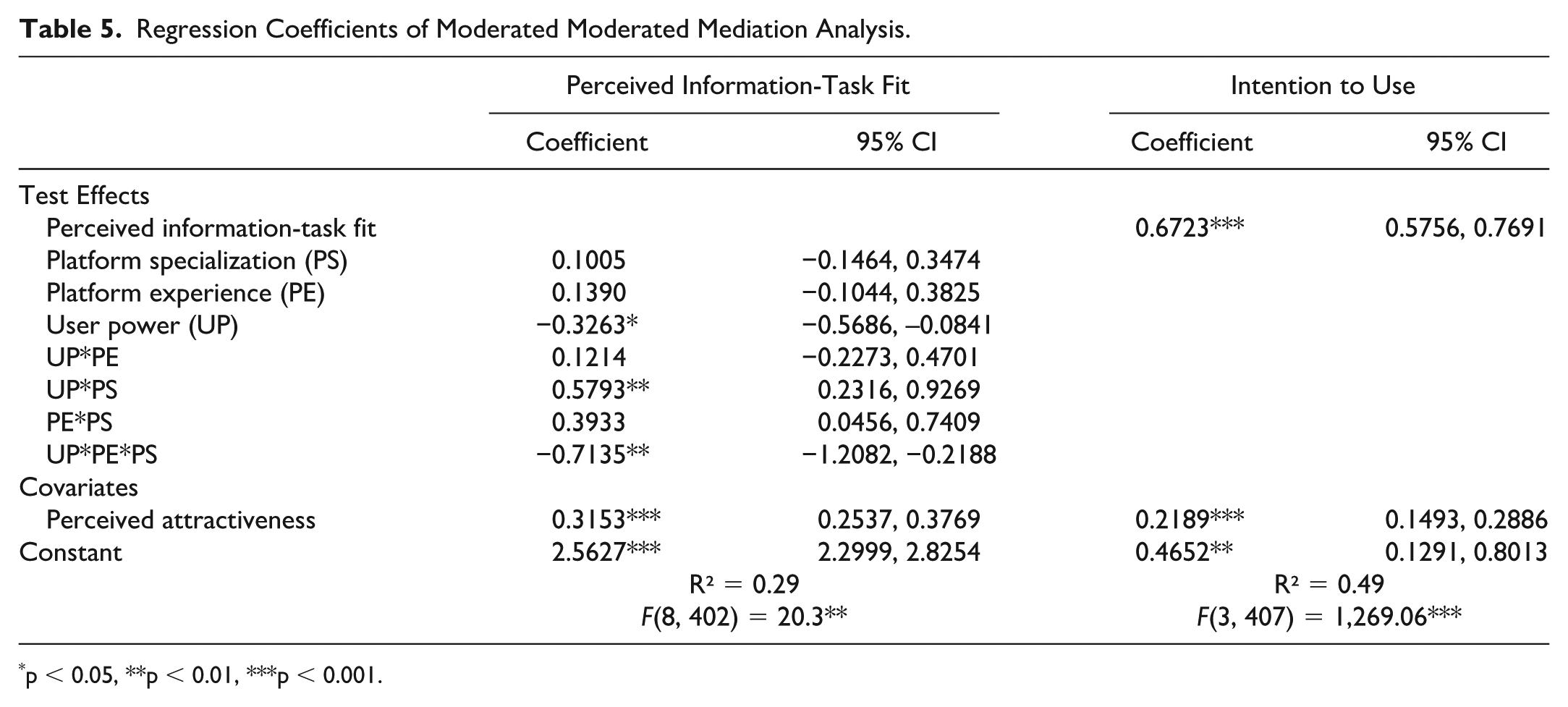
p < 0.05, **p < 0.01, ***p < 0.001.
Conditional Indirect Effect of Platform Specialization on Intention to Use through Perceived Information-Task Fit.

Note: Index of moderated moderated mediation = −0.48, 95% CI = −0.85 to −0.15.
Value in bold type denotes significant conditional indirect effect.
Discussion and Conclusions
The frequency and intensity of human–computer interactions is rapidly increasing in the contemporary era of digital transformation. A growing number of tourists rely on a variety of smart technologies before, during, and after taking a trip (Buhalis and Law 2008; Neuhofer, Buhalis, and Ladkin 2015). Social media, particularly online review platforms, are increasingly essential to the facilitation of human–computer interactions (Chung, Han, and Koo 2015). The platform through which a message is distributed can substantially influence how users perceive the message (Sundar and Nass 2001). In this regard, viewing online review platforms as a social actor is legitimate. Humans interact with them according to social rules and schemes.
Although the number of social media studies in tourism has grown over the past decade (Mehraliyev, Choi, and Koseoglu 2019), few studies have treated online platforms as a social actor in general or as a power actor in particular. By using the CASA paradigm (Nass and Moon 2000; Reeves and Nass 1996), the present study has applied power theories and discussions that have been previously used to explain human–human interactions to the tourism context, of online review platforms, thereby encompassing human–technology interactions. In particular, the current researchers have tested the interaction effect between experience and specialization of a platform (power of an influencer) and user power (power of an influenced) on information-task fit and on behavioral intentions. The findings have revealed that the expertise of specialist and experienced platforms is perceived more highly than that of generalist and nonexperienced platforms. Perceived expertise is the outcome when expert power manifests. The findings have confirmed that both specialization and experience may be considered as key attributes of expert power.
The findings offer meaningful theoretical contributions. First, they contribute to discourses on power by articulating the two attributes of expert power and explaining the psychological mechanism of the workings of the expert power of online review platforms. The study shows that expert power manifests when platforms seem to have experience or specialization. Tourist perceptions toward information-task fit of social agent and behavioral intentions are influenced by these two attributes of expert power. The study provides a potential example that can be applied to other power theories and constructs in the context of diverse media technologies. Future researchers may contribute to the literature on media technology and tourism by building on the present study to investigate human–computer interactions in tourism using other types or theories of power. For example, the key attributes of different types of power (e.g., reward, coercive, legitimate, and referent power) may apply to online platforms, and researchers may investigate their psychological effects on tourist/consumer perceptions and behaviors.
Second, the study makes an important potential contribution through the interaction effects that occur between the power of the influencer and the influenced. Many power discourses, including social power theory, view the power of the influenced as a barrier to influence. Surprisingly, this study reveals a contrary relationship. A significant three-way interaction suggests that the psychological effect of platforms’ expert power depends on both the influencer (online review platform) and the influenced (user). The findings are consistent with the psychology literature and confirm that individuals in a powerless state tend to be neutral (Kim 2018; Magee, Galinsky, and Gruenfeld 2007). Tourists’ sense of powerlessness will generate similar perceptions on the quality of task-oriented information in expert and nonexpert platforms. Those in a powerful psychological state, however, clearly notice the differences between two platforms and act accordingly. In political science, the concept of power often has negative connotations (Haugaard 2002) in that influence commonly occurs when the influenced are powerless. From a social media marketing perspective, to the contrary, power is not necessarily a malevolent presence. Interestingly, the power of the influenced becomes the facilitator of the influence. The findings have shown that user power not only has positive effects on perceptions of information-task fit but also works in two opposite directions. Individual reactions increase as a consequence of sense of power so that users’ perceptions increase or decrease toward expert and nonexpert platforms, respectively. The lowest perceptions apply to new and generalist online review platforms. These findings confirm the observation of Briñol, Petty, and Stavraki (2012) that individuals who are in a powerful state tend to make judgments based on first impressions. The findings in this study open a promising line of discussion about how empowering society can be of benefit to those who are currently wielding power. Powerful individuals within society may accept the influence of other powerful actors who are in charge (e.g., policy makers, big corporations, and community leaders) when they can provide resolution to certain tasks. The present study also offers theoretical means, calling for further research to test social relations between tourism stakeholders in settings where power is not abused by elites. It is notable that when power is abused and has negative connotations, empowering society may be seen as a barrier to influence. For example, Macleod (2010) argued that because of their lack of power, the view of African ethnic groups has largely been ignored by government officials in the Dominican Republic when promoting heritage.
Third, the findings suggest that the effect of expert power may have a threshold, particularly when more than one attribute of expert power is presented. The interaction between platform experience and platform specialization is significant when users are powerful. This finding suggests that a single attribute of expert power may suffice to alter users’ perceptions toward a platform. The effect of the second attribute may be marginal. The findings are consistent with previous literature suggesting limits to the effects of experience (Ericsson 2004), specialization (Gompers, Kovner, and Lerner 2009), and expertise (Z. Q. Zhang, Zhang, and Yang 2016). A threshold or a point seemingly exists beyond which expert power does not further increase. This study offers theoretical means to test the interaction effect between attributes of other types of power. Presumably, a threshold may apply to some types of power and not to others. For example, reward power manifests when an influenced believes he or she may benefit from an influencer either financially or through other means. The basic example is the provision of discounts and/or loyalty programs where companies offer tourists tangible rewards for their repeat custom. A rule of thumb suggests that “the more rewards, the better,” implying an endless increase in the influence of reward power. An intriguing question concerns the threshold of overall power that an agent (human or nonhuman) possesses. Researchers may use such means to test interactions between different types of power (e.g., interaction between reward and expert power), rather than the attributes of certain types of power.
Fourth, this study contributes to research on the quality of information by examining the mediating role of perceived information-task fit between specialization and behavioral intention. The results of the moderated moderated mediation model illustrate that perceived information-task fit mediates the conditional effects of specialization to intention to use. As a subdimension of information quality, information-task fit, which refers to the quality of task-oriented information, has been less widely tested as an antecedent of attitude and behaviors. The findings suggest that users’ perceptions toward a platform determine the extent of their intended use. When powerful individuals have viewed a new generalist platform, they are less likely to proceed to use it compared with specialist and/or experienced platforms. The tourism and hospitality literature has suggested that platforms can influence tourist behaviors using various informational cues (Y. Choi, Hickerson, and Kerstetter 2018). Future researchers are encouraged to test the effects of perceived information-task fit and user power when tourists are exposed to different informational cues. The cues may be presented by human and nonhuman social actors.
Fifth, the findings also reveal that perceived attractiveness has a significant positive effect on information-task fit and intention to use. Although previous studies have confirmed the effect of perceived attractiveness on behavioral intentions (Harris and Goode 2010), its effect on information-task fit has been unanticipated and, thus, deserves attention from researchers. In terms of interface design, future studies should articulate the distinctive effects of various aesthetic features of online review platforms.
In today’s online market where review platforms must compete constantly with existing platforms and newcomers, the findings in this study provide useful practical implications for platform developers, marketers, and tourists. Previous studies have shown that the appeal of social media advertisements depends on a diversity factors that are attributable to both platform and tourists (Wang and Lehto 2019). First, the findings suggest that the effects of expert power depend on the power of users. Platforms with low levels of expert power attributes (i.e., generalist platforms with no experience) should consider targeting tourists who have a low sense of power. Platforms with at least one attribute of expert power can target tourists in a higher power condition. Rucker, Galinsky, and Dubois (2012) suggested two alternative approaches to targeting consumers with an applicable power state. One considers sociodemographic factors to target the relevant audience. Digital marketing strategies are becoming highly customized and marketers possess colossal information about their potential targets. Such information may be used to identify and target powerful or powerless tourists, respectively. In the tourism context, it may be possible to perform targeting by considering the types of hotels, restaurants, and even airlines that tourists use as an indicator of socioeconomic status and power. Intriguing questions arise for the purposes of further research: are there times or episodes during a trip when tourists have a higher or lesser sense of power? For example, are tourists more or less powerful before, during, or after visiting attractions? If yes, is the type of an attraction or a destination of any consequence? Arguably, tourist activities (e.g., going to the seaside for the sunset and to a music or sports event) may have different impacts on a tourist’s sense of power.
Rucker, Galinsky, and Dubois (2012) proposed that power manipulation may be embedded alternatively within advertisements. Dubois, Rucker, and Galinsky (2011) manipulated the content of an advertisement in the services context. Specifically, a successful manipulation strategy has used a banner stating “We all feel powerful [versus powerless] in the morning: Treat yourself to free bagels” (Dubois, Rucker, and Galinsky 2011, p. 1052). Online review platforms have the capacity to prepare relevant marketing materials to manipulate tourists’ sense of power.
Moreover, the results suggest that one attribute may be sufficient to be perceived as experts and the effect of the second one could be trivial. Thus, scope-specialization strategies are recommended for newcomers with low experience to be perceived as experts. Specialist platforms that have several years of experience may consider diversification strategies and extend their business scope to other sectors. Their experience may be sufficient to be positioned as experts and alter behavior.
This study aimed to bridge power discourses and the CASA paradigm in tourism. Given its multitude of associated theories and perspectives, power is a critical discourse in the social sciences. If this study has posed more questions than it has answered, then it may constitute a contribution in its own right. Potential research directions have been proposed throughout the preceding discussion. Conducting field experiments should allow future researchers to confirm the external validity of the findings. Finally, the potential of online media to provide multiple layers of information sources is worth noting (Koh and Sundar 2010a). Future researchers may investigate how the expert power of online review platforms interacts with the expert power of upper and/or inner layers of information source, namely, computers and reviewers. Finally, the regression model that has been presented in this study has not determined whether there is a joint effect of specialization and experience on information-task fit when users are powerless, though the assumption seems to be reasonable. Figure 2 provides an implicit indication that the separate trivial effects of specialization and experience may be significant in circumstances where they work together (i.e., specialist and experienced vs. generalist and nonexperienced platforms may be perceived differently by powerless users).
Footnotes
Appendix
Acknowledgements
The authors would like to thank the Institute of International Business and Governance, established with the substantial support of a grant from the Research Grants Council of the Hong Kong Special Administrative Region, China (UGC/IDS 16/17), for its support.
Declaration of Conflicting Interests
The author(s) declared no potential conflicts of interest with respect to the research, authorship, and/or publication of this article.
Funding
The author(s) received no financial support for the research, authorship, and/or publication of this article.
