



Abstract
Past research has found that the effect of odd-ending price (e.g., $9.99) can be explained by the left-digit effect whereby the leftmost digits of both prices influence the comparison of a pair of prices. However, research on psychological pricing has mostly focused on low-priced retailing products and the focal product’s price per se. Informed by prospect theory, this study extended this line of work by examining how the effect of left-digit pricing varies with the magnitude of hotel room rates (i.e., price level) and the size of prior investment in other travel components (i.e., composite price). The results of 2×2×2 experimental revealed that left-digit pricing was an effective tactic to increase purchase intentions for low-priced hotels. It was also found that tourists who have made a substantial prepayment on other travel components were responsive to the tactic. Additionally, composite price and left-digit pricing were found to moderate the relationship between perceived value and purchase intentions.
Introduction
Psychological pricing is commonly known as the “irrational” effects of pricing on consumer decision making (Monroe 2003). It is a pricing strategy taking account of “how humans attend to, perceive, process, and evaluate price information” (Miyazaki 2003, p. 471). One psychological pricing strategy, odd-ending pricing (e.g., $19.99 rather than $20.00), is ubiquitous, especially in retailing. The effectiveness of odd-ending pricing in increasing revenues is well documented in the marketing and retailing literature (e.g., Schindler and Kirby 1997). One widely discussed explanation for odd-ending pricing is the left-digit effect, which posits that using a 9-ending lowers the left digit and that it is the change in the left digit, rather than the digit of 9 per se, that affects the perceptions of price magnitude (Thomas and Morwitz 2005; Stiving and Winer 1997).
Research on psychological pricing, such as odd-ending pricing, has been mostly focused on retailing practices (Kleinsasser and Wagner 2011). It has been argued that pricing in tourism is more complex than in retailing because of the distinct nature of tourism services (Sirakaya and Woodside 2005). For instance, tourism services such as hotels, flights, and theme parks are generally more expensive than retail products (Jeong and Crompton 2017). Hence, the use of psychological pricing might not be as effective in high-priced services as in the low-priced retail items. Unfortunately, there has only been a limited number of studies in the pricing literature for high-priced products or services (Kleinsasser and Wagner 2011).
Furthermore, research on psychological pricing has mostly focused on the effect of the focal product’s price on consumers’ price perceptions and purchase decisions. Unlike retail products, the purchase of a vacation is rarely just one single decision; instead, it often involves multiple decisions because of the multicomponent nature of a vacation (i.e., a vacation purchase may include a flight ticket, hotel reservations, and a rental car). Thus, tourism purchasing involves a series of decisions, which makes travel decision making a temporal and evolving process (Hyde and Lawson 2003). The amount of prior investment in one travel component (e.g., a prepaid flight ticket) is likely to influence consumers’ subsequent purchase of other travel components (e.g., hotel accommodations), which has been theorized as the sunk cost effect (Arkes and Blumer 1985). This multifaceted decision process has been well recognized in the travel decision-making literature (Dellaert, Ettema, and Lindhm 1998; Fesenmaier and Jeng 2000), but little attention has been paid to how the successive nature of travel decision making affects travelers’ price perceptions and purchase decisions in a pricing context. This complex nature of tourism services suggests a need to have a better understanding of psychological pricing in a tourism context.
In light of the believed importance of the above, the purpose of this study is to examine the application of left-digit effects in a hotel pricing context. Specifically, the current study seeks to understand how the effectiveness of left-digit pricing varies with the magnitude of hotel room rates (i.e., price level) and the size of prior investment in other travel components (i.e., composite price).
Literature Review
Left Digit Effect
The practice of 9-ending pricing (e.g., pricing an item at $8.99 rather than $9) is prevalent, especially in the retailing industry. Holdershaw, Gendall, and Garland (1997) examined 840 advertisements and found that 60% of the prices ended in 9. There is also quite a bit of evidence that odd-ending pricing is effective in generating demand and profit (Gedenk and Sattler 1999; Gendall, Holdershaw, and Garland 1997; Kalyanam and Shively 1998; Stiving and Winer 1997). For instance, Schindler and Kirby (1997) found that prices that ended with the digit 9 can lead to an average of a 24% increase in sales.
Although there is no shortage of anecdotal evidence that supports the effectiveness of 9-ending pricing, there is a lack of consensus regarding the theoretical explanations of this phenomenon. Past research has proposed two major psychological theories: image effects, which focus on the effect of the rightmost digit, and left digit effects, which focus on the effect of the leftmost digit (Stiving and Winer 1997; Hackl, Kummer, and Winter-Ebmer 2014; Schindler, Parsa, and Naipaul 2011).
Image effects suggest that consumers tend to associate odd-ending digits, particularly the digit of 9, with discounts and low quality (Schindler 1991). Past research based on the assumption of image effects has revealed mixed results. Schindler (2006) analyzed prices advertised in newspapers and found a strong and robust correlation between the use of the 99 price ending and the presence of a low-price appeal. Conversely, Jeong and Crompton (2018) found that the purchase decisions of tourism projects with a 9-ending price were not influenced by the symbolic meanings associated with 9-ending prices. Moreover, Jeong and Crompton (2018) concluded that the use of 9 as the ending digit in prices was effective in increasing perceived value as they found the steepest slope was between $200 and $199 along the four price points (i.e., $220, $200, $199, and $180), which indirectly lends support for the left digit effects.
Contrary to image effects, left digit effects imply that consumers give little attention to the rightmost digit (Stiving and Winer 1997). This explanation emphasizes humans’ cognitive tendency of left-to-right processing when reading prices (Poltrock and Schwartz 1984; Schindler and Kirby 1997). Left-digit anchoring refers to the tendency to anchor on the leftmost distinct digits of prices when evaluating the differences between two prices (Thomas and Morwitz 2005). It has been suggested that consumers compare prices by considering the digits from left to right (Stiving and Winer 1997). This suggests that if there is a difference in the first left-hand digits, consumers’ judgment of the price difference will be based on the subtraction of the leftmost digits, and the comparison does not go any further (Poltrock and Schwartz 1984). However, if the leftmost digits are the same, the encoding will likely move on to the second leftmost digits. That is, consumers compare a pair of prices by subtracting the first distinct left-hand digits (Stiving and Winer 1997). For instance, people intuitively judge the difference between $16.00 and $14.99 to be larger than the difference between $16.01 and $15.00 (although the monetary differences are identical) because the former pair of prices have a larger difference in their first distinct left-hand digits than the later pair.
Basu (2006) also examined the cognitive process of left-digit anchoring and stated that consumers “expect the time cost of acquiring full cognizance of the exact price to exceed the expected loss caused by the slightly erroneous amounts that is likely to be purchased or the slightly higher price that may be paid by virtue of ignoring the information concerning the last digits of prices” (p. 125). In other words, it is not the ending digit 9 per se but the change in the left-hand digit caused by the rightmost digit ending with a 9 that leads to consumers’ positive evaluation of the 9-ending prices.
Several studies in the marketing literature support the notion of left-digit effects (Coulter 2001; Stiving and Winer 1997; Schindler and Kirby 1997; Thomas and Morwitz 2005; Bizer and Schindler 2005; Manning and Sprott 2009). Schindler and Kirby (1997) surveyed retail prices advertised in a newspaper and found that 9-ending prices were more likely to be used when it would change the price’s leftmost digit (e.g., $3.99 → $4.00) than when it would not (e.g., $3.49 → $3.50). Similarly, Thomas and Morwitz (2005) conducted a series of experiments and found that consumers’ price perceptions were influenced when leftmost digits were different (e.g., $3.00 to $2.99), but no significant effect was found when the second leftmost digits were different (e.g., $3.20 to $3.19 or $2.80 to $2.79).
However, previous research on left-digit effects and 9-ending pricing has predominately focused on low-priced goods in the retailing industry (Kleinsasser and Wagner 2011). Tourism services, such as hotel rooms and airline seats, are generally priced at higher levels compared to retail goods (Jeong and Crompton 2017). Because of the typically high costs of tourism services, travel decision making tends to involve a high perceived risk of making bad decisions (Sirakaya and Woodside 2005) and a greater level of involvement (Gursoy and Gavcar 2003). This has been argued to lead to more cognitive processing and more careful selections (Jeong and Crompton 2017). It is unknown if left-digit effects in pricing will influence consumer’s purchase decisions of higher-priced services as left-digit pricing has been argued to take effect through consumer heuristics (Jeong and Crompton 2017).
Prospect Theory
This study is primarily informed by Tversky and Kahneman’s prospect theory. Their original conceptualization of the theory was articulated in Kahneman and Tversky (1979) and was later extended and modified (Tversky and Kahneman 1992). Neoclassic economic theories, such as expected utility theory, assume that when making decisions, people are rational and seek to maximize utility. Starting with the idea that people’s intuitions are deficient, Kahneman and Tversky (1979) found systematic discrepancies between behavior and expected utility theory through a series of experiments. They further generalized their results into prospect theory, which has been argued to be one of the most influential theories in the field of economics (Barberis 2013).
Rooted in cognitive psychology, prospect theory has been used to describe decision making by taking into account various context effects. Unlike expected utility theory, which predicts how people ought to behave, prospect theory emphasizes how people actually behave (Crompton 2016). Three tenets of prospect theory are particularly relevant to pricing: reference dependence, loss aversion, and diminishing sensitivity.
Reference Dependence and Loss Aversion
According to Kahneman and Tversky (1979), prospect theory involves an editing process. They suggested that people evaluate a price by coding it as a gain or a loss relative to some reference point. A price that is above one’s reference point is coded as a loss, and a price that is below the reference point is coded as a gain. This editing process can ease the decision makers’ cognitive burden and simplify evaluation tasks. Hence consumer preferences are reference dependent in that the utility of an alternative is affected by the reference standard against which it is evaluated (Tversky and Kahneman 1991). In other words, it is the deviation from the reference point, rather than the price per se, that influences price evaluations and the final decision related to purchasing.
After the editing process, whether a price is coded as a gain or a loss likely influences consumers’ preference and subsequent purchase decisions. From a cognitive perspective, Tversky and Kahneman (1991) found that a loss looms larger than an equivalent gain. In other words, the degree of pain associated with an outcome above a reference state is much greater than the degree of joy associated with the same level of outcome below the reference state. Some studies have suggested that losses are twice as powerful as gains (Abdellaoui, Bleichrodt, and Paraschiv 2007; Tversky and Kahneman 1992). Thus, people prefer avoiding losses to acquiring the same amount of gains (Tversky and Kahneman 1991). This tendency is termed loss aversion.
Composite price and prospect theory
Composite price refers to the total sacrifice a consumer makes for a product/service (Zeithaml 1988). Crompton (2016) suggested that from a consumer’s perspective, prices consist of multiple components beyond the monetary payment of the product or service. For instance, a hotel room might be priced at $150, but in order to go to a destination, tourists need to pay for multiple other things (e.g., flight, gas, food/drinks). Moreover, monetary costs are just one component of the composite price. Nonmonetary costs associated with this trip could include time (e.g., planning, waiting) and effort (e.g., planning, searching, and booking) (Crompton 2016).
The effects of composite price on consumption behavior can be explained by the sunk costs effects. Sunk costs refer to the costs that have already been incurred and cannot be recovered (Park and Jang 2014). For example, in a travel consumption context, money spent on prepaid tourism services such as flight tickets represents sunk costs. Classical economic theory argues that rational individuals would not consider historical costs when making decisions because historical costs are irrelevant to the incremental payoffs of future decisions. However, an abundant amount of evidence demonstrates that consumer decision making is affected by sunk costs (Navarro and Fantino 2009; Park and Jang 2014), which is considered an irrational economic behavior (Arkes and Blumer 1985). This phenomenon is called sunk cost effects. Sunk costs effects refer to humans’ tendency to continue an endeavor, regardless of its merits, once an investment in money, effort, or time has been made (Arkes and Blumer 1985).
Prospect theory has been suggested to be a relevant theory for explaining the sunk cost effects (Arkes and Blumer 1985; Thaler 1980). Prospect theory suggests that choices are not evaluated in terms of final payoffs, but in relation to a reference point. Sunk costs made in the past are generally considered as a loss for decision-makers (Arkes and Blumer 1985). Because of loss aversion, individuals may intend to take irrational actions, by either sticking to the previous endeavor or getting involved in risk-seeking behavior, to avoid losses and/or to decrease the psychological pain of losses.
Past research has examined how the size of prior investment/purchase influences the decision making of future purchases (Park and Jang 2014; Stevens, More, and Markowski-Lindsay 2014; Jang, Mattila, and Bai 2007). For instance, Jang, Mattila, and Bai (2007) found that when a high membership fee was paid for a restaurant, customers chose to continue their patronage with the restaurant regardless of whether its competitor provided superior services with a free membership. However, no research in this area has investigated the effect of composite price in a tourism context.
Tourism products are multicomponent by nature. The money that a tourist has spent on one trip component, such as flight tickets, becomes sunk costs for that trip once payment is made (Dharmaratne and Brathwaite 1998). Sunk costs suggest that compared to those who have made a small prepayment on one trip component (e.g., drive travel), tourists who have made a larger investment (e.g., flight) have a higher tendency to proceed with a new purchase (tendency to continue an endeavor) and that this tendency is stronger when the purchase decision is further justified by a deal or perceived savings induced by left-digit pricing (Arkes and Blumer 1985; Thaler 1980). Thus, the effect of left-digit pricing on one’s perceptions of value and purchase intentions might depend on the investment size that a tourist has made.
Price level and diminishing sensitivity
The third tenet of prospect theory is diminishing sensitivity, which states that the marginal value of losses and gains decreases with their size. The diminishing sensitivity principle of prospect theory essentially echoes Weber’s law of psychophysics. Weber’s law states that the magnitude of responses to a change in a stimulus (e.g., left-digit pricing) is inversely proportional to the initial stimulus (e.g., the price level). Similarly, diminishing sensitivity posits that with the same amount of price differences (i.e., discount or premium), the higher the price level is, the smaller the psychological utility that a consumer will derive from the discount. That is, people’s perception of the difference between $10 and $15 is larger than the difference between $150 and $155.
This pattern was observed by Grewal and Marmorstein (1994). They surveyed customers who recently bought a TV, VCR, or microwave and found that consumers’ intentions to do a price search were a function of the expected savings relative to the purchase price. Consumers were more willing to spend time comparing prices when the expected savings accounted for a larger proportion of the purchase price. This finding indirectly supports the notion that the psychological utility that a consumer derives from a fixed amount of saving is inversely related to the price of the item.
Tversky and Kahneman (1985, p. 121) examined the diminishing sensitivity principle by conducting the following experiment:
Scenario 1: Imagine that you are about to purchase a calculator for $15. The calculator salesman informs you that the calculator you wish to buy is on sale for $10 at the other branch of the store, located twenty minutes’ drive away. Would you make the trip to the other store?
Scenario 2: Imagine that you are about to purchase a calculator for $125. The calculator salesman informs you that the calculator you wish to buy is on sale for $120 at the other branch of the store, located twenty minutes’ drive away. Would you make the trip to the other store?
The two scenarios were identical except for the price of the calculator. Yet, the responses to the two scenarios were remarkably different: 68% of the respondents were willing to make an extra trip to save $5 in scenario 1, whereas only 29% were willing to make the trip in scenario 2.
In line with the above discussion, a higher price level is likely to dilute one’s perceptions of a price difference, and higher sunk costs are likely to induce irrational judgment. Thus, for a low-priced tourism service, the effect of left-digit pricing (i.e., a larger difference in the leftmost distinct digits) will likely be more salient when composite price (i.e., the amount of prepaid services) is high (vs. low composite price). On the contrary, for a high-priced tourism service, left-digit anchored pricing will likely be less effective even when sunk costs are high. Thus, it is hypothesized that
Hypothesis 1: The effect of left-digit pricing on perceived value will be significant when a hotel’s price level is low and the composite price is high.
Hypothesis 2: The effect of left-digit pricing on purchase intentions will be significant when the hotel’s price level is low and the composite price is high.
Methods
Research Design
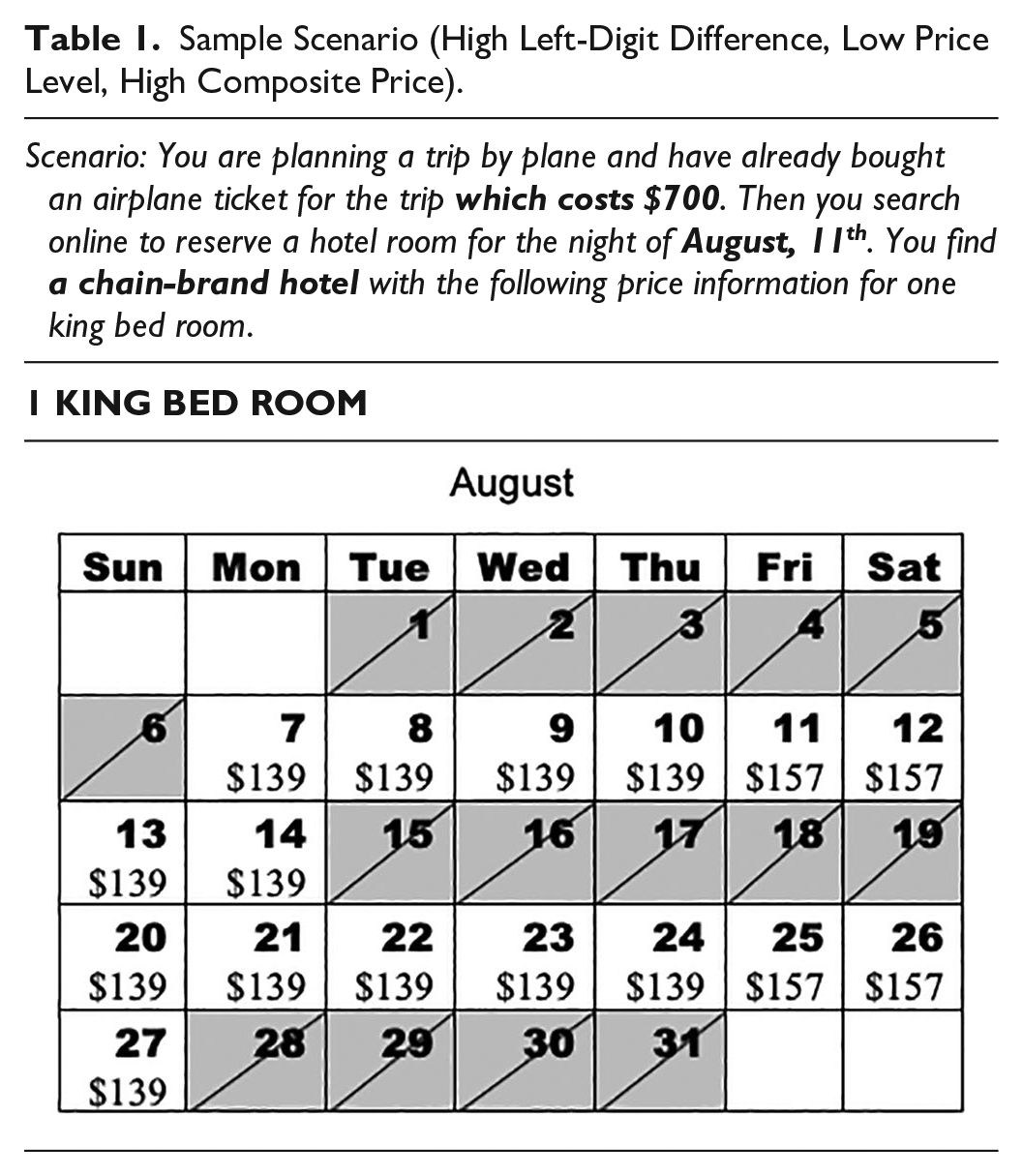
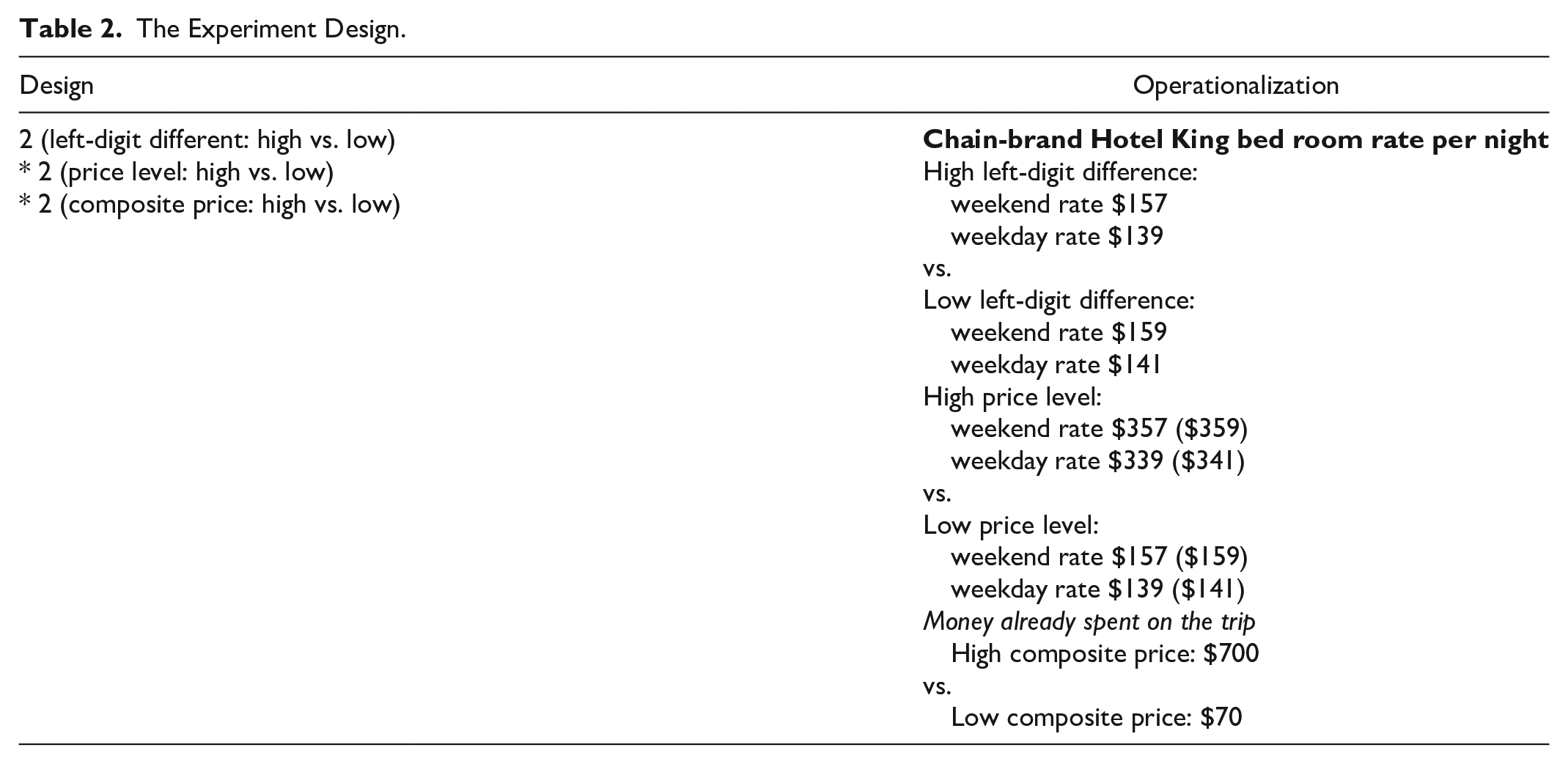
This study adopted a hypothetical scenario-based experiment approach to test the proposed hypotheses. The scenarios were based on a hotel reservation context (see a sample scenario in Table 1), and manipulations were based on left-digit anchoring effects and two other independent variables: composite price and price level. The experiment was a 2 (left-digit effect: high difference in left digit vs. low difference in left digit) × 2 (composite price: high vs. low) × 2 (price level: high vs. low) factorial design (see Table 2 for the manipulation plan). Participants were randomly assigned to one of the eight scenarios at the beginning of the survey. To make the scenario more realistic, a few randomly selected dates were indicated to be not available by adding a diagonal line. After reading the scenario, participants were asked to answer three attention check questions and a series of questions related to price perceptions, purchase intentions, and demographics.
Sample Scenario (High Left-Digit Difference, Low Price Level, High Composite Price).
The Experiment Design.
A total of four experts were invited to review the research design and pretest the instrument. These experts were university faculty specializing in social psychology or tourism marketing, all with extensive experience in experimental design. After the expert panel review, the survey was pilot tested with a convenience sample of students and faculty members in a research university. Results from the expert panel review and the pilot study resulted in minor changes to the wording of a few survey items and the organization of the survey. For instance, since some survey questions did not pertain to the scenario, one comment suggested that the scenario should be kept displaying when respondents were answering questions related to the scenario.
Left-digit effect was manipulated at two levels (high or low left-digit differences). For the high left-digit difference condition, the higher price was set at $157 while the low price was set at $139 (i.e., $157 → $139). Thus, the difference between the left digits was two (i.e., 5 – 3 = 2). In the low left-digit difference condition, the higher price was set at $159 while the low price was set at $141 (i.e., $159 → $141). The difference between the left digits was one (i.e., 5 − 4 = 1). The price differences in both pairs of prices were identical (i.e., $18). The goal of this design was to examine whether the larger difference in left-digits created an illusion of higher price differences. To check this manipulation, participants were asked what price they paid for one night for the designated date (i.e., August 11th) and for another date with a lower price (i.e., August 10th) to ensure the respondents captured the price differences.
Price level was manipulated at two levels. For the low-price condition, the weekend rate was $157 ($159), and the weekday rate was $139 ($141). For the high-price condition, the weekend rate was $357 ($359), and the weekday rate was $339 ($341). This design was believed to be realistic as a number of chain-brand hotels offer different levels of quality products/services with different levels of prices.
Composite price was manipulated at two levels (high vs. low). For the high composite price condition, participants were instructed to imagine that they had spent $700 on an airplane ticket for the trip, while for the low composite price condition, the spending was $70 on a rental car. One attention check question was designed to ensure whether the manipulation was observed (i.e., “In the above scenario, how much did you spend on an airplane ticket/rental car? A. $700 B. $70”).
Measurement
The questionnaire for the study was composed of three sections. In the first section, participants were randomly assigned to one of the eight scenarios and were instructed to read the scenario. The scenario was followed by three attention check questions, and only the responses that passed all three questions were included in the data analysis. In the second section of the questionnaire, participants were asked to evaluate the price in the given scenario by rating their perceived value and future purchase intentions. The last section of the questionnaire included demographic questions such as age, education, and income level.
Since the study was interested in how tourists encode the price provided in the scenario, perceived value was operationalized in relation to monetary price. Adopted from Dodds, Monroe, and Grewal (1991), perceived value was measured with four items on a 7-point Likert-type scale. Respondents were asked “Knowing that there is a lower price for the same room, please indicate the extent to which you agree or disagree with each of the following statements based on the scenario,” followed by four items (i.e., the hotel room is a very good value for the money; at the price I pay, the hotel room is very economical; the hotel room is considered to be a good buy; the hotel room appears to be a bargain). To prompt respondents to consider the comparative price provided in the scenario, part of the question—“Knowing that there is a lower price for the same room”—was bolded.
Purchase intentions were measured via two items adapted from Oh (2000). Participants were asked to indicate their level of agreement to the following statements: “I would purchase the hotel room” and “The probability of me purchasing the hotel room is very high.”
Participants and Data Collection
Participants were recruited from Amazon’s Mechanical Turk (MTurk). Launched in 2005, MTurk is an Internet-based human intelligence marketplace with about 500,000 individuals, referred to as “workers” (Amazon’s Mechanical Turk 2014). MTurk workers are recruited by requesters for the completion of tasks, which are called Human Intelligence Tasks (HITs) in exchange for a monetary payment (called a reward). Requesters can post HITs on MTurk and make their HITs only available to workers who meet predefined criteria such as country of residence or accuracy in previously completed tasks. Workers can search and choose preferred HITs based on various criteria such size of the reward and maximum time allotted for the completion.
Previous studies using MTurk have found that the quality of the data obtained from MTurk had the same, if not better, reliability than that from conventional sampling methods (Byun and Jang 2015; Mason and Suri 2012). For instance, Paolacci, Chandler, and Ipeirotis (2010) conducted a comparative study in which they replicated the same study with three different sampling sources: MTurk, a large university student pool, and online discussion boards. They found that the results obtained from MTurk were no different from the results obtained from the other two sources. Moreover, the response error was significantly lower, and the survey completion rate was higher in MTurk (Paolacci, Chandler, and Ipeirotis 2010).
To help ensure the quality of the data, workers who participated in the survey were required to be located in the United States and have a “master” qualification granted by MTurk. “Masters” are elite groups of workers who have demonstrated accuracy on specific types of HITs on Mturk. Workers achieve a “master” distinction by consistently completing HITs of a certain type, with a high degree of accuracy across a variety of requesters, and in order to continue to be “masters,” they must continue to pass MTurk’s statistical monitoring process (Amazon Mechanical Turk 2014). Data collection took place in August and September 2019. A total of 339 participants opened the Qualtrics link and were randomly assigned to one of the eight experimental conditions in exchange for a payment of $0.80. Among them, six did not complete the survey and were excluded from data analysis, leaving 333 complete responses. Among the 333 complete responses, the average completion time was about 3.8 minutes. One participant completed the survey in less than one minute and, thus, was screened out from data analysis. As a result, a total of 332 usable responses were retained.
Results
Attention Check and Participant Profiles
Participants were asked three attention check questions regarding the amount of prepaid costs described in the scenario, and the hotel room rates shown in the scenario. A total of 13 responses were deleted because participants did not pass at least one attention check question. As a result, a total of 319 responses were included in the final data analysis.
Manipulation of price level was checked by asking participants to state how expensive they considered the hotel room rates to be on a 7-point scale (7 = very expensive). Participants assigned to the high price level condition rated the hotel room rate as significantly more expensive than those assigned to the low price level condition (t 317 = 12.4, p = .016, Meanhigh_level = 6.26 vs. Meanlow_level = 4.67). The scenarios’ realism was evaluated using a realism check question on a 10-point Likert-type scale (10 = extremely realistic): “based on the scenario you just read, please indicate in the following scale how realistic the scenario seemed to you?” The scenarios were deemed to be realistic (M = 7.66).
The average age of the respondents was 40.7 years(SD = 0.59), ranging from 23 to 73 with a median of 39 years. The sample was highly educated, as 66.5% of the participants had a four-year college degree or higher. Additionally, the annual income of respondents was relatively evenly distributed, with the median income range being $50,000 and $59,999.
Hypothesis Testing
The items for perceived value and purchase intentions were averaged respectively to aid in analyzing the data. Two three-way analyses of variance (ANOVAs) were subsequently employed to test the proposed hypotheses, and simple two-way interactions or simple-simple main effect analysis was carried out if significant interaction effects were found.
Perceived Value
Hypothesis 1 posited that there would be a three-way interaction effect among left digit effect, price level, and composite price on perceived value. A three-way ANOVA was performed on perceived value (see Table 3) and no significant three-way interaction was found (F1,311 = 0.9, p = .343, partial η2 = .003). Thus, hypothesis 1 was not supported. A significant main effect of price level was found (F1,311 = 92.83, p <.001, partial η2 = .23). Participants in the high price level condition perceived the value of the hotel room significantly lower than those in the low price level condition (Meanhigh_level = 1.97 vs. Meanlow_level = 3.37).
Three-Way Analysis of Variance for Perceived Value.
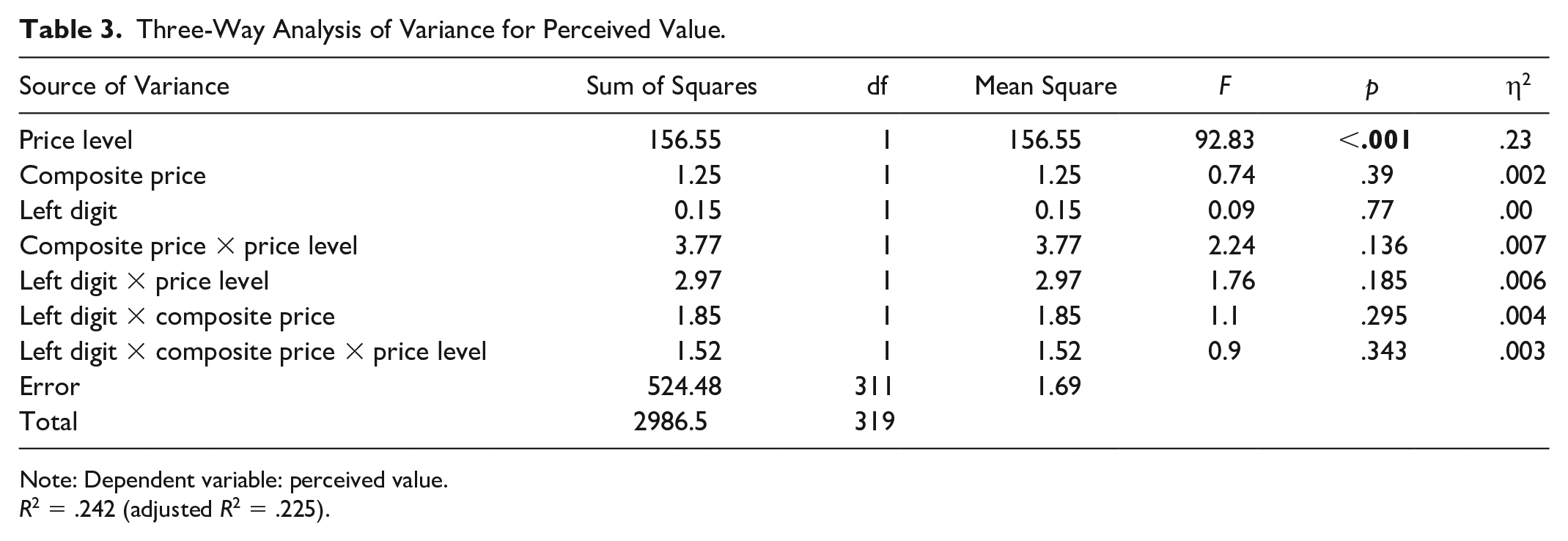
Note: Dependent variable: perceived value.
R2 = .242 (adjusted R2 = .225).
Purchase Intentions
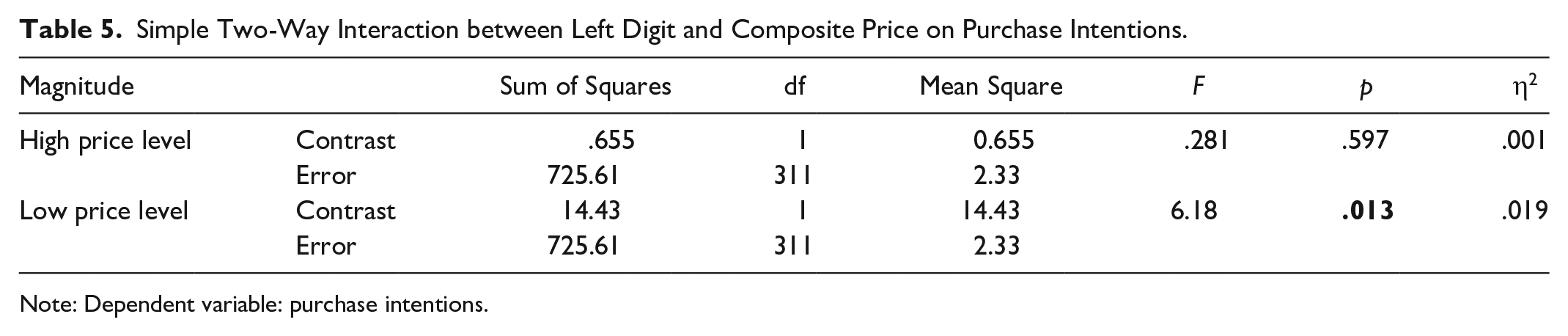
Hypothesis 2 postulated that there would be a three-way interaction effect among left digit effect, price level, and composite price on purchase intentions. A three-way ANOVA was performed on purchase intentions (see Table 4). A significant three-way interaction between left digit effect, composite price, and price level was found (F1,311 = 4.49, p = .035, partial η2 = .014). The simple two-way interaction analysis (Table 5) revealed that when price level was low, the two-way interaction between left digit effect and composite price was statistically significant (F1,311 = 6.18, p = .13, partial η2 = .019). However, no significant interaction was found when the price level was high (F1,311 = 0.281, p = .597, partial η2 = .001). This finding is consistent with the principle of diminishing sensitivity in prospect theory.
Three-Way Analysis of Variance for Purchase Intentions.
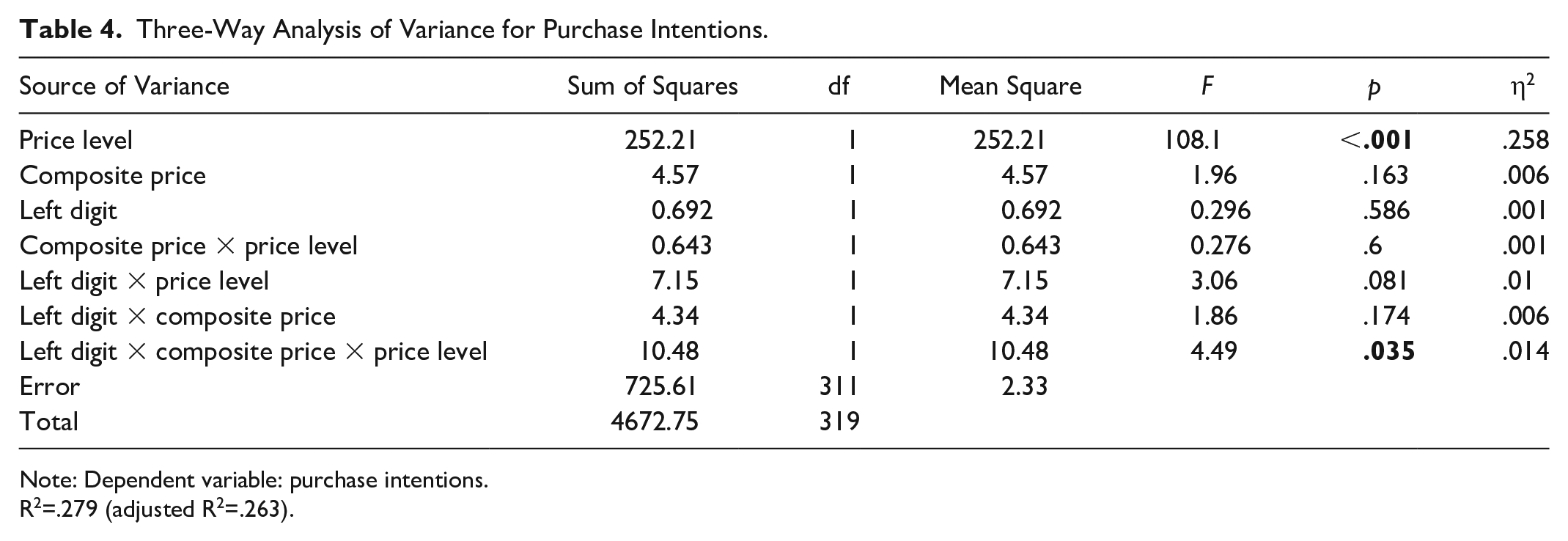
Note: Dependent variable: purchase intentions.
R2=.279 (adjusted R2=.263).
Simple Two-Way Interaction between Left Digit and Composite Price on Purchase Intentions.
Note: Dependent variable: purchase intentions.
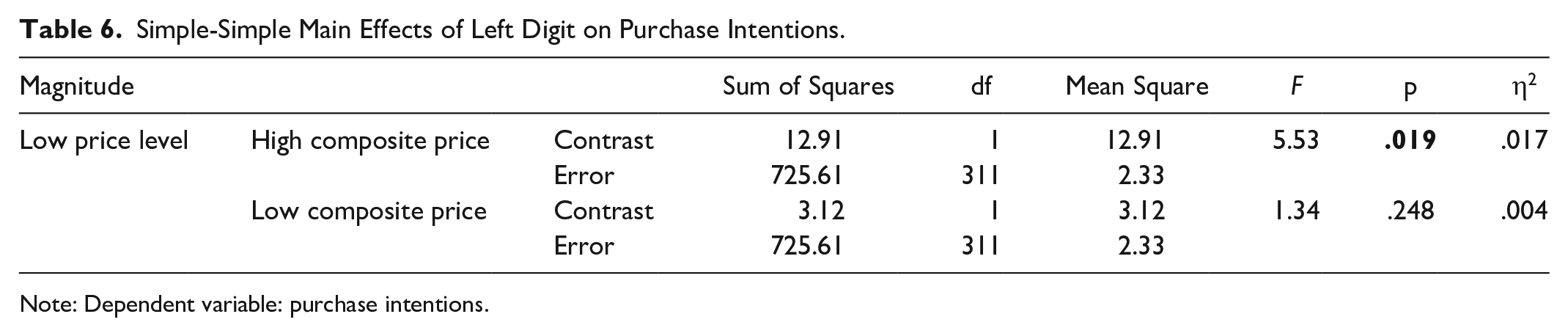
Further simple-simple main effect analysis (Table 6) showed that there was a significant (p < .05) main effect of left digit effect when price level was low and composite price was high. As shown in Figure 1, when composite price was high, purchase intentions were significantly higher in the low left digit difference condition than in the high difference condition (F1,311 = 5.53, p = .019, partial η2 = .017, Meanhigh_left = 4.03 vs. Meanlow_left = 4.83), but when composite price was low, there was no significant difference (F1,311 = 1.34, p = .248, partial η2 = .004, Meanhigh_left = 4.29 vs. Meanlow_left = 3.9). Thus, hypothesis 2 was supported by the data.
Simple-Simple Main Effects of Left Digit on Purchase Intentions.
Note: Dependent variable: purchase intentions.

Marginal means of purchase intentions.
Similar to the results of ANOVA on perceived value, a significant main effect of price level was found (F1,311 = 108.1, p <.001, partial η2 = .258). Participants in the high price level condition had significantly lower purchase intentions than those in the low price level condition (Meanhigh_level = 2.49 vs. Meanlow_level = 4.27).
Further Analysis of Perceived Value and Purchase Intentions
As previous research has shown that perceived value influences purchase intentions (Zeithaml 1988; Llach et al. 2013; Ponte, Carvajal-Trujillo, and Escobar-Rodríguez 2015) and that odd-ending pricing positively influences perceived value (Jeong and Crompton 2018), the findings of the current study that hypothesis 1 (perceived value as dependent variable) was not supported while hypothesis 2 (purchase intentions as dependent variable) was supported warranted further analysis. Thus, additional analysis was performed to examine if any factors moderated the relationship between perceived value and purchase intentions. Model 3 in Hayes’s (2017) PROCESS procedure was deemed suitable and thus was used to test the moderation effect for the relationship between perceived value and purchase intentions. To simplify the moderation model, the data were split into two groups based on the price level conditions (one data set as the low price condition group and the other as the high price condition group). Two identical analyses were performed on the two sets of data, with perceived value as the independent variable, composite price and left digit as moderators, and purchase intentions as the dependent variable.
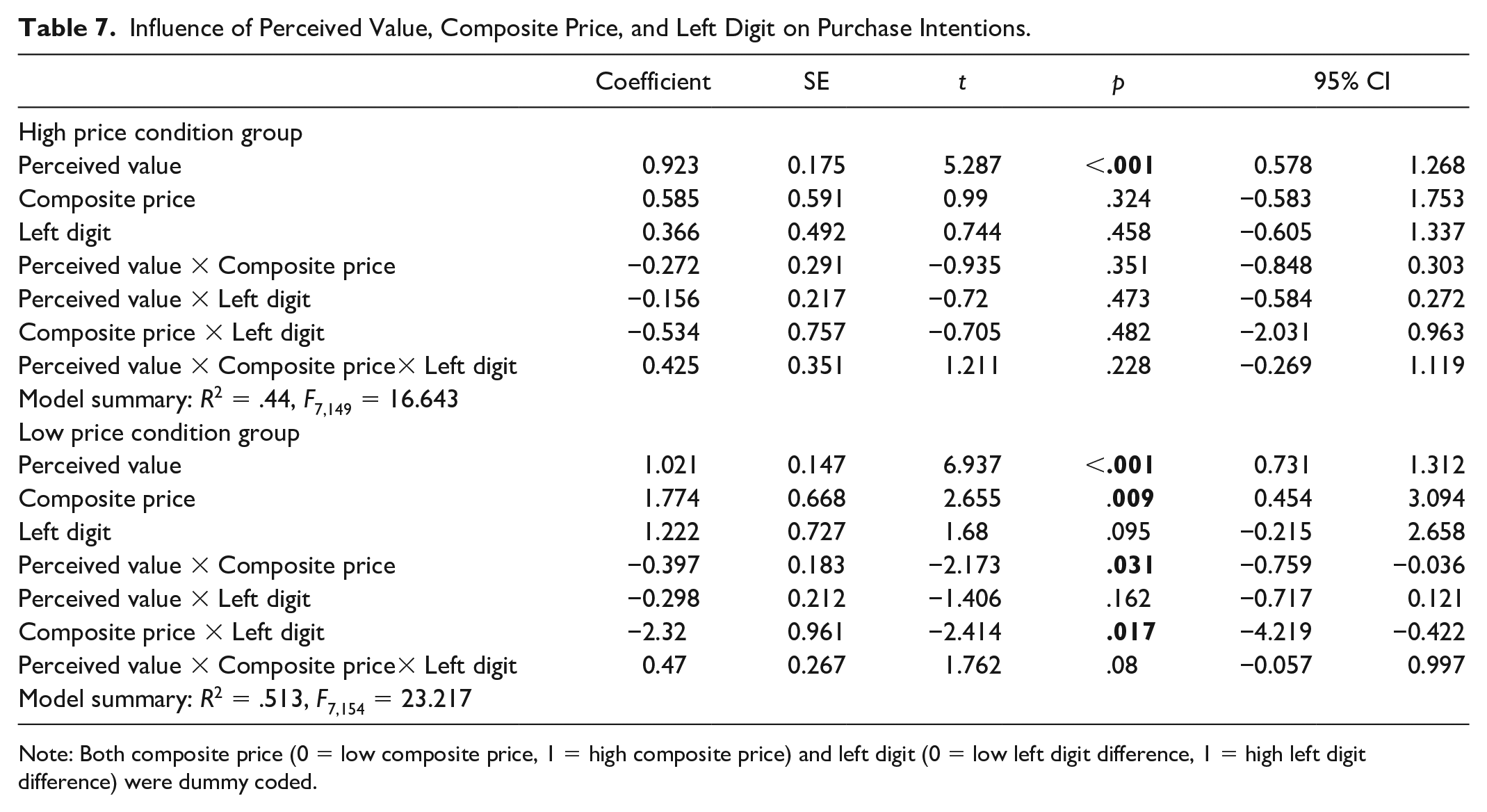
As shown in Table 7, results for the high price condition revealed no significant interactions (either the three-way interaction or the two-way interactions). Although no three-way interaction was found (b = 0.47, p = .08), the results with the low price condition data set revealed a significant two-way interaction (perceived value by composite price) (b = −0.397, p = .031), indicating that the influence of perceived value on purchase intentions was dependent on the level of composite price when the left-digit difference was low (condition two-way interaction of perceived value by composite price). As shown in Figure 2, when the left-digit difference was low, the influence of perceived value on purchase intentions was stronger when composite price was low than when it was high. However, the influence of perceived value on purchase intentions was not significantly different between low and high composite price when the left-digit difference was high.
Influence of Perceived Value, Composite Price, and Left Digit on Purchase Intentions.
Note: Both composite price (0 = low composite price, 1 = high composite price) and left digit (0 = low left digit difference, 1 = high left digit difference) were dummy coded.

Moderation effect of composite price on the relationship between perceived value and purchase intentions.
Discussions and Implications
The purpose of this study was to explore the applicability of left-digit pricing in a hotel context. Specifically, the study tested the effectiveness of left-digit pricing under different price levels (i.e., high vs. low) and different composite prices (i.e., high vs. low). Two main conclusions emerged from the study. First, the effect of left-digit pricing was found to be effective when price level is low and composite price is high. Second, this effect was found to useful in shaping tourists’ purchase intentions but not perceived value.
As demonstrated in the current study, left-digit pricing as a psychological pricing strategy is applicable in the context of tourism services such as hotel accommodations. The results showed that the effects of price framing held in a tourism service and that tourists responded differently to hotel room rates with low and high left-digit differences. This is consistent with previous research on left-digit effect (Thomas and Morwitz 2005). Thus, one contribution of the current study is that it suggests a viable and cost-effective psychological pricing tactic for hoteliers to potentially improve profitability when adopting differential pricing based on timing/days of use (i.e., weekday vs. weekend rates).
Although the left-digit effect in pricing was shown to be applicable in the hotel and travel industry, its effectiveness was found to depend on situational factors. The results of the study revealed a significant three-way interaction effect on purchase intentions. As predicted by prospect theory (Kahneman and Tversky 1979), the use of left-digit pricing was found to be effective in changing tourists’ purchase intentions only when price level was low and composite price was high. This finding reaffirms the notion that pricing in tourism services is more complicated than in retailing goods as travel decision-making is multifaceted and successive (Jeng and Fesenmaier 2002), and thus, applying psychological pricing from the marketing literature to a tourism context should take account the distinct characteristics of travel decision-making.
Left-digit pricing was found to be effective in changing purchase intentions when the hotel price level was as low as $150, and there was no effect when the hotel room rate was as high as $350. This moderating effect of price level is congruent with the diminishing sensitivity principle of prospect theory. It is also consistent with previous studies in the marketing literature that have found that price level moderates the effects of price digit on consumer’s price evaluation (e.g., Manning and Sprott 2009; Gendall, Holdershaw, and Garland 1997).
The current study is likely the first study to incorporate tourists’ prior monetary commitment in pricing research. The results revealed that left-digit pricing took effect when a high amount of prepayment was made (i.e., $700), but it had no effect when the prior monetary investment was low (i.e., $70). This moderation effect of composite price is in line with research on sunk cost effects (Stevens, More, and Markowski-Lindsay 2014; Jang, Mattila, and Bai 2007). Similar to past research, it was found that when sunk costs were high, consumers were more likely to be irrational in their subsequent judgment and decision-making and that left-digit pricing tends to be more effective when consumers are irrational (Arkes and Blumer 1985).
Contrary to expectations, left-digit pricing was found to have a significant effect on purchase intentions but not on perceived value. The findings of the further analysis were consistent with the literature that perceived value is positively related to purchase intentions (Zeithaml 1988; Llach et al. 2013; Ponte, Carvajal-Trujillo, and Escobar-Rodríguez 2015). However, the results revealed that left digit pricing’s influences on purchase intentions through perceived value was dependent on the level of sunk costs (i.e., composite price). When the left digit difference in a pair of prices was low, the positive relationship between perceived value and purchase intentions was weaker as the prepaid amount of the trip increased. These findings echo previous research, which suggests that consumers’ prior unrecoverable investments such as involvement (Chen and Tsai 2008) and switching costs (Yang and Peterson 2004) moderate the relationship between perceived value and purchase intentions.
Nevertheless, the finding that hypothesis 1 was not supported but hypothesis 2 was supported also implies a missing link between perceived value and purchase intentions. While perceived value has been found to be a good predictor of purchase intentions in previous studies (Zeithaml 1988; Llach et al. 2013; Ponte, Carvajal-Trujillo, and Escobar-Rodríguez 2015), there has been evidence that variables such as satisfaction (He and Song 2009; Tarn 1999; Jo, Lee, and Reisigner 2014) and quality (Petrick 2004; Hallak, Assaker, and El-Haddad 2018) might be better predictors of purchase intentions than perceived value. For instance, Petrick (2004) compared three models for explaining the relationship between perceived value, satisfaction, and quality in predicting behavioral intentions (i.e., the satisfaction model, the quality model, and the perceived value model), and he found that the quality model fit the data best and that perceived quality was found to be the best predictor of behavioral intentions.
It is believed that the current study makes several contributions to tourism pricing literature. First, to the best of the authors’ knowledge, this is one of the first empirical investigations of the applicability of left-digit pricing in a tourism context. The findings of this study not only show the profitableness of left-digit pricing but also shed light on the contexts of effective left-digit pricing. Second, past research on left-digit pricing has focused on low-priced retailing goods (e.g., Thomas and Morwitz 2005; Manning and Sprott 2009). This study extends previous research by (1) examining the left-digit pricing in high-priced services such as hotel accommodations, and (2) comparing the effects of left-digit pricing between high-priced and low-priced tourism services. Last but not least, previous research in the tourism literature has examined the use of price digits in tourism services (e.g., Jeong and Crompton 2017; Ngan, Ren, and O’Bree 2018). The current study extends this line of research by incorporating the successive nature of travel decisions and examining the influence of travelers’ prior monetary commitment on price evaluation.
Several practical implications can be drawn from this study. First of all, left-digit pricing was found to be effective in changing purchase intentions when the hotel room rate is as low as $150. Hotels at this price level are recommended to adopt left-digit pricing when communicated messages about different prices. Results suggest that to promote lower-priced rooms, hoteliers should increase the differences in the tens digits, whereas to promote the higher-priced rooms, the difference in the tens digits should be decreased.
Left-digit pricing was also found to be effective in changing purchase intentions for tourists who have made a high amount of prepayment on airfare. These tourists are likely long-distance travelers. The hotel industry might need to reconsider their pricing strategy in line with the characteristics of their customers. Hotels who attract or target long-distance travelers (e.g., hotels in San Francisco or New York City) should consider adopting left-digit pricing.
Last but not least, although not significantly, left-digit pricing was found to moderately influence tourists’ perceptions of value. The use of left-digit pricing doesn’t substantially change the price, and its implementation requires minimal costs and efforts (i.e., changing the digits of the prices). Hotels who are facing financial challenges should try left-digit pricing to increase their customers’ perceived value.
This study is not free from limitations. Compared to a real consumption situation, the use of scenarios may have weakened participants’ emotional responses and reactions to prices (e.g., perceived price and purchase intentions). Therefore, future studies should focus on empirical validation of the findings utilizing field experiments or virtual reality experiments. In addition, although the price levels utilized in this study were chosen based on common practices in the hotel industry and discussions with a panel of tourism experts with pricing expertise, the current study is limited as it is unknown what the precise difference in prices is needed to make a difference. Thus, future studies should examine the effects of different variations of price on tourists’ price evaluations. Similarly, the manipulation of composite price only included monetary costs, yet it has been suggested that monetary costs are just one component of composite price (Crompton 2016; Zeithaml 1988). Other components of composite price include time, effort, psychic, and opportunity costs (Crompton 2016). The relative magnitudes of the effects likely vary across different types of costs. Thus, it is recommended that future research on pricing should look at the effects of other nonmonetary components of composite price.
Finally, the current study provided a partial explanation of the divergent findings of hypothesis 1 and hypothesis 2. Future research should be conducted to better understand how left digit pricing influences purchase intentions through perceived value. For instance, although Thomas and Morwitz (2005) provided indirect evidence that left-digit effect might also influence consumer quality perception, future research should further examine how left-digit pricing influences tourists’ quality perception and subsequently perceived value. Also, while the purchase intentions and perceived value measurements of the current study were adapted from existing validated scales, the study is limited as respondents were not provided information about the product (i.e., the hotel room) to evaluate the value or comparative alternatives to judge purchase intentions. Therefore, it is recommended that future research should give respondents a more holistic description of the tourism product to better understand perceptions of value and give respondents comparative tourism products to better understand purchase intentions.
Yet, it is believed that the findings make a substantial contribution to the literature. Theoretically, multiple components of prospect theory were shown to be applicable outside of a retail context, while practically, the results provide specific, inexpensive tools for manipulating price, to potentially maximize profits. Although the study was conducted prior to the outbreak of COVID-19, the practical implications are arguably relevant in the post-COVID-19 travel world. For instance, as a result of the financial impacts of the global pandemic, hoteliers are in need of cost-efficient pricing tactics to protect profitability when launching promotional specials. On the other hand, post-COVID-19 travel planning is likely to involve more non-monetary efforts and psychic energy, and in light of the current study, tourists are more likely to be susceptible to left digit pricing. Therefore, hoteliers in a post-COVID-19 environment are recommended to adopt left digit pricing.
Footnotes
Declaration of Conflicting Interests
The author(s) declared no potential conflicts of interest with respect to the research, authorship, and/or publication of this article.
Funding
The author(s) received no financial support for the research, authorship, and/or publication of this article.
