



Abstract
Drawing on the dual process theory, this study investigates the impacts of systematic and heuristic cues on travelers’ cognitive trust, emotional trust, and adoption intention toward artificial intelligence (AI)–based recommendation systems in travel planning. The moderating effect of perceived risk is also examined. Two studies with both scenario-based surveys and lab experiment approaches are conducted. Findings suggest that while travelers utilize both systematic and heuristic cues, effects of systematic cues on adoption as a decision aid is stronger than the effects of heuristic cues. Emotional trust has a stronger impact on intention to adopt as a delegated agent than cognitive trust. Perceived risk moderates the relationships between systematic and heuristic cues, trust, and adoption intentions. When travelers perceive high risk, they rely more on systematic cues through building cognitive trust. However, when the level of perceived risk is low, travelers depend more on heuristic cues through establishing emotional trust.
Keywords
Introduction
Travel agents used to be the main source for recommendations in travel planning decisions. However, with the exponential development of information technologies (IT), sources travelers utilize for recommendations have evolved over time (Ai, Chi, and Ouyang 2019). Many travel service providers have developed smart recommendation systems utilizing web-based personalization technologies (Murthi and Sarkar 2003). In particular, the rapid advances in big data technologies, computing storage capabilities, and machine learning techniques have contributed to the development and increasing popularity of artificial intelligence (AI)–based recommendation systems (e.g., Google Trips, IO Travel Planning, etc.).
AI-based recommendation systems help travelers save time by reducing time-consuming information search activities, overcome online information overload, and improve the personalization and efficiency of travel decision making (Bohner, Moskowitz, and Chaiken 1995; Liao and Zheng 2018). According to the Press Trust of India (2019), the Tripeur’s AI platform for business travel planning has processed more than 140,000 travel transactions, served more than 50,000 business travelers and created a new standard for the business travel booking experience. The Travel Trends Report by Travelport (2020) also shows that using AI technology reduces the time spent on making travel bookings by almost 90% and that there is a growing trend among travelers to use smart recommendation systems for travel planning.
As noted by Komiak and Benbasat (2006), web-based recommendation systems have to be widely adopted by online users before their benefits accrue to companies and individual users. However, previous studies on AI-based travel planning mainly focused on improving the quality of recommendation systems from technical perspectives (e.g., Souffriau et al. 2011; Rodríguez et al. 2012), paying limited attention to why and how travelers adopt AI-based recommendation systems. Further, unlike the adoption of generic technologies, which is heavily determined by cognitive factors (e.g., perceived usefulness, perceived use of ease, etc.) (Venkatesh et al. 2003), the adoption of AI-based technologies involves affective evaluations and thus requires a theoretical lens that includes a balanced cognitive and emotional view (Gursoy et al. 2019).
Ambiguity and uncertainty inherent in decisions related to traveling, especially in decisions related to experiential aspects of travelling because of their intangible and variable nature, make the travel planning a complex and a complicated process (S. Park and Tussyadiah 2017), which requires travelers to utilize not only cognitive processing but also affective processing in their decision making processes (Gursoy 2019; Seegebarth, Backhaus, and Woisetschläger 2019). Similarly, travelers are likely to utilize both cognitive processing and affective processing in determining whether to adopt an AI technology in travel related decision making since adoption of a new AI technology also involves ambiguity and uncertainty. This is consistent with the AI technology adoption literature that has highlighted the importance of including both cognitive (e.g., social influence) and affective factors (e.g., hedonic motivation) in conceptual frameworks (Fan et al. 2020; Lin, Chi, and Gursoy 2020). Therefore, drawn from the dual process theory, this study adopts the heuristic–systematic model to investigate travelers’ cognitive and affective assessment of AI-based recommendation systems in travel planning.
One of the critical factors that can influence travelers’ adoption intention is their trust in a smart recommendation system. Trust is considered as essential in situations where there is uncertainty and potential risks, and it is strongly linked to persuasiveness in social interaction contexts (Strauss and Corbin 1990; Touré-Tillery and McGill 2015). In the context of AI-based recommendation system adoption, given the complexity and the amount of information used from various sources, travelers often cannot verify the quality of recommendations before actually experiencing them, giving rise to the possibilities of faulty decisions (Gaudiello et al. 2016). In such situations, trust serves as a key mechanism through which systematic and heuristic factors impact travelers’ adoption intention toward AI-based recommendation systems. Moreover, to gain a balanced view, this study conceptualizes trust as a multi-dimensional construct including cognitive trust and emotional trust.
Travelers’ dependence on systematic or heuristic factors and the development of trust are closely associated with the level of risk involved in decision making (Bélanger and Carter 2008). As noted by Bruwer and Cohen (2019), travelers’ risk perception is associated with their involvement in the travel planning, which is an important factor influencing information processing and decision making (Cheung, Xiao, and Liu 2014). Therefore, this study further considers travelers’ perceived risk in travel planning and argues that risk perception determines the strength of the relationships between systematic/heuristic factors and travelers’ adoption intention toward AI-based recommendation systems.
In summary, drawing on the theoretical underpinnings of the dual process theory (i.e., HSM) (Chaiken 1980) and relevant literature, this study aims to investigate the impacts of systematic cues and heuristic cues on travelers’ trust and adoption intention toward AI-based recommendation systems in travel planning, and to further examine whether the strength of the relationships would vary across different levels of risk perceptions.
Findings of this study will extend our knowledge on travelers’ postadoption evaluations of an AI-based recommendation system. Contrary to previous studies that focus heavily on cognitive factors in AI technology adoption, this study provides a more comprehensive view by investigating the impacts of both travelers’ cognitive assessments (i.e., systematic route) and affective evaluations (i.e., heuristic route) utilizing the trust-centered HSM. By doing so, we extend the traditional cognition-affect-intention framework in technology adoption by utilizing a trust-centered lens in which cognitive trust and emotional trust both jointly and interactively serve as key mechanisms. Furthermore, by using an experimental approach to manipulate perceived risk, this study empirically uncovers the boundary condition under which travelers’ dependence on systematic and heuristic cues varies. Findings of this study will provide critical implications for the design and implementation of AI-based recommendation systems in the travel industry.
Literature Review
Adoption of AI Technology
AI refers to “the simulation of human intelligence processes that allows computer systems to automatically learn from experience and perform humanlike tasks to improve efficiency of daily tasks” (Li, Bonn, and Ye 2019). AI devices perform tasks based on stipulated rules and algorithms. Due to continuous technological developments, AI-based technologies nowadays can perform various tasks that are used to be performed by humans, such as driving vehicles, processing human language, recognizing faces in photos, analyzing big data, or conducting online searches (Anthes 2017). As noted by Wilson and Daugherty (2018), AI is transforming business models, customer behaviors, and even the whole world.
The adoption of AI technologies has attracted attention from scholars in various disciplines such as marketing (e.g., Goudey and Bonnin 2016), information systems (e.g., Gaudiello et al. 2016; Gessl, Schlögl, and Mevenkamp 2019), medical fields (e.g., Roham, Gabrielyan, and Archer 2012), and travel, tourism, and hospitality (e.g., Lu, Cai, and Gursoy 2019; Sunny, Patrick, and Rob 2019). Previous studies have mainly relied on traditional technology adoption theories such as theory of reasoned action (TRA), technology acceptance model (TAM), and the unified theory of acceptance and use of technology (UTAUT) to understand users’ adoption intention toward AI technologies (Huang et al. 2019; T. Zhang, Seo, and Ahn 2019). However, it is worth noting that some studies argue that traditional IT adoption models (e.g., TAM) are less suited for examining the adoption of AI technologies, which have unique features (e.g., humanlike mindset) that are significantly different from traditional technologies (Gursoy et al. 2019; Lu, Cai, and Gursoy 2019). In the travel-related service context, studies also point out that users may have mixed feelings toward the adoption of AI technologies. While users may expect higher service quality and performance because of the use of advanced technologies (Zalama et al. 2014), they may also feel isolated and uncomfortable because of the anthropomorphic features of AI technologies (Murphy, Gretzel, and Pesonen 2019). In addition, while the adoption of traditional recommendation agents relies heavily on the output quality, the adoption of artificially intelligent recommendation systems depends on agent characteristics, which allow users to assess the performance and effort they need to devote to using the smart system (Lin, Chi, and Gursoy 2020). Given that travel products are usually heterogeneous and intangible and AI devices are new to customers in the travel industry, both agent characteristics and environmental clues should be considered when examining the adoption intention (Lu, Cai, and Gursoy 2019).
While some studies in the travel and tourism field have made initial attempts to investigate travelers’ attitudes and behaviors toward AI technologies, most of them only assessed the initial adoption intention (e.g., willingness to use) (e.g., Choi, Liu, and Mattila 2019; Gursoy et al. 2019). Since the value of many AI-based technologies depends heavily on whether travelers can truly benefit from the use of AI technologies and rely on them for travel-related tasks (Choi, Liu, and Mattila 2019), studies need to further understand travelers’ postadoption attitudes and behaviors toward AI-based technologies. Among few studies that have investigated the postadoption attitudes of AI technologies, Duan, Edwards and Dwivedi (2019) suggested that cultural differences and personal values may affect the acceptance of AI support in decision making. Schneider and Leyer (2019) found that choice complexity has no impact on the willingness to delegate a strategic decision to an AI technology, and that people with low levels of situational awareness are more likely to delegate decision making to AI devices. These findings are different from previous findings in consumer research, which showed that consumers grant decision rights to other people when they perceive the choice to be difficult (Steffel and Williams 2018). These findings suggest that, when seeking help in decision making, customers hold different attitudes toward humans and AI devices. Previous studies show that people may hesitate to adopt intelligent devices in decision making because of a number of reasons, such as overconfidence in their own abilities, fear of being replaced and job losses, concerns about privacy infringements, and group pressure (Marler, Fisher, and Ke 2009; Li, Bonn, and Ye 2019).
The Heuristic–Systematic Model
The dual-process theory provides a theoretical lens for understanding how individuals process information, establish validity assessment, and subsequently perform decision making (Eagly and Chaiken 1993). One of the most prevalent models rooted in the dual-process theory is the heuristic–systematic model (HSM) (Chaiken 1980), which predicts individuals’ social judgments such as attitudes, impressions, and self-beliefs. The HSM posits two parallel routes of processing social information, which includes “the objective properties of the stimuli we think about and the properties that we bring into the perceptual experience” (Bohner, Moskowitz, and Chaiken 1995). One route is heuristic processing, in which individuals consider a few informational cues—or even a single informational cue—and form irrational judgments based on limited cues (Tam and Ho 2005). The other route is systematic processing, in which individuals consider all relevant pieces of information, elaborate on those pieces of information, and form rational judgments based on these elaborations (K. Zhang et al. 2014). Compared with heuristic information processing, systematic information processing requires the information recipient to spend more cognitive effort in evaluating pieces of information (Chaiken 1980). The HSM assumes that heuristic processing and systematic processing can occur simultaneously and even interact with each other during one’s decision-making process (K. Zhang et al. 2014).
The theoretical extensions of HSM have systematically illustrated the interactions between the two information processing routes and identified three types of effects including the additivity effect, attenuation effect, and bias effect (Chen and Chaiken 1999). The additivity effect illustrates that the heuristic processing and systematic processing can independently impact the judgmental decision making (Chaiken, Liberman, and Eagly 1989). The attenuation effect indicates that an elevated level of systematic processing may weaken the effects of heuristic processing on one’s judgmental decision making (Chaiken, Liberman, and Eagly 1989). Finally, the bias effect highlights that the heuristic processing may alter individuals’ evaluations indirectly through biasing systematic processing because heuristic cues may hinder individuals’ capability of validating systematic cues (Chaiken and Maheswaran 1994).
The HSM is widely applied to examine users’ information processing and decision making in the context of information technology use. According to Chaiken (1980), both message characteristics (e.g., validity of information) and source characteristics (e.g., popularity of a person) could impact individuals’ judgments. For instance, Ferran and Watts (2008) found that people are more influenced by the likeability of a speaker (i.e., source characteristic) than the quality of arguments (i.e., message characteristic) in videoconferences. In travel and tourism studies, the HSM is also widely applied to understand travelers’ decision-making processes such as their continuous usage of travel-related social media (Hur et al. 2017), attitudes and purchase intentions toward eco-resorts (Sparks, Perkins, and Buckley 2013), travel-related information processing (Jun and Vogt 2013), and so on. Specifically, Hlee, Lee, and Koo (2018) examined travelers’ processing of online travel information and found that travelers rely on both heuristic cues (e.g., identity, reputation, and expertise) and systematic cues (e.g., linguistic and lexical cues) in their travel-related decision making. In our study context, we adopt HSM to investigate travelers’ processing of the objective properties and the perceptual experience properties they bring into regarding the AI-based recommendation system. The outcome of such information processing can determine their judgments of whether they can trust and rely on the system for travel planning.
Perceived Risk
Perceived risk has long been recognized as central to consumers’ evaluations, choices, and behaviors in decision making (Dowling 1999). In consumer research, perceived risk is often defined in terms of uncertainty and consequences, which suggests that risk perception derives from uncertainty involved in decision making and potential negative consequences associated with decision making (Featherman and Pavlou 2003). Following this doctrine, risk perception is highly relevant to this study context because, when using AI-based recommendation systems for travel planning, travelers may not be able to determine how well the AI technology could function (i.e., uncertainty) and may be worried about faulty decisions (i.e., consequences). Risk perception is also closely related to users’ trust and adoption intention toward new and emerging technologies (Luo et al. 2010; Leung, Shi, and Chow 2020). In travel-related decision making, risk perception is also considered important because many travel-related products and services cannot be verified before actually experiencing them, rendering travelers vulnerable to faulty decisions (Sharifpour et al. 2014). Accordingly, risk perception is viewed as an important determinant of the level of cognitive effort consumers spent in the decision-making process (Dholakia 2001).
Consumers’ perception of risk may come from multiple sources (e.g., functional, physical, financial, social, and psychological) or from only one source (Campbell and Goodstein 2001). The importance of a particular type of risk depends on the specific context of decision making. For example, Adam (2015) found that perceived sociopsychological risk (e.g., impacting social standing) is least relevant for backpackers who travel to another country. In another study context, Dholakia (2001) revealed that social and psychological risk have the greatest impacts on consumers’ involvement, information seeking and dissemination in purchase decision making. In our study, we consider social risk to be the most important because travelers’ level of involvement and strategies of decision making would vary according to the social context (e.g., traveling with family and friends or traveling alone) associated with the travel planning (Bruwer and Cohen 2019). Studies have also found that social factors (e.g., opinions of others, social relations) significantly impact individuals’ travel planning process (Fotis, Buhalis, and Rossides 2011). Therefore, this study focuses on travelers’ perceived social risk in travel planning.
Research Model and Hypotheses Development
As presented in Figure 1, this study examines the impacts of systematic and heuristic cues on travelers’ trust and adoption intention toward AI-based recommendation systems in travel planning. This study also investigates the moderating role of risk by examining whether the strength of the relationships would vary across different levels of risk perceptions (as shown in Figure 1).
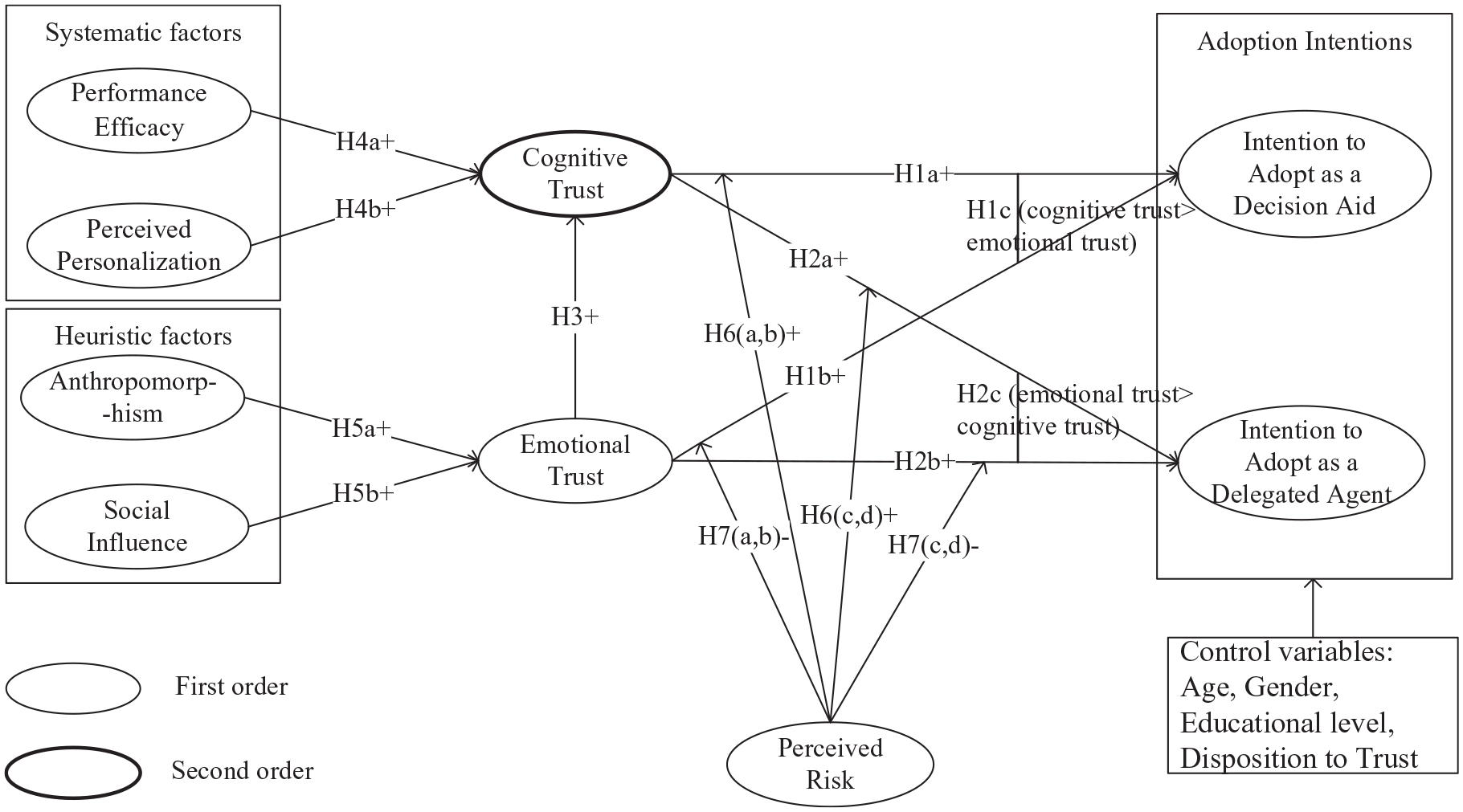
Proposed moderated mediation model and hypotheses.
This study specifically focuses on performance efficacy and personalization as systematic factors and anthropomorphism and social influence as heuristic factors for the following reasons. First, both performance efficacy (systematic cue) and social influence (heuristic cue) have been reported to have significant impacts on technology adoption intention (e.g., Venkatesh et al. 2003; Venkatesh, Thong, and Xu 2012; Gursoy et al. 2019). In the context of AI technology, studies have also reported that both performance aspects (e.g., efficacy) and environmental factors (e.g., social influence) significantly influence users’ trust toward the technology (Hancock et al. 2011; Charalambous, Fletcher, and Webb 2015). Second, anthropomorphism (i.e., humanlike features) is considered as an important heuristic attribute of AI technologies and has been reported to significantly influence users’ trust (Touré-Tillery and McGill 2015) and adoption intention (Gursoy et al. 2019; Murphy, Gretzel, and Pesonen 2019). Third, the personalization feature of AI technology is considered as a systematic cue in recommendation systems (Bhattacherjee and Sanford 2006) and has been argued to be one of the important factors impacting recommendation adoption from recommendation systems (Maes, Guttman, and Moukas 1999).
For the adoption intention, instead of treating it as a unitary construct, this research goes one step further by investigating to what extent travelers depend on AI-based recommendation systems for travel planning. When using a personalized and semi-automatic computer agent, customers may partially depend on it or fully delegate the decision making to the computer agent (Maes, Guttman, and Moukas 1999). Accordingly, in our study context, since travelers may adopt the AI based recommendation system as a decision aid or as a delegated agent, the proposed research model includes both the intention to adopt as a decision aid and the intention to adopt as a delegated agent as dependent variables.
Hypotheses Development
Impacts of cognitive and emotional trust on adoption intentions
In this study, intention to adopt as a decision aid refers to the extent to which a traveler is willing to let the system provide several plans that she or he will then evaluate to determine his or her final travel plan. The intention to adopt as a delegated agent refers to the extent to which a traveler is willing to let the system make a final plan on his or her behalf. These two dimensions of adoption intentions are closely related but also differ in terms of the level of dependence on the AI-based recommendation system for decision making (Komiak and Benbasat 2006). On the one hand, adopting as a decision aid may increase the validity of decision making but also leads to lower efficiency as a result of more time and effort spent on evaluating recommendations from AI-based recommendation systems. On the other hand, adopting as a delegated agent may be more efficient but also includes potential risks such as faulty decisions.
The extent to which travelers are willing to rely on AI-based recommendation systems for decision making depends heavily on trust (Gaudiello et al. 2016). Cognitive trust refers to the cognition of travelers’ rational reasoning and evaluation (Lewis and Weigert 1985). According to the theory of bounded rationality, people’s rational cognition is limited (Kahneman 2003). Therefore, when using AI-based recommendation systems for travel planning, travelers with cognitive trust may still need to spend considerable cognitive effort to evaluate the validity of recommendations and consider potential risks of adopting those recommendations (Bélanger and Carter 2008), which is likely to result in adopting the AI-based recommendation systems as a decision aid. On the other hand, emotional trust is treated as an attitude toward a behavior, an object or a technology with more irrationality, and a high level of emotions, which usually result in a positive attitude toward adopting a technology (Komiak and Benbasat 2004; Gursoy et al. 2019). Komiak and Benbasat (2006) found that emotional trust positively affects users’ willingness to accept the recommendation agent as a decision aid. Based on preceding discussion, this study proposes that:
Hypothesis 1a: Cognitive trust is positively related to the intention to adopt an AI-based recommendation system as a decision aid.
Hypothesis 1b: Emotional trust is positively related to the intention to adopt an AI-based recommendation system as a decision aid.
According to the attenuation effect in HSM, the influence of heuristic route can be reduced by the systematic route when there is uncertainty in information processing (Chaiken, Liberman, and Eagly 1989). When travelers intend to adopt AI-based recommendation systems as a decision aid, they usually face uncertainties and have strong motivations to systematically evaluate the recommendations, which will enhance the attenuation effect (K. Zhang et al. 2014). Compared to emotional trust, cognitive trust carries a stronger signal of partial dependency on AI-based recommendation systems and would thus exert a stronger impact on intention to adopt as a decision aid. Therefore, we propose:
Hypothesis 1c: Compared with emotional trust, cognitive trust will exert stronger influence on intention to use an AI-based recommendation system as a decision aid.
Gursoy et al. (2019) argue that if people believe AI devices can deliver expected services satisfactorily, they will be more likely to accept AI devices. Cognitive trust in AI-based recommendation systems represents travelers’ confidence in its competence, integrity, and benevolence in generating high-quality recommendations (Lewis and Weigert 1985), which will serve as solid foundations for adopting AI-based recommendation systems as delegated agent. On the other hand, emotional trust represents travelers’ feelings of security and comfort about relying on an AI-based recommendation system for travel planning (Komiak and Benbasat 2006). Such positive feelings can mitigate uncertainty and risk perceptions toward decision making, leading travelers to completely depend on AI-based recommendation systems (Komiak and Benbasat 2006; Hexmoor, Rahimi, and Chandran 2008). Based on the above discussion, we propose:
Hypothesis 2a: Emotional trust is positively related to the intention to adopt an AI-based recommendation system as a delegated agent.
Hypothesis 2b: Cognitive trust is positively related to the intention to adopt an AI-based recommendation system as a delegated agent.
According to theoretical extensions of the HSM, heuristic processing will dominate the decision-making process when people have less motivation to systematically evaluate information (K. Zhang et al. 2014). Accordingly, when travelers intend to completely depend on the AI-based recommendation system, they are inclined to spend less cognitive effort and will rely more on heuristic processing. As noted by Komiak and Benbasat (2004), with users’ increasing delegation to an agent, the impact of emotional trust becomes stronger than that of cognitive trust. Thus, emotional trust, which indicates feelings of security and comfort, will have a stronger impact than cognitive trust under high level of dependence on AI-based recommendation systems. Based on the preceding discussion, we propose:
Hypothesis 2c: Compared with cognitive trust, emotional trust will exert stronger influence on intention to adopt an AI-based recommendation system as a delegated agent.
Bias effect between emotional trust and cognitive trust
The relationship between cognitive trust and emotional trust can be explained by the bias effect illustrated in the HSM, which posits that heuristic processing may alter individuals’ systematic processing through influencing their expectations about the validity of information (Bohner, Moskowitz, and Chaiken 1995). Such a bias effect has been widely supported in previous literature. For example, studies found that source credibility (i.e., heuristic cue) would bias individuals’ judgments through producing inferences about the probable validity of persuasive messages (Bohner, Chaiken, and Hunyadi 1994; Chaiken and Maheswaran 1994). In the online review context, K. Zhang et al. (2014) confirmed that source credibility and perceived quantity of reviews may bias users’ evaluation of argument quality. Following the same logic, this study expects that when travelers feel secure and comfortable about using an AI-based recommendation system, they may develop higher expectations of the competence, integrity, and benevolence of the recommendation system. Such expectations can enhance the actual development of cognitive trust (Chen and Chaiken 1999). Therefore, we propose:
Hypothesis 3: Emotional trust is positively related to cognitive trust.
Impacts of systematic cues on cognitive trust
In technology adoption context, performance efficacy refers to the degree to which individuals believe that the technology could facilitate task performances (Venkatesh et al. 2003). The assessment of performance efficiency requires users to systematically and comprehensively evaluate the capability and performance of AI-based technologies as compared with humans in decision making (Lu, Cai, and Gursoy 2019). Thus, positive performance efficacy evaluations can improve perceived validity of cognitive evaluations about the ability and integrity of AI-based technologies. In a similar vein, if customers perceive a higher level of performance efficacy of AI-based recommendation systems, they will be more likely to believe that the recommendation system is competent in offering valuable recommendations about travel planning. Thus, we propose:
Hypothesis 4a: Performance efficacy is positively related to cognitive trust.
In this study, perceived personalization refers to the extent to which an AI-based recommendation system understands and represents travelers’ personal interests in travel planning. AI-based recommendation systems are able to provide customized information and services to travelers by acquiring personal behavioral data, understanding personal preferences, filtering invalid information, and matching personal needs (Uchyigit and Ma 2008). Previous literature confirmed that when a user is offered with tailored recommendations from a technology, he or she shows higher level of cognitive trust in the capabilities of that technology (Tam and Ho 2005; Komiak and Benbasat 2006). Accordingly, perceived personalization of an AI-based recommendation system will make travelers believe that the recommendation system is competent and can represent their interest, leading to cognitive trust. Thus, we propose:
Hypothesis 4b: Perceived personalization is positively related to cognitive trust.
Impacts of heuristic cues on emotional trust
In our study context, anthropomorphism refers to travelers’ perception of the extent to which an AI-based recommendation system has humanlike self-consciousness and emotions (H. Y. Kim and McGill 2018). Studies suggest that anthropomorphism is an important factor impacting users’ attitudes and behavioral intentions toward the adoption of AI technologies especially in the service context (Gursoy et al. 2019; Lu, Cai, and Gursoy 2019). According to H. Y. Kim and McGill (2018), when users interact with a humanlike AI device, they may treat the AI device as an intelligent being using their own social beliefs and norms. Such an interaction could make users feel that they are being treated with care and warmth, potentially enhancing their emotional trust toward the AI device (Murphy, Gretzel, and Pesonen 2019). In our study context, anthropomorphism of an AI-based recommendation system can be judged based on the design and functions of the application. Accordingly, anthropomorphism can enhance travelers’ feelings of security and comfort when relying on AI-based recommendation systems for travel planning. Thus, we propose:
Hypothesis 5a: Anthropomorphism is positively related to emotional trust.
In this study, social influence refers to the degree to which travelers’ social groups think that the use of AI-based recommendation systems in travel planning is relevant and consistent with group norms (Liébana-Cabanillas, Sánchez-Fernández, and Muñoz-Leiva 2014). Social influence has been confirmed as a significant predictor of technology adoption intention (Thompson and Higgins 1991; Venkatesh, Thong, and Xu 2012). In terms of AI device adoption, social influence can enhance users’ recognition of the popularity of the device and increase their confidence to use (Gursoy et al. 2019). In online shopping, social influence has also been confirmed as an important heuristic cue that influence customers’ positive attitudes toward product evaluations (Cheung, Xiao, and Liu 2014; Travelport 2020). Therefore, if customers perceive that using AI-based recommendation systems is a widely accepted social norm, they will have more positive emotions toward using the recommendation systems for travel planning. Therefore, we propose:
Hypothesis 5b: Social influence is positively related to emotional trust.
Moderating Role of Perceived Risk
Dholakia (2001) reported that social risk perception derives from consumers’ involvement in decision making. According to Cheung, Xiao, and Liu (2014), under high levels of involvement, consumers are more likely to rely on systematic cues instead of heuristic cues in their decision making. In travel and tourism research, studies also found that when tourists perceive high social risks, they tend to spend more cognitive efforts in various risk-handling activities (e.g., systematic information search) in order to reduce potential negative consequences (Adam 2015). In addition, when perceived social risk is high, consumers become more wary and more conservative, which makes them more cautious about their evaluations and decisions (Dowling 1999). Under such circumstances, consumers will prefer the norm to the novel and their decisions will, thus, be less influenced by heuristic factors such as emotions and enjoyment (Campbell and Goodstein 2001).
Based on the above discussion, high levels of perceived social risk will motivate travelers to utilize more systematic cues to determine adoption intention through building cognitive trust. In contrast, low levels of social risk perceptions will lead travelers to depend more on heuristic cues to determine adoption intention through emotional trust. Thus we propose:
Hypothesis 6: Perceived social risk moderates the indirect effects of performance efficacy (hypothesis 6a) and perceived personalization (hypothesis 6b) on adopting AI-based recommendation systems as a decision aid through cognitive trust.
Perceived social risk moderates the indirect effects of performance efficacy (hypothesis 6c) and perceived personalization (hypothesis 6d) on adopting AI-based recommendation systems as a delegated agent through cognitive trust.
Hypothesis 7: Perceived social risk moderates the indirect effects of anthropomorphism (hypothesis 7a) and social influence (hypothesis 7b) on adopting AI-based recommendation systems as a decision aid through emotional trust.
Perceived social risk moderates the indirect effect of anthropomorphism (hypothesis 7c) and social influence (hypothesis 7d) on adopting AI-based recommendation systems as a delegated agent through emotional trust.
Study 1: Antecedents of Travelers’ Trust and Adoption Intention toward AI-Based Recommendation Systems
The characteristics of AI-based recommendation systems are important sources for travelers to determine their trust levels and adoption intentions toward the system. Study 1 investigates the impacts of systematic cues and heuristic cues on travelers’ trust and adoption intention toward AI-based recommendation systems in travel planning.
Research Design
The research model and proposed hypotheses were tested employing a hypothetical scenario method (Weber 1992). This approach uses vignettes that “present subjects with written descriptions of realistic situations and then request responses on a number of rating scales that measure the dependent variables of interest” (Trevino 1992). Scenario-based methods are widely used in previous studies to examine decision-making behaviors (e.g., Jun and Vogt 2013; J. Y. Park and Jang 2013). This approach is advantageous for this study because scenarios can incorporate situational details that might be important for decision making (Klepper and Nagin 1989). General survey questions that do not refer to a particular context can induce measurement errors if participants’ imagined circumstances do not match with those in real settings (Hong and Desai 2020). Therefore, scenarios provide an approach to enhance the realism of decision-making situations by providing more contextual details and ensuring that these details are consistent across respondents (Siponen and Vance 2010).
Scenario Design
A well-established AI-based travel planning application was chosen as the target application in scenarios. The scenario described a situation where the participant is going for a short trip next week and there is an AI-based recommendation system that could help him or her for travel planning. Afterwards, the main functions of the AI application were introduced through a video and pictures were used to show the process of using the AI application for making a travel plan (see Appendix A for details of the scenario). The introduction to the AI-based recommendation system shows the whole process of how travelers interact with the system and the characteristics and functions of the system, which allows travelers to gain a comprehensive understanding of the features (e.g., anthropomorphism) of the AI system.
Measurement
The measures were adopted from previous studies and the items were slightly modified to fit the study context (see Appendix B). All of the constructs were measured using a 5-point Likert scale, with 1 representing strongly disagree and 5 representing strongly agree. Disposition to trust, expertise knowledge, age, and gender were included as control variables because previous studies have demonstrated their impacts on trust and technology adoption. For example, disposition to trust, as an individual trait, has been shown to have an effect on trust development (Gefen 2000). Individuals’ expert knowledge of a technology has also been proven to impact their risk perception, which further impacts trust and adoption intention (Sharifpour et al. 2014). Sundar, Waddell, and Jung (2016) found that age will impact people’s attitudes and behavioral intentions toward AI technologies. Finally, gender was included because earlier studies have shown differences in male and female’s decision-making processes and acceptance of emerging technologies (Venkatesh, Morris, and Ackerman 2000).
Pretest
Before conducting the pretest, 5 professors and 10 doctoral students were invited to review the items and scenarios in our study. After making modifications based on their feedback, all professors and doctoral students reached a consensus that the items and scenarios were appropriate. To further validate the measurement items (Straub 1989), a pretest was conducted with 80 university students. The reliability and validity of the measurement items were tested by examining the Cronbach’s α, convergent validity, and discriminant validity. The assessments yielded satisfactory results, showing good validity and reliability of the measurement items.
Sample and Data Collection
Data were collected with the help of an online survey company in China, namely, Sojump. Sojump has millions of registered users from a wide range of demographic backgrounds and it is thus particularly useful for gathering self-reported data. The survey company helped recruiting participants with diverse backgrounds and geographical locations in China. To ensure the validity and reliability of responses, a number of validation and attention check questions were inserted into the online survey. We also included a screening question to make sure that participants had some prior experience with AI technologies so that they can have adequate understanding of the scenario. In total, 413 responses were collected and 364 were identified as valid ones. The respondents’ demographic characteristics are summarized in Table 1.
Demographic Profile of the Sample.

Data Analysis
Data were analyzed using a component-based structural equation modeling technique—partial least squares (PLS) (Chin and Marcoulides 1998). Specifically, the software package of Smart PLS 2.0 was used. PLS allows researchers to analyze the measurement and structural models simultaneously (Bollen 1989). PLS is advantageous for our study for the following reasons: (1) it makes minimal demands on sample size and the distribution of data and works with nominal, ordinal, and interval scaled variables (Chin and Marcoulides 1998); (2) PLS path models can be very complex (i.e., consist of many latent and manifest variables) without leading to estimation problems (Henseler, Ringle, and Sinkovics 2009); and (3) PLS can be used for analyzing the second-order formative construct, which is included in our research model.
Results
Assessment of the Measurement Model
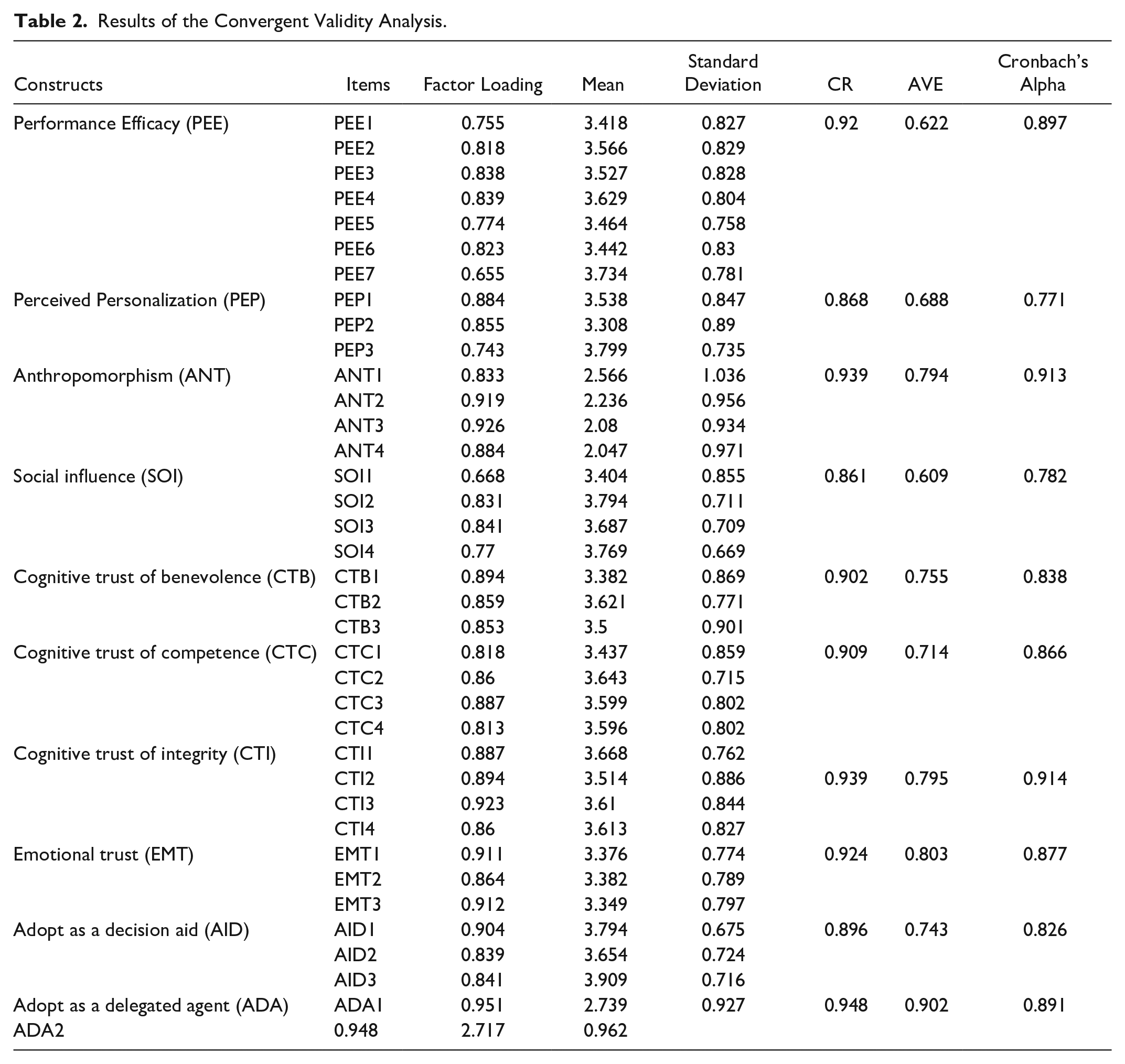
First, the measurement model was tested by assessing both the convergent validity and discriminant validity. Three criteria were used to determine convergent validity (Fornell and Bookstein 1982): (1) composite reliability (CR) should be above 0.70; (2) the average variance extracted (AVE) should be at least 0.50; and all factor loadings should be greater than 0.60 and be statistically significant (i.e., more than twice the standard error). Based on previous studies (Dowell, Morrison, and Heffernan 2015; Shi and Chow 2015), cognitive trust (COT) was conceptualized as a formative second-order construct composed of multiple reflective, first-order dimensions. As shown in Table 2, all measurement items demonstrated good convergent validity.
Results of the Convergent Validity Analysis.
Discriminant validity was assessed by analyzing whether the square root of the AVE values of each construct (i.e., the diagonal entry of each column) is larger than its correlations with other constructs (Chin and Marcoulides 1998). As shown in Table 3, the results indicated good discriminant validity. The potential multicollinearity issues were assessed using the variance inflation factor (VIF) test. A VIF value above 10 indicates multicollinearity problem (Harter, Schmidt, and Hayes 2002). Results showed that the VIF values for all independent variables ranged from 1.282 to 2.198, thus eliminating the threat of multicollinearity.
Correlations of Latent Variables for the First-Order Constructs.
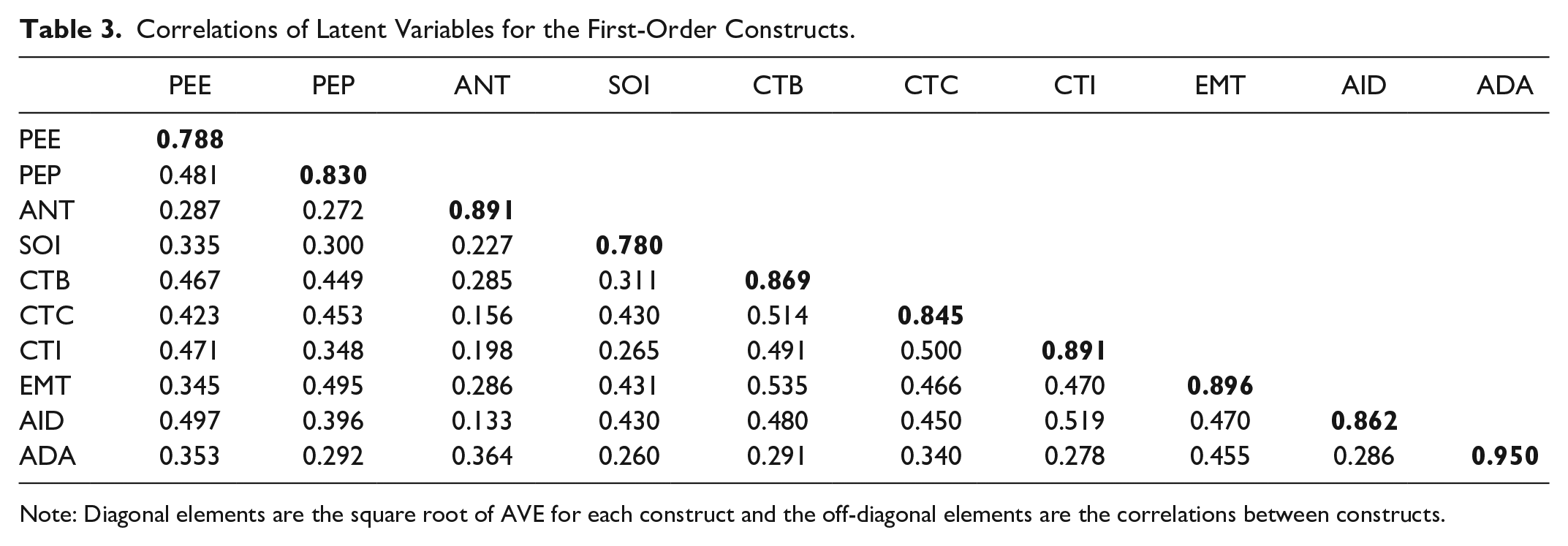
Note: Diagonal elements are the square root of AVE for each construct and the off-diagonal elements are the correlations between constructs.
Common method bias
Harman’s one-factor analysis was used to statistically test the severity of common method variance (CMV). All of the measures used in this study were subjected to a principal components analysis. Results indicated that the first factor accounted for 31.147% of the total variance, which suggested no single factor dominates the variance explained (see appendix C). By adding a common method factor in the research model, the CMV was further tested and the variance of each indicator was estimated using its principal construct and method factor (Liang et al. 2007). As shown in Table 4, the substantive factor loading (R1) of each item was significant at p <.001 and was much larger than the corresponding method factor loading (R2). Most of the method factor loadings were not significant at p <.05. Therefore, it was concluded that common method bias was not a serious concern in this study.
Common Method Bias Analysis.
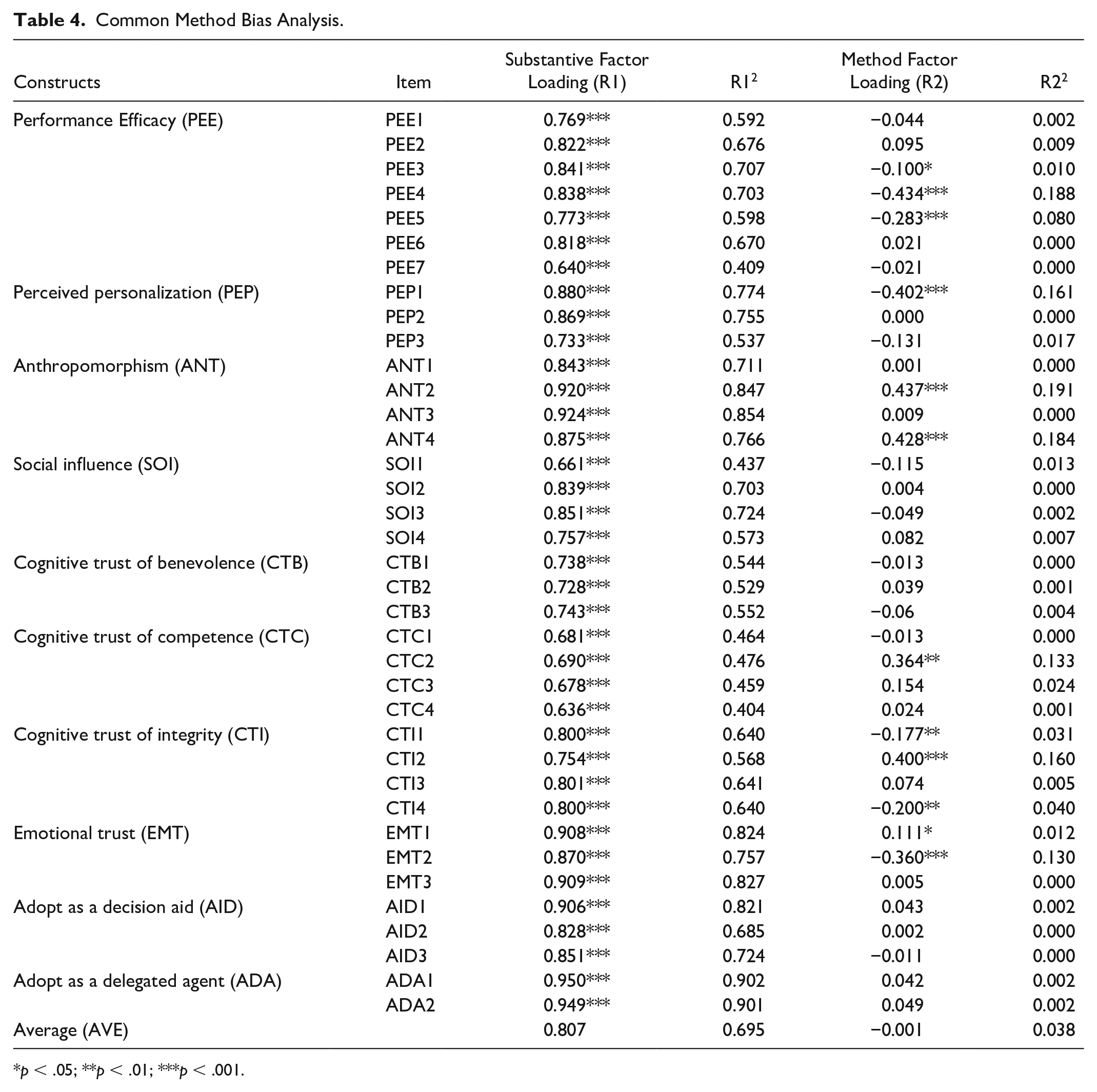
p < .05; **p < .01; ***p < .001.
Assessment of the second-order construct
Following McKnight, Choudhury and Kacmar (2002), cognitive trust was conceptualized as a second-order formative construct, which comprises three first-order reflective constructs (i.e., benevolence, competence, and integrity). Following the approaches suggested by previous studies (Petter, Straub, and Rai 2007; Shi and Chow 2015), the validity of the second-order construct was evaluated using three tests (as shown in Appendix D). In test 1, the correlation between first-order constructs was calculated and the absolute correlation between them was lower than the cut-off value of 0.80 (Sawy 2006). In test 2, the strength of the relationships between the second-order construct and its first-order factors were examined and were shown to be all significant (p<.001). In test 3, validity of indicators was evaluated using weight (ranging from 0.268 to 0.388). The possibility of multicollinearity among first-order structures was assessed using VIF (ranging from 1.435 to 2.048). These results provided satisfactory evidence for the validity and reliability of the second-order formative construct.
Assessment of the structural model
Figure 2 presents the results of the structural model analysis, indicating that most of the hypotheses were supported except for hypothesis 2a. The two systematic cues of performance efficacy (β = 0.350, p < .001) and perceived personalization (β = 0.140, p < .01) were both positively related to cognitive trust, supporting hypotheses 4a and 4b. The two heuristic cues of anthropomorphism (β = 0.198, p < .001) and social influence (β = 0.386, p < .001) were both positively related to emotional trust, indicating support for hypotheses 5a and 5b. Cognitive trust (β = 0.476, p < .001) and emotional trust (β = 0.241, p < .001) were found to be positively associated with the intention to adopt AI-based recommendation systems as a decision aid, validating hypotheses 1a and 1b. Results also indicated that, compared with emotional trust, cognitive trust exerts stronger impact on the intention to adopt AI-based recommendation systems as a decision aid, supporting hypothesis 1c. Moreover, while emotional trust significantly influenced intention to adopt AI-based recommendation systems as a delegated agent (β = 0.300, p < .001), the impact of cognitive trust was not significant (β = 0.124, p > .10), supporting hypothesis 2b and rejecting hypothesis 2a. Results also indicated that emotional trust has a stronger impact on intention to adopt as a delegated agent than cognitive trust, supporting hypothesis 2c. Finally, emotional trust was positively associated with cognitive trust (β = 0.365, p < .001), supporting hypothesis 3. For control variables, age (β = 0.125, p < .01), gender (β = 0.105, p < .05), and disposition to trust (β = 0.185, p < .001) had significant impacts on intention to adopt as a delegated agent. The R2 values showed that the model explained a sufficient variance in cognitive trust (53.77%), emotional trust (22.28%), intention to adopt AI-based recommendation systems as a decision aid (47.18%), and intention to adopt AI-based recommendation systems as a delegated agent (29.36%).
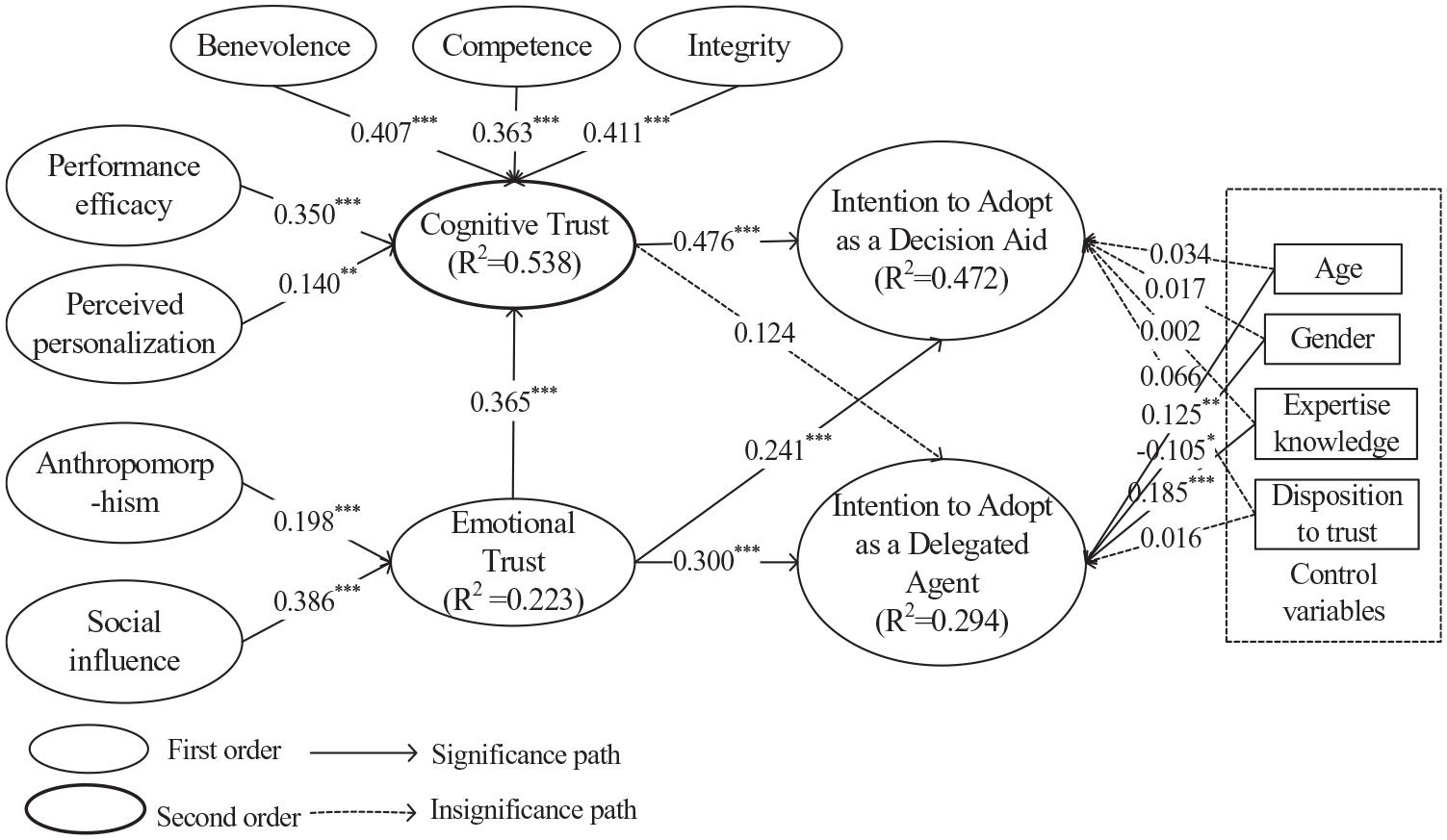
Results of structural equation modeling.
Study 2: Examining the Moderating Effect of Perceived Risk
Study 2 aims to further examine whether the strength of the relationships between systematic and heuristic cues and adoption intentions toward AI-based recommendation systems would vary across different levels of risk perceptions. Investigating the moderating role of perceived risk allows for a deeper understanding of how systematic and heuristic cues function together to jointly impact travelers’ trust development and adoption intentions under different decision-making contexts.
Phase 1: Qualitative Assessment
Before we quantitatively examine the moderating role of perceived risk, a focus group was conducted to gain a deeper understanding of the relevance of perceived risk regarding travelers’ adoption of AI-based recommendation systems for travel planning.
Research design
We have used a convenience sampling technique to carefully select 10 participants with adequate knowledge of AI technologies and rich experience in travel planning. In order to make sure that the participants had a good understanding of our research context, we asked them to download an AI-based travel planning application and try to make a travel plan with the AI application before the focus group. We designed a protocol to lead the focus group discussion with open-ended questions to elicit views and opinions from the participants (Shi, Gursoy, and Chen 2019). The protocol was designed in two parts: (1) general questions such as how travelers perceived the use of an AI technology in travel planning, how their planning process changed due to the use of the AI technology, etc.; and (2) travelers’ risk perceptions during the travel planning process using the AI-based recommendation system, what kind of social risk they perceived, and how did social risk impact their evaluations, trust, and adoption intention, etc. The focus group was led by one of the authors and lasted for about 50 minutes.
Data analysis and results
The focus group discussion was audio-recorded with handwritten notes taken. Recording of the focus group was then transcribed into text files. We followed Strauss and Corbin’s (1990) open and axial coding procedures to analyze the qualitative data. After the coding, a second author reviewed the text files and associated coding outcomes. In a few cases where there were disagreements between the authors, the third author acted as an independent judge and facilitated a discussion in order to reach a coding consensus.
Findings of the focus group revealed that, when using AI-based recommendation systems for travel planning, level of perceived risk is likely to vary based on travelers’ knowledge about the technology and the decision-making context. Most participants suggested that social risk perceptions will greatly impact whether or how much they will depend on AI-based recommendation systems for travel planning. For example, participants noted that their intention to rely on an AI-based recommendation system significantly differs when making a travel plan for the whole family, for a close friend or just for themselves. This further suggests that travelers’ information-processing strategies, trust development, and adoption intention would vary according to the levels of their social risk perceptions. The dual process theory also suggests that individuals’ characteristics and the decision-making context will impact individuals’ evaluations and behavioral responses (Cheung, Xiao, and Liu 2014). To further understand the impact of perceived risk, we used an experiment approach to manipulate perceived social risk and empirically investigate its moderating effects.
Phase 2: Quantitative Assessment
Research design, sample, and procedure
Laboratory experiment approach was employed to empirically assess the moderating effects of perceived social risk. The manipulation and measurement of perceived social risk were designed following previous studies (e.g., Campbell and Goodstein 2001) (see Appendix E). In the low-risk scenario, participants were asked to develop a travel plan for only themselves. In the high-risk scenario, participants were asked to develop a travel plan for colleagues who are going for a company-paid trip. First, a pretest with 87 university students (43 in low-risk scenario and 44 in high-risk scenario) was conducted. Results showed that the levels of perceived social risk were significantly different (on a three-item, five-point scale: Mlow= 3.225, SDlow= 0.911; Mhigh= 3.955, SDhigh= 0.621; t = 4.358, p < .001) across the two scenarios. In the formal experiment, participants were 184 university students who were recruited through an online research community with a small incentive to encourage participation. We recruited a student sample because a recent report by Deloitte (2019) showed that more than half of the customers of AI services are aged between 20 and 35, with most of them holding a bachelors’ degree or above. Accordingly, we consider university students as representative of major customers of AI services. Further, using student sample is a well-established practice in many recent tourism and travel studies, especially those focusing on traveler behavior (e.g., Luna-Cortés, López-Bonilla, and López-Bonilla 2019; Hong and Desai 2020). Participants were randomly assigned to one of the two experimental conditions.
Specifically, in each experiment group, participants were firstly introduced to the functions and features of the AI-based recommendation system (i.e., IO Tour, one of the most advanced AI-based recommendation systems for travel planning in China) through a short video. After the introduction, the research assistant presented the instructions for designing a travel plan under an assigned experimental condition (i.e., low or high social risk). Then, participants were asked to use the mobile application of IO Tour to develop a travel plan. After participants have completed the travel planning assisted by the AI application, they were then instructed to fill out the survey, which included their evaluations of perceived social risk and all of the variables used in study 1. In total, 148 valid responses (81 in the low-risk scenario and 67 in the high-risk scenario) were collected after eliminating 36 invalid responses who either had failed the attention checks or did not finish the survey, resulting in an effective response rate of 80.43%. Among the respondents, 72.97% were female and 27.03% were male, 83% were undergraduates, and the rest were graduate students. The age of responders ranged from 18 to 28 years. In terms of travel frequency, the majority (93.92%) of the respondents traveled at least once every year, 42% of them traveled at least twice a year.
Results
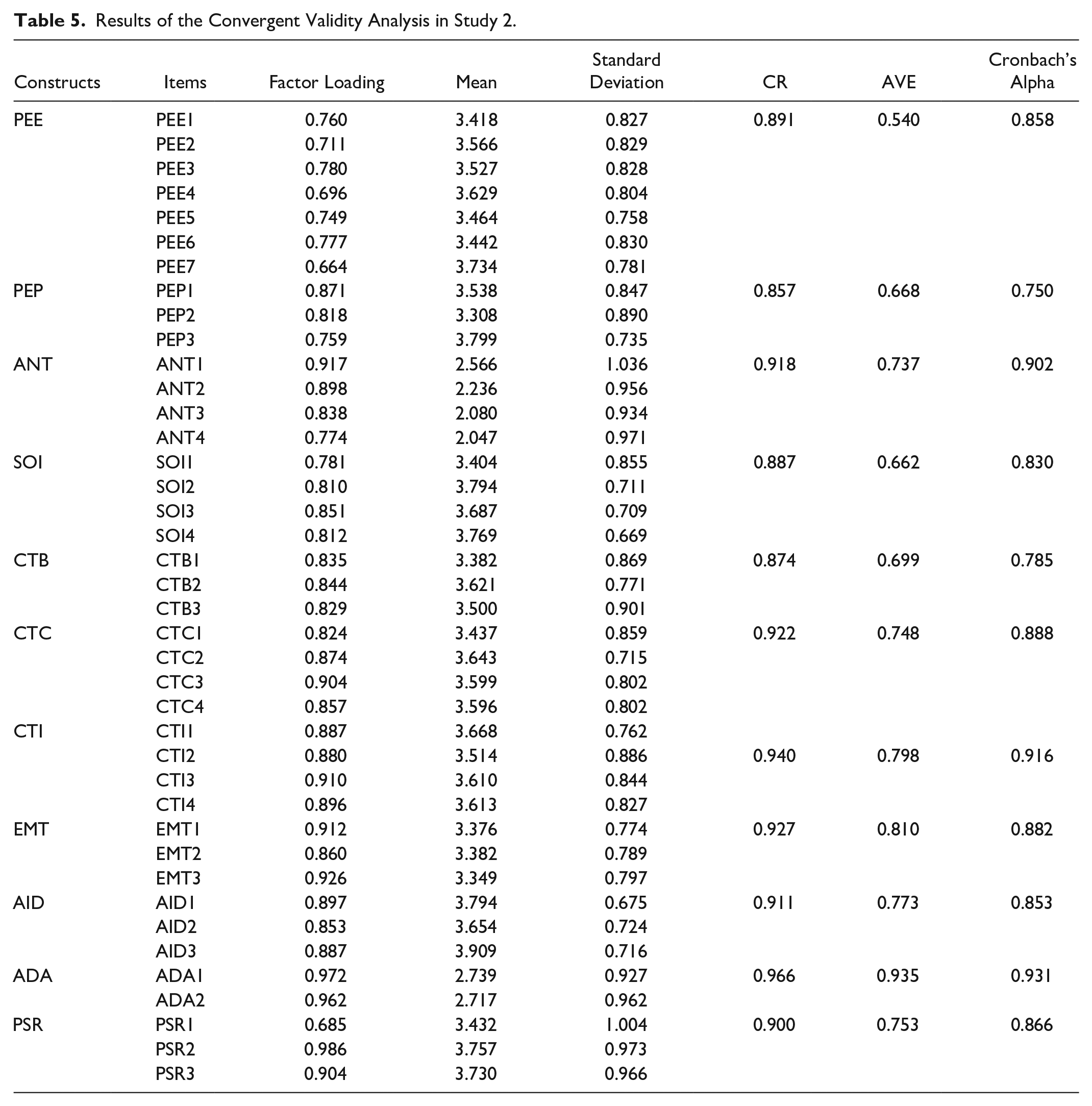
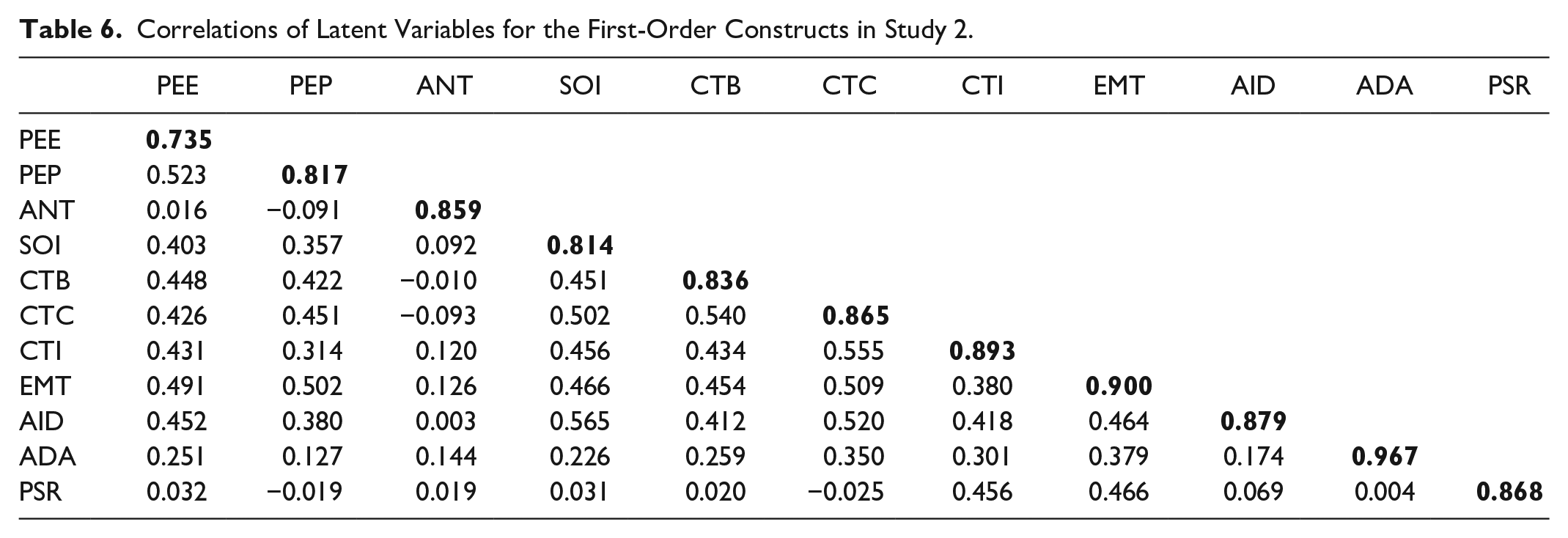
First, an independent samples t-test was conducted to assess the manipulation of perceived social risk. Results showed that participants perceived lower social risk in the low-risk scenario (Mlow = 3.216, SDlow = 0.922) and perceived higher social risk in the high-risk scenario (Mhigh = 4.022, SDhigh = 0.560). The levels of perceived social risk was significantly different across the two scenarios (t = 6.404, p < .001), suggesting successful manipulation. The measurement model assessment showed satisfactory convergent validity and discriminant validity (as shown in Table 5 and 6).
Results of the Convergent Validity Analysis in Study 2.
Correlations of Latent Variables for the First-Order Constructs in Study 2.
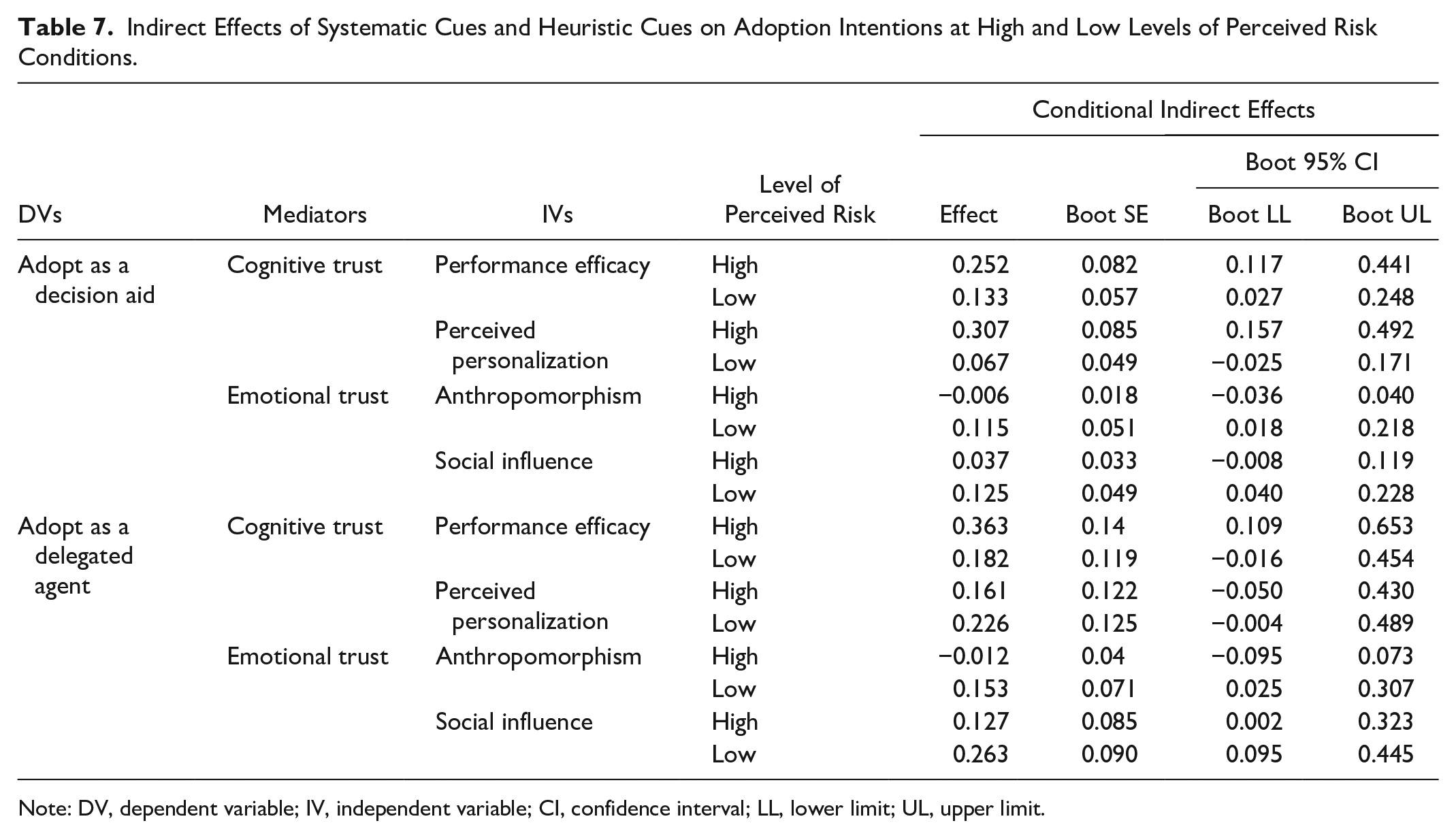
Next, moderated mediation analyses were conducted using PROCESS with a bootstrap method (Luna-Cortés, López-Bonilla, and López-Bonilla 2019) to examine the hypotheses, with systematic cues and heuristic cues as independent variables, cognitive trust and emotional trust as mediators, adoption as a decision aid, and adoption as a delegated agent as dependent variables, and perceived social risk (1 = high, 2 = low) as the moderator. In order to provide meaningful interpretations of predictors’ simple effects, variables were mean centered.
Results of the moderation effects are presented in Table 7. The upper part of the table shows the moderated indirect effects when adoption as a decision aid serves as the dependent variable. For systematic paths, the conditional indirect effect of performance efficacy mediated by cognitive trust were significant at both high and low level of perceived risk, with a decreasing magnitude of effects (t = 10.04, p < .001) as the level of perceived risk decreases. Meanwhile, the effect of perceived personalization through cognitive trust was significant at high level of perceived risk (95% CI: 0.157, 0.492) but was not significant at the low level (95% CI: –0.025, 0.171). For heuristic paths, the conditional indirect effects of anthropomorphism and social influence mediated by emotional trust were both significant at low level of perceived risk (95% CI: 0.018, 0.218; 95% CI: 0.040, 0.228), but were not significant at the high level (95% CI: –0.036, 0.040; 95% CI: –0.008, 0.119). Thus, Hypotheses 6a, 6b, 7a, and 7b were supported.
Indirect Effects of Systematic Cues and Heuristic Cues on Adoption Intentions at High and Low Levels of Perceived Risk Conditions.
Note: DV, dependent variable; IV, independent variable; CI, confidence interval; LL, lower limit; UL, upper limit.
The lower part of Table 7 shows the moderated indirect effects when adoption as a delegated agent serves as the dependent variable. For systematic paths, the conditional indirect effect of performance efficacy mediated by cognitive trust was significant at high level of perceived risk (95% CI: 0.109, 0.653) but was not significant at the low level (95% CI: –0.016, 0.454). The conditional indirect effect of perceived personalization mediated by cognitive trust was not significant at both levels of perceived risk. For heuristic paths, the conditional indirect effect of anthropomorphism mediated by emotional trust was significant at low level of perceived risk (95% CI: 0.025, 0.307) but was not significant at the high level (95% CI: –0.095, 0.073). The conditional indirect effects of social influence through emotional trust were significant at both levels of perceived risk, with a decreasing magnitude of effects (t = 9.38, p < .001) as the level of perceived risk increases. These findings provided support for hypotheses 6c, 7c, and 7d, while hypothesis 6d was rejected.
Discussion and Implications
Discussion of Results
Study 1 and 2 jointly provide strong evidence that, when determining adoption intention toward AI-based recommendation systems, systematic cues that require more cognitive effort to process enhance individuals’ rational cognition, while heuristic cues that require less cognitive effort facilitate individuals’ affective evaluations. Moreover, the strength of impacts of systematic and heuristic cues on adoption intention is dependent on the perceived risk associated with travel planning.
Findings of study 1 provide support for most of the hypotheses regarding the impacts of systematic and heuristic cues on adoption intentions through cognitive and emotional trust. Unlike the additivity effect, which is fully confirmed, the attenuation effect between systematic processing and heuristic processing is partially supported. Contrary to our prediction, when determining the intention to adopt an AI-based recommendation system as a delegated agent, only the impact of emotional trust is significant. This can be explained by the unique characteristics of AI-based technologies as compared with traditional technologies that does not involve intelligent features and personal interactions (Gursoy 2019). As suggested by the uncanny valley theory, the humanlike features of AI applications can generate fear and anxiety among individuals (Murphy, Gretzel, and Pesonen 2019). Therefore, compared with cognitive trust, which depends heavily on rational evaluations, emotional trust that derives from individuals’ positive inner feelings has a stronger predictive power toward the intention to completely rely on AI-based recommendation systems for travel planning.
Results also confirm the bias effect in the HSM by showing that emotional trust has a positive impact on cognitive trust, suggesting that heuristic factors can alter travelers’ adoption intentions indirectly through influencing their systematic processing (Chaiken and Maheswaran 1994). These results reveal the critical role of emotional trust in determining a traveler’s level of dependence on AI-based recommendation systems. Since travelers’ knowledge about AI-based recommendation systems (e.g., how it functions and on whose behalf) is usually low and ambiguous, emotional trust could serve as a trigger to reduce travelers’ anxiety and negative emotions toward the adoption of AI-based recommendation systems in travel planning. It is also worth noting that the variances explained in constructs of emotional trust and adoption as a delegated agent are relatively small as compared to other constructs. This suggests that, when determining full dependence on an AI-based recommendation system, the heuristic processing alone may not be sufficient. Other psychological, social, and moral aspects could be further considered as suggested by previous literature (Gessl, Schlögl, and Mevenkamp 2019; Schneider and Leyer 2019).
Results of study 2 further suggest that when travelers perceive high social risk, they tend to rely more on systematic cues to determine their adoption intentions toward AI-based recommendation systems through building cognitive trust. However, when the level of perceived social risk is low, travelers are more likely to adopt the approach that require the least amount of effort and depend more on heuristic cues to form adoption intention through establishing emotional trust. However, the indirect effects of perceived personalization on adoption as a delegated agent through cognitive trust are not significant at both levels of risk perception. This may be explained by the fact that personalization is regarded as a basic feature of AI technologies and the dependence on personalization to form cognitive trust and delegated adoption intention may be weakened by other factors under either low or high risk perceptions (Schneider and Leyer 2019).
Implications for Research
This research contributes to the extant literature with several important theoretical implications. First, while previous travel and tourism research mainly focuses on the initial acceptance of AI technologies by travelers (e.g., Gursoy et al. 2019; Sunny, Patrick and Rob 2019; Lin, Chi, and Gursoy 2020), this study extends the research line by examining travelers’ postadoption intention (i.e., AI-assisted decision making) of AI-based recommendation systems in travel planning. Compared with initial adoption, understanding postadoption experiences and behaviors are critical in facilitating individuals’ continuance usage (Hur et al. 2017; Li, Bonn, and Ye 2019). While previous travel and tourism research focuses heavily on using AI technology for forecasting (e.g., Yu and Schwartz 2006; Law et al. 2019; Höpken et al. 2020), this research is a response to the calls for providing new insights on travelers’ use of technology for travel planning due to rapid technological advancements (Xiang et al. 2015).
Second, based on the dual process theory and HSM, this study identifies two different paths that affect travelers’ cognitive trust and emotional trust toward the AI-based recommendation systems, respectively. Although the dual-process theory has been widely used to explicate travelers’ information-processing patterns (e.g., Jun and Vogt 2013; Sparks, Perkins, and Buckley 2013; M. J. Kim and Petrick 2020), little research has specifically examined the potential relevance of the HSM in understanding travelers’ adoption of AI technologies in decision making. Furthermore, while previous studies mainly focus on users’ cognitive evaluations toward AI technologies (e.g., Gessl, Schlögl, and Mevenkamp 2019; Lin, Chi, and Gursoy 2020) and travelers’ cognitive trust in travel settings (e.g., Gursoy et al. 2016; Agag and El-Masry 2017; S. Park and Tussyadiah 2019), this study expands our understanding by investigating the impacts of both travelers’ cognitive assessments and affective evaluations utilizing the trust-centered HSM. This study also investigates the joint effects of both systematic and heuristic evaluations on trust development and adoption intentions, and interactions (i.e., additivity, attenuation, and bias effects) between systematic and heuristic routes.
Third, while some previous studies have considered the importance of trust in the acceptance of AI technologies (e.g., Gaudiello et al. 2016), this study is among the first to examine the roles of different types of trust in AI technology adoption. By doing so, we also respond to the calls for including both cognitive and affective trust in analyzing tourists’ behavioral intentions (M. Kim and Kim 2020). Findings reveal that including both cognitive trust and emotional trust to AI adoption models especially in the postadoption decision-making context is of great value. Moreover, this study offers new insights into the relationship between cognitive trust and emotional trust in determining travelers’ level of dependence on AI-based recommendation systems for travel planning. While cognitive trust may have a stronger impact on users’ adoption intention toward conventional technologies, this study reveals that emotional trust predicts a higher level of dependence in the context of AI technology adoption. As also suggested by Kuo and Wu (2012), individuals’ final decision to accept or reject the use of AI devices during service encounters are likely to be determined by their emotions.
Finally, this study has important implications for understanding travelers’ AI-assisted decision making under different levels of risk perceptions. In the travel and tourism context, perceived risk is considered vital due to the ambiguity and uncertainty involved in decision making (Sharifpour et al. 2014; S. Park and Tussyadiah 2017). Though some studies have suggested that specific context characteristics should be considered when investigating AI technology adoption (Schneider and Leyer 2019), little empirical research has examined perceived risks associated with using AI technologies. Findings suggest that travelers depend more on the systematic route rather than the heuristic route, such that they become more wary and conservative in their decision making, when travel planning using AI-based recommendation systems involves higher risk. While findings indicate that systematic processing and heuristic processing conjointly determine travelers’ adoption intentions, this study also uncovers the boundary condition under which travelers’ dependence on systematic and heuristic cues varies. By doing so, this study contributes to the current AI adoption literature by revealing the relative importance of different informational cues under different decision-making contexts.
Implications for Practice
Findings of this research also generate valuable implications for practitioners and managers. First, designers of AI-based recommendation systems may leverage the impacts of AI technology characteristics through the lens of our research model. According to our findings, practitioners should improve the functional design of AI-based recommendation systems through enhancing systematic cues such as including patented technology, collecting and analyzing personal preferences, and providing high-quality information in order to enhance travelers’ cognitive evaluations. In terms of heuristic cues, practitioners should pay attention to humanlike features of AI-based recommendation systems so that travelers feel a sense of human contact and generate personal feelings during their interactions with the system. They should also spend considerable effort in showcasing the acceptance and use of AI technologies for travel-related tasks in society to improve the effects of social influence. Practitioners should also design the AI-based recommendation systems in a way that it generates a sense of comfort and security in order to facilitate emotional trust.
Moreover, findings provide guidance for the implementation of AI-based recommendation systems in the travel industry. Given that nowadays many companies in the travel industry adopt AI-based recommendation systems to assist decision making, managers should be aware of the most important factors that determine the actual value of the system. For example, companies may need to provide educational materials and instructions in order to enhance customers’ knowledge about the personalized functions and performance of the system. Further, managers should pay close attention to not only the functional qualities of the system but also heuristic cues that drive positive emotions. For example, hotels, airlines, and the travel agencies could use robotic AI devices with humanlike features to provide recommendation services for travelers. In order to stimulate positive social influence, managers can establish a platform to encourage users of AI-based recommendation systems to share their experiences.
Last but not the least, when designing and implementing AI-based recommendation systems for travel planning, practitioners should consider travelers’ risk perceptions in decision making. Our findings clearly indicate that in situations where the perceived risk is high, travelers tend to depend more on systematic cues to form cognitive trust and adoption intentions. Therefore, it is important to identify high-risk travel decisions using data collected from travelers before generating recommendations from the system. For example, under high-risk conditions, the AI-based recommendation systems should provide more details of the recommendation-generation process and highlight the reliability and validity of recommendations in order to facilitate the cognitive evaluations by travelers. Moreover, more flexibility should be offered in system operations so that travelers can modify the recommended travel plans according to their own intuition and evaluation in order to reduce risk in decision making.
Limitations and Future Research
Although the contribution of this study is evident, it has certain limitations that could be addressed by future studies. First, given that AI-based recommendation systems are adopted for various tasks, the generalizability of our findings may be limited because this study only focuses on travel planning as the research context. Future research may consider extending the findings to other contexts of AI-assisted decision making. The generalizability of study 2 may also be limited because we invited university students for experimentation. Future studies can include different customer groups in order to further validate our findings. Second, although this study empirically examined the moderating effects of social risk perception, the moderating effects of other dimensions of risk (e.g., financial risk) and other possible factors (e.g., consumer involvement and expertise) were not tested. Future research is thus recommended to expand our understanding of the boundary conditions that impact travelers’ evaluations and decision-making processes with AI-based recommendation systems. Also, other factors (e.g., media coverage about AI technology) shaping public opinion and perceived risk could be further analyzed. Finally, findings show that the model explains 22.3% of variances in emotional trust and 29.4% of variances in adoption intention as a delegated agent. Although the R2 value above 10% is considered as adequate by previous studies (Falk and Miller 1992), these two moderate R2 values indicate that some other important predictors may be missing in the proposed research model. For example, according to the model of AI device use and acceptance (AIDUA) (Gursoy et al. 2019), travelers’ positive and negative emotions (e.g., pleasure and anxiety) toward the AI-based recommendation system can be considered when examining their delegation intention. Therefore, future studies are encouraged to enrich our understanding of the impacting factors of these two constructs. Moreover, future studies are encouraged to examine travelers’ actual usage of AI-based recommendation systems instead of measuring behavioral intentions.
Supplemental Material
Appendix_A – Supplemental material for Antecedents of Trust and Adoption Intention toward Artificially Intelligent Recommendation Systems in Travel Planning: A Heuristic–Systematic Model
Supplemental material, Appendix_A for Antecedents of Trust and Adoption Intention toward Artificially Intelligent Recommendation Systems in Travel Planning: A Heuristic–Systematic Model by Si Shi, Yuhuang Gong and Dogan Gursoy in Journal of Travel Research
Footnotes
Declaration of Conflicting Interests
The author(s) declared no potential conflicts of interest with respect to the research, authorship, and/or publication of this article.
Funding
The author(s) disclosed receipt of the following financial support for the research, authorship, and/or publication of this article: This work is supported by the National Natural Science Foundation of China (71502140).

Supplemental Material
Supplemental material for this article is available online.
Author Biographies
References
Supplementary Material
Please find the following supplemental material available below.
For Open Access articles published under a Creative Commons License, all supplemental material carries the same license as the article it is associated with.
For non-Open Access articles published, all supplemental material carries a non-exclusive license, and permission requests for re-use of supplemental material or any part of supplemental material shall be sent directly to the copyright owner as specified in the copyright notice associated with the article.
