



Abstract
Anecdotal evidence suggests that tourists do not only choose tourism destinations based on objective quality criteria. Rather, tourists may be drawn to certain destinations for reasons such as feelings of connection or affinity. This article provides a first examination of tourism affinity (TAFF) and its effects on tourism behavior. Tourists who are high on TAFF feel sympathy, admiration, or attachment toward a given country. In addition to examining TAFF, we also test the impact of tourism animosity (TANI) on a variety of resident and tourism behaviors. The results show that TAFF is a positive driver of several tourism-related outcomes, such as word of mouth and resident hospitality, while TANI drives general intention to visit and provide word of mouth but is a barrier to closer interactions. In addition, goal compatibility, relative power, and moral obligation drive TAFF while relative power drives TANI.
Introduction
Anecdotal evidence suggests that tourists often have emotional links with the destinations they wish to visit. Lisbon is the top urban destination for Brazilian travelers (Xavier 2019), London is the top urban destination for New Zealanders (Llewellyn 2018), and Hong Kong and Taipei are both in the top five urban destinations for Singaporean tourists (Masaki-Joyce 2018). These examples indicate that some tourists may have a positive attitude toward certain travel destinations because of perceptions such as a shared past and/or a shared future, and that this affinity may affect their travel-related choices. While such attitudes could play an important role in understanding tourists’ preferences and decision-making, they have not been conceptualized or empirically tested in tourism research.
The bourgeoning literature on tourism biases (e.g., Kock et al. 2019; Stepchenkova et al. 2019) may offer an avenue to explore such positive attitudes toward a specific foreign destination. Tourism bias refers to the systematic tendency of an individual to be predisposed toward members or objects associated with a specific in- or out-group (see Kock, Josiassen, and Assaf 2019b for a review). Specifically, the literature differentiates between in-groups, that is, groups that the individual perceives themself belonging to, and out-groups, that is, groups that the individual does not perceive himself or herself belonging to (Brewer 1999). Recently, a number of studies have confirmed the existence of several such biases that affect tourists’ destination choices. In order to understand, structure, and provide a theoretical basis for these biases, we introduce the attraction-repulsion framework (Josiassen 2011) in tourism. The attraction-repulsion framework provides a powerful lens through which to understand the biases and their similarities and differences. For example, Kock et al. (2019) discovered a positive bias toward domestic tourism. They labeled the phenomenon tourism ethnocentrism, and conceptualized it as an intergroup bias that favors the in-group. Another example is tourism xenophobia, which is a “negative out-group bias toward foreigners or strangers because of their perceived ‘otherness’” (Kock, Josiassen, and Assaf 2019b, p. 157). Other recently identified tourism biases include tourism animosity (e.g., Stepchenkova, Su, and Shichkova 2019), which refers to a negative predisposition toward a specific destination, and tourism xenophilia (e.g., Nørfelt, Kock, and Josiassen 2020), which is a positive predisposition toward foreign destinations in general because of their foreignness. As such, past literature has investigated a positive domestic tourism bias (tourism ethnocentrism), both positive (tourism xenophilia) and negative (tourism xenophobia) tourism biases toward foreignness in general, and a negative tourism bias toward a specific destination (tourism animosity). However, despite its potentially important implications, a gap remains since no study has yet focused on the existence and tourism-related effects of a positive bias toward a specific foreign destination.
We address this gap by identifying, conceptualizing, and empirically testing the phenomenon of tourism affinity (TAFF), defined as a feeling of sympathy, admiration, and attachment toward a specific foreign destination, as a potential driver of tourism-related outcomes. In short, we aim to understand if TAFF matters in a tourism context. Tourism animosity (TANI), on the other hand, has been introduced and investigated in the tourism literature. However, animosity has been investigated in a tourism context as stereotypical perceptions (Stepchenkova, Su, and Shichkova 2019), and recent research in marketing (e.g., Harmeling, Magnussen, and Singh 2015; Kock, Josiassen, and Assaf 2019a) illustrates the usefulness of understanding affinity and animosity as affective concepts. Hence, for the first time in the tourism literature, we provide a conceptualization and investigation of TANI as an affective concept and test it in a nomological model alongside TAFF. Following the recent state-of-the-art conceptualization of consumer animosity in marketing (Harmeling, Magnussen, and Singh 2015; Kock, Josiassen, and Assaf 2019a), TANI is defined as negative feelings toward a specific destination and its inhabitants.
We situate both concepts in a model containing five outcomes and three antecedent variables. We wish to test whether these two biases affect not only tourists’ decision making, but also residents’ inclinations toward incoming tourism. While TANI perceptions (hereafter TANIP) have been shown (Stepchenkova, Su, and Shichkova 2019) to affect tourists’ destination-related inclinations, we not only provide the first tourism investigation of TANI as an affective concept, but also provide the first investigation of whether TANI may influence residents’ inclinations toward incoming tourists.
We follow an appraisal-based approach (C. A. Smith and Ellsworth 1985) to conceptualize TAFF and TANI because it enables us to distinguish between and explain idiosyncratic emotions. In fact, Harmeling, Magnussen, and Singh (2015) explicitly apply appraisal theory to distinguish between contending and accommodating dimensions of animosity. In harmony with this approach, we identify and test three cognitive appraisals for a potential link to TAFF and TANI emotions. Specifically, we test goal alignment, relative power, and moral obligation as antecedents in the research model. In doing so, we provide a rare application of appraisal theory of emotions (Leach, Ellemers, and Barreto 2007) in the tourism literature and its first application in the emerging tourism biases literature.
The remainder of the article is structured as follows. First, we conceptualize TAFF and TANI, with a focus on TAFF given that the overall case for TANI has already been made in the tourism literature. Second, we present the research model with its five outcomes and three antecedents and we detail the methods used to test them. Finally, we outline the results and discuss their theoretical and practical implications.
Understanding Tourism Affinity and Animosity Emotions
In order to conceptualize TAFF and TANI and delimit them from other related concepts, we begin by distinguishing country-induced mental representations along two dimensions: affective versus cognitive and performance-related versus performance-unrelated. First, we examine the difference between affective and cognitive mental representations. The tourism literature has mostly focused on cognition to understand how tourists acquire, store, and apply mental representations of countries to tourism-related decisions, commonly formalized as the destination image concept (Kock, Josiassen, and Assaf 2016). This focus on cognitions reflects a long tradition across the social sciences of concentrating on the cognitive aspects of human mental representations and processes (Laros and Steenkamp 2005). In recent years, and notably after the pioneering works of scholars like Damasio (1994), Simon (1983), and Phelps, Lempert, and Sokol-Hessner (2014), researchers in psychology are increasingly focusing on affect, emotions, and feelings and their influence on behavior (Lerner et al. 2015). Many studies (e.g., So et al. 2015) even document that affect is a better predictor of outcomes such as behavioral intentions and behavior than is cognition. Unsurprisingly, then, the importance of the affective element of attitude is now well established in psychology research and is an emerging trend in disciplines like marketing and management (Y. C. Chen, Mathur, and Maheswaran 2014; Kock, Josiassen, and Assaf 2019a).
Second, we turn to the difference between performance-related and performance-unrelated country-induced mental representations. Performance-related representations can be objectively justified, while the performance-unrelated representations are the ones that are present for other reasons. The usefulness of a taxonomy of performance-related and performance-unrelated mental representations of countries has been demonstrated in other fields such as marketing (Kock, Josiassen, and Assaf 2019a; Maheswaran and Chen 2006; Maheswaran, Chen, and He 2015; Shankarmahesh 2006). The term bias reflects the performance-unrelated nature of the focal concepts TAFF and TANI. As Hewstone, Rubin, and Willis (2002, p. 576) note, “[The u]se of the term “bias” involves an interpretative judgment that the response is unfair, illegitimate, or unjustifiable, in the sense that it goes beyond the objective requirements or evidence of the situation.” Biases can be positive (e.g., favoritism) or negative (e.g., derogation).
Research on tourists’ decision-making and behavior, based on their country-induced mental representations, has been driven predominantly by investigations into their performance-related cognitions. The vast literature on destination image is an example thereof, having most frequently been defined and operationalized as individuals’ cognitive mental representations of destinations (for a recent literature review, see Josiassen et al. 2016). While the importance of affect (e.g., Jordan, Spencer, and Prayag 2019; Pera et al. 2019) has gained recognition, it has rarely been used in understanding tourists’ mental representations of destinations. Similarly, performance-unrelated biases have only recently emerged as a tourism research stream that compliments the mostly cognitive and performance-related destination image literature. As such, tourism researchers have only recently begun investigating performance-unrelated affective and cognitive mental country representations to understand inter-group destination biases (e.g., Chien and Ritchie 2018; Kock et al. 2019; Stepchenkova, Su, and Shichkova 2019).
In the marketing literature, country-induced biases have been illustrated in the attraction-repulsion (AR) framework (Josiassen 2011). We draw on this framework to delimit the tourism biases and indicate the gap we are addressing. The attraction-repulsion framework rests on the attraction hypothesis (Rosenbaum 1986) and the repulsion hypothesis (F. F. Chen and Kenrick 2002). The two hypotheses aim to explain the relationship between individuals through the web of in-groups and out-groups that people socially operate within. The main feature of Rosenbaum’s (1986) attraction hypothesis is that individuals are attracted to others that are similar to them. The repulsion hypothesis, on the other hand, asserts that individuals are repulsed by individuals and groups that they are dissimilar to (Chen and Kendrick 2002). The AR framework combines these two hypotheses and does not only focus on level of (dis-)similarity as the deciding factor. The framework is a meta-framework within which several specific theories operate, like social identity theory (Tajfel and Turner 1979), image theory (Brewer 1999), and intergroup emotions theory (E. R. Smith and Mackie 2008).
Using the AR framework, we can display the intergroup biases as a 2-by-3 matrix (see Figure 1). One dimension relates to whether the bias is positive (attraction) or negative (repulsion). The second dimension describes the object of the bias—whether it is the domestic group, a specific foreign group, or foreignness in general (see Josiassen 2011 for a more detailed introduction). These group biases can be cognitive or affective, but are all performance-unrelated. It is worth noting that biases that are “general” mental representations (general foreignness) often reflect deeper-rooted values or personality traits of the perceiver, while “specific” biases (specific destination attraction/repulsion) often reflect social or personal interactions of the perceiver with the particular destination.
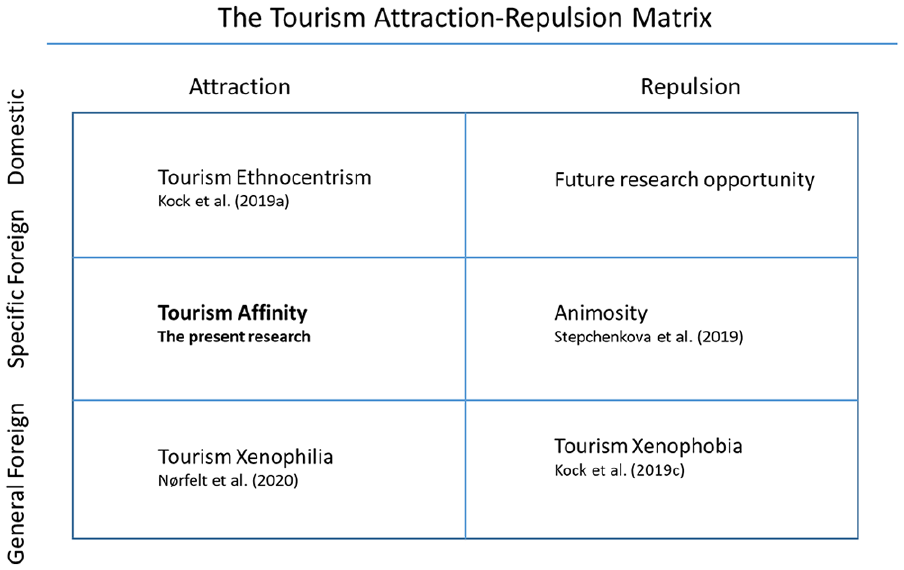
The attraction–repulsion matrix.
Having introduced the AR framework, we now review the literature on tourism biases (Figure 1). The first tourism intergroup bias is tourism animosity, which reflects country-specific repulsion. Stepchenkova and coauthors have investigated tourism animosity perceptions (TANIP) across several studies (Stepchenkova, Su, and Shichkova 2019; Stepchenkova and Shichkova 2017; Stepchenkova et al. 2018). They found that high TANIP is a powerful barrier to marketing to tourists, but that a targeted promotion campaign might help to overcome such negative destination stereotypes.
Research (Kock et al. 2019) has also shown that some tourists have a preferential predisposition toward their home country, labeled tourism ethnocentrism, which drives them to take part in and recommend domestic tourism. In addition to country-specific biases, tourists may harbor positive or negative predispositions toward foreign countries as a general category. Indeed, Nørfelt, Kock, and Josiassen (2020) found that tourists may exhibit a general preference for the foreignness of foreign destinations as reflected in the bias of tourism xenophilia. They empirically linked tourism xenophilia to outcomes such as willingness to visit foreign destinations and intention to interact with locals. Conversely, some tourists also harbor negative affect related to foreignness in general (tourism xenophobia). Kock, Josiassen, and Assaf (2019) investigated whether tourists who exhibit higher levels of xenophobia would still be willing to travel. Contrary to expectations, the authors show that tourists with higher levels of xenophobia still travel, but their travel is characterized by unique behaviors such as being more likely to purchase travel insurance, travel in groups, and avoid eating local food. Recent research shows that xenophobia can be fueled by a pathogen threat, as elicited in the coronavirus pandemic, and that it plays an important role in tourist behavior (Kock et al. 2020).
While such research has taken important steps toward understanding performance-unrelated tourism biases, TAFF and its potential impact on tourism has yet to be examined. This study investigates the role of affinity in tourism based on the idea that TAFF is a positive bias toward a specific out-group, as illustrated in Figure 1. In general, affinity can be understood as a directed positive, affective inclination (Kock, Josiassen, and Assaf 2019a). It can be directed toward an object, person, or animal, as opposed to other types of affect, which need not be directional such as mood states of being happy or content (Lerner et al. 2015). Affinity has been investigated outside of the tourism literature, for example, in psychology where it has been shown to relate to an endowment effect (Tom 2004); in marketing for its effects on willingness to purchase products from an affinity country (Oberecker and Diamantopoulos 2011), and sociologists have studied affinity toward political extremes (Falter and Schumann 1988).
In concert with Kock, Josiassen, and Assaf (2019a), who build on Oberecker and Diamantopoulos (2011), and as supported by the interviews for this study (see the Method section for details), TAFF is defined as a feeling of sympathy, admiration, and attachment toward a specific foreign country. Sympathy reflects a state of liking and warmth (Fiske et al. 2002); admiration relates to respect and competence (Fiske et al. 2002); and attachment reflects an emotional bond (Park et al. 2010). We also investigate the potential impact of TANI on behavioral tourism–related intentions. In the marketing literature (Harmeling, Magnusson, and Singh 2015; Kock, Josiassen, and Assaf 2019a), consumer animosity has been conceptualized along two dimensions: contending and accommodating emotions. Hence, we conceptualize TANI as comprising contending and accommodating emotions. The contending TANI dimension relates to the negative-valence emotion of anger, while the accommodating TANI dimension relates to the negative-valence emotion of fear. Next, we outline the framework and the hypotheses forwarded for testing.
Conceptual Framework and Hypotheses
Having identified a gap in the tourism biases literature in terms of investigating TAFF and TANI emotions, we now present the research model for testing the variables in a nomological network of outcomes and antecedents (see Figure 2). Understanding the drivers of these intergroup biases and knowing whether they may drive tourism intentions is important for both researchers and managers.
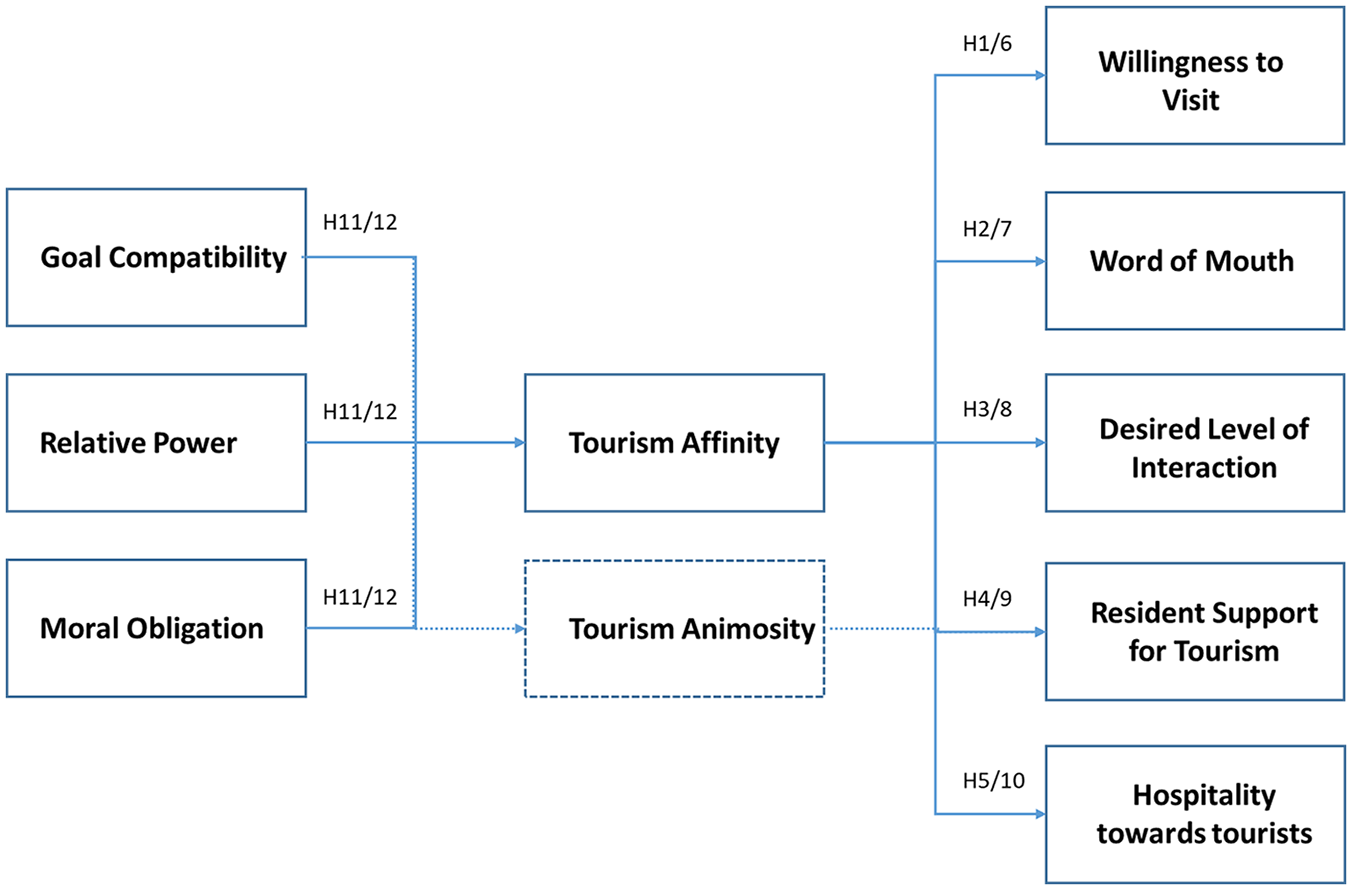
The tourism affinity model.
We first wish to test whether TAFF is related to willingness to visit (WTV). WTV is a commonly used outcome variable in the destination image literature (see Josiassen et al. 2016 for an overview of destination image studies that include WTV as an outcome variable). Similarly, an overwhelming majority of studies in the emerging tourism biases literature have tested a relationship between the focal concept and WTV (e.g., Nørfelt, Kock, and Josiassen 2020). We follow this approach and expect, based on attitude theory (Ajzen and Fishbein 2005), that tourists’ positive emotions toward a particular country are likely to affect their behavioral intentions accordingly. Thus, tourists who harbor positive emotions toward a specific country are likely to have them reflected in their behavioral intentions to visit. We hypothesize that higher levels of TAFF are linked with a higher willingness to visit the focal destination.
Hypothesis 1: Tourism affinity has a positive effect on tourists’ willingness to visit the focal destination.
TAFF is an important bias that relies on mutual cooperation and a certain degree of homogeneity and cohesion (Kock, Josiassen, and Assaf 2019a). The degree to which TAFF is instrumental depends in part on the degree to which it is promoted by the in-group (Scheepers et al. 2006). Further, in-group members positively inclined toward a particular country are motivated to promote the favored out-group to their fellow in-group members, consequently reinforcing the intergroup bias (Scheepers et al. 2006). Hence, we posit that tourists with higher levels of TAFF are more willing to spread positive word of mouth about the focal destination than tourists with lower levels of TAFF.
Hypothesis 2: Tourism affinity has a positive effect on word of mouth about the focal destination.
The tourism literature recognizes that there exist individual differences in the desired level of interaction with local residents at travel destinations (Mo, Howard, and Havitz 1993). Some tourists are keen to engage a lot with locals, while others prefer to keep such interactions to a minimum (Cohen 1972). A wide variety of reasons are likely to underlie such individual differences. Fan et al. (2017) suggest that one of these factors is the level to which tourists seek strangeness, and that tourists who seek strangeness, as opposed to tourists who do not, wish to engage more with locals. Recently, Nørfelt, Kock, and Josiassen (2020) discovered that tourism xenophilia can also account for some of these interaction differences. In our case, TAFF could provide an alternative explanation for these differences in the desire to engage with locals. Hence, tourists with more positive emotions toward a destination will also be more inclined to engage with the locals. Thus, we wish to test the following hypothesis:
Hypothesis 3: Tourism affinity has a positive effect on the desired level of interaction with locals at the focal destination.
While tourists are, unsurprisingly, a key group of stakeholders in the tourism literature, another increasingly relevant research stream concerns residents and the effects of their predispositions regarding incoming tourism (e.g., Rasoolimanesh et al. 2017; Vargas-Sánchez, Porras-Bueno, and Plaza-Mejía 2011). Based on recent findings (Kock, Josiassen, and Assaf 2019b) showing that tourism biases also tend to affect residents, we posit that TAFF also affects individuals in their roles as both tourists and residents, such that residents with higher levels of TAFF toward a specific country are also more positively inclined toward accepting tourism from this country.
We test two aspects of resident attitudes: (a) support for tourism from the focal country and (b) hospitality toward incoming tourists from the focal country. Both aspects of resident attitudes reflect the emotions of the resident in-group toward an incoming tourist out-group (Kock et al. 2019) and, as such, are captured by sociopsychological accounts of intergroup behavior (Hewstone, Rubin, and Willis 2002). However, residents’ support for tourism can also be anchored in social exchange theory (Andereck et al. 2005; Perdue, Long, and Allen 1990; Woo, Kim, and Uysal 2015) as it contains elements of weighing benefits and costs from receiving tourists from the focal country. Based on research on the role of residents’ predispositions toward in-bound tourism (e.g., Kock et al. 2019; Rasoolimanesh et al. 2017; Vargas-Sánchez, Porras-Bueno, and Plaza-Mejía 2011), we argue that TAFF positively affects residents’ support for receiving and being hospitable toward tourists from a focal country.
Hypothesis 4: Tourism affinity has a positive effect on residents’ support for receiving tourists from a focal destination.
Hypothesis 5: Tourism affinity has a positive effect on residents’ hospitality toward incoming tourists from a focal destination.
While our focus is on TAFF, we also aim to test, for the first time in the literature, whether TANI emotions drive selected outcomes. The scarce literature on TANI has linked the phenomenon with important outcomes in recent years. Stepchenkova and her collaborators (Stepchenkova, Su, and Shichkova 2019; Stepchenkova et al. 2019; Stepchenkova et al. 2018) have found that high TANIP creates a powerful barrier to marketing to tourists, but that a targeted promotion campaign might help to overcome such negative stereotypes. Stepchenkova et al. (2019) further showed that TANIP influences tourists’ willingness to visit for a special event as well as their willingness to visit under the condition that bilateral relations between the home and the focal country improve.
Like with TAFF, we wish to test whether tourists’ TANI emotions affect their (a) willingness to visit and (b) willingness to recommend the destination. It is not clear whether TANI emotions tied to a country will lower or increase these behavioral intentions. On one hand, TANI may increase fascination with the country, leading to a higher willingness to visit and to recommend the country for tourism experiences. In the experience economy, customers are commonly attracted to scary, sad, provocative, and other negatively valenced experiences (Menninghaus et al. 2017; Mura 2010). For example, Mura (2010, p. 43) investigated the role of fear in tourism and concluded that “fear was perceived by the young tourists on Ios as a positive component of the tourism experience.” Furthermore, the most attractive rides in an amusement park are the scariest and most endorphin-inducing ones (Stephens 2018) and movies that trigger negative emotions such as fear, shock, revenge, and sadness are highly sought after (Menninghaus et al. 2017). Such findings suggest that fear and other strong emotions linked to a destination may promote rather than hinder tourism, regardless of valence.
On the other hand, TANI may affect tourists in the same way that animosity affects consumers who are considering the purchase of goods. The animosity literature in marketing has found that negative emotions linked with a country diminish consumers’ willingness to buy products from this country (Klein, Ettenson, and Morris 1998). Furthermore, TANIP negatively affects outcomes, which are closely related to the willingness to visit, such as the willingness to visit for a special event (Stepchenkova et al. 2019). In order to address this conundrum, we forward two sets of competing hypotheses regarding (a) willingness to visit and (b) positive word of mouth.
Hypothesis 6a(b): Tourism animosity has a (a) negative ([b] positive) effect on tourists’ willingness to visit a focal destination.
Hypothesis 7a(b): Tourism animosity has a (a) negative ([b] positive) effect on positive word of mouth about a focal destination.
We now wish to test whether TANI affects tourists’ desired level of interaction with the locals. In regard to how closely tourists wish to interact with the locals, fascination and interest alone may not result in a desire to interact closely. In fact, research in marketing (Ouellet 2007) shows that consumers who are repulsed by a particular out-group refrain from close interactions with said group. We therefore suggest that compared with lower-level TANI tourists, tourists with higher levels of TANI would be less interested in close interactions with the locals.
Hypothesis 8: Tourism animosity has a negative effect on desired level of interaction with locals at a focal destination.
We suggested earlier that TAFF may affect both tourists and residents. Similarly, TANI may also affect residents’ inclinations toward tourists from the country they hold animosity against. We argue that TANI emotions color behavioral intentions toward these incoming tourists, and we separate this effect into two distinct behavioral intentions: (a) resident support for receiving such tourists and (b) resident hospitality. Similar to hypotheses 4 and 5, both these hypotheses are based on intergroup behavior theories (Hewstone, Rubin, and Willis 2002) as they reflect individuals’ attitudes toward members of an out-group, and on social exchange theory (e.g., Perdue, Long, and Allen 1990) because accepting inbound tourism relates to a cost–benefit analysis of how valuable tourism is to the local economy. Against this background, we suggest that TANI negatively relates to support for, and hospitality toward, incoming tourists from the unfavored country, and forward the following two hypotheses:
Hypothesis 9: Tourism animosity has a negative effect on residents’ support for receiving tourists from a focal destination.
Hypothesis 10: Tourism animosity has a negative effect on residents’ hospitality toward incoming tourists from a focal destination.
Since our research model suggests that TAFF and TANI emotions matter to tourists and residents, and that they color their behavioral tourism-related intentions, we wish to understand how these emotions arise. A recognized theoretical framework that helps understand how emotions arise is the appraisal theory of emotions (e.g., C. A. Smith and Ellsworth 1985). Rooted in cognitive psychology, appraisal theory argues that emotions arise because of the individual’s cognitive understanding, or appraisal, of the context in which the emotion arises. This approach to understanding how emotions form is a seminal one in psychology today, albeit rarely used in tourism research (see Ma et al. 2013 for a rare exception).
We apply an appraisal approach to model the effects of three potential drivers of TAFF and TANI. Most researchers (e.g., Fiske et al. 2002; Alexander, Brewer, and Livingston 2005; Leach, Ellemers, and Barreto 2007) argue that two or, more prominently, three appraisals are able to describe and predict bias toward a group, and that a host of potential appraisals is possible. For our choice of antecedents, we rely on the appraisals suggested by Alexander, Brewer, and Livingston (2005) of goal competence and perceived relative power. In addition, in an impactful paper, Leach, Ellemers, and Barreto (2007) argues that previous research has generally overlooked the importance of the moral aspect and its relevance in causing emotions; hence, our third driver is moral obligation.
The first driver, moral obligation, is the perceived sense of duty to help members in one’s own or affiliated groups (Giner-Sorolla 2013). Leach, Ellemers, and Barreto (2007) found that moral obligation is often a more important explanation of group-based emotions than other drivers. Moral obligation has been found helpful in forging cross-group bridges (Reed and Aquino 2003), and those who perceive a moral obligation to the focal country may be more likely to feel attached to it. In this way, this driver of emotions could help us understand the TAFF dimension of attachment. Conversely, individuals with lower levels of perceived obligation may tend to exhibit higher levels of TANI.
The second driver is that of goal alignment. Goal alignment refers to the degree of alignment or compatibility between the goals of the perceiver and the perceived (Alexander, Brewer, and Livingston 2005). Goal alignment is a key appraisal applied in image theory (Alexander, Brewer, and Livingston 2005), and might be particularly relevant to understanding the TAFF dimension of sympathy. In general, goal alignment is valence determining—research has found that emotions tend to be overall positively valenced when individuals perceive a high degree of goal alignment with others (Alexander, Brewer, and Livingston 2005). Applying a similar logic, we suggest that individuals who perceive less goal alignment will tend to be higher on TANI.
The third key appraisal we adopt from image theory is relative power, which refers to the power of the perceived group relative to the power of the perceiving group (Alexander, Brewer, and Livingston 2005). Relative power could be especially diagnostic for the admiration dimension of TAFF. Powerful individuals and groups often receive admiration from equally powerful or, in particular, less powerful individuals and groups (Onu, Kessler, and Smith 2016). We argue that some tourists may also admire more powerful countries and their inhabitants.
Moreover, powerful individuals and groups are not only admired, they are also feared (Brewer 1999). Thus, we suggest that perceived relative power relates positively to TANI emotions. For example, if an out-group is perceived as having low goal alignment, and is perceived as having relatively low power, that is, not a threat, in-group members are likely to be indifferent to this out-group. On the other hand, if the ill-aligned out-group is a powerful group, then indifference is less likely. Against this background, we suggest the two following hypotheses for testing:
Hypothesis 11: TAFF is driven by the three appraisals. Specifically, TAFF relates (a) positively to moral obligation, (b) positively to goal alignment, and (c) positively to relative power.
Hypothesis 12: TANI is driven by the three appraisals. Specifically, TANI relates (a) negatively to moral obligation, (b) negatively to goal alignment, and (c) positively to relative power.
Study 1: Scale Development
The development of the TAFF scale is required because no scale exists to measure the psychological tourism phenomenon we have identified. We also develop the TANI scale to complement the existing scale that measures TANI stereotypes. Further, for the operationalization of TAFF, the marketing literature on affinity provides a fruitful basis, which we draw on and further advance.
The TAFF and TANI scales were developed by combining inductive and deductive methods (Hinkin 1995; Kock et al. 2019). The initial item pools for TAFF and TANI were generated by reviewing the literature on affinity, animosity, and closely related topics. For example, for TAFF, items were drawn from relevant studies that examine positive object-directed consumer emotions (e.g., Kock, Josiassen, and Assaf 2019a; Park et al. 2010; Thomson, MacInnis, and Park 2005), while for TANI, items were drawn from studies on negative emotions (e.g., Harmeling, Magnusson, and Singh 2015; Kock, Josiassen, and Assaf 2019a).
We then conducted exploratory interviews with 14 individuals with the objective of confirming or disconfirming items drawn from the literature, and identifying other potentially important items. Informants in a midsized city in the northeast of the United States were recruited using a street-intercept procedure. This context is apt since the United States has the second highest international tourism expenditure after China (UNWTO 2019). To understand how both biases manifest in the minds of the informants, we asked them to describe perceptions and emotions they would relate to two foreign self-selected destinations along each of the dimensions. We also asked them to introspect regarding the reasons for such beliefs and emotions as well as potential effects this had on their intentions as tourists and residents. This approach resulted in an initial pool of 23 items for TAFF.
The next step focused on parsimony with items being evaluated for redundancy of meaning, resulting in the removal of six items. The remaining items were judged for face and content validity. Three academic experts evaluated the degree to which the intended core of TAFF was reflected in each item (content validity) and how well each item reflect TAFF rather than another construct (face validity). Five items were eliminated based on these steps, leaving a pool of 12 items. For the tourism animosity (TANI) scale, we followed the same procedure, and at this stage, the resulting pool was 12 TANI items. Following previous studies (e.g., Batra, Ahuvia, and Bagozzi 2012) that aimed to develop a broadly applicable scale and demonstrate its usefulness in a specific context, we first asked respondents to answer questions with regard to a self-selected country context.
We then tested and applied the scale to the context of Germany. We selected Germany because it is a well-known country to US respondents, and could elicit positive as well as negative responses, ensuring satisfactory variance in our TAFF and TANI items. On the one hand, Germany was an adversary of the United States in World War II, and narrative of Germany as the villain still exists in books, comics, and movies (e.g., Red Scull in the Marvel Universe and the villains in the Die Hard movies). Previous studies in the biases literature note that historic military conflict is a key reason for animosity (Klein, Ettenson, and Morris 1998). Further, Germany poses an economic threat as a major economic rival and driving force behind positioning the EU and the Euro as important economic and financial alternatives to the United States and the US dollar. On the other hand, Germany has, for several decades, been a close military ally of the United States, and there are probably as many or more American families that have positive links with Germany as there are families with scars due to World War II.
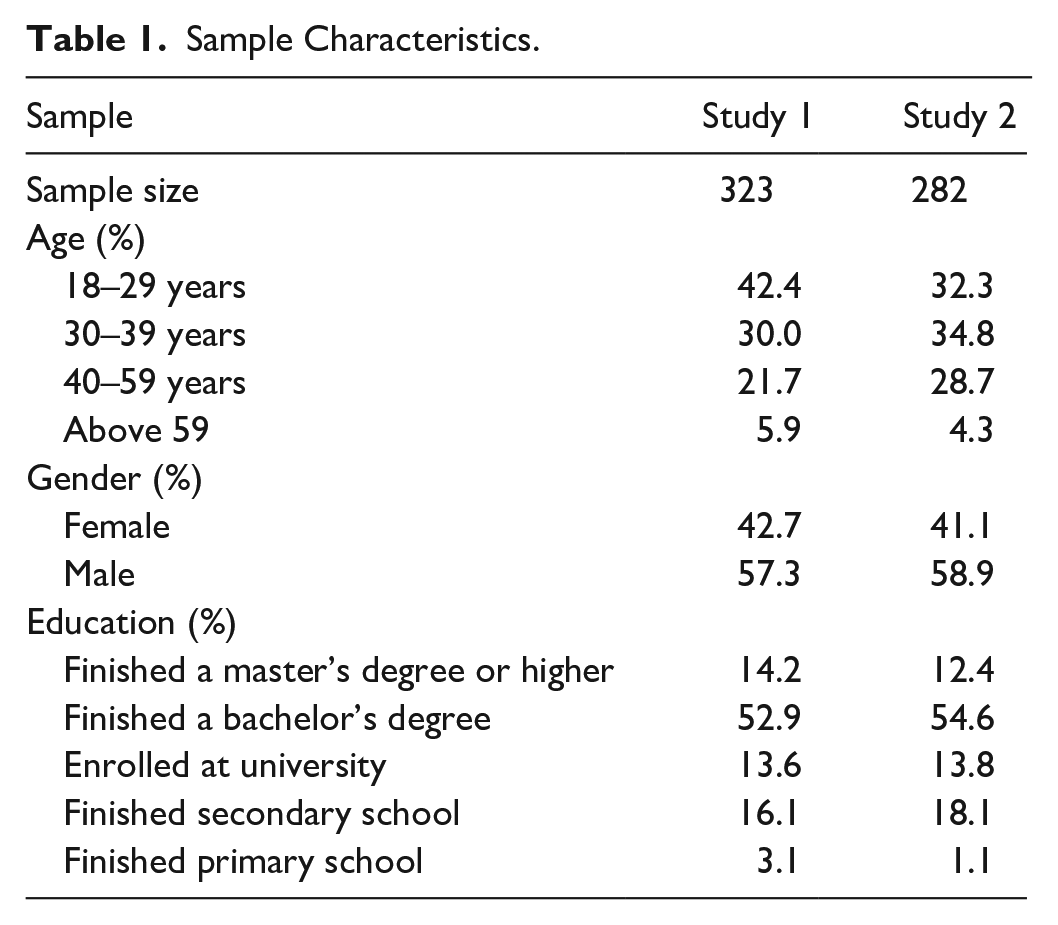
Self-selected among the Mechanical Turk (MTurk) online panel, a sample of US respondents answered the questionnaire. The quality of MTurk data sets has been shown to be as good as or better than data collected via street intercepts or among students (Goodman and Paolacci 2017). We included an instructional manipulation check (IMC) in order to detect potential response bias resulting from, for example, straight lining or satisficing (e.g., Barber, Barnes and Carlson 2013). We asked respondents to answer “agree” to the IMC, and respondents who provided a wrong answer were not included in the subsequent analysis (24 respondents or 6.9% of respondents, leaving 323 respondents). Sample characteristics of both studies appear in Table 1.
Sample Characteristics.
We then carried out a factor analysis on the data that met the thresholds for both Bartlett test of sphericity (BTS) and the Kaiser–Meyer–Olkin (KMO) criterion (BTS = 6454.325; df = 231, p < .001; KMO = 0.954). To examine the dimensionality of the constructs, we conducted a parallel analysis resulting in three factors for TAFF and two for TANI.
Next, all items were evaluated using four statistical criteria (Josiassen 2011). In the first step, we inspected factor loadings and item-to-total correlations with .4 and .5 as the thresholds. In the second step, we judged item redundancy by investigating inter-item correlations. In the third step, we tested what the effect of deleting the item would be on the composite reliability of the scale. To complement these three steps, in a fourth step, we used a χ2 difference technique to further purify the scale. Using this technique, the item with the lowest item-to-total correlation is selected for deletion. After deletion, we iteratively selected the next item, which now has the lowest correlation. The procedure stopped or skipped an item when deleting it would change the conceptual meaning of the construct or when the model fit did not increase (Voss, Spangenberg, and Grohmann 2003). After finalizing these four steps, aiming for a parsimonious scale, 11 items remained (SYM 4, ADM 3, and ATT 4) in the final TAFF scale, and 8 items (CONT 4, and ACCOM 4) remained in the final TANI scale.
The resulting TAFF measure has factor loadings ranging from .77 to .92 (TANI: .88 to .94). The composite reliability (CR) was .91 (TANI: .96) and the average variance extracted (AVE) was .76 (TANI: .93), documenting that the scales are reliable. Table 2 lists the items and scale properties. Overall, study 1 resulted in reliable and parsimonious scales to measure TAFF and TANI. In study 2, these measures will be applied to test the hypotheses in the proposed nomological network.
Parameters of the TAFI Scale.
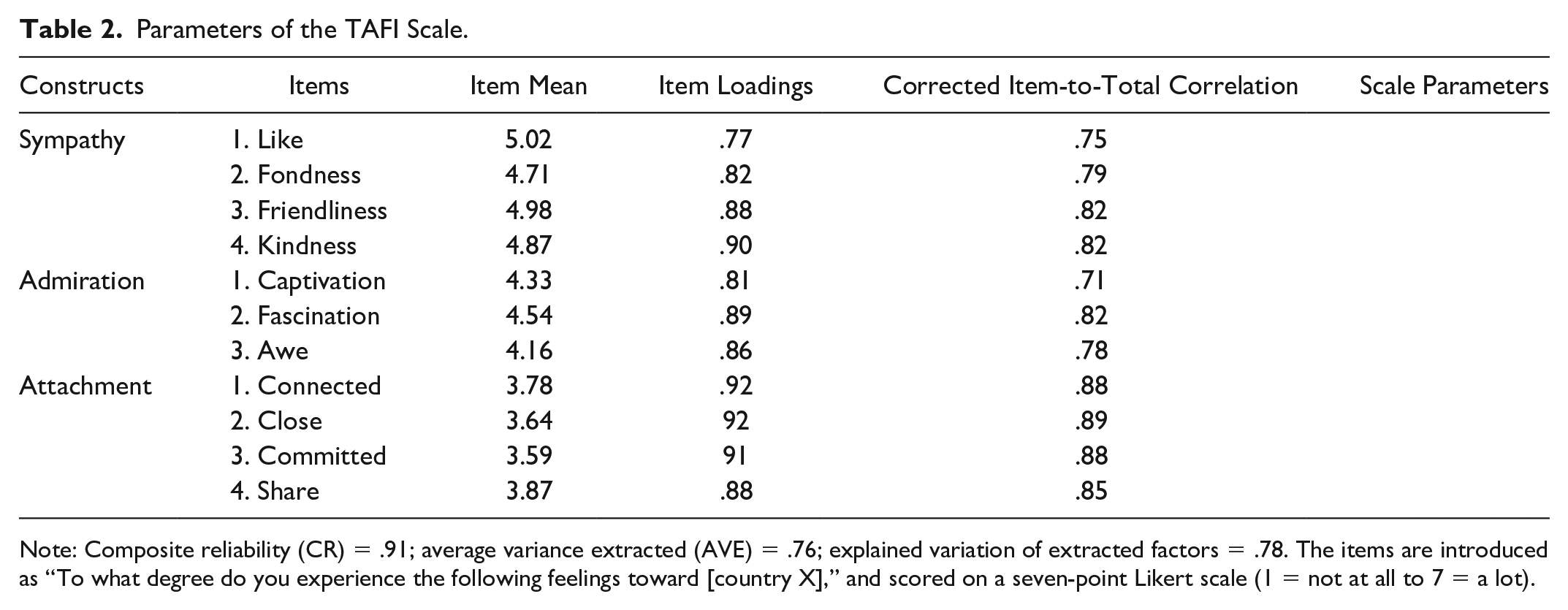
Note: Composite reliability (CR) = .91; average variance extracted (AVE) = .76; explained variation of extracted factors = .78. The items are introduced as “To what degree do you experience the following feelings toward [country X],” and scored on a seven-point Likert scale (1 = not at all to 7 = a lot).
Study 2: Hypothesis Testing
Participants and Procedures
Study 2 aimed to test the theoretical framework and the related hypotheses (Figure 2). Data were collected from a sample of US citizens using MTurk panels. Respondents were asked to answer several qualifying questions. Only those older than 18 with an annual household income above US$30,000 and with some travel experience in the recent two years qualified for the main questionnaire. As with study 1, we included an IMC, which led to the deletion of 27 responses (8.7% of the sample), resulting in 282 responses being used in the final data set. See Table 1 for the sample characteristics.
Measures
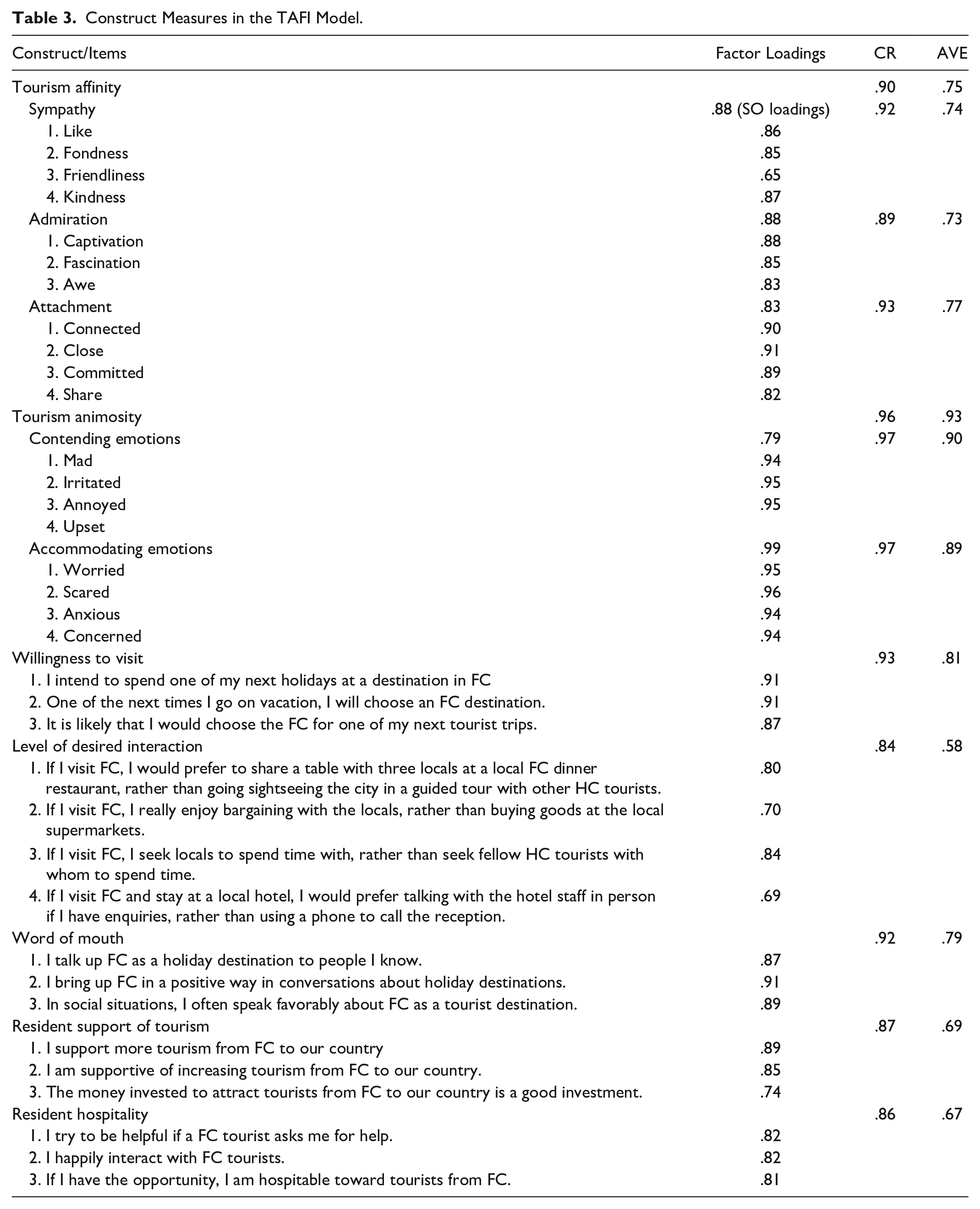
The measures and their psychometric parameters are shown in Table 3. The questionnaire included the newly developed TAFF and TANI scales as well as the measures involved in the hypotheses being tested. Again, we asked respondents to answer the questionnaire items with Germany as the destination in mind. Willingness to visit and word of mouth were measured by the scales adopted from Kock, Josiassen, and Assaf (2016). Level of desired interaction (LDI) and the appraisals were newly developed scales following the same steps as for the focal TAFF scale. LDI draws conceptually on Ouellet (2007) and reliably measures tourists’ desired level of interaction with the local residents (CR = .84). The resident support for tourism scale was adopted from Stylidis and Terzidou (2014) and Woo, Kim, and Uysal (2015), and the scale for resident hospitality was adopted from Kock et al. (2019). Goal alignment was measured by four items on a Likert-type scale anchored by “it will really hurt the home country [HC]” at one end and “it will really help both the [HC] and the focal country [FC]” at the other. The items were: (1) “What would be the consequence of significantly improving the [FC]’s influence in the major international organizations? (2) If [FC] were to significantly increase the military budget, would that affect [HC]? (3) What would be the result if GDP in [FC] were to increase significantly? (4) What would be the consequence if a [FC] national became the next President of the UN?”
Construct Measures in the TAFI Model.
Perceived out-group power measured the perceived power of the [FC] relative to the [HC], and consisted of four items. The items were as follows: (1) “Which country is more politically powerful to be able to influence other countries?” (2) “Which country is more economically powerful to be able to influence other countries?” (3) “Which country’s culture influences the other country more?” and (4) “Which country has the stronger and more powerful international connections?” Options for answering ranged from “the [HC] has more political (economic/cultural/network) power than the [FC]” to “the [FC] has more political (economic/cultural/network) power than the [HC].”
The final appraisal moral obligation was measured by five items. Prefaced by “relative to many other countries . . . ,” (1) “[FC] can count on the [HC] if it’s really necessary,” (2) “it would be expected that the [HC] helps [FC] if necessary,” (3) “if [FC] needs it, then the [HC] will be on its side after all,” (4) “while we do not always agree, the [HC] wants the best for [FC],” (5) “the [HC] has a kind of duty to help [FC].” Options for answering ranged from strongly disagree to strongly agree. In addition, we captured respondents’ age, gender, and education.
The lowest standardized factor loading was .65, thus demonstrating convergent validity (Bagozzi and Yi 1988). We found discriminant validity as the data satisfied both the Fornell-Larcker (1981) test with the square root of all AVEs being greater than all interconstruct correlations, as well as the newer heterotrait-monotrait (HTMT) method with the average of correlations being below .90 (Kline 2011).
Results
We first examined the univariate skewness and kurtosis of the variables and found them to be within acceptable limits. Then the structural equation model was tested in AMOS 24. A confirmatory factor analysis showed that the fit between the data and the developed model was good, as indicated by the goodness of fit indices (χ2/df = 2.150; root mean square error of approximation = 0.064; standardized root mean square residual = 0.0674).
Overall, the results demonstrate strong support for our hypotheses, showing the importance of TAFF in explaining several tourist and resident outcomes. TAFF has a significant and positive effect on tourists’ willingness to visit (0.719, p < .001), thereby confirming hypothesis 1. Tourists with higher levels of TAFF are also more likely to provide positive word of mouth about the destination (hypothesis 2: .794, p < .001). Hypothesis 3 was also confirmed as TAFF positively affects the desired level of interaction with locals (0.669, p < .001). In terms of residents’ attitudes toward tourism from the focal destination, both hypotheses 4 and 5 were confirmed, as TAFF was found to positively influence residents’ support for receiving tourists from the focal destination (0.762, p < .001), as well as being hospitable toward such tourists (0.600, p < .001).
We also tested TANI within the nomological network. TANI positively relates to willingness to visit (WTV); thus, hypothesis 6b was confirmed whereas hypothesis 6a was not confirmed (0.281, p < .001). TANI relates positively to word of mouth, thus confirming hypothesis 7b but not 7a (0.128, p < .01). Tourists with higher levels of TANI were found to be less inclined toward closer interaction with locals than tourists with lower levels of TANI. Although only borderline significant, this finding was in line with hypothesis 8 (–0.097, p < .1). In terms of their roles as residents, TANI was found to relate negatively to both resident support of tourism (–0.188, p < .001) and resident hospitality (–0.371, p < .001), confirming hypotheses 9 and 10. Finally, regarding the appraisals, the results show that moral obligation (0.421, p < .001), goal compatibility (0.431, p < .001) and relative power (0.150, p < .001) all relate positively to TAFF, confirming hypothesis 11. However, hypotheses 12a and 12b could not be confirmed as moral obligation (0.109, n.s.) and goal compatibility (0.124, n.s.) were found to have no effect on animosity; however, relative power positively drives TANI (0.261, p < .001), confirming hypothesis 12c.
Conclusion
This study investigates whether a positive country-specific bias (TAFF) and a negative country-specific bias (TANI) affect tourism-related decisions. Further, the research investigates three potential antecedents of TAFF and TANI. This article relies on the attraction-repulsion framework to illustrate the research gap within the emerging tourism biases literature (e.g., Kock et al. 2019). The attraction-repulsion framework is a flexible meta-theory within which to understand and investigate positive and negative group-related biases (stereotyping, prejudice, and discrimination). As the tourism-biases literature grows, this framework can provide a useful theoretical underpinning for future research endeavors. For example, it is apparent from this framework that repulsion from being a tourist at the home destination has not yet been explicitly investigated as a bias.
We introduce TAFF as a positive country-specific intergroup bias for the first time in the tourism literature. The results show that TAFF affects tourists’ willingness to visit, inclination to provide word of mouth, and their desired level of interaction with the locals at a specific destination. For example, tourists with higher levels of TAFF prefer closer encounters with the locals, while tourists with lower levels refrain from such close encounters. Overall, the results clearly show that TAFF can contribute to an understanding of tourists’ destination choices, and that this bias, consequently, is an important consideration for further studies of destination choices.
Another implication is that future research can benefit from considering TAFF as a potential driver of other outcomes than the ones we test. For example, tourists’ attitudes toward events (Prayag et al. 2013) or local companies (Fischer 2004) may be colored by their level of TAFF. As such, TAFF could be tested as an antecedent of such specific attitudes or as a moderator on the relationship between the specific attitude and outcomes.
We also investigated TANI and its potential cognitive appraisals as well as potential impact on tourist and resident-related outcomes. The results show that the effect of TANI on tourist inclinations depends on the perceived level of interaction with the locals. Specifically, we found that tourists with higher levels of TANI are more willing to visit and recommend than are tourists with lower levels of TANI. This finding differs from findings in the marketing literature (e.g., Klein, Ettenson, and Morris 1998) on products. However, the results are in line with research on experiences and attractions for which negative emotions are often considered attractive (Mura 2010). Negatively valenced emotions may not have a negative effect on tourists’ willingness to visit and recommend when a tourist is interested in/fascinated with the place. However, while TANI might infer a certain level of interest or fascination, the results also showed that tourists higher on TANI are less interested in closer interactions with locals than tourists lower on TANI.
This research also has timely implications for the literature on resident attitudes. The attitudes of residents are increasingly taken into account by both researchers and practitioners (Boley and Strzelecka 2016), fueled by increasing international tourism challenges such as overtourism and tourism sustainability. The results show that residents with higher TAFF are both more supportive of increased tourism from the focal country and would be more hospitable toward these tourists. As for TANI, residents with more negative emotions toward the origin country of the incoming tourists would be less inclined to support such tourism and are also less inclined to be hospitable toward this group of tourists. Receiving tourists on one’s home turf no longer allows experiencing the other group and its culture at an arm’s length but involves a less controllable set of interaction circumstances. Residents might meet these tourists at their favorite restaurant, stand in queue with them at the post office, or serve them as customers. This effect on resident attitudes mirrors the negative effect that TANI has on tourists’ preferred level of interaction.
The results also have implications for tourism practitioners. TAFF and TANI are deep-rooted predispositions that may be even more important in a post–COVID-19 world. The concepts themselves are likely to be as or more relevant but the levels of TAFF and TANI toward tourists from certain countries may change (Klein, Ettenson, and Morris 1998). For example, TANI levels toward tourists from China or other countries associated with the virus may have increased on average. The present conceptualization and operationalization provide a solid basis for understanding the impact of such events on tourism.
Providing a conceptualization and operationalization of TAFF allows practitioners to examine TAFF levels prior to developing and promoting tourism offerings. TAFF levels may help explain why certain destinations do well with tourists from certain markets and seem less attractive to tourists from other markets. Hence, instead of trying to boost tourist demand from the focal country by adding an attraction or changing some variable, these results show that such performance-related measures may not always be effective. Perhaps a deeper-rooted destination affinity present in the target market is driving a portion of tourist demand.
Further, a deeper understanding of TAFF levels enables practitioners to improve the strategic allocation of resources, and thus improve segmentation, targeting, and the ability to meet tourist needs. For example, many domestic tourism authorities rationalize the high number of visits from neighboring countries by pointing to the geographical closeness. Yet, this study’s results suggest that geographical closeness alone will not account for a significant portion of the variance in visits. Additionally, the present findings support and help explain anecdotal evidence about the high demand for tourism from across considerable distances. As such, demand due to high levels of TAFF exists without objective reasons for why one destination is more attractive than other destinations.
All in all, it is important for tourism practitioners to consider TAFF as an alternative to the traditional destination image concept when trying to gauge demand from certain countries. TAFF also has an effect on resident outcomes. As such, an investigation and understanding of TAFF can help local businesses and politicians gauge the level of support for increased tourism from a particular country. Plans to attract tourism from a country because of the country’s buying power, geographical proximity, or increasing outgoing tourism may fail if the residents are not supportive of increased tourism from the particular country.
Tourism practitioners can use the results from the investigation of TANI to identify why some markets are harder to succeed in. However, it is important to note that TANI may create attraction in tourists even when TANI levels are high. When targeting such high-TANI tourists, tourism practitioners should be aware that while they may be interested in visiting, they may want to do so at an arm’s length. With this information, practitioners can tailor the tourist experience more precisely to various tourist segments. Local politicians and tourism businesses can investigate TANI levels among residents to understand the likelihood of tourists from a certain country being well received and being made to feel welcome. Understanding TANI levels allows practitioners to plan, change strategies, or allocate resources to try to overcome this challenge.
In documenting the importance of the intergroup bias of affinity for understanding tourist behavior, this study opens a related research agenda: TAFF is likely to affect several additional tourism outcomes, such as willingness to pay, preferred length and mode of stay, and preferred mode of travel. We call for research to identify and test these and further outcomes.
The finding that TANI relates to higher levels of willingness to visit, but a lower desired level of interaction with locals, is an interesting area for future research. Indeed, this area shows researchers three main avenues for further research. First, it would be interesting to replicate this study in another context, for example, a context with a current or recent conflict and where the TANI levels are more extreme and widespread. Second, the positive effect of TANI on WTV brings up the question of whether the familiarity effect could be at play. However, if this were the case, we would expect TANI to relate positively to all outcomes, and it does not. Rather, the effect of TANI seems to be regulated by the level of desired interaction. It would be beneficial to understand how much interaction would be considered too much and too close for the relationship between TANI and tourism inclinations to flip. This threshold may itself be context-specific, and while it may not be straightforward to identify, understanding it further could have significant theoretical and practical implications. Third, the finding has broader implications for the marketing literature. Researchers could identify experiences that are similar to tourism experiences (e.g., attending a movie screening or participating in an escape room) and for which negative emotions may have a similar effect as found in a tourism setting. In other words, while experiential products may still be sought after in spite of negative valence, it is not known what level of experiential essence a product offering would have to have for this effect to appear, or which other variables play a role.
Lastly, we found that three cognitive appraisals relate to TAFF and TANI. We urge researchers to further study the intricate relationships between tourism emotions and their cognitive appraisals—not only in relation to TAFF and TANI but also more broadly in the tourism biases literature. Understanding TAFF and TANI in the light of the appraisals as profile measures may be useful. In fact, we have not been able to locate any significant studies employing profile measures in tourism, and research focused on this topic is welcome. As the tourism discipline matures, it will be important to investigate phenomena by applying not only scales or indices but also other measure types, such as profile measures (Wong, Law, and Huang 2008). Further, TANI emotions are also likely driven by TANI perceptions (TANIP), and we urge future research to investigate this relationship. Overall, the present results show that TAFF and TANI matter, and future research on these country-specific emotions is encouraged.
Footnotes
Declaration of Conflicting Interests
The author(s) declared no potential conflicts of interest with respect to the research, authorship, and/or publication of this article.
Funding
The author(s) received no financial support for the research, authorship, and/or publication of this article.
