




Abstract
Leisure tourism, including destination choice, can be viewed as an investment in mental health maintenance. Destination marketing measures can thus be analyzed as mental health investment prospectuses, aiming to match tourist desires. A mental health framework is particularly relevant for parks and nature tourism destinations, since the benefits of nature for mental health are strongly established. We test it for one globally iconic destination, using a large-scale qualitative approach, both before and during the COVID-19 pandemic. Tourists’ perceptions and choices contain strong mental health and well-being components, derived largely from autonomous information sources, and differing depending on origins. Parks agencies emphasize factual cognitive aspects, but tourism enterprises and destination marketing organizations use affective approaches appealing to tourists’ mental health.
Introduction
We propose that at the broadest scale, the principal driver of destination decisions by leisure tourists and holiday makers, is to maintain and improve their self-perceived mental health and well-being (Buckley, Zhong, and Martin 2020; L. Wang, Hou, and Chen 2021). This applies to tourists in general, not only a targeted well-being subsector. It excludes only travelers whose destinations are predetermined by events, business, or visiting friends and relatives. Such travel may still affect mental health, but not via destination choice.
This approach arises from a recent paradigm shift in human psychology and mental health. Historically, especially within clinical psychiatry, individuals were considered mentally healthy unless diagnosed clinically with a defined mental disorder. The current view, however, is that just as for physical health, there are indefinitely fine gradations between peak positive mental health, and immediately life-threatening negative mental health. These gradations do not form a single scale, but a multidimensional matrix of complementary mental health measures. There is no single line between healthy and unhealthy, clinical and subclinical. Individual mental health and well-being can also vary moment by moment, for many different reasons. Mental health influences not only the individuals concerned, but also everyone they interact with either personally or professionally, and hence their workplace performance and contributions to national economies. Mental health and its variations are a continual part of human life experience.
While individuals’ mental health conditions may be modified by many factors outside their own control, people are not purely passive recipients. They engage routinely in personal mental health maintenance: that is, they take voluntary steps to improve their own well-being. Leisure tourism represents one of the largest individual investments in mental health maintenance. Paying to visit a holiday destination is not just discretionary expenditure: it is an investment in individual mental health and well-being. Viewed from this perspective, we can reconceptualize destination marketing as pitching a mental health investment prospectus.
We set out a mental health framework for destination choice and marketing, incorporating existing theoretical frameworks. Our framework does not contradict previous models: it rearranges the components and views them from a new perspective. It recognizes that in tourism transactions, destination stakeholders can act as surrogates for the seller, and travel agents and distributors as surrogates for the buyer.
The mental health framework is potentially relevant to tourism in general, but we apply, test, and analyze it specifically in relation to nature tourism, where the principal destination attractions, marketing, and management are related to internationally well-known national parks and natural heritage features. The reason for this approach is that, unlike urban destinations, the positive links between nature and mental health are well established, together with the associated economic value of national parks, and the role and therapeutic effectiveness of nature tourism in improving mental health.
Theoretical Framework
Tourism, Nature, Health
Nature acts as a tourism attraction, tourism brings people to nature, and nature improves mental health (Bratman et al. 2019; Buckley 2020a; Buckley and Westaway 2020; Buckley, Zhong, and Martin 2020; Levi et al. 2018; Lehto and Lehto 2019). Nature tourism includes wildlife tourism and park or protected-areas tourism. Park tourism is valued at US$0.6 trillion per annum (p.a.); outdoor nature and adventure tourism at more than US$1 trillion p.a.; and the value of parks via visitor mental health, at US$6 trillion p.a. (Buckley et al. 2019).
Relevant previous research (Table 1) has examined tourist well-being and quality of life, emotion and affect, recovery from stress, motivations, activities and experiences, addiction, control, transformation, and therapy. The concept of emotions has a lay or vernacular origin, whereas affect is a technical, nonvernacular term, used in psychology and social sciences. Affect refers to emotions, feelings, or mood, as contrasted with cognitive, sensory, or motor brain processes. Research on destination image, for example, distinguishes affective, cognitive, and conative psychological domains. Well-being is a term used in psychology, whereas mental health is used in medicine, health policy, and health economics.
Mental Health in Tourism Research.

Emotions have been defined, characterized, and classified from many different perspectives (Xu et al. 2017), including neurophysiological (Pessoa 2017; Spunt, Ellsworth, and Adolphs 2017); behavioral (Hommel et al. 2017; Ridderinkhof 2017), social (Niedenthal and Brauer 2012; Niedenthal, Rychlowska, and Wood 2017), cultural (Gendron 2017), and evolutionary (Frijda 2016). The ability to recognize emotions in others, and to display or hide one’s own, are important components of communication. Happiness is a broad emotion that includes narrower terms such as contentment, satisfaction, enthusiasm, delight, joy, or bliss. Research in tourism operations, marketing, guiding, and emotional choreography distinguishes these finer-grained emotions. Examples include the routine measurement of customer satisfaction, specific actions aimed at creating customer delight (Jiang 2020), and the role of joy in transformational experience (Holmbom, Brymer, and Schweitzer 2017).
Well-being (Table 1) is a psychological construct, combining multiple domains or dimensions of individual self-perceived life experience into unified scales that can be applied in a range of circumstances, from market research to national policy. It is also a global industry, reportedly worth US$4.5 trillion p.a. (Yeung and Johnston 2020). Leisure tourists can choose destinations, activities, enterprises, products, and companions to maximize self-perceived gains in well-being from investment of discretionary income and assets. There is also a well-studied well-being subsector of the tourism industry (Table 1), estimated at US$639 billion p.a. (Yeung and Johnston 2020).
Mental health, in contrast, is a medical and health economics term, a direct parallel to physical health. Mental ill health is defined, diagnosed, and treated by qualified doctors, certified by national medical associations, subject to national legislation. Doctors can and do use psychological scales of mental health, but only as aids to diagnosis, not alone. Treatments may be funded by national governments, health insurers, or patients, but they are linked to specific named conditions, defined by medical manuals of psychiatry. Governments worldwide routinely collect statistics on the prevalence and costs of mental ill health, both direct and indirect. Direct costs include medical consultations and treatments. Indirect costs include lost workplace productivity, paid and unpaid carers, and public and private antisocial behavior. Poor mental health, even prior to the COVID-19 pandemic, cost global economies about 10% of GNP every year. Tourism research has included the costs of travel for treatments, as a type of medical tourism, but very little has measured tourism outcomes in mental health terms.
COVID-19 Considerations
Tourism and mental health worldwide have both suffered from the COVID-19 pandemic and associated lockdowns, continuing during 2021. Mental health mechanisms include livelihood losses, family concerns, nature deprivation, and travel restrictions (Ettman et al. 2020; Moreno et al. 2020; Mucci, Mucci, and Diolaiuti 2020; Pierce et al. 2020; Zacher and Rudolph 2020). There have been major disruptions to international travel and tourism (Gössling, Scott, and Hall 2020). These have created pressures for national tourism industries to refocus on domestic marketing (UNWTO 2020). National parks and nature destinations have experienced renewed popularity worldwide. As parks have reopened, they have experienced surges in visitation and tourism well above seasonal expectations (Buckley 2020b; McGinlay et al. 2020). Therefore, the tourism–nature–health framework is of particular relevance for all three sectors currently.
Destination Marketing and Choice
There are three classic models for destination marketing: construction, projection, and perception of destination image (Huang, Qu, and Montgomery 2017); induced, organic, and autonomous information sources (Lian and Yu 2019); and affective, cognitive, and conative psychological domains (Afshardoost and Eshaghi 2020). Figure 1 integrates these three broad-scale published frameworks. It is our summary of previously published research. Within these, numerous finer-grained terms and approaches have also evolved. These include attachment and attraction (Jiang et al. 2017), authenticity (Park, Choi, and Lee 2019), bias, brand, choice (Ye et al. 2020), competition (de Souza, Mendes-Filho, and Buhalis 2020), content, communication, complexity, damage, emotions (Pestana, Parreira, and Moutinho 2020), engagement, equity (Guervos et al. 2019), extension (Kim, Stepchenkova, and Yilmaz 2018), fascination (Y. C. Wang et al. 2020), fashion (Lewis, Kerr, and Burgess 2019), fragmentation (Camprubí and Coromina 2016), information (Lian and Yu 2019), loyalty (Stylos and Bellou 2019), memorability (Ye et al. 2020), personality, positioning (Pezenka 2016), psychology (Afshardoost and Eshaghi 2020), repair, and self-concept and self-congruence (Li et al. 2020).
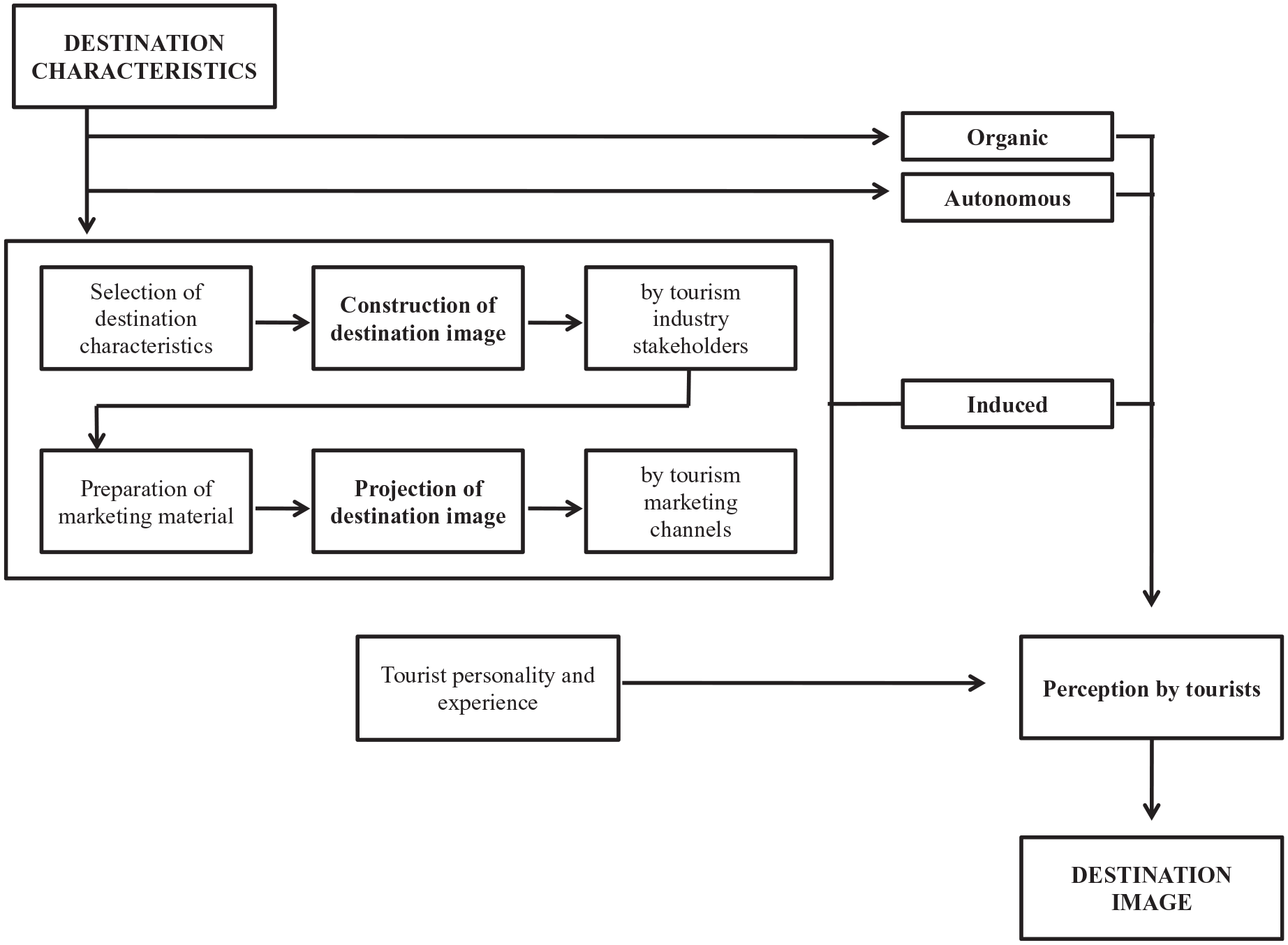
Traditional theoretical model for tourism destination image.
The main focus has been on how destinations present themselves to tourists. There is rather less research on how tourists choose between destinations, and this has treated destination offers as fixed, at least in the short term, rather than malleable in response to tourist demand (Ye et al. 2020). There are a few recent exceptions, such as the suggestions that destinations aim to reposition themselves as fashionable (Lewis, Kerr, and Burgess 2019), or that tourists pick destinations with congruent personalities (Bekk, Spörrle, and Kruse 2016; R. Chen et al. 2020). It is recognized that different tourists care about different destination characteristics, such as authenticity (Fu 2019; Park, Choi, and Lee 2019), and that their choices may reflect different aspects of personality, such as loyalty (Stylos and Bellou 2019; R. Chen et al. 2020). Most of these approaches recognize that there is an affective or emotional component to destination marketing and choice (Pestana, Parreira, and Moutinho 2020; Prayag et al. 2015), but this has been seen as a bias to cognitive processes (Wattanacharoensil and La-Ornual 2019), rather than a contribution to mental health.
The framework adopted here, in comparison (Figure 2), treats tourist mental health as a primary driver, with destination marketing as a response. Figure 2 contains the same components as Figure 1, but assembled in a different structure, to indicate different lines of information flow and influence. Most of its components are preexisting, derived from previous research, but the reassembly is novel. In addition, Figure 2 encapsulates our proposal that leisure tourism can be analyzed as individual discretionary investment in maintenance of mental health. That is, it treats the maintenance of mental health as a tourist goal. It suggests that tourists create a mental match between what they want (choice) and what they think destinations can provide (image), with mental health maintenance as their goal. This is our conceptual framework for the current study.
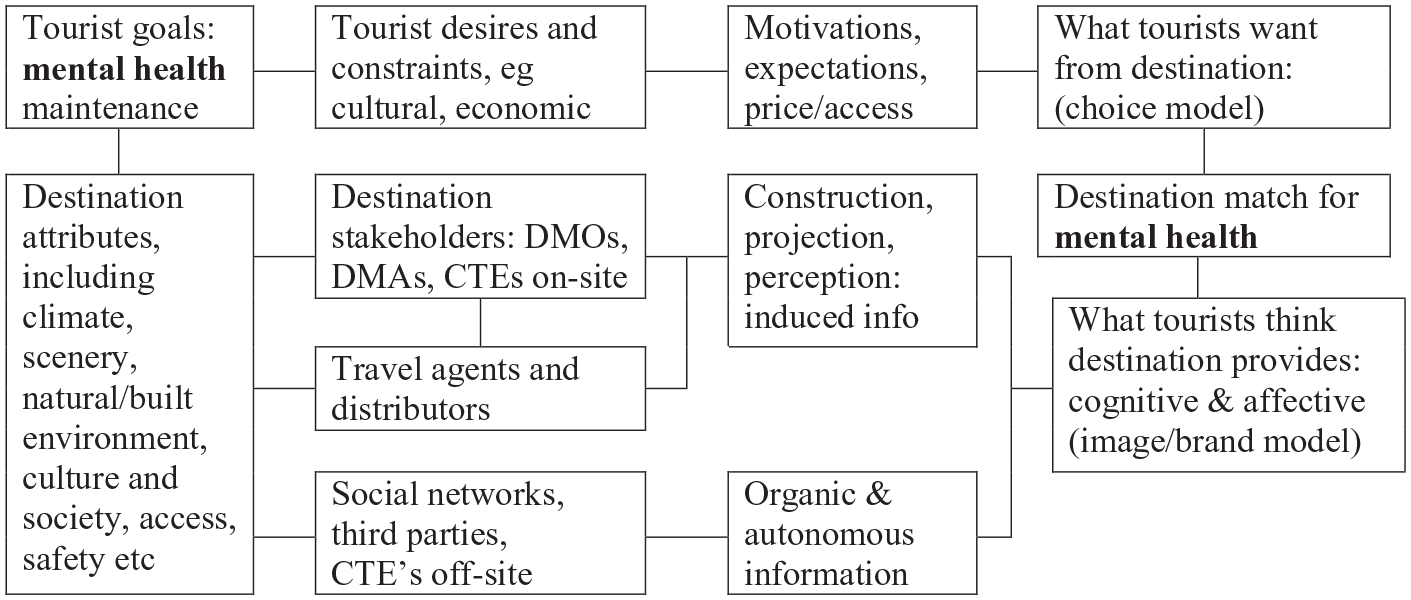
Theoretical framework for mental health in destination choice and marketing.
In Figure 2, well-established considerations such as destination attributes, social networks, price, and access remain as relevant as ever, but we conceptualize them all as a means to a mental health goal. In this study, while we recognize the role and importance of all the intermediate links and mechanisms shown in Figure 2, we do not attempt to re-establish them empirically. Our empirical analysis focuses on the start and end points of Figure 2, asking to what degree tourists and tourism stakeholders recognize mental health as a tourist goal and destination criterion. This is the aspect that we propose and test here, as a reconceptualization of destination choice and marketing.
Methods
We tested this approach for a globally iconic nature tourism destination, Chilean Patagonia. This region is >2,000 km in length, and 240,000 km2 in area. More than 50% of the terrain is in protected areas, including biosphere reserves and World Heritage Areas, which provide preferred tourism attractions worldwide (Buckley 2018b; Mariani and Guizzardi 2020). The remainder consists of rural landscapes used for livestock grazing, forestry, or rural tourism. There are no large cities, and the townships are few and relatively small.
We interviewed tourists and destination stakeholders for five sites representing different subregions: Huilo Huilo, Lago Llanquihue, Isla Chiloe, Carretera Austral, and Torres del Paine. Since we are analyzing destination choice and marketing, and since destination image is constructed and projected by destination stakeholders before it is perceived by tourists, the perspectives of the stakeholders are equally important. Our initial data collection was prior to the COVID-19 pandemic. We repeated the main components in September 2020, after 6 months of COVID-19 restrictions in Chile.
We included tourists in four origin groups: intercontinental, mainly Europe and USA; intracontinental, mainly Argentina and Brazil; domestic Chileans who have visited the Patagonian region; and domestic Chileans who have not yet done so. The first three groups were approached and interviewed on site, either briefly or at length depending on circumstances. The fourth group were interviewed in or near the capital city of Santiago.
Stakeholders included destination marketing organizations (DMOs); commercial tourism enterprises (CTEs); and park management agencies (PMAs), which are the principal destination management agencies (DMAs) in this region. PMAs included five national parks, namely, Patagonia, Puyehue, Chiloe, Cerro Castillo, Torres del Paine; and three private reserves, Huilo Huilo, Tagua Tagua, and Pullao Wetlands. CTEs included 12 lodges, namely, Huilo Huilo, Anticura, Cabañas del Lago, Chepu, Posada del Colono, Hotel Parque Quilquico, Espejo de Luna, Green Baker, Patagonia, EcoCamp, Hotel Las Torres, and Hotel Explora Salto Chico; and two mobile tour operators, namely, Aibandu and Romahue. Stakeholder respondents were identified from their organizational positions, and interviews carried out at their place of work. They gave extended and considered responses.
Interviews were semistructured, <60 minutes, in Spanish or English, and followed an approved ethics protocol, including informed consent. They were recorded and transcribed into NVivo. We asked respondents how they perceived the destination themselves; how they thought it was perceived by others; and why they were visiting, planned to visit, or thought that others would visit. Since it is marketed as a nature and heritage destination, we also asked interviewees about their perceptions of the region as a green or eco destination.
For these semistructured interviews, we used an interview guide with 14 primary questions for destination stakeholders and 8 for tourists, and up to 23 subsidiary prompts as required. For the tourists, we asked first about aspects of destination choice, namely, first or repeat visit; expectations; intended activities and experiences; pretrip information sources; key messages from those sources; principal influences on travel decisions; and general perceptions of the destination.
We then asked about perceptions of Patagonia as a nature-based destination specifically, with questions about landscape, environment, management, infrastructure, architecture, parks, conservation, and comparisons with nature destinations elsewhere. To create this interview structure, we drew on previous research in this field (Hardeman, Font, and Nawijn 2017; Lai et al. 2020; Line, Hanks, and Miao 2018; Lozano-Oyola et al. 2019). We used probing approaches to obtain detail on aspects of greatest interest to each individual respondent. For destination stakeholders, we added questions about their role, perceptions of tourist interests, and marketing. Our interviews did not include any questions about mental health: the mental health aspects analyzed here were volunteered by the interviewees, both tourists and destination stakeholders.
For analysis, we used a suite of standard qualitative approaches, jointly and iteratively (Bryman 2016; Glaser and Strauss 2017; Harreveld et al. 2016; Silverman 2016; Stern and Porr 2017). These included open coding with two independent coders; repeated interviews pre- and postpandemic; differential stakeholder analysis, with triangulation between the five sites; and directed content analysis, for comparison between frameworks.
We also extracted and analyzed destination marketing text from websites, print materials, and social media; and tourist commentary from blogs, social media, and peer-to-peer travel networking sites. Together, these provided a rich source of qualitative data. Where necessary, some of these data were recoded to categorical parameters, allowing for statistical tests.
Conventional perspectives on open coding and grounded theory approaches assume that they can disaggregate text unambiguously into minimal indivisible concepts, which can then be reassembled hierarchically into a saturated and efficient coding tree (Aldiabat and Navenec 2018; Nelson 2017; Saunders et al. 2018). In reality, however, just as for description and classification of physical objects, we argue that there are multiple ways to dismantle text into concepts; indefinite subdivisibility of concepts; and many different hierarchies to reassemble concepts into constructs. Grounded theory aims to extract pattern solely from textual data, unencumbered by preconceptions or hypotheses. We suggest, however, that the search for concepts, and the construction of coding trees, are influenced epistemologically by prior knowledge frames, illustrated here by the distinction between Figures 1 and 2.
The implicit frame for qualitative research in destination marketing and choice is derived from existing theories in that field (Figure 1). The implicit frame for qualitative research in mental health is quite different: neither better nor worse, but constructed for different purposes. The mental health frame, as in Figure 2, leads to a different coding tree than the conventional assembly, as in Figure 1. Neither is automatically more or less accurate, but they can yield different insights. In addition, we iteratively compared top-down division of high-tier constructs against bottom-up aggregation of low-tier concepts and searched for differences between stakeholders and subregions.
Results
Primary Data
We conducted 138 prepandemic interviews, 70% with tourists and 30% with destination stakeholders. Of the tourists, 36% were international and 64% domestic. The stakeholder representatives were drawn from 16 DMOs, 21 CTEs, and 6 PMAs. For some of these, we interviewed multiple representatives. We conducted 33 postpandemic interviews during 2020, 75% with domestic tourists and 25% with destination stakeholders. Some were interviewed multiple times. These interviews generated >200,000 words (650 pages) of transcripts. This is a large volume of data, ~30 times the length of this article. Extracting patterns thus requires substantial compression. We also analyzed 2105 individual prepandemic destination marketing items from websites, social media, and printed marketing materials; and a comparable range of postpandemic social media, blog and peer-to-peer network posts by tourists and destination stakeholders.
Person versus Place Concepts
At the highest tier, we can distinguish concepts relating to the person from those relating to the place. Person concepts are strongly associated with mental health and well-being, and include individual emotions, aesthetic responses, and awareness of self, surroundings, and social milieu. They reflect research into the individual psychology of tourism. Place concepts are associated with practical logistics and technicalities for travel and accommodation. These include comfort and luxury; itinerary planning for access to attractions; local involvement and cultural aspects; and parks and environmental management. They reflect research into tourism business and management. Both person and place aspects were addressed by all destination stakeholders and all tourist origin groups. Destination stakeholders considered the practicalities of place in more detail than most tourists, but they also recognized the importance of mental health components for their clients and marketing, as outlined below.
Prepandemic, Tourist Top-of-Mind Focus on Mental Health
Almost all tourists interviewed prepandemic, from all origins, identified personal mental health concepts as top-of-mind (Table 2). Some also mentioned specific activities such as adventure, hiking, trekking, horse-riding, climbing, birdwatching, refugia, trails, and hot springs. They rarely commented on technical place issues, unless questioned specifically on those topics. Mental health and psychological responses by tourists can be considered in three main groups: short-term emotions, medium-term recovery, and long-term worldview. Similar groups have been identified previously (Buckley 2019, 2020a; Xie and Fan 2017), but not universally (Buckley and Westaway 2020). As described by Xie and Fan (2017), initial emotional reactions can lead to recovery from stress, and for some individuals, this progresses to a change in worldview.
Tourist Mental Health Concepts and Expressions, Prepandemic.

Prepandemic, Destination Stakeholders Recognized Client Mental Health Interests
Representatives of both DMOs and CTEs showed that they were well aware of the mental health aspects of tourist motivations, expectations, and experiences. DMO representatives said that tourists to Chilean Patagonia “are looking for the essence of things” at “the end of the world.” Speaking of a marketing campaign, a representative of the national tourism agency Sernatur said that “this campaign’s challenge is to generate an emotional bond.”
CTE representatives were more specific, reflecting their local expertise and experience. In Torres del Paine, the CEO of an upmarket lodge said that their clients have “a powerful experience, new levels of discovery, a deep transformation, their hearts open.” Their chief guide noted that “there is a big difference between 2-hour and 6-hour hikes: the longer ones let people empty their minds of thoughts, become aware of colors, brightness, light, their bodies, their breath.” Her counterpart in another park summarized this process as “hiking to your soul.” Another said that over a 10-day visit, tourists “arrive jumpy, then relaxed but desperate to do activities, then just relaxed and enjoy, they even put aside their cameras.”
A CTE representative on Chiloe Island, said that “tourists come here looking for rest and relaxation, and to go back to their workplace refreshed. Guests thank us for how tranquil this place is, they can really disconnect and get rid of stress . . . it is because we are surrounded by nature, all they can hear is peace and quiet.” In another region, referring to a rare and endangered deer species, the huemul (Buckley and Cooper 2019), a CTE guide said: “People experience love at first sight because of the view, but leave much more in love . . . the color of the river, which is magical, the trees . . . if they encounter huemules, they are transformed, there’s only a few people that have experienced an encounter with huemules, so they say how incredible it was, telling us where they saw them.”
Destination stakeholder responses differed between DMOs, CTEs, and PMAs. DMOs and CTEs recognized and emphasized tourist mental health aspects, but also commented on technical place-based issues such as architecture, conservation, local employment, and cultural authenticity. They were knowledgeable about operational factors such as water use efficiency, waste reduction and recycling, sewage treatment, energy efficiency, carbon offsets, park regulations, and fires and invasive species but did not emphasize these in their marketing. They recognized that tourists from different origins sought different experiences: nature and wilderness, comfort in a remote area, or active adventure.
DMOs make aesthetic appeals, using phrases such as natural virtue, magic, unique and special, bucket list, end of the world. PMAs emphasized place concepts, notably physical features of park attractions. Torres del Paine NP, for example, points out that <6% of the park is used for tourism and >94% solely for conservation. Individual stakeholders in different subregions emphasized different components or terminology. In marketing documents from Torres del Paine, for example, DMOs emphasized nature and CTEs culture, but the reverse applies at Lake Llanquihue. At Huilo Huilo, both DMOs and CTEs market rainforest, but using different terms. There were also differences between marketing channels. Social media, for example, were used preferentially to advertise environmental quality and guest activities, topics of immediate interest to guests. The proportion of items in these two categories jointly, relative to other types of information, was significantly (p = 0.0003) higher in Facebook posts (105 vs. 57 items) than in websites and brochures (440 vs. 451 items).
COVID-19 Has Intensified Tourist Interest in Nature and Mental Health
In September and October 2020, after more than half a year of the COVID-19 pandemic and associated lockdowns and travel restrictions, interviewees added a number of new themes related specifically to COVID-19 (Table 3). These range from general themes referring to social structure to specific themes referring to future tourism and destination marketing.
Interview Themes after 6 Months Pandemic and Lockdowns.

Interviewees argued that historically, mental health was not a socially acceptable topic in Chile, but because of COVID-19, this is now changing. They said, for example, that “mental health in Chile is still taboo. People associate mental health with being crazy and unstable, but it is an essential aspect of having a good quality of life.” “Mental health is not a government priority in Chile, but this can change.” “In my job as a psychologist, people are now coming to me asking for more tools, for balance, mindfulness and well-being.” They argue that COVID-19 lockdowns have been bad for mental health, and nature is now seen as safer, and therapeutic. “Now nature is safer, cities are scary.” “People reject turmoil.” “Because of lockdown, people will go to places with tranquility . . . essential to mental health.”
The COVID-19 pandemic has focused people’s attention on the role of nature in their own mental health. “Nature is a balm for our daily life.” “Nature gives you energy.” “Nature delivers reconnection.” “Nature has freedom, space, air, openness, endlessness, peace, tranquility.” “Now my choices start from what makes me feel good, it’s a conscious act.” “Now we want nature, balance, free time, purpose.” It has also encouraged new people to get outdoors. “Very urban people are now enjoying, for the first time, places such as mountains, canyons, hikes on the hills.” “People in cities where lockdowns are over, have started going for hikes at nearby sites.” “Chileans did not have the culture of outdoor activities until recently.” “Chile has so much nature, but people did not know its benefits.” “After the pandemic, Chileans will move out of cities, and search for nature.”
Interviewees argued that one effect of the COVID-19 pandemic will be to change tourism preferences. The pandemic lockdowns have shown the value of slower and simpler lifestyles, including tourism. “Traveling now is about enjoyment, and it is simpler than before.” “All-inclusive mass tourism will change.” “People have acknowledged that we do not need much for living.” “Chileans associated having a good time with consumption, but now we enjoy simple things.” Closure of international borders, cancellation of flights, and risks from air travel have encouraged self-drive domestic nature tourism. “It will boost domestic tourism to nature-based destinations.” “Domestic tourism will be by car, and people will choose natural places.” “I would not fly to any destination, but I will definitely travel by car to nature-based destinations in Chile.”
Finally, interviewees argue that the COVID-19 pandemic has explicitly demonstrated a role for tourism in mental health, and that this will be reflected in tourism destination marketing. “Vacations are a positive part of mental health.” “Tourism can become the perfect partner for the health ministry, to maintain awareness that we need nature to be mentally healthy.” “Part of mental health is personal transformation, and tourism has a key role in delivering this, through experience.” “Nature-based tourism destinations deliver a transformative experience.” “Marketing strategies in tourism will change towards mental health.”
COVID-19 Has Modified Destination Marketing, Emphasizing Mental Health
Social media posts by CTEs during the COVID-19 pandemic, still ongoing in Chile as of March 2021, adopted three main themes. The first theme is aimed at maintaining contact with past and potential clients, using evocative on-site videos to create and maintain a desire to visit. Many CTEs, in Patagonia as worldwide, were already using this approach routinely prepandemic. This matches the “person” theme as outlined above. The second addresses practical logistics, such as COVID-19 health and safety protocols, reopening dates, and changes to transport options. This corresponds to the “place” theme.
The third appeals directly to tourist mental health, using phrases such as “natural, magical and unforgettable,” “places that stay with you forever,” “adrenaline-filled adventure,” “reconnect to nature,” “a place where time stands still,” “pure scenery awakens boundless inspiration,” and “what you see will remain imprinted on your heart, soul, and fondest memories for the rest of your life.” These posts reflect similar concepts to those identified by tourists in our prepandemic interviews. That is, it appears that CTEs have noted the mental health emphasis by their guests and clients, and have adapted their marketing accordingly.
Discussion
Scope and Limitations
We analyzed a globally iconic nature tourism destination, Chilean Patagonia, where nature is the principal attraction, and central to destination choice and marketing. We asked tourists from other continents, other countries, and Chile, why they chose that destination, and how they perceived it; and we asked three groups of destination stakeholders how they saw tourist interests, and what they emphasized in destination marketing. Their responses included a wide range of place factors that are commonplace considerations in destination image, but they also included personal factors, notably mental health. Specifically, they linked mental health and nature.
We did not analyze a representative population sample, asking whether individuals took holidays as a means of maintaining mental health. We only interviewed tourists and destination stakeholders. Our interview respondents did, however, mention mental health directly, not indirectly. It was a commonplace and widespread top-of-mind response. This was especially conspicuous during COVID-19, but also applied prior to the pandemic. That is, for our interviewees, mental health does appear as a goal, the top left box of Figure 2. We found that mental health is one major component of what these tourists want from nature destinations, what tourists perceive nature destinations to provide, and how destination stakeholders promote nature destinations to tourists. These are the boxes on the far right of Figure 2, and those connected to them in the preceding columns.
Not everyone is interested in nature. Many tourists may prefer urban or heavily managed rural destinations, for example, for shopping, gambling, golf, or various social activities. Our findings do not apply to those tourists. However, it seems equally possible that they may also see their own preferred destinations and activities as means to maintain mental health. This remains to be tested.
Evolving Theoretical Frameworks
As outlined in Figure 2, in this analysis we asked whether tourist choice of leisure holiday destinations, and corresponding marketing by destination stakeholders, can be conceptualized as a component of mental health maintenance. To address that question, we assembled a substantial set of empirical qualitative data from tourists of different origins, and destination stakeholders with different interests. Since the COVID-19 pandemic had powerful disruptive effects on both tourism and mental health, we took advantage of that disruption as a tool or intervention to provide a further test of our conceptual framework. As noted in our Theoretical Framework, our approach was to search for statements and components related to mental health, in semistructured interviews and in marketing materials.
As presented in the Results section, we did indeed find that mentions of mental health are very prevalent in both choice and marketing. Mental health was by no means the only theme, but it was a major one. This applies both prior to COVID-19 and even more so midpandemic. By constructing a qualitative coding tree that distinguishes person and place at the highest tier, we generate an epistemology where mental health can be recognized. The way that we decide to divide a body of knowledge or information determines what we see or what it reveals. Many qualitative data sets from tourism research interviews may contain comments on mental health, but if we do not see them as central to our inquiry, we classify them under other themes, until retrospective reanalysis reveals them (Buckley 2019). In this study, our interview questions did not address mental health, but interviewee responses emphasized it.
The framework outlined in Figure 2 suggests that maintenance of mental health can be seen as an overarching goal for individual tourists, and a criterion for destination choice, and hence, that this would be recognized and reflected in destination marketing by relevant stakeholders. Our findings do indeed support this. But they are only the first step. Next, we need to investigate the detailed mechanisms. In making travel decisions, for example, do tourists consider mental health explicitly, or implicitly? How do they frame mental health within their own internal considerations? And does destination marketing information modify tourists’ attention and framing of mental health opportunities and benefits, and if so, how?
Evolving Marketing Contexts
Tourists are also members of societies and civilizations, and these evolve. The social connotations of terminology relating to mental health have seen major changes, even an about-face, in recent years. Worldwide as well as in Chile, mental health was a negative topic or a taboo subject. Taking a holiday to recover mental health would have been seen as an admission of illness, like being sent to a sanatorium. But that has changed. The global discourse around wellness has led to widespread acceptance that everyone needs to maintain their mental health, and that this is a responsible action, just like physical exercise. Mental health is now a positive topic, and a perfectly acceptable and socially laudable reason to take a holiday. Indeed, some national tourism marketing campaigns emphasize exactly that. The former campaign “No Leave, No Life” in Australia provides one example.
Our findings indicate that mental health has indeed become part of tourism marketing, especially during COVID-19. But there are still many linguistic subtleties. We do not expect DMOs or CTEs to advertise themselves as therapies for diagnosed psychoses. Those would still be seen as negative. Wellness, flourishing, peak performance, are all positive. Stress recovery, relaxation, detoxification, tranquility, self-care, are all acceptable phrases. Indeed, they may replace terminology such as pampering, now seen as indulgence rather than investment. Similarly, nature, environment, and authenticity have been recast, in marketing terms, from things you should save, to things that will save you, as therapy for urban lifestyles. Marketing ecochic has been replaced by marketing ecospirit.
No Contradiction with Traditional Frameworks
Our findings do not contradict traditional frameworks of destination marketing and choice, as outlined in Figure 1, but they provide a different and broader perspective. Our primary data can equally be interpreted in line with the traditional models of destination marketing (Buckley and Cooper 2021). Individual tourists and destination stakeholders mentioned aspects of destination authenticity, brand, choice, competitiveness, fashionability, loyalty, and memorability. We could, and indeed did, construct alternative basic and axial coding schemes based around communication stages, authenticity, etc., and those would be equally valid, albeit less novel. As for any scheme of classification in any field, different approaches are not necessarily more or less accurate, simply more or less useful.
Of the various destination marketing parameters identified in previous research (Buckley and Cooper 2021), we found that some were reflected strongly in our data, whereas others were not. Our data included basic components such as communications, information sources, and psychological domains, with generally good consistency. The overall brand focuses strongly on nature, emotion, and mental health, matching concepts of nature therapies or ecospirit. Our data also included comparisons and differences between cultures, stakeholders, and tourists versus local resident communities (Jabreel, Huertas, and Moreno 2018; Stylidis, Shani, and Belhassen 2017). Aspects such as fashionability (Lewis, Kerr, and Burgess 2019) were identified by domestic Chilean tourists but not others. We did not find strong representations of factors such as loyalty (R. Chen et al. 2020; Stylos and Bellou 2019; Y. C. Wang et al. 2020), perhaps since Patagonia is rarely a repeat destination, but more of a bucket-list desire. Competitiveness (Armenski, Dwyer, and Pavluković 2017; Cvelbar et al. 2016; de Souza, Mendes-Filho, and Buhalis 2020) was identified by DMOs at the scale of subregions, which compete to attract tourists to their own locale, rather than for Patagonia as a whole.
Authenticity (del Barrio-García and Prados-Peña 2019; Park, Choi, and Lee 2019) was mentioned repeatedly by all tourists, and was applied very broadly, to include authenticity of unspoilt natural heritage, as well as cultural heritage such as horse-riding and local foods. Memorability (Ye et al. 2020) was emphasized especially by CTE stakeholders, whose marketing materials included many terms such as “unforgettable” and “lifetime memories.” At least some of the tourists and stakeholders imbued destinations with a kind of personality (Bekk, Spörrle, and Kruse 2016; Papadimitriou, Apostolopoulou, and Kaplanidou 2013), a “Patagonia ecospirit.” Such phraseology appeared in guide and tourist responses across the entire region.
Alternative Epistemologies in Qualitative Research
By starting from the perspective that holidays and leisure tourism are tourist investments in mental health maintenance (Figure 2), rather than from existing destination marketing models (Figure 1), we identify different data as important, assign different coding, and construct a different hierarchy (Table 2). Our raw data include >200,000 words of tourist interviews and >2,000 individual items of marketing materials, sufficient to support many possible models, each with ample saturation and efficiency. This is not a criticism of qualitative analysis and grounded theory paradigms in general. It simply shows that, just as quantitative data may be used to test many alternative hypotheses, qualitative data may be coded and assembled according to many alternative frameworks and that these reflect underlying epistemologies at the highest level, in this case the disciplinary division between marketing and mental health.
Conclusions
Our findings, from an internationally iconic nature tourism destination, provide support for a theoretical framework of destination choice and marketing that includes individual investment in leisure tourism as a mechanism for maintenance of mental health. This contributes to tourism–nature–health frameworks by adding a marketing component to previous analyses, apparently for the first time. The role of tourism in public health was raised by Hartwell et al. (2012), and the wellness components of vacations were addressed by Lehto and Lehto (2019), but neither proposed the framework adopted here, where destination marketing and choice can be seen as components of individual mental health maintenance.
Our proposed framework does not contradict or replace previous models of destination marketing and choice; nor those of tourist motivations, expectations, experiences, satisfaction, and intentions; nor those analyzing the broader mental health benefits of nature. It aims to provide a different perspective, one that includes tourism as a way to maintain and improve mental health. Since the economic value of mental health benefits from park visitation is an order of magnitude larger than the economic value of parks and nature tourism, the tourism–nature–health approach can provide advantages and opportunities in tourism business and management, as well as theoretical insights.
For practical marketing by nature tourism destinations and enterprises, our findings suggest that there is commercial value in emphasizing positive aspects of mental health, such as calm, tranquility, and recovery from stress. In our study area, commercial tourism enterprises and destination marketing organizations are well aware of this opportunity, and have already adopted it, especially midpandemic. Therefore, the theoretical framework proposed and tested here, does seem to reflect real-world practice and understanding.
As the COVID-19 pandemic focuses attention on mental health, domestic tourism, and park visitation (Buckley 2020b; McGinlay et al. 2020), this approach is timely for tourism marketing and management worldwide. Governments are currently allocating recovery budgets to regions with heavily tourism-dependent economies, but their focus is largely on infrastructure, irrational when visitor volume is depressed. Our findings here suggest that they would do better to invest in marketing nature tourism, including parks and wildlife, as a way to overcome negative mental health effects from COVID-19 lockdowns and livelihood losses.
From a research perspective, our findings show qualitatively that mental health has a role in destination choice and marketing, at least for nature tourism destinations. To determine the economic significance of that role, will now require quantitative studies. For the tourism sector, such studies could focus solely on tourists, domestic or international. For the health sector, they would need large samples, representative of entire national populations. Qualitative tourism studies have used interview sets numbering in the hundreds (Buckley 2020a; Buckley, Zhong, and Martin 2020), or social media extracts in the thousands (Buckley and Westaway 2020), but quantitative health economics studies used samples from tens of thousands (Buckley et al. 2019) to millions (Chekroud et al. 2018). Large data sets are needed to extract single influences on individual mental health, from among many such factors.
Any aspect of tourism that improves the mental health of tour clients has a corresponding economic value. This may include emotional intensity and choreography (Holmbom, Brymer, and Schweitzer 2017; Jiang 2020), park infrastructure (Buckley, Zhong, and Martin 2020), activity and social context (Buckley and Westaway 2020), and destination choice, marketing, and matching (Buckley and Cooper 2021), as considered here. Future research can therefore focus on how tourists consider and incorporate mental health maintenance in holiday travel decisions, how these considerations may be influenced by destination marketing, how tourists perceive that recently completed leisure tourism has influenced their mental health, for what length of time they can detect residual mental health effects of past holidays, how that duration may depend on the emotional intensities of tourism experiences, and how those intensities may be influenced by emotional choreography by tour operators and guides. The relation between the intensity of a tourist experience and the scale and duration of its effects on mental health and well-being is perhaps the most interesting and central of these immediate research opportunities.
Footnotes
Acknowledgements
Alexandra Peterman and Eduardo Arias, Huilo Huilo Biological Reserve; Rodrigo Condezza, Mitico Puelo Lodge; Amory Uslar and Fernando Claude, Chepu Adventures; Arturo Perez, Hotel Parque Quilquico; Elisa Ibañez, Explora Hotel Salto Chico; Mauricio Kusanovic, Hotel Las Torres; Corporación Nacional Forestal, CONAF; regional and central offices, Servicio Nacional de Turismo, Sernatur.
Declaration of Conflicting Interests
The author(s) declared no potential conflicts of interest with respect to the research, authorship, and/or publication of this article.
Funding
The author(s) received no financial support for the research, authorship, and/or publication of this article.
