



Abstract
The digital transformation of the tourism industry influences tourists’ behavior. Grounded in dual-processing theory, this study developed a holistic framework to explain the underlying psychological mechanisms of virtual tourism. The study’s overarching objectives were to (1) examine how mental imagery processing (MIP) of sensory stimuli in virtual tourist attractions influence cognition (learning) and emotion and (2) contribute to prior research that focused on the positive effect of MIP. This study aims to explore the potential negative impacts of MIP on future behavioral intention to visit actual tourist attractions. Two rounds of surveys in China show that MIP influenced cognition and emotion, which together may affect future visitation. MIP inspired a desire to visit through learning, although it also decreased interest because of negative emotions. The current study contributes to the virtual tourism literature and MIP theory and suggests implications for the use of virtual technologies in tourism marketing.
Keywords
Introduction
Tourist attractions have widely adopted immersive visualization and three-dimensional (3D) reconstruction of products and the environment (Guttentag 2010). Various digital technologies (virtual reality [VR] and augmented reality [AR]) have blurred the boundary between real and virtual environments, allowing users to virtually surf reconstructed tourist attractions. The advantages of digital technologies (surpassing temporal-spatial constraints and enriching experiences) have led to their extensive use by various tourist attractions and other suppliers (Wei 2019), such as the British Museum, the Auschwitz–Birkenau Memorial and Museum, and the Memorial Hall of the Victims in Nanjing Massacre. Google has also launched a cultural digitization platform, known as the World Wonders Project, which provides virtual tours covering over 100 heritage sites (e.g., Stonehenge, Pompeii) (Google 2013). The leading Chinese search engine provider Baidu has also launched an encyclopedia museum project, which is an online virtual platform allowing users to appreciate the exhibits of more than 300 museums worldwide for free. These projects have become of greater interest given the breakout of COVID-19, with travel and many tourist attractions affected as a result of travel bans and lockdowns. The demand for digital leisure and tourism products (e.g., virtual tours, live streaming) has surged as a result (El-Said and Aziz 2021). An increasing number of tourism marketers have been eager to incorporate virtual tours with digital technologies into their marketing strategies. It is anticipated that virtual tours may inspire future visitation and aid post-pandemic recovery. Given these changes, it would be helpful to understand the integrated experience processes prompted by virtual tourist attractions (Guttentag 2010) and the influence on future visitation (Hudson et al. 2019).
Mental imagery processing (MIP) is the mental processing of marketing stimuli in the working memory by forming imagery of future consumption. MIP has been studied extensively in tourism services marketing research (Walters, Sparks, and Herington 2007) although its significance in virtual tourist attractions has been largely neglected (Bogicevic et al. 2019). Driven by a significant decrease in tourist arrivals in real places due to the COVID-19 pandemic, virtual tourist attractions use the process of imagination to heighten experiences and inspire the desire for future visitation (Cowan and Ketron 2019). While experiencing the virtual environment, rich stimuli with multiple sensory cues (e.g., visual, auditory) activates MIP and transports the individual to a yet-to-be-experienced destination (Krishna, Morrin, and Sayin 2014). The extent of involvement in MIP may also enhance the sense of presence in a virtual environment (Bogicevic et al. 2019). Sense of presence refers to the mental state of being located in a mediated virtual environment during a virtual tour, while physically being situated in another (Tussyadiah et al. 2018). However, there were two shortcomings within MIP research. Studies have tended to focus on the impact of mental imagery from a cognitive perspective, while there has been less emphasis on the emotional perspective (Le, Scott, and Lohmann 2019). According to dual-processing theory (McCabe, Li, and Chen 2015), MIP drives users to learn and process information and it influences emotional experience, which together affect behavioral intention. It is suggested that both cognitive and affective pathways be incorporated simultaneously to gain a holistic understanding of the impact of MIP on tourist decision-making (Le, Scott, and Lohmann 2019). Research has focused on the positive effect of MIP on future behavioral intention (Lee and Gretzel 2012; Yoo and Kim 2014), while the possible negative effects remain undetermined. For example, if virtual tourist attractions evoke negative emotions, would the MIP of sensory stimuli discourage tourists from visiting the tourist attraction?
Given the importance of virtual tourism experiences (Cowan and Ketron 2019) and the discussed research gaps, this study seeks to understand the underlying processes of how virtual tours influence the behavioral intention to visit actual tourist attractions via cognition and emotion in the postpandemic era. Specifically, the study’s objectives are to (1) examine how the MIP of sensory stimuli in virtual tourist attractions (e.g., 3D virtual tours of dark tourism sites) influence learning (cognitive route) and emotions (affective route) and subsequent visitation; and (2) explore the potential negative impacts of MIP on future behavioral intention to visit actual tourist attractions, by building on the prior research that focused on the positive impact of MIP. To address these issues, the relevant theories and literature are reviewed, followed by a discussion of the research hypotheses and the theoretical model. The model will be validated through two rounds of survey data and is followed by a discussion of the theoretical and practical implications of the study.
Theoretical Background and Hypothesis Development
Virtual Tourism
Various virtual technologies have been used to create simulated tourism experiences within the digital realm to attract tourists (Cowan and Ketron 2019; Gutierrez, Vexo, and Thalmann 2008). With increasing use of virtual technologies in theme parks, cultural heritage sites, national parks, art galleries, and other tourism settings, virtual tourism has received growing academic attention (Wei 2019). Within these studies, research has explored ease of use, usefulness, enjoyment, and other factors that influence customer acceptance of virtual technologies (El-Said and Aziz 2021). Research has also described users’ state of experience within virtual tourist attractions (Wei 2019) as a flow experience (Kim and Ko 2019), a sense of presence (Tussyadiah et al. 2018), and an immersive experience (Hudson et al. 2019). For instance, in virtual tourism, flow describes a psychological sensation that entails enjoyment, concentration, and total involvement (Kim and Ko 2019). The consequences of virtual experience on attitude (Tussyadiah et al. 2018), attachment (Kim, Lee, and Jung 2020), and behavioral intention (Hudson et al. 2019) have also been analyzed.
Although virtual technologies are increasingly considered an important tourism marketing tool (especially since the breakout of COVID-19), the underlying process in users’ minds while experiencing virtual tours is yet to be fully investigated (Bogicevic et al. 2019). Imagination plays a key role during the integration processes of sensory stimuli in virtual tourist attractions; however, empirical studies remain limited (Bogicevic et al. 2019). Imagination also has the potential to enhance the sense of presence in a virtual space, and higher presence may lead to increasingly intense cognitive and emotional responses (Yung, Khoo-Lattimore, and Potter 2020). Yet, the consequence of imagination during virtual experience on users’ cognition (Loureiro, Guerreiro, and Ali 2020), emotion (Yung, Khoo-Lattimore, and Potter 2020), and actual visitation remains under-researched. Furthermore, how the impact of imagination on subsequent visitation differs between virtual experiences has rarely been explored (Li and Chen 2019). When virtual tourism settings (e.g., 3D reconstruction of dark tourism sites) evoke unpleasant thoughts or feelings, would this experience lead to a decrease in the intention to make an actual visit? Considering the limited research on the role of imagination (Bogicevic et al. 2019) and the possibility that negative virtual experiences may impact on future visitation (Deng, Unnava, and Lee 2019), this study adopts MIP to unveil how imagination influences users’ cognitive and emotional responses and the intention to visit actual tourist attractions.
Mental Imagery Processing
MIP provides a theoretical perspective from which to understand the underlying psychological mechanism where the processing of sensory stimuli in the digital realm is transformed into a future consumption scenario (Bogicevic et al. 2019). The concept of MIP stems from an information-processing perspective (Bogicevic et al. 2019; Paivio 1990)—it is a “(mental) process (not a structure) by which sensory information is represented in working memory” (MacInnis and Price 1987, p. 473). In experiential marketing, the terms consumption vision (Walters, Sparks, and Herington 2007) and narrative transportation (Hu, Chen, and King 2014) share a similar meaning. MIP describes a mental process and differs from destination image, which refers to a knowledge structure (the cognitive and affective component) associated with a place (Josiassen et al. 2016). This mental process connects (i) stimuli in a virtual environment, (ii) individuals’ mental imagery space, and (iii) their vision of themselves experiencing a not-yet-purchased-destination (Spears and Yazdanparast 2014). Users’ experiences in virtual attractions are the combination and transformation of three essential spaces—virtual, imagery, and physical (Biocca, Kim, and Choi 2001). Various sensory stimuli and digital technology in a virtual space can induce users’ imagery space as “a coherent spatial mental model” (Biocca, Kim, and Choi 2001, p. 253). Through the mental image of a prospective experience, which is consistent with a sensory perception in the physical space, users transport themselves into the future. Then, MIP may lead to future actual visitation (Bogicevic et al. 2019). Imagination combines the virtual space, the present reality (Samuelsen and Olsen 2010), and a future scenario. For example, during a 3D virtual tour of the Mausoleum of the First Qin Emperor, various sensory stimuli arouse users’ background knowledge of the First Qin Emperor and the Terra-Cotta Warriors through various technological devices (computers, iPads, smartphones, or other mobile devices). Further, such knowledge may lead users’ visual attention to search for related elements (e.g., ancient Chinese military formations, the postures, the dress and facial features of the different Terra-Cotta Warriors). During the mental processing of sensory stimuli, users may piece together the various elements to construct their own mental imagery, and then may be virtually transported into a future scenario of themselves walking through the famed Terra-Cotta Warriors pit and appreciating the spectacle (He, Wu, and Li 2018). Despite the significance of MIP in integrating marketing stimuli and enhancing the sense of presence in a virtual space, its role in virtual tourism has largely been neglected (Bogicevic et al. 2019).
In this study, MIP is conceptualized as a mental stimulation process in response to sensory stimuli (MacInnis and Price 1987) within virtual tourist attractions. The concept of MIP includes two dimensions: elaboration and quality. The dimension of elaboration is related to the number of thoughts and images generated by the stimuli within the individual’s mind (Yoo and Kim 2014) and the level of involvement in mental imagery. The dimension of quality describes how sharp, intense, clear, and vivid those images are (Walters, Sparks, and Herington 2007). High elaboration and the quality of MIP enables users to experience the feeling of being virtually transported to another scenario (Walters, Sparks, and Herington 2007), and this provides the impression of being immersed in the virtual space (Laing and Crouch 2009; Le, Scott, and Lohmann 2019). Compared to traditional stimuli, digital technologies seek to stimulate tourists’ multiple senses and engage them in the virtual world. For example, during a VR hotel preview, users are led to envision themselves in many scenarios within the hotel suite and the MIP enhances their sense of presence (Bogicevic et al. 2019). Thus, further research is necessary to systematically examine the immersive experience of virtual tourism from the perspective of MIP.
Reviewing the literature on tourist MIP indicates the need for incorporating the dual-processing theory to extend understanding within the field (Le, Scott, and Lohmann 2019). Dual-processing theory suggests that tourists’ decision making are based on two different but complementary systems (i.e., cognitive reasoning and affective reactions) (McCabe, Li, and Chen 2015). Research is needed to explore how MIP influences tourists’ behavior indirectly via cognition and affective consequences (He, Wu, and Li 2018), especially as this type of research is relatively limited (Le, Scott, and Lohmann 2019). This study goes beyond this by constructing a holistic model that incorporates MIP and its cognitive and affective consequences, in the tourist choice process.
MIP might inspire tourists’ desire to visit a destination via cognitive consequences. Through MIP, users might preview a never-experienced scenario and mentally travel to a destination (Cardoso et al. 2019; Yoo and Kim 2014). This reconstruction process enhances users’ memory of knowledge (Wong, Lee, and Lee 2016) and results in a better comprehension of the destination (García-Almeida 2019). Higher elaboration and the quality of MIP has also proved to increase users’ attitudes toward a brand (Bogicevic et al. 2019) and decrease risk perception (Hu, Chen, and King 2014). The knowledge formed by imaginative transportation, in turn, fulfils an individual’s need for information and increases the desire to visit (Le, Scott, and Lohmann 2019). This study posits that MIP positively increases the intention to visit the actual tourist attraction (i.e., visit intention) indirectly via learning. Therefore, the following hypotheses (hypotheses 1a and 1b) are established.
Hypothesis 1a: The elaboration of MIP, stimulated by a virtual tourist attraction, positively influences visit intention via learning.
Hypothesis 1b: The quality of MIP, stimulated by a virtual tourist attraction, positively influences visit intention via learning.
Less attention has been paid to the impact of MIP on emotional consequence (Le, Scott, and Lohmann 2019). Along with external stimuli, MIP also stimulates emotional reactions (Hirschman 1985). Without an emotional response, MIP may not affect a travel decision (Lang 1979). Only a limited number of studies have explored the interrelationship between MIP and emotions and their impact on behavioral intention (e.g., willingness to pay or intention to visit) (Tercia et al. 2020; Walters, Sparks, and Herington 2012). While the importance of emotional response and its valence (positive or negative) has been proposed (Baumeister et al. 2007), the hedonic nature of leisure travel suggests that tourism studies have focused on positive emotions (Le et al. 2020; Walters, Sparks, and Herington 2012; Yoo and Kim 2014). Hedonism is associated with tourism as tourists seek pleasure, joy, and other positive emotions (Cohen, Prayag, and Moital 2014; Kim and Hall 2019). Negative emotions have mostly been ignored (Kim, Wang, and Song 2020). Negative emotions may have a greater influence on future behavior than positive emotions (Kim 2020; Nawijn and Biran 2019), suggesting a need to focus on negative emotions (Le et al. 2020).
Negative Emotion and Intention
There has been a call for greater emphasis on the role of emotions as an indicator of tourist behavior within tourism research. This focus becomes even more important for virtual tourism, which may intensify emotions through the use of digital technologies (Yung, Khoo-Lattimore, and Potter 2020). Even though people seek pleasure through travel, they may also encounter negative emotions (Wang, Hou, and Chen 2020). Prayag, Hosany, and Odeh (2013) found that tourists to a World Heritage site expressed emotions of disappointment, regret, and displeasure. The negative emotion of fear has also been common in adventure tourism (Carnicelli-Filho, Schwartz, and Tahara 2010). During visits to sites of death and atrocities (i.e., darkest tourism), negative emotions (e.g., despair and fear) may dominate the emotional experience (Nawijn and Biran 2019).
Within the digital realm, virtual tourist attractions could intensify emotional experience by using multisensory stimuli (Kim, Lee, and Jung 2020) and stimulating the imagination (Carnicelli-Filho, Schwartz, and Tahara 2010). Although limited in number, studies suggest that negative emotions do occur and may affect approach/avoid behavior toward these experiences (Yung, Khoo-Lattimore, and Potter 2020). For instance, virtual parks designed to arouse anxiety or evoke relaxation may trigger different emotions (Riva et al. 2007). Of these, virtual parks designed to stir anxiety were found to trigger intense negative emotions (Riva et al. 2007). It was also found that within a virtual reality restaurant, a crowded waiting area was incompatible with expectations, suggesting that crowding may lead to customer discomfort, displeasure, and possibly avoidance (Hwang, Yoon, and Bendle 2012). Tourism marketers may benefit from a greater understanding of negative emotions intensified by digital technologies.
This study focused on virtual tourist attractions (e.g., 3D reconstruction of dark tourism sites) which might trigger negative emotions to explore how MIP influences behavioral intention. The affective consequence of MIP might also be unpleasant, awful, and potentially unlikable (Weiler et al. 2017). A higher the degree of unpleasant MIP may lead to the greater intensity of negative emotions (MacInnis and Price 1987). MIP has been used to trigger negative emotions to persuade individuals to avoid behaviors with poor health outcomes (e.g., smoking (Yoo and Kim 2014)). In the hedonic tourism context, negative emotions (e.g., regret or disappointment) often result in unfavorable outcomes on behaviors (e.g., dissatisfaction, lower intention to revisit or recommend) (Baumeister et al. 2007; Nawijn and Biran 2019). Negative emotional experiences might also decrease the intention to revisit sites of death (Zhang et al. 2016). In this study, it is assumed that if MIP elicits negative emotions, mental imagery and subsequent emotions may indirectly impact on the intention to visit. Therefore, we hypothesize:
Hypothesis 2a: The elaboration of MIP, stimulated by a virtual tourist attraction, which may evoke negative emotions, negatively influences visit intention.
Hypothesis 2b: The quality of MIP, stimulated by a virtual tourist attraction, which may evoke negative emotions, negatively influences visit intention.
Several previous studies have focused on analyzing how MIP evoked by pictures, text, or verbal material featured in travel advertisements or destination websites have influenced behavior (Le, Scott, and Lohmann 2019). Scholars have also highlighted the importance of exploring the MIP of sensory stimuli in virtual tourist attractions and its effect on the brand experience and resulting behavioral intention (Bogicevic et al. 2019). Thus, an understanding of the impact of MIP on learning, emotion, and behavioral intention to visit a tourist attraction will advance the literature (see Figure 1).

Conceptual framework.
Methods
Study Setting and Sample
To verify the model proposed in this study, a virtual tour of the Memorial Hall of the Victims in Nanjing Massacre by Japanese Invaders (hereafter, the virtual Nanjing Memorial) was chosen as a study site. In 2014, December 13 was designated as the National Memorial Day for the Victims of the Nanjing Massacre. Since the declaration, more than 10 million Chinese have mourned compatriots, presented a bouquet, and prayed through the virtual National Memorial website (http://www.cngongji.cn/). The documented heritage of the Nanjing massacre was included in the UNESCO Memory of the World register in 2015. On the 13th of December each year, various media add a link to the National Memorial website to their front pages. With the construction of the virtual Nanjing Memorial in 2017, the virtual tour has become an important way to commemorate the victims of the Nanjing Massacre, to cherish peace, and to contemplate the meaning of life. Research on visitation to the Nanjing Memorial identified a series of negative affective experiences, which might have demotivated revisitation (Zhang et al. 2016). Thus, the virtual Nanjing Memorial provides an ideal site for this study to explore if a virtual tourist attraction evokes negative emotions and to establish if MIP has a negative effect on the future behavioral intentions via emotion.
The virtual Nanjing Memorial was created through a (3D) reconstruction of the memorial before renovations in 2017. As the original exhibition hall has been open for 10 years and had received around 50 million visitors, it needed to be upgraded and reconstructed. Cultural heritage sites in China have been implementing digital technologies to create virtual museums. Users can access the virtual memorial to virtually “walk” through the historical relics via a computer or mobile phone. Viewing angles allow 360-degree viewing and a zoom-in option for detail. A highly vivid virtual tourism experience has been created via a 10-billion-pixel image, which enhances the potential for the display of historical sites and knowledge of the tragic history of the Nanjing Massacre (Museum 2019).
As part of this study, qualitative research was conducted between May 10 and 20, 2019, to explore users’ underlying psychological state when visiting the virtual Nanjing Memorial. The interview included questions related to the users’ imagination, learning, and emotions during their virtual visit of the Memorial. Intention to visit was also explored in the interviews. Twenty-eight interviewees of varying ages (13-51 years) were recruited. The interviewees viewed the virtual Nanjing Memorial, and then each respondent was interviewed for 30 minutes on average. During the in-depth interviews, many respondents indicated that after their virtual tour, they were fully immersed in the dark atmosphere and felt depressed. From the collected data and related information on MIP during the virtual tour, the respondent learnings, emotions, and behavioral intentions were coded. The most frequently mentioned negative emotions included despair, afraid, uneasy, shame, and loss, and these terms were used for further study. These terms were consistent with previous studies on the emotional experience of dark tourism, which revealed that negative emotions dominated affective experience at sites of death (Nawijn and Fricke 2015). Furthermore, this qualitative research demonstrates that negative emotions were also related to a lack of willingness to visit the actual Nanjing Memorial.
This study also conducted two rounds of surveys to test our hypotheses. The first survey was conducted between June 1 and July 15, 2019, at three scenic spots: the Yuexiu Park in Guangzhou City, the Qixing Park in Guilin City, and the Yushan Lake Park in Maanshan City. The three sites are located in three different provinces. The randomly recruited respondents were presented a brief on the objectives of the study and were asked if they were willing to spend approximately 10 to 12 minutes participating in a virtual tourism study. Instructions were provided to explain how to virtually walk through the virtual Nanjing Memorial and view the exhibits and included a brief introduction to the Memorial. Respondents were then asked to experience the virtual tour of the Nanjing Memorial (http://www.19371213.com.cn/exhibition/njdtsssz/) via a smart phone or an iPad for about 5 minutes. After viewing the 5-minute free virtual visit as often as they wished, respondents were asked to close their eyes for 30 seconds to recall what they had experienced. They were then asked to complete an online self-administrated questionnaire about their MIP, learnings, emotions, and behavioral intentions. Respondents received ¥2 (about $0.31) for their cooperation. A total of 480 questionnaires were collected; 434 were usable for final data analysis, with the removal of 46 owing to mismarked responses (e.g., all marked with same scores). To improve the generalization and robustness of the model, a second round was undertaken at three scenic spots: the Yuexiu Park in Guangzhou City, the Nanhu Park in Nanning City, and the Qixing Park in Guilin City between July 5 and August 10, 2020. A total of 550 questionnaires were collected. After removing 28 mismarked responses (e.g., all marked with same scores), 522 were used for final data analysis. Based on Hair et al.’s (2010) suggestion, both the sample sizes were sufficient for structural equation modeling (SEM) analysis.
In the first round, approximately 41% were males. Most respondents were aged between 18 and 40 years, consistent with the primary target market for virtual tourist attractions. Most of the respondents had an education level of college or above. In the second round, male respondents accounted for 42.5% of the total, and most respondents were aged between 18 and 40 years. The respondents in both rounds of the survey had diverse occupations, including government workers, teachers, and lawyers.
Measurement Scales
The study instrument was developed after reviewing the literature on virtual tourist attractions and MIP and by conducting a qualitative study. As MIP has been widely studied, the 14 most frequently used items were used (Bogicevic et al. 2019; Walters, Sparks, and Herington 2007) to evaluate users’ elaboration and quality of MIP in a virtual tourist attraction (e.g., “The mental images that came to mind made me feel as though I was actually experiencing the tourist attraction”). Items related to learning were drawn from Kang et al.’s (2012) study to assess if users had a deeper understanding of the tourist attraction after the virtual tour (e.g., “I learned about the excavation and restoration of this site”). To explore the negative emotions users experienced during the virtual tour, five items were generated from the previous qualitative study (i.e., despair, afraid, uneasy, shame, and lost). Behavioral intention was measured using three items from the research (Horng et al. 2012; Lam and Hsu 2006) to measure users’ intention to visit the actual memorial after the virtual tour (e.g., “I wish to visit the actual tourist attraction in the future”) (see Tables 1 and 2). Items were rated using a five-point scale (1 = totally disagree, 5 = totally agree). The appropriateness and efficacy of the measurements were evaluated by four marketing scholars. Three graduate students majoring in tourism read and reread the measurements several times to improve readability and clarity. A pilot study of 100 undergraduate students was undertaken, which required the respondents to surf the virtual Nanjing Memorial site before completing the questionnaire. Based on the pilot survey results (e.g., the Cronbach’s α of each scale), no items required deletion and the reliability of the scale was satisfactory.
CFA of Mental Imagery.

Note: CFA = confirmatory factor analysis; SFL = standardized factor loading; CR = composite reliability; AVE = average variance extracted.
Results of the Factor Analyses on Emotions, Learning and Visit Intention Items.

Note: EFA = exploratory factor analysis; EV = eigenvalue; VE = variation explained in rotation sums of squared loadings; KMO = Kaiser-Meyer-Olkin.
Data Analysis Methods
After analyzing the respondents’ demographic profiles using frequency analysis, exploratory factor analysis (EFA) was applied to extract learning, emotions, and intention to visit. A confirmatory factor analysis (CFA) was applied to confirm the two dimensions of MIP. Structural equation modeling using the AMOS 21.0 was then performed to explore the hypothetical relationships.
Results
Factor Analysis
Survey design followed Podsakoff et al.’s (2003) suggestion and controlled for common method variance (CMV) for self-reporting. From the outset, respondents were informed that the questionnaire was anonymous and confidential. The order of items was also counterbalanced. The Harman single-factor test was conducted to assess the CMV. The EFA on all study measures reached multiple factors (eigenvalues > 1), with the first factor explaining only 21.3% of the total variance. These results demonstrated that CMV was not present.
To assess that the structure of MIP had a solid theoretical foundation, CFA was applied. The results demonstrated that the two-dimensional structure (i.e., elaboration and quality) reached a satisfactory fit (round 1: χ2/df = 2.972, normed fit index [NFI] = 0.926, comparative fit index [CFI] = 0.949, incremental fit index [IFI] = 0.950, root mean square error of approximation [RMSEA] = 0.067, parsimonious normed fit index [PNFI] = 0.773; round 2: χ2/df = 3.358, NFI = 0.944, CFI = 0.960, IFI = 0.960, RMSEA = 0.067, PNFI = 0.788). All construct loadings were above the threshold of 0.5, and t values were above 1.96, which indicated significance. The elaboration factor consisted of 10 items, which referred to the number of mental images generated by the stimuli of virtual memorial. The quality factor comprised four items related to the vividness of the mental imagery (see Table 1).
The study further assessed the dimensionality of learning, emotion, and intention using the EFA. Results of the EFA on learning yielded one factor, which was consistent with Kang et al.’s (2012) study. Results of the EFA on emotion also yielded one factor. Results of the EFA on intention again yielded one factor, confirming Horng et al.’s (2012) study (see Table 2).
Measurement Model
To test the measurement models, loadings of the reflective indicators were used to assess indicator reliability. The results revealed that all indicators in the outer model exhibited loadings above 0.50 and were significant, showing a satisfactory indicator reliability. Then, the measures internal consistency and convergent validity were evaluated. The results showed that all composite reliability (CR) values exceeded 0.70. The average variance extracted (AVE) values of all variables varied from 0.456 to 0.731 in the round 1 data and 0.526 to 0.705 in the round 2 data. Almost all were above the threshold of 0.50 (Fornell and Larcker 1981). The results provide support for the measure of the constructs (see Table 3).
CR and AVE of Constructs for SEM.

Note: CR = composite reliability; AVE = average variance extracted; SEM = structural equation modeling.
Structural Model
To examine the structural equation model and to evaluate the research hypotheses, the maximum likelihood estimation method was undertaken using AMOS 21.0. The model performed well and was a good fit with the data from the two rounds. The goodness-of-fit index for the model in round 1 was as follows: χ2/df = 2.221, NFI = 0.892, CFI = 0.937, IFI = 0.938, TLI = 0.930, RMSEA = 0.053, PNFI = 0.802. The goodness-of-fit index of the model in round 2 was as follows: χ2/df = 2.306, NFI = 0.920, CFI = 0.953, IFI = 0.953, TLI = 0.948, RMSEA = 0.050, PNFI = 0.827, demonstrating a good fit with the data.
To begin, the structural model in round 1 was tested. Hypotheses 1a and 1b, which proposed the positive relationship between MIP, learning, and intention to visit, were fully supported. Elaboration (β = 0.487) and quality (β = 0.253) influenced learning positively, and learning influenced intention to visit positively (β = 0.473). Hypotheses 2a and 2b, which predicted that MIP would be negatively linked with the intention to visit the real destination due to negative emotions, were also supported. The results indicated that elaboration (β = 0.206) and quality (β = 0.203) influenced negative emotions positively, while negative emotions affected visit intentions negatively (β = −0.110) (see Figure 2).

Results of hypothesis model (Round 1).
The round 2 model was then tested. Hypotheses 1a and 1b and hypotheses 2a and 2b were fully supported (see Table 4). The results indicated that for the cognitive route, elaboration (β = 0.461) and quality (β = 0.344) influenced learning positively and learning increased visit intention (β = 0.575). For the emotional route, elaboration (β = 0.200) and quality (β = 0.218) influenced negative emotions positively, while negative emotions decreased the intention to visit (β = −0.093) (see Figure 3).
Summary of Hypothesis Test Results.

p < 0.01.
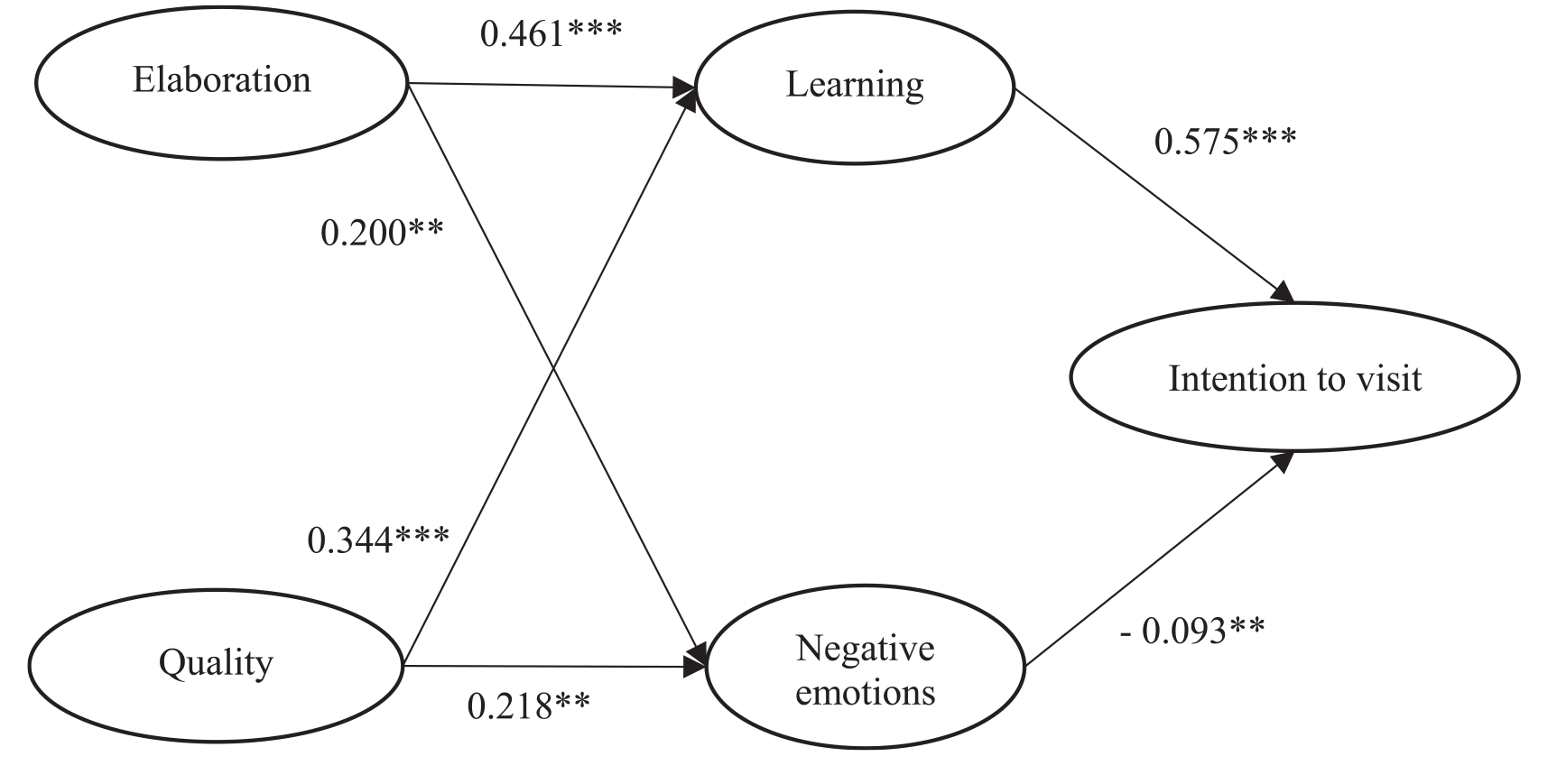
Results of the hypothesis model (Round 2).
Implications
Theoretical Implications
Owing to the proliferation of technologies and the threat of the COVID-19 pandemic, virtual tours are increasingly being designed as an important component of marketing strategies in tourism. Subsequently, substantive research on virtual tourism (Yung and Khoo-Lattimore 2019) may assist tourism marketers to leverage this medium. The present study sought to establish a holistic understanding of how MIP, stimulated by sensory stimuli in virtual tourist attractions, can affect future behavioral intentions (Wei 2019).
This empirical study contributes by uncovering users’ mental stimulation process of stimuli during virtual tours through the lens of the MIP theory. While tourism is enthusiastically embracing the use of virtual tours through digital technologies, research on virtual tourism is still in its early stages (Loureiro, Guerreiro, and Ali 2020). Studies have found that the virtual environment creates an experience (e.g., flow [Kim and Ko 2019], a sense of presence [Tussyadiah et al. 2018]), and the experience may influence brand perception, satisfaction, and loyalty (Bogicevic et al. 2019; Kim and Ko 2019). It has also been suggested that virtual tourism research must not only understand the stimuli and behavior but also the psychological mechanisms between the stimulus and response (Le, Scott, and Lohmann 2019; McCabe, Li, and Chen 2015). MIP provides an ideal perspective to understand how users’ mental processing and internalization of various sensory stimuli influence the virtual experience and deserves more academic attention (Bogicevic et al. 2019). Recognizing the significant role of MIP in virtual tourism (He, Wu, and Li 2018) and a scarcity of research (Bogicevic et al. 2019), this study adds to the literature by exploring the impact of the MIP of sensory stimuli in a virtual tourist attraction and its influence on visitation intention.
Prior research has mainly analyzed MIP and its influence on cognition or emotion separately, with little consideration of the holistic psychological mechanism. According to dual-processing theory, this paper contributes theoretically and empirically by incorporating dual system processing (i.e., cognitive and affective responses). The use of dual system processing broadens the understanding of the influencing mechanisms of MIP on tourist decision making within virtual tourism (McCabe, Li, and Chen 2015). It has been found that both elaboration and quality of MIP may enhance experiential learning (Yung and Khoo-Lattimore 2019), as well as eliciting emotion. High elaboration and quality of MIP, in turn, inspires behavioral intention via learning. In this way, the experiences of users in the digital realm fulfills their need to collect information to make informed decisions about intangible tourism products. However, the effect of MIP on behavioral intention via emotion is somewhat more complex.
Although most studies primarily suggest there is a positive effect of MIP on consumption (Le, Scott, and Lohmann 2019), this study found that there may also be a negative effect. This may be so if the tourist attraction triggers negative emotions. The MIP of the unpleasant content may lead to a reduced intention to visit. By analyzing the two rounds of survey data, the results demonstrated that the virtual Nanjing Memorial was laden with heavy, negative emotions and created vivid imagery for the user. The intensity of these emotions for the user not only failed to develop their interest but also impacted on the user’s intention to visit. It would seem that when users process information that evokes negative emotions, the frequency and vividness of the mental image in the mind of the user increases, which may hinder the intention to visit. This has been confirmed by psychological research that suggests consumers pursue services related to positive emotions and avoid those linked with negative emotions (Baumeister et al. 2007). This would also suggest that after experiencing unpleasant virtual tours, individuals are less inclined to visit the actual attractions to protect themselves from further negative emotions. This is supported by Dubois et al. (2020) where video game players might not separate a real place from the fictional place (as the backdrop in the games), the violent content, and the negative representations of the place portrayed in the video games. The impression of the place may have a detrimental impact on future travel intention to this place. Thus, where MIP affects behavioral intention via emotion, the impact depends on the valence of the emotion triggered by the stimulus. This result expands the prior research that focused on the positive effect of MIP on tourists’ behavioral intentions (Walters, Sparks, and Herington 2007; Yoo and Kim 2014). Moreover, the study answers the call for more research on the mental stimulation of negative emotions and the effect on tourist behavior in a special tourism context (Le et al. 2020). Previous studies tended to focus on the positive impacts of virtual experience; this study also found there were possible negative impacts on future visitation as a result of a virtual experience (Kim, Lee, and Jung 2020; Tussyadiah et al. 2018). The findings of this study caution us not to overlook the potential negative impacts when studying virtual tourism experiences.
Managerial Implications
The findings provide valuable implications for tourism marketers. It is suggested that greater attention needs to be paid to the nuances of introducing virtual tourist attractions as marketing strategies, with special consideration for the genre and nature of the content. With hedonic tourism attractions, it is important for virtual attractions to elicit vivid pleasant imagery, so that users may perceive the place as attractive. When users are disappointed with virtual attractions, they may be less willing to visit this attraction in reality (Rahmani, Gnoth, and Mather 2019). Instead of simply creating a digital copy of the site or destination, managers would benefit from designing an experience process that avoids possible negative emotions (e.g., disappointment and regret [Nawijn and Biran 2019]). Negative emotions may have a detrimental impact on future behavioral intentions. Virtual tourist attractions also would benefit from the facilitation of interactive experiences or learning (Yung and Khoo-Lattimore 2019). These interactive experiences may help to increase an individual’s desire to visit the actual destination. For instance, background music may enhance the atmosphere to facilitate vivid imagination and experiential learning. In this way, the virtual tourism experience fulfills the individual’s information needs to make a travel decision.
The study’s findings do not suggest that virtual technologies should not be used within non-hedonic tourist attractions (i.e., dark tourism sites) where negative emotions are likely to be evoked (e.g., Auschwitz, Chernobyl Museum). Dark tourism attractions may be seen as educational reflecting on the past and celebrating the present. For users, learning from these historical events and relics within their own homes allows them to appreciate how precious life and peace is. Managers of dark tourism sites may benefit from a focus on experiential learning and the promotion of the role of the virtual environment to preserve public memory and life education. Beyond detailed and concrete exhibit information, important historical events and figures could be represented by digital technologies to improve storytelling (Loureiro, Guerreiro, and Ali 2020). Moreover, personal stories could be used as a cue to incorporate digital technologies, historical relics, and users’ engagement in the digital realm. The virtual world may help to overcome temporal-spatial distance and assist individuals to understand the site’s history and foster empathy within the virtual environment (Laing and Frost 2019). In this manner, the significant function of the attractions is to perpetuate the collective memory and to promote social benefit.
As virtual dark tourist attractions may inspire negative emotions and hinder the intention to visit the site, when constructing a dark tourism virtual memorial, a balance between immersive experience and negative emotions must be reached. Vividly gruesome mental imagery may arouse intense negative emotions, and thus deter future visits, therefore the characteristics of visual stimuli (e.g., lightness/darkness [Sun and Lv 2021]) in virtual dark tourist attractions needs to be designed with discretion. For instance, the degree of the darkness of the virtual environment should not be too high, as it may conjure negative emotions that are too intense. It may also be possible to transform negative emotions to have a positive effect (e.g., reshaping memories, identities, meaning-making) in the dark tourism context (Nawijn and Biran 2019). Virtual tourist attractions need to be designed effectively to facilitate the transformation of negative emotions. The emotional line (arousal, catharsis, transformation, and meaning-making) along each visiting route needs to be designed with ingenuity. At the outset of a virtual tour, a system guide map with multiple itineraries may assist, allowing users to personalize their visit according to their interests. Users might follow an itinerary where the exhibits stimulate negative emotions. In such instances, there is a need to provide channels for contemplation and emotional catharsis. For instance, a message board could be added so that users could share comments to express, and transform their emotions (Zheng et al. 2020). Thus, users could derive meaning from a negative emotional experience, thereby benefiting well-being (Wang, Hou, and Chen 2020).
Concluding Remarks
Drawing on MIP, this empirical study constructed a holistic framework to determine if vivid imagery and imagination elicited as a result of sensory stimuli in virtual tourist attractions have a negative effect on users’ intention to visit the actual tourist attraction. The virtual tour of the Nanjing Memorial was studied, and two rounds of surveys were conducted. Grounded within dual-processing theory, cognitive and affective responses were incorporated to increase explanatory power to understand how the virtual experience influenced experiential learning, emotions, and decision making. Results indicated that higher elaboration and quality of MIP could enhance learning. The study addresses a call by Loureiro, Guerreiro, and Ali (2020) for greater attention to the impact of digital technologies on learning. The study also found that vivid imagery within virtual tourist attractions does not always increase the individuals’ desire to visit the site. Vivid imagery may deter the intention to visit via negative emotions. Given the hedonic nature of leisure travel, previous research on MIP tended to focus on positive emotions. By exploring negative emotions, this study sheds light on the potential for virtual technologies to have a negative impact on behavioral intention (Deng, Unnava, and Lee 2019; Li and Chen 2019). These findings advance research by exploring how virtual tourism influences emotions and the intention to visit actual attractions (Yung and Khoo-Lattimore 2019). The study also provides discussion of the implications of the adoption of virtual technologies as a marketing tool.
While this study presents an understanding of MIP within virtual tourist attractions and its nuanced effect on behavioral intention, it is not without limitations. With the development of virtual technologies, multisensory stimuli (e.g., music, text cue to evoke imagination of touch and smell) can be included in virtual tours to create more memorable experiences. As MIP focuses on visual information (Le, Scott, and Lohmann 2019), future studies need to consider multisensory stimuli to evoke tourist imagery processing in the context of digital technologies. As tourists’ MIP might be moderated by individual goals and imagery ability (high or low), future studies could explore the role of goals (Le et al. 2020) and imagery ability (Chang 2013), and the underlying psychological mechanisms between MIP, cognition, emotions, and behavioral intention. Respondents also may have viewed different content during the virtual tour, which did not allow the study to identify the content that induced MIP and influenced behavioral intention. Future studies that focus on the impact of specific content on MIP will gain a better understanding of the impact of MIP on the virtual tour experience. Future studies may contribute by exploring the relationships between MIP, flow (Kim and Ko 2019), immersion (Hudson et al. 2019), and sense of presence (Tussyadiah et al. 2018) in forming vicarious experiences within the virtual world. These experiences could be expanded to virtual adventure tourist attractions, and other contexts that may induce negative emotions to help generalize the findings. Future studies may also benefit by the incorporation of respondents from different cultures to provide a holistic understanding of psychological process and experiences.
Footnotes
Acknowledgements
We are grateful to our students Zhongqing Zhang and Jiale Zhu for distributing the questionnaires and checking the database in the pilot survey.
Declaration of Conflicting Interests
The author(s) declared no potential conflicts of interest with respect to the research, authorship, and/or publication of this article.
Funding
The author(s) disclosed receipt of the following financial support for the research, authorship, and/or publication of this article: This research was funded by the National Natural Science Foundation of China (grant numbers 41801135, 41971173, 71673015, 71572084, 41801144, 41871126); Social Science Foundation of Ministry of Education of China (grant number 17YJC790209).
