




Abstract
Destination marketing organizations (DMOs) have widely adopted virtual reality (VR) commercials to highlight attractions for potential tourists and encourage visitation. This study extends the stimulus-organism-response (SOR) model by incorporating telepresence and social presence as stimuli and elucidating these factors’ possible interplay in jointly shaping users’ cognition, affection, and (re)visit intentions. A 2 × 2 between-subjects experiment was conducted with a sample of 254 participants. Results showed that VR commercials with higher telepresence elicited stronger (re)visit intention, and this effect was mediated by cognition (i.e., education) and affection (i.e., entertainment, and esthetics). Such causal effects appeared stronger in contexts with lower levels of social presence. Findings offer valuable insight into the design of destination VR commercials.
Keywords
Introduction
The COVID-19 pandemic has had profoundly damaging and enduring impacts on the tourism industry, with international travel bans affecting more than 90% of the world’s population (Sarkady, Neuburger, and Egger 2021). Widespread restrictions (e.g., border closures, community lockdowns, and social distancing) have greatly affected tourism business development (Itani and Hollebeek 2021). As a mitigation measure, the World Travel and Tourism Council recommended increasing budgets to promote travel destinations, specifically through virtual reality (VR). VR can offer consumers a “try-before-you-buy” experience that may whet their appetite for tourism as travel restrictions ease (Rogers 2020). More academic effort is needed to explore how to seize COVID-19 as an opportunity to use emerging technology (e.g., VR) to revolutionize tourism destination marketing—particularly in terms of designing destination-oriented VR commercials to encourage visitation once this crisis ends (El-Said and Aziz 2021; Kim and Ko 2019).
VR technology, as a new form of interactive media, affords tourists a 360° glimpse of tourism sites without time or space constraints; put simply, VR provides individuals a sense of physically being “there” (Spielmann and Mantonakis 2018). VR commercials hence represent powerful destination marketing tools that may accelerate the travel and tourism industry’s recovery (Debusmann 2020). A growing number of DMOs have begun to post VR commercials online, aiming to influence viewers’ travel-related decisions by providing first-handed destination experiences (Kang 2020). For instance, when forced to cease physical tours, the Louvre Museum, Great Wall of China, and Eiffel Tower (Bloom 2020) responded by releasing virtual tours. Several countries have even begun embracing VR commercials in an attempt to maintain touristic interest. For example, the Singapore Tourism Board (2020) released the “Experience Singapore now. Travel later.” initiative online (https://www.visitsingapore.com/en/), which includes diverse VR commercials showcasing the city-state’s most iconic attractions. The Germany National Tourist Board has unveiled a number of immersive projects, taking viewers on trips across the country and to parts of its Baltic and North Sea coasts. However, VR commercial production costs are roughly $10,000/finished minute on average (Giardina 2016). Given this high price, more insight is required to help DMOs design destination-oriented VR commercials with optimal effectiveness.
Scholars generally agree that presence plays a critical role in consumers’ participation and advertising success (Bogicevic et al. 2019). Presence comprises two crucial elements, namely telepresence and social presence (Algharabat et al. 2018). Telepresence determines the degree of users’ immersion in a virtual environment, which can shape consumers’ information-gathering efficiency and destination-related attitudes (Nowak and Biocca 2003; Steuer 1992). Social presence refers to “the extent to which other beings (living or synthetic) also exist in the virtual environment” (Schuemie et al. 2001, 184). Several empirical studies have suggested that telepresence can guide consumers’ decision-making process (Kang 2020; Kim and Ko 2019). However, scholars have not yet reached a consensus on whether social presence interferes with the effects of telepresence on consumers’ behavioral intentions. Some studies conducted in online social environments (e.g., online education, video games, online shopping) have shown that social presence is essential to tourists’ perceived telepresence in virtual environments (Kim and Ko 2019; Nagy and Koles 2014; Vella 2016). Another research stream (e.g., Hudson et al. 2019; Sweetser and Wyeth 2005) focuses on the tourism destination context, suggesting that social presence (or social interaction) may distract or interrupt one’s feeling of being immersed in another world and thus diminish the effects of telepresence on users’ behavioral outcomes. The aforementioned disparities highlight the need for more work exploring the effects of social presence on telepresence and consumers’ behavioral outcomes.
A few tourism studies have also emphasized on how sense of presence affects consumers’ tourism brand experiences and visit intention (e.g., Bogicevic et al. 2019). However, few studies have addressed the combined effects of telepresence and social presence on tourists’ (re)visit intentions in a destination marketing context. The underlying psychological process thus remains unclear, giving rise to the following questions: Will the level of telepresence in VR commercials affect tourists’ (re)visit intentions? If yes, what are the underlying mediating mechanisms? What is the role of social presence?
Based on the stimulus-organism-response (SOR) model (Mehrabian and Russell 1974), this study sets out to accomplish the following objectives: (1) to investigate the effects of telepresence on tourists’ (re)visit intentions; (2) to explore the cognitive and affective mediation between telepresence and (re)visit intention, as well as the potential moderating role of social presence; and (3) to provide suggestions for DMOs interested in designing destination-oriented VR commercials. A model was proposed, and tested through a 2 × 2 between-subjects experiment with a sample of 254 participants.
Literature Review and Hypothesis Development
VR in Destination Marketing
VR technology refers to “the use of computer-generated 3D environment[s], that the user can navigate and interact with, resulting in real time simulation of one or more of the user’s five senses” (Guttentag 2010, 638). The 3D virtual world created by VR technology enables customers to acquire destination information interactively, improves their destination attitudes (Tussyadiah et al. 2018), and stimulates the desire for an actual visit (Kim, Lee, and Jung 2020). Compared with conventional forms of multimedia (e.g., photography, video, and audio), VR commercials offer travelers a comprehensive view of destinations in an immersive manner and promotes interactive advertising (Wan et al. 2007), and thereby familiarizing viewers with unknown locations and reduce their perceived risks or anxiety by Lee and Oh (2007).
Earlier literature on the use of VR in tourism emerged in 1995 and summarized the technology’s primary characteristics (e.g., visualization, immersion, and interactivity), possible threats to tourism, and VR’s advantages as a marketing tool (Cheong 1995; Williams and Hobson 1995). Later studies were focused on whether VR technology would enhance the sustainability of mass tourism, framing VR as a useful tool to predict tourists’ location and movement patterns (Torchin 2002). Since the 2000s, researchers have noted its application in tourism contexts (Guttentag 2010; Li, Robinson, and Oriade 2017), and started to investigate its effects on tourists’ travel behavior (Kang 2020; Yung and Khoo-Lattimore 2019).
Recent studies on the VR technologies have moved from simple description of its characteristics to unveiling how these features (e.g., sense of presence) may further shape tourists’ pre-trip experiences and behavioral intentions (e.g., Spielmann and Mantonakis 2018; Wei, Qi, and Zhang, 2019). For example, Choi, Ok, and Choi (2016) found that the informative and entertaining features might influence VR users’ sense of telepresence, as well as their evaluations of utilitarian and hedonic performance. Tussyadiah et al. (2018) suggested that viewers’ sense of presence could affect personal enjoyment of VR experiences, and even alter users’ attitudes toward a destination. Spielmann and Mantonakis (2018) identified a mediating role of telepresence between online virtual tours and users’ object-related attitudes.
Stimulus-Organism-Response (SOR) Model
The Stimulus-Organism-Response (SOR) model (Mehrabian and Russell 1974) suggests that a response output (R), such as (re)visit intention in destination sites, is influenced by a stimulus (S) via an organism’s internal experience (O) (Kim 2015). By definition, the stimuli “are external to the person and consist of various elements of physical atmosphere” (Bagozzi 1986; Jang and Namkung 2009, 452). The organism refers to “individuals’ affective and cognitive intermediary state that occur when they interact with stimuli” (Tang, Warkentin, and Wu 2019, 218). The responses to an environment can be classified as either approach or avoidance behavior: “approach includes a desire to stay, to look around and explore the environment, and to communicate with others in the environment, whereas avoidance is comprised of the opposite behaviors” (Jang and Namkung 2009, 452).
Whereas Mehrabian and Russell (1974) focused solely on affection relative to the organism, Bitner (1992) incorporated cognition into the model. Kim and Lennon (2013) extended Mehrabian and Russell’s (1974) model by integrating reputation and websites as stimuli, cognition and emotion as the organism’s internal states, and purchase intention as the response. In tourism context, Kim, Lee, and Jung (2020) expanded the SOR framework by incorporating authentic experience as a stimulus, affective responses (enjoyment, emotional involvement, flow state) and cognitive responses as organisms, and attachment to VR tourism experiences and (re)visit intention as tourists’ responses. Despite the above works, recently Loureiro, Guerreiro, and Ali’s (2020) called to “further extend [the] SOR framework in new studies by incorporating new constructs more connected to VR technologies” (15).
Telepresence
Telepresence measures the extent to which a VR user has a sense of “being there” in a virtual environment (Nowak and Biocca 2003, 485; Steuer 1992). Technically, the sense of telepresence could be determined by the degree of freedom in users’ input, stereoscopy (e.g., 3D), and level of immersion (Kang 2020). Prior experiments usually create strong telepresence scenarios using VR HMD (e.g., Kang 2020), which provides high immersion and a 3D perspective while affording users the freedom to modify their view by moving in any directions. In contrast, video on 2D screens (e.g., computer monitors) is less immersive and isolating, and users perceive less telepresence (Kang 2020). Essentially, the more interactive and richer the information when moving from 2D to 3D formats (i.e., full-motion video and audio), the stronger the telepresence (Klein 2003). Other factors, such as image quality and sound, have comparatively small effects on telepresence (Kang 2020).
Higher level of telepresence can elicit stronger (re)visit intentions in various ways. First, according to perceptual load theory (Lavie 1995), when facing a task with heavy perceptual load, an individual’s attention will be fully occupied by the task-relevant processes, little attention is available for task-irrelevant distractors. In a VR-based destination marketing case, the VR advertisements formed the main task, and viewers’ surrounding environment brings various real-life distractors (e.g., lights, noise). VR technology enables viewers to visualize the physical destination environment through full immersion in an artificial setting (Hyun and O’Keefe 2012), and thereby increasing viewers’ perceptual load (Leung, Lyu, and Bai 2020). As such, more attentions could be directed to the advertisements, and the destination’ core selling points could be better perceived in an immersive and interactive manner.
Meanwhile, higher telepresence (created by wearing a VR HMD) can obscure the viewers’ external environment and enable them to ignore real-world distractors such as light or noise. This can effectively reduce interference from distractions and enhance viewers’ direct attention on the VR commercials. Given that direct attention can positively influence individuals’ performance on memory-related tasks, high perceptual loads should allow viewers to better recall destination-related selling points presented in VR commercials (Leung, Lyu, and Bai 2020). The more selling points the viewers perceive and recall, the more positive their attitudes toward the destination, and further stimulate stronger (re)visit intention as hypothesized below:
Mediating Roles of Cognition and Affection
A synthesis of the literature on tourists’ decision making suggests that consumers arrive at final judgments via two systems, namely cognitive and affective. The cognitive system involves thorough information searching behavior and deliberate attribute evaluations (Chaiken and Ledgerwood 2011). The affective system entails an intuitive, automatic, and effortless process, reflecting subjective and instantaneous reactions to a product’s features (Hong and Chang, 2015). McCabe, Li, and Chen (2016) argued that decision making involves distinct stages (e.g., information search, information evaluation), with either system being activated in each stage.
Cognition
Cognition refers to consumers’ thoughts and beliefs and is determined by memories, knowledge structures, and thoughts (Lavidge and Steiner 1961). In line with previous studies, this study focuses on three cognitive factors: Perceived usefulness refers to “the extent to which a VR commercial enhances the effectiveness of information acquisition” (Davis 1989, 320; Davis et al. 1989); Perceived ease of use is “the degree to which using the VR commercial is perceived as free of effort” (Davis 1989, 320; Davis et al. 1989); Education refers to “the absorption of events unfolding before [a tourist] at a destination, while actively participating through interactive engagement of the mind” (Oh, Fiore, and Jeoung 2007, 121).
Cognition of technologies arises based on the information content, visual representation, and interactive elements that engage users, all of which are vital in shaping tourists’ (re)visit intentions (Bitner 1992; Kim, Lee, and Jung 2020; Li and Chen 2019). Essentially, if tourists find the VR commercial easy to use, and very useful in providing needed information, they might produce positive attitude toward the VR commercial contents (i.e., accept or concede the contents), form trust toward its producer (e.g., destination marketing organizations), and further form (re)visit intention (Li and Chen 2019). For example, Mäntymäki and Salo (2011) investigated hotel user purchasing behavior in a social virtual world, suggesting that perceived usefulness indirectly affects consumer purchase intention. Huang et al. (2013) also pointed out that a useful, easy-to-use 3D platform for destination promotion could offer visitors a virtual experience that positively influenced their travel intentions to develop consideration and awareness in destination choice making. Similarly, Chang, Shu, and King (2014) revealed that visitors’ utilitarian values of cognitive responses influence (re)visit behaviors among theme park visitors.
This study contends that increased telepresence can promote users’ cognition and in turn increase their (re)visit intentions. The primary barrier to enhance cognition involves consumers’ perceived risk arising from a lack of sufficient and reliable online information (Choi, Ok, and Choi 2016). Higher levels of telepresence can remove this obstacle by providing vivid and dynamic information based on users’ input and thus draws their selective attention (Suh and Chang 2006). As tourists received more real and practical destination-related cues (e.g., locations, destination knowledge), they will perceive less ambiguity and risk, and more usefulness, ease of use, and sense of being educated from the VR commercial (Li and Chen 2019). Therefore, we hypothesize that:
Affection
Affection represents emotional-based attitudes, preference, and experiential hedonic responses (Leung, Lyu, and Bai 2020). This study focuses on three affective elements: Entertainment represents “an activity or performance that provide[s] amusement and pleasure” (Lee et al. 2020, 2); Esthetics is “the beauty that can be expressed through elements such as color, photographs, font style, and layout” (Lee et al. 2020, 2); Escapism is defined as escaping from one’s “regular environments to suspend the power of norms and values that govern their ordinary lives or to think about their lives and societies from different perspectives” (Oh, Fiore, and Jeoung 2007, 122).
Increased telepresence presented in VR commercials can increase tourists’ (re)visit intentions by enhancing the above three affective elements. According to affect infusion theory, affect itself can be the information based on which a consumer makes a purchase decision (Forgas 1995). Destination-related VR content (i.e., historical knowledge, background stories, beautiful scenery) provides emotional experience (e.g., entertainment, esthetics, and escapism). If tourists find the VR commercial was so entertaining that they can completely escape from reality, they might well form deeper impression of the commercials cues and show more interests on the advertised destination (Leung, Lyu, and Bai 2020).
Telepresence has been widely acknowledged as a significant driver of stronger affective responses (Lee 2004). For instance, Lee (2004) found that telepresence produced through a 3D or 4D film enhanced audience members’ entertainment, escape, and esthetics. Relatedly, Kang and Gretzel (2012) discovered that presence elements (or telepresence) created by iPod-based podcasting technology on tours had a significant positive impact on tourists’ entertainment, esthetic, and escape experiences. The multidimensional information users receive through stronger telepresence tends to be relatively simple to interpret and assimilate, thus facilitating construction of richer mental representations. Overall, telepresence enables consumers to process rich information, evokes mental imagery or sensorial richness, and promotes users’ entertainment, esthetics, and escapism (Choi, Ok, and Choi 2016; Ye et al. 2020). The following hypothesis is thus proposed:
Social Presence
Social presence was originally defined as the “sense of being with another” (Biocca, Harms, and Burgoon 2003, 456). In this study, social presence refers to the extent to which a VR user engages with a real person in VR commercials by being psychologically present to develop a sense of interpersonal interaction and sociability (Algharabat et al. 2018). Accordingly, social presence is associated with VR commercials’ capacity to present content related to facial expressions, posture, audio, and other social/personal cues (Short, Williams, and Christie 1976). Therefore, stronger social presence can be established by incorporating a real person into VR content (e.g., Bailenson et al. 2001).
This study contends that increased social presence will stimulate stronger (re)visit intention. Previous e-commerce studies reveal that perceived social presence can enhance online trust, and further encourage behavioral intentions (Gefen, Karahanna, and Straub 2003). The presence of a real person (not a celebrity but a virtual travel companion) in VR commercials allows an individual to establish a close psychological connection and human warmth in many ways (e.g., describing and sharing the destination’s historical knowledge with the viewers), which can help reduce risk and further enhance trust (Ye et al. 2020). Compared with higher social presence, the VR commercial presented in lower social presence might be impersonal and anonymous, making it difficult for viewers to validate the information provided by the destination marketing organizations (i.e., VR commercial producer platform/company). The perception of real person in the VR commercials can helps viewers feel secure about the VR commercial contents and information, which enhance their confidence and trust toward the destination service and travel experience (Zhang, Wang, and Zhang 2021). As such, we expect VR commercials displaying higher levels of social presence to stimulate stronger (re)visit intention as hypothesized below:
The moderating role of social presence
Previous literature has revealed disparities in social presence’s role on telepresence. On one hand, some research suggested that the presence of a real person is essential to tourists’ immersion in virtual environments, in that most people use VR to interact in virtual environments. These studies focused on socially oriented virtual environments that are generally designed to facilitate daily activities (e.g., online education or shopping in a virtual store; Nagy and Koles 2014), develop interpersonal relationships (e.g., holding an online virtual party), or achieve shared goals (e.g., playing a cooperative video game with other players; involving screen basketball sports; Kim and Ko 2019; Vella 2016).
On the other hand, studies have indicated that social presence may not necessarily increase the effects of telepresence on users’ behavioral outcomes. For example, in terms of tourism destinations, Hudson et al. (2019) noted that the presence of other people in a fully immersive VR underwater seascape decreased the impact of telepresence (or immersion) on positive outcomes. More specifically, they found that social interaction with others could interfere with telepresence, leading to a knock-on negative effect on positive behavioral outcomes.
While telepresence elicits stronger cognition among VR users, social presence will reduce the effect of telepresence on users’ cognition and thus compromise their (re)visit intentions. Viewers’ increased perceptual load and improved direct attention underpins the effect of telepresence on cognition. Higher levels of social presence (e.g., incorporating a real person into VR commercials), however, may generate additional stimuli, interrupt users’ attention, and compete with telepresence for cognitive attention, thus attenuating the effect of telepresence on users’ cognition. Hence, we put forward the following hypotheses:
This study also contends that although telepresence will lead to higher affection, social presence will weaken such effects and thus further weaken its effect on (re)visit intention. This contention has several underpinnings. First, a higher level of telepresence affords users potential opportunities to “escape” into an alternative world (i.e., the destination presented in the VR commercials) where human presence is incongruous. Thus, in high social presence context, the users’ interplay with the human elements (e.g., a person presented in the VR) may “expel” them out of the immersive experience and back to their real life, and thereby undermining the impacts of telepresence on users’ entertainment, education, escapism, and esthetics. Empirical studies have shown that others’ presence can interfere with the impact of telepresence (or immersion) on tourists’ (re)visit intentions and destination loyalty (Hudson et al. 2019). Sweetser and Wyeth (2005) also argued that social presence is not an important facilitator of flow but can instead impede immersion; that is, real people in VR commercials represent a link to the real world that can take users out of a fantasy destination shown in the VR commercials.
Second, unlike the aforementioned socially oriented virtual space, a tourism destination presented in the VR commercials does not lead to a sense of becoming part of a community or identifying with a group. Accordingly, others’ social presence embedded in a higher telepresence condition should not enhance involvement in a virtual travel destination featuring physical attractions and natural landscapes (i.e., rather than other people). In other words, others’ social presence will likely diminish the effect of telepresence on users’ affection and reduce their (re)visit intentions as follows:
The following conceptual framework (Figure 1) illustrates the proposed relationships.

Proposed research model.
Methods
Experiment Design and Stimuli
We adopted a 2 (telepresence: higher vs. lower) × 2 (social presence: higher vs. lower) between-subjects factorial design in this study. Following Kang’s (2020) work, telepresence levels were manipulated through different VR devices (VR HMD vs. an HD computer monitor): a higher level of telepresence was achieved via a VR HMD connected with a smartphone where the interaction occurred through bodily motion, and a lower level of telepresence was achieved via a 27″ HD computer monitor where the viewer interacted with the virtual environment by clicking/dragging the mouse. Following Ye et al. (2020) research, we manipulated the level of social presence by showing participants a VR panoramic commercial with or without a real person (a young woman). Notably, the real young woman was not a celebrity, but rather represented a virtual travel companion sharing the destination’s historical knowledge, traditional culture, and locations with the viewer. In the lower level of social presence condition, a voice-over (no real person) was used to introduce relevant information. The two commercial videos were found on a professional VR panoramic video platform, UtoVR (https://www.utovr.com), and were each edited to three minutes. To minimize potential confounding factors and ensure the comparability of the two commercials, we ensured that the two videos were identical in all other aspects, including depicted scenes, advertising lines, and voices; additionally, we ensured that the two VR devices had the same screen resolution (1,080 × 1,920, 1080p) and were operating within the same Wi-Fi network environment. The four experimental treatments are visually summarized in Figure 2.
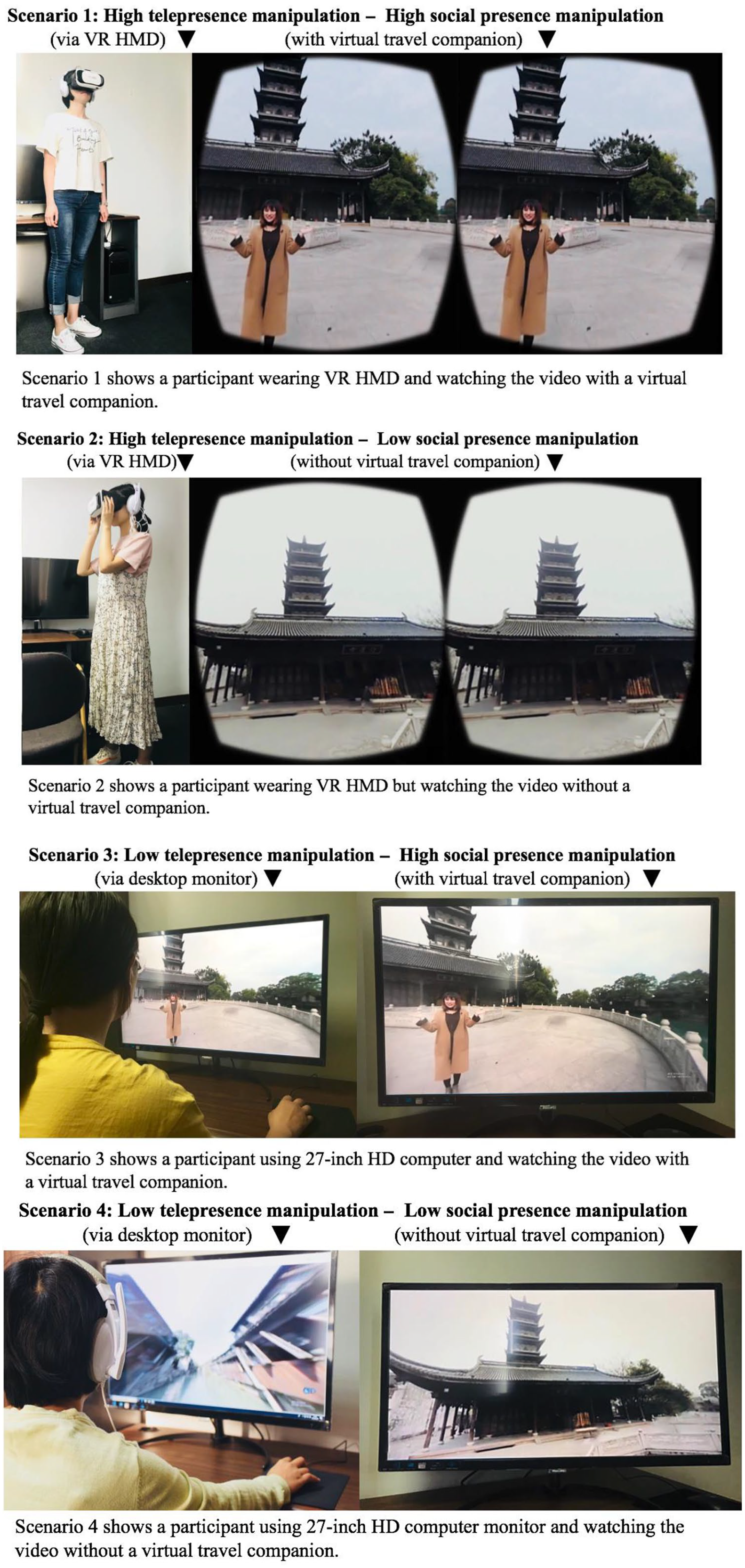
Four experimental groups.
The VR commercial video presented a three-minute virtual travel experience in Wuzhen, one of the most famous historic towns in China. Wuzhen was selected as the study area for two reasons. First, it is a well-known destination in China and is representative of a traditional Chinese historic town; therefore, findings may be generalizable to similar settings. Second, unlike smaller man-made attractions (e.g., museums, shopping centers, and art galleries) that merely allow tourists to move around in an indoor space, historic towns have a larger spatial scale. As these towns offer visitors various tourism attractions, travelers must gather more information in the pre-visit stage, which provided key conditions for our experiment.
Instrument
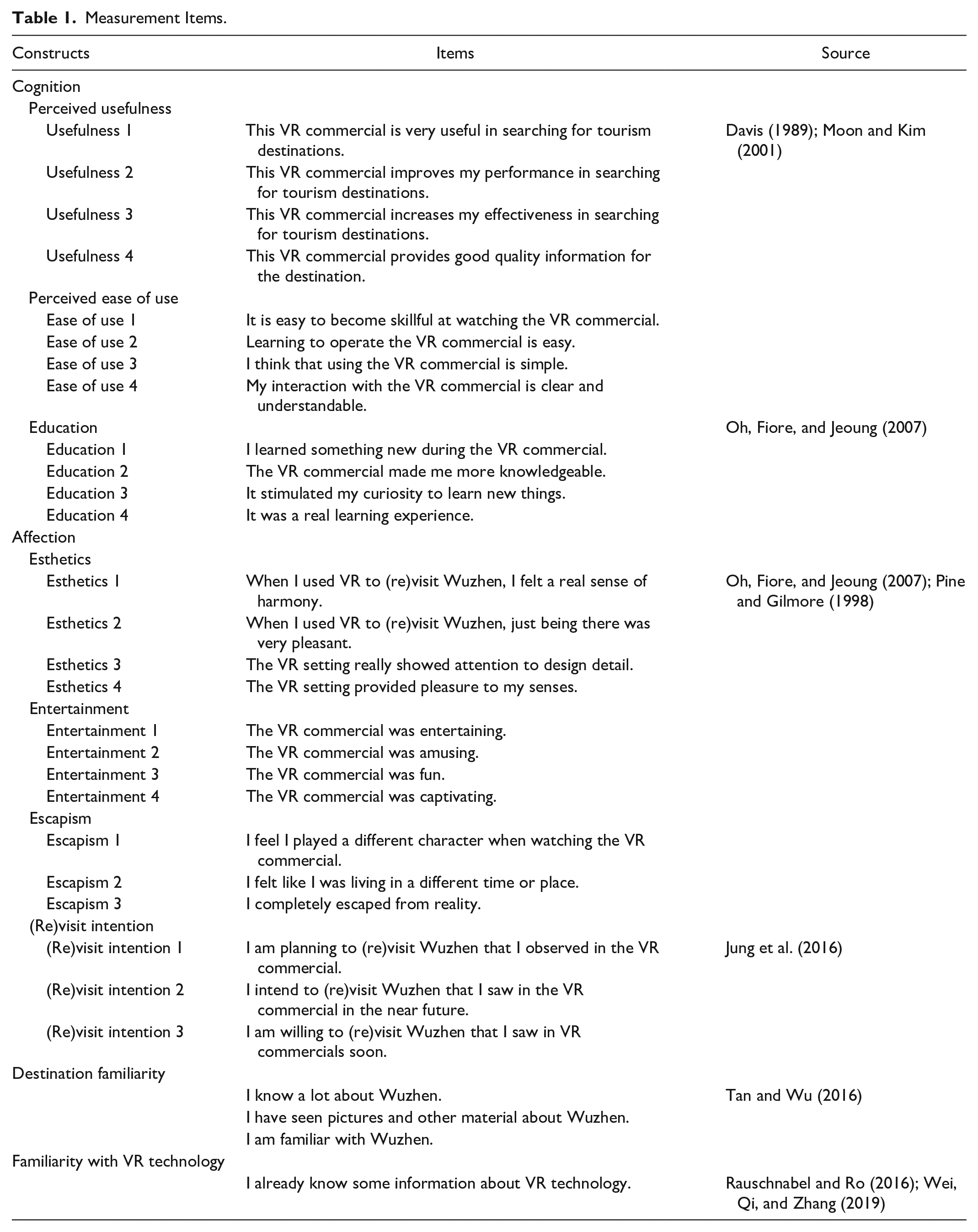
Our questionnaire consisted of three parts. Part 1 included demographic questions, the participant’s familiarity with VR technology, destination familiarity, and prior tourism experience with Wuzhen, if applicable. Part 2 measured participants’ perceived sense of telepresence, perceived sense of social presence, perceived usefulness, perceived ease of use, education, entertainment, esthetics, and escapism. Part 3 measured participants’ intentions to (re)visit the destination shown in the VR commercials. The questionnaire was drafted in English before being translated into Chinese and reviewed by two bilingual (Chinese–English) experts. To ensure translation accuracy, the questionnaire was back-translated from Chinese to English (Behling and Law 2000), and discrepancies were addressed as needed. Three professionals from a large public university in southeastern China reviewed all items for face validity and wording. The research questionnaire included two attention check questions in random locations (e.g., “This is an attention check question, please select ‘strongly disagree/agree”). Items were scored on a 7-point Likert scale (1 = strongly disagree, 7 = strongly agree) and are listed in Table 1.
Measurement Items.
Sample and Experiment Procedures
We performed a laboratory experiment and recruited college students to take part. Data were collected in VR laboratories at a large public university in southeast China. A student sample was chosen for several reasons. First, our study was intended to investigate fundamental human behavior, answering universalistic and theoretical questions (i.e., how telepresence and social presence interact and jointly affect [re]visit intention). When comparing the behavior of students to that of participants recruited from the general population in an experiment, researchers (Wang and Yang 2008) have found that student and nonstudent participants demonstrate similar patterns despite having distinct demographic profiles. Second, unlike field experiments or quasi-experiments that aim to ensure high external validity, the requirement of VR devices justified our use of laboratory experiments, which require high internal validity; the relative homogeneity of a student group could help us maximize control and internal validity (Thomas 2011). Furthermore, industry reports have indicated that consumers between the ages of 18 and 34 are most interested in using VR devices (Boland 2017). Therefore, a student sample can represent tourists who are most likely to use VR devices to watch destination commercials. Overall, the use of a student sample is permissible (Viglia and Dolnicar 2020).
Before the main experiment, a pilot study was distributed to 24 undergraduates from a large public university in southeast China. The pilot study was conducted to identify problems with the study procedures as well as possible awkward or vague questionnaire items. Some items on the initial questionnaire were modified slightly, and the experimental procedures were verified. A power analysis was performed in G*Power 3.1.9 software to determine the main sample size (effect size = 0.30, alpha level = 0.05, power = 0.80, number of groups = 4; Faul et al. 2009). The power analysis indicated that the main study would require 190 participants to ensure an actual power of 0.80. Accordingly, we aimed to collect at least 190 cases (47/group).
The main experiment was conducted from May 5 to July 27, 2018, well before the onset of the COVID-19 pandemic. A recruitment notice was posted on a university student forum, encouraging students to participate in a destination commercial study in exchange for monetary compensation. Each participant could choose a scheduled time listed on the notice to come to the laboratory. Participants were randomly assigned into one of four experimental groups, which were assembled as listed in Table 2. To prevent mutual influences, we used two laboratories: one with a VR HMD and another with a 27″ HD computer monitor. We used the “random” function in Microsoft Excel software to randomly generate group assignments. Each participant received a short reminder message containing the corresponding laboratory room number before the formal experiment began. Experiments were conducted simultaneously and individually (i.e., each session included only one participant at a time in a separate laboratory).
Sample Size in Different Treatments.

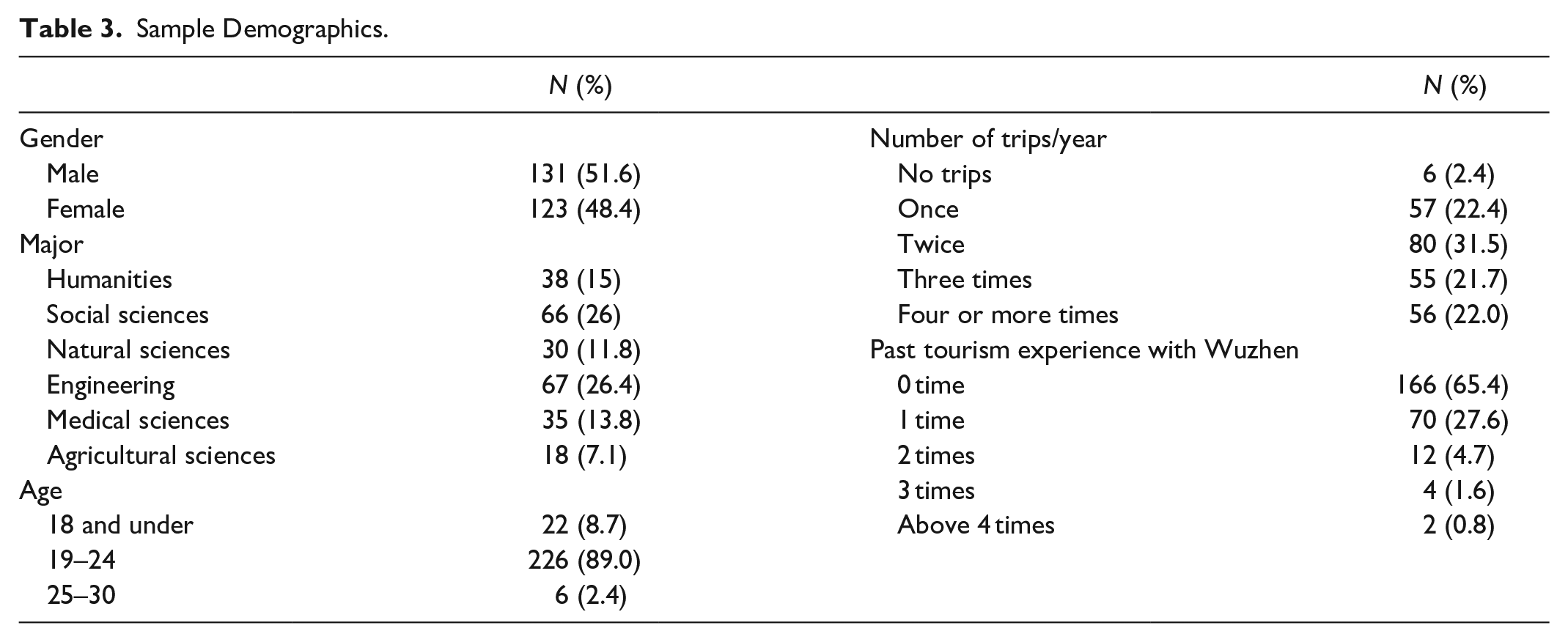
A total of 260 subjects participated in the experiment. Six cases were excluded from analyses for failing to pass the attention checks, leaving 254 valid cases for hypothesis testing (Table 3). Among the participants, 51.6% were men. Most (89%) were between 19 and 24 years old (Mage = 20.42). Participants were studying diverse majors, including in the humanities (15%), social sciences (26%), natural sciences (11.8%), engineering (26.4%), medical sciences (13.8%), and agricultural sciences (7.1%). Most traveled two or three times/year (53.2%). In general, the student sample was representative of younger Chinese travelers, who presumably constitute the primary VR user population.
Sample Demographics.
When the experiment formally started, participants were invited to come to the laboratory entrance at a scheduled time. Upon arrival, they were randomly assigned to one of the four conditions (i.e., the research assistant invited participants to enter the corresponding laboratory). They were first presented with the informed consent form, which briefly introduced our study procedure and potential risks. Participants were informed that if they experienced motion sickness, cybersickness, or other symptoms at any time during the process, they could quit the experiment. After signing the form, participants were asked to read the instructions consisting of a designed scenario in which they imagined planning to visit a famous historic town, Wuzhen, for a weekend holiday; their budget could cover the cost. Second, the research assistant opened a browser window containing the electronic questionnaire. The questionnaire was hosted on a Chinese survey platform, Sojump (https://www.wjx.cn), which enables complete data collection and simple data management. Participants were asked to complete Part 1 of the questionnaire. Third, the research assistant trained each participant on using the equipment (i.e., how to wear the HMD connected to a smartphone and to turn their head to access the 360° view; how to use the 27″ HD computer monitor to view the VR commercial video using a mouse). After this brief training, the research assistant asked each participant to complete a one-minute practice session to familiarize themselves with the VR controls (i.e., moving the head right-left and up-down or dragging the mouse to navigate the monitor simulation). After this practice session, participants were told they could freely view the commercial for three minutes. Then, the research assistant left the room. The VR content varied by group; for example, if participants were assigned to the higher telepresence –higher social presence condition, they were asked to wear a VR HMD and watch the commercial video including a real person. After three minutes, the assistant came back and told the participant to open the browser window again to complete the remaining portion of the questionnaire.
Data Analysis
The descriptive analysis of measurement items appears in Supplemental Appendix A. Preliminary analyses were conducted to examine whether sample characteristics were homogenous across the four conditions. Next, confirmatory factor analysis (CFA) was performed to assess the measurement scales’ validity and reliability. Third, two-way analyses of variance (ANOVA) were carried out in SPSS 24.0 to test the main and interaction effects of telepresence and social presence on (re)visit intention. Lastly, we completed a moderated mediation analysis (SPSS PROCESS Model 7, 5,000 bootstrapping samples; Hayes 2017) to test whether the relationship between telepresence and (re)visit intention was mediated via cognitive and affective elements, and whether this mediated relationship was moderated by social presence.
Results
Manipulation Check
Independent t-tests were carried out to compare the mean values of telepresence between a VR HMD and desktop VR. This variable was measured with a 3-item scale adapted from Kim and Biocca (1997) (e.g., “While watching the VR commercial, I felt I was in the world the VR technology created,” “While watching the VR commercial, my body was in the room, but my mind was inside the world created by the VR technology,” and “While watching the VR commercial, the VR-generated world was more real or present for me compared to the ‘real world’”). Results showed that the VR HMD elicited significantly higher perceived telepresence than desktop VR (MVR HMD = 4.551 vs. MDesktop VR = 4.015; t = 3.582, df = 252, p < .001, d = 0.451).
With respect to social presence, participants were asked to indicate their agreement toward the statements adapted from Gefen and Straub (2004) (e.g., “I felt connected with “real persons” through the VR scenario,” “I sensed human characteristics through the VR commercial,” “I felt human care and warmth through the VR commercial,” and “I felt interpersonal connection through the VR commercial”). Results revealed that VR commercial with a real person evoked a higher level of perceived social presence than that without a companion (MVR HMD = 3.972 vs. MDesktop VR = 3.653; t = 1.895, df = 252, p < .05, d = 0.238). Therefore, the manipulations of social presence and telepresence were each effective.
Confirmatory Factor Analysis
CFA was carried out to assess our measurement scale’s reliability and validity. The model demonstrated satisfactory factor loadings and an acceptable fit to the data (λ2/df = 2.501, p = 0.000; CFI = 0.926; GFI = 0.826; TLI = 0.914; IFI = 0.927; SRMR = 0.065; RMSEA = 0.077). Table 4 lists the results related to convergent and discriminant validity. All standard factor loadings were significant at the 0.001 level and exceeded 0.60. Cronbach’s alpha values surpassed the critical value of 0.80. All composite reliability (CR) values were above 0.8, and average variance extracted (AVE) values were larger than 0.5, indicating good convergent validity (Bagozzi and Yi 2012). The constructs also showed good discriminant validity, as the square root of the AVE value for each construct was greater than its correlations with other constructs (Fornell and Larcker 1981).
Convergent and Discriminant Validity of the Multi-Item Measurements.
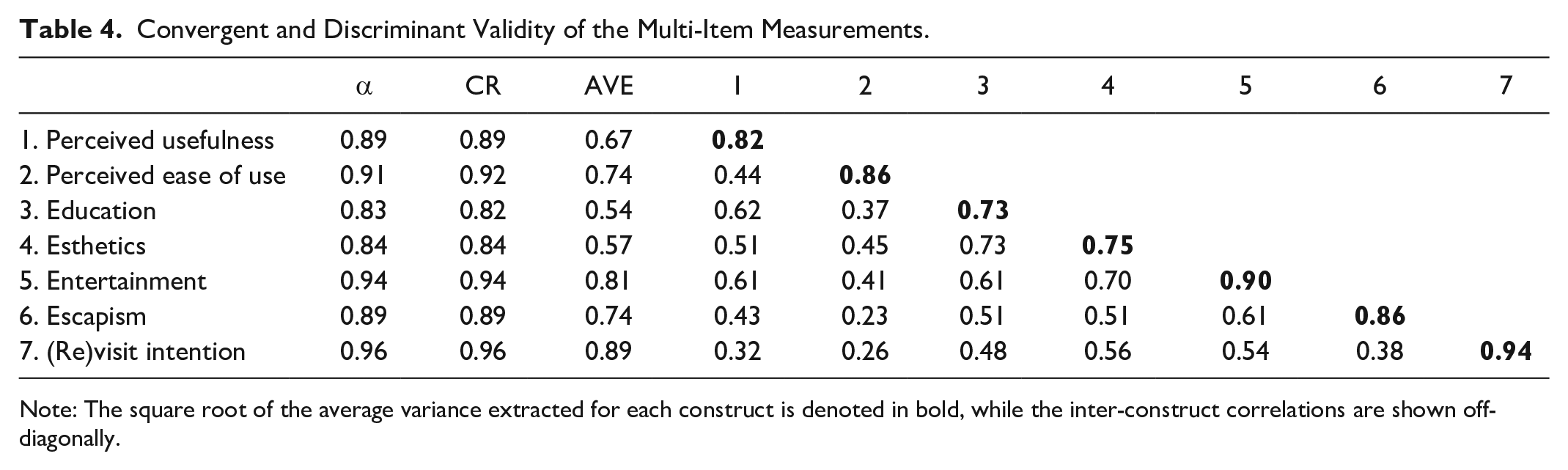
Note: The square root of the average variance extracted for each construct is denoted in bold, while the inter-construct correlations are shown off-diagonally.
Potential Confounders Check
This study also measures the potential confounders: familiarity with VR technology, destination familiarity, and prior tourism experience in Wuzhen. Results revealed that the mean value of users’ familiarity with VR technology in the four experimental groups ranged from 4.110 to 4.660; between-group differences were not significant [F(1, 253) = 1.224, p > .05]. With respect to destination familiarity, the mean values of the four experimental groups ranged between 3.164 and 3.427, and differences among groups were not significant [F(1, 253) = 0.652, p > .05]. In terms of past tourism experience with Wuzhen, according to the total sample’s travel experience average of 0.449, we divided participants into two groups: those with rich travel experience (34.6%) and less tourism experience (65.4%). An independent sample t-test indicated that tourism experience did not significantly affect (re)visit intention (MTER = 5.119 vs. MTEL = 5.076, t = 0.231, p > .05). These results indicate that the effects of telepresence and social presence on (re)visit intention were not influenced by these factors.
Results of Two-Way ANOVA
Dummy-coded variables were created for telepresence and social presence, with 0 being lower and 1 being higher. We conducted a 2 × 2 ANOVA in SPSS 24.0, taking telepresence (higher vs. lower) and social presence (higher vs. lower) as fixed factors with (re)visit intention as the dependent variable. Higher levels of telepresence elicited significantly stronger (re)visit intention than lower levels of telepresence [MVR HMD = 5.265, SD = 1.278; MDesktop VR = 4.927, SD = 1.304; F(1, 253) = 4.215, p < .05, d = 0.262]; as such, H1 was supported, but H4 was not. Planned contrasts are displayed in Figure 3.

Effects of telepresence and social presence on (re)visit intention.
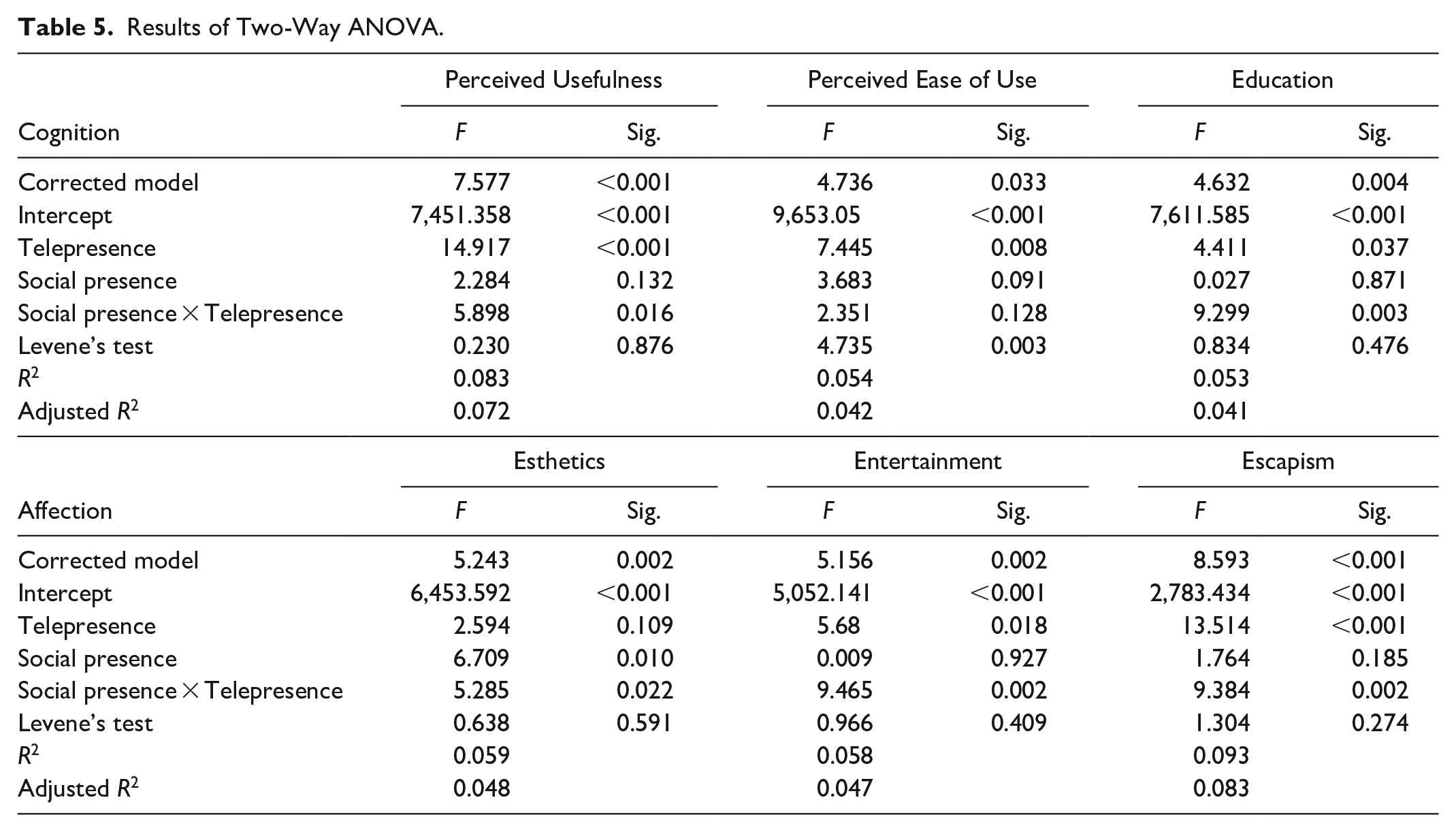
We were also interested in understanding how telepresence and social presence might interact to inform users’ cognition and affection. We therefore conducted a 2 × 2 ANOVA in SPSS 24.0, taking telepresence (higher vs. lower) and social presence (higher vs. lower) as fixed factors. Perceived usefulness, perceived ease of use, education, esthetics, entertainment, and escapism served as dependent variables.
As shown in Table 5 and Figure 4, a higher level of telepresence (VR HMD) elicited significantly stronger perceived usefulness [MVR HMD = 5.482, SD = 0.944; MDesktop VR = 5.011, SD = 1.013; F(1, 253) = 14.917, p < .001, d = 0.482], perceived ease of use [MVR HMD = 6.105, SD = 0.890; MDesktop VR = 5.769, SD = 1.052; F(1, 253) = 7.445, p < .01, d = 0.347], education [MVR HMD = 5.485, SD = 0.944; MDesktop VR = 5.223, SD = 1.039; F(1, 253) = 4.411, p < .05, d = 0.265], entertainment [MVR HMD = 5.379, SD = 1.103; MDesktop VR = 5.023, SD = 1.263; F(1, 253) = 5.680, p < .05, d = 0.302], and escapism [MVR HMD = 4.880, SD = 1.360; MDesktop VR = 4.235, SD = 1.440; F(1, 253) = 13.514, p < .001, d = 0.461]. However, the main effect of telepresence on esthetics was insignificant [MVR HMD = 5.375, SD = 1.072; MDesktop VR = 5.155, SD = 1.052; F(1, 253) = 2.594, p = 0.109, d = 0.207].
Results of Two-Way ANOVA.
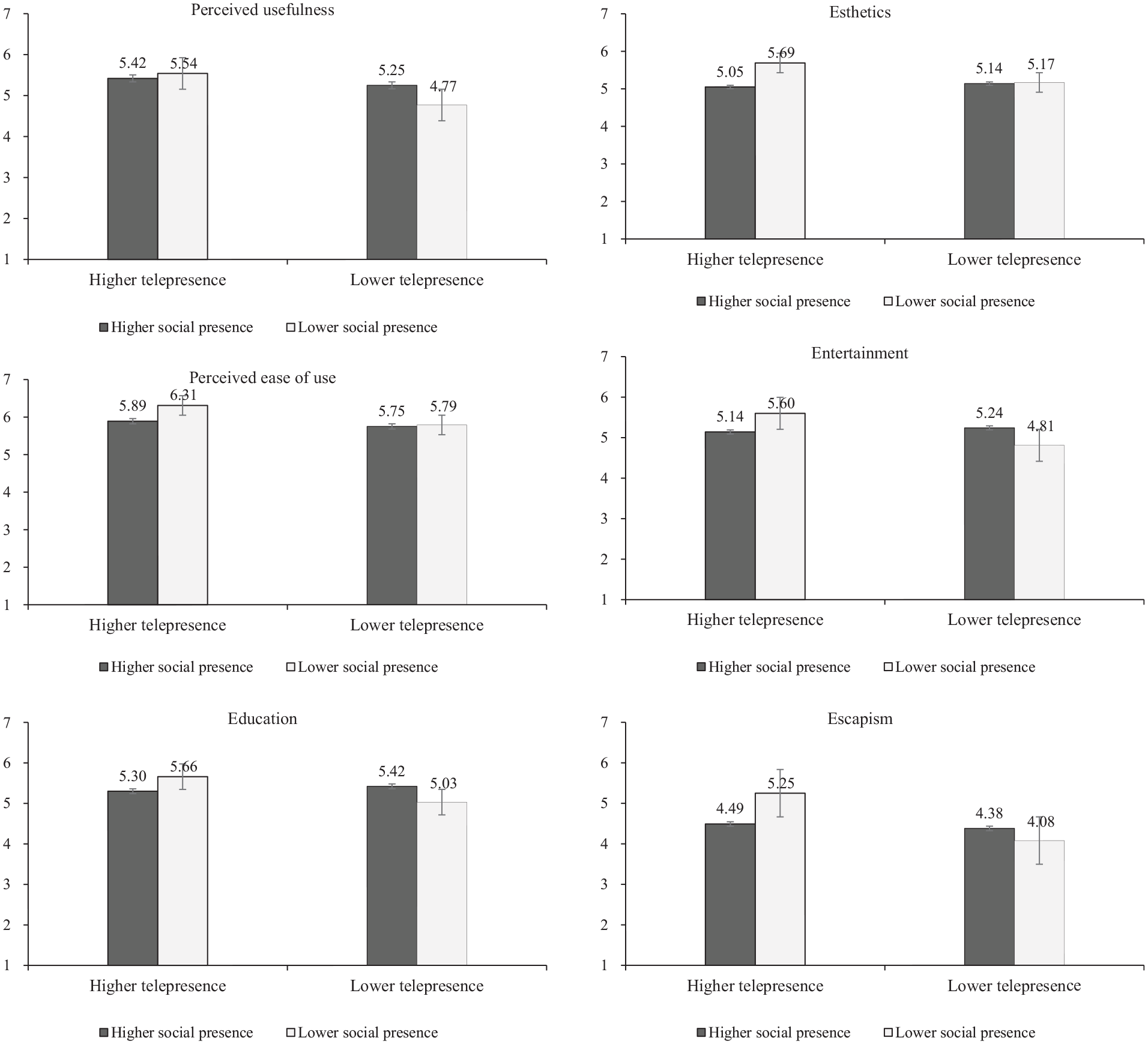
Interactive effect of telepresence and social presence on different dimensions of cognition and affection.
Levene’s tests were all insignificant except for that of perceived ease of use; therefore, the assumption of homoscedasticity was not violated (except for perceived ease of use). Variance values of perceived ease of use for the four groups were 1.087 (high telepresence–high social presence), 0.439 (high telepresence–low social presence), 1.120 (low telepresence–high social presence), and 1.112 (low telepresence–low social presence), respectively. As the largest variance ratio was far less than 3 and the per-group sample size was larger than 5, our findings were robust to violation of the homoscedasticity assumption. Overall, the results of the two-way ANOVA were valid (McDonald 2009).
The telepresence × social presence interaction effect was significant for perceived usefulness, education, esthetics, entertainment, and escapism (except for perceived ease of use). The results of planned contrasts (Figure 4) demonstrated that when participants experienced lower social presence, higher telepresence elicited significantly stronger perceived usefulness [MVR HMD = 5.536, SD = 0.945; MDesktop VR = 4.771, SD = 1.049; F(1, 253) = 5.898, p < .05; d = 0.770], education [MVR HMD = 5.657, SD = 0.875; MDesktop VR = 5.025, SD = 1.074; F(1, 253) = 9.299, p < .01; d = 0.650], esthetics [MVR HMD = 5.686, SD = 0.967; MDesktop VR = 5.174, SD = 0.957; F(1, 253) = 5.285, p < .05; d = 0.532], entertainment [MVR HMD = 5.604, SD = 1.050; MDesktop VR = 4.805, SD = 1.261; F(1, 253) = 9.465, p < .01; d = 0.693], and escapism [MVR HMD = 5.248, SD = 1.243; MDesktop VR = 4.085, SD = 1.546; F(1, 253) = 9.384, p < .01; d = 0.837].
Conversely, under a higher level of social presence (irrespective of whether participants were in the higher or lower telepresence condition), no significant difference was observed in perceived usefulness, education, esthetics, entertainment, and escapism. We therefore found that the effect of telepresence on perceived usefulness, education, esthetics, entertainment, and escapism was much stronger under lower perceived social presence.
Results of Moderated Mediation Analysis
We were also interested in whether the relationship between telepresence and (re)visit intention would be mediated via cognition and affection and whether this mediated relationship would be moderated by social presence. We adopted a moderated mediation analysis (SPSS PROCESS Model 7, 5,000 bootstrapping samples; Hayes 2017), taking telepresence as the independent variable, social presence as the moderated variable, and (re)visit intention as the dependent variable. The aforementioned six predicted mediators were entered simultaneously to test for parallel mediation. PROCESS is an add-on package for SPSS that allows for statistical mediation, moderation, and conditional process analysis based on ordinary least squares or logistic regression (Hayes 2017).
Post-hoc conditional probing of the moderation relationship via the PROCESS macro highlighted the effects of telepresence at different levels of social presence. Table 6 shows that under lower social presence, telepresence had a more positive indirect effect on (re)visit intention via education, entertainment, and esthetics (education: b = 0.126, SE = 0.076, 90% Boot CI: [0.045, 0.253]; esthetics: b = 0.172, SE = 0.093, 90% Boot CI: [0.042, 0.346]; entertainment: b = 0.278, SE = 0.130, 90% Boot CI: [0.089, 0.515]). This effect became insignificant as the level of social presence increased.
Results of Moderated Mediation Analysis.

Importantly, the index of moderated mediation was negative with 90% confidence (education: 90% Boot CI: [−0.312, −0.005]; esthetics: 90% Boot CI: [−0.458, −0.028]; entertainment: 90% Boot CI: [−0.616, −0.081]; these intervals did not include zero). Our findings revealed that in lower social presence conditions, telepresence could elicit stronger cognition (i.e., education) and affection (i.e., entertainment, esthetics) and increase participants’ (re)visit intentions. Therefore, H2[c], H3[a], H3[b], H5[c], H6[a], and H6[b] were supported, but H2[a], H2[b], H3[c], H5[a], H5[b], and H6[c] were not.
Discussion and Conclusions
The COVID-19 outbreak represents a watershed moment for VR technology, making it a permanent fixture of tourism marketing (Debusmann 2020). In the absence of tourists, DMOs (e.g., tourism boards, hotels, and destinations) have turned to VR technology to keep would-be visitors interested and prepare for the long road to recovery. The findings of our study thus may provide valuable insight into “how the tourism industry can respond to and recover from the COVID-19” (Gretzel et al. 2020, 188). This study was focused on the question of how to design destination-oriented VR commercials to encourage visitation once the pandemic ends, and examined how destination-oriented VR commercials with different levels of telepresence and social presence collectively influenced tourists’ internal states (i.e., cognition and affection) and decision making. Several findings are worthy of discussion.
First, higher levels of telepresence in VR commercials were found to promote tourists’ intentions to (re)visit the presented destination. This result coincides with prior studies (e.g., Leung, Lyu, and Bai 2020) showing that VR commercials displaying higher levels of telepresence imposed greater perceptual loads and attracted more attention to the commercial itself, leading to stronger (re)visit intention. This finding also corroborates previous work in the e-business, peer-to-peer accommodation, and 3D commercial realms (e.g., Song, Fiore, and Park 2007; Ye et al. 2020) in that higher telepresence can promote consumers’ online purchase intentions. We have therefore extended research from online retail contexts (e.g., Song et al. 2007) with empirical evidence that consumers’ psychological experiences with VR commercials featuring higher telepresence can be transformed into actual travel intentions.
Second, the insignificant relationship between social presence and (re)visit intention warrants more discussion. This could be attributed to the fact that the real person (not a celebrity but an unknown travel companion) in VR commercials could evoke a sense of strangeness. Social psychological distance distinguishes one’s in-group (e.g., friends and family) from out-groups (e.g., an unknown person in VR commercials) (Hernández-Ortega 2018). As such, although experiencing stronger social presence, viewers may still be suspicious of the reliability, accuracy, and credibility of cues provided by the real (unknown) person. Therefore, our findings suggest that the less reliable and accurate users perceive cues from VR commercials to be, the lower their confidence in the destination (its products) and their intentions to (re)visit.
Third, both cognition (i.e., education) and affection elements (i.e., entertainment, and esthetics) turned out to be key mediators bridging telepresence and users’ (re)visit intentions. This finding coincides with Choi, Ok, and Choi’s (2016) model assuming that telepresence would influence (re)visit intention indirectly by facilitating tourism websites’ utilitarian (cognitive value) and hedonic (affective value) performance. However, this effect opposes Kang’s (2020) study indicating that affection elements are more essential for tourism advertisements.
Fourth, a surprising finding of this study is that, whereas VR commercials exhibiting higher telepresence can enhance users’ cognition (perceived usefulness and education) and affection (entertainment, esthetics, and escapism), the effect appears weaker when social presence is stronger. This pattern contrasts with the popular belief from VR studies in multi-player gaming environments (Vella 2016) and socially oriented virtual environments (Kim and Ko 2019; Nagy and Koles 2014; Ye et al. 2020), where the presence of others enhances consumers’ experiences. This finding reinforces past studies (e.g., Hudson et al. 2019; Sweetser and Wyeth 2005) advocating that human elements disrupt users’ attention and immersion in the tourism destination context. Our findings also supplement research (e.g., Hernández-Ortega 2018) implying that higher levels of social interaction may serve as additional stimuli, distract users’ attention, and compete with higher telepresence for cognitive attention to ultimately diminish the effect of telepresence on users’ cognition. Our results further suggest that this effect is particularly salient in the type of immersive virtual experience studied in this paper (i.e., tourism destination context), which does not involve group achievement.
Finally, the indirect effect of telepresence on (re)visit intention via education, entertainment, and esthetics seems much stronger when social presence is lower and weaker. These results corroborate findings (e.g., Hudson et al. 2019) indicating that, without social presence among human elements in virtual environments, a VR HMD with stronger telepresence can block out the external environment and enable viewers to ignore real-world distractors. Doing so can create a more isolated and immersive virtual world that allows VR viewers to focus their attention, more readily recall destination-related selling points presented in VR commercials, and demonstrate stronger behavioral outcomes.
Nonetheless, the insignificant mediating effect of escapism warrants closer discussion. Although VR commercials presented in higher levels of telepresence positively influences escapism, it is not a significant driver of (re)visit intention. This result aligns with those of Hosany and Witham (2010), who noted that escapism was not statistically related to tourists’ satisfaction, intentions to recommend, or destination loyalty. This insignificant effect was likely due to the scale items, as Oh, Fiore, and Jeoung (2007) found that education, entertainment, esthetics, and escapism differed in their relative importance in explaining outcome variables. Therefore, future research should adopt a different set of items to measure escapism.
The above discussion points to several conclusions. Generally, VR commercials displaying higher levels of telepresence elicited stronger (re)visit intention than those with lower telepresence, and this effect was mediated by both cognition (i.e., education) and affection elements (i.e., entertainment and esthetics), and moderated by social presence. The effects of telepresence on cognition (i.e., education) and affection (i.e., entertainment and esthetics) will be stronger in the lower social presence contexts.
Contributions, Implications, and Limitations
This study contributes to tourism-related VR research in several ways. First, we developed a SOR-based model incorporating telepresence and social presence as stimuli. This model elucidated how telepresence and social presence can interplay to jointly shape users’ cognition, affection, and (re)visit intentions. Previous VR literature has suggested that telepresence or social presence can each inform consumer behavior (e.g., Choi, Ok, and Choi 2016; Kang 2020; Kim and Ko 2019), but little was known about how telepresence and social presence might simultaneously influence users’ cognition, affection, and (re)visit intentions. To the best of our knowledge, our study is one of the first to explore the underlying moderating effect of social presence on the relationship between telepresence and users’ cognition, affection, and (re)visit intentions relative to destination marketing.
Second, this study advances the understanding of VR users’ experience in the VR commercials. In recognition of both cognitive and affective elements of VR applications, this study offers empirical evidence for the effects of telepresence on different aspects of VR users’ experience in the VR commercials, and further on tourists’ behavior intention.
Finally, although telepresence was found to positively influence (re)visit intention via education, entertainment, and esthetics, this effect was much stronger when social presence was lower and weaker. This pattern contrasts with general findings in socially oriented virtual environments (Kim and Ko 2019; Nagy and Koles 2014; Vella 2016). Our findings suggest that social presence can interfere with the effect of telepresence on (re)visit intention, and this impact is more salient in VR commercials where the need for social interaction or group identity is less prioritized.
Our pre-pandemic findings also have practical implications for DMOs interested in designing destination-oriented VR commercials to encourage (re)visitation once the crisis ends. First, increased telepresence can promote tourists’ intentions to (re)visit a destination presented via VR commercials, and this effect seems much stronger when social presence is lower. As more people are likely to shift to work-from-home arrangements in the wake of COVID-19, this change could become a key entry point for VR technology (i.e., emerging VR hardware and software/apps may become more accessible to a wider group of consumers). DMOs could leverage VR wearable devices (e.g., Sony PlayStation VR, Google Daydream, Windows Mixed Reality headsets, or Samsung Oculus) to present destination-oriented VR commercials. The VR commercial content delivered by affiliated devices could exclude real-person interaction to encourage full viewer immersion and enhance users’ affection and (re)visit intentions. Second, as VR apps (e.g., Discovery VR app, Ascape VR, and Sites in VR) become more pervasive amid COVID-19, DMOs could consider working with these companies to develop VR commercial content (without real-person presence). DMOs could also add instructions such as “For better viewing, please slip your smartphone into a VR headset when playing the video” before commercials start. Finally, DMOs could thus include more educational (e.g., historical knowledge, background stories), entertaining (e.g., gamification), and esthetic (e.g., attractive subtitle style, charming scenery) elements to induce consumers’ (re)visit intentions.
Our study has limitations that illuminate avenues for future investigation. First, this research only included one experiment without replication. Subsequent studies could use field experiments/quasi-experiments to replicate this study and enhance the external validity of its conclusions. Such efforts would provide further insight into effective destination VR design for better destination marketing. Second, we only recruited students as the study sample and thus the findings may not apply to the entire population of VR users. Future research should replicate this experimental design with different samples, such as actual visitors. Third, this study used destination-related commercials. Generalization from one type of VR commercial content to all types is questionable. Subsequent work could apply the same methodology to different types of VR commercials to verify our findings. Fourth, this research only manipulated telepresence and social presence (not cognition and affection), future studies are encouraged to manipulate cognition and affection, so as to validate their causal effects on (re)visit intention. Moreover, subsequent studies are encouraged to improve the manipulation of experimental scenarios (e.g., use more advanced VR devices) so as to capture more significant effect of telepresence on behavior intention. Finally, as we used an unknown young woman as the real person in research stimuli, our findings may not be generalizable to VR commercial content with other virtual companions (e.g., a cartoon figure) or to a real-person companion with different roles (e.g., friends, family, tour guides, and celebrity). Future studies are thus encouraged to incorporate novel stimuli to investigate the moderating effect of social presence between telepresence and tourists’ (re)visit intentions.
Supplemental Material
sj-docx-1-jtr-10.1177_00472875211047273 – Supplemental material for Virtual Reality in Destination Marketing: Telepresence, Social Presence, and Tourists’ Visit Intentions
Supplemental material, sj-docx-1-jtr-10.1177_00472875211047273 for Virtual Reality in Destination Marketing: Telepresence, Social Presence, and Tourists’ Visit Intentions by Tianyu Ying, Jingyi Tang, Shun Ye, Xiaoyuan Tan and Wei Wei in Journal of Travel Research
Footnotes
Declaration of Conflicting Interests
The author(s) declared no potential conflicts of interest with respect to the research, authorship, and/or publication of this article.
Funding
The author(s) disclosed receipt of the following financial support for the research, authorship, and/or publication of this article: The third and corresponding author acknowledges the funding support by the National Natural Science Foundation of China (Grant Number: 72004195)

Supplemental Material
Supplemental material for this article is available online.
Author Biographies
References
Supplementary Material
Please find the following supplemental material available below.
For Open Access articles published under a Creative Commons License, all supplemental material carries the same license as the article it is associated with.
For non-Open Access articles published, all supplemental material carries a non-exclusive license, and permission requests for re-use of supplemental material or any part of supplemental material shall be sent directly to the copyright owner as specified in the copyright notice associated with the article.
