



Abstract
This paper investigates the impact of the COVID-19 pandemic and its associated policy effects on global tourism performance. Using daily data from 117 countries between January 23, 2020 and June 5, 2021, we applied a fixed-effects panel data model to investigate the impact and its moderators. Results show that COVID-19 cases had a significantly negative effect on tourism revenue and pricing. Specifically, a 10% increase in COVID-19 cases led to a 0.490%, 0.103%, and 0.388% decline in RevPAR, ADR, and occupancy change, respectively. Furthermore, degree of dependence on tourism, and economic support policies moderated this effect. Consequences related to revenue and demand were more remarkable for luxury tourism products than economic ones. Geographical and temporal heterogeneity were also noteworthy, and the impact of pandemic severity on revenue and demand was highly notable in certain periods, such as April and May 2020 and January to mid-March 2021. Lastly, implications are provided.
Introduction
The COVID-19 pandemic is a tragedy of historic proportions. Since early 2020, governments worldwide have mandated social distancing and self-isolation, implemented the closure of non-essential businesses, imposed stay-at-home orders, and enforced several rounds of lockdowns to combat the virus. Human mobility and in-person contact remain strongly discouraged due to health and hygiene concerns. Overall, the pandemic has generated unparalleled challenges and grave uncertainty in the global travel industry. Travel and tourism have been among the worst-hit sectors during the pandemic given halts in international travel, border closures, and rigid travel restrictions. International arrivals declined by 74% in 2020, returning to levels of 30 years ago; this loss is equivalent to approximately $1.3 trillion in international tourism receipts (UNWTO 2021), far outweighing previous crises combined—including the 9/11 terrorist attacks, 2003 SARS epidemic, and 2008 economic recession. Tourism activities have shrunk substantially amid the COVID-19-induced downturn, further reinforcing its bleak prospects (Taylor 2020). Travel professionals and government decision makers have thus been forced to grapple with this unforeseen disruption.
Although scholars have examined the economic effects of COVID-19 on individual countries/regions, such as Spain (Gallego and Font 2021), Italy (Polemis 2020), and Hong Kong (Zhang et al. 2021), few have provided global empirical findings that allow for generalizable insights. Given the scope of the COVID-19 outbreak, an assessment of tourism performance at the global level is of particular interest to tourism professionals (i.e., hotel owners and operators, airline operators, and tour guides) and government policymakers. Such an analysis will enable stakeholders to devise suitable strategies to weather this pandemic and inform policies intended to mitigate the virus’s impact. Short-term effects of a public health crisis such as COVID-19 on the tourism sector are intertwined on multiple geographical levels (Page et al. 2006). As such, this study seeks to elucidate the short-term consequences of COVID-19 on tourism demand using a global lens. Specifically, our first research question is “How has the COVID-19 pandemic influenced tourism performance globally.”
The COVID-19 pandemic has triggered several tourism demand shocks, including people’s reluctance to travel and government-imposed travel restrictions. These outcomes represent channels through which the pandemic has inhibited tourism performance, namely via mobility constraints, governments’ border control and stay-at-home orders. Therefore, our second research question is related to these tourism demand shocks: “How do tourism demand shocks derived from COVID-19 (e.g., policy stringencies) affect tourism performance.” Further, every country possesses varying degrees of economic dependence on the tourism industry. Individual countries have also instituted a variety of economic relief packages to alleviate economic losses due to the pandemic (Kreiner, Collins, and Ram 2021). Following this research strand on country-level discrepancies, our third research question asks, “How do country-level differences, such as tourism dependence and economic support during COVID-19, moderate the pandemic’s effects on tourism performance?” Finally, it is essential to acknowledge the roles of spatial and temporal heterogeneity in pandemic impacts from a global perspective. The fourth research question guiding this study is therefore “How do the influences of COVID-19 vary spatially and temporally in terms of global tourism performance.” Addressing these research angles can help policymakers, practitioners, and scholars better understand the possible implications of COVID-19 and take action to ease uncertainty and combat challenges currently facing the global travel industry.
To answer the above questions, we collected daily tourism performance data from 117 countries between January 23, 2020 and June 5, 2021. In particular, we adopted hotel performance indicators to proxy tourism performance for several reasons. First and foremost, hotels represent a key sector of the global tourism and travel industry, and travelers, both domestic and international, spend a sizeable portion of their budget on hotel services (Ahn et al. 2018). Second, revenue per available room (RevPAR), average daily rate (ADR), and occupancy have been widely accepted as core hotel performance metrics from multiple perspectives (e.g., Kim, Lee, and Roehl 2018; Yang and Mao 2020). ADR reflects tourism businesses’ pricing behavior (Lozano, Rey-Maquieira, and Sastre 2020). Occupancy is a fair proxy of travel demand, as tourism demand drives temporary visitor stays and hotel demand. RevPAR, as the product of ADR and occupancy (Sharma, Perdue, and Nicolau 2020), embodies an ideal revenue indicator. Last but not least, high-quality country-level hotel performance data are available at the daily level, thus enabling international comparisons. Panel data econometric models were applied in this study to estimate the impacts of pandemic severity and policy stringency on tourism performance. We also examined factors moderating the impact of the pandemic and investigated the roles of geographical and temporal heterogeneity on the effects of pandemic severity.
This study makes several contributions to the literature. First, it presents a timely and comprehensive effort to examine the effect of the COVID-19 health crisis on global tourism via rigorous econometric modeling. Global tourism industry performance has plummeted during this pandemic; evaluation and planning are urgently needed to promote the industry’s smooth recovery worldwide. Different from prior research that relied on digital footprint big data (Gallego and Font 2021) and corporate stock market data (Sharma and Nicolau 2020), our dataset provides richer and more reliable information on several aspects of tourism performance, including revenue, room nights (demand), and room rates (pricing). Second, to the best of our knowledge, this study represents the first empirical effort to leverage a demand–supply approach to scrutinize structural changes in tourism demand/performance, thereby revealing the channels/mechanisms underlying how COVID-19 has affected the tourism industry through demand shocks. Future conceptual and empirical tourism demand/performance studies can build upon our work to promote a clearer understanding of the economic effects of public health crises on the tourism industry. Third, this study assesses the heterogeneity of COVID-19-related effects on tourism performance by identifying various moderators. In particular, findings regarding heterogeneity in geography (e.g., country-level distinctions) and tourism products (e.g., hotel classes) can illuminate factors dictating the travel industry’s resilience. Fourth, we explored the temporal effects of pandemic severity, such as lagged effects and time-varying effects; results shed light on how the impact of COVID-19 has evolved across stages of the pandemic. Such insight enriches general knowledge of crisis management. Last but not least, the estimation results from our empirical models provide tuning parameters for tourism forecasting efforts projecting demand recovery (Zhang et al. 2021) and macro-economic modeling involving policy simulation (Yang, Zhang, and Chen 2020).
Literature Review
COVID-19 Pandemic and Tourism
The first case of COVID-19, a contagious atypical pneumonia, was reported in December 2019. A person infected with COVID-19 can experience a long incubation period and exhibit mild, severe, or even no symptoms (Chinazzi et al. 2020). The virus’s ability to remain undetected yet infectious is a core epidemiological feature that accelerated COVID-19’s worldwide spread in merely two to three months. Despite the lower death rate compared with respiratory viruses such as SARS and MERS, the World Health Organization (WHO 2021) reported that the total number of confirmed cases and deaths from COVID-19 exceeded more than 100 million and 2 million, respectively, through January 2021. This pandemic therefore represents the gravest public health crisis to afflict the modern world.
Given its heavy reliance on human mobility and close interaction, the tourism and hospitality industry is a co-contributor to, and the primary receiver of, COVID-19 and the consequences thereof (Gallen 2020). Research has shown that countries with higher international tourist volumes have seen more confirmed COVID-19 cases and deaths (Farzanegan et al. 2021). Governments have also been forced to impose travel bans to manage transmission risks (Gössling, Scott, and Hall 2021; Yang, Zhang, and Chen 2020). In effect, this pandemic has obliterated travel demand and generated great uncertainty about people’s future travel behavior (Li et al. 2020), leaving the travel and hospitality industry especially vulnerable (Reddy, Boyd, and Nica 2020). Similar to prior contagious epidemic disasters, the actual impact of the COVID-19 outbreak on tourism and hospitality will depend on the containment of the pandemic, the distribution of vaccinations and other pharmaceutical treatments, and the duration of travel restrictions around the world (Mateus et al. 2014).
Yet COVID-19-induced disruption is unique in its testing of the travel industry’s strength and resilience. First, the pandemic’s scope and corresponding travel decline are unprecedented worldwide. Most prior pandemics, such as SARS, MERS, and swine flu, were limited to several countries or regions. Second, the salience of COVID-19-induced shocks has been dramatic, spontaneous, and unexpected, with reductions in economic growth significantly more pronounced than those caused by regular shocks. Third, given the difficulty of tracing and preventing COVID-19 due to its asymptomatic nature, the virus is readily transmissible via person-to-person contact such as travel and gatherings. Asymptomatic individuals can carry the virus unknowingly. This heightened risk of infection creates a negative externality, which could lead to fundamental behavioral changes in people-to-people or high-touch industries such as tourism, hospitality, and education (Dolnicar and Zare 2020). These circumstances did not apply to earlier pandemics. Finally, the end of the public health crisis from COVID-19 remains elusive although the pandemic has persisted for more than a year. Many other contagious diseases were well controlled by nature, climate, or other measures, typically within 12 months. In the case of COVID-19, however, the UNWTO estimates that international travel will not reach 2019 levels until 2024 (UNWTO 2021).
Systematic Approach to Tourism Performance Analysis
The travel and tourism industry is vulnerable to external shocks, such as economic recessions, infectious disease outbreaks, and political turmoil (OECD 2020). Due to continually shifting market demand and the perishability of tourism products (e.g., hotel rooms and air flights), tourism businesses must react promptly to the dynamics of customer source markets and take proper action by monitoring ongoing changes. One of the most difficult factors to take into account when projecting tourism demand/performance is the level of market disequilibrium, or the imbalance between demand and supply (Arenoe, van der Rest, and Kattuman 2015), each of which can generate short-term growth or declines in ADR, occupancy, and RevPAR in the hotel sector. In other words, tourism performance levels fluctuate daily based on variations in demand, supply, and their associated factors (Denton and Sandstrom 2020). Tourism performance is a function of demand and supply in the short-term visitor market. By applying principles from tourism economics theory, this study uses a dynamic supply–demand market equilibrium–based approach to evaluate tourism performance at the country level.
In the present study, the demand shock (i.e., reduction) is a result of public health measures and changing personal preferences based on efforts to avoid COVID-19 infection. Government policies and regulations to slow the spread of the virus, such as travel bans, stay-at-home orders, quarantine requirements, and border closures, reflect an unmatched demand effect; in other words, people who are eager to travel may be unable to do so because of these restrictions. Moreover, individuals’ travel intentions may decline in accordance with their financial circumstances and attempts to avoid crowds. In terms of monetary expenditure, people are likely to devote a smaller proportion of their budget to non-essential goods such as travel and hotel stays if the pandemic has lowered their personal earnings. The prospect of crowding may deter people from traveling or booking hotels due to perceived risks, namely the possibility of contracting COVID-19. Likewise, business travel has tumbled to historical lows as in-person conferences and conventions have ground to a halt. Tourism supply is similarly vulnerable to the COVID-19 outbreak: many lodging properties and attractions have suffered losses since the onset of the pandemic, resulting in partial or full business closures. These consequences could affect tourism performance as well.
Moderators of COVID-19’s Impact on Tourism
Geographical or cultural boundaries could exert varying effects on the severity of COVID-19 and consequent tourism performance. Two economic attributes, specifically tourism dependence and economic support, are focal points in this paper.
Tourism dependence
The extent of a nation’s reliance on international tourism could influence COVID-19’s impact on tourism performance. Economies with larger tourism sectors, more tourist arrivals, and higher GDP contributions are generally considered tourism-dependent countries. On one hand, the negative effects of COVID-19 could be greater for these countries; a sudden pause in international travel would drastically reduce foreign visitors’ tourism and hotel stays and compromise the tourism and hotel sectors’ operating performance. On the other hand, tourism-dependent countries’ past experience has likely prepared them to deal with adverse events. They might be inclined to adopt national contingency plans, such as government support, a fiscal stimulus, and health emergency management, to allay the negative consequences of COVID-19 on the economy in general and on the tourism industry in particular (Khalid, Okafor, and Burzynska 2021). Additionally, countries with greater international tourism dependence can shift their focus to the domestic travel market, as their residents are constrained to within-country travel. As such, a country’s tourism dependence level could lead COVID-19 to differentially affect tourism performance.
Economic support
To alleviate the adverse effects of the pandemic on floundering economies, governments have introduced an array of policies and economic support, including fiscal, monetary, and financial measures, tailored to stakeholders such as financial institutions, healthcare systems, enterprises (including travel and hospitality firms), and households (Khalid, Okafor, and Burzynska 2021). Stimulus packages intended for tourism companies include a range of economic incentives and benefits, such as income and corporate tax deferrals, the introduction of special loans and credit lines, and exemption from certain payments. As the tourism industry is intertwined with many sectors and the overall economy (Nunkoo et al. 2020), it can benefit substantially from general economic relief packages and continued government support. Furthermore, governmental economic aid to general businesses and households can increase the discretionary funds available for businesses and individuals to take trips. Essentially, governmental economic support is expected to encourage travel activities, resulting in a positive moderating effect between COVID-19 and tourism performance.
COVID-19 and Tourism Demand/Performance
The literature has reflected a renewed interest in examining tourism/hotel performance in the wake of COVID-19, most notably since early 2020. For example, Gössling, Scott, and Hall (2021) offered an initial assessment of COVID-19 and discussed how it compared to earlier crises. They also provided an overview of early estimates of the damage the travel industry would sustain in 2020. In a study of COVID-19’s early impact on hotel performance in Polish cities, Napierała, Leśniewska-Napierała, and Burski (2020) confirmed the negative effect of the pandemic on hotel occupancy and RevPAR since the onset of the pandemic in Europe and Poland, respectively. To quantify the magnitude of government-mandated lockdowns to contain the spread of COVID-19 on the hospitality industry, Polemis (2020) employed a difference-in-differences technique with daily unbalanced panel data to compare hotel performance in Italy and Turkey. Their findings suggested that Italy’s lockdown policy diminished its hotel revenue performance by 68% on average. Sharma and Nicolau (2020) applied a market valuation method (e.g., autoregressive conditional heteroskedasticity model) to study the economic impacts of COVID-19 on four major sectors (i.e., hotel, airline, cruise, and rental car) within the tourism industry. Their results showed that the aforementioned industries were severely affected by the pandemic and suffered significant losses in stock market valuation, with the cruise industry being the hardest hit. To reduce the risk of COVID-19 for tourist markets, Gallego and Font (2021) developed a method to identify leading indicators and detect early reactions in the air travel segment using the data platform ForwardKeys based on digital footprint big data. Their results indicated a double-digit decline in individuals’ desire to travel by air. The authors further performed a case study on Spain, demonstrating the utility of this big data approach in helping destination marketing organizations make informed decisions. Wu et al. (2020) studied the effect of COVID-19 on Hong Kong’s hotel industry and uncovered a negative relationship between the outbreak and hotel room rates. Their findings suggested that four-star hotels were most seriously affected, whereas five-star hotels were affected least. In another study, Zhang et al. (2021) aimed to forecast Hong Kong tourism demand recovery amid COVID-19 by integrating econometric and judgmental techniques, followed by an empirical evaluation of Hong Kong’s tourism performance over the same forecasting period. They recommended using a scenario-based Delphi adjustment econometric forecasting approach for tourism demand prediction to capture the effects of unanticipated events.
Although the abovementioned studies outlined a valuable research direction and reinforced the pandemic’s negative impact on tourism and hotel performance, prior work has suffered from two deficiencies. First, most related research has assumed an isolated approach to examine the effect of COVID-19 on tourism and/or hotel performance using country-specific case studies (Khalid, Okafor, and Burzynska 2021). Results therefore cannot account for national heterogeneity and are not generalizable to other geographical areas. Second, no previous studies have explored the underlying channels how COVID-19 has affected the tourism and hotel industry in particular, resulting in imprecise practical recommendations. This study seeks to fill these gaps by taking a global perspective and unraveling the mechanisms underlying COVID-19’s effects on tourism and hotel performance.
Research Method
Econometric Model and Variable Operationalization
Following Allison (2009) and Wooldridge (2002), we employed fixed-effects panel data models to examine the impact of the COVID-19 pandemic on tourism performance. The baseline model is specified as follows:

where i indicates a specified sample country, and t denotes a specified day between January 23, 2020 and June 5, 2021. We sought to gather data from all countries/territories. Eventually, we incorporated 117 countries into our sample due to substantial missing data in the remaining countries. Our dependent variables were three proxies of daily change in hotels’ operating performance to represent the tourism performance level: lnRevPAR_ratio (i.e., the log ratio of daily RevPAR relative to that on the same day in 2019); lnOCC_ratio (i.e., the log ratio of the daily occupancy rate relative to that on the same day in 2019); and lnADR_ratio (i.e., the log ratio of the daily average daily rate relative to that on the same day in 2019).
The variable lnCOVID19_cases was the key independent variable of interest in the model, reflecting the severity of the pandemic (i.e., the log number of confirmed COVID-19 cases). We used lnCOVID19_cases (i.e., the log number of confirmed COVID-19 cases) as an alternative measure of pandemic severity. Following Abbott and Klaiber (2011), we also introduced
We further explored the moderating effects of certain economic factors by adding interaction terms to our baseline models. Specifically, we took lntouristy, the ratio of international tourist arrivals to a country’s population size (Zuo and Huang 2018), as a moderator to investigate whether tourism-dependent countries would receive heterogeneous effects from the COVID-19 pandemic. We used data from 2018 to construct this variable to avoid potential endogeneity (Wooldridge 2002). We also included an economic support index, lneconomic_support, to assess whether governmental economic support could alleviate the pandemic’s adverse effects.
Data Source and Description
We obtained data on tourism performance indicators (i.e., RevPAR, ADR, and occupancy) and hotel room supply from STR, LLC, the world’s leading data provider on these indicators based on a large sample of hotel properties worldwide (Haynes 2016). For COVID-19 cases, we gathered data from the European Centre for Disease Prevention and Control (https://www.ecdc.europa.eu/en/publications-data/download-todays-data-geographic-distribution-COVID-19-cases-worldwide). Data pertaining to policy variables, including the policy stringency index and economic support index, were provided by the Coronavirus Government Response Tracker (https://www.bsg.ox.ac.uk/research/research-projects/coronavirus-government-response-tracker). The policy stringency index considers various containment and closure policies (e.g., travel controls, restrictions on gatherings, public event cancellations, and public transport closures) and public information campaigns. The economic support index evaluates income support and debt/contract relief for households. In terms of daily flight departures from international airports, we obtained data from the International Civil Aviation Organization’s Global COVID-19 Airport Status (https://www.icao.int/safety/Pages/COVID-19-Airport-Status.aspx). Data on Google mobility were obtained from Google’s Community Mobility Reports (https://www.google.com/COVID19/mobility/), based on Google users’ location history.
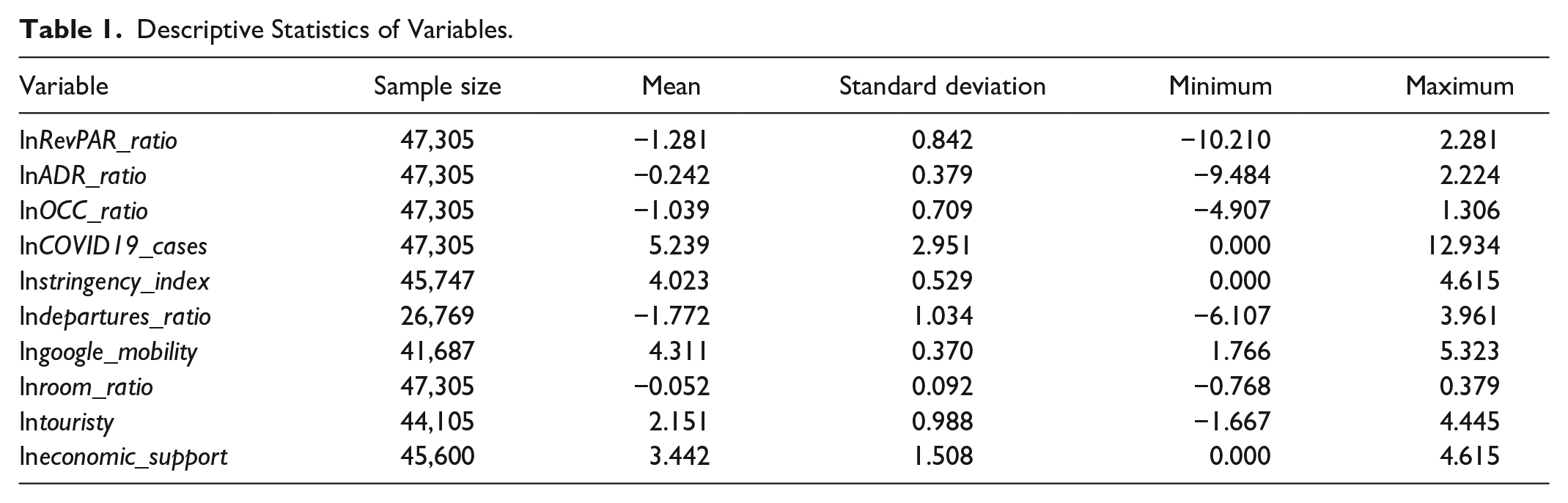
The descriptive statistics of variables and multicollinearity diagnostics are listed in Tables 1 and 2, respectively. As shown in Table 1, among three dependent variables, lnADR_ratio has the lowest mean value and the smallest standard deviation, indicating that during the pandemic time, ADR change fluctuated less than their RevPAR (lnRevPAR_ratio) and occupancy (lnOCC_ratio) counterparts. Note that airflight departure data in international airports were not available in many countries, leaving lndepartures_ratio with significantly smaller sample size. As indicated in Table 2, several pair-wise correlations were well above 0.4, warranting further attention when interpreting results. For example, lnCOVID19_cases and lnstringency_index was highly correlated with a coefficient of 0.449, indicating that the pandemic severity is positively associated with the implementation of stringent policy. Therefore, in empirical analysis, we will introduce these two pandemic-related variables successively. Figure 1 illustrates how the three dependent variables and the major variable of interest changed over time. RevPAR and occupancy each declined sharply from late February 2020 after an upsurge in COVID-19 cases. These two indicators bottomed out around early April of 2020 and then gradually began to recover. In 2021, these two indicators continued to improve.
Descriptive Statistics of Variables.
Correlation of Independent Variables.

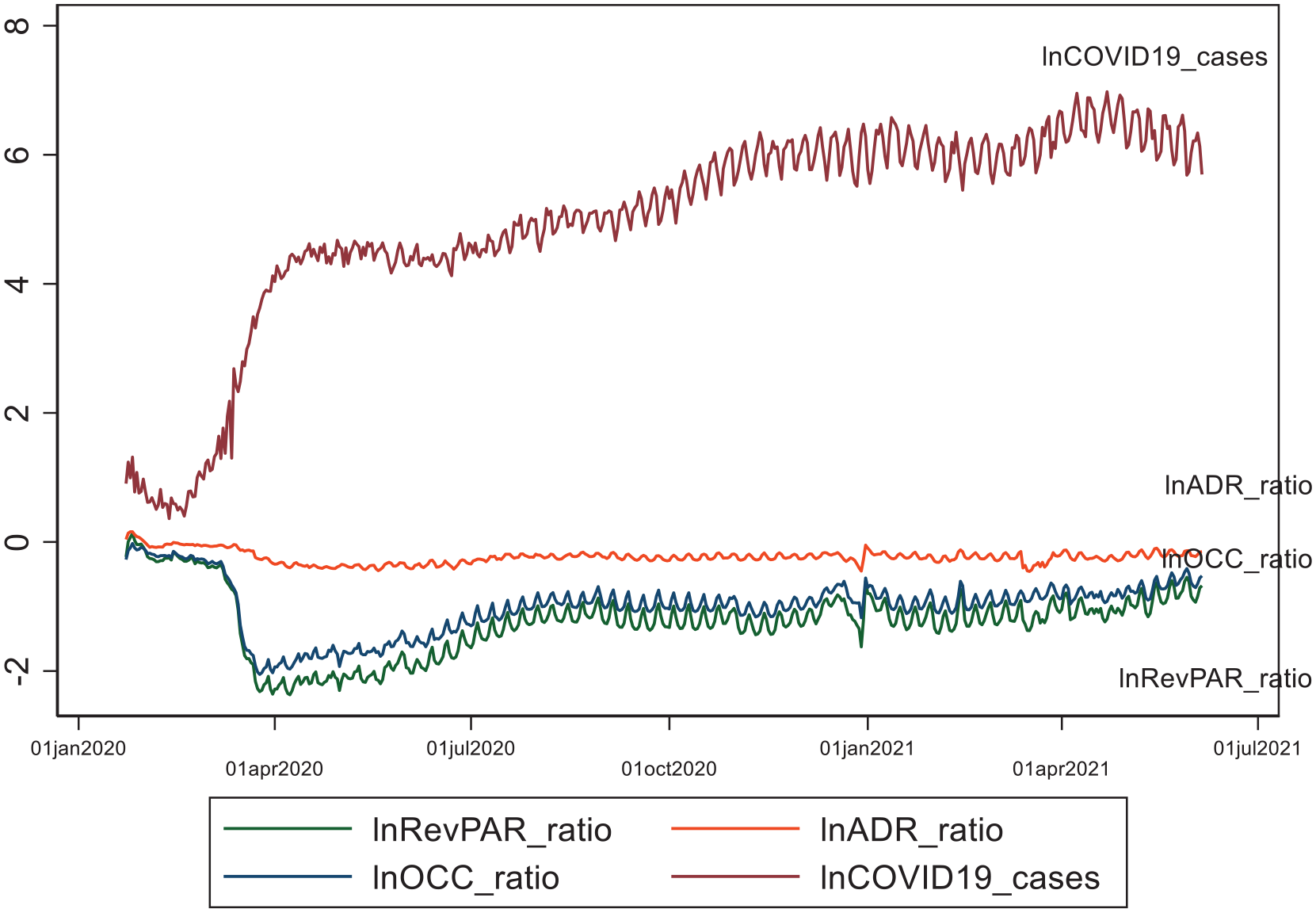
Change of major variables over time.
Figure 2 visualizes the average of tourism performance indicators and COVID-19 cases per capita for countries in our sample. The RevPAR change map (top) indicates that European and Southeastern Asian countries suffered substantially from the pandemic based on RevPAR. By contrast, the ADR change map (middle) shows that countries in North America, Western Europe, and Asia, and the Pacific region witnessed a substantial decline in ADR. In the occupancy change map (bottom), we observed that many Mediterranean countries and Southeastern Asian countries were associated with plummeting occupancy rates.

World map of tourism performance indicators and pandemic situation in the sample.
Estimation Results
Basic Results
Table 3 presents the estimation results of major models without interaction terms. Models 1–3 included lnCOVID19_cases only for the three dependent variables, and the estimated coefficient was negative and significant in all three models. More specifically, a 10% increase in COVID-19 cases resulted in a 0.490%, 0.103%, and 0.388% decline in RevPAR, ADR, and occupancy rate change, respectively. The negative coefficient of lnCOVID19_cases was significantly smaller in the ADR model (Model 2), suggesting that price was less impacted compared to other performance measures. In Models 4–6, we included another independent variable, lnstringency_index, to measure the level of policy stringency. As indicated by this variable’s coefficients, policy stringency had negative and significant effects on all three performance indicators. In particular, this effect on RevPAR (Model 4) and occupancy (Model 6) was substantially more extensive than that on ADR (Model 5). Our estimation results indicated that a 10% increase in policy stringency index led to a 3.56% and 3.21% decrease in RevPAR and occupancy changes year over year, respectively, but resulted in an only 0.351% decrease in ADR.
Estimation Results for Major Models.

Note: (1) **,*** indicate significance at the 5% and 1% level, respectively. (2) Robust standard errors are presented in parentheses.
We included all other independent variables in Models 7–9. All coefficients of lnCOVID19_cases were estimated to negative and statistically significant. Due to data unavailability of some control variables, models were estimated with a smaller sample of 23,708 observations from 100 countries. Regarding the estimation results of additional control variables, both airport flight change (lndepartures_ratio) and hotel room supply change (lnroom_ratio) were found to be positively associated with changes in three performance indicators (Models 7–9). While the level of within-country mobility (lngoogle_mobility) tends to boost occupancy (Model 9), its effect on ADR was found to be negative and significant in Model 8. One possible explanation for this negative effect is that with a higher level of within-country mobility, tourism businesses are able to better leverage pricing and revenue management tools, such as discounts and packaged products, to maximize potential revenue.
Results for Moderators
Table 4 presents estimation results for the moderating effects of lntouristy and lneconomic_support. The coefficient of lnCOVID19_cases*lntouristy was found to be significantly positive in the RevPAR model (Model 10), the ADR model (Model 11), and the occupancy model (Model 12). The results indicate that tourism-dependent countries witnessed a smaller detrimental effect of the pandemic on all three performance indicators. There are three major reasons why tourism dependence helps mitigate the negative shock from the pandemic. First, tourism-dependent countries can be more prepared to implement various crisis management practices that help reduce the negative impact of the pandemic. Second, tourism-dependent countries are more likely to serve a more diversified tourist market, which is likely to reduce the risk during a time of uncertainty (Schmallegger, Taylor, and Carson 2011). Third, behavioral persistence characterizes tourism demand (Li, Song, and Witt 2006), and this inertia tends to buffer the detrimental impacts from the pandemic.
Moderating Effects of Economic Factors.

Note: (1) *** indicates significance at the 1% level. (2) Robust standard errors are presented in parentheses.
In Table 4, the coefficients of lnCOVID19_cases*lneconomic_support were estimated to be significant and positive in Model 13 for RevPAR and Model 15 for occupancy rate. This result underscores the moderating role of governmental economic support, which could help alleviate the negative effects of pandemics on RevPAR and occupancy rates. However, its moderating role was not statistically significant in Model 14 for ADR. This is possible because the government economic aids could just stimulate the travel demand of individuals and organizations that may otherwise not have the financial means to do so during the pandemic. Meanwhile, most hotels keep the rates little changed to remain competitive in the dull market.
Results for Different Tourism Products
We assessed the impact of pandemic severity on different tourism products by examining the effects across hotel classes. Different hotel classes appear susceptible to unique consequences from global pandemics due to the distinct market segments they serve (Yang and Mao 2017). STR classifies hotels into six categories based on room rates: luxury, upper upscale, upscale, upper mid-scale, mid-scale, and economy hotels (Vogel 2016). These labels reflect the degree of luxury associated with different tourism products. We estimated separate models based on tourism performance indicators from different hotel classes. Although we could only access hotel-class performance indicators for 23 countries, the sample was geographically representative, covering all major markets including the Caribbean, Central America, North America, South America, Australia and Oceania, Central and South Asia, Northeastern Asia, Southeastern Asia, Eastern Europe, Northern Europe, Southern Europe, Western Europe, the Middle East, Northern Africa, and Southern Africa. Figure 3 depicts the overall impact of COVID-19 cases (lnCOVID19_cases) and associated 95% confidence intervals (CIs) on RevPAR, ADR, and occupancy changes for different hotel classes. In general, consistent with the results on all hotels in Table 3, pandemic severity, as measured by COVID-19 cases, was less detrimental to ADR than to RevPAR and occupancy. Moreover, high-end hotels were found to be more vulnerable to pandemic severity, as indicated by the larger negative effects of COVID-19 cases on RevPAR and occupancy. Luxury and upper-upscale hotels suffered more than other hotel classes. The effect of pandemic severity was statistically smaller for low-end hotel classes. For example, the effect size for economy hotels is only half of that for luxury ones. However, the effect on ADR demonstrated a different pattern: although the highest- and lowest-end hotel classes (i.e., luxury and economy, respectively) witness a less substantial impact on ADR, all other hotel classes sustained significant ADR losses based on the severity of the COVID-19 outbreak. A possible reason for the smaller effect on luxury hotels is that these hotels enjoy brand equity associated with a price premium; hefty discounts may damage this equity, which is established after decades of effort and thus jeopardize these hotels’ long-term profitability (Yang, Zhang, and Mattila 2015). Collectively, our findings demonstrated that the effects of COVID-19 varied across hotel classes.

Effects of COVID-19 cases by different hotel classes.
Results for Different Geographical Regions
Geographical heterogeneity can further characterize the impact of pandemic severity. We estimated region-specific effects for tourism performance indicators. Figure 4 presents results for several regions, namely Africa (22 countries), Asia (19 countries), Central America (12 countries), Eastern Europe (12 countries), Western Europe (23 countries), the Middle East (14 countries), North America (2 countries), South America (9 countries), and Oceania (4 countries). As indicated in the figure, the negative impact of pandemic severity on RevPAR change was significant in six out of nine regions—with Asia and Eastern Europe being the most affected. Moreover, pandemic severity significantly lowered room rates in four regions and diminished occupancy rates in six regions. The negative impact was found to be largest in Oceania for ADR change and in Eastern Europe for occupancy change.

Effects of COVID-19 cases over different geographical regions.
Lagged Effects of Pandemic Severity
We anticipated that the severity of the pandemic would impose a lagged effect on tourism performance because of tourists’ booking and planning cycles (Webb et al. 2020). Therefore, we examined the lagged effects of COVID-19 cases to recognize when this impact peaked and whether the tourism industry faced long-term consequences. We estimated each model of tourism performance using only the spontaneous and lagged variables of lnCOVID19_cases. The results with lagged effects from 1 to 28 days are depicted in Figure 5. The effect of COVID-19 cases on ADR change was found to be relatively stable over time. The magnitude of the negative effects of COVID-19 cases on RevPAR and occupancy changes reached a maximum around 13 days after, and after that, the effect starts to diminish. The significant lagged effect of COVID-19 cases reflects tourists’ booking cycles (Webb et al. 2020). When tourists book their accommodations before the travel, they consider the current pandemic situation, contributing to the lagged effect. In sum, our analysis highlighted the lagged effect of pandemic severity on tourism performance.
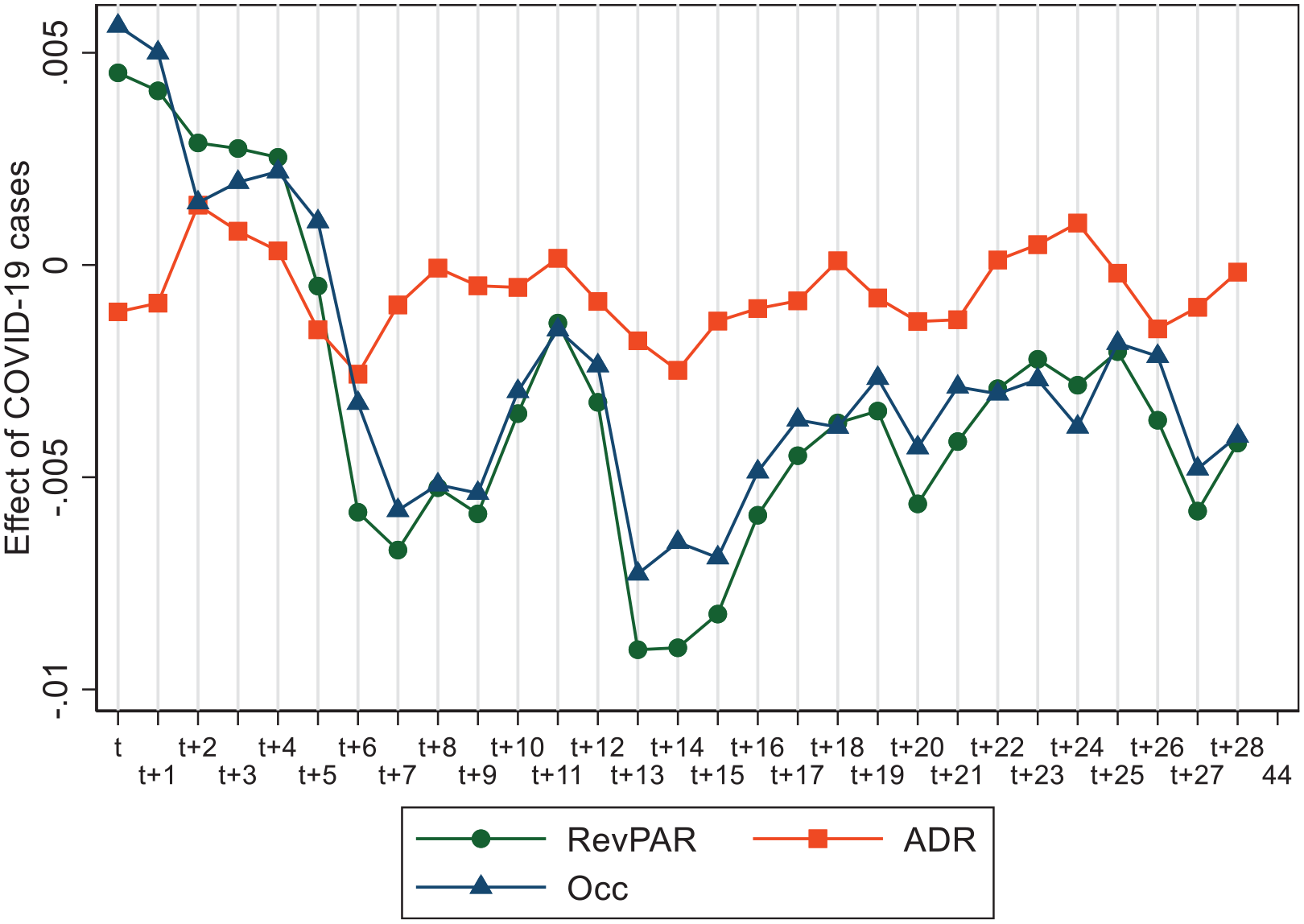
Lagged effects of COVID-19 cases.
Time-Varying Effects of Pandemic Severity
Due to the intricacy and uncertainty of the pandemic, its impact on the global tourism industry could demonstrate dynamic changes over the research period. We split the sample into four sub-samples, and each sample covers 125 days in the data set. Table 5 presents the estimation results. For RevPAR and occupancy, the most substantial impact of pandemic severity (as measured by the coefficient of lnCOVID19_cases) was found in the first period (January 23–May 26, 2020) due to the psychological effect on consumers at the beginning of the outbreak. In the second period (May 27–September 28, 2020), this effect was modest on RevPAR and occupancy after the global pandemic became relatively stabilized. However, along with additional waves of COVID hit, the effect of pandemic severity became sizeable in the third and fourth periods but still smaller than its counterpart in the first period. Regarding the impact on ADR, the result tells a different story. Across the four periods, the largest impact was identified in the second period, with the smallest one in the fourth period.
Estimation results of different periods.

Note: (1) *** indicates significance at the 1% level. (2) Robust standard errors are presented in parentheses.
To understand more nuanced time-varying effects over days, we further estimated time-varying effects of COVID-19 by incorporating a set of interaction terms between lnCOVID19_cases and day-specific dummy variables. By doing so, we obtained estimated marginal effects of COVID-19 cases over time as displayed in Figure 6. This figure also contains a graph illustrating the daily average of COVID cases (lncases) and COVID deaths (lndeaths) across the same period to show how pandemic severity evolved. The graphs on RevPAR (upper left) and occupancy (bottom left) show a similar pattern to the time-varying impact of COVID-19 cases. Starting from February 1, 2020, when the global pandemic was first identified, the negative impact of COVID-19 was considerable in early and mid-February. This negative impact then started to decline. By mid-April, the impact of pandemic severity became statistically insignificant (as the 95% CI included 0). This period corresponded to a decline in COVID-19 cases after the initial peak in early April, as shown in the bottom-right graph of Figure 6. This finding conveys an optimistic market outlook associated with the declining figure, signaling tourism market recovery. However, the negative impacts on RevPAR and occupancy became stronger and were again statistically significant in mid-to-late July. This result can be explained by the spiking number of COVID-19 cases as shown in the daily mean value graph in this period. An upsurge in cases worldwide further eroded tourists’ confidence in traveling and led to a drop in global tourism demand. Likewise, we observe the significant and negative impact around January 1, 2021, and April of 2021, corresponding to COVID-19 case spikes. The time-varying effect on ADR (upper right) demonstrated a different pattern from RevPAR and occupancy. In the first week of February 2020, the native effect of pandemic severity was significant but smaller than the effect sizes on RevPAR and Occ. After that, the effect became moderate and statistically insignificant. This negative effect was later substantial and significant in May and June 2020. As displayed in the daily mean value graph of COVID cases and deaths (bottom right), these two months coincided with relatively stable pandemic severity based on the curve of COVID-19 cases. Therefore, tourism firms seemingly began to leverage pricing tools for revenue management in this area. Starting in June 2020, the negative impact of the pandemic on ADR remained statistically insignificant. In sum, the effect of pandemic severity varied substantially over time. This variation can be partly explained by evolving pandemic severity worldwide, which largely shaped tourists’ expectations and perceived risks related to travel (Kock et al. 2020) as well as tourism businesses’ confidence and pricing strategies (Denizci Guillet and Chu 2021).
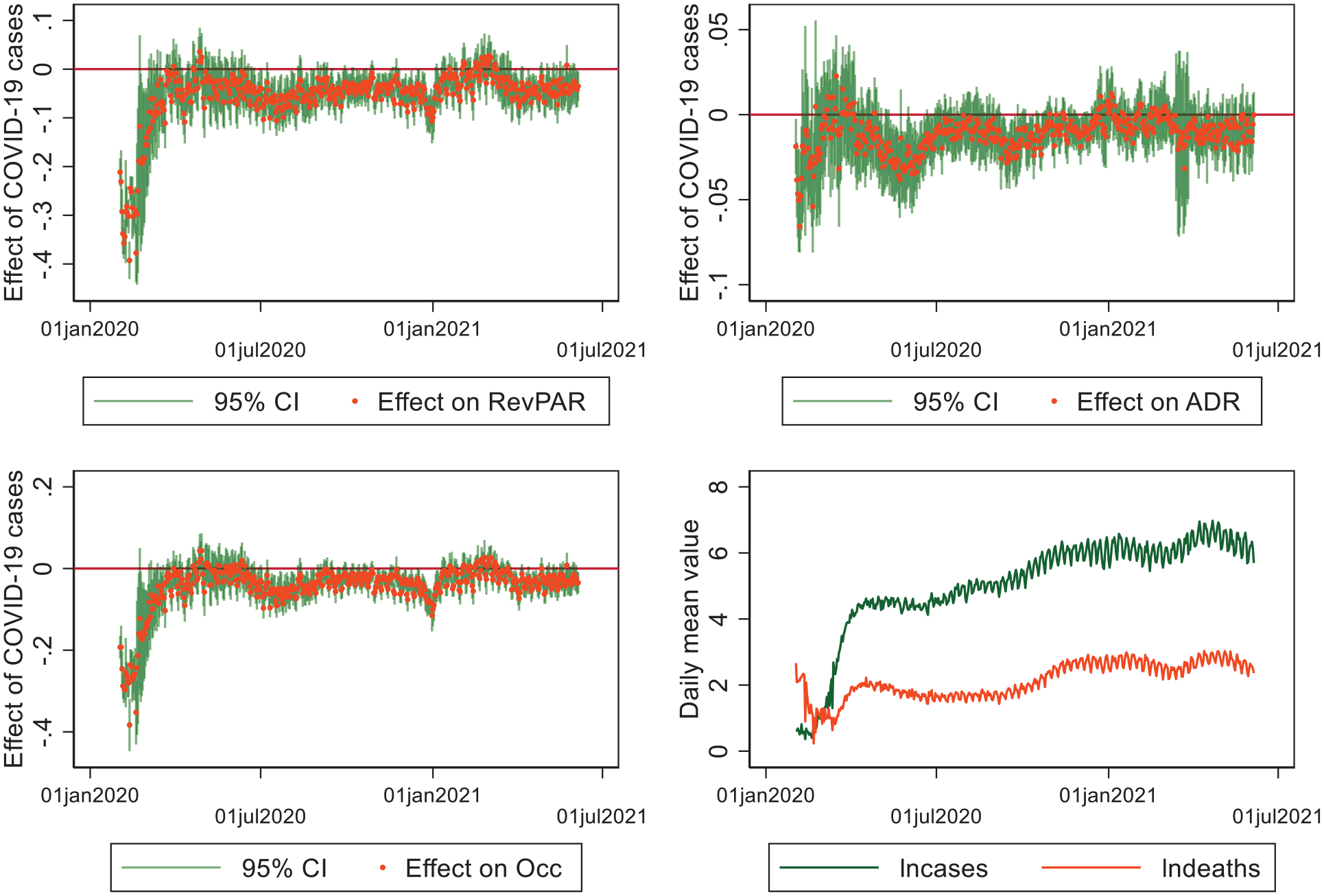
Effects of COVID-19 cases over time.
Results With Alternative Measure of Pandemic Severity
To compare our results based on a different measure of pandemic severity, we used lnCOVID19_deaths to replace lnCOVID19_cases as the major variable of interest and re-estimated all models. Results of these estimations are provided in the Supplemental Material. First, based on the specifications of Models 1–3, the coefficients of lnCOVID19_deaths were estimated to be −0.106, −0.0185, and −0.0873 for RevPAR, ADR, and occupancy changes, respectively. These estimate sizes were substantially larger than their counterparts estimated with lnCOVID19_cases, indicating a larger impact of COVID-19-related deaths on tourism performance during the pandemic. Moreover, the moderating effect of lntouristy was confirmed in all three performance indicators, whereas that of lneconomic_support was confirmed in RevPAR and occupancy. In terms of impacts across different hotel classes, our results suggested a similar pattern to Figure 3. Higher-end hotels were more affected, as indicated by RevPAR and occupancy changes, while luxury and low-end hotels were less impacted based on ADR. Lastly, the time-varying effect of COVID-19 deaths demonstrated a broadly similar pattern to that of COVID-19 cases (Figure 6).
Lastly, we checked whether the growth of COVID19 cases, as a measure of the pandemic severity, impacts tourism performance levels. We created the variable as lnCOVID19_case_growth, measuring the difference of lnCOVID19_cases (lnCOVID19_cases minus the lag of lnCOVID19_cases). As shown in the Supplemental Material, the coefficient of this variable was not estimated to be statistically significant in any of the proposed models. Therefore, daily change of COVID cases was not found to impact tourism performance measures.
Results of Robustness Check
As indicated in Table 1, three performance indicators cover a wide range of values. We, therefore, conducted a robustness check by keeping observations between 1% and 99% percentiles for each dependent variable. Results were presented in the Supplemental Material. According to the specification of Models 1–3, the coefficient of lnCOVID19_cases was estimated to be −0.0498, −0.0101, and −0.0415 for RevPAR, ADR, and occupancy changes, respectively. These estimates were very close to their counterparts in Table 3, confirming the robustness of our major results.
Conclusion and Discussion
COVID-19 is first and foremost a humanitarian crisis that has disrupted everyday life. The travel and tourism industry has been the most ravaged sector due to its heavy reliance on human mobility, leading to a dismal outlook. Our study presents a timely analysis of global tourism/hotel performance amid COVID-19 using data from 117 countries. We first empirically evaluated global tourism performance during the pandemic. We found that COVID-19 cases exerted a significantly negative effect on tourism revenue and pricing, echoing the disruptive nature of this crisis (Gössling, Scott, and Hall 2021) and providing an answer to our first research question. More specifically, a 10% increase in COVID-19 cases generated a 0.490%, 0.103%, and 0.388% decline in RevPAR, ADR, and occupancy change respectively.
In a subsequent analysis, we added constraints from government policies and individuals’ travel-related concerns into the model to address our second research question. Findings revealed unfavorable and salient impacts of stringent government policies on tourism revenue and demand even after separately accounting for COVID-19’s effect on tourism performance. Our study therefore confirmed earlier conclusions regarding the adverse consequences of government-imposed travel restrictions on tourism performance (Khalid, Okafor, and Burzynska 2021; Polemis 2020). Both COVID-19 and national policies uniquely and jointly influenced international tourism performance. Furthermore, the impact of COVID-19 on tourism performance became trivial once human movement variables were added to our models, implying that COVID-19 impedes travel activities via people’s reluctance to move, as reflected in declining air traffic and international travel. We further investigated whether and how country-level differences have influenced tourism performance since the onset of the pandemic, addressing our third research question. We unveiled the multiple effects of tourism dependence, and economic support between COVID-19 and tourism performance. While economic support was found to be a positive moderator of revenue and demand, tourism dependence had a significant impact on all three performance indicators.
Lastly, we carried out temporal and spatial analyses of COVID-19 cases to explore the global impact of the pandemic and respond to our last research question. Results revealed that the pandemic produced lagged effects on various tourism performance indicators. The negative effect of pandemic severity reaches its maximum after 13 days for revenue and demand. In addition, the effects of COVID-19 severity on tourism performance varied substantially over time. We also observed regional effects, particularly geographical differences in tourism performance, with Asia and Eastern Europe being the most vulnerable. We considered different tourist products’ performance as well. Although the pandemic led to an overall reduction in performance, different products (as proxied by hotel classes) suffered differential impacts. For example, luxury products were more affected than economy ones when measured by revenue.
Theoretical Implications
This study presents an analysis of global tourism performance during the COVID-19 outbreak, using a dynamic, systematic market equilibrium approach (i.e., supply and demand changes). Findings not only substantiated the significant and negative effect of the pandemic on tourism performance but also revealed how COVID-19 has influenced tourism performance on the basis of human mobility, such as air traffic, and international travel. We analytically identified factors related to international tourism performance during a global crisis, extending knowledge of tourism performance and its drivers. Moreover, our research enriches the tourism performance literature by incorporating country-level factors into a demand and supply model to account for national heterogeneity. Different national dimensions (i.e., travel restrictions, tourism dependence, and monetary stimulus packages) were found to exert unique effects on tourism performance. Hence, country-level dimensions should be included in future global impact studies to mitigate possible endogeneity issues.
Furthermore, tourism performance can be operationally represented by different indicators, such as revenue (i.e., RevPAR), demand (i.e., occupancy), and pricing (i.e., ADR). Each indicator reflects specific aspects of performance with different findings. For example, COVID-19 adversely influenced revenue and demand substantially but had a less pronounced effect on pricing in this study. Likewise, national travel restrictions exerted smaller negative effects on price when compared to revenue and demand. Additionally, governmental economic support had a positive moderating effect on revenue and demand. Furthermore, revenue and demand tended to move with high volatility but in tandem while pricing remained relatively stable over time during the COVID-19 outbreak. Accordingly, revenue appears to be the best performance indicator; it can conceptually capture the combined effect of demand and pricing, which was further confirmed by our empirical evidence.
Practical Implications
COVID-19 gave rise to the 2020 pandemic. The development of vaccines and therapeutic drugs in late 2020 and early 2021 has begun to reveal a light at the end of the tunnel. Nevertheless, individuals, including customers and employees, should maintain careful sanitation practices such as social distancing, masking, and handwashing even as herd immunity may gradually be achieved through vaccination. Tourism firms such as hotels and destination marketing organizations can concentrate on touchless service encounters or create designated health-related positions (e.g., Chief Health Officer) to emphasize the importance of public health and cleanliness to their guests and employees. Other safety measures, including global vaccine passports and rapid COVID-19 tests at transportation hubs and gathering centers, could also be beneficial additions. Additionally, they are advised to make business continuing plans and surviving strategies on new business models through digitalization for future disasters. In sum, tourism firms should cooperate with governments to contain the virus. These precautions can help to restore travel motivations, dismantle travel barriers, and reduce tourists’ travel-related fear.
Timely lockdown and stringent policy on human mobility at the inception of the pandemic is vital and necessary for effective control of virus transmissions, which allows time for scientists to develop potential solutions and mitigate the medical system pressure. Local authorities are encouraged to educate people and raise their awareness of the virus and pandemic control. They should also consider implementing stimulus plans to sustain virus-stricken economies during the pandemic. Governments can especially distribute more targeted rescue and bailout packages to the hardest-hit sectors like travel, hospitality, and related industries, especially in tourism-dependent countries. Additionally, although stringent national lockdown policies have been deemed effective in containing the virus, governments should assume a calculated, precise, and tiered approach suited to the pandemic’s scope, timing, and affected industries for different phrases. All nations must have a well-rounded crisis management plan and enact a comprehensive Emergency Relief Act to prepare basic means and funds for their people at the earliest possible moment in the event of national disasters.
Countries should also embrace multilateral collaboration due to the contagious nature of COVID-19. Under the WHO’s guidance, a proactive crisis management approach, such as an early-warning system for contagious diseases and integrated global crisis response and recovery strategies, should be formulated and implemented in all countries to combat potential future outbreaks through international cooperation and communication. The government at all levels should work diligently together to draw up common blueprints on border control and human mobility restrictions through data sharing. Phrased recovery plans with concerted efforts can be formulated based on the temporal and geographical trajectory of the virus spread.
Limitations and Future Research
Several limitations must be acknowledged in this study. First, we only considered direct and short-term consequences of COVID-19 on tourism performance. This pandemic is fluid; in light of vaccine supply and viral mutations, it is difficult to predict whether or when herd immunity will be realized to allow for a full reopening of global travel. Subsequent studies can assess the pandemic’s mid-and long-range effects on global tourism performance. Second, we focused on the economic impacts of COVID-19 on tourism performance without accounting for other factors such as social, mental, behavioral, societal, and environmental aspects. It is therefore recommended that scholars examine the aforementioned attributes in future research to more fully delineate the impact of COVID-19. Lastly, we took hotel performance as a proxy for tourism performance in this study. Tourism includes other sectors such as airlines, cruises, destinations, casinos, and so on. Future work can further validate our findings by evaluating the performance of other tourism-related industries.
Supplemental Material
sj-docx-1-jtr-10.1177_00472875211047276 – Supplemental material for Pandemic Severity, Policy Stringency, and Tourism Performance: A Global Analysis
Supplemental material, sj-docx-1-jtr-10.1177_00472875211047276 for Pandemic Severity, Policy Stringency, and Tourism Performance: A Global Analysis by Yang Yang, Zhenxing (Eddie) Mao and Zhihong Wen in Journal of Travel Research
Footnotes
Declaration of Conflicting Interests
The author(s) declared no potential conflicts of interest with respect to the research, authorship, and/or publication of this article.
Funding
The author(s) received no financial support for the research, authorship, and/or publication of this article.

Supplemental Material
Supplemental material for this article is available online.
Author Biographies
References
Supplementary Material
Please find the following supplemental material available below.
For Open Access articles published under a Creative Commons License, all supplemental material carries the same license as the article it is associated with.
For non-Open Access articles published, all supplemental material carries a non-exclusive license, and permission requests for re-use of supplemental material or any part of supplemental material shall be sent directly to the copyright owner as specified in the copyright notice associated with the article.
