



Abstract
In a series of three studies, we explore the effectiveness of two types of discount frames—add-on discount frame (ADF) and bundle discount frame (BDF)—in driving consumers’ purchase intentions for cross-category, add-on travel bundles. Consistent with the analytical mindset induced by a utilitarian core product, we found that an ADF is most effective in driving purchase intentions for utilitarian core-hedonic add-on bundles due to the heightened sense of savings and ease of justification (Study 1). Conversely, consumers tend to adopt a heuristic mindset when evaluating a hedonic core product. Hence, heightened perceptions of attractiveness associated with a BDF (vs. ADF) yield higher purchase intentions for hedonic core-utilitarian add-on bundles (Study 2). Study 3 provides process evidence for the hypothesized effects.
Introduction
Travel managers, particularly in the current COVID-19 environment, are seeking ways to increase share of consumers’ wallets. Add-on bundling constitutes one approach to achieving this goal. Expedia’s Add-On Advantage program, for example, enables consumers to create a travel package by providing a discount on the add-on component (e.g., “Buy a flight and unlock up to 43% off select hotels”). Similarly, individual travel firms leverage add-on bundling to drive ancillary revenues (e.g., Libero Hotel: “Book a room and breakfast, and enjoy breakfast at a discounted price”). The bundled offers in these examples fit an add-on discount frame (ADF) whereby the discount is explicitly offered on the add-on product in the bundle. Another type of discount frame frequently applied by travel firms is a bundle discount frame (BDF), where the discount is offered on the bundle itself rather than on the add-on product or service (e.g., Onyx Hospitality Group’s WOW! Wednesday with a 30% discount on room and breakfast packages, or Novotel’s 25% discount on Thalassa Sea and Spa packages).
Despite the prevalence of both ADF and BDF add-on bundles in practice, little is known about the relative effects of these two discount frames on consumers’ evaluations. In this research, we explore which type of bundle discount frame, ADF or BDF, is most effective in driving demand for cross-category, add-on travel bundles. By definition, cross-category bundles are those that contain both utilitarian (i.e., functional, necessary) and hedonic (i.e., experiential, pleasure-oriented) products. Thus, within a cross-category add-on bundle: (1) a largely utilitarian core product can be paired with a hedonic add-on product, or (2) a largely hedonic core product can be paired with a utilitarian add-on product. Prior research has focused on cross-category bundles containing products of equal or similar monetary value, and/or level of importance (e.g., Khan and Dhar 2010; Kim, Bojanic, and Warnick 2009; Kim, Kim, and Kim 2018). In contrast, add-on bundles, by their nature, contain a lead, or core product that dominates the bundle in terms of monetary value, and an add-on product of lesser monetary value—and importance—that will not be sold unless the lead or core product is purchased (Guiltinan 1987). Thus, here we extend the literature on cross-category bundling to the domain of add-on bundles, and suggest that consumers will adopt a mindset that fits the consumption nature of the core product within the bundle, and this, in turn, will influence their reaction to the bundle discount frame (ADF or BDF).
Prior research suggests that consumers activate different sets of goals (functionality vs. pleasure-related goals) depending on the type of product that they are considering (utilitarian or hedonic), and that these goal-related differences lead to systematic differences in the information-processing strategies that consumers employ when evaluating the two types of products (Chernev 2004; Chitturi, Raghunathan, and Mahajan 2007, 2008). The functionality-related goals underlying utilitarian purchases trigger consumers to engage in cognitive elaboration and effortful information processing, while the pleasure-related goal of hedonic consumption induces consumers to process information more holistically, using heuristics and cues (Melnyk, Klein, and Völckner 2012). Drawing on this body of work, we propose that the consumption nature of the core product in a cross-category, add-on bundle will drive the information processing style that consumers adopt. When the core product in an add-on bundle is largely utilitarian in nature, we expect that consumers will scrutinize available information in order to justify the purchase of a hedonic add-on (Igou 2011; Klein and Melnyk 2016; Li et al. 2020; Melnyk, Klein, and Völckner 2012; Thompson and Hamilton 2006), and we suggest that perceived savings will provide such justification. Further, we propose that the easy to process discount information provided via the ADF will yield higher perceived savings than the BDF, leading to greater ease of justification and willingness to purchase the ADF (vs. the BDF). In contrast, when the core product is largely hedonic in nature, we expect that, by virtue of the holistic approach to information processing induced by the hedonic core product, the BDF will be more effective than an ADF in driving purchase intentions.
In a series of three studies, we test our research hypotheses. In Study 1, we focus on cross-category add-on bundles with a utilitarian core product and a hedonic add-on. In Study 2, we switch our focus to hedonic core-utilitarian add-on bundles. Finally, we designed Study 3 to support Studies 1 and 2 by providing process evidence for the hypothesized information processing modes induced by a utilitarian versus hedonic core product.
In addition to contributing to the literature in the domain of add-on bundles, this research seeks to provide guidance to travel marketers in terms of the optimal use of discount frames (ADF vs. BDF) in add-on bundling. The sale of add-on bundles constitutes an important component of most travel firms’ revenue management strategy. Thus, given that travel products/services can be either hedonic or utilitarian in nature, it is important that travel marketers understand which type of discount frame is likely to be most effective in inducing purchase across different combinations of utilitarian/hedonic core and add-on products.
Literature Review
Cross-Category Add-On Bundle: Utilitarian Core Product and Hedonic Add-On
Given that the consumption of utilitarian products (i.e., products consumed with functionality-related goals) tends to induce cognitive elaboration and effortful processing, we expect that, when the core product within a cross-category bundle is largely utilitarian in nature, consumers will adopt a deliberative, cognitive approach to evaluating the bundle (Igou 2011; Klein and Melnyk 2016; Li et al. 2020; Melnyk, Klein, and Völckner 2012; Thompson and Hamilton 2006). In this context, we suggest that consumers will seek to justify the purchase of a hedonic add-on, and propose that the perceived savings associated with an ADF (vs. BDF) will facilitate such justification, and ultimately yield higher willingness to purchase ratings.
Perceived savings and ease of justification
Prior research suggests that hedonic consumption is more difficult to justify than utilitarian consumption (Khan and Dhar 2010; Kivetz and Zheng 2017; Okada 2005; Uhrich, Schumann and von Wangenheim 2013). Hedonic consumption represents relatively more guilt-inducing consumption than utilitarian consumption, and is more closely related to discretionary, rather than necessary, choice (Choi, Madhavaram, and Park 2020; Choi et al. 2014; Hanks and Mattila 2014; Oh 2020). Furthermore, the outcome of hedonic consumption is related to a personal and experiential outcome, as opposed to the task and functional outcomes of utilitarian consumption, making it more difficult to quantify (Ettinger et al. 2021; Okada 2005). Therefore, justification plays a particularly critical role in the purchase of hedonic products. The rationalization involved in justification allows consumers to rationalize difficult purchase decisions, and can alleviate decision conflict, and post-purchase regret (Shafir, Simonson, and Tversky 1993).
Researchers have demonstrated a number of approaches that can facilitate the justification of hedonic purchases including the degree of effort required to obtain a hedonic product (Jang and Mattila 2005; Kivetz and Simonson 2002), and associating charitable donations to the purchase of hedonic products (Strahilevitz and Myers 1998). Price discounting has also been shown to reduce the anticipated guilt associated with hedonic purchases. For example, Khan and Dhar (2010) demonstrated that, for cross-category bundles containing products of equal monetary value, a discount on the hedonic (vs. utilitarian) product led to higher purchase intentions. In a similar vein, Kivetz and Zheng (2017) found that promotions were more effective in driving purchase decisions when the product was hedonic (vs. utilitarian) in nature, was framed as more hedonic in nature, or the consumer had a hedonic (vs. utilitarian) goal. Here, we extend the literature in the domain of price promotions and propose another factor that may help the consumer to justify hedonic purchases: perceived savings.
Specifically, we suggest that, for utilitarian core-hedonic add-on bundles, an ADF (vs. BDF) will be more effective in driving consumers’ perceptions of savings. Prior research suggests that consumers will more likely choose a bundle with transparent pricing information than a bundle that does not disclose any savings information (Tanford, Baloglu, and Erdem 2012). This finding is in line with the notion that information availability can positively affect the persuasiveness and credibility of information (Bhaduri and Copeland 2021; Lynch and Ariely 2000; Miao and Mattila 2007). Furthermore, consumers are cognitive misers, generally preferring to minimize the amount of cognitive effort expended in product evaluation and choice (Bettman, Luce, and Payne 1998; Tanford and Kim 2019; Westbrook and Braver 2015). Building on this research, we expect that consumers will favor an ADF which provides the consumer with explicit, easy to process information regarding the amount, and source, of the discount (vs. a BDF which only provides consumers with discount information about the bundle as a whole). The more appealing, easier to process, explicit discount information inherent in the ADF will likely enhance savings perceptions (vs. BDF). Furthermore, since perceived savings can facilitate justification for the purchase of a hedonic purchase, consumers are likely to more favorably rate their ability to justify the purchase of an ADF (vs. BDF) bundle as it is consistent with their perceived savings beliefs. This will ultimately lead to higher willingness to purchase ratings for an ADF (vs. BDF).
Hedonic versus utilitarian add-on
Furthermore, we expect that the proposed route to willingness to purchase for a utilitarian core-hedonic add-on bundle will be different to the route one could expect for a homogenous utilitarian add-on bundle (i.e., utilitarian core product and utilitarian add-on). In the latter case, both of the products in the bundle are functional in nature. Prior research suggests that a consumer will not actively seek to justify the purchase of a functional utilitarian add-on (Botti and McGill 2011; Dhar and Wertenbroch 2000; Khan and Dhar 2010; Okada 2005; Sela, Berger, and Liu 2009). Thus, attaching the savings to the add-on or the bundle itself is unlikely to significantly impact savings perceptions. Thus, we expect that, for a homogenous bundle, an ADF and a BDF will be equally effective in driving purchase intentions.
In sum, we hypothesize that for add-on bundles with a utilitarian core product:
H1: The consumption nature of the add-on in the bundle will moderate the effect of discount frame on consumers’ perceptions of savings.
H1a: For cross-category bundles, an ADF will lead to higher perceptions of savings than a BDF.
H1b: For homogenous add-on bundles, there will be no significant difference in perceived savings, ease of justification or willingness to purchase across discount frames (ADF vs. BDF).
H2a: Perceived savings and ease of justification will serially mediate the discount framing-willingness to purchase relationship for cross-category bundles
H2b: Perceived savings and ease of justification will not serially mediate the discount framing-willingness to purchase relationship for homogeneous bundles
Cross-Category Add-On Bundle: Hedonic Core Product and Utilitarian Add-On
The consumption of hedonic products is driven by affective and sensory experiences of sensual or esthetic pleasure (Chernev 2004; Dhar and Wertenbroch 2000; Okada 2005). In this context, consumers are less likely to engage in cognitive elaboration and extensive processing of available information, and are more likely to process information holistically, using heuristics as cues. Indeed, prior research has demonstrated that consumers evaluate hedonic products by holistic processes (Klein and Melnyk 2016; Li et al. 2020); and that they tend to perceive a hedonic product bundle as a gestalt (Evers, Inbar, and Zeelenberg 2014; Shaddy and Fishbach 2017). Building on these findings, we propose that, when the core product within a cross-category add-on bundle is hedonic in nature, consumers will be more willing to purchase a BDF (vs. an ADF). The gestalt nature of the BDF is more in line with the heuristic processing induced by a hedonic core product than the ADF.
We further suggest that the perceived attractiveness of the add-on product within the bundle is the underlying mechanism explaining the superiority of the BDF over ADF. Previous research shows that consumers are highly responsive to the perceived attractiveness of a bundle (e.g., Harlam et al. 1995; Janiszewski and Cunha 2004). For example, separating or combining the components in a bundle can drive the perceived attractiveness of an offer (Chakravarti et al. 2002; Yadav and Monroe 1993). In turn, perceived attractiveness has been found to have a positive impact on quality perceptions and purchase intent (e.g., de Oliveira Santini et al. 2015; Schnurr, Brunner-Sperdin, and Stokburger-Sauer 2017). Here, we expect that, in the case of a BDF, the fit between a hedonic mindset and the gestalt bundle is likely to transfer the consumers’ affective response toward the bundle as a whole, to the perceived attractiveness of the add-on product in the bundle, and subsequent purchase intentions.
Utilitarian versus hedonic add-on
Furthermore, we expect that the predictions set forth for a hedonic core-utilitarian add-on bundle will hold for a homogenous hedonic add-on bundle (i.e., hedonic core product and hedonic add-on). Regardless of the consumption nature of the add-on product in the bundle, a hedonic core product induces heuristic information processing. Thus, the bundle is evaluated holistically, and as a gestalt.
In sum, we hypothesize that for add-on bundles bundle with a hedonic core product:
H3: A BDF will lead to higher perceived attractiveness of the add-on product than an ADF, regardless of the consumption nature of the add-on (hedonic or utilitarian) in the bundle.
H4: The perceived attractiveness of the add-on product in the bundle will mediate the discount framing-willingness to purchase relationship.
Study Design Overview
Study 1 was designed to test H1 and H2 regarding cross-category (vs. homogeneous) add-on bundles with a utilitarian core product, while Study 2 was designed to test H3 and H4 regarding cross-category (vs. homogeneous) add-on bundles with a hedonic core product. Prior research suggests that consumers may engage simultaneously in systematic and heuristic information processing (Lord, Lee, and Sauer 1995; Mick 1992; Mittal 1990). Thus, in line with the approach adopted by Lord, Lee, and Sauer (1995), we ran the causal model depicted in Figure 1 to enable us to rule out heuristic (systematic) information processing when the core product in the add-on bundle was utilitarian (hedonic) in nature. Study 3 was designed to provide supporting evidence for the hypothesized approaches to information processing tested in Studies 1 and 2.

Conceptual model.
Study 1
Methodology
Procedure
Air travel was selected as the context for the Study 1. A seat on an airplane constitutes the core product purchased by consumers, and can be described as largely utilitarian in nature. Air travel also allows for the examination of both hedonic (e.g., airline lounge access, in-flight entertainment) and utilitarian (e.g., checked baggage, travel insurance) add-ons to the core product.
We employed a 2 (discounting frame: ADF and BDF) × 2 (consumption nature of the add-on: hedonic and utilitarian) between-subjects experimental design. Participants were randomly assigned to one of the four conditions. All participants were asked to imagine that they planned to travel to a U.S. city. They were informed that the price of a round-trip ticket for a regular economy class seat was $250. They were also told that, for an extra charge, they could purchase an additional amenity. Participants in the hedonic add-on condition were offered airline lounge access, while checked baggage was offered as the amenity in the utilitarian add-on condition, with each amenity valued at $35. The results of two pretests indicated that consumers view these amenities as comparable in terms of anticipated price and perceived attractiveness. Participants in the ADF (BDF) condition were informed that they would receive a $10 discount on the $35 value of add-on (a $10 discount on the $285 total package cost). See Appendix A for sample scenarios. After reading their assigned scenario, participants completed a questionnaire that contained items used as manipulation checks, measures for the key variables, a realism check, and demographic questions.
Measures
Perceived savings were measured using a 2-item, 7-point Likert scale (González et al. 2016; r = 0.75, p < .0001). A 2-item, 7-point Likert scale was used to measure ease of justification (Heitmann, Lehmann and Herrmann 2007; r = 0.61, p < .0001). Willingness to purchase was measured using a 3-item, 7-point Likert scale (Maxwell 2002; Cronbach’s α = 0.97). We measured the perceived attractiveness of the add-on product within the bundle using a single item (Khan and Dhar 2010), with a 7-point Likert scale. We used a single item, 7-point bipolar scale anchored by primarily utilitarian (1) and primarily hedonic (7) to ensure that the manipulation for consumption nature of the add-on product was successful (Khan and Dhar 2010). Participants were also provided with a definition for each add-on type. To ensure that the manipulation for discount framing was successful, participants were asked to indicate which product in the bundle was discounted. We included two attention checks in the survey. Embedded within the various scale items that participants were required to complete, they were asked to select a specific answer to a non-survey-related question. Finally, a single item measure was used to assess the realism of the scenarios (1 = strongly disagree; 7 = strongly agree). See Table 1 for scale items.
Scale Items for Studies 1 Through 3.

Data analysis
Sample characteristics
A total of 200 participants were recruited via Qualtrics 1 . Fifteen of the participants were removed following a long-string analysis of the data (Curran 2016). Their responses were fully-invariant at the top end of every scale in the survey (i.e., they gave a rating of “7” for all scale items). Of the remaining 185 participants, 7 did not pass both attention checks. However, because our results held whether these participants were included or not, we present our results using the larger sample size of 185. This yielded an approximately equal number of participants in each experimental condition: n = 47 for the ADF/hedonic and the BDF/utilitarian conditions; n = 46 for the BDF/hedonic condition; and n = 45 for the ADF/utilitarian condition. Approximately, 49% (n = 91) of the participants were female. The average age of the participants was 45.78 (SD: 13.85). The majority of participants had a college or graduate degree (88.6%; n = 164), with 82.1% (n = 152) of the sample having a household income higher than $40,000. Of the participants, 31.9% (n = 59) had traveled by air three or four times in the 24 months prior to participating in the survey, with a further 47.1% (n = 87) traveling by air more than four times. See Table 2.
Sample Characteristics.

Manipulation and realism checks
The manipulation check for the consumption nature of the add-on was successful: the ratings were significantly higher in the hedonic condition than in the utilitarian condition (Mhedonic = 4.85, Mutilitarian = 3.28, F1,183 = 36.81, p < .0001). All participants in the ADF condition correctly identified that the $10 discount was given on the add-on, and all participants in the BDF condition identified that $10 discount was given on the bundle itself. Therefore, the discount framing manipulation was successful. All four scenarios were perceived as realistic (MADF and hedonic = 5.34, MADF and utilitarian = 5.49, MBDF and hedonic = 5.71, and MBDF and utilitarian = 5.63).
Results
The cell means and standard deviations for perceived savings, ease of justification, perceived attractiveness of the add-on product with the bundle, and willingness to purchase are reported by experimental condition in Table 3. When the add-on was hedonic in nature, participants perceived the savings for the ADF as significantly higher than the savings for the BDF (MADF = 4.03, MBDF = 2.96; F1,91 = 17.01; p < .0001). A similar pattern in cell means was observed for ease of justification and willingness to purchase. Participants’ ratings for ease of justification and willingness to purchase were significantly higher in the ADF (vs. BDF) frame (ease of justification: MADF = 4.56, MBDF = 3.66; F1,91 = 15.63; p < .0001; willingness to purchase: MADF = 4.33, MBDF = 3.02; F1,91 = 19.47; p < .0001). Together, these results provide initial support for H1a and H2a.
Study 1. Means and Standard Deviations for Perceived Savings, Ease of Justification, Perceived Attractiveness of the Bundle Add-On, and Willingness to Purchase by Experimental Condition.

Consistent with our predictions in H1b and H2b, perceived savings did not differ across discount frames when the add-on was utilitarian in nature (MADF = 3.61, MBDF = 3.51; F1,91 = 0.095; p = .76), and the gap in ease of justification and willingness to purchase was not significant across discount frames (Ease of justification: MADF = 4.61, MBDF = 4.44; F1,91 = 0.35; p = .56; Willingness to purchase: MADF = 4.14, MBDF = 4.08; F1,91 = 0.027; p = .87).
We ran an ANOVA to test for differences in the perceived attractiveness of the add-on product within the bundle add-on across experimental conditions. Neither main effect (discount frame: F1,181 = 0.65, p = .42; Consumption nature of the add-on: F1,181 = 2.66, p = .11), or the interaction effect (F1,181 = 0.79, p = .38) were significant, providing initial support for the notion that heuristic processing does not play a significant role in consumers’ evaluations of add-on bundles when the core product is utilitarian in nature.
We used a customized PROCESS model macro in SPSS (Hayes 2017) to formally test H1 and H2. This procedure used an ordinary-least squares path analysis to estimate the coefficients in the model in order to determine the direct and indirect effects of discount framing on willingness to purchase. We specified a B matrix to reflect the hypothesized mediating effects of perceived savings and ease of justification on the discount framing-willingness to purchase relationship. To enable us to rule out simultaneous systematic and heuristic processing, the B matrix was configured to include the potential mediating effect of the attractiveness of the add-on product within the bundle on the discount framing-willingness to purchase relationship. In sum, within the B matrix we specified the relationships between bundle discount frame and perceived savings, perceived savings and ease of justification, ease of justification and willingness to purchase, bundle discount frame and perceived attractiveness of the bundle add-on, perceived attractiveness of the bundle add-on and willingness to purchase, and bundle discount frame and willingness to purchase. Remaining paths were fixed to zero. We also specified a W matrix to incorporate the hypothesized moderating effect of the consumption nature of the add-on on the discount framing-perceived savings relationship (i.e., within the W matrix we specified that the path between bundle discount frame and perceived savings in the mediation model represented in the B matrix was linearly moderated by the consumption nature of the add-on product). Bootstrapping was implemented in these analyses to obtain bias-corrected 95% confidence intervals for making statistical inference about specific and total indirect effects (see Preacher and Hayes 2008).
The results of the moderated serial mediation analysis are presented in Table 4 and Figure 2. First, the consumption nature of the add-on product within the bundle had a significant moderating effect on the discount framing-perceived savings relationship (β = −0.96, CI: −1.78, −0.14). This interaction effect is visualized in Figure 3. Specifically, when the add-on was hedonic in nature, an ADF frame led to significantly higher ratings for perceived savings than a BDF frame (effect: 1.06, CI: 0.49, 1.64). Conversely, when the add-on was utilitarian in nature, the gap in perceived savings between the ADF and the BDF was not significant (effect: 0.10, CI: −0.48, 0.68). Thus, H1a and H1b were supported.
Study 1. Results of Moderated Serial Mediation Analysis.

Reference group: BDF
Reference group: hedonic.
Interaction: discounting frame × consumption nature of the add-on product.
Interaction effect of discounting frame and consumption nature of the add-on product on perceived savings.
Discounting frame → perceived savings → ease of justification → willingness to purchase.
Discounting frame → perceived attractiveness of the bundle add-on → willingness to purchase.

Study 1 results. *Significant.

Study 1. Interaction effect of consumption nature of the add-on in the bundle and bundle discount framing on perceived savings
The index of moderated serial mediation for the conditional indirect effect of bundle discount frame type on willingness to purchase through perceived savings and ease of justification was significant (index = −0.38, CI: −0.73, −0.06). When the add-on was hedonic in nature, the serial mediating effects of perceived savings and ease of justification on the bundle discount frame type-willingness to purchase relationship were significant (effect: 0.42, CI: 0.19, 0.69). The ADF led to significantly higher ratings for willingness to purchase than the BDF through higher ratings for perceived savings and ease of justification. Thus, H2a was supported. These serial mediation effects did not hold when the add-on was utilitarian in nature (effect: 0.04, CI: −0.21, 0.30). In other words, the gap in willingness to purchase between the ADF and BDF frames was no longer significant when the add-on was utilitarian in nature, providing support for H2b.
As expected, the indirect effect of discount framing on willingness to purchase through perceived attractiveness of the add-on product within the bundle was insignificant (index: 0.05, CI: −0.06, 0.19). Finally, while the perceived attractiveness of the add-on product within the bundle (β = 0.26, CI: 0.15, 0.36) and ease of justification (β = 0.79, CI: 0.66, 0.92) had a direct significant effect on willingness to purchase, discount frame type (β = 0.21, CI: −0.08, 0.49) did not directly affect willingness to purchase.
Discussion
Study 1’s findings provide support for systematic processing for utilitarian core-hedonic add-on bundles. The results suggest that perceived savings can play an important role in facilitating the justification of a hedonic add-on. Consistent with the notion that consumers favor greater information availability and transparency (Bhaduri and Copeland 2021; Lynch and Ariely 2000; Miao and Mattila 2007), the explicit discount information inherent in the ADF enhances savings perceptions, making the ADF easier to justify, and therefore, more likely to be purchased than the BDF. In contrast, consumers are equally willing to purchase an ADF or BDF add-on bundle when the utilitarian core product is paired with a utilitarian add-on. Because both of the products in the bundle are functional in nature, consumers do not actively seek to justify the add-on purchase (Khan and Dhar 2010). Thus, the source of the savings, whether on a specific product in the bundle or the bundle itself, does not significantly impact savings perceptions.
Study 2
Methodology
Procedure
The cruise industry was selected as the context for Study 2. The core product is typically a pleasure cruise which is largely hedonic in nature, and add-ons include those that are relatively more hedonic (e.g., special dining, on-board activities) or utilitarian (e.g., transportation services at the destination, travel insurance) in nature.
We employed a 2 (discounting frame: ADF and BDF) × 2 (consumption nature of the add-on: hedonic and utilitarian) between-subjects experimental design. Participants were randomly assigned to one of the four conditions. All participants were asked to imagine that they planned to take a cruise to the Bahamas. They were informed that the price of a cruise ticket was $300, inclusive of an ocean-view room, food and beverage amenities, and nightly entertainment during the two nights of travel on the cruise ship. They were also told that, for an extra charge, they could purchase an additional amenity. Participants in the hedonic add-on condition could select one activity from a list of available on-board activities, and those in the utilitarian add-on condition were offered travel insurance. Results of a pretest indicated that consumers view these amenities as comparable in terms of perceived attractiveness. The add-on price ($30) was based on market research, as well as the anticipated prices reported by participants in the pre-test. Participants in the ADF (BDF) condition were informed that they would receive a $10 discount on the $30 value of add-on (a $10 discount on the $330 total package cost). See Appendix B for sample scenarios. After reading their assigned scenario, participants completed a questionnaire that contained items used as manipulation checks, measures for the key variables, attention checks, a realism check, and demographic questions.
Measures
Study 2 employed the same set of measures as Study 1 (Perceived savings: r = 0.71, p < .0001); ease of justification (r = 0.59, p < .0001); willingness to purchase (Cronbach’s α = 0.96). See Table 1.
Data analysis
Sample characteristics
A total of 200 participants were recruited via Qualtrics. As with Study 1, participants with responses that were fully-invariant at the top end of every scale in the survey were removed, reducing the sample size to 192. Thirty-six of the remaining participants did not pass both attention checks, but our results held whether or not they were included in the sample, so we present our results based on a sample size of 192. This yielded an approximately equal number of participants in each experimental condition (n = 47 for the ADF/hedonic and the ADF/hedonic conditions; n = 48 for the BDF/utilitarian condition; and n = 50 for the ADF/utilitarian condition). Approximately, 65% (n = 124) of the participants were female, with an average age of 42.67 (SD: 13.53) among participants. The majority of participants had a college or graduate degree (78.7%; n = 151), with 72.4% (n = 139) having a household income higher than $40,000. The majority of participants (84.9%; n = 163) had taken a cruise either once or twice in the 24 months prior to participating in the survey, and the remainder had taken a cruise more than twice. See Table 2.
Manipulation and realism checks
The manipulation check for the consumption nature of the add-on was successful: the ratings were significantly higher in the hedonic condition than in the utilitarian condition (Mhedonic = 5.78, Mutilitarian = 2.62, F1,191 = 151.32, p < .0001). All participants in the ADF condition correctly identified that the $10 discount was given on the add-on, and all participants in the BDF condition identified that $10 discount was given on the bundle itself. Therefore, the discount framing manipulation was successful. All four scenarios were perceived as realistic (MADF and hedonic = 5.54, MADF and utilitarian = 5.59, MBDF and hedonic = 5.65, MBDF and utilitarian = 5.69, p < .001).
Results
The cell means and standard deviations for perceived savings, ease of justification, perceived attractiveness of the add-on product within the bundle, and willingness to purchase are reported by experimental condition in Table 5.
Study 2. Means and Standard Deviations for Perceived Savings, Ease of Justification, Perceived Attractiveness of the Bundle Add-On, and Willingness to Purchase by Experimental Condition.

We ran an ANOVA to test for differences in the perceived attractiveness of the add-on product within the bundle and willingness to purchase across experimental conditions. As expected, the main effect of discount framing on perceived attractiveness of the add-on product within the bundle was significant, with the mean for the BDF significantly higher than the mean for the ADF (5.69 vs. 5.19; F1,188 = 6.44, p = .12). The main effect for the consumption nature of the add-on in the bundle (F1,188 = 0.81; p = .37), and the two-way interaction between discount framing and consumption nature of the add-on (F1,188 = 0.19; p = .67) were insignificant. These results provide support for H3 regarding the higher rating for perceived attractiveness of the add-on product in the bundle with a BDF (vs. ADF), regardless of the consumption nature of the add-on.
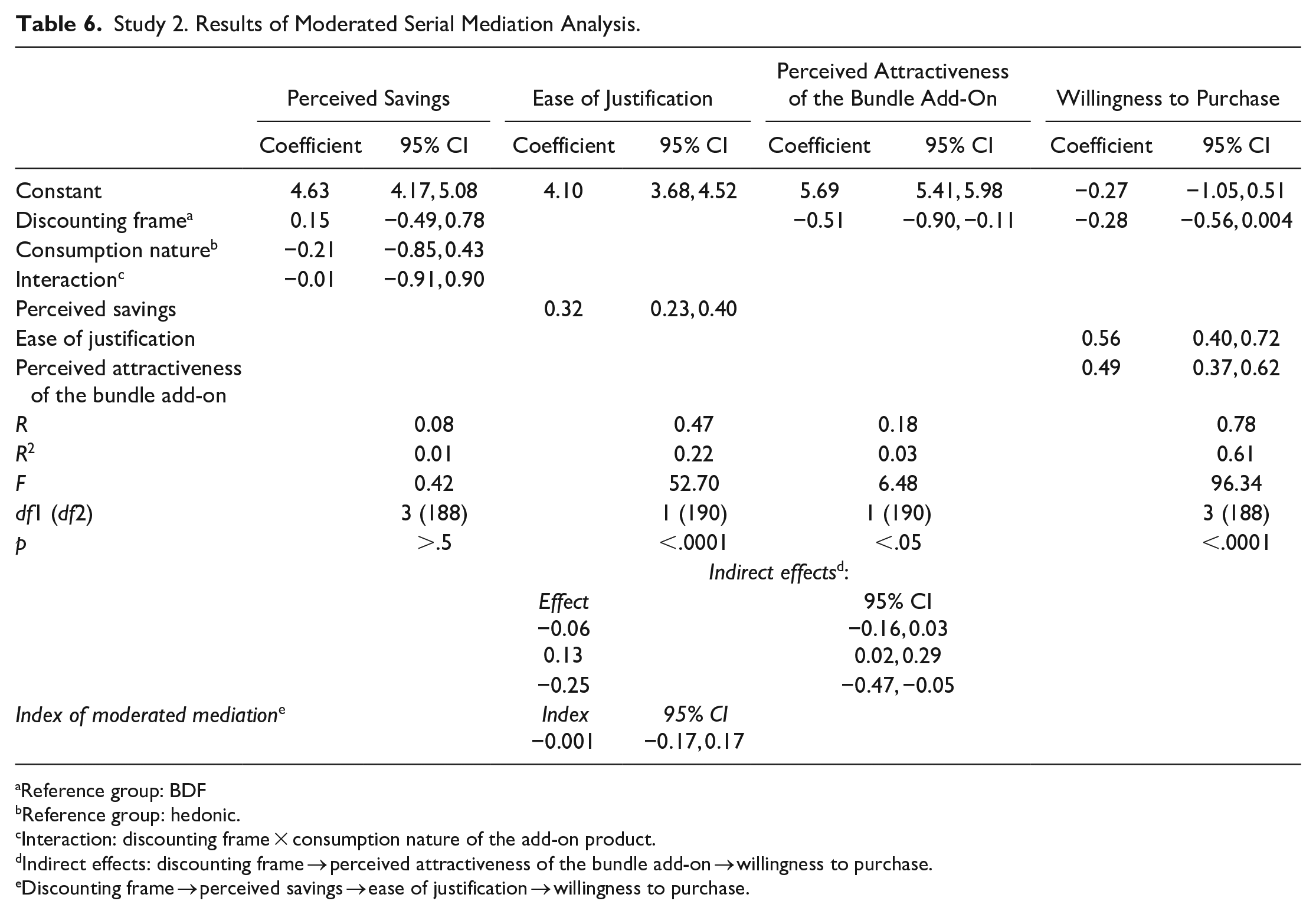
We used the same customized PROCESS model as we did in Study 1 to test H3 and H4. The results of the moderated serial mediation analysis are presented in Table 6 and Figure 4. As expected, discount framing had a direct effect on the perceived attractiveness of the add-on product within the bundle (β = −0.51, CI: −0.90, −0.12). The indirect effect of discount framing on willingness to purchase through perceived attractiveness of the add-on product within the bundle was significant (index: −0.25, CI: −0.47, −0.05). Thus, H4 was supported. As predicted in H3, the consumption nature of the add-on in the bundle did not have a significant moderating effect on the discount framing-perceived savings relationship (β = −0.01, CI: −0.91, 0.90). Furthermore, the index of moderated serial mediation for the conditional indirect effect of bundle discount frame type on willingness to purchase through perceived savings and ease of justification was not significant (index = −0.001, CI: −0.17, 0.17).
Study 2. Results of Moderated Serial Mediation Analysis.
Reference group: BDF
Reference group: hedonic.
Interaction: discounting frame × consumption nature of the add-on product.
Indirect effects: discounting frame → perceived attractiveness of the bundle add-on → willingness to purchase.
Discounting frame → perceived savings → ease of justification → willingness to purchase.

Study 2 results. *Significant.
Finally, while ease of justification (β = 0.56, CI: 0.40, 0.72) and the perceived attractiveness of the add-on product within the bundle (β = 0.49, CI: 0.37, 0.62) had a direct significant effect on willingness to purchase, discount frame type (β = −0.28, CI: −0.56, 0.004) did not directly affect willingness to purchase.
Discussion
Study 2’s findings provide support for heuristic processing when the core product in a cross-category add-on bundle is hedonic in nature. The gestalt nature of the BDF is more in line with the heuristic processing induced by a hedonic core product (Li et al. 2020; Melnyk, Klein, and Völckner 2012), and thus yields a greater willingness to purchase than the ADF. Further, the perceived attractiveness of the add-on product within the bundle mediates the effect of discount framing on willingness to purchase. This lends support to the notion that the heuristic processing induced by the BDF can transfer the consumers’ affective response toward the bundle as a whole to the perceived attractiveness of the add-on product within the bundle, and subsequent purchase intentions. Our results also support the notion that the consumption nature of the add-on (hedonic vs. utilitarian) in a largely hedonic bundle does not impact the superior effect of a BDF (vs. ADF) on the perceived attractiveness of, or consumers’ willingness to purchase, the bundle. Because they are engaged in holistic, affective information processing, consumers only superficially consider the information provided.
Study 3
Methodology
Procedure
Using the stimuli from Studies 1 and 2, we employed a 2 (consumption nature of the core product: hedonic and utilitarian) × 2 (consumption nature of the add-on in the bundle: hedonic and utilitarian) between-subjects experimental design. Specifically, using an ADF discount frame, we presented participants with a utilitarian (airline ticket) or hedonic (cruise line ticket) core product, and an add-on that was utilitarian (airline: checked baggage; cruise line: travel insurance) or hedonic (airline: lounge access; cruise line: on-board activity) in nature. Participants were randomly assigned to one of the four conditions. Participants were first screened to ensure that they had taken a flight (cruise) within the past 36 months 2 . After reading their assigned scenario, participants completed a questionnaire that contained items used as manipulation checks, measures for the key variables, attention checks, a realism check, and demographic questions.
Measures
Since the goal of Study 3 was to provide empirical support for the information processing styles induced by utilitarian and hedonic core products within a cross-category bundle, we measured affective processing using a three-item scale adapted from Shiv and Fedorikhin (1999) (Cronbach’s α = 0.90). To support the notion that a hedonic add-on induces a greater feeling of guilt than a utilitarian add-on, we also measured anticipated guilt via three items adapted from Choi, Madhavaram and Park (2020) (Cronbach’s α = 0.81). See Table 1.
Finally, participants were asked how much of a discount that they received on the add-on product. All participants reported the correct amount.
Data analysis
Sample characteristics
A total of 195 participants were recruited using Prolific. All responses were usable, yielding an approximately equal number of participants in each experimental condition (utilitarian core/utilitarian add-on: n = 52; utilitarian core/hedonic add-on: n = 50; hedonic core/utilitarian add-on: n = 45; hedonic core/hedonic add-on: n = 48). The majority of participants were 29 or younger (n = 138; 70.8%), and 52.8% (n = 103) of the participants were male. The majority of participants had a college or graduate degree (71.8%; n = 140), with 31.9% (n = 62) having a household income higher than $40,000. See Table 2.
Results
The cell means for affective processing were as follows: utilitarian core/utilitarian add-on: M = 2.24, SD = 1.32; utilitarian core/hedonic add-on: M = 2.59, SD = 1.60; hedonic core/utilitarian add-on: M = 2.56, SD = 1.43; hedonic core/hedonic add-on: M = 3.33, SD = 1.72). The ANOVA results for the affective processing scale show a significant main effect for both the core product (F1,194 = 4.03, p = .04) and add-on product (F1,194 = 4.6, p = .03). The interaction was insignificant (p = .18). Consistent with our theorizing, the cruise context induced higher levels of affective processing (M = 2.96) than the air travel context (M = 2.50). Moreover, the hedonic add-on resulted in higher levels of affective processing (M = 2.95) than the utilitarian add-on (M = 2.48).
In terms of guilt, the cell means by experimental condition were as follows: utilitarian core/utilitarian add-on: M = 3.21, SD = 1.28; utilitarian core/hedonic add-on: M = 3.78, SD = 1.45; hedonic core/utilitarian add-on: M = 3.08, SD = 1.38; hedonic core/hedonic add-on: M = 3.54, 1.51). The ANOVA results for the guilt scale show a significant main effect for the add-on product only (F1,194 = 6.67, p = .01). As expected, the hedonic add-on resulted in higher levels of anticipated guilt (M = 3.67) than the utilitarian add-on (M = 3.14). Neither the main effect for the core product (p = .38), nor the interaction effect were significant (p = .79).
Discussion
In sum, the results of Study 3 provide supporting evidence that a hedonic core product induces a more affective, heuristic information processing style than a utilitarian core product. Further, the results for anticipated guilt suggest that, once a consumer has decided to make a hedonic core product purchase, that purchase will not induce a greater degree of guilt than the purchaser of a utilitarian core product. However, when it comes to making an add-on purchase, a hedonic add-on will induce a greater level of anticipated guilt than a utilitarian add-on. Thus, when pairing a hedonic add-on with a utilitarian core product that induces systematic processing, consumers will be more likely to seek to justify their purchase, hence creating the potential for a factor such as savings perceptions to alleviate such guilt.
General Discussion
Travel firms are increasingly looking to add-on bundling to drive value for consumers, increase incremental revenue from ancillary products and services, and capture market share (Berry and Lampo 2000; Maier and Intrevado 2018). In this research, we focused specifically on cross-category add-on bundles, and examined the efficacy of two types of discount framing, ADF and BDF, in driving demand for such bundles.
This research contributes to the literature in a number of ways. First, it extends the work of Khan and Dhar (2010) in the domain of cross-category bundling. Their research probed the effects of price framing in cross-category bundles containing products of equal value that can be purchased independently. In contrast, our focus was bundles consisting of a core product along with an add-on product of lesser value that is not purchased unless the core product is. We argued that the information processing style adopted by the consumer when purchasing a cross-category add-on bundle will be dictated by the core product in the bundle. The findings of Studies 1 and 2, complemented by the findings of Study 3, suggest that, when purchasing a cross-category bundle with a utilitarian core product, consumers tend to adopt a systematic approach to evaluating the bundle. In contrast, when purchasing a bundle with a hedonic core product, consumers tend to adopt a more holistic, heuristic processing approach. This processing style, in turn, influences the relative effects of discount framing (ADF vs. BDF) on consumers’ willingness to purchase the add-on bundle.
Second, we demonstrated that for utilitarian core-hedonic add-on bundles, perceived savings can facilitate justification for the purchase of a guilt-inducing hedonic add-on. While previous research suggests that consumers seek to justify the purchase of hedonic products (Choi, Madhavaram, and Park 2020; Kivetz and Simonson 2002; Shafir, Simonson and Tversky 1993), this is the first study, to our knowledge, that empirically investigates the role that perceived savings plays in facilitating the justification of a hedonic add-on purchase. In line with the notion that greater information availability and transparency is favored by consumers (Lynch and Ariely 2000; Miao and Mattila 2007), we found that the explicit, easier to process discount information inherent in an ADF (vs. BDF) induced greater savings perceptions when consumers are motivated to justify an add-on hedonic purchase. In turn, we found that perceived savings and ease of justification serially mediated the discount framing-willingness to purchase relationship for a utilitarian core-hedonic add-on bundle. In contrast, we found no significant difference in perceived savings across discount frames for homogenous utilitarian add-on bundles. Consumers do not need to actively seek to justify a utilitarian add-on to a utilitarian core product purchase (Okada 2005; Shafir, Simonson and Tversky 1993). Thus, in the absence of a guilt inducing component within the bundle, perceptions of overall savings on the bundle, and subsequently ease of justification and willingness to purchase, are not influenced by type of discount frame.
Third, we demonstrated that, for add-on bundles with a hedonic core product, consumers are more willing to purchase a BDF than an ADF regardless of the consumption nature of the add-on. Our findings suggest that the perceived attractiveness of the add-on product within the bundle is the underlying mechanism explaining the superiority of the BDF. Because consumers tend to perceive a hedonic product bundle as a gestalt (Evers, Inbar, and Zeelenberg 2014; Shaddy and Fishbach 2017), our findings suggest that the consumers’ affective response to the bundle as a whole transfers to the perceived attractiveness of the add-on product within the bundle, and in turn, purchase intentions.
Managerial Implications
The findings of this research provide a number of practical implications for the effective development, and marketing of cross-category add-on bundles.
First, travel marketers need to understand how different market segments are likely to perceive the various add-on products that they offer (i.e., whether they perceive them as primarily utilitarian or hedonic in nature) so that, depending on their target market, they can frame the description of that add-on accordingly. For example, depending on the needs and characteristics of a given market segment, an add-on product like airline lounge access, could be viewed as primarily utilitarian or hedonic in nature. In Study 1, participants were informed that they were taking a leisure trip, and the lounge access was described in terms of the hedonic benefits that it provided. Hence, participants perceived the lounge access as primarily hedonic in nature. However, had the goal been to promote lounge access to the business traveler as a utilitarian benefit, the description of the lounge access product could have been framed to emphasize the utilitarian benefits (e.g., quiet space to work).
Second, once marketers have identified the target market segment for a given add-on product, and have framed the description of that add-on product to fit the primary needs of the market segment, they should leverage the findings of this research to guide their discount framing decisions. Specifically, they should employ:
(1) An ADF to promote a utilitarian core-hedonic add-on bundle: The ADF will yield greater savings perceptions for the hedonic add-on, and will enable consumers to better justify the bundle purchase.
(2) A BDF to promote a hedonic core-utilitarian add-on bundle: The BDF will enhance the perceived attractiveness of the add-on in the bundle.
Furthermore, based on our examination of cross-category (vs. homogeneous) bundles, marketers should use:
(3) Either an ADF or a BDF to promote a homogenous utilitarian add-on bundle: Consumers will not seek to justify the purchase of a utilitarian add-on.
(4) A BDF to promote a homogenous hedonic add-on bundle: As with a utilitarian add-on to a hedonic core product, the bundle is evaluated as a gestalt. Thus, the perceived attractiveness of the add-on product will be enhanced within the BDF.
Third, marketers should be aware that revenue potential of any add-on bundle is contingent on the attractiveness of the add-on product within the bundle. As observed in the results for Studies 1 and 2, the perceived attractiveness of the add-on product within the bundle was a significant driver of purchase intentions. Thus, marketers need to carefully evaluate consumers’ perceptions of the attractiveness of bundle add-ons. If advertised add-ons are not valued by consumers, no add-on bundles, regardless of discount framing, will be effective in driving revenue.
Limitations and Future Research Directions
As with any research, our findings should be interpreted with caution. First, we employed a controlled experimental design for all studies. While this approach allowed us to test precise predictions derived from theory while holding all else constant (Calder, Phillips and Tybout 1981), a limitation of an experimental design is that it often lacks external validity, limiting generalizability across populations and settings. Additional research employing a field study that examines actual choice behavior is also needed to complement the findings of this research. Second, in our study design, we measured, rather than manipulated, the mediators of interest. Thus, while our results show preliminary evidence for the mechanisms underlying the discount framing-willingness to purchase relationship, further testing of our empirical model is required. Third, this research was conducted in two contexts: the airline and cruise industries. Further research utilizing different travel-related contexts (e.g., hotels, spas, and car rental) is needed to assess the robustness of the findings across different service contexts. Fourth, this research focused on cross-category add-on bundles that comprise of one add-on to a core product. In reality, a service firm may bundle more two or more add-ons to the core product. Thus, further research is required to assess how consumers evaluate multiple hedonic and utilitarian add-on options simultaneously. Prior research has demonstrated that too many options can create choice overload, and negatively affect consumers’ responses (Chernev, Böckenholt and Goodman 2015; Scheibehenne, Greifeneder and Todd 2010). Therefore, examination of how consumers simultaneously assess multiple hedonic and utilitarian add-on options should incorporate consideration of choice set size.
Fifth, in this research the price differential between the core and add-on products was relatively large (e.g., $35 for airline lounge access versus $250 for an airline ticket). Research is merited to investigate whether our studies’ findings would hold when the price differential is less significant (e.g., the price of a one-night hotel stay coupled with the price of a spa treatment) and/or the core product is less expensive. Sixth, this research examined the role of the consumption nature of the add-on product within the cross-category add-on bundle on the discount framing-willingness to purchase relationship. Future research should encompass other potential moderators of this relationship. For example, consumers who are familiar with a given product can evaluate it more easily, and this in turn can positively influence their confidence in the evaluation process (Raju 1977). Thus, it is likely, for example, that familiarity with a given hedonic add-on within a cross-category add-on bundle may impact the ease with which a consumer can justify the purchase of that add-on to the utilitarian core product in the bundle.

Study 1 sample stimulus: ADF and hedonic add-on condition.

Study 1 sample stimulus: BDF and utilitarian add-on condition.

Study 2 sample stimulus: BDF and hedonic add-on condition.

Study 2 sample stimulus: ADF and utilitarian add-on condition.
Footnotes
Declaration of Conflicting Interests
The author(s) declared no potential conflicts of interest with respect to the research, authorship, and/or publication of this article.
Funding
The author(s) disclosed receipt of the following financial support for the research, authorship, and/or publication of this article: This study was supported by Marriott Foundation
