




Abstract
It is argued in this letter that tourism studies, as an autonomous field of academic study, can better position itself in the COVID-19 era as a “pandiscipline” which synthesizes concepts and theories from other disciplines to better describe and explain tourism-related phenomena. Universal core tourism structures and processes, in turn, are captured in “tourisation theory,” which describes the increasing embeddedness of tourism in places as manifested in six tentative propositions and associated impulse, amplification, ubiquity, ascendancy, concentration, and endorsement effects.
[Tourism is] the sum of the processes, activities, and outcomes arising from the relationships and the interactions among tourists, tourism suppliers, host governments, host communities, and surrounding environments that are involved in the attracting, transporting, hosting and management of tourists and other visitors (Weaver and Lawton 2014, 3).
As both a sector and field of study, the viability of tourism is under threat. The ongoing COVID-19 pandemic, which directly led to an 80% decline in international stayover arrivals in 2020 as compared with 2019, is the immediate factor behind the sector threat (Sigala 2020). The academic threat is more subtle. Following a period of rapid expansion in the late twentieth century, freestanding tourism departments and programs in dominant countries such as Australia and the UK have experienced consolidation and contraction as their respectability, quality, and profitability come under increased scrutiny (Dredge, Airey, and Gross 2014; Fidgeon 2010; Goh and King 2020). It remains to be seen whether COVID-19 will ultimately help to stimulate or suppress the institutional status of tourism studies, but a larger issue is the lack of sound academic foundations from which the rationale for institutional viability can be made. Such foundations will become essential as advocates for tourism departments and programs are forced to compete against well-established departments for scarce resources within universities which themselves have been devastated by the COVID-induced loss of revenue from international students. This Letter argues that tourism can better survive—and perhaps thrive—as a freestanding focus of study by innovatively positioning itself as a pandiscipline focused around the investigation of tourisation theory and associated propositions which encapsulate universal core tourism processes and structures.
Twenty-five years ago, Tribe (1997) rightfully argued that tourism failed to satisfy Hirst’s (1974) criteria for a discipline and therefore should be regarded as a field of study. Notwithstanding the growing popularity of interdisciplinary research (Wen et al. 2021), Hirst’s emphasis on disciplines still matters, as they provide a concerted (i.e., “disciplined”) path to knowledge progression through their distinct and generally well-defined modes of analyzing and contextualizing complexity in the external world (Tight 2020). Also, while interdisciplinarity is necessary to deal with complex issues, it still depends on input from relevant disciplines. Recognition as a venerable discipline is desirable in the social world because of the status it therefore confers, which translates into more funding possibilities and more respect and recognition from government and the public. Beyond the implied lack of respect, recognition as a “field” is risky because the topic it formally designates may be transitory due to vagaries of fashion or politics. This risk is illustrated by the shift in universities from “women’s studies” to “gender studies” programs (Rollmann 2013), and the disestablishment of international business departments (Michailova and Tienari 2014). The seemingly endless semantic possibilities for topics, moreover, is feeding a contemporary proliferation of fields (whereas disciplines respond to expanding knowledge by spawning new sub-disciplines), many of which display the same restricting silo-like characteristics that critics ascribe to disciplines.
Tribe’s (1997) assessment of tourism as a field of study still resonates in 2022, and remains problematic. With respect to Hirst’s four criteria of a discipline, tourism still lacks its own central concepts and continues to rely instead on derivatives of concepts borrowed from other fields, such as the multiplier effect and product life cycle. Second, these concepts are still essentially engaged in reference to parent disciplines rather than each other, and thus do not form a coherent network underpinning a distinctive logical structure. This trend may accelerate if tourism scholars increasingly opt for employment in their parent departments to achieve greater security of employment. Third, these concepts generate no statements empirically testable against criteria unique to a form of knowledge called “tourism.” Therefore, finally, tourism lacks irreducibility, or its own “methodological ways of analyzing and conceptualizing the external world” (p. 643). Supporting Tribe are longstanding contentions that the theoretical underpinnings of a discipline are absent in tourism (Cooper et al. 1993; Echtner and Jamal 1997). “Theory” has multiple meanings, but typically embodies Hirst’s (1974) networks in its most widely accepted academic definition as an integrated set of empirically testable statements that tentatively describe and explain observable phenomena, establishing relationships between variables and thereby allowing subsequent possibilities for prediction and prescription (Abend 2008). Theory, as such, is critical to knowledge advancement and problem solving (Sutton and Staw 1995). As elaborated by Van de Ven (1989), good theory is practical beyond the academy in providing a more reliable and consistent basis for informing decisions; revealing and clarifying crucial research questions, and establishing common ground knowledge to unify diverse stakeholders.
I propose that tourism in the 2020s can meet at least the first two of Hurst’s discipline criteria through six initial propositions and allied “effects” that constitute the distinctive and logical network structure of tourisation theory. I then argue that while the uniqueness and irreducibility criteria cannot be met, the approaches required to investigate these propositions logically position tourism as neither discipline nor field of study per se, but as a pandiscipline better suited to advance tourism knowledge and address relevant tourism problems. Semantically, prior use of “tourisation” appears confined to Ivona (2003), where it tangentially describes accumulating and largely destructive tourism effects on rural Europe. “Touristification” (Belhassen, Uriely, and Assor 2014) and “tourismification” (Jansen-Verbeke 1998) have similar negative connotations, although Ojeda and Kieffer’s (2020) recent advocacy of “touristification” as an ideologically neutral analytic concept is more in alignment with this Letter.
Tourisation is selected here as the most semantically apt term, since “touris-” invokes both tourism and tourist, while “-ation” indicates an action or resultant state, that is, of becoming more tourism-oriented. Here, the observable action foundational to tourisation theory is the tourism sector’s increased direct and indirect embeddedness in places all around the world, and resultant growing dominance, through the attraction and support of tourists as well as outbound tourist flows. As per Abend (2008), the six universal propositions and allied effects, as depicted interactively in Figure 1, constitute tentative theory in entailing an integrated set of empirically testable statements that variably describe (i.e., ubiquity, ascendancy, concentration, and endorsement effects) or attempt to explain (i.e., impulse and amplification effects) this embeddedness, and hence the phenomenon of tourisation. These statements, as such, indicate predictable relationships among multiple variables, including tourist motivations, tourism facilities, space, economic development, and resident perceptions and attitudes. The proposed tourisation theory, in tandem with Van de Ven (1989), therefore has potential to provide a reliable basis for tourism-related decision-making, reveal important tourism-related research questions, and provide a common focus for diverse tourism stakeholders. The following list of propositions and related effects is tentative, and intended to stimulate further conversations about the basic dynamics and consequences of tourism’s continued expansion as sector and focus of academic study in a time of great uncertainty.
P1: Nine major “tourisation impulses” drive tourism development
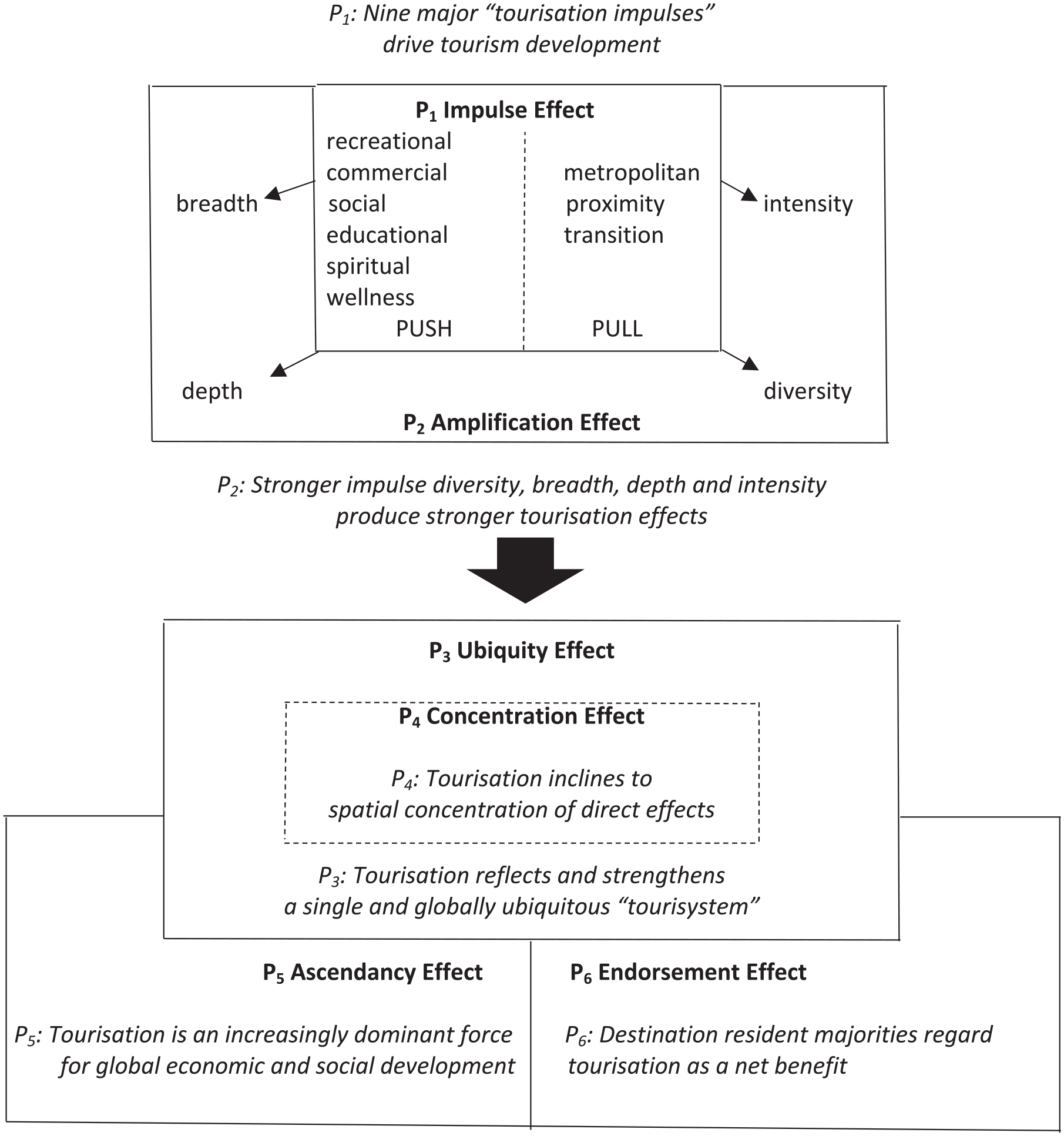
Tourisation theory framework.
The tourisation impulse effect proposes that global tourism growth has been propelled by nine basic drivers. Six demand-side motivational impulses reflect the push component of the push-pull models long used to explain differential patterns of tourism movement and development (Chen and Chen 2015; Kim and Lee 2002), and largely parallel UNWTO qualifying travel purpose conventions (UN and UNWTO 2010). Thus, the recreational impulse combines the UNWTO purposes of “recreation” and “shopping” in a globally dominant category that implicates most tourist attractions. Dark tourism (Jordan and Prayag 2022), casinos (Wong, Luo, and Fong 2019), and ecotourism (Fennell 2022b) are manifestations that illustrate the attendant motivational diversity. Commercial and social impulses similarly invoke the UNWTO’s respective “business and professional” and “visiting friends and relatives (VFR)” categories, but, as impulses, transcend the narrow reference in these official terms to specific travel purposes, as do the educational (“education and training”), spiritual (“religion”), and wellness (“health and medical care”) impulses. As demonstrated by VFR tourism, where social and recreational impulses are often co-prevalent (Yousuf and Backer 2015), and by the overlap of spiritual and wellness impulses in many religious attractions (Arora, Sharma, and Walia 2021), impulse hybridization is normative. Moreover, attractions can satisfy these six demand-side impulses formally or informally, as demonstrated respectively in the spiritual impulse by religious pilgrimage sites and inspirational sunsets, or in the social impulse by family reunions and generic group travel. The formal idea of specific purpose (as per the UNWTO) and the informal and more foundational idea of impulse are thereby both reflected.
Supplementing the six demand-side impulses are at least three supply-side or structural impulses that implicate the pull component of the push-pull dynamic. Here, broader spatial or economic circumstances impel relevant types of tourism development. The dominant manifestation of this supply-side dimension is the metropolitan impulse, which captures the tourism attraction, transport, and institutional agglomeration effects of large urban places such as London, Singapore, and Dubai (Maxim 2020). The derivative proximity impulse reflects the distinctive tourism development that occurs in metropolitan “excursionsheds,” or the exurban areas around cities, including cruise ports-of-call, that are accessible to daytime-only tourist excursions (Weaver and Lawton 2017). Tourist shopping villages and other “hyper-destinations” are typical features of excursionsheds (Getz 1993). Finally, the transition impulse describes induced substitutions of tourism for declining primary or secondary industries. Representations include the post-industrial economic transformations of the Ruhr Valley, north-eastern England, and Wales through industrial heritage tourism (Hospers 2002), and the conversion of abandoned or defunct railways and canals (Metzger and Bobel 2009, Scherrer et al. 2021) into linear recreational facilities.
P2: Stronger impulse diversity, breadth, depth, and intensity produce stronger tourisation effects
All else equal, increases in four primary “impulse parameters” increase tourisation effects. Diversity, or the number of impulses satisfied by a destination, is a major factor in the hyper-tourisation of world tourism cities such as London (Maxim 2020) that satisfy multiple demand-side impulses within strong parallel metropolitan and proximity impulses. Breadth is variability (or sub-impulses) within an impulse, wherein the existence of diverse recreational attractions within a tourist city such as Orlando (e.g., Magic Kingdom Park, Wizarding World of Harry Potter, Universal Studios, Epcot, etc.) creates greater interest and visitation from consumer segments inclined to that impulse (Kirilenko, Stepchenkova, and Hernandez 2019). In world tourism cities, breadth is usually well articulated within all impulses. Depth, which describes scale as well as associated services and facilitators, is also exemplified in world tourism cities, as is intensity, or the emotional and social allure of iconic and flagship attractions such as Big Ben and the London Eye, respectively (Weidenfeld 2010). Accrual, accentuation, and hybridization of the four parameters, accordingly, constitute the tourisation amplification effect. Las Vegas and Orlando exemplify destinations initially “tourisationed” through weak diversity but strong depth (i.e., casino and theme park scale-economies respectively), and more recently through stronger diversity, breadth (e.g., by becoming a gastronomical destination), and intensity (Fyall 2019).
P3: Tourisation reflects and strengthens a single and globally ubiquitous “tourisystem”
According to the proposed tourisation ubiquity effect, tourisation occurs through the integrated communication, transport, trade, human mobility, media, and finance systems that generate a single and ubiquitous global “tourisystem” (Weaver 2020). Tourisystem omnipresence is reflected partially in the direct presence of tourists and specialized facilities, but also more extensively and less obviously in tourist viewscapes (visually experienced spaces, as per Van Auken 2010) and resident engagement with Uber- and Airbnb-type visitor services (Cramer and Krueger 2016; Guttentag 2015). Also important are pervasive indirect and induced spatial effects, the diversity and subtlety of which are illustrated by such diverse manifestations as farmland abandonment due to labor diversion from agriculture to tourism, new housing built to accommodate labor employed in tourism projects, added icecap debris loads caused by carbon emissions of commercial aircraft, and reduced retail trade resulting from residents’ outbound summer holiday travel.
P4: Tourisation inclines to spatial concentration of direct impacts
Notwithstanding tourisystem ubiquity, tourisation at all scales and stages favors spatial clustering of direct impacts. Lawton (2001), in natural protected area contexts, proposes a “95/5” effect where, illustratively, 95% of visitors confine their activity to 5% of the park. This tourisation concentration effect pertains globally, regionally, and nationally (Williams and Lew 2015), and is notably present as well within such diverse localized destination contexts as tourism-intensive small islands (Weaver and Lawton 2014), tourist shopping villages (Weaver and Lawton 2001), and tourism cities (Bertocchi and Visentin 2019). Beyond the three structural impulses, spatial concentration reflects the presence of alluring attractions as diverse as beaches, waterfalls, battlefields, casinos, and shopping districts around or along which direct tourism facilities and activities coalesce. Tourism concentration effects are also evident in transit regions, wherein airports, railway stations, and other transport infrastructure serve vital bottleneck and gateway functions.
P5: Tourisation is an increasingly dominant force for global economic and social development
Tourisation is not only omnipresent but increasingly influential at the global as well as local scale. The tourisation ascendancy effect captures its transformation from minnow to behemoth, accounting directly and indirectly for one-tenth of the global economy. As such, tourism displays one of the most impressive growth trajectories among human systems during the 70-year post-World War Two Great Acceleration of human economies (Steffen et al. 2015). Tourism by 2017 contributed 10% or more to GDP in 80 of 173 reporting countries (Weaver 2020); increasingly, tourism is the dominant national sector. The COVID-19 pandemic perversely corroborates the ascendancy effect as substantial initial virus diffusion has been linked to tourist movements (Russell et al. 2021), while subsequent sector devastation (in essence a “tourism-kills-tourism” effect) has contributed substantially to global and national economic contractions (Sigala 2020). Tourism recovery, consequently, has been a major focus of national and regional economic recovery initiatives, with indications of high consumer proclivity to resume travel (and resultant rapid recoveries of domestic tourism) suggesting strong social and psychological persistence of the six motivational impulses outlined in the first proposition above (Shadel 2020).
P6: Destination resident majorities regard tourisation as a net benefit
An expanding resident perceptions literature indicates a tourisation endorsement effect, or pattern of overall support for local tourism development and its considered expansion within highly diverse destination contexts (e.g., Del Chiappa, Lorenzo-Romero, and Gallarza 2018; McGehee and Andereck 2004; Shakeela and Weaver 2018; Stylidis 2018). Majorities, more specifically, tend toward qualified support for present and future development based on recognition of substantive economic benefits but also accompanying actual or potential sociocultural and environmental costs; smaller minorities are typically more unequivocally pro- or anti-tourism (Sharpley 2014). That this pattern appears pertinent to all levels of intensity and development stages may reflect personal adaptations and resultant new community equilibriums wherein negatively affected residents adjust their activities or move, temporarily or permanently, to less affected areas, while those enjoying tourism-intensive environments will relocate to such areas (Koens, Postma, and Papp 2018).
Buckley (2021) reminds us that COVID-19 has not been an unalloyed evil with regard to how it has shaped tourism’s environmental and social effects. Among broader positive outcomes has been the much-needed opportunity to reflect on tourism’s future as a viable academic focus and economic sector. An emergent tourisation theory, through its constituent propositions and effects, can provide a basis for tourism’s institutional justification, while providing a focus for advancing tourism knowledge. Moreover, political neutrality makes the six tentative propositions amenable to engagement from both the social science and business management perspectives of the tourism academy, as per Tribe (1997). Enhanced institutional articulation should however also facilitate “real world” problem-solving, especially given the effects of the COVID-19 pandemic (Sigala 2020) and the potentially dire implications of the “climate crisis” (Gössling and Higham 2021). While problem-solving is nevertheless impeded by the enduring gap between academics and practitioners (Airey et al. 2015; Thomas and Ormerod 2017), Duxbury, Bakas, and Pato de Carvalho (2021) argue that a decimated tourism industry is now more incentivized to collaborate with academics, and thereby develop a greater vested interest in research outcomes and applications. A facilitative mechanism is Fennell’s (2022a) Tourism Knowledge Translation framework, which sequences from problem articulation to knowledge gathering and synthesis, and development of remedial tools.
In the context of tourisation theory, clarification of the impulse and amplification effects would, for example, permit collaborative research teams to identify prevailing “motivation-scapes” to inform resilient post-COVID recovery strategies. Implications of a single tourisystem, as per the ubiquity effect, include the repositioning of small-scale “alternative tourism” as a system appendage inextricably linked to mass tourism because of its dependency on the very same large-scale global systems of transit, finance, and information technology (Weaver 2014). This repositioning shifts the parameters of discourse for the critical issue of transformative governance in sustainable tourism by implying that environmental and social reform are most likely to occur within this essentially neo-liberal and industry-led world tourism order, and accordingly through incremental and evolutionary change, or “paradigm nudge” (Weaver 2007) that accords with “enlightened mass tourism” (Weaver 2014). Radical and more immediate paradigm shift, although strongly advocated as a timely imperative by some academics (Ateljevic 2020; Guia 2021; Renaud 2020; Sigala 2020), by contrast, seems unlikely to gain traction given the apparent lack of appetite for revolutionary change among consumers, practitioners, or communities (Weaver 2020).
Among other elements of tourisation theory, the scientific articulation of the ubiquity, ascendancy, and endorsement effects could help to elevate the status of tourism as a sustainably oriented strategic priority for government. The community endorsement effect, moreover, provides opportunities for identifying and strengthening the local tourism characteristics that attract widespread support, while improving those aspects—such as an excessive pace of development, and environmental damage—that attract widespread concern (Lawton and Weaver 2015). The concentration effect merits practical research around the contrasting perceptions of concentration as potential liability—expressed for example in current discussions of “overtourism” (Koens, Postma, and Papp 2018)—or opportunity, as in being able to strategically confine most direct impacts to a relatively small area where they can be more easily managed. A specific COVID-19 consideration is the potential of bottleneck locations to facilitate virus super-spreading, thereby inviting strategies to encourage greater dispersion, or at least more disciplined crowd behavior.
Any hypothesis testing arising from such issues requires input from all the social sciences, echoing Echtner and Jamal’s (1997) assertion that tourism cannot be comprehensively understood within the perspective of a single discipline. Hence, while the six motivational impulses privilege a psychological perspective and the three structural impulses favor geographical and economic sciences, these disciplines must be hybridized with additional fields to fully engage the complexities of tourisation theory across all six propositions, as per an interdisciplinary approach of dynamic interaction (Darbellay and Stock 2012). To do this, tourism as a field of academic inquiry should move away from its prevailing and essentially atomized multi-disciplinary foundations and reposition as a “pandiscipline” that opportunistically and innovatively incorporates relevant concepts and frameworks from other disciplines.
Footnotes
Declaration of Conflicting Interests
The author declared no potential conflicts of interest with respect to the research, authorship, and/or publication of this article.
Funding
The author received no financial support for the research, authorship, and/or publication of this article.
