




Abstract
Destination Marketing Organization (DMO) websites serve as hubs for disseminating information to tourists and communicating with destination stakeholders via a system of hyperlinks. These websites and their hyperlink structures potentially reflect cultural variations among societies and, therefore, differ in what tourists from other cultures might expect in terms of the information search process, affecting early impressions about the destination. The study compares the hyperlink structure of official DMO websites of South Korea, the United States, and Germany and examines whether the ways of organizing and distributing tourist information are reflective of cultural variations. The collected data were examined using the blockmodeling technique. The main differences among the three networks were found in structural properties and the ways tourist information was distributed. Cultural dimensions can explicate the different patterns of information flow. The findings contribute to the literature on how hyperlinked information can be leveraged to the benefit of tourists.
Introduction
Given that tourism products are characterized by intangible, heterogeneous, and perishable qualities, tourists make their decisions piecing together a multitude of informational bits. This requires DMOs (Destination Marketing Organizations) to devise effective communication strategies and sustain them through multiple communication channels like TV ads, printed brochures, postcards, national and local destination websites, and, most recently, social networks. Through these channels, DMO websites connect potential tourists with numerous information and service providers at the destination, thus serving as the destinations’ information hubs while keeping their neutrality (Baggio et al. 2007; Nolan 2020; Tigre Moura, Gnoth, and Deans 2015). However, since the arrival of social media platforms that enables DMOs to achieve not only information sharing but also dialogic relationship-building with consumers (Lovejoy and Saxton 2012) and the booming popularity of online communications, the role of DMO websites as tourist information repositories has been dwindling (Kim et al. 2017). The annual international visitor survey conducted by the Korea Ministry of Culture, Sports, and Tourism in 2018 found that more than 80% of international tourists who visited South Korea acquired tourist information through social media and online travel communities, while only 7% used the official Korea Tourism Organization website. With each successive year, this gap has widened (Korea Ministry of Culture , Sports, and Tourism 2019). While social networks such as Facebook, Instagram, and Twitter and travel information-sharing platforms such as TripAdvisor will likely continue to remain attractive to users, improvement in communications between DMO websites and potential tourists by understanding the underlying force of such communications is a worthy goal.
DMO websites have been examined to benchmark their performance from various standpoints, including information quality (Choi, Lehto, and Oleary 2007; Stepchenkova et al. 2010; Tierney 2000), structural and graphic design (Hofbauer, Stangl, and Teichmann 2010), different linguistic expressions (Manca 2008), and the role of visual images (Stepchenkova and Zhan 2013). Recent studies have taken a new turn by adopting telepresence (Choi, Ok, and Choi 2016a), machine-learning (He et al. 2022), and eye-tracking (Kanazawa et al. 2021) approaches. This study uses hyperlink analysis to investigate communication between the DMO websites and tourists as “end users” of those websites, largely following the “sender-message-receiver” model of communication (Lasswell 1948). We would contend that information may fail to reach users who seek it if the information dissemination structure is not effective. Specifically, we zoom in on the websites’ hyperlink structure since it enables users to move among various website pages and from one website to another in search of information. The primary role of hyperlinks is to distribute information by connecting its various pieces in the web space via a network pattern. When users make decisions on which hyperlink to activate and which to skip, the activated hyperlinks serve as a gateway to new information, and these micro-decisions constitute the interactive communication process between the DMO sender and the tourist receiver (Lee, Lee, and Hwang 2014; Sundar, Kalyanaraman, and Brown 2003; Sundar, Xu, and Bellur 2010). In the “sender-message-receiver” model, examining the hyperlink structures may shed light on destination information flow from DMO websites to end users, that is, tourists.
In the early stage of the Internet, scholars reasoned that its nature would accelerate cultural homogeneity, transcending nationalities and cultures (Johnston and Johal 1999; Lee 2007; Marcus and Gould 2000). However, it has been shown that cultural lenses such as language, social beliefs, and social structure filter an individual’s perceptions and attitudes, thus shaping a cultural barrier, which is challenging for global organizations to break through (Mazaheri, Richard, and Laroche 2011). According to the Lasswell’s (1948) model, effective communication requires reducing the state of uncertainty from the recipient’s perspective (Steinwachs 1999). However, the information decoding process can be obstructed by the culture gap between sender and receiver (Leidner and Kayworth 2006), as culture permeates all ways of life while the acquired cultural identity dictates rules of individuals’ behavior. As DMO websites are full of information reflective of cultural peculiarities, the organization and dissemination of that information via hyperlink networks might also be subject to cultural influences in the sending-decoding process. Cultural impact is sometimes so subtle that it is not noticeable; however, its consequences may be significant. We would maintain that it is quite possible that culturally influenced website structure is a factor of website assessment on the part of a user, and might influence satisfaction, destination image, and subsequently the decision-making process, as the information search on a website that is constructed in a cultural paradigm different from that of the user might be not very pleasant and even frustrating.
Thus, the study investigates the hyperlink structure of the DMO websites from two main angles. The first is to survey what type of information hyperlinks provide to tourists, who the most important actors in information dissemination and sharing are, and how the information flows are distributed among the actors from the destination tourism sectors. The second is to examine whether disparities in hyperlink networks created by websites of prominent destinations are consistent with and can be interpreted from the perspectives the underlying cultures of their respective societies. For this study, three national DMOs were selected: Korea Tourism Organization (KTO) of South Korea, Brand USA of the USA, and the German National Tourist Board (GNTB) of Germany. Geography-wise, these countries belong to the Asian, North American, and European continents, respectively. They also differ in the cultural values they prioritize the most within society (Schwartz 2006), which is discussed in the next section. The investigation, therefore, was designed to answer the following research questions:
Research Question 1: What types of tourist information are provided to the users via hyperlink networks for the three DMO websites?
Research Question 2: Is there a difference in the size and structure of the hyperlink networks for the three DMO websites?
Research Question 3: Can differences of tourist information flow, if found, be explained by the cultural differences of the respective societies?
Literature Review
Culture Theories as Theoretical Underpinnings
“Complex, intangible and subtle, culture has been notoriously difficult to conceptualize and scale” (Shenkar 2001, 519). Scholars in anthropology and sociology make use of value and social structure to account for how culture is established and evolves—and thus clarify different types of rules of behavior between different societies (Hall 1976; Hofstede 1980; Kluckhohn and Strodtbeck 1961; Kroeber and Kluckhohn 1952; Schwartz 2006; Trompenaars 1993). They explain behaviors in a specific culture by examining its explicit and implicit patterns, the transmission of knowledge in groups, and the expressions of shared belief (Kroeber and Kluckhohn 1952). The scholars have noted that elements of culture are highly situational and closely rely on the relationships among societal group members (Hofstede 1993; Maznevski et al. 2002). Scholars also seem to agree that due to the complex nature of culture and its gradual and invisible change, it is problematic for researchers to apply direct measurements to the culture concept, which impedes understanding of it (Schwartz 2006). Several attempts, however, have been made to conceptualize and operationalize the domain of culture by devising quantitative approaches; some of them are briefly described in the following sections.
Hofstede’s cultural dimensions
Geert Hofstede, who described culture as “the collective programming of the mind distinguishing the members of one human group from another” (Hofstede 2011, 3), delineated six cultural dimensions to shed light on the embodiment of culture in business organizations and elicit the patterns of employees’ behaviors and prevalent beliefs. They are Power Distance, Uncertainty Avoidance, Collectivism-Individualism, Masculinity-Femininity, and the later added dimensions of Long-term Orientation and Indulgence-Restraint. Power Distance reflects “the extent to which the members of a society accept that power in institutions and organizations is distributed unequally” (Hofstede 1984, 83). The dimension of Uncertainty Avoidance refers to “the degree to which the members of a society feel uncomfortable with uncertainty and ambiguity” (Hofstede 1984, 83). Collectivism-Individualism reflects how tightly individuals in a particular group are fitted in a societal social framework and their degree of interdependence. Masculinity-Femininity expresses the societal preference for either achievement, assertiveness, and material rewards (masculine values) or cooperation, modesty, caring, and balance in life (feminine values). Long-term Orientation refers to “the extent to which a society shows a pragmatic future-oriented perspective rather than a conventional historical or short-term point of view” (Hofstede 2011, 8). Finally, Indulgence-Restraint represents the extent to which a society values pleasure and gratification of human needs and desires. Despite criticism of Hofstede’s work (e.g., Orr and Hauser 2008; Schwartz 1994) that largely focused on business organizations rather than societies themselves being the objects of Hofstede’s studies, the Hofstede model of national culture is, arguably, the best-known cultural framework for understanding the phenomenon of culture at the national level.
Schwartz’s theory of cultural value orientation
Another influential work on culture is the theory of cultural value orientation developed by Schwartz (1994, 1999, 2006) that characterizes culture as “the rich complex of meanings, beliefs, practices, symbols, norms, and values prevalent among people in a society” (Schwartz 2006, 138). Schwartz developed his theory based on essential individual human values that form three cultural value dimensions: Hierarchy-Egalitarianism, Embeddedness-Autonomy, and Mastery-Harmony. On the Mastery-Harmony continuum, harmony portrays a culture in which an individual is an entity of the world; therefore, people need to fit into the world as it is against societal norms to exploit and change it. In a mastery-oriented culture, success, competence, and ambition are considered virtues. With respect to the Hierarchy-Egalitarianism continuum, a culture regulated by a hierarchical system views unequally distributed power and differential allocation of resources as legitimate. People in this culture take hierarchically distributed roles for granted and conform to their obligations to avoid being sanctioned.
Within egalitarian societies, on the other hand, individuals are socialized to transcend human self-interest, share common interests, and function as morally equal members. Therefore, values such as everyone’s welfare, equality, and social justice are deemed as important. Finally, along the Embeddedness-Autonomy dimension, embeddedness underlines maintaining the status quo instead of transformation, which may deteriorate the present solidarity. Through belonging to a group, people find meaning in social relationships and strive toward shared goals. In contrast, autonomy refers to the individual’s right to either follow their own intellectual directions or pursue their own goals and experiences. It considers creativity, curiosity, and adventurousness as valuable. Despite methodological differences in establishing the cultural dimensions—inductively by Hofstede (Hampden-Turner and Trompenaars 1997) and deductively by Schwartz (Crawford 2004)—the two theories elaborate similar cultural attributes: for example, Power Distance, Masculinity, and Individualism by Hofstede and Hierarchy, Mastery, and Autonomy by Schwartz, respectively.
Hall’s intercultural communication theory
The view on culture as a form of communication has been proposed by American anthropologist Hall (1976). He argues that the setting of a word and intended meaning are interconnected in dynamic situations and that cultures can be differentiated on the amount of context that underlies all communication messages. Hall focused on four dimensions in his discussion on culture: Context, Time, Speed of Information, and Space. In high-context cultures (e.g., China, Greece, Japan, South Korea, and UAE), people are involved with each other and share strong intimacy; thus, feelings, thoughts, and opinions are often communicated nonverbally. In those cultures, people accept a hierarchical social structure as an essential component of the society; thus, power relations are not directly spelled out in formal instructions and business contracts. Information containing deep meaning could be successfully channeled through brief messages, as the implied context is known to both the sender and the receiver. On the other hand, in low-context cultures (e.g., Canada, Germany, Sweden, Switzerland, and the USA), the degree of interconnectedness among members of society is lower, necessitating detailed verbal communications. Low-context cultures have a propensity to be monochronic, that is, to view time as linear, which is conducive to planning and relying on deadlines.
In contrast, high-context societies are often polychronic (e.g., Greece, Italy), meaning they are more flexible with time, placing emphasis not so much on the product but on the process, in which context is further elaborated and inter-relations are strengthened. In polychronic cultures, human interaction is valued over time. Further, communication messages can be characterized as “fast” or “slow” (e.g., newspapers’ headlines vs. full articles), and miscommunication can occur if the sender’s and receiver’s expected formats do not match. Finally, Space refers to how people establish social roles and status as well as maintain a comfortable level of privacy and security by keeping physical distance. Hall’s four dimensions are not mutually exclusive but overlapping and interconnected. To sum up, Hall argues that the key to understanding culture is to master effective communication by understanding its main components and the underlying level of context.
Cultural Characteristics of Selected Countries
Based on the literature review, a short summary is provided of the cultural characteristics of the three countries selected for the present study.
According to Hofstede (2011), South Korea belongs to a society in which people appreciate the value of collectivism; therefore, they tend to be familiar with and accept commands within the top-to-bottom structure. Power is centralized to authorities in a hierarchical order. Eccentric behavior is often seen as a form of individualism and generally not seen as acceptable. Also, members of the South Korean society try to avoid uncertainty, resulting in the tendency to share values and ideas. People make it their own responsibility to ensure that long-term goals are achieved (Kim and Kim 2010). When communicating with others, they express their opinions indirectly by utilizing nonverbal cues. Without cultural background information, it is challenging to fully capture the implicit meaning of communications (Hall 1976; Kim, Coyle, and Gould 2009).
In contrast, in the United States, people think that the value of an individual’s freedom has to be at the forefront of any discussion; thus, the culture in the US is considered high on individualism (Kim, Coyle, and Gould 2009). American society also places a great emphasis on equality and egalitarianism. People expect to get information through open access and rely on explicit communication in which information is clearly defined and expressed (Choi, Im, and Hofstede 2016b). Americans are willing to take the risk of new ideas and innovations and better tolerate uncertain outcomes (Dinev et al. 2009).
Even though the German culture shares some characteristics with the American culture, a few cultural characteristics do not match (Hall and Hall 1990; Harvey 1997). For example, people in Germany place family as the first social institution (Tinsley and Woloshin 1974). However, influenced by individualism, they focus on the immediate family rather than the extended family. Information and power are decentralized in German society. To resolve conflicts, therefore, Germans gather information from different social classes and then establish regulations guided by bureaucracies (Harvey 1997). This approach is different from that of Americans, who manage conflicts through negotiation. In sum, the United States, Germany, and South Korea represent culturally different societies, with the most considerable differences being, arguably, between the United States and South Korea.
Method
Methodological Approach
The present study adopts hyperlink network analysis. The hyperlinks are a fundamental element of the Internet through which users’ expectations that they will reach the information they seek are satisfied (Baggio and Corigliano 2009). They are gateways through which users navigate the unbounded informational universe. Given the functional imperative of hyperlinks to send information from A to B, hyperlink network analysis has become known as a valuable method of examining social interactions on the web.
Several researchers have argued that exploring hyperlinked structures on the web can be used to investigate invisible interactions between different social actors (e.g., Park 2003; Shumate and Dewitt 2008; Ying, Norman, and Zhou 2016; Yi and Scholz 2016). From the perspective of theory, researchers have used different foundations for their hyperlink studies (Yi and Scholz 2016). With the growing interest in the web communication structure, World Systems Theory (WST), originally developed to account for flows of goods, has been applied to understanding the highly centralized structure of information flow on the web (Barnett and Sung 2005; Taneja 2017). As one example, Barnett and Sung (2005) explored the relationship between culture dimensions operationalized by Hofstede and the structure of international hyperlink networks. They discovered a hierarchical structure in which hyperlink networks were arrayed along a core-periphery form posited by WST. Researchers in political sciences characterized hyperlink networks by adopting the Advocacy Coalition framework and Institutional Collective Action framework to see how network structures influence performances in different policy contexts (Yi and Scholz 2016). Along with the theoretical advancements, the literature points to a strong potential of hyperlink network analysis for understanding the representation of web communication.
Hyperlink network analysis has also been employed in tourism literature. One of the earliest studies investigated the complex system of a tourism destination (Baggio et al. 2007). The researchers compared structures of the hyperlink network of two destinations and concluded that hyperlink manifestation, like offline relationships, is formed based on social relations and process. In their discussion, Ying, Norman, and Zhou (2016) noted that the use of hyperlink data can be a complementary way to understand the relations between tourism stakeholders in the real world. They investigated the online communication and networking of 745 tourism organizations in South Carolina, USA. Through link impact, they found major dissimilarity in terms of the overall significance of a website between core tourism sectors such as tourism operators, accommodations, and attractions and peripheral tourism sectors, including nonprofit associations, government agencies, and transportation. More recently, Raisi et al. (2018) analyzed the hyperlink network of the tourism industry in Western Australia. They collected data from more than 1,500 websites based on a list of tourism organizations and examined different structural properties of the web-network in the Western Australian tourism area. They concluded that the network has a hierarchical structure, is centralized, and the website clusters are based on geographical locations.
Despite the inroads made into the topic of hyperlink network analysis of tourist websites by the reviewed studies, research has primarily focused on collaborative ties between the official DMOs and the tourism industry stakeholders, and not on online communication of DMOs and other actors in the tourism system with tourist end-users, as this research does. To the authors’ best knowledge, none of the previous studies has empirically traced the potential effect of culture as the underlying source of hyperlink network formation through collectively shared information on the web. The present study builds on the body of literature by examining the formation and structure of tourist information flow from the consumer’s point of view and within different cultural contexts. Therefore, this study ultimately contributes to the literature on effectiveness of marketing communications between destination tourism providers and potential tourists from culturally different countries.
Network Analysis
Ego-network analysis
A serial research process including exploring, categorizing, crawling, and analyzing data was performed. The entire research process of the study is illustrated in Figure 1.
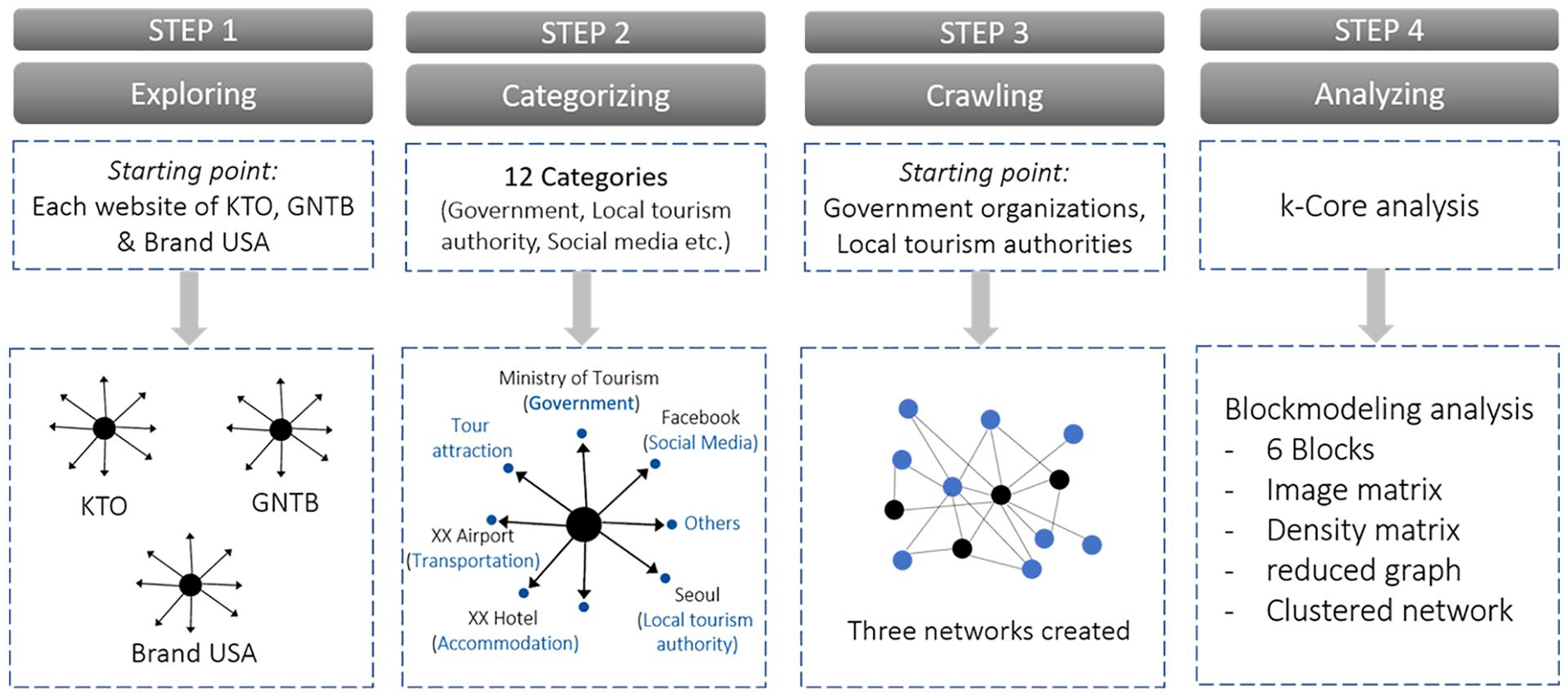
Research process.
To answer the first research question What types of tourist information are provided to the users via hyperlink networks for the three DMO website?, we explored the three national DMO websites by gathering hyperlinks for ego-network analysis. South Korea’s website provides information in 11 foreign languages, Brand USA offers eight foreign languages, while GNTB offers three foreign languages, which are also present in the other two websites: English, French, and Spanish. Regarding the website content in different language versions of the same site, close examination revealed that the page design and navigation interface including photos and layout were very similar in the KTO and Brand USA websites (only Chinese version was slightly different) and identical in the GNTB website. In this study, English version of each website was examined. The hyperlink data were collected using Rcrawler, one of the R packages, during late May–early July 2020. The URLs of each of the three DMOs’ English-language websites were provided as the root URLs. The crawling procedure was repeated three times for each DMO’s website.
After gathering hyperlinks from each DMO’s website, the hyperlinks that belonged to the same seed URLs were aggregated into one page group to serve as a single node of the network. For instance, the web pages embedded in the same seed URLs, such as english.visitseoul.net, chinese.visitseoul.net, and japanese.visitseoul.net, were grouped into visitseoul.net. Also, websites no longer in operation and inaccessible hyperlinks were filtered out before moving forward. Since one of the goals of the study is to examine the destination information flow from the DMO websites to other stakeholders, category building to verify the characteristics of each hyperlink is essential. We, then, developed a classification scheme to categorize each hyperlink. The classification was also used for analyzing the frequency of category occurrences.
Whole network analysis
To answer the question Is there a difference in the size and structure of the hyperlink networks for the three DMO websites?, we employed the whole network analysis. We set the starting point to collect hyperlink data from the websites belonging to Government Organizations and Local Tourism Authorities categories identified at the previous stage. These websites (seed websites) from each DMO’s ego-network were fed to Issuecrawler, which extracted hyperlinks from deeper layers of those websites. Websites from the other categories were not included into the seed websites since we wanted to focus on information management by regulatory agencies, as these were considered ultimate senders of the information in the “sender-message-receiver” model and the primary decision-making actors within the hyperlink network systems.
The generated networks had a large number of nodes and edges, which makes the data set unwieldy for unveiling meaningful patterns due to a considerable amount of irrelevant information (Borgatti, Everett, and Johnson 2018). To avoid this problem, k-core analysis, one of the tactics of pruning nodes, was applied by differentiating the vital websites of the three networks. A k-core is calculated by removing all nodes with a degree less than the number of k (Wasserman and Faust 1994). For instance, a group is the 4-core if it contains all nodes connected to at least four other nodes within the group. In this study, 3-core was applied as a cut-off point in which reciprocity and transitivity value can be examined. Since reciprocity is a measurement of the likelihood of nodes in a directed network to be mutually linked (Wasserman and Faust 1994), we can determine the strengths of the relationships between two actors. Transitivity refers to the notion that if i sends a link to j and j directs a link to k, then i should be connected to k (Wasserman and Faust 1994). It indicates that, from the standpoint of i, although the influence of the network can be decreased by removing the structural hole, information asymmetry that can occur in the relationship between i and k can also be lowered controlling k’s behavior. Thus, transitivity indicates the degree of structural balance of the network.
Blockmodeling analysis
With respect to third research question, Can differences of tourist information flow, if found, be explained by the cultural differences of the respective societies?, we examined patterns of information flow in each DMOs’ network using blockmodeling analysis, with subsequent comparisons of results. Since examining the individuals’ relations with others with whom they share social boundary is the focal point to understanding how culture operates as a system in a society (DiMaggio 2011; Emirbayer and Goodwin 1994), we reasoned that there can be a block structure that shows a meaningful difference in the relational patterns between blocks within the three networks.
Blockmodeling analysis belongs to the group of positional approaches based on the idea that the partition of the units in a network can be clustered along some meaningful definition of equivalence (Doreian, Batagelj, and Ferligoj 2000; Lorrain and White 1971). The abbreviation of the node attribute consists of a representation of the network with regard to the equivalence positions determined by a researcher, and a graph can display how the positions of each node are associated with each other (Borgatti, Everett, and Johnson 2018; Faust and Wasserman 1992). The starting point is to define the blocks of units that share structural attributes in a network. Since blockmodeling analysis is a technique of examining whether a relational pattern for each individual group in the network could exist, it is necessary to clearly distinguish the subject who operates the website. Therefore, the category used in the ego/whole network analysis could not be employed because it was mainly classified based on the informational attribute provided by the website. To define the attribute of the block, we manually visited each website identified by the 3-core analysis to see who operates the website. Accordingly, government organizations were subdivided into three blocks (i.e., federal level, state level, local level) depending on its regulatory level. Also, the websites not operated by public institutions were classified into private sector. The websites owned by a mix of public-private were bound to association. Given the nature of the platform, all social media webpages were categorized into social media. Therefore, in this study, a total of six blocks—Federal Level Government, State Level Government, Local Level Government, Social Media, Private Sector, and Association—were determined as the attributes becoming the basis for creating blocks.
Result
Result of Ego-Network Analysis
The number of collected hyperlinks from each DMO’s website is presented in Table 1. Among them, 43 websites for the KTO network, 58 websites for the GNTB network, and 171 websites for the Brand USA network were analyzed for the whole network. The outputs of this step are three hyperlinked networks centered on each DMO’s website (Figure 1).
The Number of Hyperlinks From Each DMO’s Website.

Note: Crawled from the English-Language Websites.
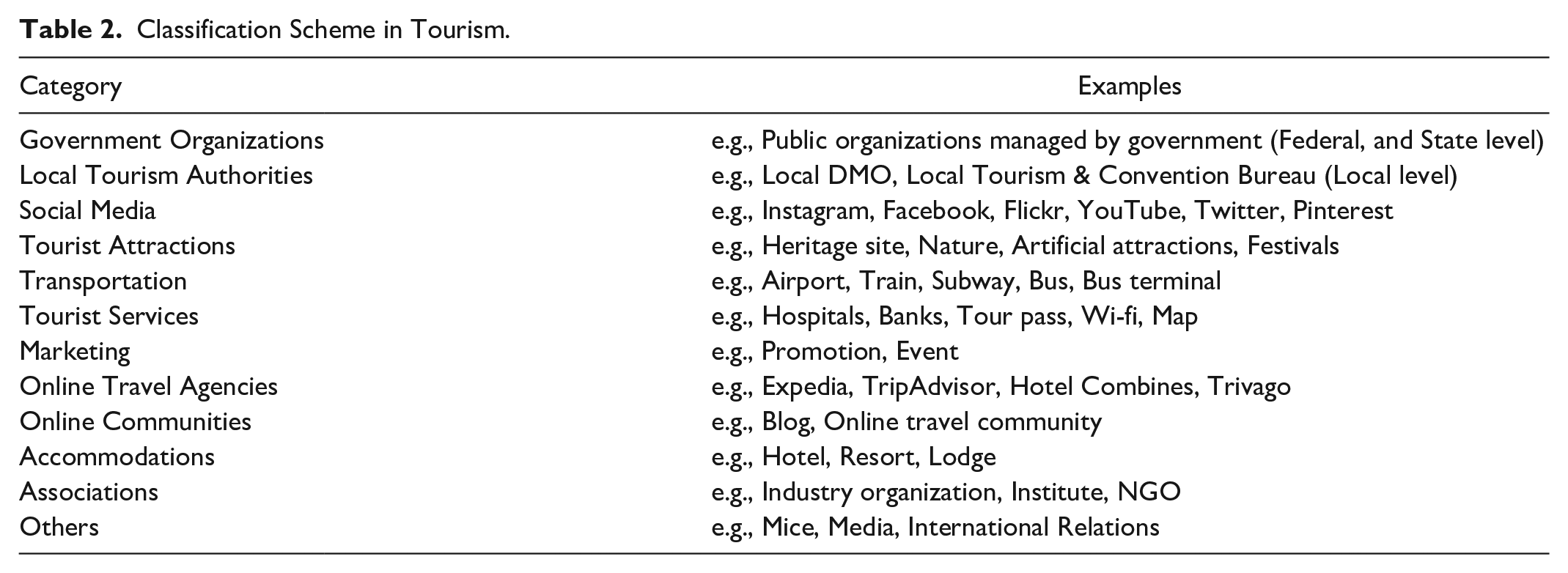
Based on the previous research on hyperlink networks in tourism (Raisi et al. 2018; Ying, Norman, and Zhou 2016), the classification scheme was developed with minor modifications. Thus, we established the following 12 categories: Government Organizations, Local Tourism Authorities, Social Media, Tourist Attractions, Transportation, Tourist Services, Marketing, Online Travel Agencies, Online Communities, Accommodations, Associations, and Others. The description of the classification scheme is summarized in Table 2.
Classification Scheme in Tourism.
After developing the classification scheme, every single hyperlink of each DMO’s website was manually coded into a category to identify which types of destination information are transmitted from the official DMO websites to other websites. The result of categorizing each hyperlink is presented in Table 3. Among the three official DMOs’ websites, Brand USA included the highest number of outside links (641), followed by KTO with 268 hyperlinks. The official DMO of Germany and other German websites were hyperlinked with only 126 links. There are significant differences among KTO, GNTB, and Brand USA in the categories of the outgoing hyperlinks (χ2 = 432.13, p < .00). For the Brand USA website, 267 of 641 links (41.7%) connected to the websites related to the Tourist Attractions category. The next largest categories were Local Tourism Authorities (n = 145, 22.6%) and Transportation (n = 93, 14.5%). On the other hand, the top three categories of hyperlinks from the KTO website belonged to Accommodations (n = 70, 26.1%), Transportation (n = 57, 21.3%), and Tourist Attractions (n = 44, 16.4%). The distribution of the hyperlinks from the GNTB website revealed that, of 126 hyperlinks, the site sent the most links—51 (42.1%)—to Local Tourism Authorities. Tourist Attractions was the second most hyperlinked category (n = 33, 27.3%), and the next largest category was Others (n = 16, 9.2%), which found many hyperlinks related to MICE industries (e.g., promotion of events and conferences) and some pointed to media (e.g., online newspaper and broadcasting websites).
Classification of Hyperlinks of Each DMO’s Website.
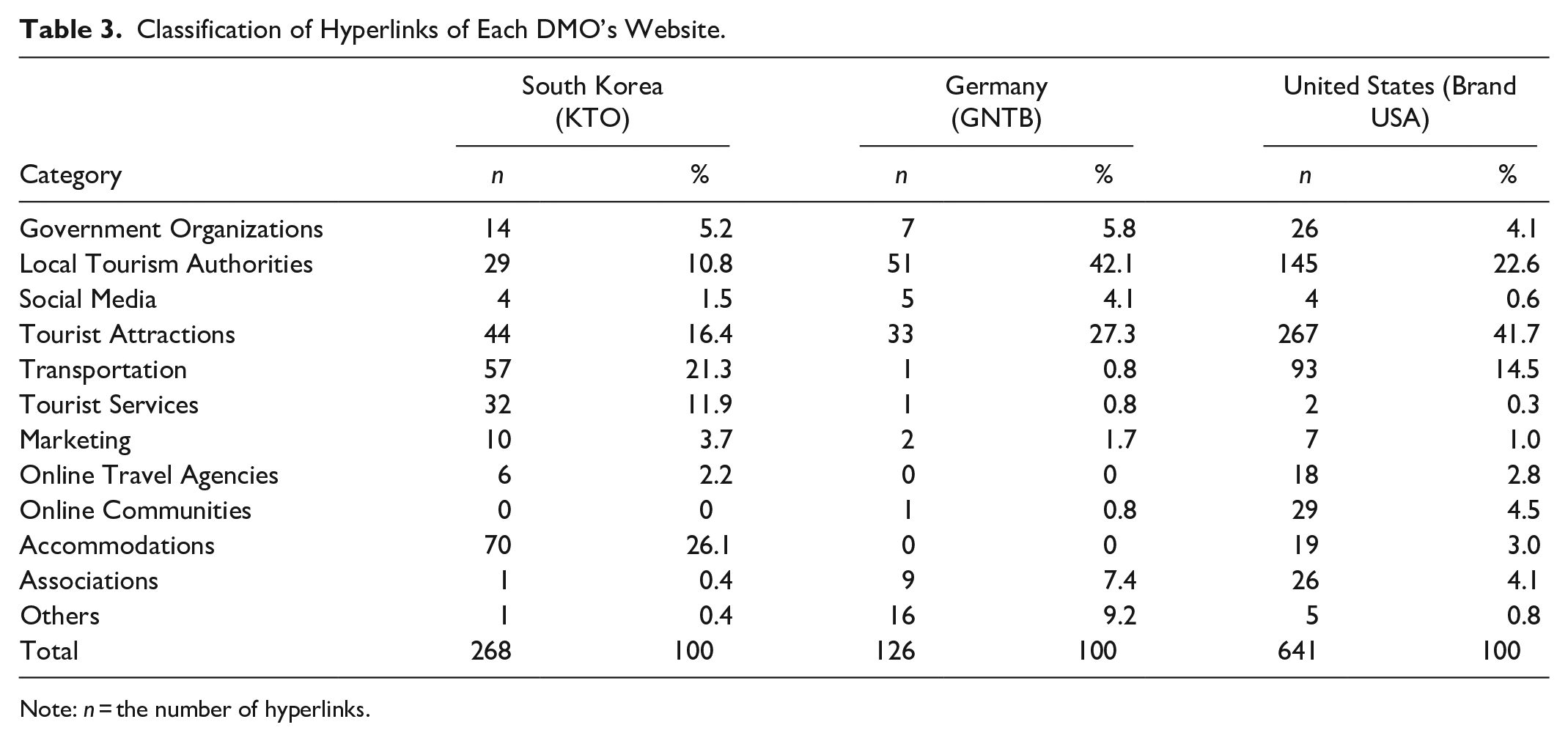
Note: n = the number of hyperlinks.
Result of Whole Network Analysis
To examine whether there is any difference among the three whole networks, we analyzed network-level properties (Table 4). The largest network among the three, the KTO network, consisted of more than 1,900 websites with more than 6,000 links between them, with the diameter value of 11. While every website in the KTO network had 3.17 hyperlinks on average, those in the networks of GNTB and Brand USA were connected to others through 1.67 and 1.47 hyperlinks, respectively. The density values of the networks were low, ranging from 1% to 2%, indicating the direct interconnections between nodes in the whole network are rare. However, the low density (<0.001) is frequently reported in the web-based networks where the extremely many number of nodes and edges are identified (Maier et al. 2018; Ying, Norman, and Zhou 2016).
Network Level Properties of the Three DMOs’ Networks.
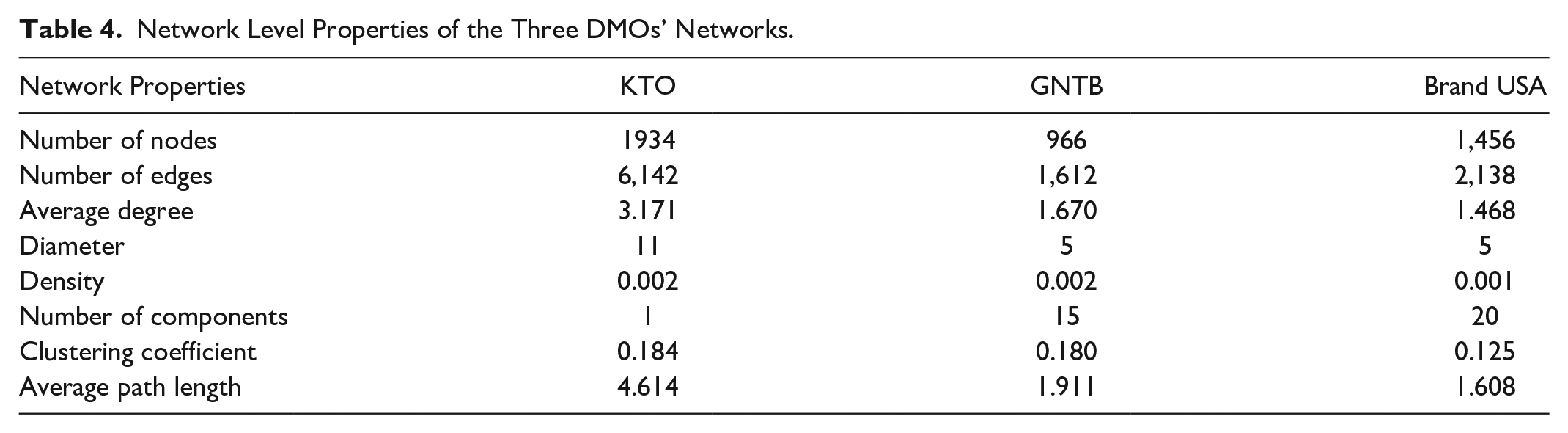
Next, we compared clustering coefficients of the three networks. A clustering coefficient is an indicator of a tendency for the nodes in the network to cluster together. Specifically, the clustering coefficient value of 0.184 for the KTO network means that when a node in the network is selected randomly, the likelihood, on average, that it forms a triad configuration with some other two websites is 18.4% out of 100%. From Table 4, we can see that KTO and GNTB have a similar tendency to form clusters, while Brand USA has a lower clustering tendency. In terms of average path length, an average number of 4.61 clicks will lead users visiting the KTO website to any other selected website. On the other hand, visitors to the Brand USA and the GNTB sites could move to another website with 1.61 and 1.91 clicks, respectively, on average.
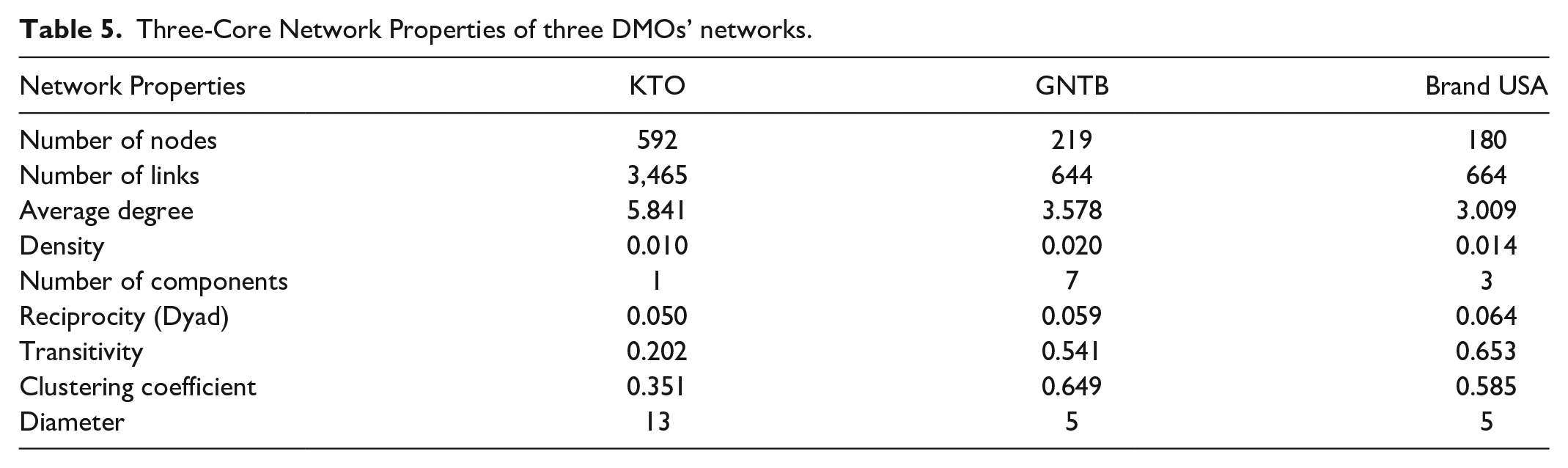
To get an insight into the core structure of each whole network, 3-core analysis was performed. The core network of the KTO is the largest, with one big component, which is the minimum requirement for a cohesive structure. The networks of Brand USA and the GNTB are approximately half the size of the KTO’s. Also, their networks reveal three and seven components respectively (Table 5). The Brand USA and GNTB networks have a larger predominance of reciprocated hyperlinks over asymmetric connections than the KTO network, as evidenced by the reciprocity index. The results also show that the KTO network is lower on transitivity (20%) than the other two networks: 54% for GNTB and 65% for Brand USA. Taken together, the indices indicate a higher degree of interrelationships in the GNTB and Brand USA networks than in the KTO network. The 3-core network properties of the three DMO’s networks are provided in Table 5.
Three-Core Network Properties of three DMOs’ networks.
Result of Blockmodeling Analysis
Using six blocks—Federal Level Government, State Level Government, Local Level Government, Social Media, Private Sector, and Association, the block image matrix was split off from the block density matrix (Table 6). In the block image matrix, if the main node exists between two positions, the cell has the value of 1, while 0 in the cell represents the absence of the main node between two positions (Faust and Wasserman 1992). Also, each cell represents a normalized number of the main nodes between two sub positions. For example, the density of the KTO network is equal to 0.01; therefore, any submatrix with a density greater than 0.01 was coded as one block in the block density matrix. Also, to evaluate how well the blockmodeling fits the identified categories, the goodness-of-fit for the hypothesized blockmodeling was also examined. The goodness-of-fit index was computed by randomly changing the permutation of the given node attribute vector, a process that was repeated by the number of iterations, approximately 1,000. As provided in Table 7, the blockmodeling of the three networks secures the adequacy of representation of each data set.
Image and Density Matrix of Blockmodeling of three DMOs’ Networks.

Note: D means the density of each network.
Goodness-of-Fit Index of the Blockmodeling.

Note: City Block Distance Index was applied.
To visualize the tourist information flow within the networks, we created three clustered maps (Figure 2). These maps separated nodes of different clusters using a given partition vector (six blocks in this study). Then, an attractive force was applied to nodes of the same cluster, and repelling force was also applied to nodes of the different clusters. Since block modeling is the grouping of nodes belonging to a specific group based on network properties, a square in the clustered map represents each block uncovered by the algorithm. In addition, based on each image matrix, reduced graphs in which the positions of the block and the relationships between positions were represented by node were displayed as the abbreviation form (Figure 3). Each node in the reduced graphs corresponds to the position based on the selected six blocks. The results show that there are structural dissimilarities in the tourist information distribution pattern among the three DMOs’ networks.
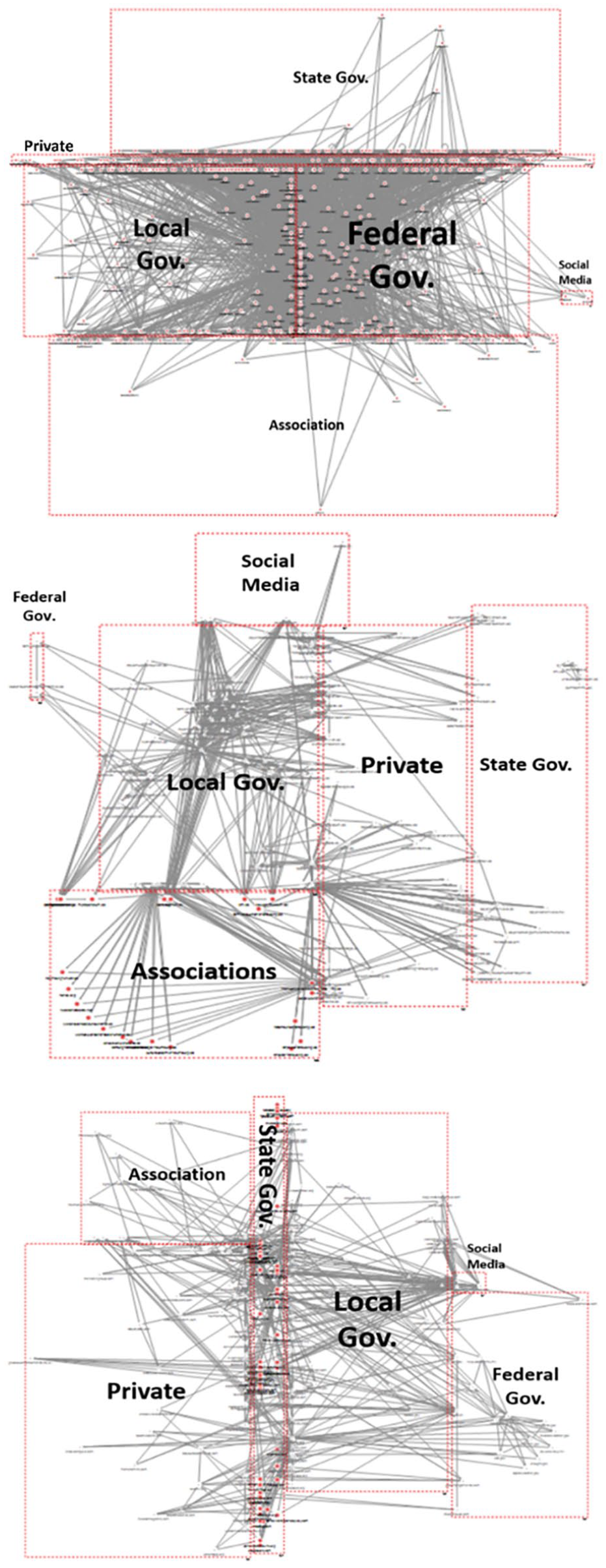
Clustered network by blockmodeling analysis (KTO, GNTB, and Brand USA from the top to bottom).

Reduced graphs of blockmodeling (KTO, GNTB, and Brand USA from left to right).
Discussion
The ego-network analyses found that the relative importance that DMOs place on various categories of hyperlinks (e.g., government organizations, local tourist authorities, transportation, or tourist services) differ across websites (Table 3). The KTO network emphasizes information on tourist infrastructures such as Accommodations (26.1%), Transportation (21.3%), and Tourist Attractions (16.4%), which seems to be reflective of the South Korean government’s plan to integrate tourism readiness into destination management planning to improve tourist conveniences for the 2,018 PyeongChang Winter Games (Choi 2017). Brand USA places the most attention on the Tourist Attractions (41.7%) and Local Tourism Authorities (22.6%) categories in their information distribution. On the GNTB website, the share of the Local Tourism Authorities (42.1%) category is the highest of all three websites. A striking feature of both Brand USA and GNBT websites is very few hyperlinks to the accommodation sector (Brand USA: 3%; GNTB: 0%). A close look at these two websites revealed that Brand USA and GNTB have established a close rapport with their local tourism bodies and effectively “outsource” information distribution to local DMOs, directing visitors to those websites and effectively empowering local tourism authorities to play a leading role in managing related information.
The channeling of information through local DMOs by Brand USA and GNTB, together with noticeable shares of the Online Communities (Brand USA: 5%; GNTB: 1%) and the Associations (Brand USA: 4%; GNTB: 7%) categories, demonstrates that their hyperlink networks are constructed with various interorganizational information exchange in mind. By contrast, close to zero shares of the Online Communities (0%) and Associations (0.4%) categories on the KTO website suggest that South Korean tourism authorities do not actively collaborate with stakeholders from these sectors. While from the consumer’s standpoint it might be desirable to obtain all information in one place with minimum navigational maneuvers (Sundar, Kalyanaraman, and Brown 2003), the number of services at a country-destination, the sheer scope of information to communicate, as well as its comprehensiveness, completeness, and currency, might make “horizontal” distribution preferable. Whatever is the choice, the expectations of users, including those from different cultural backgrounds, need to be recognized and addressed.
The initial findings of the ego-network analyses that different approaches to distribution of the information on national websites exist and are consistent with the cultural explanation of the power distance and maintaining hierarchy in respective societies (Hofstede 2011; Schwartz 1994), are further supported by the results of the whole network analyses. Thus, the website of the smallest—geographically, population wise, and in the number of incoming tourists—country of South Korea has the largest whole network (Table 4), noticeably outrunning the Brand USA, the website of the largest country on those parameters. The number of components in the whole networks (KTO: 1; Brand USA: 20; GNTB: 15) points again to the high centralization of the KTO website in the information sharing, as well as to a more egalitarian approach of information distribution on the Brand USA and GNTB websites. In short, in the KTO network, there is a linear structure that emphasizes hierarchical principles of deferring to authorities, which curbs interactions among actors. In comparison, the relationship between the participants in the GNTB and the Brand USA network is more interrelated and equalized (Hills 2002).
The blockmodeling analysis further abstracted the information on the relationships between different blocks in each network (Figures 2 and 3). The resulted variations in tourist information flows are quite consistent with and can be interpreted from the standpoint of the cultural make-up of the DMO’s respective societies. Most information in the KTO network is directed to very limited number of partitions, mostly representing federal and local government entities, which seems to mirror the South Korean society which grants the legitimacy to the disproportionate distribution of resources, roles, and powers. The small proportions of the Social Media, Association, and Private Sectors are reflective of less autonomy for the actors, highlighting that authority and hierarchy is more respected than is the interrelationship between society members. This interpretation is further supported by the reduced graph of the KTO network (Figure 3) in which the Private Sector block has no relation ties with blocks of other destination stakeholders, implying that cooperation between the public and the private sectors in the country’s tourism sphere is not strong.
Conversely, both the Brand USA and GNTB networks present close connections among all sectors to the extent that industrial actors send and receive the hyperlinked information by interacting with government organizations. However, while the information flow of Brand USA and the GNTB seems to follow a similar pattern, Brand USA fosters more horizontal information sharing and distribution where vertical downwards information spread rarely exists (Figure 3). This “horizontal” layout implies a more equalized power sharing among the stakeholders in various tourism sectors on the Brand USA website, which is consistent with the relative placement of the American society on such cultural dimensions as power distance (Hofstede 2011) and hierarchy-egalitarianism (Schwartz 2006). Furthermore, the blocks are all interconnected, which is consistent with the characteristics of the individualistic societies to place more value on the individual as compared to the society at large. Actors in individualistic societies has more opportunities than in collectivist societies to participate in the information exchanging behavior and to organize similarly minded individuals to get resources for and promote their agendas (Choi, Im, and Hofstede 2016b). One noticeable feature of the Brand USA network (Figures 2 and 3) is the importance of the Social Media block, which is indicative of the more positive attitudes toward social media in the US culture (Bolton et al. 2013), as well as a larger role of social media in the society compared to other two cultures. In the case of the GNTB network, the result shows that the pattern of the GNTB information flow had features similar to both the Brand USA and the KTO networks.
Methodological Considerations, Limitations, and Future Research
This study considered Government Organizations and Local Tourism Authorities as primary information senders and decision-makers in the “sender-message-receiver” model in each whole network; however, other influencers of the tourist information distribution may well exist outside the government-related entities (e.g., social media influencers). Although setting an artificial boundary is inevitable in the network analysis (Borgatti, Everett, and Johnson 2018), taking in consideration websites from other categories as the starting point to build the whole networks might have added new findings to the obtained results. Additionally, for the blockmodeling analysis, we used the attribute of the nodes according to the operating entities rather than mathematical properties. The block information from a structural equivalence technique would also be useful to measure each block’s positions in a network, which can offer another layer of information in terms of the possible relations among actors.
Since this study is not a cause-effect investigation and considering the multitude of factors (organizational, environmental, business-related, esthetic, etc.) which contribute to development of destination websites, we would like to point out that interpretation of differences found in the hyperlink structure from the perspective of the national culture, while plausible and consistent with what we know about the respective societies, is not definitive. It is worth comparing whether non-government (e.g., corporate or consumer) websites in the tourism field from culturally different countries display similar differences in the structure of their hyperlink networks. If the differences detected in this study hold, it will make the case in favor of the culture-related explanation stronger. We consider such an investigation as a future research direction, together with an examination whether the differences among websites would persist if not just one (albeit the most prominent website) but a sample of destination websites within the same culture are selected for comparisons. Further, guided by results of this study, future research may operationalize the cultural dimensions for comparisons and formulate hypotheses about the relative nature of the DMO hyperlink networks from different societies.
The present study highlights the importance of research on how disparate propensities of message senders (i.e., DMO’s websites) and receivers (i.e., users) might disturb the line of communication. It is important to mention, however, that irrespective of whether the dissimilarities in website information flow can be attributed to cultural differences or another external factor, the very fact of existence of such differences might be of consequence for tourists who browse the websites. Therefore, in addition to research directions already mentioned, the results of the study point toward the next step in investigation, namely, how users perceive the information patterns from the cultural standpoint and whether these patterns influence destination perception and decision-making process of tourists. Moreover, because the way people communicate and interpret information varies among societies depending on the situational context, high or low, in respective cultures (Hall 1976), in addition to structural patterns of information flow, other types of tourism content such as, for example, text, pictures, and videos can be subject to interpretation through the cultural lenses and, thus, needs to be taken into account in future research.
Conclusion
This study addressed the importance of cultural considerations in the tourism marketing communications by comparing national DMO websites of three prominent country destinations from the perspective of the websites’ hyperlink structure. The significance of the cultural factor in communications is highlighted by the COVID-19 pandemic that exposed ingrained cultural differences between countries in response to communications about dangers of the virus and necessity of preventive actions. While all national governments introduced and promoted restrictive measures to curb the spread of the virus, the public reaction to these policies varied substantially across countries (Van Bavel et al. 2020). The rigid policies adopted by several Asian countries were largely accepted by the public, while in many Western societies, the instigated policies were met with a significant share of distrust and push-back. The differences in reactions speak volumes about how much human behavior is influenced by cultural values and peculiarities of a society.
The main premise of the study was that since culture transcends all spheres of human existence and is made, learned, and shared by all members of a society, the cultural variations in information dissemination and sharing must also be reflected in the structure of the tourism information networks. The study found evidence that dissimilarities in the hyperlink network organization lend themselves interpretable from the cultural point of view. Overall, the findings align well with previous studies where culture was found to be an important variable in investigation of nature of information processing and sharing (Steinwachs 1999; Wilson 1997). This study found that the most prominent cultural dimensions along which the detected differences can be explained were power distance, hierarchy-egalitarianism, and individualism-collectivism. The particular importance of these cultural aspects is supported by the findings of (e.g., Goodwin, Operario, and Fiske 1998; Torelli and Shavitt 2011; Zajenkowska et al. 2021) who reported that the degree to which situated power in a society is involved in interpersonal communication and relationships can trigger different dispositions to process information. This is especially pronounced among collectivist cultures as compared to individualist cultures (Choi, Im, and Hofstede 2016b; Hofstede 1993; Torelli and Shavitt 2011).
The results of this study contribute to a deeper understanding of DMOs web information flow and set out a viable approach in the hyperlink research. It points to the directions of future research in order to verify the findings with larger website samples and in the hypothesis testing setting. It is hoped that the results would increase awareness among the tourism marketing professionals responsible for destination promotion via DMO websites of the importance of the cultural congruency in the information communication and search processes on the sender and the receiver sides of communication.
Footnotes
Declaration of Conflicting Interests
The author(s) declared no potential conflicts of interest with respect to the research, authorship, and/or publication of this article.
Funding
The author(s) received no financial support for the research, authorship, and/or publication of this article.
