



Abstract
Studies of service delivery often assume that any deviance from service protocols when interacting with customers is largely due to service worker ineptitude or incompetence; this is particularly the case with customer deception or manipulation. This contrasts with studies which report that service workers frequently act in deviant ways. In tourist settings, service quality is paramount, and any attempts to deceive or manipulate customers is tantamount to service failure. This study explores service worker deception and manipulation on cruise ships through a series of in-depth interviews (n = 50) via the lens of “Deviant Leisure.” This study finds that manipulation is a quotidian practice on cruise ships, including the manipulation by cruise ship frontline employees (including the manipulation of customers, co-workers, subordinates, and superordinates), and the manipulation of cruise ship frontline employees (including manipulation by customers, co-workers, and managers). The paper concludes with a discussion of contributions to theory and practice.
Introduction
“We get conned because we want to believe” American Tricksters: Thoughts on the Shadow Side of a Culture’s Psyche (2014, p. 46).
The importance of service quality in tourism is well established (and accepted), while the pivotal significance of service quality in some sub-sectors, such as cruise vacations, is acknowledged as paramount (Hwang & Han, 2014; Kwortnik, 2008; Lobo, 2008; Teye & Leclerc, 1998; Xie et al., 2012). Interactional quality, the quality of interactions between workers and passengers on cruise ships, is strongly related to perceived value, which in turn drives customer satisfaction and loyalty (Chua et al., 2015). Any deviation from service quality norms by employees is considered a “service breakdown” and failure, while attempts to manipulate passengers—the deliberate and intentional act of tricking, deceiving, and swindling guests by service workers—for personal (and often monetary) gain would appear to be the nadir of service failure (Harris, 2012).
As we shall see, some credulous and somewhat naïve views maintain that service workers in tourism settings (and beyond) consistently adhere carefully to prescriptive service scripts and protocols, that dictate behaviors designed to deliver the highest levels of service quality and satisfaction. Any digression from these conventions by workers (certainly those to the detriment of tourists) is inviolable and is orthogonal with the views of management. In this regard, any dubious, dishonest, or even criminal, acts toward customers (in this case, tourist customers) are viewed as rare occurrences by an immoral few (Chesney-Lind & Lind, 1986).
Research into employee deviance and the deception of customers/tourists often highlights the fallibility of several common but highly questionable assumptions. The first assumption is that service failure and deviance from service protocols is a product of employee or organization incompetence (e.g., Sabharwal et al., 2010). A second assumption suggests that acts of deception or crimes against customers/tourists, whether petty or serious, are typically recorded in police-reported crime data (e.g., Brunt et al., 2000). Assumption three considers that any minor acts of deception and dishonesty by employees are exclusively financially motivated (Harris & Ogbonna, 2002). Specifically, extant studies have tended to neglect the (mis)behavior of tourist service workers toward guests (Harris, 2012). In this context, cruises are often viewed as the epitome of exemplary service standards in the tourism and hospitality sectors and attempts to manipulate guests clearly runs contrary to these expectations. Such actions also do not accord with commonplace views of cruise vacations as “paradise at sea”; reflected in the names given to some vessels, such as Ecstasy, Fantasy, Paradise, and Elation. While studies have examined some aspects of employee deviance toward customers, including some focusing on poor service and service failure in tourist settings (Crotts et al., 2008), worker misbehavior toward tourists (A. Chapman & Light, 2017), as well as serious and petty crime toward tourists (Harris, 2012), in general, the manipulation of tourists has remained relatively unexplored. This leads to the suggestion that existing studies have overlooked the (mis)behavior of service workers who exploit their position to dupe, scam, or otherwise swindle tourists, who are often unaware that they have been the target of employee deception and fail to report such incidents.
Given this rationale, the purpose of this study is to examine clandestine acts of duplicity toward passengers on cruise ship vacations to manipulate them; where manipulation refers to “controlling someone or something to your own advantage, often unfairly or dishonestly” (Cambridge English Dictionary, 2020). Consequently, this study is motivated to gain an understanding of why workers do it, how do they do it, what it achieves, how do they feel it is justified behavior, and does it cause any harm. Studies of the lived experiences of workers on cruise ships are few in number and relatively under-developed (e.g., Papathanassis & Beckmann, 2011), while studies on cruise ships are also few in number (Klein, 2017). This would seem an oversight, given the significance of the cruise sector to tourism. In addition, the requirement to deliver high levels of service quality to passengers would seem at odds with the reported challenging working and living conditions of employees on board cruise ships. This is further exacerbated given that interactions on cruise ships between workers and passengers are between (predominately) white, affluent passengers from the developed world, and service workers who are (typically) people of color, of lower socioeconomic status, and from the developing world.
Adopting a “Deviant Leisure” perspective (Raymen, 2019; Raymen & Smith, 2019, 2020), this study contributes to tourism theory by examining deviance and manipulation from the novel perspective of the tourism worker rather than the behavior of customers, which has been the subject of some scrutiny (e.g., CA. hapman & Light, 2017; Li & Chen, 2019; Taheri et al., 2020; Uriely et al., 2011), while employee (mis)behavior in comparison has received limited attention (A. Chapman & Light, 2017). The present study also responds to calls to better understand the working lives of lower status cruise ship employees (e.g., Brownell, 2008; Gibson, 2008; Harris & Pressey, 2021; Papathanassis & Beckmann, 2011; Thompson, 2002). In so doing, the study explores a considerable omission in the tourism literature, namely the deviant, deceptive and manipulative practices of customer-facing workers on cruise ships, generating insights into employee deviance in tourist settings.
Further, this research contributes to—and extends—the growing literature on deviant leisure (Raymen & Smith, 2019, 2020) and, crucially, to the limited research on service worker misbehavior in tourist settings (A. Chapman & Light, 2017; Harris, 2012), particularly in the much-neglected cruise ship sector (Harris & Pressey, 2021). It would seem pertinent to study manipulation and deviant leisure in service-tourism for several reasons. Initially, relations between tourists and employees are rarely characterized by a lack of mutual respect, and employees may have limited regard for tourists (Bandyopadhyay, 1973). Next, some (arguably, unscrupulous) employees may take advantage of inattentive tourists (Walton, 2007), and this may be more common than is presently assumed. Thirdly, the role of frontline employees interacting with customers is frequently challenging and stressful and employees need mechanisms—such as manipulation—to cope (Faulkner & Patiar, 1997; MacKenzie & Kerr, 2013). Next, the research on deviant leisure overwhelmingly examines deviance from the viewpoint of the tourist and overlooks the potential deviancy and agency of tourism employees, and also often ignores the “invisible” aspects of tourism (Lytras & Papageorgiou, 2015). Fifthly, frontline employees are pressured to perform emotional labor and often dirty work and seek methods (such as deviancy from service scripts and protocols) to mitigate this (Pienaar & Willemse, 2008). Finally, tourism employees may regularly be faced with intolerable and obnoxious behavior by customers and may subsequently respond with some form of retribution (Harris & Ogbonna, 2002; Reynolds & Harris, 2006).
Against this background, interactions between tourists and employees may be charged with tension, where holidaymakers may act inappropriately whilst momentarily separated from the norms of everyday life. Consequently, employees may feel justified to respond and act in ways that establish a sense of equity and even “manage” customers to their own advantage through practices and techniques of manipulation. Whilst the misbehavior and transgressions of tourists has been widely studied both within and outside the prism of deviant leisure, no previous extant study has examined the manipulation of tourists in any depth.
This paper is structured in the following way. After this introduction, service worker deviance, (mis)behavior, and manipulation is explored, followed by the literature on deviant leisure. This is followed by a brief examination of the working context of cruise ships and the lived experiences of their service workers. Thereafter, the research design and methodology of the study explained. The findings of an in-depth study of the manipulation of guests on cruise ships are then reported. The paper culminates with a discussion of the key implications of the study for theory and practice.
From Service Worker Deviance and (Mis)Behavior to Deviant Leisure
Service Worker Deviance and (Mis)Behavior
The services literature outlines how customer evaluations of service performance are overwhelmingly founded on the behavior and attitudes of the service provider (Sergeant & Frenkel, 2000), and emphasize the interaction/collaboration between customer and service provider in the co-creation (and the potential co-destruction) of value (Bitner et al., 1990; Vargo & Lusch, 2004; Vargo et al., 2008). Problematically, however, much of the research in this area is predicated on the (dubious) assumption that service workers behave honestly, and meticulously adhere carefully to prescribed protocols designed by management (Harris & Ogbonna, 2002; Van Eerde & Peper, 2008). Estimates suggest, however, that regular—and intentional—deviant employee behavior might extend to in excess of 90% of staff members (Slora, 1991), and that deviant employee behavior in contemporary workplaces is pervasive (Bennett & Robinson, 2000; Harris & Ogbonna, 2002).
Such behavior has been referred to under a variety of labels (Sackett, 2002) including “counterproductive behavior,” behavior that is either unethical, deviant, or dysfunctional (Marcus, 2000), as well as employee misbehavior (Ackroyd & Thompson, 1999), which recognizes that employee deviance may often be rational. Employee deviance and misbehavior refers to any employee behavior that is not in accord or consistent with management-prescribed rules, service blueprints, and related protocols. Misbehavior by employees spans a variety of acts, including fraud, theft, sabotage, deceit (Furnham & Taylor, 2004), as well as verbal abuse, and the destruction of property (Sackett, 2002). The nature of contemporary servicescapes and environments (including tourism settings) might themselves be influencing service worker misbehavior in a similar fashion to how the configuration of certain servicescapes might actually trigger customer misbehavior (Reynolds & Harris, 2009).
Given the poor pay and working conditions of many tourist workers, and their limited supervision, as well as the narrow contextual knowledge of many foreign visitors, the deception of tourists by employees is far from uncommon. Indeed, some hold that “ripping off tourists seems almost inevitable” (Harris, 2012, p. 1088). Tourists themselves would appear to concur with this view; while some tourists may be oblivious to acts of deceit, the bulk of tourists accept that during their visit they will be subjected to deception or even cheating by service workers (Harris, 2012). Similarly, Browning’s (2008) study in the tourism and hospitality industries found that service sabotage is common. This corresponds with the findings of Dickson and Huyton (2008), where the emotional pressures of providing high levels of service in some tourism settings leads to an unwillingness of workers to improve service quality. In their study of deviant employee behavior at a seaside amusement park, A. Chapman and Light (2017) provide a fascinating account of drug and alcohol consumption, sexual transgressions, cheating, verbal abuse, and even violence toward customers, against a background of the carnivalesque and visitor misbehavior.
In a longitudinal study of an entertainment complex, Analoui (1995) witnessed employee misbehavior, including damage to property and pilferage. Similarly, Sprouse (1992) reported employee theft as a common occurrence. There are also widespread accounts by former airline employees of misbehavior toward passengers as a form of revenge for their condescending or rude behavior (Hester, 2002). Further, service staff in some industries have used online fora for storytelling about difficult customers as a coping mechanism and to entertain colleagues within their network (Sayers & Fachira, 2015).
In a detailed mixed-methods study of the cheating or swindling of tourists, Harris (2012) reports several surprising conclusions. Initially, most tourists expect to be duped at some point during their stay by service employees. Secondly, the deception of tourists by service workers was carried out in the most part financially to benefit the perpetrator. Thirdly, the cheating of tourists by service workers is routine and widespread. A repertoire of forms of cheating are discovered, including short-changing, overcharging, charging for unused services, and forced use of unneeded services. Harris (2012, p. 1088) concludes thus: “…many service workers are guilty of, at best, sharp business practice, and at worst, criminal acts of minor fraud, deception, and even theft (none of which are reported or recorded).”
Finally, in an empirical study of front-line cruise ship workers, Harris and Pressey (2021) employed Routine Activity Theory as a lens drawn from the criminology literature to explore the convergence of conditions (means, motives, and opportunities) that facilitated minor employee deceptions of passengers (often perpetrated to solicit larger tips). They conclude that “cruise ships form ideal breeding grounds and conditions for such [deceptive] behaviors,” (due to their captive, and often unwitting, passengers) suggesting that research on the deceptive and surreptitious service practices performed by employees on tourists on cruise ships has been neglected.
Collectively these studies (particularly the following studies: A. Chapman & Light, 2017; Harris, 2012; Harris & Pressey, 2021) report workers’ agency, resistance, entertainment, and learning as coping mechanisms, against a potential context of role tedium, long hours, and low remuneration. Despite regarding itself as a “people industry” (Baum & Nickson, 1998), many personnel in the cruise ship sector (as we shall shortly see) have the characteristics of “dirty work,” which may be encouraging duplicitous behavior.
Few studies in a tourism setting have focused on the tourist as a target of service providers’ cheating, deception, or mistreatment (Brunt et al., 2000; Harris, 2012; Kozak, 2007), in order to better understand the deviant behavior of employees. In addition, several commentators have noted that the roles and behaviors of tourism service providers more generally have been relatively empirically neglected (Ballantyne et al., 2009; Baum, 2007, 2015; Baum et al., 2016; Baum & Szivas, 2008; Ladkin, 2011; Solnet et al., 2014).
Our focus in the present study concerns one aspect of employee (mis)behavior and deviance—the manipulation of tourists by service personnel. Social (and personality) psychologists—who have studied manipulation extensively as a discipline—consider manipulation as “…the tactics that people use to elicit and terminate the actions of others” (Buss et al., 1987, p. 1219). While manipulation can be aligned to Machiavellianism (Christie & Geis, 1970), and viewed as a cynical and opportunistic personality trait, it is by no means necessarily a deleterious characteristic or competence (Buss, 1987). An inability to manipulate is to put one at a distinct disadvantage: to obtain a partner, acquire resources, or forge collaborative alliances, all requires the ability to influence others. More specifically, manipulation is the capacity “…to coerce, influence, change, invoke, and exploit the environment” (Buss et al., 1987, p. 1220), in order to shape one’s environment so that it accords or aligns with the world which we inhabit (Buss, 1987). To manipulate successfully is to be inherently human and is grounded in natural selection; as Buss et al. (1987, p. 1228) remind us: “Existing humans have ancestors who were especially adept at influencing others.”
Manipulation might be more widespread, non-financially motivated, accepted, and even tolerated by management, unreported, and invisible to tourists. Further, manipulation might be skillful, subtle, and artistic in form and practice, yet we know little about it in tourist settings. The current study can be viewed as a response to calls for further research into “dysfunctional” service encounters (see Fisk et al., 2010) and the “dark side” of service delivery in tourist settings (see Harris, 2012; Reynolds & Harris, 2009). Certain tourism sites or contexts will also be fertile ground in which staff could deceive and manipulate guests; for example, cruise ships—the context of the present study—have characteristics that favor, or else encourage, the manipulation of passengers by service workers. Before exploring these characteristics, we introduce the theoretical lens of “Deviant Leisure.”
Deviant Leisure
The present study examines manipulation practices through the lens of “deviant leisure”—defined by criminologist Raymen (2017, p. 15) as the “myriad harms associated with the most legitimate, normalized and culturally embedded forms of commodified leisure.” Deviant leisure considers social harm as the supreme unethical behavior and view deviance as a contravention of the ethical duty we have to one another (Smith & Raymen, 2018). Collectively, this body of work challenges the assumption that leisure is an absolute social good and examines the marketization and commodification of leisure often around aspects of social harm (Raymen & Smith, 2019).
Research in sociology and criminology has concentrated on highly overt types of harm, such as gambling (Raymen & Smith, 2020), the market in lifestyle drugs (Hall, 2019), drug use in CrossFit communities (Mulrooney & Van de Ven, 2019), substance use and the night-time economy (Ayres, 2019), sadomasochism (D. J. Williams, 2009), and extreme leisure pursuits found in the violence in some pornography and videogames, as well as sex tourism (Atkinson, 2019), but has tended to ignore harm in everyday life (Pemberton, 2016) as well as less sensationalized behavior and practices.
Previous work in leisure studies has examined various aspects of “…leisure behaviors which violate criminal and non-criminal moral norms” (Raymen & Smith, 2019, p. 18), encompassing both practices that are clearly illegal or else are close to the boundary between illegality and legality, ethical and unethical (Franklin-Reible, 2006; Rojek, 1999; Shaheer & Carr, 2022; Stebbins, 1996; D. Williams & Walker, 2006). The growing corpus of work on deviant leisure and tourism has looked at, variously, joyriding, street-racing, the consumption of illegal forms of pornography, and graffiti writing—the types of crime that transpire from very serious leisure activities (Stebbins, 1996), as well as vandalism, gangs-related behavior, risk-taking, and crime (Bhati & Pearce, 2016; Briggs, 2013; Stodolska et al., 2019; Uriely & Belhassen, 2006; Wickens, 1997; D. Williams & Walker, 2006). Other extreme examples include the unethical use of wildlife in tourism (Moorhouse et al., 2017), slavery and dark tourism (Raymen, 2017); and even murder as a form of deviant leisure (Gunn & Caissie, 2006). The corpus of work on deviant leisure has also captured a broad number of morally ambiguous practices, including picking flowers and the inappropriate touching of “do not touch” signs (Tsaur et al., 2019), climbing trees and on sculptures (Li & Chen, 2017), deviant sexual practices, sex tourism and nudism (Eiser & Ford, 1995; Monterrubio & Valencia, 2019; Oppermann, 1999; Theocharous et al., 2015), disruptive customer behavior (Gursoy et al., 2017; Hunter, 2016; Knutson et al., 1999; Loi & Pearce, 2012; Smeaton et al., 1998; Taheri et al., 2020; Tsaur et al., 2019; Wan et al., 2021; Yagil, 2008), drug use and leisure experiences (Lavie-Ajayi et al., 2022), as well as guests taking something from a hotel during their stay (Anderson, 2016). Other deviant leisure practices and behaviors may stem from attempts at personal self-expression, such as participating in the Mardi Gras celebrations in New Orleans as a form of “deviant play” (Redmon, 2003), or thrill-seeking through taking part in Urbex (Garrett, 2013) as well as free-running and parkour (Raymen, 2019).
The large body of research on crime, deviance, and tourism has tended to examine these topics separately, although recent scholarship has begun to examine how they intersect (e.g., Harris, 2012; D. Williams & Walker, 2006), as well as a growing and related stream of literature on tourist deviance (e.g., A. Chapman & Light, 2017; Li & Chen, 2019; Taheri et al., 2020; Uriely et al., 2011). Drawing on these perspectives, the purpose of the present study is to extend the literature on deviant leisure in several logical ways. Initially, research on deviant leisure has overwhelmingly focused on the misbehavior of tourists themselves and has tended to overlook the role of service workers and their deviant practices. The literature on deviant leisure and tourist criminology has tended to focus on observable and reported antisocial and/or illegal actions by tourists, often ignoring the more nuanced and subtle deviant practices and behaviors of service workers in a tourist setting. Finally, the present study considers tourism workers beyond previous prescribed views of them as subservient employees eager to serve and recognizes their agency and potential deviancy as individuals capable to manipulate customers.
Building on the limited work on tourism employee deviance and misbehavior (particularly A. Chapman & Light, 2017; Harris, 2012; Harris & Pressey, 2021) we examine the intersection between service worker misbehavior and deviant leisure. Further, the manipulation of passengers on cruise ships in the present study is examined through the theoretical lens of “deviant leisure”; this would seem appropriate as it draws attention to unreported deviant practices that may cause harm (even if these are relatively mild in nature), practices that are on the boundary between illegal and legal, ethical and unethical, and the everyday deviant practices of service providers where their actions deviate from company norms and service scripts for personal gain. The context in which workers on cruise ships work may even encourage deviance and manipulation, as we shall briefly explore in the following section.
The Cruise Ship Work(Er) Context
Two of the key determinants of customers when choosing a cruise package is cruise destinations and the anticipated high levels of customer service (Xie et al., 2012). Therefore, cruise ships cannot operate effectively without customer-facing staff competent to deliver the highest levels of customer service, and who can adhere to prescribed service protocols and “scripts,” that help justify the considerable expense of most cruise vacations. For example, Weaver (2005a) notes that customer-facing workers on cruise ships are expected to adhere to “routinized and standardized social encounters that involve compliance with prepared scripts” (p. 10), even if they are fatigued, homesick, or dissatisfied with their role, and not under the gaze of management. Many cruise ship worker roles require high levels of emotional labor and self-discipline, where “employees engage in self-surveillance and subordinate themselves on behalf of management goals even when management is not looking” (Tracy, 2000, p. 109). In this way, cruise ship workers are expected to act as eager hosts when interacting with passengers—to be joyful, happy, and polite. Employees on cruise ships are also expected to be adroit at suppressing any traces of fatigue, dissatisfaction, irritation, and anger, from passengers (Johansson & Näslund, 2009), who expect their time on-board to be enjoyable, relaxing, and entertaining—a paradise at sea. For some, however, the reality of working life on-board cruise ships is one of particularly demanding physical and emotional labor: “They are in darkness about seafarers’ hard labor … Behind the scene and below the deck, seafarers … keep the cabin spotless, the glasses sparkling, the swimming pools glittering etc. … However, once in the scene and on the deck, seafarers, no matter how they really feel, are obliged to control or manage their emotion so that they can combine the product of their physical labor with the product of their emotional labor. They, therefore, appear smiling” (Zhao, 2002, p. 8).
As such, there is a dark underside to work on-board cruise ships, where employees have to work, live, and socialize, for extended periods of time, in often poor working conditions—factors hardly conducive to encourage staff to consistently deliver high standards of customer service. Previous work on cruise ships has tended to neglect, the experiences and behaviors of cruise ship workers (Papathanassis & Beckmann, 2011; Zhao, 2002), and instead focus on the experiences of cruise passengers (Foster, 1986; Meng et al., 2011; Morrison et al, 1996; Teye & Leclerc, 1998; Yi et al., 2014). The cruise ship industry promotes on-board careers as an exciting way to see the world and be remunerated for it, and this is the actual experience of some employees (Matuszewski & Blenkinsopp, 2011). The poor working conditions on cruise ships, however, have been widely and consistently reported (P. Chapman, 1992; Chin, 2008; Frantz, 1999; Gibson, 2008; Klein, 2002). The International Transport Federation (Mather, 2002, p. 2) reports that abuses of workers’ rights is prevalent across the sector, and where many cruise ship workers have:
Insecure and short-term contracts;
Poor levels of remuneration;
Extensive working hours and work intensity;
Improper management practices that can tolerate bullying;
Reports of discrimination;
Inadequate training and high levels of labor turnover, and;
Low levels of trade union representation and organization.
Given these conditions, it is unsurprising that cruise ships have been labeled “sweatships” (Klein & Roberts, 2003), with most crew living in confined quarters, enduring irregular working hours and excessive workloads (Bruns, 2008), limited legal protection and representation (Presser, 2017), questionable dismissal practices (Walker, 2016), as well as intrusive crew cabin inspections. Further, several texts by whistle-blowing ex-employees have provided sensational accounts of the lives (and treatment) of workers on cruise ships (e.g., Bruns’Cruise Confidential series, 2008). In this regard, the working conditions of many cruise ship workers may be viewed as intentionally concealed from passengers (Klein, 2002; Weaver, 2005a; Zhao, 2002). Accordingly, these accounts of cruise ship workers’ conditions align with narratives of “dirty work” found in other occupations (Hughes, 1962), where employees are subjected to poor conditions, servile roles, or degrading, and stigmatized jobs (e.g., funeral director, exotic dancer, prison guard).
When service-workers are faced with poor working conditions their levels of deviancy are reported to increase, while tourism workers facing such conditions are more likely to act deceptively and even manipulate tourists (A. Chapman & Light, 2017; Harris, 2012). This misbehavior may be considered a coping mechanism for customer-facing employees, and often a means to subsidize poor levels of remuneration, or else triggered by customer misbehavior (Harris & Ogbonna, 2002; Reynolds & Harris, 2006). For customer manipulation to occur clearly opportunities must be available to service workers, opportunities where both financial motives/incentives intersect with extended staff-customer interaction. In this regard cruise ships offer an abundance of apposite opportunities, as well as limited competition or alternatives, particularly while at sea, where staff can manipulate passengers.
Cruise ships afford the opportunity for service workers to manipulate passengers for personal gain given the extensive retail/service operations on board. Cruise ships are carefully designed environments intended to capture revenue from passengers (Weaver, 2005a, 2005b), spanning shore excursions, goods (e.g., bars, shopping), and services (e.g., beauty care, casinos). These are just some of the services that guests enjoy as a part of the cruise experience, where the journey is as important (sometimes more so) than the places visited. These retail opportunities present staff with the prospect of manipulating passengers for a variety of reasons: gaining gratuities from guests, establishing rapport, relieving boredom, and even as a means to exact revenge on “difficult” guests.
Passengers themselves may also present as good targets for manipulation. For many passengers (particularly first-time passengers) the ship is an unfamiliar environment, where they are uncertain as to the expected conduct of guests, customs, and behavior. As such, passengers may be uncertain about what packages or excursions to take, and whether or not to tip workers (and how much). Given these circumstances, cruise ship workers in customer-facing roles may act in a deviant way to take advantage and actively manipulate guests.
The purpose of the present study is to position service worker manipulation and misbehavior of passengers on cruise ships as a form of deviant leisure and to examine deviance from the perspective of the worker rather than the tourist. Some of the foregoing studies depict the “ideal” cruise ship worker as diligent, emotionally controlled, and obedient; any negative feelings or emotions are suppressed and to be experienced only in private. Such views, however, are somewhat naïve, idealistic, and overlook the substantial literature on service-worker deviance across a variety of divergent sectors in contemporary work settings, as well as the literature on deviant leisure. While service frameworks are premised on the assumption that employee behavior observes management directives, studies of frontline service workers find that they regularly misbehave, manipulate, and act in deviant ways. In the context of the tourism sector—and cruise ships in particular—where customer service is an important component of a vacation experience, service worker deviance is likely to be particularly damaging. Further, given the typical (“dirty work”) conditions of employment in the cruise ship industry, such deviant behavior is likely to be more prevalent than previously believed.
Therefore, the purpose of this study is to address three objectives:
To identify what (if any) deviant manipulation tactics service workers on cruise ships employ;
To identify what harm (if any) these manipulation tactics cause passengers; and
To explore the motivations for employing manipulation tactics and deviation from service scripts and protocols.
Research Design and Methods
Our research approach can be categorized as interpretivist (see Denzin, 1989). As such, this project reflects the biases and positionally of the research team who are senior, middle-aged, male scholars, each with over 20 years research experience centered on service dynamics, with extensive experience of various forms of travel and tourism. The team includes individuals from both working- and middle-class Western backgrounds, all with doctoral degrees from established Western universities. The team worked hard to minimize bias derived from our education and research experience to ensure that the terminologies, categorizations, and conceptualizations were those of participants and not imposed or rationalized by the research team. As a central theme of the project was to understand better the complex interactions and dynamics of cruise ship, frontline employees (much of which was likely to be clandestine or surreptitious) we deemed an exploratory research design most appropriate. Moreover, adopted qualitative methods, principally in the form of observation and in-depth interviews, as the most apposite means of data collection. Accordingly, we undertook 50 in-depth interviews with cruise ship workers and customers.
Table 1 details the nature of these informants. Twelve cruise ship customers were interviewed, 26 frontline cruise ship employees, and 12 managers/supervisors drawn from three cruise ships over a 4-month period. The cruise passengers interviewed had each spent at least 6 days traveling on the ship. Nine passengers interviewed were seasoned cruise takers (having an average of over four cruises each), while three passengers were interviewed during their first cruise experience. To ensure that both frontline employees and managers/supervisors were best positioned to discuss cruise ship work, all informants had at least 3 months of full-time employment in cruise ship work; with some having worked in the industry for over 20 years. Demographically, informants were fairly evenly split between men and women (26:24) with ages varying from 22 to 72 (passengers being, on average, much older than employees), while informants were drawn from a wide range of cultural and ethnic backgrounds.
Informant Details.
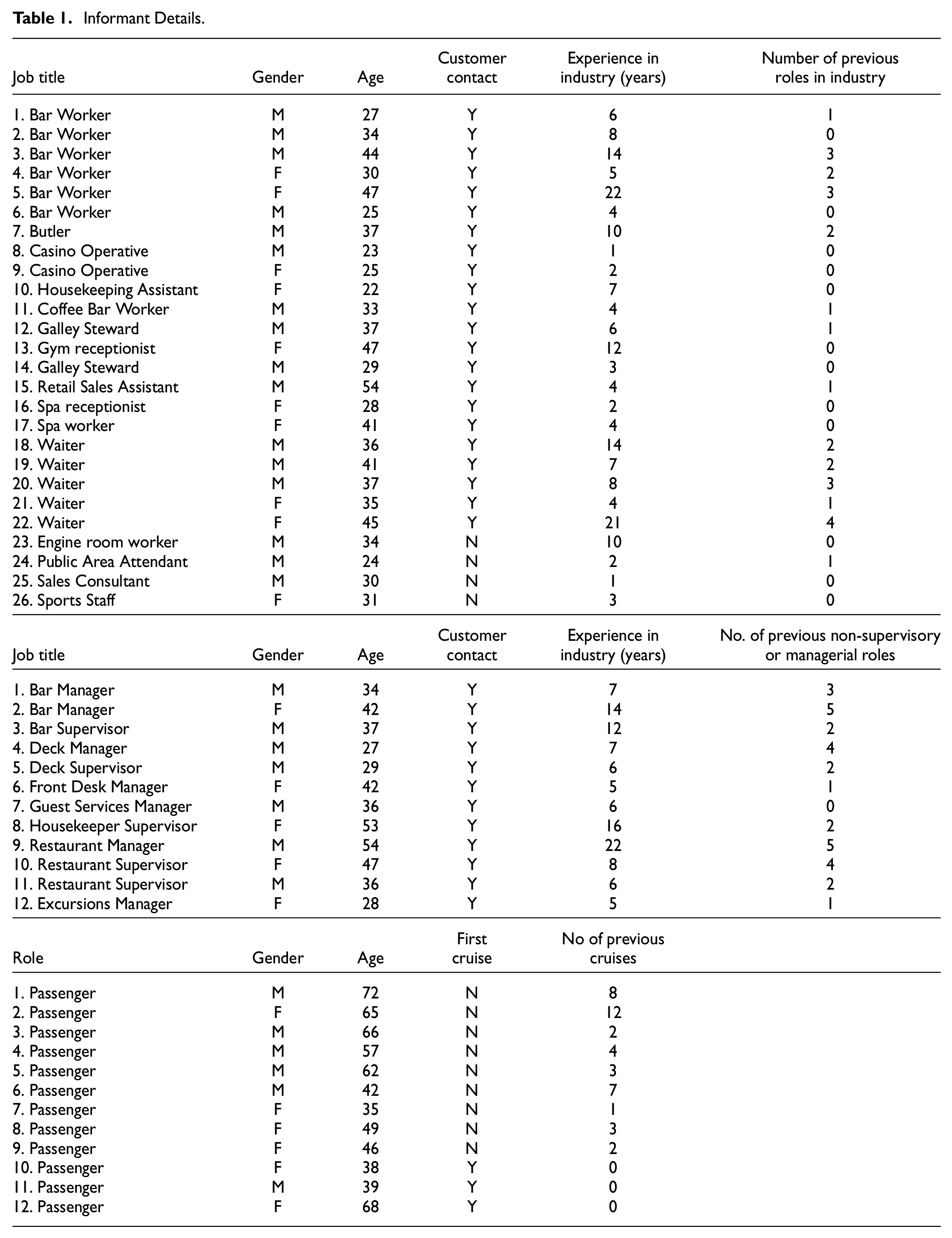
The organizations involved in the study required detailed confidentiality clauses, which have required us to disguise locations, names, and firms, amongst other broader identifying details. The confidentiality clauses specified that no specific identifying details could be published. Nonetheless, we are permitted to state that all three ships may be categorized as “large vessels,” which serve a global market (and which operate in a wide range of locations). Following standard research protocols, gender, ages, job titles, experience, and other details have been included for contextual understanding. Informants were requested to dedicate at least 1 hr for each in-depth interview, which were all conducted face-to-face in a private location (such as an unoccupied cabin). On average, each interview lasted for 72 min.
To facilitate structured data analysis, each interview was digitally audio-recorded and later fully transcribed by a professional transcription service generating a considerable body of text. Such data were complemented during analysis by extensive notes taken during interviews (regarding speech patterns, body language, and emotional states). We recognized the possibility that informants might find commenting on illicit behaviors difficult or uncomfortable. Accordingly, we began all interviews by explaining that the informants could pause or stop the interview. Three interviews were temporarily suspended when informants felt the need for a break and an “off-the-record” reassurance of confidentiality clauses. To aid reliability, an interview schedule was developed by the research team prior to data collection and was adapted as data collection progressed. The focus of this schedule was on open-ended questions to encourage informants to describe their experiences and tell anecdotes about their experiences using their own terms, jargon, and language. During the opening phases of interviews we focused on building trust and rapport. Time was taken to explain the role and importance of the research, issues of confidentiality, and (arguably most importantly) the centrality of informants to the research. Opening questions were designed to highlight these issues and to stress the value we placed on the contribution of informants. Our view is that while the perception of every informant is useful and valuable, our approach sought to restrict potential bias as well as retrospective sensemaking by studying multiple, insightful informants with potentially differing perspectives (Eisenhardt & Graebner, 2007).
As our aim was to identify and elucidate key themes, issues, and interpretations, our adopted data analysis procedure was designed systematically to incorporate analysis of data both during and after data collection. In this regard, our procedure both informed and enriched our collection of data. This was most evidently reflected in our adapting interview schedule, which developed over time to incorporate insights gained during earlier data collection. We followed the well-documented recommendations of Strauss and Corbin (1998) regarding data analysis. Specifically, we used three types of coding to analyze data and followed the Strauss and Corbin (1998) recommendations regarding protocol and procedural guidelines. We used “open” coding to discover and identify the dimensions and the properties of core concepts. Using our annotated transcriptions, this process centered on theme identification and code collation. The research team separately undertook open coding processes before comparing initial outcomes and debating differences and similarities. “Axial” coding was utilized to explore linkages between the core categories as well as the level of dimensions. In many regards this process pivoted on the organization of open codes and the deeper exploration of linkages and root-similarities. Finally, we employed a “selective” coding procedure in an effort to refine insights. This reflexive phase of coding permitted the refinement of the central issues and the clarification of core insights.
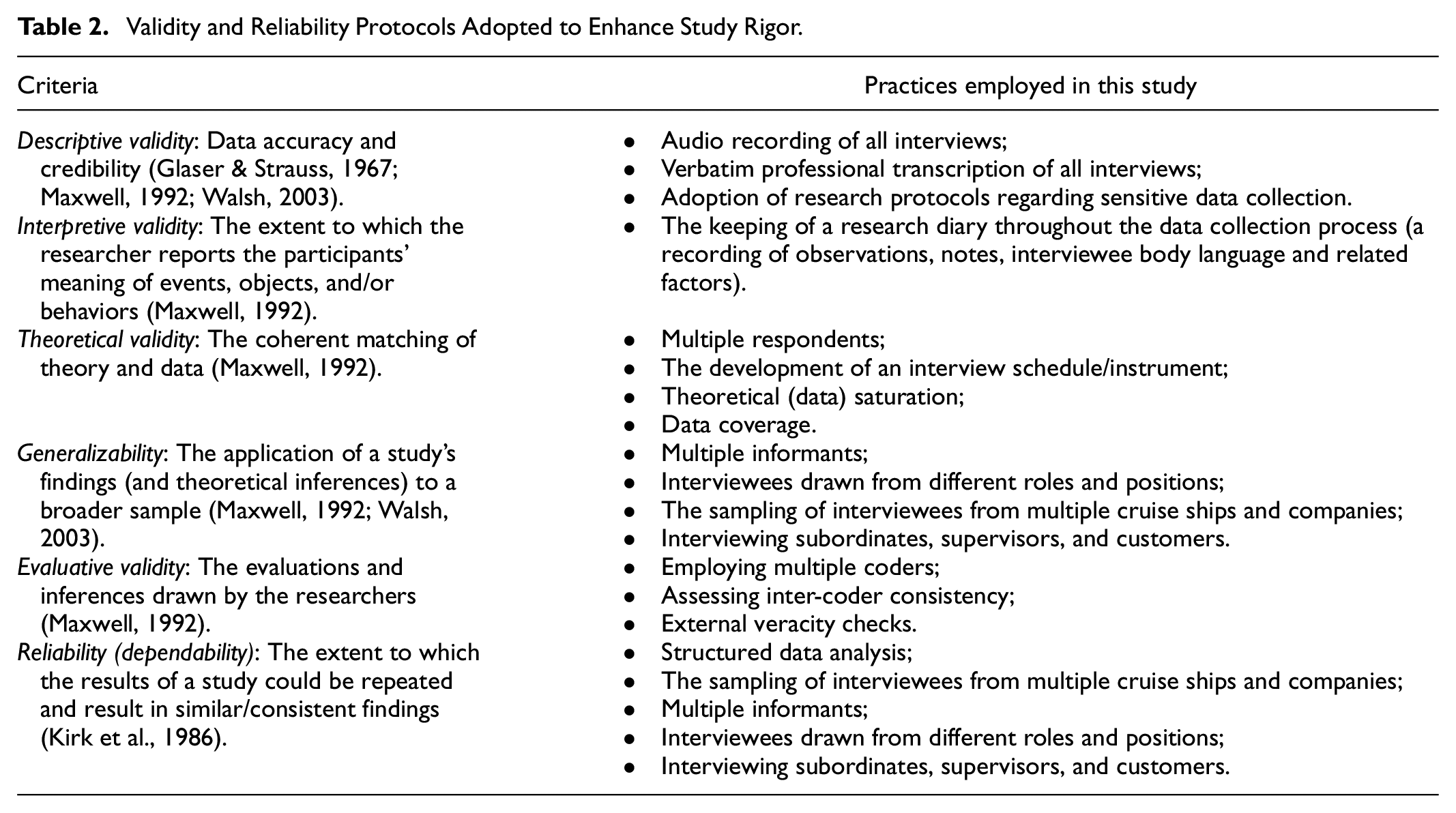
We endeavored to adopt procedures, techniques, and policies throughout our data collection and analysis to enhance the value of insights gained. Table 2 presents a summary of our efforts to maximize the rigor of our research.
Validity and Reliability Protocols Adopted to Enhance Study Rigor.
Findings
Data analysis revealed that frontline employees on cruise ships were both engaged with and subject to manipulation by a range of actors. Our findings focus on the nature and dynamics of such manipulation in two areas: (i) Manipulation by cruise ship frontline employees (including: manipulation of customers, manipulation of co-workers, manipulation of subordinates, manipulation of superordinates, and manipulation of themselves), and (ii) Manipulation of cruise ship frontline employees (including manipulation by customers, manipulation by co-workers, and manipulation by managers). Before explicating such practices, however, it is beneficial to contextualize any forms of manipulation with the espoused norms, rules and regulations of behaviors by frontline cruise ship personnel.
This is the SS Florida: You WILL Act According to Our Rules…
The title of this section (and quote from the Bars Manager of the SS Florida—a pseudonym) summarizes the typical socialization talk given by managers welcoming new frontline employees. While most workers have previous experience of cruise work, each ship has specific norms, rules and regulations regarding interactions with co-workers and guests. On most ships, and for most roles, detailed regulations have been developed, sanctioned, and codified into various forms of ship documentation and role folios that specify rules and expectations regarding all aspects of onboard behavior. A waiter explains: When you join, you get given a file and you get the induction to the ship and a special role induction. It is fairly standard – dress, timekeeping, rules of service, politeness, modes of address, etc. The role stuff is all about targets on satisfaction, speed of service timings, timing of service checks, etc. It is all down on paper – you have to pass the tests before you can serve and then you shadow and get checked for the first six weeks. [Restaurant Waiter, Male, 36, 14 years’ experience]
As such, all ships and all roles have rulebooks and full instructions regarding “best practice.” Nonetheless, experienced employees noted that while managers (in particular) were advocates of such practices (often involving training workshops), workers in many roles had developed their own set of informal rules that worked best—for them. A senior member of the deck team claims: The rules are clear. Black and white, written down – targets, timings, everything. Then there is the real world – the real way things work. Most of us have been doing this for years – we know what works and we’ve been around long enough to learn the real tricks of the trade from our friends and colleagues – those are the real rules for us – the tricks and ploys that make it work in our favor. [Butler, Male, 37, 10 years’ experience]
As such, frontline practices often deviated from ship rubrics and this deviance was tacitly supported by supervisors balancing customer needs with over-zealous ship-rule applications. Thus: There are rules and there are rules. If you have a good supervisor, they’re only interested in happy customers and happy us. Checking [in singsong voice] that ‘all is well with your drink, this evening!’ eight times a night annoys people – good supervisors ignore rules that stop us keeping customers happy and making money. [Bar Manager, Female, 42, 14 years’ experience]
While managers promulgate rules regarding onboard service encounters, such regulations are often tacitly reinterpreted at the customer interface by employees. The reminder of this paper is dedicated to exploring this “codification of best practice” (as specified in company policies) and how and why manipulation is widely viewed as a necessary requirement for the efficient and harmonious functioning of cruise ships.
Manipulation BY Cruise Ship Frontline Employees
Notwithstanding the covert (to senior management) reinterpretation of service rules, however, frontline employees commonly adopt various forms of inter- and intrapersonal manipulation for a range of reasons. Such practices involve the manipulation of customers, co-workers, subordinates, managers and, occasionally, even of themselves.
Manipulation of Customers
While ship and company managements (variously) espouse customer satisfaction, delight and contentment, frontline cruise ship employees have an almost universally-accepted raison d’tre. One explains: The guests don’t really get why we are here. We’re just like the furniture to them. We’re here for the money – that’s why they work and why we work! My role is to serve them but my objective is to wring every last cent I can out them – just politely and with a smile. [Coffee Bar Worker, Male, 33, 4 years’ experience]
As such, gaining tips from passengers constitutes a key source of much desired and pursued income. Consequently, astute employees adopt a range of strategies and tactics to generate and elicit tips from guests. Tactics include playing to the egos of self-satisfied passengers to reducing extra tips: They [the customers] expect you to be a character. They expect you to be smiling and funny and friendly and, well, not altogether clever. You want a tip? Mispronounce words so they can correct you – they love it – it plays to their egos and proves that you are not clever and they are superior – tips flow from superior people… [in a more heavily accented way with mock comic ‘determined’ facial expression] ‘so sorry, I will say right’! [Bar Worker, Female, 47, 22 years’ experience] I guess all waiters are the same – they’re looking for a buck. It’s just these guys are better at it – you want to chat – they’ll chat. You want fast, they’ll do fast. Pretty tooting good in my book [Passenger, Male, 67, 4 previous cruises]
Similarly, customer service employees can manipulate socially-competing couples to extract extra reward: To them it is a game – you get two couples showing off to each other about how blasé they are about being here and you can play them off. ‘You are so kind, thank you so much’ [turning as if to another person and thickening the accent noticeably], ‘Soooo generous, you are the best customers!’ [Bar Worker, Male, 27, 6 years’ experience]
This is not to suggest that such employees exclusively manipulate customers for financial reasons. While such motives are paramount, customer-contact employees also manipulate customers for the benefit of the customers themselves (and indirectly the employee and co-workers). For example: The old hands [long-term or second or third time passengers] know what to do. The new ones [first cruise or first-time ship passengers] need to be told what to do or they get flustered and unhappy… What you need to do is ask them questions and give them answers at the same time. So –‘would you like me to bring you a round of drinks before the show starts, or do you think two rounds would be easier for you?’ Or, ‘as I’m here on my own, would you like to move to the lido deck so I can serve you faster or are you happy here on your own?’ [Bar Worker, Male, 34, 8 years’ experience] The staff are superb – they’ll just tell you precisely what to do. ‘You want extra fast? Here’s the best table, sir’. ‘Quiet table? Just over here.’ [Passenger, Male, 66, 2 previous cruises]
Thus, in this example, workers persuade customers to move to easier-to-serve locations that mutually benefits the customer (who gets the service they want) but also staff, as serving customers with similar needs in a smaller area is more efficient.
Manipulation of Co-Workers
Customer-contact cruise ship employees also routinely maneuver co-workers during their working days. Their motivations for this behavior varies considerably. In the first case, the overwhelming drive to maximize income leads to manipulation tactics designed to maximize income potential. For example, Aisyah explains how she persuades Tan to swap his more lucrative work-zone for a less attractive one: I’m not above flirting with people to get what I want out of a day. [Coquettishly] A little flirting is fine. If it means that I get a better zone [an area of tables to serve], then a little flirting to coax somebody into swapping isn’t hard. [Restaurant Waiter, Female, 35, 4 years’ experience]
In other instances, co-workers cooperate to maximize tipping potential on a case-by-case and reciprocal basis. Thus, for example, waiters swap tables to match waiters with particular types of customer (benefiting individual waiters and, indirectly, the customer). Common grounds of reciprocal swapping include languages and gender. For instance: Look, our job is to keep the guests happy. If that means they are more comfortable with a cabin steward who is male or female, then we’ll just swap things around. It doesn’t make a great deal of change for us, keeps them [the customers] happy and means they leave a better tip. [Housekeeping Assistant, Female, 22, 7 years’ experience] I’m not saying that all we do is chase tips to make money. Persuading somebody to switch tables to match up better with customers is good for the customers too. I can speak fair German – if he [the other waiter] can’t, well, swap over, let me have a crack at making them open up! [Restaurant Waiter, Male, 37, 8 years’ experience]
Such practices were common and were accepted as the norm by employees who considered failures to swap ill-mannered and inefficient. Thus, long-serving employees would socialize early-career workers into such behaviors on the dual grounds of maximizing tip income while enhancing customer satisfaction.
I’ve been doing this for seven years now. I’m not a fresh-faced newbie! If I can see that I’ll do better with a cabin, I’ll tell them [the co-worker] that I need to swap and get what I can off the cabin. [Housekeeping Assistant, Female, 22, 7 years’ experience]
In this sense, the manipulation of co-workers was largely driven by instrumental needs but is concordant with organizational customer-orientation imperatives.
Manipulation of Subordinates
While frontline cruise ship employees manipulate co-workers for a variety of motives, the manipulation of subordinates is designed systematically to achieve two main objectives. First, customer contact employees use their experience to both train and acclimatize less-experienced or newly-hired subordinates into their dual roles—satisfying customers and controlling customer behavior for maximum returns. A supervisor explains how experienced employees can socialize fresh hires: I always put new staff with the old hands. It is supposed to be shadowing but it is really training them in what works [i.e. manipulation]. [Restaurant Supervisor, Male, 36, 6 years’ experience]
A veteran of 12 years’ experience outlines how new workers need to be trained in “real-world” practice: You need to kick the hospitality school out of them. Get them to be natural and yet take control of guest interactions – not pushy, but respectful persuasion … coaxing without the guests cottoning on! [Bar Supervisor, Male, 37, 12 years’ experience]
Such “real-world” practice centers on controlling guest behavior for the benefit of both the customers and the serving employees. Such manipulation is variously called “controlling,”“managing,” or “overseeing” passenger behavior by staff—all synonyms for persuading customers to behave in certain ways. This is often espoused as mutually beneficial: For those [staff] just joining the ship, a key phase is getting them to understand what we want – happy guests, yes. But managed, happy guests is best. We need to control what guests expect and receive – then they’re happy. [Guest Services Manager, Male, 36, 6 years’ experience]
The second motivation for manipulating subordinates centers on perceived respect and recognition of authority. With employees drawn from a range of cultural contexts, respect of superordinates (or, in some cases, merely those who believe themselves to be superordinates) is a highly-sensitive and important dynamic within ships. In some contexts, older employees expect their age to be respected, male employees often expect submissive behavior from female workers and (in all contexts) more experienced employees expect less-experienced workers publicly to respect them. Afra, a senior waiter, who has worked on his ship longer than any other waiter and who allocates zones of work (despite having no legitimate authority to do so), explains: There are times when you need to exert your authority. They [less experienced workers] need to know that they can push only so far. Be disrespectful or annoy the customers and a line is crossed – that will cost then. I knew it when I was in their role and they know that I know it. They will follow my way of doing things to the level I want – they push things too far and the lucrative shifts, the best zones will get moved to other people. [Restaurant Waiter, Male, 36, 14 years’ experience]
In this case, Afra claims authority and demands “respect,” legitimized (to some degree) by a veneer of customer-orientation.
Manipulation of Superordinates
Customer-contact cruise ship employees operate within a clearly defined hierarchy (by, e.g., job titles, uniforms, privileges, and quarters). As such, on first appearance, adherence to legitimate-positional authority seems inherent to roles. However, on analysis it emerges that subtle manipulation of superordinates is endemic. Workers vie with each other for the most lucrative roles, zones, timings, and shifts of work which are allocated by immediate superordinates. Janie, a female and relatively inexperienced waitress, explains why she consistently works on one of the best decks: I’ve been on this deck [a prestigious and lucrative deck level] for the last three weeks or so. I think Fred [the supervisor] likes me because I’m always very, very, very polite and respectful to him so he likes me and rewards me. He’s lonely and I always take the time to talk with him and ask him about his day. He just wants to feel important – so I always ask his advice. Men like feeling wanted. [Restaurant Waiter, Female, 35, 4 years’ experience]
Similarly, Tomi notes that as a less-experienced bar tender, he explicitly (even ostentatiously) pays public respect to his (more experienced) superordinate: You can’t ‘buy’ the best zones but you can pay for them with respect. It’s not bribing anybody but if you treat your boss with the respect that they want, they’ll notice you. Disrespectful? Fine – try the morning shift in the coffee bar on deck nine [a notoriously slow, boring and unrewarding location and time]. [Bar Worker, Male, 25, 4 years’ experience]
In this regard, subordinate customer-contact employees consciously and carefully manipulate their superordinates in order to gain more lucrative or more attractive (in terms of timing or location) shifts, zones, or roles.
Again, both the subordinate and superordinate employees recognize such activities—with superordinates tacitly accepting such practices and subordinates justifying their actions on the basis of mutual employee-superordinate-passenger benefits: The Floor Supervisor knows what we’re doing – they did it themselves! What do they care who does what as long as the guests are kept happy? They’re not going to tolerate us being silly or anything but as long as we’re ticking all the service standard boxes, they’re happy. As long as we make them look good, they’re happy. [Retail Sales Assistant, Male, 54, 4 years’ experience]
Indeed, subordinate manipulators argue that their bosses rely on such manipulative behavior, not only for customer satisfaction benefits but also for their own reward: The supervisors get judged on how we do. I know it and they know it too. It’s a balance, they want to keep us [the waiting staff] happy as we can keep guests happy, so they make sure that we get a fair share of the best zones, shifts, whatever – the best staff get the most and the less able the least – they know who’s good and who’s not so good. [Restaurant Waiter, Female, 45, 21 years’ experience]
Manipulation of Themselves
While customer-contact cruise ship workers recognize and even celebrate their manipulation of others as an inherent part of their working lives, a less publicly acknowledged aspect of their work is their own self-motivation, which in many regards constitutes self-manipulation. In a similar way to which they manipulate customers to behave in a manner that suits their needs and they manipulate others to shape their work, frontline workers appear to adopt tactics to motivate themselves in, what is, hard and demanding work: Thinking too much destroys you. If you think about the rudeness, think about the hours ahead, think about the petty snobbery [laughs] you’d go looney tunes! You have to banish negativity – not ‘cos it just drags you down but if you don’t, the time drags and drags and you’re unhappy not the [singsong voice] ‘all is happy here, I’m happy, you’re happy, we’re all happy’. [Spa Worker, Female, 41, 4 years’ experience]
In this regard, many cruise ship employees adopt deep acting techniques to manage their emotional labor during long shifts and contracts of work. Much of this “deep acting” (Hochschild, 1983), draws on positive emotions generated by the support of such workers for their families back in their home countries. Mary, a mother of three children, draws on the thoughts of the farm she has bought for her grandparents, parents, uncles, sisters, husband, and children all of whom work on the farm at home in Asia and rely on her wage remittances: You can’t get through a day [a twelve-hour shift] on faking it. You can, but you really can’t. You’ve got to get into ‘happy-mode’– I think of my kids and the farm and I smile! Think happy thoughts and you’ll be happy. [Receptionist, Female, 47, 12 years’ experience]
Similarly, Jenq whispers a coping mantra under his breath of “this is a better life” to get through shifts: I do this for a better life. This
In this way, employees variously, and commonly, use techniques to manipulate their mood and outward emotional display. Much of this self-manipulation relies on comparisons between working in their countries of birth compared with their current employment (which is, most often significantly better remunerated). As such, the hard work and separation from family inherent in working on ships is downplayed psychologically when compared to the hardships faced in working at home. Fariq concludes: If I was at home, I’d be struggling and fighting for every Đng [currency of Vietnam], every day. No security, no stability in job. This is hard but I say to myself all the time ‘home is harder than this – remember it and keep going!’ [Public Area Attendant, Male, 24, 2 years’ experience]
Manipulation OF Cruise Ship Frontline Employees
While evidence of manipulation by customer-contact cruise ship workers emerges from the data, analysis also reveals that such employees are subjected to manipulation themselves. As much as employees attempt to manipulate others, evidence indicates that they are themselves subjects of manipulation. Although evidence is found of manipulation attempts by a range of different workplace actors, three bases of manipulation seem especially worthy of discussion: manipulation efforts by customers, co-workers, and managers.
Manipulation by Customers
Given the extended nature of contact between customer contact cruise ship employees and customers (some of whom can be aboard for a month or longer), it is not surprising that such employees recognize attempts by customers to manage/manipulate their interactions and relationships. While employees may be motivated to manipulate customers into giving higher tips, customers themselves, also attempt to maximize the value of their interactions. Josie, a bar tender, comments: Just because they’re rich doesn’t mean that they’re generous. They didn’t get wealthy by being stupid. They love free drinks or extras or add-ons as much as anybody – and the richer they are, the more they’ll look to cajole you into things. [Restaurant Waiter, Male, 37, 8 years’ experience]
Employees suggest that customer’s exhibit flirtatious behaviors for instrumental reasons and that such actions are often effective: They’ll flirt and flutter their eyes for the best seats or a free round or some free tour tickets – seriously, you should see how they get the boys [the male waiting staff] to jump for them! [Restaurant Waiter, Female, 35, 4 years’ experience] It passes the time, a little flirting here and there – at my age, I’ll take all the flirting I can get! [Restaurant Waiter, Female, 45, 21 years’ experience]
In this regard, employees recognize manipulation attempts by customers and selectively accede to such overtures for personal, instrumental reasons. For example: They’re [the customers] not terribly subtle – they just want something and if they can get what they want for a tip here and there – that is fine with us. [Galley Steward, Male, 29, 3 years’ experience] ‘Can you sort us out a
In most cases, cruise ship employees encourage such manipulation attempts as such actions not only satisfy customers but also generate personal benefits (most often in the form of increased tips).
Manipulation by Co-Workers
As customer-contact cruise ship workers attempt to manipulate their co-workers, co-workers often recognized such efforts and reciprocate with their own manipulation in return. As such, employees mutually used a variety of tactics to maneuver others for their own advantage. For example: We [the bar staff] know each other really well. I mean, really well. We’ve been here just two months and I know every detail of their lives. We know why we’re here and we know what works. If you have a gay couple – Jonah will flirt with them so we’ll swap tables. I do well with others – families with kids – I’ve got kids and I know how to talk with them and when the parents want peace and quiet. It is a mutually beneficial deal. [Bar Worker, Male, 44, 14 years’ experience]
Such tacit cooperation was perceived to be mutually beneficial both instrumentally (for the maximization of tips) and for social capital (for creating favors that would require later payback). For example, Suzie discusses a swap of table allocations with John, both of whom wish to avoid groping customers: We know that we’re using each other – I know that he wants to avoid the fat old lady pinching his behind and I’m dodging the octopus on table fourteen! We both know but politely pretend that a swap is just a swap. [Restaurant Waiter, Female, 35, 4 years’ experience]
Interestingly, while customer contact employees commonly considered the manipulation of co-workers to be an inherent and entirely mundane part of their work, most informants indicated that they were very rarely unknowingly manipulated by others. However, discussion with matching dyads of co-workers suggested that such views were misplaced. Ding comments about Julla, a head section waiter who had previously claimed that he was “never” manipulated by other section leaders: Ding’s a good leader. He’s very on the ball when it comes to service but he’s blind when it comes to heading off problem customers. If I’ve got one who’s going to be difficult, I can just flutter my eyes and ask him to ‘help out because he’s sooo fast’ [in a child-like, girlish voice] and he’ll do it. Sucker for a pretty face that one! [Restaurant Waiter, Female, 45, 21 years’ experience]
Manipulation by Managers
The final category of manipulation of customer contact employees centers on manipulation by managers. Although managers have legitimate and hierarchical authority and are able simply to direct subordinates, most managers noted that part of their role was persuading and manipulating subordinates into actions: You learn quickly that you can’t just bark orders. Well, you can but then if you need more, you’ll get the blank faces. Bark when you need to, but cajole when you can. Persuading people that that is what they want to do. [Deck Manager, Male, 27, 7 years’ experience]
In some regards, such actions may be viewed as astute management or leadership in that superordinates use negotiation and persuasion to achieve organizational goals as well as imposing authority when required. However, conversely, such actions may also be viewed by subordinates as a corruption of legitimate authority and a form of exploitation. Tyrion, reflects on his career moving up the hierarchy: It is hard. It’s hard on them and it was hard on me. You ask them to do the extra, you persuade them to stay on past their shift-end, to work beyond what they get paid for with a vague suggestion that it will be in their long-term interest – a promotion, better shift, better zone. Sometimes they get rewarded and sometimes not. That’s life. As a manager you use all the resources you have to get what you need. We’re all climbing the slippery pole. [Restaurant Manager, Male, 54, 22 years’ experience]
It is tempting to assume that passengers are oblivious to tourist workers’ acts of manipulation, but this is not the case. On the contrary, customers were often complicit in such acts: I think the customers know what we’re doing – well, some of them anyway. If they want a clown, we clown. If they want fast, we do fast. If they want a sob story, they get one. We’re just putting on a show for them and they’re happy to pay for it. I think they know it is just a game. [Bar Worker, Male, 25, 4 years’ experience] Guests are not completely stupid! Not all of them anyway [laughs]. They know that we’re ‘dancing’, we’re managing them – we just need to do it in a way that they don’t mind – they get what they want and so do we. [Restaurant Waiter, Male, 36, 14 years’ experience]
Contributions
Contribution to Theory
This paper reflects the need for more targeted research on the much-neglected working lives of (often) low-status, customer facing cruise ship workers (Brownell, 2008; Gibson, 2008; Papathanassis & Beckmann, 2011; Thompson, 2002), and their exchanges with typically extremely affluent guests. In this way, the study exposes insights into the often-invisible lives of cruise employees, with an emphasis on worker (mis)behavior in the form of deviant manipulation practices. As such, this research contributes to—and extends—the growing literature on deviant leisure (Raymen & Smith, 2019, 2020) and, crucially, to the limited research on service worker misbehavior in tourist settings (A. Chapman & Light, 2017; Harris, 2012), as well as to the much-neglected cruise ship sector (Harris & Pressey, 2021). These studies point to the importance of understanding the deviance and misbehavior of tourism workers in addition to the misbehavior of tourists, and the present study responds to these calls. The tourism service workers in our study employ deviant behaviors to resist and violate rules and service protocols (Whether to elicit greater tips or to control customers), strengthening the identity of a sub-culture of workers, and, in so doing, testing the boundaries of feasible behaviors in their role.
Our study highlights that although manipulation practices are not (typically) criminal, such actions should be viewed as deviant behavior as they digress from established service scripts and protocols; and moreover, manipulating behavior by cruise ships workers is both pervasive and prevalent in the context of cruise ships. In this regard, our focus on cruise ships revealed a compendium of manipulation practices performed by service workers that significantly and deliberately deviated from the expectations of cruise ship companies. Moreover, such acts were normalized, legitimized, and tolerated deviant by both peers and superordinates. More importantly, however, we extend the literature on deviant leisure as our findings suggest that deviant behavior is not limited to tourists. In contrast, our research reinforces the notion that cruise ship and tourist workers are equally likely to act in deviant ways. It is, therefore, reasonable to conclude that broader settings than cruise ships may also be affected (cf. A. Chapman & Light, 2017) and wider tourist settings are equally susceptible to such pressures and influences. This seems especially relevant as extant literature on deviant leisure and misbehavior in tourism overwhelmingly focuses on the actions of tourists, while the misbehavior of service employees is often overlooked resulting in a theoretical imbalance in our understanding of deviance in a tourism setting.
In broad terms, the study of tourism, leisure, and recreation has (understandably) focused on positive behaviors and exchanges, while subjects such as deviance and harm have largely been neglected unless they are blatantly overt (Franklin-Reible, 2006; Rojek, 1999). In this sense, the manipulation practices uncovered in this study contributes to our understanding of service worker deviance in the form of manipulation and (mis)behavior (Browning, 2008; Chen & King, 2018; Harris, 2012; Lugosi, 2019; Volgger & Huang, 2019). The diverse deviant manipulation practices uncovered would appear to be mundane, quotidian even, and in some cases highly sophisticated. Employees practice manipulation to control their working lives, and the interviews reveal a rich corpus of methods and techniques of practicing manipulation and deviance from service scripts. Nonetheless, most studies of service provision (in tourism or more broadly) tend to assume that any service failures are exclusively attributable to incompetence (Harris, 2012), rather than due to the active deviance of employees.
Central to deviant leisure is the notion of social harm (Raymen, 2017). The deviant manipulation practices uncovered in the present study are more subtle and nuanced and sit on the boundary between ethical and unethical behaviors, as with many practices in deviant leisure such as free-running and parkour (Garrett, 2013; Raymen, 2019). However, in the current study, manipulation is not necessarily intended to cause harm, but rather to elicit greater tips, “manage” customers, and even positively to improve customer satisfaction. As such, manipulating deviance also helped to restore some sense of social justice due to the wealth disparities between passengers and workers. While our participants did not articulate feelings of exploitation (largely as they typically made more money on cruise ships than they could in their home country), they did recognize that there was considerable inequality between themselves and passengers. Nonetheless, external observers and commentors could look at the treatment of cruise ship workers and highlight social injustices and (arguably) exploitation which guides or clouds their expressed views. The workers interviewed were largely pragmatic, however, and accepted the trade-off between occasional minor mistreatment by passengers and the remuneration received, which afforded them and their families a good quality of life.
In summary, the present paper sheds light on several areas in cruise tourism and tourism more generally in several areas. Initially, the intermittent literature on tourism and wrongdoing has tended to focus on criminology with a particular emphasis on observable and recorded crime (e.g., Ajagunna, 2006; Brunt et al., 2000), but often overlooks the potentially more common, subtle and nuanced practices of everyday tourist deception and manipulation (see Harris, 2012; Harris & Pressey, 2021). Next, little is understood about deviant employee and invisible practices in tourism where there is a paucity of research (Lytras & Papageorgiou, 2015), this is particularly the case for cruise ship tourism, which has attracted limited research in recent decades (see Foster, 1986; Meng et al., 2011; Morrison et al., 1996; Teye & Leclerc, 1998; Yi et al., 2014). Thirdly, tourism settings (particularly cruise ships) are well-placed to facilitate employee manipulation where tourists may be inattentive whilst at leisure and also “captive” targets. Further, whilst critical observers acknowledge that some tourism settings, such as cruise ships, have arduous working conditions for employees (Klein & Roberts, 2003), we have, however, a limited understanding of the implications of these working conditions for employee (mis)behavior and deviance in tourism scholarship (A. Chapman & Light, 2017; Harris, 2012). Fifthly, contrary to some views on cruise ship workers, the findings of the present study suggest that frontline employees frequently find ways to negotiate their roles rather than simply subordinate themselves or conceal their true emotions (Johansson & Näslund, 2009; Tracy, 2000), and also finds that service workers in tourism settings regularly deviate from service protocols and scripts both for their own gain and also to maintain customer satisfaction. Finally, the findings of the study point to the need to understand deviant leisure not just from the viewpoint of the tourist. To this extent, understanding the role of service workers themselves and deviant practices in leisure settings would seem a fertile area to explore and address the poverty of theory in cruise tourism scholarship.
Managerial Implications
The present study also has implications for practice. Managing the gray area between service delivery protocols and scripts, and allowing some forms of manipulation to help facilitate customer satisfaction and to motivate employees would seem beneficial to all. Therefore, striking a balance on the one hand between designing service scripts and protocols for customer-facing staff to follow, and allowing employees some room for subtle manipulation, tolerated by both superordinates and by company management to small acts of tourist manipulation in the provision of a positive customer experience, would seem merited. There is also an argument to suggest that manipulation and deviance is included in the formal training of cruise ship employees in order that it can be regulated and managed, given that some forms of manipulation benefit passengers.
Future Research
Several areas would merit further enquiry. Initially, a better understanding of the manipulation of tourists (particularly in different settings to the current study, such as “enclave resorts where tourists are ‘captive’), could reveal different techniques and driving factors. There is also a need to better understand deviant behavior by service workers in tourist and leisure settings in addition to understanding deviant behavior and practices by customers, particularly in the context of social harm; this might take the form of acts of significant social harm toward tourists (e.g., theft, abuse, violence), or else relatively minor harm (e.g., eliciting bigger tips, passenger management). We also suggest that employee deviance would be particularly useful to understand where customers are from affluent developed countries while workers are drawn from the developing world. This specific issue also has important societal implications beyond the boundaries of tourism scholarship and could center on themes such as exploitation, social justice, and inequality (Rawls, 1999; Sen, 1992).
Footnotes
Declaration of Conflicting Interests
The author(s) declared no potential conflicts of interest with respect to the research, authorship, and/or publication of this article.
Funding
The author(s) received no financial support for the research, authorship, and/or publication of this article.
