



Abstract
Studies have confirmed the ineffectiveness of sentiment expressions generated by sellers in improving guests’ purchasing intentions. However, how sentiment expressions can influence guest behavior and host performance remains unclear, given the relative importance of seller-generated content in peer-to-peer rental platforms. After collecting data from Airbnb and developing empirical models, this study confirmed that hosts’ sentiment expressions largely benefit from their online performance. This case is especially true when their properties did not receive high-quality negative reviews. To further reveal the mechanism behind this effect, we further conducted two experiments. Results show that trust plays an intermediary role in the relationship between hosts’ sentiment expressions and guests’ purchasing intentions. This work contributes to tourism literature and property owners on peer-to-peer rental platforms in practice.
Introduction
As a new business model, sharing economy have attracted numerous academic attentions in recent years (S. Liang et al., 2017). Property owners can use these platforms to flexibly rent their idle houses, apartments, and even beds to travelers, providing alternative accommodation options at affordable prices during vacations (Dogru et al., 2020). Compared with hotels, the heterogeneous amenities and services in accommodation-sharing platforms are a few of the comparative advantages, leading to the rapid growth of their market shares. However, the relatively high heterogeneity of amenities and services requires guests to search for additional information to make rational decisions, consequently increasing information asymmetry in peer-to-peer rental platforms (Leoni, 2020).
User- (or guest-) and seller-generated contents (or host-generated contents) were identified as major information sources for guests before making decisions (Lalicic et al., 2021; L. Zhang et al., 2020). Product or service providers frequently have more complete information than consumers; thus, seller-generated content (SGC) should contain other comprehensive descriptions of products or services (Goh et al., 2013). By contrast, user-generated content (UGC) is a type of consumer-oriented information source and thus more likely to be perceived as credible by other consumers (Ye et al., 2009).
From the perspective of product or service providers, SGC is not only an information acquisition channel for their consumers but can also be content to promote or recommend their products or services (Z. Zhang et al., 2019). However, controversy persists on whether or not the effectiveness of SGC includes sentiment expressions. On one hand, sentiment expressions convey the positive sentiment of product or service providers to consumers to help product or service providers build emotional relationship with consumers and increase the consumers’ trust (Bai & Yan, 2020; Hsu et al., 2019). Moreover, SGC has been confirmed to possibly influence consumers’ engagement (Meire et al., 2019). On the other hand, most prior studies have found that UGC often has a greater impact on consumers’ purchasing decisions than SGC, especially when products or service information provided includes sentiment expressions (Song et al., 2019). This finding is primarily due to the fact that SGCs containing sentiment expressions are likely to be perceived as persuasive or promotional information by consumers, and the latter perceives these contents to lack credibility (Goh et al., 2013).
In the context of peer-to-peer rental platforms, based on the particularities of review systems, several recent studies also noted the ineffectiveness of UGC such as online reviews in peer-to-peer rental platforms (S. Liang et al., 2021). Specifically, they proved the positive bias of online reviews existing in such platforms, such as Airbnb (Baute-Díaz et al., 2022). For example, Zervas et al. (2021) summarized that over 95% of online reviews on Airbnb have 4.5 or higher ratings with low rating variance. Such bias may be due to the following factors: guests’ social closeness, empathy, and concern of possible retaliation (Pera et al., 2019). The ineffectiveness of UGC creates difficulty for guests to differentiate the property quality by only relying on a single information source, which highlights the importance of host-generated content (S. Liang et al., 2020). For example, S. Liang et al. (2020) investigated the power of text descriptions generated by hosts and found that the width and depth of textual descriptions positively influenced property performance. In addition, some studies reported the existence of reciprocity on such platforms which suggested that most hosts tended to regulate their behavior first to also regulate guests’ behavior and obtain long-term profits (Davlembayeva et al., 2021; Proserpio et al., 2018). Thus, guests and hosts in peer-to-peer rental typically have more trust in each other to act in good faith (Peng et al., 2020).
Although some prior studies have highlighted the importance of SGC on peer-to-peer rental platforms (S. Liang et al., 2020; Su & Mattila, 2020), very few of them further observe how to improve the efficiencies of such content by changing its writing style. Especially, no study focuses on whether or not hosts can use this information source (SGC, such as textual descriptions) also as a service promotion by including sentiment expression information. Accordingly, the current study aims to investigate, given the particularities of peer-to-peer rental platforms, how sentiment expressions posted by property owners affect guest purchasing intentions. In this paper, to answer the research question mentioned above, based on mixed-method approaches, we first collected a large secondary dataset from Inside Airbnb and constructed econometrics models to observe the direct effect of sentiment expressions on hosts’ online performance. Second, we conducted two experiments to further verify the findings and further reveal the mechanisms behind this relationship.
Literature Review and Hypothesis Development
Information Cascade Theory
Information cascade theory suggested that when a decision maker chooses one product among multiple competing products, he/she constantly has two channels of information: (1) his/her own private information (e.g., decision maker’s prior knowledge of the product) and (2) the information coming from the decision result of others (Bikhchandani et al., 1992). When two information sources deliver contradictory information and if others’ decision-making information has a greater impact on the decision maker, information cascades will be generated and then directly lead to the herding behavior (Bikhchandani et al., 1992).
Prior studies mostly tended to use information cascades theory to explain user behavior in online market. Owing to the existence of UGC in such contexts, decision makers’ consultation can easily capture others’ behavior (Duan et al., 2009). For example, driven by information cascades, users’ arguments in online discussion forums on the rumors can directly influence subsequent readers’ belief in that rumor, leading to their belief change (Q. Wang et al., 2018). The literature of information systems also proved that information cascade directly influences individuals’ decisions of technology adoption (Duan et al., 2009; H. Sun, 2013). In recent years, information cascade theory was generally used by tourism literatures to explain tourists’ imitative behavior (Ryan et al., 2018). For example, Boto-García and Baños-Pino (2022) regarded information cascade as one of causal mechanisms behind interdependent preferences and bandwagon effects.
Although several prior studies confirmed the effectiveness of information cascade, some literature also reported that information cascade is not always effective to influence individuals’ decision making. The theory suggested that information cascade only occurs when information of others’ decision making has a relatively strong effect on individuals’ decisions (Bikhchandani et al., 1992). Accordingly, Y. J. Lee et al. (2015) found that if the platform further allows users to observe the reviews and rating postings by their friends, strangers’ reviews and ratings cannot induce their herding behavior. By contrast, many studies found that information cascades were more salient for experience goods than for search goods because consumers often use own-based information to understand search goods (Li & Wu, 2018; Xiao & Benbasat, 2011).
Cognitive Dissonance Theory
Cognitive dissonance theory is a theory in social psychology based on the consistency principle (Festinger, 1962), which refers to a psychologically uncomfortable state that occurs from an inconsistency between the desired and the actual states. Cognitive dissonance describes the mental discomfort created by a contradiction between personal belief and newly obtained information (Cummings & Venkatesan, 1976). Similar to satisfaction, dissonance comprises both cognitive and emotional components (Sweeney et al., 2000) but which are regarded as immediately post-decisional (Festinger, 1962).
Cognitive dissonance is a basic topic in the psychology field and is generally adapted to solve research questions in multiple fields such as marketing and tourism management. Festinger (1962) first proposed that cognitive dissonance occurs when one cognition that a person holds is inconsistent with the observation of another, leading to psychological discomfort. Following the above definition, some marketing scholars investigated the effect of cognitive dissonance on consumer behavior. For example, Wilkins et al. (2016) found that the cognitive dissonance caused by deceptive packaging has a negative effect on consumer’s repurchase behaviors.
Cognitive dissonance theory was also widely used in the literature of tourism management to explore the mechanism of consumer purchase decision-making behaviors. Following the definition presented by Cummings and Venkatesan (1976), Sweeney et al. (2000) proposed three conditions for the arousal of dissonance, which is especially applicable to explain consumers’ purchase decisions of travel products (Book et al., 2018). First, consumers need to pay a substantial amount of financial or psychological costs in the purchase decision, which is important for tourists. Second, consumers have the freedom to purchase. Tourists can voluntarily choose whether to purchase related products. Third, the consumer’s decision shows an irrevocable commitment. The tourist needs to bear the decision to purchase travel products and its subsequent consequences. In addition, dissonance is greater for experiential purchases, such as travel products, because it reflects the personal taste of the tourist (Bawa & Kansal, 2008). Accordingly, most of tourism literature also found the negative relationship between cognitive dissonance and subsequent traveling and purchase intentions (Book et al., 2018). Tanford and Montgomery (2015) also focused on the measurement of post-decision dissonance in the context of hospitality and found that a common method for consumers to reduce post-decision dissonance is to look for other favorable information about the hotel they booked.
Hosts’ Sentiment Expressions
Sentiment expressions or emotional expressions were mostly defined as contents embedded into the text that contains the variations in phrases and nouns used to show emotions or sentiments (Nakayama & Wan, 2018). For online platforms, sentiment expressions embedded in consumers’ online reviews attracted the most academic attention because one main function of online reviews for consumers is to share their experience and sentiment with their peers. Additionally, readers will perceive online reviews with sentiment expressions as more useful to help them make decisions (Yin et al., 2014). As the multiple online platforms directly become the important channels for consumers to obtain information, more and more product or service providers started utilizing various online channels (e.g., social media platforms) to post descriptions of products (B. Zeng & Gerritsen, 2014). Distinct from sentiment expression embedded in online reviews which may contain both positive or negative emotions (Folse et al., 2016), sentiment expressions embedded in sellers’ description primarily include the introduction of positive sentiments brought by their products or services or simply convey their positive sentiments (e.g., warmth, happy) to the consumers (X. Wang et al., 2022; L. Zhang et al., 2020).
The consequences of sentiment expressions posted by product or service providers have been the focus of studies in different fields, such as management information systems, marketing, and tourism management. However, the findings were relatively inconsistent. On one hand, some studies noted that compared with sentiment expressions, informational expressions posted by service providers are more effective to influence guests’ decisions (Goh et al., 2013; Meire et al., 2019). This finding is because sentiment expressions may occasionally be treated by consumers as promotional information which reduces their perceived credibility of such contents (Scholz et al., 2018). On the other hand, several recent studies also noted the positive influence of sentiment expressions posted by sellers on consumer engagement and purchasing intention (Wan & Ren, 2017). Compared with informational expressions, sentiment expressions convey the positive sentiment of product or service providers to consumers to help product or service providers build an emotional relationship with consumers and increase the consumer’s trust (Bai & Yan, 2020; Hsu et al., 2019). Some studies also noted that containing sentiment expressions in social media postings can benefit the quantity and speed of the information sharing (Stieglitz & Dang-Xuan, 2013). Even on some special platforms such as online heath interaction platforms, physicians’ sentiment expressions can also provide emotional support to patients, thus improving the patients’ perceived usefulness of physicians’ information sharing (Liu et al., 2020).
Hypothesis Development
Hosts’ Sentiment Expressions and Guest’s Purchase Intention
Most prior studies found that information cascade theory is effective in explaining consumers’ purchasing decisions for experience goods, such as travel products (X. Li & Wu, 2018). On Airbnb, two information sources are available for consumers: online reviews generated by previous guests and information posted by property owners. According to information cascade theory, guest purchasing decisions can be driven by the information of others’ decisions; thus, positive guest reviews can lead to the potential guests’ herding behavior and promote their purchasing (Boto-García & Baños-Pino, 2022; Q. Wang et al., 2018).
However, as noted above, information cascade is only effective when information of others’ decisions can directly influence consumers’ decisions (Li & Wu, 2018; Xiao & Benbasat, 2011). In the context of peer-to-peer rental platforms, several studies have reported the ineffectiveness of UGC such as guest reviews on potential guests’ purchasing decisions. For example, previous studies argue that guests’ reviews and ratings may have a positive bias and thus would further reduce users’ perceived credibility of UGC (Baute-Díaz et al., 2022). Accordingly, many studies have noted that in peer-to-peer rental platforms, making purchasing decisions only relying on UGC is difficult for guests, and further highlighted the importance of SGC, such as host descriptions (Gao et al., 2022; S. Liang et al., 2020; X. Wang et al., 2022; L. Zhang et al., 2020). Thus, we expect that positive sentiment embedded in sentiment expressions of SGC can help guests further confirmed the trustworthiness of positive guest reviews which further promote the occurrence of information cascade.
However, although prior studies have reported the ineffectiveness of sentiment expressions generated by service providers in some one-sided electronic commerce platforms (e.g., Goh et al., 2013), we expect that guests on two-sided peer-to-peer platforms will more likely trust hosts’ behavior and perceive their sentiment expressions as more credible. First, distinct from one-sided electronic commerce platforms, guests and hosts relatively have “equal” status; thus, for most guests, hosts are more likely to be their peers rather than traditional service providers (Gao et al., 2022). Second, two-sided peer-to-peer rental platforms such as Airbnb frequently adapt a bilateral reputation system to generate trust among strangers and regulate behavior of posts and consumers (Proserpio et al., 2018). Prior studies have confirmed the existence of reciprocity principle on peer-to-peer rental platforms (Davlembayeva et al., 2021). Accordingly, the high perception of reciprocity in peer-to-peer rental platforms also leads to the guests’ high perceived trustworthiness toward hosts. Finally, unlike other service providers such as hotel managers, property owners constantly have other opportunities to directly interact with their guests from booking, to the stay itself, and afterward (S. Liang et al., 2021). Influenced by low social distance, guests are likely to trust content posted by property owners because the former can normally directly seek confirmation from the latter face to face.
In general, the high perceived trustworthiness of hosts’ descriptions decides that if the information of host descriptions and prior guest reviews is consistent, potential guests can further confirm the credibility of guest reviews which lead to the occurrence of information cascade. Prior studies have previously reported the existence of positive bias on guest reviews of Airbnb; thus, most of the guest reviews are positive reviews (Baute-Díaz et al., 2022). Therefore, the hypothesis is proposed as follows:
Moderating Effect of Negative Reviews
On Airbnb, the information generated by hosts and prior guests constitutes two different information sources for subsequent guests who intend to make purchasing decisions. Among them, hosts’ sentiment expressions provide a positive signal for guests to infer the service quality of the properties, allowing consumers to have a good prior understanding of the listings. As noted above, if guests can obtain consistent information from hosts’ sentient expressions and guest reviews, it may motivate the occurrence of information cascade and thus improve subsequent guests’ purchase intention. However, negative reviews from previous guests serve as counter-attitudinal information, which will lead to customer experience dissonance when faced with reviews that are contrary to their prior understanding (Tanford & Montgomery, 2015). Cognitive dissonance is an imbalance between one’s cognition (values, beliefs, attitudes, and knowledge) caused by the inflow of conflicting information, objects, events, or experiences (Awa & Nwuche, 2010). Therefore, the conflict between the host’s information and the previous guests’ information has led to the cognitive dissonance of consumers, which has damaged the consumers’ good impression of the listings, thereby affecting their purchase intention.
Especially, the existence of positive bias in ratings and reviews on accommodation-sharing platforms indicates that most reviews on such platforms are positive reviews (Baute-Díaz et al., 2022). It may further highlight the values of negative reviews to help subsequent guests differentiate the quality of properties and hosts. Previous studies have found that the negative impact of negative reviews on sales is stronger than the positive impact of positive reviews, especially for hospitality products (Chevalier & Mayzlin, 2006; M. Sun, 2012). Accordingly, the existence of negative reviews will lead consumers to suffer from increased cognitive dissonance when the host’s description contains sentiment expressions (J. S. Lee et al., 2021). It may further reduce the perceived credibility of hosts’ sentiment expressions, thereby weakening its positive influence on guests’ purchasing decisions. Therefore, from the perspective of cognitive dissonance theory, the following hypothesis is presented:
In addition, the quality of reviews, such as readability and content richness, is important in deciding the propensity of consumers or guests to adopt such information (S. Liang et al., 2017). High-quality reviews can allow consumers to obtain more useful information, reduce uncertainty, and thus increase consumers’ trust (Filieri et al., 2015). Guest reviews contribute to information search and as a prominent source of non-price information that can affect sales and consumers’ purchase intentions (Book et al., 2018). Based on cognitive dissonance theory, when consumers have cognitive dissonance, they may adjust themselves by seaching further information (Tanford & Montgomery, 2015). However, the high-quality negative reviews will make them face greater information conflict, thereby causing serious dissonance, which will largely influence consumer decision making. On the other hand, although some negative reviews exist, if the quality of these reviews is relatively low, cognitive dissonance resulting from the inflow of conflicting information is not serious; whereas high-quality negative reviews will lead to serious dissonance for consumers and thus reduce their purchase intentions. Accordingly, we present the following hypothesis:
Mediating Effect of Trust
Trust is one party’s confidence in the reliability and integrity of exchange partners. In peer-to-peer markets, trust is a direct and important element influencing purchase intention (Wu et al., 2017).
Despite the important role that trust plays in online purchase decisions, studies that investigated the effect of hosts’ sentiment expressions on perceived trust in different situations remain scant. Sentiment expressions from the host on platforms would influence the extent to which consumers believe they can rely on during decision making. L. Zhang et al. (2018) also pointed out that positive words in self-descriptions can increase consumers’ perceived trust. The possible reason is that the positive emotions of service providers are contagious to guests (Schoenewolf, 1990). By contrast, as noted above, on peer-to-peer rental platforms, owing to the existence of reciprocity and low social distance, guests naturally have high trust on the credibility of hosts’ postings. Thus, if property owners embed emotional expressions into their textual descriptions, it may also increase the trust of guests on the service quality of properties, while the statement of positive reviews will improve their purchase intention. Thus, we expect that sentiment expressions positively influence the guests’ purchase intentions partly because of its positive effect on guests’ trust.
However, guests’ feelings about hosts’ sentiment expressions are rather relevant to negative reviews (Chevalier & Mayzlin, 2006). When negative reviews exist, especially when the quality of negative reviews is relatively high, guests will face inconsistent information between UGCs and SGCs, resulting in cognitive dissonance (J. S. Lee et al., 2021). In other words, high-quality negative reviews will render the host’s excessive sentiment expressions similar to false marketing, which will lead to a high sense of mistrust among consumers (Filieri et al., 2015). At this time, consumers will not trust the landlord to describe this information source; when consumers’ trust decreases, their willingness to buy will decline (S. Liang et al., 2017). Thus, we present the following hypotheses:
Research Design
To fully answer our research questions, we design two different studies by adopting a mixed method. In Study 1, we obtained secondary data from Inside Airbnb (http://insideairbnb.com/) to observe how hosts’ sentiment expressions influence guests’ purchase intentions and the moderating effect of negative reviews. Laboratory experiments are considered particularly useful for the identification of psychological processes (Hwang & Mattila, 2018). Thus, in Study 2, we conducted two experiments to ensure the sensitivity of our empirical results and explore the mechanism behind the effect of hosts’ sentiment expressions. Figure 1 presents the conceptual model.
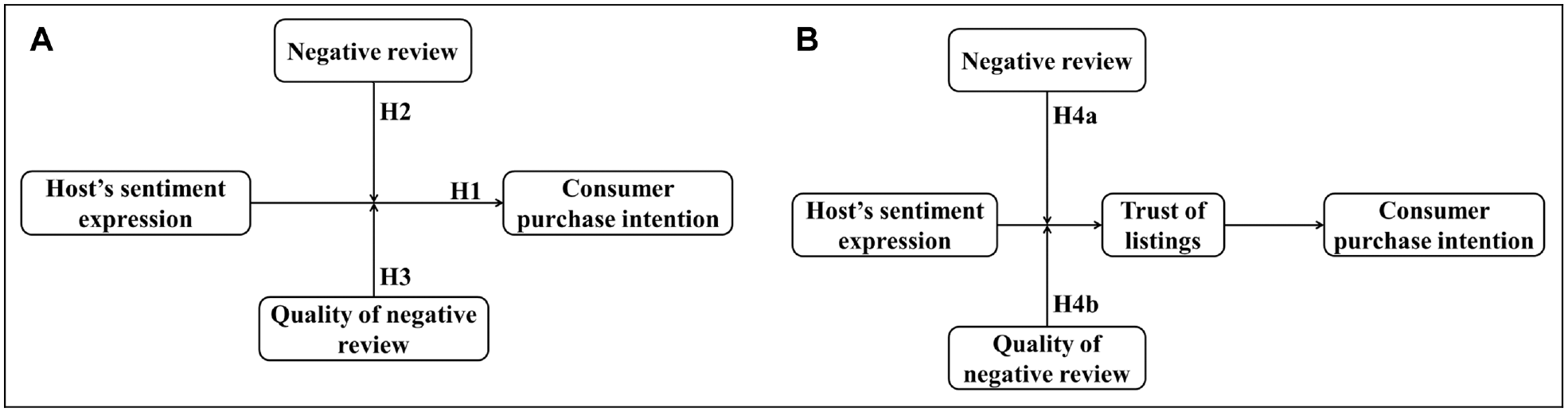
Conceptual Model.
Study 1: Empirical Study
Data Collection
As the pioneer of shared short-term rental, Airbnb as a successful case of a sharing economy platform was listed on NASDAQ on December 11, 2020; it also attracted increasing attention from many scholars (L. Zhang et al., 2020). Consistent with prior studies (e.g., Ert & Fleischer, 2019; Gurran et al., 2020), we collected the data from Inside Airbnb, which is an Airbnb-independent data collection project created by Murray Cox. This site includes not only listing details but also 365-day availability calendars and review data for all listings. Through this site, we collected the dataset including the host’s descriptions, price, host response rate, corresponding reviews, and other related information of each listing located in New York City (see Figure 2). We used panel data for a total of 10 months from November 2020 to August 2021 on Airbnb in New York City for empirical analysis. Finally, after deleting missing variables, 4,770,147 reviews posted on 105,902 listings were used for our final analysis.

Listing Interface.
Variable Measurements
Listing Demand (LD)
Airbnb has adapted availability calendars to allow all guests to observe the availability of each property in future days (S. Zhang et al., 2022). Thus, following prior studies (Gao et al., 2022; S. Liang et al., 2020), this paper adopted the number of unavailable days of each listing within 60 and 90 days as proxy of property demand as the dependent variable.
Sentiment Expression Intensity (SEI)
In Airbnb, to attract guests’ attention and promote their properties, some hosts may embed sentiment expressions such as the descriptions of advantages of their listings in a very positive or even exaggerated way into the expressed property descriptions. To capture such sentiment expressions, this paper uses machine learning methods based on the Natural Language Toolkit (NLTK) (nltk.sentiment.vader) and SentiWordNet (Denecke, 2008) to distinguish the sentiment expression intensity and complexity of the text, including both hosts’ listing descriptions and guest’s reviews. Figure 3 shows the data processing, while Figure 4a and b show the detailed sentiment computing process and an example 1 of it, respectively.

Data processing framework.

(a) Sentiment computing process and (b) example of sentiment analysis.
After text preprocessing, we used SentiWordNet to obtain text polarity and complexity (compound score). First, we calculated the polarity score

where

Second, the sentiment

Finally, the SEI is obtained by a simple logistic classifier based the score of listing description, that is,
Moderator Variables
The moderating variables include the Number of Negative Review (NNR) and the Quality of Negative Review (QNR). Following the same methods for obtaining the sentiment intensity of listing description, the NNR is counted from all reviews under each listing.
Referring to L. Zhang et al. (2018), we used the readability of reviews to represent the quality of reviews in this article. We adopted the Gunning Fog formula to calculate the readability of the negative reviews from guests as the following formula 4, that is, QNR.

where ASL is the average sentence length of negative reviews for one listing, and PHW is the percentage of complex words in a negative review text obtained by SentiWordNet.
Control Variables
We divide the control variables into two parts to control the heterogeneity of listings and hosts. The first part is related to the hosts. The host with the title, “Superhost,” may increase the room reservation rate owing to the increase in consumers’ perceived trust (S. Liang et al., 2017; L. Zhang et al., 2018). Moreover, the length of time the host stays on Airbnb (Time), the number of houses owned (ListingNum), and the response rate of a host (Response) will also affect the house reservation (Ert & Fleischer, 2019). Meanwhile, this paper also considers the control variables related to the listings, including Type (the type of listing, i.e., entire home/department, private room, and hotel room), Price, Volume (the number of reviews), Valence (rating of each listing), Latitude and Longitude (geographic location), which significantly affect the consumer’s reservation (Gao et al., 2022; G. Zeng et al., 2020).
Empirical Models
We aim to better understand our data and identify suitable panel regression models for data analysis. First, LM test for individual-specific effects (
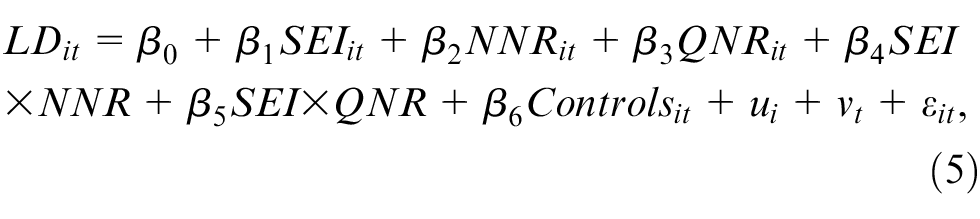
where i = 1, …, N for each listing,
Results for Empirical Study
Statistic Description and Correlation Analysis
According to the results of statistical description and correlation analysis, the number of unavailable days (booking amounts) in future 60 days (LD_60) and that in future 90 days (LD_90) are 32.13 and 43.49 on average, respectively. In total, 13.5% of the listings contain negative reviews, of which 74.2% are high-quality negative reviews. Each host has 7.44 listings on average. In total, 35.5% of the hosts in our dataset are super hosts, with an average response rate of 89.9%. Each listing in our dataset shows that on average, the unit price per night is 148.43 USD, the number of reviews per month is 1.55, the total number of reviews is 44.33, and the ranking score is 91.81 (percentage scale).
Hypothesis Testing
Table 1 presents all primary regression results of fixed effect models and robustness results of pooled ordinary least squares (POLS) model. We hypothesized that the effect of the hosts’ sentiment expressions on property demand is positive and significant (H1). In Table 2, when using property demand in future 90 days as dependent variable, Model 1 refers to the results of the model containing independent and control variables. Models 2 and 3 further report the results including independent variables, moderating variables, and all control variables. The results of Model 1 show that, after controlling fixed effects, SEI has a significantly positive impact on the listing demand in future 90 days (
Empirical Results of Fixed Effect Models and Robustness Check.

p<.05. ***p<.01.
Regression Results of Experimental Study.

p < .1. **p < .05. ***p < .01.
The results of interactive terms (SEI×NNR and SEI×QNR) show significantly negative effects (
To further control the impact of geographic location (including latitude and longitude) in the model, we also used the POLS model to do robust check. Table 1 (see Models 4, 5, 9, and 10) displays the results, which were highly consistent with the results using fixed effect models.
Study 2: Experimental Study
Experimental Design and Participants
To further explore the internal mechanism of the impact of host description and reviews on user behavior, this study designed two 2 × 2 experiments to further test the relationship between hosts’ sentiment expressions, negative reviews, quality of negative reviews, trust, and guests’ purchase intentions. Specifically, the 2 (negative review: including negative review vs. excluding negative review) ×2 (host description: with sentiment expressions vs. without sentiment expressions) experiment and the 2 (quality of negative reviews: high vs. low) ×2 (host description: with sentiment expressions vs. without sentiment expressions) between-subject experiment. The experiments achieved high internal validity and full control for participants (Pera et al., 2019), and the results of hypothesis test are considered more robust.
Consistent with previous studies, Airbnb is one of the most popular accommodations for young consumers, and pervious study also proved that young people aged 19 to 28 with university education are the most frequent users of Airbnb (Garg, 2020). As such, following G. Zeng et al. (2020), we used a sample of undergraduate students from a comprehensive university in China. All participants are Chinese with excellent English proficiency and had experience of booking Airbnb properties while traveling overseas.
Experimental Stimuli and Procedures
We simulated a seminar on the winter camp plan. At the seminar, students were provided the opportunity to study in New York University (NYU) for 2 days. The instructor carefully introduced the precautions for visiting NYU (for approaching closer to the empirical research scenario) and emphasized that accommodation reservations need to be made through Airbnb during the visit. All the students who participated in the seminar as subjects were randomly divided into eight groups and browsed the interface of Airbnb and then filled out the relevant questionnaires. Among the participants (N = 528), 58.5% are female, and all of them have had experiences in booking short-term rental properties on Airbnb and other similar platforms. A red lucky envelope was given at the end of the experiment as an incentive.
All experiments are conducted online, and the interface display and the distribution of questionnaires were carried out through our self-developed experimental system to better control the experimental process. The overall procedure and detailed contents of our experiment are presented in Figure 5.

Experimental procedure framework.
The pre-experiment process was basically the same as the formal experiment. First, we sent emails to each participant. Second, we show two similar listing pages designed according to the experimental needs by completely simulating the Airbnb interface to increase credibility (Hwang & Mattila, 2018). Third, we control the countdown and page sliding options to ensure that they browse all details. Finally, we collect data through a 7-point Likert scale ranging from 1 (strongly disagree) to 7 (strongly agree). Among them, trust of listings referred to the same items from L. J. Liang et al. (2018) and purchase intention measured based on Mao et al. (2020). Cronbach’s α values of trust and purchase intention were .879 and .857, respectively.
Pre-experiment Manipulation
A pre-experiment with 27 students (59.3% were female aged 20 to 26 and with a high level of English reading) who have Airbnb booking experience was implemented to validate our experimental manipulations before the formal experiment. In the pre-experiment, we first used real examples to explain to the participants the meaning of a sentiment expression and that of a high-quality negative review. Then, we showed all the experimental interfaces to participants and asked them to answer questions about their trust of listings (with reference to L. Zhang et al., 2018) after they scanned each comparison group. The preliminary results of the pre-experiment showed that when different combinations of negative review quality and host sentiment expression existed, the participant’s trust in the listing was highly inconsistent. In addition, to ensure that the independent variables in our experiment have been best manipulated, we explained the experimental intention to participants and improved our interactive interface and text used according to their suggestions.
Host’s Listing Description Simulation
In the formal experiment, we informed all participants that they would have an opportunity to visit NYU and would need to book a house on Airbnb for a two-night stay. We randomly assigned the participants to different combinations of host’s descriptions and guest’s reviews. Figure 6a and b show comparison examples of the experimental interfaces and marked the module of host’s sentiment expression and guest’s reviews, which can be expanded to present the detailed contents.
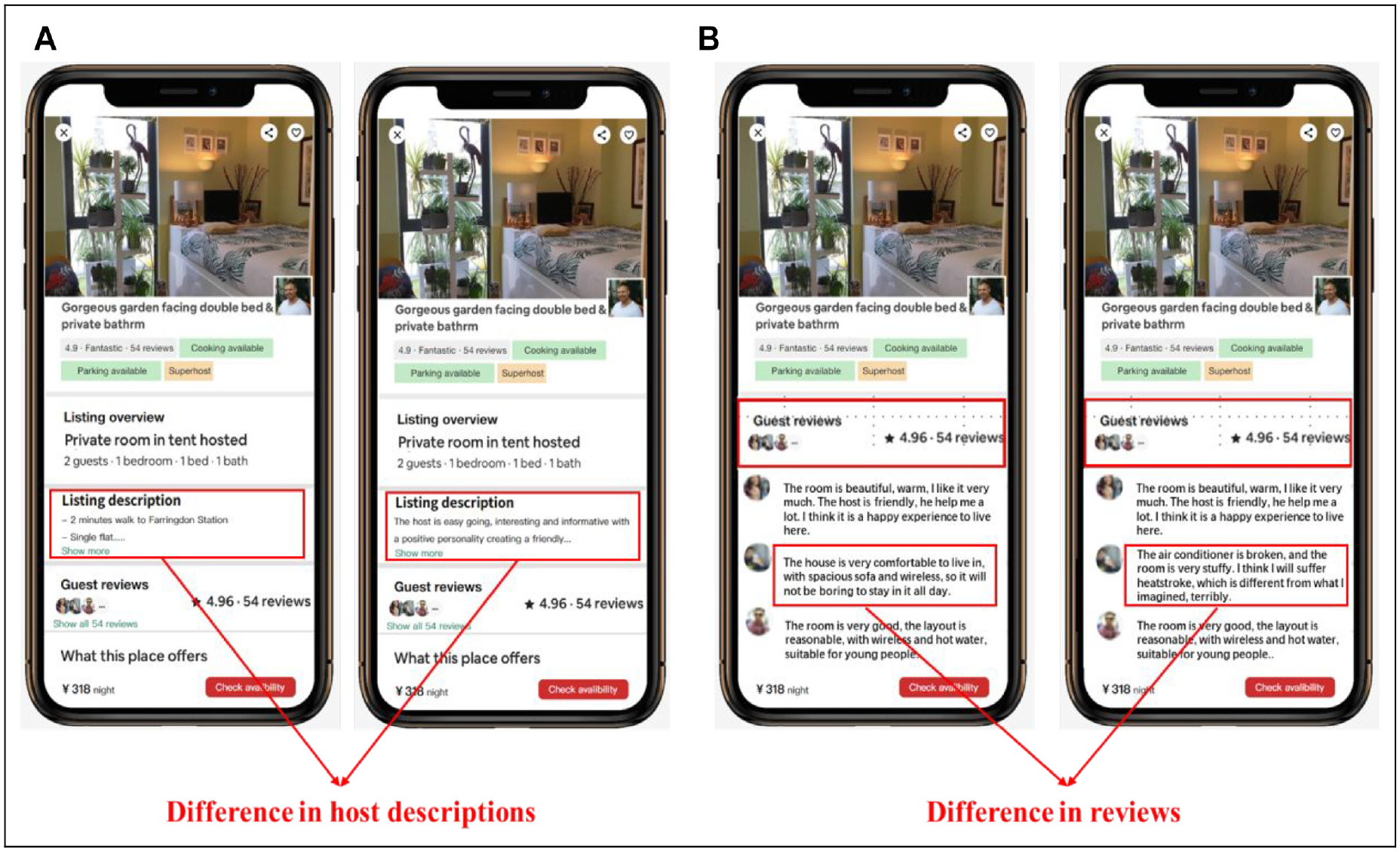
Example of experimental interface: (a) difference in host descriptions and (b) difference in reviews.
Based on L. Zhang et al. (2020), we developed two versions of the hosts’ descriptions. The host description with no sentiment expressions only objectively describes the hardware conditions of the listings (e.g., “The room is located on a residential street, and it is far from the bus and the subway is very close” and “There are many parks around”). By contrast, the host description with sentiment expressions includes many emotional and subjective words owing to the promotion purpose (e.g., “The house is located on a quiet residential street, very convenient” and “There are many excellent parks around, you can relax in them”). Both have been proven to generate different effects on trust and purchase intention. Figure 7 shows the specific design.

Host description comparison.
Guest’s Reviews Simulation
The valence of the online review is an important control variable in the experiment design. Analysis of objective data shows that the proportion of negative reviews is 10.91%. Thus, referring to the experimental design of G. Zeng et al. (2020), we set that the participants are required to browse comments of which 10.91% are negative reviews, whereas participants in the other group are required to browse all positive comments. Users’ visual attention is limited. Based on the load theory of attention, their attention decreases when users browse reviews from top to bottom (Q. Wang et al., 2014). Therefore, in manipulating our experiments, we place the negative review in the fourth of the top 10 reviews to ensure that it gains attention in the total 20 reviews.
We referred to previous literature and suggestions in the pre-experiment to design the review with different quality levels shown in the interface. We chose objectivity, informativeness, understandability, sufficiency, and linguistic correctness as the criteria for review quality (L. Zhang et al., 2018). High-quality reviews were readable, product relevant, relatively objective without linguistic errors, and have sufficient reasons to support reviewers’ evaluations (e.g., “I can’t recommend the place. The windows lack noise insulation which turns the room into a nightmare to sleep in. The room is not huge at all and stinks from mold.”). However, low-quality reviews were more subjective and emotional, with no information except expressions of feelings and product-irrelevant information (e.g., “This is the worst experience”). Figure 8 displays the comparison between high- and low-quality negative reviews.

Comparison on the quality of negative reviews.
Results of Experimental Study
We conducted a two-way (host description × negative review) analysis of covariance variables (ANCOVA) on purchase intention. Figure 9 presents the results of the ANCOVA, which revealed a significant two-way interaction between host description and the existence of a negative review (F [1, 263] = 3.247, p < .05). This result shows that the influence of host’s sentiment expression on guest’s purchase intention is weakened with the appearance of negative reviews, which suggests that H2 is supported.

Interaction between negative review and hosts’ sentiment expression.
We also conducted another two-way (host description × negative review’s quality) ANCOVA on purchase intention (see Figure 10). The results indicated a significant two-way interaction between the quality of a negative review and the host description (F [1, 263] = 4.153, p < .05). Specifically, in the low-quality negative review condition, when hosts’ sentiment expressions are strong (above the average of our sample), it will lead to higher purchase intention than those with low-intensity sentiment expressions (F [1,263] = 5.843, p < .05). Conversely, in the high-quality negative review condition, when the host has high-intensity sentiment expressions, the latter will lower the purchase intention than those with low-intensity sentiment expressions (F [1,263] = 28.081, p < .05). Thus, H3 is supported.
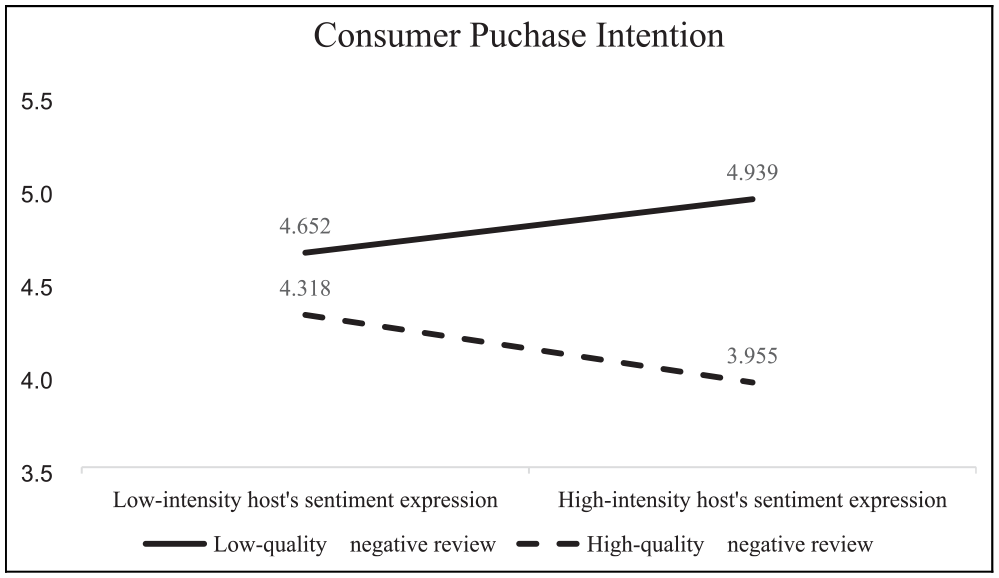
Interaction quality of negative review and hosts’ sentiment expressions.
Our hypothesis proposes that host description influences consumers’ purchase intention by influencing trust. To test H4, we used a moderated mediation analysis with serial mediators through the bootstrapping method (PROCESS Model 7). In this model, we used purchase intention and different designs of host descriptions as the dependent and independent variables, respectively. We used trust as an intermediary variable. The existence of negative reviews or non-existence and their quality are used as the moderator and dependent variables.
When the negative review is the moderator variable, the intermediary path of host description → trust →purchase intention is insignificant when no negative reviews exist (indirect effect = 0.2108, 95% CI = [−0.0216, 0.4461]), but the intermediary path is significant when considering negative reviews (indirect effect = 0.2986, 95% CI = [0.0687, 0.5425]). The results unveil that hosts’ sentiment expressions improve consumers’ trust in listings and thus increase their purchase intention.
When the quality of negative reviews is taken as the moderator variable, the intermediary path of negative review quality → trust → purchase intention is significant when the quality of the negative reviews is low (indirect effect = 0.2830, 95% CI = [0.1188, 0.4554]). The intermediary path is also significant when considering high-quality negative reviews (indirect effect = −0.1906, 95% CI = [−0.3524, −0.0391]). Thus, trust can play an intermediary role in both high- and low-quality negative review scenarios. However, the host’s emotional description increases trust in the case of low-quality negative reviews but reduces it in the high-quality negative review scenario. This finding means that the appearance of high-quality negative reviews accompanied by more emotional host descriptions induces users’ feeling of being cheated and thus reduces users’ trust, which alleviates their purchase intention. Thus far, the above results support H4.
To ensure the robustness of experimental results, we also conducted an OLS regression model and controlled the demographic variables (including gender, age, and major) using the experimental data. The path results shown in Table 2. All results were consistent with the results of fixed effect models and ANCOVA, suggesting that our results were robust.
Discussion, Implications, and Limitations
Main Findings
Building on previous studies focusing on the influence of UGCs and SGCs on consumer behavior (L. Zhang et al., 2020), this paper provides theoretical and managerial insights for peer-to-peer rental platforms and hosts by considering the cascade effects of information from two sides—hosts and guests—based on information cascade theory and cognitive dissonance theory. Specifically, we investigate the influence of hosts’ sentiment expressions, the existence of negative reviews or non-existence, and the quality of negative reviews on consumers’ purchase intentions. Furthermore, we used a research paradigm combining empirical study and experiments, in which the empirical study uses secondary data to determine the phenomenon. Meanwhile, experiments further explore the inner mechanisms.
This study explores how hosts’ sentiment expressions affect guests’ purchase intention on peer-to-peer rental platforms. Based on the persuasion knowledge model, prior studies focusing on the context of online travel agencies summarized that UGC, such as online reviews, has a greater influence on consumers’ purchasing decisions than descriptions posted by service providers (Goh et al., 2013). In this study, based on the information cascade theory and the results of empirical analysis, we find that hosts’ sentiment expressions embedded in textual descriptions can promote the guests’ purchasing intentions by increasing their trust and helping them confirm the positive signal from guest reviews, which differ from the results focusing on the context of traditional online travel agencies.
Based on cognitive dissonance theory, this study further investigates the effect of hosts’ sentiment expressions with the existence of negative reviews. We find that when negative reviews exist, especially when the quality of negative reviews is relatively high, the positive influence of hosts’ sentiment expressions on guests’ purchasing decisions will be weakened. The high-quality negative reviews provide clear negative information cues related to the quality of properties or hosts, which is inconsistent with the positive information cues from hosts’ sentiment expressions. It may trigger guests to suffer from a relatively severe cognitive dissonance and lead to their reduced perceived credibility of hosts’ sentiment expressions.
Finally, to understand the in-depth mechanism behind the impact of hosts’ sentiment expressions, we conducted lab experiments to investigate the mediating role of trust. The results show that trust for the listings plays a mediating role in the relationship between hosts’ sentiment expressions and guests’ purchasing decisions. It shows that if properties lack negative reviews and/or the quality of negative reviews is relatively low, hosts’ sentiment expressions can increase the guests’ purchase intentions by improving the trust for the quality of properties.
Theoretical Implications
Across two experiments and one empirical study using 4,770,147 real-world reviews and 105,902 listings’ information, we investigated the effect of hosts’ sentiment expressions on guests’ purchasing behavior. As an early attempt to investigate the influence of hosts’ sentiment expressions on guests’ purchase intentions in the context of peer-to-peer rental platforms, this study contributes to the literature on the UGCs and SGCs. Many previous studies have compared the influence of UGC and SGC on consumers’ purchasing decisions, and most of them have confirmed that consumer-oriented UGC has a greater influence on the context of traditional online travel agencies. This study further validates the effect of one type of SGC (hosts’ sentiment expressions) in the context of peer-to-peer rental platforms by further modifying the relevant theories, including the theories of information cascade and cognitive dissonance based on the particularities of this new context. Thus, our findings provide new insights for future studies to further validate and compare the effect of UGCs and SGCs on other emerging contexts.
Second, this study contributes to the literature on sharing economy and peer-to-peer rental platforms. Information asymmetry is more prominent on such platforms; thus, many studies have confirmed the effectiveness of different information sources on guests’ behavior (Baute-Díaz et al., 2022; L. Zhang et al., 2020). Moreover, some studies have confirmed the importance of hosts’ textual descriptions and selfies on guests’ purchase intentions (e.g., S. Liang et al., 2020). However, given the importance of host descriptions, prior studies scarcely further explored how to improve guests’ purchase intentions and host performance by more effectively designing the writing style of textual descriptions. This study addressed this question by validating the influence of hosts’ sentiment expressions on guests’ purchase intentions and the mechanism behind this relationship. Thus, the findings also provide several new insights for future studies to contribute to the research questions by using other text and graphic mining technologies.
Practical Implications
The practical implications of this paper are threefold. First, we discover direct evidence that hosts’ sentiment expressions can highly contribute to the increase in guests’ purchase intentions. Thus, hosts should maximize this information source to promote their listings. However, some studies have noted over 95% of listings on Airbnb have ratings of 4.5 or above. Given that the rating of each review on Airbnb is not publicly available to all users, we have checked all reviews of 9,174 listings and found that over 10% of reviews can be identified as negative reviews. Thus, the proportion of negative reviews is excessively little. Accordingly, property owners must pay close attention to the generation of negative reviews. Additionally, if high-quality negative reviews exist, they must be cautious about posting sentiment expressions because it may cause guests’ cognitive dissonance and reduce their purchase intentions.
Second, the findings of this study provide practical implications to help property owners improve their recovery strategies in the post-COVID-19 period. Ample studies have confirmed that the COVID-19 pandemic has caused a negative shock on peer-to-peer rental platforms by both reducing guests’ trust toward and purchase intention of shared properties (Shi et al., 2020). Based on the secondary data gathered on the effect of the COVID-19 pandemic, we find that for property owners, embedding sentiment expressions into property textual description is an effective method to promote their properties and improve the guests’ trust. We also further discuss the effectiveness of these strategies when hosts have different types of online reviews. Thus, this study provides an effective method for property owners to recover the performance from the negative shock of the COVID-19 pandemic.
Finally, this study can offer practical implications to platform managers. Our findings have indicated that hosts’ sentiment expressions can increase guests’ purchase intentions by improving their trust. To improve guests’ trust and the matching efficiencies of platforms, platform managers can present online designs to motivate property owners, especially those with better online reputations, to post emotional descriptions instead of objective descriptions. Moreover, after motivating property owners to post sentiment expressions, platform managers must artificially or automatically develop algorithms to check the authenticity of hosts’ sentiment expressions to avoid the appearance of crooked promotions. Moreover, the platform should develop intelligent reminder function for hosts to inform them whether they need more sentiment expressions, which can help the platform and the host achieve better mutual benefit.
Limitations and Future Studies
This study also has some limitations. First, this study only collected data from one destination, namely, New York City. Future studies can further validate our results by focusing on destinations from other cities or countries and comparing their results with ours. Second, this study only checks the sentiment expressions from the perspective of textual descriptions based on text mining approaches. Future studies can further analyze the impact of sentiment expressions from graphics or videos on guests’ purchase intentions. Third, we collected the data from Inside Airbnb after the outbreak of the COVID-19, and our results confirmed that hosts’ sentiment expressions are effective to increase guest purchasing intention and trust in the post-pandemic period. Future studies can further verify whether hosts’ sentiment expressions can also have an effect on reducing the negative emotions of guests caused by COVID-19 or how such negative emotions influence the effectiveness of negative emotions. Fourth, this study used Airbnb as our research context owing to its representativeness. Future studies can also consult the research design of this study and observe similar research questions based on other peer-to-peer rental platforms using different website designs with Airbnb to observe whether website design affects the main results of this study.
With regard to our experiment design, we considered only student samples in our design. Future studies can also extend to use broader samples (e.g., old adults, foreign, etc.) to explore how the impact mechanism changed in samples with different career backgrounds. In addition, this paper only considered a single dimension of consumers’ trust of host. Future research can consider trust as a multi-dimensional variable, including cognitive and affective trust, and further explore its influence mechanism.
Footnotes
Acknowledgements
We would like to thank the anonymous reviewers for their constructive comments on an early version of this paper.
Declaration of Conflicting Interests
The author(s) declared no potential conflicts of interest with respect to the research, authorship, and/or publication of this article.
Funding
The author(s) disclosed receipt of the following financial support for the research, authorship, and/or publication of this article: This work was supported by the National Natural Science Foundation of China (71722005, 72241432, 72002107), the Natural Science Foundation of Tianjin (No. 18JCJQJC45900), the One Hundred Talents Program of Nankai University (ZB22000102), the Humanities and Social Science Foundation of Ministry of Education of China (20YJC630075) and the fellowship of China Postdoctoral Science Foundation (2020M68087, 2021T140342), The National Key R&D program of China [Grant 2020YFA0908600].
