




Abstract
This study examines the impact of perceived busyness on the effectiveness of destination advertising based on construal level theory. Results from four experiments using two different tourism destination settings (i.e., water sports park and spa resort) indicate that low- (vs. high-) construal tourism destination advertisement is more effective for tourists with higher (vs. lower) busyness perception. This relationship is mediated by the need for time efficiency and benefit focus (serial mediation) and is strengthened when the achievement motivates (i.e., hope of success and fear of failure) of the tourist are high. Our study enriches tourism research by revealing that the effectiveness of destination advertising depends on a matching effect between advertising messages and tourists’ perceived busyness. It also has practical ramifications for destination marketing organizations in that it can enhance their understanding of tourists’ decision-making process with perceived busyness as an internal factor and thus help promote their destinations.
Keywords
Introduction
It has been widely acknowledged that destination advertising plays a central part in attracting potential tourists (Byun & Jang, 2015; L. Wang et al., 2022). Several studies have concluded that effective destination advertising can significantly promote tourists’ attitudes and visit intentions (Amar et al., 2017; Zhang et al., 2018). To elicit and maintain tourists’ interest in destinations, destination marketing organizations have launched advertising campaigns with different appeals and messages. However, given that the COVID-19 pandemic has significantly presented many challenges to tourism and hospitality industry (Gursoy & Chi, 2020), it is still arguable which destination advertisements can effectively encourage tourists’ positive responses. Studies have paid great attention to the critical role of the matching effect between advertising messages and tourists’ personal characteristics in destination advertising effectiveness. For example, Jiang et al. (2020) find that a match between arousal in advertising and tourists’ culturally-derived power can promote tourists’ positive attitudes toward tourism destinations. Seo et al. (2021) suggest that luxury hotel advertising that matches affective (vs. cognitive) language with tourists’ fixed (vs. growth) mindsets can result in more positive attitudes. Additionally, Zhang et al. (2018) argue that a gain-framed (vs. loss-framed) message results in more positive destination image perceptions in promotion (vs. prevention) focused tourists.
Apart from these crucial factors, a stream of research has been done to examine the aforementioned “matching effect” through the lens of construal level theory. According to construal level theory, people can mentally construe or represent the same information, action, and event in different ways, depending on their psychological distance (Trope & Liberman, 2003). Psychological distance refers to one’s perception of when an event/task occurs (temporal distance), where it occurs (spatial distance), to whom it occurs (social distance), and whether it occurs (hypotheticality) (Trope & Liberman, 2010). When psychological distance increases, people tend to construe objects at a high and abstract level; while when psychological distance decreases, people tend to construe objects at a low and concrete level. Researchers in the hospitality and tourism field acknowledge the importance of match between tourists’ psychological distance and the nature of message received, for instance, J. Kim et al. (2016) note that the congruency between tourists’ high (low) psychological distance and message abstractness (concreteness) leads to better evaluations of the advertisement and the destination. S. Wang and Lehto (2020) find similar results in the social media destination advertising context. Most recently, Jia et al. (2021) discuss the interactive effects of pictorial information and psychological proximity on tourists’ evaluations of tourism products. As it can be inferred, the extant literature has focused primarily on the characteristics of tourists’ psychological distance, especially their temporal or spatial distance. However, how tourists’ decision-making process is shaped by other internal factors, such as their perceived busyness, has not received much attention from tourism scholars. Given that the busy lifestyle has become an increasingly widespread phenomenon, people are motivated to seek travel activities in order to escape and relax from a busy everyday life (Marques, 2007; Pesonen & Komppula, 2010). Therefore, it would be meaningful to examine how tourists’ busyness perception influences their construal level and then influence their travel decision-making process.
Specifically, this study firstly investigates the impact of tourists’ perceived busyness on their construal level. It then examines whether such busyness perception can affect tourists’ responses toward low- versus high- construal advertising and explores the proposed underlying mechanism. Lastly, the study analyzes whether tourists with different levels of achievement motives (i.e., hope of success and fear of failure) will show different responses toward different construal levels of destination advertisements and explain their distinct behavioral patterns.
The current research makes the following contribution to tourism research. First, we contribute to destination advertising research by identifying tourists’ perceived busyness as an internal factor influencing their travel decision-making process. Second, we take a new theoretical perspective on the construal level to understand the mechanism underlying tourists’ perceived busyness. Specifically, we extend this research by showing a novel determinant of the abstractness or concreteness of tourists’ thoughts and mindsets—perceived busyness. Third, we discuss how this mechanism is hindered or enhanced by achievement motives (i.e., hope of success and fear of failure). Thus, we provide systematic insights into how tourists’ perceived busyness, achievement motivation, and destination marketing organizations’ marketing efforts jointly affect tourists’ travel decisions. This study also provides practical strategies to help destination marketers and managers develop effective marketing messages that enable tourists to form positive visit intentions.
Literature Review and Hypotheses
Perceived Busyness and Construal Level
With the advent of the era of rapidity, globalization, and high competitiveness, busyness has become a widespread “epidemic” among modern-day individuals. An increasing number of people report feeling busier than ever (Darrah, 2007). Perceived busyness is a subjective perception of having many required tasks to perform and lacking leisure time (Bellezza et al., 2017; Wilcox et al., 2016). Individuals perceive themselves as busy when they feel that they are occupied with tasks or when they spend long hours on these tasks. Previous research has investigated the effects of perceived busyness on social inference (Bellezza et al., 2017), volunteering behaviors (Ebrahimi et al., 2017), and self-control behaviors (J. C. Kim et al., 2019). Additionally, Kang et al. (2018) argue that when individuals feel busy and therefore experience the constraint of time, they will focus more on how well their time was spent (i.e., time usage efficiency). Given their task-oriented mentality and conscientious use of time, we argue that individuals with high (vs. low) perceived busyness may care most about the feasibility of the means to complete tasks rather than the desirability of an outcome.
Construal Level Theory (CLT) posits that people can mentally construe information, actions, and events at high or low levels; different construal levels lead to different mental models in terms of abstractness/desirability or concreteness/feasibility (Liberman & Trope, 1998; Trope & Liberman, 2010). Individuals with high construal levels (HCL) adopt abstract mindsets and concentrate more on why-oriented representations and desirability considerations; by contrast, individuals with low construal levels (LCL) apply concrete mindsets and focus more on how-oriented representations and feasibility considerations. In hospitality and tourism marketing research, CLT has been widely discussed. For instance, J. Kim et al. (2016) note that when psychological distance is distant (vs. close), tourists will positively evaluate an abstractly (vs. a concretely) described hotel. Shin et al. (2019) examine that near-future travelers would consider a concrete review more helpful, while far-future travelers would consider an abstract review more helpful. Jia et al. (2021) document that when a tourism product is perceived as a psychologically distal (vs. proximal) one, tourists will evaluate it more favorably if rich (vs. pallid) pictorial information is provided.
In line with the idea of CLT, these findings corroborate the notion that tourists process information that corresponds with their mental representation (Tsai & McGill, 2011) and make decisions that are consistent with their construal level (Maglio et al., 2013). Drawing on this logic, we predict that tourists with high (vs. low) perceived busyness will prefer low- (vs. high-) construal ads, consistent with their motive of being attentive to concrete and detailed features of messages and the means used to reach the end state of their actions. Consider, for example, a tourist evaluating a water sports destination online ahead of a trip. We propose that a tourist with high busyness perception will care more about concrete pieces of information related to the feasibility of the vacation, such as how to get to the destination, tips for speedy check-in, weather condition or water sport activities at the destination. In contrast, a tourist with low busyness perception will need abstract pieces of information that emphasize the desirability or holistic values of a trip to the destination, such as why the water sports park can be a perfect place for enhancement of happiness and well-being. Thus, we hypothesize that:
H1. Perceived busyness will elicit tourists’ preferences for low- versus high-construal destination advertising messages.
Need for Time Efficiency and Benefit Focus as Serial Mediators
The Impact of Perceived Busyness on the Need for Time Efficiency
Like money, time is also a valued resource that can help people achieve desired outcomes in their lives (Halbesleben et al., 2014). Building on the previous literature (Fernbach et al., 2015; Han & Broniarczyk, 2021), we define the need for time efficiency as individual’s motivation to minimize the time spent to complete the same amount of tasks. Our daily routines often force us to engage in multiple tasks or spend long hours working; such a busy lifestyle makes us have little (leisure) time. Therefore, individuals experiencing time constraint are motivated to be productive by planning their time efficiently (Shu & Gneezy, 2010; Soman & Cheema, 2004) and reducing the time it takes to complete tasks (Wilcox et al., 2016). Similarly, Kang et al. (2018) find that when people feel busy and are thus likely feeling time constraint, they commonly concerned about their time usage efficiency in obtaining/consuming a product. These findings underly a central proposition of our study, namely, that perceiving busyness increases motivations to use time efficiently. If busyness perception (i.e., a kind of time shortage) makes tourists feel a lack of resources or control, they will reestablish it by using their time resources efficiently (Fernbach et al., 2015; Han & Broniarczyk, 2021). We thus posit that tourists with high perceived busyness might be motivated by a “get-things-done” orientation, and they tend to keep strict account of their time when it comes to any time-consuming activity.
The Impact of Need for Time Efficiency on Benefit Focus
Technology advances make it easier and less costly for individuals to access information. However, due to the massive amounts of information, individuals must decide which information they would like to receive and which they would rather avoid (Kelly & Sharot, 2021). We define benefit focus as the attribute individuals care most about during the information evaluation procedure, which usually involves trade-offs between different dimensions (attributes) in information processing and decision-making.
Research in information management literature establishes that the motives driving people’s benefit focus can be broadly categorized into action, affect, and cognition (Kelly & Sharot, 2021; Sharot & Sunstein, 2020). People commonly assign different weights to these three factors. Regarding action, people will be more likely to receive information when it can reveal instrumental utility, aiding in selecting and directing action. Regarding affect, people care most about the hedonic utility of information. Such information affords enjoyable experience and triggers positive affective state. Regarding cognition, people assign greater weight to the cognitive utility of information because such information is especially relevant to concepts they often think of (Sharot & Sunstein, 2020). We hypothesize that the stronger the need for time efficiency among tourists, the greater weight they assign to messages that emphasizes utilitarian/instrumental benefits (e.g., usefulness) versus hedonic/affective benefits (e.g., enjoyment). Prior research provides initial evidence for our predictions. Cotte et al. (2006) note that analytic time planners value time as a limited resource, finishing their tasks in a time-efficient manner and putting more weight on feasibility over desirability, whereas spontaneous time planners are pleasure-oriented and tend to seek hedonic consumption benefits in return for their time expenditure; such individuals would be relatively unlikely to regard time as a limited resource to be managed carefully and efficiently. Most recently, Pai et al. (2020) argue that when the economic value of time was high (e.g., holding a belief that time is money), individuals weighed the instrumental value (e.g., perceived usefulness) of networking more heavily than the socio-emotional value (e.g., perceived enjoyment) in their decision making about how to allocate time.
Put together, these findings help us to gain an understanding of how individuals make trade-offs when they choose between different attributes of messages. According to CLT, high-construal messages indicate why the purchase of the product or service is important (e.g., desirability) and emphasize abstract and global features and benefits of the consumption experience itself; whereas low-construal messages highlight how to engage in a consumption experience (e.g., feasibility), and reveal concrete and specific features (Liberman & Trope, 1998; Trope & Liberman, 2010). Therefore, we propose that high (vs. low) perceived busyness drives tourists’ need for time efficiency, which shapes their benefit focus on utilitarian (vs. hedonic) benefits regarding the features of the destination and, ultimately, results in more favorable evaluations toward low- (vs. high-) construal advertising messages and the targeted destination. More formally, we hypothesize that:
H2. The effect of perceived busyness on tourists’ preferences for low- (vs. high-) construal destination advertising messages will be mediated by tourists’ (a) need for time efficiency and (b) benefit focus (serial mediation).
The Moderating Role of Achievement Motivation
Achievement motivation is defined as the “energization and direction of competence-based affect, cognition, and behavior” (Elliot, 1999). A behavior can be considered as achievement motivated when it involves a standard of excellence (McClelland et al., 1953). The achievement motivation can be split into two tendencies that differ in how individuals respond to this standard of excellence, namely a tendency to approach success (hope of success, HS) and a tendency to avoid failure (fear of failure, FF) (Atkinson, 1957). Individuals with high hope of success are concerned about enhancing their efficiency and doing well on tasks (Brunstein & Heckhausen, 2018), while individuals with a high fear of failure tend to avoid failing to reach a standard of excellence and meet minimal goals (Elliot, 1999).
Recent research has assessed the differences in cognitive process and decision making under both types of achievement motivation. For instance, Lange and Crusius (2015) demonstrate that hope for success (fear of failure) is linked to the motivational tendencies of dispositional benign (malicious) envy. Zheng and Wang (2020) find that people motivated to achieve future success are likely to have meaning in life and thus feel that time passes fast. In contrast, for those motivated to avoid failure, life is less meaningful and thus, time passes slowly. Since the existence of these two trends lead to the achievement motivation cannot be seen only by a one-dimensional, we contend that these motivational tendencies separately moderate the effect of perceived busyness on tourists’ preferences for low- (vs. high-) level construal tourism advertising messages and explain their distinct behavioral patterns. Specifically, when motivated by hope of success, individuals tend to associate successful mastery of challenges with pleasure and will engage in self-improvement behaviors such as gaining new skills and enhancing their efficiency. They tend to feel a fast passage of time in the meantime. In this case, perceived busyness (e.g., having many tasks to be completed) will fuel their task-related efforts and need for time efficiency; this will further shape their preference for information that emphasize utilitarian value and reveal concrete and detailed attributes of products/services.
On the contrary, when motivated by fear of failure, individuals have weak time awareness and may even lose their sense of time passage. Such avoidance-motivated individuals are concerned about the aversive consequences of failing and aim at meeting minimal goals rather than facilitating time-efficient or doing perfect on tasks. Under these circumstances, they tend to assess matters carefully in precise detail and employ item-specific elaboration that entails attending to particulars and engaging in lower-level, concrete thinking (Higgins, 2002; Liberman et al., 1999; White et al., 2011; Zhu & Meyers-Levy, 2007). This behavior pattern is more salient when tourists perceive high level of busyness because multiple required tasks activate vigilance means of goal pursuit to ensure that the goal is not thwarted by any component of the tasks or specific action. Accordingly, we propose:
H3. The effect of perceived busyness on tourists’ preferences for low- (vs. high-) construal destination advertising messages will be moderated by achievement motivation (i.e., hope of success and fear of failure).
H3a. Hope of success will positively moderate the indirect effect of perceived busyness on tourists’ preferences for low- (vs. high-) construal destination advertising messages through need for time efficiency and benefit focus.
H3b. Fear of failure will positively moderate the direct effect of perceived busyness on tourists’ preferences for low- (vs. high-) construal destination advertising messages.
The conceptual model is illustrated in Figure 1.
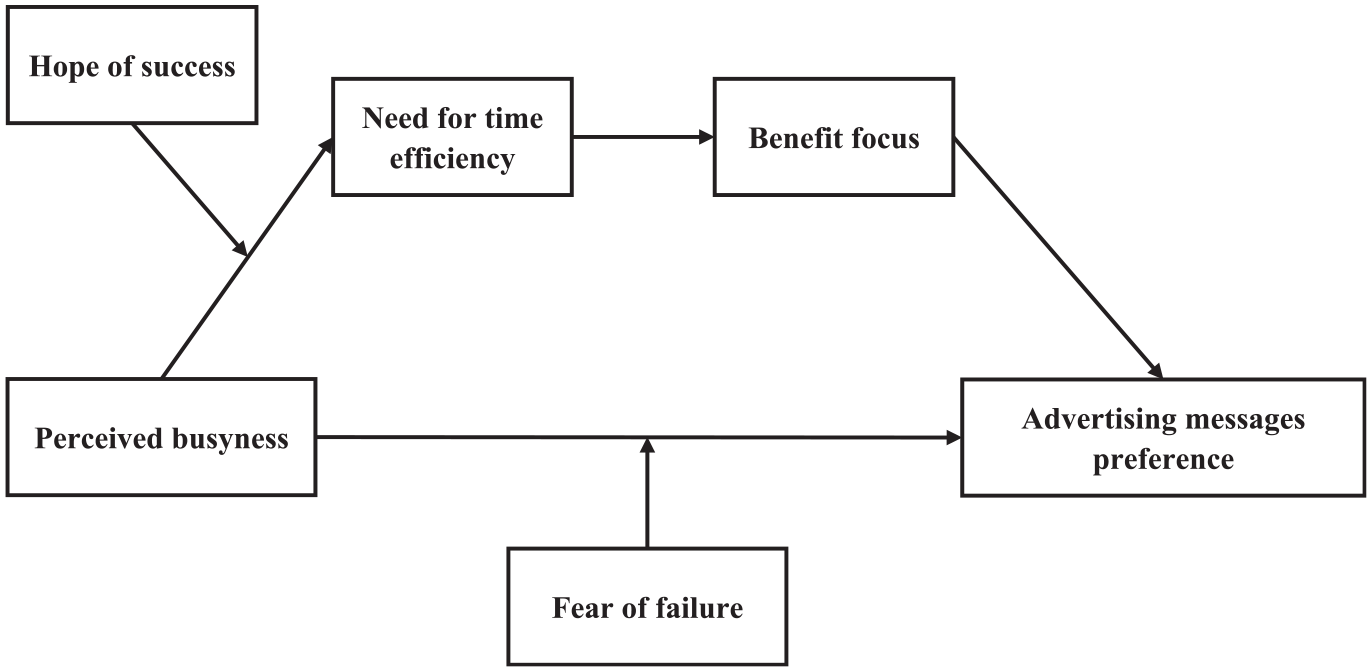
Conceptual model.
Overview of Studies
Through four experimental studies conducted between May 2021 and March 2022, we examine the proposed relationships. Study 1 demonstrates the basic effect that perceived higher busyness leads to lower construal levels. Studies 2 and 3 examine how perceived busyness, aligned with lower (vs. higher) construal level, affect tourists’ preferences for low- (vs. high-) construal destination advertising messages. Study 3 further rules out the alternative explanation that perceived busyness influences sense of self-importance, which might account for any variation in construal levels and messages preferences. Study 4 clarifies why perceived busyness leads to lower (vs. higher) construal levels and preference for low-construal destination advertising messages by testing the mediating effects of need for time efficiency and benefit focus. Also, Study 4 demonstrates how achievement motives (i.e., hope of success and fear of failure) moderate the effect of perceived busyness on preference for destination advertising messages varying in construal levels.
Study 1
Method
Subjects and Design
Study 1 employed a one-factor, two-level (perceived busyness: high vs. low) between-subjects design. Ninety participants (47.8% female, Mage = 29.72) from Credamo.com (an online data collection platform in China) completed the online study for a small monetary compensation.
Procedure
The participants first read a short paragraph outlining this study’s description. They were informed that this study was voluntary and their responses would be anonymous and kept confidential. After providing informed consent and electing to participate, participants were randomly assigned to one of the two manipulated conditions, in which they were asked to list ten (high busyness condition) or three (low busyness condition) tasks/activities they had to do recently (Wilcox et al., 2016). As a manipulation check, participants indicated two items regarding how busy they are and how many tasks they have to complete on a seven-point scale (1 = not at all busy/very few tasks, 7 = very busy/very many tasks; Pearson r = .79, p < .01; Wilcox et al., 2016).
Next, all participants were asked to complete the Behavioral Identification Form (BIF) questions, a widely used scale that measures individual’s construal level (Vallacher & Wegner, 1989). In this form, each target behavior/action is represented in two ways: one emphasizing why the behavior is conducted (i.e., an abstract, high-level way), and the other emphasizing how the behavior is conducted (i.e., a concrete, low-level way) (A. Y. Lee et al., 2010; Liberman & Trope, 1998; Vallacher & Wegner, 1989). For example, the behavior of “washing clothes” can be interpreted as “removing odors from clothes” (high construal level) or “putting clothes into the machine” (low construal level). Participants were presented with 19 behaviors and were instructed to choose which of two descriptions of each behavior they preferred (Vallacher & Wegner, 1989). We then calculated a construal level score by imputing a score of 1 if participants chose high-construal option and a score of 0 if they chose the low-construal one. In other words, the sum of the scores was the BIF score; higher scores represent higher construal levels (Septianto et al., 2023). At the end of the study, participants completed basic demographic measures and received compensation.
Results
Manipulation Check
We conducted an independent-sample t-test and found that participants in the high busyness condition reported higher perceived busyness than those in the low busyness condition (Mhigh-busyness = 6.01, SD = 0.89; Mlow-busyness = 5.28, SD = 1.40; t(88) = 2.96, p < .01, Cohen’s d = 0.62). Thus, our manipulation of perceived busyness is deemed successful.
Construal Level
A one-way ANOVA on the BIF score with perceived busyness as an independent variable showed a marginally significant main effect of perceived busyness (F(1,88) = 3.12, p = .081, ηp 2 = 0.034). As predicted, participants in the high busyness condition selected fewer abstract items (M = 13.09, SD = 5.12) than those in the low busyness condition (M = 14.67, SD = 3.10), see Figure 2.

Effect of perceived busyness on construal level (Study 1).
Robustness Checks
Adding the individual difference variables age and gender as covariates did not change the patterns of our results (F(1,86) = 3.23, p = .076, ηp 2 = 0.036).
Discussion
Study 1 suggested that participants feeling busy tend to construe events at a lower level compared to those who feel less busy. This finding extends past work examining the elements that influence construal level (e.g., Bullard et al., 2019; Dogan & Erdogan, 2020; H. Lee et al., 2014; Rubin et al., 2022) by identifying that busyness perception can be an antecedent of construal level. According to our hypotheses, people tend to actively seek information that matches their cognitive state, so, when tourists perceive themselves to be busy, they will show more positive evaluation and preference for tourism advertising messages with low (vs. high) construal level. Using BIF questionnaire to assess preferences and evaluations of actions, Study 1 revealed how perceived busyness induced variations in people’s construal level in a general daily life context. To further explain and understand such decision-making process in the tourism context, we will introduce a tourism destination marketing context (i.e., water sports park) to test this message preference and subsequent evaluation of the tourism destination in the advertisement in Study 2.
Study 2
Method
Subjects and Design
Study 2 employed a 2 (perceived busyness: high vs. low) × 2 (construal level of ad messages: high vs. low) between-subjects design. Following previous research (Simmons et al., 2011), we predetermined a sample size of 50 observations per cell in this online study. Two hundred participants (59.0% female, Mage = 28.22) from Credamo.com completed the study for monetary compensation.
Procedure
Participants were briefly informed about the study through an informed consent form. After providing informed consent and electing to participate, participants were randomly assigned across four conditions.
We used a different manipulation of perceived busyness adapted from J. C. Kim et al. (2019). As a cover story, this task was ostensibly described as a survey of lifestyle and daily activities. In the high perceived busyness condition, participants were told that a recent survey revealed that Chinese people are busier than people in other developing countries. They only spend 20% of their time every day on leisure and entertainment activities, while the remaining 80% of their time is devoted to working and self-enriching learning activities. Participants were then asked to think about and write down three things/activities that keep them busy. In the low perceived busyness condition, participants were told that a recent survey revealed that different national cultures and social backgrounds shape people’s behavior patterns differently; for example, Chinese people behave differently from people in other developing countries. Participants were then asked to think about and write down three things/activities they do on their typical day. As a manipulation check, participants indicated three items adapted from Bellezza et al. (2017): (1) You spend many hours at work (1 = strongly disagree, 7 = strongly agree); (2) You spend many hours doing hobbies and/or leisure activities (1 = strongly disagree, 7 = strongly agree; reverse coded); and (3) How busy you are? (1 = not busy at all, 7 = extremely busy); Cronbach’s alpha = .70.
Subsequently, participants completed another ostensibly unrelated task, in which they were asked to imagine that they were choosing a water sports park for their vacation and were randomly shown one of the two tourism advertisements crafted based on varying construal levels. Specifically, the low-construal advertisement was, “MEISHI provides various water sports activities. Try our new surfing and kayaking program at MEISHI!” The high-construal advertisement was, “MEISHI is a fun and exciting water sports destination. Get a sample of what the new season brings to MEISHI!” (S. Wang & Lehto, 2020). After reading the advertisement, participants reported their attitude toward the advertisement and the destination.
We measured “attitude toward advertisement” on seven items: “The advertisement was—attractive, appealing, good, favorable, pleasant, desirable, and persuasive” (Cronbach’s alpha = .96; S. Wang & Lehto, 2020); whereas “attitude toward destination” was measured by four items: “The destination was—good, positive, pleasant, and favorable” (Cronbach’s alpha = .94; S. Wang & Lehto, 2020). All variables were measured on a 7-point (1 = strongly disagree and 7 = strongly agree) Likert-type scale. Participants also reported how many times they had traveled in the past 2 years. At the end of the study, participants completed basic demographic measures and were paid and thanked.
Results
Manipulation Check
The results of independent-sample t-test showed that participants in the high busyness condition reported higher perceived busyness than those in the low busyness condition (Mhigh-busyness = 5.49, SD = 0.73; Mlow-busyness = 4.97, SD = 0.95; t(198) = 4.33, p < .001, Cohen’s d = 0.62). These results indicate that the manipulation was successful.
Attitude Toward Advertisement
A 2 (perceived busyness: high vs. low) × 2 (construal level of ad messages: high vs. low) ANOVA on the ad attitude index revealed a significant two-way interaction (F(1,196) = 9.42, p < .01, ηp 2 = 0.046; all other effects: ps > .05). Contrast analyses revealed that when the destination advertisement was construed at a low level, participants in the high busyness condition indicated directionally more positive attitude toward the ad messages than those in the low busyness condition (Mhigh-busyness = 4.36, SD = 1.20; Mlow-busyness = 3.92, SD = 1.12; F(1,196) = 2.82, p = .095, Cohen’s d = 0.38). Conversely, when the destination advertisement was construed at a high level, participants in the high busyness condition indicated significantly less positive attitude toward the ad than those in the low busyness condition (Mhigh-busyness = 3.79, SD = 1.30; Mlow-busyness = 4.47, SD = 1.50; F(1,196) = 7.10, p < .01, Cohen’s d = 0.48); see Figure 3. These results supported H1.

Effect of perceived busyness and construal level of ad messages on attitude toward advertisement (Study 2).
Attitude Toward Destination
A similar pattern of results was obtained for tourism destination attitude. An ANOVA with perceived busyness (high, low) and construal level of ad messages (high, low) as independent variables and attitude toward the destination as the dependent variable revealed only a significant interaction effect (F(1,196) = 10.96, p < .001, ηp 2 = 0.053; all other effects: ps > .05). A planned contrast analysis also confirmed our expectations. Specifically, the tourism destination displayed in the advertisement with a low-level construal received more favorable attitude from participants who felt busier (M = 4.58, SD = 1.19) than those who felt less busy (M = 3.99, SD = 1.09; F(1,196) = 5.66, p < .05, Cohen’s d = 0.52). In contrast, the tourism destination displayed in the advertisement with a high-level construal received less favorable attitude from participants who felt busy (M = 4.02, SD = 1.28) than those who felt less busy (M = 4.58, SD = 1.33; F(1,196) = 5.30, p < .05, Cohen’s d = 0.43); see Figure 4. Again, these results were consistent with H1.

Effect of perceived busyness and construal level of ad messages on attitude toward destination (Study 2).
Robustness Checks
Including participants’ gender, age and personal travel experiences as covariates did not change the significant two-way interaction effect between perceived busyness and construal level of ad messages (ps < .01) when conducting multivariate analysis of variance (MANOVA) with the dependent variables being attitude toward advertisement and attitude toward destination, suggesting the robustness of our findings.
Discussion
Consistent with other types of fit effects reported in existing tourism literature (e.g., Jia et al., 2021; J. Kim et al., 2016; S. Wang & Lehto, 2020), the findings of Study 2 indicated that participants with a high level of busyness perception evaluated the destination advertisement construed at a lower level more favorably, whereas those with low level of busyness perception evaluated the advertisement construed at a higher level more favorably. That is, the fit between perceived busyness and the construal level of destination advertisement messages heightens the effectiveness of the messages, thus resulting in more favorable evaluations. Our hypothesis H1 was supported.
Study 2 extended the findings of Study 1 in three important ways. First, we provided greater external validity by using a travel decision-making context, in which participants were asked to imagine that they were choosing a destination for their vacation and to evaluate the travel advertisement and destination. Second, we use a different manipulation of perceived busyness—showing participants with ostensibly unrelated lifestyle surveys and then asking them to finish a writing task. Finally, we further measure participants’ attitudes toward advertisement and destination, and ruled out the alternative explanation of personal travel experiences.
However, there is a potential alternative explanation for the effect of perceived busyness on advertising message preference, that is, the individual’s sense of self-importance. Previous studies on busyness were mainly conducted from the perspectives of time-perception (i.e., one stream of research that relates to the current research; see Fernbach et al., 2015; Han & Broniarczyk, 2021; Kang et al., 2018; Wilcox et al., 2016) and self-perception (Gershuny, 2005; J. C. Kim et al., 2019; Rutherford, 2011). Research on self-perception suggests that perceived busyness can enhance an individual’s sense of self-importance because it can signal to the self that he/she is an individual of high value—that is, an important person (Gershuny, 2005; J. C. Kim et al., 2019); such sense of self might lead to increased self-focus and decreased other-focus. In the CLT literature, taking the perspective of oneself (vs. others) has been shown to shorten social distance, thus reducing construal level and bolstering feasibility considerations (Trope & Liberman, 2010). Therefore, tourists who perceive themselves as busier tend to have a stronger sense of self-importance and use a lower and concrete mindset, resulting in more favorable message evaluations toward low- (vs. high-) construal advertising messages. Study 3 aims to test the potential mediating role of self-importance.
Study 3
Method
Subjects and Design
Study 3 employed a 2 (perceived busyness: high vs. low) × 2 (construal level of ad messages: high vs. low) between-subjects design. Given the smallest effect size observed in Study 2 (i.e., ηp 2 = 0.046, or f = 0.22), we conducted a priori power analysis using G*Power 3.1 (Faul et al., 2009) to determine the sample size of this study. The results indicated that we could achieve over 80% power with the recommended sample size of 165 participants. We thus recruited 165 participants (61.8% female, Mage = 30.22) via Credamo.com for this study.
Procedure
The procedure in this study was similar to that in Study 2. The participants gave informed consent prior to data collection. As participants took part in the experiment, they were first randomly assigned to either the high or the low perceived busyness condition. The manipulation of perceived busyness was the same as that in Study 2. After reading the experimental stimuli materials, participants responded to the measures of perceived busyness (Cronbach’s alpha = .65; identical to Study 2) and sense of self-importance (“I feel like I am an important person”; “I feel like I am a person of worth”; Pearson r = .45, p < .01; Rucker et al., 2011). Next, in a seemingly unrelated study, participants were required to imagine that they were choosing a spa resort for vacation and were presented with an advertising message for the fictitious spa resort. On the basis of prior construal-level research (T. W. Kim & Duhachek, 2020; A. Y. Lee et al., 2010), we created the advertisement to highlight either high-level or low-level construal prescriptive statements regarding the spa resort (see Appendix).
To ensure the validity of construal level manipulation, we conducted a separate pretest. A total of 60 participants were randomly presented with low- versus high- level construal ad messages. The participants then responded to a series of questions regarding their attitude toward the advertisement and the destination, their visit intention, their perceptions about the concreteness, information volume, valence and comprehensibility of the messages. The results of independent-sample t-test indicated that the manipulation of ad messages’ construal level only yielded difference in the concreteness of the messages. Specifically, the low-level messages were perceived to be more concrete than high-level messages (Mhigh-level = 5.00, SD = 1.39; Mlow-level = 5.75, SD = 0.93; t(58) = −2.48, p < .05, Cohen’s d = 0.64). There was no difference in term of other dimensions (ps > .05). This was a desirable feature of the stimulus, showing that we successfully manipulated construal level without causing any other differences.
In the main study, participants were asked to indicate the degree to which they perceived the information of the resort to be (1) concrete (reverse coded) and (2) abstract (Pearson r = .50, p < .01; Shin et al., 2019; S. Wang & Lehto, 2020) as a manipulation check. Participants then indicated their attitude toward the advertisement (Cronbach’s alpha = .89; identical to Study 2), attitude toward the destination (Cronbach’s alpha = .69; identical to Study 2), and their visit intentions toward destination (“How likely would you be to visit the destination?” and “How willing would you be to visit the destination?”; Pearson r = .44, p < .01; Peloza et al., 2013). They were also asked to rate their mood (“calm—anxious (reverse coded)”; “relaxed—excited (reverse coded)”; “sad—happy” and “feeling bad—feeling good”; Cronbach’s alpha = .80). The purpose of measuring mood was to rule out the alternative explanation that busyness perceptions influenced positive or negative mood, which in turn might account for any variation in destination messages preferences. All these variables were measured on a 7-point Likert-type scale. Finally, participants indicated their gender, age and personal travel experiences in the past 2 years.
Results
Manipulation Checks
As expected, participants who were assigned to the high busyness condition reported higher perceived busyness than those who were assigned to the low busyness condition (Mhigh-busyness = 5.70, SD = 0.60; Mlow-busyness = 5.05, SD = 0.92; t(163) = 5.40, p < .001, Cohen’s d = 0.84). These results show that our manipulation of busyness was well achieved.
In addition, the ad messages with high construal level (M = 2.96, SD = 1.33) was indeed perceived to be more abstract than the messages with low construal level (M = 2.55, SD = 1.05; t(163) = 2.16, p < .05, Cohen’s d = 0.34). Thus, both advertising messages with different construal levels were designed as intended.
Mood
An ANOVA revealed that mood did not differ between perceived high and low busyness conditions (Mhigh-busyness = 5.53, SD = 0.93; Mlow-busyness = 5.69, SD = 1.04; F(1,163) = 1.12, p > .05), thereby ruling out this factor as the driver of our results.
Attitude Toward Advertisement
Consistent with the findings observed in Study 2, the results of the two-way ANOVA revealed only a significant interaction of perceived busyness and construal level of advertisement on the ad message evaluation index (F(1,161) = 8.60, p < .01, ηp 2 = 0.051; all other effects: ps > .05). As shown in Figure 5, participants reported higher evaluations of the low-construal advertisement when they felt busier (M = 6.01, SD = 0.44), compared to those who felt less busy (M = 5.55, SD = 1.07; F(1,161) = 7.63, p < .01, Cohen’s d = 0.56). However, there was no difference in attitude toward high-construal advertisement based on perceived busyness (Mhigh-busyness = 5.67, SD = 0.68; Mlow-busyness = 5.90, SD = 0.74; F(1,161) = 1.91, p > .05).
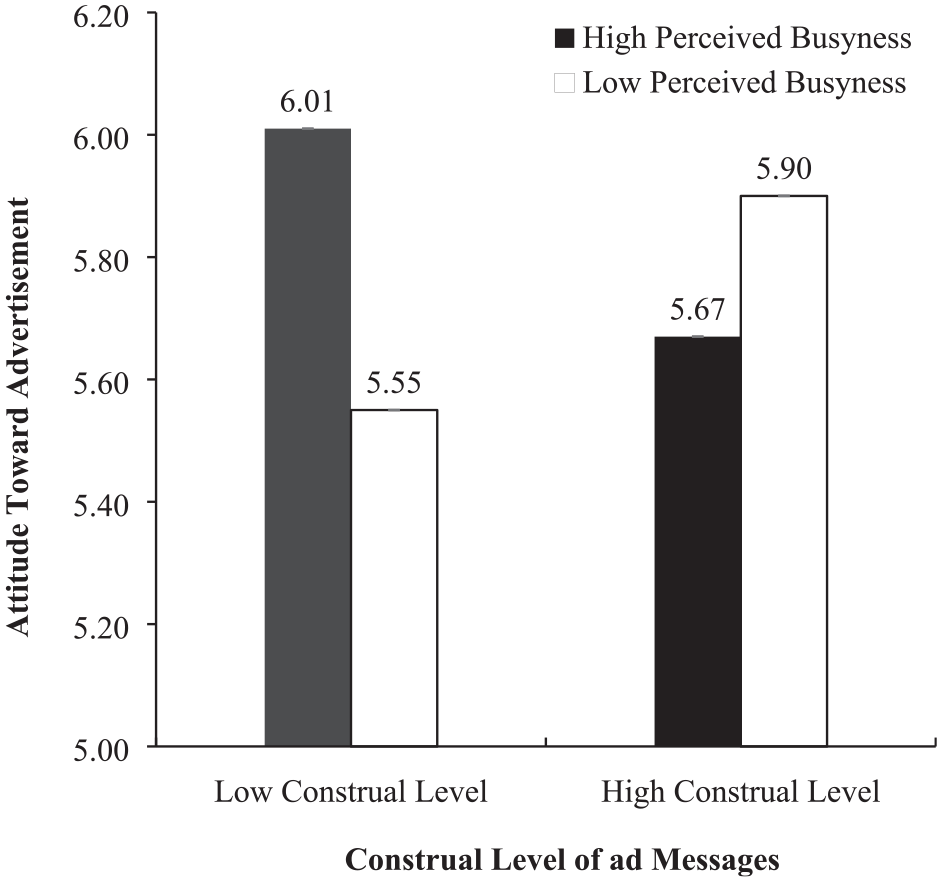
Effect of perceived busyness and construal level of ad messages on attitude toward advertisement (Study 3).
Attitude Toward Destination
A similar ANOVA on attitude toward destination revealed only a perceived busyness × construal level of ad messages interaction (F(1,161) = 13.25, p < .001, ηp 2 = 0.076; all other effects: ps > .05). Replicating past findings, the tourism destination displayed in the advertisement with a low-level construal received more favorable attitude from participants who felt busier (M = 6.13, SD = 0.44) than those who felt less busy (M = 5.82, SD = 0.86; F(1,161) = 5.97, p < .05, Cohen’s d = 0.45). In contrast, the tourism destination displayed in the advertisement with a high-level construal received less favorable attitude from participants who felt busy (M = 5.87, SD = 0.48) than those who felt less busy (M = 6.21, SD = 0.40; F(1,161) = 7.32, p < .01, Cohen’s d = 0.77); see Figure 6.
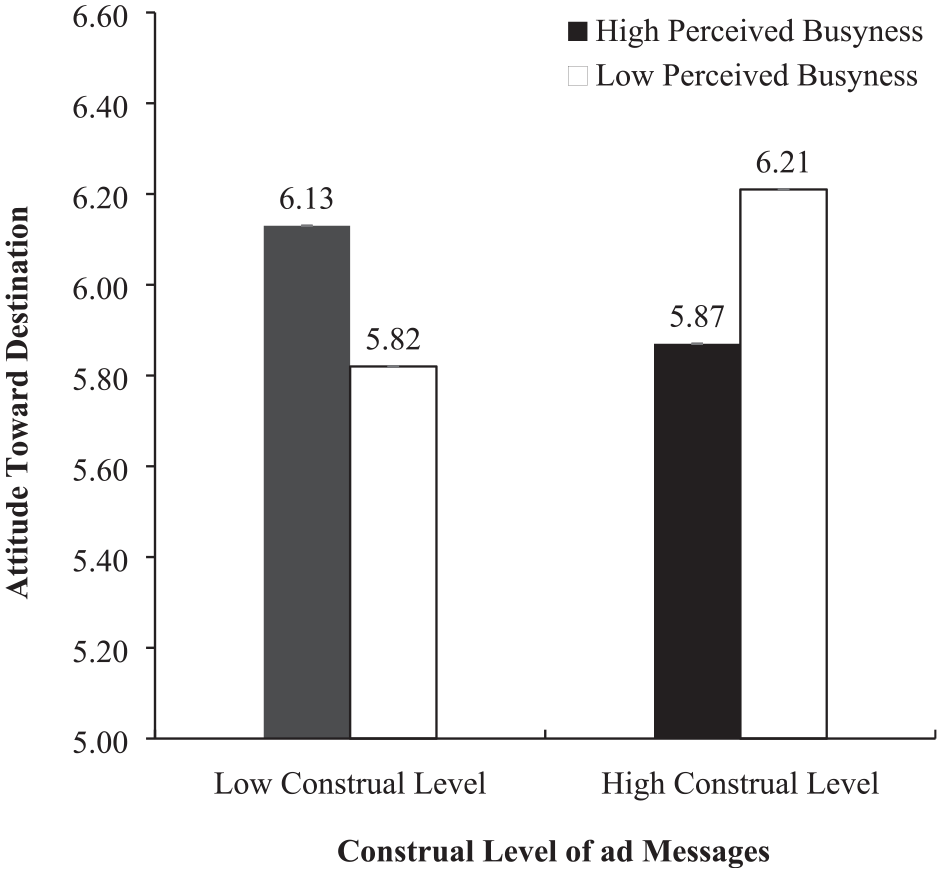
Effect of perceived busyness and construal level of ad messages on attitude toward destination (Study 3).
Visit Intention Toward Destination
We conducted an additional two-way ANOVA in which the independent variables were the same as above, with visit intention toward the travel destination as the dependent variable. The results yielded a significant two-way interaction (F(1,161) = 15.44, p < .001, ηp 2 = 0.088), no other effects were significant in the analysis (ps > .05). Contrast analyses showed that when the tourism destination was construed at a low level, participants reported higher visit intentions in the high versus low perceived busyness condition (Mhigh-busyness = 6.28, SD = 0.54; Mlow-busyness = 5.90, SD = 0.96; F(1,161) = 5.96, p < .05, Cohen’s d = 0.49). The opposite was true when the tourism destination was construed at a high level: higher perceived busyness led to lower visit intentions than lower perceived busyness (Mlow-busyness = 6.33, SD = 0.45; Mhigh-busyness = 5.85, SD = 0.75; F(1,161) = 9.72, p < .01, Cohen’s d = 0.78); see Figure 7.
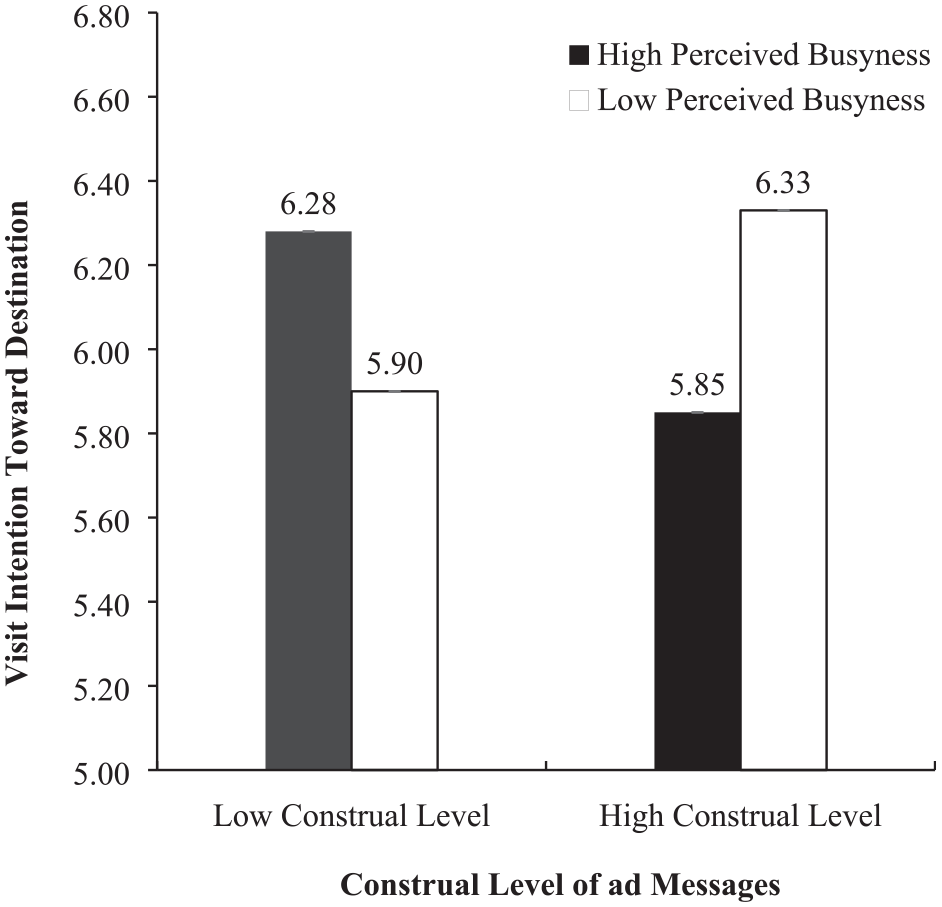
Effect of perceived busyness and construal level of ad messages on visit intention toward destination (Study 3).
Alternative Explanation of Self-Importance
To rule out an alternative account related to the mediating role of self-importance in the proposed relationship, we conducted additional tests. Specifically, we performed bootstrapping mediation analyses using PROCESS Model 15 developed by Hayes (2017) with 5,000 bootstrap resamples. Results revealed that the indexes of moderated mediation for self-importance were not significant (95% CI = [−0.08, 0.04] for ad attitude; 95% CI = [−0.04, 0.04] for destination attitude; 95% CI = [−0.11, 0.05] for destination visit intention), and there were no significant indirect effects at high- (95% CI = [−0.09, 0.03] for ad attitude; 95% CI = [−0.08, 0.02] for destination attitude; 95% CI = [−0.06, 0.02] for destination visit intention) or low- level construal condition (95% CI = [−0.13, 0.05] for ad attitude; 95% CI = [−0.09, 0.04] for destination attitude; 95% CI = [−0.12, 0.05] for destination visit intention). These results help rule out the possibility that high busyness perception bolsters people’s sense of self by enhancing their self-importance, which may lower their construal level and enhance their preference for advertising messages construed at a low level.
Robustness Checks
Similarly, adding participants’ gender, age, personal travel experiences and mood as covariates did not change the patterns of our results.
Discussion
Study 3 replicated and extended the findings in Study 2 by using a richer array of dependent measures, including attitude toward advertisement, attitude toward destination and visit intention toward destination. Results showed that people had positive attitude toward low-construal destination advertisement and the focal destination than they did toward the high-construal ones when their perceived busyness is high (vs. low). Importantly, Study 3 extended our effects from a relatively exciting and thrilling travel destination in Study 2 (i.e., water sports park) to a relaxing and calming one (i.e., spa resort). Additionally, it introduced a different experimental procedure to manipulate the construal level of destination advertisements differing in their feasibility (e.g., how-oriented messages) and desirability (e.g., why-oriented messages). By doing so, we heightened the robustness and enhanced the generalizability of our findings.
In addition to argue against the alternate account of mood, Study 3 further ruled out the mediating role of self-important. Researchers have argued that busyness gradually become a “badge of honor” (e.g., status symbol) in society (Bellezza et al., 2017; Gershuny, 2005). Driven by perceived higher busyness, tourists are more likely to self-evaluate as valuable and important. On the one hand, they may have strong internal motivation to maintain a positive self-concept by focusing on tangible and functional attributes of the activities (Bandura, 1991). Therefore, the low-level destination ad messages highlighting the utilitarian/functional attributes of the vacation can satisfy their needs and promote visit intentions. On the other hand, tourists with high busyness perception may be more inclined to purchase products or services matching their “high symbolic status.” Therefore, the high-level destination ad messages emphasizing the desirability, holistic and hedonic/affective attributes of the vacation can fit with the symbolic meaning of higher social status and boost visit intentions. Thus, we believe sense of self-importance cannot serve as an explanation of our observed effects.
Study 4
Method
Subjects and Design
Study 4 employed a 2 (perceived busyness: high vs. low) × 2 (achievement motivation: high vs. low) between-subjects design. Given the smallest effect size observed in Study 3 (i.e., ηp 2 = 0.051, or f = 0.23), we conducted a priori power analysis using G*Power 3.1 (Faul et al., 2009) to determine the sample size of this study. The results indicated that we could achieve over 80% power with the recommended sample size of 151 participants. To have a sample robust to attrition, we recruited 180 participants (63.9% female, Mage = 30.39) via Credamo.com for this study.
Procedure
As in previous studies, participants began the survey by indicating their informed consent. They were then randomly assigned to one of the two perceived busyness conditions. The manipulation of perceived busyness was the same as that in Study 2. After reading the experimental stimuli materials, participants responded to the measures of perceived busyness (Cronbach’s alpha = .82; identical to Study 2), need for time efficiency (“Completing the tasks as efficiently as possible”; “Not wasting any time completing tasks”; “Minimizing time spent on tasks”; 1 = strongly disagree, 7 = strongly agree; Cronbach’s alpha = .82; Han & Broniarczyk, 2021), and benefit focus (“Place more weight on message enjoyment (1) or usefulness (7)”; Pai et al., 2020). Afterward, participants entered an ostensibly unrelated study. All participants were asked to imagine that they were choosing a water sports park for their vacation, and then they were told that a water sports park was in the process of finalizing its slogan for a new ad and would like to know tourists’ preferences for the two slogan options, identical to what we used in Study 2: one slogan conveyed desirability and the other slogan conveyed feasibility (S. Wang & Lehto, 2020). Participants were asked to indicate which ad they prefer along a seven-point scale (a higher score represents a greater preference for the low-construal ad slogan). As a manipulation check, they rated the slogans regarding construal level (“concrete (1)—abstract (7)” and “feasibility (1)—desirability (7)”; Shin et al., 2019; S. Wang & Lehto, 2020). They also indicated the degree to which they perceived the slogans to be useful on a 7-point Likert-type scale. We then included a 10-item version of the Achievement Motivation Scale (Lang & Fries, 2006) to measure hope for success (Cronbach’s alpha = .76; e.g., “I am attracted by tasks, in which I can test my abilities”; 1 = strongly disagree, 7 = strongly agree) and fear of failure (Cronbach’s alpha = .92; e.g., “I feel uneasy to do something if I am not sure of succeeding”; 1 = strongly disagree, 7 = strongly agree). Similar to previous studies, participants were asked to report their personal travel experiences of water sports park in the past 2 years. Finally, participants provided their demographic information and were thanked and paid.
Results
Manipulation Checks
We first performed an independent-sample t-test to assess the success of the manipulation. As expected, the results showed a significant effect of the variable manipulated—perceived busyness: participants in the high busyness condition perceived a higher degree of busyness compared to those in the low busyness condition (Mhigh-busyness = 5.74, SD = 0.83; Mlow-busyness = 4.59, SD = 1.21; t(178) = 7.47, p < .001, Cohen’s d = 1.11).
We then conducted separate paired-sample t-tests for the two manipulation check items regarding ad messages construal level. As anticipated, the high-construal ad messages were perceived to be more desirable and abstract than the low-construal ad messages (Mhigh-construal = 5.50, SD = 1.49; Mlow-construal = 2.77, SD = 1.75; t(179) = 12.83, p < .001, Cohen’s d = 0.96, for desirable; Mhigh-construal = 5.38, SD = 1.29; Mlow-construal = 2.13, SD = 1.14; t(179) = 22.75, p < .001, Cohen’s d = 1.70, for abstract). Moreover, participants perceived that the ad messages were more useful when they were construed at a low level (M = 5.90, SD = 0.73) than when they were construed at a high level (M = 4.45, SD = 1.34; t(179) = 12.86, p < .001, Cohen’s d = 0.96).
Preference for Low-Construal Advertisement
We performed a one-way ANOVA to test the effect of busy perception on tourists’ preferences for destination advertising messages. The results showed that preference for ad messages with low-level construal was higher among participants in the high busyness perception condition (M = 5.49, SD = 1.97) than in the low busyness perception condition (M = 4.76, SD = 1.99; F(1,178) = 6.18, p < .05, ηp 2 = 0.034), indicating that perceived busyness enhanced tourists’ preferences for low-construal advertising messages (Figure 8).
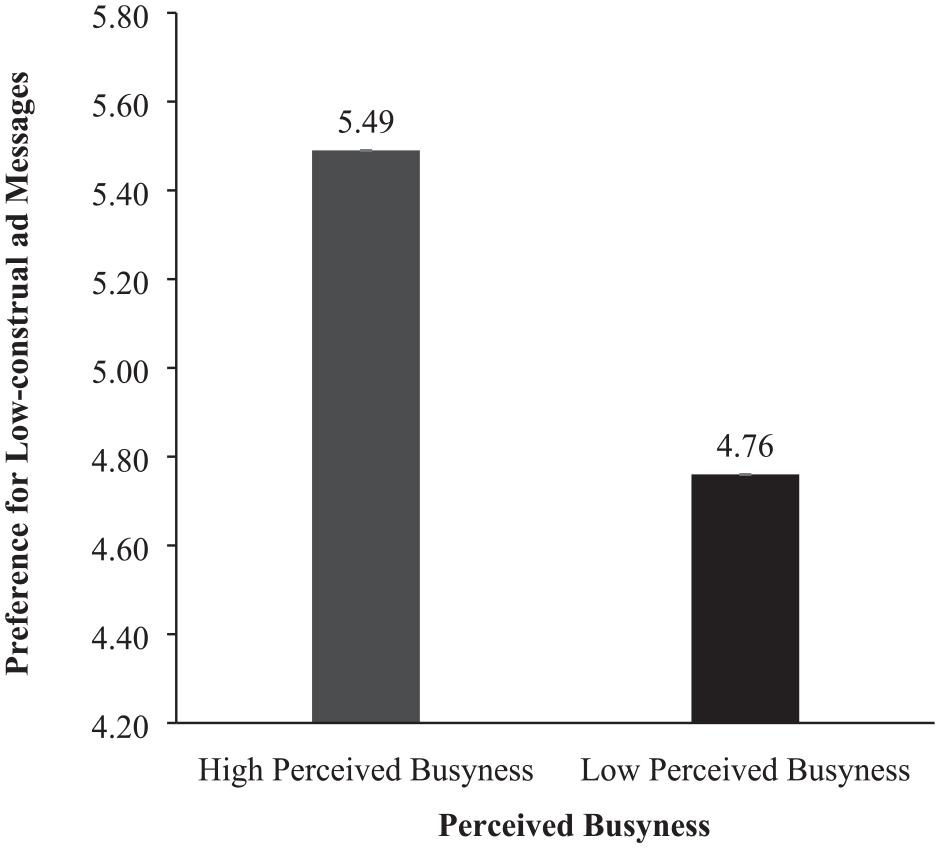
Effect of perceived busyness on preference for low-construal ad messages (Study 4).
Serial Mediation Through Need for Time Efficiency and Benefit Focus
To test the sequential mediation, we employed the bootstrapping mediation analyses using PROCESS Model 6 developed by Hayes (2017) with perceived busyness as the independent variable, need for time efficiency and benefit focus as the mediators, and preference for low-construal advertising messages as the dependent variable. The number of resamples was set to 5,000, and the confidence interval was 95%. As shown in Figure 9a, busyness perception had a significant positive impact on need for time efficiency (b = 0.63, SE = 0.14, t(178) = 4.49, p < .001), need for time efficiency had a significant positive impact on benefit focus (b = 0.48, SE = 0.10, t(177) = 5.24, p < .001), and benefit focus had a significant positive impact on participants’ preference for low-construal advertising messages (b = 0.37, SE = 0.13, t(176) = 2.94, p < .01). At the same time, perceived busyness had a positive direct impact on preference for low-construal ad messages (b = 0.76, t(176) = 2.49, p < .05). In addition, the effect size of the sequential mediating effect (i.e., perceived busyness→need for time efficiency→benefit focus→preference for low-construal ad messages) was 0.11 (95% CI = [0.03, 0.24]). Neither of the other indirect pathways in this model (i.e., from perceived busyness to advertising messages evaluation through need for time efficiency (95% CI = [−0.18, 0.02]) or benefit focus (95% CI = [−0.06, 0.07], as single mediator) was significant. Thus, H2 was supported.
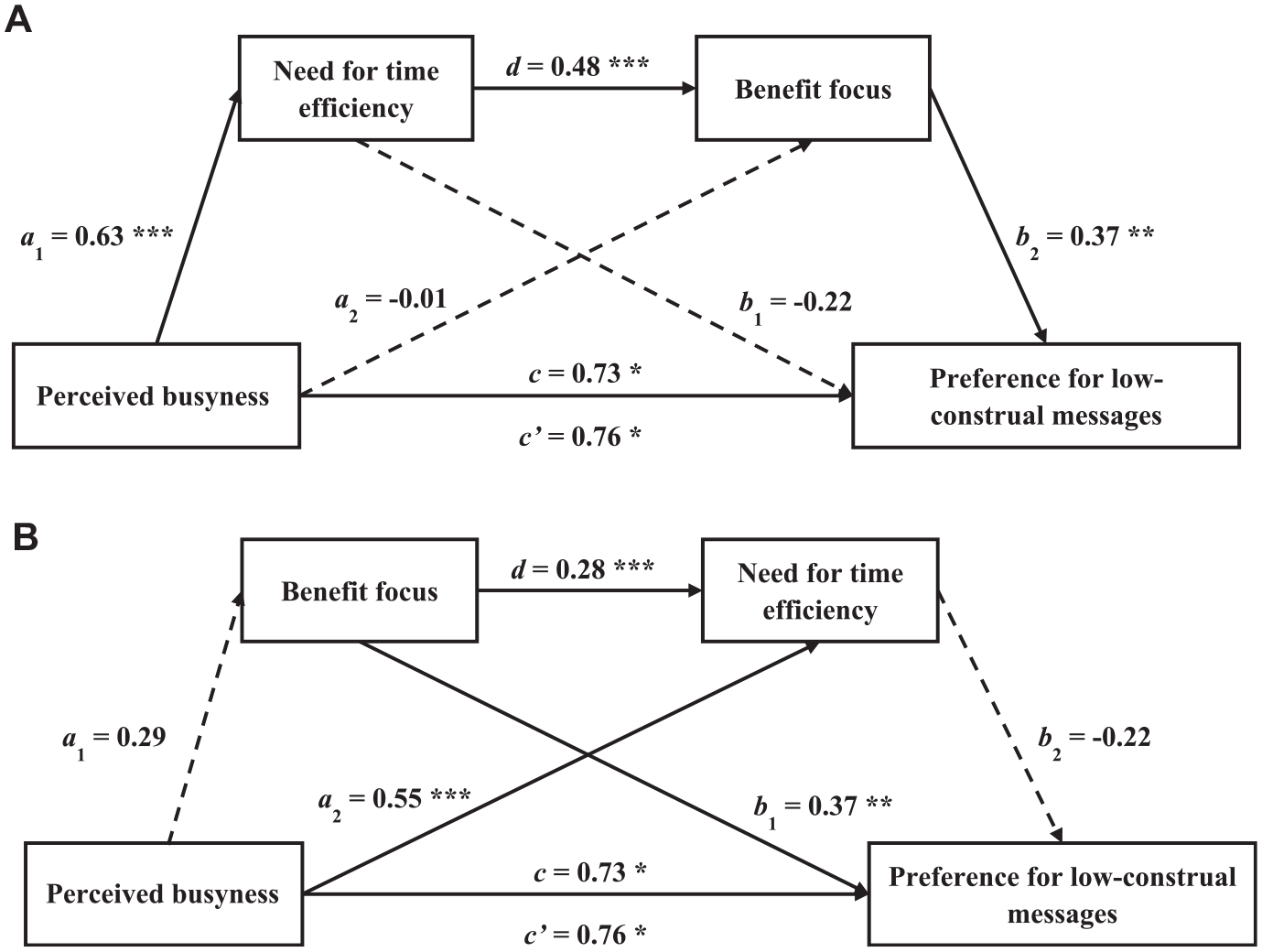
(a) Mediation via need for time efficiency and benefit focus (Study 4). (b) Mediation via benefit focus and need for time efficiency (Study 4).
Finally, when we switched the order of the two mediators (i.e., perceived busyness→benefit focus→need for time efficiency→preference for low-construal ad messages), the indirect effect of perceived busyness on low-construal ad messages preference was not significant (b = −0.02, SE = 0.02, 95% CI = [−0.0871, 0.0048]); see Figure 9b.
Moderation Analyses for Achievement Motivation
To test Hypothesis 3, we conducted separate moderated serial mediation analyses using PROCESS Model 85 developed by Hayes (2017) in each achievement motivation dimension. For hope of success (HS), the indirect effects of perceived busyness × HS on low-construal ad message preference via need for time efficiency and benefit focus were examined. As predicted, the indirect effects of perceived busyness via need for time efficiency and benefit focus (a serial mediation) were significant among tourists with high HS (+1 SD; b = 0.07, SE = 0.06, 95% CI = [0.0023, 0.2170]), but not significant among tourists with low HS (−1 SD; 95% CI = [−0.02, 0.08]), providing evidence for Hypothesis 3a. Additionally, neither of the other conditional indirect pathways in this model (i.e., from perceived busyness to advertising messages evaluation through need for time efficiency (95% CI = [−0.26, 0.03]) or benefit focus (95% CI = [−0.24, 0.11], as single mediator) was significant.
For fear of failure (FF), the results of moderated mediation analysis using PROCESS model 85 (Hayes, 2017) revealed only a significant conditional direct effect of perceived busyness on low-construal ad message preference (b = 0.70, SE = 0.20, 95% CI = [0.32, 1.09]). We applied the Johnson-Neyman procedure (Spiller et al., 2013) to identify regions of significance of the effect of perceived busyness across different levels of FF. Consistent with predictions, we found a significant positive effect of perceived busyness on low-construal ad message preference at and above 3.05 on the FF scale (bJN = 0.59, SE = 0.30, 95% CI = [0.00, 1.19], p = .05). Below the level of 3.05 on FF scale, there are no differences in advertisement preference based on perceived busyness. Moreover, all the indirect pathways in this model are independent of FF (95% CI including zero), these results provide evidence for Hypothesis 3b.
Robustness Checks
As in previous studies, adding participants’ gender, age and personal travel experiences as covariates did not change the patterns of our results.
Discussion
Results from Study 4 provided strong support for our underlying mechanism related to need for time efficiency and benefit focus (H2). Specifically, results revealed that high (vs. low) perceived busyness enhanced tourists’ need for time efficiency, which shaped their benefit focus on utilitarian benefits (e.g., usefulness) versus hedonic benefits (e.g., enjoyment) regarding the features of the destination and, ultimately, resulted in more favorable evaluations toward low- (vs. high-) construal advertising messages. Additionally, we identified boundary conditions and confirmed our theorized process: consistent with H3, we found that our effects emerge for those who were high in hope of success or fear of failure achievement motivation (via distinct path), but not for those whose motives were weak. Our findings mirror past literature suggesting that individuals with high hope of success are concerned about doing well on their tasks (Brunstein & Heckhausen, 2018). When faced with multiple tasks (i.e., perceived higher busyness), they are more confident in their abilities to cope with such tasks, and are thus more motivated to proactively use time efficiently and focus on utilitarian attributes of information. Additionally, individuals with a high fear of failure are concerned about the aversive consequences of failing and tend to protect self-esteem by striving to complete tasks (Higgins, 2002; Liberman et al., 1999; White et al., 2011; Zhu & Meyers-Levy, 2007). When faced with multiple tasks, they are more inclined to get lost in detail and engage in lower-level, concrete thinking to make sure they don’t make mistakes.
General Discussion
Theoretical Implications
This research makes several theoretical contributions to tourism research. First, it adds to the behavioral consequences of perceived busyness in the tourism decision-making context by linking perceived busyness to destination advertising preference. Although busyness perception has become an important push factor (i.e., internal motive) when making travel decisions (Marques, 2007; Pesonen & Komppula, 2010), the existing studies have investigated perceived busyness (Bellezza et al., 2017; Ebrahimi et al., 2017; J. C. Kim et al., 2019) and destination advertising (Jiang et al., 2020; Seo et al., 2021) separately rather than jointly. To the best of our knowledge, our study is the first to examine how perceived busyness and its interaction with construal level of advertising messages influence destination advertising effectiveness. By doing so, the present study fills this research gap and helps bridge social psychology to tourism destination advertising and marketing, thereby providing rich insights for future interdisciplinary research opportunities.
Second, while the general topic of “matching effect” between the construal level of advertising messages and tourists’ personal characteristics has attracted academic attention in tourism literature (Jia et al., 2021; J. Kim et al., 2016; S. Wang & Lehto, 2020), this stream of research lies largely in the tourists’ characteristics such as their temporal or spatial distance. Building upon prior work, we look beyond these tourists’ characteristics by identifying perceived busyness—a psychological phenomenon that is increasingly prevalent in tourists’ everyday lives—as a novel determinant of the abstractness or concreteness of tourists’ thoughts and mindsets (i.e., the construal level). That is, we show that, when people have higher busyness perception, they are more likely to utilize low and concrete construal level. Additionally, we predicted and identified that perceived busyness might systematically affect such construal level through the need for time efficiency and benefit focus. The current findings enrich our understanding of how tourists’ busyness perceptions, construal level and the destination marketing campaigns can jointly shape tourists’ evaluations of advertising messages.
Third, this research enriches our understanding regarding how achievement motivation could influence tourists’ attitudes of destination messages. Existing research has focused on the influence of achievement motivation on tourists’ preferences. For example, Ross (1997) finds that individuals higher in achievement motivation are more likely to place a high value on vacations in their life for relaxation purposes. Tran and Ralston (2006) suggest that people possessing a high need for achievement will most likely prefer adventure tourism. However, research in this field has largely silent on how tourists’ achievement motivation affects their messages preference and subsequent travel decision-making process. We contribute to this area by emphasizing the importance of understanding tourists’ achievement motivations when developing promotional materials for hospitality and tourism businesses.
Practical Implications
The current paper provides some valuable practical implications for tourism marketers and managers. First, on the basis of the construal level in destination advertisements, destination marketers should develop tailored promotional messages that match construal level with perceived busyness. Our findings suggest that perceived busyness can be used as an important market-segmentation tool by destination marketers and managers. Specifically, when targeting tourists with high perceived busyness (e.g., data analysts or software developers), destination advertisements should be designed with a low level of construal; in addition, during business days, marketers can adjust messaging and tourism product recommendations to emphasize utilitarian value and detailed attributes of the destination. In contrast, when targeting tourists with low perceived busyness (e.g., retired people), destination advertisements should be designed with a high level of construal; additionally, destination advertisements should reveal abstract and global features or benefits of the consumption experience itself during the weekends or holidays.
Second, given that the differences in perceived busyness may be activated by advertisements (J. C. Kim et al., 2019), marketers can integrate both the elements of busyness perception and construal level into the advertisements to improve destination advertising effectiveness. More specifically, if the advertisement of a destination emphasizes feasibility attributes (i.e., low construal), advertising messages that activate busyness perception would be more effective; on the contrary, if the advertisement of a destination emphasizes desirability attributes (i.e., high construal), advertising messages that activate busyness perception would be less effective. Using this strategy may help boost advertising effectiveness and visit intentions without conducting extra market segmentation campaigns to find certain segments of the population (e.g., busy potential tourists).
Third, additional strategies could be devised for managers to attract tourists with different achievement motives. Our findings suggest that the matching effects of perceived busyness and construal level of destination messages emerge for highly success-motivated or failure-motivated tourists. However, the internal factors and motivations that drive their decision-making are very different (e.g., success-motivated tourists are directed by perceived positive outcomes; while failure-motivated tourists are instigated by a negative outcomes). In this case, in addition to emphasizing the busy lifestyle, advertisements emphasizing time value and utilitarian benefits of the destination could be expected to appeal the former kind of tourists; whereas advertisements emphasizing assurance of reliable service, rather than time value, could be an effective strategy to appeal the latter kind of tourists.
Limitations and Future Research
This research has some limitations that need to be indicated for future directions. First of all, participants were recruited through Credamo.com in the current research; future research could conduct field experiments to examine our effects among participants who actually have travel plans for a particular destination. Additionally, the sample may be limited in scope regarding country, culture, and travel purpose; future studies should also attempt to include bigger samples in different contexts to further validate and extend the current theoretical model.
Second, we conducted the experiments based on hypothetical situations, and in some instances, these results may be considered detached from a practical situation. For example, in Studies 2 and 3, there was no alternative travel destination for participants to choose. However, tourists could face various alternatives and options in reality. Future researchers are advised to integrate improved design of experimental stimuli to aid tourism practitioners in making use of the meaningful insights that this research offers.
Third, we asked participants to evaluate ad messages without telling them the time horizon and location of vacation. Future research could take into consideration the temporal and spatial distance to a travel plan to provide more realistic results. Additionally, researchers have demonstrated that information medium (textual vs. pictorial) is also important in understanding the influence of construal level (Trope & Liberman, 2010). It is worthwhile to compare the effects of pictorial versus textual information on perceived abstractness/concreteness to improve our understanding of the present research.
Finally, the study employs the need for time efficiency and benefit focus as a serial mediating mechanism to explain the effect of perceived busyness on destination advertising effectiveness. Alternative explanations such as “need for cognitive closure” (Lalwani, 2009) and “time scarcity” (Mullainathan & Shafir, 2013) could be considered. Besides, our research could be further applied to explore additional moderators. One important boundary condition is work ethic (Cassidy & Lynn, 1989). One could imagine that a person with low work ethic tends to view work as an activity one is forced to engage in and thus may physically or mentally quit from tasks. This behavior pattern, in turn, increases psychological distance as well as construal level. Another potential boundary condition could be perceived social mobility (Bjørnskov et al., 2013; Yoon & Kim, 2016). In general, those with high perceived social mobility believe that hard work may bring success and social affirmation, whereas those with low perceived social mobility tend to believe that hard work cannot bring success and help escape poverty. Similarly, it may be that our proposed effects would be attenuated among tourists perceiving low social mobility. Thus, future research could precisely examine these effects.
Footnotes
Appendix
Advertisements with low-construal messages (upper) and high-construal messages (lower) in Study 3 (translated in English).
Declaration of Conflicting Interests
The author(s) declared no potential conflicts of interest with respect to the research, authorship, and/or publication of this article.
Funding
The author(s) disclosed receipt of the following financial support for the research, authorship, and/or publication of this article: This work was supported by the Key Project of the National Natural Science Foundation of China (71832015); the Major Project of the National Social Science Foundation of China (18ZDA062); Guangdong Provincial Philosophy and Social Sciences Planning Project (GD22XGL04); and the Fundamental Research Funds for the Central Universities (QNMS202206).
