



Abstract
Although customer engagement’s (CE) effects on marketing-related outcomes are well documented, its broader impacts on life domain constructs (e.g., subjective well-being [SWB]) have received less attention. We propose CE as a viable mechanism for prolonging travel’s positive effects on SWB. Specifically, this study adopts a three-wave design to investigate the linkages between destination brand experience (DBE), CE, and SWB over time. Our results indicate that sensory destination experience (t1) and affective destination experience (t1) stimulated CE with a destination (t2), which contributed significantly to SWB (t3). Findings from this longitudinal study contribute to the literature by demonstrating that CE significantly mediates the effects of the sensory and affective dimensions of DBE on tourists’ SWB over time. The study highlights the importance of CE beyond key marketing performance indicators.
Introduction
In the context of tourism, travel—as an activity deliberately undertaken to pursue happiness—has been recognized as a key means of enhancing well-being (Sirgy et al., 2011). The linkages between travel experiences and subjective well-being (SWB) have received considerable attention; however, a consensus around how tourism contexts inform/sustain such an important quality-of-life indicator is lacking. For example, experimental research suggests that vacation experiences do not significantly alter one’s SWB (Strauss-Blasche et al., 2000). Conversely, other studies have shown that SWB is influenced by relaxing travel experiences, albeit temporarily as one’s happiness ultimately returns to pre-trip levels (de Bloom et al., 2013; Nawijn et al., 2010). Initial studies of SWB indicated that situational aspects had little effect (Diener & Larsen, 1984). Instead, stable factors such as income (Diener et al., 1993), personality traits (Lucas & Diener, 2009), and marriage (Soons et al., 2009) appeared more prominent. However, tourism research has revealed that such certainty might be misguided; SWB may also be influenced by travel or vacation experiences (Y. Chen et al., 2013; Huang et al., 2020; Kay Smith & Diekmann, 2017; Kwon & Lee, 2020; Sirgy et al., 2011), although a paucity of empirical evidence exists to support this supposition.
Tourists’ experiences in a destination can increase their happiness (Gilbert & Abdullah, 2004) as well as their SWB (McCabe & Johnson, 2013; Sirgy et al., 2011). While the immediate effects of tourism experiences on SWB may be understood, the strength of the connection between travel as an experience and SWB as a life domain construct, over time, seems tenuous at best. For instance, de Bloom et al. (2013) found that one’s SWB gradually returned to baseline after travel, and a fade-out effect occurred within 2 to 4 weeks. Similarly, Y. Chen et al. (2013) discovered that tourists’ chronic SWB did not change after vacation; however, occasion-specific SWB rose immediately after a trip and dissipated after 2 months, highlighting time as a main factor in SWB research. Efforts to strengthen this connection are essential for tourism policy development, considering the emphasis on SWB in the formulation of policies and social initiatives intended to enhance community development and quality of life. Tourism has been widely considered a mental and physical health pursuit that results in health and wellness benefits (see C. C. Chen & Petrick, 2013, for a review). As such, a stronger empirical connection between the effects of a travel experience and SWB overtime, can further promote tourism as a viable community development initiative.
Although research has substantially enriched our current understanding of SWB, the extensive use of cross-sectional data gathered at one point in time to derive empirical inferences could influence results’ validity (Pedhazur & Schmelkin, 2013)—particularly in terms of delineating the sustained effect of such efforts. SWB represents a retrospective judgment that is constructed when prompted (Kahneman & Krueger, 2006). SWB may increase after a travel experience and decline subsequently, possibly leading to inaccurate estimations of travel experiences’ actual effects on SWB. These concerns imply that cross-sectional empirical studies may not be an ideal way to measure SWB with respect to episodic events (e.g., travel experiences) (Chamberlain & Zika, 1988). Additionally, cross-sectional studies may produce common method variance (Podsakoff et al., 2003). Such bias could hamper researchers’ ability to infer cause-and-effect relationships (Pedhazur & Schmelkin, 2013). In seeking to clarify how a sustained impact on SWB can be realized, and thus strengthen this connection, research on the effects of travel experiences requires research data gathered across multiple time points. Due to the transient and remote nature of travel experiences, it is also important to identify the mechanism linking experience and SWB that enables temporary effects to endure over time.
Customer engagement (CE) is well established as a conduit that can sustain the positive impacts of brand interaction beyond one’s initial experience (So et al., 2014, 2016, 2021a, 2021b). CE is connected to but exists outside of purchase transactions. We therefore consider CE’s central role in sustaining the positive impacts of travel experiences on SWB over time. Organizational benefits include positive evaluations and enhanced loyalty (e.g., So et al., 2016), however CE-related customer advantages remain unclear, particularly with reference to broader life domains such as subjective well-being (SWB). This discrepancy is somewhat surprising given that CE occurs outside of purchase transactions and manifests in everyday life. Prentice and Loureiro (2018) and L. D. Hollebeek and Belk (2021) recently uncovered CE’s potential impacts beyond marketing, namely in terms of well-being; however, this line of work remains in a nascent stage. Rich empirical evidence supports customer experiences—such as at integrated resorts (Ahn & Back, 2018) and in retail settings (Mohd-Ramly & Omar, 2017)—as CE antecedents. Under the assumption that CE and SWB may be linked, CE could be a viable explanatory mechanism that sustains travel experiences’ effects on SWB over time.
Despite prior research examining CE and SWB in tourism and hospitality (e.g., Ahn & Back, 2018; Ahn et al., 2019), findings regarding SWB often vary in terms of relationships’ magnitude, direction, and significance (e.g., Y. C. Wang et al., 2020). For example, several scholars (Filep, 2016; Nawijn, 2016; Uysal et al., 2016) have suggested that arousal has inconsistent effects on SWB, making empirical generalizations difficult. Understanding how these theoretical constructs interact within destination marketing and management requires empirical examination of their linkages in such settings. Our research is one of the first attempts to use a three-wave dataset to explore these relationships.
Building upon the literature on SWB (e.g., Sirgy et al., 2011) and CE (e.g., So et al., 2014, 2016, 2021a, 2021b), this study adopts a three-wave design to investigate linkages among the travel experience (operationalized as destination brand experience [DBE]), CE, and SWB across time via the stimulus-organism-response (S-O-R) framework. Our investigation focuses on DBE’s effects as a stimulus on CE as an organism, leading to tourists’ responses (i.e., as reflected in SWB). Furthermore, by using a unique dataset capturing responses across multiple time points, this study empirically examines the mediating role of CE in sustaining the effects of travel experiences on tourists’ subsequent SWB.
Literature Review
Theoretical Framework
This study is guided by Mehrabian and Russell’s (1974) S-O-R theory, which holds that various environmental stimuli (S), such as experiences, directly influence a person’s organism (O), which in turn affects their responses (R) to stimuli. Aspects of one’s organism serve as mediating variables in determining reactions to environmental stimuli (Mehrabian & Russell, 1974). S-O-R theory has been widely adopted to investigate linkages between input (stimuli), processes (organism), and output (responses) (e.g., W. G. Kim & Moon, 2009). Hospitality and tourism scholars have applied this theory to explore the impacts of consumer experiences, such as at hotels (Dedeoglu et al., 2018) and Airbnb (Mody et al., 2017), as stimuli that induce responses. Tourism researchers have also adopted S-O-R theory to examine the effects of destination-based service quality on SWB as a response (He et al., 2020). The literature suggests that the S-O-R framework is appropriate for explaining tourists’ behavior in numerous hospitality and tourism contexts, such as theme parks (P. J. Chang et al., 2014), hotels and restaurants (Choi & Kandampully, 2019; Jang & Namkung, 2009; Jani & Han, 2015; W. G. Kim & Moon, 2009), casinos (Lam et al., 2011), and virtual reality tourism (Flavián et al., 2019; M. J. Kim et al., 2020).
Travel experiences are commonly taken as stimuli in empirical investigations (P. J. Chang et al., 2014). In the S-O-R model, as the mediating component, “organism” includes one’s cognitive and emotional states (Mehrabian & Russell, 1974). CE has been conceptualized as comprising cognitive and affective responses toward a brand (Brodie et al., 2011), factors that have been used to represent the organism. Responses convey “approach or avoidance” as the consequence component of the S-O-R model. Considering this study’s purpose, namely tourists’ post-travel reactions to an experience, SWB was used as the response construct. The S-O-R framework was therefore considered appropriate for examining relationships between DBE, CE, and SWB.
S-O-R theory has also appeared in previous multi-wave studies (e.g., Katakam et al., 2021; Yang & Gong, 2021). For example, Yang and Gong (2021) employed this theory to investigate the engagement–addiction dilemma of mobile games. Three waves of data were collected to assess the proposed theoretical model. As the S-O-R framework is a prototypical mediation model that emphasizes connections between stimuli and responses (Cole & Maxwell, 2003), a time-lagged survey is necessary to account for temporal precedence of events (Ozturk & Karatepe, 2019). To explore the time-lagged effects of travel experiences on SWB that are mediated by CE, as well as following previous multi-wave studies (Yang & Gong, 2021), the S-O-R framework was deemed suitable for the present investigation with three waves of data collection. Travel experiences, conceptualized as DBE, represent stimuli in our context as detailed below.
Destination Brand Experience
Arising from brand experience (Brakus et al., 2009; Schmitt, 2009), DBE captures holistic experiences based on experience-related stimuli (Barnes et al., 2014). This notion is applicable to complex experiential settings such as tourism (Barnes et al., 2014). Compared with other experience-related constructs (e.g., customer-based brand equity, destination brand personality), scholars have argued that DBE provides a comprehensive view of the customer experience because the construct captures multiple dimensions of travel (Barnes et al., 2014). Travel experiences are multidimensional by nature (Fernandes & Cruz, 2016) and include myriad encounters in a specific destination (Moon & Han, 2019), reflecting tourists’ overall interactions within that place (Mossberg, 2007). Travelers may experience food, festivals, events, or other emotional or cultural aspects in destinations. Based on the literature and as modeled by Barnes et al. (2014), we operationalized the travel experience as DBE.
DBE is defined as a combination of sensory, affective, intellectual, and behavioral experiences associated with a destination as a stimulus (Barnes et al., 2014). Specifically, sensory experiences entail customers’ mental and sensory perceptions of goods or services, representing attributes that can be detected through sensory organs (Hwang & Hyun, 2012). Such experiences can be intensified by stimulating customers’ senses including vision, smell, touch, and hearing (Brakus et al., 2009). In a destination context, sensory experiences occur when tourists are exposed to an esthetic or sensorial stimulus. Affective experiences capture tourists’ feelings about a destination, including all subjective experiences associated with specific feelings and emotions (Hwang & Hyun, 2012). Tourists thus develop feelings about a brand (e.g., a destination), either positive or negative (Miao et al., 2014). Intellectual experiences result from knowledge, specifically in terms of thinking, curiosity, and problem solving (Kumar & Kaushik, 2018), which inspires thought or curiosity (Yu & Lee, 2014). In destination contexts, a destination brand’s creative advertising (e.g., a slogan) could surprise tourists and lead them to think about the destination. Lastly, behavioral experiences reflect behavioral responses to a brand, triggered by specific brand stimuli (Shim et al., 2015). Destinations also design physical activities which encourage tourists’ participation and interaction, therefore enhancing attention and memorability (Campos et al., 2016). DBE collectively reflects travel experience stimuli that influence tourists’ responses in the form of SWB.
This study mainly seeks to unearth which dimensions of DBE have a greater impact on CE to better inform practical strategies to enhance CE. It was therefore necessary to examine the roles of individual DBE dimensions, rather than overall DBE, on CE. Such an approach has been adopted in other studies across numerous contexts (e.g., Barnes et al., 2014; Hwang et al., 2021; Kumar & Kaushik, 2020). Barnes et al. (2014) considered DBE dimensions in determining destination revisit intention and word-of-mouth recommendation as measured at a single time point. Similarly, Hwang et al. (2021) suggested that the effects of DBE dimensions (i.e., sensory DBE, affective DBE, behavioral DBE, and intellectual DBE) lead to brand satisfaction, in turn resulting in brand loyalty. In the case of India, Kumar and Kaushik (2020) used a cross-sectional one-off data collection approach and found that the four dimensions of DBE (except for sensory brand experience) significantly influenced destination brand engagement. These impacts then led to destination brand advocacy and revisit intention.
Studies on DBE have also emerged in the online setting. As one example, Jiménez-Barreto et al. (2020) investigated online DBE and showed it to positively affect online destination brand credibility. Such work has advanced the understanding of DBE. However, no study in tourism has investigated the role of DBE in influencing SWB through CE across several time points. Additionally, in a departure from earlier work, our effort illustrates that the established conceptualization of DBE is rooted in a stimulus–reaction paradigm derived from psychological studies by connecting experience, CE, and SWB across time. Table 1 summarizes previous research on DBE that is relevant to this investigation.
Summary of Representative Research on DBE.

Note. DBE = destination brand experience; CE = customer engagement; SWB = subjective well-being.
Subjective Well-Being
SWB is considered an ideal proxy for the sociopsychological benefits travelers derive from tourism experiences (Su et al., 2015). Defined as a person’s cognitive and affective evaluation of their life, SWB represents a prerequisite for a satisfactory life and a healthy society (Diener et al., 2003; Y. C. Wang et al., 2020). Authentic happiness theory holds that happiness or high SWB is derived from three sources: positive emotions (i.e., love, interest, and joy); a sense of meaning in life; and engagement (i.e., a sense of involvement in activities) (Seligman et al., 2005). In addition, most definitions of SWB describe the concept as a person’s subjective, positive evaluation of their overall life, including work life and leisure life (Diener & Lucas, 2004; Kashdan, 2004). Tourism, especially a leisure trip, can significantly enhance one’s life satisfaction (C. C. Chen & Petrick, 2013). This circumstance also aligns with bottom-up theory, which suggests that positive moments in life can cumulatively improve one’s well-being (Diener & Ryan, 2009). We applied bottom-up theory by investigating tourism experiences as a contributor to life satisfaction. Eudaimonic well-being and hedonic well-being have each been considered as outcomes of travel experiences; SWB is a more comprehensive concept by comparison (De Vos et al., 2013). Specifically, eudaimonic well-being is measured based on psychological aspects while hedonic well-being is normally based on happiness concepts. For this reason, life satisfaction represents one of the most popular measures of SWB (Larsen et al., 1985; Pavot & Diener, 2008; Proctor, 2014).
The above discussion implies linkages among DBE, CE, and SWB. Relationships between experiential aspects of tourism and SWB have been demonstrated previously (e.g., Neal et al., 2007; Sirgy et al., 2011; Uysal et al., 2016). For instance, building on the bottom-up theory of well-being, several studies (e.g., Neal et al., 2007; Sirgy et al., 2011; Uysal et al., 2016) indicated that travelers’ satisfaction with their trips can result in positive evaluations of life, a core aspect of SWB. Grzeskowiak and Sirgy (2007) suggested that SWB is the most relevant outcome of consumption; it may improve a person’s life satisfaction (Dolnicar et al., 2012). Dolnicar et al. (2012) also discovered that engaging in new life experiences while traveling can promote life satisfaction. However, empirical research is lacking on how travel experiences and CE are interconnected or contribute to one’s SWB over time. J. Li et al. (2021) found that a positive Airbnb experience results in greater SWB; however, they referred to data gathered at one point in time. Therefore, in accordance with S-O-R theory, we consider CE as the organism stimulated by DBE which in turn sustains tourists’ responses (i.e., SWB).
Customer Engagement
CE represents the personal connection between a customer and a brand as reflected in the customer’s cognitive, affective, and behavioral responses outside a purchase setting (Rather et al., 2022; So et al., 2014). In tourism and hospitality contexts, CE is a second-order construct comprising five dimensions, namely identification, enthusiasm, attention, absorption, and interaction. Although absorption and travel experience appear conceptually similar, they are fundamentally different. Absorption signals a pleasant state in which a person is happy and deeply engaged in playing the role as a consumer (So et al., 2014); it involves “effortless concentration, loss of self-consciousness, distortion of time, and intrinsic enjoyment” (So et al., 2014, p. 209). Empirical research has shown that absorption is an important dimension of CE (e.g., Prentice et al., 2020; Rasoolimanesh et al., 2021; So et al., 2021b). Travel experience represents the comprehensive (Barnes et al., 2014), multidimensional (Fernandes & Cruz, 2016), and episodic encounters (So et al., 2021a) that tourists have in a destination. Absorption varies from travel experience because the former is a state in which tourists are deeply engrossed. They do not realize the time required for the process (Patterson et al., 2006) and have difficulty disengaging from the brand (Dessart et al., 2015). As such, absorption is integral to deep engagement with the destination (So et al., 2021b; van Tonder & Petzer, 2018) rather than the travel experience itself.
Within the last decade, CE has become one of the most studied theoretical constructs in the marketing and tourism and hospitality fields. In marketing, CE has been identified as a driver of tangible benefits (e.g., firm performance) and intangible benefits such as opting in and privacy sharing (Pansari & Kumar, 2017). The hospitality and tourism literature has shown that customers’ experiences significantly affect CE (Ahn & Back, 2018; Brakus et al., 2009; Mohd-Ramly & Omar, 2017; Prentice et al., 2019). Brakus et al. (2009), who devised the brand experience concept, suggested that different components of brand experiences may emerge in a service encounter including sensory, affective, behavioral, and intellectual brand experiences. Barnes et al. (2014) outlined differential effects of the dimensions of DBE on satisfaction and intention to recommend. Given that these components represent distinct underlying dimensions of an experience, they are theorized to contribute differently to an individual’s responses.
Specifically, sensory stimuli have been deemed a primary decision-making and motivational factor in holiday travel (Choe & Kim, 2018). Sensory stimulation can be activated by visual, gustatory, and auditory stimuli. For example, tourists in integrated resorts are likely to pay more attention to the resort’s brand-related information when enjoying positive sensory experiences (Ahn & Back, 2018). Ohman (2017) found that positive visual impressions increase CE by stimulating customers’ senses, capturing their attention, and enhancing their interest in a specific airline brand. When broadening this effect across time, we posit that a tourist’s positive sensory DBE (t1) will induce higher CE (t2) as hypothesized below:
Additionally, tourists traveling for pleasure encounter emotional stimuli and gain enjoyable affective DBE, which then influences brand engagement (Garg et al., 2005). A brand’s affective value exerts a considerable impact on customers’ decision-making processes (Hwang & Hyun, 2012). Pansari and Kumar (2017) suggested that CE develops when the customer–brand relationship is satisfactory and includes emotional bonding, suggesting the longitudinal impact of CE. Affective DBE involves customers’ feelings, moods, and emotions, consistent with the emotional aspects captured within CE. Therefore, we presume that affective DBE (t1) is likely to result in increased CE (t2):
Behavioral DBE is related to physical engagement with a destination brand’s action-oriented characteristics (Brakus et al., 2009). DBE encompasses one’s experience during tourism activities—shopping, adventures (Kumar & Kaushik, 2020), or participating in mega-events or activities (Folgado-Fernández et al., 2021)—which behaviorally engage them with the destination. Vivek et al. (2012) asserted that customers’ participation and involvement in activities, whether initiated by firms or customers themselves, are antecedents of CE. Following this logic, tourists expect to participate in various activities during travel, such as swimming, hiking, and shopping. These activities involve engaged bodily experiences and could increase CE with the destination. Thus, it is expected that behavioral DBE (t1) will result in higher CE (t2), as reflected in the following hypothesis:
Intellectual DBE is also conceptually related to CE. Various educational tourism activities spur tourists’ thinking by inducing surprise, intrigue, and provocation (Tsaur et al., 2007). Intellectual involvement then enhances external information search behavior (Beatty & Smith, 1987) and greater depth of processing (Burnkrant & Sawyer, 1983), subsequently eliciting more intense engagement-related focus (Vivek et al., 2012). Iglesias et al. (2011) and Bendel (2011) found intellectual DBE to be positively associated with strong relational outcomes such as commitment and place attachment. Tourists with intellectual DBE (e.g., attending conferences or using mobile applications for travel activities) may use logic, satisfy their curiosity, and develop stronger commitment and attachment to the destination brand at a later time. Accordingly, we expect that intellectual DBE (t1) will enhance CE (t2):
The relationship between CE, as a holistic concept, and SWB has been documented previously. For example, engaging with a luxury fashion brand sparks self-contentment and enhances an individual’s well-being (Fionda & Moore, 2009). Similarly, cognitive and behavioral CE with smart products have been found to lead to greater self-efficacy and less technology anxiety—two components of customer well-being proposed in the context of smart service systems (Henkens et al., 2021).
The linkage between CE and SWB can also be theorized through examining the effects of CE’s underlying dimensions on SWB. For example, identification refers to the extent to which a consumer’s self-image overlaps with the brand’s image (Bagozzi & Dholakia, 2006). Essentially, identification is a cognitive construct (Mael & Ashforth, 1992) which could help explain travelers’ relationships with destinations or brands. Attention represents a tourist’s attentiveness to the destination, embodying a behavioral component of CE (Scholer & Higgins, 2009). A highly engaged tourist may focus on destination-related information, which can promote SWB (Henkens et al., 2021). Absorption is a pleasant state wherein a customer is deeply and pleasantly immersed in a service (Patterson et al., 2006). Enthusiasm is also a positive affect state and considered an affective dimension of CE (Uysal et al., 2012). Interaction involves sharing one’s experience in a destination (e.g., ideas and feelings) with others, which is thought to lessen depression and is considered a key factor driving tourists’ SWB (P. J. Chang et al., 2014).
In addition to the effects of CE dimensions on SWB, Prentice and Loureiro (2018) found that CE with luxury fashion brands can lead to SWB. Duedahl et al. (2022) pointed out that tourists’ engagement in leisure activities leads to SWB. More recently, marketing scholars have theorized the impact of consumers’ technology-facilitated brand engagement on well-being (Hollebeek & Belk, 2021). Empirical research shows that patient portal behavioral engagement directly leads to consumers’ well-being (Akareem et al., 2021). Taken together, and based on So et al.’s (2014) CE conceptualization as a higher-order construct, we propose the following:
S-O-R theory asserts that an organism mediates the effects of environmental stimuli on responses (Mehrabian & Russell, 1974). Therefore, to gain deeper insight into consumers’ responses, we must consider the organism which serves as the internal processing mechanism triggering a response (Diener & Iran-Nejad, 1986). Although the S-O-R model is commonly cited in hospitality and tourism research (e.g., Daunt & Harris, 2012; Jani & Han, 2015), studies have rarely revealed the mediation effect of CE as a processing mechanism. CE is believed to be conceptually related to one’s emotional process as a mediator (Husnain & Toor, 2017). In the S-O-R framework, the organism element represents customers’ cognitive and affective states bridging stimuli and responses (Loureiro & Ribeiro, 2014). Aligned with this logic, Loureiro and Ribeiro (2011) suggested that customers process stimuli into meaningful information used for decision making. Cognitive and affective states are also critical dimensions of CE (So et al., 2014). The current study proposes that, as an organism state, CE is influenced by stimuli (i.e., DBE) that inspire SWB. Accordingly, we incorporate CE as a mediator into our S-O-R model to investigate its theoretical relationships with other key constructs within the destination experience and destination brand literature. Specifically, we included this mediator to inform the mechanism by which travel experience–related stimuli can have a sustained impact on tourists’ responses in the form of SWB. In tourism and hospitality, brand engagement has been shown to mediate the relationship between customers’ experiences and subsequent responses (Ahn & Back, 2018). Therefore, based on S-O-R theory and the conceptualization of CE as an outside of purchase phenomenon that positively affects both the brand and the individual, we suggest CE as the conduit through which a tourist’s triggered SWB response to a DBE stimulus can be sustained over time:
The proposed conceptual model guiding this study appears in Figure 1.
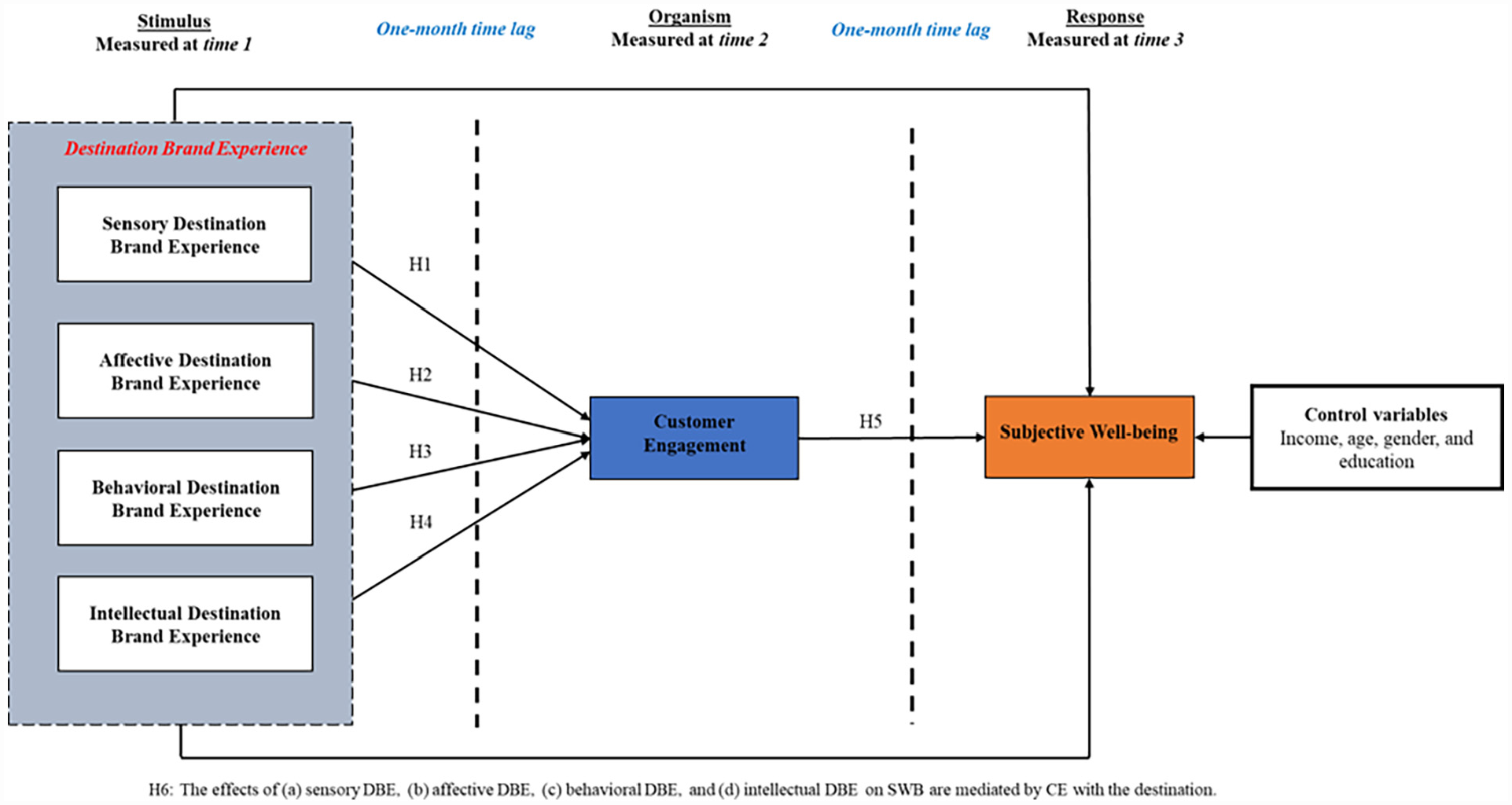
Proposed Model based on S-O-R Paradigm.
Methods
To test our proposed hypotheses, we adopted a quantitative method comprising data collection on the independent variables, mediator, and dependent variable across three time points to integrate temporal precedence. Data collection at the same time point could offer insight into how CE is related to other constructs. However, the predominantly cross-sectional nature of the literature implies a lack of understanding regarding this notion’s interactions with related constructs over time. The proposed three-time-point measurement allows researchers to capture the temporal precedence of constructs (e.g., Selig & Little, 2012)—in this instance, how DBE and CE induce change in other theoretical construct(s). By gathering data at three points, we respond to calls to more accurately measure sequential effects among these variables and utilize procedural remedies to reduce common method variance. According to MacKenzie and Podsakoff (2012) and Podsakoff et al. (2003), procedural remedies such as randomizing the order of similar items throughout a questionnaire and obtaining predictor and outcome variables from different sources or at separate times could reduce method variance in the research design. In line with other studies featuring a similar approach (e.g., Kaya & Karatepe, 2020a, 2020b; X. Li et al., 2015), we acquired data on predictor and outcome variables at different times to control common method variance.
Using a three-wave dataset provides temporal precedence for relevant causes, mediators, and effects, which has been described as a necessary condition for drawing valid inferences about mediation effects (Kline, 2015; Tate, 2015). As such, data were obtained at a 30-day interval between each wave of an online survey assessing travelers’ DBE, CE, and SWB, respectively. In multi-wave designs, it is crucial to determine an appropriate time lag between study waves because the intervals may affect internal validity (Taris & Kompier, 2014). The data collection interval can also influence the magnitude of the estimated effect (or causal effect, depending on the research design) (Selig, 2009). Therefore, the selected interval should reflect the causal lag between variables (Dormann & Zapf, 2002; Ployhart & Vandenberg, 2010). Travel experiences only influence a person’s SWB for a short period (de Bloom et al., 2013). Considering the moderate stability of the construct (Brunstein, 1993; Katja et al., 2002) and longitudinal research that also implemented a 1-month interval when examining SWB (Pavot & Diener, 1993), we implemented a 1-month lag between the three waves of data collection.
Pilot Study
A pilot study was performed via Amazon Mechanical Turk (MTurk) prior to the main three-wave study. Netemeyer et al. (2003) suggested that a pilot study is an effective way to identify problematic items that do not meet the psychometric criteria. In terms of sample size, Clark and Watson (1995) suggested that N = 100 to 200 seems reasonable for a less complex model. Such a sample size has appeared in research in marketing (Pontes et al., 2021) and tourism and hospitality (Y. Wang et al., 2017; Zheng et al., 2022). Thus, a total of 202 valid responses from MTurk was deemed sufficient for the pilot study. Among the sample, 35.1% of respondents were men and 18.8% were between 35 and 60 years old. Most (52.6%) held a bachelor’s degree, and 56.9% of respondents earned less than $60,000 annually. Respondents who had traveled either domestically or internationally in the past 30 days were qualified to participate. The measurement instrument’s psychometric properties were as expected. Minor modifications were made (e.g., wording) to the questionnaire.
Survey Instrument
To ensure the reliability and validity of our measure, all items were adapted from the existing literature and modified slightly to suit the context of this study. Three items measuring each DBE dimension (Time 1 survey) were adapted from Barnes et al. (2014). To capture CE (Time 2 survey), 4 items measuring identification, 5 items measuring enthusiasm, 5 items measuring attention, 6 items measuring absorption, and 5 items measuring interaction were adapted from So et al. (2014). While the original measurement scale was developed and validated in the tourism brand context (e.g., hotels and airlines) (So et al., 2014), the instrument has since been adopted in settings such as tourism social media sites (Harrigan et al., 2017; So et al., 2021), hotels (Rather & Sharma, 2016), national parks (Rasoolimanesh et al., 2019), retail store brands (So et al., 2016), and products and services (Ndhlovu & Maree, 2022). Earlier studies reinforced the scale’s reliability and validity, hence its suitability for this research. Following the sources of the measurement scales, all items were scored on a 7-point Likert scale.
Most definitions of SWB describe the concept as a person’s subjective, positive evaluation of their overall life, including work life and leisure life (Diener & Lucas, 2004; Kashdan, 2004). As noted, the bottom-up theory of well-being posits that participation or satisfaction with a leisure trip can improve one’s well-being cumulatively (Diener, 1984). For this reason, life satisfaction has been widely adopted as a measure of SWB (Larsen et al., 1985; Pavot & Diener, 2008; Proctor, 2014). Five items were thus adapted from Diener et al.’s (1985) Satisfaction with Life Scale to measure SWB (Time 3 survey).
Procedure of Main Study
We used Qualtrics, one of the largest online research companies in the United States, to obtain data. Qualtrics’s consumer panel consists of more than 95 million people around the world (Frye et al., 2020). Panel providers recruit respondents and record their personal information (e.g., email address and profession) to be included in a subject database for online survey distribution (W. Chang & Busser, 2020). Qualified respondents for this study were adults who had (a) traveled either domestically or internationally in the past 30 days and (b) used at least one social media platform(s) (e.g., TripAdvisor) related to their destination, which was named at the start of the survey. “Travel” was defined at the beginning of the survey as “travel away from [one’s] usual environment for more than 24 hr domestically or internationally.” Several general trip-related questions (e.g., destination name, travel companion, and travel purposes) were also included to help respondents recall their experiences as vividly as possible. Data on the four DBE dimensions were collected in the first wave, CE was captured in the second wave, and SWB was measured in the third wave. This three-wave data collection process has been suggested as a potential remedy for common method variance (Ozturk & Karatepe, 2019; Podsakoff et al., 2003) in addition to enhancing researchers’ ability to make inferences about mediation (Kline, 2015; Ozturk & Karatepe, 2019). Data collection was completed in March 2019.
Time 1 (t1) questionnaires were distributed to respondents who had traveled within the last 30 days; 1,198 individuals responded. After a 30-day interval, all respondents who completed the Time 1 questionnaire were contacted again and invited to participate in the Time 2 (t2) questionnaire, to which 428 respondents obliged and 770 did not (attrition rate: 64.27%). The 428 respondents were then re-contacted and invited to participate in the Time 3 (t3) questionnaire, resulting in 215 complete responses and 213 respondents who did not continue (attrition rate: 49.77%). Such attrition rates are largely consistent with often reported rates of 30%–70% (Gustavson et al., 2012). The questionnaires for Times 1, 2, and 3 were matched based on respondents’ Qualtrics identification numbers. Qualtrics was also instructed to perform preliminary screening of the data; cases were removed due to incomplete responses, failure to pass a speeding check (measured as one-half the median initial soft launch time), or selection of an incorrect response to one of the two attention check items. A final sample of 215 respondents provided research data across the three time points, which established the foundation for this study.
In light of the complexity of the proposed model (Fabrigar et al., 2010; Hair et al., 2006), this sample size was acceptable. We adopted MacCallum et al.’s (1996) popular procedure to assess its adequacy by generating the minimum sample size required for the model. This computation yielded a minimum sample size of 54.10 based on the structural model’s degrees of freedom of 418 (alpha level of .05); desired statistical power of .80; and null and alternative root mean square error of approximation (RMSEA) of .05 and .08, respectively (Preacher & Coffman, 2006). Our final sample of 215 cases thus exceeded the desired minimum.
The required sample size in multi-wave studies also differs from that in cross-sectional designs. As per Little (2013), a sample size closer to 150 provides sufficient confidence in the social and behavioral sciences. Studies with a similar design have included a sample size between 150 and 200 for three-wave data collection (e.g., Kaya & Karatepe, 2020a, 2020b; Ozturk & Karatepe, 2019). The power analysis and the literature on multi-wave research further indicated that our sample size was adequate.
Data Analysis
Using SPSS 27.0 and AMOS 27, covariance-based structural equation modeling (CB-SEM) was employed to test the proposed hypotheses. CB-SEM can explain the covariation between constructs and associated indicators (Hair et al., 2017). CB-SEM is also a precise approach in empirically measuring theoretical concepts. Considering the purpose of this study, CB-SEM was deemed appropriate for data analysis. To minimize estimation bias from mixing different levels of abstraction in examining the relationship between DBE (i.e., first-order level) and CE (i.e., second-order level), we followed Marsh’s (1991) and Kline’s (2011) suggestion as was done by So et al. (2017), and Taylor et al. (2018): a first-order confirmatory factor analysis was performed on all scales, after which a second-order confirmatory factor analysis was conducted to assess CE’s second-order factor structure.
We also carried out a two-step analysis, including an assessment of the measurement model and an evaluation of the structural model (Anderson & Gerbing, 1988). Regarding the structural model, data for the independent variables were collected at Time 1, data for the mediator were collected at Time 2, and data for the dependent variables were collected at Time 3. Along with testing the model via well-established procedures, the fully mediated model and partially mediated model were compared.
Results
Demographic Profile of Respondents
Within the sample (N = 215), 51.2% of respondents were men, and nearly all respondents were between 31 and 40 years old (52.1%); 18.1% were aged between 19 and 30, 19.1% were between 41 and 50, and 10.7% were above 60 years old. With respect to annual household income, approximately 1% of respondents earned less than $20,000, 5.6% earned between $20,000 and $40,000, 11.2% earned between $40,001 and $60,000, 14.4% earned between $60,001 and $80,000, 57.7% earned above $80,001, and 10.2% opted not to disclose their earnings. Table 2 presents the results.
Demographic Profile.

Following Armstrong and Overton (1977), we assessed non-response bias by comparing early responses (initial 5%) with late responses (latest 5%) on scale measures and demographic variables. A series of chi-square tests revealed no significant differences between early and late respondents’ demographics. A t-test indicated that all items did not differ significantly between the early 5% and late 5% of respondents. Therefore, non-response bias was not evident in this study.
Measurement Model: First-Order Confirmatory Factor Analysis
Given that CE is a second-order reflective construct, a first-order confirmatory factor analysis (CFA) was conducted with all first-order factors, followed by a second-order CFA to assess the second-order factor structure of CE (Kline, 2011). In accordance with Schumacher and Lomax’s (1996) model re-specification procedure, we performed a specification search in which we examined factor loadings and critical ratios (t values), standardized residuals, and modification indices. More specifically, we first considered the magnitude of standardized factor loadings as well as their statistical significance in the proposed model. Second, we inspected residual covariances to identify sources of model misspecification; these covariances show the discrepancy between a sample covariance matrix and the model-predicted covariance matrix (Kline, 2011). Third, based on Jöreskog and Sörbom (1996), we assessed modification indices whereby a chi-square of 3.84 or associations with multiple sources of misfit indicate potential re-specification. This approach has been described as the most useful way to re-specify a hypothesized model (Jöreskog & Sörbom, 1996). Estimation of the initial first-order measurement model identified several problematic items (i.e., SDBE3, ADBE2, BDBE3, IDBE2, EN1, EN2, ID2, AT1, AT2, AB4, and SWB5) exhibiting low factor loadings or cross-loadings. Consistent with prior research (Holden & Fekken, 1990; Schriesheim & Hill, 1981), our initial analysis showed that negatively worded items (i.e., SDBE3, ADBE2, BDBE3, and IDBE2) caused reliability issues. These items were accordingly removed from further analysis. Furthermore, following Kline (2015) and MacCallum (1995), the measurement model was re-estimated after each item was removed. The factor loadings of EN1, EN2, ID2, AT1, AT2, AB4, and SWB5 were lower than .70. According to Hair et al. (2022), factor loadings below .70 can be problematic, leading to misfit in model estimation. After careful consideration of their respective meanings and results, these items were removed. For example, the factor loading of SWB5 was .559, which was below the cutoff value of .70 (Hair et al., 2022). This item also yielded a factor loading below .61 when initially used in E. Diener et al.’s (1985) Satisfaction with Life scale. As such, after reviewing the result and the meaning of SWB5, the item was removed.
Results of the final first-order CFA indicated a good model fit to the data (see Table 3): χ2 = 597.09 (p < .001, df = 389), χ2/df = 1.54; comparative fit index (CFI) = .97; Tucker–Lewis Index (TLI) = .96; root mean square error of approximation (RMSEA) = 0.05 (PCLOSE = 0.49, 90% confidence interval [C.I.] = [0.04, 0.06]); and standardized root mean square residual (SRMR) = .03.
Results of First-order CFA.

Note.χ2 = 597.09 (p < .001, df = 389); χ2/df = 1.54; comparative fit index (CFI) = .97; Tucker–Lewis index (TLI) = .96; root mean square error of approximation (RMSEA) = .05; standardized root mean square residual (SRMR) = .03; SL = standardized loadings; C.R. = critical ratio; CR = composite reliability; AVE = average variance extracted; N/A = not applicable.
As all standardized factor loadings exceeded .70 (Hair et al., 2006) and the critical ratios for all standardized factor loadings were above 2.57 (Netemeyer et al., 2003), the measure’s convergent validity was supported. Discriminant validity was also achieved because the square root of the average variance extracted (AVE) for each factor was greater than the correlations with other factors (Fornell & Larcker, 1981). Results appear in Table 4.
Discriminant Validity.

Note. SDBE = sensory destination brand experience; ADBE = affective destination brand experience; BDBE = behavioral destination brand experience; IDBE = intellectual destination brand experience; EN = enthusiasm; ID = identification; AT = attention; IT = interaction; AB = absorption; SWB = subjective well-being. The boldfaced diagonal elements are the square root of the variance shared between the constructs and their measures. Off-diagonal elements are the correlations between constructs.
As shown in Table 3, composite reliability (CR) estimates ranged from .71 to .96, well above the suggested threshold of .70 (Hair et al., 2006). All AVE values exceeded the recommended level of .50 (Fornell & Larcker, 1981), indicating acceptable construct reliability.
Measurement Model: Second-Order CFA
To assess hierarchical CFA, the second-order construct of CE was modeled as correlated with other first-order constructs. Results demonstrated a reasonable model fit: χ2 = 690.86 (p < .001, df = 414), χ2/df = 1.67; CFI = .96; TLI = .95; RMSEA = .06 (PCLOSE = .09, 90% C.I. = [0.05, 0.06]); and SRMR = .05. In addition, we found that the five CE dimensions were significant and strong indicators of the second-order construct of CE (p < .001). The AVE value of CE (.78) was well above .50, indicating convergent validity. Discriminant validity was established as well; the square root of the AVE for each construct exceeded its correlations with other constructs (Fornell & Larcker, 1981). The CR value of CE (.95) was beyond the .70 threshold (Hair et al., 2006), and the AVE value was greater than the suggested .50 cutoff (Fornell & Larcker, 1981). Furthermore, no significant common method bias was apparent in the dataset (
Structural Model
To investigate the proposed hypotheses, a structural model was assessed using maximum likelihood estimation. Results indicated a good model fit: χ2 = 801.50 (p < .001, df = 418), χ2/df = 1.92; CFI = .94; TLI = .93; RMSEA = .06 (PCLOSE = .01, 90% C.I. = [0.06, 0.07]); and SRMR = .06. To control for the effects of demographic variables on the outcome variables of CE and SWB, we tested the hypothesized model with and without control variables including income, age, gender, and education. Our results indicate that income was significant in predicting SWB while age, gender, and education were not. As the inclusion of control variables did not significantly change the magnitude and significance of relationships, we have reported the model findings without control variables (Carlson & Wu, 2012). The critical ratios of structural paths revealed that four hypotheses were supported. Specifically, sensory DBE (H1 supported:

Results of structural model.
Testing for Mediation
To test the mediation effect of CE, we compared the proposed full mediation model with the alternative partial mediation model, which included additional direct paths from the four dimensions of DBE to SWB. The chi-square difference test demonstrated that the partial mediation model (χ2 = 800.97, df = 414, χ2/df = 1.94, p < .001, CFI = .94, TLI = .93, RMSEA = .07, PCLOSE = .01, 90% C.I.= [0.06, 0.07], SRMR = .06), with additional direct paths, did not have a significantly better model fit (Δχ2 [4] = 0.53, p > .05) than the more parsimonious full mediation model (χ2 = 801.50, df = 418, χ2/df = 1.92, p < .01, CFI = .94, TLI = .93, RMSEA = .07, PLOSE = .01, 90% C.I. = [0.06, 0.07], SRMR = .06). These findings thus offered additional empirical support for the full mediation model.
Furthermore, the hypothesized model suggests that CE transmits the effects of the four DBE dimensions on SWB, implying mediation (MacKinnon et al., 2007). As our study involved temporal precedence in the measurement of presumed causes, mediators, and outcomes, conditions for a true sense of mediation were established (Kline, 2015). Results of a bias-corrected bootstrap analysis with 5,000 subsamples (Mackinnon et al., 2004) indicated that sensory DBE (90% C.I. for indirect effect: [0.003, 0.13]) and affective DBE ([0.02, 0.45]) each exerted a significant indirect effect on SWB. The indirect effects of behavioral DBE ([−0.02, 0.11]) and intellectual DBE ([−0.10, 0.19]) on SWB were not significant. In addition, we identified the total effects of each dimension of DBE on SWB. As shown in Table 5, affective DBE (β = .76) played the strongest role in SWB followed by sensory DBE (β = .50). Therefore, H6a and H6b were supported while H6c and H6d were not.
Mediating Effects.

Note. DBE = destination brand experience; SWB = subjective well-being; CI = confidence interval.
Discussion and Implications
Building on the literature regarding travel experiences and SWB, as well as the emerging school of thought connecting CE and SWB, this study offers academics and practitioners useful insight. By gathering data at three time points, we echo earlier calls for attention to more accurate measurement accounting for sequential effects among these variables. Using a three-wave dataset provides temporal precedence for relevant causes, mediators, and effects, which has been described as a necessary condition for drawing valid inferences about mediation effects (Kline, 2015). A conceptual model examining the direct impact of DBE on CE, as well as its indirect impact on SWB, was proposed and empirically assessed over time. By doing so, the effects of DBE on subsequent CE and SWB were analyzed across multiple time points.
Much is known about customers’ behavioral intentions in relation to brand experiences (e.g., Ahn & Back, 2018; Choi & Kandampully, 2019). Yet this study contributes to the tourism and hospitality literature in several ways via S-O-R theory. First, while prior tourism and hospitality research has adopted S-O-R theory to understand consumers’ travel behavior (Dong & Siu, 2013), few temporal investigations have been conducted. Our study fills this knowledge gap by focusing on how travelers’ DBE affected CE and SWB over time. Second, building on the extant literature, this study has provided justification and empirical evidence to support linkages between the multidimensional CE concept and related constructs in understanding travelers’ experiences as well as how these experiences’ impacts on SWB can be sustained. Third, our findings contribute to the literature by demonstrating the mediating role of CE, stressing the role of CE in tourists’ experiences. We extend the construct’s effects to benefits for the destination brand along with the customer. Our findings are further discussed in the ensuing section.
Theoretical Implications
Our results show that sensory DBE and affective DBE each directly enhance CE. This finding is consistent with research suggesting that sensory DBE positively influences customers’ brand engagement at integrated resorts (Ahn & Back, 2018); that is, when tourists gain positive sensory DBE, they tend to engage with the destination brand. Tourism research has extensively examined visual components of the tourist experience (Pan & Ryan, 2009), thus underlining the roles of sensory aspects. Tourism is an exemplar of the experience economy (Oh et al., 2007; Pine & Gilmore, 1999): it typifies a consumption experience of a composite product that includes lodging, food, transportation, souvenirs, and leisure activities (Mossberg, 2007; O’Dell & Billing, 2005; Rodrigues et al., 2010; Sánchez et al., 2006). The findings of this research also echo the idea that “everything tourists go through at a destination can be experienced” (Oh et al., 2007, p. 120), providing support for a multi-sensory approach to engineering tourism products.
Affective DBE similarly influences CE. Various sensory experiences can stimulate positive emotions, including pleasure, fun, and happiness (L. Hollebeek, 2011). Similarly, emotion is a core component of the tourist experience (Bastiaansen et al., 2019; Mcintosh & Siggs, 2005). Prior research (Miles, 2014) indicated that travel experiences at battlefield heritage sites could evoke negative affective responses (e.g., horrific memories or a sense of suffering)—and these reactions may continue affecting tourists long after they have returned home (Gnoth, 1997). The relevance of the affective aspects of an experience has been highlighted in the CE literature, which emphasizes the importance of brands connecting emotionally with customers (Pansari & Kumar, 2017). Accordingly, tourists with positive affective experiences generally demonstrate enhanced emotional connections to a destination brand. This finding exemplifies the critical role of DBE in building CE.
However, behavioral DBE and intellectual DBE at t1 did not significantly contribute to CE at t2. Although our literature review provides support for these relationships, after accounting for a 1-month interval, the effects were not evident in this study. Such findings are in line with Barnes et al. (2014), who concluded that sensory and affective DBE primarily drive tourists’ behavioral outcomes compared with the other two insignificant dimensions: behavioral DBE and intellectual DBE. Relatedly, Ahn and Back (2018) found that the behavioral and intellectual dimensions of DBE could not predict affective CE in an integrated resort context.
Our results further indicated that CE influenced the outcome variable of interest, SWB. Although the effect was moderate, this result harkens back to other literature (Harrigan et al., 2017; L. Hollebeek, 2011; Prentice & Loureiro, 2018) suggesting that tourists who are highly engaged with a destination brand are more likely to experience improved SWB after traveling. This study also demonstrates the mediating role of CE. As suggested by S-O-R theory, DBE at t1 functioned as the stimulus that produced CE at t2 as the organism process, leading to SWB in t3 as the psychological response. While Ahn and Back (2019) noted that tourists’ integrated resort brand experiences represented a significant antecedent of CE, and that tourists’ behavioral intentions were thus a consequence of CE, the mediating role of CE was not formally tested. Despite the moderate effect size, our study contributes to the literature by introducing CE as a full mediator. We observed empirical support for this mediating effect based on three waves of data. The significance of the effect over time provides causal evidence of a mechanism that can potentially sustain the positive impacts of DBE on SWB.
Consistent with cross-sectional results indicating that tourists’ experiences can affect their personal well-being both directly (Vada et al., 2019) and indirectly (Ahn et al., 2019), our findings conclusively show that CE mediates the effects of DBE on tourists’ SWB over a 2-month span. The effects of travel experiences on SWB may change depending on the time frame in which these effects are captured; even so, the ability of CE to sustain such effects over a 2-month period was supported in our work. Life satisfaction is often associated with a longer time frame. Positive and negative emotions tend to involve briefer periods in which people provide self-reported data. As such, the extent to which tourists might be affected by their current emotional state when discussing SWB may be shaped by how long ago their travel experience occurred. Our research has effectively answered Newman et al.’s (2014) call for studies using different time frames to measure SWB. In doing so, we address their concerns that when SWB components are measured cross-sectionally, a stronger (and perhaps conflated) association will likely be observed due to a method effect.
In verifying the positive relationships between multidimensional constructs (i.e., DBE and CE) along with a psychological outcome by using the extended S-O-R framework, this research contributes to the hospitality and tourism literature by empirically demonstrating the following: specific antecedents (i.e., sensory DBE and affective DBE) have indirect effects on SWB, thereby unveiling the mediating role of CE. This finding expands our understanding of the effects of travel experiences on SWB and highlights the importance of CE. By presenting and testing the proposed theoretical model using a three-wave dataset, our study responds to the need for research adopting multiple waves of data rather than cross-sectional data (Podsakoff et al., 2003). Such a design minimizes common method variance while offering compelling evidence of relationship causality. This work therefore enhances the tourism literature with results that are supported by a robust data collection technique.
Practical Implications
This study points to several practical implications. Our work should enhance destination marketers’ and tourism policy makers' understanding of how DBE and CE are essential to SWB. First, findings suggest that the sensory and affective components of DBE warrant more attention. As such, when developing advertising or marketing campaigns, destination marketers and hospitality managers should consider these components. From a sensory perspective, destination initiatives should focus on sensory stimuli and affective arousal that stimulate tourists’ senses of smell, sight, touch, taste, and sound (Barnes et al., 2014; Kumar & Kaushik, 2018). Specifically, destinations could play background music in major tourist attractions or visit points, enhance cultural experiences, and present colorful elements to promote visual and sensory exposure. In terms of affective experiences, marketers should seek to establish emotional connections with travelers by organizing activities, festivals, or events that convey destination uniqueness and authenticity. Marketers should also offer tailored experiences based on customers’ preferences to trigger exciting experiences and memories.
To enhance CE, destination marketers should continue to facilitate engaging experiences that have traditionally been advanced in the CE literature and in practice (e.g., maintaining online communities or social platforms where customers can share travel stories, photos, or videos). Our results also reveal the broader impacts of CE efforts that transcend commercial advantages to benefit consumers at an individual and societal level. Such virtual communities and social platforms will enhance customers’ identification, interaction, and attention toward a destination while meaningfully affecting customers’ perceived SWB. Therefore, destination marketers who are well versed in CE strategies are encouraged to consider their efforts/impact beyond simply encouraging revisit intention or positive word of mouth. Such deliberation is particularly important if an organization’s vision extends beyond realizing economic impacts to prioritizing corporate social responsibility and/or community development. A wider societal focus is common at the state and national levels of destination management (e.g., the U.S. Travel Association’s vision). Based on this study’s results, the impacts of smaller destination management organizations can also transcend economic benefits. This outcome offers a more appealing, socially conscious value proposition for certain stakeholders when considering the benefits of tourism (i.e., government and respective departments focused on community development). This study also reinforces the importance of enhancing tourists’ CE to improve their SWB. For governments, SWB enhancement is one of the most prominent social benefits associated with tourism. Our findings show that CE mediates DBE’s impact on SWB. This result underscores the role of CE beyond marketing-related benefits; its contributions also apply to key life domains. Therefore, destination management companies, travel agencies, tour operators, and service providers aiming to make an impact beyond economic contributions should assign greater importance to sustaining and enhancing CE by sharing adequate, timely, and useful destination information (Zhang et al., 2017). These entities should also focus on interacting with tourists via social media (Harrigan et al., 2017). Such activities, when tailored to foster CE, may help destinations outperform their competitors.
Limitations and Future Research
Several limitations apply to this research. First, SWB is conceptualized as a momentary and relatively stable state (Eid & Diener, 2004). Measurement over different time frames may undermine the stability and validity of results (Selig, 2009; Taris & Kompier, 2014) as well as the magnitude of estimated effects (Selig, 2009). Future work can adopt different time intervals (instead of a 1-month interval) to expand model results. Scholars could also uncover additional insight by extending SWB time frames. A longitudinal research design to understand the time-varying effects of travel experiences over a long period or to explore patterns of change over time. Second, results may differ based on how SWB is measured (i.e., life satisfaction or a global measure) and the timeframe in which SWB is captured (e.g., 1 week, 1 month). Researchers should explore how findings may vary conditionally.
Third, while our work helped to reveal how CE relates to relevant constructs over time, the central question of when CE may start to crystalize remains open. As such, future research could track the evolution of CE over a long period. Fourth, all variables were evaluated via self-report surveys, which could inflate inter-item correlations and result in common method variance. Following Podsakoff et al. (2003), we adopted a three-wave study design to minimize such variance. We also assessed for common method variance using Harman’s single-factor test and found that such variance was not apparent in our study. This lack of bias bolsters confidence in our findings. Fifth, even though we controlled the effects of demographic variables, the impacts of personality traits on one’s SWB cannot be ignored. Researchers can thus investigate the potential moderating effects of personality traits on the hypothesized model. In addition, this study is limited to the general tourism context; follow-up efforts should replicate the theoretical model in settings such as resorts or casinos.
In conclusion, we have explored the mediating role of CE in evoking SWB over time through travel experiences. From a theoretical standpoint, this study expands the hospitality and tourism literature by providing empirical evidence of the effects of DBE on CE, which transmit related impacts to the most critical psychological travel outcomes (i.e., SWB). From a practical perspective, our findings indicate that destinations should focus on providing travelers with positive sensory and affective experiences to enhance destination-related CE, which can then promote tourists’ SWB and boost cognitive and affective evaluations of their lives. In a post pandemic era, the ability to enhance one’s SWB is expected to take on increased prominence, thus further illuminating the importance and timeliness of this study.
Footnotes
Declaration of Conflicting Interests
The author(s) declared no potential conflicts of interest with respect to the research, authorship, and/or publication of this article.
Funding
The author(s) received no financial support for the research, authorship, and/or publication of this article.
