



Abstract
Since reusable launch vehicles have revolutionized access to space, space tourism has received enormous policy and research attention. However, such growth is occurring within a wider context of concerns over climate change, emissions, and space debris. Although the space industries have enormous environmental impacts, few studies have been undertaken on the sustainability of space tourism. Therefore, we aim to create and assess an extended value-beliefs-norms theory with environmental, social, and governance (ESG) factors, trust in artificial intelligence (AI), and the benefits of AI, in comparing three types of space tourism (Earth, suborbital, and orbital). To achieve the goals, multi-method analyses of 1,000 respondents were applied, including partial least squares-structural equation modeling, multi-group analysis, fuzzy-set Qualitative Comparative Analysis, and deep learning. Results revealed that the extended value-belief-norm model well explains space tourist behavior, ESG also has significant roles on the research model, and the three types have unique characteristics.
Keywords
Introduction
Space tourism is a major business following the development of fully and rapidly reusable rockets (e.g., SpaceX, Virgin Galactic, Blue Origin), and reusable launch vehicles (SpaceX, 2022). However, one SpaceX rocket (Falcon 9) launch generates CO2 emissions equivalent to 395 transatlantic flights (Champion Traveler, 2022). Given the establishment of private space launch operations and associated ancillary industries and tourism services, a detailed examination of the sustainability related consumer concerns surrounding space tourism, for example, impacts on stratospheric ozone, air pollution, and contribution to global heating, is important (Ryan et al., 2022; Scott, 2022).
Space tourism involves traveling for leisure, recreation, and/or pleasure with an interest in space (Duval & Hall, 2015). There are various types of space-related trips, for instance, stargazing/planetarium, visiting space museums/spaceports, virtual reality experiences of space trips, high-altitude aircraft and balloon airlifts, suborbital and orbital travel, and potentially in the future, space hotels, travel to the moon and Mars, and inter-planetary travel (Crouch et al., 2009; Giachinoa et al., 2021; Hasegawa et al., 2018; Olya & Han, 2020, 2023; Reddy et al., 2012). Nevertheless, it has been suggested that potential consumers are likely to react differently to various types of space tourism experiences, particularly with respect to Earth, suborbital, and orbital space tourism (Crouch et al., 2009). However, despite the distinctiveness of each form of space tourism, comparisons between the different types of space tourism are largely neglected.
The value-belief-norm theory suggests individuals act when they value something, perceive it as threatened, and believe their actions can restore its worth (Schwartz, 1977, 1992; Stern et al., 1999). Value-belief-norm theory has been effective in predicting sustainable behaviors in areas including mobility choice, eco-friendly accommodation, and sustainable tourism (Han, 2015; Landon et al., 2018; Lind et al., 2015). Various studies have used the value-belief-norm model to predict tourists’ sustainable behavior, finding that individual norms influenced by environmental perceptions can lead to involvement in sustainable practices and last-chance tourism (Denley et al., 2020; N. Kim et al., 2022). The model has also been expanded to include subjective norms in agricultural heritage tourism, proving effective in predicting eco-friendly behaviors (C. Lee et al., 2022; Megeirhi et al., 2020; Park et al., 2022). T. H. Lee and Jan (2018) devise an integrated ecotourism behavioral model for Taiwanese nature-based tourism destinations, combining theories of planned behavior, technology acceptance, value-belief-norm, and social identity for sustainable tourism development. Employing complexity theory and fuzzy set Qualitative Comparative Analysis (fsQCA) to develop a model for predicting visitors’ pro-environmental behavior intentions revealed four key configurations: demographics and value-belief-norm factors of values, beliefs, norms, and attitudes (Olya & Akhshik, 2019). Applying the value-belief-norm model and theory of planned behavior to examine US travelers’ intentions to participate in last-chance tourism finds social norms to be the strongest predictor (Woosnam et al., 2022). Although the value-belief-norm model fits well to explain tourist behavior, value-belief-norm theory has not previously been applied to predict space travel behaviors.
Given the rapid growth of space tourism and related environmental concerns, such as climate change, emissions, and space debris, there is an urgent need to understand the factors influencing the sustainable behavior of potential space tourists (M. J. Kim, Hall, Kwon, Hwang, & Kim, 2023; M. J. Kim, Hall, Kwon, Sohn, & Kim, 2023). Increasing awareness of environmental, social, and governance (ESG) issues is prompting businesses to adopt voluntary CSR initiatives and robust ESG practices (BlackRock, 2022; Ortas et al., 2015). The focus on sustainability in ESG has an increasing influence on the nature of tourism demand and consumption, yet some companies still do not fully acknowledge its relevance to their business practices (Dogru et al., 2022; Hassan & Meyer, 2022). Space tourism is recognized as an ESG concern with societal benefits, though research on ESG's role in space travel and artificial intelligence remains limited (Buczkowski, 2022; Marshall, 2022). Artificial intelligence (AI), including deep learning, is making significant inroads in space-related applications such as space tourism, spacecraft monitoring, and earth observation (Das, 2020; Mirchevski, 2019; Schmelzer, 2020; Xu & Liu, 2022; Zeng et al., 2020). Its potential to enhance the sustainability of space tourism through automation and intelligent decision-making is considerable (Dialani, 2021; Russo & Lax, 2022). However, despite the importance of ESG and AI in space tourism, studies on value-belief-norm theory and the distinct differences between on Earth and suborbital/orbital space tourism are largely overlooked.
To fill some of the research gap with respect to space tourism and its sustainability, the purpose of this work is to create and assess an extended value-belief-norm model including ESG as well as trust in and benefits of AI relevant to space tourism, along with comparisons between three types of space tourism to examine potential sustainable space tourist behavior. To achieve the research goal, this work raises four research questions: First, does extended value-belief-norm theory predict potential space tourist behavior? Second, does ESG influence sustainable space tourist behavior? Third, does AI contribute to sustainable space tourism behavior? Fourth, do the three types of space tourism differ from each other in terms of the perceived sustainability of space tourism behavior? To answer these questions, this study applies multi-analysis methods to 1,000 potential space tourists, including partial least squares-structural equation modelling (PLS-SEM), multi-group analysis (MGA), fsQCA, and deep learning (M. J. Kim & Hall, 2022b; M. J. Kim, Hall, Kwon, Hwang, & Kim, 2023; M. J. Kim, Hall, Kwon, Sohn, & Kim, 2023). Accordingly, this study offers novel insights on the perceived sustainability of space tourism industry with implications for both practice and research via provision of a strong theoretical and managerial foundation to the study of space tourism and sustainability.
Literature Review
Theoretical Background
Space Tourism With Sustainability
Space tourism refers to “the temporary movement of people for non-military and scientific reasons beyond the Earth’s atmosphere: the Kármán line, at an altitude of 100 km (62 miles) above sea level, is conventionally used as the start of outer space for regulatory purposes, such as the 1967 UN Outer Space Treaty” (Duval & Hall, 2015, p. 676). Scholars have long been interested in space tourism (Crouch, 2001; Goodrich, 1987; Olya & Han, 2020). As an integral part of the commercialization of space, private space tourism had become a big business bringing together tourism with the transportation, engineering, manufacturing, energy, technology, and construction sectors (Olya & Han, 2020, 2023), especially as space tourism is a means of radically reducing the cost of space transportation systems (Crouch, 2001).
Interest in more environmentally friendly and sustainable tourism reflects a broader process of enlarging the boundaries of what is sustainable in travel and tourism (Galvani et al., 2020) and includes consideration of operations, culture, resource availability, economic contribution, and human survival (Fawkes, 2007). Space tourism has been criticized as being representative of excess travel consumerism (Toivonen, 2017). Yet, given the investment in the sector by business and government it is clearly going to continue to expand. Therefore, attention needs to be given to improving the sustainability of operations, systems, and practices (W. Peeters, 2010; P. Peeters, 2018; Toivonen, 2017), so as to ensure that space travel is not just positioned as the ultimate in pro-consumerist tourism (Spector et al., 2017; Spector & Higham, 2019), but actually makes real contributions to sustainability.
There is growing interest in the sustainability of space tourism (Frost & Frost, 2022; Mammarella, 2021; Toivonen, 2021, 2022). From the perspective of sustainable behavior, space tourism may offer unexpected opportunities, as well as action to support sustainability programs (Mammarella, 2021). Environment-focused technologies (e.g., multisensory virtual space experiences) may contribute to better understanding of global climate change (Toivonen, 2022). However, the space tourism industry needs to develop policies and programs that promote sustainable behavior and expand public understanding of the environmental challenges of spaceflight (Frost & Frost, 2022).
In recent years, researchers have examined consumer behavior in relation to different types of space tourism (M. J. Kim, Hall, Kwon, Hwang, & Kim, 2023; M. J. Kim, Hall, Kwon, Sohn, & Kim, 2023; Mehran et al., 2023; Paladini & Saha, 2023). M. J. Kim, Hall, Kwon, Hwang, and Kim (2023) found that extrinsic motivation and trust in AI significantly boost consumers’ intentions to participate in both orbital and suborbital space tourism, while intrapersonal constraints negatively affect these intentions, highlighting distinct differences between the two forms of space tourism. According to an Extended Model of Goal-Directed Behavior for space tourism, individual interventions had a significant effect on all model constructs, but organizational interventions exert a partial impact, thereby influencing behavioral intention differently depending on experience levels (M. J. Kim, Hall, Kwon, Sohn, & Kim, 2023). Paladini and Saha (2023) reconceptualized the sustainability of low orbit space tourism and emphasized that future studies needed to incorporated examination of the technological dimensions of sustainability. Mehran et al. (2023) created a framework linking personality with public responses to space tourism, identifying research gaps, and proposing directions for future studies on a range of topics including tourism typology, ethical issues, stakeholder perspectives, and the use of new technologies. However, studies on space tourism are not sufficiently examined with a strong theoretical or conceptual basis (e.g., ESG, AI, types of space tourism).
Value-Belief-Norm Theory
Stern et al. (1999) defines value-belief-norm theory in terms of “individuals who accept a movement’s basic values, believe that valued objects are threatened, and believe that their actions can help restore those values experience an obligation (personal norm) for pro-movement action” (p. 81). Norm-relevant actions consist of three concepts: acceptance of a particular individual’s values; the belief that something important to those values is threatened; and the belief that behavior initiated by a person can help mitigate threat and restore value (Schwartz, 1977, 1992). Value-belief-norm theory has well predicted sustainable behaviors in terms of mobility mode choice (Lind et al., 2015), selection of environmentally friendly accommodation (Han, 2015), and pro-sustainability actions in sustainable tourism (Landon et al., 2018).
A number of studies applied the value-belief-norm model to predict tourists’ sustainable behavior (e.g., Denley et al., 2020; N. Kim et al., 2022; C. Lee et al., 2022; Megeirhi et al., 2020; Park et al., 2022). For example, drawing on the value-belief-norm model, Denley et al. (2020) found that perceptions of the environment (values, environmental worldviews, perceptions of consequences, assignment of responsibilities) influence the activation of individual norms, which in turn lead to the individual’s intention to involve in last-chance tourism. In studies of heritage tourism, the value-belief-norm theory has been extended to incorporate subjective norms (C. Lee et al., 2022; Megeirhi et al., 2020), while the value-belief-norm model has been found to substantially predict environmentally friendly behaviors, along with altruism (Park et al., 2022).
Tourism research has shed light on the relationship between value, belief, and norm (Denley et al., 2020; Han, 2015; N. Kim et al., 2022; Landon et al., 2018; C. Lee et al., 2022; Lind et al., 2015; Megeirhi et al., 2020; Park et al., 2022). Biospheric value was found to have significant impact on adverse consequences for valued objects (belief) via ecological worldview, which influences ascribed responsibility (norm) relevant to pro-environmental behaviors (Han, 2015; Landon et al., 2018; Lind et al., 2015). The strong relationships between value (biospheric), belief (awareness of consequences), and norm (personal norm) has been identified in relation to pro-sustainable tourism behavior (Denley et al., 2020; Megeirhi et al., 2020). Moreover, studies have found strong relationships among value, belief, and norm in heritage tourism (C. Lee et al., 2022), sustainable tourism development (Park et al., 2022), and preventive travel behaviors (N. Kim et al., 2022), providing valuable contributions to existing sustainable tourism literature. Nevertheless, although value-belief-norm theory has become significant in research on sustainability, it has not been applied with respect to space tourism, particularly with ESG.
Environmental, Social, and Governance
Institutional and corporate awareness of ESG has led to an increase in the adoption of voluntary corporate social responsibility (CSR) initiatives (Ortas et al., 2015). For example, investment firm BlackRock now requires businesses to demonstrate how they will fulfill their responsibilities to shareholders via sound ESG practices and policies (BlackRock, 2022). Sustainability has been a core focus of ESG research (e.g., Dogru et al., 2022; Hassan & Meyer, 2022; Teixeira Dias et al., 2023). Tourists’ perception of ESG risk rating has been found to be a determinant of international tourism demand (Hassan & Meyer, 2022). However, many companies still prioritize short-term profits for stakeholders (shareholders, employees, customers, local communities) (Dogru et al., 2022). Space tourism is also an ESG issue due to its potential to benefit society (Buczkowski, 2022). As a result, many businesses are tracking their ESG targets (Marshall, 2022). However, there is limited research on the role of ESG in space travel, along with AI and types of space tourism.
Artificial Intelligence for Space Tourism
Artificial intelligence (AI) is proposed for use in a variety of space-related applications (Xu & Liu, 2022; Zeng et al., 2020), including hospitality and tourism, space travel, and space exploration (Das, 2020; Mirchevski, 2019; Schmelzer, 2020). The market value of AI in space exploration is estimated to be $2 billion and is growing rapidly (Bagchi, 2021). AI-based space systems and robots are being used in spacecraft, imagery, and satellite monitoring (Schmelzer, 2020), as well as being applied to earth observation, global navigation, and space communication (Das, 2020). AI can be used in a variety of ways to help space tourism. For example, AI can be used to create astronaut assistants (e.g., Cimon), help with mission design and planning (e.g., Daphne), process satellite data (e.g., satellite health monitoring system), track space debris (e.g., collision avoidance maneuvers), and navigation systems (e.g., Lunar Reconnaissance Orbiter) (Adetunji, 2021). As a subset of AI, deep learning can be applied to automatic landings, intelligent decision-making, and fully automated space travel, making spacecraft more self-sufficient and autonomous (Dialani, 2021; Russo & Lax, 2022). As a result of its extensive use, AI potentially has important applications to the sustainability of space tourism. This study seeks to examine the effective associations between value-belief-norm theory, ESG practices, and AI applications for sustainable space tourism, comparing three types of space tourism.
Hypothesis Development
The term “value” is defined as “a desirable trans-situational goal that varies in importance and serves as a guiding principle in the life of a person or other social entity” (Schwartz, 1992, p. 21). The value-belief-norm model posits that each individual possesses a distinct cognitive belief structure that interacts with stimuli from the external environment. Furthermore, it suggests that internal emotional cues elicit specific instantaneous sensations of moral obligation (Schwartz, 1977). As per value-belief-norm theory, “values have a positive and significant influence on beliefs in the context of environmentalism” (Stern et al., 1999, p. 91). This ecological perspective has been found to be influential within the green lodging industry (Han, 2015). However, even though they are unrelated to an environmental worldview, self-centered values have been demonstrated to link with alternative beliefs that drive environmentally friendly behavior (Landon et al., 2018).
Trust is a significant factor within human-AI interactions because the intricacy and unpredictability of AI behavior may give rise to perceived risks by users (Glikson & Woolley, 2020). Factors such as familiarity, self-efficacy in robot usage, technological attachment, social influence, and a general trustful attitude toward technology were identified to impact the propensity to trust AI social robots (Chi et al., 2021). When considering the use of chatbots by accommodation providers, perceived system usability emerged as a key element influencing trust in AI, followed by perceived intelligence, perceived affinity, and perceived privacy breaches (Cheng et al., 2022b).
AI software can provide valuable potential advantages to society through machine learning to augment services and decision-making, which is aligned with the United Nations Sustainable Development Goals (SDGs) (Johnson et al., 2020; Truby, 2020). Both static and AI-assisted environment benefits positively influence purchase intent, and perceived AI-assisted environment benefits influence women more than men (Frank, 2021). This study considers beliefs, trust in, and benefits of AI as mediators between value and sustainable space tourism. Accordingly, we propose the following three hypotheses:
H1: Value on sustainable space tourism has a positive effect on beliefs (H1a), trust in AI (H1b), and benefits of AI (H1c) related to space tourism.
Environmental, social, and governance (ESG) factors are increasingly being incorporated into corporate strategy (Clementino & Perkins, 2021). There are a range of benefits from ESG implementation. For example, a study of Starbucks found that brand trust had a significant impact on eco-friendliness, quarantine, food health, and ethical governance, whereas quarantine and brand trust had a positive effect on repurchase intention (Moon et al., 2022). Companies with a higher level of transparency in distributing ESG information can also better benefit from contact with third-party financial institutions (Raimo et al., 2021). During financial crises, a major bond market benefit of ESG investments is a decrease in perceived debt agency costs (Amiraslani et al., 2023), while applying ESG to companies that increase gender equality also provides significant economic benefits (Bosone et al., 2022). Based on these findings, we hypothesize that ESG influences beliefs, trust, and benefits. Specifically, we hypothesize that:
H2: ESG on space tourism has a positive effect on beliefs (H2a ), trust in AI (H2b ), and benefits of AI related to space tourism (H2c ).
Based on the value-belief-norm theory, beliefs about the consequences of a behavior have a significant effect on personal norms and behavioral intentions, such as selecting sustainable transport modes (Lind et al., 2015). In the context of green lodging, beliefs about the adverse consequences of a behavior for valued objects can strongly influence norms, which can lead to behavioral intention (Han, 2015). During the COVID-19 pandemic, beliefs about the adverse consequences of a behavior and the benefits of taking responsibility can lead to personal norms and preventive travel behaviors (N. Kim et al., 2022). Therefore, this study proposes two hypotheses:
H3: Beliefs in sustainable space tourism have a positive effect on personal norms (H3a) and behavioral intention to sustainable space tourism (H3b).
AI social robots follow human norms of behavior and have the ability to interact directly with humans, facilitating collective norm formation through the effect of trust (Chi et al., 2021). System trust positively influences consumers’ intention to adopt AI-driven chatbots in the accommodation-based sharing economy (Cheng et al., 2022a). During the COVID-19 pandemic, residents’ interpersonal trust influenced place attachment relevant to pro-environmental behavior over quality of life (Ramkissoon, 2023). Therefore, we suggest hypotheses:
H4: Trust in AI related to tourism has a positive effect on personal norms (H4a) and behavioral intention to sustainable space tourism (H4b).
In order to benefit from AI, consumers need a substantial level of background knowledge and skill in information use (e.g., health literacy) (Schulz & Nakamoto, 2013). For AI to benefit the UN SDGs, ethical governance solutions should limit the behavior of AI systems based on moral norms, implying that the benefits of AI are related to norms (Truby, 2020). From value-belief-norm theory, environmentally friendly personal norms as well as benefit perceptions both predict consumer adoption of new facilities and practices (Poortvliet et al., 2018), implying that benefits lead to sustainable behavior. Hence, we posit two hypotheses:
H5: Benefits of AI related to space tourism have a positive effect on personal norms (H5a) and behavioral intention to sustainable space tourism (H5b).
Individual pro-environmental norms are the beliefs that individuals and other social actors have a duty to mitigate environmental problems, consistent with individual norms producing general dispositions (Stern et al., 1999). Based on the value-belief-norm and health belief models, personal norms had a significant impact on tourist’s preventive actions during the COVID-19 pandemic (N. Kim et al., 2022). Pro-environmental personal norms have also been found to have a highly significant impact on intended use in waste water management (Poortvliet et al., 2018). Therefore, we suggest the following hypothesis:
H6: Personal norms on sustainable space tourism have a positive effect on behavioral intention.
Space tourism can take place on Earth, in suborbital or orbital space, or even on the Moon or Mars (Crouch et al., 2009; Giachinoa et al., 2021; Hasegawa et al., 2018; Reddy et al., 2012). Giachinoa et al. (2021) suggest that we should aim for more environmentally sustainable terrestrial space tourism and virtual space tourism. Crouch et al. (2009) identified four types of space travel: high-altitude jet fighter flight, atmospheric zero-gravity flight, short suborbital flight, and long-range space orbital travel. Reddy et al. (2012) found that the form of space travel (orbital/quasi-orbit), the launch type and design of the spacecraft, the spacecraft’s location, required training, insurance, duration, the participant’s health, and the operator’s reputation all influence tourism decision making. Olya and Han (2023) found that sub- and orbital space travelers have positive push effects and negative mooring and pull impacts with respect to avoidance intention of space trips, while they have highly positive influences of gratification, adventure, service experience, and social motivation on behavior intention to participate in space tourism. Therefore, given the importance of type of space tourism, we propose the following hypothesis:
H7: Three types of space tourism (i.e., on Earth, short duration suborbital, and long duration orbital) differ from 13 relationships of the research model on sustainable space tourism behavior.
In keeping with prior studies, we suggest an extended value-belief-norm model including value, beliefs, norms, three ESGs, trust, benefits, and behavioral intention for sustainable space tourism behavior (Figure 1).

Proposed research model.
Methods
Measurements
In this study, the survey tool consists of nine constructs and 36 items. Specifically, value on sustainable space tourism was estimated by four questions grounded upon established literature (Han, 2015; M. J. Kim et al., 2020) (e.g., “Sustainable space tourism is vital to save the planet”). Four questions relevant to belief on sustainable space tourism came from existing works (Han, 2015; N. Kim et al., 2022; Landon et al., 2018; Lind et al., 2015) (e.g., “I believe that sustainable space tourism is important for planetary health”). Personal norm in relation to sustainable space tourism was assessed using four questions from previous studies (e.g., Denley et al., 2020; Megeirhi et al., 2020; Park et al., 2022) (e.g., “I feel an obligation to go on space tourism trips that are sustainable”). Four items associated with behavioral intention to sustainable space tourism were derived from M. J. Kim et al. (2020; N. Kim et al., 2022) (e.g., “I’m planning to participate in sustainable space tourism”).
Perceived ESG was examined by three subconstructs of environmental, social, and governance with each four questions generated from prior literature (e.g., Dogru et al., 2022; Hassan & Meyer, 2022; Teixeira Dias et al., 2023) (e.g., “I think that space tourism operators help minimize the environmental impact of their activities”). Trust in AI relevant to sustainable space tourism was estimated with four questions drawn from previous literature (Cheng et al., 2022a; Chi et al., 2021; M. J. Kim et al., 2011) (e.g., “AI algorithms don’t cause errors when I participate in space tourism”). Four items relevant to benefits of AI relevant to sustainable space tourism came from existing works (e.g., Poortvliet et al., 2018; Schulz & Nakamoto, 2013; Truby, 2020) (e.g., “I believe that applying AI to space tourism would enable me to better accomplish my participation in space tourism related trips”).
Given not only its high reliability but also discriminant validity, all questions applied a seven-point Likert-type measure ranging between (1) strongly disagree and (7) strongly agree (Preston & Colman, 2000). General information items were also included in relation to participation in space tourism, ranking the type of space tourism they would most like to participate in, primary motivation for space tourism, greatest concern about the UN 17 SDGs, and the most sustainable space trip. In addition, respondent socio-demographic questions (i.e., monthly household income, occupation, residential area, gender, educational level, age, and marital status) were used.
Content Validity
In this research, measurements were first formed in English then translated into Korean. The Korean form was then back-translated to correct discrepancies in wording and intended meaning. This process leaded to revisions of the questionnaires, since Korean and English have quite different cultural backgrounds.
Three academic researchers carried out a preliminary assessment of the content legitimacy of questionnaires. In the step, a question for perceived ESG_ environmental and an item for perceived ESG_ social were deleted to capture the clearest meaning of the sub-constructs. Three online survey professionals adjusted the questionnaire to the requirements of the online platform with the directions, general enquiries, and general wording being edited. As a pilot exercise, the instrument was given to five PhD candidates. As a result, the definitions on space tourism, sustainable behaviors, and sustainable space tourism were reworded. In addition, a pre-test was also undertaken on 50 Koreans who hoped to participate in space travel. Consequently, three questions were added with respect to trying to improve the quality of response, experience of space tourism, and time spent on answering (Supplemental A).
Data Collection
Korea was chosen as the data collection site due to the growing interest in space tourism among Koreans. This surge in interest follows the 2022 success of “Nuri-ho,” a Korean space vehicle that exclusively utilized domestic technology, and “Danuri-ho,” a lunar spacecraft (M. J. Kim, Hall, Kwon, Hwang, & Kim, 2023; M. J. Kim, Hall, Kwon, Sohn, & Kim, 2023). Because of their cost effectiveness, web-based panel surveys are increasingly used for consumer research in Korea (M. J. Kim et al., 2011, 2020). The largest digital survey firm in Korea (Embrain) was used to collect samples. Data were collected from October 3 to 18, 2022. Based on Ministry of the Interior and Safety (2022) data, socio-demographic quota sampling was used to reflect the Korean population’s age, residential area, and gender. People who were 18 years old and more, residents of Korea, and who wanted to participate in space tourism were asked to join in the survey. Invitations were emailed to 13,168 subjects grounded upon a random sampling of 1.6 million panel members of the survey firm. Of them, 4,378 respondents connected to the email invitation and 1,252 subjects passed the screen questions. Of these 1,155 panel members completed the survey as a valid questionnaire. After removing respondents who spent less than 3.6 minutes to complete the survey, 1,000 potential space tourists were then used for analysis, employing PLS-SEM and MGA (Ringle et al., 2015), fsQCA (Ragin, 2017), and deep learning (M. J. Kim & Hall, 2022b).
Data Analysis
This work performed symmetrical (SEM and MGA), asymmetrical (fsQCA), and deep learning methods to forecast sustainable space tourism behavior in Korea. Symmetric methods (e.g., SEM, MGA) are for testing the sufficiency of the input factor (X) when forecasting the input factor (Y) (Olya, 2023). In asymmetric methods unlike symmetric approaches, such as fsQCA, a better score for X (solution) is not essentially associated with a better score for Y (outcome factor) (Ragin, 2017). In the context of our study, the combination of these four methods would give a well-rounded view of the factors that influence sustainable behavior among potential space tourists. Symmetric methods like SEM and MGA could identify key variables and their relationships, while the fsQCA could reveal complex combinations of conditions that lead to sustainable behavior relevant to space travel. Meanwhile, deep learning methods could capture any non-linear relationships or patterns on space tourist behavior that might be missed by the other methods.
As a symmetrical approach, to evaluate the research framework as a symmetrical approach, PLS-SEM was primarily employed with MGA (Hair et al., 2017). PLS-SEM is perceived as superior to traditional SEM (e.g., covariance-based methods) for nonnormal data, second order factors along with first order factors, and/or complex models in multi-group analyses (Hair et al., 2020). Therefore, to verify the measurement and structural frameworks, SmartPLS 3.3.5 was used in this study (Ringle et al., 2015).
As an asymmetrical approach, to verify the comparative effects of various configurations, fsQCA is applied for tourist behavior (e.g., M. J. Kim & Hall, 2022a). To gain richer results with sufficient configuration solutions and causal combinations as well as the analysis of necessary condition (i.e., necessary condition analysis) that produces consistency and coverage scores for individual conditions, the impacts of value-belief-norm, ESG, and AI factors on behavioral intention were validated and compared for three types of space tourism (i.e., on Earth, suborbital, and orbital) (Ragin, 2017). Analysis of necessary condition (i.e., necessary condition analysis) is an approach and tool for identifying necessary conditions in data sets. A necessary condition, providing specified substitutable conditions, is a critical factor of an outcome: if the condition is not in place the outcome will not occur (M. J. Kim, Hall, Kwon, Hwang, & Kim, 2023; M. J. Kim, Hall, Kwon, Sohn, & Kim, 2023). As an asymmetrical approach based on Boolean Algebra, fsQCA was used to explore sufficient solutions (i.e., a combination of the predictors) to stimulate travel consumers for sustainable space tourism. We used fsQCA 3.0 software to find sufficient causal combinations of constructs and recipes as well as Analysis of necessary condition of prerequisites (Ragin, 2017). fsQCA also helps explore solutions for low scores of residents’ support which are not opposite to solutions for high scores of potential tourists’ behavioral intention for sustainable space tourism (Olya, 2023; Ragin, 2017). Configurational modeling was conducted in three stages (Olya, 2023). In the set, seven is specified as a complete member with a value of 1, four represents the intersection with a value of 0.5, and one is used as a complete non-member of the set with a value of 0 for all variables (Ragin, 2017).
Without the need to hypothesize beforehand about specific associations between input as well as output factors, deep learning based on artificial neural networks (ANN) can access a variety of statistical structures (Ripley, 1996). As an artificial intelligence method, ANN outperforms traditional analyses (e.g. regression, SEM) with superior predictive accuracy because it can detect both linear and non-linear associations (M. J. Kim et al., 2021). However, ANNs do not need multivariate assumptions (e.g., normality, linearity, variance), which are not suitable for testing causality (M. J. Kim & Hall, 2022b). Therefore, the SEM and ANN methods should be considered as complementary (V. H. Lee et al., 2020). Hence, deep learning with AI were performed grounded upon ANN as well as multilayer perceptron (MLP) methods using IBM SPSS Statistics 28 package by deep learning of multi-hidden layer and MLP. Two tests of single factor method (Podsakoff et al., 2003) as well as simple and complex model comparison approaches (Korsgaard & Roberson,1995) show common method variance is not an issue in the research (Supplemental B).
Results
Profile of Samples
The demographics and general information for the entire group (1,000 cases) are provided in Supplemental C and the three groups of on Earth (336 respondents), short duration with suborbital (332 respondents), and longer duration with orbital space tourism (332 respondents) (Supplemental D). The results showed that the three groups are substantially different from each other. For instance, the orbital space tourism group is more likely to be male, young, university graduates, professionals, and hope to travel to space hotel, the moon, and Mars, but still pursue sustainable energy, sustainable infrastructure/sound technologies, and climate change mitigation. The suborbital space tourism group is more likely to be higher income earners and live in metropolitan areas. The on Earth space tourism group differs substantially from the suborbital and orbital space tourism respondents and are more likely to be women, older, less educated, and married and their primary motivations for space tourism are leisure and curiosity.
Measurement Model
With respect to the measurements, 34 indicators had factor loadings over 0.7 based on confirmatory factor analysis (Hair et al., 2020) (Supplemental E). As shown in Supplemental F, the composite reliability, Rho_A, and Cronbach’s α of variables are over 0.7, confirming the internal validity of scales. The average variance extracted (AVE) of concepts is over 0.5, and the factor loadings of all the indicators are above 0.7, supporting convergent validity. Discriminant validity is established with Heterotrait-Monotrait Ratio (HTMT) (Hair et al., 2017). That is, the maximum value between personal norms and behavioral intention is 0.710, which is smaller than the cut-off of 0.9; the discriminant validity is accordingly recognized. Furthermore, as Q2 values, an acceptable degree of predictive relevance is attained over zero which were recognized for the endogenous variables, revealing a range between 0.151 and 0.553 based on Stone (1974). In addition, the multicollinearity of factors is verified, utilizing the variance expansion coefficient (VIF). The results showed that multicollinearity is not a problem since the VIF range was from 1.513 to 3.805 (Hair et al., 2017) (Supplemental E).
Structural Model
Due to the nonnormal distributions of data, applying bootstraps of 5,000 resamplings, PLS-SEM is utilized to assess the seven hypotheses (Hair et al., 2017). The R2s (variance explained) show beliefs (45.9%), trust in AI (21.5%), benefits of AI (21.3%), personal norms (24.0%), and behavioral intention (43.5%) (Hair et al., 2020) (see Figure 2). With regard to hypotheses, value positively influences beliefs (H1a: γ = .427, p < .001), trust (H1b: γ = .158, p < .001), and benefits (H1c: γ = .366, p < .001). Also, ESG positively influences beliefs (H2a: γ = .360, p < .001), trust (H2b: γ = .367, p < .001), and benefits (H2c: γ = .156, p < 0.001). Beliefs have substantial effects on personal norms (H3a: β = .330, p < .001) as well as behavioral intention (H3b: β = .122, p < .001). Moreover, trust significantly influences personal norms (H4a: β = .156, p < 0.001), but an insignificant effect on behavioral intention (H3b: β = .027, p > .05). Benefits have positive effects on personal norms (H5a: β = .130, p < .01) and behavioral intention (H5b: β = .181, p < .001). Furthermore, personal norms have highly significant impacts on behavioral intention (H6: β = .490, p < .001). Therefore, hypotheses 1, 2, 3, 5, and 6 are fully supported. However, hypothesis 4 is only partially supported because the relationship between trust and behavioral intention is insignificant. The plausible reason is that consumers who has trust in AI for space tourism may not be concerned about sustainability in the context of space traveling.
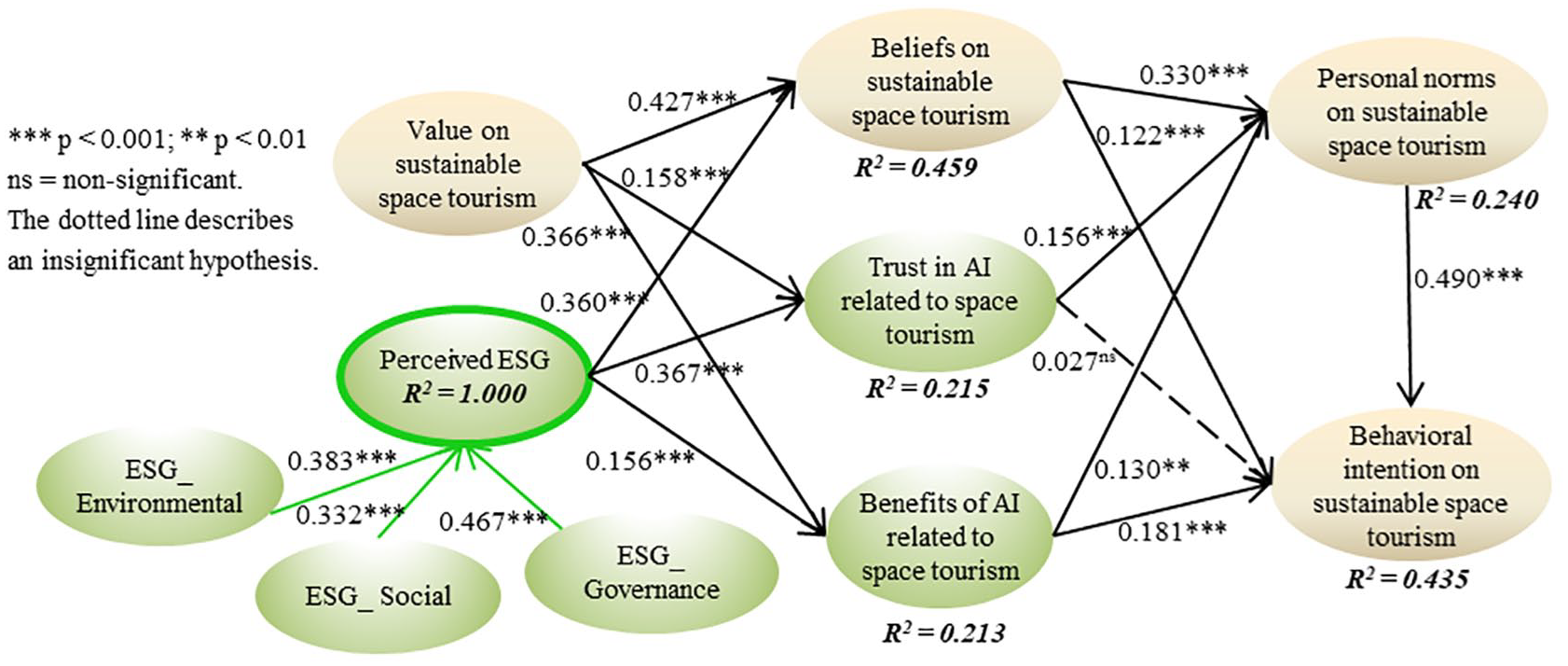
Results of path analysis.
Regarding mediating effects, to verify the mediating effects of beliefs, trust, benefits, and personal norms in this research, PLS-SEM bootstrapping by 5000 re-sampling is used. Personal norms (γ = .213, p < .001) and behavioral intention (γ = .227, p < .001) are indirectly influenced by value. Also, personal norms (γ = .213, p < .001) as well as behavioral intention (γ = .227, p < .001) are indirectly influenced by ESG. Moreover, behavioral intention is indirectly influenced by beliefs (β = .162, p < .001), trust (β = .077, p < .001), and benefits (β = .064, p < .01). Interestingly, the relationship between trust and behavioral intention is not significant with the direct effect, but it’s indirect effect is significant. Hence, beliefs, trust, benefits, and personal norms had indirect influences in this study (Supplemental G). Cohen’s f2 is a standardized assessment of effect size (Cohen, 1988). The f2 values are shown as being from 0.001 to 0.324. Therefore, since the effect ranges (f2) of 0.02, 0.15, and 0.35 denote from small to big impacts, the model outcomes show an appropriate range of influences.
Comparing Three Types of Space Tourism
Based on the MGA (Ringle et al., 2015), we compared the 13 relationships for on Earth, suborbital, and orbital space tourism. The suborbital group has the greatest prediction power for this study model among three groups, along with benefits and personal norms, while the on Earth group has the highest prediction power for beliefs and trust. The on Earth group has strongest relationships between value and beliefs, ESG and trust, trust and personal norms, and benefits and behavioral intention. The suborbital group has the strongest relationships between value and trust, value and benefits, beliefs and behavior intention, benefits and personal norms, and personal norms and intent to behave. The orbital group has the strongest relationships between ESG and beliefs, ESG and benefits, and beliefs and personal norms. These results demonstrate that the potential suborbital space tourists are the best fit on the extended value-belief-norm model (Figure 3).
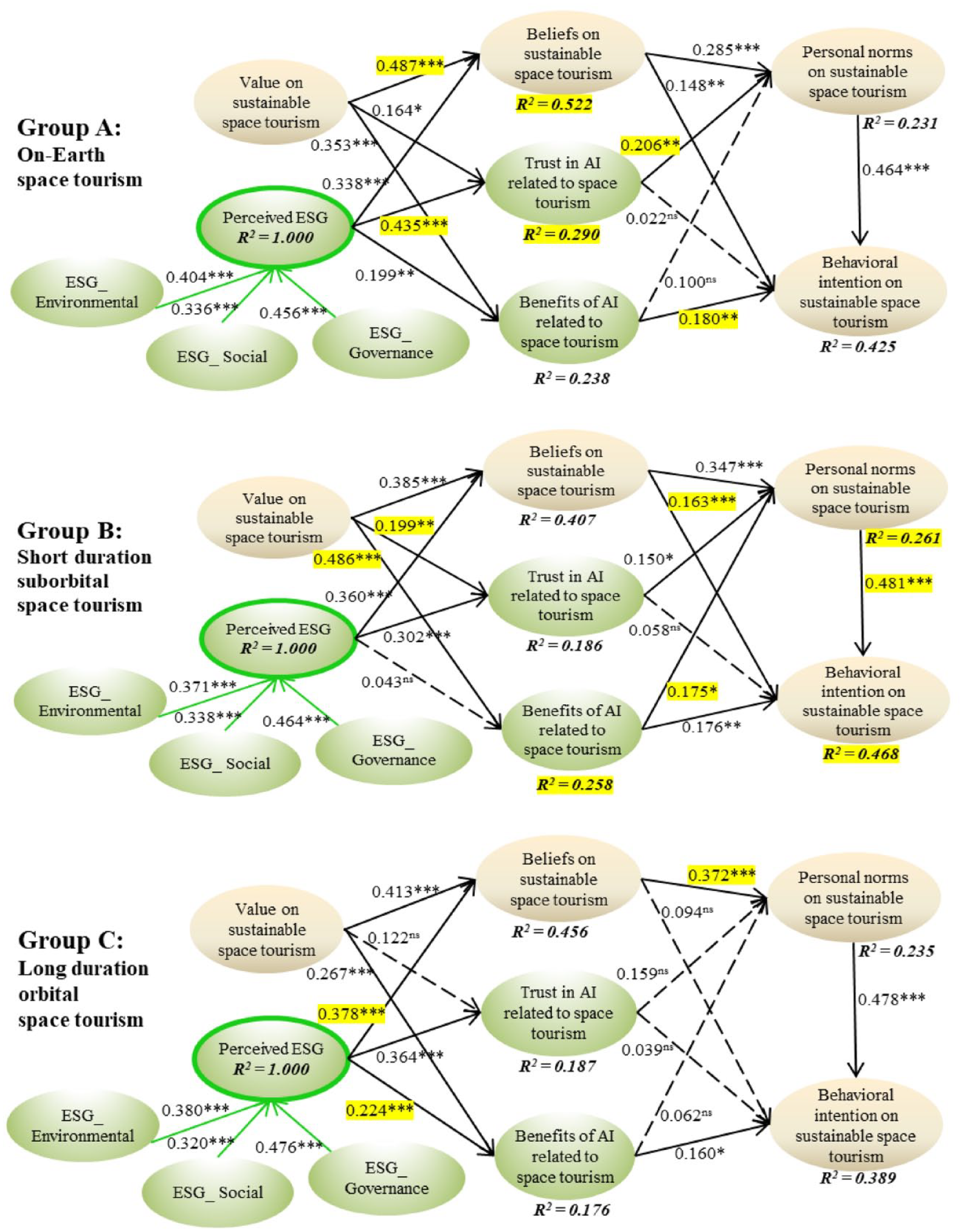
Comparing groups A, B, and C.
FsQCA
The necessary factors for three types of space tourism are identified using the analysis of necessary condition that provides pragmatic results for practitioners to know what are the critical conditions to attain the outcome (Supplemental H) (Olya, 2023). Based on the cut-off of consistency (>0.90), value and benefits are necessary to achieve sustainable space tourist behavior for the on Earth group, which is quite different from symmetric methods (M. J. Kim, Hall, Kwon, Sohn, & Kim, 2023). For the suborbital group, value, ESG, and benefits are necessary to obtain sustainable space tourist behavior, while benefits are necessary for sustainable space tourist behavior for the orbital group, which are interesting results and different findings from symmetric methods of PLS-SEM and MGA (M. J. Kim, Hall, Kwon, Hwang, & Kim, 2023). While analysis of necessary condition reveals the influence of variables forecasting the outcome as an individual condition, fsQCA that deals with combinations of causal conditions and computes multiple solutions to predict the outcome examines the combined impacts of variables with diverse names, for example, configuration, recipe, algorithm, solution, and causal model (Ragin, 2017).
Together with the other predictors, fsQCA addresses the heterogeneous role of predictors in simulating the outcome and is able to process a large number of cases to provide deeper insights into the effect of each predictor (Supplemental I). With the on Earth space tourism group, four solutions are suggested as ESG* beliefs*trust*benefits; ESG* beliefs*trust*~benefits*personal norms; ESG*trust*benefits*personal norms; and ESG*~trust*benefits*~personal norms to generate a high level of sustainable space tourist behavior. With the suborbital space tourism group, four solutions are suggested as value*ESG*beliefs; value*ESG*trust; value*ESG*benefits; and value*ESG*personal norms to generate a high level of sustainable space tourist behavior. With the orbital space tourism group, four suggested solutions are beliefs*trust*benefits; trust*benefits*personal norms; ~ESG*~beliefs*benefits; and ~ESG*benefits*personal norms to generate a high level of sustainable space tourist behavior. In contrast to the symmetric methods, the results from fsQCA indicate several causal configurations for three types of space tourism. That is, ESG is relatively important for the on Earth group, whereas value and ESG are critical for the suborbital group. In addition, benefits are significant for the orbital group in order to achieve a high level of positive sustainable behavioral intention by potential space tourists in Korea.
Deep Learning
Building a three ANN framework on the dependent construct can automatically generate hidden neuron nodes. To resolve the overfitting problem, this study applied 70% of the data set to training and 30% of them to testing (M. J. Kim et al., 2021, 2022a) (Figure 4). As the framework of this work, model B showed the best prediction accurateness with 48.8% as 1—relative error of testing data among the three models. Notably, in deep learning by the ANN as well as MLP method, the endogenous variables are forecast better (M. J. Kim & Hall, 2022b). In other words, the prediction accuracy value of model B by the deep learning is much larger than PLS-SEM. A plausible reason is mainly due to hidden layers of architecture, the MLP method, and the ability of ANNs to capture nonlinear connections. With regard to the normalized importance of independent variables, personal norms (100.0%) get twice the importance than benefits (44.5%) followed by beliefs (34.5%), trust (17.7%), value (17.0%), and ESG (12.0%) for sustainable space tourism behavior. Deep learning of the capabilities of thicker ANN structures and the ability to identify nonlinear associations using MLP yielded interesting results, which are important with respect to model B, along with the importance of independent variables (Supplemental J).

Comparing models A, B, and C by deep learning algorithms.
Conclusion and Implications
Discussion
In using PLS-SEM, the extended value-belief-norm theory incorporating ESG as well as AI trust and benefits has substantially explained space tourist behaviors in relation to sustainability for the entire group. Specifically, the significant impact of value on beliefs, trust, and benefits implies that people with high value on sustainable space tourism are more likely to have strong beliefs in sustainable space tourism as well as trust in and benefits of AI with space tourism, extending prior literature (Cheng et al., 2022b; Frank, 2021; Landon et al., 2018). The positive influence of ESG on beliefs, trust, and benefits suggests that potential space tourists with high degrees of ESG have perceived better beliefs on sustainable space tourism as well as AI trust and benefits with space tourism, thereby expanding previous studies on ESG, sustainability, and AI (Bosone et al., 2022; Clementino & Perkins, 2021; Moon et al., 2022). Personal norms on sustainable space tourism were significantly influenced by beliefs, trust in AI, and benefits of AI related to space tourism, broadening past research on value-belief-norm and AI (Chi et al., 2021; Han, 2015; Truby, 2020). Moreover, behavioral intention on sustainable space tourism were positively affected by beliefs, benefits of AI, and personal norms, strengthening prior literature on value-belief-norm, sustainability, and AI (Cheng et al., 2022a; N. Kim et al., 2022; Poortvliet et al., 2018).
In comparing three types of space tourism with the MGA approach, potential on Earth space tourists are more likely to be oriented by value and beliefs, ESG and trust, trust and personal norms, and benefits of AI and behavioral intention, extending findings of prior literature on space tourism (Crouch et al., 2009; Giachinoa et al., 2021). Potential suborbital space travelers, who are the best fit on the EVBM model, are more likely to be influenced by value and trust, value and benefits, beliefs and behavioral intention, and benefits and personal norms, also expanding previous research (Reddy et al., 2012; Hasegawa et al., 2018). The potential orbital space travelers are more likely to be affected by ESG and beliefs, ESG and benefits, and beliefs and personal norms, building on previous insights of space tourism (Olya & Han, 2020, 2023). The different results for the three groups highlight the importance of more clearly distinguishing between the different types of space tourism when undertaking behavioral research.
From the analysis of necessary condition results of fsQCA, value and benefits are necessary to generate actual consumer behavior for on Earth space tourism; value, ESG, and benefits are necessary to generate actual consumer behavior for suborbital space tourism; and benefits are necessary to generate actual consumer behavior for orbital space tourism, this is partially consistent with prior literature (Olya, 2023). From causal configurations for three types of space tourism on behavioral intentions, on Earth space tourists have perceived greater level of ESG as well as beliefs relevant to sustainable space tourism behvior. Suborbital space tourists have stronger level of value and ESG for sustainability space travel actions. Moreover, orbital space tourists are more likely to have more benefits of AI related to space tours. These findings also support existing literature on differences between sustainable transport users (M. J. Kim & Hall, 2022a). Furthermore, by using the deep learning analysis method, the current research model has the best prediction of potential space tourist behavior including, in descending order, personal norms, benefits, beliefs, trust, value, and ESG as second order factor.
Theoretical Contributions
The theoretical contribution of this study lies in highlighting the potential of extended value-belief-norm theory to predict sustainable travel consumer behavior in the context of space tourism. This implies that the extended value-belief-norm theory can be a useful framework for understanding and predicting the behavior of travel consumers in the space tourism industry, specifically in relation to sustainability. This research indicates that the use of ESG factors, measured through three formative indicators, is important for enhancing sustainable space tourism behavior. This implies that considering ESG factors and their influence on travel consumer behavior can contribute to promoting sustainability in space tourism. The findings also suggest that trust in and benefits of AI in the context of space tourism can enhance personal norms and behavioral intentions towards sustainability. Incorporating AI technologies in the space tourism industry can therefore potentially contribute to promoting sustainable tourist behavior. It also reinforces Paladini and Saha’s (2023) arguments as to the importance of considering technological advances, such as AI, when applying theoretical frameworks to space tourism and sustainability particularly with respect to sub-orbital space tourism, for example, Virgin Galactic type space travel.
The findings of this study with respect to governance, one of the sub-factors of ESG, imdicated that the governance practices of organizations involved in space tourism are substantially regarded by potential space tourists as playing a significant role in promoting sustainability. Moreover, this study highlights the relevance of considering organizational factors and practices when studying sustainable behavior in space tourism. The results of this study also suggest that categorizing different types of space tourism appropriately is critical to developing a better understanding of the space tourism literature because of their distinct characteristics and corresponding implications for theory development.
The results of this research also show that the three types of space tourists are influenced by different factors and configurations to achieve actual action by symmetric and asymmetric analyses methods. This implies that there are specific factors and configurations that drive the behavior of each type of space tourist, highlighting the need to consider the heterogeneity of space tourists and their unique determinants of behavior. The findings from the fsQCA and deep learning methods also offer new insights and demonstrate the best fit of the research model, offering new innovative knowledge to academics. This result implies that utilizing fsQCA and deep learning methods can contribute to advancing theoretical understanding in the field of space tourism and reinforces the importance of using appropriate modeling techniques and considering independent variables when studying travel consumer behavior.
Practical Contributions
This study offers numerous managerial implications. Results are potentially important for the successful development of behavioral interventions and social marketing campaigns in a space tourism context, with this research suggesting that relevant agencies should increase citizens’ value on space in order to improve their beliefs in sustainable space tourism. In addition, space tourism agencies could seek to enhance people’ perceived ESG in space travel in order to boost their beliefs on, trust in, benefits of, and personal norms on sustainable space trips for behavioral intention. Promoters of space tourism should focus on enhancing the personal norms on sustainability so that potential space tourists are involved in pro-environmental behaviors and actions.
With the MGA and fsQCA approaches, the results suggest that if space tourism planners and managers want to improve potential tourists’ behavioral intention for sustainability, they should segment the space tourism market based on the different types of space travel (on Earth, suborbital, and orbital space tourism) and developing different strategies for each segment. Also, space tourism promoters could usefully apply deep learning in examining consumer behavior.
Limitations and Future Research Directions
While the study has theoretical and practical contributions for understanding and encouraging sustainable space tourism behaviors, this work has some limitations. This study distinguished between on Earth, suborbital, and orbital space trips based on multi-analyses approaches, such as PLS-SEM, MGA, fsQCA, and deep learning. Accordingly, future research might seek to utilize multi-sourced data, such as scraping websites and social media and expert interview from academics, governments, NGOs, and practitioners to better understand potential space tourism behavior. Future research on cross-cultural approaches would be interesting and valuable to understand the differences and similarities in various countries and cultures in terms of pursuing sustainable space tourism. In Boolean logic, negation switches membership scores from 1 to 0 and from 0 to 1 so that future research might be valuable to test the negation of the outcome, such as low level of behavioral intention of sustainable space tourism practices. Finally, future research might investigate other types of space tourism such as virtual reality (VR) space tourism and its implications with respect to sustainability and future space tourism behavior (see Supplemental C and D).
Supplemental Material
sj-docx-1-jtr-10.1177_00472875231191514 – Supplemental material for Effects of Value-Belief-Norm Theory, ESG, and AI on Space Tourist Behavior for Sustainability With Three Types of Space Tourism
Supplemental material, sj-docx-1-jtr-10.1177_00472875231191514 for Effects of Value-Belief-Norm Theory, ESG, and AI on Space Tourist Behavior for Sustainability With Three Types of Space Tourism by Myung Ja Kim, C. Michael Hall, Ohbyung Kwon and Kwonsang Sohn in Journal of Travel Research
Footnotes
Acknowledgements
The authors thank Prof. Jinok Susanna Kim, Ph.D., Mr Minseong Kim, and Ms Nayoung Yang for their thoughtful advice on refining the survey instrument as well as Ms Sunhee Lim for her dedicated help in managing the grant project.
Declaration of Conflicting Interests
The author(s) declared no potential conflicts of interest with respect to the research, authorship, and/or publication of this article.
Funding
The author(s) disclosed receipt of the following financial support for the research, authorship, and/or publication of this article: This work was supported by Institute of Information & communications Technology Planning & Evaluation (IITP) grant funded by the Korea government (MSIT) (RS-2022-00155911), Artificial Intelligence Convergence Innovation Human Resources Development (Kyung Hee University), and the Ministry of Education of the Republic of Korea and the National Research Foundation of Korea (NRF-2020S1A3A2A02093277).

Supplemental Material
Supplemental material for this article is available online.
Author Biographies
References
Supplementary Material
Please find the following supplemental material available below.
For Open Access articles published under a Creative Commons License, all supplemental material carries the same license as the article it is associated with.
For non-Open Access articles published, all supplemental material carries a non-exclusive license, and permission requests for re-use of supplemental material or any part of supplemental material shall be sent directly to the copyright owner as specified in the copyright notice associated with the article.
