



Abstract
The communication of unethical destination incidents (UDIs) through social media can be quite complex. Interestingly, the relationship between information forms of UDIs and users’ online behavior has been grossly ignored, especially in the case of secondary crisis communication (SCC). We investigate the heterogeneous impact of UDIs’ information forms on SCC rooted in the Defleur model of communication. Results from three experimental studies revealed that UDIs in video form elicit higher levels of presence and SCC than those in image-text and text forms. Risk perception and anger are important guiding factors in this process. In brief, the diffusion process of UDIs includes the three stages of reception, transformation, and transmission. The study’s findings suggest a new perspective for understanding destination crisis communication and offer practical implications for alleviating the negative impact of destination crisis.
Keywords
Introduction
Social media is highly decentralized and interactive by nature, which increases the risks related to crisis information communication (Schroeder & Pennington-Gray, 2015; Zhai et al., 2020). Social media users are easily encouraged to comment on, share, or forward crisis-related posts (Luo & Zhai, 2017; Schultz et al., 2011), raising severe challenges to online public opinion control for tourism and the management of destination reputations. Unlike external crises (e.g., natural disasters), unethical destination incidents (UDIs) may lead to internal attribution by the public (Breitsohl & Garrod, 2016; Coombs, 2007) and may trigger negative word of mouth and even collective protest against destinations (Su et al., 2023). For example, on December 29, 2017, a tourist used an image-text form to reveal that he and his family were cheated on an accommodation price in Snow Town, a well-known snow tourism destination in China. On January 14, 2018, a video of a female tour guide selling high-priced tickets in Snow Town was exposed. After these explosive communications, the Weibo topic #Snow Town Swindle garnered over 200 million views and 12,300 comments (Sina Weibo Data Center, 2018). The events led to an online public opinion crisis and resulted in the immediate destruction of the tourism image of Snow Town. The growing prevalence of social media allows the different information forms of UDIs to extend from offline to online, with significant negative impacts on some destinations or even the local tourism industry (Avraham, 2021; Zhai et al., 2020). It is crucial to clarify the antecedents of secondary communication about UDIs. This analysis will help destination management organizations (DMOs) gain insight into the UDIs’ communication mechanism and predict users’ crisis communication behavior, thereby providing theoretical guidance for DMOs to predict online public opinion and conduct crisis intervention.
The impact of destination crisis information on users’ emotions, cognitions, and behaviors has been widely explored since the advent of the social media era. Several studies have examined the impact of different types of tourism crisis events (e.g., victimized, accidental, and preventable crisis events as well as competence and moral negative events) on destination trust, tourism boycott, travel intention, tourism market regulation, and destination image (Avraham, 2021; Liu et al., 2021; Oliveira & Huertas, 2019; Su et al., 2023; Zhai et al., 2020; J. Zhang et al., 2023). Most research has focused on the negative impacts of different types of destination crisis. However, destination crisis communication occurs in various forms in the social media era. The public can easily comment on and forward crisis information through text, image text, and video (Xie et al., 2022), which makes the impact of destination crisis information on users’ behavioral intentions more complex. Previous conclusions in marketing contexts have shown that different forms of information can arouse different attitudes and behaviors among consumers. For example, different forms of marketing vision, travel experience sharing, and virtual tourism previews can trigger different degrees of positive emotional responses, visit intentions, and impulse buying intentions among individuals (Le et al., 2020; Yao & Jia, 2021). However, previous research has paid less attention to the effects of information forms in destination crisis situations. Further, compared to other destination crisis events, UDIs are more likely to trigger users’ perceptions of travel risks and negative emotions (e.g., anger), which in turn increases the communication about crisis information and becomes a key factor influencing potential tourists’ travel decisions (Breitsohl & Garrod, 2016; Coombs, 2007). However, there is a research gap on the relationship between the information forms of UDIs and users’ online behavior, especially secondary crisis communication (SCC). Given the context of complex network public opinion, analyzing users’ SCC has become the key to intervening in the transformation from the first crisis to the second crisis (Leung et al., 2023; Luo & Zhai, 2017; Zhai et al., 2020). To address these research gaps, our study seeks to examine the unresolved issue of whether and how the information forms of UDIs affect users’ SCC.
Accordingly, two questions are raised: (1) Do different information forms of UDIs (video vs. image-text vs. text) trigger different levels of users’ SCC? (2) How do different information forms of UDIs affect the SCC of social media users? Past research has indicated that the presentation forms of information are closely related to the sense of presence. Vivid and interactive information can provide users with a greater sense of presence, thereby influencing their attitudes and behavioral intentions (Tussyadiah et al., 2018; Yung et al., 2021). To address the above issues from a presence perspective, our study presents three scenario-based experiments to explore the influence of different information forms of UDIs on SCC. This study incorporates the information form into the framework of destination crisis research and further explores its impact on users’ SCC. This analysis helps to expand the theoretical framework of tourism crisis research (Su et al., 2019; J. Zhang et al., 2023) and fills the research gap on the formation mechanism of SCC (Luo & Zhai, 2017; Zhai et al., 2020). Moreover, the concept of presence in the field of communication is introduced (Pelet et al., 2017), which provides an innovative research perspective on destination crisis communication. Importantly, the findings offer suggestions for predicting and intervening in online public opinion in the context of UDIs.
Literature Review and Hypothesis Development
Defleur Model of Communication
The Defleur model of communication is also known as the mutual process model. It describes the process of information communication as a cyclic process in which the source of information is transmitted to the destination via the channel and is fed back from the destination (DeFleur, 1966; DeFleur & Ball-Rokeach, 1982; S. N. Zhang et al., 2021). In this process, the source and destination can be transformed into each other. They can be both receivers and transmitters of information, with dual identities. Among them, the source acts as the information publisher; the channel refers to the medium of information transmission; and the destination refers to the information receiver and responder (DeFleur, 1966; DeFleur & Ball-Rokeach, 1982; Kemoni, 2004).
The Defleur model of communication provides a theoretical basis for information communication in different social contexts. Compared with linear communication models (e.g., the Lasswel model and the Shannon-Weaver model), the Defleur model of communication adds interaction to the “source-destination” one-way communication process. It highlights the two-way flow and circularity of information communication (Shannon, 1948; Westley & MacLean, 1957; S. N. Zhang et al., 2021). Especially in social media, information communication is more prominent in two-way interactions (Liu et al., 2021; Park et al., 2019). Thus, the core idea revealed by the model matches better with the complete information communication process of UDIs in social media. In addition, the application scope of the Defleur model of communication is relatively universal, and all types of social communication processes (e.g., mass communication) can be illustrated to some extent by this model (DeFleur, 1966; Fawkes & Gregory, 2001; Narula, 2006). For example, in the context of internet celebrity restaurants, S. N. Zhang et al. (2021) constructed a research framework from consumer eWOM acceptance to eWOM communication based on the Defleur model of communication. Haryanti and Rusfian (2018) examined the impact of using social media as a medium for communicating public policy on the digital divide between social groups. Therefore, the Defleur model of communication can be utilized to investigate the communication mechanism of UDIs in different forms.
The widespread use of social media provides unlimited scope for the communication of UDIs in different forms (Park et al., 2019; Schroeder & Pennington-Gray, 2015; Xie et al., 2022). When UDIs are reported, users’ widespread interest will be stimulated, and the information about UDIs spreads rapidly in a two-way interactive manner (Kemoni, 2004; Liu et al., 2021; Park et al., 2019). This interactive process allows social media users to be both recipients and transmitters of UDIs. It is worth noting that there is a psychological “bridge” between the reception and communication of UDIs. Numerous studies in areas such as marketing and education have found a strong link between information forms and the sense of presence (Tussyadiah et al., 2018; Yung et al., 2021). This perception leads to a sense of immersion and “being there” in a crisis environment, helping users better understand UDIs and influencing their attitudes and behaviors. Furthermore, some empirical evidence from destination crisis research suggests that individuals’ negative perceptions and emotions play crucial roles in assessing destination crisis events. Considering the characteristics of UDIs such as negativity, uncertainty, and internal attributions (Breitsohl & Garrod, 2016), risk perception and anger are often viewed as intrinsic organism variables between informational stimuli about UDIs and users’ behavioral intentions, with significant predictive effects on user behavior (Breitsohl & Garrod, 2016; Sharifpour et al., 2014; Xie et al., 2020). Our research thus introduces presence, risk perception, and anger as mediating variables to build a bridge between users’ communication of UDIs. Overall, the information forms of UDIs, presence, risk perception, anger, and SCC are integrated into a theoretical model to explore the negative effects of different information forms of UDIs.
Information Forms of UDIs and SCC
An unethical destination incident (UDI) occurs when a destination product (service) supplier violates moral norms and social standards. It is regarded as an internal crisis at a destination and is characterized by public and negative attributes (Breitsohl & Garrod, 2016; Hu et al., 2020; Liu et al., 2021). Typical examples of UDI include price hikes, assaults on tourists, bullying and ripping off customers, as well as forced buying and selling. The negative deviation effect indicates that negative information is more likely to be noticed and remembered as more diagnostic and persuasive than positive and neutral messages (Skowronski & Carlston, 1989). Therefore, the occurrence of unethical incidents in a destination will trigger or deepen users’ negative attitudes toward the destination and seriously damage the reputation and image of the destination (Breitsohl & Garrod, 2016; Coombs, 2007; Zhai et al., 2020). In particular, the use of social media has accelerated the communication of crisis information. The public is no longer just receivers of crisis information but transmitters of it (Schroeder & Pennington-Gray, 2015; Zhai et al., 2020). In addition, the dissemination of crisis information has also changed markedly. Users can not only publish text information but also communicate through images and videos (Xie et al., 2022). The communication content is characterized by diversified forms. With the increased communication speed of crisis information and various communication forms, users can easily access destination crisis information and thus produce a variety of behavioral responses to different forms of crisis information.
According to the Defleur model of communication, after receiving information about UDIs, users evaluate related factors (e.g., the severity of incidents, and the responsibility and image of destinations). Consequently, they generate behavioral intentions (Kemoni, 2004; S. N. Zhang et al., 2021), such as SCC, which refers to the online behavior of users commenting on, sharing, or forwarding crisis information on social media (Luo & Zhai, 2017; Schultz et al., 2011; Utz et al., 2013). In particular, users receive destination crisis information and show certain heterogeneity in different forms of UDIs when considering whether to carry out secondary communication. For UDIs in video form, words, sounds, and images are integrated into one. This new information processing technology and multiple impression stimulation strengthen users’ actual experience and sense of presence (McLean & Barhorst, 2022; Yung et al., 2021). UDIs in image-text form provide more intuitive and vivid information compared to the text form (Yung et al., 2021). This enables users to understand the details of crisis information, thereby arousing stronger negative emotions and communication willingness. For example, Kim et al. (2014) found that, compared with high-imagery audio ads, video ads can trigger stronger behavioral intentions in individuals. This study thus speculates that, compared with text and image-text forms, UDIs in video form can trigger stronger secondary communication. The following hypotheses are proposed:
H1: Compared to UDIs in (a) text and (b) image-text forms, UDIs in video form can lead to more intense SCC of social media users.
The Mediating Role of Sense of Presence
Sense of presence refers to the individual’s sensory experience of the media environment, which involves two types: spatial presence and social presence. In this study, it primarily refers to the degree to which users feel as if they are in the destination crisis scene when browsing social media information. In other words, the presence makes users feel immersive in the media environment, belonging to the spatial presence (Pelet et al., 2017; Wei et al., 2019). The level of presence is determined by the degree to which the individual feels he or she has been transferred from a physical environment to an environment simulated by information about the UDI. When an individual’s perception of the simulated environment exceeds that of the real environment, a sense of spatial presence is created (Lombard & Jones, 2007). The level of presence generally depends on the vividness of information, which is closely related to the sensory breadth of users (Fortin & Dholakia, 2005), that is, the number of sensory dimensions that are displayed simultaneously (Steuer, 1992). Current destination crisis information primarily includes three forms: text, image-text, and video. The visualization of crisis information in image text and video forms is higher than that in text form (McLean & Barhorst, 2022; Yung et al., 2021). And compared to image text, video-form information integrates visual and auditory sensory elements and has a wider perception range and higher information vividness (McLean & Barhorst, 2022; Yung et al., 2021). Moreover, many empirical studies have verified that video-form information can lead to a higher sense of presence. For example, the experimental conclusions from McLean and Barhorst (2022) revealed that, compared with the static image and 360° touch-sensitive VR videos, VR head-sets bring consumers a stronger immersion. Yao and Jia (2021) found that potential tourists’ presence brought about by video-form travel experience sharing was significantly higher than that in images and further higher than that in text. Therefore, this study assumes that video-form UDIs can induce a higher sense of presence compared to text and image-text forms.
H2: Compared to UDIs in (a) text and (b) image-text forms, UDIs in video form can trigger a higher sense of presence of social media users.
In the marketing field, existing research shows that spatial presence helps users receive more details information about products in a virtual environment, enhancing their brand knowledge, positive attitudes, and purchase intentions (Suh & Chang, 2006; Vonkeman et al., 2017; Wu & Lai, 2021). The same is true in the context of negative information communication. When the sense of presence is stronger, users have a more comprehensive grasp of the crisis scene, resulting in a stronger sense of insecurity and negative emotions (Chua et al., 2021; Liu-Lastres et al., 2019; Wangenheim, 2005). For instance, J. Lee et al. (2019) found that vivid 3D projection mapping stimulated more negative emotions than a 2D flat screen in the dissemination of anti-smoking messages. Nah and Oh (2023) concluded that health websites with more interactive preventive measures will cause greater fear and disgust in the receiver. Therefore, this study speculates that a higher level of presence provides users with an immersive psychological feeling, which facilitates the reproduction of the crisis scene. This perception enhances users’ perception of the severity of incidents (Westerman et al., 2009) and raises higher risk perception and anger (Breitsohl & Garrod, 2016; Coombs, 2007).
H3: The sense of presence mediates the relationship between the information forms of UDIs and the risk perception of social media users.
H4: The sense of presence mediates the relationship between the information forms of UDIs and the anger of social media users.
The Mediating Role of Risk Perception
In consumer behavior research, risk perception is usually regarded as an individual’s assessment of the possibility of failure or adverse outcomes when purchasing goods or consuming services (Dowling & Staelin, 1994; Wang et al., 2020). It does not represent the actual likelihood of negative consequences, but an individual’s subjective expectation of potential loss (Reisinger & Mavondo, 2005). Researches show that social media users’ risk perception may be related to their sense of presence. For example, compared to 2D flat screens, the anti-smoking information mapped by 3D projection increases participants’ perceived severity of negative information through spatial presence (J. Lee et al., 2019). In addition, Westerman et al. (2009) believed that spatial presence would enhance people’s perceived severity of hurricane disasters. Thus, this study infers that a higher sense of presence will lead to greater perceived severity, thus enhancing the user’s risk perception (Breitsohl & Garrod, 2016). Furthermore, risk perception, as a crucial predictor of user behavior decisions, affects decisions related to consumption, behavior, satisfaction, and online negative word-of-mouth (Chua et al., 2021; Liu-Lastres et al., 2019; Wangenheim, 2005). Higher levels of risk perception make users pay more attention to the negative consequences of a crisis. If the perceived risk exceeds a certain range, user’s behavior will change greatly and show active crisis communication behavior (Chua et al., 2021; Rittichainuwat & Chakraborty, 2009; Toanoglou et al., 2021). Therefore, this study conjectures that more vivid video-form crisis information will lead to a higher risk perception among users, thereby enhancing the SCC.
H5: Risk perception mediates the relationship between the sense of presence and the SCC of social media users.
The Mediating Role of Anger
Anger is defined as the emotion triggered by an offensive behavior, which affects oneself or one’s social relations or even the public (Jiang et al., 2020; Smith & Bolton, 2002). Users, as social citizens, often express anger at UDIs (e.g., cheating, getting ripped off, and forced shopping). When an unethical destination incident occurs, users will consider that the destination has harmed the public’s interests and attribute the consequences of the crisis event to the destination, which often results in anger (Breitsohl & Garrod, 2016; Coombs, 2007; Song & Kim, 2021; Zhai et al., 2020). Previous research shows that users’ anger may be affected by a sense of presence. When an unethical incident occurs at the destination, users’ sense of presence may help them understand the crisis information in more detail (Nah & Oh, 2023), allowing them to be more involved and thus generate higher levels of anger (Breitsohl & Garrod, 2016; Jiang et al., 2020). Emotion is regarded as one of the predictive variables that determine users’ behavior. Once anger appears, users hope to make efforts to transfer the pressure caused by negative emotions, subsequently engaging in retaliatory actions that may have negative effects (Lazarus, 1991). Research by Grégoire and Fisher (2008) pointed out that consumers often retaliate against the destination by spreading negative word of mouth to alleviate and vent negative emotions (e.g., regret and anger). Therefore, under the stimulation of UDIs, users with a higher sense of presence are more likely to take the destination as a place to vent and release their anger, thus causing SCC. Overall, the following hypothesis is proposed:
H6: Anger mediates the relationship between the sense of presence and the SCC of social media users.
Overview
A theoretical model was constructed as shown in Figure 1. This study tested the hypothesis above through three scenario-based experiments. Considering that people usually do not browse social media information (e.g., Weibo pages) in the laboratory, Studies 1 to 3 were conducted online, an environment considered more natural and ensuring that the research results have external validity. Study 1 manipulated the information forms of UDIs to investigate whether different information forms of UDIs have a heterogeneous impact on users’ SCC and sense of presence (H1, H2). In Study 2, the mediating mechanism of sense of presence, risk perception, and anger between the information forms of UDIs and SCC (H3, H4, H5, and H6) were further examined. Study 3 was conducted to rule out interference from the victim’s nationality and to further improve the external validity of the study. Furthermore, previous studies believed that past crisis experiences and the number of sightseeing travels per year would affect individual perception and behavior (Liu-Lastres et al., 2019; Sano & Sano, 2019). Thus, past crisis experiences and travel times of social media users were controlled for in Studies 1 to 3.

The conceptual framework.
Study 1
In Study 1, a one-factor (information forms of UDIs: text vs. image-text vs. video) between-subjects experimental design was employed to verify the information forms of UDIs on users’ sense of presence and SSC (H1-H2).
Stimuli Materials
The topic “sister and brother being beaten up in groups while traveling in an ancient town” caused 3.952 million views on Sina Weibo. This UDI caused a negative influence on Ya’an Shangli Town (a 4A-level tourist destination in China). With reference to Su et al.’s (2023) manipulation of destination crisis events, the stimulus materials for the virtual tourist destination were processed based on the real event context in Shangli Guzhen, Ya’an, including three experimental groups. The first group selected a short 26 s video about this unethical destination incident. The second group contained five pictures taken from the video and the text description of that incident. The text was adapted from the user’s description of the incident on Sina Weibo, including 139 words, which took approximately 26 s to browse. The third group was the text description of that incident, which took about 26 s to browse. Furthermore, 2 experts and 11 graduate students in tourism research ensured the content validity of the stimulus materials through in-depth discussion (Appendix A). The three sets of experimental contexts were designed to ensure the internal validity of the study while effectively enhancing its external validity (Viglia & Dolnicar, 2020).
Pilot Study
A pilot study was performed to check the manipulation effectiveness of the independent variable. From April 9 to April 24, 2022, a nationwide web survey was implemented through Wenjuanxing (China’s famous research platform), and 102 participants were recruited with pay. First, all respondents were randomly assigned to three groups. Second, the materials presented in Appendix A were shown randomly to three groups (Group 1: text; Group 2: image-text; Group 3: video). Participants then completed an attention test on what type of destination crisis events were described in the above posts. Later, they were invited to answer whether they were aware of the prototype of the incident and the destination. Finally, respondents completed the scales related to their sense of presence and demographic information.
Sense of presence was assessed using four 7-point items from Wen and Leung (2021) (e.g., This crisis information generated a world where I had a sense of “being there”; α = .899). All scales in Studies 1 to 3 are shown in Appendix D. After excluding the invalid samples that failed to pass the attention test, 94 valid samples were retained (56.84% female). One-way ANOVA showed that respondents’ perceptions of sense of presence differed across each of the incident conditions. Specifically, the UDIs in video form evoked a higher sense of presence than those in image-text and text forms (Mvideo = 5.58, Mimage-text = 4.84, Mtext = 4.03, p < .001), which supported the manipulation effectiveness of information forms of UDIs.
Participants and Procedure
To determine the sample size, the suggestions by Faul et al. (2007) were followed and an analysis was conducted with G*power 3.1 software using indices of effect size (0.25), significance level (0.05), and power (0.8). The results indicated that 159 samples (53 per condition) were sufficient. A nationwide online investigation was performed through Wenjuanxing. Data collection occurred between 7 April 2022 and 2 May 2022. In total, 210 participants were recruited (51.56% female), and they were randomly assigned to one of three groups (Group 1: text; Group 2: image-text; Group 3: video). After excluding the 18 samples that viewed the incident prototype and visited the destinations covered in the materials, 192 valid samples were collected (Table 1).
Characteristics of Participants in Studies 1 to 3.

First, participants were asked to choose whether they had used Weibo and browse experimental scenarios and stimuli (Appendix A). Subsequently, they were presented with an attention test question in which they had to answer what incident was occurring in the stimulus material, whether they had viewed the event prototype, and whether they had visited the destination covered in the material. Scenario authenticity was then measured, and 96% of the participants believed the destination crisis might occur in real life. Finally, participants completed a questionnaire. The measurement scale of sense of presence was consistent with the pilot study (α = .928). Moreover, SCC was gauged by three items (Zheng et al., 2018); for example, “I will forward this crisis message on Weibo” (1 = extremely disagree, 7 = extremely agree; α = .884). All scales are listed in Appendix D.
Results
Past crisis experiences and the number of sightseeing travels per year were chosen as control variables. The two control variables were first examined using one-way ANOVA and they did not create significant differences among the three groups (p > .05).
One-way ANOVA was employed to examine H1 and H2. As expected, three groups indicated a significant difference in sense of presence and SSC. First, SCC caused by video-form UDIs was significantly higher than that elicited by image-text and text forms (Mvideo = 4.75, Mimage-text = 4.15, p < .05; Mvideo = 4.75, Mtext = 3.28, p < .001). Compared to UDIs in text form, UDIs in image-text form generated significantly stronger SCC (Mimage-text = 4.15, Mtext = 3.28, p < .001). H1 was supported (Figure 2). In addition, when browsing UDIs in video form, the sense of presence was significantly greater than those in image-text and text forms (Mvideo = 5.20, Mimage-text = 4.49, p < .01; Mvideo = 5.20, Mtext = 3.64, p < .001). UDIs in image-text form aroused a higher sense of presence than those in text form (Mimage-text = 4.49, Mtext = 3.64, p < .001), thus confirming H2 (Figure 2).
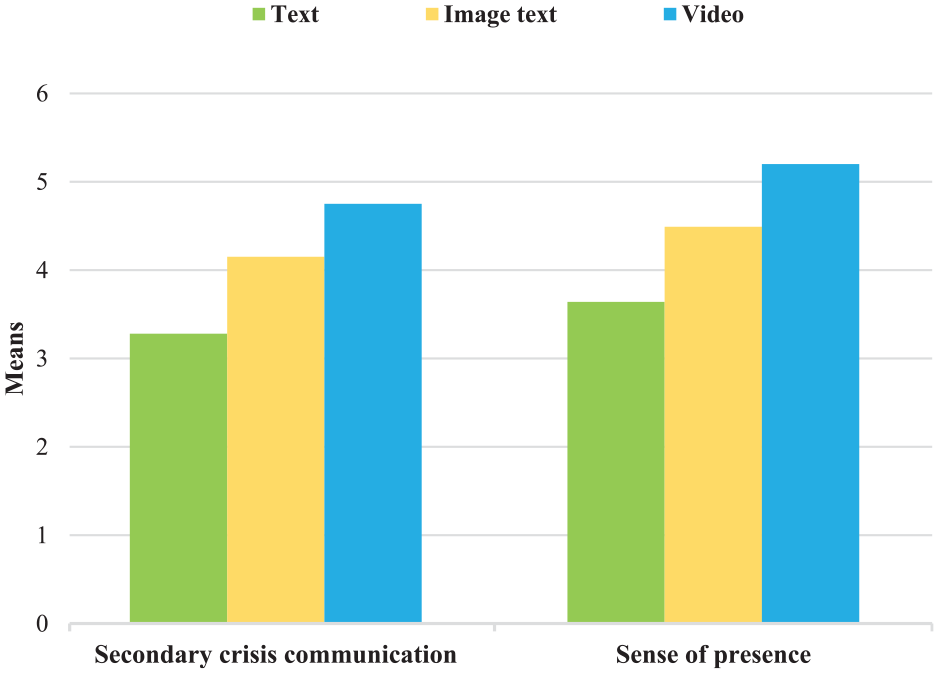
The impact of information forms of UDIs on SCC and sense of presence.
Discussion
Study 1 investigates the heterogeneous influence of information forms of UDIs on users’ SCC and sense of presence. The results show that the UDI in video form will arise a higher sense of presence and SCC than that in text and image-text forms, thus verifying H1 and H2. Moreover, Study 2 was conducted to explore the mediating mechanism of information forms of UDIs on users’ SCC. Importantly, the stimulus materials were changed to enhance the external validity of the findings.
Study 2
To further investigate the underlying mechanism associated with Study 1, Study 2 examined the mediating role of presence, risk perception, and anger. Additionally, H1 and H2 were re-examined using different stimulus materials.
Stimuli Materials
The hashtag “Chinese tourist beaten at Thai airport” generated 16.06 million views on Sina Weibo, which generated a negative impact on Thailand’s tourism industry. This unethical destination incident was thus selected as the stimulus material. First, to avoid the confounding of destination familiarity, a virtual destination A was employed based on Thailand’s real crisis background. Referring to previous designs of stimulus materials for destination crisis events (Su et al., 2023), we designed the experimental scenarios for three groups. Condition A selected the short video about the “Chinese tourist beaten at Thai Airport” released by internet users. Condition B contained 4 photos taken from the short video and the text description of the incident. The text was adapted from the user description of the incident on Sina Weibo, including 109 words. Condition C was the text description of the incident. Each exposure lasted 27 s. Moreover, 2 experts and 11 graduate students in tourism management ensured the content validity of the stimulus materials through an in-depth discussion (Appendix B).
Pilot Study
A pilot study was carried out to verify the manipulation effectiveness of information forms of UDIs. From May 3 to May 6, 2022, a nationwide online survey was conducted via Wenjuanxing, and 117 valid samples were obtained (52.99% female). The procedure was the same as in Study 1. One-way ANOVA showed significant differences in presence (α = .884), and UDIs in video form elicited higher presence than UDIs in image-text and text forms (Mvideo = 5.48, Mimage-text = 4.72, Mtext = 3.81, p < .001). These findings ensured the manipulation effectiveness of the information forms of UDIs.
Participants and Procedure
Participants were approached via Wenjuanxing from May 7 to May 18, 2022. Participants with experience in using social media were selected and randomly assigned to one of three groups. One hundred and eighty-four valid samples (48.37% female) were recovered by excluding 14 samples that viewed the incident prototype, visited the destinations covered in the materials, and had insufficient answer time (Table 1). Study 2 added the measurement of risk perception and anger, and the rest of the procedures were the same as those in Study 1. Anger was evaluated via three items from Breitsohl and Garrod (2016); for example, “I feel angry about this crisis event” (α = .933). The measurement of risk perception (α = .935) was adopted from Wang et al.’s (2020) four items, such as I feel that my safety cannot be guaranteed when traveling to Destination A. All questions were rated on a 7-point Likert scale (1 = strongly disagree, 7 = strongly agree).
Results
One-way ANOVA showed significant differences in presence and SCC. The level of presence caused by UDIs in video form was significantly higher than those in image-text and text forms (Mvideo = 5.28, Mimage-text = 4.84, p < .01; Mvideo = 5.28, Mtext = 4.07, p < .001). Simultaneously, UDIs in image-text form prompted a stronger sense of presence than those in text form (Mimage-text = 4.84, Mtext = 4.07, p < .01). In addition, the SCC when browsing UDIs in video form was stronger than when browsing UDIs in image-text and text forms (Mvideo = 4.17, Mimage-text = 3.56, p < .05; Mvideo = 4.17, Mtext = 2.80, p < .001). Moreover, UDIs in image-text form produced higher SCC than those in text form (Mimage-text = 3.56, Mtext = 2.80, p < .01). The robustness of H1-H2 was tested.
Bootstrapping (Hayes, 2013) was utilized to examine the mediating role of presence (PROCESS, Model 4,5,000 samples). The demographic information, past crisis experiences, and the number of sightseeing travel trips per year were used as control variables. The analysis revealed that presence has a significant indirect effect between the information forms of UDIs and risk perception (Dtext vs. image-text: LLCI = 0.11, ULCI = 0.64, not including 0; Dtext vs. video: LLCI = 0.22, ULCI = 0.88, not including 0). Therefore, H3 was confirmed. Similarly, presence had a significant indirect effect between the information forms of UDIs and anger (Dtext vs. image-text: LLCI = 0.13, ULCI = 0.61, not including 0; Dimage-text vs. video: LLCI = 0.25, ULCI = 0.84, not including 0). Thus, Hypothesis 4 was confirmed. Moreover, risk perception played a mediating role between the presence and SCC (LLCI = 0.10, ULCI = 0.35, not including 0). Anger played a mediating role between the presence and SCC (LLCI = 0.10, ULCI = 0.34, not including 0). Thus, H5 and H6 were supported.
Discussion
Study 2 investigated the indirect mechanism between the information forms of UDIs and SCC. The findings reveal that the presence, risk perception, and anger play a conductive role between the information forms of UDIs and the SCC. Therefore, H3-H6 were supported. However, the pictures and video contained portraits and voices, and participants were able to determine the nationality of the victim, which could potentially interfere with the results (Laufer & Coombs, 2006). In addition, both Study 1 and Study 2 selected incidents in which destination product (service) suppliers carried out assaults on tourists. However, can the same conclusions be drawn for other types of UDIs? To exclude the interference of the victim’s nationality and enhance the external validity, we conducted Study 3 using a compulsory shopping incident by a tour guide and set the victim’s nationality to Chinese.
Study 3
Study 3 was developed for two reasons: (1) The victim’s nationality in three groups was set as Chinese nationality to eliminate interference. (2) To further improve the external validity of the experiment, the stimulus materials were replaced with the tour guide’s compulsive shopping, a type of UDI.
Stimuli Materials
The topic of “tour guide forcing tourists to spend 20,000 yuan in one-hour shopping” has generated much buzz on social media. This incident harmed the reputation of Guilin in China. Study 3 thus virtualized the destination name and adapted the background of this real-life event to the stimulus material. The stimulus video material was synthesized by the author based on two real crisis events. Participants in the video form group were shown a short video of this incident for a total of 30 s. Respondents in the image-text form group were presented with three pictures taken from the video and a text description of the incident, which took 30 s to view. We provided participants with the text description of the incident in text form group and limited the browsing time to 30 s, thus preventing interference from browsing time on experimental results. Moreover, to improve the validity of the experimental stimulus materials, 2 experts in tourism and 11 graduate students in tourism management conducted an in-depth discussion. Appendix C showed the stimulus material.
Pilot Study
A pilot study was performed to guarantee the manipulation effectiveness of the information forms of UDIs. We employed a national study via a leading questionnaire platform (https://www.credamo.com/). One additional procedure was added to Study 1, in which participants were asked to make a judgment about the victim’s nationality, and a total of 90 valid questionnaires (50% female) were returned. One-way ANOVA indicated significant differences in users’ presence evaluations (α = .921). Specifically, the incident in video form elicited a greater sense of presence than that in image-text and text forms (Mvideo = 5.83, Mimage-text = 4.98, Mtext = 4.23, p < .001). All participants believed that the victim was of Chinese nationality. Thus, the results guaranteed the manipulation validity of the information forms of UDIs.
Participants and Procedure
We recruited 195 Chinese participants through Credamo based on a suggested power analysis similar to that of Study 1 (Faul et al., 2007; Leenaars et al., 2016). In Study 3, the participants’ determination of the victim’s nationality was added, and the rest of the procedure remained the same as in Study 2. We retained 183 valid samples (59.02% female) after excluding 12 participants who had viewed the archetype of the UDI and had visited the destinations presented in the materials. All participants believed the victim’s nationality was the same as their own (Chinese nationality). Furthermore, we measured sense of presence (α = .885), risk perception (α = .824), anger (α = .848), and SCC (α = .826).
Results
One-way ANOVA revealed significant differences in the way the information forms of UDIs affected users’ SCC (p < .001). Post hoc multiple comparison analysis identified that participants in the video group reported higher presence scores than those in the image-text and text groups (Mvideo = 5.90, Mimage-text = 5.40, p < .01; Mvideo = 5.90, Mtext = 4.53, p < .001). Similarly, participants in the video group produced more intense SCC than those in the image-text and text groups (Mvideo = 5.54, Mimage-text = 4.88, p < .001; Mvideo = 5.54, Mtext = 4.10, p < .001). Furthermore, participants in the image-text group reported higher SCC scores than those in the text group (Mimage-text = 4.88, Mtext = 4.10, p < .01). Thus, H1 and H2 were reaffirmed after excluding the victim’s nationality as a confounding factor.
Bootstrapping was utilized to test the mediating role of presence (Hayes, 2013). Participants’ demographic information, crisis experience, and the number of sightseeing travels per year were used as control variables. Results showed that presence mediates the relationship between the information forms of UDIs and risk perception (Dtext vs. image-text: LLCI = 0.21, ULCI = 0.63, excluding 0; Dtext vs. video: LLCI = 0.50, ULCI = 1.04, excluding 0). Similarly, the sense of presence plays a mediating role between the information forms of UDIs and anger (Dtext vs. image-text: LLCI = 0.11, ULCI = 0.39, excluding 0; Dtext vs. video: LLCI = 0.23, ULCI = 0.67, excluding 0). Therefore, H3 and H4 were supported.
In a similar vein, a bootstrap method (Hayes, 2013) was used to test the mediating role of risk perception and anger in the effect of presence on SCC (5,000 resamplings, Model 4 in Process). The results demonstrated that risk perception played a mediating role between the sense of presence and SCC (LLCI = 0.13, ULCI = 0.44, excluding 0). Moreover, anger served as a mediator between the sense of presence and SCC (LLCI = 0.08, ULCI = 0.34, excluding 0). H5 and H6 were supported again.
Conclusion and Implications
Conclusion
Building on the perspective of presence, this study conducted three scenario-based experiments to examine the negative mechanism of UDIs’ information forms on users’ SCC. Three key findings emerged from the research.
First, vivid and visible information about UDIs has a greater impact on users’ sense of presence and SCC. UDIs in video form show a significantly greater positive impact on the sense of presence and SCC than those in image-text and text forms. This finding is consistent with the mental imagery theory, which believes that users can rely on sensory responses to establish their cognition of information (McLean & Barhorst, 2022). When the information is more vivid, it is easier to induce users’ mental imagery and promotes an understanding of the media environment, thereby enhancing the response to unethical incident information (Alyahya & McLean, 2022). Compared with text and image-text forms, the UDIs in video form integrate some sensory elements (i.e., visual, auditory), and are more vivid and interactive. They arouse individual mental imagery and stimulate their imaginations. It helps to form users’ on-site experience of crisis events, enhances the efficiency of receiving crisis information, and then spurs SCC. Additionally, previous findings have revealed that the tourism experience sharing in video form has a greater impact on potential tourists’ sense of presence than that in image and text forms (Yao & Jia, 2021). Our findings support their experimental results in the context of a destination crisis.
Second, risk perception and anger are important guiding factors in the impact of a sense of presence on users’ SCC in the communication of UDIs. Different stimulus materials were used in studies 1 to 3 to confirm that, compared with UDIs in text and image-text forms, video-form UDIs can arouse users’ higher sense of presence and offer users an immersive experience. In other words, UDIs in video form increase users’ perceived severity and trigger users’ higher risk perception and anger, ultimately resulting in SCC. Prior research has identified the influence of a sense of presence on individual fear in the situation of health information dissemination (J. Lee et al., 2019; Nah & Oh, 2023). Importantly, our findings support the negative impact of a sense of presence on user behavior intention and clarify the role of risk perception and anger within a tourism crisis context. In total, this finding forms a theoretical echo and supplements previous findings.
Third, the diffusion of UDIs has three stages “reception-transformation-transmission,” a path that is primarily affected by the interactivity of social media. UDIs in various forms are transmitted via social media platforms. Therefore, the reception of UDI in different forms is a significant external factor for social media users to generate SCC. After receiving the information, receivers will form the cognition and evaluation of the UDI, including the tourist destination image, the event severity, and the responsibility of the crisis. Since tourist destinations are primarily responsible for the occurrence of unethical incidents (Coombs, 2007; Zhai et al., 2020), they can easily lead to the negative transformation of tourists’ emotions toward the tourist destination, resulting in different degrees of risk perception and anger. The internal negative transformation of social media users is therefore the key to the generation of SCC.
Theoretical Contributions
First, this study adopted a presence perspective to unpack the puzzling relationship between UDIs’ information forms and SCC. It expands the theoretical system and content framework of destination crisis research. Previous studies have focused on the negative impact of different types of crisis events (Avraham, 2021; Liu et al., 2021; Oliveira & Huertas, 2019; Su et al., 2023; Zhai et al., 2020; J. Zhang et al., 2023). However, there is a gap in an in-depth discussion and empirical testing of the effects of different crisis information forms and their heterogeneous effects. By introducing the concept of presence in the field of communication and exploring the impact of different forms of UDIs on users’ SCC, our research clarifies the communication mechanism of different forms of destination crisis information. Additionally, existing studies primarily use images and text as experimental stimulus materials when discussing destination crisis events (Su et al., 2023). However, in the digital era, video-form crisis information is becoming increasingly widespread and has a more complex impact on users’ behavior. To account for this, the forms of destination crisis information were divided into three categories of text, image text, and video. This helps to deepen understanding of different forms of destination crisis information.
Second, our work extends the presence literature to a new realm by revealing the driving mechanism of presence on risk perception and anger in destination crisis situations. Studies have explored the relationship between presence and positive attitude in the tourism marketing context. For example, scholars have verified the evocative effect of the presence on positive attitudes, such as flow experience, positive emotions, and the enjoyment of the VR experience (Tussyadiah et al., 2018; Yao & Jia, 2021; Yung et al., 2021). However, little evidence was provided to support the prediction of the presence on users’ negative attitudes. This study examined the negative effects of presence in a crisis context and proved that presence can arouse users’ risk perception and anger. Therefore, our research provides empirical support for understanding the negative effects of presence.
Third, our work contributes to expanding the application field of the Defleur model of communication by highlighting the key role of presence, risk perception, and anger in communicating crisis information. Scholars have introduced the Defleur model of communication as a basis to analyze various elements of the communication process, such as source, channel, transmitter, receiver, and noise (J. Zhang et al., 2023). However, less attention has been given to individual perceptions and the role that emotions play in the interplay of communication elements. Furthermore, studies have suggested that crisis information can have an impact on potential tourists’ risk perceptions (Chua et al., 2021; Leder et al., 2019; Liu-Lastres et al., 2019) or anger (Jiang et al., 2020). Regretfully, the transition of these factors between the initial and secondary crisis communication processes has not been fully discussed (Leung et al., 2023; S. N. Zhang et al., 2021). We examined the role of individual cognitive and emotional responses such as presence, risk perception, and anger in different forms of crisis information from reception to transmission. Our work complements the process mechanism between the reception and transmission of different forms of destination crisis information and further expands the theoretical framework of the Defleur model of communication.
Managerial Implications
First, DMOs should be aware that unethical behavior by tourism service providers can lead to tourism network public opinion in the social media era. To standardize the destination tourism market and create a healthy and orderly reception atmosphere, DMOs need to actively take on the role of supervisors and strengthen their guidance, training, and supervision of tour operators (Su et al., 2023). Simultaneously, internet thinking should be built. Managers need to configure professional network information management personnel and strengthen the training of relevant personnel, including big data processing, artificial intelligence, network public opinion detection, and analysis technology. They need to integrate emerging technologies into tourism crisis prevention and management.
Second, DMOs should implement classification management of different forms of UDIs and strengthen crisis warning and intervention mechanisms. They should work with social media platforms to establish real-time monitoring and dynamic warning mechanisms. In particular, DMOs need to strengthen the dynamic monitoring of UDIs in video and image-text form. For instance, it is a good way to obtain relevant data on unethical incidents using big data technology and then predict and diagnose users’ SCC. This will help to develop corresponding reverse interventions and improve the efficiency of online public opinion governance. DMOs should also establish communication channels and platforms with the public. For example, the role of the official and mainstream media as the center of information distribution can be considered and users can be encouraged to provide constructive feedback, suggestions, and criticism on the official tourism platform (Zhai et al., 2020). In this way, the SCC of tourists is limited within a controllable range, and managers can use targeted guidance and persuasion strategies to turn crises into opportunities.
Third, given that risk perception and anger are the catalysts of users’ SCC, DMOs should pay attention to users’ negative attitudes and try to alleviate them. For example, DMOs should be people-oriented, express empathy for victims, and offer condolences, comfort, and compensation to avoid victims’ emotional intensification. For the Internet public, DMOs should strengthen crisis communication, demonstrate the progress of incident handling, fully explain the incident, and ensure the pertinence and effectiveness of the crisis response (Zhao et al., 2016), thereby reducing public risk perception. Additionally, when the responsibility for the incident is attributed to the destination, managers should apologize actively and take responsibility. This approach could alleviate public anger toward destinations (Coombs, 2007; Zhao et al., 2016) and avoid the extreme behavior caused by the intensification of users’ emotions.
Limitations and Future Research
First, Su et al. (2023) believe that different types of crisis events have different levels of negative impact on destinations. Compared with moral crisis events, competence crisis events have a relatively less negative impact. This study only discusses moral crisis events. Future research can compare the different mechanisms of users’ SCC in the context of competence and moral negative events. Second, this study focused on anger because anger is the dominant emotion following a UDI. However, users’ emotional reactions to destination crisis events are complex and may include disgust, sympathy, sadness, gloating, etc. (Breitsohl & Garrod, 2016; Liu et al., 2021; Su et al., 2023). It is thus a direction for future research to enrich and expand the influence of users’ sentiments on their behavior in destination crisis situations. Third, although we tried to achieve a diverse sample through national online research, the focus is still limited to within-group research. Therefore, future studies may consider an outside group as a sample to confirm whether users’ nationality has a boundary effect on the information forms of UDIs (Laufer & Coombs, 2006). Fourth, our work only focuses on the impact of the information forms of UDIs on the online behavior of users’ SCC. Future research can examine the impact of the information forms of UDIs on travel intention, travel boycotts, and other tourists’ behavioral intentions (Luo & Zhai, 2017).
Footnotes
Appendix A. Experimental Materials of Study 1
Appendix B. Experimental Materials of Study 2
Appendix C. Experimental Materials of Study 3
Acknowledgements
None.
Declaration of Conflicting Interests
The author(s) declared no potential conflicts of interest with respect to the research, authorship, and/or publication of this article.
Funding
The author(s) disclosed receipt of the following financial support for the research, authorship, and/or publication of this article: This study was supported by the National Natural Science Foundation of China (Grant No.: 42201237), and the Project of Philosophy and Social Science Research Funded by Ministry of Education of China (Grant No.: 22JHQ067).
