



Abstract
With the progress of tourism commercialization, historical towns are becoming more accessible and vulnerable than ever before. Drawing on psychological essentialism theory, in this research, a theoretical framework for understanding the consequences of commercialization is developed and tested. Through one field survey and three experimental studies, we reveal that commercialization has a negative effect on tourist preference (attitude and visit intention) for historical towns and that this negative effect is mediated by perceived essence loss. Furthermore, our moderating analysis reveals that the detrimental effect of commercialization can vary by development mechanism (e.g., exogenous mode or endogenous mode) and individual characteristics (e.g., nostalgia-proneness).
Introduction
Historical towns promote a sense of national pride and shape the cultural memories that connect our present with the past and the future (Rahman, 2013). Due to their limited financial resources, cultural tourism is viewed as a significant economic industry for historical towns. Today, many historical towns are competing with each other to attract tourism with an increased level of commercialization, which involves mass-clustered tourism products based on commodification (Sun et al., 2019). While commercialization may increase tourism product appeal, excessive commercialization can bring unintended and market-driven changes such as a loss of tradition, changes in building functions, the disappearance of community, and a homogenization of culture (Bao & Lin, 2014; Cloke & Perkins, 2002).
To date, limited empirical research has examined tourist response to commercialization, and existing studies have reported mixed results. For example, scholars have revealed that tourism commercialization influences tourist perception of authenticity in different ways and thus leads to negative or no significant effects (Ye et al., 2018). Sun et al. (2019) showed that tourism commercialization has a positive influence on tourist experience quality through increased value perception. Additionally, Zhang et al. (2021) reported that tourism commercialization positively affects perceived authenticity and tourist satisfaction. Hence, there is a need to examine both the outcomes of and process by which commercialization may alter tourist behavior. We believe that these mixed results might result from the application of a general view of commercialization to distinct tourism contexts. In the present research, we thus focus on historical towns and examine how, why and when commercialization influences tourists’ preference for them.
While past studies have mainly drawn on the perspective of authenticity, little research has examined whether the basic human motive to essentialize can change tourists’ judgments and subsequent behavior. Therefore, we test the impact of commercialization on historical towns by applying the theory of psychological essentialism and contagion. According to psychological essentialism, essence comprises the unobservable and fundamental traits of an entity that compose its identity (Murphy & Medin, 1985). People have the innate tendency to look for an inner essence that makes members of a group belong (S. Gelman, 2004). Changing the most essential characteristics of an entity thus leads to a complete recategorization of it and evokes the feeling of uncertainty (Rekom et al., 2006). A tourism destination can be viewed as a geographical location that is judged by its visitors to be a unique entity (Buhalis, 2000). As typical heritage tourism destinations, historical towns encompass many characteristics, ranging from their physical attributes and social environment to the quality of the tourist experience when visiting them (Rahman, 2013). This implies that the essence of historical towns is subjective and may not be observed directly (Howard, 2003). As consumption increasingly shifts from utilitarian to experiential, what tourists primarily seek and consume at destinations is their meaning (Hung et al., 2017). Tourists look for cues that assist them in discerning the underlying “essence” of a place in an attempt to derive meaning. Factors such as the maintenance of origin, brand continuity, social system and lifestyle, core functions, appearance and communications are therefore deemed to reflect the core or essence of a destination (Swanson & Timothy, 2012).
Although concerns about essence loss have been raised in prior research, little is known concerning whether essence loss is the critical determinant of the effect of commercialization on consumer response. Psychological research on the contagion effect, which refers to the belief in passing essences through physical or virtual contact between objects, serves as a theoretical underpinning for our argument that commercialization may reduce perceived essence (Rozin & Nemeroff, 1990). In particular, when cultural heritage is used for commercial purposes, it may be deemed contaminated by commercial culture and susceptible to commercial expectations, potentially diminishing the essence of historical towns (Hung et al., 2017). The perception of essence loss concerning tourism destinations has particular significance for destination management because it can be situationally activated and result in judgment about a destination (M. J. Williams & Eberhardt, 2008). Thus, the perception of essence can help managers evaluate what they can and cannot do in the process of commercialization and maintain a unique identity in a changing market. In addition, the boundary conditions of the commercialization–tourist response relationship remain underexplored. Hence, to address these gaps, this study aims to explore the influence of commercialization on tourist behavior by arguing that the extent to which a destination is commercialized may reduce perceived essence, triggering negative tourist preference toward a historical town.
We further examine when (for what types of commercialization) the detrimental effect of commercialization is attenuated and who (for what types of tourists) is more influenced by commercialization. Specifically, tourism commercialization development modes can be categorized as either exogenous or endogenous (Chirwa & Odhiambo, 2018). Exogenous development is more externally determined and is transplanted into particular locales, while endogenous development is more locally determined and respects local values. Since the endogenous mode may lead to lower contagion perception than the exogenous mode, we assume that the former results in less essence loss and that the negative commercialization effect is thereby attenuated. Another moderator we examine in this study is nostalgia-proneness, the “inherent tendency to experience nostalgic feelings” (Reisenwitz et al., 2004, p. 58). Nostalgia elicits cherished past experiences that assure consumers that they are valuable people who have meaningful lives. Products linked to the past (heritage tourism) may be more effective in providing meaningfulness to consumers, but commercialization may diminish heritage tourism’s function as a meaning producer. Thus, the negative effect of commercialization may be stronger among people with a strong tendency to experience nostalgia because they prefer products related to the past.
Furthermore, the present study applies experimental designs. Existing research on the effects of tourism commercialization has mainly employed qualitative methods (e.g., X. Chen & Chen, 2020; Hung et al., 2017; Phua & Shircliff, 2020). Although these approaches have yielded significant insights, few studies have experimentally manipulated the factors relevant to commercialization judgment or provided evidence for causal inference. We therefore address this issue by manipulating the level and mode of commercialization, testing the consequences and the underlying mechanism of commercialization’s impacts to confirm the robustness of our proposed effects.
Overall, this research thus contributes to theory by developing a better understanding of tourism commercialization’s critical impacts and their underlying mechanisms. Specifically, these mechanisms are derived from the literature on tourism commercialization, psychological essentialism, and nostalgia. Tourism practitioners and policy-makers may therefore use the insights of this research to effectively manage historical towns and enhance their preference among prospective tourists.
Literature Review
Tourism Commercialization and Tourist Response
Tourism commercialization is defined as “a phenomenon of mass-clustered tourism products that is based on commodification, existing in the scenic areas of ethnic villages or heritage towns” (Sun et al., 2019; p. 123). Commercialization remains a highly contested issue that concerns many adverse and beneficial aspects of a destination (Hung et al., 2017). Although previous analyses have examined the salient drivers, spatial patterns, development models, and types of authenticity concerning commercialization (Coghlan & Noakes, 2012; Cohen, 1988; Jiang & Su, 2016; D. R. Williams, 2002; Ye et al., 2018), limited quantitative studies have focused on tourist perception of and response to commercialization, that is, tourist attitude, experience, satisfaction, or perceived value.
Based on a 10-year study in Eastern Indonesia, Cole (2007), for example, revealed very different attitudes of commercialization among tourists and villagers. While the villagers believed that tourism brought a sense of pride and empowerment, the tourists considered this commercialization has spoiled the village. Phua and Shircliff (2020), in the context of Chinatown tourism, observed that both tourists and locals viewed commercialization negatively for different reasons. Tourists paid close attention to the homogenization of Chinatowns, whereas locals were concerned with the loss of heritage. Similarly, based on text mining, Fan (2017) revealed that over 12% of tourists can sense the commercialization of ancient Chinese towns, which subsequently evokes negative emotions. Huang and Pearce (2019) suggested that religious tourists’ positive attitudes toward Buddhist mountains in China are harmed by commercial activities and secular matters. Giddy (2020) reported a negative link between commercialization level and adventure tourists’ ability to achieve a “flow” experience. However, some scholars have noted that commercialization does not necessarily reduce tourists’ experiences or perceived authenticity (X. Chen & Chen, 2020; Swanson & Timothy, 2012; Ye et al., 2018).
Overall, most studies have found that tourists’ reactions to commercialization are negative. The explanations for this effect focus on the perception of heritage loss, which can be due to homogenization, lack of authenticity, or interruption of flow experience. In this research, we focus on tourist preference (attitude and visit intention) as the outcomes due to their known importance for tourism destinations as key drivers of tourist satisfaction and loyalty, according to the literature (Abubakar & Ilkan, 2016; Lee, 2009; Litvin et al., 2008). We thus propose that tourists’ perception of commercialization exerts a negative impact on their preference for a historical town destination.
H1: Commercialization level negatively influences tourist preference for historical towns.
The Mediating Role of Perceived Essence
From the perspective of essentialism, we argue that the commercialization of historical towns reduces perceived essence. The concept of essentialism has been discussed for thousands of years in numerous fields including biology, chemistry, philosophy, linguistics, and psychology (Cartwright, 1968). Essentialism is the belief that objects have a set of properties that cannot be observed directly but are necessary to their identity (D. Medin & Ortony, 1989).
There are several key features of psychological essentialism. The first facet is that psychological essentialism is representational rather than metaphysical (S. Gelman, 2004). In other words, it is a claim about a way of characterizing entities in cognition, not an actual claim about the world (D. L. Medin, 1989). The second facet is causal force. An underlying essence causes other attributes of the entity to develop and be sustained (Kanovsky, 2007). However, it is not applicable in reverse; the observable features of an entity do not define its underlying essence (Birnbaum et al., 2010). The third feature is that causal essence is a placeholder concept. A person can believe that a category possesses a causal essence without knowing specifically what it is (D. Medin & Ortony, 1989). Based on this definition of psychological essentialism, we argue that tourists should have an implicit and intuitive understanding of the core, unchangeable elements that constitute a tourism destination, especially a historical town, as well as of those elements that are relatively malleable.
In the field of marketing, research has been carried out that views products as possessing an inherent defining essence (Mishra, 2009). Although the literature lacks consistency regarding the important dimensions of product essence, several broad categories have captured research attention thus far, that is, brand origin, production method, product-use pattern, creator characteristics, firm size, authenticity, and moral traits. For example, Martin et al. (2019) revealed that a brand’s origin cultivates the essence of a heritage brand. Gunasti et al. (2018) reported that a product located in the center (vs. edge) of an array of similar products is perceived to have more product essence. De Freitas et al. (2017) argued that people are inclined to view the properties of an entity that they regard as normatively good as the most essential. Prior tourism research has thus connected commercialization with diminished authenticity, displacement of residents, variance of the original intent of the creator, loss of heritage, and the practices of scale and standardization, which are important facets of product essence (Phua & Shircliff, 2020; Ye et al., 2018). Therefore, commercialization may elicit perceptions of essence loss—reducing perceived essence.
In addition, from the contagion perspective, the literature has provided additional evidence supporting our argument that commercialization may reduce perceived essence. The contagion effect originates in anthropology research. Its theoretical basis is the law of sympathetic magic, which holds that when two objects come into contact with each other, there is a potentially permanent exchange of some properties between them (Mauss, 2001). For example, Frazer (1959) discussed the belief among the people of New Guinea that everything a person comes into contact preserve his or her soul. More recently, psychology and marketing scholars defined contagion based on the view that objects can obtain the essence of a particular source through physical or virtual contact (Belk, 1988; Newman & Dhar, 2014; Rozin & Nemeroff, 1990; Rozin et al., 1986; R. K. Smith et al., 2016). Previous research on contagion has demonstrated that the belief in passing essences is pervasive across cultures and can have significant effects on consumer behavior such as artwork valuation, celebrity effect, fashion rental, and land attachment (Newman & Bloom, 2014; Rozin & Wolf, 2008; Wohl & Enzle, 2002). For example, human intervention is viewed as a contaminating source of natural products that deprives them of their essence (Rozin et al., 2004). Similarly, Vijayakumar et al. (2019) found that solitary (vs. sociable) artists are believed to retain greater essence in their creations because social contacts increase susceptibility to social expectations and obligations. Furthermore, R. K. Smith et al. (2016) explored the effect of temporal contagion and showed that their respondents prefer products with lower (vs. higher) serial numbers, which they perceive to be “closer to the origin,” that is, preserving more of its essence. Therefore, when cultural heritage is proposed to be used for commercial purposes, it may be viewed as contaminated by commercial culture and susceptible to commercial expectations (Hung et al., 2017), thereby diminishing the essence of historical towns.
The extant research has explored the consequences of perceived essence. Several studies have established that objects with a high essence are perceived to be more valuable and meaningful (Newman & Dhar, 2014; Newman et al., 2011; Vijayakumar et al., 2019). Accordingly, essence loss can devalue and decrease demand for a product. For instance, Kramer et al. (2021) revealed that perceived essence loss can diminish the efficacy of products and their purchase and recommendation likelihood. R. Smith et al. (2019) pointed out that enhancements of heritage-branded products may result in essence loss, leading to decreased purchase intention. This implies that when a product’s history is critical to its essence, its consumers have less desire for change. Although previous studies have identified the consequences of essence loss, they have typically examined the issue with regards to everyday consumer products. Thus, the current study is also novel; it explores essence loss’s influence on tourist preference regarding experiential consumption.
In sum, empirical studies have suggested that as commercialization increases, tourists visiting historical towns may perceive less retained essence, implying their decreased preference. Therefore, the following hypothesis is derived:
H2: Perceived essence mediates the effect of commercialization on tourist preference for historical towns.
The Moderating Role of Commercialization Mode
Since the process of contagion revolves around the transmission of essence via contact with an external contagion source, commercialization mode may serve as a potential moderator in this study. Tourism commercialization development can be distinguished by two types of mechanisms, termed exogenous and endogenous (Chirwa & Odhiambo, 2018). The exogenous mode emphasizes introducing external forces to stimulate local tourism development. However, the exogenous mode has been criticized for limiting the autonomy of a local community, ignoring local participation, and deepening the dependency on external forces (Li et al., 2022). In contrast to the exogenous mode, the endogenous mode emphasizes self-directed development; it highlights local involvement and initiative, giving more attention to the role of the local community (Ray, 1999; Zhou et al., 2009). Thus, compared to the exogenous mode, the endogenous mode might slow down the perceived essence loss of a historical town and the negative impact of commercialization on the preference for a historical town, which is attenuated when commercialization is in the exogenous mode.
H3: The negative effect of commercialization on tourist preference is attenuated for historical towns developed through the endogenous mode.
H4: The negative effect of commercialization on perceived essence is attenuated for historical towns developed through the endogenous mode.
The Moderating Role of Nostalgia-Proneness
Nostalgia is defined as an “individual’s desire for the past or liking for possessions and activities of days gone by” (Holbrook, 1993, p. 245). It is viewed as a complex emotion, sense or mood that is evoked by things related to the past (Holak & Havlena, 1998). Even though the term dates to the seventeenth century, the introduction of nostalgia in marketing was much more recent (Lefi & Gharbi, 2011). An individual may have a nostalgic feeling for one’s own past (personal nostalgia) or for an era that one has not lived in (historical nostalgia).
In recent years, tourism researchers have thus identified historical nostalgia as an important motivation for heritage tourism (Caton & Santos, 2007; Chi & Chi, 2022; Christou, 2020). During their visits, their experience of nostalgia, evoked by heritage objects such as historical buildings, indigenous cultures, or traditional festivals and events allows tourists to fantasize about living in the past, escape from their present temporarily, and trace their ancestral roots (Chark, 2021; Gao et al., 2020). For example, nostalgic meaning has been highlighted by travelers along America’s Route 66 National Historical Corridor as satisfying their spiritual needs (Caton & Santos, 2007). Sport heritage, including halls of fame, sport museums, and special sporting sites, are documented to provide nostalgic indulgence (Ramshaw & Gammon, 2005). The quest for nostalgia in traditional life is also viewed as underlying rural tourism in Japan, where the countryside provides a window into the preindustrial and nonurban past (Creighton, 1997). Unsurprisingly, nostalgia has become an interest in tourism marketing research.
Nostalgia-proneness refers to people’s “inherent tendency to experience nostalgic feelings” (Reisenwitz et al., 2004, p. 58). Some individuals are more inclined to nostalgia than others, and past studies have suggested that differences in nostalgia-proneness will affect consumer preference for products and perception of quality (Merchant & Rose, 2013). For example, researchers have suggested that individuals respond differently to changed brands according to their nostalgia-proneness (Shields & Johnson, 2016). Individuals with higher nostalgia-proneness process stimuli with more complex and affect-based schema, which leads an individual to perceive a greater change to a brand. In the context of pandemic influences, Chark (2021) found that nostalgia-proneness interacts with the need-to-belong, influencing heritage tourism preference. Accordingly, heritage tourism, as a type of tourism product connected to the past, has the potential to provide nostalgic meaning to tourists, but commercialization may diminish heritage tourism’s function as a meaning producer. Moreover, this effect may be stronger for tourists with a higher propensity to experience nostalgia, as they have a more stable preference for tourism products that are associated with the past.
Furthermore, research on the contagion mechanism has suggested that individual differences in the sensitivity to contagion moderate the contagion effect (Meng et al., 2022). For instance, Newman et al. (2011) observed that high-sensitivity individuals show greater effects of contagion, that is, a celebrity who contacts an object influences consumers’ willingness to purchase this celebrity item because of the transfer of his or her “essence.” Previous research has also indicated that nostalgia-prone individuals have a stronger desire to maintain the integrity and continuity of a product (Wiedmann et al., 2011). Hence, they tend to be more sensitive to change and loss concerning a product. Nostalgia-proneness may therefore serve as an indicator of contagion sensitivity for commercialization in heritage towns. Taken together, this work suggests that the contagion effect of commercialization is more salient for more nostalgia-prone individuals than less nostalgia-prone individuals. Specifically, we hypothesize the following:
H5: The negative effect of commercialization on tourist preference for historical towns is stronger for more nostalgia-prone tourists, but it is attenuated for less nostalgia-prone tourists.
H6: The negative effect of commercialization on perceived essence is stronger for more nostalgia-prone tourists, but it is attenuated for less nostalgia-prone tourists.
Based on the literature review, we propose the following research framework (see Figure 1).

Conceptual model.
Methodology
In Study 1, we carried out a field survey to examine the association between commercialization and tourist preference for historical towns. Study 2 investigated the causal impacts of commercialization on tourist preference through a scenario-based experiment and tested whether this effect was mediated by perceived essence. Study 3 replicated the results in Studies 1 and 2 and examined how the effect of commercialization on tourist preference and perceived essence was moderated by commercialization mode. Study 4 further investigated how nostalgia-proneness moderated the effect of commercialization on tourist preference and perceived essence and whether this effect extended to WOM intention.
Study 1
Study 1 aimed to examine the correlation between commercialization and tourist preference. Specifically, we collected data in historical towns to test the impact of tourists’ perceived commercialization on their preference for historical towns.
Method
Participants
A field survey was conducted in two famous historical towns (Wuzhen and Nanxun) in East China. With the development of tourism, these two historical towns have been commercialized to varying degrees. Data were collected through convenience sampling in May 2021. An anonymous self-administered questionnaire was issued to tourists who agreed to participate in the survey. The basic required sample size should be at least 10 times the number of items (N = 12 in this survey) (Hair et al., 2010). To guarantee power, we aimed to collect 240 participants, which was 20 times the number of items. Although we did not expect the effect to be specific to different historical towns, we felt it was best to collect 240 participants at each site.
In total, 477 participants (Medianage = 26–30; 51.8% male; 243 from Wuzhen and 234 from Nanxun) completed the study. The majority of our participants had received an undergraduate or postgraduate degree, accounting for 68.4% of the sample; 24.7% of the participants had received college education, and 6.9% of the participants had received high school education or below. In terms of monthly income, 23.7% of the participants earned less than RMB5000 each month, 32.3% of the participants earned between RMB5000 and RMB10,000, 18.4% of the participants earned between RMB10,000 and RMB15,000, and 25.6% of the participants earned more than RMB15,000 monthly. In addition, the average subjective socioeconomic status (SES) was 5.24 (SD = 1.97, range = 1–10).
Procedures
The questionnaire consisted of three parts (more details are in Supplemental Appendix A). In the first part, participants were asked to indicate their perception of the commercialization degree while visiting the historical town. Based on the literature (Sun & Gao, 2016; Sun et al., 2019), we developed three items to measure tourist perception of commercialization on a 7-point Likert scale (e.g., “The commercial atmosphere is strong in this historical town”; α = .80). In the second part, we measured tourist preference by asking participants to rate their attitude toward the historical town (R. P. Chen et al., 2017) with four items (α = .91) adapted from Spears and Singh (2004). In the last part, participants provided their demographic information, including age, gender, education, and income. In addition to the traditional demographic information mentioned above, we measured participants’ subjective SES. This is because tourism research has shown that heritage or other art and culture destinations are more attractive to higher social classes (Herbert, 2001; H. L. Hughes, 1987; Kim et al., 2007). Subjective SES was measured with the MacArthur Scale of Social Status (Adler et al., 2000).
Results
We averaged the items assessing commercialization and preference to form the corresponding index. The relationship between commercialization (M = 4.33, SD = 1.32) and preference (M = 5.14, SD = 1.23) was explored with a correlation analysis. These results revealed that commercialization was negatively related to tourist preference (r = −.21, p < .001). In addition, we conducted hierarchical regression analysis to confirm the negative impacts of commercialization on tourist preference by constructing two models. Model 1 included the demographic variables as the independent variables and tourist preference as the dependent variable. Model 2 added commercialization as an independent variable. These results (see Table 1) revealed that tourist age, gender, education, income and SES predicted their preference for a historical town (F = 2.57, p = .026) and explained 2.7% of the variance. When controlling for the demographic variables, we found that the explanatory power of Model 2 increased to 6.6% (ΔF = 20.08, p < .001) and that commercialization had a negative impact on tourist preference (b = −0.19, SE = 0.04, t(470) = −4.48, p < .001). Most importantly, this negative effect of commercialization on preference existed for both towns (Wuzhen: b = −0.15, SE = 0.06, t(236) = −2.43, p = .016; Nanxun: b = −0.24, SE = 0.06, t(227) = −3.74, p < .001), indicating that the backlash effect of commercialization was not specific to a particular historical town.
Overview of Linear Regression Analysis on Tourist Preference.
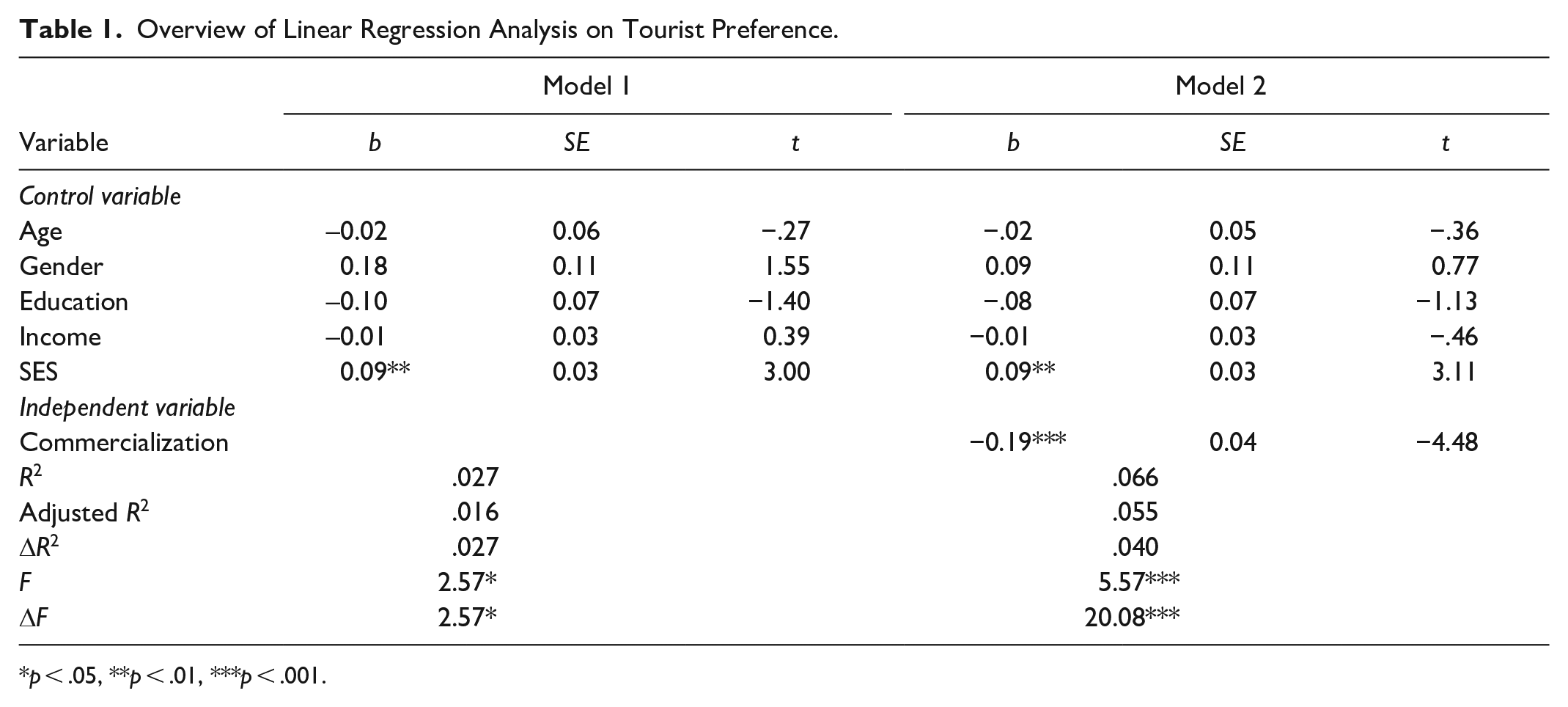
p < .05, **p < .01, ***p < .001.
Furthermore, we examined whether the two historical towns differed in their level of commercialization and tourist preference. An independent t test showed that Wuzhen had a higher level of commercialization (M = 4.58, SD = 1.31) and that tourists had a marginally significant lower preference for Wuzhen (M = 5.03, SD = 1.25) than Nanxun (commercialization: M = 4.08, SD = 1.28; t(475) = 4.19, p < .001; preference: M = 5.24, SD = 1.21; t(475) = 1.85, p = .06). In addition, mediator analysis showed that tourists’ lower preference for Wuzhen (vs. Nanxun) was due to its commercialization (indirect effect: b = 0.09, SE = 0.03, 95% CI = [0.03, 0.16]).
Discussion
Using a field survey, this study provided initial evidence for the backlash effect of commercialization on historical towns. By comparing two historical towns, we further confirmed that tourists’ preference for historical towns could to some extent be attributed to the latter’s different level of commercialization.
Study 2
The aim of Study 2 was threefold. The first objective was to investigate the causal relationship through an experimental method by manipulating commercialization degree. Second, considering that the samples in Study 1 were from an Eastern culture, we recruited tourists from a Western culture in Study 2 to examine the robustness of our results in Study 1. Notably, we did not attempt to examine the cross-cultural effect but intended to show that the backlash effect of commercialization exists regardless of culture difference. Third, Study 2 aimed to explore the mediating role of perceived essence in the negative impact of commercialization on tourist preference for historical towns.
Method
Participants
In Study 2, we conducted a one-factor, two-level (commercialization degree: high vs. low) between-subjects online experiment. In this experiment, based on the results of Study 1, G*power analysis showed that our expected sample size should range from 47 to 122 for each condition (effect size d ranged from 0.32 to 0.52). To guarantee power, we recruited approximately 150 tourists in each condition (Nlow = 147, Nhigh = 154; 179 females; Mage = 41.43, SD = 13.32) from Mechanical Turk Prime.
Procedure
Participants were first told to imagine that they were preparing for a tour in the near future and were provided information on a historical town. In the low-commercialization condition (control condition), participants read the basic introduction about a historical town and were told that the historical town adhered to the protective development principle, having adopted only a few necessary commercial facilities. In the high-commercialization condition, participants read the same introduction but were told that the historical town had been largely commercialized and had introduced many modern facilities and services (more details are in Supplemental Appendix B).
Then, we measured participants’ preference by asking them to indicate their attitude and visit intention toward this historical town (Pang & Ding, 2021). Participant attitude was measured using the same items as Study 1, and participant intention to visit the historical town was measured using two items adapted from Berger and Fitzsimons (2008). Perceived essence was measured with four items, adjusted following the literature (Baloglu & McCleary, 1999; Bilgin & Crolic, 2020; Santana & Sevilha Gosling, 2018) (e.g., “The tourism attraction here shows the essence of this historical town”). Finally, one item was used to examine whether our manipulation of commercialization was successful: “How would you evaluate the degree of commercialization of this historical town?”
Results
Manipulation Check of Commercialization
An independent t test revealed that participants in the high-commercialization condition had a higher evaluation of the commercialization degree of the historical town (M = 5.56, SD = 1.31) than those in the low-commercialization condition (M = 3.35, SD = 1.63; t(299) = 12.99, p < .001), which confirmed that our manipulation of commercialization was successful.
Preference
We averaged the items assessing attitude and visit intention to generate the index of historical town preference (α = .96; M = 5.38, SD = 1.28). An independent t test showed that the participants in the high-commercialization condition had a significantly lower preference (M = 5.17, SD = 1.36) than the participants in the control condition (M = 5.59, SD = 1.16; t(299) = 2.91, p = .004).
Perceived Essence
Four items assessing perceived essence (α = .93; M = 5.18, SD = 1.34) were averaged to generate a composite score of perceived essence. An independent t test revealed that high-commercialization significantly reduced the perceived essence of historical town (Mhigh = 4.67, SD = 1.49; Mlow = 5.71, SD = 0.89; t(299) = 7.25, p < .001) .
Mediation Analysis
To test whether the backlash effect of commercialization is driven by perceived essence, we conducted mediation analysis with PROCESS model 4 with5,000 replications (Hayes, 2017) (see Figure 2). These results showed that high commercialization led to a lower preference for a historical town than low commercialization due to perceived essence (indirect effect: b = −0.71, SE = 0.12; 95% CI = [−0.94, −0.49]). Specifically, compared to participants in the low-commercialization condition, participants in the high-commercialization condition indicated a lower perceived essence (b = −1.03, SE = 0.14, t(299) = −7.25, p < .001; 95% CI = [−1.31, −0.75]). In addition, perceived essence was positively related to preference for historical town (b = 0.69, SE = 0.04, t(298) = 15.58, p < .001; 95% CI = [0.60, 0.77]). Interestingly, when controlling for perceived essence, compared to low commercialization, high commercialization thus led to a higher preference for a historical town (b = 0.28, SE = 0.12, t(299) = 2.41, p = .017, 95% CI = [0.05, 0.52]), providing a potential solution for historical town managers. Specifically, historical towns can attempt to avoid the loss of essence from commercialization; when commercialization does not reduce perceived essence, it has a positive effect on preference.

Mediation analysis on attitude toward historical town.
Discussion
By manipulating commercialization, Study 2 further showed that high commercialization led to a lower preference for historical towns than low commercialization. In addition, we disclosed how this negative effect of commercialization was driven by perceived essence.
Study 3
In Study 3, we intended to examine the moderating effect of commercialization mode to further demonstrate when the negative impact of historical town commercialization would be weakened. Specifically, we posited that when commercialization originates from internal sources (endogenous mode), perceived essence loss is reduced, whereby the negative impact of commercialization on a historical town is attenuated.
Method
Participants
A 2 (commercialization degree: high vs. low) × 2(commercialization mode: exogenous vs. endogenous) between-subjects experiment design was adopted. We used the same method to determine the sample size of this study, and a total of 649 participants recruited from Credamo completed the survey (Nlow × exogenous = 155, Nlow × ndogenous = 160, Nhigh × exogenous = 165, Nhigh × endogenous = 169; Meanage = 29.31, 61.3% females).
Procedure
Participants were randomly assigned to four conditions. The manipulation of commercialization degree was similar to Study 2. Regarding the manipulation of commercialization mode, participants in the exogenous-commercialization (vs. endogenous- commercialization) condition were told that the commercial operations of the historical town were mainly driven and carried out by nonlocal merchants (vs. local residents) (more details are in Supplemental Appendix B). Before the formal study, we pretested the experimental materials. A total of 199 participants (Nlow × exogenous = 50, Nlow × endogenous = 50, Nhigh × exogenous = 50, Nhigh × endogenous = 49; 59.8% females; Mage = 30.56, SD = 7.81) recruited via Credamo completed the pretest. Participants read the same information and were then asked three questions as a manipulation check for commercialization degree and commercialization mode. The results of independent t tests confirmed that our experimental material was effective (more details of the pretest are in Supplemental Appendix C).
After reading the experimental materials, participants were told to indicate their preference for (including their attitude toward the historical town and intention to visit the historical town) and perceived essence of the historical town using the same items as Study 2. Afterward, they answered the same manipulation check questions as in the pretest, followed by demographic questions.
Results
Manipulation Check
An independent t test on commercialization degree perception showed that participants in the high-commercialization condition (M = 5.97, SD = 0.83) perceived the historical town to be more commercialized than those in the low-commercialization condition (M = 3.35, SD = 1.41; t(647) = 29.10, p < .001). Similarly, an independent t test on commercialization mode perception revealed that participants in the exogenous-commercialization condition (M = 2.61, SD = 1.19) perceived the commercialization of the historical town to be more driven by external (vs. internal) sources than those in the endogenous-commercialization condition (M = 5.38, SD = 1.32; t(647) = 28.10, p < .001). Therefore, our manipulations were successful.
Preference and Perceived Essence
We averaged the items assessing preference (α = .96; M = 5.56, SD = 1.28) and perceived essence (α = .91; M = 4.94, SD = 1.42) to generate corresponding indexes. A 2 × 2 ANOVA on preference revealed a significant main effect of commercialization degree on preference (F(1, 645) = 102.67, p < .001), a marginally significant main effect of commercialization mode on preference (F(1, 645) = 3.80, p = .052), and a marginally significant interaction effect between commercialization degree and commercialization mode (F (1, 645) = 2.98, p = .085). Planned contrast (see Figure 3) showed that in the exogenous-commercialization condition, high commercialization resulted in a lower preference (Mlow = 6.04, SDlow = 0.54; Mhigh = 4.93, SDhigh = 1.56; F(1, 645) = 69.36, p < .001). However, in the endogenous-commercialization condition, the negative effect of high commercialization was attenuated (Mlow = 6.06, SDlow = 0.56; Mhigh = 5.28, SDhigh = 1.57; F(1, 645) = 35.83, p < .001). Thus, in line with our hypothesis, commercialization mode moderates the impact of commercialization on tourist preference. In addition, in the low-commercialization condition, the difference in tourists’ preference between endogenous and exogenous commercialization was not significant (M endogenous = 6.06, SDendogenous = 0.56; Mexogenous = 6.04, SDexogenous = 0.54; F(1, 645) = 0.024, p = .876). However, in the high-commercialization condition, the endogenous mode (vs. exogenous) increased tourist preference (M endogenous = 5.28, SD endogenous = 1.57; Mexogenous = 4.93, SDexogenous = 1.56; F(1, 645) = 6.97, p = .009), which confirmed that the endogenous mode would to some extent reduce the negative impact of high commercialization.
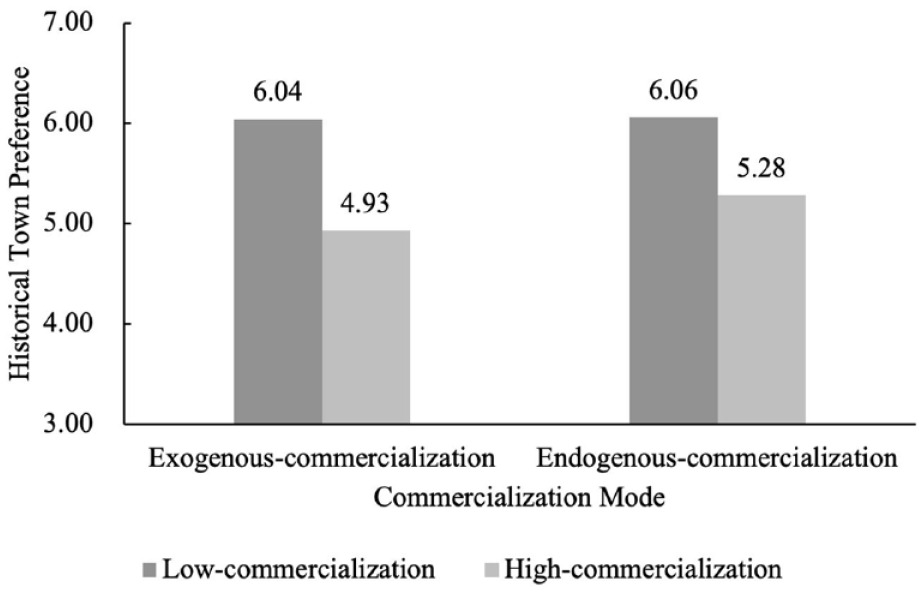
Interactive effect of commercialization degree and commercialization mode on preference.
Similarly, a 2 × 2 ANOVA on perceived essence showed a significant effect of commercialization degree on perceived essence (F (1, 645) = 165.52, p < .001), a non-significant effect of commercialization mode on perceived essence (F (1, 645) = 2.37, p = .12), and a marginally significant interaction effect between commercialization degree and commercialization mode on perceived essence (F (1, 645) = 3.68, p = .055). Planned contrast (see Figure 4) showed that in the exogenous-commercialization condition, high commercialization led to lower perceived essence (Mlow = 5.61, SDlow = 0.73; Mhigh = 4.14, SDhigh = 1.60; F(1, 645) = 107.79, p < .001). However, the negative effect of high commercialization was attenuated in the endogenous-commercialization condition (Mlow = 5.58, SDlow = 0.87; Mhigh = 4.49, SDhigh = 1.66; F(1, 645) = 60.76, p < .001). Moreover, in the low-commercialization condition, there was no significant difference in tourists’ perceived essence between the exogenous and endogenous modes (Mendogenous = 5.58, SDendogenous = 0.87; Mexogenous = 5.61, SDexogenous = 0.73; F(1, 645) = 0.07, p = .791). However, in the high-commercialization condition, tourists had a higher perceived essence for the endogenous (vs. exogenous) mode (Mendogenous = 4.49, SD endogenous = 1.57; Mexogenous = 4.14, SDexogenous = 1.60; F(1, 645) = 6.16, p = .013). These results thus supported our hypotheses, indicating that the negative effect of commercialization on perceived essence is reduced when tourists perceive this commercialization to have originated in internal (vs. external) sources.
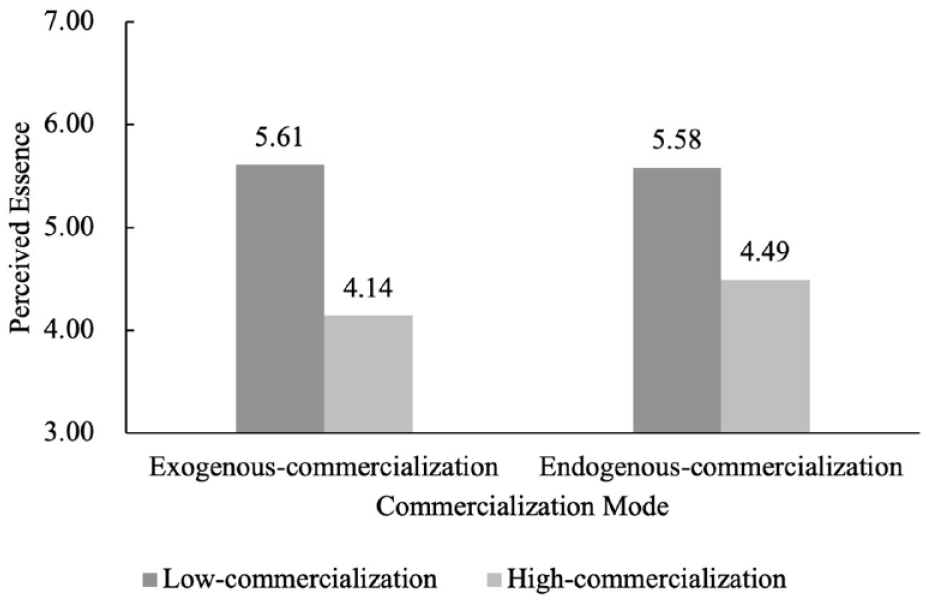
Interactive effect of commercialization degree and commercialization mode on perceived essence.
Moderated Mediation Analysis
To further confirm that the moderating effect of commercialization mode on the negative effect of commercialization on preference for a historical town is mediated by perceived essence, we conducted Process Model 8 (Hayes, 2017) (see Figure 5). Based on5,000 replications, these results showed that the moderated mediation was marginally significant (b = −0.26, SE = 0.13, 90% CI = [0.04, 0.47]). Specifically, we found that for the exogenous mode, the negative effect of commercialization on tourist preference for a historical town was attributed to perceived essence (b = −0.98, SE = 0.11, 90% CI = [−1.17, −0.81]). However, for the endogenous mode, the diminished negative effect of commercialization on tourist preference for a historical town was due to reduced perceived essence loss (b = −0.73, SE = 0.11, 90% CI = [−0.91, −0.55]).
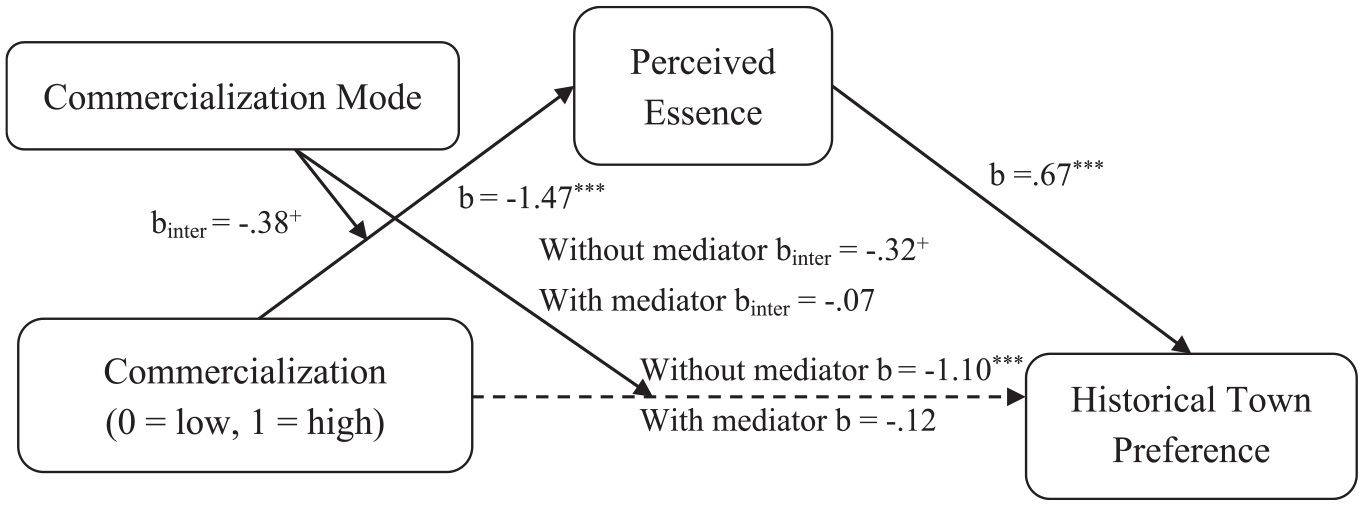
Moderated mediation analysis on preference (Study 3).
Importantly, related results also showed that in the high commercialization condition, compared to the exogenous mode, the endogenous mode improved perceived essence (b = 0.34, SE = 0.14, 90% CI = [0.12, 0.57]), further driving the increased preference for a historical town (indirect effect: b = 0.23, SE = 0.12, 90% CI = [0.04, 0.42]). Therefore, the endogenous mode attenuated the backlash effect of commercialization and this was indeed attributed to a change in perceived essence (the indirect effect).
Discussion
This study replicated the negative effect of commercialization on tourist preference and the mediation effect of perceived essence. More significantly, this study investigated how this negative effect was moderated by commercialization mode. By manipulating commercialization degree and commercialization mode, we found that compared to the exogenous mode, the backflash effect of high commercialization was attenuated when the historical town had been developed through the endogenous mode and that this effect could also be explained by a change in perceived essence. Most importantly, amid high commercialization, the endogenous mode produced a higher perception of essence than the exogenous mode and thus led to a higher preference for historical towns.
Study 4
The purpose of Study 4 was twofold. First, we attempted to investigate the moderating effect of nostalgia to further demonstrate that essence loss is the underlying mechanism of the negative effect of commercialization. Second, in addition to tourist preference for historical towns, in this study, we examined post-travel behavioral intentions, for example, WOM intention.
Method
Participants
We used the same method to determine the sample size of this study and finally obtained 327 tourists who completed the survey (Nlow = 154, Nhigh = 173; Medianage = 31–40, 32.4% females) via Wenjuanxing, the largest online survey platform in China, providing a valid source for research participants (J. Wang et al., 2020). This study had a one-factor, two-level (commercialization degree: high vs. low) between-subjects design.
Procedure
The procedure and materials (more details are in Supplemental Appendix B) adopted in this study were similar to Study 2, with two exceptions. First, in addition to measuring preference for the historical town, we measured participant intention to engage in WOM using three items adapted from Wirtz et al. (2013). Second, before the demographic variables, individual differences in nostalgia-proneness were measured by an eight-item scale adapted from Holbrook (1993).
Results
Manipulation Check of Commercialization
An independent t test showed that participants in the high-commercialization condition (M = 5.43, SD = 1.05) perceived the historical town to be more commercialized than those in the low-commercialization condition (M = 3.69, SD = 1.40; t(325) = 12.79, p < .001), confirming the successful manipulation of commercialization.
Preference, WOM Intention, and Perceived Essence
We averaged the items assessing preference (α = .88; M = 5.84, SD = 0.85), WOM intention (α = .75; M = 5.61, SD = 0.95), perceived essence (α = .80; M = 5.41, SD = 0.99) and nostalgia-proneness (α = .70; M = 3.12, SD = 0.66) to generate corresponding indexes. To prevent the collinearity effect, an independent t test was first conducted to ensure our experimental manipulation had no effect on the moderator (Mason & Perreault, 1991). These results confirmed that our experimental manipulation did not impact our measurement of nostalgia-proneness (Mlow = 3.06, SD = 0.61; Mhigh = 3.17, SD = 0.70, t(325) = 1.56, p = .12), which suggested that on the individual level, nostalgia-proneness would not be influenced by simple, incidental experimental manipulation, as nostalgia-proneness was a stable personality trait.
To confirm that the negative effect of commercialization is moderated by nostalgia-proneness, we conducted moderation analysis using PROCESS model 1, with5,000 replications (Hayes, 2017) (see Figures 6 and 7). These results revealed a significant main effect of commercialization on preference, WOM intention and perceived essence (for preference: b = −0.47, SE = 0.08, 95% CI = [−0.62, −0.31]; for WOM intention: b = −0.34, SE = 0.09, 95% CI = [−0.52, −0.15]; for perceived essence: b = −0.34, SE = 0.10, 95% CI = [−0.54, −0.15]); a significant main effect of nostalgia-proneness on preference, WOM intention and perceived essence (for preference: b = −0.33, SE = 0.09, 95% CI = [−0.52, −0.15]; for WOM intention: b = −0.34, SE = 0.11, 95% CI = [−0.55, −0.12]; for perceived essence: b = −0.36, SE = 0.12, 95% CI = [−0.60, −0.13]); and a significant interaction effect between commercialization and nostalgia-proneness (for preference: b = −0.36, SE = 0.12, 95% CI = [−0.60, −0.12]; for WOM intention: b = −0.43, SE = 0.14, 95% CI = [−0.71, −0.15]; for perceived essence: b = −0.35, SE = 0.15, 95% CI = [−0.65, −0.05]). Specifically, for participants with high nostalgia-proneness (+1 SD), commercialization negatively impacted tourist preference, WOM intention, and perceived essence (for preference: b = −0.71, SE = 0.11, 95% CI = [−0.94, −0.49]; for WOM intention: b = −0.62, SE = 0.13, 95% CI = [−0.88, −0.36]; for perceived essence: b = −0.57, SE = 0.14, 95% CI = [−0.85, −0.29]). However, for those with low nostalgia-proneness (-1 SD), the backlash effect of commercialization was attenuated or nonsignificant (for preference: b = −0.23, SE = 0.11, 95% CI = [−0.45, −0.01]; for WOM intention: b = −0.05, SE = 0.13, 95% CI = [−0.31, 0.21]; for perceived essence: b = −0.11, SE = 0.14, 95% CI = [−0.39, 0.16]). These results therefore supported our hypotheses, suggesting that the negative effect of commercialization is stronger for more (vs. less) nostalgia-prone tourists.
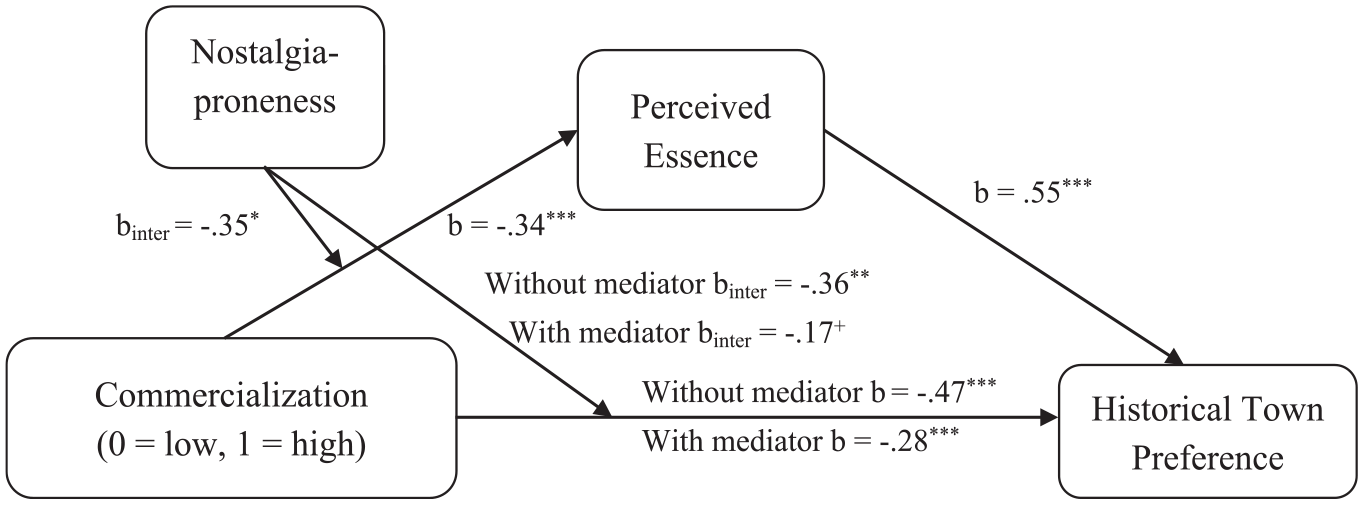
Moderated mediation analysis on preference (Study 4).

Moderated mediation analysis on WOM intention.
Moderated Mediation Analysis
To further test whether the moderating role of nostalgia-proneness in the negative impact of commercialization was mediated by perceived essence, a moderated mediation analysis was performed using Process Model 8, with5,000 replications (Hayes, 2017) (see Figure 6). These results showed that our moderated mediation was successful (b = −0.19, SE = 0.07, 95% CI = [−0.34, −0.05]). Specifically, we found that for participants with high nostalgia-proneness (+1SD), the negative effect of commercialization on tourist preference was attributed to perceived essence (b = −0.31, SE = 0.08, 95% CI = [−0.46, −0.16]). However, perceived essence did not play a mediator role among participants with low nostalgia-proneness (−1 SD) (b = −0.07, SE = 0.07, 95% CI = [−0.21, 0.05]).
Similarly, we examined the moderating role of nostalgia-proneness and the mediating role of perceived essence in the impact of commercialization on WOM intention (see Figure 7). These results also showed that our moderated mediation was successful (b = −0.17, SE = 0.07, 95% CI = [−0.32, −0.04]). Specifically, for participants with high nostalgia-proneness (+1 SD), the negative effect of commercialization on WOM intention was driven by reduced perceived essence (b = −0.28, SE = 0.07, 95% CI = [−0.43, −0.14]). However, for those with low nostalgia-proneness (−1 SD), perceived essence did not play a role as mediator (b = −0.07, SE = 0.06, 95% CI = [−0.18, 0.05]).
Discussion
This study not only replicated the negative impact of commercialization on the preference for a historical town but also extended this negative effect to explore post-travel behavioral consequences, such as WOM intention. Accordingly, we showed that this negative effect is salient for people with high nostalgia-proneness because they are more sensitive to essence loss.
Conclusions and Discussion
Theoretical Implications
Overall, the essence of heritage tourism combines a long history and profound cultural traditions and their accumulation. During the recent decades of their tourism boom, many historical towns that seek economic growth and development have changed their ancient appearance. The present study thus aimed to investigate the consequences of such commercialization of historical towns through the lens of psychological essentialism—the tendency to focus on the underlying essence when explaining what makes a tourism destination authentic. This issue, although previously expressed by some tourism scholars (e.g., Hung et al., 2017), has not previously been tested explicitly in tourism. In one correlational study and three experimental studies, we have thus provided convincing evidence supporting our hypotheses positing that the level of commercialization negatively impacts tourist preference for tourism destinations, that this effect is mediated by perceived essence, and that commercialization mode and nostalgia-proneness act as moderators.
As we predicted, commercialization has a negative effect on tourist preference. Commercialization is operationalized as tourists’ perceptions of the commercial atmosphere and commercial activities in a historical town and their evaluation of the commercialization degree of the historical town. This finding is consistent with extant research (Cole, 2007; Fan, 2017; Huang & Pearce, 2019), which has suggested that a high level of tourism commercialization negatively affects stakeholder evaluation of heritage destinations. It also echoes previous research on the idea that advocating the logic of tourism as the only real value for cultural heritage leads to aberrant destination images (Loulanski & Loulanski, 2011; F. Wang et al., 2019). From the lens of consciousness theory, tourism can be viewed as an “encounter,” an interaction with a destination in a state of heightened consciousness. Negative attitudes toward historical towns can thus be induced by different cues of commercialization, such as environmental cues (e.g., environmental disruption and modern buildings), symbolic cues (e.g., loss of uniqueness and impressiveness), or human cues (e.g., aggressive pursuit of economic profits, profit-driven interactions) (Shinde, 2007).
Moreover, this research extends the discussion on the importance of essence perception in consumer valuation (Kramer et al., 2021). In particular, we have found a mediation effect of commercialization on tourist preference through essence loss. This effect has been confirmed among both Chinese and U.S. samples. This result is significant because the majority of previous research on commercialization effects has focused on the model of authenticity. While authenticity refers to what is real, genuine, or true (Lehman et al., 2019), psychological essentialism concerns social categorization (i.e., the fundamental attributes that hold a category together) (D. L. Medin, 1989; Prentice & Miller, 2007).
Destination essence can be seen as what makes a destination unique, extraordinary, and memorable. Although psychological essentialism has received some attention in the marketing literature (Bilgin & Crolic, 2020; Newman & Dhar, 2014; R. K. Smith et al., 2016), it is a topic with little research on tourism. Applying the psychological essentialism approach to the tourism destination context therefore has particular significance for tourism management because it is associated with brand image (Doering et al., 2020), which can provide guidance on maintaining agility and uniqueness in a changing tourism market. Additionally, we consider destination essence implicit in the present study because essentialist views are intuitive and therefore difficult to articulate (S. A. Gelman, 2003). Various environmental, social and contextual cues of a place can automatically activate essentialist thinking without tourists’ conscious effort, which helps them detect the “essence” of the place in an attempt to create a meaningful experience (Levy et al., 1998). Hence, our results suggest that tourism commercialization likely impacts one’s intuitive “gut” feeling about the core features of historical towns.
The findings of the present study also support the contagion mechanism of essence loss, although further research is needed to examine this mechanism. In other words, our results suggest that when culture heritage sites are used for commercial purposes (e.g., tourism), they are likely to be viewed as contaminated by commercial culture and thus susceptible to commercial expectations, which leads to the perception of essence loss and negative judgment. This finding is highly relevant, given the present situation where the commercial construction designs of historical towns in China are highly similar and substitutable, mainly in the style of the Ming and Qing Dynasties. In addition, intangible cultural heritage, such as original songs, dances and folk customs, which have only been allowed to appear in special festivals or occasions, are expected to be presented for tourists’ entertainment, entailing a plain and shoddy commercial show (Yang, 2011). Under the profit-driven approach, the homogeneity of tourism commodities is therefore severe. For instance, handmade crafts with local characteristics are replaced by simple handicrafts via mass production. Many historical towns have also experienced the migration of their local residents, and their original lifestyles have disappeared. As a result, in these cases, heritage only exists for economic benefits; it loses its essential attributes to become a mere commodity (Bao & Lin, 2014).
This study has also demonstrated that commercialization mode is an important moderator in the relationship between commercialization and tourist preference. This finding illustrates how exposure intensity to contamination source can influence contamination results. The exogenous mode requires more contact with external forces, which can lead to a stronger contamination effect. Moreover, we have found that the endogenous mode to some extent reduces the negative impact of high commercialization. One possible reason for this is that the endogenous commercialization mode serves as a cleansing tool, washing away the upsetting consequences of high commercialization. This is because the endogenous mode is considered more sustainable and more socially inclusive than the exogenous mode (Zhou et al., 2009). The cleansing effect of such a contagion has also been evidenced in previous work (Newman & Bloom, 2014; Zhong & Liljenquist, 2006).
Furthermore, the present findings reveal that individual nostalgia-proneness, a stable personality trait, influences the consequences of commercialization. In particular, those tourists with a high propensity to be nostalgic have stronger feelings of essence loss due to commercialization, which results in a more negative attitude and reduced visit intention and WOM intention toward the destination. The COVID-19 pandemic has triggered nostalgia emotions, which can stimulate consumers’ desire for leisure travel (Wang & Xia, 2021). Despite the growing focus on nostalgia in the tourism literature (Q. Chen et al., 2020; Cho et al., 2019), the extent to which nostalgia-proneness affects tourist behavior toward heritage tourism destinations remain underexplored. The extant evidence has tied nostalgia-proneness to a stronger preference for products related to the past (Holbrook, 1993; Schindler & Holbrook, 1993). Additionally, nostalgia-prone individuals have stronger desires to maintain the integrity and continuity of a product (Wiedmann et al., 2011). Previous research has reported that commercialization in historical towns may endanger the sustainability of their cultural heritage (McCartney & Chen, 2020), which explains why nostalgia-proneness may serve as a variable that modifies tourist response to commercialization in destinations that are linked to the past, such as historical towns. Overall, this finding shows that tourism destinations can affect tourists’ intentions according to their own propensity to feel nostalgic, a novel contribution to the tourist-destination relationship management literature.
Managerial Implications
Our findings have several implications in regard to commercialization effects and the evaluations of historical towns. Although commercialization can enhance the functions of heritage tourism destinations (e.g., more facilities for dining, shopping, accommodation, and entertainment), it can also stimulate implicit thoughts of essence loss, leading tourists to view a destination as having less value. This finding reflects the shift in tourist demand from functionalized space to meaningful experience.
For historical towns to be developed, the common construction mode of general overhaul needs to be replaced by one of microtransformation and fine improvement. Managers should thus start by excavating their local cultural connotations and improving the feelings of tourists. For heritage tourism, tourists care less about whether a town is new, beautiful and tidy when it has lost its essence, for example, its historical relics, humanistic spirit and popular life. Therefore, repeated construction, nondifferentiated market positioning, and neglect of local culture should be avoided for sustainable development. Our results also show that when perceived essence loss is controlled for, commercialization can exert a positive effect on tourist attitude and behavioral intention. Hence, by highlighting the endogenous development mode and local resident involvement, destinations may help reduce concerns about essence loss and ensure the quality of tourist services and experiences.
Because heritage towns already have a high level of commercialization, it is important for managers to look for ways to reduce their signals of a commercial culture to consumers (e.g., through destination names indicating small-scale development, noncommercial activities, and stories of simple lifestyles and associations with an initial appearance). Furthermore, it is necessary for managers to develop criteria for optimizing merchants and investments from high-quality agencies with unique features. In addition, technological infrastructure aimed at creating a real and a virtual destination might be employed to balance commercialization and preservation in cultural tourism destinations.
Limitations and Future Research
Despite a growing interest in research on commercialization, the underlying process of the effect of tourism commercialization on tourist response and its boundary conditions remain unclear. Based on psychological essentialism theory, the current study has thus identified essence loss, which as a result of commercialization, affects tourist attitude, visit intention and WOM intention toward heritage destinations. We have largely focused on the business circumstance characteristics of commercialization and have highlighted the implicit nature of psychological essence. This study has also accounted for the role of nostalgic proneness in moderating the mediation effect. Finally, we have employed correlational and experimental designs in three studies to uncover the causal effects among the study variables.
However, despite the contributions enumerated above, there are limitations in the present research that provide future research directions. First, our measures are all attitudinal; we did not examine the consequences of commercialization at the real behavioral level. Future research can thus use secondary data on visitation to historical towns to further examine our proposed effects. In addition, this research concentrates on how the extent and mode of commercialization may impact tourist response. Follow-up studies could thus investigate whether different aspects of tourism commercialization will lead to different consequences. Furthermore, although the present research explored the backlash effect of commercialization via psychological essentialism, commercialization might have other kinds of positive effects that merit research attention. Finally, although we have attempted to effectively minimize the negative effect of commercialization by investigating the moderator of commercialization mode, we have found that its intervention effect remains small. In other words, when commercialization is endogenous, we found that the backlash effect thereof is slightly attenuated but still significant. Future research may therefore explore other potential factors specific to historical towns that facilitate their commercialization but have a minimal negative effect on them.
Supplemental Material
sj-docx-1-jtr-10.1177_00472875231200494 – Supplemental material for When Essence is Lost: The Consequences of Commercialization in Historical Towns
Supplemental material, sj-docx-1-jtr-10.1177_00472875231200494 for When Essence is Lost: The Consequences of Commercialization in Historical Towns by Jiaying Lyu, Yi Huang and Lili Wang in Journal of Travel Research
Footnotes
Declaration of Conflicting Interests
The author(s) declared no potential conflicts of interest with respect to the research, authorship, and/or publication of this article.
Funding
The author(s) disclosed receipt of the following financial support for the research, authorship, and/or publication of this article: This research was supported by grants from the National Natural Science Foundation of China (No: 71974173) and General Social Science Program of Hangzhou City University (E-202305) awarded to the first author and grants from the National Natural Science Foundation of China (No: 72222018, 71972169, 72332006) awarded to the third author. The first and third authors contributed equally to this research.

Supplemental Material
Supplemental material for this article is available online.
Author Biographies
References
Supplementary Material
Please find the following supplemental material available below.
For Open Access articles published under a Creative Commons License, all supplemental material carries the same license as the article it is associated with.
For non-Open Access articles published, all supplemental material carries a non-exclusive license, and permission requests for re-use of supplemental material or any part of supplemental material shall be sent directly to the copyright owner as specified in the copyright notice associated with the article.
