



Abstract
This article argues that agent-based modeling (ABM) is the methodological implication of Lawson’s championed ontological turn in economics. We single out three major properties of agent-based computational economics (ACE), namely, autonomous agents, social interactions, and the micro-macro links, which have been well accepted by the ACE community. We then argue that ACE does make a full commitment to the ontology of economics as proposed by Lawson, based on his prompted critical realism. Nevertheless, the article also points out the current limitations or constraints of ACE. Efforts to overcome them are deemed to be crucial before ACE can make itself more promising to the current ontological turn in economics.
1. Background and Introduction
The ontological issue of economics has been pointed out by several leading philosophers of economics (Lawson 1997, 2003; Mäki 2001). In his series of contributions to the ontological turn in economics, Tony Lawson reiterates the relation between ontology and methods (Lawson 1997, 2003, 2015). While it is normally perceived that ontology, the nature of (a domain of) reality, shall precede methods, it is largely the opposite that has happened in mainstream economics. The consequence of this disorder is that the ontology of economics, shaped by the mainstream methods, veered away from social reality which, according to Lawson, should have the following five properties: Highly Internally related, Open, Processual, Emergent, and Structured (HOPES).
Leaving the mainstream aside, several heterodox economics, as reviewed by Lawson, implicitly possess a set of ontological properties closer to the aforementioned HOPES. Nevertheless, “their ontological nature has rarely been made sufficiently clear” (Lawson 2015, 37). It would, therefore, be interesting to know how succinct the ontological nature of heterodox economics could be made and by what methods. Lawson did mention the use of the retroduction method (Lawson 2003) as a mode of inference, but he also dismissed a large family of newly arising methods, including “agent-based modelling, . . . as they are all methods of mathematical-deductive modeling” (Lawson 2015, 143). This makes the methodological implications of the Lawsonian critique of economics somewhat puzzling.
It is puzzling to appraise agent-based modeling (ABM) as another reduction method because this appraisal is against the perception of ABM by the community of agent-based computational economics (ACE) to be specific (Borrill and Tesfatsion 2011) and the heterodox economics in general (Lavoie 2014). For us, ABM is exactly the methodological implication of Lawson’s criticisms of mainstream economics. We shall give our arguments as to why it is so in this article.
Before we proceed, we would like to make clear the approach or strategy we take to develop our arguments. First, we refer to the literature to show that ACE has the potential to help economists study economics in line with the HOPES ontology. Second, HOPES have never been intended to be given by Lawson as five independent properties but have to be understood together to arrive at a complete picture. Therefore, when examining how ACE can serve the need of the HOPES ontology, we try to keep in mind that each property in HOPES often works with others.
The rest of the article is organized as follows. In Section 2, we first provide a direct response to Lawson’s explicit criticisms of ABM. In Section 3, we present three prominent properties of ACE that we consider to be pertinent to Lawson’s suggested ontology of economics and social reality. Based on the three properties explicated, Section 4 provides a point-to-point correspondence between ACE and HOPES. Section 5 presents the concluding remarks.
2. Direct Responses
Lawson championed his discourse on economic ontology and the ontological turn in the late 1990s, when ABM was just in its burgeoning stage in economics. Hence, ABM was not mentioned or not noticed in his earlier work. In the 2000s, ABM spread out not only to economics but also to other branches of the social sciences. In his recent work, Lawson did mention ABM but considered ABM to be “a world of isolated atoms” following “fixed rules,” “whereby the outcomes of agent interactions can be deduced” (Lawson 2015, 62). Since this is Lawson’s sole critical comment on ABM, we would like to provide our response to this criticism first.
We begin with the term autonomous agents, which is formally used by Leigh Tesfatsion to define ACE: “[A]gent-based computational economics (ACE) is the computational study of economies modelled as evolving systems of autonomous interacting agents” (Tesfatsion 2001, 281; italics added). She further elaborated what the autonomous agents could mean: Agents continually adapt their behavior in response to agent-agent and agent-environment interactions in an attempt to satisfy their needs and wants. That is, behavioral rules are state conditioned, and agents co-adapt their behavior in an intricate dance of interactions. (Tesfatsion 2001, 282)
What is referred to by Lawson, namely, the fixed-rule-following agents, is categorized as the first kind of agents, to be distinguished from the second kind, the autonomous agents. For pedagogical reasons, the first kind of agents is often used in introductory materials for beginners of ABM. These introductory materials exclusively rely on the use of a special kind of ABM, known as cellular automata or checkerboards (Hegselmann and Flache 1998). In most of these models, agents indeed belong to the first kind. This may provide a ground for Lawson to develop his criticism of ABM.
Nevertheless, even if we confine ourselves to the first kind of agents, we still cannot ascertain that everything is deductible or effectively deductible. In this regard, Borrill and Tesfatsion (2011, 230) state, “the classical idea that we can deduce solutions (or ‘future states’) for systems a priori, purely from a study of their structural characteristics, is beginning to be overshadowed by the realization that many systems are computationally irreducible.” A system is said to be computationally irreducible if the sequential behavior of the system cannot be known (predicted or computed) in any short way as opposed to going through almost every step of computation as the evolution of the system itself.
Many earlier ABMs manifested in the form of cellular automata demonstrate the property of computational irreducibility (Wolfram 2002). Beckage et al. (2013) further refine the idea of computational irreducibility by differentiating it among the physical, biological, and human systems. The ABMs with their fixed-rule-following agents, such as the aforementioned cellular automata, can be essentially regarded as the physical systems, which, albeit computationally irreducible, are not irreducible to the same level as compared to the biological systems or the human systems. Only with autonomous agents can the built ABM be more like the biological systems or even the human systems. Hence, with a more general setting of ABM, Borrill and Tesfatsion (2011, 230) state, “the only option we have to understand the global properties of many social systems of interest is to build and run computer models of these systems and observe what happens.”
As to the “world of isolated atoms,” long before ABM became established in economics, a method called microsimulation pioneered by Guy Orcutt (1917-2006) had already been applied to economics (Orcutt et al. 1961). These microsimulation models acknowledge the great heterogeneities of individuals, but not so much the interactions among them. This may fit Lawson’s world of isolated atoms. However, again, if interactions are considered, then even the behavior of the physical-like ABMs cannot be simply deduced.
In sum, while Lawson’s critical comments can be applied to some specific agent-based economic models, they cannot be applied to the ABMs as a whole.
3. General Properties of ACE
From the literature, we can have more than 20 reasons for using ABM, ranging from the democratization of science, visual friendliness, imagination facilitation, to knowledge consilience. In this section, we only focus on the three that we consider pertinent for the ontological turn of economics.
3.1. Autonomous Agents
To have a further look at autonomous agents in ACE, it is useful to present a little history of artificial intelligence. In brief, there has been a drive to design or program machines so that machines can do what we humans do. This pursuit became particularly plausible after Warren McCulloch (1898-1969) and Walter Pitts (1923-1969) published their seminal work on neural networks (McCulloch and Pitts 1943). However, after the 1950s, it was gradually realized that this pursuit was untenable and was replaced by a humbler pursuit, that is, to design machines that can, at least, learn from humans to do what humans can do. This is where the idea of machine learning comes from. Rosenblatt’s perceptron set a milestone for this pursuit (Rosenblatt 1962).
This pursuit can be considered as the origin of autonomous agents, which has not been considered by mainstream economics. This is because in mainstream economics, there is no unknown for the neoclassical agents or there are only known unknowns. Nevertheless, if the ontology of economics is focused on the perpetual novelties or unknown unknowns, then we do need a notion of agents, who, up to some point, are able to act on their own without external supervision. This kind of agent is then introduced to ACE via various machine learning methods (Chen 2016). With this capability, autonomous agents can discover things beyond model designers’ anticipation and hence surprise their designers (Chen and Yu 2011).
A typical place where one needs the involvement of autonomous agents is the economics of innovation. There, we absolutely do not know what designs or products will appear. Neoclassical economics, specifically, the Arrow-Debreu economy, is ill-fitted for the description of this economy. Over the years, Stuart Kauffman has long criticized the neoclassical economy as a closed system by using his invented term, unprestatable adjacent possibilities (Kauffman 2016). Right opposite to the Arrow-Debreu economy, unprestatable adjacent possibilities mean that we cannot articulate the possible future states, not to mention a well-formulated contingency plan. It is the unknown unknowns motivate the idea of autonomous agents in ACE, which may also contribute to the fundamental uncertainty of the world. Earlier, we have already mentioned that even simple physical systems with rule-following agents can be computationally irreducible (Wolfram 2002). Now, with autonomous agents, while in some cases order or self-coordination can emerge at different levels, in general, one could expect these autonomous agents to be the sources of intrinsic instability, perpetual novelty, and further the formation of unprestatable adjacent possibilities.
While autonomous agents leave great room for the further development of ACE, the current use of this idea in ACE is rather limited. A large family of ACE users remains to be interested only in simple agents, programmed agents, or randomly behaved agents (Chen 2012; Chen, Chang, and Du 2012). Some ACE models do apply the idea of autonomous agents, but they only use them for the purpose of numerical tinkering. The limited application of autonomous agents to the space of modules, rules, expressions, languages, genres, and the hierarchical composition of them limits the degree of the autonomy that an agent could have. Not surprisingly, when some people criticize ACE, their experiences with ACE are probably limited to the use of simple agents or number-crunching agents.
In sum, agents, in ACE, “have a richer internal cognitive structure and more autonomy than conventionally modelled economic agents” (Tesfatsion 2001, 252). In fact, the use of the formal language model, such as the context-free grammar, with evolutionary computation and many other machine learning tools can facilitate the construction of the autonomous agents in ACE (Chen 2016).
3.2. Social Interaction
The second property pertinent to the HOPES ontology is social interaction. Simply put, models without autonomous agents can still be considered as ACE in a broader sense, but models without interactions cannot. This point is well shared among ACE economists. Let us illuminate it in the Guerrero-Axtell procedure (the GA procedure). Guerrero and Axtell (2011) suggest a procedure whereby the agent-based economic model can be incrementally built from a given neoclassical economic model, which is christened as agentization (of the neoclassical model).
In the GA procedure, the assumptions of the neoclassical models are hierarchically placed from the core to, progressively, the peripheral. The GA procedure begins with the replacement of the core assumption, the non-interactiveness of agents. As Guerrero and Axtell stated, “[T]hese assumptions have to be necessarily confronted by the modeler. Without re-thinking them, the agent-based version cannot be implemented” (Guerrero and Axtell 2011, 140). A number of pioneering ACE models can all be read as the agentization of the neoclassical model (Arifovic 1994; Arthur et al. 1997; Bullard and Duffy 1998). They all have the interactiveness of agents as their essence to define their departure from the neoclassical counterpart.
Actually, the ingredient, social interaction, has already been in ACE from the very beginning (Hegselmann 2017). Sakoda (1949, 1971) took the checkerboard as a social field and worked on the social relations and their dynamics. He began with a binary attribute of an individual. Each binary attribute naturally divides the whole society into two groups, which further evokes the in-group and out-group relations (valence toward the same group and the alternative group). Each valence can have one of the three possible values: positive (attractive), negative (repulsive), or neutral. This setting allows for a total of 81 two-by-two matrices characterizing 81 possible social relations. Each of these social relations can trigger its own social interaction, which is defined as the relocation action taken by each individual. The relocation action is driven by the betterment motive in the sense that each individual constantly searches for a new position on the checkerboard so that his/her well-being will become improved in the new surroundings.
In fact, when Sakoda worked on his thesis, Jacob Moreno’s (1889-1974) pathbreaking concept in social network analysis, that is, sociograms (Figure 1) had already been known to Sakoda (1916-2005). In light of this progress (Moreno 1934), Sakoda’s efforts can be regarded as a dynamic extension of the social relations as depicted in Moreno’s sociograms, and a pioneering piece of the later developed ABMs of network dynamics (Namatame and Chen 2016). Apart from Moreno (1934), Sakoda was also aware of the significant advances in game theory (Von Neumann and Morgenstern 1944) (Figure 1), but the strategy space considered by him is confined to relocation only. Nevertheless, the later literature on spatial games initiated by Axelrod (1984) and further consolidated by Nowak and May (1992) and Albin (1992) did integrate Sakoda’s model of social interaction within a game-theoretic framework.
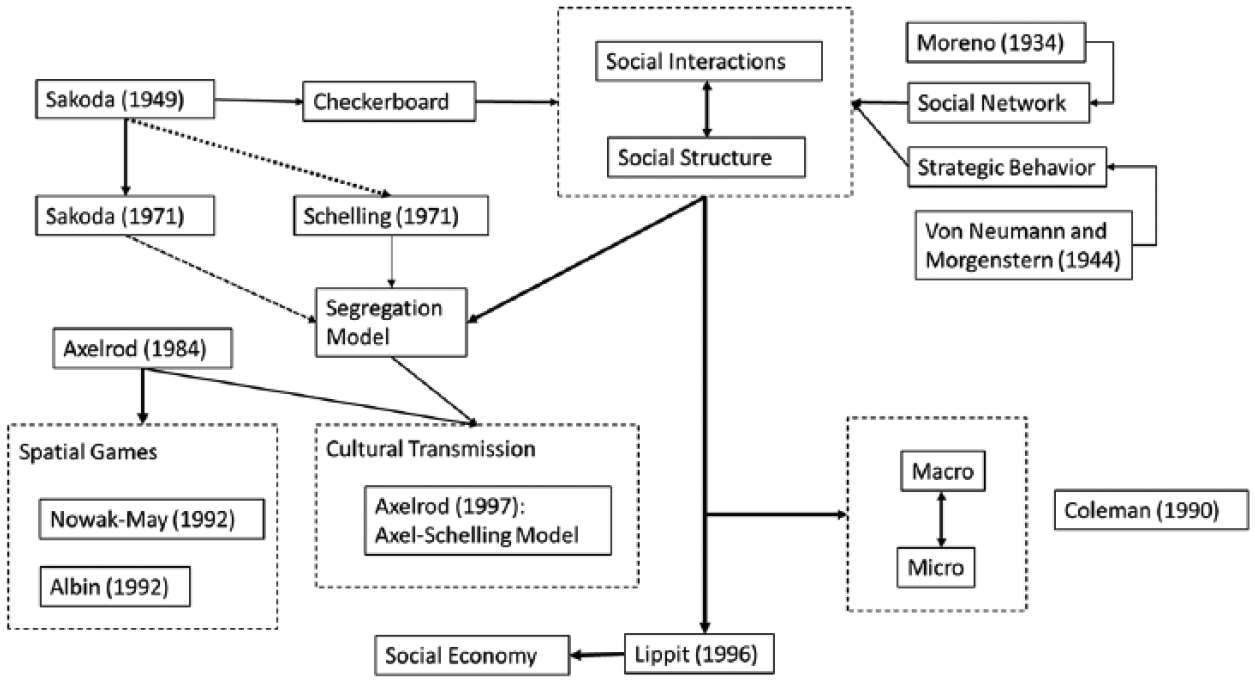
A simple history of ACE in light of social interaction.
The original Sakoda model only deals with a single ascribed attribute. The later ACE work extends the original model to include multiple-attribute variants and can incorporate both ascribed and acquired attributes. A good example is the Schelling–Axelrod model of cultural transmission (Axelrod 1997; Figure 1), in which agents’ cultural inheritances can be exogenous variables dictating friend making, which is known as the homophily effect. However, attributes can also be endogenous (acquired) because they can be assimilated and hence altered by the attractiveness or persuasiveness of the encountering agent (the friend).
In Figure 1, we provide a simple history of the development of ACE in light of the core ingredient, social interaction. Most of the items referred to have been discussed in this section, apart from the micro-macro link (Section 3.3) and social economics (Section 4.2).
One could still argue that the kinds of social interactions demonstrated by the existing ACE works are limited, but that is because one has not fully exploited the devices of autonomous agents. Otherwise, one can advance social interactions into realms with many subtleties, such as multiple selves, multiple roles, intersubjectivity, and the theory of minds (see Section 4.1).
3.3. Micro-Macro Link
The third pertinent property of ABM is the micro-macro link. In his magnum opus, Foundations of Social Theory (Coleman 1990), James Coleman (1926-1995) compared two modes of social explanations. The behavior of a given level can be regarded as the contribution not only from the same level, but also from its constituting lower levels. Without losing generality, Coleman worked on a two-level case and called the higher level the system level or the macro level, and the lower level, the individual level or the micro level.
The first mode of social explanations is that explanantia and explananda are situated at the same level, while the second mode is that there are critical explanantia situated at a level lower than where the explananda are situated. The first mode provides either macro-to-macro or micro-to-micro explanations. The second mode, which is recommended as the internal analysis of social explanation, can be viewed as the combination of the following three types of relations: “[t]he first is from the system level to the individual level; the second is wholly at the individual level; and the third is from the individual level to the system level” (Coleman 1990, 10). Coleman made it clear that the second mode “is the mode of explanation I will use throughout this book” (Coleman 1990, 2). 1
We provide a brief account to see why ACE can be viewed as a realization of the micro-macro link. Figure 2 replicates Coleman’s diagram of the micro-macro link, and, to illustrate the figure, we use an agent-based lottery market (Chen and Chie 2008). This ABM of the lottery market is designed to address how to determine the optimal lottery tax rate, an issue remaining open in mainstream economics. Since the lottery in many countries is used to fund public goods, an obvious goal for the design is tax revenue maximization.

Coleman’s diagram adapted to the lottery market.
An ACE model is naturally composed of the macro level (the market level) and the individual level (market participants). According to Coleman’s diagram (Figure 2), the macro level has two points, A and D, corresponding to macro conditions and macro outcomes. In the case of the lottery market, they are the lottery tax rate and net revenue, respectively. The micro level also has two points, B and C, corresponding to micro conditions and micro outcomes. The micro condition refers to the state and the decision rules characterizing each market participant, whereas the micro outcome refers to their actual investment in lottery tickets. In Chen and Chie (2008), the micro conditions (point B) are mainly given based on the literature of gambling psychology, but they are not static given that these participants are all autonomous agents (Section 3.1).
With the indicated four points, A, B, C, and D, Coleman’s diagram also has four links. The causal move from A to D is known as the macro regularities. The other three essentially form the micro-macro link. The link begins with the move from A to B, which is called the bridging assumptions, indicating how the tax rate as a macro variable can be connected to the decision rules of each market participant; then the move from B to C, called the theory of actions, indicating how decision rules lead to the actual decision; and finally, the move from C to D, called the transformation rules, indicating how individuals’ actual investments contribute to total revenue.
Among the three, only the transformation rule (line CD) is straightforward; that is, the total sales are the sum of individuals’ purchases. The bridging assumption (line AB), in this case, is not that direct. This is because, in their setting, the change in the tax rate first impacts the jackpot size. When the size comes close to a historical high, it draws the attention of the media and then, through waves or ripples, the attention of market participants. It is highly dynamic, progresses in time, and is not a one-shot movement. Similarly, line BC is quite dynamic and complex, and involves how the constantly changing jackpot size affects different market participants with different decision rules at different times. This part is indeed the place where we see the working of social interaction (Section 3.2) as the market mechanisms and processes.
In brief, what can happen in actual ACE models is the existence of many loops along the line, working in between A and B, and B and C. The links can be viewed as the work of the two previous properties combined, namely, the socially interacting autonomous agents. Many intriguing details, therefore, are not easy to compress into such a simple static and highly abstract diagram. To avoid over-simplification, we provide a companion to Figure 2 in Figure 3 so that one can see the dynamic nature of the micro-macro link in a more vivid way.
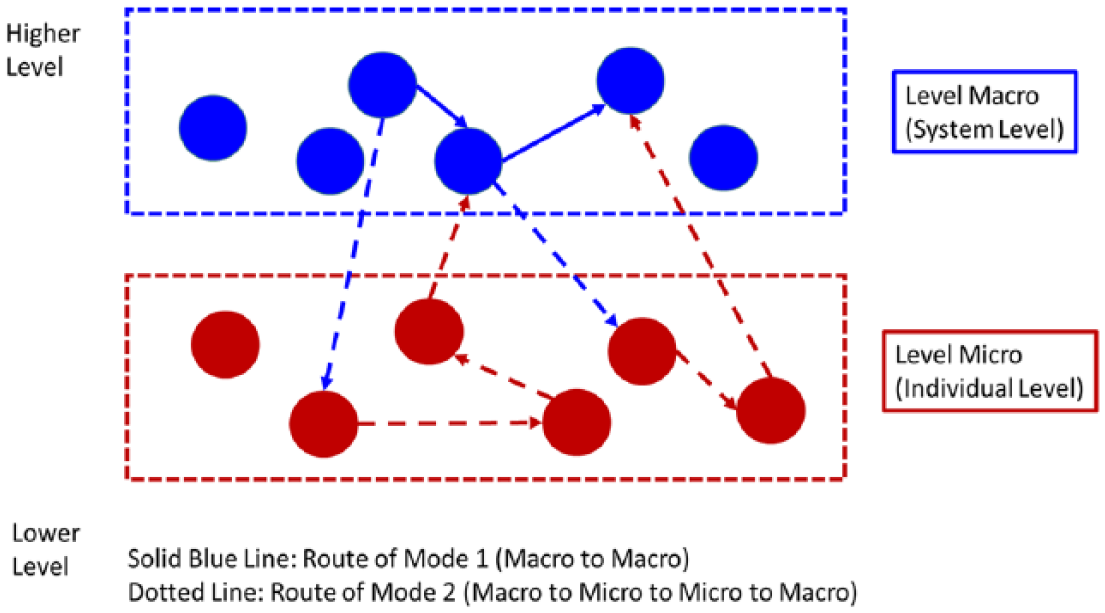
A dynamic variant of the micro-macro link.
The micro-macro link (the two-level link) is just a special case of the generalized multilevel link. However, most ACE studies only work with the two-level link; few are devoted to the three-level or higher links.
4. HOPES
We now examine the relevance of the three properties of ABM, as a whole, to the HOPES ontology.
4.1. Highly Internal Relations
Among the five ontological categories, maybe the subtlest one is the internal relations. Its meaning is deeper than what a network could mean. As Lawson pointed out, “highly internally related (meaning constituted through [and not merely linked by] their relations with each other . . . )” (Lawson 2015, 143). An internal relation, such as that of employer and employee or landlord/lady and tenant, is defined as follows: “[R]elations are said to be internal when the relata are what they are and/or can do what they do, just in virtue of the relation to each other in which they stand” (Lawson 2015, 40).
Since the very beginning of ACE (Figure 1), the idea of networking or linking has already been placed in the model, and they have been reified into various network topologies (Namatame and Chen 2016). There was a period, from around the mid-1990s to the beginning of this millennium, when the ACE models did not explicitly have social networks. Many profound ACE works published in various domains were largely devoid of the network ingredient. Nevertheless, even in these models, social interactions were implicitly carried out through various random encountering mechanisms. As mentioned in Section 3.2, without social interaction, a model cannot be claimed to be an ABM.
However, “highly internally related” may mean something more than just links. To distinguish “a link” from “more than a link,” social network analysis has differentiated this link in different designs so that the intensity, intimacy, or capacity of the relationship can be made explicitly. The popular use of the weighted social network is an example. One domain in which the “highly internal relationship” can be substantial is that of interpersonal trust, on which many further relationships depend. In this area, the ACE models have agentized game theory with socially interacting autonomous agents. These agents can learn and web their own ego networks and, based on that, obtain information and external resources for doing business, investment, job hunting, or school matching. In this community, the trust network as a network of many ego networks can constantly evolve (Chen, Chie, and Zhang 2015; Namatame and Chen 2016). Hence, we can say that ACE/ABM has the capability to go beyond the “link” and model “not just a link.”
The key for ACE to develop a “highly internally related” link is the device of autonomous agents (Section 3.1). Because of the given autonomy, the ego network can self-evolve, including the constant updating of the weights of the links to others. Additionally, autonomous agents can have multiple internal states which dictate their behavior with respect to different states. In fact, one of the earliest agent-based financial models was built in this way (Arthur et al. 1997). That application can be extended to models requiring multiple selves, for example, the Freudian agents. The multiple selves interact with each other over time and take charge in different situations. Their interchanging appearance is useful for simulating the substantially changing behavior between the physical space and the cyber space and helps understand the data inconsistencies between the two spaces (Stephens- Davidowitz 2017). This area is where ACE can enhance “H,” but has not done so yet. The second unfulfilled potential for “H” is the development of the theory of minds. Autonomous agents can simulate partially or wholly other agents’ minds. Appropriate use of autonomous agents with this property can enhance our understanding of relations with others in terms of preferences, altruistic behavior, empathy, sympathy, role playing, and intersubjectivity.
4.2. Openness
Openness, according to Lawson, means “the absence of conditions supporting event regularities” (Lawson 2015, 189); alternatively, “a situation in which many and changing causal mechanisms determine the course of events is referred to as open, whereas one in which a single mechanism is isolated, and an event regularity produced, is usually described as closed” (Lawson 2015, 15). “Social reality including the future is open, so that successful event prediction is typically not much more creditable than winning a lottery” (Lawson 2015, 4).
Wolfram (2002) classifies the patterns generated from his simulation of elementary cellular automata into four classes: from low to high, fixed points, limit cycles, pseudo randomness, and “the edge of chaos.” This hierarchy can find its equivalents in formal language theory and theoretic computing machines. Event regularities correspond well to the lowest two classes, and the equilibrium shortcut taken by the neoclassical formalization is mainly concerned with the first two classes.
What can we say about ACE? The collaborations between ACE and neoclassical economics usually proceed with the agentization procedure, as mentioned in Section 3.2, to resolve issues regarding analytical intractability, equilibrium election, and so on. This pile of works may sometimes clothe ACE with an impressive veil of mainstream economics that keeps abreast of equilibrium economics. This impression, however, is specious. First, while the agentization of neoclassical economics does provide ACE with a take-off point, further agentization could mean fundamental disentanglement from neoclassical economics. For example, up to the second level of the GA procedure, the equilibrium concept may no longer be attainable. Arthur’s dinosaur hypothesis (Arthur 1992) is an example. Similar to dinosaurs, which once dominated the world but became extinct later on, the best strategy discovered at one moment may lead to bankruptcy at a different point in time. A version of the dinosaur hypothesis in the financial market was tested in Chen and Yeh (2001), which provides a measure showing how quickly the patterns that we observe in the market dissolve over time. This result exemplifies the characterization required for openness.
Second, in addition to the agentization of neoclassical economics, what is equally interesting and important is the agentization of heterodox economics. Take social economics, one of the heterodox schools mentioned by Lawson, as an example. As seen in Section 3.2 (Figure 1), Sakoda’s pioneering efforts in the emergent social structure by threading through social attitudes, social relations, and social interactions help us understand the economic realm when it is perceived as social economics (Lippit 1996). Other forms of the agentization of heterodox economics include the agentization of Post-Keynesian economics (Di Guilmi 2017), Schumpeterian evolutionary economics (Pyka and Fagiolo 2007), and institutional economics (Gräbner 2016). Altogether, since these agentization works do not start with “the neoclassical sweet spot,” they do not have the technical characterization of equilibria as their intellectual focus.
Third, ACE could directly work with reality, of which the complexity normally surpasses the level that the analytical model can harness. Market design is a case in point. Roth (2002) points out the importance of computer simulation in market design. Over the last two decades, ACE has been actively extended to this area, covering financial systems, financial markets, electricity markets, labor markets, lottery markets, school admission matching, and so on.
2
In this regard, Bookstaber (2017, 172) provides an account of his experience developing an ABM to assess financial vulnerabilities for the US government: [T]here are two ways to develop a model . . . The other is to build a model that is flexible and unanchored, that adjusts with each unexpected twist in the road. Crises are like thrillers, in that you can’t envision where things might end up until they are nearly on top of you. The road-in-the-headlights approach is the way to go. (Italics added)
Hence, to operate the road-in-the-headlights approach with ease is another attractive feature of ABM.
Fourth, Wolfram’s Classes III and IV correspond well to the lack of event regularities. Patterns in Class III are basically random (pseudo random); hence, there are no regularities in the usual sense. In Class IV, the behavior of a system neither is locked into an ordered pattern nor dissolves into an apparent randomness. Patterns in Class IV both emerge and dissolve. One may reasonably suspect that ACE can generate patterns belonging to Class IV because an ACE model without autonomous agents can sufficiently generate patterns of Class IV, not to mention a modeled system augmented with autonomous agents, which should be of equal competence if not more. It is also true that, if conditions are right, autonomous agents who constantly search for patterns and act on them can eventually destroy them too.
Fifth, up to the present, our discussion of dynamics has been largely deterministic. For Lawson, event regularities obviously include the statistical ones; lack of statistical regularities is a violation of the ergodicity process. The classical probability or the Kolmogorov probability cannot be the right formulation for the nonergodicity process. Up to the present, there has been no formal study addressing whether ACE can generate a nonergodic process. Given the large use of standard econometrics to summarize the results from ACE simulations, the current ACE generating a nonergodic process might be low if not zero.
From what we have reviewed, ACE, relative to neoclassical economics, is significantly open. However, as to whether it is open to the extent of Lawson’s or others’ expectations, we still have some reservations. Nevertheless, it is necessary to distinguish what ACE can offer from what ACE modelers actually did.
4.3. Processuality
Processuality first means “in process” or “being dynamic,” but it does not refer to the normal type of dynamics. For Lawson, the key is not the external law of motion but the inner structure of a system that makes the system constantly transform. Lawson’s favorite example is the language system, in which we can see that processuality means not only the continuous transformation of the language due to the aggregation of users’ behavior but also the constant change in the users’ behavior due to the transformation of the language. There have been a number of agent-based models of language evolution which can demonstrate “language in process” as Lawson depicted (Sierra- Santibáñez 2015; Vogt and Boer 2010).
In regard to this category, we have two additional responses. First, processuality as briefly reviewed above is essentially the same as the familiar co-evolution of a system as the result of both upward and downward causations. Most agent-based models can feature this bidirectional causation chain (Trajkovski and Collins 2009), although the downward causation chains in some models are less explicit. Take Axelrod (1997) as an example. In this agent-based cultural transmission model, the agents’ behavior is dictated by homophily oriented local interactions. Those interactions alone not only drive the evolution of cultures but also cause agents to adapt to or to be assimilated by their local cultures.
Our second response to processuality is that agent-based model provides a process-based definition for big data (Chen and Venkatachalam 2017). What distinguishes big data from the conventional data is not the size, but whether the data are processual or not. To illustrate this fine distinction, Chen and Venkatachalam (2017) referred to a study of the formation of fish schools by Partridge (1981). In this study, Partridge built his own fish tanks and filmed the swimming of 20-30 saithe to watch the behavior of each individual fish, its interaction with other fish, and the formed structure of the school. Partridge’s data are big data because it records the entire process of school forming, not just some snapshots. This kind of process-based data cannot be simulated or generated by equation-based models, where individuals are missing. Reynolds (1987) used ABM to simulate flocks of birds and pioneered the literature on agent-based models of swarms and crowds.
The above two cases indicate that ACE is largely consistent with the ontological property of processuality. In fact, of the five properties, processuality is probably the most evident one.
4.4. Emergence
The fourth ontological property is emergence. According to Lawson (2015, 41), [A] stratum of reality can be said to be emergent, or as possessing emergent powers, if there is a sense in which it (1) has arisen out of a lower stratum, being formed by principles operative at the lower level, (2) remains dependent on the lower strata for its existence, but (3) contains causal powers of its own which are both irreducible to those operating at the lower level and (perhaps) capable of acting back on the lower level.
Among the five properties, emergence is probably the one most well noticed by ACE and the ABM community (Sawyer 2005). The ACE response to this ontological property is also twofold. First, as we explicate in Section 3.3, ACE is capable of providing Coleman’s micro-macro link. While Coleman’s presentation of the link is static, the actual implementation of ABM normally generates rather dynamic loops going back and forth between the lower level and the upper level, as shown in Figure 3. Therefore, ACE’s capability to provide dynamic micro-macro link corresponds to the three requirements for emergence, as suggested by Lawson.
Our second response will be demonstrated by using a few cases to directly illustrate the consistency of ACE with the category of emergence on the basis of the micro-macro link. We begin with Schelling’s segregation model. In Schelling (1971), the racial segregation phenomenon, as experienced by some metropolises, can be generated by a collection of individuals who are quite racially tolerant. The second and also well-cited example is the Gode–Sunder agent-based model of double auctions. Gode and Sunder (1993) showed that the market rationality can be achieved even though its constituent agents are far from rational in the usual sense. Chen and Yeh (2002), the third example, used agent-based financial markets to show that the efficient market hypothesis (EMH) can result from a large group of traders who do not accept the EMH; similarly, the rational expectations hypothesis (REH) of the market can be sustained, even though only a rather minor portion of the traders’ behavior complies with rational expectations. Di Iorio and Chen’s (2019) argument that ABM is the nonreductionist variant of methodological individualism provides an endorsing support for the emergence feature of ACE.
4.5. Structuredness
The fifth ontological category is structuredness. This property has been extensively discussed by Lawson, specifically with regard to naturalism and scientific methods (contrast explanation, retroduction, etc.). Below, we only list thee major points of his discussion that are pertinent to the later engagement with ACE.
First, according to Lawson, social reality is structured, meaning that it is irreducible to events, experience, or any of its direct objects; instead, it is constituted by underlying mechanisms, powers, tendencies, and so on, which give rise to or facilitate the actual course of events and states of affairs. Second, he further argued, “actualism is a mistake, that social research will need to concern itself not only with correlating, or otherwise describing, surface actualities, but also, and seemingly primarily, with identifying the latter’s underlying causal conditions” (Lawson 2003, 59-60). Third, given that structuredness exists in nature, societies, and individuals, the shared ambitions to discover the underlying causal mechanisms between natural scientists and economists indicate that economics can be scientific in the sense of natural science.
Clearly, structuredness, as described above, has a deeper meaning than the way in which mainstream economists may normally perceive it in their mathematical formalism. While their structured model may comprise many sectors, these sectors are generally placed at the same level. These methods are criticized by Lawson in terms of the last two points above and, with other factors, contribute to “the widespread failure of the econometrics project to date” (Lawson 2003, 225).
ABM has the structural mechanism. In practice, the built-in mechanism at the low level is used to examine whether the upper-level regularities, the so-called stylized facts, can be accounted for. ACE does not intend to correlate facts only. Over the last decade or so, two major strands of ACE, the agent-based macroeconomic models and the agent-based financial economic models, have attempted to develop causal mechanisms in the sense of the micro-macro link or retroduction to examine the formation of various stylized facts (Chen 2016; Chen, Chang, and Du 2012).
With that having been said, we also need to be more specific as to the practice currently carried out by the ACE community in discovering the underlying causal mechanism. When addressing openness (Section 4.2), Lawson mentioned the condition of multiple causal mechanisms, which is largely applicable to ACE. However, keeping good track of each step of the simulation sometimes becomes a daunting task. Furthermore, the micro-macro link does not necessarily lead to an explanation in the deductive sense but, more often than not, in the inductive sense of a hypothesis (conjecture). It is because of the existence of multiple causal mechanisms. Previously, we referred to incremental modeling, which is controlled by the agentization procedure. One of the purposes of using incremental modeling is to make it easier to identify and prioritize the causal factors. Nevertheless, incremental modeling has its own limitations. This partially explains why in practice many ACE modelers still rely on statistical or econometric analysis to select important causal explanations and use those as a basis to generate narrative explanations (stories), albeit with some degree of speculation. If a good or sensible story cannot be found, then only the statistical “facts” are left on the table without much light being shed on the mechanism. Hence, in this case, the micro-macro link is perhaps not a solid but a dotted line.
5. Concluding Remarks
In this article, we address the ontological turn in economics, in light of the HOPES ontology initiated and led by Lawson. We discuss the position of ACE in this turn by examining Lawson’s ontological criticisms of mainstream economics. We maintain that ACE is well aligned with the HOPES ontology, and ABM is the right method for those schools of heterodox economics that were reviewed by Lawson and have made commitments to HOPES. Our arguments are built upon the three basic properties of ABM, lengthily reviewed in Section 3. In this concluding section, we would like to make a few remarks on our general statement above.
First, although many of our arguments to support ACE are familiar to the ACE community, they have not been placed well in the sphere of the philosophy of economics. Integration efforts must be made to narrow the gulf between ACE and the philosophy of economics. Currently, ACE modelers lack enthusiasm for ontology or the philosophy of economics. This may come at a cost. On the one hand, without standing at an intellectual vantage point, the works and contributions in ACE will easily become fragmentized, making it difficult to form fundamental challenges to mainstream economics. On the other hand, without an intellectually commanding height, it is hard for ACE to collaborate with the schools of heterodox economics with similar ontological concerns. These two together may partially explain why ACE, despite its great potential, has not substantially moved beyond the agentization of neoclassical economics.
On the other side of the gulf, there is a lack of understanding of ACE, not just from its technical underpinnings, but more from its interdisciplinary intellectual roots. For many philosophers of economics, the method is still young and new. Purely from its outer appearance, it is, basically, just the agentization of neoclassical economics up to some minor different degrees. Hence, it will not be a total surprise, when coming to an evaluation, that ACE/ABM is viewed as another method of reduction, a new piece of clothing but with the same neoclassical spirit. This article is written to meet the two sides.
Second, having shaped the “correct image” of ACE to the philosophy of economics, we also remind ACE modelers that we may not be able to excite philosophers of economics or heterodox economists if our research interests only revolve around the agentization of neoclassical economics. In the end, we think that Lawson’s ontological criticism of mainstream economics has also pushed the ACE community to reflect upon the current state of ACE in terms of its relation to the ontology of economics, such as “the edge of chaos,” nonergodicity and the micro-macro or multilevel links. Even though ACE has many potentials, the pragmatic question concerns what fundamental ingredients are needed for ACE to progress. However, there are always “hopes” because agents are autonomous and hence can find new continents for interactions. Moving further along this line, ACE may help rhapsodize the ontological nature of heterodox economics.
Footnotes
Acknowledgements
The author is grateful to the organizer of the symposium, Professor Francesco Di Iorio, and the conference participants for their comments and suggestions. Thanks are especially given to two anonymous referees of their painstaking reviews of the paper. Of course, all infelicities are author’s sole responsibilities.
Author’s Note
An early version of the paper was presented at the Asian Conference on the Philosophy of the Social Sciences at Nankai University, Tianjin, 1-2 June 2019.
Declaration of Conflicting Interests
The author(s) declared no potential conflicts of interest with respect to the research, authorship, and/or publication of this article.
Funding
The author(s) disclosed receipt of the following financial support for the research, authorship, and/or publication of this article: The author is also grateful for the support this research received from the Ministry of Science and Technology (MOST) (Grant No. MOST 108-2410-H-004-016-MY2).