



Abstract
Although social ontology (SO) has attracted the attention of scholars in various disciplines, how it is applied to social scientific studies is still under-researched. To tackle this issue, this paper initially considers major streams of research on SO. It then argues that one of the aims of SO in the social sciences is to identify the rhetorical expression of social dynamism. To support this argument, the present study introduces a perspective of performativity and proposes that generic performativity should be identified by social scientists. Finally, such an attempt is demonstrated with reference to the global pursuit of financialization.
1. Introduction
Social ontology (SO) has developed as an interdisciplinary area that has drawn the attention of scholars in different fields. Although there have been numerous studies about SO so far, only a small number of them (e.g., Smith, Mark, and Ehrlich 2007; Condello, Ferraris, and Searle 2019) have grappled with specific social institutions. For instance, the Cambridge SO group led by Tony Lawson has conducted extensive research on SO in the context of economics (see, e.g., Pratten 2015; Lawson 2019), but the movement has not yet expanded widely outside the research group. This is partly due to the lack of connections between SO and theoretical perspectives in social science. To bridge the lack, this paper focuses on the concept of performativity that has been recently highlighted in some social scientific studies (see, e.g., Muniesa 2014; Boldyrev and Svetlova 2016; Brisset 2018).
To this end, this paper initially considers two major streams of research on SO to explore its possible application to social scientific studies. The first stream consists of works of John Searle and his concepts of collective intentionality (as well as collective acceptance). The second stream is the work of the Cambridge SO group led by Tony Lawson, whose main concern lies in the context of economics (e.g., its methodology and objects). By contrasting arguments from these two SO camps, this paper argues that both have an insufficient focus on the rhetorical identification of macro social dynamism that shapes institutional reality. 1 The scarce connection between SO and social science is discussed by examining a recent debate in the present journal (Lauer 2019, 2021).
Then, to grapple further with the issue, this paper suggests a theoretical perspective of performativity. Although the concept of performativity has long been researched from a variety of angles (see Nealon 2021), the present study particularly highlights the classification of its types (MacKenzie 2006). It finally argues that SO can support the interpretation and identification of the generic performativity that shapes social institutions. The thesis of this study is finally demonstrated through an analysis of financialization, which has performatively shaped relevant institutions such as formal corporate accounting standards.
The paper is structured as follows: The next section contrastively considers two major streams of research on SO, as well as Lauer’s (2019, 2021) arguments about the significance of SO, and identifies a common issue in these accounts. Section 3 suggests the necessity of a performative viewpoint and introduces MacKenzie’s (2006) analysis and classification of performativity. In section 4, the framework formulated in the previous section is applied to the case of financialization, and it demonstrates how SO fits well with the identification of generic performativity in social science. Finally, section 5 presents a summary of the paper and its conclusions.
2. Two Major Streams of SO Research and a Common Issue
2.1. Searlean SO: The Significance of Linguistic Representations
Searle (2014, 17) claimed that “the fundamental unit of analysis in SO is not social objects but Social Facts, specifically Institutional Facts.” As social scientific studies generally deal with social institutions and their consequences, his argument is of interest to social scientists. In particular, his building blocks of institutional reality are widely known: status functions, collective intentionality, and constitutive rules (Searle 1995). 2 Moreover, according to his recent argument, the core of institutional reality is the collective acceptance of status functions.
For the collective acceptance, deontic powers such as rights, duties, and obligations are crucial (Searle 2014, 19). All of these deontic powers are always propositional, meaning that social ontological representations are always factitive: they must be features of the world that are propositional in structure (Searle 2014, 19). This implies the existence of normativity and its close connection with rationality, as Searle assumed that SO must involve human behaviors and their rationality, which requires reasoning (Searle 2014, 19-20). This argument is not circular as he emphasized desire-independent reasons in the creation and maintenance of institutional reality: “Institutional Facts are the glue that holds human civilization together because they provide us with reasons for action that are independent of our inclination” (Searle 2014, 20).
In particular, according to Searle, the declaration of status functions gives rise to desire-independent reasons among human beings. To possess the power of declaring status function, we must have a language (Searle 2010, 13). 3 However, he also noted that a status function declaration does not always require an explicit speech act. 4 It can be performed by repeated representations, which implicitly change reality so that reality matches the representation (Searle 2018, 308). In that sense, language is self-identifying (linguistic) as well as symbolic (Searle 2007, 27).
As an application of his framework, Searle (2017) analyzed the characteristics of money. According to the textbook classification, there are three types of money (commodity money, contract money, and baseless [fiat] money). 5 The coexistence of different money types, he argues, is possible because of their general acceptance (Searle 2017, 1455). However, when it comes to why fiat money is the most common nowadays, he merely mentions that it is because of the gradual evolution of money (Searle 2017, 1455). By briefly reviewing the historical development of money, Searle attributed the spread of baseless money to the collective acceptance or recognition of its epistemologically objective status (Searle 2017, 1457). 6 In other words, what factors make baseless money the most common type of money nowadays, and why it is collectively accepted now, remain unanswered by Searle (2017).
In short, concerning Searlean SO in the context of social and institutional facts, the propositional linguistic representation plays a crucial role. However, despite the previous social scientific attempts to refine many propositional theories, assumptions, and hypotheses, what kind of propositional linguistic representations are selected by many groups of people and how some representations can survive (or provide desire-independent deontic powers) is still under-researched. To consider this matter further, the next subsection considers another stream of research on SO that primarily aims to explicate economic phenomena.
2.2. Cambridge SO: The Emphasis on Emergent Properties
The Cambridge SO group is a well-known research group that is chiefly led by Tony Lawson. Although his SO has some commonalities with Searlean arguments (Lawson 2015d, 414), 7 it primarily targets economics and economic objects. According to Lawson, ontology is the study of, or a theory about, the basic nature and structure of (a domain of) reality (Lawson 2015b, 111).
To summarize Lawson’s view, social reality depends on transformative human agency, 8 which tends to be intrinsically dynamic or processual (Lawson 2015b, 111). As a result, social reality is irreducible to each practice but instead is constituted by social rules in a highly interconnected way, resulting in totalities (Lawson 2015e, 556). Therefore, due to its inherently dynamic and totalizing human agency-dependent process, social reality is both conditional and consequential of continually reproduced and transformative human practices (Lawson 2015c, 169).
Moreover, Lawson explains why his SO approach is necessary in the domain of economics. First, ontology brings clarity and directionality as “the study of the ontological presuppositions of theories and practices of different groups and communities 9 can facilitate an understanding of varying cultural systems or even of academic tribes” (Lawson 2015a, 23). Second, it allows the identification of inconsistencies and other potential inadequacies in scientific and other forms of reasoning (Lawson 2015a, 23).
In addition to this stance of SO, one of the essences of Lawson’s SO is his focus on “emergent” characteristics formed through the relational organization of pre-existing elements. Emergent properties are based on the idea that a whole can have properties (or powers) that are not possessed by its parts—or, to put it more rigorously, properties that would not be possessed by its parts if they were not organized as a group into the form of this particular kind of whole (Elder-Vass 2007). 10 Emergent power 11 appears in the stratum of social reality (Lawson 2015b, 112).
From this perspective, Lawson has recently developed social positioning theory 12 (Lawson and Morgan 2021; Lawson 2022) and applied it to reconsider the nature of money. Although his approach distinguishes socio-philosophical ontology from socio-scientific ontology, 13 Lawson admits that his social positioning theory is in effect a contribution to socio-philosophical ontology (Lawson and Morgan 2021, 202). Therefore, Lawson’s theory is still mainly ontological and foundational; he avows that social positioning theory cannot ground a unique account of any substantive social phenomenon (Lawson and Morgan 2021, 230). Rather, the theory can help with dealing with specifically substantive puzzles 14 and difficulties only if and where the latter are grounded in errors made at the ontological level. However, errors at the ontological level are difficult to discern, and such an attempt tends to be subjective.
Considering this situation, Lawson’s SO provides only basic insight into what kind of factors make up a specific type of theory, assumption, or institution that can be emergent or transcendental. Therefore, the application of his theory to concrete situations (socio-scientific ontology) is still mainly philosophical and limited to the general context of economics or money. 15 Accordingly, why and how some social factors are emergent and transcendental in relation to other alternative accounts in a specific context is still under-researched. Social scientists need a framework that explains how a specific institution persists and becomes collectively accepted (or socially positioned) diachronically from a perspective of socio-scientific ontology.
2.3. Recent Attempts to Develop SO for Social Scientific Studies
As the previous subsections indicated, although two major SO streams have established their uniqueness, they have not yet provided the theoretical lenses needed to identify relevant discourses in society. Under Searlean theoretical framework, the kinds of propositional linguistic representation that groups of people collectively accept and how such representations can survive must be studied further. Although Tony Lawson’s SO attempts to capture the holistic aspects of social reality in different communities, the kinds of community-based social positions that are emergent or transcendental in relation to institutions must be considered further.
Meanwhile, in a more recent analysis of the matter, Lauer (2019) adopted a unique perspective with “OM!” (Ontology Matters) and advocated the further application of SO to social science. The unique strategy Lauer took was to classify SO into two types: realistic and pragmatic. The realistic type of SO argues that successful ontological theorizing cuts the social world at the joints. By contrast, the pragmatic approach assumes that the SO plays a role in making inferences about predicting and explaining phenomena.
In short, according to Lauer (2019), both SO types contribute to the success of science; 16 the realistic type works by a priori ontological reasoning, while the pragmatic type focuses more on practical merits in predicting and explaining social science. Although Lauer has accepted both the realistic and pragmatic views, he instead suggests the pragmatic use of SO in the social sciences. In that case, an ontological assumption is relevant to the inferences used to make predictions and explanations in social science (Lauer 2019, 187).
Advocating the pragmatic stance of SO, Lauer argues that ontological questions to some extent concern the linguistic framework chosen by scientists for their empirical tasks (Lauer 2021, 28). He emphasized the relative and interpretative aspects of SO: “Ontological investigations are investigations of the inferential properties of a linguistic framework, particularly those that can be understood as existentially quantified formulas or that concern individuals assumed by that framework” (Lauer 2021, 28-29). Furthermore, to deal with Lohse’s (2021) challenge, 17 Lauer highlighted the linguistic aspects of SO and maintained his pragmatic stance by arguing that the “ontological assumption” should not be understood in its extremely realist sense. In brief, Lauer (2021) suggested reconsidering ontological assumptions of different discourses in communities such as a specific scientific community.
2.4. From Relative SO to Linguistic Analysis of Performativity
Some implications can be drawn from the contrastive analysis presented in the previous subsections. First, to grasp how status functions are declared and collectively accepted within the Searlean theoretical framework, linguistic representations of propositional theories, assumptions, and hypotheses need to be analyzed. Second, as was apparent in the analysis of Tony Lawson’s SO, what kinds of theory, assumption, or institution can be emergent or transcendental is still under-researched. Third, Lauer (2021) emphasized the relative and interpretative aspects of SO and argued that we should acknowledge the inferential properties of a linguistic framework from a pragmatic perspective. To summarize, rather than concentrating on the differences among various ontological standpoints, SO can be the foundation in underpinning the existence of linguistic representations.
Many previous studies on SO have certainly been philosophical, and the authors have tended to persist in their own ontological standpoints. A number of different expressions have been employed to describe their ontological positions, such as “realistic,” “naturalistic,” “pragmatic,” “ontological,” “epistemological,” and “meta-ontological.” By contrast, social scientists do not tend to seriously doubt the existence of social constructs, such as rational decisions, corporations, and democracy. Rather, it is fair to say that social scientists are typically not interested in deliberating about the ontological properties of social constructs, but instead are primarily concerned with effectively solving social problems.
However, different social constructs (theories, concepts, models, etc.) are emergent and collectively accepted at different specific points of time. These social constructs are no doubt linguistic representations and can exist in texts ontologically as well as rhetorically. Social scientists need to investigate how and why they exist and why only some of them are widely accepted. In light of this, Barnett and Boyle (2016) suggested rhetorical realism and argued that ontology stresses relational beings, and SO is rhetorical. 18 The present study similarly argues that rhetoric matters quite a lot to SO in the social sciences. According to McCloskey (1982 [1998], 8), “Rhetoric is not everything, but it is everywhere in the speech of human persuaders.” Even economics, which is sometimes worshipped as the queen of the social sciences, uses analogies and other rhetorical devices that are also used by poets and preachers (McCloskey 1994, 27).
The perspective of performativity, then, provides us with insight as it assumes that a specific social construct exists and performs something. Put differently, from the performative standpoint, rhetorical expression sometimes has a strong impact and shapes individual as well as organizational behaviors and social institutions. The next section considers the concept of performativity further.
3. A Perspective of Performativity: MacKenzie’s Classification
To summarize the essence of performativity, when we articulate words, we are doing something rather than reporting something (Austin 1962 [1975], 13). 19 This theoretical perspective has been applied to various social scientific studies. For instance, MacKenzie’s (2006) seminal analysis of option-trader behaviors within financial markets highlighted the performativity of financial models. MacKenzie, Muniesa, and Siu (2007) broadly captured performativity of economics in different markets, and Svetlova (2016) emphasized the constitutive aspect of performativity. 20
The present study focuses on a unique classification of performativity. Donald MacKenzie has identified multiple ways in which economics may “perform.” More specifically, the influence of a particular economic doctrine or procedure can be understood as a matter of persuasion, beliefs, and state of mind (MacKenzie, Muniesa, and Siu 2007, 6). According to his theoretical analysis, there are different levels of performativity (MacKenzie 2006, 17; MacKenzie, Muniesa, and Siu 2007, 55). Figure 1 below shows a possible classification of performativity in economics, and it is also useful for classifying performativity in other social scientific studies. A possible classification of performativity (MacKenzie 2006, 17).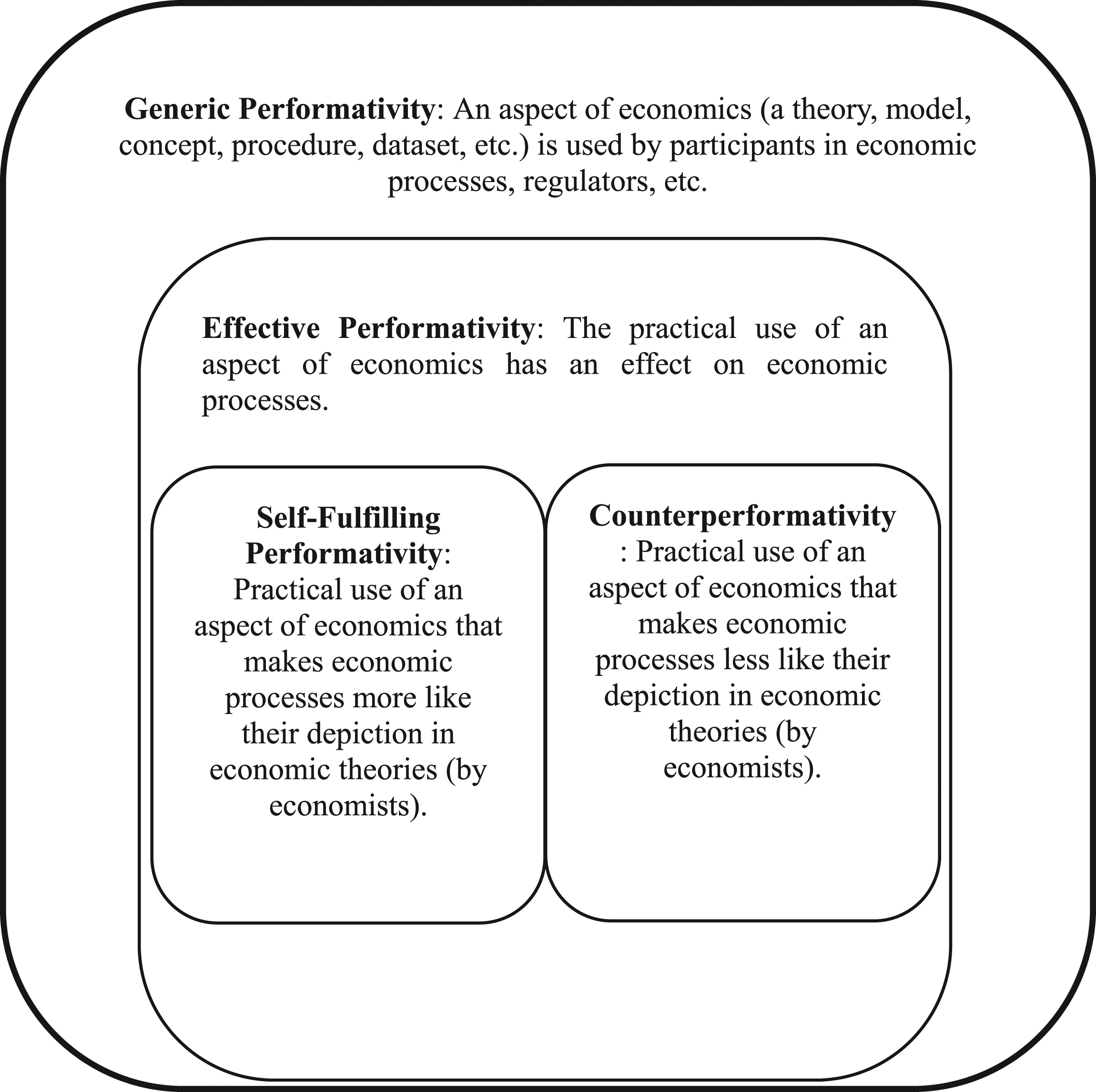
According to Mackenzie’s classification, generic performativity means that economic knowledge (theories, models, concepts, procedures, data sets, etc.) is used in economic activities and different types of regulation. Moreover, within the comprehensive generic performativity, there is a more specific effective performativity. This means that the practical application of economic knowledge impacts actual economic activity. Effective performativity can be classified into two specific types: self-fulfilling performativity 21 and counterperformativity. Self-fulfilling performativity is the practical application or use of economic knowledge that interprets economic activity as being closer to its depiction by economists, while counterperformativity is the practical application or use of economic knowledge that interprets economic activity as being less like its depiction by economists.
Therefore, generic performativity consists of effective performativity that includes both self-fulfilling and counterperformativity. The crucial distinction between generic and effective performativity is the scope of analysis and the degree of actors’ acknowledgement of the effects of a specific discourse. As to their scope, while generic performativity broadly represents macro-level social and economic dynamism, effective performativity is limited to specific contexts. Regarding the acknowledgement of effects, for instance, in MacKenzie’s analysis of the performativity of financial models, most of actors (financial traders) believed the possible effects of Black–Sholes option pricing models. However, in the case of broader generic performativity, some actors are skeptical about the effects of a specific theory or discourse. Under uncertainty, they try to follow others’ behaviors, which leads to generic performativity. For instance, many actors in many countries did not intend the effects of globalization, but many institutions have been shaped to perform globalization. Generic performativity can explain such a broader possible situation in which some powerful actors follow a collectively accepted theory or discourse under uncertainty because they cannot determine what is the most appropriate choice among other alternatives. For instance, although individuals and organizations in many countries did not know or foresee the effects of globalization, various institutions have been performatively shaped to achieve globalization. In that sense, globalization can be understood as an example of generic performativity. Social acceptance of a particular discourse is thought to provide the discourse with normative power (Okamoto 2020). For example, there are very few people who would outright deny the discourse that globalization (with its various definitions) has taken place in the past few decades.
Identifying generic performativity by observers or researchers is not an attempt to find direct causal relationships, but to explain a set of changes in behaviors and institutions. This is possible and useful because the identification of various causal relationships between social phenomena and social constructs cannot be completely objective. To support the incompleteness, George Soros (2013, 310) constructed a conceptual framework with two simple propositions. The first proposition is that in situations where thinking participants exist, “the participants’ views of the world never perfectly correspond to the actual state of affairs. People can gain knowledge of individual facts, but when it comes to formulating theories or forming an overall view, their perspective is bound to be either biased or inconsistent or both” (Soros 2013, 310). That is the principle of fallibility. The second proposition is that “these imperfect views can influence the situation to which they relate through the actions of the participants” (Soros 2013, 310). This second principle is the principle of reflexivity. For example, if investors believe that markets are efficient, this belief will change the way they invest, which in turn will change the nature of the markets in which they are participating (though not necessarily by making them more efficient) (Soros 2013, 310). Soros then went on to say that the combination of fallibility and reflexivity forms the human uncertainty principle. That principle “is much more specific and stringent than the subjective skepticism that pervades Cartesian philosophy. It gives us objective reasons to believe that the theories held by the participants, as distinct from statements of specific facts, are liable to be biased, incomplete, or both” (Soros 2013, 315). According to this analysis, social science is crucially different from natural science: humans are fallible and thus reflexively participate in and change social institutions.
Then, how do fallible and reflexive actors change institutions performatively under uncertainty? The theory of shared mental models developed by Denzau and North (1994) is useful for understanding this process. A mental model is defined as the internal representations that individual cognitive systems create to interpret the environment (Denzau and North 1994, 4). The development of shared mental models is possible because an individual interacts with a different individual through the communication channel of language and encodes/decodes ideas in each shared mental model environment (Denzau and North 1994, 20). Relying on the shared mental model, Mantzavinos (2001, 68) argues that when an individual faces a new problem the individual utilizes ready-made solutions from the environment instead of creating new alternatives ex nihilo each time. The ready-made solution is generally built into one’s cognitive system through communication. Acts of communication lead to shared rules between individuals and thus give rise to correspondent to shared mental models. Sharing mental models is equivalent to imitation that is a form of learning. 22 Imitation is an important means to overcome the uncertainty over actors’ own preferences and to express their social identity; in other words, imitation is an essential from of a performative mechanism of choice (Hermann-Pillath and Hederer 2023, 167).
Considering Soros’s argument of human fallibility and reflexivity, people’s shared mental models vary and change dynamically. As generic performativity consists of ad hoc myriad interactions between relatively detailed and specific self-fulfilling performativity and counterperformativity, the interpretation and identification of it should change as well. However, this does not mean that a collective acceptance of generic performativity cannot persist for a long time. We often see cases in which self-fulfilling performativity prevails for an extended period. The interpretation and identification of generic performativity at a specific point of time is a task for social scientists. The next section analyzes a specific case of financialization and argues it is a typical type of generic performativity that has been identified by researchers and observers and shapes social institutions in contemporary society.
4. Generic Performativity and Financialization
4.1. Financialization as Generic Performativity
As indicated above, there are at least two essential characteristics of generic performativity. First, it represents macro comprehensive social dynamism and shapes individual and organizational behaviors. It also shapes social institutions through various regulatory mechanisms. Second, generic performativity is explored and identified by observers and researchers. As a result, it tends to be retrospective and must, to a large extent, be collectively accepted to be performative. Therefore, the identification of generic performativity is interpretative in nature. Although it is observer-relative in the Searlean sense, this does not mean that such identification is not useful in social science—as it can provide a space in which social scientists can discuss a set of more specific institutions and behaviors from a consistent performative lens. This section will examine financialization as a case of generic performativity.
What is financialization? On the one hand, it has been defined broadly in previous literature. For instance, it was summarized as “the increasing role of financial motives, financial markets, financial actors and financial institutions in the operation of domestic and international economies” (Epstein 2015, 3). The impact of financialization might not be limited to the realm of international economy: “financialization refers to the web of interrelated processes—economic, political, social, technological, cultural, etc.—through which finance has extended its influence beyond the marketplace and into other realms of social life” (Van der Zwan 2014). An important aspect of financialization could be cultural, manifesting as the expansion and creep of financial ideas, metaphors, processes, and structures into everyday life and social institutions (Haiven 2014, 38). From these broad analyses, there would be no major disagreement that financialization represents a macro social dynamism.
On the other hand, some studies have introduced a slightly more limited scope in defining the concept of financialization. For example, regarding “accumulation” in the economy, financialization is defined as “a pattern of accumulation in which profit-making occurs increasingly through financial channels rather than through trade and commodity production” (Krippner 2005, 181). It is also argued to be “a macroeconomic structural phenomenon and a socio-political process that requires reconfiguration of social and economic institutions that support accumulation” (Gunnoe and Gellert 2011, 270).
In addition, financialization has been further defined in relation to the widely known political concept of neoliberalism: “Neoliberalism meant, in short, the financialization of everything and the relocation of the power center of capital accumulation to owners and their financial institutions at the expense of other fractions of capital” (Harvey 2006, 24). These varying perspectives reveal that different authors have interpreted financialization differently. However, they also indicate that financialization is now a collectively accepted social phenomenon even though it broadly encompasses different interpretations. The vague and comprehensive aspects of financialization are prominent factors of its collective acceptance.
4.2. Financialization Process through Institutional Devices
How does financialization proceed? At the very least, the spread of global financial technologies and financial theories are essential to the development of financialization, and social scientific studies have delineated its characteristics. From an actor-centric perspective, the key actors’ cognitive framework is regarded as “financial cognition.” It is the mutually formed cognitive framework of knowledge that includes specialized knowledge, tools, and various arrangements of financial transactions, which individuals acquire through education (Vollmer, Mennicken, and Preda 2009) or sharing mental models. The development and expansion of derivatives and securitization transactions in financial markets are typical examples.
As indicated above, generic performativity of financialization consists of varied financial knowledge, and it can be analyzed from a perspective of more detailed and context-specific effective performativity. When considering interactions of both self-fulfilling performativity and counterperformativity, an analytical perspective of “devices” is useful (Callon, Millo, and Muniesa 2007). Such a perspective emphasizes the driving aspects of institutions at a particular point in time or place by using the term “device.” For example, the use of “market device” is a simple way of referring to the material and discursive assemblages that intervene in the construction of markets. In a regulated market such as the stock market, formal or informal institutional devices have a significant impact on corporate behavior. Unlike generic performativity, effective performativity derived from those institutional devices can be recognized by a limited number of individual human actors in a specific context.
Many types of institutions can constitute performative financialization. Even corporate laws and accounting standards that regulate corporate financial reporting practices are analyzed from the perspective of performative financialization. This is because “accounting helps to make economics performative, being one of the instruments through which economics can make the world conform more closely to its descriptions” (Chiapello 2008, 12). Although financialization is interconnected with economics and economic theories, economics basically constitutes an academic discipline and does not represent social dynamism per se. In this sense, financialization is more suitable for demonstrating generic performativity. 23 On the basis of interviews with people involved in the process of company law reform, Collison et al. (2014) argued that recent amendments to UK company law have encouraged directors to prioritize maximizing shareholder value and neglect other stakeholders. In this case, the institutional device of company law (amendments) has encouraged financialization.
Furthermore, Zhang and Andrew (2014) focused on the conceptual framework project jointly undertaken by the International Accounting Standards Board (IASB) and the US Financial Accounting Standards Board (FASB). 24 They argued that the emphasis on “faithful representation” 25 and the relative decline in the importance of “reliability” 26 indicated the rise of financialization. Conceptual frameworks for financial reporting consist of a set of accounting theories and principles, and therefore they seem more abstract than detailed accounting standards. However, from the more generic perspective of financialization, even conceptual frameworks usually work within a limited scope of accounting and are regarded as institutional devices.
One of the key concepts in the financialization in terms of financial accounting is the fair value accounting. Under the model, corporations can use assumptions and estimates to revalue their assets on the corporate balance sheet. This practice has been accelerated by the development of modern finance theory. However, the traditional qualitative characteristics of accounting information “reliability” in the conceptual framework did not fit well with the trend as the “reliability” tends to evoke more material or contractual evidence. This can be interpreted as an effect of financialization in which the conceptual framework puts more emphasis on the use of accounting information by investors and shareholders for investment decision-making. Then, relying on the credibility of modern finance theory, the standards setters favored the expression of “representational faithfulness” to embrace fair value accounting. 27
4.3. Considerations to Alternative Performativity
The analysis in the previous subsections has provided a framework of performative financialization that encompasses changes of different types of institutions. As Little (2021, 20) has argued, “Part of the task of philosophical theories of SO is to uncover the generally unspoken presuppositions made by social scientists about the nature of the social world as they formulate theories and explanations.” But, as noted above, an exploration and identification of the generic performativity of collectively accepted social constructs is always interpretative and incomplete. Following Mackenzie’s (2006) classification of performativity, the pursuit of more detailed effective performativity (either self-fulfilling performativity or counterperformativity) in a specific context can be achieved by identifying anomalous results within a framework, suggesting alternative interpretations, or presenting new explananda. It can also facilitate inferences and explanations through an attitude of ontological skepticism that leads to doubting specific methods or treatments in a specific domain.
As shown in Figure 1 above, taking counterperformativity into account is useful at times. The identification of counterperformativity generally needs to be a pragmatic and detailed investigation in a specific context. However, this does not directly mean that the identification of generic counterperformativity is not feasible (or it could be an identification of alternative generic performativity). For instance, studies have highlighted aspects of “definancialization” in the limited context of a specific country (see, e.g., Lawrence 2014; Ban and Bohle 2021). However, both articles point out the obstacles to definancialization even after a highly criticized financial crisis. More specifically, there are still intimate relationships (the nexus of forces) such as state backups and the rising levels of indebtedness that have created the interlocking social, cultural, and political strengths of the financial sector in the UK (Lawrence 2014, 20). In an eastern European economy (Romania), the failure of definancialization is attributed to the lack of a central role for banks in the country’s growth model (Ban and Bohle 2021).
Furthermore, it is worth highlighting a recent analysis of financialization in terms of institutional changes in accounting. Zhang and Andrew (2022) have updated their previous arguments (Zhang and Andrew 2014) and taken a more critical stance toward financialized accounting. In their previous article, they pointed out the rise of financialization in the context of standard setters’ revision of the conceptual framework for financial reporting in 2010 (Zhang and Andrew 2014). 28 By contrast, in their examination of the revision of the conceptual framework in 2018, they focused on the (re)introduction of stewardship 29 as well as the new definitions and recognition criteria for corporate assets and liabilities. In the revised conceptual framework, the IASB reemphasized the provision of decision-useful information for resource-allocation decisions and broadened its understanding of such information to include not only buying, selling, and holding decisions, or decisions about providing or settling loans, but also “exercising rights to vote on, or otherwise influence, management’s actions that affect the use of the entity’s economic resources” (Pelger 2020).
This IASB’s stance was regarded as the coupling of stewardship with decision-usefulness. It was another “mechanism through which shareholder value might be secured, jettisoning many of the traditional attributes associated with the concept in the past” (Zhang and Andrew 2022, 12). Thus, by insisting on the future-oriented conceptualization of objectives in financial reporting, Zhang and Andrew (2022) argued that the revision of the conceptual framework in 2018 financialized the notion of stewardship.
At the same time, Zhang and Andrew (2022, 10) stated that “[w]hile the risk and volatility associated with financialization are serious concerns, if we focus only on these, other significant consequences may be overshadowed.” In particular, they noted the tendency of financial accounting to widen the gap between the mega-rich, the middle classes, and the poor, arguing that the accounting standard setter (IASB) must be encouraged to engage with a wider assessment of the effects of financialization on the current conditions, including intensifying economic inequality (Zhang and Andrew 2022, 10). As Sikka (2015, 50) argues, financial accounting has become a “celebration of the victory of capital over all-comers, including labour and the state” because conceptual framework that underpins financial reporting normalizes the priority given to financial capital over the planet, labor, and the state (Zhang and Andrew 2022, 11).
In short, in their most recent analysis, Zhang and Andrew imply the alternative effective performativity of economic inequality that affected the changes in the conceptual framework of financial reporting in 2018. 30 While they still admit the ongoing financialization in the conceptual framework of accounting, how it interacts with performative aspects of economic inequality emerges as an interesting research topic. Zhang and Andrew’s attempt represents an identification of a different type of effective performativity that facilitates further understanding of the generic performativity of financialization.
5. Conclusion
This study aimed to reveal a possible application of SO to social scientific studies. By contrastively analyzing major streams of SO research and a recent debate, the study has elucidated the significance of exploring and identifying the rhetorical representation of collectively accepted social dynamism. Philosophical studies of SO have provided theoretical frameworks within which social and institutional reality exists with conceptual apparatuses, such as collective acceptance, status functions, and emergent social positions. However, we still need a bridge between such philosophical achievement and more specific real social phenomena. The concept of performativity can play the role because it reflects the process of the collective acceptance of specific linguistic representations.
Although identifying such performativity is challenging because it involves scholars’ and observers’ interpretations, this study has introduced a perspective of different types of performativity. In addition to focusing on self-fulfilling performativity and counterperformativity in a specific context, an exploration of more comprehensive generic performativity can be compatible with SO. Social scientists are positioned well to identify generic performativity from a specific standpoint. As Barnes (1983, 524) argued, “The social sciences seek to refer to referring activities in general,” and such attempts are supported by the essence of SO.
To demonstrate such an attempt, this study focused on financialization in a specific context. Arguing that financialization shapes relevant institutions and is constitutive of various more detailed institutions and that human actors are occasionally unaware of it when they act, the present study particularly considered recent changes to accounting standards from the perspective of performative financialization.
Although this study emphasized the significance of scholars’ exploration and identification of generic performativity, some may argue that social scientists have long conducted such tasks implicitly. However, highlighting them through the lens of SO is useful because it draws the attention of more scholars in philosophy and social science to the identification of generic social dynamism. Social scientists tend to avoid discussing generic performativity because it is vague and abstract. Nevertheless, perspectives and analyses in SO are helpful to understand the basic mechanism of performative linguistic representations that shape social institutions in different domains.
Footnotes
Declaration of Conflicting Interests
The author declares no potential conflicts of interest with respect to the research, authorship, and publication of this article.
Funding
The author(s) disclosed receipt of the following financial support for the research, authorship, and/or publication of this article: This work was supported by JSPS KAKENHI (Grant Number JP22K01796).
