



Abstract
This article attempts to highlight the role of Field Action Projects (FAPs) and field education for students of social work, the role that institutions of higher education can play in grounding students in critical areas of practice and innovation towards relevant interventions at multiple levels in society. The article is divided into two sections. The first section delineates the historical underpinnings of professional social work education in the country and the importance of field work and field action in social work education. The second section discusses two FAPs in the area of socio-legal practice and its impact on the field, policy and curriculum which Tata Institute of Social Sciences has initiated and developed over the past three decades.
Introduction
The social work education in the country grew in response to the changing needs of post-colonial India, which had adopted a liberal-democratic, socialist and ‘Welfare State’ structure, whereby social welfare and social inclusion were the keystones to the nation-building process. The political economy paradigm envisaged that while development of the country would ‘happen’ through economic growth spurred by a ‘mixed economy’, social progress would take place through the reservation policy and a series of welfare schemes and measures, that is, through the protection and care of vulnerable sections. A plethora of welfare legislations were passed to provide ‘institutional care’ for sections living on the social fringes. These developments led to the need for the creation of personnel well-versed with care-giving and rehabilitation. The social welfare departments required trained human resources, as did the voluntary sector, which had taken roots in society by the mid-1950s. The nature of welfare legislations and policies adopted by the law and policy makers led to an emphasis on the problem-solving paradigm and the clinical approach in social work, based on the American model (Mandal, 1989). By then, the first social work education facility set up in the country in 1936 by an American missionary, Clifford Manschardt, and the Sir Dorabji Tata Trust and later renamed the Tata Institute of Social Sciences (TISS), was well and truly established (Pathak, 1981).
The TISS Mumbai Campus was inaugurated in 1954 by Jawaharlal Nehru, the then Prime Minister and an advocate of ‘modernising India’. His inaugural address acknowledged the importance of trained social workers in the nation-building and reconstruction process. Referring to the work done by a team of faculty and students from the Institute in Kurukshetra during the post-partition riots, Nehru highlighted the ‘difference in their work and the work of many others who were earnest and had done their best, but who did not have the training to do it well’. He further emphasised that ‘there is a difference between the trained workers and the merely enthusiastic workers’ (TISS, 2011). Gradually, many more university departments across the country started social work programmes, both at the under graduate and post graduate levels. Today, there are more than 100 such university departments and deemed universities imparting social work education in the country (Webindia123.com, 2011).
Social work being an applied social science discipline, the emphasis is on teaching and learning through praxis, that is, a two-way reflective process between theory and the field. This aspect of the educational process is variously captured through processes such as concurrent and block field work, internship and practicum under the broad umbrella of field education. For example, out of a total of 78 credits in the current Masters programme in social work at TISS, 24 credits are allocated for field work and 2 credits for a rural practicum (TISS, 2010).
Field Work and Field Action as a Laboratory for Social Work Education and its Emerging Link with Socio-legal Work
Field learning lies at the heart of social work education. It immerses the social work student in an extraordinary range of human and social problems that lead to better understanding of social realities. It also gives one an opportunity to both develop skills and appreciate the realities of coping with complex problems in the context of developing specific services and delivery systems. It exposes the social work student to work with a wide range of populations in diverse practice settings (Andharia, 2011; Noble, 2001; Subhedar, 2001).
At its core, the field work emphasis in social work practice promotes social and economic justice, advances learning as a relationship-centered and reflective process and prepares the learner for work with individuals, groups, families, communities, systems and oppressive social structures. The purpose of field education in social work is to provide the student with an interface between classroom education and actual practice. The student is provided with opportunities to develop practice skills by applying classroom theory to real life situations, determine which approaches work in practice and how they must be adapted to specific situations, begin to engage in self-assessment and develop trained personnel for the social sector.
A related key strategy to situate social work education as close to ground realities as possible is the setting up of Field Action Projects (FAPs). FAPs are experimental and demonstration projects which have played a ‘major role in piloting or pioneering new services’ through social work intervention by its faculty, students and project staff ‘with the objective of demonstrating to the public, the need for such services’ (TISS, 2001:5). Further,
Field action projects are thus an integral part of validation or revision of such a practice–theory continuum. These projects fulfill several objectives of professional education, and have evolved over the years due to various internal and external factors. They have emerged as a form of demonstration of new interventions and possibilities in order to test their efficacy, which then could be emulated by others; as a response to new needs, to changing social realities, or from other social movements or campaigns; to enable faculty to develop academically and keep in touch with field practice; and to provide students opportunities for learning new interventions and formulation of creative strategy for greater relevance in practice. (TISS, 2001:5)
Many of these projects have led to law and policy change and have been absorbed as government programmes over a period of time. Some examples of TISS FAPs include a Child Guidance Clinic attached to a pediatric hospital in Mumbai way back in 1937 (now a permanent initiative of TISS and renamed Muskaan, which means ‘smile’ in the Hindi language), a helpline for children in vulnerable circumstances named Childline (now absorbed as a nationwide Government of India programme) and the Counselling Cell attached to the Bombay High Court (which led to the introduction of counsellors within the judicial machinery as part of the Family Courts Act). 1
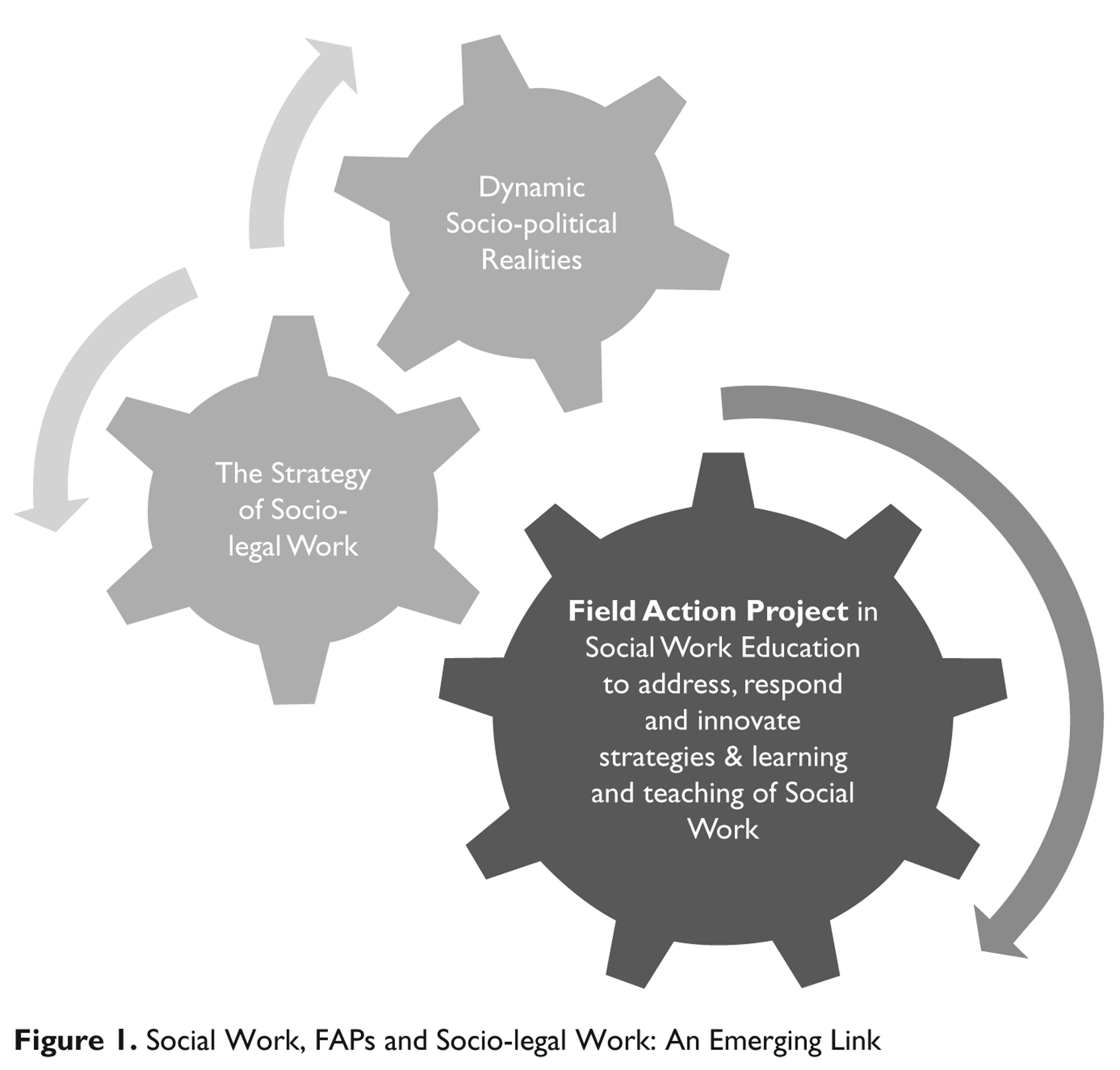
These FAPs are a unique response to field realities, especially in the Indian context which is embedded in complex socio-politico-economic structures and contradictions calling for relevant and nuanced responses which social work practice can develop and offer. They highlight the role that higher educational institutions can play in engaging with the community from a constructivist viewpoint. FAPs also offer social work educators and students a platform to enter social phenomena while they are playing out and get a phenomenological understanding of the same by planning and implementing interventions and actions around them. This, in turn, deepens their understanding about social realities and helps them devise strategies and programmes from the vantage point of the marginalised, excluded and exploited sections. Professional social work practice in the west has had a strong leaning towards psycho-social intervention owing to its origins in clinical settings, with a focus on service delivery and rehabilitation. However, with increasing socio-political contentions and conflicts, the challenge before social workers today is to be able to respond to contesting claims within a larger democratic framework based on the socio-cultural, civil and political rights of its citizens. Socio-legal practice has emerged as one of the orientations within social work to respond to these changing realities. Socio-legal practice calls for an understanding of socio-political realities and an emphasis on intervention bound by laws which protect the rights of marginalised and vulnerable sections. The limitations of a purely legalistic interpretation and approach to address rights arising from the interplay of power structures within the social fabric has led to the conception of a socio-legal approach, which emphasises on weaving the social with the legal. In this approach, law is viewed as a dependent social phenomenon, implying the need to develop a sociology of law which asks the question ‘what is society’ rather than ‘what is law’. This approach critiques the epistemological underpinnings of traditional jurisprudence and calls for an approach which requires the inter-weaving of social structure, social control and social change with legal reality, in the context of social reality (Schiff, 1976). One of the trajectories through which socio-legal practice has found a voice in social work is some of the FAPs working in domains where the citizenry, particularly the marginalised sections, come in contact with the various systems and sub-systems of the State (see Figure 1).
Social Work, FAPs and Socio-legal Work: An Emerging Link
In this context, the criminal justice system (and its allied systems) is perhaps the only system mandated by law to interfere with the life and liberty of citizens, as per laid-down procedure, under Article 21 of the Constitution. The IPC, the CrPC, the Evidence Act and the Special and Local Laws (SLL) constitute the body of legal statutes which give flesh to this Article. The mandate of the Criminal Justice System (CJS) under the criminal jurisprudence of the land is to prevent, restrain and ‘take charge’ of individuals who do not respect the life and liberty of other citizens, as also to prevent the breakdown of and maintain law and order, an essential function of any State. In order to perform these functions, the CJS functionaries have been bestowed enormous powers, along with duties and responsibilities. The ensuing interface between the citizen and the State through the CJS, therefore, is fraught with contestations. In this process, a thin line exists between performances of duties and overreach by the State. It is for this reason that the CJS functions on the basis of the principle of separation of powers and the existence of a multiplicity of agencies performing different roles. Currently, this separation of powers occurs through the existence of the police, the prosecution, the judiciary and the custodial institutions, including the penal and protective.
The role of the trained social worker comes into play in this context. The School of Social Work at TISS has been experimenting and demonstrating this role in the system through two of its field action projects, namely the Special Cells for Women and Children and Prayas, for well over twenty five years now. These projects have been placing trained social workers at police stations, courts, legal aid systems, prisons and women’s and children’s institutions and studying the impact of this placement, both on the citizens who get processed by the CJS as well as the system which processes them as per the law. The following section highlights the work of these two FAPs, both functioning within the context of the CJS and attempting to impact on the field and curriculum, through praxis.
About Prayas 2
Background
Prayas is an FAP of the Centre for Criminology and Justice, School of Social Work, at the TISS, initiated in response to the needs of disadvantaged groups being processed by the CJS. One of the outcomes of Prayas’ work has been that it has contributed knowledge and insight to the current understanding of socio-legal aspects of CJS policy and process in India—with specific reference to socio-economically vulnerable and excluded communities, groups and individuals who are at greater risk of being criminalised, or exposed to trafficking for the purpose of sexual exploitation.
Rationale
Prayas’ experience of working in the CJS over the last twenty-two years, with persons in crime or commercial sexual exploitation or vulnerable to negative forces, substance abuse, destitution or street life has revealed that structural factors 3 and negative experiences may lead individuals without social support to drift into exploitative situations or into crime. This may further lead the person to adopt alternative supportive structures and behaviours to counter life situations. Subjected to a series of exploitative situations, there may be a tendency towards actions that are destructive to self or others.
Separation from the family and socio-cultural structures leads to the social exclusion of these persons. When processed by the CJS, they get marginalised within the system and become invisible to mainstream welfare agencies, as categories of persons requiring support or assistance. This results in their further isolation and denial of basic rights as citizens. They become socially and economically disadvantaged and are unable to mobilise themselves, leading atomised lives. In terms of affected population, there are around 3.6 lakh persons in prisons in the country and an equal, if not more, number in custodial institutions for women and children. Nearly 70 per cent of them are under trial prisoners (UTPs), most of them without access to legal aid and with poor or no family/community support (Government of India, 2009).
Origin, Location and Outreach
The project was initiated by a faculty member of the Department of Criminology and Correctional Administration (now the Centre for Criminology and Justice), School of Social Work, based on five years of placement of students of the Department for field work within the CJS (Kakarella and Menachery, 2006; Prayas, 2005). Initiated in 1990 as a social work intervention project with under trial prisoners, currently the project is based in prisons, police stations, legal aid systems, women’s and children’s institutions and community-based rehabilitation centres in three districts of Maharashtra and Gujarat. The project reaches out to women and male youth in prisons or in protective custody, trafficked women and/or those forced into commercial sexual exploitation, families of CJS affected population, including children of prisoners, persons released from custody and persons vulnerable to crime, victimisation or sexual exploitation.
Areas of Focus
It has been observed that the groups of persons focused upon are those with multiple handicaps. They have been picked up by the CJS and referred/sent to either shelter homes or to custodial settings. In addition to the experience of being processed by the CJS and the consequences of that experience, a large percentage of them face social/other handicaps as well. Physical, mental or behavioural handicaps also exist, thereby creating further distance from mainstream agencies including the welfare sector. These along with educational and vocational limitations restrict the person’s opportunities to livelihood and may determine—under the given circumstances—dependence on an alternative system for sustenance. The fact remains that where these persons are neglected by the mainstream, legal sector, there exists an alternative sector (primarily illegal) that has the capacity to absorb them. A programme aimed to overcome the handicaps faced by such persons and counter the illegal sector therefore assumes importance.
The strategy adopted consciously allows for increased access to the system while creating avenues for intervention within the same. The absence of welfare mechanisms has necessitated direct intervention and work with the administration. While this has increased knowledge and understanding of relevant processes and procedures, it has also demonstrated the need for intervention for vulnerable groups within the CJS and subsequently enabled advocating alternative procedures and initiatives.
Interventions in this area have been focused at two levels: the individual and the system—namely the criminal justice system and those having relevance to the processing of the individual. The approach involves a blend of field intervention, training and capacity building of CJS functionaries and NGOs, improving co-ordination between the various wings of the criminal justice and welfare systems, research and documentation, advocacy through involvement in PILs and engaging with government departments at state and national levels, networking with related academic administrative and civil society organisations to create fora for specific issues and exposure and training to students of social work and law.
Developing a Rehabilitation Model
Prayas has evolved a rehabilitation programme for custodialised populations, called the NGO Placement Programme (akin to a community-based apprenticeship or on-the-job placement programme), to address the needs of affected groups and serve as a model for developing livelihood options for affected persons. The outcomes of this programme include increased employability of clients in the NGO sector, access to banking facilities and citizenship documents, reunion with family or strengthening of family bonds and finding alternative shelter and pro-social relationships.
Policy Change
Simultaneously, the knowledge gained through this programme has led to dialogue with the authorities concerned and alterations in procedures relevant to processing of persons within the criminal justice system and introduction of components that address the needs of the persons attempting to move away from illegal/exploitative situations. Indicators of these include a GR 4 issued by the Department of Women and Child Development, GoM, to improve the condition of shelter homes for women, police circulars (P.N. Para) 5 to prevent arrest on suspicion, improved prison conditions as a consequence to participation in Public Interest Litigations 6 and suggestions made to concerned departments with regard to processing of the person within the various systems in order to bridge gaps therein and suggest alternatives.
Prayas has been organising and providing inputs in training programmes and capacity building exercises for government officials, colleges of social work and civil society organisations, focusing on legal and rehabilitative aspects for vulnerable sections in CJS. As an outcome of these exercises, issues relevant to the building of a structure that enhances protection of the affected persons and families and their reintegration into the legal economy have been highlighted.
An attempt has been made to draw civil society groups working with marginalised sections to work with prisoners and/or their dependants on issues such as pre-primary education for children of prisoners, vocational training and legal aid. Prayas has mentored and supported social work projects and initiatives to work in prisons, juvenile institutions and with victims of crimes in various parts of the country. 7
To date, there exists no comprehensive scheme 8 for rehabilitation of persons discharged from such systems. The existing schemes lack the ingredients for equipping persons with alternative livelihood options. The voluntary sector has taken some initiative in this regard, though the focus seems to be more on custodial conditions and access to justice, rather than on the post-release situation.
Curriculum
The work of Prayas has had a lasting impact on curriculum building in the field of criminology and criminal justice social work. This has been made possible through multiple routes. Students of social work and law have been exposed to field realities and engaged with vulnerable populations interfacing with the CJS through concurrent and block field work and internships, and in fact, have helped build and strengthen the work of Prayas. Staff at Prayas are regularly invited to take guest lectures and as visiting faculty in social work institutes and colleges in Maharashtra and Gujarat to enrich their existing curriculum and pedagogy. Prayas has been organising workshops and orientation sessions for faculty and students to encourage them to start field placements and field action projects in criminal justice settings in Maharashtra and Gujarat. The work of Prayas has fed into two of the concentrations 9 developed by the Centre for Criminology and Justice in the School of Social Work, TISS. More specifically, one of the courses titled Social Work Methods in Criminal Justice (now titled Issues and Challenges in Criminal Justice Social Work) has been substantively strengthened through the experiences of Prayas. Sudhar, an NGO based in Bhopal, which was mentored by Prayas during its initial years, has designed a Certificate Course in Criminal Justice Social Work in collaboration with the Indira Gandhi National Open University (IGNOU), Delhi.
About the Special Cells for Women & Children in Police Offices
Background and Rationale
Violence against women and girls is one of the most widespread violations of human rights (UNIFEM, 2011). It can include physical, sexual, psychological and economic abuse, and it cuts across boundaries of age, race, culture, wealth and geography. It takes place in the home, on the streets, in schools, the workplace, in farm fields, refugee camps, during conflicts and crises. It has many manifestations from the most universally prevalent forms of domestic and sexual violence, to harmful practices, abuse during pregnancy, so-called honour killings and other types of femicide. The patriarchal society recognises a woman in terms of her relationships with men, perceiving her as a daughter, sister, wife and mother and does not recognise her as an individual in her own right (ibid.).
The primary goal of setting up Special Cells for Women is to respond to violated women’s right to social services; hence the Special Cell for Women and Children is strategically located within the police system. The programme supports the community of violated women and the police system to find services and justice. The differential strengths and contributions of the police system and Special Cell for Women and Children enable a coordinated, multi-agency response to the issue of violence against women. Thus through its location in the police system Special Cell creates an emotional, physical, psychological and legal space for the violated woman within the criminal justice system where she can address her needs and concerns within a facilitative environment and rebuild her strength to struggle for her rights. This strategic location allows women to approach Special Cells from all strata of society and to enable a multi-faceted response to the complex issue of violence against women in the interests of the violated woman.
Contextuality and interrelatedness of these cases to larger structures and systems is central to our understanding. The central question then is: to what extent can we strategise and or negotiate? The need is for fine and detailed work with the individual without losing sight of the larger end/goal from being achieved. For this to be meaningful it requires sufficient planning and reflection on the methods used, to maximise results as well as their effectiveness. More importantly, this balance has to be maintained leaving enough room for flexibility due to changed situations. Any one uni-dimensional picture may damage lives and future potential for work especially as we are engaging with the highly unpredictable race of human beings, mostly guided by their emotions and deeply ingrained socialisations.
Structure of the Special Cell
Every Special Cell has a uniform structure and administration:
Each Special Cell has two trained Social Workers with a Post Graduate degree (in Social Work/Social Sciences). These are full-time paid workers appointed to give emotional support, legal advice and all assistance to the survivors of crime against women and children. Each Special Cell is located within the police station or office. Each Special Cell shares infrastructure with the police station or office where it is located: writer, postage, furniture, telephone, space and vehicle. One Coordinator for 10 cells. The Programme Coordinator and now the state level monitoring committee too overlook the work of the Special Cell. There is regular interaction and sharing about work with the police, right from the police station to the office of the Deputy Inspector General (DIG) and Prevention of Atrocities against women (PAW).
Key Defining Areas of Intervention
Providing emotional support and strengthening the psychological self
The woman who approaches the Special Cell for help is severely affected by the violence inflicted on her. She is usually in a state of crisis, resulting from a single incident of violence or a precipitating event in a history of incidents of violence. She tends to feel helpless and experiences fear along with a sense of low esteem. She is mentally, emotionally and physically overwhelmed as well as exhausted and her energies need rebuilding. She is under a lot of stress, is confused about the options available to her and is not in a state of mind to make a rational decision. In this situation it is important for the social worker to provide emotional support and strengthen her to take her own decision.
Engaging police help
Engaging with police help is one of the core area Special Cells’ work. The Special Cell was started with the aim to create a space for violated women coming to police stations. This strategic location of the Cell helps to give the woman a certain amount of confidence by enabling her to observe the positive assistance and interaction with the police. Thus, the social workers need to engage with the police system at an in-depth level, understanding the hierarchies, job descriptions, functioning methods and roles of the police by maintaining familiarity through constant dialogue. Being located on the premises of a police station facilitates in eliciting people’s cooperation.
Legal aid
The Special Cell works with an inter-systemic approach involving the understanding and resolution of issues/problems at various levels. Here the issues/problems are not looked at or approached in isolation but are studied from different dimensions and their resolution is sought from a variety of support systems surrounding them. The support systems may offer a range of resources, such as legal knowledge, medical expertise and so on, which can be utilised to resolve the issues/problems. In Special Cell interventions to support women victims, the social worker approaches various support systems. This involves the creative use of spaces/systems at all levels; and interventions are designed to make optimum use of the existing resources that different systems offer. This requires constant dialogue between the agency and the systems, which facilitate ideological exchanges. In order to have a systemic approach one has to know and study the various systems thoroughly so that interventions can be designed skillfully.
Special Cells in Twenty Seven Years
The Special Cell for Women and Children was established in 1984 as a joint effort of the Mumbai Police and the TISS to provide professional support services to women and children facing violence. In the last two decades, the Special Cell has provided services to a large community of violated women; been a training site for young social work student and the police, and for research; and most importantly it has shown that a strategic alliance with the police can make a significant impact on women’s search for support and justice. The Special Cell’s experience of a strategic alliance was an effective response and it was recommended by the state Task Force on Violence against Women that the state adopt it.
In 2001, the Government of Maharashtra was supported by UNIFEM to expand the Special Cell to ten locations across the state. A Memorandum of Understanding was signed between the Government of Maharashtra (Departments of Home and Women and Child Development), TISS and UNIFEM, wherein TISS’s role included execution, expansion, monitoring, supervision and documentation of the work. At the end of three years, as planned, an evaluation was undertaken to ascertain if this could be made a ‘regular administrative measure’ to address the issue of violence against women. An evaluation study carried out by an independent consultant for the Special Cell found that ‘more than 90 per cent women felt that the Cell worker heard them sincerely and had understood their problem’ (Apte, 2004). They felt that they were given respect and focused time and attention and felt like returning to the Cell (76.9 per cent). According to 77.2 per cent of women, the approach of the Cell workers to the problem solving was among the biggest reasons why the woman wanted to return to the cell for problem solving (ibid.). 93.4 per cent women feel that they would like to revisit the Cell for help in case of further need in future (ibid.).
An overwhelming percentage (92.7 per cent) of women felt that they would recommend the services of the cell to the other women and some of them have already done so. Carrying forward the same trend, 92.7 per cent clients conveyed that it was essential to have the Special Cell within the police station because they felt that women alone could understand women’s problems. About 57.4 per cent women were satisfied to a great extent and they felt that they got appropriate help, while 31.4 per cent women were somewhat satisfied. They felt that the Cell worker understood the problem and provided the support and the problem was partially solved, while 9.6 per cent women were not at all satisfied. Here none of the expectations of the women were met.
Considering the complexity of the problems for which women approach the Cell, infrastructural limitations, limitations of judiciary, police, time and personnel, the positive response from women is amazing. Nearly 94.7 per cent police officers of the rank of Police Inspectors to the Superintendents of Police interviewed during the course of the study expressed the need for the services rendered by the Special Cells. As many as 84.2 per cent officers refer cases to the Special Cell in their areas. Further, 27 per cent of these police officials have also participated in the trainings organised by the Special Cells for various levels of the police personnel (Apte, 2004).
The Special Cells are now (since December 2005) a programme funded by the Government of Maharashtra and presently jointly administered by the Government of Maharashtra (Departments of Home and Women and Child Development), the TISS and civil society organisations. This intervention model of the Special Cell was reviewed by women’s organisations and the police department in Rajasthan and adopted in the 2002 as Mahila Sahay Avam Salah Kendra in eleven districts of Rajasthan. In Andhra Pradesh, state police and women’s organisations have had similar meetings and visits to understand the work of the Special Cells, leading to the setting up one Special Cell in Hyderabad in 2005. Under the UNDP-SAJI project in 2007, Special Cells for Women were demonstrated as a strategy in two districts of Haryana and one in MP. At the end of the project, the Government of Haryana requested TISS to be a consultant to expansion of the Special Cells in Haryana over the next two years. The Special Cell team supported and shared its experiences and expertise with them through meetings, trainings and visits, and enabled this expansion in a period of one year.
The Special Cells have developed learning and insights from working with the systems, and have especially developed the skills of working with the Criminal Justice System. Stepping out of Bombay and Maharashtra has given them an opportunity to test and contest their understandings, responses and strategies to Violence against Women, to recognise and confront different realities of the states/regions—their socio-cultural and social-political environments within which strategies and responses need to be carved. This has meant grasping the nuances of cultures, being discerning and perceptive too. Simultaneously, they began a process of consensus building with different stakeholders (both government and civil society groups) to respond to violence against women.
Police Training on Violence against Women
The work done by the Special Cell over the years has helped in developing an in-depth understanding of the issues and concerns of violated women as well as the Criminal Justice System and the Police. The experience of working with violated women has fed into preparing training material and conducting research. The research findings of the work of the Special Cell are used to monitor, reflect and enhance practice. It is shared with social work professionals, police, the women’s movement and other social work practitioners.
Trainings are conducted with different professionals in the Criminal Justice System such as the Police, the Judiciary, the Prosecutors and the Probation officers, medical practitioners and so on, on sensitisation towards issues of violence against women. The purpose is to have a concerted effort to stop violence against women and also enable women to attain justice in the long run with effective investigation.
Curriculum
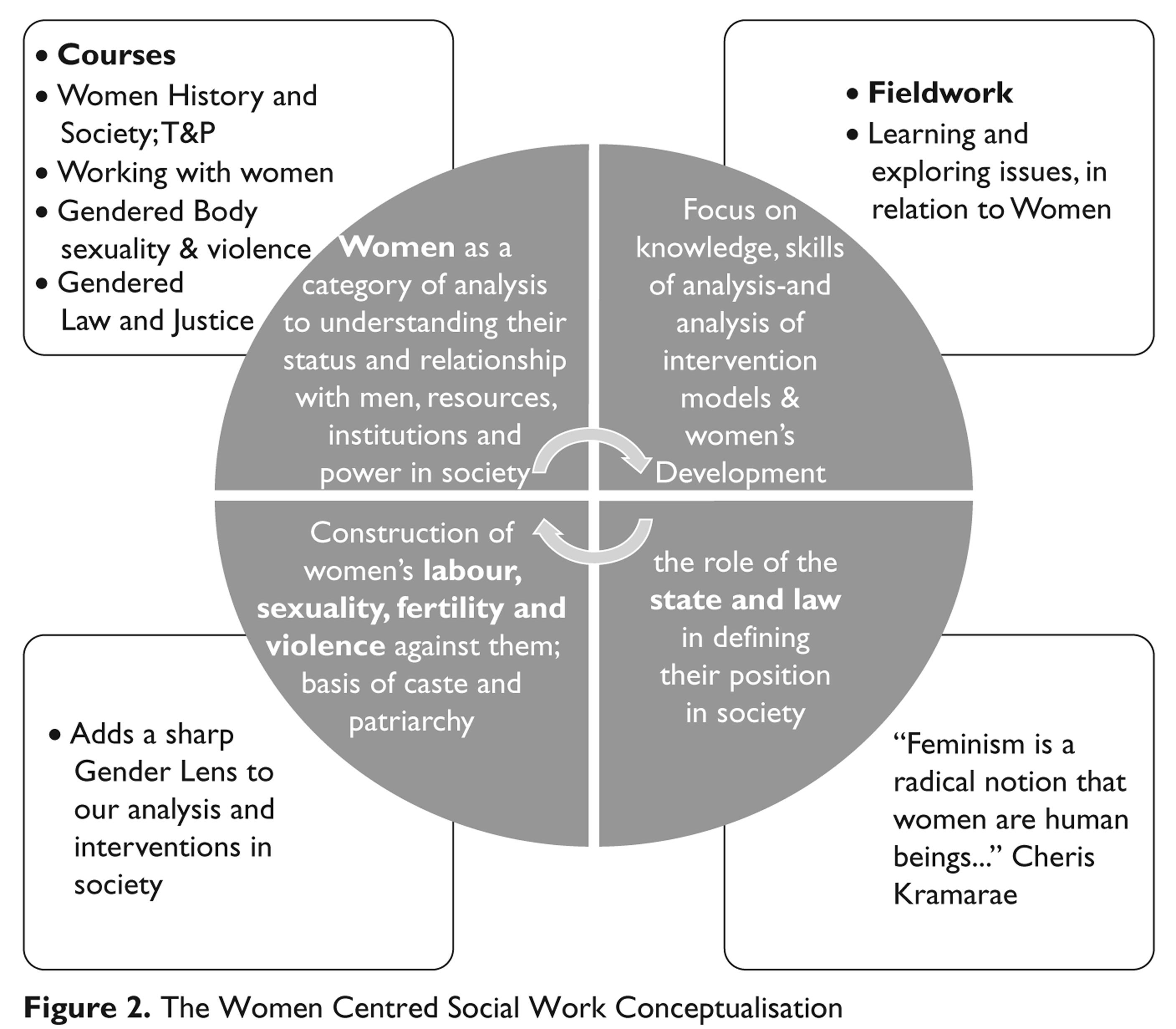
This experience of working on violence against women had helped us understand the layered ‘living’ of women’s existence, the complex realities of the oppressive social structures as well as the missing political will of many stakeholders for social change. The engagement with women, institutions and systems has provided a comprehensive understanding of what more is needed to be drawn/absorbed into the social work curriculum. The Field of Practice (FoP) Concentration—Women Centered Social Work in the new restructured MA programme in Social Work, at the Institute in 2006—was shaped and guided by these realities.
The Women Centered Social Work Conceptualisation (Figure 2) was first drawn in 2009 to introduce the FoP to the new students (Dave, 2009). To build critical thinking in the students of social work who are being readied for evolved interventions at multiple levels, the emphasis in the curriculum was on developing understanding on the subject ‘Women through the feminist lenses’; building skills of analysis and analysis interventions; and the role the state and law in defining women’s position in society. The course content and structuring of field work was designed to suit these requirements.
The Women Centred Social Work Conceptualisation
Conclusion
The work of the two FAPs of TISS in this article brings out clearly the role that universities can play in facilitating processes whereby the student community can play a larger role in contributing to build a more inclusive society. If higher education has to have meaning in a complex world, it would need to address the learners as thinking actors. Today’s contestations around caste, gender, disability, sexual orientation and the urban-rural divides require an in-depth study and analysis of social and political oppositions, whereby learners need to develop their perspectives towards their individual and community concerns. Higher education cannot afford to further dichotomise people as solidified classes of intellectuals and doers. Rather than alienate them from our own realities, it has to aid in the process of creating grounded persons. To this end, it must gear itself to develop pedagogy and a political will for multi-disciplinary and inter-disciplinary conceptualisations of interventions for people’s well-being. Education can continue to be a tool of social development if it is politically alive to the ideals of its society.