




Abstract
Dams are claimed as symbols of development for their multipurpose utility and contribution to the welfare of mankind. But compulsory displacement caused by dams has raised major issues of social justice and equity. Contextualising the Rawls’ general conception of justice and examining the case of the Hirakud dam, this study illustrates how the oustees not only lost their income and wealth but also social goods (liberty, opportunity and the very basis of their self-respect) raising the question of equality and justice. Initiatives to rehabilitate them by the Indian state of Odisha proved to be a total failure because of poor planning and a callous attitude. Better consultations and negotiations with the oustees could have mitigated the risk of their impoverishment; it can be argued that relocation would not have been involuntary. But the government did not consult those whose vital interests were at stake. They could have been resettled and rehabilitated in the irrigated area of the Hirakud dam and would not have lost their only source of income and their self-worth would have received a boost.
Introduction
The fundamental promise of large dams in the twentieth century was to provide abundant water and energy. It is ironical, therefore, that despite the enthusiastic implementation of the promise of big dams, we still live in a thirsty world which is likely to get thirstier. More than a billion people lack access to safe drinking water and high-yielding crops and new industrial technologies often require enormous amounts of water. On the other hand, the demand of energy seems limitless. The forecasts of global fresh water and energy supplies in the decades ahead are often gloomy. While dams have yielded some benefits, even if these have often been distributed unevenly, the study of World Commission on Dams (WCD) has noted that there has been a high degree of variability in the performance of dams, with some being plagued by numerous problems and others being relatively problem free. Generally, multipurpose dams face more difficulties than single purpose dams (Klingensmith, 2007: 10–11; World Commission on Dams, 2000: 37–68).
There are number of studies on dams and involuntary displacement and these studies have shown that construction of dams force people into new physical settings, which are alien social worlds, functioning on unfamiliar lines, and they enter at a structural disadvantage, having little educational, cultural or financial capital. The most outstanding study on involuntary displacement and its socio-economic impacts (Cernea, Impoverishment Risks and Reconstruction Model), says that displacement leads to the social exclusion of certain social groups of people. It culminates in physical exclusion from a geographic territory, and economic and social exclusion from a set of functioning social networks. Thus, affected people face a broad range of impoverishment risks that includes landlessness, joblessness, homelessness, marginalisation, food insecurity, increased morbidity, loss of common resources and social disarticulation that result in a loss of socio-cultural resilience. Among the oustees are aboriginals or tribals. This inevitably means a transfer of power over rivers as resources: away from local control and customary law to bureaucracies and state regulation. Even, rehabilitation efforts are made for the displaced by governments; it varies widely and it occurs in the context of the social relationship of power (Cernea, 1995: 266–67; 2000: 3663–66). In this context, this study is on the broader issue of development, displacement and rehabilitation consequent to the construction of the Hirakud dam in the Indian state of Odisha. The study aimed at (a) assessing the benefits of the project as projected; (b) the nature and extent of displacement and its socio-economic impacts; and (c) resettlement and rehabilitation facilitated to the oustees in order to understand the dispensation of justice (as conceived by Rawls).
Dams as Development
Referring to the development strategy after the Second World War and economic growth as its indicator, countries both in the developed and developing world started to grow their economies. The availability of adequate infrastructure facilities is vital for the acceleration of economic development of a country. Governments across the world have given high priority to investment in sectors such as railways, roads, power, telecommunications, ports and industries, etc. Thus, dams are the outcome of this process and symbols of development and their multipurpose utility (Bandhopadhyay et al., 2002: 4108; Joyce, 1997: 1050–55).
Falling water is the source of one-quarter of the world’s electricity today. Despite the billions of dollars spent on nuclear power, hydropower maintains a substantial lead over nuclear energy given the myriad economic and environmental problems facing nuclear power. Compared with other sources of electricity (oil, coal and nuclear energy), hydropower has environmental advantages. In a world suffering from inflation and fossil fuel depletion, hydropower offers stable prices and permanence. Hydropower complexes will be producing power long after the oil wells run dry and coal fields are exhausted, if properly managed (Deudney, 1981: 5–6).
It was during the nineteenth century that hydropower became a major source of electricity as well as of mechanical power. In 1820, the French engineer Benoit Fourneyron invented the turbine. In 1882, it was first used to produce electricity and it steadily increased the world’s electricity supply. At first, this technology was widespread in the developed countries especially in the United States and the Soviet Union in the 1930s and also shifted increasingly to the Third World. The success of large dams in the developed countries has drawn many Third World leaders to this energy source and pronounced these as highly visible symbols of progress that facilitate the growth of heavy industry and enhance the prestige and value in developing countries (Deudney, 1981: 6–19).
There was a rapid increase in large dam construction during the last century. In 1900, there were only 600 big dams in existence and many of them were built in Asia and Africa. It grew about 5,000 big dams by 1949 and by the end of the twentieth century over 45,000 large dams were built in over 140 countries. Thus, over 90 per cent of big dams were built over the last 40 years (Khagram, 2004: 5–6). In fact, the top five dam-building countries today account for nearly 80 per cent of all large dams worldwide. China, which had only 22 dams prior to 1949, has built around 22,000 large dams, close to half of the world’s total number. Other countries among the top five dam-building nations include the United States with over 6,390 large dams, India with 4,000 and Spain and Japan with between 1,000 and 1,200 large dams each. Estimates suggest that 1,700 large dams have been under construction in other parts of the world in the last five years. Of this, a total 40 per cent were reportedly being built in India (World Commission on Dams, 2000: 8–10).
Hydropower Production
Electricity generation is an important reason for building large dams in many countries either as the primary purpose or as additional functions for other purposes. Hydropower currently provides 19 per cent of total electricity supply over 150 countries. One-third of the countries in the world currently depend on hydropower for more than half of their electricity needs. Among them Canada, the United States, Brazil, China and Russia account for more than half of the world’s hydropower generation (Milewski et al., 1999: 1–10; World Commission on Dams, 2000: 14; Zhang, 1999: iii–iv).
Irrigation
Agriculture plays a greater role in the economic and social development and is seen as a vehicle for development, poverty alleviation, rural development and a solution for food insecurity. It is estimated that dams irrigate 40 per cent of the total irrigated land worldwide, which contributes about 12–16 per cent of the world food production. Four countries—China, India, the United States and Pakistan—account for more than 50 per cent of the world’s total irrigated area (Gritzinger, 1987: 14–15; Sanmuganathan, 2000: 22–57).
Flood Control
About 13 per cent of all large dams in the world—in more than 75 countries—have flood management functions. For centuries, societies have built levees and embankments along riverbanks to contain and control floods. The purpose has been to occupy floodplains for agricultural, urban and industrial uses and to reduce any resulting threat to lives and property. Indicators of the benefits derived from flood control include reductions in the area flooded and prevention of any consequent loss of life, social disruption, health impacts, property and economic losses (World Commission on Dams, 2000: 15, 58–59).
Development and Displacement
Dam construction has led to significant human and social upheavals particularly in terms of displacement. Compulsory displacement embodies a perverse and intrinsic contradiction in the context of development. They raise major ethical questions because they reflect an inequitable distribution of development’s benefits and losses. Nevertheless, the involuntary displacements caused by such programmes create major impositions on some population segments. It restricts population rights by state–power intervention. This raises major issues of social justice and equity (Cernea, 2000: 3659).
Institutional and Political Context of Displacement
The first and most important factor that displaces people is the prevailing ‘Land Acquisition Act’ (LAA) in different countries. This empowers states to enjoy unlimited power over land to acquire it within its territory for ‘public purpose’, which cannot be legally challenged by a person or community (Bartolome et al., 2000: 9; Baxi, 1989: 164–71; Dankalmair & Bartolome, 1999: 1; Hemadri, 1999: xxxii–xxxiv; Ramanathan, 1995; Sharma, 2003: 907–10). Second, ‘international institutions’ especially those who fund the buildings of dams worldwide is another cause of accelerating the number of those displaced. Among them, the World Bank, the Asian Development Bank and the Inter-American Development Bank are the most important international institutions funding dams building worldwide (Bartolome et al., 2000: 9–10). Third, ‘Privatisation and the market forces’ in the post-liberalisation era are another critical institutional factor extending the number of those displaced. The spree of market forces and private capital and their large-scale infrastructural projects have been displacing people by acquiring their private lands for public purposes (Robinson, 1999: 1–9).
Social Context of Displacement
Large dams have significantly altered many of the world’s river basins with involuntary impacts on the ‘livelihoods’ and the socio-economic foundation of millions of people. The livelihood impacts caused by dams on people are particularly devastating in Asia, Africa and Latin America. The scale and extent of impacts will vary depending on location, size and other characteristics, such as inundated area and population density in the river basin. The number of people deriving their livelihood directly from the river and its ecosystem, and the overall population density in the river basin, gives an indication of the potential impacts 1 (Bharati & Rao, 1999: 1374–75; Sharma, 2003: 907–08; World Commission on Dams, 2000: 102–04).
Among them, ‘indigenous people’ or the ‘tribals’ (ethnic minorities) are mostly the victims in the whole episode of displacement. The sources of livelihood (fodder, fuel wood, fibre and fruits) of tribals are closely associated to the forestland; relying on a number of activities, including hunting, fishing, gathering and shifting cultivation. It becomes too complex for them to sustain, while shifting their ‘forest economy’ to a non-forest economy (Jena, 1998: 822; Mahapatra, 1991: 272–73; Shylendra, 2002: 3289–90).
Environmental changes and social disruptions caused by large dams and associated infrastructure developments can have a significant adverse impact on ‘human health’ for displaced communities. The issue of equity in terms of pre-existing nutritional and health conditions of the population and the capacity to resist new health problems is at the root of the adverse health impacts of dams (World Commission on Dams, 2000: 118). The health issues associated with the displaced can be both communicable as well as non-communicable diseases. There is regional variation in the prevalence rate of health hazards and it depends primarily on ecological factors, such as the presence of insect vectors, types of vegetation and rainfall 2 (World Health Organization, 1999: 4–11). It sometimes leads to psychological trauma accompanied by the outbreak of relocation-related illness, particularly parasitic and vector-borne diseases, such as malaria. Unsafe water supply and improvised sewage systems increase vulnerability to epidemics and chronic diarrhoea, dysentery, etc. The weakest segments of the demographic spectrum—infants, children and the elderly—are affected most strongly (Cernea, 2000: 3665).
‘Gender’ is the vital element, while understanding the impacts of involuntary displacement. It not only results in terms of losses and destructions of goods and property but also alters the people’s lives and their social fabric. The displaced, coming to a new environment, lose their former support structure and it affects the social roles and responsibilities of men and women. Women have a major role in contributing to their household livelihoods and their dislocation results in loss of their livelihoods (Gururaja, 2000: 13) and such situations promote alcoholism, prostitution, gambling, etc., and it affects the lives and status of women. They also sometimes face physical and sexual violence in a newly relocated place (Asian Development Bank, 2003: 1–6).
In the process of involuntary displacement, conflicts also arise in many cases between the displaced people and ‘host communities’. It puts heavy pressure on the resources of host communities and competition takes place over the sources of livelihood and employment. The inclusion of a non-homogeneous group on the basis of caste, religion, ethnicity and community creates cultural clashes, social tensions, political problems and demographic imbalances. Sometimes these problems become very severe and lead to caste conflicts and communal riots. It hurts both, hosts and the displaced communities (Cernea, 2000: 3666–67; Hemadri, 1999: xx–xxi).
Displacement and Resettlement
The main objective of the resettlement is based on collective negotiations with the affected people, making plans and implementing it as a development project to restore pre-project income and living standards. It is not only confined to physical relocation of the oustees but also aims to improve the quality of life by raising the living standards beyond the pre-project levels. The process of resettlement as a development project is generally considered over a minimum period of two generations, which include not only protective measures but also the provision of new rights, resources and strategies for the sustainable improvement of both subjective and objective indices (Bartolome et al., 2000: 27). There are two strategies (a land-based strategy and a non-land-based strategy) generally in practice for the socio-economic re-establishment for the oustees (Bartolome et al., 2000: 31).
Land-based Strategy
It includes adequate financial compensation for lost property and providing economic opportunities to re-establish their agricultural-based livelihood sources. It is encouraged basically in Asia, Africa and Latin America, where most of the people are dependent on land for livelihood (Bartolome et al., 2000: 31). The strategy of land for land is particularly a more important option for indigenous people and especially for women, for whom land is the only sustainable resource base. Land is the integral part for them and its separation can be traumatic. It almost provides the original habitat, and protection against land alienation. The land-based strategy includes initiating and financing land reclamation activities, irrigation schemes, tree crop development, commercial or social forestry, vocational training, off-farm employment, and other kinds of lasting income-generating activities (Cernea, 1998: 184).
Compensation takes place in the form of cash or kind for the replacement of housing, land and other assets in the process of resettlement. In many cases, giving compensation to the displaced becomes more problematic. It often poses legal, social, political and economic problems and raises many questions. Most regulatory frameworks are inadequate to deal with compensation for customary rights or loss of opportunities for employment. In many cases, narrow definitions of property rights become obstacles to recognition of assets. A majority of the people affected by development projects are from the poorest sections of the community and often have no legal title to the land or premises they occupy. The displaced, generally the indigenous or tribal people and particularly sharecroppers, agricultural labourers and workers, lose their main sources of income (Fernandes & Thukral, 1989: 86–87; World Bank, 1998: 30).
In many projects, women are exempted from compensation of land. Most parts of Asia and Pacific are patriarchal societies dominated by males. The payment of compensation to those legal titles is intrinsically gender biased. Because land and property are mainly registered in the name of males, women are usually excluded from receiving compensation (Asian Development Bank, 2003: 3). Even if some people have legal title of their land, they do not get fair compensation, which is much below the market value. Although agricultural development is the primary goal of land for land resettlement, it has not been impressive in many parts of the world. This failure has been primarily due to lack of cleared land, lack of time, resources, marketing linkups, managerial capacity and the heavy cost of land reclamation (De Wet, 1999: 9–11).
Sometimes the resettled poor people do not get any benefit from the land-based strategy of resettlement. In many cases, to protect the newly settled farmers, the government gives agricultural loans at a nominal rate of interest, but corrupt practices by some officials in the loan-granting agencies discouraged the displaced from taking government loans. Hence, government initiatives towards new occupations and rehabilitation have produced indignation and bitterness rather than mitigating of displaced grievances. The experience of land-based resettlement in many reservoir projects is not very encouraging. It has been argued that unavailability and scarcity of land, poor project planning, lack of effort to identify land reserves and lack of political will of governments to provide land are the major causes of unsuccessful resettlement (Cernea, 1998: 184).
Non-Land-based Strategy
A land-based strategy is an important source of both livelihoods and food security for millions, while a non-land-based strategy is the diversification of the livelihood sources to other activities. The increasing pressure of land due to population growth and the increasing costs of agriculture, coupled with the rapid acceleration of economic activities, compel other alternatives to grab new economic opportunities. It includes job creation for oustees through creation of industrial and service sectors and giving them vocational training of different skills (Bartolome et al., 2000: 32). But this strategy has also never been impressive simply due to lack of governments’ commitment to do so (Sharma, 2003: 910–11).
Displacement and Justice
Contextualising the above intricacies, it is expedient to explain John Rawls’ ‘general conceptions of justice’ with regard to development projects—such as dam projects—and its impact of displacement is a utilitarian nightmare. It argues that the projects, which promote greater good for a greater number impoverish ‘oustees’ and compel them to sacrifice for the ‘greater good’, are intolerable. The scheme or system, which creates advantage for some parts of the community, is unjust, unless it creates benefits for all. Injustice, he advocates ‘is simply inequalities that are not beneficial to all’. Rawls’ general conception of justice enables us to recognise some of the problems encountered by ‘oustees’ as injustices. An unsuccessful resettlement scheme creates new inequalities by depriving them not only of ‘income and wealth’ but also of social goods in two other ways: ‘liberty and opportunity’ and ‘social bases of respect’ (Drydyk, 1999: 1–8; Rawls, 1971).
Income and Wealth
Displacement and faulty resettlement impoverish people by degrading the ‘assets and resources’, which they formerly depended on for their own subsistence and income. These include the five categories of ‘impoverishments’ (landlessness, joblessness, homelessness, marginalisation and loss of access to common property resources) out of eight categories that Cernea has addressed. Losing these sorts of assets and resources impoverish people, what Rawls considers as ‘social goods’, subject to the general conception of justice (Rawls, 1971).
Liberty and Opportunity
Development-induced involuntary displacement curtails the oustee’s liberty. However, this involuntary displacement and the terms of resettlement and rehabilitation can be mitigated by consultation and negotiations by the state and the displaced communities and arguably the relocation would not be involuntary at all and no liberty would have been lost. It has been observed that many government agencies decide in secrecy on displacement needs, amounts, procedures, terms and deadlines, without the consultation and participation of those whose vital interests are at stake. Rawlsian perspective advocates, liberty and opportunity are social goods subject to the general conception of justice. It is one of the social goods in which inequalities are not to be created, unless they work to everyone’s advantage. Therefore, it raises a standard for states and project authorities to consult with potentially displaced communities in order to find out the best possible solutions (Rawls, 1971).
Bases of Self-respect
Rawls’ understanding of self-respect means one’s life plans and his conception of a good life, which develops his abilities and his conception of good, and his deeds are appreciated, esteemed and enjoyed by other people. He believes that people’s belief of their own conception of a good life is subject to the general conception of justice. From this perspective, social disruption caused by displacement is seen as unjust. It addresses two categories of ‘impoverishments’ (homelessness and social disarticulation) of Cernea. In the broader sense, the first one refers to the distortion of a group’s cultural space and identity or cultural impoverishment. On the other hand, the second one refers to the dismantling of communities’ social organisation structure, dispersal of formal and informal networks, associations, local societies, etc. This undermines the degree of support, from where people derive their life plans and notion of a good life. Depriving people from their self-respect and putting them in a new social scheme (resettlement and rehabilitation) is therefore unjust (Rawls, 1971).
Rationale of Dam Constructions in India
At the time of independence, India was in the stranglehold of stagnating per capita national income, static agricultural production, poorly developed industries, inadequate infrastructure, mass poverty and extreme unemployment, etc. Among all the problems, food scarcity was worrisome to the whole nation. Indian agriculture was in a deplorable condition. Its productivity had been declining and was generally among the lowest in the world. Despite the fact that nearly 70 per cent of the working population was engaged in cultivation, the country was not self-sufficient in foodgrains, and had come to depend on imports of foodgrains (Datt & Sundaram, 2003: 510).
Additionally, the partition of the country in 1947 worsened the agricultural situation further. In fact, the statistics indicate that partition had placed Pakistan in a relatively superior position with respect to agriculture. Undivided India used to irrigate 70 million acres of land, the largest irrigated area in any country of the world and three times that of irrigated land in the United States then. Out of this, India got 48 million acres or 68 per cent and Pakistan, 22 million acres or 32 per cent. The proportion of irrigated area to net shown area is larger in Pakistan than that in India (Vakil, 1950: 126–85).
On this pretext, there was a need to put in a huge and organised effort on a national scale to achieve substantial progress on the socio-economic front. Thus, planning was accepted as the key strategy of India’s developmental efforts. The era of planned development was ushered in with the launch of the first ‘Five-year Plan’ in April 1951. It addressed the problems arising from the massive influx of refugees, acute food shortages and mounting inflation. The highest priority was given to overcoming the food crisis by raising foodgrain output, curbing inflation and the development of infrastructure. An important part of India’s agricultural and industrial development is the utilisation of the country’s great water resources, particularly through multipurpose river valley projects (Huyck, 1953: 88–99; Rao, 1952: 3–23; Swain, 1997: 823–25).
The Central Water-ways, Irrigation and Navigation Commission, a government agency, was set up to plan and promote such projects. It declared that only about 5 per cent of India’s water resources were utilised—irrigating some 46.89 million acres or 19 per cent of the cultivated land, and producing about half a million of an estimated potential of 40 million kilowatts of hydropower. To harness these resources, there were 46 river valley projects being planned by both the central and state governments at a cost estimated at over four billion rupees ($300 million), intended to provide irrigation for about 8.7 million acres and production of about 1.1 million kilowatts of hydropower. This was the target set for 1965 by the Planning Commission in India’s First Five-year Plan. Some of the important river valley projects were the Hirakud dam project in Odisha, the Bhakra and Nangal project in Punjab, the Tungabhadra River project in Tamil Nadu and Andhra Pradesh and the Kosi River project in Bihar (Morgan, 1952: 82–83). Like the First Five-year Plan, construction of dams was given high priority in each of India’s Five-year Plans and over 15 per cent of the total plan outlay was invested on dams. Till now, irrigation and hydropower generation have been the major objectives of water resource development in India (Datt & Sundaram, 2003: 536).
Under this backdrop, this article analyses the construction of the Hirakud dam in Odisha,which caused large-scale involuntary displacement of people and how the inadequate compensations and poor planning of resettlement and rehabilitation programmes made by the government impoverished oustees, and it raises the major issues of social justice and equity.
Methodology
The study is based on both primary and secondary data and information collected through surveys and focused group discussions with oustees. The study in its survey has taken one rehabilitation camp as a sample out of 18 rehabilitation camps, namely Kadalipal. The rationale behind selecting this rehabilitation camp was, albeit, purposive in nature, where the maximum number of resettled families was left out. Therefore the purposive sample has been used in the study, given my time and resource constraints. Besides the rehabilitation camp, I also randomly selected one host resettled village (Jammal), where oustees have resettled by themselves with their own effort voluntarily without any governmental assistance. In this study, a simple random sample has been used. The survey was conducted and evidence obtained from oustees by holding group discussions using unstructured questionnaires in both the case studies.
Study of Hirakud Dam
Hirakud dam is part of the Mahanadi Valley Development—the Unified Basin-Wide Plan. It is comprised of the construction of a series of dams on the River Mahanadi at Hirakud, Tikarpada and Naraj, to control, conserve and utilise the water of the Mahanadi for the primary purpose of flood control and the auxiliary functions of irrigation, hydropower generation and navigation, with a view to raise the standard of living of the common man by banishing famine, malnutrition and disease, and to extend their necessities and amenities of modern life. These three units would be individually capable of independent development, but form an integral part of the Unified Basin-wide Plan (Government of India, 1947: 11–15; Mahalik, 2005: 75–76).
Out of the three units of the basin-wide plan, the Hirakud dam project lies in the upper-most part of the Mahanadi River and its foundation stone was laid by Sir Howthrone Lewis, the then Governor of Odisha on 15 March 1946. The project report was submitted to the government in June 1947 and its construction started from 1948; it was completed in 1956 and was formally inaugurated by Prime Minister Jawaharlal Nehru on 13 January 1957 (Mahalik, 2005: 76–78). It is located across the Mahanadi below the confluence of the ‘Ib’ River and about nine miles upstream of the town of Sambalpur (Odisha) (Agarwal, 1967: 24–33).
Development
With the construction of the Hirakud dam, it not only managed floods, to a certain extent, in coastal Odisha, but also brought development in the region in terms of irrigation and hydropower generation. Development of farmers of the region has accelerated to a great extent with the opening of irrigation facilities. Industries and mining activities flourished to a large extent with the supply of hydropower. Examples are the cement factory at Rajgangpur, the steel plant at Rourkela, Indian Alumina Co. at Hirakud, the ferromanganese plant at Joda, the Titagar Paper Mills at Chowdar, the Belpahar Refractories and Orient Paper Mills at Brajarajnagar, etc. Thus literally, the hydropower system became the fore runner of industrial growth, economic progress and overall development of the state. Apart from meeting industrial requirements for hydropower, it also supplied electricity to domestic, municipal and township needs catering to many parts of Odisha (Murty & Mishra, 1994: 132–33).
Although it brought economic progress of the state, however, it is far behind in fulfilling the targets as envisaged in the original plans. The failure of the Hirakud dam could be easily seen through an empirical scrutiny of the fulfilment of its main objectives. The claims of flood management fall flat when the empirical data show that floods in the River Mahanadi occur almost once in three years, causing havoc in Odisha (Government of India, 1947: 50; Government of Orissa, 2006: 132). The original plan envisaged a target of 1,524 million units of electricity generation. The target, however, even after 50 years, looks far-fetched as the dam generates only 948.65 million units as the annual average which is merely 62.24 per cent of the original claims (Government of India, 1947: 59–65; Government of Orissa, 2006: 40). In terms of irrigation, the target was set at 1,094,953 acres; empirical records show that only 611,583 acres of land—55.85 per cent of the target—is annually irrigated (Government of India, 1947; Government of Orissa, 2006). The final objective—navigation has only remained a distant dream (Government of India, 1947: 67–70).
Displacement
The most important factor that displaces the people in India is the prevailing Land Acquisition Act (LAA) of 1894 (Bartolome et al., 2000: 9; Baxi, 1989: 164–71; Fernandes, 1998; Hemadri, 1999: xxxii–xxxiv; Ramanathan, 1995; Sharma, 2003: 907–10). Application to the LAA of 1894 for the greater good of the greater number, the Hirakud dam submerged vast areas of land and displaced a number of people. The empirical record shows that it has submerged more lands and displaced more people than estimated in the feasibility report. It was estimated in the feasibility report that about 168 villages would be submerged covering 135,000 acres of land under the Hirakud dam reservoir. Out of this, 70,000 acres would be cultivated land (Government of India, 1947: 315–17). But after the construction, it submerged 325 villages covering 183,000 acres of land. The submerged cultivated land was estimated at 123,000 acres of land. It submerged 291 villages in Odisha and 34 villages in Madhya Pradesh and displaced about 26,501 families (approximately 100,000 people). Table 1 shows the details (Government of Orissa, 2007: 1).
Proposed Estimation in 1947 and Actuals in 1957 after the Completion of the Hirakud Dam

Villages acquired for submergence of the Hirakud dam can be classified into three categories (completely submerged villages, partially affected villages and villages acquired beyond 632 RL). It completely submerged 116 villages, partially affected 133 villages and 42 villages acquired beyond 632 RL. 3 Among those 133 partially affected villages, there were 48 villages where Basti-sites or the houses were submerged, but the cultivable land and some houses remained outside. In the remaining 85 villages, land has been submerged and Basti-sites or houses remained outside. Here, Table 2 does not show the pattern of submergence of 34 villages in Madhya Pradesh due to the lack of information, which was unavailable from the concerned authorities in Odisha. Table 2 shows the details (Government of Orissa, 2007).
List of Villages Acquired for the Submergence in the Project Hirakud Dam in Orissa

Resettlement and Rehabilitation
A new department known as the ‘Hirakud Land Organization’ (HLO) was set up by the state government of Odisha for orderly evacuation, resettlement and rehabilitation of the displaced people. There were three officers working under the HLO. They were (a) the Land Acquisition Officer; (b) the Land Reclamation Officer; and (c) and the Settlement Officer (Agarwal, 1967: 71–72).
Land-based Strategy
The displaced people were rehabilitated in 18 different camps (see Table 3). It resettled only 2,243 displaced families, which merely constitute 8.46 per cent of the total displaced. Others resettled themselves by their own efforts (Government of Orissa, 2007: 1). The reasons for this are varied. Some felt that these camps were too far away from their original villages, located in the densely forested area, and inadequate in terms of infrastructural development. Various people found difficulties in shifting their luggage (tile, bricks, wood and cattle, etc.) to those rehabilitation camps. Others had no faith in the government scheme and were uncertain about the new locations. Thus, many people took the advantage of the hospitality of neighbouring villages and opted to settle there (Viegas, 1992: 49). Also, many of them preferred to stay in the periphery of the Hirakud dam reservoir, now practicing cultivation on the excess acquired land on a temporary lease basis. It was proposed in the feasibility report that 50 per cent of the displaced would be rehabilitated, but such faulty resettlement planning detracted them from resettling in camps (Government of Orissa, 1989: 4–5). It is clearly visible from Table 3, that even now, two of the rehabilitation camps (Udsing and Hotapali) are still vacant. Among those, the latter was acquired by outsiders. Besides Hotapali camp, outsiders are also staying in the other six camps (Basipada ‘A’, Sangarmal ‘A’, Sangarmal ‘B’, Sardhapali, Goudpali ‘A’, Goudpali ‘B’), where the land was laid vacant. In total, there are 205 outsider families that have been staying in seven resettlement camps including Hotapali (Government of Orissa, 2007: 13–15).
Details Showing Rehabilitation Camps for Those Displaced by the Hirakud Dam
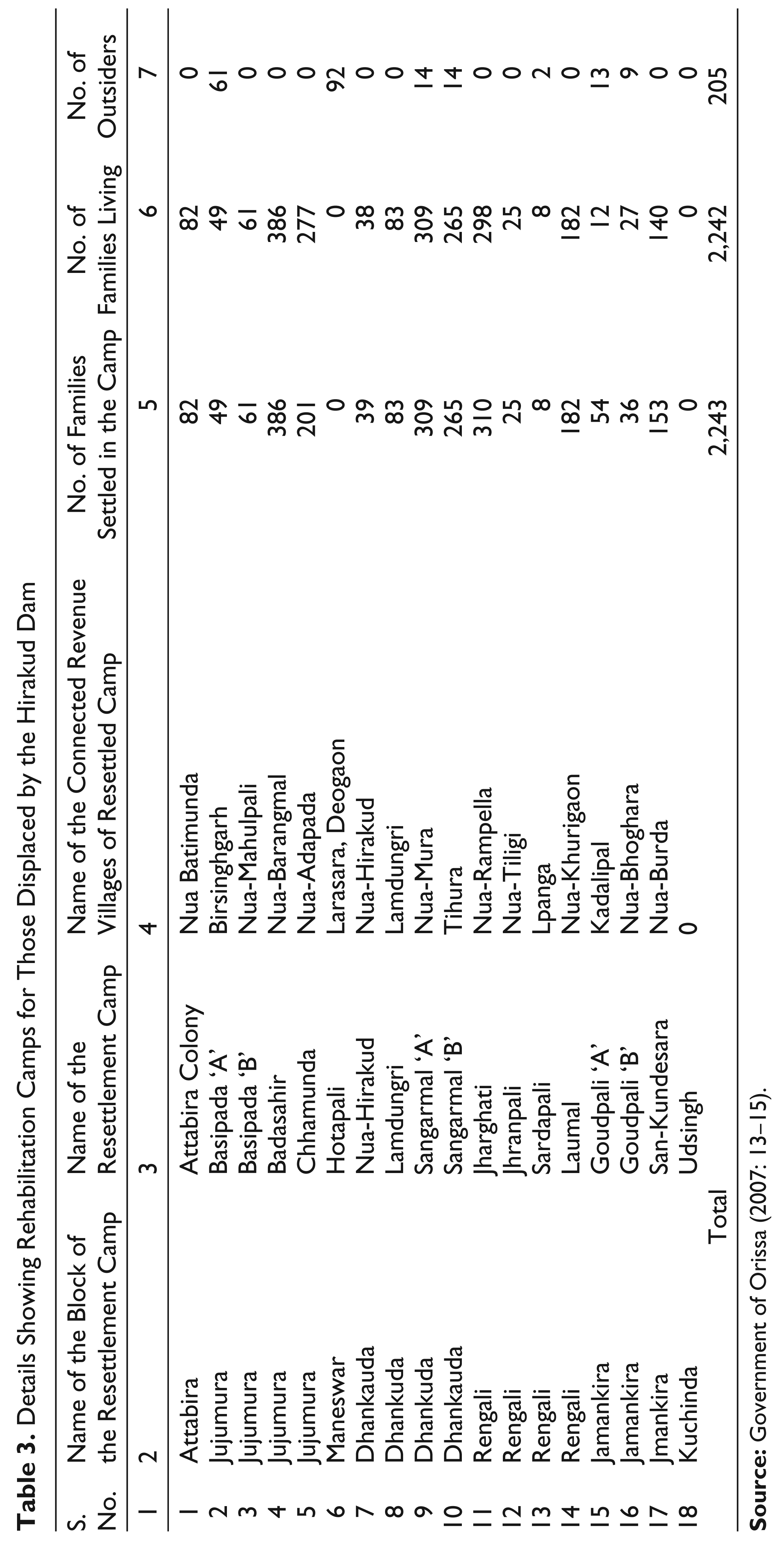
The oustees, who really wanted to be rehabilitated by the government, were just dumped in those identified camps (full of jungles and wild animals), which were devoid of basic amenities of life and without facilitating basic sources of economy, roads, schools, hospitals, clubs, markets, etc. It has been shown in my study (Kadalipal) that the government did not provide any land for cultivation to the oustees. They were only given a meagre compensation for their submerged lands.
The process of compensation was started on 14 April 1949 by the HLO working under the supervision of Revenue Divisional Commissioner (RDC). However, the programme had stopped functioning in the year 1978 (Government of Orissa, 2007: 3). The rates of compensation for likely submerged ‘lands’ proposed in the feasibility report ranged from ₹50 to ₹1,000 per acre according to their classification in terms of productivity. 4 But in actual fact, they were paid more or less in a uniform rate ranging from ₹200 to ₹600 per acre, which was much less than the market value (Government of India, 1947: 315–17). Similarly, ‘houses’ were also classified into seven categories 5 and the rate of compensation ranged from ₹250 to ₹3,000. Even though the oustees got the exact amount as per the provisions, it was too less to construct a new home elsewhere (Government of India, 1947: 318–19). For ‘temples’, the rate was estimated at ₹3,000 and ₹1,000 for pucca (concrete) and katcha (made of mud) temples, respectively, but no compensation was made for any of the categories, largely due to the fragmented and distorted resettlement pattern of the displaced people. It became problematic for the government to decide whom it would offer the compensation amount to, to construct the same (Government of India, 1947: 319). The rate of compensations for ‘schools’ and ‘tanks’ was estimated at ₹1,000 for each of those, and in such cases, problems also occurred (besides privately owned tanks and wells) similar to the temple problem. Even if compensation was made for privately owned tanks, it was not given as per the amount mentioned in the feasibility report; rather those were simply considered as land and compensated accordingly. In case of ‘wells’, people got compensation as per the provision (₹250 and ₹60 for ‘masonry’ and katcha wells, respectively), but it was too little (Government of India, 1947: 319–20). The value of ‘trees’ was estimated, varying from ₹10 to ₹30 for fruit-bearing trees and ₹10 for timber-producing trees, but it was not followed. In many cases, conflicts arose regarding the ownership of trees and in the end, a third party (mostly influential people of the villages, largely the village heads) got the benefit of compensation. The Gountias (village heads) had considerable influence in the society as well as over government officials during that period and they managed to grab as much compensation as they could by making fools of the common people 6 (Government of India, 1947: 320).
The absence of land for land as compensation was a great blow to the oustees and it was very difficult to buy a piece of cultivable land elsewhere with the meagre compensations they received. Therefore, the forest reclamation activities were conducted by the oustees themselves to convert the forest land into cultivated land. The government did not even provide the expenditure for land reclamation activities and therefore it was a huge burden on the resettled, who were already undergoing severe hardships. It is ironic that many of them were not given the legal ownership of those lands by the government. Now, the government is claiming that these lands are forest lands, coming under the public purpose of roads, drainage and water tanks, etc. Thus, a sense of insecurity still persists among them to secure their livelihoods. Besides this, a number of fishing communities, earlier dependent on the river Mahanadi to maintain their livelihood, were forced to leave the camp, since they did not find the place suitable for their source of livelihood.
The camp was also devoid of basic facilities of life like schools, hospitals, markets, clubs, etc., and the government did not provide any such facilities later. However, the resettled people opened up a school on their own initiative; but it is ironic that the school was not given recognition by the government, since the rehabilitation camp was not recognised as revenue village for a long period of time. The school got recognition by the government in the year 2004. The absence of the title of revenue village further victimised them on other grounds as well. They were deprived of all the benefits of several welfare programmes undertaken by the government from time to time and thus remained marginalised. Such situations prompted many families to leave the rehabilitation camps to settle elsewhere and the camp has recorded the highest number of families leaving the camp. Taking advantage of empty camps, many outsiders now have been staying in the rehabilitation camp, which has further caused the feeling of insecurity in the minds of the existing families staying in the camp. Interestingly, most of the outsiders are from the state of Bihar. The question that worries the rehabilitees, regarding the outsiders, is the probability of land-grabbing and resource constraints and it might cause conflicts in the future.
On the other hand, my survey in the resettled village (Jammal) has shown that most of the oustees who resettled voluntarily in that village belonged to Scheduled Tribes (STs). Since they had no legal title over their lands, where they used to cultivate and maintain their livelihood, these lands were declared as public lands by the government and therefore they were deprived of any compensation for their submerged land. In the case of non-tribal oustees, however, they were given a little compensation for their lost assets and properties, which was very much similar to the experiences of those in the Kadalipal resettlement camp.
It was found from the study that especially the displaced tribals, resettled in Jammal village, were forced to work as wage labourers. Earlier they were their own masters. Deprived of compensation and any kind of help from the government, they were reeling under severe socio-economic hardships. With the shift of accustomed environment and ecology, the displaced people faced a severe ‘health crisis’. Among the diseases, malaria was very rampant among them, primarily because the region was densely covered with forests. Many people died due to malaria owing to the lack of medical facilities. It is true that the non-displaced people of the region were also suffering from various diseases and dying of malaria, but the intensity of the health problems was more in case of the displaced people, since they were newly resettled in the region. Also, many people died of their unbearable psychological trauma. The severity of socio-economic impacts caused by displacement was even more on ‘women’ than men. Women in general in this region engaged themselves in their household activities; however, in their newly resettled village, they were forced to work outside to eke out their livelihood. Even the children were victims, who were forced to discontinue their studies and remain deprived of education and had to look for a job in the future to secure their livelihoods. The displaced too were deprived of several benefits of governmental welfare schemes for several years, since they were not the original residents of that village. The government took a long time to recognise them as residents of that village.
Besides tribals, there were a number of non-farming communities (barbers, carpenters and blacksmiths); village priests and village guards were also resettled in that village, who earlier maintained their livelihood by practicing their traditional occupation for generations. However, with their displacement, they lost their clients as well as their occupation and livelihoods. The same problems were faced by the petty businessmen as well. But the problems of village priests and village guards were little bit different from the non-farming communities. They had quite a sufficient amount of land, but did not get any compensation from the government, because the lands belonging to them were lands gifted to them by the villagers, for their services. The absence of legal ownership of such gifted lands deprived them of compensation and therefore a livelihood crisis persisted among them. 7
Non-Land-based Strategy
The government had planned a resettlement and rehabilitation programme for the oustees based on a land-based strategy, mentioned in the feasibility report. However, neither was there any provision with regard to a non-land-based strategy nor had the government initiated such programmes later to raise sources of livelihood for the displaced.
The study has shown that the oustees have reeled under severe ‘impoverishment risk’. Evidence obtained from the oustees show that the submergence of their land severely affected them in terms of their loss of livelihood and income sources. They also lost their arable land, common property resources (forests, grazing land, ground and surface water, fisheries, and so on), which changed the access and control of productive resources. The loss of economic power with the breakdown of complex livelihood systems led to decline of their living standards and marginalised them in the society. On the other, the loss of livelihood and disruption of agricultural activity of the oustees adversely affected their household food security. The displaced too faced a higher incidence of diseases associated with new environment and ecology and many died of mental trauma, which increased morbidity and mortality. The involuntary and forced displacement also fragmented their existing social fabric, which led to socio-cultural disarticulation.
No doubt, the Hirakud dam has brought massive economic progress to the state and has become the fore-runner of industrial growth. It contributed a lot in managing floods in coastal Odisha and provided electricity throughout the state to both industrial and domestic sectors. In addition, it brought irrigation to quench the thirsty land of the farmers of western Odisha, and it raised their incomes. However, it is ironical that none of the oustees got any of the benefits of the project. Rather, they were deprived in the name of the ‘greater good of the greater numbers’. The oustees were not given even a piece of land in the irrigated area as compensation to maintain their livelihood. They were not even given electricity produced by the dam and most of it is supplied to industrial, mining and urban sectors. On the other hand, the unsuccessful resettlement and rehabilitation of the oustees created a new inequality by depriving them not only of ‘income and wealth’ but also of social goods in two other ways: ‘liberty and opportunity’ and ‘social bases of respect’. The liberty of the oustees was violated, since their displacement was involuntary and forced by the Government of Odisha without any consultations to the victims. The social disruptions caused by the dam deprived oustees of their self-respect and put them in the new scheme of compensation, resettlement and rehabilitation. According to Rawls, the scheme or system, which creates an advantage for some parts of a community, is unjust, unless it creates benefits for all. Hence the Hirakud project, which has created advantages for some and has deprived others, is unjust.
Conclusion
Dams are claimed as symbols of development for mankind for its hydropower production, irrigation and flood moderation. Examining the same, the Hirakud dam has immensely contributed to the development of Odisha,though it is far behind in fulfilling the targets as envisaged in the original plans. Conversely, a massive populace got displaced and faced a wide range of impoverishment risks with little compensation. The initiative to rehabilitate them by the government proved to be a failure due to poor planning and a callous attitude. Oustees lost their sources of income, wealth and social goods (liberty, opportunity and bases of self-respect), and it raises the question of equality and justice.
The impoverishment risks of the oustees could have been mitigated by consultation and negotiations by the Government of Odisha and the displaced communities and arguably the relocation would not be involuntary at all and no liberty would have been lost. It has been observed that the government did not consult those whose vital interests were at stake. For the oustees, giving them compensation in terms of monetary value for their productive assets (submerged cultivable lands) was unjust. The government could have resettled and rehabilitated them in the irrigated area of the Hirakud dam by giving them irrigated land, so that they would not have lost their sources of income. On the other hand, it would have also revived their bases of self-respect.
Contextualising the Rawlsian perspective here, the idea of compensation is an idea of material replacement, like money for land, land for land, house for house, etc., is simply a bad idea and unjust. It is largely due to the fact that the experience of material replacement and rehabilitation still leaves people worse off. Rather, there should be the replacement of lost opportunities. His general conception of justice goes beyond compensation for economic losses. First, the displaced should not be worse-off in assets and resources by any development projects; on the contrary, it needs to be advantageous to them. Second, in the process of displacement and resettlement, there should be free negotiation between the state and community and all members of the communities need to be fairly represented in order to find out the best possible solutions to restore equality and justice. On the other hand, it also gives communities a legitimate right to refuse displacement, if it imposes disadvantages on other communities. Third, the social and cultural means of self-respect of the displaced communities should not be damaged in the process of relocation. The bases of self-respect need to revive and reinforce the social networks and associations among their members. Dams, referring to the Rawlsian conception of justice, can only be claimed as development and justifiable when all the displaced people get their due without losing their income, wealth, bases of self-respect and social goods (Drydyk, 1999: 1–8; Rawls, 1971).