




Abstract
Slums constitute the fastest-growing segment of most developing countries today. Their weight in the economy as well as politics of these regions is also likely to grow with time. The need to understand the changing economic profile and patterns of mobility inside slums of the twenty-first century through intensive longitudinal studies, along with macro surveys of their demography and livelihood patterns, is thus obvious. The present article draws upon my engagement, since 1988, with a Delhi slum called Aradhaknagar to present an outline of shifts in the occupational, income and assets profile of the community based on surveys, personal interviews and group discussions within Aradhaknagar and on comparisons with six other slum reports, from different cities of India, over the same broad period. While a small improvement in the living standards of both formal and informal sector employees is discerned in wages and assets held by concerned families since 1988, spiralling inflation seems to have hurt many informal sector workers in recent years. The article closes with an analysis of factors which seem to pull down workers trying to struggle around the bottom rungs of the urban social ladder and those that help in their efforts, occasionally.
Introduction
One of the appalling images associated with most Third World cities is that of a squalid slum huddled in the shadow of a luxury apartment or a high rise. 1 According to a UN-Habitat survey, about 900 million (or thirteen-and-a-half per cent) of world’s population still resides in harrowing conditions inside slums across the globe. 2 Slums can be of varying sizes ranging from quasi towns with millions of residents to tiny clusters of a few hundred. But some of the largest such clusters are located in the developing world whose slum population is expected to double within the next 30 years (growing at a rate of about 5 per cent per annum in many regions) (Davis, 2006).Within India, the proportion of slum dwellers in the urban population has declined, between 2001 and 2011, from 23 per cent to about 17 per cent (Government of India, Report of the Committee on Slum Statistics/Census-2011, 2013).Yet, the total number of slum dwellers exceeds 68 million in the country (excluding millions who reside in small clusters of less than 300 persons, specially in our new census towns). 3 In the national capital itself, ‘jhuggi’ clusters have grown from about 200 (with a population of 100,020 in 1951) to about 1,500 (with a population of more than 3 million) by 2013, showing a jump of 28 times as against the growth of just 11 times in the city’s total population in 60 years.
Besides rapid growth, another important aspect of most slums today is their internal stratification and diversity. Despite the image of uniformity conveyed by many large-scale surveys of poor habitats, metropolitan slums are home to a vast stratum of the poor as also petty traders and organised sector workers who may be better off but incapable of buying or renting a regular abode in a metropolis. 4 A number of such communities have been subjects of celebrated works by sociologists and anthropologists as well as litterateurs and filmmakers in the past (refer to Whyte, 1969). In India too, jhuggi-jhopries or ‘J.J. clusters’ have been studied by a number of scholars across cities (see Ali, 2003; Kundu, 2009). 5 However, most micro studies of Indian slums have had a short-term focus, while longitudinal analysis of data on slums from census and other reports offers faceless data at an aggregate level only. 6 The resultant gap in our understanding of the grimmest sections of our cities today seems amiss at a time when slums are not only growing rapidly but are also expected to play a major role in our politics and economy for decades to come. 7
The Scope of Enquiry
The article aims at addressing this gap in a small way by researching a Delhi slum (called Aradhaknagar) across two-and-a-half decades to chart its changing demography, occupational profile and social stratification, as also pressures behind upward and downward mobility among residents in the backdrop of transformed political economy in the country now.
Aradhaknagar is the real name of a middle-sized slum located next to the Grand Trunk Road on the border between Delhi and Ghaziabad. The slum has been visited repeatedly by me, since 1988, when I wrote a dissertation on its occupations and demography, and more frequently, since 2008, when I began a post-doctoral survey on the changing income and consumption profile of the community and its interfaces with various organs of the state. 8
Survey data on population, assets, etc., were gathered by me, in Aradhaknagar, both through household surveys and personal interviews and group discussions in 1988–89, 2008–09 and, on a limited scale, in 2013 again. To add some qualitative evidence on the changing class profile of Aradhaknagar, I also developed 16 life sketches of willing subjects from diverse occupational, caste and gender groups in the community. Recollections of half a dozen septuagenarians who had arrived in Aradhaknagar in the late 1960s were also tapped to develop a broad profile of the local economy, as it reportedly was, 50 years ago. Further, an attempt has been made, in this article, to compare data from Aradhaknagar with some other major studies of slums conducted in different Indian cities over the same period, and also with macro-level national and regional data on slum dwellers published by agencies such as the National Sample Survey Organisation (NSSO) and the Census Commission of India.
Still, two limitations in my data need to be noted at the outset. First, my own findings relate only to one particular slum from India’s capital which may be similar to some in cities like Mumbai and Bangalore but does not illustrate conditions among the poorest shanties, specially in smaller towns of India. 9 Second, complete precision in the understanding of every household’s income and finances is not claimed here as all respondents of Aradhaknagar did not share full information on our queries and some also varied their responses during repeat surveys conducted after a short interval too. 10
Nevertheless, a broad understanding of the occupational and class dynamics of Aradhaknagar is expected in the present report as the method of combining focus group discussions, life sketches and repeated personal interviews during fieldwork yielded considerable cross-checked information from subjects who seemed candid, on the whole, and also showed a remarkable degree of mutual knowledge emanating from close and proximate living. Errors in data collection were further minimised by using actual names wherever permitted by concerned subjects and by keeping all field notes in the Hindi script for ready scrutiny and comment of the subjects, as also by sharing the first version of this report with 40 members of the community in their language, namely, Hindi.
Mapping Aradhaknagar
As mentioned, the slum of Aradhaknagar lies close to the Grand Trunk Road on the border between Delhi and Uttar Pradesh. The quadrangle of about 5.5 acres, on which this basti is spread, is flanked by the aforesaid highway on its north, the railway line connecting Old Delhi and Ghaziabad train stations to its south, transport godowns of Bhoora Mandi to its east and a flyover and an underpass on the west.
Surrounded by these structures, Aradhaknagar slowly turned from a grove of shrubs and ‘Keekars’ on the outskirts of the old village of Chikambarpur into a dense community of 1,864 residents by 2009. The first jhuggis were raised here in the early 1960s. But Aradhaknagar’s growth took off in the following decade with growing immigration of labourers from villages of Uttar Pradesh, and to a lesser extent from Bihar and Madhya Pradesh, in the wake of growing demand for manual workers in surrounding middle-class colonies such as Vivek Vihar and Surya Nagar as well as the Jhilmil and Sahibabad industrial complexes in its vicinity.
By 1988, when I first studied Aradhaknagar, the slum had already grown into a community of 91 families with 442 men, women and children living cheek by jowl in 90-odd jhuggis or kutcha houses made of mud, stones and thatched roofs. But, in 2008, when I returned to the slum for a detailed restudy, the jhuggis had given way to 256 semi-pucca dwellings (housing 301 families) and the population had swelled to 1,864 (showing a jump of about 400 per cent in 18 years). Eighty of the 91 families counted in 1988, in Aradhaknagar, were present here in 2009 too. The major Dalit castes of the region, namely, Valmikis and Jatavs, account for almost 83 per cent of Aradhaknagar’s population, while the rest consist of ‘other backward’ castes like Ahirs, Gurjars and Yadavs (10 per cent), upper castes including Brahmins, Thakurs and Banias (6 per cent) and a few Muslims (1 per cent). The male–female ratio in Aradhaknagar has hovered around 10:9, while the proportion of children (aged below 14 years) has fallen from 59 per cent to 45 per cent between 1988 and 2009, apparently due to growing acceptance of family planning over time.
Occupations
Unlike mega slums like Dharavi or Delhi’s Bhalswa slums, Aradhaknagar does not house lakhs of people with hundreds of production units. Yet, the 2,000-odd residents of this slum also pursue a variety of occupations, including those of sweepers, rag pickers and servants; hawkers, loaders and rickshaw pullers; skilled and unskilled factory and construction workers; and of several kinds of semi-skilled artisans (masons, carpenters, tailors, etc.) and service providers (cobblers, barbers, vendors and hawkers, domestic maids, etc.).
Major occupational categories of the residents of Aradhaknagar, as shown in Table 1, have remained broadly the same in past two-and-a-half decades. However, their weights within the occupational pyramid have changed markedly over time. For example, the ratio of public sector employees has gone down in the slum from 46 per cent to just 22 per cent between 1988 and 2009. On the other hand, the number of formal private sector employees has grown from just 4 to 118, although their proportion among all workers is still 18 per cent and almost all of them are contractual or casual workers in petty establishments only. Another striking development in the occupational profile of Aradhaknagar between 1988 and 2009 has been the rise of a petty bourgeoisie within the slum comprised of small traders, moneylenders and a few professionals and Grade III formal sector employees like teachers, clerks, nurses, etc.
Occupations in Aradhaknagar, 1960–2009
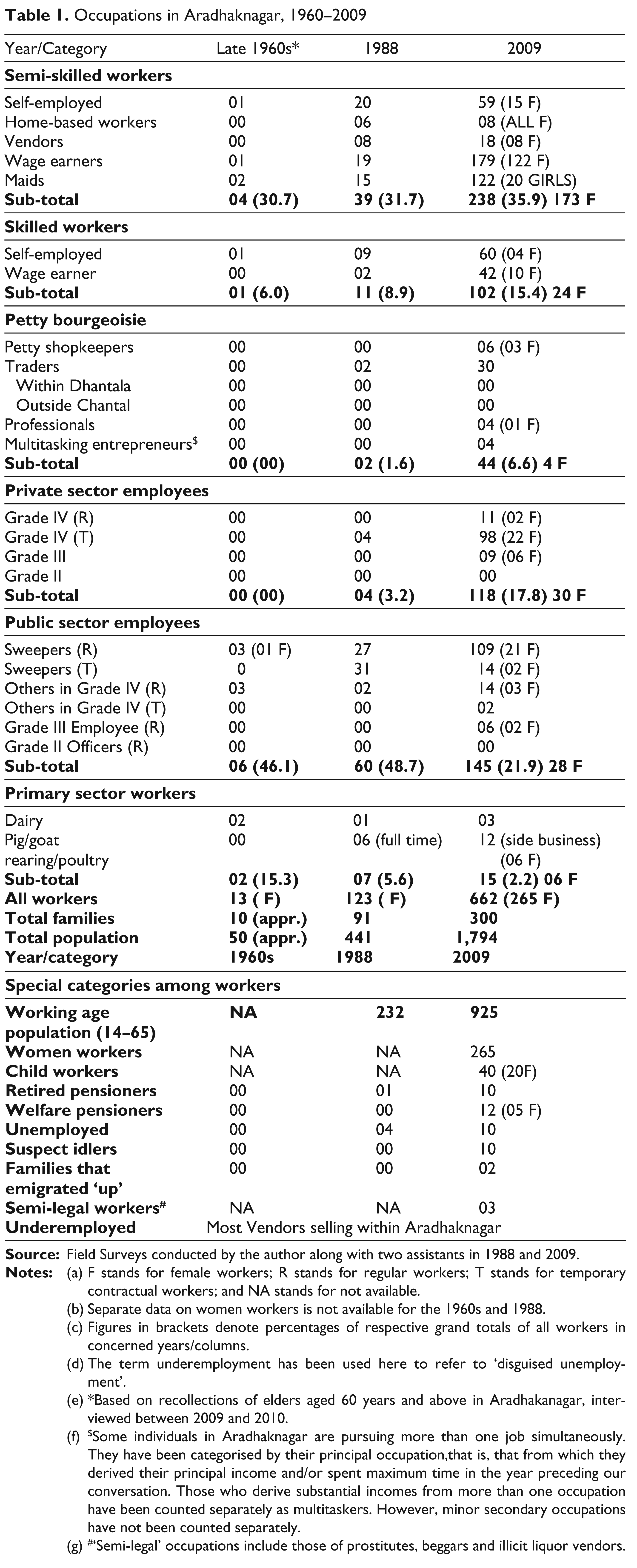
F stands for female workers; R stands for regular workers; T stands for temporary contractual workers; and NA stands for not available. Separate data on women workers is not available for the 1960s and 1988. Figures in brackets denote percentages of respective grand totals of all workers in concerned years/columns. The term underemployment has been used here to refer to ‘disguised unemployment’. *Based on recollections of elders aged 60 years and above in Aradhakanagar, interviewed between 2009 and 2010. $Some individuals in Aradhaknagar are pursuing more than one job simultaneously. They have been categorised by their principal occupation,that is, that from which they derived their principal income and/or spent maximum time in the year preceding our conversation. Those who derive substantial incomes from more than one occupation have been counted separately as multitaskers. However, minor secondary occupations have not been counted separately. #‘Semi-legal’ occupations include those of prostitutes, beggars and illicit liquor vendors.
A vast proportion of Aradhaknagar’s workers, however, remains dependent on a variety of low-income informal sector jobs as skilled or unskilled wage earners or self-employed persons. Thus, in 2009, out of 662 workers (including 40 children) in Aradhaknagar, nearly 355 were engaged in such low-paid jobs, while 149 had regular public or private sector jobs. The poorest among the informal workers are those who are too weak or constrained to go out of the slum for work and manage with low incomes from local vending, animal rearing or home-based stitching, packing, etc. For better pay, however, many more go out to work as the slum itself is devoid of production units apart from a few based on tailoring and repair work, which also survive with difficulty by bribing officials from time to time.
The highest earners in the slum are a handful of multitasking entrepreneurs, many of whom also have one or more public sector jobs in the family and side businesses in property, moneylending and some trading or shopkeeping.
Some Other Slum Surveys
Aradhaknagar can hardly be considered a representative slum of India. The number of Grade IV public sector employees (mostly regular or contractual sweepers in the Municipal Corporation of Delhi [MCD]), for example, are peculiarly high in this slum which lies within the National Capital Territory (NCT). Yet, on several counts, the slum is similar to others in India’s many metropolises. Hence, it may be useful here to compare the profile of occupations and earnings noted in Aradhaknagar with that of some other slums studied by notable scholars since independence (see Table 2).
A Comparison of Livelihoods in Selected Slums Studied since Independence
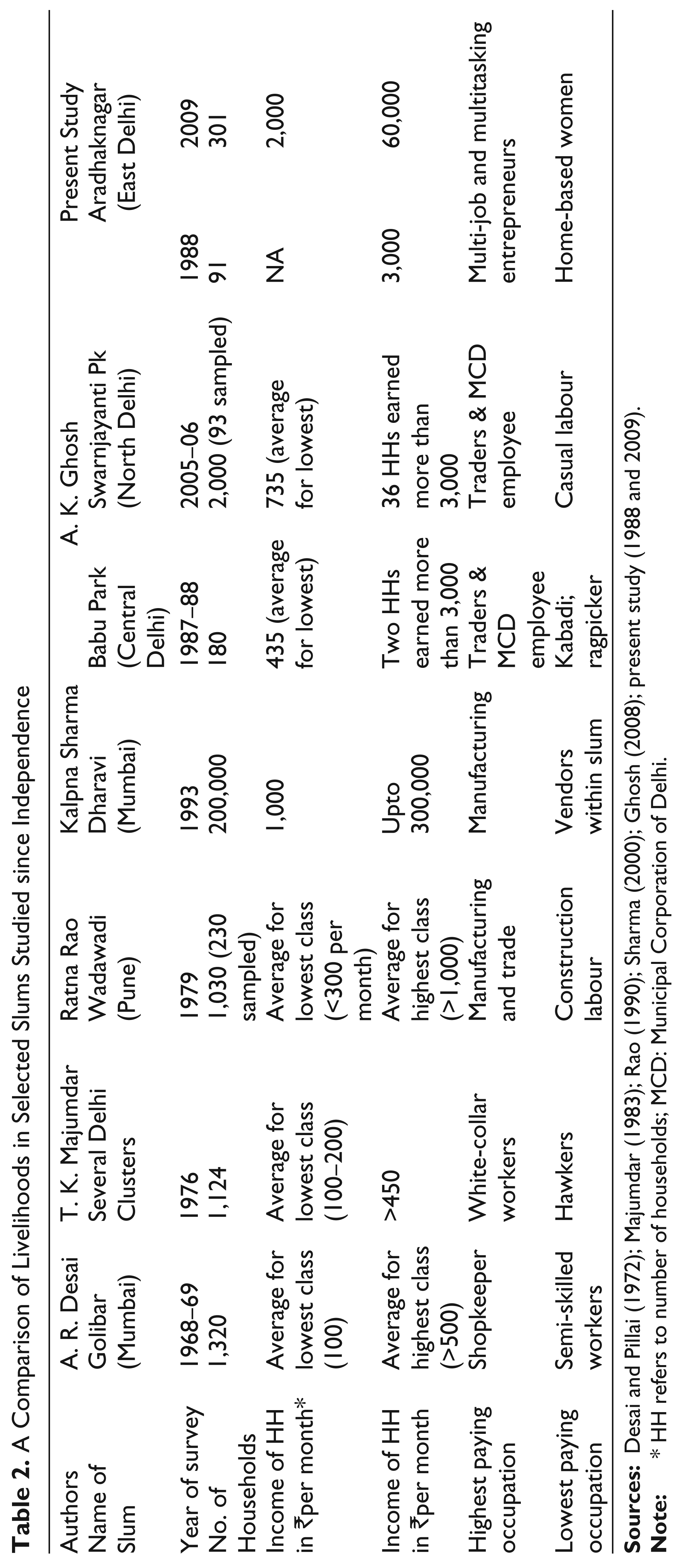
Among the earliest systematic studies of Indian slums was the classic report on Goribali, in erstwhile Bombay, by A. R. Desai and S. D. Pillai (1972) which showed that the highest earners in the community, in 1968–69, were some shopkeepers whose monthly household income at that time was above ₹500 on average. On the other hand, the lowest earners in Golibari were semi-skilled casual workers with a monthly average income of ₹100 per household. Similarly, in a detailed survey of more than 1,100 households in Delhi, in 1976, T. K. Majumdar had found hawkers earning as low as ₹100 per month per household, while some white-collar workers residing in these slums had a monthly average income of ₹450 approximately. In an interesting long-term study of Bangalore slums, in 1973, and again in 1992, Hans Schenk noted that the average income of the slum dwellers had risen by about 50 per cent at constant prices, while the lowest earners were getting about ₹500 per month per household in 1961 prices.
In comparison with these studies, our evidence from Aradhaknagar shows a higher proportion of formal sector workers now and also multitasking entrepreneurs whose combined household incomes can be more than ₹60,000 in today’s prices. Clearly, the rising cost of accommodation in Delhi has forced a number of lower middle-class families to remain in slums, while openings in Grade IV formal sector jobs have continued to rise for sweepers who have also benefited from revised salaries after the implementation of the Sixth Pay Commission recommendations. The same cannot be said about the vast segment of informal sector workers, as we shall note late.
Occupational Shifts
As far as occupational shifts within Aradhaknagar are concerned, three significant changes can be noted in the slum’s profile since 1988. First, permanent Grade IV employees (including sweepers, peons, gardeners, etc.) in the public sector have risen slowly over the period, despite casualisation of work associated with economic liberalisation. This may be explained with reference to considerable public investment made in the NCT by the state. But even the number of employees in the private sector—in malls, schools and offices as well as courier services and construction work—has gone up in recent years.
At the same time, it is striking that a good number of clerical or Grade III employees and even some teachers and medical practitioners and contractors are residing in Aradhaknagar now, which has a slightly better infrastructure and offers a cheap alternative to skyrocketing rents in regular colonies today. While in 1988 only one such educated professional was seen by me in Aradhaknagar, by 2009, their number (including clerks) had risen to 19.
The third noticeable change is that the proportion of earning women workers in the slum has risen conspicuously between 1988 and 2009. The biggest rise in this category was among domestic maids which were only 15 in 1988 and had gone up to 158 by 2006 (before falling back to 122 in 2009 when more girls started attending school encouraged by welfare schemes like ‘Laadli’ and distribution of mid-day meals and free books and uniform in schools.) A general rise in the number of working women in Aradhaknagar can be attributed to greater pressure for work and income amidst growing social disparities in the city, and also to increased demand for domestic maids in surrounding middle-class homes in which more educated women are going out to work now and are also more open to allowing Dalit women inside their homes and kitchens.
Classes
Behind its manifest occupational categories, Aradhaknagar can be divided into ‘classes’ or social strata, each of which reflects a different ‘life chance’ or command over incomes, assets, social links and status. Mobility between these classes is not absent but extremely difficult for most unorganised workers ordinarily.
The identification of classes in any community poses difficult methodological issues. Although all social classifications are heuristic and may vary with analytical preferences, in the present study, it was found useful to identify five major classes inside Aradhaknagar. The most conspicuous economic divide in the slum is between formal and informal sector workers, that is, those who work in registered enterprises that are theoretically regulated by laws and constitutional provisions and those who are tied to the vast informal sector of barely protected hawkers, maidservants, rickshaw pullers, etc. 11
As stated, the total number of workers (excluding homemakers) was 662 in Aradhaknagar in 2009, of which nearly 355 (or about 55 per cent) were in low-income informal sector jobs. Although most formal sector workers are also engaged in low-grade jobs of sweepers, peons and labourers, yet, their economic position vis-à-vis unorganised workers is better due to regular employment, higher salaries as well as legal and trade union protection.
It is important to remember, however, that organised workers living in Aradhaknagar can in turn be classified into those in extremely secure government jobs (117 men and 28 women) and those who work in private shops, factories, public schools, etc. (118 in all, in 2009); with the former faring even better in terms of job security and insurance cover.
For workers in the unorganised sector, even the rights and pay of a sweeper in the public sector are highly enviable. Indeed, most unorganised workers are desperately looking for an entry into the former sector, if not for themselves then for their children. But unorganised workers can also be divided into skilled and unskilled employees working for others (as drivers and gardeners on one hand, and domestic servants and construction workers on the other), as also a broad section of self-employed service providers (such as cobblers, barbers, petty shop owners and hawkers, etc.). In fact, the subclass of vendors, women and child workers showed considerable variation in incomes in our surveys, as the old and the sick who could not sell wares far from their homes barely earned ₹70 daily in 2013, while those who could put up a stall even on the footpath, along the highway, could earn upto ₹400 rupees daily.
The slum’s middle class is formed by 50-odd better-off families who have one or more than one member employed in the public sector or employed as a clerk, supervisor, petty businessman or multitasking contractor.
At the top of the social pyramid of Aradhaknagar sit about half a dozen ‘multitasking’ entrepreneurs who dabble, through their small capital and connections, in a variety of economic pursuits, including moneylending, sale–purchase of unauthorised properties and in procuring ration cards, pensions, etc., on commission. It is these local entrepreneurs who are politically well connected and have also secured organised sector jobs for two or more family members. They form the most powerful and wealthy section of the slum and own a car or additional property.
At the other end of the social pyramid of Aradhaknagar lies a small underclass of beggars, ‘criminals’ and the sick or physically challenged who have lost family support and sell petty wares from their door, or are practically unemployed. The same underclass also comprises a few prostitutes, bootleggers and pickpockets who have short spells of good earnings. But most such ‘deviants’ suffer indignities and sharp slides in fortunes too. 12
More generally, it is worth reiterating that extreme destitution in a metropolitan slum has close correlation with poor health and old age. While the strong find sufficient demand for their labour in cities, those who are relatively weak among the urban poor are left with very few props. In fact, debility sharply accentuates misery among unorganised workers who lack savings, social insurance and any property that could strengthen support from inheritors. In such dire conditions, many perish, while some fall back on selling petty grocery or confectionary outside their homes.
Houses and Assets
Recent data on personal assets and public facilities available to slum dwellers in India, published by official agencies, have presented a picture of considerable improvement in areas like access to electricity, toilets, potable water and ownership of durables like mobiles, television sets and personal vehicles (Government of India, 2011 and National Sample Survey [NSS], 2010).These official claims have been subjected to both methodological and substantive criticisms by numerous experts, and their tendency to exclude smaller jhuggi clusters (of less than 300 residents) and shanties located in emergent census towns has obviously inflated numbers of better-off slum dwellers in published data.
My own findings on shifts in slum dwellers’ assets in Aradhaknagar go along with official claims, partly as ownership of consumer durables and quality of housing has evidently improved in the studied slum in past two decades, while public facilities, specially for sanitation and health, have actually deteriorated sharply over the same period. As stated earlier, in my first visit to Aradhaknagar, I had found only two pucca houses out of 91 present then; none of these was double storied. In 2009, out of a total of 250-odd abodes in the slum, only two were kutcha and 40 were actually two storied, while one had three stories.
Another level at which conspicuous improvement is noticeable between 1988 and 2009 in Aradhaknagar is with regard to the ownership of consumer durables. As per my initial count, out of a total of 91 families in the slum, 21 had black and white TV sets, one had a video cassette player, four had two wheelers and one had a room cooler. By 2009, however, among 206 families (which shared such data out of a total of 291), 178 had colour TV sets, 84 had refrigerators, 73 had room coolers and 30 had washing machines (mostly second hand), while 194 persons had cell phones. In addition, almost every dwelling now had a cable TV connection, while six families had cars in Aradhaknagar and 35 had two wheelers by 2009. It was also heartening to note that in the new millennium, banking and insurance services have also improved rapidly in Aradhaknagar and a large number of families have bank accounts as well as life insurance policies (worth ₹50,000–₹100,000 in all and carrying a monthly premium of ₹300 to ₹600 generally) now.
Incomes, Wages and Poverty
Even more than housing and assets, it is the average monthly incomes of subjects over the past 25 years that would reveal their changing living standards adequately. The official figure for the proportion of people falling below the ‘poverty’ (starvation) line (BPL) of ₹34 per person per day was only 8 per cent in 2010 in Delhi. Assuming that the majority of Delhi’s poor live in its slums, we may expect at least a quarter of the slum dwellers to be BPL by the official criterion.
My own efforts at gathering exact income data for all families in Aradhaknagar were not very successful as subjects’ responses continued to be hesitant and extremely variable on this issue. A rough estimate suggests that about 15 per cent of the residents of Aradhaknagar fell below the said poverty line based on minimum calorie intake (or ₹34 per person per day) in 2011. Their number definitely appeared much higher 25 years ago when I had not made a full count of the same, unfortunately.
In the absence of continuous local-level data on all residents’ incomes, trends in real wages of skilled and unskilled workers (who form the vast majority of slum dwellers in most cities) can serve as a useful yardstick of changes in living standards in the studied community. Fortunately, I had noted prevailing wage rates as well as prices of many staples in my field visits in 1988. Comparing them with the same in 2013, and with official data, it is possible to say that while the consumer price index rose by about 10 times, from 60 to 600 approximately (with base year 1993 as 100), current wages also rose for both skilled and unskilled workers by about 12 times (from ₹25 for unskilled labour and ₹50 for skilled workers in 1988, to ₹300 and ₹500 for the same in 2013). Thus, the rise in real wages of unskilled construction workers was around 20 per cent over the said period. 13
On the Downside
Yet, it is worth reiterating that the small rise in real wages (despite steep inflation) and some growth of second-hand consumer durables in the preceding two decades does not reflect a major turnaround in living conditions in Aradhaknagar. Even for those organised sector workers who have risen above acute poverty, general living conditions in the slum have actually deteriorated with increased congestion and rising morbidity. If we were to count access to a functional toilet, running water and sanitation as minimum human needs, then the entire slum would still fall in the category of the vulnerable stratum.
Two Narrations
Karan who used to make a reasonable earning from stitching badges for a garment exporter saw his orders declining sharply after 2009, when the demand for Indian exports collapsed due to massive slump in the export market. This forced Karan to accept the work of an unskilled contract worker in a private school and also to cut down on essentials like milk, fruits, etc., at home as prices shot up simultaneously in the period. While narrating his life story to me, Karan’s neighbour, Madanlal, who sells grocery within Aradhaknagar, also said that new machines at the printing press where he had worked for decades forced him out of work in 2000 and after prolonged illness of his wife, he is reduced to running a small vend outside his room. He lamented that his daily earnings rarely cross ₹70 (in 2011), while his household purchases have more than doubled in the last four years. It is only because of the yellow ration card (fetching 30 kg of wheat-cum-rice at a reduced price of ₹6 and ₹4 per kg, respectively) issued to Madanlal by the administration recently and the support extended by his two sons (who have started tailoring work after leaving school) that he was able to make ends meet in these difficult times.
Factors behind Upward and Downward Mobility
In this light, it would be useful now to analyse systematically different processes that promote downward and upward mobility among our subjects. These can be classified into micro factors such as illness and family size, which figure in subjects own narratives conspicuously; macro processes like public policies and inflation over which they have little personal control; and still deeper societal structures such as class, gender and caste that are difficult to change in the short run. Most of these, however, affect the urban poor in very similar ways across slums and cities. Hence, in the following sections, we have applied terms like the ‘urban poor’ and ‘slum dwellers’ in a more general sense, alongside references like ‘residents’ or ‘subjects’ that allude to our specific research sample.
Structural Constraints
An obvious structural constraint that obstructs upward mobility among residents of Aradhaknagar is their ‘class’ position or near lack of capital (economic, social and cultural) that many in the upper classes inherit without exertion. Thus, 80 per cent of the residents of Aradhaknagar reported in 2009 that they do not have any property in the city apart from the unauthorised hovel in which they live. But lack of wealth is only one aspect of the proletarian status of the majority living in Aradhaknagar. Even the returns on the hard labour that the poor offer day after day to the city barely ensures survival for the majority that work, particularly in the unorganised sector. Not only does the daily wage of ₹300 or so, available to a labourer in Delhi now, not add up to even a tenth of the daily average of a clerk’s salary in government but also offers a huge contrast to the minimum wages of up to $10 per hour assured in developed countries for unskilled work too. The complete absence of social welfare or security against unemployment, illness, old age, accident, death, etc., further marginalises the real proletariat that resides in slums of the underdeveloped world.
Like class and lack of capital, caste and gender relations also act as major structural constraints in slum dwellers’ lives. Gender discrimination is clearly evident in different wage standards being applied to women’s work among the poor. Out of a total of 265 female workers in Aradhaknagar in 2009, nearly 122 (including 20 girls) were low-paid domestic maids who barely earned ₹3,000 for the back-breaking work of washing dishes and sweeping floors in up to three homes daily. Of the remaining, there were 200-odd ‘homemakers’, many of whom spent hours on stitching, packing or tailoring work from home. Returns on such work were the lowest of all. Thus, we found stitching work, packing and labelling, envelope making, etc., from home fetching not more than ₹50 a day, while domestic maids got less than ₹1,000 per month for washing, sweeping and dusting from households whose children spend such amounts daily on snacks. Yet, a number of slum women were running their homes solely on these earnings by working in two or more such jobs, especially where the male head was alcoholic, or physically challenged or a deserter. Most such families fell below the absolute poverty mark of ₹34 per capita per day in 2013.
Our fieldwork also suggests that caste restrictions on Dalits’ choice of vocations, residence and movement have declined, but not disappeared in and around Aradhaknagar (for evidence on caste discrimination in Delhi slums refer to Singh, Andrea and de Souza, 1980). In a survey of 200 Dalits in Aradhaknagar in 2010, 167 mentioned caste identity as a source of discrimination faced by them in the city.
Debt and Daily Vicissitudes
Besides the broader social and political structures that drag down the hardworking poor trying to better their position in the urban space, numerous processes in their immediate environment also pull them down repeatedly and visibly. Among the personal tragedies which precipitate sharp downturns in many lives, accidents, prolonged illness and the early death of a breadwinner are familiar. However, the poor are hit much more by such exigencies because their buffers are meagre, the need for daily earning is pressing and working conditions extremely threatening for those who labour in underground sewers, on electric poles, in underconstruction high rises, etc. As local and outside moneylenders charge interest at the rate of 10–20 per cent per month from the hapless poor, they are then forced to sell their petty assets like a share in a village plot, a little jewellery or their slum abode itself.
Besides natural and man-made calamities, other factors with which the slum dwellers struggle daily include: (a) unemployment and underemployment brought by summary dismissals, privatisation of public sector units, sudden closures of factories, slowdowns brought by globalisation or vicissitudes of the market, state checks on hawking, vending, etc. and occasionally, by prolonged riots and political disturbances; (b) prolonged and steep inflation, specially in the prices of essential commodities; (c) rise in the number of dependants associated with the arrival of more children, marriage or the disability of an ageing elder; (d) desertion or alcoholism in a family; and (e) trouble with the police or court cases.
Sources of Help
Turning to the sources of help available to slum dwellers in emergencies, it may be noted that the extended family still serves as a major fallback for most residents. This does not imply that poor families have a lot to offer or that acrimony and family splits are not common at the bottom of the social pyramid but that, even today, among distant relatives too, and specially among blood relations, help is expected and extended in times of need. In fact, beyond family, ethnic ties based on region, language, locality and caste also bring forth help even without prior acquaintance. Thus, for the poor too, caste and other ties remain a vital mechanism for survival as the state provides little by way of social or even physical security.
Political solidarity can also strengthen a community’s bargaining power. But Aradhaknagar does not have a regular panchayat or even an elected or appointed association. A ‘pradhan’ has acted as the self-appointed spokesman of the slum and mediated between the residents and authorities, besides mobilising electoral support for the Congress Party that has been a dominant force in city’s politics. However, not all residents accept the self-appointed pradhan’s leadership and his standing derives entirely from his closeness to local Congress leaders of the zone.
It is not that slum dwellers have not mobilised on their own for improvements and against outside threats. A memorable effort in this regard was against demolition of 51 dwellings by the Central Public Works Department in the front row of Aradhaknagar in 2009. Not only the affected families but neighbours also pooled in resources to hire vehicles for meeting the chief minister and the area’s Member of Parliament (MP) and Member of the Legislative Assembly (MLA) collectively and pressed for alternate shelter for evicted families. There are several other instances of the slum dwellers getting together to help neighbours threatened by police, illness, accident, etc.
Non-governmental organisations (NGOs) do have some presence in Aradhaknagar. But one such NGO called Bhagat Singh Sewa Dal, which provides a useful ambulance service, is actually run by a councillor who has been contesting for the assembly seat as well. The Young Men’s Christian Association also rented two rooms in the slum and ran a crèche and women’s counselling unit for five years but wound up after 2010. I myself held remedial classes for school students for one year in an improvised room in the half built temple of Aradhaknagar, in 2008–09, but discontinued later. In this situation, it is not surprising that residents see most ‘social workers’ as non-serious or powerless whose actual work and proclaimed intent do not often match.
While ethnic ties and some charitable organisations and NGOs as also the slum as a community come forward to help residents occasionally, none of these is geared for providing sustained and reliable aid to residents in emergencies. In dealing with the state’s daftars, police and other powers, the slum dwellers are thus forced to seek help from hated politicians and employers repeatedly. But the vast majority of slum dwellers are self-employed in petty trades and employers’ help is out of question for them. The principal source of help against police and other officials, for ration, a job, school admissions, procurement of a caste certificate, a pension application or even a small aid in case of death, fire, riot, etc., is thus the area’s MLA, councillor or the sitting MP. But these patrons are often to be approached through the dominant party’s link with the slum or the unelected pradhan who gets residents’ work done, but charges commission and expects political support during elections, rallies, etc.
Democracy, Affirmative Action and Education
Among the larger institutions and processes that bring some relief or upward mobility to slum dwellers, our democratic state, its policies of social justice and welfare, phases of rapid economic growth and the education system are also worth considering. In a democracy, competition among parties for mass votes can be a catalyst of pro-poor stances among political actors. Ironically, six decades of democratic government has still not ended mass poverty, even in our major cities, and critical needs of the urban poor for secure jobs, decent wage, low inflation, reliable medical services, empowering education and above all, for healthy, affordable housing remain largely unaddressed in a populist yet callous political order. Even as millions are being spent every year by central and state government on departments of slum rehabilitation, urban housing, etc., now, the race for global investment and beautification of cities has actually increased the displacement drives against the poor, while welfare schemes such as the Jawaharlal Nehru National Urban Renewal Mission and the Rajeev Awas Yojna for slum dwellers still remain unrealised.
Interestingly, most slum dwellers interviewed by me expressed keen desire, if not hope, for wide-ranging support from an active state/sarkar. When asked about the spheres in which they expect the state/sarkar to play a proactive role, 90 per cent of the respondents in Aradhaknagar stated that sarkar should not only maintain law and order but also deal effectively with challenges of unemployment, price control, subsidised rations, education and health facilities and housing for the poor.
At a personal level too, the most sought after route for upward mobility among slum dwellers is that of public sector employment. Indeed, the better-off in Aradhaknagar consist almost entirely of families with more than one worker in public sector employment, as mentioned earlier. While caste, religion and the local community remain significant among slum dwellers’ attachments, it is the resourceful state (despite its rampant corruption and oppressive agencies) that is recognised by our subjects as the most effective potential tool of their empowerment.
Next to the state, it is interesting that most residents of Aradhaknagar cite good education as a ray of hope for their children and invest considerably in it by sending kids to costlier private schools. Out of 300 families in Aradhaknagar in 2013, only 10 were not sending children to any school, while about 30 kids were paying up to ₹300 per month fee to attend private schools in adjacent colonies. Since the slum itself has no school, the poorest walk up to 3 km daily to attend government schools, while others go packed in rickshaws or three wheelers that charge ₹300 or so per month per child.
The state government had recently made it compulsory for private schools to reserve a quarter of their seats for children from economically weaker sections and educate them free. But, as late as May 2013, only 12 students from Aradhaknagar had benefited from this scheme. While both parents and the constitution lay considerable stress on education, the quality remains low in government’s own schools. Besides this, the near absence of skill building, specially for own ventures, in our pedagogy leaves the potential of schooling grossly untapped. Also, job reservations for Dalits benefit a tiny minority only. Thus, the number of Dalits who have found employment in the public sector in Grade III or higher jobs through the system of reservations was only six in Aradhaknagar till 2009. Yet, the number of Dalit students gaining admission to higher education through reserved seats has been growing of late. Not all manage to pass through college but affirmative action has definitely helped in this regard and in 2009, I counted seven graduates and 31 intermediate or diploma holders (including nine girls) in Aradhaknagar. Though small, it is this group of the educated and the public sector employees that remains a source of hope and leadership, as also a base for further organisation and mobilisation among Dalit residents.
Economic Growth and Liberalisation
Our study of Aradhaknagar began a little before the ushering of economic ‘liberalisation’ and closed a few years after the ‘India Shinning’ campaign. In these two-and-a-half decades (1988–2009), public sector employment shrank generally, though many sweepers still got regularised in 1998 and again, in 2009. As a result, some improvement in the living standards of a section of the slum dwellers has been noted by us. This may be attributed partly to acceleration in economic growth between 1993 and 2009 which, apparently, created some additional contractual jobs for sweepers, peons, drivers, etc., in sectors like call centres, malls, courier companies, computer centres, cable TV and for servicing the expanded middle class as drivers, domestic maids, etc. Similarly, innovations like cell phones, cheaper watches and TV sets also brought limited improvement in slum dwellers’ lives in our study period.
Yet, a direct correlation between ‘liberalisation’ and reduction in poverty would be wrong to deduce not only because Aradhaknagar is not representative of vast pockets of poverty outside the capital, but also because decades of economic ‘reforms’ happened to be the era of a major expansion in welfare expenditure of the central as well as state the government, propelled by the decline of one-party dominance and resultant increase in competition between political parties during elections.
Yet, huge leakages in government spending accompanied by spiralling inflation due to increased deficit financing seem to be undoing much of the potential benefit of welfare programmes announced for the poor by both central and the state governments since the late 1980s. Besides this, growing congestion, a heightened sense of disparities and a widening gap between aspirations and available opportunities for the youth in the slum have also contributed towards a worsening living environment, even as the increasing number of welfare schemes for the urban poor have failed to deliver targeted benefits till now.
From Understanding to Action
It is evident from our study that the factors that tie urban workers to low incomes include many structural constraints and without addressing the broader issues of class, caste and gender inequities, a radical change in slum dwellers’ condition is implausible. Revolutions have proved to be not only difficult but also costly in human terms. Within the prevailing economic structure also, a number of measures can help in improving conditions inside slums, as shown by successful housing and social security programmes run in several Latin American and East Asian countries. Callous neglect, in India, of adequate wage, training, social security and low-cost housing for unorganised workers who form the majority of slum dwellers has been a major failure of governance. It is slum dwellers who provide highly cheap labour to cities while surviving amidst stench and squalour and living with constant threats of eviction, police harassment and disasters like fire, flooding and epidemics. They have also missed benefits from major welfare initiatives like Mahatma Gandhi National Rural Employment Guarantee Act (MGNREGA) and enhanced support for farm prices extended by the Indian state to rural poor of late.
Eschewing indifference as well as forced evictions, urban bodies need to concentrate possibly on raising, in situ, multi-storied tenements rapidly and continuously for the growing mass of the urban poor. Systematic attention also needs to be given to maintenance aspects while providing for public facilities such as community toilets, taps and lighting in congested slums. Interestingly, programmes for wage assurance and job creation and infrastructure building and maintenance can be synergized to a large extent. Much more needs to be done with regard to health and education too. Services at the local state hospitals require a major overhaul. As far as government schools are concerned, enhancing the skill-based component in curricula and simpler options against papers like English and Maths (which are difficult to clear for slum children without tuitions) may not only bring down the dropout rate of poorer pupils but improve their employability too.
Last but not the least, local government needs to be restructured for better use of welfare funds and implementation of numerous schemes existing for the poor on paper (for details, refer to Sivaramakrishnan, 2011). The experience from Aradhaknagar suggests that a critical tool for better implementation of state’s schemes could be found in empowered colony and slum-level samithis or associations (below the elected MLAs and councillors). The population of most urban neighbourhoods far exceeds that of a median village. Yet, unlike rural panchayats, urban wards with denser populations have not received sufficient help or recognition in our constitution. The population of Aradhaknagar is touching 2,000, but it has neither a regular association nor an elected pradhan. Local confidantes of the area MLA and MP do liaison between residents and officials but their dependent status restricts this trickle of selective help. With the regularisation of elections and funding for slum (and colony)-level associations, the administration of welfare and local infrastructure could receive a boost since elected representatives residing within a community can serve the area’s needs much better than NGO volunteers or MLAs and councillors or their unelected agents who offer very limited access to residents.
Meanwhile, the recent rise in real wages (which has been at the back of much of the limited improvement in the living standards of urban workers) also needs to be understood afresh. While official claims on inflation could actually be underestimating the suffering faced by the urban poor residing in slums, the rise in demand for numerous services arising out of the expanded middle class spawned by economic liberalisation may have indirectly helped in improving living standards (as highlighted in our findings as also recent NSS and census reports on slums cited earlier).
At the same time, the growing practice of family planning and increasing school attendance among slum children of both sexes, and the resultant decline in the supply of cheap labour in the economy, may also be having its delayed impact on wages now. The demographic explosion noted in Aradhaknagar between 1988 and 2013 does not reflect this subterranean turn as a large number of new migrants from villages continue to stream in every year. However, a look at the average family size in the slum suggests that many poor women are now asserting their preference for a healthier, smaller family with the help of increased awareness brought about by media and literacy, thereby contributing to rise in wages too.