



Abstract
The Basic Services to the Urban Poor (BSUP) is the part of a mission mode programme of the Indian Government that aims at providing access to basic amenities and services, including housing security, to urban poor living in slums. The article discusses the implementation of the BSUP in the city of Bhopal. The article throws a point for discussion whether providing a house under the programme is enough to improve the quality of life of urban poor and the programme delivers a complete package as it has been promised in the BSUP guidelines issued by the government. The article looks at two specific dimensions of the implementation of the BSUP: whether stated objectives of the BSUP have been fulfilled and whether the living conditions in the newly constructed settlements are sustainable. The article compares three cases in the city of Bhopal to probe these two specific dimensions. The cases include a newly constructed settlement under the BSUP, a transit camp where habitants of a displaced slum are waiting to shift to a newly constructed settlement under the BSUP and an existing slum, which was expected to be rehabilitated in the future.
Introduction
Urban India is on its path to become a pivot of India’s economic growth. Currently, urban India constitutes 65 per cent of the country’s GDP and is expected to enhance its contribution to 75 per cent by 2020 (Urban Update, 2014). To harness the economic strength of urban India, the Government of India initiated an urban reforms programme—Jawaharlal Nehru National Urban Renewal Mission (JnNURM)—in December 2005. JnNURM aims to improve the condition of urban infrastructure and basic services and bring necessary reforms in the governance structure. One of the important components of this programme is improving the living standard of urban poor by ensuring their access to basic amenities and social services under the Basic Services to the Urban Poor (BSUP). Under the BSUP, those urban poor who live in slums and other unauthorised settlements are rehabilitated in newly constructed houses with the security of tenure. The programme also provisions linking of rehabilitated families with basic amenities and social services: sewage, water supply, sanitation, drainage, electricity, roads, education, health facilities and employment. This article tries to analyse if the BSUP has been able to fulfil its stated objectives. The article also looks at the post-implementation life of the rehabilitated families in order to observe the sustainability aspect of the BSUP. Completion of any of such welfare programmes includes combination of withdrawal, programme extension and transition (Gardner et al., 2005). Therefore, the sustainability, in this article, and in the context of BSUP, means that the implementation agency or government comes out of the programme only after residents of new settlements are able to manage their lives by their own and have access to all relevant basic services that are necessary to live a decent life.
Methodologically, this article compares three cases in the city of Bhopal to understand as to what difference new settlements have created to the lives of the poor who have been living in slums. These three cases include: post-rehabilitation living conditions in a newly constructed settlement under the BSUP in Shabari Nagar, one existing slum in Gautam Nagar and a transit camp where habitants of Naya Basera slum were waiting to shift to new houses. The selection of these three sites is based on their different residential status, that is, one shifted in new houses, one is in transit and one is still a slum.
The article is based on the primary information collected through focused group discussions, individual discussions and site observations of the slums and the new settlement in Shabari Nagar. The study was carried out during December 2012 and January 2013. A total of nine group discussions (74 participants) were organised that includes three (25 participants) among the residents of new BSUP settlement in Shabari Nagar, three (24 participants) in the transit camp and three (25 participants) in the existing slum in Gautam Nagar. The participants for the group discussions were the members of the Self Help Groups in those sites. These groups were organised by the Samarthan Centre for Development Support, a Bhopal based development voluntary organisation. A total of 15 in-depth interviews, five from each site, were held in all three sites. The selection of respondents for in-depth interviews was done randomly. Substantial on-site information was collected through the site observations and informal discussions with the residents of all three sites.
The structure of the article is as follows. After presenting the argument of the article in the introduction section, the article provides an introductory detail of the BSUP in general and the current scenario in Madhya Pradesh and Bhopal. The section ‘Observations from Three Cases’ of the article is based on the analysis of three different cases. The last section presents discussion and conclusion.
Basic Services to the Urban Poor (BSUP)
BSUP is a component of JnNURM. JnNURM was launched in December 2005, for a period of seven years, but extended by the government for two more years. JnNURM was launched with an aim to enhance quality of life in the selected cities (called mission cities) by improving infrastructure and services and bringing governance reforms at various levels. BSUP comprises the basic services part of the mission those are to be delivered to urban poor. Following are the objectives of the BSUP (Ministry of Urban Development, n.d.):
Access to basic municipal services, such as water supply, toilets, waste water drainage, solid waste management, power, roads, transport, etc. To be integrated and mainstreamed with municipal supply networks resulting in sustainable improvements in the quality of life of the urban poor. Better access to legal and affordable housing with in-house basic services that will allow them to live as legitimate citizens. Improved access to social services, such as education, health and other social programmes of the government. Participation in political processes and city governance will also be enhanced.
The rationale behind the implementation of BSUP is that around 30 to 50 per cent of the total population in the large cities is poor. Therefore, if poor are provided improved services and governance, the quality of life in the cities would itself get improved. A large part of the BSUP initiative is focused on slum development, as the majority of urban poor live in slums. There are three key components under the BSUP: Housing, basic facilities and social services. Under the housing component, BSUP provisions legal and affordable housing with tenure security to urban poor with improved basic services in the houses and the vicinity. Therefore, housing security is integrated with other two components in order to realise a complete residential facility. Table 1 provides a list of the services and targets that BSUP is to deliver.
Services under the BSUP

BSUP in Madhya Pradesh and Bhopal
Census of India 2001 estimates that 24.31 per cent urban population of Bhopal is living in slums, which has increased to 28 per cent in the Census 2011 (Times of India, 2013). In a survey conducted by the Government of Madhya Pradesh, about 14 lakhs families with a population of around 70 lakhs are poor who reside in the cities covered under JnNURM (Urban Administration and Development Department, n.d.). Census 2011 estimates that out of 364 statutory towns, 303 towns are slum reported towns where 5.7 million people are living in slums (Office of the Registrar General & Census Commissioner, 2013). The poor in slums are living in very distressed conditions where basic facilities of a decent life are nearly absent. Prior to the arrival of the BSUP, the Government of Madhya Pradesh was not paying proper attention to the development of urban poor living in slums. Slum improvement and upgradation is one of the 18 functions provided in the 74th Constitutional Amendment Act to the urban local bodies. According to the Memorandum of Agreement between the Indian Government and the cities, prior to JnNURM, Madhya Pradesh had not included this function in its Municipal Act (Administrative Staff College of India and Center for Good Governance, n.d.). Approach to deal with this problem in the state was ad-hoc and was not attended through any substantive schemes or programmes. Madhya Pradesh Government, in addition to the outside support, was contributing only 5 per cent of its own resources to the delivery of services to the urban poor.
Summary of the BSUP Projects in MP
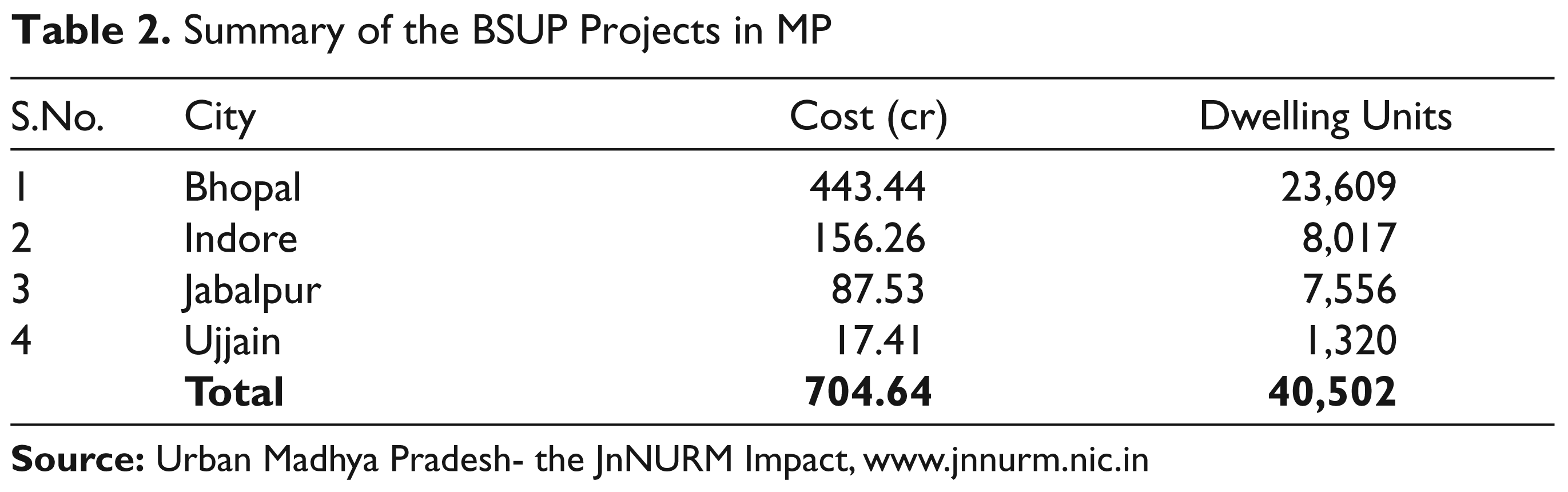
Under the BSUP, more than 40,000 housing units were planned to be developed in four major cities (Bhopal, Jabalpur, Indore and Ujjain) in the state (Table 2). According to Ministry of Housing and Poverty Alleviation, as of 2 January 2012, 41,446 dwelling units were approved and to be developed under BSUP in these four cities. The need of housing is more intense in Bhopal than in other cities. Historically, Bhopal has attracted more slums built in a very short period of time. From 1981 to 1991, the increase in the slum population in the city went up by 85.7 per cent. This happened because of the ‘patta’ Act 1984 which had a provision of providing land pattas to those who were living in illegal houses without any land ownership title. The slum population in Bhopal, according to census 2011, constitutes around 27 per cent of the total city population. It means if government plans to provide housing to all slum dwellers, then the demand would be very high. Bhopal is an attractive destination for many of the migrants from nearby districts of the state and also other states like Chhattisgarh.
There are some obvious advantages which makes the city a good destination for migrants. Bhopal has very good rail connectivity, so it is easy for migrants to reach there from any part of the country. It is one of the fastest growing cities in the Northern and Central part of the country; therefore, demand for labour force is very high in the city. Bhopal is surrounded by districts where agriculture is an important sector which provides employment and livelihood to poor and landless. But, opportunities in agriculture are seasonal. Therefore, people choose to come to Bhopal. Social atmosphere of Bhopal is conducive and the city is said to be a ‘safe’ city. Nearby industrial areas, such as Mandideep provide ample livelihood opportunities for semi-skilled, skilled and unskilled workforce. However, accommodating these many people has been a herculean task.
According to the City Development Plan (CDP) of Bhopal, by 1995, dwelling units were short by 1.2 lakhs. By recent estimates, 4.4 lakhs dwelling units are needed, adding 3.2 lakhs to newly emerging needs and as well as backlogs (Bhopal Municipal Corporation, n.d.). In Bhopal, under BSUP, 14 projects had been sanctioned which proposed to provide dwelling units to the urban poor. However, all proposed projects could not be completed by the end of JnNURM, that is, March 2012, and many of them are still in progress. Out of estimated 443.44 crore budge required for all 14 projects, only 148 crore was spent. The BSUP in Bhopal is being implemented by the Bhopal Municipal Corporation (BMC) and Bhopal Development Authority (BDA). However, District Urban Development Authority (DUDA) is acting as a State Nodal Agency.
Observations from Three Cases in Bhopal
Observations from a BSUP Housing Settlement
The habitants of two slums, that is, Shabari Nagar and Bapu Nagar have been rehabilitated to new houses in Shabari Nagar, provided under the BSUP. A total of 13 blocks have been constructed in this new settlement. Each block has 32, G+4 (ground floor + four levels building) style houses. People living in slums started shifting to these houses from 2006 onwards. For a single unit, a beneficiary family has to pay 1.57 lakhs (in installments). As of December 2012, a total of 512 families are residing in these houses. People are less satisfied by the condition of living there. There are several issues that have not been given serious attention by the government and the concerned implementation agencies. Issues are as follows:
Location of these houses in Shabari Nagar where the residents of Bapu Nagar slum have been shifted is in the lowland. These houses are not elevated enough from the ground level. Therefore, there are possibilities that in the monsoon season, water might enter the flats on the ground floor. Another serious issue is the uncompleted construction work. The shifting of slum dwellers into new houses was started by the implementing agencies even before the completion of the construction work. Once shifting started, the remaining construction work could not be completed. Families were pressurised to shift to these incomplete houses. Also, in some of the houses the plaster applied on the walls is coming out. One building in block number seven was collapsing gradually and people were still living in that building. This could hurt the people grievously some day.
Sanitation and hygiene are usually neglected subjects in the slums. The new residential area does not present a different picture. Also there is no provision for removal of garbage regularly from this place. Behind each block, heaps of waste and garbage can easily be observed. Residents report that sanitary workers deputed by the municipal government do not visit regularly. The drainage system of these houses is also not well planned. Since Shabari Nagar is on the lower surface and exists in the catchment area of the Kaliyasot Dam, waste water of these houses flows to the dam which creates environmental problems. Main pipeline for sewage flow for a block of 32 houses is only three to four inch wide. This width is not enough to carry the load of sewage flow from all 32 houses. Therefore, the sewage drain overflows more often. When sewage overflows, the filthy water runs into the houses, as the chambers of the sewage tanks have been inserted inside the houses. This is a big lacuna in the design of the house. A study observes that in the first few months of residence in Shabari Nagar, the ground-floor residents paid a hefty amount to get the sewage chambers cleaned every month. After few months of constant struggle with the badly constructed sewage system, they either closed their doors and windows, turning them into a permanent wall, resulting in non-ventilated room or made high door sills to prevent sewage from overflowing into their rooms (Mahadevia et al., 2013).
For water supply, a 500 litre water tank has been installed on the roof for each house. Water in these house tanks is supplied from an overhead big tank that exists in the settlement area. Water is supplied every day. Timing of the supply is about half an hour per day. These houses do not have separate facility for drinking water. Residents have to drink the same water which comes though the overhead tank to roof tanks. Roof tanks are not cleaned regularly. Therefore, the quality of drinking water is worrisome. Poor people cannot afford installing a water purifier in their houses. They need a separate water supply channel to collect running water, so that they can use it for their consumption. In terms of livelihood and employment, the project plan does not contain any strategy or a plan for restoring livelihoods for these people. The new residents are far away from their earlier places of stay where they used to work. They cannot run a shop here as space is a constraint and also not many people to buy from them. Petty shops were a lifeline for these poor families. Also, it is very common for the slum dwellers to have pets and livestock. The families living on the upper floors cannot keep the livestock as there is no designated place for them down stairs. Women used to work in nearby homes as domestic helps. Now they have lost their jobs as they have shifted to a new place and their working place is far from the residence.
Safety of women is also aconcern in such multi storey housing settlements. During the night time, many people who consume alcohol gather at the entry door of the building and it becomes difficult for women to move in or out. Existing living conditions in newly constructed settlements does indicate that the planning and implementation of the project was not participatory. It almost seems that poor families have been shifted just to ensure that the land where these families were residing can be recovered back. Existing living conditions of these ex-slum dwellers do not suggest that new settlements have improved their lives, rather on many fronts, their lives have become worse.
Observations from the Transit Shelter
The local administration has put 700 families of Naya Basera slum in a transit shelter, which is a disputed land. Each family has been allocated a 10×10 sq. feet area to live with their large families. Displaced families were asked to wait till new houses were ready to be handed over to them. The shelter place became another slum like place for the residents as it lacks basic facilities to live a decent life. No approach road existed and even surface of the land where these families were asked to camp was not levelled. Displaced families were forced to use their own money and buy 20 truckloads of soil to level the surface. These families had not been provided any facilities of water, lighting, sewage, etc. After a long struggle, residents forced municipal authorities to set up two hand pumps for drinking water. There was no drainage system, therefore, waste water used to get collected in front of the camps and this created a threat to health related hazards.
At the time of displacement, officials promised that these families would be shifted to new houses in the next one and half year. As of now, nearly two years have passed and authorities are not sure as to when they would shift these people to their new houses. Construction work at the residential site is obstructed. At the time of displacement, affected families were told that they had to pay 1.25 lakhs as a cost for their new house, but now they are being told that they have to pay 1.85 lakhs. Because of this new demand, displaced families are feeling cheated. Families also have to pay ₹30,000 as a down payment and for the rest of the amount they have to take loans from banks. Being poor, arranging ₹30,000 in one instalment is another problem for them. Without the provision of any penalty/compensation due to the delay in delivering the houses to beneficiaries, displaced families are left to the mercy of government officials.
Observations from an Existing Slum: Gautam Nagar
Gautam Nagar is a 40–50 years old slum, which has not been displaced yet. Most of the residents in this slum are migrants from Maharashtra. Almost all families are engaged in petty jobs and businesses. Since this slum is close to Arera Colony, a posh residential area of the city, most of the women from the slum work as domestic help in the nearby houses. A total of 75 families are living in this slum. Streets in the slum are cemented and street lights are working. People also get a running water supply, so that they can store drinking water for the everyday consumption. If residents have any problem, they can access local Parshad, an elected representative of local government. Looking at the conditions in new housing settlements, poor people want to stay in the same place and do not want to get a new house. These families think that they have freedom to mould their houses as per their wish. In future, if they are able to earn more, they can construct a multi storey house. But in the house provided under BSUP, they cannot expand or reshape it.
Discussion and Conclusion
Observations from new settlements suggest that the process of rehabilitation was not planned properly, and poor families have been shifted without taking care of their needs of day-to-day life. The completion of BSUP is just marked by the completion of the construction of building. Transition of people into their new homes with sustained day-to-day living arrangements is not a part of the deliverables of implementing agencies. Observations from Gautam Nagar reflect that those, who are living in the slums, are happier than those who have got new houses. The avoidance from the government in terms of delivery of basic services in the new settlements is not much different compared to slums. Because of the lack of basic amenities, rehabilitated families do not feel like rehabilitated but displaced. A home for anyone is not merely a place to spend nights, but is an important indicator of quality of life which consists of proper and other civic facilities. Lack of facilities in these houses does not give any other picture than a slum made of bricks. There are chances that in a span of three to four years, condition of these houses would get worse as the poor families would not be able to take care of painting and repairing charges of these houses and this would reduce the life span of the building.
Living in a multi-storey building is also a matter of behavioural change for rehabilitated families. It is easy for the middle income group or people from well-off sections to arrange basic facilities like lighting and cleaning of common area and maintenance of drinking water and sanitation. However, it is not easy for slum dwellers who do not have enough money to spend on such facilities. They also do not have exposure to such living style and do not possess any capacity to manage it collectively. The maintenance of basic facilities should have been planned in a way that these people could manage the same. The capacities of these families should have been developed before the government comes out of the programme. Since people do not find new houses as a suitable place for them, some of them continued to live in their old slum areas. A few families who are large in size are living in both places. In Shabari Nagar, many families have rented their new houses and are still living in old slums. A few residents of Bapu Nagar slum have also rented out their new BSUP house located in Shabari Nagar. According to an owner of a new house provided under BSUP and who has still not deserted his residence in the slum:
Since we have a very small house, I am continuing to live in my jhuggi in Bapu Nagar. My son is living with his family in this house. I come here only to take food. I have done this for the last two years.
2
Since new houses do not satisfy beneficiaries’ needs justifiably, they are not willing to pay loan instalments of these houses and the municipal taxes on time. This kind of apathy is encouraging these families to set up new slums again. In Bapu Nagar, around 20 families have again established their jhuggis.
The new housing settlement, at least for now, is also depriving residents of political negotiations. While in the slums, if they faced any problem, they could contact the local Parshad and pressurise him/her to solve their problems. As slums are consolidated vote banks, political parties listen to their grievances. But in the new settlements, many of them do not have their names appearing in the voting list and they have also not been able to organise themselves into a united group, hence, they are not able to exercise their political choices.
A review of project documents of BSUP indicates that sustainability related strategies were included into the plan, however, implementing agencies walked away once construction of the buildings was over. The newly constructed settlements lack a proper community management and monitoring system that is needed to manage the place. Findings indicate that many of the BSUP targets have not been achieved in the Shabari Nagar Project. Design of the houses does not satisfy the beneficiaries. Sewage facilities are flawed. Basic municipal services, such as community toilets, stand posts, drainage and solid waste management are absent. The beneficiaries are hardly aware of any efforts of the municipal government on the availability of social services (pensions, health, education, etc.). This simply means that implementing agencies have not delivered this aspect of the BSUP project. However, there are evidences of voluntary organisations organising and facilitating poor families with relevant help to complete uncompleted work and access social services. Although this has to be delivered by the government agencies.
The BSUP guidelines mandate to ensure community participation in the planning and implementation stages of the project. A study on BSUP in Bhopal indicates that except in Shyam Nagar, a pilot show case project, where a local NGO was invited to submit a tender to conduct a survey to prepare a preliminary list of eligible households, community participation in other projects has not been ensured by the implementing agencies. NGOs are predominantly involved in offering livelihood training only. They may apply to work with the state/municipality through quotation or tender only (SPARC, 2012). This study also finds that households were not in dialogue with the BMC at any stage during the planning and implementation of either project studied (SPARC, 2012).
Evidences show that even though government is providing new houses, new jhuggis are being set up near the old slum areas and therefore, the city cannot be made slum free, as envisaged by BSUP. This has to be noted unmistakably that majority of lands that host slums are illegal for slum dwellers and the dwellers have to be provided legal houses. But such arrangements cannot be made without providing basic amenities and services. Prevailing conditions in new settlements provided to urban poor are not much different from what they were in their previous habitations, that is, slums. Urban poor cannot be left in the situation where they have to arrange for basic amenities, and they do not have the financial bandwidth to arrange them on their own. It is clear from the cases examined in this article that implementing agencies have not fulfilled completely the stated objectives of the BSUP. Since there is no effective monitoring system in place, agencies are getting away without facing any penalty.
It is important to note that more than 40 per cent of Indian population is expected to live in urban areas by 2030. More intense interventions shall be needed to treat poverty and unfavourable living conditions and an efficient governance system should be employed in managing a gigantic urban scenario. In the post-BSUP scenario, in four major cities of the state, 1,258 slums with 13.38 lakhs population have been identified to be rehabilitated/developed/improved under the new Rajiv Awas Yojana. 3 Municipal government must build effective sustainability strategy, so that newly rehabilitated poor urban families are able to manage their lives on their own. Any such planning must take into account the accountability of the implementing agencies, so that they can be penalised in case of any negligence of the stated responsibilities.
Footnotes
Acknowledgements
The article is based on the experiences of urban governance initiatives of Samarthan Centre for Development Support, a Bhopal based development voluntary organisation.