



Abstract
Noted scholars have argued that urbanisation in India is dysfunctional, sans industrialisation, dependent on a largely informal tertiary sector and totally unsustainable (Bhalla, 2004). I posit in this article that whatever the nature of urbanisation—'top heavy', tertiarised and sans industrialisation—India needs to promote urbanisation since we can demonstrate that poverty is better fought through urbanisation than by only focussing on rural development programmes and the population living in 600,000 small and scattered villages and hamlets which are unlikely to attract substantial private investment in public infrastructure. I argue in this article that there is a need to shift the policy focus to promoting urban growth, albeit the segment of the academia that discourses on over-urbanisation in India. The situation wherein the agricultural sector which has a share of 60 per cent employment and 25 per cent share in GDP (1999–2000) is not sustainable. However, the current approach to urban residential planning that merely carves out areas required for high, middle and low income as well as economically weaker sections that leaves out perhaps more than 50 per cent of people living in urban areas must drastically change. At present, this segment of the city population occupies areas with very poor basic services.
Keywords
Introduction
Noted scholars have argued that urbanisation in India is dysfunctional, sans industrialisation, dependent on a largely informal tertiary sector and totally unsustainable (Bhalla, 2004). Such a position is anchored by important work of Kuznet’s on economic growth which equates development with industrialisation. I posit in this article that whatever the nature of urbanisation—ʻtop heavyʼ, tertiarised and sans industrialisation—India needs to promote urbanisation since we can demonstrate that poverty is better fought through urbanisation than by only focussing on the population living in 600,000 small and scattered villages and hamlets which are unlikely to attract substantial private investment in public infrastructure. I argue in this article that there is a need to shift the policy focus to promoting urban growth.
However, there is a segment of the academia that discourses on overurbanisation in India when the reality is that urban growth has crawled from an urban population of 11 per cent in the 1950s to a mere 28 per cent in 2001 and 31.6 per cent by 2011.
Urbanisation in India still trails other comparable industrialising countries. Indonesia and China had lower levels of urbanisation than India in 1959 (about 13 percent), but they have now overtaken India (with percentage of the total population living in cities reaching 43 percent and 52 percent respectively). Brazil and Mexico, both upper middle income countries have urban population exceeding 75 percent. (Sud, 2010)
Level of Urbanisation and Incidence of Poverty
In India among 16 large states, the correlation coefficient between per capita SGDP (2001–02) and percentage of urban population (2001) is statistically significant and works out to be 0.758. It is also possible to show that within India, urban poverty is lower than rural poverty in several states (Table 1). In the table, states, which record higher urban poverty than rural between 1993–94 and 2004–05, have been highlighted (bold font). The gap in the proportion of people living in poverty in urban and rural areas has narrowed down although urban poverty levels are consistently lower than rural poverty when all the major states are taken together. The states which record consistently (since 1993–94) higher urban poverty than rural poverty are: Andhra Pradesh, Karnataka, Maharashtra and Rajasthan. Haryana and Kerala joined this group in 1999–2000. States that recorded higher urban poverty earlier and reversed the trend in 2004–05 are Gujarat and Tamil Nadu.
India—Urban and Rural Poverty Per Cent by Major States
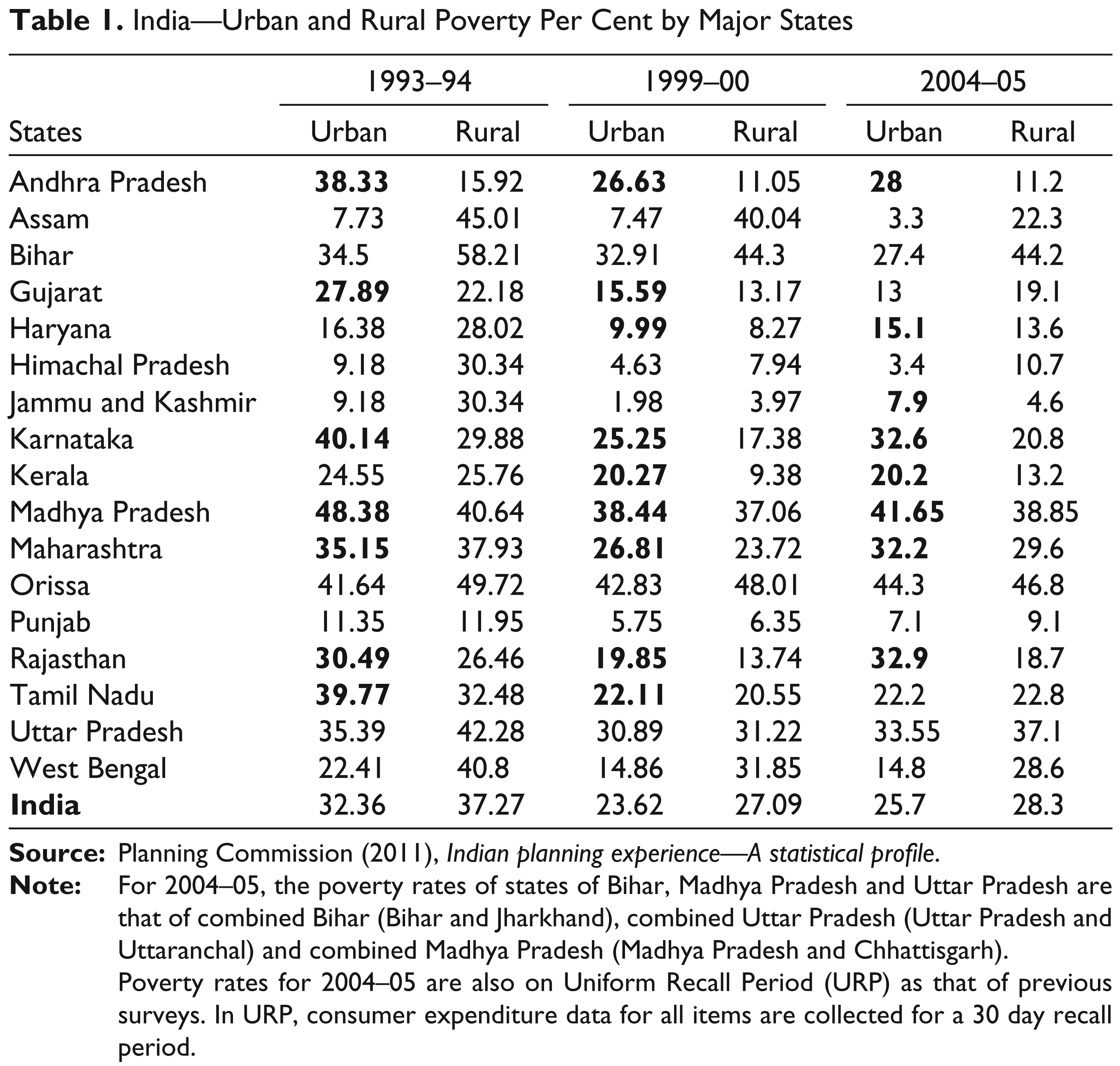
Poverty rates for 2004–05 are also on Uniform Recall Period (URP) as that of previous surveys. In URP, consumer expenditure data for all items are collected for a 30 day recall period.
One possible explanation for incidence of consistently higher urban poverty in Andhra Pradesh, Karnataka, Madhya Pradesh and Maharashtra is that these states have pegged their urban poverty line at a much higher level than rural poverty line—more than 1.6 times (Table 2). Such a high urban poverty line in relation to rural poverty line is unacceptable (Deaton & Tarozzi, 2005; Himanshu, 2010) as they demonstrate that the difference between rural and urban poverty lines could at best be 1.15 times. Of course the states that record high rural poverty also record high urban poverty but not higher than rural poverty.
India—Ratio of Urban and Rural Poverty Lines

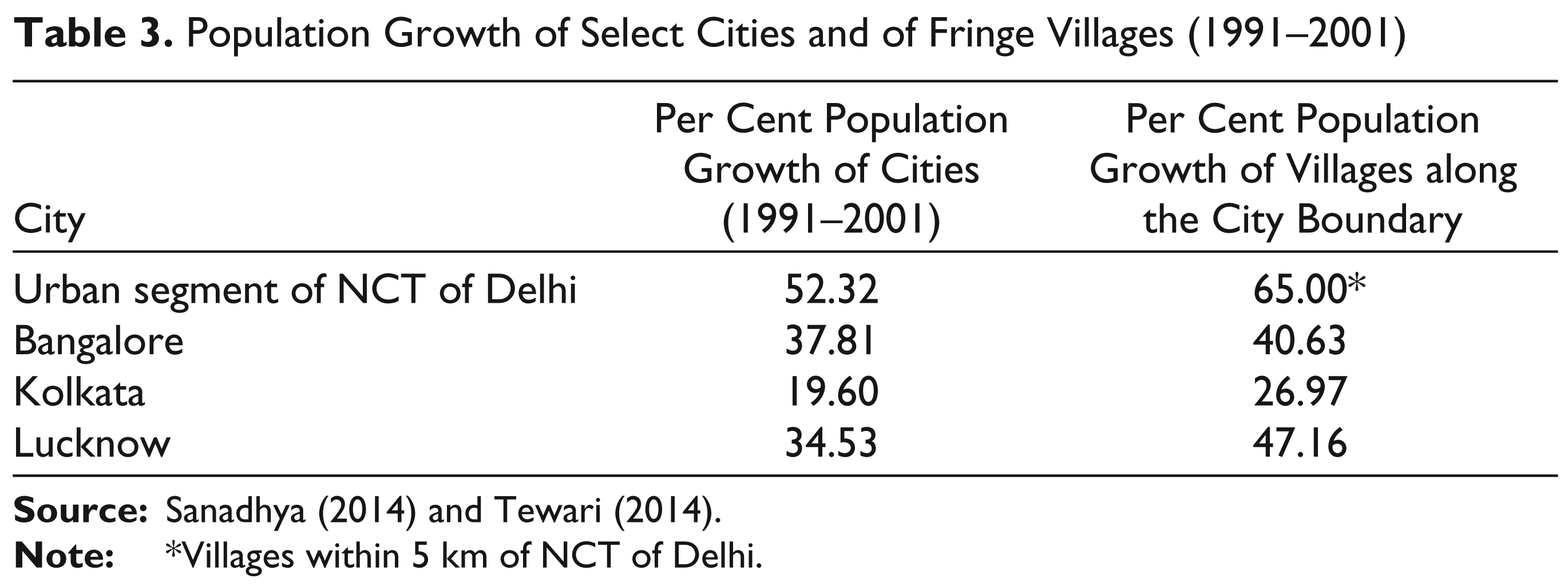
An alternative explanation for higher incidence of poverty in rural areas is also available. It has been argued that cities are becoming anti-poor because of the antipathy of the urban middle class coupled with harassment of informal sector workers, such as vendors and pavement hawkers, and the high rental values that deflect the potential migrants from the city proper to the fringe villages of big cities. This is evidenced, for example, by comparative population growth of city proper and the villages surrounding some of the large cities (Table 3). This evidence is, of course, selective; there are other large cities whose peripheral villages do not record higher population growth than the city growth.
Population Growth of Select Cities and of Fringe Villages (1991–2001)
Urban Economic Base and Poverty
The incidence of strong secondary sector reduces incidence of both urban and rural poverty significantly as compared to tertiary sector (Table 4). In India, there is a notable change in the source of growth since 1990s. Earlier on, in the 1980s the secondary sector recorded a growth of 6.86 per cent, followed by tertiary sector (6.58 per cent). But in the 1990s, tertiary sector recorded 8.24 per cent followed by secondary sector with a growth rate of 7.45 per cent. This change in the major source of growth prompted the question posed by Bhalla (2004)—‘whether India’s pattern of growth sans industrialisation is sustainable’? One is tempted to quickly counter this question with another; is the situation wherein agricultural sector with a share of 60 per cent employment and 25 per cent share (1999–2000) in GDP sustainable? Contrast this with corresponding figures of tertiary sector—24 per cent in employment and 48 per cent in GDP which is even better than 16 per cent employment share and 27 per cent of GDP in the secondary sector. If unemployment is an important policy issue in India, which I presume it is, then the preceding figures compel us to cheer the growth of tertiary sector at least in the interim period when we wait for industrialisation to accelerate. This is particularly so when the rural to urban migrants are too poorly skilled to be absorbed in the manufacturing sector.
Correlation Coefficients (16 Major States of India)

Recent decades have recorded increased absorption of labour force released from rural economy in the urban informal sector in the developing world including India where the informal sector accounts for over 90 per cent of employment. This has been viewed as a solution to the growing problem of unemployment (Kundu & Sharma, 2001: 10).
Therefore, I argue that tertiary sector-led urban growth as experienced in India is not as unsustainable as a segment of research literature makes it out to be, despite increasing regional and interpersonal income disparities, since accelerated reduction of poverty is positively related to level of urbanisation and without much cost to the public exchequer (Table 4). It may be noted that even earlier the pace of urbanisation in India accelerated (in the 1970s) without any acceleration in industrialisation.
City Size and Poverty
Another important feature to be noted is that there is evidence that with increasing size of the city, the incidence of poverty decreases steadily as measured by head count ratio. One estimate places 14 per cent population below poverty line in cities with more than a million people. The corresponding figures for cities with a population of 50,000–100,000 and cities with less than 50,000 people are 20 and 24 per cent, respectively. It has been argued that there is an imbalance in the distribution of urban population with increasing top-heavy character evidenced by an enhanced proportion of urban population living in large cities (Table 5). On the other hand, it is to be noted that there is evidence of dispersed concentration in the urban population with million-plus population cities increasing from about 4 in the 1950s to 54 in 2011. These and the corridors connecting them are the hubs that will fight poverty with enhanced growth rates as compared to investments in rural development. Promotion of medium- and small-sized towns can only ensure spatially equitable social services but such towns cannot become engines of growth.
Distribution of Per Cent Urban Population of India by Size Class of Cities
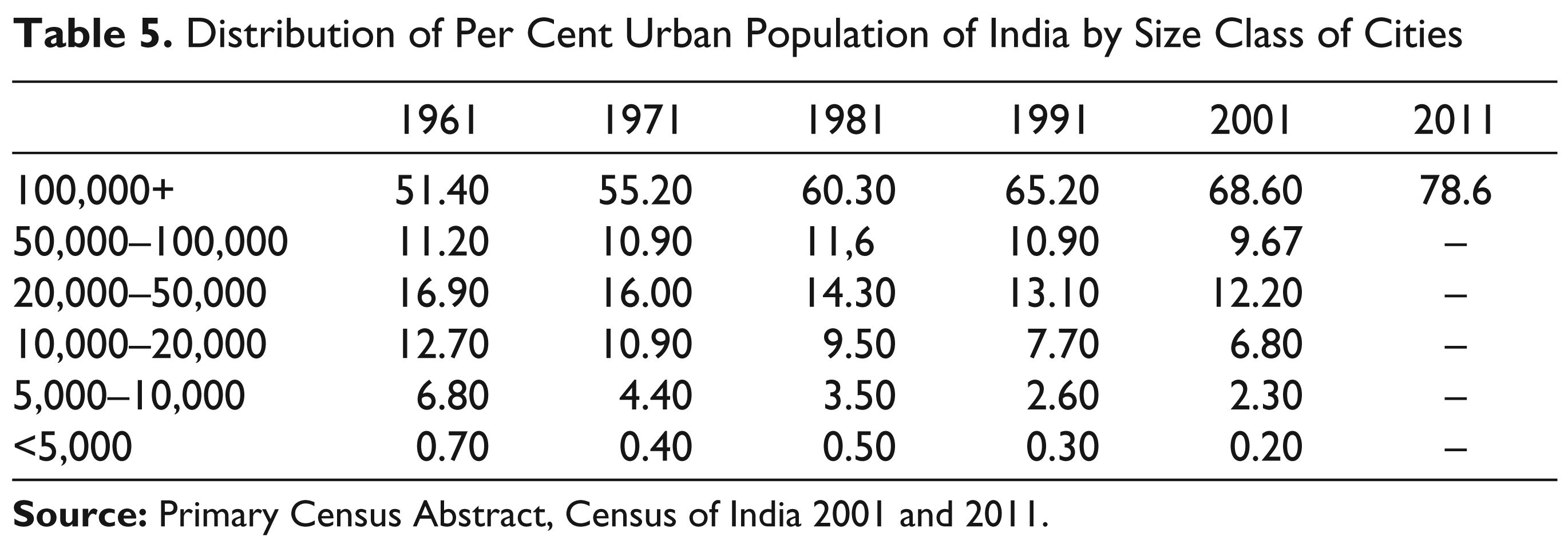
In the light of the position that I take, the increase in the number of million-plus cities now provisionally estimated to be 54 by the Census of India (2011), is to be welcomed. Of course, this would accentuate the inverted pyramidal distribution of urban population in India. Such a top-heavy distribution of urban population is in itself not a matter of concern. Consequential concerns are the proliferation of slums, poor living conditions in such cities, traffic congestion and provision of infrastructure, such as drinking water, waste disposal and other such facets of city administration that affect quality of urban life. It should, however, also be noted that living conditions in smaller cities are no better. Such city-specific issues need to be tackled at the city level.
Stratified Society and the City Development Plans
While population and human settlements are classified as urban and rural, high degree of heterogeneity and wide disparities within urban population in a city is a basic feature. City plans in India as in many other countries are essentially land use plans—earmarking areas for residential, commercial, industrial, institutional, recreational and land for transportation. Residential land use is the anchoring feature that occupies the largest proportion of a city’s land and residents and their living conditions are the focus of city plans. Residential layouts planned by the Development Authorities attempt to accommodate disparities among the city population in the planned residential areas by earmarking residential land for four categories such as high income, middle income, low income and economically weaker sections. Obviously, residential densities increase with decreasing income level, with highest densities of economically weaker sections and lowest in the case of high income group. It is also clear that the per capita costs of providing urban infrastructure (such as sewage line, water pipe, electrical connection etc.) would decrease with increasing densities. Simultaneously, the environmental conditions (congestion, crowding etc.) deteriorate with increasing densities beyond a point. Thus, there is a trade-off between urban residential density, and per capita infrastructural and environmental costs. While reasonable range in population densities associated with income are expected, this stretches in the case of Delhi for example, from less than 50 persons per hectare in some parts of the city to over 20,000 per hectare. Generally, it is the high-cost, low-density, high-income areas that have better urban services.
Increasing demand for residential space in cities is accommodated by increasing densities—vertical growth and through urban sprawl—eating into the agricultural land in the peripheral villages. Vertical growth in already established urban areas puts stress on system of services that were planned for lower densities. Increasing the capacities is expensive and the costs of such capacity expansion are borne by the government while the profits accruing from increased density goes to property owners. Outward city sprawl is often a combination of leap frog and infilling processes and result in eating into usually irrigated agricultural land that is often highly productive.
Despite earmarking residential land in city plans for different economic strata, such planned layouts are grossly inadequate to meet the demand—particularly of the lower middle income group and the poor. The inadequacy of planned layouts results in mushrooming of unplanned residential areas which often account for a larger proportion of residential area than the planned layouts. It is such unplanned areas that accommodate the poor and the lower middle class urban population. The moot question is where would the low income population occupying unplanned areas go if cities are fully planned devoid of unplanned areas?
Besides numerical dimension of the employment challenge, there is a huge qualitative deficit that most Indian workers face. Even among those fully employed and likely to continue to earn their livelihoods (well above poverty line), many people have inadequate earnings to afford a decent housing. It is also important to note that while city plans for residential layouts provide for owned houses and high rise apartments, a larger proportion of the urban population lives in rented accommodation. Casualisation of labour and frequent relocation of place of employment for the poorer section and the in-migrants increase the demand for rental housing. While the issue of rental housing cannot be addressed by the city plans, there is a need for policy options in so far as city administration is concerned. The short supply of rental housing particularly for the lower income group is one of the reasons for deflecting rural in-migrants to the villages in the city periphery. Many of these attributes relate to large cities, since employment opportunities in the informal service sector appear to be substantially more than that in small and medium sized cities and towns. One of the evidences of deflection of migrants to the city to peripheral villages is comparative growth rate of villages in the fringes of cities as shown in Table 3 earlier.
There is great amount of economic and social churning that is taking place in villages in the fringe areas of large cities, such as increasing heterogeneity in the village population, sudden change in lifestyle through lump sum windfall by selling of agricultural land and increasing youth unemployment, which is inviting public response.
The not-so-inclusive urban planning in so far as low income population is concerned is not limited to housing issue, but extends to provision of transportation facilities that promote high speed personalised transport without any space for slow moving non-motorised vehicles, pedestrians etc. It has also been shown that in Delhi as in many other urban centres, high density areas are provided much less open spaces (parks) than low density areas.
Land for Urban Expansion and Growth 1
Having argued that we need to actually increase the pace of urbanisation, and taking into account that at least two strands of government policy which proactively promote urban growth are that (a) relating to the industrial corridors 2 and (b) the Special Economic Zones it is not possible to escape from addressing the question of land use conversion from agriculture to urban uses. Urban expansion of the existing large cities can to certain extent be through densification (vertical growth) or through sprawl (horizontal expansion). Both these have environmental and cost implications. These processes are city specific and have to be addressed at the city level.
In addition to the industrial corridors and the Special Economic Zones, the BJP led NDA Government has flagged creation of 100 new smart cities in its manifesto. Obviously, the idea has not been thought through and meanwhile the term being used is ʽSmart Citiesʼ which among other things would be technology-driven with digital data base for city management. It would also appear that some of these new cities would develop as satellite/twins of the existing cities and others as counter magnets. Nevertheless, there is, as one can see, both conceptually and on the ground an overlap between them—corridor, SEZ and New Cities.
UNICEF’s estimate of urban population in India for the year 2026 is of the order of 535 million as compared to 377 million in 2011—that is an absolute increase of 158 million people. The additional population may come up in the existing cities (densification and sprawl) and new towns/cities (smart or otherwise) on the proposed corridors and SEZs. Assuming an urban population density of 400 persons per hectare of land, the town planning norm, the land required for urban purposed would be in the order of 500 square kilometres.
Elsewhere we have identified areas that can be made available for urban use without adversely affecting areas that are characterised by relatively higher levels of agricultural productivity, forest/tribal areas (Ramachandran & Biswas, 2007). Areas with the above characteristics span about 9,000 square kilometres spread over parts of 64 districts in 16 states. It may be noted that only 12 of these districts are found in the list of 150 backward districts identified by the Planning Commission. The areas identified are: (1) within 10 kilometres of National Highways, (2) within 30 kilometres of broad gauge railway lines, (3) between 60 and 100 kilometres from existing large cities and (4) characterised by low agricultural productivity. While such specific criteria can be set for identification of land for SEZ and new cities, it is not possible to do so as far as the proposed corridors are concerned their alignments being largely predetermined.
Concluding Observations
For too long, Indian policy makers have argued that India lives in its 600,000 villages and hamlets and development policies were and are, to a substantial extent, geared to discourage rural–urban migration by (a) providing in-situ employment and (b) large public expenditure on often populist rural development programmes. The situation, wherein agricultural sector with a share of 60 per cent employment and 25 per cent share in GDP, is not sustainable (Ramachandran, 2011). For several decades, urban problems tended to be ignored by both policy makers and academic researchers. It is now clear that both in terms of proportional contribution to and proportion of labour employed in urban sector would grow and anchor the development policies.
It has been repeatedly pointed out that the classic sector sequence of primary–secondary–tertiary breaks down in India where we find primary– tertiary sequence bypassing the secondary sector. While there is no denial of the fact that manufacturing sector in India needs to be strengthened, the informal service sector offers some employment avenues for the rural migrant labour that is without necessary skills for employment in manufacturing sector. This is particularly so in big cities.
It has been argued that there is an imbalance in the distribution of urban population with increasing top-heavy character evidenced by an enhanced proportion of urban population living in large cities. On the other hand, it is to be noted that there is evidence of dispersed concentration in the urban population in cities with over a million people. These and the corridors connecting them are the hubs that could fight poverty with enhanced growth rates. Promotion of medium- and small-sized towns can ensure spatially equitable access to social services, but such towns do not have the threshold size to become engines of growth unless they develop as clusters on the basis of locally available resources/skills. To repeat, what has been argued earlier is to actively promote urbanisation, particularly through large cities to fight poverty. However, the current approach to urban residential planning that merely carves out areas required for high, middle and low income as well as economically weaker sections that leaves out perhaps more than 50 per cent of people living in urban areas must drastically change. At present, this segment of the city population occupies unplanned areas—both legitimate and encroached—with very poor basic services.