



Abstract
The study focus on the urgency and relevance of debate on the subject in the context of (a) MDG 7 (b) Rangarajan Committee’s Report and (c) new versions of MDG and JnNURM on the anvil. The latest UN report (mid-2014) saying that one-third of the world’s extreme poor are in India is of serious concern.
Urban poverty, all over the globe, has many dimensions. It can be viewed from economic, spatial and social/cultural perspectives. Being multi-dimensional in its genesis and manifestations, it calls for multi-pronged strategies. In India, policy makers have concentrated on (a) planning and policy framework (b) in situ improvement of slums (basic services for the urban poor (BSUP); (c) affordable housing; and (d) improving skill and job opportunities of slum dwellers.
Interestingly, in a recent survey in 127 cities on the perceived constraints to inclusiveness, the highest tally was for failures of planning/policy framework and not the scarcity of funds. While emphasising the role of city governments in ensuring inclusiveness, the author relies on knowledge gathered by UN-HABITAT in ‘success cities’.
The urban divide can possibly be encapsulated in three D’s: dynamics of the divide (DD), characteristics of the divide (CD) and bridging the divide (BD).
Context
The Millennium Development Goal 7 (MDG 7) of the UN had a specific item on lifting up of 100 million slum dwellers across the globe by 2020. Good news is that this target was achieved 10 years ahead of the schedule. China and India alone achieved the global slum target by improving the lives of 125 million slum dwellers by 2010. But the bad news is that the target was probably too soft in the context of a total global slum population of one billion and that the slum dwellers around the world show 8–10 per cent urban population growth every year. However, India reported a moderate increase in slum population by 25.1 per cent in between two censuses in 2001 and 2011. It is partly explained by deceleration in overall growth rate of population and urbanisation rate; but also by massive investment of about ₹7 lakh crores in poverty alleviation schemes in the 11th plan period.
India is engaged in a serious debate on the extent of poverty prevailing both in rural and urban areas. Estimates of urban poverty as in 2011–12 were worked out by the Planning Commission in July 2013 at about 13 per cent. This was based on a definition of urban poor as a person whose income was less than ₹32 (half-a dollar) per day. This implied a substantial fall in the population of the urban poor in India in the seven year period from 2004–05 to 2011–12. While the then political dispensation had valid reasons to rejoice, the estimate was criticised, especially on fixing an unrealistically low income level as the poverty line. In the first week of July 2014, Rangarajan Committee recommended a much higher expenditure level for urban poor at ₹47 per capita per day. By simply changing the poverty line, India added about 97 million in the category of the poor.
Let us have a look at the trend and incidence of urban poverty over the decades in India, as reported in Rangarajan Committee Report, 2014 (Table 1).
Urban Poverty Ratio and Number of Urban Poor in India
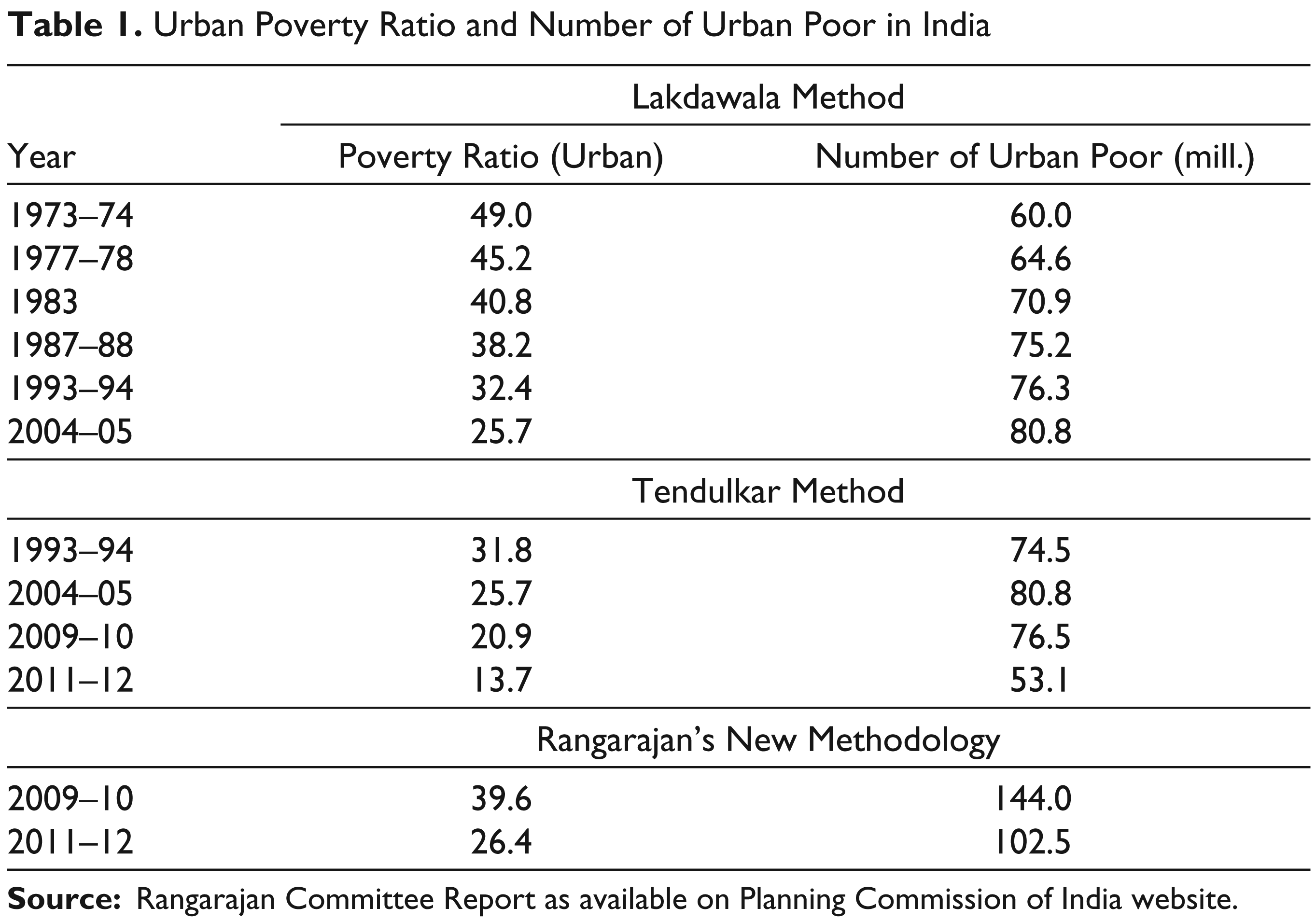
Both the cut-off (poverty line) fixed by Tendulkar and Rangarajan Committees are incidentally lower than the World Bank’s category of the poor as ‘below US dollar two per capita per day’. Only the other day, the author of the latest estimates explained that with price/purchase parity, ₹47 per person per day expenditure works out to be US$ 2.1 (approximately), which is the UN/World Bank global bench mark of poverty. Thus, the estimates of the urban poor in India, in the World Bank and the UN reports on the MDGs, are likely to be closer to Rangarajan’s estimate than the earlier Tendulkar’s estimate.
Basic Slum Statistics in India
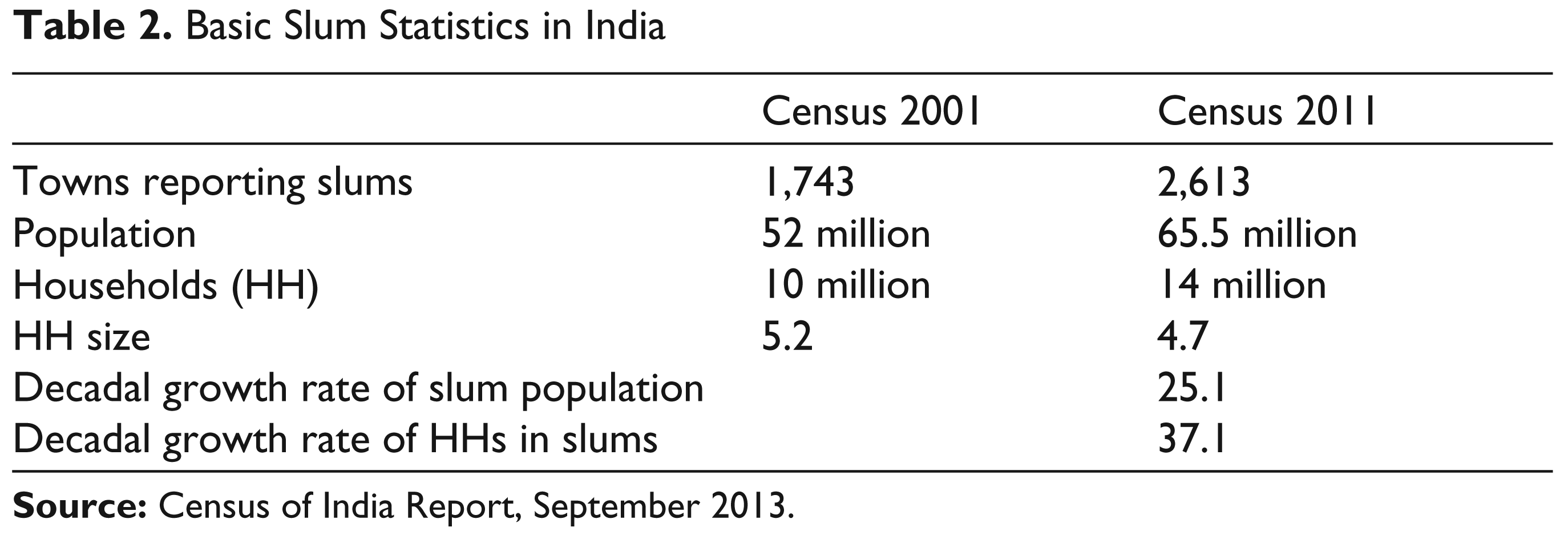
Without getting into the controversy over definitional aspects of poverty lines, facts remain that (a) incidence of urban poverty in percentage terms has shown consistent decline over the decades (b) number of urban poor remained static or showed slight increase up to the end of the last century (c) number of the urban poor went down in the first decade of the present century—the extent by which it was down remains in the realm of controversy.
An estimate is an estimate. It cannot override the findings in census operations. Slum statistics of census 2011 were released in September 2013. Slum population during the period 2001–11 shows an actual increase as shown in Table 2.
Trends of urban poverty on regional basis throw up some interesting features. UN-HABITAT estimates that between 2000 and 2010, a total of 227 million in the developing world moved out of slum conditions (UN-HABITAT, 2008a, 2008b). The collective will shown by the governments in achieving MDG 7 is commendable. In spite of all that has been achieved, India should be concerned at the recent UN report that one-third of the world’s extreme poor are in India. Equally discerning is the fact that the task was doable in the light of what China did during the same period (1990–2010).
Asia stood at the forefront of successful efforts to reach the slum targets with improving the lives of 172 million (74 per cent). China and India were at the centre stage with achievement at 125 million. Interestingly, Western Asia failed to make a contribution as the number of slum dwellers in the sub-region increased by 12 million.
Africa accounted for 12 per cent of the global effort by improving lives of 24 million. Latin America and the Caribbean made a contribution of 13 per cent of the world’s achievements by improving the conditions of 30 million slum dwellers.
Adding to the urgency is the discussions on future shape of JnNURM, the flagship scheme in urban sector, which remained operational for nine years (with two years’ extension) up to March 2014. Many expect that the scheme will not continue in the same format. Even though the bulk of allocation in JnNURM was earmarked for urban infrastructure, the co-committed reform agenda were supposed to take care of inclusion of the poor. The new government announced an allocation of about ₹7,060 crores in the budget 2014–15 for one hundred new smart cities. Rajiv Avas Yojna (RAY) with a focus on provision of housing facilities in slums misfired before gaining full momentum.
A new version of the MDGs is on the anvil. Whatever name the programme is given, attack on poverty and ambitious targets on the uplift of the slum dwellers may continue unabated in the comity of nations.
Multi-dimensional Aspects of Inclusion in a City
The 2009 UN-HABITAT Policy Analysis on the Inclusive City brought a lot of clarity and fresh insights into the arena, which so far had been looked mainly from economic perspective. An inclusive city can be defined and personally experienced in many different ways by its residents.
Still, inclusive cities share a number of basic features that take different shapes in various conditions. An inclusive city provides the opportunities and supportive mechanisms that enable all residents to develop their full potential and gain their fair shares of the urban advantage. This advantage includes access to all aspects of basic, decent living conditions such as housing, transportation, education, recreation, communication, culture, religion, employment and the judiciary among others.
The Planning Commission of India, while having an overview of the 11th Five Year Plan (2007–12), observes that focus on growth of inclusiveness should continue. It conveys the same message as the UN-HABITAT but in different words:
Inclusive growth should result in lower incidence of poverty, broad-based and significant improvement in health outcomes, universal access for children to school, increased access to higher education and improved standards of education, including skill development. It should also be reflected in better opportunities in both wage employment and livelihood and in provision of basic amenities like water, electricity, roads, sanitation and housing.
Four Dimensions of Inclusion
On a conceptual plane, exclusion in cities can be divided in four categories:
Economic Divide
Income inequalities are higher in the developing countries than in the developed. High unequal expenditure pattern in cities in developing world point to institutional and structural failures as also to broader economic problems like imbalanced labour market. The more unequal the distribution of income or consumption in urban areas, the higher the risk that economic disparities will result in social and political tensions.
Spatial Divide
When slum area are physically isolated and disconnected from the main urban fabric, residents get cut off from the city, often enduring longer commuting times and higher transportation cost.
Opportunity Divide
Access to urban advantage and distribution of related benefits is largely determined by various organisations, including land and labour markets. If these organisations are weak and dysfunctional, vested interests capture them and the poor are exposed to the danger of differentiated opportunities. In this process, uneducated people and young slum dwellers, particularly women, are deprived of the formal/secure livelihoods. The urban poor constitute bulk of informal sector; and unfortunately informal sector remains neglected. Innovative ways are to be designed to ensure inclusion of this sector in the schemes executed by national/state or city governments.
Social/Cultural Divide
Beyond the functional goods and services that provide for decent living conditions, economic poverty eats into most physical and social organs. Manifestations of this become evident in the fields of hunger, health and higher education (3 H’s).
Role of City Governments
Improvements in the foregoing four inclusions are inter-related. Municipal authorities make significant progress in bridging the urban divide when they integrate all these dimensions into policies. The following five strategic steps were listed by UN-HABITAT to an inclusive city:
Assessing the past and determine present status
Each city is unique in its own way—its history, economy, politics, social dynamics, cultural moorings and human talent. It is the understanding of these realities that will provide a good beginning to researchers or those who intend to initiate process of deeper inclusion in the city.
Establishing/strengthening more effective institutions
Evidence gathered across the globe on ‘success cities’ shows the way municipalities perform their role is as important as the nature of what they achieve. Inclusive cities conduct in-depth reviews of their systems and institutions to make changes in them.
Building new linkages and alliances across tiers of government and civil society.
Bhagidari experiment in Delhi is a typical example of the new alliances. ‘Cities that manage both to develop innovative programmes and actions and deploy greater entrepreneurship achieve more if they establish strategic alliances that combine policies and resources with other tiers of government as well as the private sector’.
Developing sustained comprehensive vision on inclusion
A city’s vision builds upon its specific identity, comparative advantage, geographic endowments and defining historical and cultural dimensions. It is not just a city’s function, structure and form that its vision projects into the future but also a community’s dreams and aspirations.
Ensuring more equitable redistribution of resources, investments and opportunities
This is the ACTION part of the exercise. ‘Strong empirical evidence confirms that the concentration of people and productive activities in cities generates economies of scale and proximity that stimulate growth and reduce the costs of production, including the delivery of collective basic services.’ Pragmatic schemes are to be drawn which will ensure redistributive justice to the residents of the city.
General Perception on Constraints to Inclusion
UN-HABITAT, in a recent survey in 27 cities, came out with an interesting finding. A comparatively small proportion of respondents feel that lack of funding is the factor responsible for exclusion. In Asian context, percentages of respondents agreeing with each of the following options, as a factor hindering inclusion policies, were:
Lack of Policy Focus (44); Lack of Political Will (36); Lack of Human Resources (25); Inadequate Community Participation (23) and Lack of Funding (17).
Strategy Focus in India
A few approaches, interventions and instruments tried in India for making cities inclusive are briefly described in the following paragraphs.
Tackle the Problem at Planning Stage
Urban and regional planning processes are effective tools for finding out the right mix in innovative solutions of urban development, provision of affordable and basic services to the poor and in keeping the interest of the so called voiceless in getting access to opportunities created by urbanisation. Two types of situations may arise. First, while planning new settlements in urban extensions, policy prescriptions envisage earmarking of about 20 per cent of newly developed land for use by the EWS/LIG families. Also, 25 per cent of dwelling units constructed by them would be in EWS/LIG slab. Second is the earmarking of municipal funds (maintenance and otherwise) for the poor by ULBs in JnNURM towns. It is to the credit of the Delhi Development Authority (DDA) that it has lived up to the above stipulations much beyond the lowest limits. About 80–85 per cent of the DUs developed by DDA are in EWS/LIG categories. The same is not true of private developers and builders who were allotted land on clear understanding that they would abide by the stipulations on housing units for weaker sections. Two important recommendations in this connection could be:
If the private sector is unwilling to take up housing projects on the specified terms, the state government, ULB or the housing board should take over the 20–25 per cent of the developed land and make this land available for the urban poor. There should be built-up incentives to ULBs in spending the earmarked funds for the colonies of the poor.
Improve the Habitat: Upgradation of Basic Urban Services to the Poor (BUSP)
As an important pillar of JnNURM, BUSP aims at improving the services in the slums/low income neighbourhood areas. It includes affordable shelter, issue of pattas, security of tenurewater/sanitation/education/health and social security in these areas. Beset with immense challenge of consensus on local development plans and funding, execution of works in densely populated low income areas and of maintenance after construction, this intervention is the soul of in situ development of slums. Unfortunately, ‘in situ’ development does not get the same degree of support as ‘relocation of slums’ gets. Commercial interests of ULBs and of the entrepreneurs outweigh the welfare aspects of the slum dwellers. It is often forgotten that relocation cuts off slum dwellers from their livelihood/workplaces and results in segregation of the poor in far-off colonies.
A few improvements could be:
Relocation of slums should be sanctioned in rarest of the rare cases where land is required for a genuine public purpose like road widening or creating urban facility, especially for the affected colony. Once title has been conferred on them, the slum dwellers will, most likely, invest in improving their houses as a matter of social and family pressure. In those rare cases of relocation, the displaced should be accommodated in the nearest possible locations.
Provision of Housing as a Tool to Manage Urban Poverty
Unaffordable housing and lack of investible initial capital to fund a formal dwelling unit are the two most important factors compelling the migrant to have a footing in squatter settlements. If these causative factors are taken care of, at least further growth of slums and squatter settlements would be checked, if necessary with heavy hands. I have been a great votary of having rental housing solutions with effective check on salami/pagadi demands. In addition, government interventions in making available land and finances should work wonders. The central scheme of Interest Subsidy for Housing and Urban Poor (ISHUP) envisages interest subsidy of 5 per cent for a new housing unit for EWS/LIG segment. RAY intended to finance housing for the slum dwellers on a fairly large scale. But a real beginning was yet to be made. A lot of time was lost in framing guidelines (which are quite cumbersome), as also in convincing the states for joining hands. Heavy investment in this type of programme is called for in the light of the commitment of the new government to end homelessness by 2022.
Sustainable Livelihood for the Urban Poor
Livelihood issues for sustainable living are paramount in any community. Slum dwellers and squatters are no exceptions. The poor are poor because they are not skilled in tune with the market demand. They were marginalised because of their incapability to acquire new/more productive skills and technology or loss of natural resources on which they were dependent, especially during transition. I am aware of at least one state (West Bengal) which realised this simple fact and insisted on inclusion of livelihood issues in the scheme of slum improvement implemented with DFID assistance. Initial evaluation reports are indicative of higher success level in relative and sustainable terms; the outcome was positive and sustainable. The poor view, and rightly so, shelter, access to amenities and livelihood as intricately and irrevocably connected issues. JnNURM concentrated on improving urban/municipal infrastructure and shelter to some extent but did not embrace livelihood issues for best convergence in reduction of urban poverty. A valuable suggestion was made by experts that the guidelines on preparation of city development plans (CDP) should have specific reference to skill up gradation and sustainable livelihood issues. The government endeavour to tackle this problem via employment generation is reflected in the guidelines of Swarna Jayanti Shahari Rozgar Yojna (SJSRY). In this context, a success story of Mexico City is worth replication. In this case, informal housing and informal processes were recognised and then integrated with official policy framework. Thousands of houses built in districts like Ciuadad Neza were considered informal settlements. However, since official policies started supporting them and ‘investments in upgrading the infrastructure were made, the settlements were transformed into a vibrant city of 1.5 million people. A large number of businesses have been set up within the settlement providing nearly 65% of their jobs to the residents (Tiwari, 2009, p. 348).’
Conclusion
First, country-wise data show positive association between ‘per capita GDP’ and ‘level of urbanization’: most of the highly urbanised countries of North America, Western Europe and Oceania have high per capita GDP. On the other hand, lesser urbanised countries of Asia and Africa are in low per capita GDP bracket. Thus, urbanisation per se with all its pangs and pitfalls is not to be bemoaned.
Second, talking of ‘urbanization’ and ‘exclusion of the poor’ in the same breadth may give an erroneous impression that urbanisation and urban poverty are cause and its effect. In the Indian context experts have shown that data in this respect are mixed. Some Indian states (Gujarat and Punjab) are highly urbanised and have low incidence of poverty. At the same time, poverty incidence is high in low-urbanised states of Bihar, Uttar Pradesh, Orissa and Madhya Pradesh. In other words, causative factors of urban poverty are to be located elsewhere and not in the level of urbanisation.
Third, urbanisation, like industrialisation, is a major (demographic) transition embracing radical socio-economic transformation. It creates new classes, new elite, new poor and the marginalised. However, there is a major dissimilarity in the two situations. When industrialisation took place, it was accompanied and followed by the evolution of a ‘welfare’ state. But when urbanisation is reshaping Asia and Africa in the twenty first century, a strong case for liberalisation and withdrawal of the state is being made. In any transition certain enterprising sections harvest quick returns while some are left behind. The state cannot surrender or negate its basic role of restoring balance in the society. It has to ensure that while private sector is encouraged to take part in the development processes, interests of the slum dwellers and the urban poor are not put swept beneath the carpet. This process of marginalisation is to be recognised and timely remedial action by state becomes imperative.
Fourth, in many countries and situations words like ‘exclusion’, may not signal the seriousness in the matter. It could be outright exploitation of the voiceless, uneducated, half hungry rural folks flocking to cities in search of better avenues of livelihood.
Fifth, ‘urban poor’ may not be coterminous with ‘slum dwellers’. Pockets of urban poverty do exist and can exist outside the slums. Then, why slums are the focus of attention whenever urban poverty is discussed? Reason is simple. Slums have the largest concentration of the urban poor; slum dwellers account for the bulk of the urban poor. The census figures of 2011 will illustrate this phenomenon convincingly. Slum improvement and uplifting the slum dwellers should occupy centre stage of public policy in war against urban poverty. Relocation, and that also with required preparations and precautions, should be allowed in the rarest of the rare cases.
Lastly, what is true of India is also true of many other countries. Genesis of urban poverty is often rooted in some common systemic deficiencies in the process of urbanisation. Manifestations of the Urban Divide may vary, yet may reveal conceptual common under currents. If ‘D’ stands for ‘URBAN DIVIDE’, the scenario in a country can be summed up in the following D’s:
DD: Dynamics of the Divide CD: Characteristics of the Divide BD: Bridging the Divide
The journey to end urban poverty and deprivation in India continues; and is full of challenges in the context of global downturn and change over to new models of development. Sooner or later, rhetoric like MY City: My Pride or Right to City has to become reality. This is what Nelson Mandela had to say in June 2008:
‘It is in