



Abstract
This article, examining the interface of research university and knowledge society, argues that India will have to build a strong research base in its universities since a modern research-oriented university is the mother of knowledge society—a society in which knowledge industry plays a vital role in enhancing its power and wealth. Universities play an important role in sustaining the knowledge society as well, since the universities, through their research activities, train students who are capable of original thinking and can become the next generation’s elites, that is, scientists, engineers, teachers, industrial entrepreneurs and political leaders, enabling society to adapt to rapid changes. Furthermore, taking the USA as a paradigm of knowledge society, it asserts that the country has become rich and powerful by promoting scientific research in its universities. Concurrently, while appraising India’s progress towards knowledge society, the article concludes that if India aspires to be a world power in the 21st century, it will have to become a knowledge society by promoting research not only by guaranteeing substantial financial support, but also by regenerating a research culture and ceaselessly transmitting it among the coming generations of students.
Keywords
Introduction
Contemporary Indian policy-makers, aspiring to make India a global power by calibrating a development trajectory with projects like ‘Make in India’, ‘Bullet Trains’, ‘Smart Cities’, ‘Metros’ and so on, need to recognise that economic progress in the emerging knowledge society depends largely upon a knowledge economy. Let me illustrate the point with a personal anecdote. In 1994, I was at a university in UK, as a Charles Wallace Fellow. During my stay there, once I had a chat with an economics professor. At some stage, I asked a simple question which had been bothering me as a non-economist for a long time: ‘Professor, as an economist, how do you explain the huge difference between the value of British pound sterling and Indian rupee?’ 1 He looked at me with a smile and said, ‘Simple. We [in Britain] sell supersonic jets and you [in India] sell potatoes and onions!’ I was flabbergasted. However, a moment’s reflection made it all clear. What he meant was that a product like a supersonic jet involves much value-addition, caused by extensive research in various areas. Such sophisticated products are in a high demand and fetch astronomical prices, contributing to the country’s economic prosperity. On the other hand, raw materials like potatoes and onions do not contribute much to a country’s economic development. Thus, a country’s capability to undertake path-breaking research enables it to become rich and powerful by globally marketing value-added products. Conversely, a country unable to do so remains economically underdeveloped. Thus, knowledge creation through scientific research is the key to economic development in a knowledge society.
This article argues that a knowledge society is the product of a modern, research-oriented university. Furthermore, taking America as a paradigm of knowledge society, it asserts that the country has become rich and powerful by promoting scientific research in its universities. Concurrently, while appraising India’s progress towards a knowledge society, the article concludes that if India aspires to be a world power in the 21st century, it will have to become a knowledge society by promoting research not only by guaranteeing substantial financial support, but also by regenerating research culture and ceaselessly transmitting it among the coming generations of students. The article is focused more on the natural sciences, since they play a crucial role in promoting a knowledge economy, the basis of knowledge society.
Research University: The Mother of Knowledge Society
Human being’s quest for knowledge is ancient. However, knowledge society originated in modern times due to the digital revolution of the mid-20th century caused by scientific research mostly done in universities.
The Knowledge Society
A knowledge society, heavily dependent on knowledge economy, creates, communicates and uses knowledge for the people’s well-being (Bernheim & de Sauza, 2003, p. 1). It is a society characterised by transition from an economy based on material goods to the one based on knowledge (Drucker, 1969). The members of a knowledge society attain a higher average standard of education, and a growing proportion of its workers are employed as knowledge workers. Increasingly digitised knowledge provides enhanced access to information, data banks, communication technology and the internet to its population. A knowledge society also invests heavily in education and research, and organisations become increasingly innovative.
Research University and the Origin of Knowledge Society
Although modern universities took root in Europe by the 15th century, research-oriented universities with the emphasis on science education emerged in the early 19th century with the establishment of the University of Berlin, now Humboldt University, in Germany in 1810 (Clark, 2006). The University of Berlin initiated a new trend in German higher education, making research an inseparable part of teaching; transforming traditional teacher–student relations into that of master-apprentice; giving importance to the ‘institutionalisation of discovery’ and publication of results based on original research; and sponsoring seminars, libraries and laboratories (Howard, 2009, pp. 130–211; Watson, 2010, pp. 225–26). By 1850, all these innovations became the German university’s defining features (McClelland, [1980] 2008; Watson, 2010, pp. 225–37). Significantly, German society was largely underdeveloped and characterised by agricultural economy before 1800. However, after their disastrous defeat in 1806 by Napoleon, the Germans initiated wide-ranging reforms, including in university education, kicking off the processes of modernisation and industrialisation (Howard, 2009, p. 132; Watson, 2010, p. 227). Germany became the world leader in the chemical industry by the late 19th century due to chemical research taking place in German universities and industrial laboratories. And, by 1900, it became the largest economy and most powerful state in Europe.
Impressed by the higher standards of German universities, many foreign students from Europe and USA went to Germany for higher education. Consequently, between 1870 and 1905, the number of foreign students in German universities increased by nearly 70 per cent. USA alone sent about 10,000 students to Germany in the 19th century for higher studies, many of whom were distinguished Americans who later became leaders in their fields (Howard, 2009, pp. 348, 363). Overwhelmed by the spectacular success of German universities in scientific research, many Western countries, including the UK, France and USA, started following the German model, particularly after 1860 (Howard, 2009, pp. 363–78; Watson, 2010, p. 226). Gradually, many universities of these countries also emerged as knowledge producers.
The invention of the transistor by American researchers by mid-20th century paved the way for the development of advanced digital computers, microchips and the internet, heralding the digital revolution. 4 And gradually American economy became increasingly knowledge driven, giving rise to a modern knowledge society. Since the late 20th century, due to increasing globalisation, the knowledge society has started spreading to other parts of the world, including India.
The Role of Research Universities in Sustaining a Knowledge Society
Research universities play a pivotal role in sustaining a knowledge society in two ways. First, by doing fundamental research, they create new knowledge indispensable for developing future products and processes. Second, they also produce future elites such as scientists, engineers, doctors, teachers, professionals, industrial entrepreneurs and political leaders, capable of original thinking through their training in research. Such elites enable their society to adapt to amazingly dynamic knowledge society, as discussed in the following.
Changing Economic Life
The changing economy in a knowledge society radically transforms the lives of the people, causing new challenges. After Robert M. Solow (1957), a Nobel laureate in Economics, observed that technological innovations foster economic growth more than capital and labour augmentation, and that governments started investing more in technological research and higher education, making the economy more knowledge intensive. As a result, the employment opportunities for uneducated or less educated persons are steadily declining. Moreover, the qualifications of educated persons also become obsolete rapidly due to the constant advent of new knowledge and advanced technology, requiring them to continuously update their knowledge and training and expecting them to be lifelong learners. However, today, the acquisition of knowledge is becoming more challenging due to the knowledge explosion.
Knowledge Explosion
Derek J. de Solla Price (1961, 1963), an eminent historian of science and a pioneer of scientometrics, observed that science grows exponentially as is indicated by the manifold increase in the number of scientific journals, papers, discoveries and scientists since the mid-17th century. According to him, 80 to 90 per cent of scientists who ever lived on planet earth were actually living in the 20th century. By following the growth of journals from 1650 onwards, Price formulated a ‘fundamental law’ that scientific journals double within a period ten to fifteen years. Price also observed that published scientific papers in many fields double every five to ten years, and that the rate of important discoveries doubles every twenty years. Moreover, as Larsen and Ins (2010) note, publication in peer-reviewed journals still continue to increase, and if the publications using new channels such as conference proceedings, open access archives and internet are taken into account, the growth is astounding.
Additionally, the quantum of knowledge produced by academic disciplines also continually expands. For instance, as estimated by James B. Appleberry, the disciplinary knowledge doubled for the first time in 1750. In other words, it took 1750 years to double disciplinary knowledge for the first time. It then doubled after 150 years, that is, in 1900 and, subsequently, after another fifty years, that is, in 1950. Afterwards, it started doubling every five years, and it is projected that by 2020, it will double after every seventy-three days (Bernheim & de Sauza, 2003. p. 2; Gillani, n.d., pp. 3–4). This estimate may perhaps appear slightly overstated but it does indicate the geometrical nature of the knowledge explosion.
Besides, due to escalating disciplinary, interdisciplinary and trans-disciplinary research, several new disciplines, sub-disciplines and interdisciplines such as microbiology, biochemistry, biotechnology, socio-biology, nanotechnology, biomedical technology and so on keep on emerging, indicating the qualitative aspect of the knowledge explosion. Clearly, we live in the age of ‘information overload’ (Toffler, 1970) and ‘information anxiety’ (Wurman, 1989), in which learning has become more demanding.
Explosion of Information
One more problem emerging in the dynamic knowledge society is the mindboggling growth of information, due to the escalation in cheaper and faster computer chips. Gordon Moore, one of the founders of Intel, predicted in 1965, now known as ‘Moore’s Law’, that the number of components of integrated circuit used in electronic equipment and the capacity of computer chips will tend to double roughly every two years. Consequently, increasingly smaller, faster and economical transistors have been produced, revolutionising the electronic industry and drastically transforming the means of communications, transportation, educational pedagogy and office work. 5
As a consequence, massive amount of data is generated, due to Instagram, Tweeter, Tumbler, Facebook, Flickr, Blogs, instant messages, smart phones and so on. For instance, Eric Schmidt, the former CEO of Google, estimated in 2010 that every two days, we create data equivalent to the entire amount created from the dawn of human society up till 2003, equivalent to five exabytes of information. Besides, every minute we upload 300 hours of new content on YouTube. It is also estimated that digital data will grow by a factor of ten, to forty-four trillion gigabytes or forty-four zettabytes, in the period of 2013–20 (Seigler, n.d. ; Grossman, 2015). To handle this astonishing data explosion, to make the enormous amount of information comprehensible and to transform it into useful knowledge is yet another challenge faced by the contemporary knowledge society, necessitating the multitudes of well-trained and competent knowledge workers.
Shrinking Time and Space: Emergence of Global Village
In the emerging knowledge society, with the increasing speed of travel, time and space constrict constantly. For instance, in the early 19th century, the animal-driven cart was the only mode of transport. However, as stated in Table 1, with the emergence of increasingly faster vehicles, travel speed has been increasing constantly every 100 years (Doren, 1991).
Consequently, the world has become smaller, accelerating the process of globalisation and giving rise to the global village (McLuhan, 1962, 1964), causing new international trends, too complex and too fast to grasp instantly.
Speed: Distance Comfortably Travelled in a Day
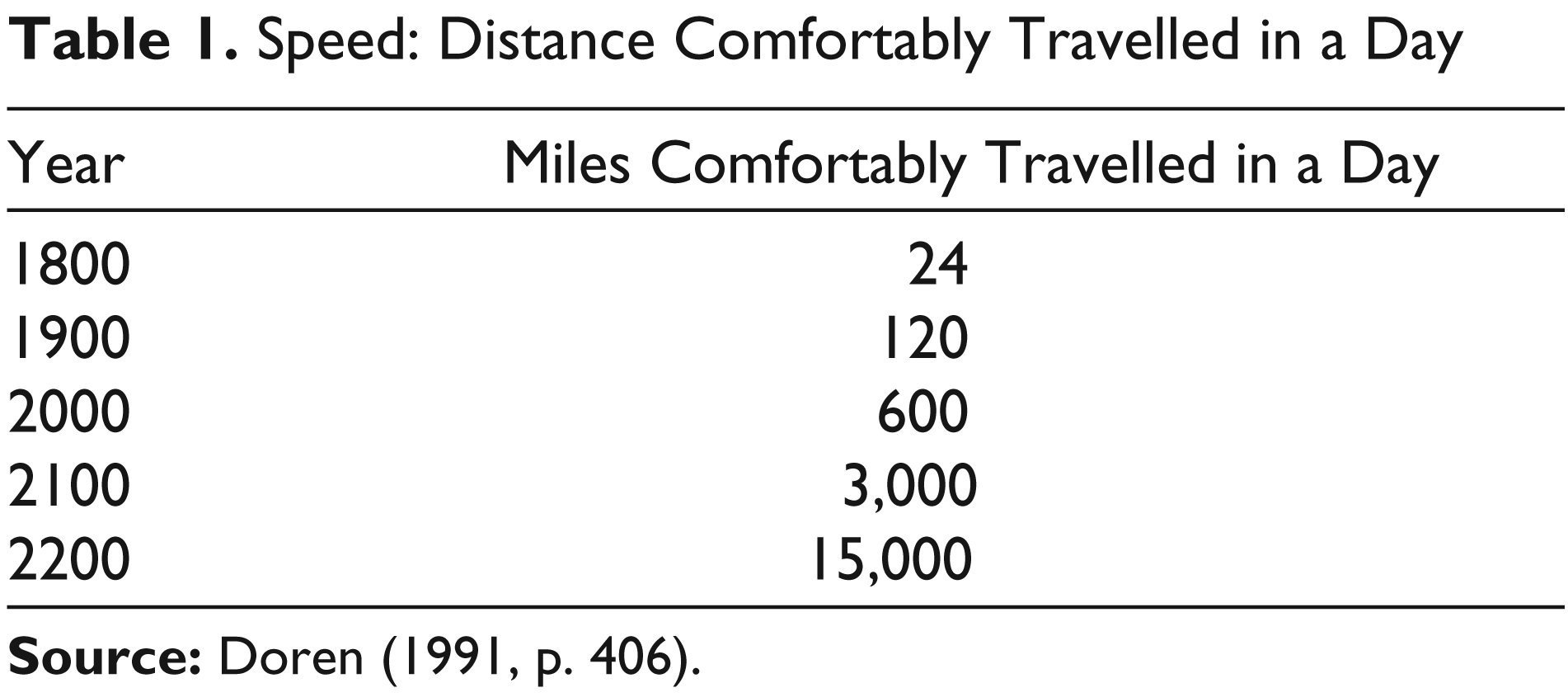
Speed: Distance Comfortably Travelled in a Day
Need for Trained Elites
The rapid changes in the knowledge society, mentioned earlier in the article, often demand quick adaptations. However, society often finds it hard to adapt to these changes because the values, attitudes and behavioural patterns of human beings do not change as fast as the technology changes. As a result, strains develop in the society and several unprecedented social and individual problems emerge, requiring a huge army of enlightened elites who are capable of reflective and original thinking, have problem-solving skills and possess the necessary talent to handle information and the knowledge explosion. Research universities serve this function as they are the only places giving specialised training in research and awarding research degrees like MPhil, PhD and the like.
Thus, the research university is the mother of the knowledge society since it plays a significant role both in the origin and sustenance of the knowledge society.
Recognising the value of university research, the US government initiated a partnership with the nation’s research universities during the Second World War, which made USA a world power. Convinced by the importance of this partnership, the US government continued the collaboration with research universities even after the war ended. Today, the federal government supports about 60 per cent of the curiosity driven and competitively awarded, basic research in research universities (University Research: Understanding its Role, 2011). Clearly, as an instance of a contemporary knowledge society, USA demonstrates that a nation acquires enormous power and wealth by promoting scientific research.
Scientific Knowledge: Source of Power
The 20th century is known as the American century due to its hegemony stemming from the extraordinary advances in the field of knowledge. The power of America, emerging from scientific research, was evident particularly during the Second World War. As the American Nobel laureate I. I. Rabi, who was personally instrumental in the development of the radar and atom bomb, proudly proclaimed: ‘With the radar we won the war, and with the atom bomb we stopped the war; as unyielding Japan was compelled to surrender with the latter’ (Personal interview, August 1986 at Columbia University, New York). Moreover, as later history demonstrates, the USA is the world’s sole superpower as no power in the world could stop America from devastating Vietnam, launching a war against Iraq, toppling Libya’s Colonel Muammar Gaddafi, eliminating Osama bin Laden and disgracing the Taliban of Afghanistan.
Scientific Knowledge: Source of Wealth
The scientific progress has also enhanced America’s material prosperity. Clearly, the US economy is now knowledge driven. Its leading industries are microelectronics, biotechnology, new materials science industries, telecommunications, computer technology (hardware and software), civilian aircraft, and robotics. More than 700 products introduced in the market by 2006 had originated from the research done in US universities, and it is projected that in the future, almost all industries will depend on the research done in American universities (Cole, 2012, pp. 4, 205).
American Universities: Scientific and Academic Achievements
Undoubtedly, most path-breaking research is done in the USA, particularly in its universities. It is the world’s top ranking country by winning 47 per cent Nobel Prizes in sciences up till 2014. 6
Similarly, the USA tops in higher education also. According to the Academic Ranking of the World Universities (ARWU), 2014, 80 per cent of the top ten universities, 68 per cent of top fifty universities and 52 per cent of the top 100 universities of the world are in USA. 7 Naturally, millions of students of the world aspire to obtain a degrees from American universities, many of whom become elites later in their own countries. These US universities are mostly known as research universities due to their extensive research work. The USA has about 260 such research universities, of which about 125 are knowledge factories, contributing thousands of scientific discoveries, inventions, devices, concepts, techniques, tools, technological innovations and medical breakthroughs that have changed the lives of people all over the world (Cole, 2012, pp. 193–342, 519). Table 2 shows some most outstanding innovations made in the US universities.
Besides, most of the text books, reference books and research papers published in reputed journals, used by students and teachers the world over, are published by the US scholars. Most elites of the USA working in different fields such as literature, academics, science, politics, military, business, industry and so on are the products of the country’s top universities. Many universities, their faculty members as well as their alumni have become multimillionaires by becoming entrepreneurs. Just one example of Stanford University illustrates this point. Since 1939, 2,235 members of Stanford University have established 2,450 companies, including giants like Cisco Systems, Google, Hewlett-Packard, Sun Micro System and Yahoo. Moreover, the university has earned more than US$ 250 billion from the three patents registered in 1980, and earns US$ 100 million every year from the patents registered in the 1990s. It also earned US$ 336 million by the technology transfer of the Google Search Engine developed by its two PhD students, Sergey Brin and Larry Page (Cole, 2012, pp. 193–99).
A Selective List of the Exceptional Contributions Made by American Universities in Different Areas of Knowledge
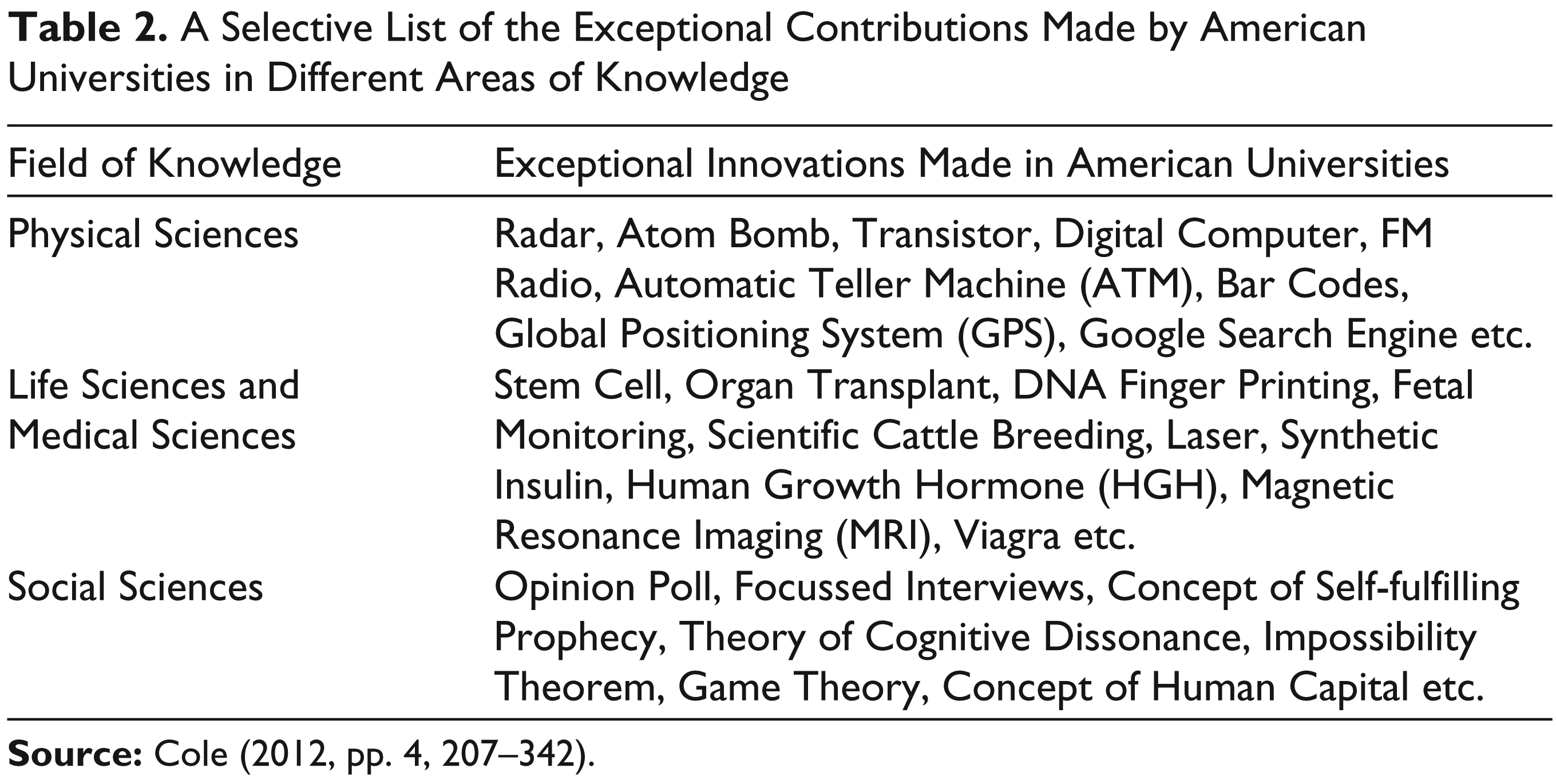
A Selective List of the Exceptional Contributions Made by American Universities in Different Areas of Knowledge
Besides Stanford, several other elite universities of the USA earn billions from their path-breaking research. For instance, eight universities located in the Boston area registered 264 patents, obtained 280 commercial licences and established 41 start-up companies, by which they contributed US$ 7.4 billion in the economy of the Boston area. If the 4,000 companies set up by the students and faculty members of the Massachusetts Institute of Technology (MIT) of Boston, employing 1.1 million workers and producing US$ 116 million, were counted as a separate nation, then it would have been 24th largest economy in the world, having a gross domestic product (GDP) more than that of Thailand and slightly less than that of South Africa (Cole, 2012, pp. 193–99).
Not surprisingly, the unusual achievements and consequent reputation and wealth earned by the faculty and the alumni of these great universities make them proud of their alma mater, inspiring them to contribute generously to the latter’s coffers. Some of the outstanding elite universities of the USA have amassed amazing amounts in endowment funds, as shown in Table 3.
Top Ten US Universities in Terms of Endowment Fund, 2014

The Comparison of Developed and Developing Countries in Terms of GDP, Population, R&D Expenditure and the Number of Researchers, 1996–97 and 2007
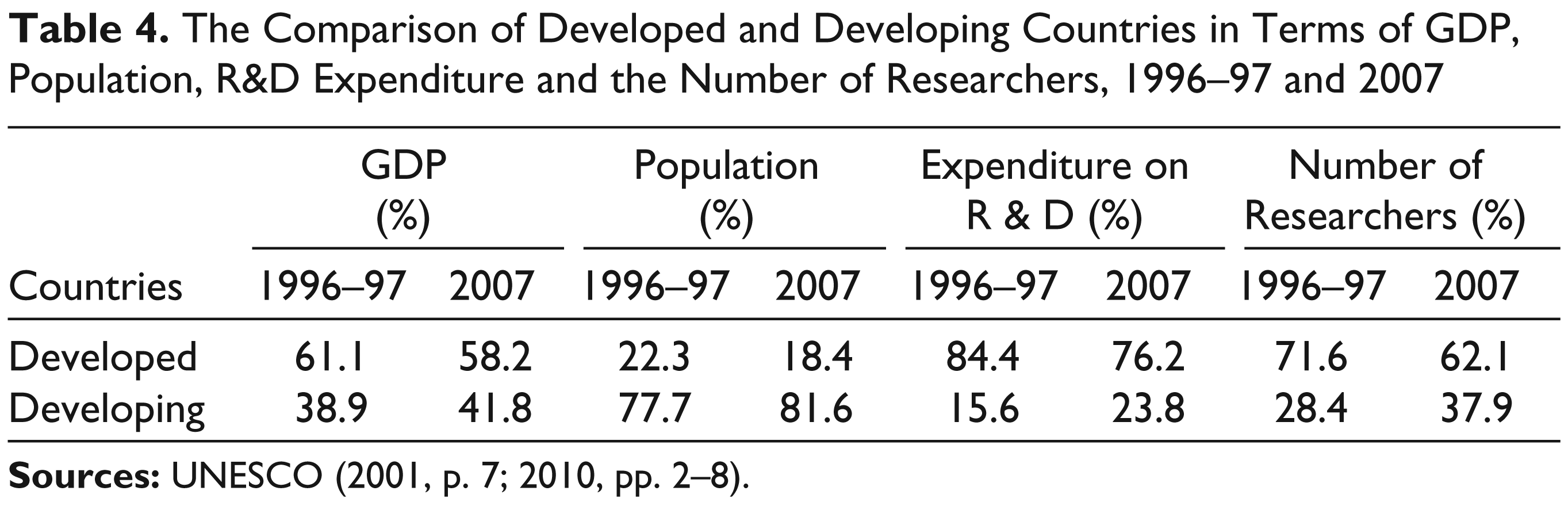
On the one hand, as the instance of USA shows, a knowledge society acquires enormous power and wealth by promoting scientific research. However, on the other hand, it also creates a hiatus between the developed and developing countries. Since scientific knowledge enables the former to enhance their wealth, as Table 4 reveals, they become richer, and the poor countries stagnate or, still worse, become poorer.
As Table 4 shows, the GDP of developed countries is much larger than that of developing countries, but their population is relatively much less. Obviously, they are able to plough back their enormous surplus in research and development and create a multitude of researchers. On the flip side, developing countries suffer from inadequate investment in knowledge-producing infrastructure. Table 4 also shows that not withstanding the recent progress of some developing countries to produce knowledge, a gap still persists. Thus, there is a vicious cycle: Developed countries, being rich, do more research; since they do more research they become richer, and, on the contrary, developing countries, being poor, do less research and therefore remain poor.
India’ Performance in the Domains of Science and Higher Education
In this context, it is relevant to appraise India’s progress towards a knowledge society. Undisputedly, India is moving towards a knowledge society, indicated by the fact that a substantial amount of India’s GDP is derived from the knowledge-intensive services such as (a) information technology services, (b) research and development services, (c) architectural, engineering and technical services and (d) communication services (Mani, 2010, p. 11; UNESCO, 2010, p. 324). According to the World Bank, India has emerged as the third largest economy in the world in terms of purchasing power parity (World Bank, 2016).
Yet, the stark reality is, lately, India has been lagging behind in science and higher education, despite its past achievements, as discussed.
The Domain of Science
In the realm of science, for instance, India made glorious achievements in the past. Sir C.V. Raman (1888–1970) was awarded a Nobel Prize in 1930 in Physics, making him the first Asian to win the Prize. India also produced a galaxy of internationally renowned scientists, such as Jagdish Chandra Bose (1858–1937), Prafulla Chandra Ray (1861–1944), Srinivasa Ramanujan (1887–1920), Meghnad Saha (1893–1956), Satyendra Nath Bose (1894–1974), Shanti Swarup Bhatnagar (1894–1955), Homi Bhahbha (1909–66), Prasanta Chandra Mahalanobis (1893–1972), Vikram Sarabhai (1919–71) and C. N. R. Rao (1934), to name a few. Some scientists of Indian origin, such as Subrahmanyan Chandrashekhar (1910–95), Har Gobind Khorana (1922–2011), Amartya Sen (1933), Venkatraman Ramkrishnan (1952), were also successful in the winning the Nobel Prize, although only after working in British or the US universities. India’s achievements in atomic energy, space science, chemistry, pharmacy and information technology are also noteworthy.
Nevertheless, lately, India’s performance in science has relatively declined. 8 For instance, India’s rank in the Global Innovation Index for 82 countries was 56th in 2008 (UNESCO, 2010, p. 324). India’s total contribution in the world’s scientific research is only 3.4 per cent, whereas China’s contribution is 11 per cent (Adams, Pendelbury, & Stembridge, 2013, p. 11). As indicated in Table 5, in many fields of scientific research, India is far behind China—its neighbouring country with which it is competing to be a world power.
Ironically, India and China became independent almost simultaneously in the late 1940s. At that time, India was much ahead of China in scientific achievements. However, during the 1980s, China introduced radical reforms in its economic, scientific and academic policies. Coincidently, around the same time, India started declining in all these fields. For instance, in the 1980s, the GDP of India and China was almost at par, hovering around US$ 300–400 billion. After reforms, China’s GDP jumped to US$ 9,000 billion in 2011, whereas India’s GDP was less than half of China’s, that is, US$ 4,000 billion in the same year (Adams et al., 2013, p. 5). In terms of industrial production, China has now emerged as a manufacturing powerhouse of the world (Krishnan & Arun, 2015). Consequently, economically, China is only next to the USA now, and experts project that its economic power would be equivalent to that of USA by 2020 if it continues to grow like this (Adams et al., 2013, p. 5).
Contribution of India and China to World’s Scientific Research in Selected Disciplines, 2013
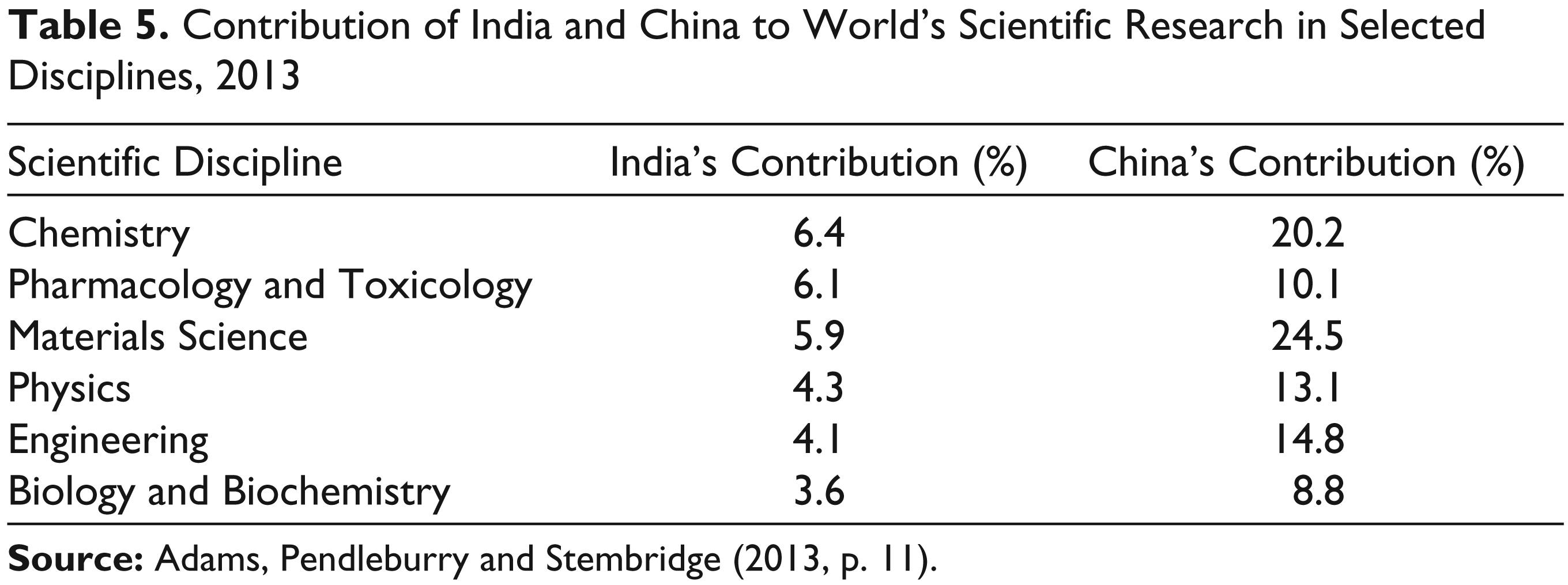
Contribution of India and China to World’s Scientific Research in Selected Disciplines, 2013
Domain of Higher Education
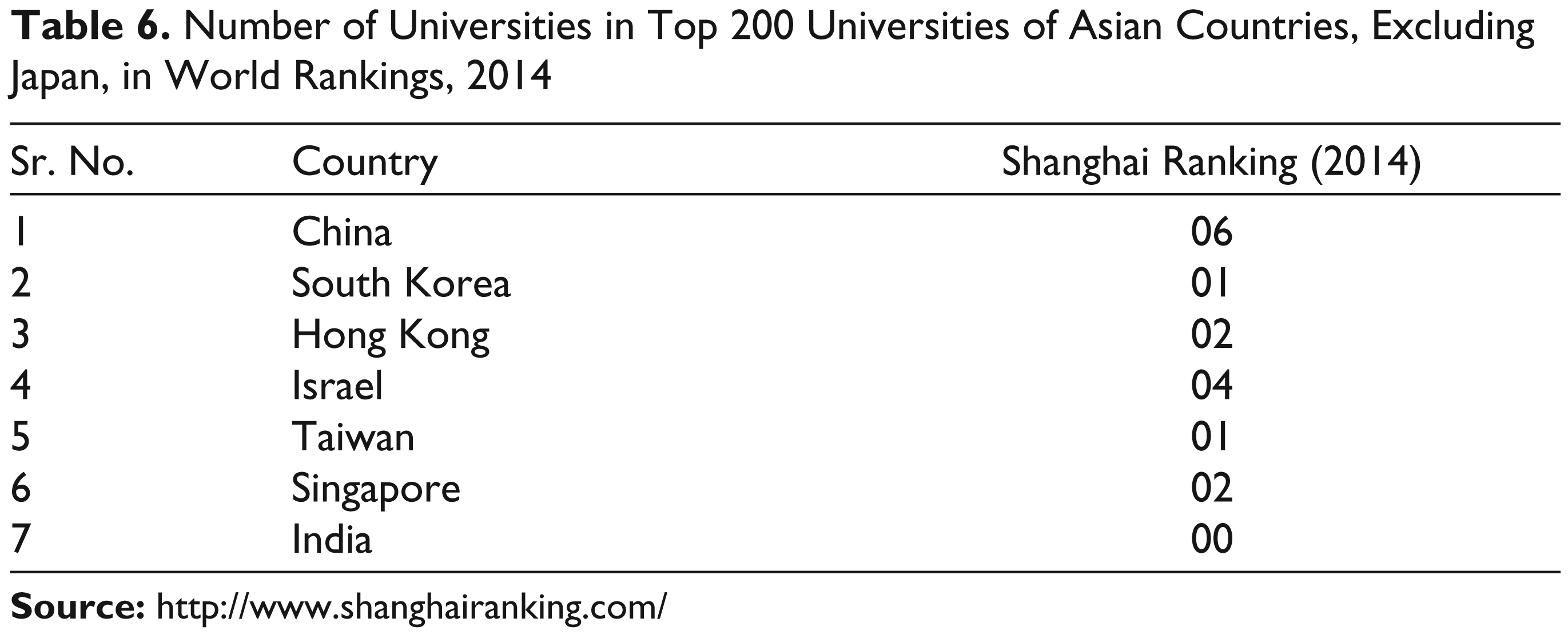
Likewise, although India has made strides in higher education after independence, Indian universities and other institutions, lately, have not fared well (Patel, 2003, 2012). Arguably, failing education system produces a rapidly expanding pool of unemployable graduates. What is worse is that there are no signs of improvement (Shah, 2005). The institutions that are supposed to train competent researchers have mostly become teaching institutions of low quality. Only 1 per cent of students enrolled in institutions of higher education pursue research, and only 0.1 per cent could obtain PhD degree in 2011–12 (Ansari, 2015). 9 Thus, Indian higher education is not a source of technology for industry. The Parliament’s Standing Committee on Human Resource Development, in its 248th report submitted on 26 February 2013, noted that Indian universities are too bogged down with routine teaching and administrative work to pay much attention on research (Ansari, 2015). India’s performance, even in comparison with some developing Asian countries, is also quite disappointing, as indicated by Table 6.
China performs much better as compared to India in research, publication and related academic activities also, as Table 7 shows.
Clearly, India’s serious weaknesses in scientific research and higher education vis-à-vis other nations, including China, necessitates an examination of factors responsible for India’s decline in science and higher education.
Number of Universities in Top 200 Universities of Asian Countries, Excluding Japan, in World Rankings, 2014
A Comparison of China and India in Terms of Research, Publication and Related Academic Activities
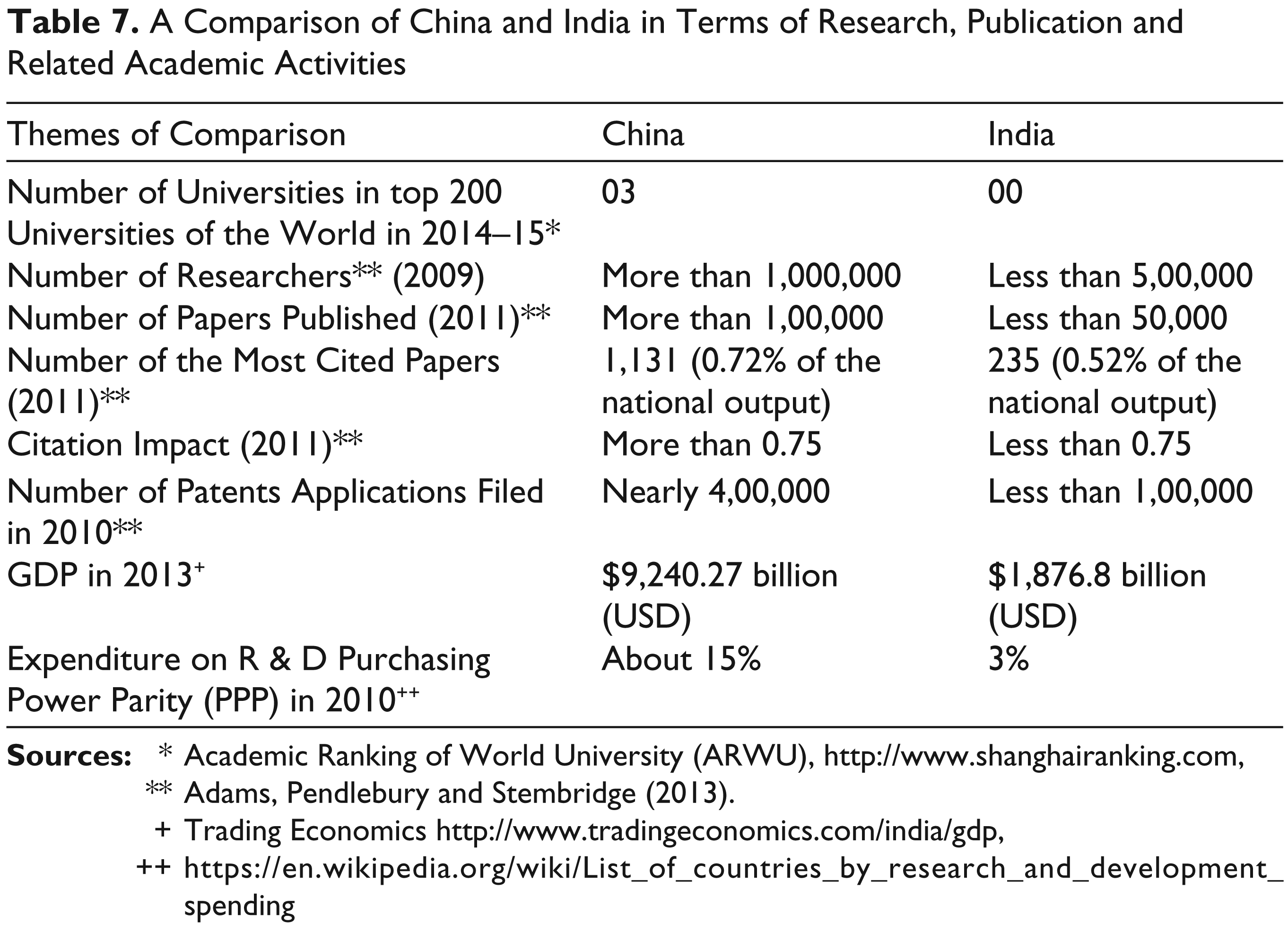
** Adams, Pendlebury and Stembridge (2013).
+ Trading Economics
++
Any activity, to flourish, needs not only funds, but also the adequate sociocultural support. The scarcity of both material and cultural resources for science and higher education in India is evident from the following account.
Inadequate Financial Resources
The allocation of financial resources as a percentage of GDP to the science and higher education indicates the importance given to these areas. In this context, it must be noted that India’s economy has been relatively weak, and it allocates unquestionably inadequate financial resources for both the fields. For instance, India’s GDP (about US$ 1 trillion as on 2013) is relatively much less as compared to USA’s (about US$ 17 trillion) and China’s (about US$ 9 trillion) in the same year, according to World Bank figures. 10 India’s expenditure in terms of the percentage of its GDP on research and development (0.81 in 2011) is also relatively much less than USA’s (2.79 in 2012) and China’s (1.98 in 2012). 11 This is a matter of concern for two reasons. First, research has now become heavily technology intensive. Secondly, due to the inevitable process of trial and error involved, path-breaking research demands heavy expenditure.
Moreover, India spends much less on higher education. For instance, the public expenditure on higher education in India is very low at 0.6 per cent of GDP, compared to 2.7 per cent in the USA. 12 Consequently, hundreds of thousands of meritorious students prefer foreign universities for higher studies, causing a huge dent on country’s foreign exchange reserve, further weakening an already flagging economy.
Allocation of more funds for higher education has been a contentious issue among the policy-makers and educationists since independence. However, the situation has worsened, particularly after the early 1990s, due to the gradual withdrawal of subsidies (Kaur, 2011) and reduction in public funding of higher education (Bora, 2011, p. 8). The government’s contribution to higher education in the total planned resources decreased from a high of 1.24 per cent in the Fourth Five-Year Plan (1969–72) to 0.35 per cent in the Eighth Five-Year Plan (1992–97). The spending on higher education, as the percentage of gross national product (GNP), declined from 0.98 per cent in 1980–81 to 0.35 per cent in 1994–95. Similarly, higher education’s share in the total expenditure on education has fallen from 28.19 per cent in 1990–91 to 15.7 per cent in 1996–97 (Tilak, 1995, p. 216). Currently, India spends less than 1 per cent of its GDP on higher education (Goswami, 2015). India also spends much less per student in higher education. For instance, in 2007, India spent US$ 400 per student, whereas Brazil spent US$ 3,986, China spent US$ 2,728, Russia spent US$ 1,204, the EU21 countries spent US$ 12,958 and USA spent US$ 29,910 in the same year (Higher Education Spending: India at the Bottom of BRIC, 2007). Therefore, Indian universities find it increasingly difficult to meet even the recurrent expenditure necessary for survival. Funds required for libraries, laboratories, exchange of scholars, research and organising seminars and conferences have always been in short supply (Shah, 2005). The poor teacher–student ratio is the most damaging consequence, perhaps having far-reaching unanticipated effects.
Indian policy-makers, however, decided lately to allocate more resources for higher education. For instance, in the Tenth Five-Year plan (2002–07), the allocation of funds was increased by 76 per cent as compared to the Ninth Five-Year Plan (1997–2002) (from ₹ 24,098 crore to ₹ 43,825 crore) (Higher Education Spend Stagnates, 2007). And, in the Eleventh Five-Year Plan (2007–12), ₹ 84,943 crore were allocated for higher education, which was nine times more than the allocation for the Tenth Five-Year Plan (Singh & Ahmad, 2011, p. 2). However, these additional funds were being used mostly to set up new universities and higher education institutions, ostensibly to increase access to higher education. For instance, in the Eleventh Five-Year Plan, the Government of India decided to set up fifteen new central universities, eight Indian Institutes of Technology, seven Indian Institutes of Management, twenty National Institutes of Technology, twenty Indian Institutes of Information Technology and 200 polytechnics. However, these newly established institutions are mostly understaffed and extremely deficient in infrastructure, even after more than five years of their establishment, and the existing fund-starved state universities continue to fight for their survival. In the Twelfth Five-Year Plan (2012–17), an ambitious scheme called Rashtriya Uchchatar Siksha Abhiyan (RUSA) was introduced to further strengthen the institutions of higher education with unprecedented amounts of funds and greater participation of the state governments. 13 However, the future of the scheme is in limbo due to the recent abolition of the Planning Commission in 2014.
Similarly, the Technical Education Quality Improvement Programme (TEQIP) was introduced in 2003 as a long-term programme of about ten to twelve years’ duration, to be implemented in two or three phases, with the World Bank’s assistance. Nevertheless, due to the shortage of academic and non-academic staff and other factors, the scheme has not been able to achieve its target as desired.
Deficiency of Research Culture
However, the financial resources are necessary but not sufficient. Without developing adequate research culture, highly funded universities would be like soulless bodies. Insufficient institutionalisation of a scientific culture in Indian academic institutions for some historical reasons is a glaring weak point of Indian scientific research and higher education. The first universities, established in 1857 by the British, were modelled on the University of London, which was mostly a teaching and examining body; the German model of the research university was yet to make an impact in the UK (Howard, 2009, pp. 355–63). As a result, the early Indian universities remained affiliating and examining bodies for a long time. The postgraduate teaching and research departments were set up in the early 20th century (Shah, 2005, pp. 2234–35). It was only after independence that the functions of universities were reorganised and research was given impetus.
Thus, the research culture in Indian universities is hardly 100 years old. And, before it took firm root in independent India, economic support declined (as mentioned earlier), weakening the already weak research culture (Shah, 2005). Inadequate financial resources not only resulted in poor infrastructural facilities, but also in inadequate research grants and acute shortage of teaching and non-teaching staff. Even now, nearly 50 per cent of the faculty positions are vacant in most universities (Chande, 2011, p. 38), resulting in unhealthy teacher–student ratio. Since the late 1980s, most vacant teaching posts have also not been filled up, leave aside adding new positions. Most universities manage to continue the teaching–learning process with ad hoc, temporary or contractual teachers. A latent dysfunction of continuation of this thoughtless policy, for nearly thirty to forty years now, is the discontinuity of healthy academic traditions in most of these institutions, causing serious damage to the research culture as it is transmitted from one generation to another. The upcoming generations learn and internalise fundamental cultural values, in any field of society, by emulating seniors, some of whom become their role models. Unfortunately, a large section of the senior academicians in almost all disciplines, some of the outstanding ones, have already retired over a period. Thus, by keeping the academic posts vacant for an abnormally long period in the universities, India has lost almost two to three generations of senior academicians who could have socialised younger generations of students in research culture.
As a result, research has become mostly ritualistic. Instances of extremely poor quality research, often involving plagiarism, are not infrequent. The professional peer review, a widely accepted process in the world, subjecting scholarly works to expert scrutiny, is conspicuous either by its almost non-existence or fragile existence in Indian academia. The related function of ‘gate-keeping’ in the academic profession, necessary to weed out the incompetent and allow the suitable to enter the profession, performed by competent peers, is also weak. The unconvincing performance of this gate-keeping institution in Indian universities is mostly evident in admissions, examinations and selection processes, often giving primacy to particularistic criteria like caste, kinship, friendships, communal loyalties, political influence and so on, barring a few elite institutions which unquestionably are the islands of excellence. However, the fact is that the developing countries which have progressed fastest in recent years are the ones that have adopted policies to promote science, technology and innovation (UNESCO, 2010).
Social organisations like universities are not built merely with bricks and mortar. The most important ingredient of the modern university is its research culture, which, as discussed in the following section, is to be cultivated and nurtured with great care.
Scientific Research Culture and Its Transmission
Scientific methodology, in brief, is characterised mainly by objectively conducted empirical research and theory-building. However, Robert K. Merton, the founder of sociology of science, argued that science is not only about having its independent methodology, but is also a social institution with its own value complex (Merton, [1942] 1968, pp. 604–15; Patel, 1975, pp. 63–71).
Scientific Research Culture
Like any other social institution, values and norms guiding scientific inquiry are commonly accepted by the substantial number of the members of the scientific community and are supported by operative sanctions. Some of the most important norms, discussed below, are considered by Merton as the very ethos of science.
Originality
One of the most important norms of science is originality. Original contributions of scientists are indispensable for the growth of scientific knowledge. Therefore, the institution of science has developed an elaborate and hierarchical system of rewards to encourage scientists to conform to the norm of originality. Since the contributions of scientists are not equally significant, the rewards given for these contributions also vary in importance. For instance, eponymy, the tradition of linking the scientists’ names with their valuable contributions, is the highest reward given to them. ‘Newton’s Law of Gravity’, ‘Boyle’s Law of Gases’ and ‘Einstein’s Theory of Relativity’ are some such examples of eponymy. At times, the name of a genius is associated with the age in which he lived, just as the 17th century is also known as ‘Newton’s Age’. Thus, by eponymy, the scientists become immortal and their names are remembered for all times to come, in almost all parts of the world.
Next in hierarchy are awards such as the Nobel Prize, followed by lesser rewards like prizes given by scientific organisations, honorary membership of professional associations, honorary degrees awarded by the universities and so on.
On the contrary, research done ritualistically, plagiarism, manufacturing or distorting evidences or escaping from research to take administrative jobs are all instances of deviant behaviour in science.
Universalism
Another significant value of science is ‘universalism’, by which a scientist is expected to evaluate the scientific statements or theories proposed by other scientists without regard to their particularistic or ascribed characteristics like age, sex, race, religion, nationality and the like. The acceptance or rejection of scientific ideas should be based on the universalistic standards of truth and validity established by science. In this sense, the Nazi’s rejection of theories or contributions of Jewish scientists was an instance of deviance.
Communism 14
The value of communism, also known as communalism, emphasises the collective ownership of scientific findings. The institution of science values the sharing and common possession of intellectual products of scientists. Therefore, free communication of scientific ideas in publications, seminars, symposia, conferences and so on is highly appreciated in the scientific community. On the other hand, the concealment of scientific innovations for military or industrial purposes, retarding the speedy growth of scientific knowledge, is considered a deviation and is abhorred in science.
Disinterestedness
The norm of disinterestedness ensures that scientists evaluate scientific knowledge without regard to any vested interest, personal emotions, likes–dislikes, considerations of benefit or loss, fear or favour and so on while formulating or assessing any scientific opinion, proposition, theory and method. Therefore, unsupported grandiose claims about past scientific achievements of ancient India, for patriotic or emotional reasons, is an aberrant behaviour in science (Top TIFR Scientist Warns of Noisy Fringe, 2015).
Organised Scepticism
Just as faith is valued in religion, scepticism is valued in the institution of science. A scientist is supposed to be a questioning mind, a ‘doubting Thomas’. Nothing should be accepted in science at face value, without subjecting it to rigorous and critical scientific scrutiny. Notwithstanding the popularity or sacredness of a theory or a belief in a society, a scientist is expected to test it by the canons of science and accept it only if found true. Scientists look down upon uncritical attitude, which is not in conformity with the scientific ethos.
Merton asserts that in addition to these values, there are some other institutionalised norms of science, such as humility, intellectual honesty, integrity, truthfulness and so on. Undisputedly, all these values are significant from the viewpoint of scientific methodology too, as a scientist interested in making successful predictions cannot afford to ignore these values. A prediction based on inadequate or false or manufactured evidences inevitably fails. However, the scientific community disapproves this kind of behaviour, considering it contrary to the institutionalised values of science. Thus, these values are not only methodologically imperative, but are also morally prescribed standards of the social institution of science. Therefore, most of the scientists desiring acceptance by their fellow colleagues conform to these institutionalised norms of science. In other words, the institution of science regulates the behaviour of the scientists by a system of reward and punishment. This mechanism of sanctions creates social pressure on the scientists to follow the institutionalised norms. Moreover, most of the scientists, considering the scientific community as a reference group, seek approval of their behaviour from the group. They are constantly watchful about the evaluation of their own behaviour by their peers and are anxious to be accepted by their colleagues. Thus, these norms also become the internalised source of inspiration guiding their behaviour, apart from being institutionalised prescriptions.
A large number of great scientists, who have imbibed the ethos of science, working together in a university or a research organisation, gradually build the research culture of the university or the organisation, engendering a creatively stimulating environment. However, this culture needs to be successfully transmitted from one generation of scientists to another for the sake of the continuity of the tradition of scientific research, both in terms of quantity and quality. Is there any mechanism for this? Yes. This is being done by a socialisation process whereby the senior members of the community educate the members of the next generation. This process is often latent and less visible, but is an inevitable part of the scientific activity. The observations on the socialization of the Nobel Prize winners by Harriet Zukerman (1977) discussed below, illustrates the point.
Transmission of Research Culture: The Process of Socialisation among the Nobel Laureates
A very important fact noted by Zukerman was that 41 per cent of total 286 scientists who won the Nobel Prize between 1901 and 1977, from all over the world, had either studied or worked under at least one Nobel laureate. Likewise, more than half of the US Nobel Prize winners up till 1972 had a laureate as their mentor. In some instances, ambitious students deliberately chose to work under such mentors, undergoing rigorous and often demanding training, notwithstanding the mentor’s idiosyncrasies. On questioning the former apprentices of the masters, Zukerman found that they were hardly interested in learning the subject matter from the latter. A few of them believed that in some areas of their studies, they knew more than their guides. Evidently, they were more interested in learning the method of their mentors as to how they selected a problem, how they tried to crack it or how they pondered different issues.
Clearly, there are no readymade formulas available for becoming a genius. Even the creative genius is often unaware of or unable to explicate the mysterious process. Therefore, his instructions or precepts are less important than the actual performance, the manner in which he conducts the inquiry. By observing the giant, the apprentice gradually acquires some understanding of the intricacies of scientific method, the pattern of scientific thinking, the norms and standards of judging the merits or demerits of an idea or a finding, the right kind of attitudes necessary for great discoveries and all such things that are generally not found in standard textbooks. In short, the intellectual competence and ethos of scientific research required for great breakthroughs can be learnt only after studying or working under the great scientists over an extended period. The mentor becomes the role model for the apprentice. The masters who have kindled a spark of creativity within themselves, after a prolonged and dedicated study (sadhana), can alone ignite the spark in their students. In short, excellence breeds excellence.
Conclusion
Since modern research-oriented university is the mother of knowledge society, a society in which knowledge industry plays a vital role in enhancing its power and wealth, India will have to build a strong research base in its universities to emerge as a knowledge society. Research universities will also be needed to garner high-quality elites, who are capable of original thinking, to solve rapidly emerging new problems. It will indeed be a stupendous task, due to the recent deterioration in scientific and academic achievements of India. However, it is not impossible. The experience of Germany, UK, France, USA and China has shown that it takes two to three generations to transform academic institutions, if determined efforts are made by all the stakeholders. Apart from guaranteeing a consistent flow of substantial financial support, research culture in Indian universities requires to be reinforced at once. Moreover, uninterrupted transmission of that culture as a vibrant tradition needs to be ensured as well.
To instil life-breath in the currently unexciting Indian universities, to make them intellectually stimulating and throbbing and to achieve global recognition in the scientific and academic achievements, Indian policy-makers will have to (a) study German, American and Chinese models of academic and scientific developments and selectively emulate relevant and useful features, (b) enforce stringent gate-keeping by tightening evaluation, monitoring and reward systems at all levels, including conferring degrees, appointing and promoting academic staff, awarding research grants and research projects, (c) augment the deployment of well-trained and competent faculty, with excellent research record, at all levels, (d) provide them autonomy with accountability and ample resources in terms of money, time and research infrastructure, (e) promote better interaction amongst them as sustained innovations require intense exchange of ideas among the community of colleagues and (f) enhance international academic exchange and cooperation. Otherwise, India will find it difficult to compete even with China, leave aside reaching the goal of being a world power in the near future, as the knowledge divide will widen. It is relatively easy to provide material resources, but it takes time to recruit and train talented scientists and researchers, to make them independently productive and to reinforce the research culture. Even the established researchers will need sufficient time to innovate and socialise new recruits. Serious damage has already been done by keeping academic posts vacant for unusually long periods. Indian policy-makers will have to wake up soon and listen to the adage: ‘Failing to plan is planning to fail’.
Footnotes
Acknowledgements
I am grateful to A. M. Shah, N. R. Sheth and Bhikhu Parekh for their valuable comments on the earlier draft of the article.