



Abstract
First, we attempt to critically identify gender issues of disempowerment, especially social perceptions of the status of women regarding marriage, sexual relationship and family formation. Second, the article deals with women’s exploitation in different forms and arenas. Third, we will briefly taken an overview and critique the government’s national policy on women’s empowerment. We will also illustrate and look into major central government schemes for women in India. Finally, we will suggest some policy recommendations for the holistic and critical empowerment of women.
Introduction
The history of the entire world is full of instances, stories, myths and incidents of women’s deprivation and disempowerment in different forms, at different periods of time and in different places. Of course, many colonial countries became independent in the late 1940s and 1950s and their new constitutions provided various kinds of freedoms and rights to men and women without discrimination. But even then women did not have the same social, political, economic and cultural rights as men did because women were generally considered to be inferior to men by society at large and due to the prevalence of patriarchy in most parts of the world the norms and values about such an ‘inferior sex’ dominated.
These values are inculcated during the very process of socialisation of children both in the private domain (family, peer group and so on) and the public domain (school, club, community and government institutions and so on). Ironically, girls and women too, by and large, inculcate such discriminatory patriarchal values as ‘given’, ‘shared’ or ‘preserved’ from generation to generation without questioning them. That is to say, the biological difference (in terms of parts of the bodies of girls and boys) get deliberately and consciously converted into social and cultural discrimination, economic deprivation and spatial distance leading to multi-dimensional disempowerment; thus gender becomes a ‘social construct’. All women have a uterus, they menstruate, most become pregnant and give birth to children. A woman’s biological difference is thus both a ‘capacity’ (procreation) and a ‘limit’ (a burden of carrying foetus in their wombs for nine months incapacitating them for other work). Thus their reproductive capacity results in a paradox of motherhood with both power and powerlessness, limiting them to a private domain and thus leading them to a subordinate role.
This division of social life into ‘domestic’ (private) and ‘public’ spheres has been a legacy of nineteenth-century social theorisation based on old patriarchal ideas of sexual relationship, motherhood, fatherhood, family and home. Claudia von Werlhof (1988) terms it ‘a historical and social creation’ emerging with the rise of capitalism as well as professionalism in science and based on economic definition of nature, of seeing people as ‘nature’, as a ‘free resource’ to be exploited. Since nature is perceived as inferior to culture, so women are perceived inferior to men; as culture tries to control and transcend nature, hence it is considered ‘natural’ to control women.
In India, women’s subordination has historical roots. The Manusmriti states that during childhood a girl should live under the control of her father, during adulthood she should be under the control of her husband and during old age she should be under the control of her sons—meaning a woman should never be independent. Similarly, an old Sanskrit verse talks of the unpredictability of a ‘woman’s character’ (tiriyacharitra) and man’s destiny—not even knowable to the gods! However, the same Manusmriti also mentions a positive aspect about women. ‘Wherever women are worshipped, there live the gods’ (Yatra Naryastu Pujyante, Ramante Tatra Devatah) (Sharma, 2012).
Such contradictions may be understood because of the prevailing socio-cultural, economic and political conditions during the ancient period of Indian history yet the fact remains that especially during the Vedic period there existed almost equality between men and women due to following facts: first, like male gods there were powerful goddesses too, for example, Laxmi (the goddess of wealth), Saraswati (the goddess of knowledge), Kali and Durga (the godesses of valour) and besides there were female consorts to male gods. Second, like the 12 jyotirlingas (of Lord Shiva) there have been 51 shaktikpeethas (seats of the female deity, Parvati); third, various religious treatises of Hindus reflected the social reality of different periods of Indian history as interpreted by the sages and are often ‘textual’ rather than contextual; finally, many women like Gargi, Maitreyee and others composed hymns of Vedas and Vedangas, and during Buddha’s time, marginalised women composed Therigathas reflecting upon their everyday lives. However, over the centuries women have been discriminated against because of a preference for sons (who would light the pyre of their dead parents) due to patrilocality, patriarchy and patriliny.
In Europe, Olympede Gouges (1748–1793) questioned the anti-women ‘Declaration of Rights of Man and Citizen’ (1789) espoused by the French Revolution, and in the National Assembly of France placed the Declaration of Rights of Woman and of the Female Citizen in 1791 by demanding universal suffrage to all- right to property, right to equality, right to freedom and so on. She proposed a ‘social contract’ to safeguard women against oppression in marriage; however, she was executed in 1793 on charges of sedition (Mukhopadhyay, 2016). Consequently Mary Wollstonecraft (1759–1797) theorised the woman question and wrote A Vindication of the Rights of Woman (1792) criticising the prevailing discriminatory, artificial and misleading education system that prepares women of the middle class to live in the sphere of mythical ideals of ‘femininity’, that is, to become obedient and too conscious about looking beautiful through the use of artificial items. She linked women’s questions with fundamental socio-economic and political issues and traced the dependence of women in patriarchy, capitalist economy, hegemony of the Church and bourgeois polity. Thomas Paine, who wrote Rights of Man (Vol. I in 1791 and Vol. II in 1792) and justified the democratic ideals of the French Revolution, appreciated her book. She also criticised J.J. Rousseau’s thesis that by birth and in the beginning people were free (‘man is born free but is everywhere in chains’) but later due to the evolution of civilisation people became barbarian, unfree and unnatural, hence he (Rousseau) recommended solitude for realisation of actual freedom.
John Stuart Mill (1806–1873), in his book The Subjection of Women (1869) stated that social and legal conditions restricted women’s freedom and her status in married life was reduced to ‘domestic slavery’. He argued that her subjection in society was primarily due to the assumption of the ‘natural’ inferiority of women vis-à-vis men but could be liberated if she was treated equally and became economically self-dependent because she was socio-culturally conditioned to enslave her mind and perpetuate the status quo of the domination–subordination pattern. However, Julia Annas rightly criticised him on two grounds: first, his view that marriage was a valid career for women based on the division of labour between man and woman was irreconcilable with his thesis of equality based on her right to earn a livelihood; second, he argued for limited property rights for women (Mukhopadhyay, 2016).
In the West, in the eighteenth and nineteenth centuries, there were mainly two streams of feminists: ‘enlightenment feminists’ like Mary Wollstonecraft (1759–1797), Margaret Fuller (1810–1850) and Harriet Martineau (1802–1876); and ‘moral crusaders’ like Elizabeth Cady Stanton (1815–1902) and Lucretia Mott (1793–1880). Both streams were actually libertarian and rational, and dedicated to the cause of women, yet they had two differences (Rossi, 1973): first, the enlightenment feminists concentrated individually on intellectual conscientisation by writing essays, books and delivering lectures on women’s problems and rights while the moral crusaders were engaged in practical social activism; second, while the enlightenment feminists were sceptical of religious institutions, the moral crusaders were basically pious and morally passionate. Early feminism in the nineteenth-century US overlapped with three other major movements of the time: the moral reform movement (for the closure of brothels), the temperance movement (advocating abstinence) and anti-slavery movement (abolitionist movement). For instance, Lucy Stone (1818–1893) and Elizabeth Cady Stanton (1815–1902) were both feminists and passionate abolitionists in the US. In England, Emmeline Pankhurst (1858–1928) was a radical suffragist and founded the Women’s Social and Political Union, and her husband Dr Richard Pankhurst (1835–1898) drafted the first Suffrage Bill in 1869. Further, he was pro-active in preparing the Married Women’s Property Act of 1884. Thus, both of them contributed significantly to the suffrage movement in England (Mukhopadhyay, 2016). Similarly Virginia Woolf (1882–1941) too was an early feminist in England as in her two books, A Room of One’s Own (1929) and Three Guineas (1938), she mentions patriarchy’s unequal treatment and oppression both in domestic and public spheres (business, law, education and religion) through the inferiorisation of women due to an imbalance of power. In A Room of One’s Own, published one year after full enfranchisement of women, she finds displacement of feminine representation and subjectivity by male authors in patriarchal texts (Mukhopadhyay, 2016, p. 24).
Simone de Beauvoir wrote The Second Sex (1949) but she did not join the prevailing feminist movement as she considered structural economic change essential for the development of both men and women and obviously the root cause was in capitalism. However, in 1972, she joined the feminist movement as she realised the need for uprooting of patriarchy independently by organising women. But, unlike Betty Freidan, who tried to uproot men’s power absolutely, Beauvoir viewed that though women’s struggle was beyond the class struggle, yet it would be launched with the active participation and support of men.
In most primitive societies there was a division of labour based on age and sex but it was not uniform and universal—that is, what tasks were exclusively earmarked for children, adults and elderly people in one community were differently earmarked for them in other communities. Similarly, the tasks that were the exclusive domain of males in one community were not so in other communities. Social anthropologist Margaret Mead (1949) in her study of the dynamics of primitive cultures of seven Pacific Island tribes found universal similarities in sex roles which were not something ‘deeply biological’.
Later, the economist Ester Boserup (1910–1999), through her empirical study in different societies (1970), proved that the provision of food was not the exclusive prerogative of men because of two patterns of subsistence agriculture—communities where food production is done by women with little help from men and communities where food production is done by men with little help from women. She cites the example of African tribal societies where almost all tasks of food production is done by females, mostly in shifting cultivation. Tree felling (for shifting cultivation) is done by adolescent males (aged 15–18 years) and the remaining tasks are done by females such as the removal and burning of felled trees; sowing/planting in the ashes; weeding of crops; harvesting and carrying of crops and preparation for consumption or storage for future needs. She identifies three systems of subsistence farming in Africa: exclusively by women; predominantly by women and predominantly by men. However, she asserts that such traditional farming systems undergo changes both in the division of sexual labour and techniques—often the female farming system changes over to male farming system and less frequently the male farming system changes to the female farming system. She is of the view that before the European conquest of Africa, tree felling, hunting and warfare were the three main occupations of men in the female farming regions in Africa.
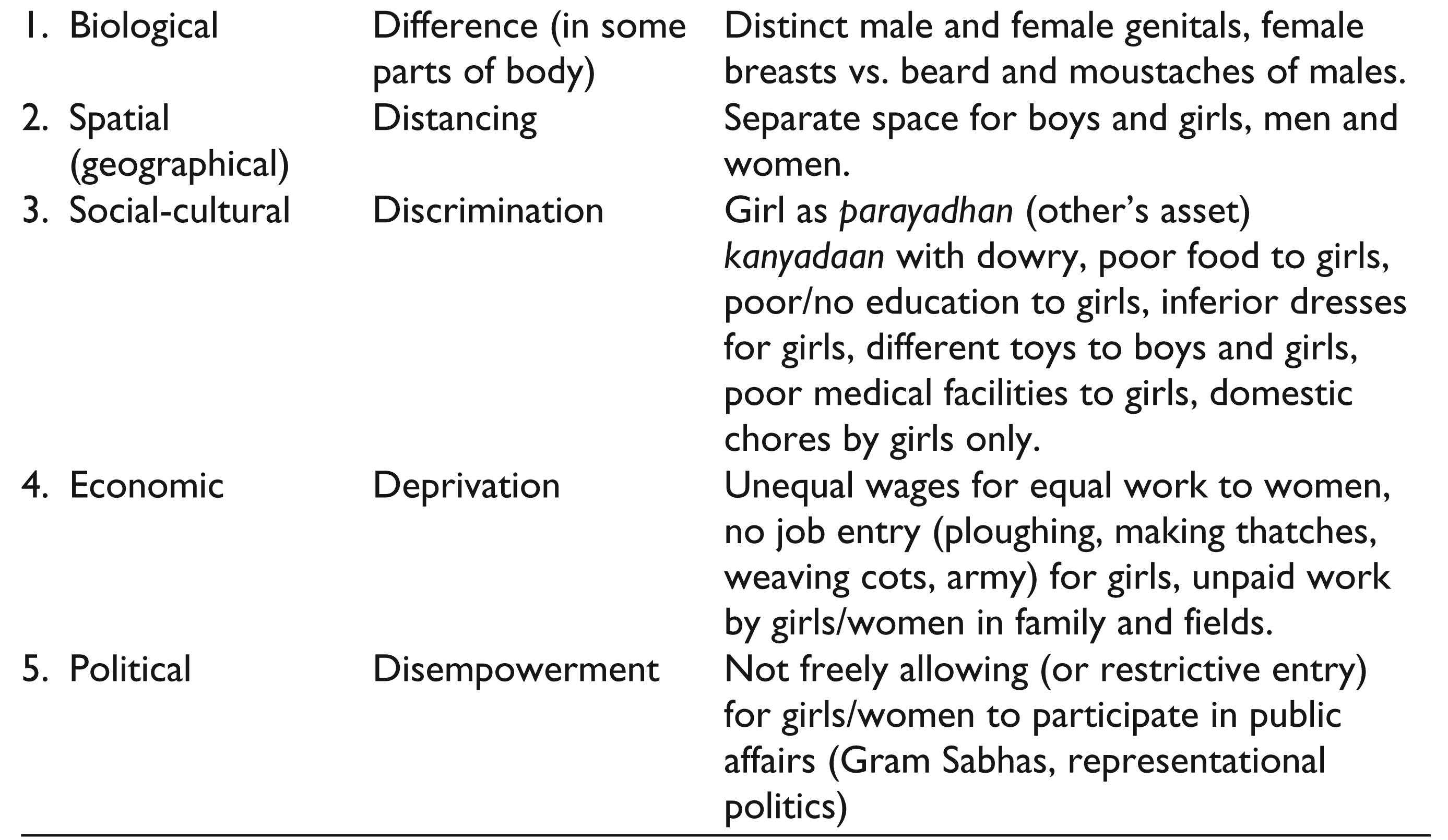
In India, various forms and dimensions of male–female interaction range from difference, distance, discrimination, deprivation to disempowerment.
Critical Issues of Gender Inequality and Disempowerment
A male–female relationship is not egalitarian but discriminatory in India (see Table 1) in everyday life because males are considered to be the ‘be-all’ and ‘end-all’ of family decisions. For instance, the national-level literacy rate of men is 81 per cent while that of women is 65.46 per cent and the total literacy rate is 74 per cent (2011 Census). Similarly, girls are lagging behind boys in school enrolment: 95.4 per cent in 6–9 years, 93.7 per cent in 10–14 years and 83.8 per cent in the 15–17 years age groups. The top five states for girls’ education are Kerala, Maharashtra, Tamil Nadu, Telangana and Jammu and Kashmir, while the five bottom states are Rajasthan, Gujarat, Odisha, Madhya Pradesh and Uttar Pradesh. Further, despite the Equal Remuneration Act 1948, we find that even for the same work women (cutting across all castes, regions and religions) are paid lower wages than men.
Dimensions and Forms of Male–Female Relationship in India
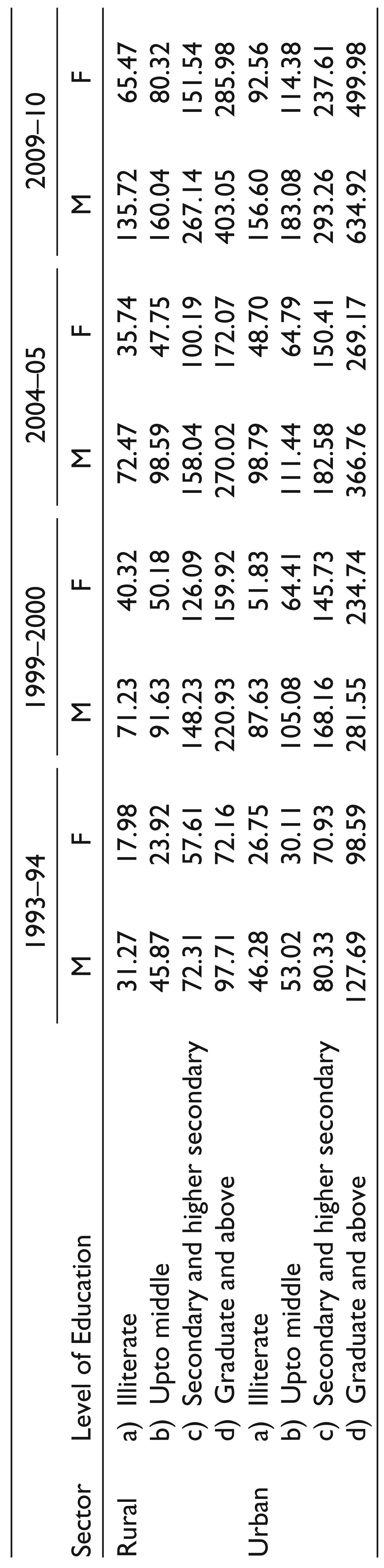
From Table 2 it can be seen that in all categories of educational status women workers are paid less than men ranging from 20 per cent to 50 per cent. Second, this discrimination exists both in rural and urban areas though in urban areas both males and females get more wages than in rural areas. Third, the discrimination has persisted even after India’s independence. Finally, with the increase in the level of education the wages of both men and women workers have risen and the wage difference between the two sexes has narrowed down (see Table 2). According to the World Bank, 32.7 per cent (40 crore) Indians live in poverty (on less than $1.25 dollar a day) while as per the Suresh Tendulkar Committee Report 29.8 per cent Indians lived below poverty line in 2009–2010. Actually in poor households women and girls are the worst sufferers due to intra-household discrimination and they usually work as informal and casual workers on a contract basis. Further, there are 2.3 crore women-headed households in India (as per the 2011 census) and amongst them 1.4 crore are deprived. They are mostly widows, separated, divorced or single women. In fact, only 4 per cent of married women head households. Uttar Pradesh, West Bengal and Tamil Nadu have highest number of female-headed households (Sharma, 2012).
Mean Daily Wages (in Rs) to Workers by Level of Education
Status of Indian Women Regarding Marriage and Sexual Relations
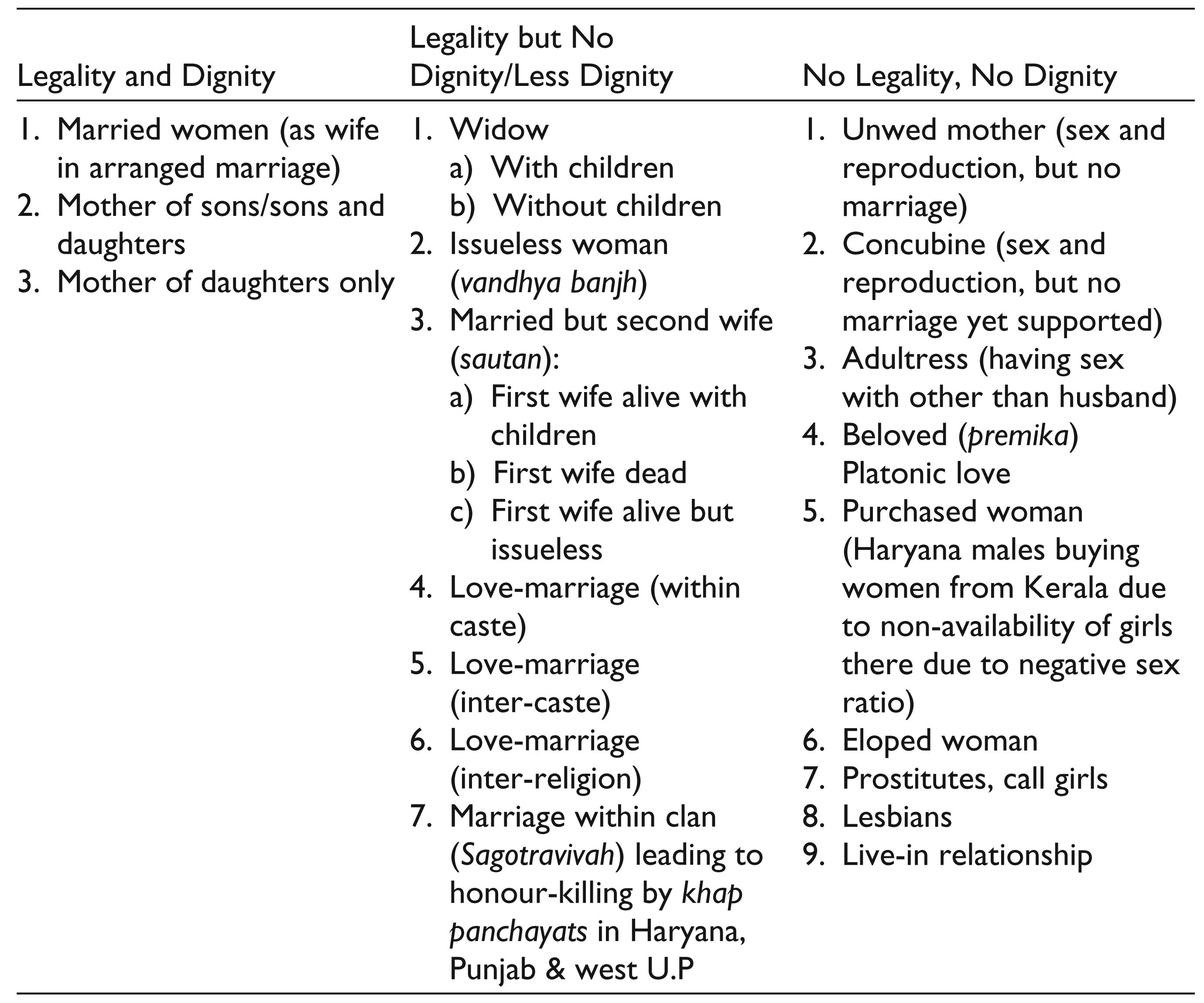
There are three inter-related processes: feminisation of poverty; casualisation, informalisation and contractualisation of jobs, especially for women, and the sexual exploitation of women seen in increasing trends in trafficking of girls/women, call girls and prostitutes. The status of Indian women regarding marriage and sexual relationship further varies in terms of legality and dignity (see Table 3).
There are thus basically three major categories of status of women regarding marriage and sexual relationship: those who have both legality and dignity; those who have legality but no dignity or less dignity and those who have neither legality nor dignity. Of course, power relations lie in these categories and sub-categories.
The second critical issue is reproduction in order to have labour force for a capitalist economy and patriarchy for the preserving of private property. There exists a prevailing tendency to control the female body in the family, local community, market and society at large. For instance, though vasectomy (male sterilisation) is safer, tubectomy (female sterilisation) is done more at the local, regional and national levels. In 2013–2014 in Delhi 1,401 men were sterilised against 17,773 women and in 2012–2013 there were 1,892 men and 25,228 women were sterilised. Men are actually reluctant to opt for this procedure fearing loss of potency—yet another myth indicating gender bias.
Third, there have been a near absence of women’s ownership of means of production (land, house, factory, institutions, trade) in India; at the most they have partial control over their ornaments (streedhan). Power emanates from the control over various resources; women’s less control actually means less power for women. However, in early twenty-first century there has been some improvement: in 2014–2015, 38.4 per cent women in India owned a house or land, alone or jointly, while earlier their economic position was negligible (The Times of India, March, 2017). But in India, in 2016, the appointment of new women Board member stood at 11 per cent of total hires as against 14 per cent for new male directors—this was lower than the global average of 17 per cent of women Board members (Malaysia has 27.3 per cent women directors) (The Times of India, February, 2017).
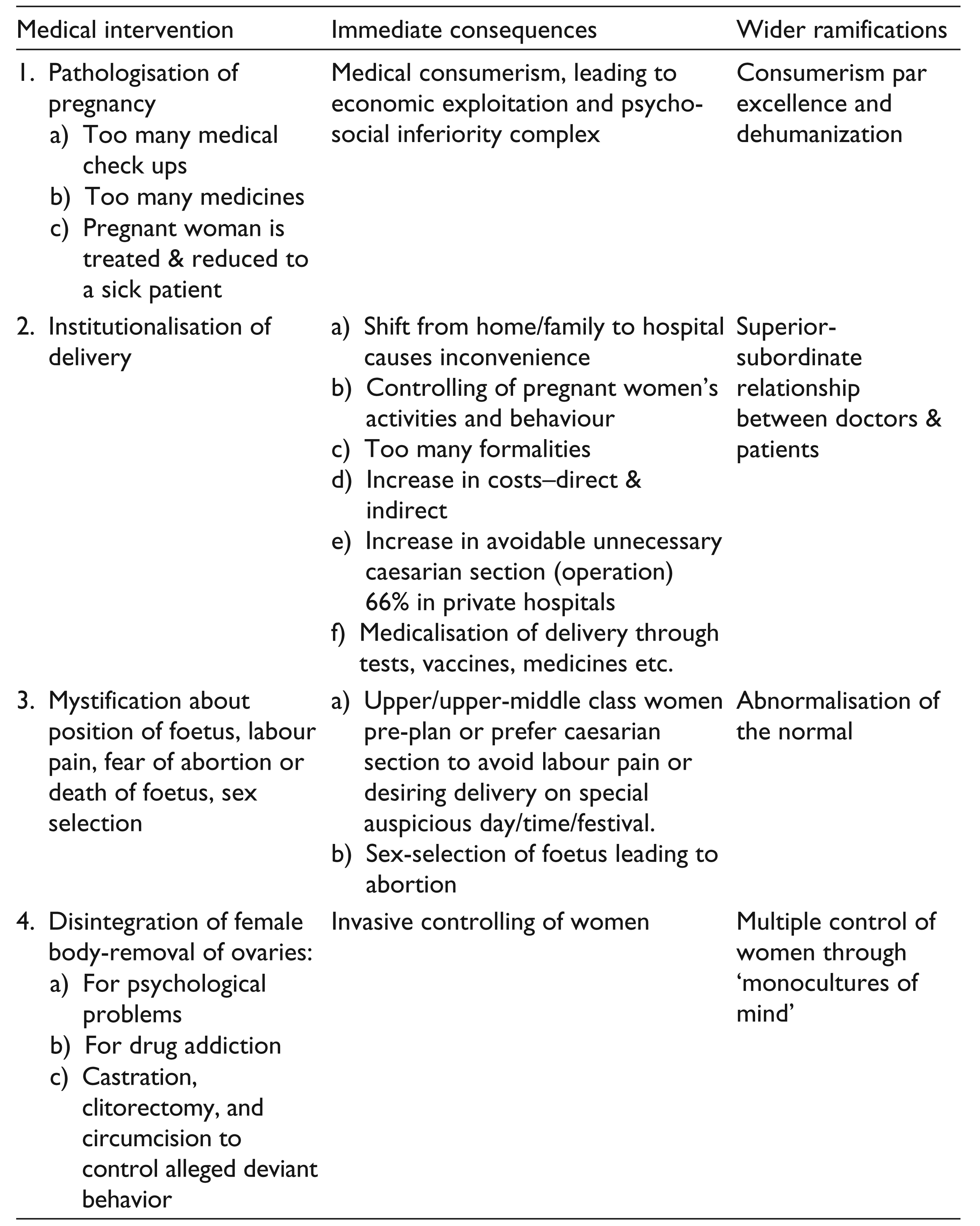
Fourth, modern science and technology is usually based on the reductionist principle of the West to control and ‘normalise’ reality resulting into the ‘monocultures of the mind’ (Shiva, 1973). Modern science and technology conniving with consumerism, commercialisation and capitalism has often worked against women’s reproduction in following ways: unnecessary medical checkups of pregnant woman; avoidable caesarean sections for delivery—more so in so-called sophisticated private hospitals; pathologisation of pregnancy—when a pregnant woman is reduced to a ‘sick patient’; institutionalisation of delivery because of distances from the home; excessive formalisation and ‘medicalisation of delivery’; abnormalisation of the normal: that is, when upper middle class men and women seem to prefer caesareans on a designated day, keeping time, zodiac position and festivals in mind (see Table 4). Besides many pregnant women want to avoid labour pains; removal of ovaries and uterus or forcible circumcisions. (It has been reported that some private hospitals removed the uterus of even young women in Bihar and Rajasthan to avail of the financial package being disbursed under the Rashtriya Swasthya Bima Yojana (RSBY).)
However, on the other hand, reproduction technology has helped women, especially through various devices like intra-uterine devices, contraceptive pills, jelly and abortion which have unburdened and freed women by reducing/eliminating unwanted pregnancies. Indeed new reproductive technology has changed the paradigm in recent years from ‘sex without reproduction’ (due to contraceptives) to ‘reproduction without sex’ (due to the IVF method). But, both capitalist and socialist systems have absolute faith in modern science and technology as ‘the motor of development’ with a wrong conviction that all human problems have technological solutions, as R. D. Klein rightly calls it ‘the technological fix’ (Gupta, 2000). Hence, there is a need for softening and humanisation of technology as a facilitator, not as a creator of new sorts of dependence and perpetrator of the patriarchy.
Intervention and Consequences of Modern Medical Technology in Women’s Reproduction
Fifth, the health situation of women is still not satisfactory in India; maternal mortality ratio (MMR) was 301 per 100,000 live births in India in 2000 but it declined to 167 in 2013 due to better health and medical facilities. However, thousands of women still die annually in delivery complications due to following major causes: haemorrhage (30 per cent), anaemia (19 per cent), sepsis (16 per cent), obstructed labour (10 per cent), toxaemia (8 per cent) and others (17 per cent). This is basically due to poverty, unemployment, lack of awareness and lack of medical facilities. Institutional delivery increased during 2006–2011 from 42 per cent to 84 per cent in India as a whole due to the launch of National Rural Health Mission by the Government of India. However, 50 per cent of adolescent girls and women in India are anaemic (Sharma, 2012). The Maternal Mortality Rate is still very high among states: there were 6,000 maternal deaths in 2013–2014 in Bihar but only 352 were reported by district officials, as admitted by the State Health Society of Bihar (>The Times of India, August 2014).
Sixth, despite the right to equality enshrined in Article 14 and Article 15 in the Indian Constitution ensuring no discrimination by the state on the grounds of sex, race, caste, place of birth and religion women are discriminated by some laws, too. For instance, Section 64 of the Criminal Procedure Code, 1973, provides for the serving of summons to ‘some adult male member’ of an accused family residing with him in the absence of the summoned person, indicating that females of family are not considered eligible for serving such summons. Second, in the Hindu Minority and Guardianship Act 1956, under Section 6(a) a father is considered first guardian and only ‘after’ him, a mother may become a guardian. This was challenged in the Supreme Court of India in the Geeta Hariharan case and held both parents as natural guardians of a child and ‘after’ father did not mean after the life of father. Hence, it is imperative to amend this law (Sharma, 2012). Third, the definition of ‘rape’ in the Indian Penal Code 1860 (with some amendments in 1983) is still archaic because it recognises sexual violence only when there is a male organ’s penetration into a female’s private parts without consent of the woman but it does not recognise other forms of sexual assault: insertion of objects like bottles, sticks, stones etc; insertion of finger or other parts of a male; forced oral penile penetration and anal penetration by male organ or other objects (Singh, 2004). Therefore, the culprits of such sexual assaults are usually not convicted for rape or simply punished for lesser forms of sexual assault under Section 354 of IPC. In addition, not raising an alarm by a girl/woman during rape is not construed as rape: for example, in the Mathura rape case the Supreme Court of India acquitted the two accused policemen (who allegedly committed rape in a police station) on this ground. Finally, dependent Indian women accompanying their H1Bvisa-holder husbands to US on H4 visas are disempowered in many ways as they are kept outside the labour market, with their legal and financial status tied to that of their husbands’ immigrant status, though their number is huge—69 per cent of H1B-visa holders and 82 per cent of H4-visa holders are Indians—thus there is a ‘loss of identity’, ‘complete dependence’ and ‘forced unemployment’ of immigrants’ wives. However, the Obama Administration extended an employment authorisation document in May 2015 only to those H4-visa holders whose husbands’ green card applications were in an advanced stage of processing (Ravindranath, 2017).
The last issue is the increasing crime rate against women in India, especially rape, kidnapping, molesting, eve-teasing, dowry deaths and so on. In 2011, there were 24,206 rape cases, 8,570 sexual harassment cases and 42,968 eve-teasing cases registered in police stations in India. During 2001–2011, there was a 50.5 per cent increase in rape cases, 12 per cent increase in sexual harassment cases and 26 per cent increase in eve-teasing cases. In 2012, a total of 244,000 crimes against women were registered in India as against 228,000 cases in 2011. West Bengal shares 7.5 per cent of India’s total women population but accounts for 12.7 per cent of total crimes against women in India in 2012. In 2013, 300,095 total crimes were reported against women but unfortunately the conviction rate was unsatis factory with just 22 per cent in 2013, 21per cent in 2012 and 27 per cent in 2011 (then there were 500 fast track courts in 2011 against 212 such courts only in 2013–2014). During 2001–2013 there were 263,000 rape cases registered in India and every 20 minutes one rape case occurs in India. Unfortunately, 65 per cent cases of rape occur while women go to attend the call of nature at night in India (as yet 50 per cent of the country’s population goes for open defecation).
Major crimes against women affect them in some of the following ways: physical torture that results in pain and injuries; they stigmatise woman and her family; cause mental agony and depression; often victims find it difficult to get jobs or retain them, if they are already employed; face harassment during legal trials; tardy court cases give an opportunity to the accused to destroy evidence and threaten witnesses and finally there is a low conviction rate against the perpetrators; for example, only 21–22 per cent of the accused were convicted in 2012–2013. This does not deter criminals who continue to indulge in crimes. Crimes against women deprive women from any active participation in public affairs resulting in their further disempowerment.
National Policy for Empowerment of Women (2001)
This policy attempts to create gender development indices for better planning, programme formulation and adequate allocation of resources, as well as collection of gender disaggregated data by all primary data collecting agencies. Regarding institutional mechanisms, it was resolved to strengthen existing institutions by provisioning for resources, training and advocacy skills to effectively influence macro-policies, legislation, programmes and so on. Further the National Council (headed by the Prime Minister of India) and the State Council (headed by the state’s Chief Minister) was to be formed including representatives of concerned departments/Ministries, National/State Commissions for Women, Social Welfare Boards, NGOs, women’s organisations, trade unions, corporate sector, financing institutions, academics, experts. National/State Resource Centres on Women would be established for collection and dissemination of information, to do research/survey, training and awareness generation. Adequate resource allocation, developing synergy between health, rural development, education and women and child development departments and meeting credit needs by bank and financial institutions were also envisaged in the policy. The Women’s Component Plan was to ensure that 30 per cent of funds/benefits flow to women from all ministries/departments. The Ministry of Women and Child Development was made the nodal ministry to review its progress.
The highlights of this policy included: advancement, development and empowerment of women in all spheres of life; a more responsive judicial legal systems sensitive to women’s needs; women’s equality in power-sharing and active participation in decision-making; mainstreaming a gender perspective in the development process; strengthening and formation of relevant institutional mechanism; partnership with community-based organisations; implementation of international obligations, commitments and cooperation at the international, national and sub-regional levels, especially the Convention for the Elimination of all forms of Discrimination Against Women, 1979, Convention of the Rights of the Child, 1989 and International Conference on Population and Development (ICPD+5).
Regarding legislation, it was envisaged to review all personal, custom and tribal laws, subordinate legislation, rules/executive orders and so on to eliminate gender discriminatory references in consultation with civil society. To support this focus the National Commission for Women and Department of Women and Child Development was created.
Regarding gender-sensitisation, the policy also focused on the training of the executive, legislative and judicial wings of government. In addition, following measures were to be taken: promoting societal awareness of gender issues and women’s human rights; review of curriculum and educational materials to include gender education and human rights issues; removal of all references derogatory to the dignity of women from all public documents and legal instruments and the use of mass media to communicate social messages relating to women’s equality and empowerment.
The United Nations Development Programme declared eight Millennium Development Goals (MDGs) in 2000. The third goal of the MDG was directly related with women’s empowerment, that is, elimination of gender disparity in primary and secondary education from all levels of education by 2015. Though we could not achieve gender parity in school education by 2015, there was an improvement in the enrolment of girls at all levels in many regions in India. Again, though we could not achieve the target of substantially reducing the high infant mortality rate (IMR) for children below 5 years of age, it and the MMR did see a decline. Similarly, women’s participation in employment and decision-making is not satisfactory though the champions of liberalisation, privatisation and globalisation boast generating massive employment. In reality women’s participation in the work force has declined since economic reforms in 1991. The fact is that there was a ‘jobless growth’ in many sectors of the Indian economy despite a high growth rate of more than 7 per cent during 2002–2016. The Sustainable Development Goals (to be achieved by 2030) targets for bringing down MMR to 70 per 100,000, IMR to 12 and child mortality rate to 25 and universal health coverage to all, inclusive and common education to all, to bring equality among men and women, and to prevent all types of violence against girls and women. The National Commission for Women has, unfortunately, no statutory power to take cognisance of crimes against women and to punish the accused. A draft of new National Policy for Women looking at many challenges facing women has been formulated and is in the process of finalisation.
Central Government’s Schemes for Women
Many schemes have been introduced by the state to empower women. For example, SABLA (Rajiv Gandhi Scheme for Empowerment of Adolescent Girls) was implemented in 205 selected districts of India through the Integrated Child Development Services (ICDS) which gave 100 per cent central assistance for nutrition (iron and folic acids), health check-ups and referral services, counselling on family welfare and education on child care practises. It also imparted life skills to girls aged from 11–18 years and vocational training for 16–18 year-old girls. Up to December 2014, 98.15 lakh beneficiaries were covered for nutrition and 0.42 lakh girls were provided vocational training under the scheme. One success story related to Kajal Bhagat in English Bazaar in Malda district, West Bengal. Inspired by an anganwadi worker the young girl refused to marry before the age of 18 years and leave her school education.
Another significant scheme, Matritva Sahyog Yojana, was first implemented in 53 selected districts in India through ICDS. Under it, pregnant women of aged 19 years and above for their first two live births would receive ₹6,000 for each baby in two equal instalments during pregnancy and lactation. This was then extended to all the districts of India in 2016–2017. During 2015–2016, the central share of the scheme was ₹1,497 crore as per provisions of the National Food Security Act (2013). The Swadhar Scheme for women in difficult circumstances was launched by the central government in 2001–2002. This covered deserted widows, released women prisoners, homeless women who have survived national disasters, trafficked women who had been rescued or had runaway from brothels, women victims of terrorist or extremist violence who had no support, mentally challenged women and women with HIV-AIDS without support or had been deserted by giving them shelter, food, clothing and care. The programme also covered women for their rehabilitation, arranged for their clinical and legal support and provided women in distress with a helpline. As of now, 311 Swadhar homes are functioning under the aegis of the state government’s Women Development Corporations or trusts. During 2013–2014, against the budgetary provision of ₹75 crore for Swadhar, a total expenditure of ₹53.74 crore was incurred and in 2014–2015, its budget allocation was increased to ₹115 crore.
Further, Ujala is a scheme to combat trafficking of women. In place since 2007, it focused on the prevention, rescue, rehabilitation, reintegration and repatriation of trafficked victims. During 2014–2015, 289 projects were sanctioned (including 165 protective and rehabilitative homes) with an outlay of ₹16 crore. Then there is the Support to Training and Employment Programme for women, launched in 1986–1987, to provide skills to women above 16 years of age. During 2013–2014, ₹7 crore was released to different states. By the end of 2014, there were 915 working women’s hostels with 68,631 working women residing there. During 2014–2015, the budgetary allocation for construction of working women’s hostels was ₹25 crore. Recognising the need for validation, six Stree Shakti Puraskars are given at the national level to individuals and organisations with a prize of ₹3 lakh each, one Rajya Mahila Samman (₹40,000) for each state and Union Territory and one Zila Mahila Samman (₹20,000) for each district.
The Ujjwala Scheme provides free LPG connections to poor households from 1 May 2016 onwards. As of July 2017, 2.5 crore poor households have benefitted from this scheme which means that 73 per cent households in India are using LPG. The long-term target is that 5 crore households will benefit from this scheme by 2019. Finally, Beti Bachao, Beti Padhao (save daughter, educate daughter) is a flagship scheme of the central government announced with much fanfare. While these schemes have been beneficial to a certain extent, they have not brought out substantive transformation, especially in women’s livelihood and empowerment.
Policy Recommendations for Women’s Empowerment
Empowerment is an inclusive process of encouraging, enabling and developing the capability for self-sufficiency, self-dependence, self-assertion and autonomy of the marginalised and disempowered groups (like women) or community (dalits/tribes) through consciousness-raising, pro-active participation in public life and mobilisation for right entitlements. Feminist anthropologist J. Schrijvers (1985), during her study of women in the north central province of Sri Lanka formulated four dimensions of autonomy and C. Pijpers added a fifth (Gupta, 2000). They were: control over female sexuality and fertility; the social moulding of motherhood; division of labour between the sexes; access to and control over labour, property, knowledge and power positions; inter-relationships among women, cooperation and organisation; gender ideology, that is, women’s self-image (and self-respect) and as added by C. Pijpers (Gupta, 2000), ‘the freedom and possibility to take part in all forms of social interaction’.
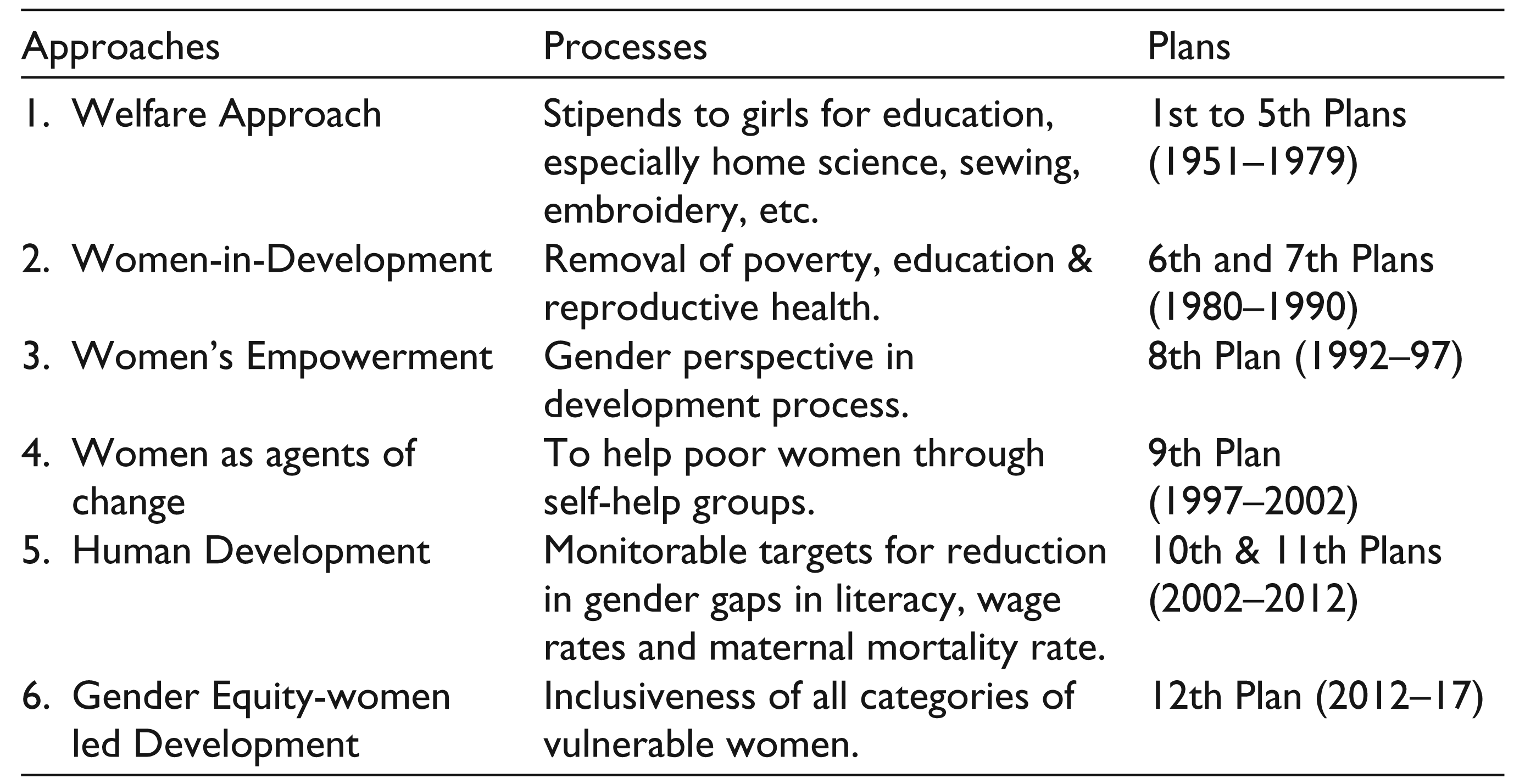
Another scholar, Postel-Coster (1987), talked of individual and collective aspects of autonomy—collective autonomy being close to ‘power’, using power in both a negative sense (control and domination) and a positive sense (‘power to’, an enabling aspect emerging from within). Women’s freedom to choose the number of children depends on socio-economic conditions, education-levels of the mother and father, cultural values, the family planning policy of the government, whether children are seen as assets or liabilities: working women are more conscious of a small family norm and the neighbourhood/community context.If we look at various five-year plans in India, we find different approaches for women’s welfare development or empowerment in different plans (see Table 5).
Reproduction is a major issue for women’s empowerment. I. Van Staveren suggests six entitlements to women related to reproductive freedom: access to contraceptives; access to decision-making regarding children (with whom, and if yes, then when and how many); access to sex education and information on sexuality; access to reproductive health care for parents and children; access to alternative roles, other than motherhood/fatherhood and access to economic resources.
To ensure empowerment and development for women some urgent steps need to be taken. These have briefly been outlined. First, family welfare measures need to be publicised more, hence more resources, motivation and consciousnessraising for education and employment of women is needed. This could be done by making girls’ education, at least up to the degree-level, free, ensuring better school and college infrastructures, providing adequately trained teachers especially women teachers, organising drives for upgrading skills, re-skilling and multi-skilling in all schools and colleges, including the vocationalisation of education by reorienting and reorganising industrial training institutes and polytechnics for women in trade as demanded by the market, state and civil society.
Type of Approach for Women’s Development in Different Plans in India
Second, both the Union and state governments should ensure 30 per cent funding for women. They should also be given priority by the government and private sector for jobs in the organised sector. It should be noted that self-help groups have not been successful, largely due to the non-cooperation of banks for financing. Actually self-employment schemes come with many risks and, therefore, they need to be reorganised primarily because the one-size-fits-all model does not succeed in India given its diversity.
A third aspect deals with women’s representation in legislative bodies. In the 64th Lok Sabha, women accounted for just 11.8 per cent of the total members and in the 27th Rajya Sabha only 11 per cent. Thus, India ranks 148th in the 193-member countries of the UN whereas women’s representation in the Rwanda Parliament is the highest in the world with 61.3 per cent, followed by Bolivia’s 53.1 per cent and Cuba with 48.9 per cent. Even Nepal with 29.6 per cent, Pakistan with 20.6 per cent and Bangladesh with 20.4 per cent women parliamentarians better India’s tally (Dainik Jagran, March, 2017). In fact, the Reservation Bill for Women which looks at one-third reservation for women in both the Lok Sabha and State Assemblies was passed in 2010 by Rajya Sabha but has yet not been passed by the Lok Sabha. Actually, one-third reservation for women in rural local self-government (in the three-tier Panchayati Raj) and urban local bodies in 1990s did bring in a huge number of women representatives into the political arena but they now need upward mobility. To be sure, the states of Maharashtra, Bihar, Himachal Pradesh, Madhya Pradesh and Rajasthan have provided 50 per cent reservation for women in the Panchayati Raj. Unfortunately, however, some regional political parties based on (caste) ‘identity politics’ have often opposed women’s reservation in legislatures fearing this would reduce their hegemony; and such political parties do not distribute sufficient tickets to women during elections.
Fourth, thousands of widows in Vrindavan in Uttar Pradesh, are living a neglected and inhuman life: they beg for food, clothes and shelter, have been ousted from ashram lands by the building mafia resulting in a shelterless existence: without an old age or widow pension they are sexually exploited; without voter cards, ration cards they have no identity and they have no means to ensure that their last rites are undertaken in a dignified manner (Kocher, 2014). Similarly abysmal are the conditions of over three million prostitutes located in red light areas all over the country (Sharma, 2012). They need to be liberated to ensure their dignity by providing alternative modes of livelihood.
Fifth, the situation of women farmers and labourers has also worsened mainly due to natural calamities such as floods and drought; the unequal terms of trade between agricultural produce and artisans’ services and industrial products; a high rate of inflation, low and unequal wages; poor health and sanitation and so on. In fact, women should be given ownership rights over agricultural means of production. An amendment in the Hindu Succession Law in 2005 has given daughters full rights, equal to sons, in their parents’ property (whether they have brothers or not). This needs to be widely disseminated. Further, the prevalence of unequal wages to women should be strictly dealt with under the Equal Remuneration Act, 1948. Casual and unorganised workers, especially women, should be given multi-dimensional support as Ela Bhatt’s organisation SEWA has done showing very positive outcomes.
Sixth, an anecdote, illustrates in its own way the importance of health and maternity care. About 300 years ago when Mumtaz Mahal, the queen of the Mughal Emperor Shahjahan, died when delivering her 14th child he built Taj Mahal in Agra in her memory. Almost at the same time when a Swedish queen had delivery complications, the king called French doctors to save her and later set up schools to train rural women to become nurses and midwives so that they could attend to local delivery cases. At present Sweden has the lowest MMR, 10, and IMR, 5, whereas India has a high IMR 38 in 2014 compared to Bangladesh’s 31 and Nepal’s 29 and an MMR of 167 in 2013. Between 1990 and 2012, India’s IMR declined by 50 per cent while it declined by 67 per cent in Bangladesh and by 66 per cent in Nepal. These high rates of maternal, infant and under-five child mortality rates are primarily because India spends only 1.3 per cent of its of gross domestic product (GDP) on health in the public sector. Compare this to Britain which spends 7.6 per cent of its GDP on health; Brazil spends 4.1 per cent and USA 8.1 per cent. For a realistic level of health for all, the expenditure on public health needs to be increased to 5 per cent of the GDP.
India’s National Health Policy (NHP) 2017 envisages an expenditure of 2.5 per cent of GDP to ensure that public hospitals and medical staff are more women-friendly and gender-sensitive. Further NHP 2017, provides that every family should have a health card for a defined package of health services anywhere in India. To ensure this facility, an up-gradation of health sub-centres and reorienting of primary health centres to provide a comprehensive set of preventive, promotive, curative and rehabilitative services, including AYUSH health care services, is needed. The per capita expenditure on health in India is also unsatisfactory: it remains at $61 in India as compared to $102 in Sri Lanka, $3,598 in Britain and $9,146 in the US. Health insurance in India is also only at 18 per cent and the government’s share in total health spend is only 28.6 per cent. Schemes like the Pradhan Mantri Suraksha Bima Yojana and Pradhan Mantri Jeevan Jyoti Yojana are good beginnings in this regard. Similarly, Mission Indradhanush with its focus on providing seven vaccinations for children is also a step in right direction. Swachh Bharat Abhiyan is an equally appreciable effort as by spending $1 per capita on sanitation it saves $9 dollars per capita on health, education and economic development.
In India, out of 640 districts only 193 have medical colleges and hospitals (for tertiary health). In India, 70 to 80 per cent of medical facilities are provided by the private sector. It is appreciable to integrate the National Health Rural Mission and the National Urban Health Mission as a National Health Mission. There should be health for all according to the Almati Declaration in 1978, not simply universal healthcare coverage that presumes healthcare by the private sector and health insurance too. More than 6.3 crore Indians are pushed to poverty annually due to health care costs (Berman, Ahuja & Bhandari, 2010). The RSBY has been only partially successful. Its effectiveness has been hampered because of a lack of awareness among poor people; insurance companies claiming more than the prescribed packages and the performing of unnecessary surgeries, especially hysterectomies (Mamidi & Pulla, 2013).
Seventh, education has undoubtedly raised the girls’ marriageable age, reduced fertility rates, enhanced family nutrition, reduced child mortality and resulted in the accessing of better jobs. But the ground reality is that patriarchy still prevails: the ‘superiority’ of husbands in a marriage continues; technical education and better paying jobs for men are the norm; dowry for girls still exists; doing household chores by working women and motherhood all form essential components of a woman’s life. Thus, there exists ‘multiple modernities’ (as Eisenstadt calls it) where both tradition and modernity interact in complex ways. As Kaviraj (2000) rightly remarks, modern practices are situated in historical and social contexts since modernity is not written on a clean slate.
There needs to be progressive reforms in all religions for the liberation of women and, education too needs to be freed from gender biases, religious (both majority and minority) biases and reductionist science and technological biases. Muslim women are deeply socialised in a more conservative-religious ethos (Islamic hadith is a major source for ‘normative conduct along deeply gendered lines’) by internalising patriarchal values much more than Hindu girls internalising their religion (Gupta, 2015). Triple talaq (a divorce decree by uttering talaq thrice) is an anti-human practice in Islam. Unfortunately, at the Shani Shignapur temple, in Ahemednagar district, Maharashtra and the Haji Ali dargah in Mumbai women were not allowed. The women’s movement initiated a mass mobilisation against these restrictions and the Bombay High Court allowed the entry of women, with the Supreme Court of India upholding that order. However, at Ayyappa temple in Sabrimala, Kerala, Hindu women, aged between 10 and 50 years, are still not allowed because menstruation is considered impure. Women are fighting against this traditional taboo and a case is pending in the court.
Finally, criminals are not brought to justice due to the faulty functioning of the criminal justice system. Blocking up the system are many challenges—the acute shortage of trial court’s presiding officers, frequent adjournments, faulty prosecution and investigations by the police, gender insensitivity among judicial officers, prosecutors, police officers and advocates. Hence, preventive, promotional, curative and rehabilitative measures for the safety and security of women and speedy trial by fast track courts is needed. After Nirbhaya’s gang rape and murder in Delhi on 16 December 2012, only 16 states set up 212 fast track courts in the entire country for the trial of crime cases against women: surprisingly even, Bihar and Gujarat did not set up such courts in time though the Union Law and Justice Ministry allocated annual funds of ₹80 crore, to be matched by the states, for this purpose. Earlier in 2011, when the Union government ran fast track courts properly, there were 500 such courts in India. Therefore, there is a need for at least 80 per cent funding from the GoI for the smooth functioning of such courts and sensitisation of the criminal justice system in order to increase the conviction rate from 22 per cent in 2013. The working women’s security at work places, journey routes and residences must also be ensured by the state.
Hence, the empowerment of women is critically needed and all stakeholders should be synergised for concrete action at the grassroots level, with both women and men working together in a constructive partnership. However, in the name of women’s liberation, the western feminist discourse should not be adopted in toto to focus on their body, rather the healthy and progressive local–regional–national cultural traditions of India should be adhered to complement modern economic, social and political emancipation.