




Abstract
The study discusses the impact of the implementation of the Mahatma Gandhi National Rural Employment Guarantee Act (MGNREGA) on an already tightened rural labour market through a field survey conducted in two villages of Rajasthan. The article argues that the impact of the programme in a constricted rural labour market has been marginal because of a low off-take of work because of already developed alternate livelihood strategies which reduced the incentive to work in this programme. Nevertheless, the scheme has been instrumental in two ways: first, it led to the withdrawal of lower caste women from agricultural work which signifies an escape from the exploitative production relations in the two villages under study; and second, it has resulted in the formation of an exclusive category of MGNREGA workers consisting of female workers from the middle castes who were previously were not participating in paid labour.
Perhaps no other employment generating programme has attracted more scholarly attention as the Mahatma Gandhi National Rural Employment Guarantee Act (MGNREGA) has done. Since its inception in 2006, a large number of studies have assessed the programme’s impact on poverty alleviation and generation of income opportunities. A few of them have also claimed that the programme has caused an upward pressure on farm and non-farm wages in rural areas. 1 Rajasthan has been hailed as the state where the implementation of the programme has been very successful, particularly in the first few years of its operation (Bhatia & Dreze, 2006; Dreze & Oldgies, 2009). 2
In the state, the share of MGNREGA in the income of poor households was the second highest in the country (10 per cent) after Andhra Pradesh where it was 17 per cent (Jha, Gaiha, & Pandey, 2011). In another study, the Ministry of Rural Development (2012, p. 6) found that among female-headed households, the share of MGNREGA earnings in Rajasthan was nearly 15 per cent of the household’s income which was slightly higher than twice of that in male-headed households, implying greater importance of this source of income to female-headed households. Khera and Nayak (2009) found that women constituted 69 per cent of the total workers in the scheme in the state which was the third highest after Kerala and Tamil Nadu. Pankaj and Tankha (2010) have also estimated that the share of women in total person-days was above 50 per cent in Rajasthan between 2006–2007 and 2008–2009, well above the national average of 47.8 per cent.
Although most of these studies are significant in highlighting the importance of MGNREGA for the welfare of poor rural households, their findings are broadly based on the regions marked by an excess supply of labour and consequent low wages. However, there are regions in the state where casual wages have been considerably higher than the MGNREGA wages, and therefore, the off-take of work under the programme has been low. What has been the impact of the programme on labour markets in such areas? What is the socio-economic background of these MGNREGA workers? Has the scheme led to any kind of labour market tightening and an increase in wages in an already tightened labour market?
This article attempts to address some of these questions through a case study of two villages in Rajasthan where the off-take of work under the programme was low due to the presence of already developed alternate livelihood strategies with a steady income flow. The starting point of this research was to attempt an exploration of the scheme’s contribution to employment and earnings of female workers and the impact of the scheme on the rural labour market. It was expected that due to very little employment availability in agriculture, particularly for women workers, there would be a high participation of females in the programme. However, the sites chosen for this study—Baspur and Kharda (names have been changed)—in Jhunjhunu district in Rajasthan soon made two things very clear. First, the participation under the scheme was very low because of alternate employment strategies with a steady income flow developed by rural households over the years. Second, women workers accounted for a large proportion of MGNREGA workers; however, this proportion was very low in comparison with total households in these villages.
Jhunjhunu is located in a semi-arid but a fairly cultivated region in northern Rajasthan, at a distance of 250 km from Delhi and 180 km from the state capital, Jaipur. The economy of the district is primarily agrarian and around 66 per cent of its workforce is engaged in the primary sector. A regular occurrence of droughts is a common phenomenon in the region and a year of good yield is often followed by drought in the next year (Rathore, 2005). 3
Animal husbandry and employment-related migration to urban areas have emerged as important survival strategies for rural households over the past few decades.
The two surveyed villages, Baspur and Kharda, are medium-sized villages located in Alsisar tehsil in the northwestern part of the district. According to the 2011 Census, Baspur had 244 households and a population of 1,208 while Kharda had 146 households and a population of 726. While Baspur is located on the Jhunjhunu–Rajgarh–Hisar state highway at a distance of 18 km from Jhunjhunu, Kharda is connected to the state highway through a metalled road and located at a distance of 24 km from Jhunjhunu. Most families here live in pucca (permanent) houses. Drinking water is supplied through public taps, hand pumps and private water connections. Roads in the villages are made up of reinforced concrete and some of them are lit with solar lights. Sanitation facilities have also improved over the years, particularly in Baspur, where the majority of houses have lavatories constructed with government support.
The share of the Scheduled Caste (SC) population is quite high in both the villages: 27 per cent in Baspur and 39 per cent in Kharda 4 Meghwal is the largest sub-caste within SCs in both the villages followed by a few households of Kotwals and Bhopas in Baspur and Nayaks in Kharda. The share of Scheduled Tribes (STs) is very low in both the villages: 1.58 per cent in Baspur and 1.37 per cent in Kharda. Meena and Dhanaka constitute this population. Jats, an Other Backward Caste (OBC), form the largest caste groups in the two villages. The other OBCs are Kumhar, Khati and Gusai. Forward caste households of Brahmins and Rajputs account for less than 5 per cent of the total households.
Agriculture in the Villages
The climate, and hence agricultural output, of the area is semi-arid in nature with the average annual rainfall in this area being 30–40 cm. The 2011 Census data reports that a very high share of cultivators belong to the main workers category (80 per cent in Baspur and 82 per cent in Kharda) with a very low share of agricultural workers (0 per cent in Baspur and 7 per cent in Kharda). Our survey suggests that the actual number of cultivators in this category is actually considerably lower. The low share of agricultural labourers can be explained by a low level of landlessness, a short agricultural cycle and a predominance of small and marginal farmers. Four households in Baspur and seven households in Kharda are reported to have no agricultural land.
The agricultural cycle is short because cultivation is undertaken mainly in the kharif season in which the period of intense agricultural activity does not exceed one-and-a-half months. Most farmers accomplish agricultural tasks with the help of either family members or neighbours and relatives who don’t charge anything for this help. Even a majority of medium and large farmers, most of whom are Jats, an intermediate farming caste group known for their sturdiness and penchant for farming, do not hire much labour and accomplish most of their tasks with the help of family members. In such a scenario, only those who either do not have enough family labour or are in urgent need of accomplishing a farm task generate agricultural employment. The need for saving labour costs arises because of an uncertain crop output due to the high volatility in rainfall and low monetary value of many crops. Rainfall is so erratic that a year of good monsoon is often followed by a drought the very next year. Further, even a bumper yield of crops, like Bajra, an important kharif crop in the region, does not translate into high monetary gain. Employment in the rabi season too is very low since only a few farmers undertake cultivation in this season. Very few workers show little willingness to work in rabi crops because of the high level of drudgery involved in these tasks in spite of rabi wages being higher than kharif wages. So there is a long spell of agricultural inactivity after the kharif season which generally gets over in October.
Reasons for the Poor Response Towards MGNREGA
The programme was rolled out in Jhunjhunu district in 2008 in the third phase of the programme’s implementation. The first worksite started in May 2009. Local administration and the gram panchayats played an important role in spreading awareness about the scheme through radio, local newspapers and special meetings. The programme triggered great enthusiasm for enrolment and almost every household was registered under the scheme. Since it was a government programme and a photo-affixed entitlement card was issued to individuals, people thought that such a card would provide more benefits in the future, over and above the guaranteed employment being offered presently. Perhaps, it was for this reason that while many people rushed to enrol very few actually sought work. In the first year of the programme’s implementation around 55 people in Baspur and 60 in Kharda under the scheme and this number declined further in subsequent years. The lukewarm response towards the MGNREGA work was not peculiar to only these two villages. Our interaction with the panchayat and MGNREGA officials in other villages in the region indicated that they also experienced the same situation. This apathy towards MGNREGA was driven by a number of factors. First, the high gap between the wages offered under the scheme vis-à-vis farm and non-farm wages. In the year of survey (2013), the wage offered under the scheme was ₹149 while it was ₹300 in agricultural and other casual works. In fact, the gap increased between 2009 and 2013. For instance, MGNREGA wages increased from ₹100 in 2009–2010 to ₹149 in 2013–2014. On the other hand, casual wages in agriculture increased from ₹150 to ₹300 during the same period.
A number of factors accounted for this high differential in wage rates. In the face of low employment availability in agriculture and inadequacy of farm income in sustaining livelihood for the whole year, rural households developed alternate employment strategies, two important ones being animal husbandry and employment-related migration. Animal husbandry not only adds to the income of farming households, it also prepares them to face weather-induced uncertainties.
Short-term and seasonal migration has long been part of the rural livelihood in the district. It increased further in recent years (as uniformly reported by the respondents), with a greater diversity of migration destinations and durations. Men until two decades ago would go to Sri Ganganagar and Hanumangarh in Rajasthan, and to Punjab, Haryana and Uttar Pradesh to work as agricultural labour. Some others also worked on brick kilns there. These streams are existent even today, so employment in agriculture is no longer the only avenue of work. Male workers from Kharda even today head towards northern Rajasthan to undertake construction work in the Indira Gandhi Canal project. The emergence of the construction sector in nearby towns and other parts of Rajasthan has also enhanced the incidence of migration. Uneducated youth from these villages who opted to leave agricultural work have readily grabbed these opportunities. Movement to distant urban locations to get work in construction, shops, private companies and factories has also gained momentum in recent years.
International migration to Gulf countries is also a common occurrence in these villages. This movement which started in the 1980s with the boom in oil-based economies of the Middle East in the mid-1970s is still unabated. Most migrants work in different industries and earn between ₹15,000 and ₹40,000 per month. There is another category of migrants constituted by those who left their homes in villages for government jobs. A few men from Baspur were in government jobs as school teachers or in the army. While a majority of them were Jats, Meghwals have also been recruited as teachers and in other government jobs.
Evidently, migration led to an exodus of workers from these villages. Although there has been very little permanent migration, in the sense of a definite departure of households from the village, participation of these workers in local labour market declined substantially. Higher enrolment rates in schools and colleges, and emerging non-farm opportunities in nearby places further curtailed the supply of workers not only for agricultural operations but other casual works as well.
The steady flow of income from non-farm employment of young males resulted in the withdrawal of some female and elderly workers from the labour pool. In fact, a peculiar feature of female employment in the Indian context has been the sensitivity of their work participation to economic stimuli. Commonly termed as the ‘income effect’, extant literature has pointed out that females are likely to cross the household boundary and join the labour force if there is an apparent decline in the reservation income of households (Srivastava & Srivastava, 2010; Unni, 1989). Consequently, female workforce participation rates tend to increase in times of distress. The same factors are also responsible for fluctuations in the workforce participation rate of children, adolescents and the elderly. Therefore, the participation of female, children and elderly in labour market increases during distress and a recovery in economic conditions leads to their withdrawal from the labour force (Himanshu, 2011).
The withdrawal of male and female workers led to the tightening of the rural labour market and a consequent rise in farm and non-farm wages in these villages. Farm wages also increased because of a very low mechanisation of agricultural operations in spite of a decline in labour availability. The use of machines in agriculture is confined to tractors and threshers. In fact, in the last ten years or so, farm wages have become equal to other casual wages in these villages.
The last factor responsible for the rise in agricultural wages was an increase in the contractual system in agriculture. The rate under this type of arrangement was ₹50 per hour which enabled workers to earn in three hours of work what they would earn after a full day’s of work under MGNREGA. So in peak season, workers could undertake multiple work contracts in a day. Because of this higher earning, workers preferred to work on a piece-rate basis by taking work on contract rather than on daily wages. The contract arrangement also saved workers from strict monitoring and minimised chances of a wage cut by employers. In many cases, employers encouraged the contract system too as this saved them monitoring costs. Attracted by better income under the contract system, workers bargained with employers to undertake all work on a contractual basis. This also put a pressure on daily wages in agriculture and ensured that the rate of increase of daily wages should not fall below a point.
The more lucrative piece-rate system further diminished the incentive to work in MGNREGA as it specified both the duration of work as well as the quantum of work. MGNREGA required workers on site literally throughout the day, between 9 am and 5 pm. Besides, the promised wage could be gained only after the completion of the specified work, which was meticulously measured and recorded. Any shortfall in the quantum of work led to a proportionate cut in wage income.
It is seen in some regions of the country that the low participation in MGNREGA work is often due to the through-out-the-year availability of work in agriculture at relatively higher wages, for example, in Thanjavur district in Tamil Nadu (Jeyaranhan, 2011). But there was no clash between MGNREGA work and agricultural employment in these villages. While the period of kharif cultivation was between July and October, employment in MGNREGA was generated during November and May. In such a scenario those who wanted employment in the off-season could have worked in MGNREGA but the high reservation wage which was double the rate offered under the programme discouraged them.
Profile of MGNREGA Workers
The two surveyed villages have a high population of OBCs and SCs. But employment under the programme was primarily sought by SCs and a few subcastes from OBCs. SC workers accounted for 68 per cent of the total MGNREGA workers; Meghwals constituted 81 per cent of total SC workers while Nayaks, Kotwals and Sansis accounted for 14, 3 and 2 per cent of SC workers, respectively. The high turnaround of Meghwals was due to their high population in both villages. OBCs constituted around 24 per cent of MGNREGA workers. Jats accounted for 74 per cent followed by Dhabai (16 per cent) and Gusai (10 per cent). STs (Dhanka) and Others (Rajputs) constituted 2.5 per cent of MGNREGA workers each.
Among the OBCs, Khatis, traditionally carpenters and Kumhars, traditionally potters of Baspur did not participate in the scheme. Although both of these communities are known to cultivate their own lands, the main source of income was mainly carpentry for the Khatis and a variety of non-farm occupations for the Kumhars. The two villages have only a few forward caste households. Some Rajput households of Kharda who sold their land in the past or owned small landholdings were working in the scheme since its inception. Members of Brahmin households did not participate in the programme. Only one Brahmin household in Baspur reportedly participated in 2010 for less than a week.
The gendered classification of workers shows that women constitute 72.5 per cent of MGNREGA workers. SC women accounted for 74 per cent of the total female workers out of which 91 per cent were Meghwal and 7 per cent were Nayak. The low participation of Nayak women in MGNREGA is ascribed to their low population share and their aversion to work on soil. OBCs constituted 21 per cent of women workers. Jat women accounted for 75 per cent of this category and the remaining by the Dhabai community. Dhanaka (ST) constituted 3 per cent of the total women workers. We came across only one Rajput women from the forward caste as a MGNREGA worker.
Impact of the Scheme on Rural Labour Market and Women
In multiple visits to MGNREGA worksites in these villages, the number of workers never exceeded 25 on a particular day while the pool of workers that sought or worked in the programme on a regular basis was never more than forty. It has been reported and witnessed in several regions in the country that when the demand for work in the scheme is higher than the availability of work, workers are provided work on a rotation basis. A group of workers is hired for a stipulated period before being replaced by another group for the same duration. Thus every worker gets work in turn. This is done by the panchayats to show a high participation of households under the scheme and to keep any discord (about the non-availability of work under the scheme) in abeyance. However, as the number of workers seeking work was very low in the villages, most were provided work for longer durations ranging from 60 to 100 days in a year (Table 1).
Why did MGNREGA attract women more than men? Conditions of employment in rural India are characterised by low levels of employment in terms of the days for which wage labourers find work (Dhar, 2013; Dhar & Kaur, 2013; Ramachandran, Rawal & Swaminathan, 2010; Ramachandran, Swaminathan & Rawal, 2001; Rawal, 2006). The literature on gender disparities in employment shows that while men work both within the village and outside, most rural women workers do not go out of the village seeking work. This typically results in women working only in agriculture (Dhar & Kaur, 2013; Rawal, 2006). The conditions of employment in the two surveyed villages broadly conform to these patterns. In these villages, the agriculture cycle was very short and paid work for them was confined to harvesting. Equal wages for both male and female workers made employers prefer hiring male workers because of their sturdiness and capacity for hard work. So even if women were willing to sell their labour, very few employers were interested in hiring them.
Number of Employment Days for Workers in MGNREGA
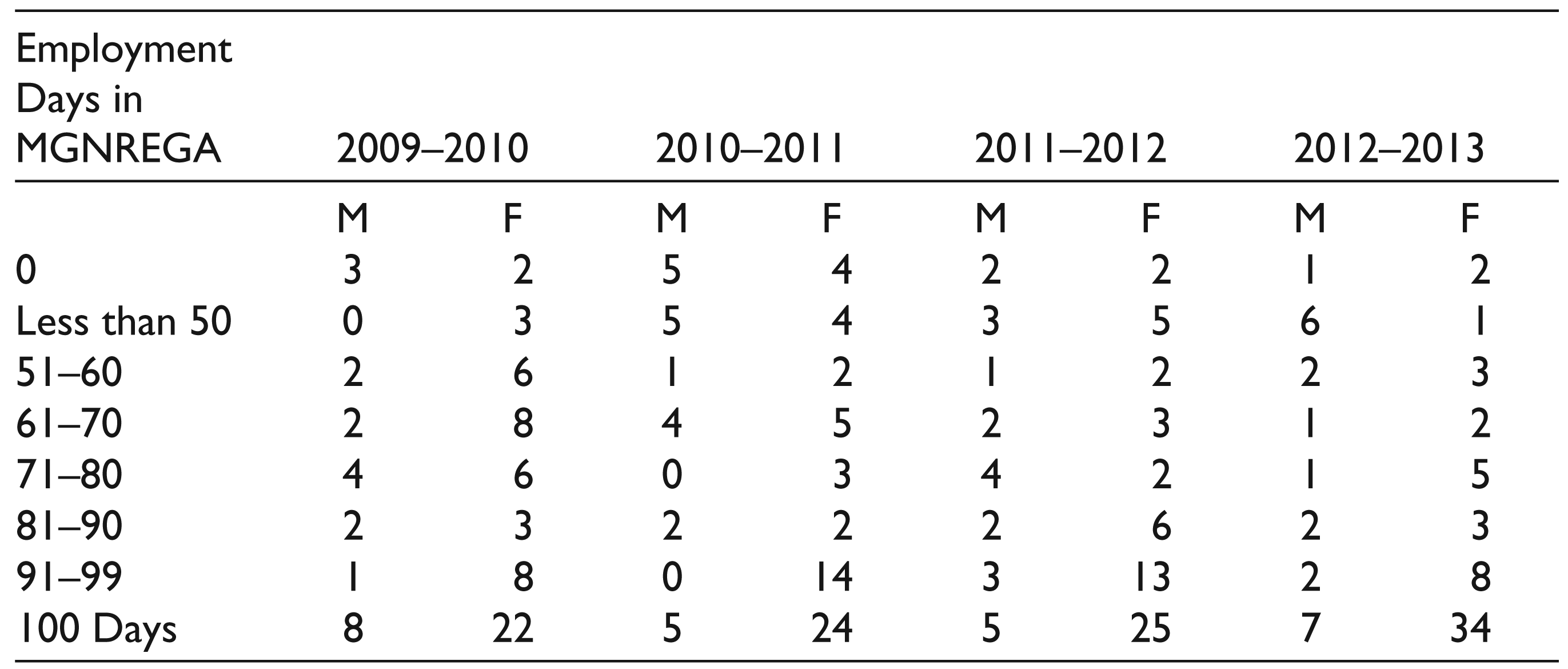
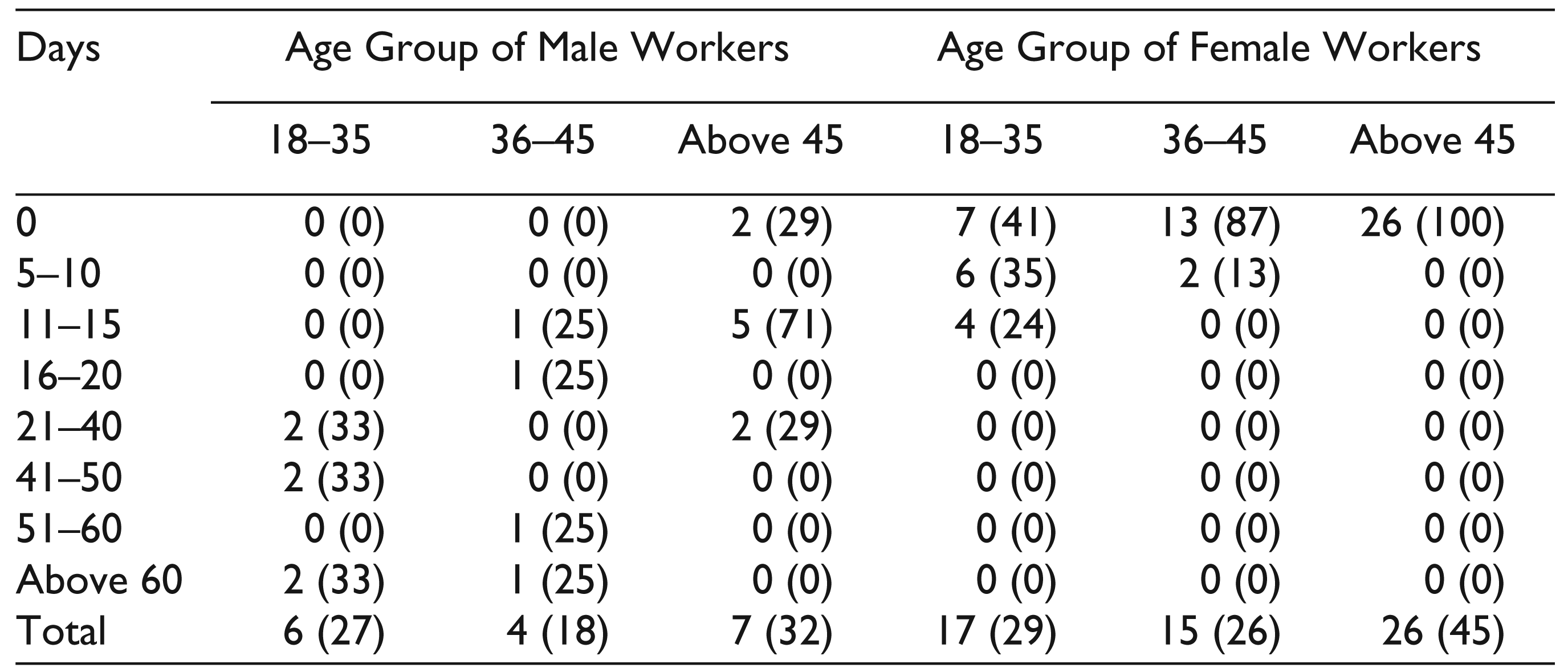
Table 2 sheds light on the availability of MGNREGA work for women across age-groups. It shows that 29 per cent of these workers were in the age bracket of 18–35 years while 26 per cent and 45 per cent were between the ages of 36 and 45 years and above 45 years of age, respectively.
The table shows that 76 per cent of women workers did not work in any other employment in the last one year except MGNREGA. Only 21 per cent were employed on other farms, out of which only 7 per cent of women workers were employed for 11–20 days. All these women were between the ages of 18 and 35 years. This indicates that women workers in the younger group were hired by private employers while women above the age of 45 either did not like to work or were not hired by private employers. This signifies that the programme, to a large extent, provided work to those female workers (above the age of 45 years) who had already withdrawn from the labour market.
Table 2 also shows that, the participation of male workers was very low and this was attributed to the availability of better earning opportunities in and around villages. Like their female counterparts, a large number of male workers, except the younger ones, were those who either stopped seeking work in agriculture or construction because of poor health or were not hired by employers because of their age.
Farm employment for women workers was very low and they also showed a general aversion against working on construction sites. As a result, a majority of women workers particularly from the SC stopped seeking work altogether. Further, some young women workers from this community also withdrew from the labour market after their husbands or sons secured a regular income from the non-farm sector. Their withdrawal from the labour market was also an attempt to avoid the humiliation caused by the strict monitoring of their work, frequent wage cuts and delayed payments by their employers. The implementation of MGNREGA led to the reversal of this trend to a significant extent. The scheme attracted household women back into the workforce. For them, MGNREGA work was not similar to agricultural work. Rather, in their perception, it was akin to working for the government outside the harsh caste hierarchy that had earlier defined production relations in agriculture.
MGNREGA Workers with the Number of Days of Non-MGNREGA Work in the 365 Days Preceding the Survey
There was another sub-category of female workers, mostly from Jat households, who never came out of their homes to work on others’ farms. Jats own the largest landholdings in the region and are known as a sturdy agricultural caste. The arrival of Jat women in the labour market as casual labour was a relatively new phenomenon. Jat women would work on their family farms but working as wage labourers for others was perceived as demeaning for their caste and economic status. However, employment under MGNREGA was perceived as a form of employment that did not threaten their social esteem and identity. These women can best be termed as ‘exclusive MGNREGA workers’ as they were not part of the scheme’s regular workforce and their participation did not add to the labour market’s tightening up. MGNREGA in this way was instrumental in bringing out two new sets of women into the workforce. One was from the middle and upper caste that had until now not been part of the regular workforce. The other set was from the lower castes who had recently withdrawn from the labour force.
However, the participation of a few women from the higher and middle castes in MGNREGA does not mean that socio-cultural obstacles hindering their participation in physical work disappeared completely. Members (both male and female) of several Jat households, who had a weak economic status than the participating households, have not participated in MGNREGA work.
The low participation of village households in the scheme makes one feel that the scheme has been only partially successful in its aim of providing livelihood security to poor households. However, the narratives of a couple of female MGNREGA workers shed light on the importance of the scheme’s role in ensuring livelihood for the poorest households. Kavita, a 29-year-old woman, studied until Class 10 and was married to a person in Baspur at the age of 18. Her husband was an alcoholic and did not do any work. She works in MGNREGA now, sends her two daughters to a private school (the school waived the fees completely). According to her, if there was no employment under the scheme, survival for herself and her daughter would have been impossible. Gulab Devi, a 65-year-old Rajput woman working on a MGNREGA worksite, was asked, ‘Why do you need to work on a MGNREGA site at the age of 65?’ Her choking throat did not allow her to speak as tears flowed down her cheeks. A female co-worker explained, ‘Her husband passed away two years ago and sons spend all their daily earnings on alcohol. What will she eat if she does not work here? No one in the village will provide her work due to her age.’ Kusum, age 28, from Kharda also shared a similar experience. Widowed four years ago and left with two children and no source of livelihood, she sweeps the Anganwadi Kendra in the village in the morning for a paltry income and then works on MGNREGA site until the evening.
A simple exercise to estimate the income earned by women workers from MGNREGA work is also attempted in the article. Although male workers also participate in the programme, the exercise was confined to females since MGNREGA income accounts for a very large part of their earnings. Table 2 shows that the maximum work obtained by four female workers in non-MGNREGA tasks was between 11 and 15 days in the whole year preceding our survey while eight women got agricultural work between 5 and 10 days. Hence, the total income from wage labour in agriculture for female workers was between ₹2,750 (that is, ₹250 x 11 days) and ₹3,750 (that is, ₹250 x 15 days). On the other hand, a majority of women worked in MGNREGA between 80 and 100 days. If we deduct ₹30 every day from MGNREGA earnings because of wage cuts due to the incompletion of stipulated work (digging 52 mann 5 of soil everyday), the yearly income from MGNREGA averages between ₹8,240 and ₹10,300 (that is, 80 days x ₹103 or 100 days x ₹103). The figure of ₹103 as an average daily wage in MGNREGA is arrived after deducting ₹30 from the stipulated wage of ₹133 in MGNREGA in 2012–2013.
Concluding Discussion
The survey in the two villages reflects some interesting findings. First, there are not too many who work under the programme primarily because of low wages, strict measuring of the quantum of work done and the drudgery involved. The alternate livelihood options adopted by rural households over the years, namely, migration to other places, animal husbandry and emerging non-farm employment options in the villages and nearby urban locations, further seem more appealing, constraining motivation and the need to work in the scheme. The scheme attracted mainly those workers who were never part of the labour force or have withdrawn from the labour market because of their age or inability to undertake heavy physical work. In other words, it largely provided employment to ‘surplus labourers’ in the villages, whose services were not in demand in the rural labour market. As a result, the participation of these workers did not add to labour market tightening to a significant extent and hence put little upward pressure on farm and non-farm wages which were already higher than MGNREGA wages.
The impact of MGNREGA on contributing to the shortage of labour for agricultural operations also seems minimal since work availability in the programme does not clash with the agricultural season in the villages. The shortage in agricultural labour (if there is any at all) and their diversion from farms is due to factors outside MGNREGA, namely, migration and emerging non-farm opportunities in nearby villages and towns, either with higher wages or a steady income flow. In fact, this is true not only for these villages or the district as a whole but for a majority of regions in the country. Indumatib and Srikantha (2011) found that high non-farm wages have had a more significant role in the diversion of labour from agriculture than MGNREGA. Using macro-level data in the drought-prone states of Karnataka and Rajasthan as well as in an irrigation-dominated state like Andhra Pradesh, they observe that the impact of MGNREGA wages on labour shortage is more prevalent in Karnataka and Rajasthan; but this impact is relatively modest when compared with the impact of increase in non-farm wages. Though the provision of food security through the Public Distribution System (PDS) also contributed to the scarcity of labour, the relative hike in non-farm wages is contributing to higher scarcity of labour rather than PDS and MGNREGA wages. These findings are further corroborated by Kajale and Shroff (2011) in their study on Maharashtra which notes that the shortage of agricultural labour has taken place along with a parallel increase in non-farm activity in the same villages, and so it is difficult to segregate the effect of non-farm pull factors, spread of education and MGNREGA on labour shortage in agriculture.
Further, the arrival of workers, particularly women, from middle and forward castes to labour market as casual workers by overcoming socio-cultural barriers is the most important success of the programme. The high participation of marginalised groups like SCs and landless households from other castes suggest that the programme is successful in self-targeting its participants.
The little impact of MGNREGA on the rise in rural wages was largely through the withdrawal of young female workers from paid labour in agriculture which has further tightened the supply of farm labour. A number of female MGNREGA workers stopped looking for work in agriculture after the implementation of the scheme. Some of them are still available for farm labour but now they care less about getting farm labour. In short, the programme has created a new segment of workers in the two villages which are now exclusively focusing on MGNREGA labour.