



Abstract
The global commitment to achieve the sustainable development goals (SDGs) by 2030 focusses on poverty, tackling inequality and injustice, setting different targets including the economic empowerment and the wellbeing of women. Central to an inclusive and sustainable industrial development is the need to harness the economic potential of women and for that entrepreneurship remains critical. The present article is contextualised against the backdrop of the SDGs and tries to address questions of women’s empowerment, agency building and wellbeing through an analysis of the entrepreneurial activities of women. To this end, the article tries to provide policy recommendations indicating that entrepreneurship is not only an economically rewarding activity but also needed to address larger questions on reducing gendered vulnerabilities across social groups and building a women’s agency for sustained labour market participation. The article is based on the secondary data largely drawn from the Economic Census and the reports of the National Sample Survey.
The Background
Advances in gender equity are occurring at a time when globally entrepreneurship is recognised as being critical to economic development and sustainability. Given the global challenges of employment, it is imperative to enable women, who comprise half the global population, to participate constructively in the economic activities of their country or regions. Entrepreneurship development is a key element in strategies that allows economies to benefit from the talents, energy and ideas––the productive potential––that women bring to the labour market (Global Entrepreneurship Monitor [GEM], 2015). In the context of declining female labour force participation in India and increasing informalisation of the economy, women’s employment/entrepreneurship and effective labour market participation is vital for the overall socio-economic development of the country. Moreover, the global commitment on achieving the sustainable development goals (SDGs) by 2030 focusses on poverty, tackling inequality and injustice. Specifically, SDG No: 5 aims to ‘Achieve Gender Equality and Empower all Women and Girls’ which has set different targets ensuring economic empowerment and the wellbeing of women. Central to inclusive and sustainable industrial development is the urgent need to harness the economic potential of women. It is estimated that by 2020, 870 million women who have been living or contributing at a subsistence-level will enter the economic mainstream for the first time as producers, consumers, employees and entrepreneurs (UNIDO Gender, 2014). 1
Against this background, fostering women entrepreneurship for ensuring economic empowerment in India remains one of the main concerns of policy makers.Gender gaps in labour force participation indicate a substantial loss in income and economic development. Countries and regions with the largest gaps incur income losses of up to 30 per cent of GDP per capita (Global Employment Trends, 2014). The surveys conducted by the National Sample Survey Office (NSSO) shows declining trends in the rate of female labour force participation, concentration of women in vulnerable employment and increasing informalisation of the labour force as well as entrepreneurship in India. All these are indeed a matter of serious concern for policy makers and it becomes crucial to emphasise the economic empowerment and agency building of women for achieving the SDGs.
According to the GEM’s report, entrepreneurs create jobs for themselves and enrich stakeholders that include employees, investors, suppliers and organisations they work with. They benefit societies by creating solutions to social problems and by introducing innovations that help people live better lives and launch new industries and revive mature ones (GEM, 2015). However, in developing countries, women’s access to engage in entrepreneurship and the scope for innovation remains a complex issue. In these countries, women are over represented in unpaid work and domestic duties and their contribution in national accounting statistics remains invisible. Moreover, their engagement in paid activities often arises due to economic necessity and they prefer to remain self-employed rather than being motivated to take up entrepreneurship for innovation and employment generation. India ranks 70 among 77 nations across the world in the Global Female Entrepreneurship Index (FEI) as estimated by the Global Entrepreneurship and Development Institute (FEI, 2015 in Terjesen & Lloyd, 2015). A question which arises here is whether the choice of entrepreneurship for women in countries like India is preference-driven or is it out of economic necessity, that is, necessity-driven? Such complex questions reiterate the need for an indepth probing into the question of empowerment of women through promotion of entrepreneurship.
Most literature on empowerment within the development context originates from work in industrialised societies. But a question which arises here is whether poor and marginalised women within developing economies face similar situations? In fact, their lack of access to resources and to formal power is significant, even if the contexts within that lack and experiences are very different (Eade, 1999). Growth programmes for women entrepreneurs succeed when they address specific gendered vulnerabilities of women (Seth, 2009). Presently, the performance gap between male and female entrepreneurs has been the focal point of increasing literature on female entrepreneurship which has brought out clearly that if such gender differentials exist, it would imply that countries are not fully utilising their human and physical capital and that the repercussions on the country’s growth potential are negative (Bardasi, Sabarwal & Terrell, 2011). However, literature on SDGs and economic empowerment that focus on the role of business for women have very clearly highlighted that the empowerment of women is essential to expand economic growth, promote social development and enhance business performance. Further, investing in women’s empowerment produces the double dividend of benefitting women and children and is pivotal for the health and social development of families, communities and nations (United Nations [UN], 2014). Access to finance can initiate a virtual spiral of social, economic, political empowerment and wellbeing (Cheston & Kuhn, 2002). Further, debates on women’s agency are closely linked to women’s economic empowerment. To have the power and agency to benefit from economic activities, women need to have the ability to make and act on decisions and control resources and profits (Golla, Malhotra, Nanda & Mehra, 2011). Feminist economists acknowledge that individuals and groups make choices and exercise agency, but suggest that they do so within the limits imposed by the structural distribution of rules, norms, assets and identities between different parts of society. Gender disadvantage in the labour market is a product of these ‘structures of constraint’ (Folbre, 1994 in Kabeer, 2012) which operate over the life course of men and women from different social groups (Kabeer, 2012).
Scholars working on entrepreneurial activity among social groups believe that individuals from groups facing labour market discrimination have a greater incentive to pursue self-employment because they expect lower wages or unfavourable employment in the labour market. Thus, self-employment or entrepreneurship is seen as a route out of poverty and as a desirable alternative to wage employment (Deshpande & Sharma, 2013).
However, there have been diverse perspectives on the relationship between gender and entrepreneurship. Moreover in developing countries, there has not been much literature on the subject. Against the above background, the present article is based on understanding entrepreneurship activities among women and the constraints they face in opting for entrepreneurial activity. The article is contextualised within the broader framework of women’s agency building through participation in economic activities which has been reiterated in much of feminist literature. Scholars like Sylvia Chant (2006, p. 253) in Hanson (2009) referred to the potential for power over resources to improve people’s lives, particularly women’s lives, and running a business, however small, enables some women to have more power over resources. The present article is based on data from the Economic Census (EC), reports of the NSSO (National Sample Survey Office) and other global reports.
Economic Census
The EC is the complete enumeration of all establishments (that is, establishments engaged in production and/or distribution of goods and services not for the purpose of sole consumption) at a point in time with respect to well-defined characteristics. It is an important activity carried out with the aim of improving the availability and quality of existing basic economic statistics and establishing or improving survey frames or developing a statistical business register for the organisation of follow-up economic surveys on a more integrated basis at a later stage. EC is one of the most significant achievements of the Indian statistical system. In India, six ECs have been conducted so far. These were conducted in the year 1977, 1980, 1990, 1998, 2005 and 2013 (Government of India [GOI], 2016). For the present article, secondary data from both the fifth and sixth ECs have been used. Unit level data obtained from both the censuses are used for a disaggregated analysis. Various rounds of NSSO data have also been used for the present article.
The subsequent sections discuss women’s employment in India, engagement in entrepreneurship with regard to the state/Union Territory (UT)-wise distribution of establishments, employment, types of activities, access to credit and entrepreneurial activity among social groups and so on. The article is contextualised within the backdrop of SDGs and tries to explore questions related to women’s agency and wellbeing. To this end, the article tries to provide policy recommendations for ensuring entrepreneurship as not only an economically rewarding activity but also addressing the larger question of reducing gendered vulnerabilities across social groups and building women’s agency for a sustained labour market participation.
Women’s Employment in India
The World Economic Forum in its Global Gender Gap Report 2015 mentions that India ranks 139 in economic participation and opportunity amongst 145 countries which raises many questions on access to economic resources and labour market participation. What is even more disturbing is the declining female labour force participation and increasing informalisation of the economy. While the female labour force participation in rural areas has declined from 126.49 million in 2004–2005 to 106.2 million in 2009–2010 and further to 103.6 million in 2011–2012, in urban areas there is a marginal increase from 24.2 per cent in 2009–2010 to 28.8 per cent in 2011–2012 as reported by the National Employment and Unemployment Surveys. 2 Further, it is also seen that among workers in usual status (ps+ss), 3 about 52 per cent are self-employed while the proportion of self-employed is higher among females (56 per cent) than among males (51 per cent). About 18 per cent of workers in India are regular wage/salaried employees. The proportion of regular wage/salaried employees in the workforce is much higher in urban areas (about 43 per cent) as compared to rural areas (about 9 per cent). In other words, the self-employed and casual labourers together constitute nearly 91 per cent of the rural workforce and nearly 57 per cent of the urban workforce as reported by the NSS 68th (2011–2012) round. However, a larger number of women are employed as self-employed and casual labourers. The concentration of women in self-employment and basically informal own-account enterprises raises many questions on their access to social security provisions.
Share of Workers in Smaller Enterprises during 2011–2012
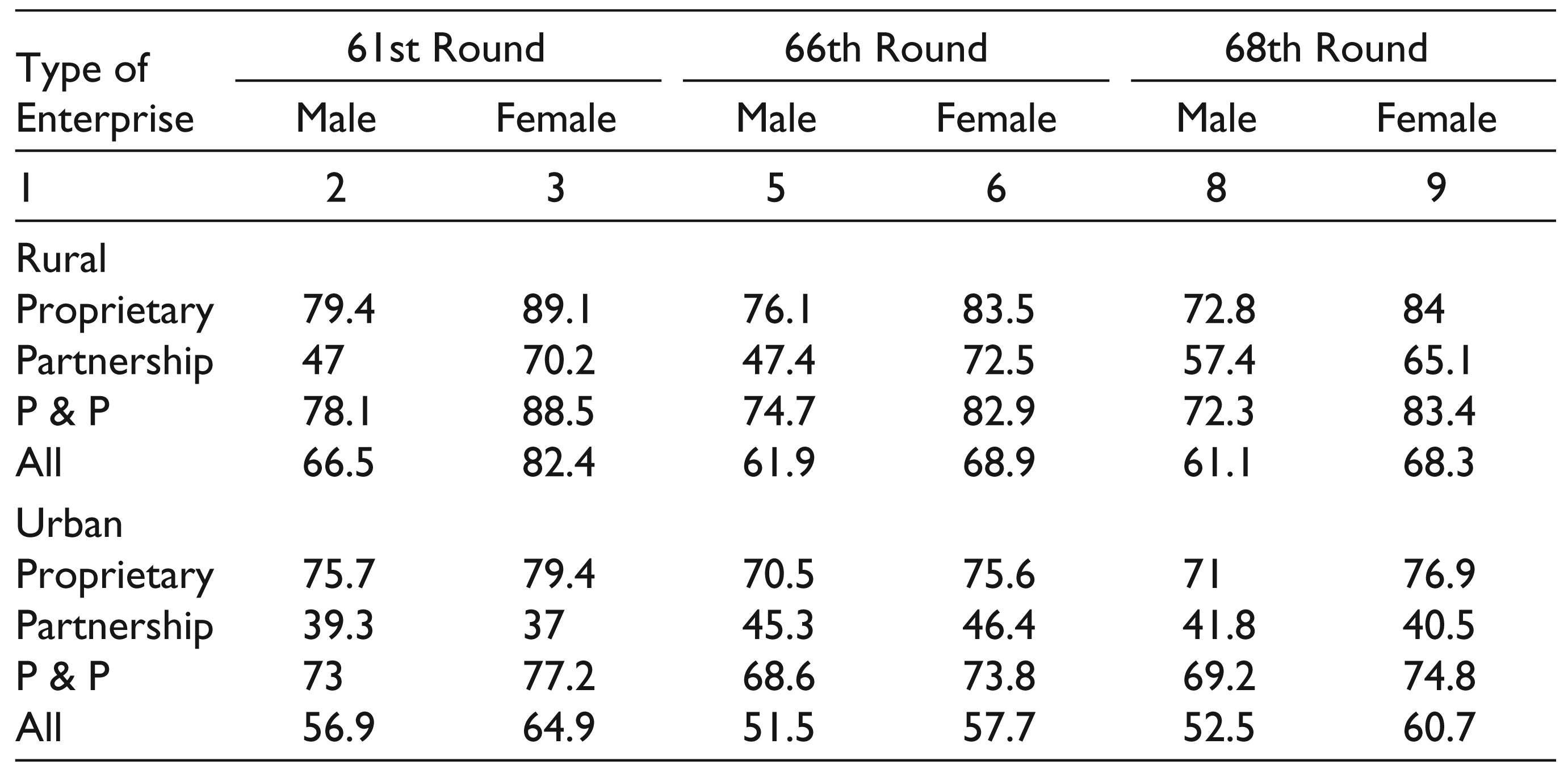
The survey results of the NSS 68th Round (2011–2012), Report No. 557: Informal Sector and Conditions of Employment in India show that a higher proportion of the informal sector workers are engaged in smaller enterprises as compared to all workers in the AGEGC 4 and non-agriculture sectors. The proportion of workers engaged in smaller enterprises is higher for rural areas than in urban areas. In rural areas, about 75 per cent of the informal sector workers were engaged in smaller enterprises as compared to 63 per cent of all workers in the AGEGC and non-agriculture sectors, while in urban areas, about 70 per cent of the informal sector workers are engaged in smaller enterprises as compared to 54 per cent of all workers in the AGEGC and non-agriculture sectors. It is also seen from Table 1 that compared to male workers, a higher proportion of female workers have worked in smaller enterprises—among workers in AGEGC and non-agriculture sectors, the proportion is 68 per cent for rural females as compared to 61 per cent for rural males and 61 per cent for urban females as compared to 53 per cent for urban males. Similarly, among workers in the informal sector the proportion is 83 per cent for rural females as compared to 72 per cent for rural males and 75 per cent for urban females as compared to 69 per cent for urban males. The proportion of workers employed in smaller enterprises is much higher for proprietary enterprises (76 per cent in rural areas and 72 per cent in urban areas) compared to partnership enterprises (59 per cent in rural areas and 42 per cent in urban areas).
Ownership of Establishments as Means to Economic Empowerment
The GEM states that the level of established business ownership indicates sustainability of entrepreneurship efforts in an economy. Further, early stage entrepreneurial activity is important for creating dynamism in economic activities and established businesses are important for preserving stability (GEM, 2015). In this context, the nature of ownership and location of enterprises become important for promoting sustainability and growth of enterprises. It is observed from Tables 2 and 5 as the 6th EC reports that 8.05 million (15.40 per cent) out of the total 52.29 million proprietary establishments are run by women and out of this 83.20 per cent are without hired workers. The percentage of establishments without hired workers in rural areas is 86.85 per cent whereas in urban areas it was 76.33 per cent. It is also observed that about 65.12 per cent of women-owned establishments are located in rural areas and of the remaining only 34.88 per cent are in urban areas. The number of women-owned establishments involved in agricultural activities is 34.3 per cent of the total number of establishments owned by women. The total number of workers engaged in women-owned establishments is 13.44 million (13.08 per cent) persons, out of total 103.06 million persons engaged in India under different economic activities.
Proportion (per 100) of Workers Engaged in Enterprises with Less Than 6 Workers Among the Workers (ps+ss) in AGEGC and Non-agriculture Sectors Separately for ‘P & P’ Enterprises and ‘All’ Enterprise Types during NSS 61st (2004–2005), 66th (2009–2010) and 68th (2011–2012) Rounds
Establishments and Workers Engaged in Total Proprietary and Women-owned Establishments during the 5th and 6th ECs

Such a picture raises many questions on the intention and support for entrepreneurial activities. It also reflects the possibility of a necessity-based early stage entrepreneurial activity that is driven by limited choices for work. Although necessity entrepreneurship is important in enabling women to create income-generating businesses, opportunity-driven entrepreneurs are important for the economy for their greater potential impact on dimensions such as job creation aspirations (GEM, 2015).
With regard to establishment and workers engaged in total proprietary and women-owned establishments during 5th and 6th ECs, it is apparent that women-owned establishments have increased from 9.50 per cent during the 5th EC to 15.40 per cent during the 6th EC. Similarly, the number of workers have also increase in women-owned establishments from 7.77 per cent during the 5th EC to 13.05 per cent during 6th EC.
However, the average rate of employment per establishment in case of women-owned establishments decrease from 1.71 during the 5th EC to 1.67 during the 6th EC (Table 3). On the contrary, though the average employment rate of male-owned establishments also decrease from 2.13 per cent during the 5th EC to 2.03 per cent during the 6th EC, yet the gender differentials in the average employment rate is prominent with the employment rate still being higher in male-owned establishments. Though the gender gap in the employment rate for male and female-owned establishments has gradually reduced, yet the relative performance of women-owned establishments is still lower in comparison to males.
Though there is an increase in women-owned establishments during both the ECs, a question which arises: what is the status of their premises and what are the basic conditions of work? There is no denying the fact that in women-owned establishments, 86.8 per cent were located within the women’s premises during the 5th EC whereas their status deteriorated during the 6th EC to 61.5 per cent of the establishments having premises. This raises very pertinent questions about the general working conditions and availability of resources for such establishments.
Further, it is also evident that there has been a rapid increase in establishments without premises during the 6th EC from 38.5 per cent to 13.2 per cent during the 5th EC (Table 4.) This trend reflects on the vulnerability of establishments which remain mobile and exist outside households without any fixed structure.
A comparison of the status of establishments as per their activity during the ECs can also be seen (Table 5). It is found that in women-owned establishments, the establishments without hired workers have increased from 77.10 per cent during 5th EC to 83.20 per cent during the 6th EC reflecting an increase in the informalisation of the enterprise. Moreover establishments which have at least one hired worker (22.90 per cent) during the 5th EC decrease to 16.80 per cent during the 6th EC. There has been a decrease in women-owned establishments in rural areas from 74.10 per cent during the 5th EC to 65.12 per cent during the 6th EC. However, there has been an increase in women-owned establishments in urban areas, that is, from 25.90 per cent during 5th EC to 34.88 per cent during the 6th EC. Further, there has been an increase in agricultural establishments from 15.70 per cent during the 5th EC to 34.30 per cent during 6th EC and a decrease in non-agricultural establishments from 84.30 per cent during 5th EC to 65.70 per cent during the 6th EC.
Employment Rate (Average Employment per Establishment)

Status of Premises in Women Establishments during 5th and 6th ECs

Type, Sector and Activity-wise Percentage Distribution of Women-owned Establishments during 5th and 6th ECs

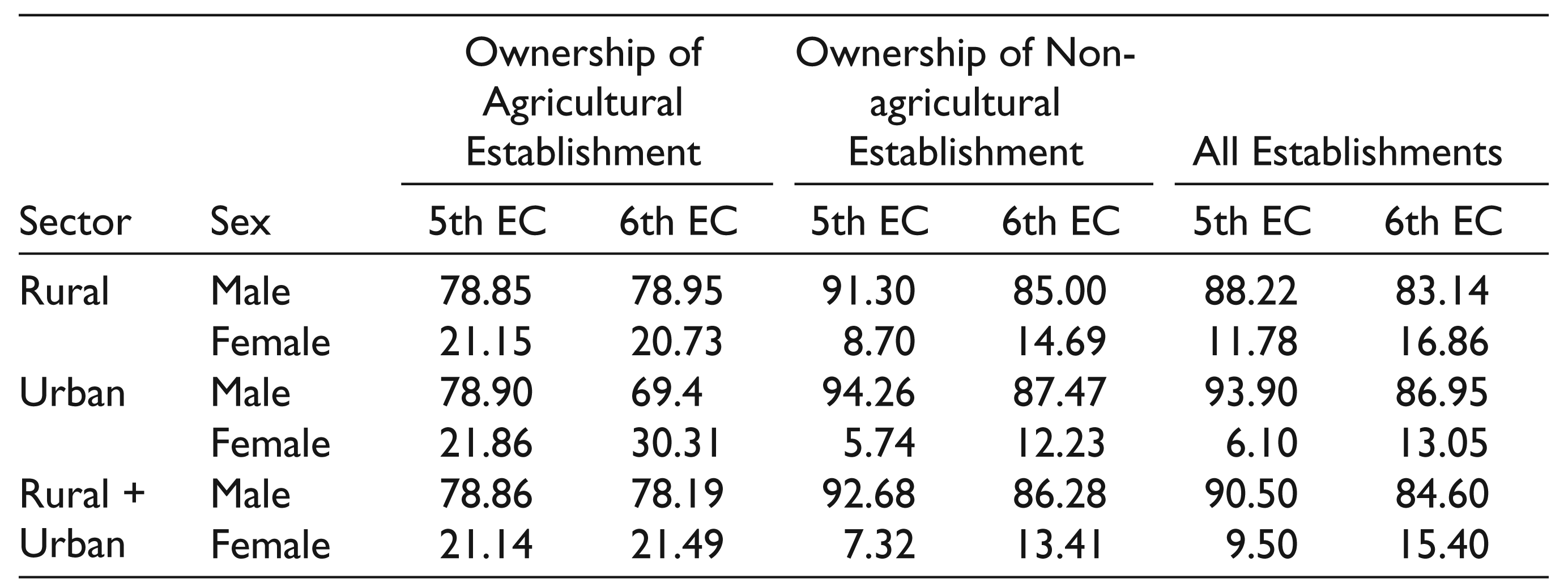
With regard to ownership in proprietary establishments, gender differentials become prominent with ownership of females being low in comparison to males in both agricultural and non-agricultural establishments. There is a decline in women’s ownership in agricultural establishments in rural areas from 21.15 per cent during the 5th EC to 20.73 per cent during the 6th EC (Table 6). On the contrary, the ownership of rural males in agricultural establishments has increased from 78.85 per cent during the 5th EC to 78.95 per cent during the 6th EC. However, the gender differentials in ownership remained constant during both the ECs with a higher number of males owning agricultural establishments as compared to females. Similarly, in urban areas the ownership of males in agricultural establishments was higher at 69.4 per cent whereas only 30.31 per cent females had ownership in agricultural establishments during the 6th EC. It is also noteworthy that the ownership of females in agricultural establishments increases during the 6th EC to 30.31 per cent which is an increase from 21.86 during the 5th EC. However, in the case of males ownership it declines in urban areas during the EC years.
With regard to ownership in non-agricultural establishments, the gender differentials in male/female ownership continue to exist in establishments though female participation has increased during both the ECs with 84.60 per cent overall ownership of males in all establishments whereas female enterprises remain as low at 15.40 per cent in all establishments. Further, it becomes important to understand the nature, size and other conditions in women-owned enterprises. As is evident from literature on developing countries, women tend to operate smaller firms as they feel the constraint in accessing credit, face regional differences in gender gaps and also the concentration of women in specific industrial sectors often penalises them (Bardasi et al., 2011). The participation of women in entrepreneurial activities and managing an enterprise on their own is affected by a lot of social and cultural constraints that women face. A lack of adequate skills, household domestic responsibilities, a lack of access to finance, a lack of decision-making abilities due to socio-cultural arrangements constrain women’s active agency. 5
Ownership (%) in Establishments: Gender Differentials
Women-owned Establishments and State-wise Distribution of Activities
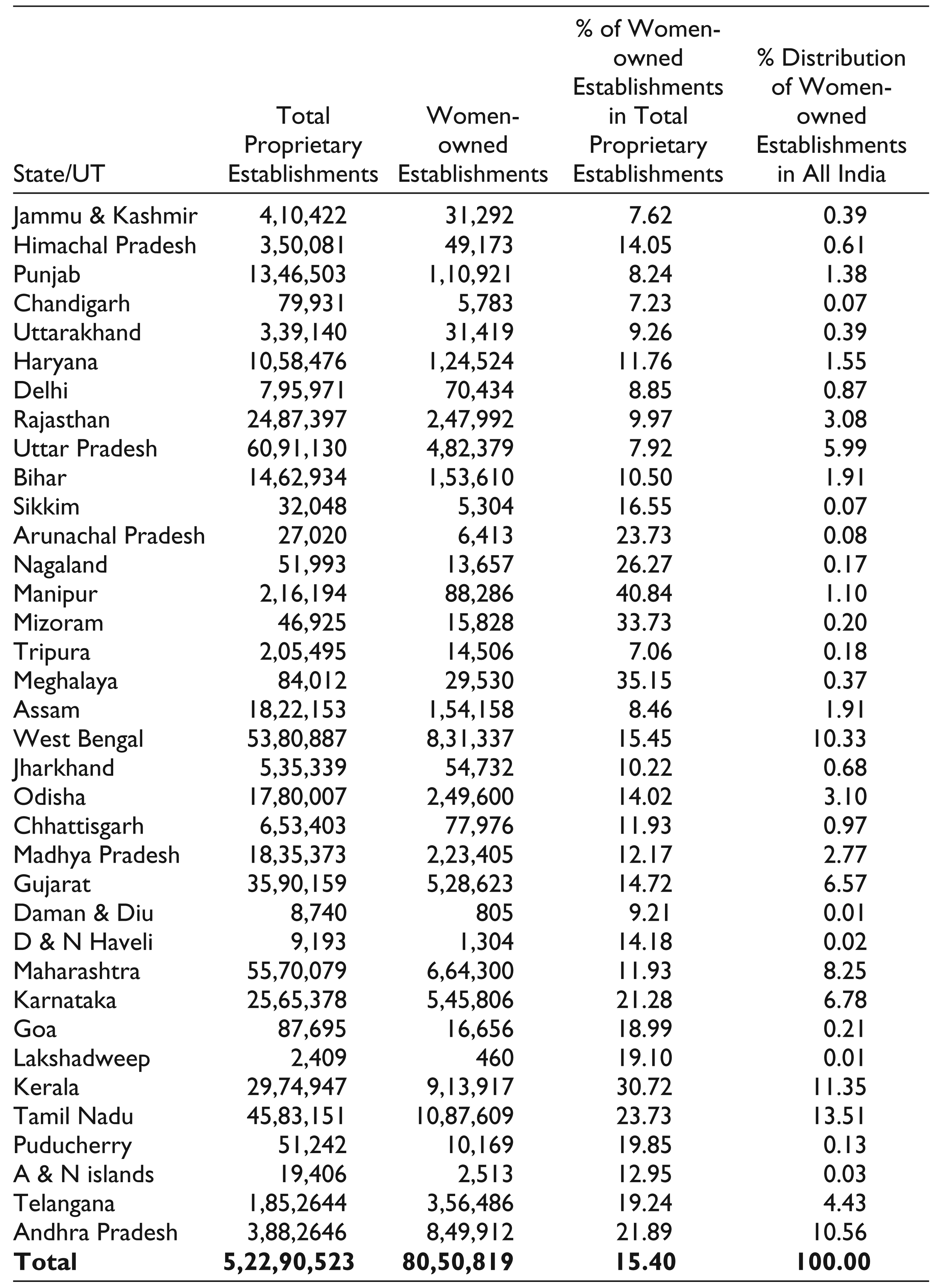
There has been a shift in the state-wise distribution in the identification of the top five states which have the highest percentage share of women entrepreneurs. The top five states in India during the 6th EC with the highest percentage share of women entrepreneurs are Tamil Nadu (13.51 per cent) followed by Kerala (11.35 per cent), Andhra Pradesh (10.56 per cent), West Bengal (10.33 per cent) and Maharashtra (8.25 per cent) which are the more advanced states as compared to northern states, where the female population is significantly high. However, during the 5th EC, the top five states with the highest percentage share of women entrepreneurs are in Kerala (18.51 per cent) followed by Tamil Nadu (17.79 per cent), Gujarat (12.48 per cent), Andhra Pradesh (10.10 per cent) and Karnataka (9.58 per cent) (Table 7). Though the southern states show a relatively higher share of entrepreneurial activity during both the ECs yet, Maharashtra emerges as a state with growth in entrepreneurial activity during the EC years.
Percentage of Women-owned Establishments of Total (Male + Female) Proprietary Establishments and Percentage Distribution of Women-owned Establishments in All India during 5th EC (2005)

One observes that the top five states/UTs where the percentage of women establishments in total (male + female) proprietary establishments are increasingly found are in the four states of the Northeast, namely Manipur (40.84 per cent), Meghalaya (35.15 per cent), Mizoram (33.73 per cent), Nagaland (26.27 per cent) and one southern state, Kerala (30.72 per cent) all of which have a matrilineal social structure (Table 8). Some studies in the Northeast region reveal that women in the region are mostly engaged in traditional activities and very few women entrepreneurs opt for non-traditional occupations. In a study of 400 men and women entrepreneurs from the Northeast, it is found that traditional activities, such as handicrafts and handlooms, still predominated in types of activities taken up by women entrepreneurs. Securing loans to set up and expand business was a problem faced by women entrepreneurs as they were unable to provide collateral security against loans because property was mostly controlled by male family members (Sinha, 2003). Though women entrepreneurship in traditional sectors remains an important option for women, it becomes important to address questions on their access to finance and other support from the state for ensuring economic empowerment and mobility. However, some other studies have suggested that government should support women through micro-finance, education and training in the development of their skills to give more employment opportunities (Sinha & Sinha, 2013).
Percentage of Women-owned Establishments of Total (Male + Female) Proprietary Establishments and Percentage Distribution of Women-owned Establishments, All India during 6th EC (2013)
Percentage of Women-owned Establishments Engaged in Top Five Activities during 5th and 6th ECs
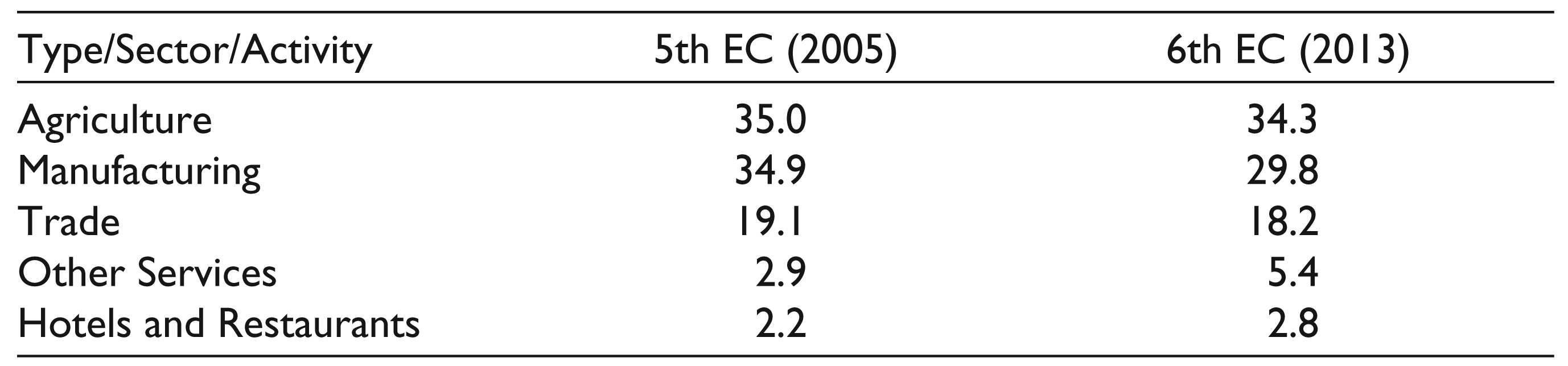
With regard to the percentage of women-owned establishments in the top five activities statistics show that agriculture remains one of the activities where women entrepreneurs are mostly engaged both during the 5th EC (35.0 per cent) and during the 6th EC (34.3 per cent). While a decline is witnessed in manufacturing and trade, there is a shift and increase in other services, hotels and restaurants. While women entrepreneurship in manufacturing declines from 34.9 per cent during the 5th EC to 29.8 per cent during the 6th EC, entrepreneurship for females in trade also declines from 19.1 per cent during the 5th EC to 18.2 per cent during the 6th EC. However, there is an increase in female entrepreneurship in other services from 2.9 per cent during the 5th EC to 5.4 per cent during the 6th EC (Table 9). Also, in the hotels and restaurants’ sector there is a marginal increase from 2.2 per cent during the 5th EC to 2.8 per cent during the 6th EC. The sectoral shifts in entrepreneurial activities clearly show that the service sector is increasing at a rapid pace and has immense potential for absorbing women. But a question which arises is how far have the emerging sectors created enough innovative spaces for women to operate and grow their businesses? An insight into the nature and operation and access to finance can help in understanding the status of women entrepreneurs’ amidst sectoral shifts and diversification of economic activities.
Nature of Operation and Access to Finance
Examining the nature of operation and access to finance, it is disturbing to note that women’s ownership in perennial entrepreneurship has declined from 92.50 per cent during the 5th EC to 89 per cent during the 6th EC. On the contrary, women-owned establishments that are seasonal in nature have witnessed an increase from 7.50 per cent during the 5th EC to 9 per cent during the 6th EC while the remaining 2 per cent are casual in nature (Table 10). Though the majority of women-owned establishments are perennial it becomes important to analyse whether their perennial status makes access to finance easier?
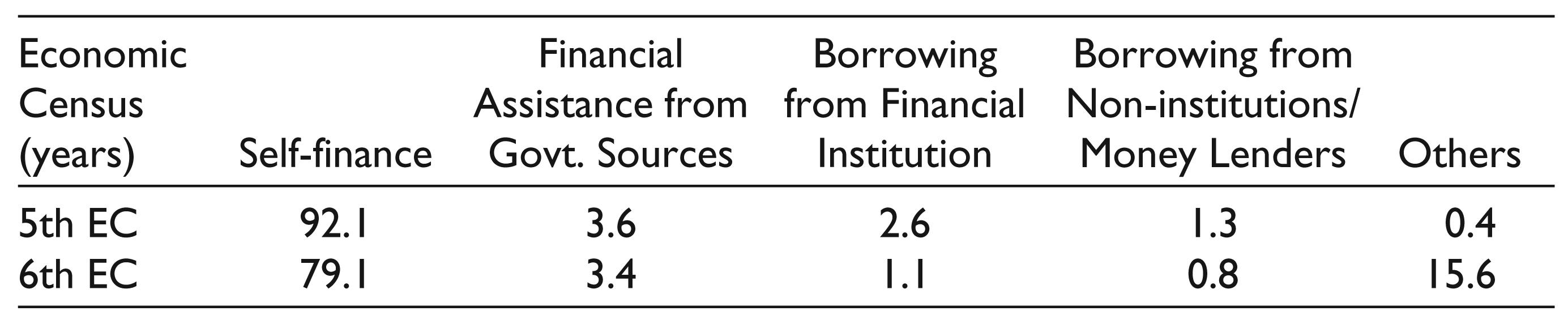
However, it is striking to note that 79.07 per cent of women-owned establishments are self-financed and financial assistance from government sources is only limited to 3.4 per cent during the 6th EC which has decreased from 3.6 per cent during the 5th EC (Table 11). This indicates that access to finance and other support to entrepreneurial activities by women still remains a major challenge before women to take up entrepreneurship.
Apart from this, women face many constraints in taking up entrepreneurial activity. It is observed that women are mostly engaged in labour intensive and low-productive activities. Personal or environmental constraints that place women at a disadvantage could translate into female under-performance in entrepreneurship. Similarly, if women opt for smaller (and potentially sub-optimally smaller) enterprises—for example, a negative gap in performance can be explained by a desire to better accommodate the demands of the family on their time or by their ‘excessively low’ propensity to risk (Bardasi et al., 2011).
With regard to the source of finance in different states, it is revealed that the top five states, where entrepreneurial activity among females is high, did not have much access to finance by women entrepreneurs and are mostly depending on self-finance. Funding from the government remains lowest in all of these states. Though West Bengal manages to raise funds from other agencies, for the rest of Indian women entrepreneurs it is always difficult to access finance.
Nature of Operation-wise Percentage Distribution of Women-owned Establishments during 5th and 6th ECs

Percentage of Women-owned Establishments by Major Source of Finance during 5th and 6th ECs
The face of entrepreneurship is also changing across the world; entrepreneurs are increasingly young and/or female due to increasing unemployment. The International Labour Organization reports that globally, almost 13 per cent of young people (close to 75 million people) are unemployed. This phenomenon is particularly evident in regions where wage employment is difficult to obtain. Access to funding remains the primary obstacle for entrepreneurs from all markets. The public and private sectors each have an important role to play in creating entrepreneurial ecosystems that, in addition to funding, are essential to promoting entrepreneurial success (GOI, 2015).
Initiatives for the Financial Empowerment of Women and Entrepreneurs
The Government of India has launched schemes like Start Up India and Stand Up India to encourage entrepreneurship among women. The Start Up India campaign aims at fostering entrepreneurship and promoting innovation by creating an ecosystem that is conducive for the growth of start-ups. Under the scheme, entrepreneurs can get loans from banks to start their businesses. The Union Budget has introduced substantial hikes for seed funding for start-ups in the next fiscal year.The government has also announced opening 25 technology-business incubators to provide relevant training and has earmarked ₹10 crore for creating world-class incubators (Chawla, 2016). But, the question which arises is how far are these start-ups accessible to women who aim to take to small businesses? There are detailed eligibility norms under the scheme in order to enrol to derive benefits. For example, the norms on registration, ceiling on annual turnover, certification, innovation and so on remain a huge challenge for women entrepreneurs with small capital just to be eligible for the scheme.
Schemes like Stand Up India launched on 5 April 2016 aims to facilitate bank loans between ₹1 million (₹10 lakh) and ₹10 million (₹1 crore) to at least some Scheduled Caste (SC) or Scheduled Tribe (ST) borrowers and at least one woman borrower per bank branch for the setting up of a new enterprise (Chawla, 2016). The major focus of the scheme is on handholding support for both SC/ST and women borrowers to leverage the institutional credit structure to reach out to the underserved sectors by facilitating loans to non-farm sector entrepreneurs. The scheme helps not just those who are in the initial stages of their entrepreneurial plans, but also those who have already set up their company but still fall under the start-up category. Under the scheme, the government has opened refinancing options through the Small Industries Development Bank of India, at an initial amount of ₹10,000 crore. Along with that, a corpus (principal amount) of ₹5,000 crore will be created, to ensure credit guarantee through the National Credit Guarantee Trustee Company. Along with the composite loan, they will also be provided with a debit card. 6 However, such schemes can be instrumental in promoting entrepreneurship by facilitating both entrepreneurs in need of capital and investors.
The other initiatives undertaken by the government include the Rashtriya Mahila Kosh (RMK) which is the National Credit Fund for Women set up in the year 1993. It is an apex funding organisation under the Ministry of Women and Child Development exclusively for poor women to provide credit facilities. The RMK provides micro-credit to women self-help groups and women entrepreneurs in both rural and urban areas. It also aims to build the capacities of women by imparting training in financial management, project management, enterprise development, skill upgradation and exposure visits. Marketing assistance is also provided to women and the scheme aims at the holistic development of women entrepreneurs. It has an initial corpus of ₹31 crore which has been further raised to ₹100 crore during 2009–2010. Bharatiya Mahila Bank Ltd. is another initiative which is the first of its kind in the banking industry in India formed with a vision of economic empowerment for women in 2013. The bank focusses on the entire pyramid of Indian women, special attention being given to economically neglected, deprived, discriminated, under banked, unbanked, rural and urban women to ensure inclusive and sustainable growth. The bank with a team of professionals with rich experience and expertise has designed and developed new products and services to suit the needs of women of all segments including self-help groups, women entrepreneurs, salaried women, high net worth individuals and corporates. Though the government has taken several initiatives to promote entrepreneurship, yet a lot more needs to be done in terms of women’s access to such schemes.
Women Entrepreneurs and Social Groups
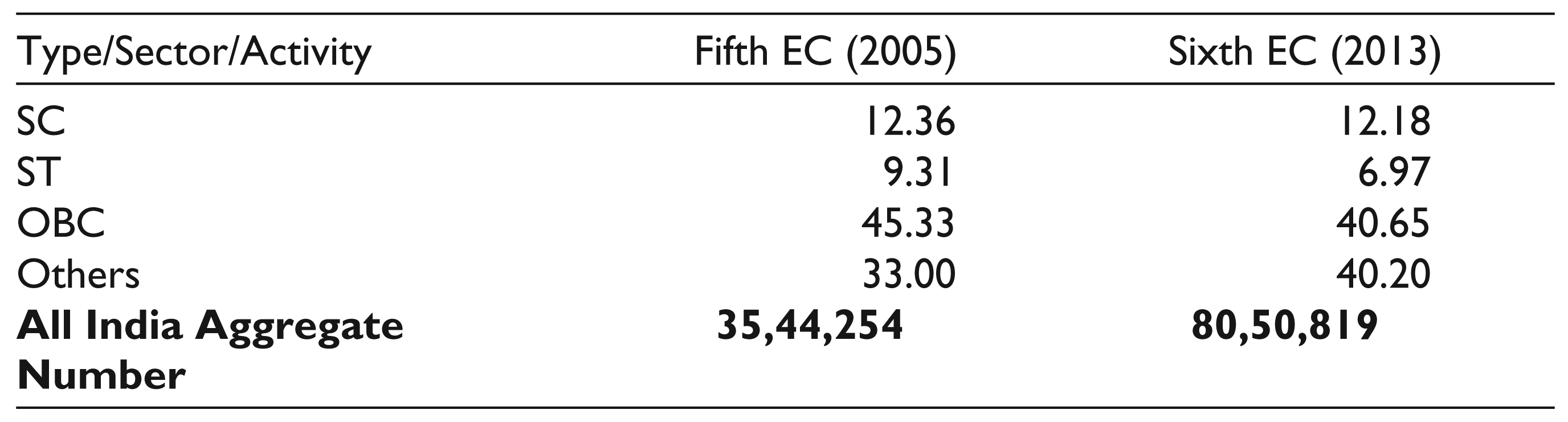
The distribution of women-owned establishments among social groups reveals a declining trend during the EC years. Though the Other Backward Classes (OBCs) category has the highest percentage of women entrepreneurs, yet a decline has been witnessed from 45.33 per cent during the 5th EC to 40.65 per cent during the 6th EC in the participation of OBCs in entrepreneurial activity. Also among the SCs there is a decline from 12.36 per cent during the 5th EC to 12.18 per cent during the 6th EC. Further, entrepreneurship among the STs has declined from 9.31 per cent during the 5th EC to 6.97 per cent during the 6th EC. However, in the category ‘others’ there has been an increase from 33.0 per cent in the 5th EC to 40.20 per cent during the 6th EC (Table 12). The decline in entrepreneurial activities among social group reiterates the need to identify constraining factors and consider policy formulation ensuring effective participation of social groups.
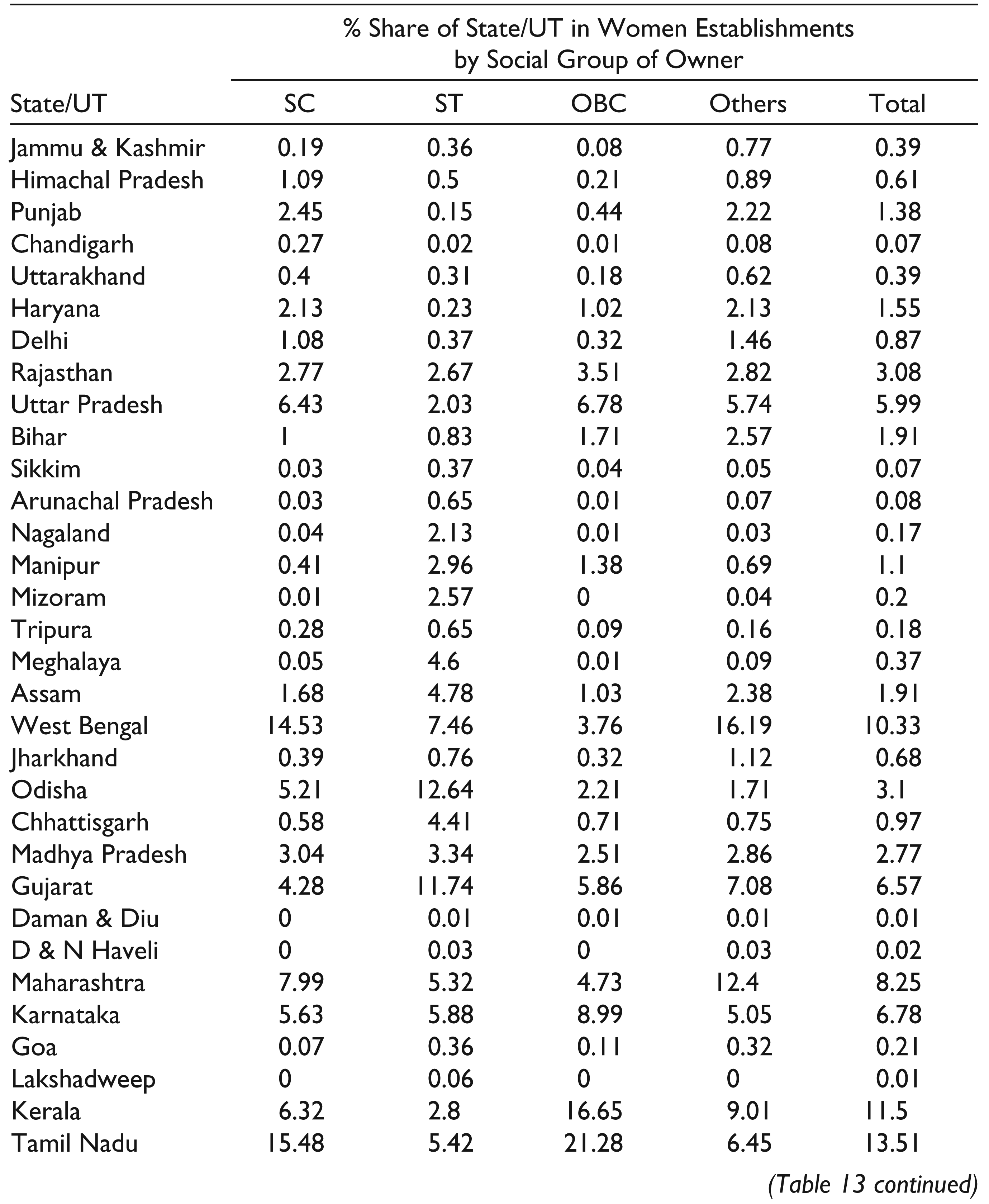
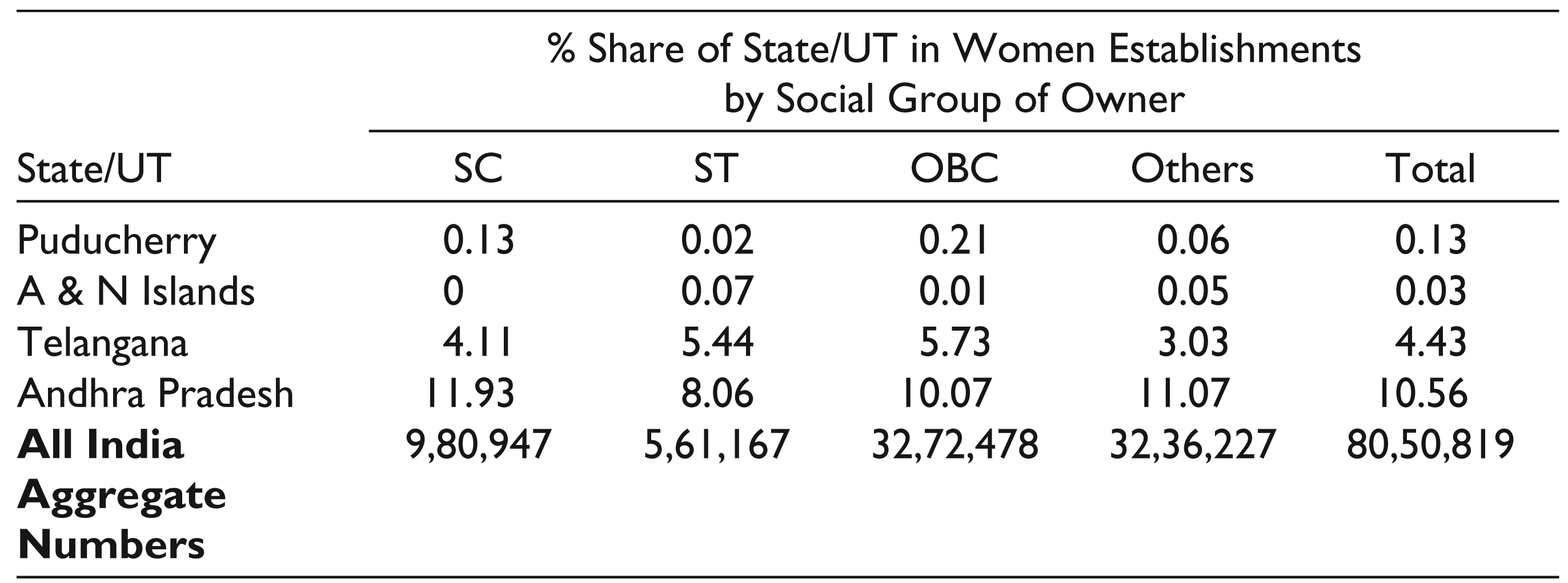
The state-wise distribution of women-owned establishments by social groups can be seen in Table 13. It can be observed that the top five states where entrepreneurial activity is the highest among the SC community is Tamil Nadu (15.48 per cent), West Bengal (14.53 per cent), Andhra Pradesh (11.93 per cent), Maharashtra (7.99 per cent) and Uttar Pradesh (6.43 per cent). The states which have the highest number of female entrepreneurs in the ST category include Odisha (12.64 per cent), Gujarat (11.74 per cent), Andhra Pradesh (8.06 per cent), West Bengal (7.46 per cent) and Karnataka (5.88 per cent). Further, the state-wise participation of women in entrepreneurial activities among OBCs shows that Tamil Nadu (21.28 per cent) has the highest participation followed by Kerala (16.65 per cent), Andhra Pradesh (10.07 per cent), Karnataka (8.99 per cent) and Uttar Pradesh (6.78 per cent). The southern states have the highest concentration of women across social groups engaged in entrepreneurial activity. The overlapping of gender and caste becomes prominent as we see entrepreneurial activity increase among the vulnerable social groups. On the contrary, as evident in Table 13, entrepreneurial activity among women in the general category is comparatively lower. It is only in West Bengal (16.19 per cent) and Maharashtra (12.4 per cent) that women are engaged in entrepreneurial activity in the general category, that is ‘others’. Such figures lead to addressing the larger question of whether entrepreneurship among social groups has led to their upward mobility or not? Available literature on the overlapping of caste and gender finds that SC and ST women are doubly disadvantaged on account of their gender and lower caste status.
Social Group-wise Percentage Distribution of Women-owned Establishments during 5th and 6th ECs
State/UT-wise Percentage of Establishments under Women Entrepreneurship by Social Group of Owner
Historically, there has been a trade-off inherent in gender caste overlapping. hile dalit and adivasi women have been subject to greater material deprivation and oppression, SC and ST individuals on an average are poorer with lower education, fewer assets and poorer networks (Deshpande & Sharma, 2013). In this context, it would be important to learn about the type of enterprises women from different social groups are engaged in. Other aspects that demand attention is the size of the enterprise, and access to credit that would enable one to understand whether entrepreneurship among social groups is necessity-driven or survival-driven or preference-driven. Such questions need a thorough probing and investigation for informing governmental policy to promote entrepreneurship and mobility among women belonging to the deprived sections of society.
Concluding Remarks
In view of the above discussion, it becomes evident that entrepreneurship for women remains mostly a necessity-driven activity with limited scope for innovation. The results of the ECs very clearly reflect that there has been a decrease in the long-term entrepreneurship by women and an increase in women-owned entrepreneurs without hired workers thereby showing a high level of informalisation and vulnerable enterprises. Further, the decline in women-owned establishments among social groups with differentials across states reiterates the need for a particularistic approach in a re-examination of social contexts of women located across different social groups and geographical locations of the country, However, the states that report the highest entrepreneurial activity among SCs, STs and OBCs also seemed to have less access to governmental finance and mostly depended on self-finance.
Also, sectoral shifts in entrepreneurial activity among women from agriculture to other services, opens up a lot of potentially new emerging entrepreneurial activities that need to be strengthened through appropriate skill training for innovation apart from easy access to finance. Further, it becomes important to promote entrepreneurship development among women and particularly women belonging to deprived sections. Keeping in view declining female labour force participation and commitment towards achievement of goal No. 5 on gender equality of the SDGs women’s entrepreneurial activities need to be strengthened. It is quite evident that women entrepreneurship can contribute immensely for improving the participation of women in the economy thereby boosting the GDP to a greater extent.
Though the government has taken initiatives to encourage institutional credit as discussed above what needs further attention is identifying gendered vulnerabilities associated with women belonging to different social groups who lack active agency. Building women’s active agency in the context of global commitments of the SDGs needs an identification of the challenges and constraints women face to have access to entrepreneurial activity. As women engaged in traditional occupations, women belonging to different socio-economic, cultural and religious groups remain disadvantaged due to a lack of access to knowledge and awareness on various governmental measures for enhancing their entrepreneurial potentialities and promoting economic empowerment. Therefore women’s access to finance and promotion of entrepreneurship from the perspective of innovation remains a major challenge before India’s policymakers.
The Report of the Steering Committee on Women’s Agency and Child Rights for the Twelfth Five-Year Plan, 2012–2017 clearly states that the micro-finance movement in the country has been progressing, yet there is a need for the financial inclusion of women in the mainstream credit system as a part of the agenda for the 12th Plan. 7 The committee recommends that women self-help groups should be classified under the priority sector and be given loans at concessional rates and for this, necessary directives by the National Bank for Agriculture and Rural Development (NABARD) and the Reserve Bank of India (RBI) will be necessary.Though such efforts can contribute immensely to women’s increased access to credit facilities, appropriate steps in this direction need to be taken. However, public policies to promote women entrepreneurship includes fostering a gender neutral legal framework for business, reducing administrative burdens on firms and excessive regulatory restrictions, ensuring equal access to finance for male and female entrepreneurs and pairing relevant financing schemes with support measures such as financial literacy, training, mentoring, coaching and consultancy services and increased access to support networks (OECD, 2014).
Apart from this, there is a lack of data that identifies the gaps between existing skill sets, education profile and other socio-economic variables like income that affect entrepreneurial activity. The ECs can contribute immensely if they reflect on the social realities of women through relevant probing questions that identify the constraints women have before taking up an entrepreneurial activity. Efforts in gender mainstreaming of such surveys can be instrumental in informing governmental policy towards ensuring the economic rights and eventual wellbeing of women.