Abstract

Social Change has started a new series as part of its ongoing efforts to highlight data and share knowledge on issues of development. In every issue, the journal will bring to its readers, Social Change Indicators, a collation of available data that will provide insights on how inequality is being addressed. We start this series by examining learning and education in India.
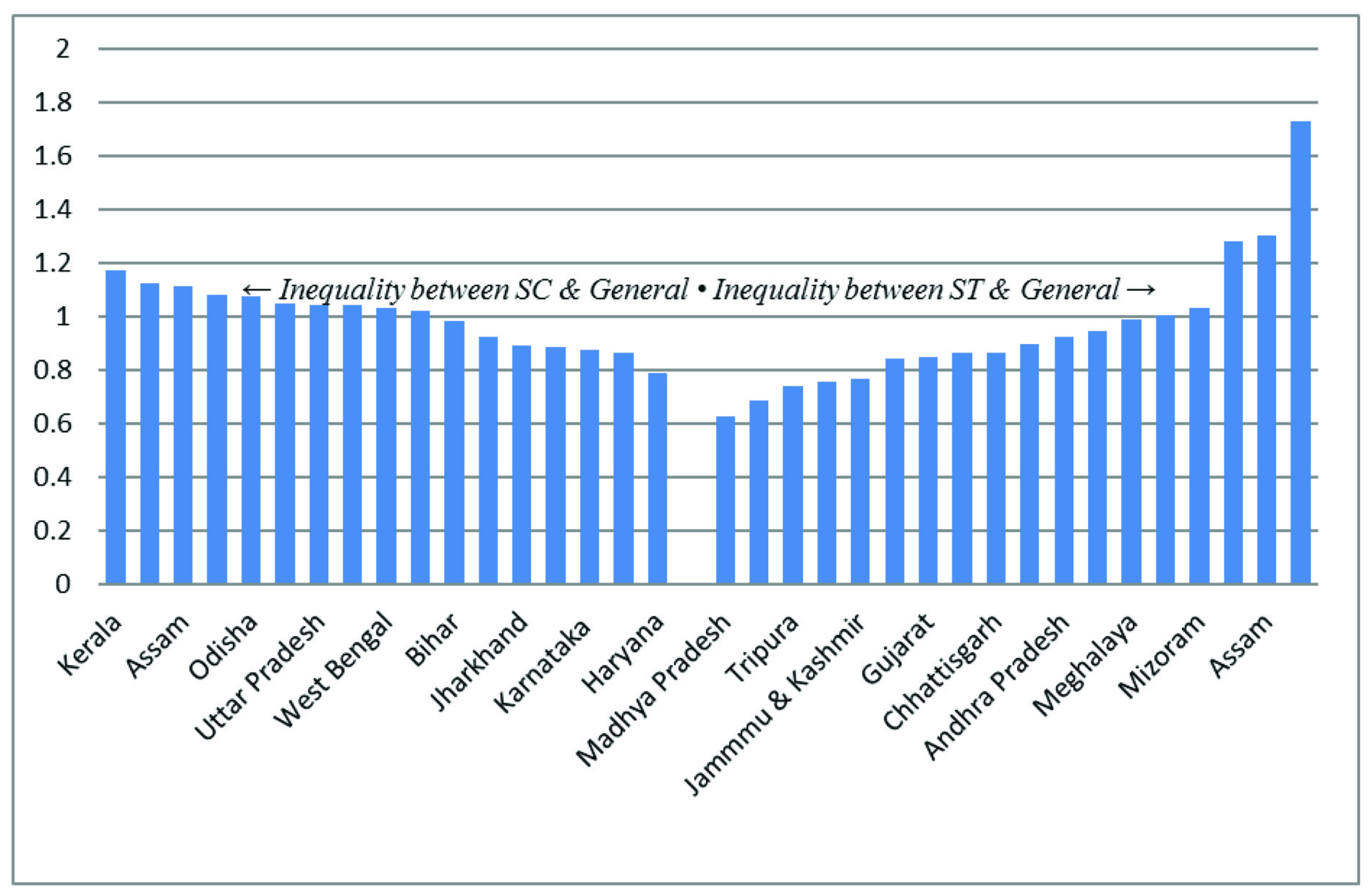
It is generally observed that children from different social backgrounds have uneven educational participation and attainments. Further, socially deprived groups remain excluded as they progress towards higher levels of learning. This is essentially because the income, parental education or occupational status of families play contrasting roles for different social classes. Abundant research has contributed to explaining these linkages and the effects of social inequalities in the access and achievement patterns in education. The data outlined will further our objective to identify how well students from socially disadvantaged groups are succeeding in their learning given the element of social inequality. We have focussed on inequalities in access, attainment and outcomes, such as school attendance rates, dropout rates, enrolment rates and literacy rates. By using government statistics on the learning and educational outcomes across major social groups for several states of India we have examined whether social inequalities are entrenched in educational inequalities (see Government of India, 2016a, 2016b; International Institute of Population Sciences, 2017). The inequality for a particular group, namely the Scheduled Castes (SC) or Scheduled Tribes (ST) is interpreted as relative to the general (or non-SC–ST) population. Our sample constitutes 17 and 18 states for the SC and ST categories, respectively, and covers more than 95 per cent of the SC and ST population in the country. The respective state’s positions in Table 1 and Table2 and Figure 1 and Figure2 are ranked. The results suggest that circumstances of social inequality affecting education and learning outcomes remain authentic in certain states, and disadvantages are faced in aspects of enrolment, attendance and completion rates.
Inequality in School Attendance Rate (6–17) Years
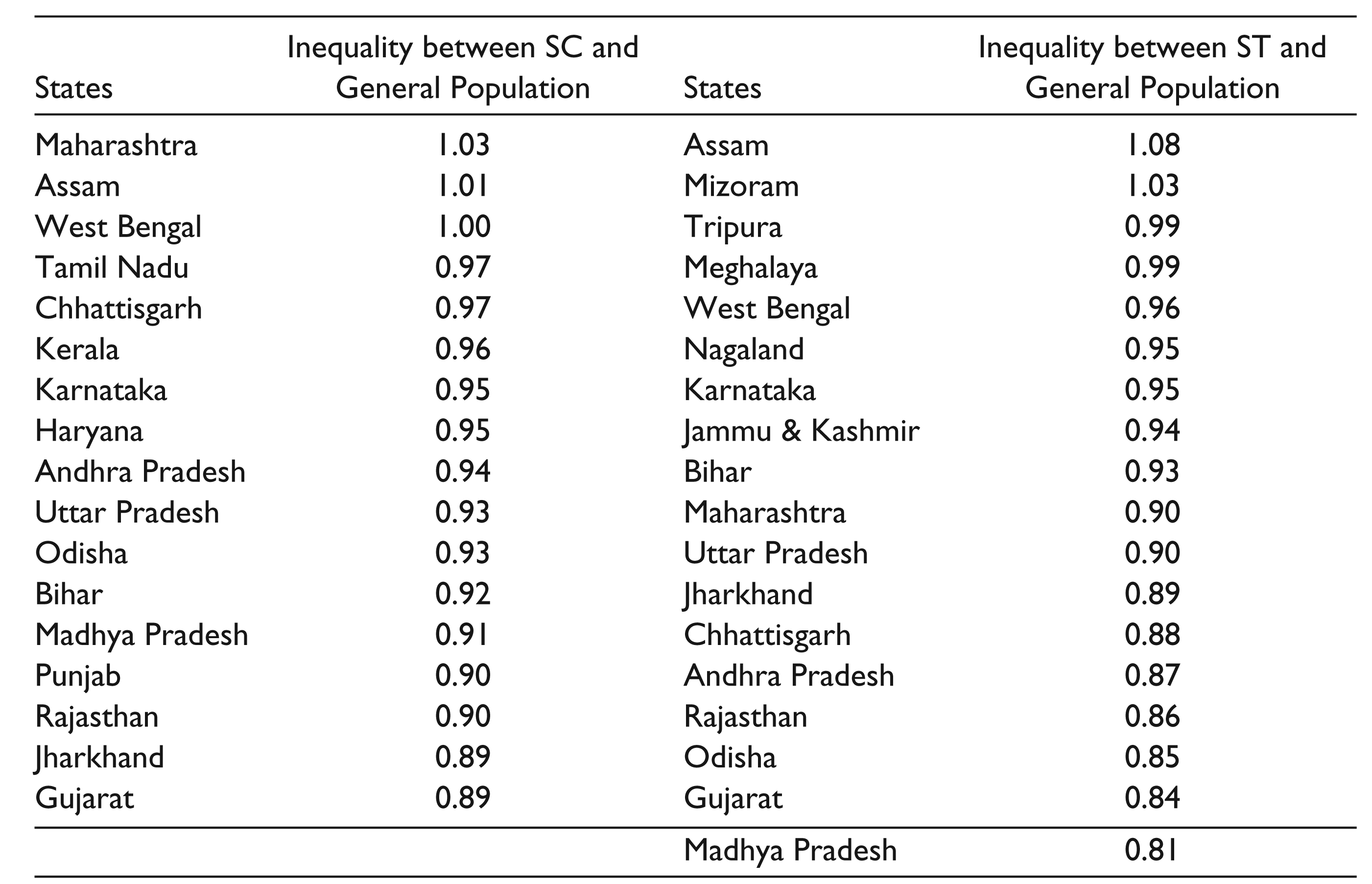
Inequality in the Secondary School Drop-Out Rate