




Abstract
The paper highlights key challenges facing the Government of India’s welcome initiative of Universalisation of Secondary Education. The challenges identified are in five areas: political will and social commitment, policy design and implementation, quality, inequality and governance. Five broad questions are raised for deliberation and debate. First, how adequate is the level of political will and social commitment to universalise secondary education? Second, how realistic and implementable are this designs of the recent initiatives announced by the Government of India? Third, are the planned measures to improve the quality of education adequate to produce the desired outcomes? Fourth, are the recommended interventions to reduce inequality likely to produce equitable outcomes by 2020? And finally, are the measures planned by the initiatives to improve governance sufficient and appropriate?
I am deeply honoured by the invitation of the Council for Social Development to deliver the inaugural address of the national seminar on universalisation of secondary education. I must confess that I was surprised by the invitation because I do not consider myself to be an expert on the topic of secondary education. Nor am I that knowledgeable about what is happening in India, especially the recent initiatives in the education sector. But I have in the past faced similar situations when people, more knowledgeable in a field, have requested me to speak on a topic where I have no technical expertise. I guess experts sometimes want to hear what questions and concerns a non-expert may have based on common sense and perspectives of a concerned citizen. So I seek your indulgence as I raise some questions with you for consideration and deliberation in the seminar.
My perspective is shaped by my own experiences in Bangladesh where we face many challenges similar to those of India. In some areas, we have undertaken innovative initiatives which have addressed specific obstacles and yielded positive results, such as the introduction of stipends for girls which resulted in the rapid expansion of girls’ enrolment in secondary schools. The enrolment of girls increased from 442,000 in 1994 to over one million by 2001 (Bhatnagar, Dewan, Torres, & Kanungo, n.d.). As a result, Bangladesh achieved gender parity in enrolment in secondary schools. In fact, there are now more girls than boys enrolled in secondary schools. The ratio of girls to boys changed from approximately 45:55 in 1994 to 55:45 in 2001 (Bhatnagar et al., n.d.).
But expanding school enrolment with quality education remains a big challenge for us, as is the case in India. We too have seen the gradual development of disparity between public schools delivering poor quality education to children from low-income households and private schools providing better quality education to children from upper-income households. We also have the divide between vernacular-medium schools and English-medium schools which are now attracting students not simply from upper-middle-income households but from middle-and lower-income households. We have the added challenge of the rapid expansion of madrasa education where children from extremely poor households go because they can get free room and board. We face similar challenges of governance—lack of monitoring and accountability. Absenteeism of teachers, despite increase in salary, is a persistent problem. Professional bodies such as teachers’ associations are preoccupied with demands for increasing teachers’ salaries and do not pay much attention to issues concerning the improvement of quality of education.
However, despite our past experiences of being disappointed with the inadequacies of public policy responses, we still look forward to policies and actions from the state to address the myriad problems we face in the education sector. After all in a democracy such as India and Bangladesh, citizens should be able to reasonably expect that public policies and actions will be geared towards improving the quality of education for the majority of the electorate. So some of the recent initiatives of the Government of India such as the Right to Education Act, Rashtriya Madhyamik Shiksha Abhiyan (RMSA), the integration of the Sarva Shiksha Abhiyan (SSA) with RMSA and Teacher Training, and the Integrated Scheme for School Education are very welcome news indeed. I look forward to learning more about the efficacy of these initiatives from your deliberations.
After India passed the Right to Education Act in 2009, the Centre for Policy Dialogue organised a seminar in Bangladesh and invited some Indian experts, including Professor R. Govinda, in order to create an opportunity for them to share Indian experiences with Bangladeshi experts and our own minister of education in the hope that we can learn some lessons from India. In that spirit, I am participating in this seminar in Delhi today and hope to carry back some lessons about what to do and what not to do in Bangladesh.
When I read the concept note of the seminar and looked at the programme of various sessions, several very broad questions came to my mind. I would like to share them with you and I hope very much that you will find some time to address these questions in the seminar.
Political Will and Social Commitment
My first question is: How adequate is the level of political will and social commitment in India to universalise secondary education? In Bangladesh, I often feel frustrated when we end a seminar with a statement that policy X or action Y could not be implemented because of the lack of political will and social commitment. Political will often becomes a catch-all phrase to shift responsibility or explain away all deficits. If political will and social commitment are the critical ingredients for the success of any public policy or public action, then should we not first assess what is the level of our political will and social commitment before we embark on any public policy or programme initiative? If we think the level of political will and social commitment is inadequate, then can we not devise some strategies to create that additional level of political will and social commitment?
I raise this question of political will and social commitment because in an excellent paper Professor J.B. Tilak has written on the experiences of East Asia titled, Building Human Capital in East Asia: What Others Can Learn; a key lesson he highlights is the importance of political will and social commitment. He states the following:
…political will and social commitment to education is one particular feature that explains the growth of the education system in East Asian economies …In every country…education was an item of national obsession; it is regarded as the most important means of achieving social status, occupational mobility and economic advancement ––individually and as a society. …Investment in human capital has been regarded as the cornerstone of nation building and the key factor of economic development in East Asia. This realisation is critically important. (Tilak, 2002)
I hope in this seminar you will be able to ponder on this lesson drawn by Professor Tilak and ask has education now finally become a ‘national obsession’ in India more than 70 years after Independence? Do the national and state governments regard investment in human capital as the ‘cornerstone’ of nation building and economic development? If the answers to both questions are ‘yes’, then of course this seminar does not need to spend much time deliberating on them. But if the answers are ‘no’ or ‘not yet’, then we need to think how can we make education a ‘national obsession’ and a ‘cornerstone’ of our development policies.
Policy Design and Implementation
My second question for the deliberation of this seminar is: How realistic and implementable are the designs of these recent initiatives announced by the government of India?
I often read policy and programme documents which are full of good intentions but their targets and timeframe are unrealistic; they lack specific instruments to address specific constraints and insufficient resources are allocated to achieve the policy and programme objectives. Our persistent record of gaps between policy design and policy implementation creates serious credibility and trust gaps between government and citizens. But these credibility and trust deficits appear not to be taken seriously by our policymakers. Our policies and programmes are rarely scrutinised from the perspective of feasibility of their implementation. Often policy implementers, mostly bureaucrats, go along with unrealistic and ambitious policies and programmes because they know that policymakers are more concerned with policy pronouncements rather than policy implementation.
In Bangladesh, we have often noticed wide gaps between policy and programme adoption and their implementation. Sometimes a much-heralded policy or initiative of one government gets neglected when there is a change in government. Sometimes ministries fail to spend allocated resources because of the slow rate of implementation. For example, a recent budget analysis found that 13 per cent of the allocated budget of the education sector and 40 per cent of budget of the health sector were not spent though these sectors were allocated only a small portion of the annual budget (approximately 5 per cent) (CPD, 2018).
I note from the concept note of the seminar that the objectives of India’s new Integrated Scheme for School Education are ‘to improve school effectiveness measured in terms of equal opportunities for schooling and equitable learning outcomes’ and raise ‘allocative efficiency and optimal utilization of budgetary and human resources’. Providing equal opportunities and attaining equitable outcomes are challenging enough objectives! Combining them with ‘allocative efficiency’ and ‘optimal utilization of resources’ make the achievement of all these goals even more challenging. The goals of achieving equality and efficiency may not always go together as efficiency is often interpreted as cost-cutting. When policy implementers are given the tasks of ensuring both equality and efficiency, they may not be able to deliver on either of them.
A report highlighting some challenges of universalisation of secondary education in India notes that most states will not succeed in achieving the targetted secondary-level gross enrolment ratios by 2017 and they will find it difficult to do so even by 2020 (UNESCO, 2016 April 21). The report further notes that with the current level of financing and availability of trained teachers and facilities, expanding opportunities for groups and areas that are so far left behind to meet the stated targets will be a near-impossible task for many states (UNESCO, 2016, April 21). I hope the seminar will find time to deliberate on the prospects of realising some of the goals and targets of these initiatives.
We need to also discuss the problems associated with setting up quantitative targets. The Millennium Development Goals (MDGs) with their quantitative targets pushed countries to focus on increasing the number of student enrolment rather than the quality of their education. Increasing the number of students is important but we should not lose sight of what they are learning. The MDGs and the current Sustainable Development Goal (SDG)-4, which is quality education, have not succeeded in developing satisfactory indicators to measure improvements in quality and this remains a singular challenge for tracking the progress of SDG-4.
Quality
My third question is: Are the planned measures to improve the quality of education adequate to produce the desired outcomes? The planned measures include many interventions, such as, the provisioning of infrastructure, appointment of additional teachers, in-service training of teachers, review of curriculum, residential accommodation for teachers. But are there sufficient resources, financial and human, to implement these measures? For example, if we are to take the feasibility of one intervention, such as the appointment of teachers and training of teachers, will it be feasible to appoint adequately trained teachers to impart quality education within the time frame of 2020, particularly in underperforming states?
In their recent study, An Uncertain Glory: India and Its Contradictions, Jean Dreze and Amartya Sen highlight the huge burdens created by poor standards particularly in government schools. They note that of the children aged 8–11 years enrolled in government schools, only 50 per cent can read, 43 per cent can subtract and 64 per cent can write (Dreze & Sen, 2013). The adverse teacher–student ratio, particularly in government schools, again, is a huge problem.
In Bangladesh, too, students demonstrate poor capability in reading, writing and mathematics. We are faced with not only a shortage of teachers but a shortage of teachers who will be able to improve the quality of education. A recent survey found that 78 per cent of heads of institutions were not aware of either the strength or the weakness of their curriculum; 35 per cent of teachers reported receiving no training to improve the quality of their teaching; and 30 per cent of students felt that their teachers were not knowledgeable (Campaign for Popular Education [CAMPE], 2007). About a half of the schools had no science laboratory; only 15 per cent had a library with a modest collection and 37 per cent of schools claimed to have computer education facilities but a fifth of these schools had only one computer (CAMPE, 2005). In public sector schools, the teacher -student ratio in computer education is 4,207 as compared to 755 in private sector schools (CAMPE, 2015).
I hope, the seminar will come up with a few innovative ideas to add value to the measures already being planned to improve the quality of education. Moving forward, we need to change teaching methods and teaching materials to make our education competitive in the global market. The low scores of India in the PISA ranking, compared to the consistent top ranking of East and Southeast Asian countries, should be a matter of great concern for policymakers. We need to also pay attention to the contents of curriculum. Sometimes efforts are made to change school curriculum, as has happened recently in Bangladesh, to downgrade the importance of diversity in our cultural tradition. We need to be vigilant against such efforts, particularly at a time when globally and in our region a conscious political campaign is being mounted to portray the ‘other’ as the enemy.
Inequality
My fourth question is: Are the recommended interventions to reduce inequality likely to produce equitable outcomes by 2020? Do these measures adequately address some of the sources of inequality, such as the exclusion of marginalised groups and the growing divide between public and private sector and vernacular-medium and English-medium schools? In South Asia, we have produced and nurtured a dual system of education—one for the rich and another for the poor. Will inclusion of excluded groups be accommodated within the existing dual system with ever-increasing disparity between English-medium private sector schools on the one hand and public sector vernacular-medium schools on the other hand?
The recommended measures for inclusion appear to be geared towards increasing coverage of excluded groups such as students coming from rural areas and urban slums, Scheduled Tribes and Scheduled Castes and girls. Will the expansion of existing facilities, building of new schools, free boarding facilities, cash incentives and so on be adequate to address the myriad of economic and social obstacles that hold back the children from these groups from attending schools?
In Bangladesh, as I noted earlier, we introduced a special cash incentive of providing scholarships for girl students for secondary education. This not only contributed towards a fast increase in girls’ school enrolment, but there were other collateral benefits such as the reduction in the number of young women marrying before 18 years of age. For example, the overall proportion of 13-15-year-old married girls declined from 20 per cent in 1992 to 14 per cent by 1995 (Bhatnagar et al, n.d.). But we have also noticed that cash incentives often were not enough to counter the parents’ concerns of safety and security for girls in an environment of fear of sexual harassment and violence against girls.
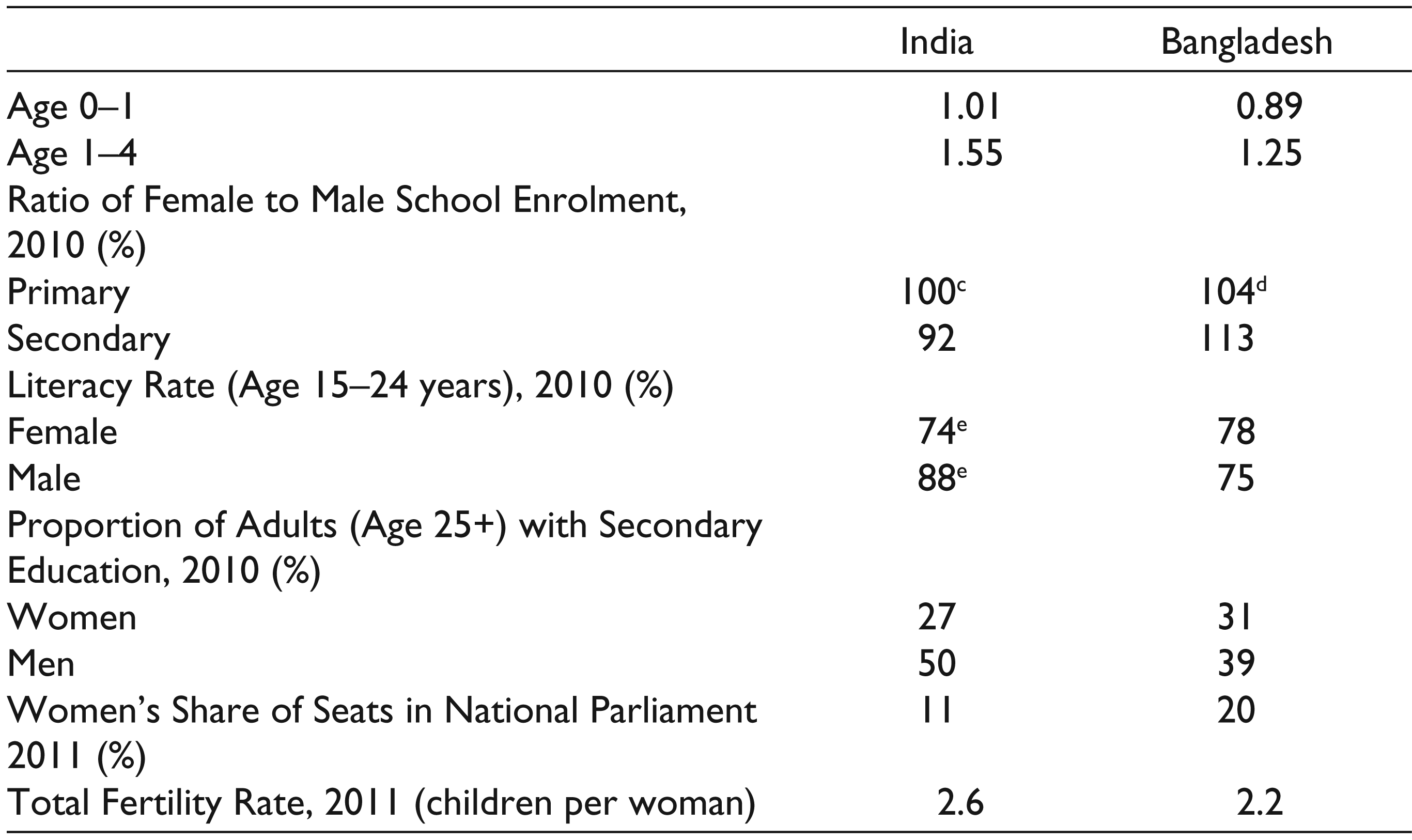
If we are to ensure equitable outcomes for girls’ secondary education, then we need to think of multipronged measures to improve girls’ and women’s condition and status and community and society’s support for enhancing women’s empowerment. I have annexed a table comparing gender-related indicators in India and Bangladesh which is taken from Dreze’s and Sen’s book, Uncertain Glory. The table shows Bangladesh doing better than India in all indicators including literacy, school enrolment and labour force participation. Female literacy rate is 78 per cent in Bangladesh as compared to 74 per cent in India, secondary school enrolment ratio for girls is 113 in Bangladesh compared to 92 in India, and labour force participation rate is 57 per cent in Bangladesh compared to 29 per cent in India. These improvements in Bangladesh have been made possible by consistent and conscious policies and actions pursued by government as well as the non-government sector over the last four decades.
I believe if we are serious about addressing the issue of inequality and inequity, then we have no alternative but to improve the standards of government and vernacular-medium schools so that children from upper-income households do not flee from these schools and flock to private English-medium schools. The growth of the dual system of education has consolidated a widening social gap between a narrow privileged elite and the large excluded masses. This inequality has expanded over the last half a century. In Bangladesh, we have now reached a situation where many people have given up efforts to improve the quality of public sector and believe that the public sector is beyond repair!
But this divide between vernacular and English-medium and public and private sector schools was not there when I went to school and university in the 1950s and early 1960s. Most of us studied in Bangla medium government or private schools in muffasil towns (small towns). I did not have that many postgraduate teachers in my schools but I received sound basic training in reading, writing and mathematics from highly motivated teachers which enabled me to make the transition to an English-medium college and university after matriculation, and ultimately earn a PhD from Harvard University. I think it will be much more difficult and unusual for a student trained in Bangla medium mufassil schools these days to make this kind of transition to an elite university in the USA. I believe many of my age groups in India also were able to go through a similar transition from vernacular-medium schools in small towns to top universities in India and even in the USA or UK.
Even if we think that given the ground realities, inequality has to be bridged by provisioning of a public–private sector mix, we still have to improve the standards of the public sector where the majority of our students are enrolled. I hope the seminar will come up with many different options involving both public and private sector. One recommendation of the Right to Education Act which drew our attention in Bangladesh was the reserved quota for underprivileged children in elite private schools. It will be interesting to know how far this measure has been implemented.
Another issue I would like to draw your attention to, which is not generally discussed in seminars, is the availability and quality of translation. When I was in school, I could read excellent Bangla translation of world literature including those of Shakespeare, Tolstoy, Dostoevsky, Chekov, Maxim Gorky, Eric Maria Remarque and so on. In fact, I enjoyed reading the Bangla translation of Arthur Conan Doyle’s Lost World when I was in school much more than the original English edition which I read later when I was in college. I was exposed to books published in the West mainly through Bangla translations. These days I do not find good quality Bangla translation of books published in other countries. This has narrowed the horizon of Bangla medium students. Internet, with all its limitations, is their only window on the world.
Here, I would like to particularly acknowledge my deep appreciation for Professor Muchkund Dubey’s recent translation of Fakir Lalon Shah’s poems and songs from Bangla to Hindi. He has added a new dimension to translation. I feel translation from Bangla into Hindi, rather than just English, has widened the readership of Lalon and created an opportunity for a much larger Hindi reading public to understand and appreciate the rich syncretic cultural legacy of Bangladesh which had traditionally focussed on mystical and devotional aspects of religion. I believe many more such translations from one vernacular language to another will help foster greater appreciation and understanding between different regions of South Asia.
Governance
My fifth question, again, is: Are the measures planned by the initiatives to improve governance sufficient and appropriate? In their book, Dreze and Sen highlight several governance challenges including those of management, accountability and the role of professional organisations. They highlight the problem of absenteeism of teachers as an example of governance failure. They have calculated that with 20 per cent absenteeism of teachers and 33 per cent absenteeism of students, in effect the probability of any effective teaching in a school in any day is 50 per cent (Dreze & Sen, 2013, p. 120). They further note that despite improvement in salary, absenteeism of teachers has continued which underscore lack of monitoring and accountability. They point out the narrow focus of teachers’ associations which mainly demand improving the conditions of teachers rather than the condition of the education sector as a whole.
In Bangladesh, too, we face similar problems of student and teacher absenteeism. Absenteeism of head teachers is 20 per cent in primary schools and 18 per cent in secondary schools. Over the years, teachers’ salaries, though still inadequate, have improved, but this has not contributed towards a reduction in absenteeism. Again, I do not remember teachers being absent when I was in school though those teachers were also poorly paid. Moreover, nearly 40 per cent of teachers are involved in private tutoring (Campaign for Popular Education, 2015, p. 17). Teachers’ associations are politicised and political parties use them to expand their vote base. Before every national election, teachers’ associations start agitations to increase their salaries. Members of Parliament have expanded their holds on school boards and use them as a patronage resource.
Governance reforms are critical to improving quality and reducing inequality. But these reforms are not feasible without a strong political will and social commitment, the very first question I started with in my address. I hope the deliberations of this seminar will be widely disseminated to academics, policymakers, political leaders, civil society activists and the media and you will continue your engagement in pushing for governance reforms, improvement of standards and reduction of inequalities in the education sector. I look forward to future opportunities for sharing our experiences and learning from each other.
Declaration of Conflicting Interests
The author declared no potential conflicts of interest with respect to the research, authorship and/or publication of this article.
Funding
The author received no financial support for the research, authorship and/or publication of this article.
Footnotes
Appendix
Gender-related Indicators in India and Bangladesh
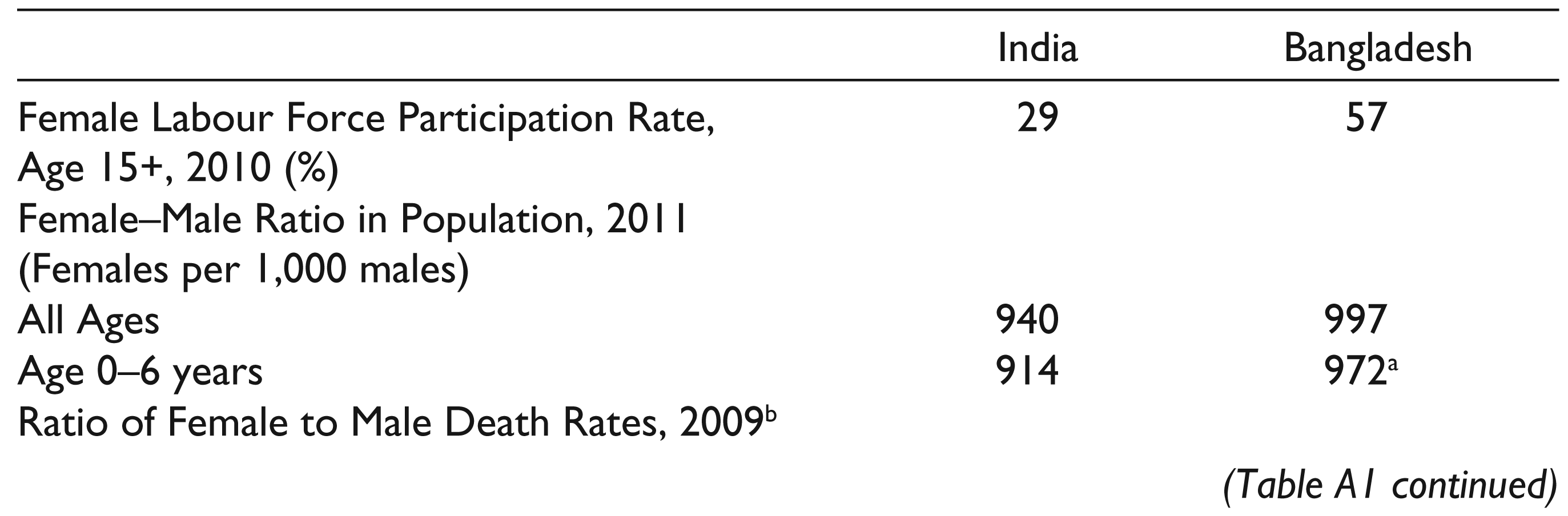
| India | Bangladesh | |
| Female Labour Force Participation Rate, Age 15+, 2010 (%) | 29 | 57 |
| Female–Male Ratio in Population, 2011 (Females per 1,000 males) | ||
| All Ages | 940 | 997 |
| Age 0–6 years | 914 | 972a |
| Ratio of Female to Male Death Rates, 2009b | ||
| Age 0–1 | 1.01 | 0.89 |
| Age 1–4 | 1.55 | 1.25 |
| Ratio of Female to Male School Enrolment, 2010 (%) | ||
| Primary | 100c | 104d |
| Secondary | 92 | 113 |
| Literacy Rate (Age 15–24 years), 2010 (%) | ||
| Female | 74e | 78 |
| Male | 88e | 75 |
| Proportion of Adults (Age 25+) with Secondary Education, 2010 (%) | ||
| Women | 27 | 31 |
| Men | 50 | 39 |
| Women’s Share of Seats in National Parliament 2011 (%) | 11 | 20 |
| Total Fertility Rate, 2011 (children per woman) | 2.6 | 2.2 |