




Abstract
The Indian state has ratified preferential policies enshrined in the Indian Constitution by ensuring a reserved quota for geographically isolated and underprivileged communities such as adivasis, thereby attempting to integrate them within mainstream society. Computing the data available on the impact of a preferential policy on the adivasis of Odisha, this article argues that although the policy has been relatively useful in securing employment, adivasis of the state remain underrepresented in aggregate numbers and in different groups of services. The article also indicates the existence of a regional disparity even among the adivasis of Odisha with regard to their representation in elite government employment. The real problem is not the preferential policy per se but its poor implementation, abject poverty, bureaucratic apathy and the lack of political will to implement preferential policies effectively. In fact, the practice of preferential policies has sporadically led to violent community conflicts in Odisha and impacted the changing relationship between policy and politics.
Introduction
Preferential policies have been debated and deliberated by planners, policymakers and academicians for decades. The persistent nature of the debate over preferential policies is an indication of the policy’s significant implications. Hasan (2006) argues that in a system of formal equality and open competition, members of previously victimised groups, who have been already burdened by accumulated disabilities and disadvantages, will not be able to compete, and will, in fact, fall further behind if preferential policies are not encouraged. Jayal (2006) contends that due to their histories of deprivation and marginalisation, adivasis (Scheduled Tribes [STs], indigenous people) 1 require preferential consideration to gain access to education and public employment. Mahajan (1998) emphasises that preferential policies would enable adivasis to lead a reasonably dignified life with some protection against conditions that render them destitute and vulnerable to exploitation. Jaffrelot (2006) contends that the policy of preference has a disproportionate impact, which is evident more in politics and less in socio-economic spheres. The unfavourable position of adivasis requires a certain extent of sympathy and understanding to facilitate appropriate policies and their implementation so that they feel protected in different spheres (Heredia, 2012).
Higham and Shah (2013, p. 81) discuss the ramification of preferential policies for adivasis in India in forms of indirect inclusion, positive action and positive discrimination. Under indirect inclusion, adivasis derive most benefits from mainstream policy without being explicitly differentially treated, and this has been demonstrated in the case of universalising primary education especially in the 1990s. Positive action encourages adivasis without at the same time depriving and marginalising other groups and has been reflected in the implementation of capacity building programmes, fee relaxation, distribution of free uniforms, meals, books and so on. The positive discrimination policy of the state provides reservation through quota to adivasis for their adequate representation in politics, government employment and education.
Although much has been written on the impact of preferential policies on dalits, little attempt has been made to examine the impact of preferential policies on adivasis. There is scant empirical understanding about which positions are occupied by adivasis, and to what extent. Using detailed empirical evidence at the micro level, Xaxa (2002) investigates the implementation of preferential policies in the University of Delhi and its affiliated undergraduate colleges. In other writings, he provides a comparative analysis of the relative effect of job preference on dalits and adivasis (Xaxa, 2008, pp. 87–100). This article offers a descriptive account of preferential policies, focussing on statistics regarding the employment of adivasis in the public sector under policy-based quotas in Odisha.
First, the article focusses briefly on the status of adivasis in Odisha. Second, it details the genesis of preferential policy in Odisha and different provisions offered under it. Third, it looks at the implementation of this policy and the representation of adivasis in government jobs. Fourth, it examines the various reasons responsible for the limitations of this policy. Fifth, it examines the recursive relationship between preferential policies and politics in the context of spiral occurrences of conflicts in Odisha, ending finally with a conclusion.
Status of Adivasis in Odisha
According to the 2011 Census, adivasis constitute 22.85 per cent of the population in Odisha. The state has the third highest concentration of adivasis only after Madhya Pradesh and Maharashtra drawn from 62 communities, making this the largest number in the country. Adivasis living in the state hail from small communities such as, the Chenchu, Banda, Juanga and Didayi to larger groups, such as the Munda, Santhals, Kandha, Oraon, Saura and Bhuiyan. Out of 62 communities, the Government of India (GOI) has identified 13 adivasi communities as particularly vulnerable tribal groups (PVTGs). They are namely Birhor, Bonda, Didayi, Dongria Kondh, Juang, Kharia, Kutia Kondh, Langia Saora, Lodha, Mankirdia, Paudi Bhuiyan, Saura and Chutia Bhunja. They live in Sambalpur, Koraput, Malkangiri, Keonjhar, Sundergarh and Mayurbhanj districts. Over the years, these communities have attained various stages of socio-economic and political development. But a low level of literacy, a declining or stagnant population, a pre-agricultural level of technology, economic backwardness, and so on remain the defining features of the PVTGs.
Das and Pradhan (2002, p. 41) have classified the adivasis of Odisha into the Austro-Asiatic or Munda group, Dravidian group and Indo-Aryan group. Exploring economic practices, Behura (2002, p. 63) has classified adivasis of Odisha into hunting-gatherering nomads living in hilly and forest areas, hunter-gatherer shifting cultivators, simple artisans, shifting cultivators, settled agriculturists, and industrial and urban unskilled and semi-skilled workers.
The core of the adivasi population in the state is concentrated in the region’s south-west belt comprising the district of Koraput, and the north-west belt consisting of Mayurbhanj and Sundargarh districts in the north of Odisha. According to the 2011 Census, the adivasis of Odisha have attained a 52.24 per cent literacy rate. The poverty ratio among adivasis of Odisha has been 75.6 and 63.5 per cent in 2005–2006 and 2010–2011, respectively. During 2004–2005, the adivasis of south Odisha experienced a poverty ratio of 82.8 per cent (Ambagudia, 2019, p. 199).
Preferential Policy in Odisha
In India, a preferential policy has become some kind of a competitive tool among communities striving for equality (Corbridge, 2000; Galanter, 1984), placing various kinds of demand and pressures. 2 Although the legislative protection of dalits began in 1943, the same was not extended to adivasis until the post-colonial period (Corbridge, 2000, p. 62, footnote 1). India introduced 5 per cent quota for adivasis in September 1950 for the first time. It was subsequently raised to 7.5 per cent in March 1970 on the basis of their proportion to the total population and continues to remain the same even though their numerical strength has increased.
The Government of Odisha adopted preferential considerations in the initial recruitment of posts and services for dalits and adivasis in 1953. The impact of preferential policy on dalits lies largely outside the scope of the present inquiry, and the article is confined only to adivasis. The initial practice of preference for adivasis in Odisha did not emerge as a policy framework instead it appeared in the form of issuing executive instructions, orders and government resolutions. The state government took a number of initiatives to ensure the adequate representation of adivasis in public services. During 1965–1966, it set up the District Employment Committee in all districts to review the progress of adivasis in government services on a quarterly basis and to explore various possible employment opportunities. During 1970–1971, it constituted a Standing Committee to study the employment status of adivasis in government services and other public sector undertakings (Srichandan, 1993, p. 224). Odisha also set up the Tribes (Adivasi) Advisory Council (TAC)3 in 1950. The TAC, in its 3 September 1974 meeting, recommended adequate legal and administrative provisions to reserve seats for adivasis for employment in the state government.
Consequently, the state’s Tribal and Rural Welfare Department framed draft rules concerning reservation for Scheduled communities, resulting in the enactment of a preferential policy called the Orissa Reservation of Vacancies in Posts and Services (for Scheduled Caste and Scheduled Tribe) Act, 1975. 4 However, Odisha adopted legislative measure much later than other states. 5 The main objective of the Act is to provide reservation in initial appointments and facilitate promotion up to lower rungs of group A services. This Act is adopted in consonance with the constitutional and social obligations embodied in Articles 16 (4), 46 and 335 of the Indian Constitution. This Act came into force on 1 July 1976, granting an overriding effect on all executive instructions, orders and government resolutions issued in this regard (Section 19). The Act has been amended in 1982 and 1994 to make the scope of provisions more comprehensive for adivasis and dalits at the time of initial recruitment and promotion (Government of Odisha, 2014a, p. 30).
The quantum of preference through reservation for adivasis has been determined by their percentage to the total population of the state in the last census and, accordingly, the quota has been fixed at 22.5 per cent (Government of Odisha, 2014b, p. 37). The scope of the Act is extended to all appointments to various posts and services under the state government, legislative and all local authorities functioning within the state and under the control of the state government. The representation of adivasis in direct recruitment is based on their proportionality, and promotional appointments will be equal to the percentage of adivasis in the lower grade from which promotion is to be made. The original Act emphasised that in the case of non-availability of suitable candidates, the post would be further re-advertised separately and posts would be filled with dalit candidates. The amended law on reservation, however, stipulates that there will be no exchange of vacant seats between adivasis and dalits and seats shall be filled by the respective communities only. In the case of non-availability of suitable adivasi candidates, even after issuing a separate advertisement, such vacancies shall be de-reserved by following the ‘carry forward rule’ laid down by the GoI. 6 The enshrined provisions under sections 12(A) and 13A(1) of the Act punish appointing authorities on the grounds of transgressing the Act. Accordingly, the prosecution is filed against one appointing authority under section 13A(1), and the matter is under sub judice (Government of Odisha, 2014b, p. 38). The provisions of the Act unambiguously indicate a more significant concern for the adequate representation of adivasis in public services in Odisha.
Nevertheless, the extension of preferences in employment is not automatic for adivasis. It is based on a certain level of qualification and merit, thereby demanding additional measures to improve their chances. The most viable and dramatic attempt to improve chances of adivasi applicants has been the availability of free pre-employment coaching centres to prepare them for tests/interviews. As a result, coaching for competitive examinations for adivasis has been started by the Ministry of Tribal Affairs, GoI, in different parts of the country. In Odisha, coaching for the Indian civil service examinations has begun at Ravenshaw and Utkal universities. The Ministry also provides financial assistance to several private coaching institutions/centres across the country for imparting free coaching to adivasi students. As a part of preferential policies, adivasis can avail of several relaxations with regard to age, fees, minimum eligibility criteria, experience and so on to fulfil prescribed quotas.
Similarly, the central government has also introduced identical facilities for adivasis irrespective of the states they belong to. So, preferential considerations help adivasis to enter the competition they would not have otherwise been eligible (Galanter, 1984). In some cases, it works as a means of capacity building through coaching. It is worthwhile mentioning that not all of these measures have been implemented in locations or indeed for all posts. For instance, coaching is primarily arranged for administrative, banking and clerical grade services to enable adivasi candidates to acquire a minimum standard required to compete in qualifying examinations (Government of Odisha, 2014a, p. 30). However, such coaching facilities are not extended to entrance tests of different universities, which have more formidable implications for their representation in public services. The confinement of capacity-building programmes to specific services can perhaps explain why we should not project adivasis as a homogenous category. The lack of such facilities in the specified sphere helps some adivasis to have an edge over their fellow members when it comes to addressing issues concerning occupying public services.
Preference in Practice: Government Employment and Adivasi Representation in Odisha
Different government services can be broadly categorised into A, B, C and D groups. Group A and B posts are scientific, technical, managerial and administrative; group C and D posts are typically clerical, office products and other miscellaneous non-managerial jobs. In 1976, as Table 1 demonstrates, the adivasis of Odisha had a representation of 1.1, 1.2, 22.3 and 7.7 per cent in group A, B, C and D services, respectively. In 1977, their representation was 0.41, 0.51, 6.15 and 8.12 per cent in group A, B, C and D services, respectively. The 28th report of (GOI, 1987) indicated that as on 1 January 1986, their share was 0.88, 1.56, 5.62 and 12.02 per cent in group A, B, C and D services, respectively. The participation rate of the adivasis in state government services, however, increased from 5.25 per cent in 1961 to 8.59 per cent in 1991 (Government of Orissa, 2001) probably due to preferential considerations.
Representation of STs in Public Services in Odisha (Percentage)
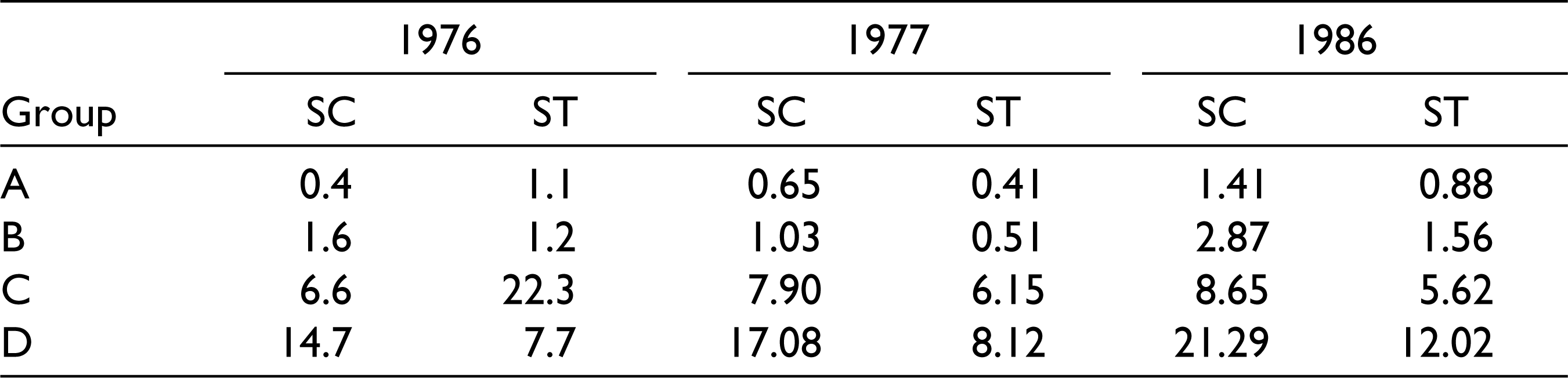
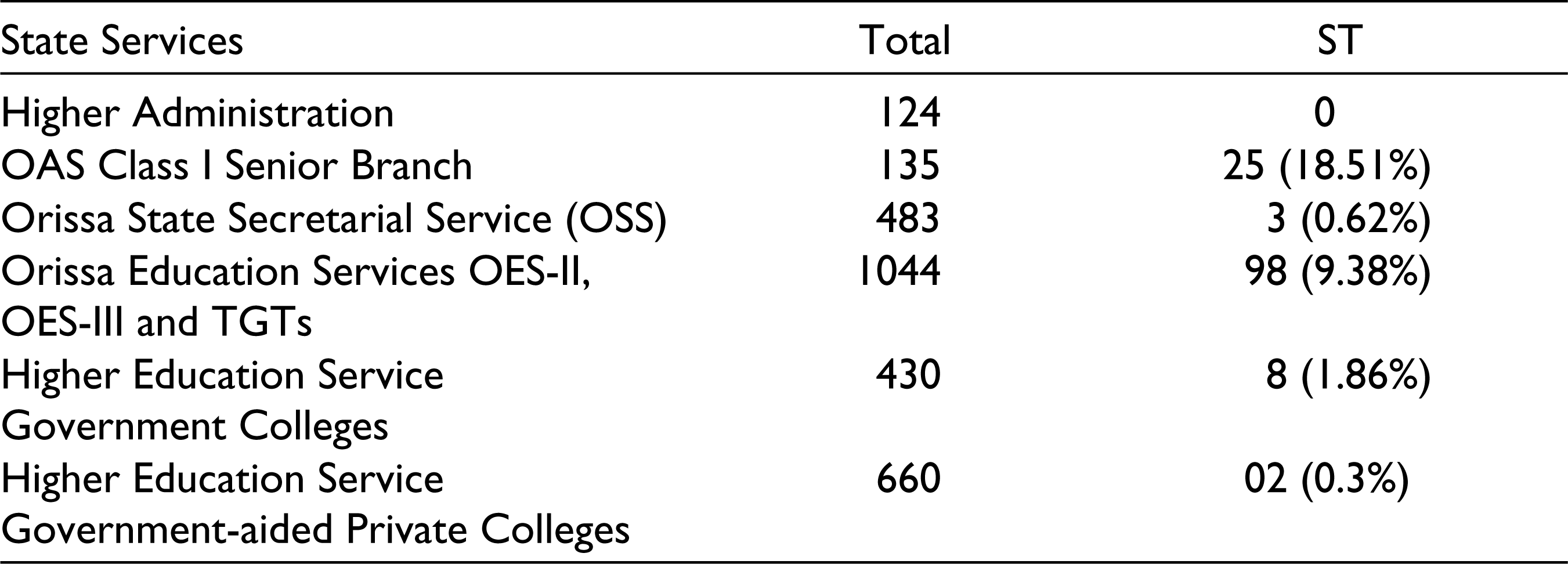
Table 2 shows that the adivasis in the Odisha Administrative Service (OAS) senior branch, Odisha State Secretarial Service, Odisha Education Service (OES II–III) and Trained Graduate Teachers (TGTs), higher education service (government colleges) and higher education service (government-aided private colleges), had a representation of 18.51, 0.62, 9.38, 1.86 and 0.3 per cent respectively. Thus, available data reflect the underrepresentation of adivasis in government employment in Odisha.
Share of STs in State Services (as on 1 January 2009)
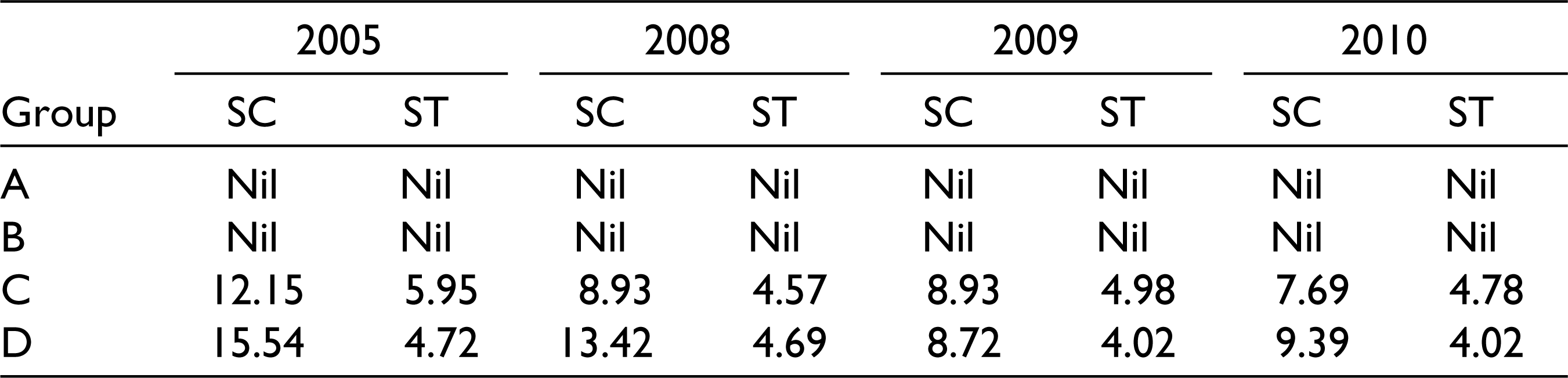
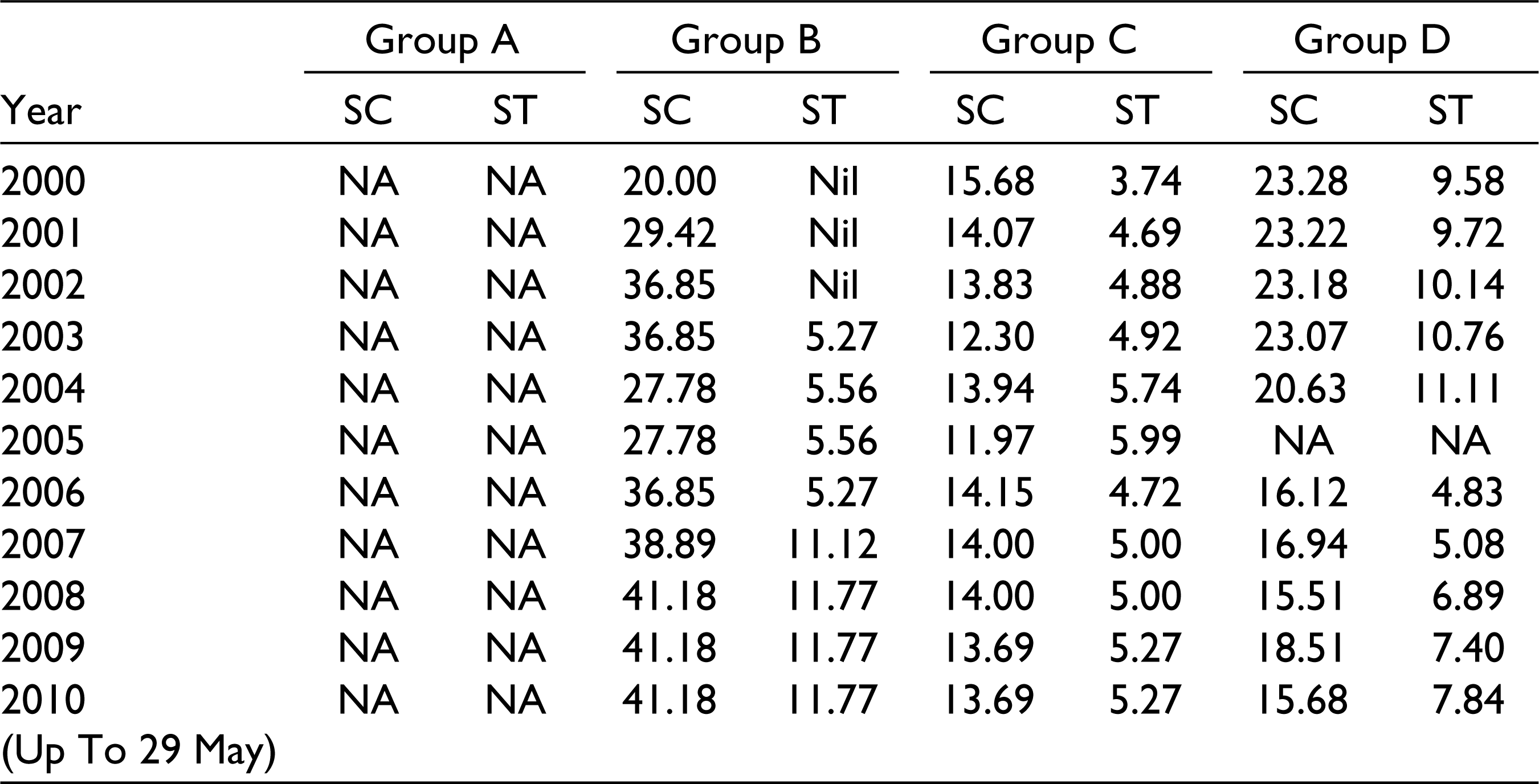
The segregated data also indicate a similar state of affairs in various departments. Table 3 demonstrates that adivasis had a representation of 5.55, 20.00, 7.38 and 10.75 per cent in group A, B, C and D posts in the Department of Agriculture in 2010–2011. Table 4 shows that there was no representation of adivasis in group A and B services in the Department of Text Book Production and Marketing. They, however, had a 4.78 and 4.02 per cent representation in group C and D services as on 1 January 2010. As of 29 May 2010, their representation was 11.77, 5.27 and 7.84 per cent in group B, C and D services in the office of the Registrar, Cooperative Societies, Bhubaneswar (Table 5).
Representation of SCs and STs in the Agricultural Department, GOO (Percentage)

Representation of SCs and STs in the Department of Text Book Production and Marketing as on 1 January (Percentage)
Representation of SCs and STs in the Office of the Registrar of Cooperative Societies, Bhubaneswar, Odisha (Percentage)
The aggregate data of three universities (North Orissa, Ravenshaw and Fakir Mohan) of Odisha demonstrate that the share of adivasis in group A, B, C and D services was of 4.57, 7.14, 9.45 and 9.09 per cent, respectively (Table 6). The data unambiguously indicate an abysmal low representation of adivasis in academic posts against their prescribed quota of 22.5 per cent.
Representation of SCs and STs in Universities of Odisha (Percentage)

2. *North Orissa University, Baripada, does not have the sanctioned group B post.
The comparative analysis of different categories of services shows that adivasis are relatively better represented in group D service, this is, however, mostly menial labour. It is apparent from the tables that seats which are somewhat filled up with a relatively large number of adivasis are the ones at the bottom end of the skilled spectrum. In all the cited departments, there is an underrepresentation of adivasis in Odisha.
The data sheet prepared by the Scheduled Castes (SC) and ST Research and Training Institute, Government of Odisha, shows that adivasis had represented only 1.94 (3 out of 154) in Indian Administrative Service (IAS), representing all three from Khurda (coastal) district. Their representation was 2.91 per cent (3 out of 103) in Indian Police Service (IPS), representing one each from Bargarh, Khurda and Koraput districts, as on 1 August 2000 (Government of Orissa, 2001). Although the break-up figures do not tally the total numbers, Government of Orissa (2008) indicates that, as on 1 October 2006, their representation was 2.38 (4 out of 168) and 3.06 per cent (3 out of 98) in the IAS and the IPS, respectively. As of 1 January 2009, their representation in the IAS was 3.55 per cent (6 out of 169) in Odisha (Bajaj, 2011, p. 36). It is, however, difficult to construct any concrete state-based argument on the basis of these elite government services because these are central government services, and the recruitment process is not state-centric rather it depends on all-India level competition.
The representation of adivasis in the IAS and IPS demonstrates that most of the beneficiaries are from districts located in coastal areas of Odisha. This is essentially because coastal regions were the centres of colonial activities and thereby endowed with various facilities and opportunities than inland areas of Odisha. The location of adivasis and non-adivasis in the coastal areas perhaps provided a head start to the first generation, having spillover effects over the next few generations. The adivasis inhabiting the coastal areas accessed opportunities and benefits offered by colonialism in and around its centre of activity. Such facilities have not only enabled adivasis to have an edge over others in Odisha but also equipped them to compete with the most developed adivasis of India such as the Meenas of Rajasthan and the Christian tribes of Northeast India. 7 The location of communities emerged as one of the essential reasons for the regional disparity in the representation of both adivasis and non-adivasis in professional and administrative functionaries in Odisha (Bailey, 1959, pp. 137–177; Mohanty, 2014, p. 41).
The Orissa/Odisha Public Service Commission (OPSC) recommended only 196 candidates (18.59 per cent) against 1,054 notified vacancies for adivasis for appointment to various posts/services during 2008–2009 (Government of Orissa, 2009a, p. 2). During 2011–2012, the OPSC received 11,006 applications against 769 advertised posts for adivasis. Out of 11,006 applicants, the OPSC called 170 candidates (22.10 per cent of the advertised post) for interviews and recommended 104 candidates (13.52 per cent of the advertised post) for appointment (Government of Odisha, 2012, pp. 34–39).
Similarly, the representation of adivasis in the judicial services is highly negligible. The report of the National Commission for SC and ST shows that there was not even a single judge from the adivasi community in the Odisha High Court by the end of February 1998 (GoI, 1998). Although the OPSC received 146 applications for 11 notified vacancies for adivasis for the post of civil judges in the Odisha judicial services during 2011–2012, none of them were called for interviews. There were shortfalls of twenty-two and four in the judicial services during 2011–2012 and 2013–2014, respectively (Government of Odisha, 2012, pp. 34–35; Government of Odisha, 2014c, p. 49).
The OPSC also conducts examinations related to various specialised subjects under lectureship, managerial, engineering and technical posts and the significant shortfalls in the recommendation of candidates are mainly from these areas. For instance, the OPSC advertised two jobs for the post of a lecturer in Samhita, Sidhant, and Drabyaguna but no applications were received from adivasis. It has also been noticed that the OPSC received fewer applications for the advertised posts for adivasis than the number that was advertised in some specialised posts such as assistant surgeon (Government of Odisha, 2012, p. 36; Government of Odisha, 2014c, p. 45). The OPSC, however, shows that against 22.5 per cent reservation, adivasis made up 34 per cent and 35 per cent of the total appointments made during 2011–2012 and 2013–2014, respectively (Government of Odisha, 2012, 2014c). The relatively higher representation of adivasis is attributed to the carry forward rule laid down by the GoI. Owing to the unavailability of data, it is tough to provide the adivasi/region specific data concerning the representation of adivasis in various government services in Odisha.
The above statistics indicate the underrepresentation of adivasis in all categories of posts. The representation in group A and B services is most deficient. Even in group C and D services, where the minimum standard specified is slightly on the lower side, the representation of adivasis is far from adequate. Adivasis, thus, are underrepresented both in respect of aggregate and the different group of services in Odisha. The adivasis in government employment are unevenly distributed with a relatively higher percentage in lower-ranking positions. Nevertheless, achieving employment equity in Odisha remains a pipe dream.
Limits of Preferential Policy
The above description demonstrates the poor representation of adivasis in government employment in Odisha. There is a persistent gap between preferential policies through reservation on the one hand and action and implementation on the other side. The non-availability of suitable candidates for such posts appeared as the reason for underrepresentation of adivasis (Government of Orissa, 2009a). The Parliamentary Committee on Welfare of SCs (dalits) and STs (adivasis), however, argues that,
… there is no dearth of qualified SC/ST candidates who are still jobless for want of opportunities. The main hindrance the Committee feels is the lack of zeal on the part of implementing authorities who are not able to give adequate publicity to such posts in SC/ST inhabited areas…. (Asian Indigenous and Tribal Peoples Network, 2009, p. 46)
If the non-availability of candidates is the reason, the number of adivasis on the live registers of employment exchanges in Odisha would not have risen the way they did. For instance, the share of adivasi registrants in employment exchanges increased from 8.27 per cent in 2006 to 14.10 per cent in 2007 (Government of Orissa, 2009b, p. 2/4). The underrepresentation of adivasis, even in group C and D posts, although attributed to the non-availability of adivasis, cannot in any way be justified.
The real problem is not the preferential policy per se but poor implementation, bureaucratic apathy and the lack of political will to implement preferential policies effectively, which would open up opportunities for adivasis and transform the promises of preferential policies into reality (Galanter, 1984, p. 533; Heredia, 2012, p. 170). The first prime minister of India, Jawaharlal Nehru, in his communication addressed to the country’s chief ministers, dated 26 June 1961, strongly reacted against the enactment of a preferential policy in services and emphasised that this system would lead to inefficiency and second-rate standards (GoI, 2007, p. 136). Although the politicians of the day do not manifest their aversions towards affirmative policies publicly due to vote bank politics, it continues to dominate the public discourse on preferential policies in India. Young (1990, p. 46) argues that indifferent attitudes towards marginalised groups shape multiple forms of discrimination and deprivation. Young further contends that the practice of prejudice, discrimination and exclusion existed because some people mistakenly believed that group identity becomes the basis of capacities, temperament or virtues of group members and is fallaciously clubbed as compromising with merit and efficiency (Young, 1990, p. 46).
The opponents argue that in practice, preferential policies have not benefitted adivasis proportionately and the principle of creamy layer exclusion should be applied to address the disadvantaged of the most deserving one even among adivasis (Krishnaswamy & Khosla, 2008, p. 57). This argument is, however, untenable if one examines from the above statistics concerning the employment status of adivasi communities in Odisha. If their representation is along the line of a constitutionally mandated share of 22.5 per cent, then the creamy layer proposition will have practical implications. It can be further emphasised that even the Supreme Court of India has maintained silence in applying such principles to adivasis (Heredia, 2012, p. 179; Krishnaswamy & Khosla, 2008, p. 57).
Nevertheless, one may still argue for some seats to be part of the creamy layer but even if we apply this principle to exclude the benefitted adivasi middle class from a preferential policy, then reserved seats would be de-reserved under the pretext of non-availability of suitable candidates and may lead to underrepresentation of adivasis further.
The effectiveness of preferences in government employment also depends on the internal dynamics of adivasi society in Odisha, that is, its orientation towards preferential policies. The adivasis of Odisha are also internally differentiated at various stages of social, economic, political and educational developments. These differences perhaps explain the regional variations of adivasi representation in public employment. It requires the prevalence of a certain degree of awareness among adivasis towards utilising the benefits of the preferential policy.
The awareness level, of course, depends on the educational attainment of adivasis. The ground reality suggests that adivasis from most of the rural areas of Odisha have little or no idea about the existence of reservation of seats for their community.8 The low level of awareness is embedded in the conception of how the state captures the imagination of adivasis.
The capacity to secure government employment depends on the educational attainment of adivasis. Their low level of educational achievement has a direct bearing on their representation in Odisha's public services. For instance, according to 2011 census, the adivasi literacy rate is 52.2 per cent in Odisha in comparison to the general literacy rate of 72.9 per cent. Similarly, the admission statistics of 2010 in the higher education indicate the admission rate of adivasi communities of Odisha is 10.94 per cent (6,328 out of 57,812) and 10.38 per cent (2,330 out of 22,430) at the plus-two and plus-three degree levels, respectively (Government of Orissa, 2010). In other words, the adivasis of Odisha are continuously suffering from low literacy. Needless to say due to poor economic condition, adivasis show a lack of interest in education. Owing to their subsistence economy, it is not easy for most adivasis to send their children to school. The adivasis engage their prospective school-going children in non-school activity, which also affects their performance in education. Meanwhile, it is important to note that the modern educational system based on the language of the dominant society has not only compelled adivasis to demonstrate little interest in education but has also apparently affected their performance. The educational advancement, along with supporting measures, would undeniably help them to make use of preferences and quotas. These educational handicaps can lead to employment disadvantages, and consequently a large number of government jobs may go unfulfilled.
Contending Communities and Policy–Politics Interface
The controversy over preferential policy, within the context of collective rights, brings into focus an uneasy relationship between the rights of the underprivileged and the universal rights of citizenship. The acknowledgement of collective rights demands preferential considerations for groups that have suffered past discriminations (Kellough, 1992, p.118). The preferential consideration revolves around the distribution of public jobs, social benefits, rights and entitlement. The distributive pattern of state resources forms the arena of community conflict and disturbs the existing social cohesion in Odisha. It is in this context that various types of struggles over preferential policies take place in different parts of the state.
Although there is an inadequate representation of adivasis in different spheres of government employment, they are increasingly becoming conscious and articulating the case of preferential consideration at different levels and in various forms in Odisha. Different parts of the state have experienced violent conflicts over preferential policies between adivasis and non-adivasis (Ambagudia, 2019). For instance, Kandhamal (Phulbani) district experienced some conflict between adivasis (Kandhas) and non-adivasis (Panas, dalits) in 1994 on casteist issues, like purity and pollution. Though the conflict emerged as caste violence, it subsequently turned contentious over the issue of preferential policy. During the conflict, the Kandhas demanded, among other things, the immediate conversion of Phulbani assembly and parliamentary constituencies, which were for dalits into adivasi reserved constituencies; the renaming of Phulbani district to Kandhamal district and also the proper utilisation of funds meant for the social and economic development of Kandhas (Mohapatra & Bhattacharyya, 1996, p.161). The Kandhas felt that the reserved seats for dalits led to the political empowerment of the Panas, thereby contributing to the former's political marginalisation. Similarly, the Narayanpatna block of Koraput district experienced conflict between adivasis and non-adivasis because of the state’s failure to implement preferential policies designed to protect the land rights of the former. Nabarangpur District also saw tension between adivasis and non-adivasis (Bengali migrants from erstwhile East Pakistan) in 2001 due to the growing erosion of former’s rights on land and forests (Ambagudia, 2019).
The spiral occurrence of conflict corresponding to preferential policies has redefined the policy–politics relationship. In the wake of the Kandhamal conflict, the government was urged to examine allegations levelled by adivasis against Panas (non-adivasis) that the benefits of preferential policies meant for the former were grabbed by the latter by producing fake adivasi certificates. The government constituted the Justice Sarat Chandra Mohapatra Commission to examine the causes behind the conflict. Its interim report emphasised that among other things, land grabbing and the issue of fake adivasi certificates were mainly responsible for on-going tensions. The state was renamed Phulbani as Kandhamal district in 1994, and the Phulbani assembly constituency has been reserved for adivasis since 2009. The Phulbani (Kandhamal) parliamentary constituency continued to be reserved for dalits until 2009, but now has been converted into an unreserved constituency. It is, however, worth mentioning that the Phulbani assembly constituency became an adivasi reserved constituency, not because of the demands made by the Kandhas but because of the implementation of delimitation of constituencies based on demographic changes.
Similarly, in the wake of the Narayanpatna conflict, the government instructed the concerned authorities of Koraput, Malkangiri, Nabarangpur and Rayagada districts of south Odisha to look into the detailed procedure of adivasi land transfer since 1956. Similarly, during the 2001 conflict, the adivasis of Nabarangpur district demanded the identification and deportation of illegal Bengali migrants. As a result, 322 infiltrators were identified and arranged for deportation (Ambagudia, 2019, p. 148). The Biju Janta Dal (BJD) government withdrew the cases filed against adivasis in the wake of the conflict in Nabarangpur district. As a result, the BJD, for the first time, won three of the four assembly seats of Nabarangpur district in 2009 assembly election. The BJD also contested successfully in three out of the four constituencies in 2014 assembly election, and it also won the Nabarangpur Lok Sabha constituency in the 2014 general election. In short, distributive, redistributive and regulatory policies of the state apparently determine politics (Heinelt, 2007; Lowi, 1972, p. 299).
The analysis of contending communities concerning preferential policies suggests that when one group is unable to compete on even terms with another, they turn to politics and to violence to get the preferences and quotas they want(Sowell, 2004, p. 39). Preferential policies aiming at reducing the disparity between social groups emerge as a form of redistribution. The redistributive policy manifests inter-community relationships and yields a particular sort of conflict or consensus. The policies of redistribution considered by beneficiaries and non-beneficiaries on an unequal term precipitate the emergence of community conflicts. This does not mean that preferential policy per se generates tensions and conflicts in society; rather it aims to address emerging problems of society by defining the public sphere more in terms of inclusiveness. The credibility of policy depends on the way it has been operationalised to meet challenges. The lack of commitment to implement policy at administrative, bureaucratic and political levels, in letter and spirit, sometimes generates tensions in society, aggravates existing differences and redefines policy–politics relationship.
Conclusion
Countries often enact preferential policy to address past injustices against marginalised and underprivileged communities on the ground that they have in the past received less than their fair share of employment and they now deserve to receive more by way of compensation (Sher, 1975, p. 160, emphasis original). In India, the preferential policy ensures that adivasi communities who were historically barred from employment due to their distinct social identity are no longer denied opportunities for such reasons. The implementation of preferential policies has, however, raised a number of complex and disconcerting issues. The practice of preferential policy can lead people to question the qualification of beneficiaries, create resentment among non-beneficiaries (Sowell, 2004, p. 32), undermine the confidence of recipients (Borooah, 2010, p. 32) and reveal the lower level of job satisfaction among beneficiaries (Niemann & Dovidio, 2005, p. 512). Borooah (2010, p. 32) draws the link between confidence and performance in jobs and emphasises that a higher level of confidence will lead to a higher level of achievement, and high achievements can also lead to increased confidence. It is also worth mentioning that conversely low levels of confidence of an individual can also result in marginal achievements and vice versa.
While preferential consideration might not be the best or only method of addressing deprivation and marginalisation, it is, however, the only programme that directly targets the ethnicity-based inequality and exclusion in the contemporary period. Despite preferential policies and implementation of various welfare measures and programmes, adivasi communities of Odisha continue to endure dispossession, deprivation and marginalisation. Nevertheless, even while accepting the argument that preferential considerations have been relatively useful in securing some employment of adivasis, their under-representation in public employment stems from ethnic discrimination. Although a few have gained some benefits from preferential policies, there is still a long way to go to achieve employment equity. Consequently, adivasis continue to live in a situation of marginalisation and deprivation. Over time, preferential policy Over the period, the preferential policy has evolved into a bureaucratic structure with significant inefficiencies (Manchanda, 2009, p. 192). It has been manipulated by the political leadership to garner votes but the same leadership shows little interest in the effective implementation of preferential policies in India.
One observes there is a lot of resentment not only towards preferential policy per se but hostility to any policy intervention that sets out to empower the underprivileged by restructuring the established hierarchical order of power and privilege. The resistance to policy interventions takes place more firmly at the state level than the central level. The comparative analysis of adivasi representation in central and state services demonstrates that adivasis seem to be relatively better represented in central government services than in Odisha. For instance, available data demonstrates that against the reserved quota of 7.5 per cent for adivasis at the central level, they have a representation of 4.5, 5.7, 7.4 and 7.2 per cent in group A, B, C and D services, respectively, as of 1 January 2010 (GoI, 2012, p. 38). This data does indeed reveal more pleasing statistics than those seen in Odisha.
Notwithstanding, there is a close relationship between higher education and adivasi representation in government employment. The relatively better representation of adivasis in the central government services is apparently associated with their educational development. For instance, according to the 2011 Census, the adivasi literacy rate of Odisha is 52.2 per cent lower than the national literacy rate of 58.96 per cent. To fulfil the significant share of 22.5 per cent for adivasis in Odisha, there is a critical need to carry out different affirmative policies by the state with single-minded commitment, which is sadly lacking. These policies refer to the educational development of adivasis, increasing their awareness level and generating a political will to implement social and economic development policies and programmes, which would not only empower adivasis in social and economic spheres, but also enable them to utilise preferential policies more efficiently and meaningfully.
Footnotes
Acknowledgements
The earlier version of the article was presented at the panel on Inequality and Affirmative Action in South Asia, 21 European Conference on Modern South Asian Studies, University of Bonn, Germany, 26–29 July 2010 and substantially revised. The enactment of Right to Information Act, 2005, facilitated the collection of data from respective departments. I am thankful to Dr Alpa Shah and Dr Sara Shneiderman for their detailed and critical comments. I am obliged to Prof. Virginius Xaxa for helping me to sharpen several of the ideas expressed in the article. I would also like to thank Mr Dipti Ranjan Behera, OAS, for helping me to collect data, and Ms Sasmita Mohanty, Department of Political Science, Rajdhani College, University of Delhi for reading several drafts of the article and offering critical comments. The usual disclaimers apply.
Declaration of Conflicting Interests
The author declared no potential conflicts of interest with respect to the research, authorship and/or publication of this article.
Funding
The author received no financial support for the research, authorship and/or publication of this article.