




Abstract
Based on an empirical study, this article narrates the condition and status of women workers engaged in the unorganised sector in Surat. The city, considered Gujarat’s economic hub and business capital, is known for its small- and medium-scale industries (SMSIs) especially those connected with weaving, dying-printing, embroidery and diamonds. A number of non-industrial, informal sector livelihood activities, known as the fringe sub-sector, are integrated with the city’s main industrial activities. Studies reveal that a high number of migrant workers from all over India eke their livelihood from this wide spectrum of economic activities combining both these sub-sectors in which women constitute a significant proportion of this workforce. The article firstly describes their demographic profile as well as their working conditions. It also takes into account not only their contribution in terms of an economic income but also outlines their impact in the social sphere. The article argues that though the work milieu of the unorganised sector is as exploitative and oppressive for women workers as it is for men, to a certain extent there is an element of liberation for women in their social existence.
Prologue
Jan Breman and other scholars hold a distinct view when they consider organised and unorganised sectors as separate economic entities and argue that this divide is artificial. To buttress their contention, they draw attention to the uninterrupted link between the two in their production process. Based on a set of empirical studies, this essay extends this line of argument by emphasising that linkages between the two sectors are not only confined to production processes but extend beyond, encapsulating almost all aspects related to economic and social spheres in a complex and nuanced way. The main contention of this essay, with reference to the urban centre of Surat city, is that the unorganised sector, extending from the industrial sub-sector to the non-industrial or fringe 1 sub-sector (FS), forms a continuum of activities. This includes a vast gamut of production-related activities as well as service sector livelihood options. Based on this theoretical premise, the article narrates the experience of women livelihood earners located in this network of unorganised sector earning options. However, before expanding on the central theme of this article, it is important to take a look at the setting in which this phenomenon takes place.
Surat, considered one of the fastest-growing cities of India according to various economic and ‘development’ indicators, is the twelfth largest city of India. With a population that has crossed 4.5 million and has more than quadrupled since 1961, Surat, one of Gujarat’s four major cities, has registered the highest population growth rate since Independence. Its gender ratio is the lowest among all these major cities with a considerable decline evident during the last five decades—from 921 in 1961 to 756 in 2011. The density is 25,194 persons per sq. mm. in 2001 decreasing to 13,680 persons per sq. km (2011 Census) primarily due to the expansion of the city’s limits during that decade. Surat has a 57.60 per cent male workforce participation rate, which is again the highest among the state’s cities, indicating its high employment potential. This potential primarily exists in the unorganised sector, which is reflected indirectly in the fact that the city contains 334 slum pockets. 2
The city’s phenomenal population growth and low gender ratio indicate sizeable in-migration especially over the last three to four decades, signifying its enormous employment potential. Surat is known for its livelihood potential primarily in the small- and medium-scale industries (SMSIs) in the unorganised sector, especially in the weaving and dyeing-printing sub-sectors of the textile branch, embroidery as well as diamond polishing industries. Textile and diamond industries are recognised as the backbone of the city’s economy. Together, the two sub-sectors provide employment to nearly 58 per cent of the total workforce.
Surat also has the presence of giant, capital-intensive private/public enterprises such as Reliance, Larsen & Toubro, Essar Steel, KRIBHCO, ONGC and IOC. But these concerns employ less than 5 per cent of their workers on a regular basis, the remaining majority are casual and contract workers. During the last two decades, as several large older factories closed down, a large number of permanent workers were unemployed and had to find work in the unorganised sector for their survival.
Unorganised Sector of Surat and Its Women Workers
The unorganised sector is vast in terms of types and nature of activities covered. Apart from those eking out a livelihood from small- and medium-scale units in mainline industries as well as contract and casual labourers of giant units, another very large segment of people being employed is in various small workshops, shops, hotels and repair-garages, construction activities, as casual labourers doing whatever labour-work is available at recruitment-points known as majoor bazaars; they work as auto-rickshaw drivers, as security guards in housing societies, shopping malls and industrial units, and as elevator operators in multi-storied buildings. A significant proportion of the self-employed is also engaged in micro-size production and processing-related activities, doing various repair works, as service providers and those selling eatables and other utility items in carts, micro-shops, standing on roadsides and footpaths, including a large number of hawkers and also rag-pickers. These livelihood activities, known as the fringe sub-sector (FS), comprise livelihood earners in non-industrial, unorganised sector activities. According to one guesstimate, the workforce engaged in the entire unorganised sector enveloping the industrial sub-sector as well as FS (Desai, 2014, 2018, for a detailed narration—this essay is based on these studies) forms more than 85 per cent of the city’s working population.
According to another guesstimate, more than 60 per cent of Surat’s population is migrant in nature and a very large portion is earning its livelihood from the unorganised sector as mentioned earlier. These migrant unorganised sector livelihood earners (USLEs) come from different parts of India. The slums of Surat, where most USLEs live, are mostly inhabited by migrants (around 80 per cent) as another study revealed (Das, 1993). With regard to their socio-economic background and other demographic details, studies indicate that most migrant workers are landless and land-poor and belong to socially backward groups (Desai, 2014, 2018; South Gujarat University [SGU], 1985). Recent reports of the National Commission for Enterprises in the Unorganised Sector (NCEUS, 2008) indicate a very high proportion of illiterate workers in the unorganised sector.
Previous studies observe a low presence of women in the industrial sector (Breman, 1999a; Government of India, 1969; Morris, 1965; Sharma, 1974) and have also noticed the presence of women in home-based work. As Breman notes, it is the entire urban informal 3 sector that exhibits a very strong masculine presence. Though the scenario largely remains the same, the entry of women into the lower echelons of the social and economic hierarchy has significantly increased in the unorganised sector. In several families, with the main male bread-earners having lost their jobs, either due to mills closing down or being retrenched from regular work due to their age or downsizing because of technological change or decreasing production levels, women members have had to search for work in the unorganised sector. They end up in small-scale industries, or doing home-based work as domestic help in the self-employment sub-sector and so on.
So following the all-India phenomenon (Jha, 2016), the presence of women workers has increased in various informal sector activities recently, both in the industrial sector and the FS. However, as elsewhere it is not possible 4 to get an exact numerical count of these women workers but one guesstimate indicates their proportion is between 10 per cent and 15 per cent. This range is primarily based on qualitative details obtained in a set of studies mentioned earlier (Desai, 2014, 2018).
In terms of few demographic details about USLEs, studies show that 9 out of every 10 workers, irrespective of gender, fall in the age group of 14 to 40 years (Desai, 2002; Desai, 2014, 2018; SGU, 1985; Shah, Shah, & Desai, 2007). As Breman notes with reference to the textile industry, ‘[O]nly one in ten powerloom operators is older than forty. The labour process is so exhausting that very few are able to perform adequately after middle age’ (Breman, 1996, p. 61).
The data starkly suggests that illiteracy is more common among women workers than among men. Seven out of every ten woman workers have not studied beyond Class 4 and out of them, six are illiterate. The proportion among males in the similar category is 37 per cent. The proportion of illiterates is also comparatively lower among men. Among those who have got some level of education (in both women and men), the workers with secondary schooling form the largest group. Only one woman worker has passed higher secondary level with a post-graduate degree. Due to their poor economic and social conditions, a majority of the USLEs cannot pursue education beyond a certain level. Children are far more important as wage-earners as they contribute to the family’s income at an early age. Those children who cannot perform labour that requires physical strength have to take care of their younger siblings when both parents go out for work as in most cases a double income is needed for survival. And since schooling at a higher level is expensive, this discourages parents from continuing the studies of their children.
In terms of categorisation according to social groups, numerically, Other Backward Communities (OBCs), intermediate castes and Muslims form the three largest groups among women workers in the unorganised sector.
The qualitative details encapsulating almost all dimensions related with workers’ life suggest that for most seeking ‘work’ does not mean progressing gradually into another phase for an individual’s definitive lifecycle; playing and schooling in childhood, strengthening comprehending capacities in one’s youth through higher education, entering the workforce in the next significant chapter of life that roll-on until her/his limbs and faculties allow her/him to be productive and reproductive and then slowly passing into oblivion as age catches up. It means to carry on entering into another front in an on-going battle of survival in which ‘livelihood activity’, to use an objective term, remains an essential constant factor. Since gaining physical strength and capacity (or even without acquiring these traits in many cases), most have been occupied in livelihood activity in order to mitigate existential struggle, while schooling, playing, socialising and so on have been relegated to subsidiary aspects. For most, these softer areas simply do not feature in their harsh struggle of livelihood. The sphere they are most engaged in is the unorganised sector of economy. Instability, insecurity, irregularity, all three dimensions collectively make for a condition of constant vulnerability.
Let us outline a case study of a girl child labour that fits into the situation outlined above and whose social profile can best be termed as ‘uncertain’. But the question that comes to mind while making sense of the socio-economic demographic background of such cases is how do we profile them? And why should one profile them? Do they matter or exist for the larger society, mainstream socio-political-economic order, the planners, the system, the government or even academia?
Her name is Anju and all she knows about her social background is that she belongs to the Devipoojak community, also known as Vaghari. Her dwelling is in a slum locality just adjacent to a railway track at Surat. She does not know where her ‘native’ place is and also who her mother is. She has no idea or experience of family life so to get to know about her family type, whether nuclear or joint, is meaningless. She only tells us that she has a father who remains mostly inebriated. He has to be fed and provided money for country liquor otherwise he will come to her place of work and create a ruckus. She does not know how a school looks or even the meaning of education. The community, society, system or city do not matter or exist for her. Her existence is circumscribed to her hovel and railway platform, her ‘workplace’. She has to work; selling water bottles on railway platforms to passengers to survive, the basic instinct of any human being.
—From field notes, Desai, 2014
A large proportion of woman workers are engaged in home-based work. Often children and other members also join them. It is a putting-out system that dates back to pre-capitalist times. In simple terms, home-based workers (HBWs) bring home raw materials, work on them and return the finished products to suppliers or intermediaries. HBWs hardly come into direct contact with main producers. Papad, lace and brocade, hosiery, garments or embroideries on them, carpets, incense sticks, beedis and toys are mostly manufactured in this fashion. Breman has reservations about considering home-based work as a form of self-employment. In his view, contracting out-of-production work creates an illusion of work being carried out as self-employment. But ‘[O]ut-sourcing is an organisation of the labour process that sets entrepreneurs free from the botheration of dealing with labour and from any possible claim on their responsibility as employers’ (Breman, 2013, p. 50). The standard mode of payment in this type of work is per piece-rate or on the basis of job work and because of these methods, that suggest freedom to earners for carrying out work at will or even not to work sometimes, and thereby, all home-based work is generally categorised as self-employed. Certainly, most HBWs self-exploit themselves due to a piece-rate payment method. In Marxist terms, this mode of payment is considered regressive as payment of wages on time rates is considered a major achievement in the emancipatory struggle.
Breman’s reservation is valid, but in the capitalist mode of production, every earner or producer has to be dependent on others in an asymmetrical manner. Qualitative details reveal that woman HBWs who were earlier working as housemaids or in industrial units are experiencing some freedom as HBWs as they can simultaneously take care of children as well carry household chores. Of course, this point opens up another debate from the feminist perspective. Far more women and children than men are involved in this activity, and women have to bear a double burden as they have to combine this work with domestic chores (Breman, 1999b, p. 411).
Mangalaben is a 32-year-old HBW who has studied up to Class 3. She belongs to an OBC group. She migrated to Surat from Navapur, Maharashtra, 15 years ago when she got married. Her husband works in a weaving unit at Surat. From an extremely poor background and ever since a child, she has been supporting her parents by working as a casual agricultural labourer. Often, her family had to go to other villages searching for work, even joining a team of sugarcane harvesters and moving from one village to another for cutting cane. They have also worked as labour in onion farming. She recalls that their entire neighbourhood comprised casual agricultural labourers and they all worked together as a group, moving from place to place in search of work. After coming to Surat, she immediately started working as a housemaid to support her husband. She was working in five to six households in a middle-class locality. But after three years of tiring work, she realised that the workload was too much. She had to work for long hours, from 8 in the morning to late evening, moving from one house to another for as little as ₹2,000 a month for almost 12 hours of work. Sometimes the mistress also behaved badly, using abusive language. Most of her chores involved working in water and she became prone to skin disease. After three years, she left this work and looked at an alternative livelihood activity. As some women in her neighbourhood were HBWs cutting threads from sarees for embroidery units, Mangalaben too opted for it. She did this work for one year, getting a piece-rate of 40 paise per sari and earning ₹4,000–₹5,000 per month. But payment was irregular; often she received remuneration after two to three months. Through her agent, she began to make incense sticks. This work gives her a better income, ₹7,000–₹8,000 monthly. Though the work was comfortable and needed no investment, raw materials are provided by the main producer, except her labour, it has other set of problems. It entailed working with chemicals and the main producer or commission agent did not provide any protective gear, not even hand gloves. The work has taken its toll on Manglaben’s skin which has started peeling. Her skin also shows other signs of irritation, it has developed blisters and is becoming black. Besides, the work requires her to sit on the floor with her body bent for very long hours resulting in pain. Then there are the additional problems such as a decrease in sales resulting in fewer orders and receiving late payment from the intermediary. Despite such problems, Mangalben does not intend to give up her present activity even as she is searching for better option.
—From field notes, Desai, 2014
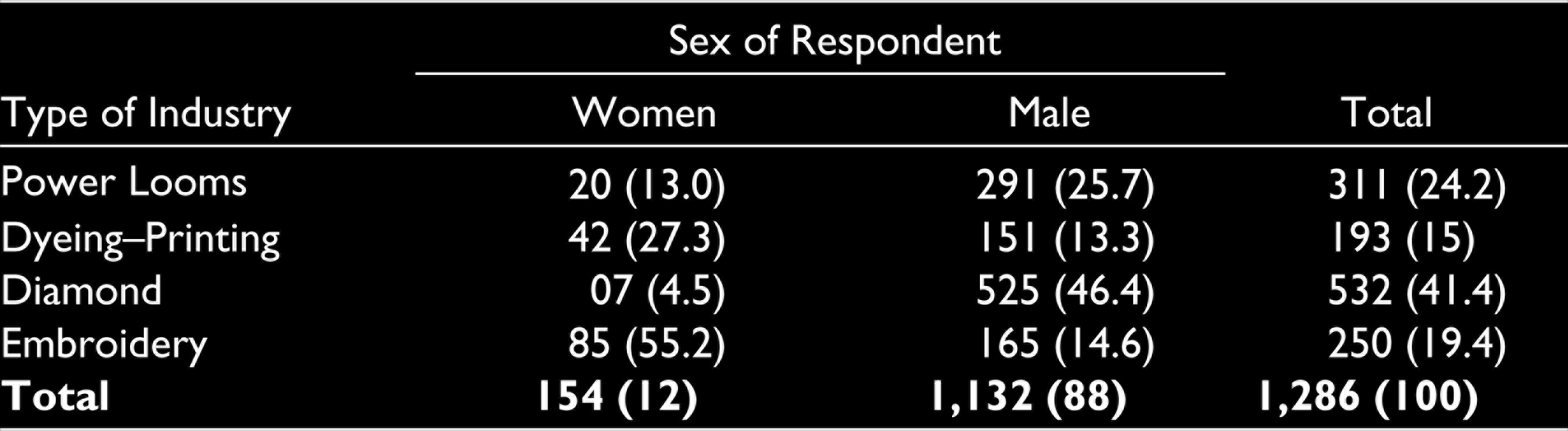
As Table 1 suggests in terms of a woman workers’ presence in industrial activities, embroidery and dyeing-printing industries form a significant proportion. Out of every 100 women workers, 55 are working for embroidery units. The embroidery industry also provides the option of working from home and that suits some women workers more as they can simultaneously take care of their domestic responsibilities. Of the four industries, the diamond units show the least number of women workers, seen also in another study (Desai & Raj, 2001a). Sociologically, the diamond industry is an interesting case study (Desai & Raj, 2001a; Desai, 2018; Engelshovan, 1999, 2002). The Saurashta Patel community has a stranglehold over every aspect of the social as well as economic life in the diamond zone 5 of Surat. These spheres are governed by highly patriarchal and conservative social ethos, values and norms which are restrictive and obstructionist for women. The mere idea of woman members of this conservative community working in industrial units with its overwhelming male presence is unacceptable and hence obstructed. So the scarce presence of women workers in the diamond industry can be sociologically explained. However, of late, the conservative tendency has lessened and a major change has taken place with regard to the status of women. It must be added that this slight transformation does not cover the entire population but only a small minority. Nevertheless, its significance cannot be overlooked. The bar on girl’s education has been raised. Similarly, girls working alongside male colleagues in different occupations has gained social acceptance. And most significantly, different sub-groups among the Saurashtra Patels of Surat have become extra-conscious with regard to the birth and well-being of girls. This signifies a remarkable transformation in the perspective of the community.
Gender and Industry-wise Distribution of Workers
In the not-too-distant past, female infanticide was very common among them. Clinics providing this ‘social service’ had proliferated enormously in the Varachha Road area. In contrast, now huge programmes are being organised to encourage people to celebrate the birth of the girl child. Parents are given gifts and beneficial social schemes. This change of attitude is not really a change of heart but perhaps a compulsion. Due to the mindless practice of female infanticide, the ratio of the girl child had decreased quite alarmingly among the Saurashtra Patels. There were even incidences of boys from the community being compelled to marry tribal girls from other states. This phenomenon worried the community’s leadership enough to initiate social programmes to modify this gender imbalance.
As for the way of getting work, studies (Desai, 2014, 2018; Desai & Raj, 2001a, 2001b; SGU, 1985) clearly indicate that it is a social and relationship network at Surat through which livelihood seekers get particular work. Although qualifications such as education, technical know-how, perseverance are vital in getting an appropriate job, they are not the prime determinants. The parameters that characterise the functioning of the informal sector are complex and quite different from the formal sector. The assumption that a livelihood seeker’s first preference in an urban centre is finding industrial work and failing that to try for activities at the lowest rung of the informal sector used to hold some sort of factual legitimacy previously but does not hold true presently. Due to fragmentation and segmentation of the labour market, which can be called effectively as a ‘cordoned niche’, it is not easy for work-seekers in the unorganised sector to access to any activity easily. Even otherwise, the issue of getting into the workforce cannot be addressed by focussing on either of the sub-sectors exclusively—industrial or fringe. In order to comprehend these two sub-sectors in terms of activities they offer and the entire work milieu covering both, one must locate each sub-sector in the entirety of the informal sector. This theoretical line of reasoning has been one of the tentative yet constant steering assumptions of the present narration and one that has proved vital in comprehending the complex and nebulous world of the workforce of the unorganised sector of Surat city. A general hypothesis that any work-seeker entering the industrial urban centre of the magnitude of Surat city primarily seeks work in an industrial sphere, and only when failing to get that work, the option of FS is considered as a last resort has not proved accurate in case of the unorganised sector in Surat. A livelihood seeker will search and get an opportunity where her/his contact exists. So, it is difficult to establish a pattern that justifies the above hypothesis. In a nutshell, both the sub-sectors of the unorganised sector—industrial and fringe—are interconnected. And even to order the pack of activities in a hierarchical mode in terms of a set of variables associated with each activity too is a futile exercise as it tantamounts to ordering the disorder. So, to grade industrial work as hierarchically higher and the set of activities of FS as a lower standing is inappropriate. In order to exemplify and simplify this crucial dimension a case study of two wage-earners in one household who are engaged in two different sub-sectors is narrated below.
Geetaben Gupta, 33, an HBW who does embroidery, lives with her spouse and three children in Surat. Her home village is in Sultanpur district of Uttar Pradesh. Her husband, having migrated to Surat ten years ago, was joined by Geetaben and their children three years later. Because of the family’s vulnerable economic condition, Geetaben started working as a housemaid. Later, they moved to a locality situated in an industrial area where a few women in the neighbourhood were earning money as embroidery HBWs. Geetaben too began stitching laces, easily earning ₹1,500–₹2,000 monthly. Her spouse who sells fruits remains the family’s primary earner with a monthly income of ₹10,000.
—From field notes, Desai, 2018
The embroidery industry employs a large proportion of women workers even at the unit level and a huge section belongs to the rural hinterland of Surat city as well as the neighbouring, predominantly, tribal districts. Most commute daily from their village to their workplace, while a small section has made Surat their temporary home, living with other women co-workers on a shared basis. All have
acquired jobs through contacts, mostly women workers, who are already working in embroidery units. A kind of pattern can be seen, indicating that initially few young teenage girls start jobs in Surat in the weaving sector, performing bobbin-work, later drawing other women co-villagers to work in weaving units (Desai & Raj, 2001b). The embroidery branch grew in the early part of the 2000s, the nature of work in that production activity providing scope for the employment of women. The embroidery units are located in the same or nearby industrial estates where weaving units are operating; in some cases, the owners are the same. Some women workers who were earlier working in the weaving sector shifted to emerging new industrial work have been instrumental in bringing other women workers from their native places and creating relational circles in the embroidery branch. Employers always prefer a workforce of similar identities and origins as that makes the mode of recruitment easy, and moreover, it facilitates the task of controlling and managing workers much easier.
The reasons behind the migration of women workers corroborate, more or less, with all-India findings. Factors such as marriage and ‘family migration’ feature prominently for women as compared to male migrants. However, one can find a variation between two data sets, that is, all-India and Surat, in the crucial category of ‘migration for seeking work’, especially among women workers. All-India figures (Bhagat, 2014) clearly suggest that the migration of women for the purpose of employment has been declining over the years. But the data set of Surat (Desai, 2018) tells a different story as almost 40 per cent of women migrants have stated employment-related reasons for migration. However, a caveat is in order: woman migrant workers may have mentioned a specific reason, that is the migration of her spouse along with whom she too has migrated and later has started working in the unorganised sector.
Is there any relationship between the nature of work and social groups? Breman observes that ‘[N]evertheless, social origin frequently determines the type of work carried out… Access to work is connected to caste membership’ (Breman, 1999b, p. 414). Research on Surat though clearly signifies that no such relationship can be established between social groups and nature of work in terms of social hierarchy as pointed out by Breman. Intermediate groups, for instance, has a predominant presence in the diamond industry. Similarly, in the other three branches, ‘OBCs’ have a noteworthy presence in almost all the operations. However, the only exception is gender-based work distribution. Except for diamond polishing work, one hardly finds women workers in machine-work in the remaining three branches. Most women workers in the embroidery industry, for instance, are in home-based auxiliary work, such as stone and lacework, cutting threads once clothes have been tailored in units. Those who are working in units too are doing less complicated sewing-work on machines. Similarly, women workers being employed in weaving units perform ancillary jobs such as bobbin-work and thread-cutting work. In dyeing-printing units too, woman workers are doing auxiliary jobs and not engaged in mainline shop-floor operations. In a nutshell, in the industrial sphere of the unorganised sector, women workers have to play a subsidiary role to male workers. They are mostly employed in non-technical, non-mechanised jobs. And they are remunerated less than male workers even though they have been performing the same task as men in certain operations. However, the same is not the case in the FS for all activities. Take the case of construction work where most women labourers are helping-hands to males and hence, paid less. But on the other side, almost in all self-employment activities, if a man and woman are found working jointly, there might not be much difference in their individual earning. In fact, the study (Desai, 2014) has indicated that in most cases of self-employment (especially in sale), the wife is the principal worker and the husband plays a supportive role.
Work-related conditions pertaining to all the four industrial branches of Surat starkly reveal gross the illegality in labour practices irrespective of gender. Small- and medium-scale units are covered under a set of labour laws such as the Shops and Establishment Act, Factories Act, Contract Labour Abolition Act and Inter-State Workmen Act to name a few. But workers are denied of their rights and benefits by the establishments which unashamedly and deceitfully violate them. The Factories Act, for instance, is applied to all units with more than 20 workers. But in order to escape from implementing them, owners artificially divide units in a way that each such separated unit, with names of relatives as owners, shows such a numerical strength of workers that the mentioned enactment is deemed inapplicable. A study has noted (Desai & Raj, 2001a) that the diamond industry has undergone a phenomenal structural change with small units being closed down, on the one hand, and big and larger units getting a hold over the production process, on the other. But even in these larger units, the Factories Act has not been implemented on a full scale. Few corporate giant diamond units do extend the benefit of insurance and a Provident Fund to their employees. But their number is very few. And it is not been ascertained that these benefits are obtained by the entire workforce of these giant units.
Even minimum leave is denied. A weekly leave is given on the day when the electricity supply has been staggered but it is an unpaid one. The leave system has a social connotation. It allows permanent workers of big mills or employees of government offices or banks with secure jobs to meet social and personal obligations and also have a work-free time which can be used for their and family members’ recreation and/or personality development. The leave system takes care of their social world life. This way their social dignity is maintained and respected. The unorganised sector earners do not have any such dignity-caring mechanism. They have to surrender and subject themselves to their livelihood activities in order to survive. Their private or social life is completely dependent on their livelihood activities.
Some woman workers have mentioned in an undertone that their male co-workers, contractors and owners do harass them sexually. They make nasty comments and suggestive gestures. Apmritiyu Nivaran Sayay (ANIS), an NGO based in Surat has done some systematic research on this issue. Many working women, a few employed in the power loom units as well as many self-employed FS earners, have complained about daily harassment especially eve-teasing. While moving in industrial zones and with discussions with a group of owners, the research-team overheard a few nasty comments on how owners and supervisors viewed their woman workers and how they took advantage of them physically. The working women are considered gullible and increasing incidences of such misconduct are the outcome of this parochial and perverted male mindset. Irrespective of the nature of livelihood activity, industrial or FS, women workers are always exposed to sexual abuse and harassment. A few housemaids explicitly mentioned the sexual advances made by their masters. Similarly, those who are working as construction labourers face sexual innuendoes and harassment from co-workers and contractors. But they are utterly helpless. Not only can they not complain to the authorities but they also cannot talk about this to their companions and family members. If the sexual harassment becomes unbearable, they have no option but to leave work and search for a job.
The case study outlined below suggests that an up-gradation in terms of horizontal or ‘vertical’ mobility is largely achieved through individualistic pursuit in a specific case. This mobility is not facilitated by the system as an integral and organic part of labour practice; in essence, it is the entire system which is anti-labour in nature.
Her name is Monal Chaudhari and she is 29 years-old. She belongs to the Chaudhari sub-tribe, commuting daily to work in an embroidery unit from nearby village Madhi for nine years. She lives with her joint family consisting of her parents and other relatives. After passing Class 12, she was taking care of the family’s agricultural land as well as animal husbandry activity. But as she was the lone earner in the family, it became difficult to sustain a big family from the income of those family occupations. A good number of women from her village had been working in the embroidery industry of Surat; so with the help of a friend, she got a job in the embroidery unit. Her initial monthly income was around ₹5,000. She stayed with one unit for nine years and presently she is the most efficient worker in her unit. Because of her sincerity, dedication and commitment, her owner has made her supervisor. Today she earns ₹12,000 a month taking care of the unit’s work, while the owner looks after two of his other units. The owner knows her personally and is aware of how her family is dependent on Monal and he also helps her financially in time of need.
—From field notes, Desai, 2018
Social Implications
The crucial question is how the economic contribution and presence of woman workers impacted their social status. Has their social standing and position in their families undergone a change corresponding to their contribution to the family income? How do their personal social problems impact with their work? What have been the social consequences, direct and indirect, of women’s participation in the workforce? Does the growing presence of women in the workforce result in the emancipation from the drudgery of domestic chores, familial suppression and elevation of their status/position in the patriarchal social order and an empowerment in the social sphere? Another issue for contemplation is a set of reasons accountable for increasing participation of women in livelihood activities of the unorganised sector in general. The mentioned issues are addressed in the following case study:
Hansaben Chaudhari is 22-years-old. Belonging to the Chaudhari tribe, she comes from the small village of a neighbouring, predominantly, tribal district, Tapi. She moved to Surat three years ago and is presently working in an embroidery unit, earning ₹7,000 a month. Her family owns a small piece of fertile land. They also have few cattle and her brother is working in a company at Surat. So in overall terms, the family’s economic condition is reasonably sound. Like most girls of her tribe and village, Hansaben could have opted to stay back and assist her parents in agricultural as well as cattle-breeding work. But she did not like her father’s attitude of monitoring her movements and supervising her behaviour. So when she heard of an opportunity to be employed in Surat from her neighbour, she immediately decided to leave. Instead of commuting daily from her village, like some women workers from her village have been doing, she is living in Surat with other women co-workers in a rented shelter. Though her parents are insisting that she marry as most girls in their community have done by this age, she has not given in. She wants to enjoy her freedom for some more time. And she does not want to take a rash decision or accept her parents’ choice blindly. He should match her expectations. She now feels a sense of freedom. Her embroidery work gives her some independence from patriarchal clutches and enhances her dignity as an individual.
—From field notes, Desai, 2018
In the families of the lower echelons of social and economic orders, women do participate in livelihood activities for sustenance and a better life of the family. The representative case outlined here signifies individual freedom being experienced by women. Earlier studies on migrant industrial labour have indicated a pattern of male migrants moving alone from rural areas to urban places and staying with other male co-workers (Breman, 1996; Desai, 1995, 2014 Desai & Raj, 2001a, 2001b). But recent studies (Desai, 2014 & 2018) show the phenomenon of woman migrants moving and staying alone in urban places. Earlier studies on ‘fringe sector livelihood earners’ (Desai, 2014) and ‘child workers in textile industry’ (Desai & Raj, 2001b) have indicated women workers commuting daily from the rural hinterland to the urban centre of Surat for their livelihood. One can argue that such cases may be few and far between. But more than a quantitative trend, it suggests, a major qualitative change with reference to the status and attitude of women, and hence, needs to be highlighted.
This sense of freedom also emboldens these young girls to counter and defy a traditional value system that is rooted in patriarchy. The system professes a definitive life-path and a social-role, gender-wise. Girls have to learn a domestic work-regime that includes the three Cs—cooking, cleaning and caring—for their families while growing up as a major life priority; they may opt for school education if they wish but that is a subsidiary or optional, not mandatory. The latter should not obstruct the former in anyway. And once they learn domestic chores satisfactorily and cross puberty, the family gets them married off by choosing a suitable bridegroom, befitting for the bride’s family, not necessarily for girl’s choice which does not count. Once married, the girls have to forego their primary and organic membership of their family by birth and have to adapt to be an integral part of their husband’s family and serve that family again in terms of the three Cs, and most importantly, add to that the reproduction-related function, to carry forward the lineage of the husband’s family. Several case studies demonstrate an act of defiance on the part of a few woman workers against social norms pertaining to gender role as outlined here.
Irrespective of their social group, women are engulfed in a vortex of familial and social issues caused mainly by their subsidiary status in general and also a conformist belief-system. Getting work provides succour in various ways. On the one hand, it enhances their self-esteem and self-belief; they feel liberated, experience freedom and, also, independence. On the other hand, the work keeps them engaged, away from social and familial problems and that proves effective in terms of soothing their internal injuries and hurt pride which is being caused by familial and social humiliation and oppression.
However, striving for freedom and independence as well as defiance against prevalent social norms in a patriarchal social system involves a huge social and personal cost and endless struggle. The following case study of a spirited woman worker indicates this point poignantly.
Sumanben Prajapati is a 33-year-old woman worker from rural Uttar Pradesh. From the OBC, her family, one brother and four sisters, migrated to Surat long ago. Her mother passed away and her father remarried and since then he has been living separately. Sumanben married within her caste in her native place by giving a large dowry. When she had a daughter, her in-laws began harassing her as they wanted a boy. Unable to tolerate the abuse, she left her in-laws’ place with her daughter, came back to Surat and never returned. Since then, she has been staying with her maternal family and has also started earning by working in an embroidery unit. After her mother’s death, she has become the main livelihood-earner of the family. Along with working in an embroidery unit, she also makes garments at home. Trouble started however when she remarried and to a Muslim. Her brother and father strongly opposed this marriage, breaking off their relationship with her. Later on, she had a problem with her second spouse too as he was behaving inappropriately with her daughter born out of her first marriage. Despite objections from family members, she has occupied a part of her maternal family’s house and has been living there. Her relatives want to drive her away from this house to gain full ownership. But she is determined to stay the course. All her close relatives have severed ties with her because of her assertive nature. Self-reliant, financially independent and determined, Sumanben is tackling all these hardships valiantly for her future and children.
—From field notes, Desai, 2018
A parochial social ethos imposes a constricting effect on women that curbs their freedom and natural desire. But economic freedom enhances a woman’s will and courage to break social shackles. Migration to the urban centre, leaving one’s rural native home where provincial community norms and ethos are followed gives a liberating space to women.
A significant proportion of unmarried and divorced women workers have been eking out their livelihood in the embroidery industry. The qualitative details compel us to mull over the usual sociological categorisation pertaining to their marital status. The following case study is one such instance:
Sitaben Chaudhari is a 32-year-old from the Chaudhari tribe and her native village is Sathvav of Mandvi taluka of Surat district. She was first married to Prafulbhai and had two daughters. Prafulbhai was a well-off farmer with large tract of fertile land. After his death, Sitaben took care of the agriculture with the help of her brother-in-law. But then she started feeling lonely and took up the job in an embroidery unit in Surat and started commuting to the city. In Surat, she met Manubhai, a widower from Saurashtra and from a different caste. When they became close, Sitaben decided to move to Surat with her two daughters to live with him. Sitaben’s parents and relatives did not approve and opposed this step. However, Manubhai arranged her accommodation, is taking care of all her needs and those of her daughters. Today, Sitaben has left her job and is instead doing home-based work by stitching stones to saris for embroidery units. She is also taking care of her land by visiting her village regularly. At present, she is satisfied with her present relationship with Manubhai and wants to keep it going. She plans to return to her village to take care of land after her daughters get married.
—From field notes, Desai, 2018
The case study above does not fit into the standard sociological demarcation regarding marital status. This categorisation has organically imbibed patriarchal and a Brahminical Hindu value system as well as notions pertaining to the correct way of living in different stages of life in relation to the age group being propounded by the dominant social structure in terms of value system and set of notions. In other words, this classification represents and reflects class and caste bias and preference of the top order of social-economic hierarchy. And hence, apart from non-representation of marginalised groups and the phenomenon of amorphousness in the lives of these large masses, proponents of feminist methodology may find it male-centric and patriarchal in nature. This specific ideologically inclined methodology strives, ‘to find what has been ignored, censored and suppressed, and to reveal both the diversity of actual women’s lives and the ideological mechanisms that have made so many of those lives invisible’ (DeVault, 1996). And in order to accomplish such a revelation, it suggests and relies on the personal testimony of a woman. Though logically, it is too simplistic to state that qualitative methods have such capacity and quantitative modes have limitation in that respect. However, the former shows better abilities and scope to capture nuances pertaining to social phenomena. According to a dominant discourse, the nature of the relationship of Sitaben, outlined above may be labelled promiscuous as it does not fit into any standard sociological categorisation. But she has made a bold feminist as well as an individualistic statement. Despite an economically sound status, she realised that in order to tame her loneliness and void in life, she has had to engage in some work and also needed companionship. At the same time, she has been realistic about her last destination based on material interest at her native place. So, this case not only suggests some limitation pertaining to a standard categorisation for a specific characteristic such as marital status but also draws our attention towards the phenomenon of liberation and individual freedom distinguishable among woman workers. Moreover, it underscores our argument that among people of the lowest echelons of social and economic order, informality pervades in every sphere, whether that is livelihood or a social domain and that they are interrelated.
The research also shows that though women’s participation in the public sphere, especially in the field of economic activities, has increased considerably, specifically at the lower echelons of the economic and social orders, in the familial and social sphere dominance of males, paternalistic value system poses a stifling challenge to women. Women workers have to take their own course. They should not depend, rely on a dominant chauvinistic paternalistic system to recognise their contribution, to give a nod to women’s elevated and changed status.
In Lieu of Conclusion
The presence of women workers has significantly increased in the unorganised sector of the urban centre. In the case of Surat city, both industrial as well as non-industrial activities provide space for such women. The wage structure and overall conditions of the unorganised sector have compelled all able-bodied members of families to contribute economically. Similar to their male counterparts, women workers in all the activities have to face exploitation and oppression; sexploitation is an added issue for them. Social and familial obligations further add to their workload. However, they also experience liberation from social constrictions in terms of individuality, and they value it immensely.
Footnotes
Declaration of Conflicting Interests
The author declared no potential conflicts of interest with respect to the research, authorship and/or publication of this article.
Funding
The author received no financial support for the research, authorship and/or publication of this article.