




Abstract

The 2022 Uttar Pradesh (UP) election verdict is a latent function of deep communal and casteist mobilisation. However, it is being camouflaged under the garb of development and good governance. A new narrative of ‘governability leading to a new category of people labharthi (beneficiary)’ is being highlighted as the cause of the Bharatiya Janata Party’s (BJP) victory. A nuanced understanding of the 2022 UP assembly verdict is necessary to understand realpolitik.
Normalisation of Communal Mobilisation
At the outset, BJP roped in a saffron-clad leader, having direct and historical legacy of a religious shrine, at the centre of its political mobilisation. Ironically, the BJP leadership, out of 403 Assembly seats, could not find even one Muslim candidate worthy of contesting elections from its party. In the same vein, Chief Minister of UP, Yogi Adityanath began his election campaign from Kairana (a district in western UP) raising the issue of the forced migration of Hindus by Muslims without any substantial proof. He also raised the issues of Ayodhya and Mathura temples, Jinnah, Assi-Bees (80–20), the use of bulldozers (against a particular community), hijab and triple talaq. Last but not least, the Prime Minister of India ended his party’s campaign for the 2022 UP Assembly elections by remaining in Kashi (Varanasi) continuously for two days. Today everyone has accepted the use of all these identity markers in the political mobilisation as a normal social fact. Is this not the case of normalisation of communal mobilisation?
Normalisation of Casteist Mobilisation
Mobilisation in the name of caste identity is an established fact in Indian politics in general and UP politics in particular (Kothari, 1986; Kumar, 2007; Rudolph & Rudolph, 1987). It is common knowledge that UP was witnessing a political and social conflict leading to a social division between Kshatriyas and Brahmins. There were allegations that Brahmins were being discriminated against and targetted by the UP police (Seth, 2021). That is why a Brahmin from UP was inducted as a state minister in the central government. Then another Brahmin leader was brought from the Congress. This was done to project BJP as also a pro-Brahmin party (Seth, 2021). Further, non-Yadavs (communities like Kurmi, Lodh, Gujjar, Jaat, Rajbhar, Maurya, Saini, Nonia, Chauhan, Nishad, Nai and so on) were mobilised separately by the BJP. For instance, Kurmis were lured with an alliance with Apna Dal though the party itself was divided. Similarly, Nishads were lured by announcing that they would be inducted into the Scheduled Caste list. The BJP even brought Jaat leaders from Haryana and Delhi to win over Jaat voters, angry because of the farmers’ bills. Apart from Brahmins and non-Yadavs, the BJP also mobilised non-Jatavs (Pasi, Dhobi, Kori, Khatik, Valmiki and Dhanuk) for electioneering. For example, the President of India’s caste was highlighted. Then a Pasi leader was inducted as a state cabinet minister. Last but not least, the BJP also tried to woo Jatavs by fielding a Jatav woman in the fray after making her resign as governor of Uttarakhand. However, no political analyst or university intellectual has called this strategy casteist mobilisation.
Changing Nature of Political Organisations
Apart from mobilisation in the name of primordial identities, there has also been a change in a few mainstream political parties in their political organisation and their reliance on various mechanisms. For instance, some major political parties did not rely on their conventional ‘Workers Conferences’ or ‘Delegate Conferences’ to understand the pulse of the masses. Rather they roped in PR agencies, event managers, their own IT Cells and corporate media for the mobilisation of the common masses. The PR agencies not only informed the political parties, who hired them for handsome amounts of money, about their party’s anti-incumbency but detailed the anti-incumbency of their candidates. Second, there were event managers who meticulously planned the party’s road shows with specially designed air-conditioned buses which could be converted at short notice into stages for meetings on the road for leaders to deliver their speeches. Further, we have also come to know that a few political parties hired agencies to conduct in-house opinion polls at regular intervals which were aired by mainstream TV channels to sway the floating votes in UP.
Above all, the mainstream corporate media, YouTube, pollsters and so-called intellectuals, on the basis of road shows and flop rallies by leaders of the two political parties, the BJP and the Samajwadi Party (SP), all described the UP elections as bipolar. Few senior journalists from Lucknow, who have been covering campaigns, revealed in an informal discussion that, ‘For past eight months this narrative of bipolar contest in UP elections was deliberately being projected. BJP liked this because it suited them and they could pitch their campaign against the SP’. Once this perception crystallised amongst the common masses, they forgot the sufferings they had undergone because of growing unemployment, price rise, Covid deaths, problems faced due to stray cattle, the Hathras case, the Unnao case and so on.
Bipolar Narrative, False Consciousness and Its Impact
The nature and mechanism of mobilisation in UP elections created a false consciousness leading to a strong perception amongst voters that the contest was between the BJP and SP and that the Bahujan Samaj Party (BSP) was not in the fight at all. As the BSP was relying on traditional and constitutional means of mobilisation, such as traditional rallies, it could not counter the bipolar narrative falsely being spread by this new format of politics. In this context, it is worth mentioning here that the BSP had followed the constitutional and democratic principles of electioneering, whether it was giving fair representation to Muslim minorities, Other Backward Castes (OBCs) and Most Backward Castes (MBCs) or the so-called upper castes. Further, the BSP never used communal or even casteist language throughout the campaign for mobilisation. I am here reminded of a couplet by the poet Rahim who says,
कह रहीम कैसे निभे केर बेर के संग वो तो झूमत आपनो फाटत उसके अंग
[Literally translated, it means: How can a banana and plum tree stay together; if one swings, the other’s body will get torn.]
Applying this verse to Indian politics, we can argue that the political parties following their traditional and constitutional means cannot compete with political parties which have turned to the most sophisticated and modern means of mobilisation with such a huge expenditure and are also not afraid of using extra-constitutional language and means of mobilisation.
This is what has happened in UP. The communal and casteist mobilisation and corporatisation of UP politics led to a false consciousness. The masses, the Muslims, OBCs and a few so-called upper-caste voters who had traditionally voted for the BSP, deserted it. They thought that since the BSP was not really in the contest, there was no point wasting one’s vote. If the vote had been for the development and good governance, effective law and order free from communal conflict, for which the BSP has had the best record during its 2007–2012 term in UP, then the voters would have definitely supported the BSP.
So Where Did the BSP Vote Go?
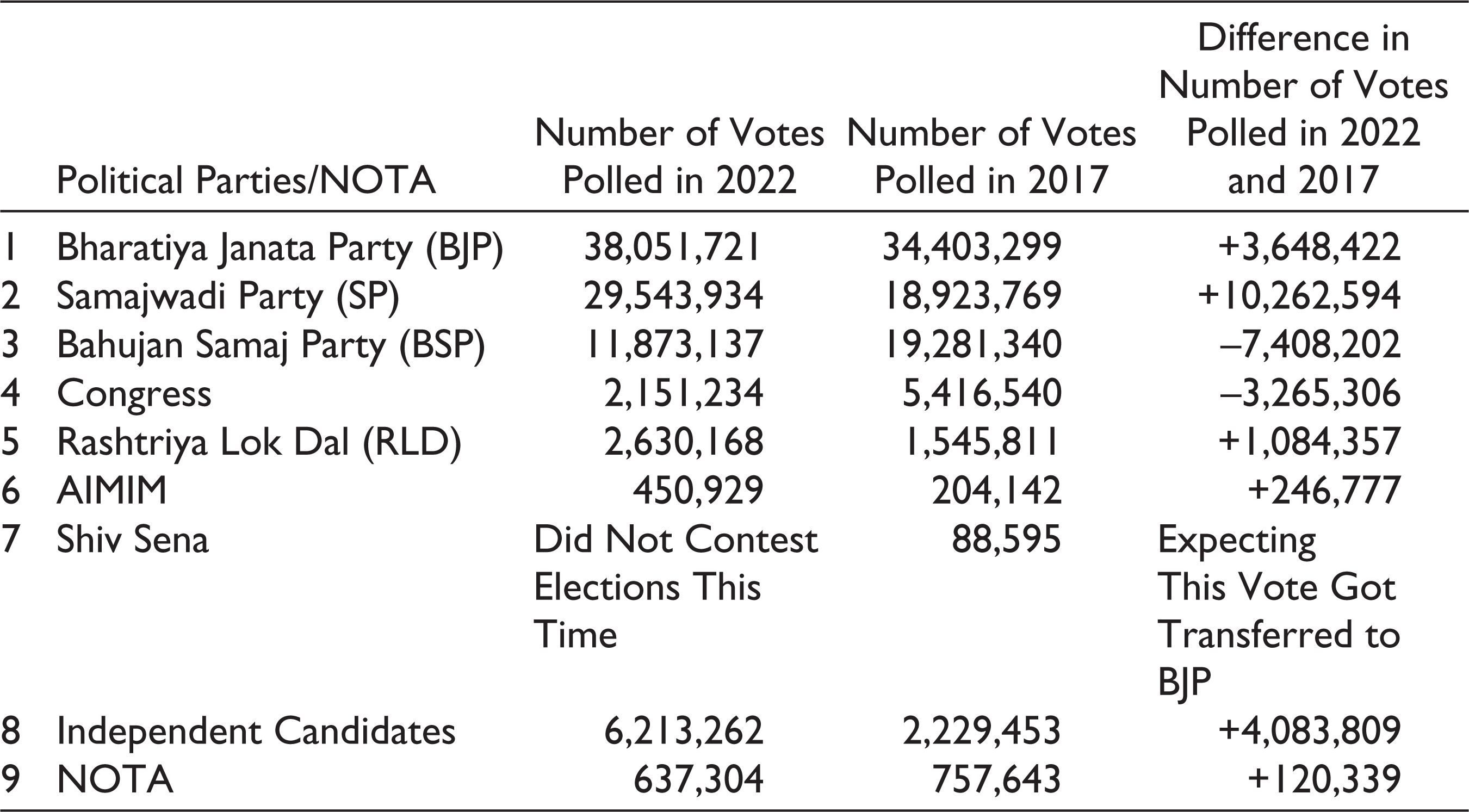
It is a fact that in this assembly election, the BSP was decimated. According to the data of the Election Commission of India, the BSP lost approximately 7.4 million votes as compared to the 2017 UP assembly elections. On the other hand, SP benefitted the most gaining, 12.6 million votes and its ally, the RLD, gained one million more in comparison to the 2017 tally (see Table 1 ). Here, it is worth mentioning that in the 2019 Parliamentary elections, the BSP had a tie-up with the SP and the RLD and therefore sympathy was created for the SP among the BSP voters. Also, we need to understand that over the years, the BSP had converted dalit votes into an ideological force, therefore they avoided voting for the BJP. That is, we can argue that in all probability, BSP votes had shifted to the SP and RLD to defeat the BJP. To substantiate our point, we can take the example of Ambedkar Nagar district where the SP had not won even a single seat in the 2017 elections. In contrast, the BSP had won two seats in the 2017 Assembly elections and in 2019 even won the Member of Parliament seat. However, in this 2022 election, SP won all the assembly seats here. Similarly, the BSP has a sitting MP from Jaunpur but here too the SP won the maximum number of assembly seats.
That the BSP votes have not shifted to the BJP can also be proved by asking two more questions: What is the increase in the BJP’s number of votes in this election? Second, from where did BJP raise its tally and why? The BJP’s tally went up by 3.6 million votes (see Table 1 ). However, we can argue that it gained most at the cost of the Congress which has lost approximately 3.2 million votes compared to the 2017 election. On the other hand, the BJP also gained because of the Shiv Sena which did not contest elections this time. It is a fact that Congress and Shiv Sena voters had no hesitation in voting for the BJP as both the parties relied on the so-called upper caste votes. And it is now an established fact that over 90 per cent of so-called upper caste voters voted for the BJP in UP.
Understanding this context, the theory or narrative that dalit votes shifted to the BJP shows nothing but ignorance of history and a despicable canard. Historically, non-Jatavs/Chamars have always voted for the BJP since the days of the Jana Sangh. They also voted for the BKD, Janata Dal and now the SP. The non-Jatavs/Chamars voted for the Jana Sangh, BKD and Janata Dal because Jatavs/Chamars used to be considered as the Congress vote bank. But the BSP weaned the Jatav/Chamars from the Congress with the help of Bahujan ideology and because of the identity of their tallest leaders. Since then non-Jatavs and Chamars have voted for the BJP and SP. For a brief period, say from 1996 to 2007, because of the extraordinary efforts of Kanshi Ram, a few non-Jatav/Chamars castes such as the Pasis and Koris started voting for the BSP. Hence, in this context, the narrative that the BSP’s non-Jatav/Chamar vote has deserted the BSP because of the BJP lacks a historical and empirical depth. It looks that this narrative has been constructed to save the so-called upper castes from being questioned as to why they voted en-bloc for the BJP.
A Comparative Picture of Various Political Parties on the Basis of the Number of Votes Polled in Uttar Pradesh Assembly Election in 2017 and 2022
Indian Politics: Caste Prejudice Against the Dalit Leadership
In the 2022 elections, nobody knew who had constructed the obnoxious narrative that the BSP was the B-team of the BJP. The narrative this year was not an aberration: In every UP election, it has been alleged that after the elections the BSP would align with the BJP. This was said because the BSP had in the past formed governments with the BJP three times, in 1995, 1997 and 2002, although for very short periods. But the question is why is this narrative posited against the BSP only? There are dozens of other political parties which have aligned with the BJP in national and state elections, and they have entered into pre-poll alliances as well. Whether it is the TMC, DMK, AIDMK, TDP, JD (U), BJD, Shiromani Akali Dal, JJP, TRS or AGP, to name a few, all have been in alliance with the BJP. But we have never heard such derogatory and aggressive campaigns against any political party as we have witnessed against the BSP. For instance, in the recently concluded 2022 Goa assembly elections, the Trinamool Congress contested the state assembly elections for the first time in its history although it did not have any organisational base there. According to the Election Commission of India website, we also know that the TMC did not win any seats, but in turn, helped the BJP to form the government there. Yet, nobody has called the TMC the B-team of the BJP. We are also aware that Mamata Banerjee had been in pre-poll alliance with the BJP and had contested assembly and parliamentary elections with them. She had formed the government with the BJP at the national level. Even then nobody has called her the B-team of BJP. On the other contrary, she is hailed as a secularist and travelled to UP to campaign for the SP. In the same vein, nobody has called the CPI (M)-led front and the Congress as the B-team of the BJP in spite of the fact that they contested the West Bengal assembly elections in 2021 without winning any seats. Similar is the case with the Congress in the UP 2022 state assembly elections. That is why one is forced to argue that spreading the canard that the BSP is the B-team of the BJP speaks volumes about the caste prejudice against the dalit political leadership. There is no other plausible explanation for the systematic spread of this lie but a deeply rooted antipathy against them.
This deeply entrenched prejudice in Indian politics is not only against BSP’s Mayawati. Take the case of the Congress’s Charanjit Singh Channi in the recent 2022 Punjab polls. Jat Sikhs, Hindus and non-Ravidasis did not vote for Channi although he is a well-educated and seasoned politician. He did not show any laxity in the campaign in a state where the Congress had been in power for almost 10 years. It is an established fact that in Punjab, the Akalis and the Congress have come to power alternatively, and the Jat Sikhs, Hindus and dalits have voted for the Congress for the past 70 years. However, this time, the AAP weaned away the Jat Sikhs, Hindus and non-Ravidasis and Ramdasis from the Congress just by projecting a Jat Sikh as the Chief Minister of Punjab. Such is the caste prejudice in Indian politics. In this context one can ask a question: Then how did Mayawati become the Chief Minister of UP in 2007–2012 on her own? The answer is not far to seek. This was a crisis period; there was misgovernance and anarchy created by SP rule, and the BJP was not in a position to replace the SP; hence, UP elected the BSP. The BSP was not an obvious choice.
What Is the Way Out for Bahujan and Traditional Politics?
Then what is the way forward for the BSP or other political parties which can only rely on traditional and conventional politics, dependent only on their organisational strength, illiterate or semi-literate, penury stricken and rural cadre without any IT cell or support of the corporate media? For parties like the BSP, the way out is difficult but not impossible. That is because it is not only a political party but also a social movement. Had it been only a political party, it would have been vying always to remain in power. And it would not have been difficult for it to be in the government in the Centre with only 10 MPs because there are political parties even with one or two MPs that are now part of government in the Centre. Hence losing and winning elections are part of the BSP movement and till there is a deficit of democracy in India, political parties like the BSP will always remain relevant.
Nonetheless, after the continuous loss of five elections (three UP assembly polls—2012, 2017, 2022 and two general elections—2014, 2019) it has been established that mainstream society is not ready to accept the BSP as a centrist party, even though it is been hailed for its good governance (strict law and order without any communal conflicts), social justice (land distribution and reservation in the private sector), pro-poor schemes (Ambedkar Village and Kanshiram Urban Housing Schemes), an effective development agenda (the Express Way, laying down the vision of airports and metro, with state SGDP at par with national numbers during 2007–2012) and developing centres of knowledge (various universities, medical, agricultural and Buddhist research institutions).
Therefore, it is clear that the BSP has to reinvent itself. It has to draw a clear-cut line between its ideology and that of other mainstream political parties. The party has to reinvent its own means of communication, restart cadre camps and reconsider ways of communicating its core ideology. It has to identify elements which exclude, discriminate and exploit Bahujans in various institutions of governance, education, production and various other walks of life. Traditional and conventional political parties like the BSP have to make people conscious of why effective self-representation in various institutions is a sine qua non for their total emancipation. Their political discourse should include the necessity of participation in decision-making. If conventional parties, in general, and the BSP, in particular, make the aforesaid changes in their programmes and policies, the BSP can repeat its 2007 performance. This will provide effective self-representation and participation in decision-making to the Bahujans, which will strengthen Indian democracy and thereby the nation.
Footnotes
Declaration of Conflicting Interests
The author declared no potential conflicts of interest with respect to the research, authorship and/or publication of this article.
Funding
The author received no financial support for the research, authorship and/or publication of this article.