




Abstract
Epidemics are biological processes that appear suddenly as shocks. Societies attempt to negotiate such shocks through the interplay of classes, ethnicities, and institutions. In the process, does it create newer fault lines or consolidate the pre-existing ones existing within the socio-cultural and politico-economic structures? The article seeks to analyse this question. The anxiety generated by the COVID-19 pandemic and the abrupt change in lifestyles have agitated the human mind. This anxiousness ‘within’ is often found to be externalised socially, unfolding a search for the ‘other’ who can be associated with the virus and thereby stigmatised in the name of the accompanying disease. The ‘other’ thus becomes the social allegory of the biological moment. But, why do we need the ‘other’? This article, moreover, also seeks to analyse these related questions by contextualising the historical experiences and then relating them with COVID-19 in the Indian scenario. It especially analyses how the pandemic influenced the everyday life experiences of those bearing Mongoloid phenotypes in India.
Introduction
The COVID-19 pandemic was caused by a novel virus, a new strain of corona that has not been identified among humans earlier. While there are wide-ranging debates surrounding the origin, source, and pathway of this ‘novel’ coronavirus still, none would argue if we say that there is nothing ‘noble’ about this virus. As epidemiologists, virologists, health professionals, and researchers attempted to contain the further spread of the virus and maximise their efforts to cure the affected, we attempted to focus on certain aspects of social relations associated with pandemics in general, and with the COVID-19 pandemic in particular. In other words, we tried to understand how society responds in the aftermath of the emergence and spread of the novel virus and its accompanying ailments. Was there a pattern to this virulent behaviour? Did fear of the unknown influence social relations? Did it further lead to a process of stigmatisation and alienation of certain communities or individuals? Did such processes emanate from the pre-existing socio-economic fault lines or did they emerge from newer fissures?
The article lays the background with an initial focus on a historical understanding of the process of ‘othering’ in a pandemic situation and then deals with the contemporary disposition. By discussing social relations in times of the pandemic, we tried to ascertain if social contexts played an important role in perpetuating the ‘other’. The next section draws insight from history in tracing such a process. In subsequent sections, historical insights have been collated with the context of COVID-19. In other words, the article negotiates the question of naming a novel virus, and how this naming reflected the interaction of history and geography, mediated simultaneously through power relations within a society. This framework is discussed with special emphasis on India in general and its North East (NE) region in particular. The NE is a region that comprises of eight states sharing more than 90 per cent of its borders with neighbouring countries. Socio-culturally, the NE is very diverse, with more than 200 ethnic groups, who speak in languages belonging to multiple language families. It possesses a unique diversity that is often missed by casual observers.
Pandemics and the ‘Other’
‘What is in a name?’ wrote Shakespeare, adding further, ‘that which we call a rose by any other name would smell as sweet’. What seemed true to the bard regarding roses in Romeo and Juliet (1597 [2007]) appears to be different when it comes to naming a novel virus. The ‘name’ (when associated with particular community or region) seems to be a statement that not only influences social relations among different population groups in a society but also reflects the powerplay within them as well. This, however, is by no means a recent phenomenon. Notably, this happened in 1817, when cholera appeared as the ‘classic epidemic disease of the nineteenth century’ (Arnold, 1986, p. 118) in the Gangetic plains of Bengal and thereafter travelled far and wide by the name ‘Asiatic’ or ‘Oriental Cholera’. From 1817, the disease followed trade routes and, by 1822, gained epidemic proportions in Burma, Sri Lanka, Thailand, Indonesia, China, and Japan. During the second wave, it circulated from Britain to Canada as well as from Mexico to Cuba in 1829 (Jain, 2020).
No matter where it spread, it was referred by the name of the Orient, in a way reflecting civilisational deficit among the continents, where the ‘filth’ of the uncivilised Orient marred the civilised Anglo-Saxon world. Thus, naming a novel virus and the accompanying disease spreading in pandemic proportions was always embedded in the framework of power. The first levels of stigmatisation 1 may appear through the process of naming. History suggests that various population groups had suffered differently under epidemic conditions, and there were no linear patterns to such victimisations.
The bubonic plague in Europe, often referred to as the Black Death of 1347–1351, witnessed large-scale discrimination, violence, stigmatisation, and murder of the Jews in Spain, France, and other areas of the continent along with Catalans in Sicily. But, surprisingly, ‘subsequent Black Deaths in the late medieval and Renaissance Europe did not set off waves of violence against the Jews or other minorities in Europe, particularly during the 16th and 17th centuries’ (Cohn, 2012). It is recorded that in the time of plague in 1575–1578, although strict vigil was maintained over the hygiene of the Jews, they were neither stigmatised nor persecuted. Rather ‘tricksters, gypsies, negroes, knaves, herbalists, street singers, comedians, and whores were prohibited from entering the cities or expelled beyond city limits to fend for themselves’ (Cohn, 2012). Again, during the yellow fever pandemic in the United States in 1853, the European immigrants were stigmatised since they were thought to be more vulnerable to the disease and thereby to its spread (Friedman, 2020).
Again, during the 1918 influenza pandemic in the United States, which ‘killed an estimated 675000 Americans, the black illness went underreported’ (Mitropoulos, 2021). It was assumed that the blacks were immune to the flu, a perception based on pseudo-scientific theories about black bodies, which perceived that ‘the lining of their nose made them prone to the micro-organisms that entered the upper respiratory tract’ [sic]. The reality was that the ‘blacks were left to fend for themselves and were turned away from white facilities when they were at death’s door’. The blacks were blamed during the later course of the epidemic for spreading the disease in big cities in the United States where they migrated in large numbers, where ‘white sanitation workers refused to dig graves for black people’ (Økland & Mamelund, 2019). This suggests that victimisation of individuals and population groups follows no uniform pattern across different pandemics.
‘Naming’ the virus, as indicated earlier, adds to the process of stigmatisation. Moreover, if the name is related to places and people hailing beyond the cradles of modernity and civilisation, that is, the Anglo-Saxon world, it becomes a potent tool for stigmatisation. What had been true for the Asiatic or Oriental Cholera in 1817 continued in contemporary times with SARS (in 2003), MERS (2012), EBOLA (2014), and the ‘Wuhan/China’ virus (nCoV) (2019) as well. During SARS, the East Asians bore the brunt as the virus originated in China, for MERS it was the Middle East, the Africans for Ebola and East Asians again for COVID-19. One may question whether plagues (except in 1347–1351), syphilis, and typhus, as well as influenza, diseases that initially surfaced in Europe carry the same levels of stigmatisation like those that originated beyond the Anglo-Saxon world? Even swine-origin influenza A (H1N1), which came to light in Mexico in 2009, did not carry the name of the American continent or the levels of stigmatisation as observed with other pandemics emanating from Asia and Africa. These differences, therefore, are a reflection of civilisational perspectives and colonialism, both structured by racism, which makes recourse to a process of ‘otherisation’ spontaneous and systemic. This might have influenced the World Health Organisation (WHO) to desist from naming novel viruses and accompanying diseases in terms of the geographical locations where it first surfaced. Epidemics actually are times of biological crisis, and the virus that initiates such a crisis is thereby supposed to be identified in biological terms, not in terms of geographies.
This display of ‘power’ once again came to the fore during COVID-19, as it was referred to as the ‘Wuhan’/‘China’ virus by the then US president Donald Trump (Sandler, 2020). This implicitly conveyed a message of legitimacy to ‘otherise’ and ‘stigmatise’ the South East Asian (SEA) communities as perceived carriers. It also provided a fillip to the stigmatisation and subsequent otherisation of these communities as many looked askance at their presence in various places around the world. Thus, as fear of the pandemic increased, it simultaneously also heightened racist and xenophobic tendencies against certain communities and races (Serhan & McLaughlin, 2020).
‘Xenophobia’, has often been identified with ‘excessive fear, dislike, and even hostility towards anything “foreign” or to anything and anybody from outside one’s social group, nation, or country’ (Hjerm, 1998, 2009; see also McEvoy, 2002; Orenstein, 1985 as cited in Philippas, 2014). These tendencies exhibited during the most recent pandemic were not only limited to individuals and communities who hailed from outside the country but equally affected fellow citizens as well, or ‘all individuals from a certain background, grouped together due to their biological characteristics’ (Balvaneeda et al., 2020). This grouping adversely influenced the physical and mental well-being of a large number of people, particularly those associated with SEA, in the recent context, who were being victimised, stigmatised and otherised.
What was true for the SEA communities for the world at large was replicated in India with people hailing from the NE, as they became the targets of racial stigmatisation. It is noteworthy that before the Tablighi Jamat gathering at Nizamabad, which thereafter took a communal turn (Niazi, 2020), the early days of COVID-19 in India had been heightened with racial overtones. It targeted and stigmatised the marginalised and the minorities of the country as the potential carrier of the virulent virus (Srivastava, 2020). The SEA prototypes of stigmatised virus carriers got ‘localised’ in India with those bearing loosely similar to the SEA phenotypes 2 (The Forefront of Genome, 2024), which overwhelmingly included those hailing from the NE. NE Indians are those who fall under the Tibeto-Burman and Austro-Asiatic linguistic families of the region, have mongoloid appearance and are mainly categorised as Scheduled Tribes in Articles 342 and 366 (25) of the Indian Constitution, but are not limited to this category (Haokip, 2020, p. 3). ‘Othering’ of the out-migrants from the NE, who in recent decades have migrated in large numbers to different locations, primarily in urban areas (McDuie-Ra, 2012; Reimeingam, 2016; Remesh, 2016), became the new source of stigma, with the ‘arrival’ of the virus in India.
Migration From Northeast India
Census in India categorises internal migration into intra-district, inter-district, and inter-state migration. Our analysis here is restricted to inter-state migration, mainly related to the out-migration of the NE people to different locations in India. Historically, literature on migration in the NE suggests that the region has been associated with large-scale in-migrations (Baruah, 1989; Kotwal, 2000; Maharatna & Sinha, 2011; Weiner, 1983). Since 1991, the tendency to out-migrate from the region has increased substantially and so the gap between ‘in’ and ‘out’ migration has narrowed significantly. The census indicates that out-migrants accounted for 39 per cent of total migration in 1991, increasing phenomenally to 52 per cent in 2001 before declining to 45 per cent in 2011. Noticeably, this process has not been uniformly distributed among the states in the region, except Manipur, which has consistently shown higher out-migration during 1991–2011 (see Table 1 ).
Absolute Number of ‘In-Migrants’, ‘Out-Migrants’, and Net Migrants Among the States of Northeast India (NEI) (1991–2011).

Source: D-1 Migration Table of 1991–2011 Census.
Other than ‘migration along with family members’ and ‘marriage’, ‘work’ (search for job) happens to be the principal reason for out-migration ( Table 2 ).
Percentage Distribution of Preferred Destination States and Reasons of NEI Out-Migration, 1991–2011.

Source: D-3 Migration Table From 1991–2011.
Note: A denotes 1991, B denotes 2001, and C denotes 2011.
They mainly moved to urban locations, and have spread over several states, namely, West Bengal, Maharashtra, Delhi, Karnataka, Uttar Pradesh, and Bihar ( Table 3 ). From 1991 to 2011, approximately 2.3 million people had moved out of the NE, which by all means is a substantial number.
Percentage Distribution of Preferred Destination States of NEI Out-Migrants, 1991–2011 (In Per Cent).
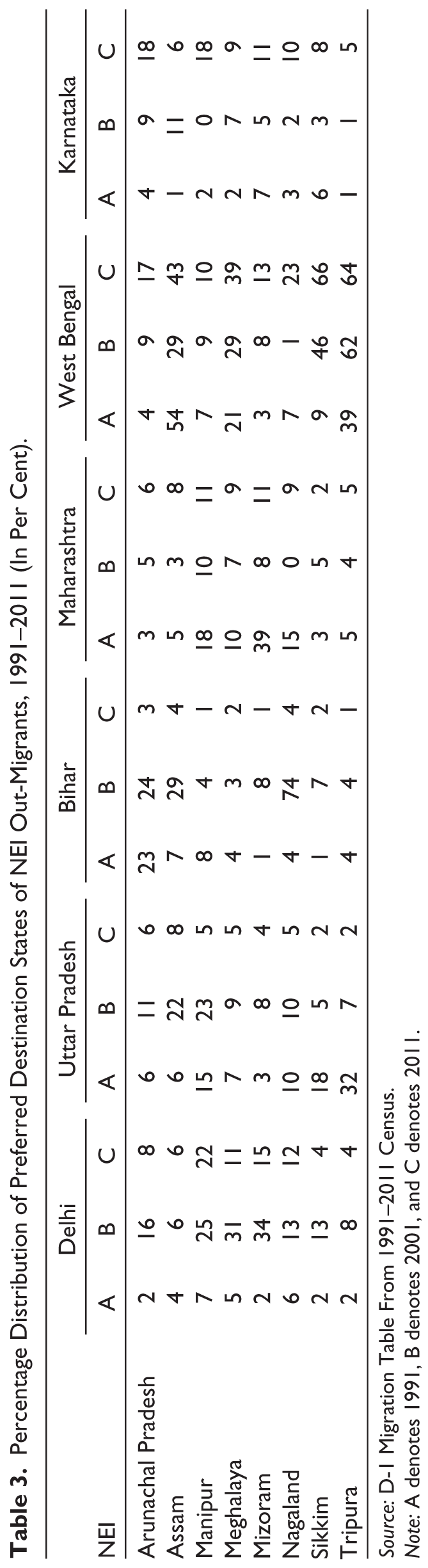
Source: D-1 Migration Table From 1991–2011 Census.
Note: A denotes 1991, B denotes 2001, and C denotes 2011.
When out-migrants reach new destinations, they are exposed to a completely new social milieu. Adjustment and adaptation become the buzzwords for existence, which is a rather complex process, dependent on the out-migrants as well as on the willingness of the locals in the host societies to accommodate them. This is a process that is entwined with strong cultural underpinnings and racial overtones. As the NE out-migrants are culturally and racially distinct, they are more exposed to social challenges in terms of language, food habits, attire, and lifestyles vis-à-vis the other inhabitants in the host societies. These differences exhibited in their ‘Mongoloid phenotypes’ 3 attract an unwanted gaze, often giving rise to various prejudices, stereotypes, and presumptions, both at individual and community levels. These presumptive ideas and stereotyping of the out-migrants and their communities in the host societies generate social fissures and unseen boundaries, leading to tensions. For the out-migrants, the new social milieu appears to be rooted in racial discrimination, where they become victims of racial prejudices and stereotyping, as one looks at the other through the ideological prism of racism. It is because of their distinct Mongoloid features that the out-migrants’ existence (identities) in the host societies fluctuate between ‘foreign nationals’ (Wouters & Subba, 2013) or ‘lesser/unwanted Indians’ (Haokip, 2020). This forces the growth of ethnic neighbourhoods, for example, Munirka, Humayunpur, Kotla Mubarakpur, and so on, as evident in Delhi (Kipgen & Panda, 2019; McDuie-Ra, 2012; also see Remesh, 2012), which provide a sense of ‘security’ against racial discrimination for the NE out-migrants. However, evidence suggests that these perceived notions of security in such ‘secured’ spaces are often unfounded. 4
The Northeast Out-Migrants and Racism
The United Nations adopted the International Convention on the elimination of all forms of racial discrimination in 1965 following increasing ‘manifestation of anti-Semitism and other forms of racial and national hatred and religious and racial prejudice of a similar nature’ after World War II, popularly referred to as the ‘Swastika Epidemic’ of 1960 (Schwelb, 1966). According to Article 1 of the convention, ‘racial discrimination’ encompasses the following:
[A]ny distinction, exclusion, restriction or preference based on race, colour, descent, or national or ethnic origin which has the purpose or effect of nullifying or impairing the recognition, enjoyment or exercise, on an equal footing, of human rights and fundamental freedoms in the political, economic, social, cultural or any other field of public life. (Schwelb, 1966, p. 2)
In simple terms, racism exists when an individual is treated differently or unequally due to factors that are beyond her/his control, for example, ethnicity (Pager & Shepherd, 2008). All discriminations are, however, not racial in nature. Racial discriminations are always rooted in prejudices and attitudes, leading to the construction of stereotypes about individuals or communities, all embedded in the idea of the supremacy of one race vis-à-vis others. In other words, where the interplay of racial factors impinges as the basis of discrimination, racial discrimination occurs (Quillian, 2006 as cited in Pager & Shepherd, 2008). This is manifested in various forms, racial epithets being the most common of all.
Whether racism is prevalent within the Indian social order often generates debate. While the existence of casteism is accepted, the utterance of racist idioms is often met with raised eyebrows in India. Interestingly, ‘the word caste comes from the Spanish and Portuguese ‘casta’ which means race’ (Haokip, 2020, p. 2). So, casteism and racism are difficult to be situated in separate water-tight compartments, although casteism is ‘practiced’ between the same racial stock, while racism ideally is between separate races. However, if we look at the 1965 UN Convention, it clearly states that any sort of discrimination and exclusion on the basis of ethnic origin is deemed as being racial discrimination. The experience of a large number of NE out-migrants and those from the hills of Darjeeling who bear Mongoloid phenotype points to such discrimination. Although the official position of the Indian government has been to differentiate between caste and race and to deny the existence of racism in India, ironically, the Committee constituted to look into the grievances of the NE out-migrants in the Indian metropolises, named the Bezbaruah Committee (Ministry of Home Affairs, 2014), acknowledged widespread racial discrimination against the out-migrants in their everyday life (Bezbaruah, 2014). The 2019 pandemic played havoc within such a social framework, and the select episodes of racism related to the people/communities bearing Mongoloid phenotypes, discussed in the next section, also point in such a direction.
The NE Out-Migrants and Racial Discrimination
The large-scale exodus of NE out-migrants in 2012 stands as a watershed moment in terms of the subtle as well as overt existence of racial discrimination against people bearing Mongoloid phenotypes in India, overwhelmingly hailing from NE. The rumours of attacks against them in retaliation to the killings of Muslims in Assam generated a fear psychosis. 5 Racial prejudices and stereotypes rooted in the ideology of superior and inferior races against people with this phenotype ultimately led to the sudden exodus of panic-stricken out-migrants from various urban centres to their home regions. Other incidents of racial discrimination against the NE out-migrants bearing mongoloid phenotypes are, for instance, the death of Loitam Richard in Bangalore 6 ; the mysterious death of a 21-year-old woman, Reingamphy Awungshi, in Delhi 7 ; the death of Nido Taniam in Delhi (Asrar, 2014); and so on, to identify a few that were reported and condemned in the national media. This led to the formation of the ‘Bezbaruah Committee’ (Bezbaruah, 2014) to examine the grievances of the NE out-migrants residing in major metropolitan cities of the country. One of the major outcomes of the committee’s recommendation led to the formation of the Special Police Unit for the North-Eastern Region (SPUNER), a unit of the Delhi Police. This unit was set up to make it easier for the out-migrants to register their cases. The Bezbaruah Committee was certainly an important benchmark as it acknowledged the existence of racial discrimination and violence against the out-migrants, both at individual and institutional levels, in various locations in urban India. However, the Union government’s lack of response in terms of stringent legal measures against widespread racial acts on the NE out-migrants became particularly evident during the course of the COVID-19 pandemic.
‘Corona’ a Racial Slur
The pandemic brought forth a ‘novel’ racial slur for the out-migrants with Mongoloid phenotypes, who were already used to being addressed as chinki, momo, Chinese, and so on. The new addition in nomenclature during the pandemic, as evident from press coverage and substantiated further through our telephonic interviews with a number of NE out-migrants at several urban locations, was ‘corona’. Select incidents of racial attack as they unfolded are discussed for understanding the different nuances associated with such a process (Chanu & Chakraborty, 2020).
These slurs, rooted in the ideology of racism, appear to follow a pattern of their own; for example, Jwala Gutta, the Indian shuttler, was savagely trolled as ‘half Corona’ (Trending Desk, 2020) because of her Chinese mother and Telugu father. Again, under the pretext of keeping the ‘virus’ at bay, the slur got manifested using another expression. A 21-year-old Ladakhi student was shouted at by a man in a local market in Jammu, ‘chal hatt, aap logon ki wajah se coronavirus aaya hai’ [get lost, because of you people coronavirus has come to India]. Similarly, a group of students hailing from the Darjeeling Hills, pursuing higher studies in Kolkata, were addressed by fellow travellers in a bus as ‘corona’, as the passengers jostled to maintain distance from these students. Such a treatment in the host society and the changed social behaviour created a sense of panic as one of them commented later:
I have never faced such a situation in my three years of stay in Kolkata. The bus was crowded, but no one sat beside me. They gawked at me. I mean they know we are from the Hills yet why such behaviour … I felt so bad. (Bhattacharya, 2020)
It seems that from this ‘false’ fear of keeping the virus away by excluding the perceived carriers or the ‘other’, a sense of legitimacy to despise them emanates among a few within a mob. At the heart of India’s capital (Delhi), a middle-aged man spat on a Manipuri girl, calling her ‘Corona’, which actually became the first highlighted case of racial discrimination during the then-ongoing pandemic (Taskin, 2020). At other places, the mob that ‘otherised’ also taught a lesson or two; for example, a group of NE out-migrant students in Kolkata were allegedly beaten up by their neighbours who forced them to vacate their rented premises. As the students left the premise, the crowds chanted ‘Go corona go’ (Sirur, 2020). Such incidents have also been reported from Bengaluru, where female NE out-migrants were not only threatened by male neighbours at midnight, to vacate their premises but the act was videographed to exhibit how ‘patriotic’ they were in their act of kicking out the ‘virus’. The local police, however, did little to stop this ‘clean up’ drive.
Racial underpinnings may also lead to exclusionary acts against the ‘others’. For example, on 5 April 2020, a 20-year-old student along with his friend hailing from Nagaland went to a nearby shop to buy groceries in Mysuru, but was barred from entering the store after standing in queue for over half an hour (Kidwai & Achom, 2020). The context for such exclusion arose from the presumptive notion that ‘they are not Indian’ but ‘Chinese’. They did produce their Aadhaar card as proof of their Indian nationality, but it was to no avail. This incident reflects how a valid identity card issued by the Government of India could prove insufficient at times for the out-migrants as a proof of their nationality. Similar incidences from Gujarat show how life could suddenly turn bizarre for the out-migrants. A group of six young women from Nagaland working in a BPO in Ahmedabad narrated how they were ‘mistaken’ as Chinese and taken to a hospital, tested for corona, and not released even after testing negative (Bahn, 2020). This incident occurred after an alleged complaint that these six women were infected with the virus. One of the victims exclaimed thereafter ‘how looking different may lead one to be treated differently!’ in our society.
Another incident was reported against a 20-year-old out-migrant girl by some locals in Gurugram as she walked through a locality. This girl was not only referred as ‘corona’ but was also threatened to be handed over to the police, and the locals repeatedly emphasised: ‘Police are on our side’. Thereafter, the ‘mob’ brutally attacked her until she fell unconscious. The police intervened after a while, but instead of filing a complaint against the perpetrators, asked the victim to ‘compromise’ (Das, 2020). This incident pinpoints how the police officials, instead of acting as an impartial law enforcing agency, become the ‘carrier’ of racial prejudices and in the process segregated between ‘us’ and ‘them’. Ironically, the Bezbaruah Committee also mentioned similar incidents highlighting institutional racism.
Being a woman in a patriarchal social milieu in itself is difficult as they are always judged through sexist social lenses. Added to it, if the woman bears a Mongoloid phenotype and is also a frontline health worker, the vulnerability of the woman and the tendency of victimisation through ‘othering’ in public has been glaring during the pandemic. The returning of a large number of nurses hailing from the NE after quitting their jobs from several private hospitals in Kolkata gave such an impression (Mitra, 2020). For these hapless nurses, discrimination and victimisation lay at the intersections of race, gender, and profession, making them potentially susceptible to ‘othering’ and racial discrimination on various counts. This seems to be not just an isolated case in one urban metropolis, but it underscores the fears behind mass exodus, as mentioned earlier during 2012.
A female Mizo student in Delhi, when asked over phone about her experience during the pandemic, shared:
It was before the lockdown during March, 2020 when I went to the University to submit my assignment. Three men in a bike constantly followed and laughed at me calling ‘corona’, ‘corona’. They were scary and I preferred not to respond. I felt like filming it but they could have easily snatched away my phone. I had to constantly avoid them walking through really fast.
A female respondent hailing from Nagaland and working in Delhi further reflected how ‘calling names’ and ‘racial experience’ had been part of the daily lived experience in Delhi:
You will find this strange but I do not find it much different when they call me ‘corona’, I feel, they are just using a different name instead of ‘chinkies’. It doesn’t make much difference, when they call us ‘corona’ or ‘chinkies’ because we were never respected by them. They (mainstream Indians) are now associating us with some ‘germs’ or ‘virus’ which only manifests, how they really feel about us. Before Corona especially Northeast women were seen as ‘walking prostitute chinkies’ and now we are ‘walking deadly viruses’. Either way they feel we need to be purged or eliminated out from the society.
Speaking with another male out-migrant from Arunachal Pradesh, who was then working in a private firm in Delhi, made it clear that the outbreak of this pandemic brought out the hostile attitude of the locals against the NE people in the city. This feeling was already there in them, but the incident of coronavirus brought the worst out in the mainstream Indian society. His frustration was clear when he shared that the NE people, who had earlier been called ‘Chinkies’, ‘Nepalies’, or ‘Chinese’, were then being called ‘corona’. He thought that other fellow Indians never considered them as Indian, and they asked out loud why was it that they always had to tell them that they were ‘Indian’ when that was not required in the case of a Bengali, Panjabi, Malayali, or so on. People from other parts of India never tried to defend their identity although they look different from each other, whereas, he shared, owing to their different looks, they were always thought first as being non-Indians.
A male student from Manipur who was located in Gujarat, when asked over the phone about his experience during the pandemic, replied:
I went out of my apartment to a nearby vegetable vendor; few guys taunted me as ‘Corona!’ and asked ‘why don’t I just go back to China?’ I ignored them because these are dangerous times … I feel scared even when I am staying inside my apartment. For the first time, I have become desperate to go back home. This place seems no more to be safe.
‘Corona’ became the new racial slur that followed the out-migrants whenever they moved out of their home states. Venturing out became risky, with boundaries of us and them that emerged. In response to such a query, a female student from Assam studying in Delhi mentioned in a telephonic conversation that she had stopped going out of her flat even for buying vegetables. The incidents of increasing racial attacks against NE people at various parts of the country not only were scary for her but also scared her parents, who asked her not to venture out at all. She started purchasing groceries online, which she found to be comparatively expensive. But, as she shared, she chose to spend a little extra rather than becoming a victim of racial attack on the road. Further, she told us that she planned on going home once the special train arrangements were finalised. She was clearly desperate to leave the city and reach home.
A sense of desperation for returning home was noticeable among many out-migrants spread over different urban locations in India as the pandemic progressed. The change in racial epithets from ‘chinkies’, ‘Chinese’, and ‘momos’ to ‘corona’ highlighted how the ‘mainland–mainstream’ Indian society used the pandemic as a pretext for racially discriminating against those with Mongoloid phenotypes. The incidents also reflected how society perceived of ‘wellness’ by excluding the ‘others’ in the name of protecting themselves—purging the uncivilised, filthy, and unhygienic carriers beyond the ‘sanitised’ social order.
Summing Up
Across the three Census periods between 1991 and 2011, more than 2.3 million people have out-migrated from the NE to different areas in India, mainly to urban locations. The youth, in particular, have migrated to cities like Delhi, Mumbai, Bangalore, Pune, and Hyderabad, and they have found employment in BPOs, retail chains, the hospitality industry, restaurants, shopping malls, health care, the beauty sector, and so one. Their demand in these services has been largely influenced by their ‘exotic Asian’ appearance and their reputation of being hardworking and loyal (Karlsson & Kikon, 2017; also see McDuie-Ra, 2012). This ‘economic inclusivity’ of the out-migrants in the metropolitan neo-liberal spaces, however, does not simultaneously imply the ‘social inclusion’ of the out-migrants (McDuie-Ra, 2012, p. 71). It is interesting to note that while the attributes of ‘exotic’ looks, proficiency in English, adaptability with accents, and good dressing sense enable them to secure jobs in various sectors, they simultaneously become the source of their discrimination and racial indictment of being ‘un-India’ in metropolises like Delhi during the pandemic, and even otherwise (Nongbri & Shimreiwung, 2017).
The NE out-migrants are more often non-recognised and misrecognised as foreigners hailing from countries in South-East Asia, and this hyphenates their Indian identity. Withholding their identity of being ‘Indian’, and its ‘Indianness’, somehow tends to rationalise the tendency of racial discrimination against these communities (Wouters & Subba, 2013). This reflects how individuals with the Mongoloid phenotype, which is much associated with these communities, remain completely absent from the common imaginaries of ‘how an Indian face should look like’. It is thereby not surprising when the Bollywood actress Priyanka Chopra is assigned to play the lead character in the biopic on the internationally acclaimed Manipuri boxer ‘Mary Kom’ because the NE people ‘don’t look Indian enough’ (Vinay, 2014). As can be discerned, racism is inherent in such thoughts and practices.
To William Shakespeare, as mentioned earlier, a rose by any other name may smell equally sweet, but the implications of a virus being named after a geographical location heralding a pandemic provides a different answer. Epidemics, otherwise a biological process, carry a cultural baggage that often takes racial overtones, ‘constructing’ the perceived carrier individuals and communities as the ‘other’ who, thereafter, are sought to be excluded for a ‘sanitised’ existence in the society. It is due to such connotations that the WHO in 2015 started identifying novel viruses by their generic names. Naming nCoV as the ‘Wuhan’ or ‘China’ virus breaches such guidelines, which castigates the SEA communities as potential threats and carriers. In India, the localised manifestation of this racial thought identified the Mongoloid phenotypes as the localised ‘other’ till it was overtaken by a communal commentary based on the Tablighi Jamat gathering at Nizamabad. Again, incidents of FIRs filed against 29 foreigners and 6 Indians who visited Nizamuddin Markaz on 31 March for allegedly spreading COVID-19 in India exhibited how, during the pandemic, ‘scapegoats’ were carefully chosen to serve a particular narrative (Naqvi, 2020).
Our discussion exhibits that ‘othering’ becomes a potent tool during pandemics in calibrating relations amongst individuals and communities within a society. There can be several ‘probable’ leads to such a proposition. First, it provides an alibi in identifying ‘scapegoats’ related to the virus. David Arnold (1986) notes that, while writing on cholera in colonial India, the scapegoats in many occasions were humans, ‘a low caste or a tribal woman, or a prostitute, who was driven out of the village to symbolise the expulsion of the disease from its boundaries’. Second, it provides a semblance of knowledge, albeit false, in understanding the novel virus by pinpointing the ‘other’ as the perceived carrier. Third, it facilitates shifting the blame onto ‘others’ and their ‘unnatural’ way of life by associating them and their habits with the disease; while for the rest, who do not adhere to ‘unnatural’ ways, the potential risk of being otherised remains less. Fourth, novel virus(es) and the accompanying epidemics come as a shock as we attempt to adjust to the changed ‘normal’; such strains of adjustments reactivate the fault lines of the pre-epidemic/pre-pandemic social order. As Henri Lefebvre discusses, ‘in space what came earlier continues to underpin what follows’ (1991, p. 229), racism along with any other form of ‘otherisation’ gets reactivated until a known aetiology emerges. And thus, during the most recent pandemic, in India, the ‘othering’ began with those bearing Mongoloid phenotypes, and they remained under the scanner along with their food, lifestyles, and manners. ‘Disciplining’ the ‘other’ during the pandemic, thereby, became an artefact of power within the social order.
Footnotes
Acknowledgements
We express our sincere thanks to the respondents who provided us with their narratives that helped us in writing the article.
Declaration of Conflict of Interest
The authors declared no potential conflicts of interest with respect to the research, authorship, and/or publication of this article.
Funding
The authors received no financial support for the research, authorship, and/or publication of this article.