



Abstract
Despite their long trajectory in the social sciences, few systematic works analyze how often and for what purposes focus groups appear in published works. This study fills this gap by undertaking a meta-analysis of focus group use over the last 10 years. It makes several contributions to our understanding of when and why focus groups are used in the social sciences. First, the study explains that focus groups generate data at three units of analysis, namely, the individual, the group, and the interaction. Although most researchers rely upon the individual unit of analysis, the method’s comparative advantage lies in the group and interactive units. Second, it reveals strong affinities between each unit of analysis and the primary motivation for using focus groups as a data collection method. The individual unit of analysis is appropriate for triangulation; the group unit is appropriate as a pretest; and the interactive unit is appropriate for exploration. Finally, it offers a set of guidelines that researchers should adopt when presenting focus groups as part of their research design. Researchers should, first, state the main purpose of the focus group in a research design; second, identify the primary unit of analysis exploited; and finally, list the questions used to collect data in the focus group.
How prominent are focus groups as a research methodology in the social sciences? To what extent have they been incorporated into our methodological toolkit? When, where, and how are they used? Focus groups were introduced to the social sciences in the early 1940s and have since grown in popularity (Liamputtong 2011:9). They are useful for studying socially marginalized groups (Liamputtong 2011; Madriz 1998), understanding community dynamics (Lloyd-Evans 2006), and eliciting feedback on sensitive issues (Madriz 2003). Despite their long trajectory and specific applications in the social sciences, we know very little about the general frequency of focus group use and the methodological ends that these help to meet. In the 1990s, a host of articles and books addressed how to undertake focus groups (Krueger and Casey 1994; Morgan 1993; Stewart and Shamdasani 1990). Few works, however, have analyzed how focus groups are currently used in practice and how often and for what purposes the data collection method appears in published works. 1
This dearth in the literature has come with great costs. First, until we understand how and when social scientists currently use focus groups, we cannot properly assess the advantages that these provide for high-level social science research. Scholars are increasingly motivated to build bridges between different methodologies in their research. One way to do this is to specify the unique added value that each method provides (Munck 2007:56–57). Theoretically, focus groups may simultaneously produce data at the individual, group, and interactive levels (Kidd and Parshall 2000). A principle contribution of this piece is to stipulate how each unit of data is used in practice. I demonstrate that each unit can serve distinct research purposes and is motivated by different objectives. The individual unit of analysis is appropriate for triangulating other methods. The group unit of analysis is appropriate as a pretest for assessing measurement validity. Finally, the interactive unit is appropriate for exploration. Despite these distinct purposes, researchers rarely use more than one unit at any given time. Moreover, they tend to either conflate the group and interactive unit (Kitzinger 1995) or disregard the social nature of the encounter altogether. As focus group usage currently stands, researchers are underutilizing the method’s comparative advantage.
Second, we have few guidelines regarding how to present the data collection method within the confines of an article-length publication. The metadata on focus groups in recent articles are remarkably scarce, as I show subsequently. There are few norms regarding how researchers present their focus group data in publishable research. An additional contribution of this piece is to offer an explicit and manageable set of guidelines on the most useful information to convey from focus group findings. Researchers should, first, state the main purpose of the focus group in a research design. Second, they should identify the primary unit of analysis that is exploited. Finally, they should list the questions used to collect data in the focus group.
By offering these guidelines, this article contributes to recent calls in the social sciences to promote more rigorous and explicit practices of data access and research transparency (Elman, Kapiszewski, and Vinuela 2010; Lupia 2008; Lupia and Elman 2014; Moravcsik 2010). How methods are analyzed and presented shapes our capacity to evaluate empirical analyses and the claims therein (King 1995). The cogency of the argument is at stake when information regarding the data collection methods is scarce. As new technologies make focus groups less costly and more feasible to organize (Gaiser 2008), the need to standardize data presentation grows. By implementing a set of clear presentation guidelines, focus group practitioners can mitigate problems of transparency (Moravcsik 2014) by making the data collection process more explicit. Their claims may be tested. Their work becomes open to more active engagement by other scholars (Elman and Kapiszewski 2014; Lupia and Elman 2014).
In the following pages, I analyze when and how focus groups have been used in high-level social science research by undertaking a meta-analysis of recent articles that incorporate focus groups into their research design. I first identify the multiple uses of focus groups for a multi-method research design. I then analyze every article that includes focus groups from four of the top political science and sociology journals over the last 10 years. These articles reveal a strong affinity between how focus groups are used and the kinds of data that are drawn from them. I use these findings, along with cues from the literature on focus groups, to devise a manageable set of norms for presenting focus group–based data in future work.
The Multiple Uses of the Focus Group
In focus groups, a group of individuals is convened to discuss a set of questions centered on a particular topic or set of topics. The primary objective of focus groups is to generate conversations that uncover individual opinions regarding a particular issue. They also help to reveal group consensus, where it exists, on the issue at hand. The potential for data collection emerges from the “range of experiences and perspectives” that these focused conversations uncover (Morgan 1996:134).
Given the conversational nature of the method, focus groups excel in revealing what participants think and why they think as they do (Bratton and Liatto-Katundu 1994:537). Because of this, focus groups have a long history in marketing, where the goal is to evaluate individual responses to products or ideas under development (Lezuan 2007:130; Munday 2006). Focus groups enable researchers to collect multiple individual reactions simultaneously (Carey and Smith 1994:125). This marketing approach has become dominant as an “accepted norm” in social science research (Liamputtong 2011:12). Data collected at the level of the individual are often privileged over the social nature of the encounter.
This emphasis on the individual participant in focus groups has not come without criticism. Scholars argue that the wholesale, uncritical adoption of the marketing approach by the social sciences ignores the different aims and objectives of the social science enterprise (Munday 2006). Others suggest that this approach disregards the social context, including the potential relationships between participants and the larger social structures in which the opinions and perspectives of individuals are sought (Hollander 2004:604). 2 Finally, researchers find that the marketing approach erroneously reduces focus groups to an easy and quick option for surveying the landscape of perspectives on an issue (Liamputtong 2011). Each criticism finds fault in the use of focus groups to assess individual opinions. They push for exploiting the social nature of the method.
Indeed, unlike most data collection methods, focus groups involve group conversation and debate. They are inherently “social events” that yield data through the interaction of individuals (Smithson 2000:105). The synergistic (Stewart and Shamdasani 1990:16) nature of focus groups means that the data collected via the group are greater than the sum of its parts.
The “rich experiential information” generated gives focus groups a comparative advantage over other data collection methods (Carey and Smith 1994:124). 3 Researchers can use focus groups to potentially collect multiple types of data at once. For example, focus groups can initially elicit rapid, individual-level feedback that researchers may value. 4 With the conversation that ensues, however, researchers can glean additional information regarding their research question. Specifically, they can ascertain group consensus. Do focus group participants interpret a question in similar ways? Does a group understand a phenomenon in similar terms? At the group unit of analysis, focus groups inform researchers of the consensus (or lack thereof) regarding phenomena of interest. This is especially the case with “thicker” concepts (Coppedge 1999). Focus groups allow participants to discuss potentially complex phenomena, such as identity, power, or race, in a more amenable setting. In a focus group, the burden of high-effort cognitive thought (Chaiken 1980; Tourangeau 1984) is shared. Participants can work together to tackle complicated ideas and concepts. Researchers can therefore ascertain the level of agreement on those phenomena (Morgan and Kreuger 1993: 16–17), as well as the phraseology used (O’Brien 1993), and they can use those findings to validate proposed measurements (Cyr 2014). Because of this, focus groups have often been used as pretests for surveys and other types of instruments (Fuller et al. 1993; O’Brien 1993). Researchers may use the conclusions from focus group conversations to assess how people ultimately understand and speak of specific phenomena.
Finally, additional, potentially rich information is often revealed prior to the culmination of a conversation. Specifically, researchers can glean important insight from the specific interactions that take place between participants as a conversation unfolds. Interactions can reveal tensions and ambiguities that complicate gut responses to particular questions or influence the construction of group consensus. These tensions may never be fully resolved. When the unit of analysis is the interaction, the deliberative process is privileged over the end result of the deliberation. Specific interactions or moments in an extended conversation may uncover surprising and unexpected reactions to a question. They may, therefore, spark new ideas about the phenomenon under consideration. Focus group interactions demonstrate how ideas and perspectives are engendered (Kitzinger 1995). Because of this, they are useful for exploratory work and hypothesis building (Fern 1982).
Focus group interactions represent an additional unit of analysis derived from focus groups that is distinct from the individual unit and the group unit. In practice, however, interactions are rarely taken into consideration as a separate data-generating process (Kitzinger 1995). Most authors subordinate the interactive process to the group unit of analysis. 5 Researchers privilege the findings at the end of a conversation (e.g., the participants agreed that X was a better description than Y of the phenomenon) rather than the information that may emerge by the process of deliberation itself (e.g., the participants quickly discounted W and, surprisingly, even addressed Z, before ultimately deliberating between X and Y as a better descriptor). This conflation of the interaction with the group unit of analysis obscures the separate functions that each unit serves for a research project. Although the group unit is useful for assessing the measurement validity of a particular question under consideration, the interactive unit can spark an entirely new research question to investigate.
In what remains of the text, I carry out a meta-analysis 6 of the use of focus groups in four highly ranked social science journals. The analysis confirms the three units of analysis that focus groups can generate and demonstrates the kinds of work that each accomplishes for high-level research. It is important to note that, in undertaking this analysis, I work both inductively and deductively. I refer to articles in highly ranked journals to examine the state of the art of focus groups. I ground this empirical examination in the literature that addresses focus groups as a data collection method. I therefore build my arguments by taking into account the established literature and focus group “best practices” as they stand today.
The Use of Focus Groups in Political Science and Sociology, 2004 to Present
My analysis of the use of focus groups in article-length publications centers on four top social science journals, namely, American Political Science Review (APSR), American Journal of Political Science (AJPS), American Sociological Review (ASR), and American Journal of Sociology (AJS). 7 I use these journals to examine how and why focus groups have been used in the social sciences in publishable research over the past 10 years. This selection method does not yield a representative sample. These journals suffer from considerable publication bias (Gerber and Malhotra 2008a, 2008b). Additionally, a selection method of this kind does not speak to how focus groups are used in other types of publications, such as books or thematically oriented journals. Yet, these four journals represent the gold standard of social science research and remain “prestigious outlets for new work” (Gerber and Malhotra 2008a:316). We may expect, therefore, that ambitious scholars will aspire to produce work that merits reception in one of these journals. By focusing our analytical attention on them, we highlight the comparative strengths of focus groups as a valued (read: publishable) data collection method in the social sciences.
Issues of representativeness notwithstanding, the results from these journals can be extended to a broader range of social science journals. In the text that follows, I periodically refer to a meta-analysis I undertook of a much broader selection of political science and sociology journals. I searched the online digital library, JSTOR, for the term, “focus groups,” over a ten-year period (2004–2013) in English-speaking articles from the collection’s full set of political science and sociology journals. The findings there largely corroborate the results from the top four journals, which I examine subsequently. Given the much higher numbers of articles generated, however, I could not include an equally in-depth analysis of each article here. Results from this broader search are available in an Online Appendix. 8
Table 1 lists the frequency with which focus groups appeared in articles published in APSR, AJPS, ASR, and AJS. I examined every edition of each journal over a 10-year period (January 2004–July 2013). Focus groups appear more regularly in sociological than in political science research, but their use in both sets of journals was scarce. Focus groups were referenced in five AJS articles (1.42 percent of all articles), three ASR journals (0.72 percent), and two APSR and AJPS articles (0.47 percent and 0.34 percent, respectively). At least in terms of highest level research, the use of focus groups was rare after 2004.
Frequency of Focus Group Use in Four Social Science Journals, 2004 to 2013.
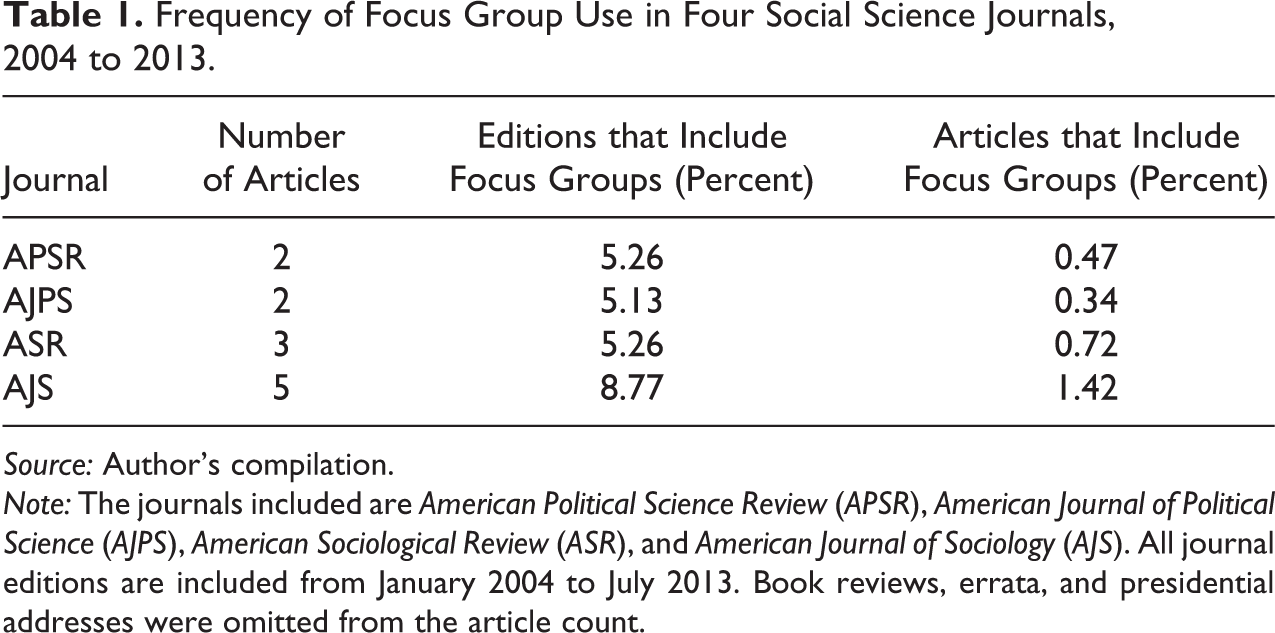
Source: Author’s compilation.
Note: The journals included are American Political Science Review (APSR), American Journal of Political Science (AJPS), American Sociological Review (ASR), and American Journal of Sociology (AJS). All journal editions are included from January 2004 to July 2013. Book reviews, errata, and presidential addresses were omitted from the article count.
These percentages remain largely unchanged in the findings from the larger JSTOR search. This much more comprehensive search uncovered 353 political science articles and 599 sociology articles that at least mentioned focus groups between 2004 and 2013. JSTOR includes 161 political science and 153 sociology journals in its database. If we assume that each journal publishes eight articles quarterly, then the total number of articles in each discipline over the 10-year period would be 51,520 in political science and 48,960 in sociology. The estimated percentage of articles over this period that at least mentions focus groups would therefore be 0.69 percent in political science and 1.2 percent in sociology.
The scant use of focus groups over the past 10 years in political science and sociology is surprising, 9 especially given the resurgence of interest in the data collection method in the 1990s (Krueger and Casey 1994; Morgan 1993; Stewart and Shamdasani 1990). A meta-analysis of focus group use is nonetheless still useful. For one, it can tell us how and for what purpose focus groups are used in top journals in each discipline. It may also provide insight into the infrequent use of focus groups as a data collection method. It can tell us where deficits lie regarding how the method is incorporated into our work. As the analysis subsequently demonstrates, the deficits are greatest in terms of what is (not) presented from the data collection process. Still, clear patterns emerge regarding the unit of analysis employed and the motivations that underpin incorporating focus groups into a research design—patterns that are largely corroborated in the larger, JSTOR meta-analysis. These patterns suggest a set of best practices that can guide future uses of the method and perhaps motivate social scientists to reintegrate focus groups into their methodological toolkit.
Table 2 examines all 12 articles that use focus groups in the four social science journals over a 10-year period. The results suggest several trends regarding the incorporation of focus groups into a research study. First, all 12 articles use focus groups as part of a multi-methods framework. Eight articles (66.6 percent) include them as a part of a mixed-method approach, where both quantitative and qualitative methods are exploited. The remaining four (33.3 percent) use focus groups within a framework that includes multiple qualitative methods. None of the articles relied on focus groups alone to collect data. This finding coheres with the literature on focus groups, which argues that the method is best exploited in conjunction with other methods (see, e.g., Morgan 1993).
Analysis of Focus Group Use in Articles from Four Social Science Journals, 2004 to 2013.

Source: Author’s compilation.
Note: EOS stands for economy of scale. “Multi-mixed” methods use multiple qualitative and quantitative methods to generate and analyze data. “Multi-qual” methods use multiple qualitative methods to generate and analyze data. Triangulation and integration are defined in the text.
Table 2 reveals that the use of focus groups as a pretest for other methods is very common. Five articles (42.7 percent) utilized focus groups for this purpose. Seven articles (58.3 percent) used them to help construct an argument, either through the integration or (most commonly) through the triangulation of data. As I discuss in greater detail subsequently, how the focus groups are employed across the 12 cases corresponds with the primary motivation for incorporating focus groups into the research design and the (inferred) unit of analysis.
A close examination of all 12 articles shows that researchers are surprisingly quiet regarding focus group metadata. 10 For example, none of the articles includes a full list of the questions asked during the focus groups. At best, articles explain the types of questions asked (Garvía 2007) or provide one specific question included in the focus group instrument (McDonnell 2010; Paluck and Green 2009). Most commonly, they give a general sense of the data generated, focusing on the finding rather than the exact questions that generated the finding. For example, Weinreb (2006) examines the efficacy of “insider-interviewers” in obtaining better information from respondents. Focus group respondents explained that they spoke most freely with a particular group of community workers that they had known a long time (Weinreb 2006:1022). The questions that yield this finding, however, are not available in the study. 11
Other descriptive data are also absent. In five articles, the number of focus groups that were undertaken is not clearly specified. In three of the remaining seven articles that specify the number of focus groups, it is unclear how many individuals participated. In some cases (Garvía 2007; Gibson 2004), the articles incorporate data from focus groups undertaken previously. Even here, the researcher does not always cite the publication where information regarding the focus groups can be found.
The lack of metadata has important implications for these studies. First, without a careful presentation of how focus groups are executed, articles that use these methods will lack transparency, precision, and rigor (Elman et al. 2010; Moravcsik 2010). Data transparency and production transparency, in particular, are threatened. The former involves access to the data used to substantiate claims; the latter, the methods through which cited evidence are chosen (Moravcsik 2014:48–49). Both are essential for evaluating the arguments put forth and distinguishing between valid and invalid hypotheses (Moravcsik 2014:50).
Equally important, there appear to be few patterns or norms regarding how focus group data are reproduced and articulated in publishable articles. It is notable that the articles examined here come from the disciplines’ top journals, where standards of rigor and presentation should ostensibly be among the highest. The larger JSTOR meta-analysis revealed similarly lax reproduction standards. 12 The findings from both analyses suggest that greater efforts must be made to standardize how focus group data are presented. They also provide clues regarding the most important information to be included. I return to this point again subsequently.
The lack of metadata also means that the unit of analysis from which researchers primarily acquire their data in each article is not specified (see the third column in Table 2). Instead, it is inferred from the information given in the article text. In most cases, the description of the focus group/groups is sufficient to make this conjecture possible. For example, where researchers asked focus group participants to fill out written surveys or referred specifically to different individuals within the group, I coded the primary unit of analysis at the individual level. Individual assessments and responses inform the findings highlighted in these texts. Where researchers found that participants expressed agreement or where they provided an overall account of perspectives on the issue at hand, I coded the primary unit of analysis at the group level. In these cases, the researchers emphasize group consensus over individual responses.
Table 2 lists the inferred unit of analysis associated with each article. Those that are unclear are marked with an interrogative and addressed subsequently. The following sections examine each unit of analysis. As Table 2 demonstrates, there are potentially three units that can be exploited from focus groups, namely, the individual, the group, and the interaction. These units, in turn, correlate with how the focus groups are used and the motivation for incorporating them into the study.
Individual Unit of Analysis
The unit of analysis is the individual in at least six 13 of the articles (Table 2). The reported findings center on the information gathered from individual participants. For these articles, focus groups were an efficient way to survey and elicit multiple reactions to a question at once. DiMaggio and Garip (2011:1920), for example, undertake focus groups with migrants and find that “most migrants reported receiving help from their peers” rather than from their families. The focus group serves to quickly assess to whom individual migrants turn when seeking assistance. The group dynamic is not as important here as the statements that came from “most” individual migrants. McDonnell (2010) uses focus groups in conjunction with other qualitative methods to measure participant reactions to different HIV information campaigns. The researcher asked participants to rank and rate campaigns and fill out a short survey on the issue (McDonnell 2010:1811). Despite the group atmosphere, individuals generate the data of interest. In both examples, the focus group format allows a researcher to undertake multiple conversations with individuals simultaneously.
These articles adopt a marketing approach to focus group data. In this approach, focus groups serve as “machinery for the elicitation of individuals opinions and for their integration into marketing strategies” (Lezuan 2007:147). According to this view, the use of focus groups is motivated by the economy of scale that they offer. Focus groups are a relatively inexpensive and efficient method to “rapidly appraise” (Bratton and Liatto-Katundu 1994:537) or assess what people think about a question. The cumulative effect is not much more than undertaking several interviews at once.
Research has found that focus groups are most typically used to obtain individual-level data (Munday 2006:94; see also, Kitzinger 1995; Morgan 1993). Table 2 lends credence to this assessment, as does the broader analysis of political science journals from the JSTOR search. 14 At least half of the articles in Table 2 exploited focus groups primarily for data at the individual level. Six articles used individual-level data to help provide evidence for an argument being advanced. In five cases, focus group data were used as part of a triangulation strategy, that is, the findings from each focus group helped to corroborate or substantiate evidence collected via alternative methods. In Weinreb (2006:1022), for example, focus group findings serve as additional “anecdotal” evidence to affirm that rural Kenyans are more likely to be open with known versus unknown interviewers. In Paluck and Green (2009), focus group data were used in an integrative (Seawright n.d.) way. Rather than add evidence to the argument, these data comprised one of the many steps in an argument regarding the capacity to express mistrust in private versus public in Rwanda. In all six cases, the focus groups served as a vehicle for surveying groups of individuals. At most, group dynamics played only a secondary role for data collection.
As mentioned previously, none of the articles relied on focus groups exclusively to make their argument. Focus groups are not meant to be representative of the general population (Vicsek 2010). Still, they are useful for bringing together targeted groups of individuals to confirm or build upon other evidence. McDonnell (2010) organizes focus groups comprised of schoolteachers, people living with HIV/AIDS, and everyday individuals in Ghana (McDonnell 2010). Each set of focus groups contains individuals with a different relationship to the disease. Garvía (2007) relies on two types of focus groups: one made up of regular and occasional gamblers and the other consisting of occasional gamblers and nonplayers. Each focus group comprised individuals that likely have distinct but potentially relevant contributions to make regarding the research at hand.
Despite the potential for unique group dynamics in each case, neither article exploited these differences in the text. For example, Garvía (2007) studies why individuals play the lottery despite the negative expected return. The article finds, among other things, that social pressures compel individuals to play the lottery (Garvía 2007:641–42). Given this, the author could have better exploited the following two types of focus groups that were organized: one where occasional players were grouped with frequent gamblers and the other where they were grouped with nonplayers. We know that focus groups can induce social pressures similar to those that exist in the real world (Hollander 2004:607; see also Gamson 1992). The author could have used this unique aspect of the method to gather evidence on how occasional players responded to questions about gambling in front of frequent versus nonplayers. Did they respond differently to why and when they engage in syndicated gambling in different groupings? In other words, were those social pressures at play in the focus group conversations? The social aspect of focus groups was underutilized.
It is puzzling that individual-level data are commonly generated via focus groups. The economy-of-scales approach to focus groups underexploits the method’s comparative advantages: the group-based interview and the interactions that occur therein. Paluck and Green (2009) come the closest to engaging with the group dynamic. The article compares individual perspectives on community trust in private versus public settings. Focus groups represent the public forum in which individual opinions are voiced. Although the individual unit of analysis has primacy, the researchers clearly understand the group dynamic at play.
Indeed, Paluck and Green’s (2009) article stands out among the 12 as an example of how focus groups can effectively and efficiently be integrated into a research design. Unlike many of the other articles, Paluck and Green clearly outline how focus groups are used in their research design. They provide the number of participants, explain how groups were formed, and include some of the questions asked. The authors convey this logistical information briefly, succinctly, and much more successfully than the remaining 11 articles. Most importantly, they explicitly and briefly justify why they use focus groups. They want to test individual responses in more public settings. Focus groups allow them to most closely reproduce a community-like forum (Paluck and Green 2009:629). In explaining the purpose for using focus groups, the researchers demonstrate that the method is an essential part of the argument they build.
Group Unit of Analysis
Paluck and Green (2009) demonstrate that individuals speak about community mistrust differently when in the company of others from the community (Paluck and Green 2009). This finding is not surprising. Focus group scholars recognize that the group dynamic inevitably shapes how individual participants react to questions (Farnsworth and Boon 2010:609). Participants tend to “exaggerate, minimize, or withhold experiences” depending upon the group in which they find themselves (Hollander 2004:626).
Researchers confront desirability bias in many types of data collection methods, including interviews and surveys (Hollander 2004). Still, for many scholars, the fact that focus group dynamics induce social pressures, groupthink, and desirability bias gives the method external validity. Most everyday conversations induce similar pressures and biases (Hollander 2004:607; see also Gamson 1992). The final outcome or consensus that emerges on a given question may not accurately reflect every participant’s individual opinion perfectly. But pressures to conform permeate our social interactions constantly. Personal opinions are a product of the environment and are influenced by the individuals with whom we interact (Krueger 1994:10–11). 15
The group’s influence on the individual implies that researchers who tap into the individual unit of analysis must consider the impact that the group has on the personal opinions that are expressed, as Paluck and Green (2009) do. It also brings to light a second unit of analysis generated by focus groups, that is, the group as a whole. Focus groups are useful for quickly identifying similarities and differences among people and for determining the language people use to discuss issues and objects (Stewart, Shamdasani, and Rook 2009:590). Is there consensus regarding the interpretation of a certain question? Does the group understand a phenomenon in similar ways? Focus groups help answer these questions by ascertaining the consensus that exists around specific questions or phenomena.
At the group level, focus groups help to demonstrate agreement or disagreement on interpretations or understandings of questions and phenomena. Because of this, researchers who tap into this level typically use focus groups to pretest other methodological instruments, especially survey questions (Fuller et al. 1993; O’Brien 1993). As Table 2 demonstrates, all four articles that most clearly utilize the group unit of analysis do so as pretests. Two articles (Gibson 2004; Sue and Telles 2007) use focus groups to pretest a survey instrument, one article (Ghazal Read and Oselin 2008) uses them to pretest interview questions, and the fourth article (Krysan et al. 2009) undertakes focus groups as a pretest for an experiment.
In all four cases, focus groups were used to test the measurement validity of the instrument in question. Measurement validity is achieved when indicators meaningfully reflect the concept a researcher seeks to measure (Adcock and Collier 2001:529). When measurements are not valid, the indicators will suffer from some sort of error that systematically affects the scoring of all cases (Zeller and Carmines 1980:77). Conclusions drawn from the biased data are, therefore, also biased.
In order to avoid systematic biases and the data distortions they produce, researchers use focus groups to ensure that the questions they ask measure what they seek to measure. For example, Gibson (2004) administered six focus groups to refine survey questions regarding racial dynamics in South Africa (Gibson 2004). He found that, even though multiple races coexist in the country, the predominant “conflict” was between black South Africans and all others (Gibson 2004:205). Sue and Telles (2007) organized a focus group to help code a dependent variable that included over 500 different names (Sue and Telles 2007). Participants were asked to come to a consensus on how Hispanic they perceived each name to be. Krysan et al. (2009) carried out focus groups in order to pretest a video used in an experiment. The researchers wanted to ensure that class and racial cues were properly conveyed in the video. Focus groups were used in Ghazal Read and Oselin (2008:303) to pretest interview questions dealing with gender-role attitudes and behaviors and family dynamics.
In each case, the researchers were explicit about why they used the focus group method. At least in contrast to the economy-of-scale articles, this set of articles included more information regarding how the researchers organized the focus group and the questions they sought to answer. This makes sense, since the researchers have strong incentives to demonstrate that their data collection instruments were valid. Still, the researchers were not entirely forthcoming in this group. They did not typically provide the questions used to assess consensus in the focus group, and in one case (Krysan et al. 2009) it was unclear how many groups were carried out in the pretest.
Nevertheless, the goal of the focus groups in each article was clear: The researchers sought to test for consensus among and across focus groups. By attaining consensus, the researchers could feel confident that their instruments tapped into the appropriate sentiments, beliefs, or stereotypes regarding the question at hand. Notably, the deliberation that takes places among participants is not under consideration here. Instead, researchers assessed overall group opinion. Prior research has shown that participants work through multiple and potentially conflicting views on a topic before arriving at a final, constructed opinion (Chong 1993; see also Barabas 2004). By analyzing the end result (i.e., group consensus or disagreement), researchers exploit the outcome of the focus group conversation and bypass the messiness of the process through which that outcome arises. 16
Most of the articles in Table 2 that use focus groups as pretests seek to examine the validity of questions that deal with subjective and/or “thick” (Coppedge 1999) concepts. 17 Thick concepts are complex in nature, and how they are perceived or understood by the public is not always clear. The articles in Table 2 use focus groups to pretest notions of race (Gibson 2004; Krysan et al. 2009; Sue and Telles 2007), class (Krysan et al. 2009), gender roles (Ghazal Read and Oselin 2008), and the division of labor among lesbian couples with children (Moore 2008). The expectations, cues, and language that elicit the appropriate responses on these topics may merit more testing than other, more “objective” topics such as household membership or crop yields (Bratton and Liatto-Katundu 1994:538). 18
Because focus groups help to reveal or establish consensus, researchers can relieve future survey or experiment participants from undertaking the high-effort cognitive thought (Chaiken 1980; Krosnick 1991; Tourangeau 1984) that is required when dealing with complex concepts. Survey participants tend to “satisfice” (Krosnick 1991; Krosnick, Narayan, and Smith 1996). They may provide inaccurate or unreliable answers because they would rather reduce the cognitive burden imposed by surveys than sort through complicated ideas or recall relevant information that might change how they respond. They therefore tend to dodge the hard work associated with information retrieval, choosing instead to focus on easily available answers that they think will satisfy the researcher (Collins 2003:231). By developing close-ended survey questions from focus groups, researchers can incorporate into the survey the difficult cognitive work needed to tap into perceptions on complex phenomena. Researchers may therefore retrieve better answers from survey or experiment respondents.
Sometimes researchers pretest survey questions by using cognitive interviewing. This process asks survey respondents to elaborate upon their answers or explain the process by which they came to their answer. Interviewers probe the respondent or urge them to think aloud as they answer questions (Beatty and Willis 2007; see also Collins 2003; Willis and Schechter 1997). Cognitive interviewing has become an accepted pretest for survey instruments (Collins 2003). Still, it may not be a suitable substitute for focus groups when it comes to devising valid indicators for phenomena that emerge intersubjectively. Beliefs and ideas regarding intersubjective phenomena are less easily explored or elicited in an individual interview (Savigny 2007; see also Krueger 1994). Intersubjectivity reflects relationships of agreement or disagreement and understanding or misunderstanding among individuals (Gillespie and Cornish 2009:24). It follows that phenomena that are created and understood intersubjectively (e.g., race or class stereotypes) are better captured through social data generation processes. Focus groups, therefore, should be used when investigating these kinds of phenomena (see, e.g., Cyr 2014).
By tapping into the group unit of analysis of focus groups, researchers assess the extent to which agreement exists. In other words, they tap into the intersubjective nature of the phenomenon at hand. In four of the five articles that used focus groups as pretests, the group dynamic was leveraged in this way to assess the validity of questions that tap into intersubjective notions of race, class, and gender.
Indeed, there is a remarkable coherence between the motivation and the use of focus groups in the articles in Table 2 and the (inferred) unit of analysis that those articles leverage. Of the seven articles that utilize focus groups for the economies of scale they provide, six (85.7 percent) of them analyze the individual unit of analysis. Of the five articles that undertake focus groups as a check for validity, four (80 percent) of these exploited the group unit of analysis. Although many of these articles were not explicit in the level of data generated, there is an affinity between how and why focus groups are used and the unit of analysis exploited.
This affinity is not limited to the articles in APSR, AJPS, AJS, and ASR. The broader JSTOR search uncovered 353 political science articles that mention the term focus groups. After randomly selecting 20 percent of these (70 articles), I examined how focus groups were used in each. Of the 70 articles, 28 (40 percent) of them mentioned focus groups without including them in any way in their argument or as a data collection method. These were dropped from the analysis. Of the remaining 42 (60 percent of the sample), the coherence observed in Table 2 is fairly well maintained. Of the 42 articles, 30 (71.4 percent) exhibited the expected pairings: 27 of these used the individual unit of analysis to generate multiple individual responses used to triangulate other evidence, two (4.8 percent) used the group unit of analysis as a pretest for measurement validity, and one (2.4 percent) examined interactions in an exploratory exercise (more on this third unit of analysis subsequently). Of the remaining 12 articles, 8 of them provided too little information to be conclusive about focus group use. The final four used focus groups in alternative ways. 19
The results from Table 2 and from the larger analysis of political science journals suggest that different units of analysis generated by focus groups serve distinct purposes for a researcher. Researchers exploit the individual unit of analysis when they wish to access multiple viewpoints simultaneously in an effort to confirm or build upon other evidence. Researchers look for group consensus to assess the validity of other data collection instruments. As we will see subsequently, focus group interactions can yield new insights that can be useful for exploratory research. These affinities raise at least two implications. First, they suggest that each unit (i.e., individual, group, and interaction) satisfies different research goals (i.e., triangulation, pretesting, and exploration). Therefore, questions regarding which unit of analysis to use may be resolved by carefully specifying the motivation behind including focus groups in the research design. Second, this affinity provides us with an important starting point for presenting focus group data and justifying their use within a given research project. Before addressing this point in more detail, let us examine the third potential unit of analysis that focus groups may generate: the interaction.
Interaction as a Unit of Analysis
In one article (Moore 2008), the researcher uses focus groups to provide additional data regarding familial roles and stereotypes within black, lesbian stepfamilies. During the focus group, however, the author found that the conversation centered on an idea about which she had not given much prior thought: 20 the parental status hierarchy between the biological and the other mother in the black, lesbian stepfamily dynamic. Against the author’s expectations, the focus group revealed “the influence that gendered ideologies about motherhood have in lesbian families” (Moore 2008:348). By analyzing the focus group discussion, the author postulated that women in same-sex relationships seek greater responsibility for childcare and housework as a way to construct a gendered sense of self (Moore 2008:348). The focus group conversation served as a source of new ideas that the author could then explore via other methods.
The interactions that unfold in the focus group setting can be a source of data that is unique to the individual or group unit of analysis. The interactive unit of analysis pays close attention to the back and forth that occurs between participants. This interaction allows answers to build and evolve (Stewart et al. 2009:594), uncovering nuances and complexities that may not otherwise be anticipated.
The interactive unit of analysis, like the group unit, exploits a comparative advantage of the focus group: its dynamic, social setting. Focus group interactions can engender collective responses on a particular issue, as participants dialogue and debate about different perspectives (Smithson 2000:109). They reveal how social processes unfold and how opinions evolve (Kitzinger 1995:116). These processes are not necessarily linear, and the discussions that take place may be unpredictable and even contradictory. Because of this, the interactive unit of analysis is less likely to confirm expectations derived from previous data or theory. Instead, interactions may lead to the formulation of new hypotheses, “fresh insights” that can later be tested via other methods (Bratton and Liatto-Katundu 1994:538). Kidd and Parshall (2000), for example, used focus group interaction to develop a new workplace injury prevention program that they hypothesized would better capture the “cognitive, schemata, folk models, and narrative patterns” that underpin workplace dynamics (Kidd and Parshall 2000:297). White (2009) undertook focus groups as part of an exploratory research project to examine how routinized discursive practices can shape the way speakers understand the political world.
The literature on focus groups tends to conflate the interactive with the group unit of analysis. Interactions tend to be viewed as one of the defining features of the group unit. Smithson (2000), for example, uses the interaction of focus group participants to justify privileging the group as the unit of analysis. The analysis earlier suggests, however, that interactions may merit examination as a different unit from which data can be produced. In Table 2, we saw that the data derived from the group unit most typically measures agreement on a particular question, in an effort to assess its validity. In articles that examine interactions, the content of the conversation uncovers assumptions and/or patterns of thought that may generate new questions that require further examination. Rather than evaluate measurement validity, the interactive unit of analysis is better oriented to deriving new hypotheses. 21
One final example of this comes from an article that makes use of a focus group study to probe attitudes on taxation in London (Prabhakar 2012). This article is notable in that it carefully and explicitly explains both how and why focus groups are used as the primary data collection method. The author recognizes that focus groups are particularly useful for exploratory work, because they “allow deliberation among participants” (Prabhakar 2012:81). Here, the interactive unit of analysis is clearly a primary focus. Additionally, the author provides specific details on the logistics of the focus groups, including when, where, and how many were organized. Finally, the author spells out the (exploratory) implications of the focus group findings. For one, he finds that how the debate on taxation was presented, and particularly whether moral arguments were made, affected participant opinions on different types of taxes. He concludes, therefore, with a hypothesis: “Embedding [tax] debates within a wider moral framework is one way in which policy-makers might try to build public support for a tax system” (Prabhakar 2012:87). As an exercise in exploratory research, this article establishes a hypothesis that can be tested in later research or implemented by policy makers.
Notably, many of the examples highlighted in this section on the interactive unit of analysis (Kidd and Parshall 2000; Prabhakar 2012; White 2009) did not come from Table 2. Indeed, the results from Table 2 (and from the larger JSTOR search) reveal that interactions are relied upon the least in works that use focus groups as a data collection method. Yet, interactions are essential to focus groups. They are also inherent to focus groups. Deliberation, dialogue, and banter occur regardless of the researchers’ intentions in using focus groups as a data collection method. One implication is that researchers should be open to new insights that focus groups interactions reveal even as they pursue the more common objectives of assessing measurement validity (at the group unit of analysis) or surveying multiple responses at once (at the individual level). They may uncover new research problems and future lines of investigation while working to answer the questions at hand.
The Promise of Focus Groups: Establishing Guidelines to Systematize Presentation
This study has examined articles published in social science journals over the past 10 years in order to assess where we presently stand when it comes to using focus groups in the social sciences. The meta-analysis yielded three findings. First, as a data collection method, focus groups are currently underutilized. The number of published articles that included focus groups over the past 10 years was remarkably small. Second, how scholars present focus group data and what they include varies quite significantly from article to article. Some articles included at least one question from the focus group; others left them out entirely. Some researchers carefully specified the number and type of participants involved in each focus group. In other cases, this information was unclear. The norms regarding how focus group data are presented are weakly established.
Finally, the analysis uncovered clear affinities between why focus groups were used and the unit of analysis that was exploited. Data generated at the individual level enabled researchers to quickly appraise multiple opinions or viewpoints that could then be triangulated or in some cases integrated with other evidence. Data generated at the group level helped settle concerns regarding measurement validity, especially on questions addressing complex and/or intersubjective phenomena. Group consensus served as a successful pretest for survey questions or other instruments. Finally, data generated through interactions produced unexpected findings that raised new research questions and hypotheses.
The affinities discovered here corroborate the long-held convention that focus groups are best used in conjunction with other qualitative and quantitative methods (Morgan 1993). On their own, focus groups typically lack the generalizability necessary to establish causal claims about the population at large. In conjunction with other methods, however, focus groups can reinforce alternative types of evidence and establish the measurement validity of indicators. Although this study has found that focus groups are most typically used as an efficient, economies-of-scale approach to triangulate other data, it has argued for exploiting the method’s comparative advantage. Especially at the group unit of analysis, focus groups generate information that cannot be easily replicated via other data collection methods. The focus group’s inherently social nature is the method’s unique value added (Munck 2007). Therefore, researchers who measure socially produced and reproduced phenomena should seriously consider undertaking focus groups as part of their research design (Cyr 2014).
These affinities also serve as a promising point of departure for establishing a minimum set of norms regarding how focus group data should be presented in future work. The subsequent list is not exhaustive of all metadata associated with focus groups. Instead, it includes key pieces of information that must be conveyed to assess the cogency of the claims made through the use of focus groups and to maximize the transparency of the method.
Clearly state the main purpose of the focus group in a research design. Do focus groups serve as pretests? Do they provide additional evidence that will be triangulated or integrated into a broader argument? Are they exploratory in nature? In the best examples of this, as with Paluck and Green (2009) and Prabhakar (2012), the explanation does not take for granted the value of the focus group for the task at hand but instead explains why the method is essential for crafting the argument. The findings of this meta-analysis suggest that focus groups can serve three very distinct research purposes. They can rapidly appraise the opinions of multiple individuals at once. They can reveal group-level consensus on phenomena. Finally, they can raise new questions or hypotheses about an issue or topic. A good research design will specify the purpose of using focus groups and briefly explain why the focus group method is well placed to achieve that goal. In the absence of such information, it is difficult to assess the appropriateness of using focus groups over other data collection methods.
Specify the unit of analysis exploited in the data collection process. It is likely that the unit of analysis (i.e., individual, group, or interactive) will correspond with the stated purpose of the focus group, in accordance with the affinities found in the previous meta-analysis. Of the articles considered here, Prabhakar (2012) makes the most explicit and detailed reference to the unit of analysis exploited. He clearly states that focus groups are used for the deliberation they provoke and the exploratory data they produce. He also signals to the reader the primary goal of the article to craft specific hypotheses based on focus group data. Where the unit of analysis is not specific, and/or where the unit of analysis does not correspond with an expected purpose, researchers will need to justify in greater detail why they use a particular unit of analysis for the (unexpected) end. Without transparency regarding the unit of analysis under consideration, one cannot easily evaluate the quality of the data analysis undertaken.
Provide the battery of questions from the focus group. If space is limited, researchers should provide those questions that directly inform the evidence presented in the text. Again, Prabhakar (2012) and Paluck and Green (2009) are the most successful at this task. Each article briefly summarizes the kinds of questions asked. Without this information, it is difficult to assess the reliability and validity of the focus groups and impossible to replicate the research design. Consequently, it is impossible to evaluate whether the stated goals of the data collection method have been met.
Taken together, these three norms represent a clear set of guidelines that can reasonably and systematically be incorporated into future publications that utilize focus groups as a data collection method. They recognize the potentially multiple uses that focus groups can have for a research design and provide precise information on how the method is practiced and presented in a given project. Where they are utilized, these guidelines promote the normative goal of research transparency. They may also help promote their more frequent use in the future.
In effect, the use of focus groups in the social sciences should be greater. Specifically, the comparative advantage of the data collection method—its inherently social nature—needs to be better exploited by researchers. The meta-analysis suggests at least one way that focus groups can and should be incorporated into future research. Because focus groups are useful for assessing complex concepts, they are an ideal pretest for researchers who wish to systematically study such concepts via survey or experimental work. By establishing a set of guidelines for how we can meaningfully incorporate focus groups into our research, this article has taken the first step in underscoring the many promises of focus groups for social science research, while helping practitioners avoid the potential pitfalls.
Footnotes
Acknowledgment
The author is grateful to James Mahoney, Kendra Stewart, and María Paula Saffon, as well as the reviewers of Sociological Methods and Research, for their comments and feedback on this work.
Declaration of Conflicting Interests
The author(s) declared no potential conflicts of interest with respect to the research, authorship, and/or publication of this article.
Funding
The author(s) received no financial support for the research, authorship, and/or publication of this article.
