



Abstract
Many political and socioeconomic binary outcomes are the result of multiactor interaction: states joining a given international institution (e.g., military alliance, economic block) and not its rivals, people entering the workforce as an employee of a specific firm and not of its competitors, and so on. Yet most empirical studies analyze multilateral phenomena as the (joint) binary choice of either a single or, at most, two decision makers. This is due in part to a lack of empirical estimators that can efficiently deal with multiactor interaction. Analyzing multilateral processes as a set of either monadic or dyadic events, though, introduces bias and has important consequences for the estimates and ultimately the inferences that one would draw. In this article, I develop a new empirical estimator that is specifically designed to analyze multiparty interactions. Specifically, the model can accommodate the input of multiple actors into a unified, overarching decision-making process. Results from a Monte Carlo analysis and an application to real data on alliance formation demonstrate the superior performance of the new estimator relative to the standard approach.
Keywords
After the Ukrainian cabinet unanimously approved the European Union (EU) Association Agreement in September 2013, the official signing of the agreement, scheduled two months later at the EU Vilnius summit, was supposed to be a simple formality. However, in November, the Ukrainian President Yanukovych refused to sign the agreement, a decision that triggered mass protests, and finally led to the current conflict in the Eastern Ukraine. What derailed a cooperation that both parties found mutually beneficial only two months before? While examining the bilateral EU-Ukraine negotiations sheds some light into this sudden change of heart, it does not tell the complete story. Arguably, a concerned third party, Russia, interfered in, and ultimately altered, the EU-Ukraine relations. A combination of political pressure and economic side payments, as well as the prospect of membership in the Eurasian Customs Union, led Ukraine closer to Russia (Englund and Lally 2013). Of course, closer ties with Russia meant weaker ties with the EU. Thus, in order to understand the Vilnius debacle, politicians and scholars alike cannot focus on the EU-Ukraine interaction alone. They also need to take into account the actors’ interaction with relevant third parties.
The decision that Ukraine faced in 2013 is by no means a singular event. Quite the contrary, situations in which a player simultaneously negotiates with more than one potential partner, and an agreement with one party precludes an agreement with the others, are ubiquitous. Governments that join a given international institution (e.g., military alliance, free trade area) implicitly decide against joining a rival organization. Employees who sign a contract with a specific employer often have alternative offers that they did not accept. Also, in most countries, people can marry only one person, politicians can be a member of only one political party, and so on.
Even though multiparty negotiations are a common occurrence, analyzing such scenarios is hindered by a lack of empirical estimators that can efficiently deal with multiactor interaction. In the absence of a well-established estimation strategy, empirical studies employ a wide range of alternative models (e.g., univariate logit/probit, (mixed) conditional and multinomial logit, bivariate probit, and selection and partial observability models) to analyze binary outcomes that are the result of negotiations with outside alternatives. While in practice they are the most commonly used estimators, univariate and bivariate models share a crucial limitation: They can accommodate one or two actors, but not more (Greene 2003; Heckman 1979; McFadden 1974; Poirier 1980; Train 2007; Wooldridge 2003). Particularly in the context of multiparty negotiations, this limitation has important consequences for the estimated parameters’ consistency and ultimately the inferences that one would draw. Specifically, results from Monte Carlo (MC) simulations indicate that ignoring the multilateral aspect in a multiactor interaction scenario leads to biased results and inaccurate or incorrect inferences.
This article develops a new estimation procedure, called the multilateral-mediated interaction with partial observability (MMIwPO) model, for the analysis of binary decisions with competing and typically unobserved alternatives. 1 In this model, a player chooses whether to cooperate with any, or none, of several potential partners. For their part, each potential partner decides whether to reject or accept any requests for cooperation. If more than one suitable partner is willing to cooperate, the player chooses the partner that they prefer the best. Given that any potential partner can reject the player, the partner with which the player ends up cooperating may or may not be their first choice. Thus, the observed outcome is the result of the joint multilateral interaction between a player and that player’s potential partners, as neither the player nor any one partner can unilaterally determine the cooperation outcome.
In summary, the new model is suited to analyze scenarios where (i) a player is confronted with multiple, mutually exclusive choice alternatives, and (ii) the player’s potential partners can opt in or out of a cooperation with that player. Because the alternatives are mutually exclusive, the model is designed to examine substitution not complementary effects. To better outline the scope conditions of the new estimator, let us consider three scenarios that involve an interaction among three (or more) actors: direct and mediated multilateral interactions and bilateral interactions with third-party intervention. 2
A direct multilateral event is, for example, where three countries come together and negotiate a treaty, of which all three can be a part. When the available choices are substitutes, though, only one of the competing alternatives can be chosen. This is the type of interaction the new estimator is designed to model. For example, one negotiates with two potential employers, and, if both make an offer, the employee must choose one. This is still a multiactor interaction; the potential employers interact, albeit indirectly via the future employee. Hearing that employer B made a bigger offer, employer A can decide to match or raise the offer. In fact, both employers can make offers at the same time and may do so either in response or anticipation of the other. I refer to this scenario as a multilateral-mediated interaction.
Lastly, in bilateral events subject to third-party influence, the intervening third party does not represent a plausible alternative to either of the remaining two actors. This would be the case of a third country promising military support to a government engaged in a civil conflict. The government, which otherwise would have signed a peace agreement with the rebels, now decides to continue fighting. As the external support is meant to augment the regime’s military forces, the third party does not constitute a distinct fighting opponent for the rebel group and hence not a proper alternative to the government.
In the next section, I introduce the new MMIwPO model. To validate the new estimator, I then present MC simulation results which provide strong evidence for the superior performance of the MMIwPO relative to the standard approach. I also analyze real data on defense alliance formation and then compare the MMIwPO results to those reported by a univariate logit to see what would be different were we to use the standard methodology in the literature (Gibler and Wolford 2006; Poast 2010). Finally, for researchers interested in employing the MMIwPO, I provide detailed working examples as well as an easy-to-use program that implements the estimation procedure in Stata 15.
Analyzing Multiparty Negotiations
The current practice of analyzing multiactor interaction as the (joint) binary choice of either a single or two decision makers is not optimal for both theoretical and methodological reasons. Theoretically, scholars are often interested in the motivations of all parties involved, as well as in how the decision of one actor constrains or alters the actions of others. Yet, univariate models can only provide insights into how factors affect the incentives (probability) of one single actor (process), while bivariate models can accommodate interactions between only two actors. Methodologically, analyzing multilateral processes as a set of either monadic or dyadic events only increases the sample size, but it adds no new information and introduces bias (Croco and Teo 2005; Fordham and Poast 2016; Poast 2010; Signorino 1999). To account for these challenges, an ideal estimator should be able to accommodate the input of multiple actors into a unified, overarching decision-making process.
The MMIwPO Model
Multilateral negotiations can be represented as an interaction between two (or more) sets of actors,

where
Actor i is willing to cooperate with j if the net value of cooperation is positive:

Similarly, for each actor j, we can describe the net value of the cooperation with potential partner i as an unobserved latent variable:

where
As with the actor i, actor j is willing to cooperate with i if the net value of cooperation is positive:

If the unobserved variables influencing actors i and j are independent,

and the individual probability that j wants to cooperate with i as:

where
Yet, when it comes to bilateral interactions, we often do not observe the individual choices of the actor

Conversely, the probability that actor i does not cooperate with actor j, either because i refuses to cooperate with j or because j rejects i (or both), is simply:

Moving from bilateral to multilateral negotiations, the situation is further complicated by the fact that, for actor i, the

where
Using the joint dyadic probabilities in equations (7) and (8), the numerator in equation (9) can be computed as:
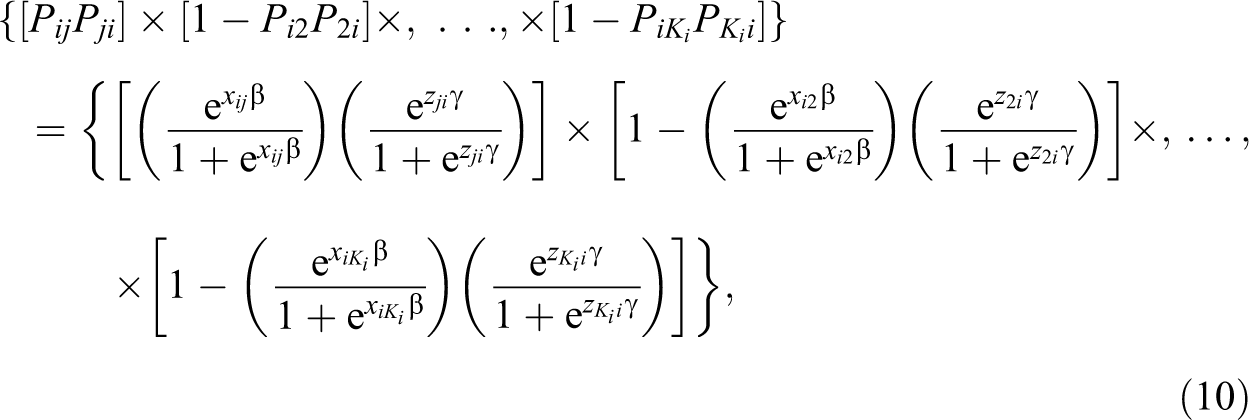
and the denominator as:
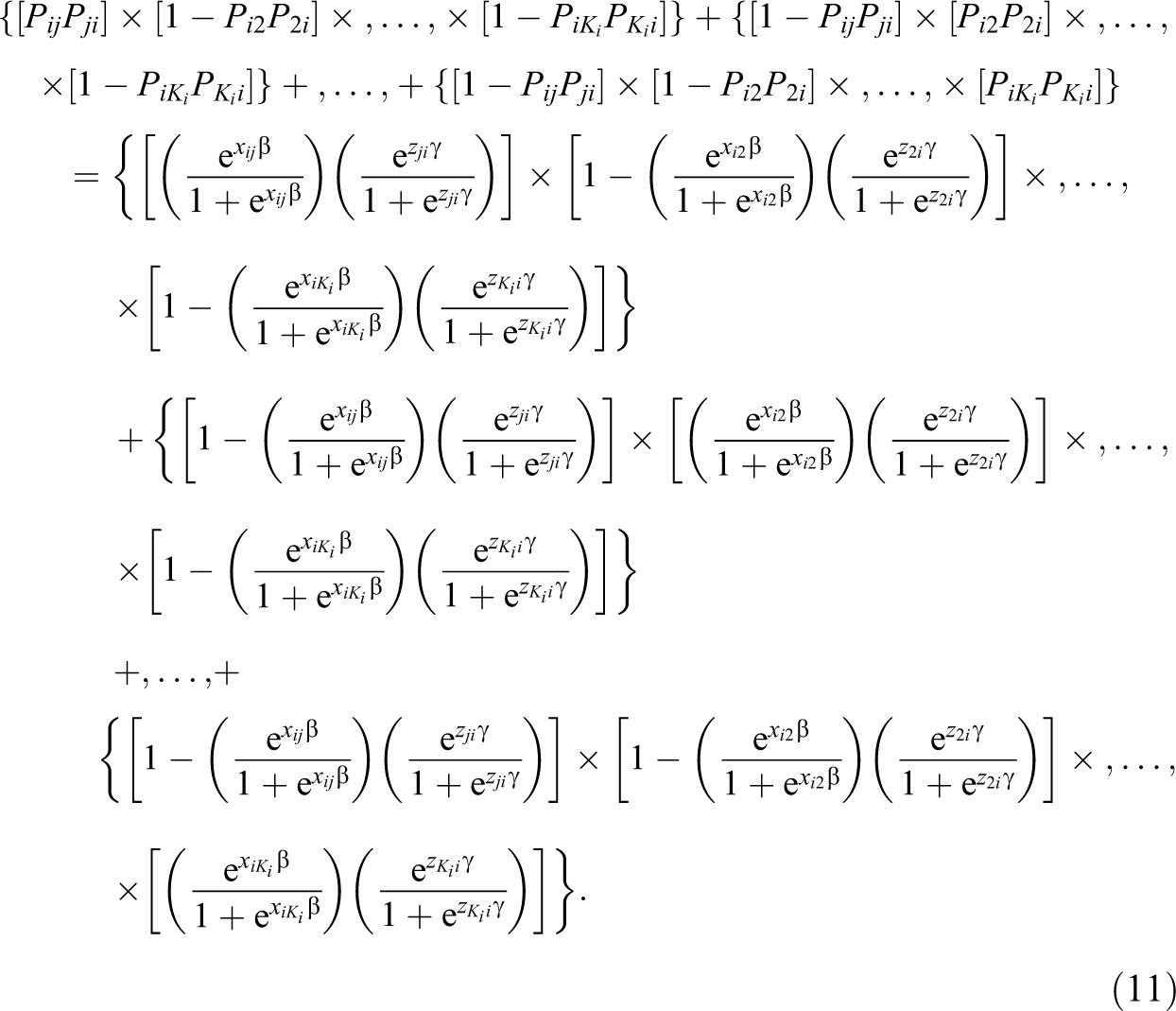
Upon simplifying both expressions,
6
the conditional probability that actor i cooperates with actor j, out of a set of

where
It follows that the likelihood for the entire sample in the MMIwPO model is

where
As with all multivariate models, in order for the MMIwPO to be identified, it is necessary that there be at least one variable in one of the vectors of independent variables
A multiparty interaction example
An example might help to illustrate how actors’ partially observed preferences determine the observed outcome, as well as the data structure underlying a multiactor interaction scenario. Suppose we have a set of N states and a set of K military alliances. The question at hand is which alliance a given candidate state (e.g., state
To each state–alliance dyad corresponds a pair of independent variable sets: one for the candidate state,
Alliance Membership as Multilateral Negotiations.

Note.
Which alliance does state
As a side note, in this example, the set of five potential partners was introduced without a preliminary discussion. Yet determining the pool of alternatives to include in the estimation is a very important issue. When it comes to identifying the full set of possible alternatives, the research question should inform the selection criteria. For example, if the analysis is about interstate conflict, then all other states are potential targets or aggressors. Often, though, only a small subset of all dyads can plausibly experience the phenomenon in question (e.g., the odds of a war between Saint Kitts and Nevis and San Marino are slim to none). Some researchers argue that only these dyads are a proper reference group, and the others should be discarded (Lemke and Reed 2001).
When this is a concern, one could run a global goodness-of-fit test to determine whether adding a given alternative improves the overall model fit. This approach is advised only if the alternative in question is included in all (or most) actors’ pool of potential partners. To identify the subset of relevant dyads at the individual dyad level, one could run a separate logit model and then include in the MMIwPO only the dyads with a high enough likelihood. This approach, however, does not properly account in the final estimation for the uncertainty in identifying these dyads. Alternatively, one can employ theoretical criteria to tag relevant dyads. A popular approach in the conflict literature, for example, is to restrict the analysis to “politically relevant” dyads, usually defined in terms of the dyad members’ major power status and geographic contiguity (Lemke and Reed 2001). While the precise attributes are likely to vary with the research question, theory should play a central role in informing this decision.
The MMIwPO and Odds Ratio
The joint probability, equation (7), and the subsequent conditional joint probability discussed above, equation (12), assume that the two component probabilities,

where
When

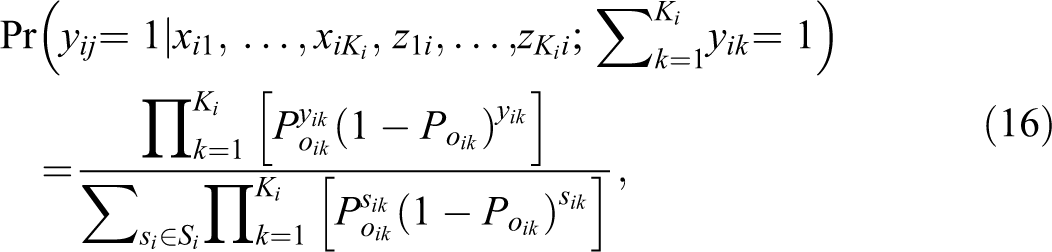
Substituting the new joint outcome probability in the conditional probability defined in equation (9), we obtain the following conditional probability that actor
where
The MMIwPO versus conditional logit (CL)
How does the new MMIwPO model relate to extant choice models? It turns out that MMIwPO nests the CL, the standard univariate model for multiple choices (McFadden 1974a, 1974b). 8 In the restricted model, the CL, a player chooses among multiple-choice alternatives and the player’s decision, is decisive. In effect, the outcome is determined solely by the decision of a single actor. In the MMIwPO, the premise is similar: A player chooses among multiple potential partners. The twist is that the partners have a say in the final outcome, as they can reject individual requests for cooperation. Thus, the outcome in this scenario is determined by the joint choices of a player and that player’s potential partners.
The fact that the CL is only a special case of the unrestricted MMIwPO model means that, on the one hand, the two models produce identical results in situations where the outcome is indeed the result of a single actor’s unilateral decision. On the other hand, the MMIwPO ought to produce more accurate estimates in situations where the outcome is the result of multilateral interactions. To determine whether this is indeed the case, I conduct multiple MC experiments that allow me to directly compare the performance of the MMIwPO and CL models. MC simulations are useful because they provide a controlled environment, where one can tease out the effect of a given modeling choice. To prevent contamination effects, ideally, there should be just one difference between the compared scenarios. The only difference between the two models in question is that the new estimator allows potential partners to reject individual requests for cooperation. In fact, were we change the corresponding probabilities to reflect that all
MC Simulations
Each MC experiment comprises 2,000 players and five potential partners. Each player chooses whether they want to cooperate with any, or none, of the five alternatives. Similarly, each potential partner decides whether they would reject or accept a player were he willing to cooperate. Both players and potential partners choose the option that maximizes the utility accrued from that cooperation. Since there are two sets of actors, that is, the players (N) and potential partners (K), there are two distinct utility functions:


where
There are two inputs to both players and potential partners’ utilities. One of the inputs, the independent variable
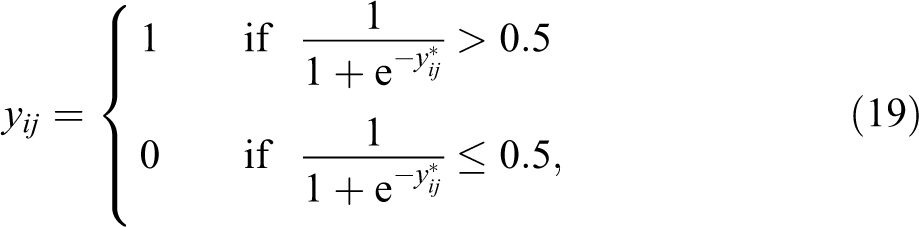
Next, employing the logistic link function, I compute two dichotomous variables to indicate the probability that actor

One assumption of the MMIwPO model is that potential partners are substitutes not complements. In practical terms, this means that actor
Overall, I conduct 30 MC experiments, which represent the combination between (i) five different values for the disturbance correlation parameter (
Which estimator performs best according to the MC simulations? I employ two indicators to discriminate between the MMIwPO and CL models. First, I perform a likelihood-ratio test to assess the goodness of fit between the two empirical models. Without exception, the test indicates that the MMIwPO model fits the simulated data significantly better in every MC experiment. Thus, the MMIwPO’s increased complexity is justified in terms of the significant improvement in fit over the CL model. Second, I contrast the MMIwPO and CL models in terms of their ability to minimize the bias in the estimated coefficients.
Figure 1 shows the bias in the

The
It is easy to note that in both scenarios the MMIwPO reports the least biased coefficients, with the bias values straddling the zero line (see panel II in Figure 1a and b). While the CL’s
An Application to Alliance Formation
In this section, I demonstrate the inferential benefits of employing the MMIwPO by applying the model to real data on alliance formation. The upcoming empirical analysis is meant only to illustrate the applicability of the MMIwPO model, not to develop a new theoretical account of the alliance formation process. First, I present a couple of anecdotes to support the claim that a state’s membership in a given alliance is contingent on the available options. Next, I describe the data and address various measurement issues. I then present the results and discuss their substantive importance.
In June 2013, the Colombian President Juan Manuel Santos announced that he wants a closer partnership with North Atlantic Treaty Organization (NATO). Not surprisingly, his announcement stirred strong emotions. Colombia’s partners in the Union of South American Nations, the defense alliance in South America, expressed strong objections to this proposal with the Bolivian President claiming that “[a]ny presence of NATO in South America or Latin America poses a threat to peace in the region” (Mallén 2013). In order to contain the problem and appease Colombia’s current South American allies, the Colombian foreign minister qualified the President’s statement by saying that Colombia is not actively seeking to join NATO (Mallén 2013). NATO also distanced itself from the Colombian President’s remarks saying that Colombia cannot become a NATO member as it “does not meet the geographically limited membership criteria” (Agence France-Presse 2013). Of course, there are various reasons why an alliance might find a particular candidate state undesirable. Georgia, for example, initiated the NATO membership process in 1994. After more than 20 years, it is still not a member because of political and military considerations (Fuller 2014). Indeed, it may be the case that negotiations over a potential alliance membership never even start because the interested candidate knows that it does not meet the necessary requirements or it infers that the negotiations would fail.
Regardless of whether because of a geographic or other technical reason, when states are denied membership in an alliance of their choice, they are forced to look for security guarantees somewhere else. Therefore, their subsequent decision (i.e., to join another alliance, form a new one, or remain neutral) is determined in part by having had their options curtailed by their preferred alliance’s rejection. For example, Fordham and Poast (2016) argue that in 1963 Spain was forced to form a bilateral alliance with the United States, instead of joining the existing U.S.-sponsored European alliance, because of other NATO members’ distaste for Franco. In their assessment, this “illustrates how the positions of third-party states can influence the formation of a bilateral alliance” (Fordham and Poast 2016:844).
Data and Measurement Issues
The upcoming analysis builds on Poast’s (2010) work on alliance formation, which in turn draws on Gibler and Wolford’s (2006) study on alliance membership. While my analysis closely follows Poast (2010) with respect to the set of explanatory variables, operationalization rules, and temporal domain, it is not a replication per se of that work. The two studies differ in terms of their scope and the cases included in the respective analyses. On the one hand, Poast (2010) addresses the question of why a given k-adic alliance forms while alternative k-member alliances do not. On the other hand, this study answers two questions: (i) why a state forms a given k-adic alliance instead of joining an existing one and (ii) why the other alliance members accept that state. Finally, Poast (2010) drops alliances with six or more members from the analysis, whereas I include all alliances irrespective of their size. These differences aside, I focus on Poast’s (2010) study because, by conceptualizing alliance formation as a multilateral event, it departs from the traditional dyadic analysis framework. In the process, it also provides the first guidelines with respect to various aggregation issues that one faces when moving from a dyadic to multiactor interaction.
Following Poast (2010), the analysis focuses solely on alliance formation, treating the decision to join an existing alliance as distinct from the decision to create a new one.
11
The data are organized into alliance membership opportunity sets. A state’s membership opportunity set comprises the state–alliance dyads between the potential member and all extant alliances, as well as the dyad between that state and the new alliance.
12
An example might help to illustrate the data structure. Suppose we have a state,
The temporal domain covers the period from 1816 till the end of the Cold War in 1990. The number of independent states and military alliances varies across time, but the full data set comprises 121 states and 182 military alliances. In total, there are 5,638 unique state–alliance dyads grouped in 509 alliance membership opportunity sets. 14 The dependent variable in the upcoming empirical analysis, New Allies, is coded 1 if the state–alliance dyad represents a true relationship in the sense that the state is an original member of the newly formed alliance, 0 otherwise.
In Poast’s (2010) analysis, four core determinants explain a state’s decision to form a new alliance: capability ratio, joint democracy status, geographic distance, and common threat. Since the main objective of a defense alliance is to provide assistance in case of foreign aggression, the military capabilities of the parties involved play a crucial role in determining whether a state joins a given alliance. Capability ratio captures the relative military strength of the candidate state and target alliance. Effectively, it is an indicator of whether the would-be member is likely to be a consumer or provider of security within a particular alliance. Capability ratio is calculated as the ratio between the military capability of the would-be member and that of the target alliance.
15
For example, if
Generally, the literature reports a positive relationship between regime type similarity and alliances although some recent studies have questioned this finding (Lai and Reiter 2000; Simon and Gartzke 1996; Siverson and Emmons 1991). Joint democracy captures the political similarity between the candidate state and target alliance. Joint democracy is calculated as the product between the democratic status of the candidate state (0 or 1) and the proportion of member states that are democracies in a given alliance (Poast 2010). A state is coded as a democracy if it scores a six or above on the Polity IV scale for a given year (Marshall, Gurr, and Jaggers 2010). Higher values indicate that a democratic state seeks to affiliate with a military alliance that has a large share of democratic members.
As an indicator of geographic proximity, geographic distance, captures both the incentives to ally (in terms of how likely states are to have a common interest or threat) and the presumed alliance effectiveness (in terms of how expeditious receiving military support would be). The expectation is that the geographically closer states are, the more likely they are to ally. Measuring geographic distance between states is relatively straightforward in a dyadic setting, and it is usually calculated as the square root distance between the capital cities. This becomes complicated when more than two states are involved. Following Poast (2010), I apply the “weakest link” principle and use the square root distance between the candidate state and the most distant alliance member (Oneal and Russett 1997). For contiguous states, the distance is set to 0 (Gibler and Wolford 2006; Lai and Reiter 2000; Poast 2010). 16
Finally, countries’ involvement in international disputes provides an additional indicator about how opportune a given military collaboration is. Common threat captures the idea that countries are more likely to come together if they face a common enemy. Common threat is calculated as the proportion of alliance members that participated in a militarized interstate dispute (MID) against the same third party as the candidate state in the previous ten years (Poast 2010). 17 Theoretically, a state’s willingness to join a military alliance should increase with the number of alliance members that fought against the state’s enemies in the past.
In terms of the candidate state’s MID experience, military alliances are interested to know how belligerent the would-be member is. One of the costs of accepting new members is the probability that the alliance would be dragged into wars against states with which, absent the new member, the alliance has no quarrels. Additional threat is calculated as the proportion of alliance members that did not participate in a militarized dispute against any of the candidate state’s adversaries in the previous ten years. Discriminating between the candidate state and target alliance’s incentives based on their respective MID records also helps satisfy the MMIwPO’s identification requirement. Recall that in order for the model to be identified, it is necessary that the actors’ determinant sets are not identical (Gordon and Smith 2004; Poirier 1980).
Results and Discussion
The results of the empirical analysis are shown in Table 2. The second column presents the estimates from a CL model, the standard univariate logit for multiple choices. These results act as a benchmark against which to compare the results from the MMIwPO. The MMIwPO estimates, which are shown in the third and fourth columns, indicate how covariates influence the choices of the would-be member and target alliance separately.
The Determinants of Alliance Formation.

Note. The conditional logit estimates indicate how the regressors influence the likelihood of alliance formation. The would-be member and target alliance estimates, respectively, indicate how the regressors influence the incentives of the candidate state and target alliance.
The results from the CL model are generally in accord with those from previous studies. Specifically, the likelihood of alliance formation decreases as the candidate state and alliance members are geographically farther apart. This is indicated by the negative and statistically significant coefficient on geographic distance in the Conditional Logit column. The positive and statistically significant coefficients on capability ratio, joint democracy, and common threat indicate that a state is more likely to join a military alliance if that state is militarily strong, the alliance members have a similar regime, or they have previously fought against the same enemies.
I now turn to the results from the MMIwPO model. 18 The first thing to note is that, unlike the univariate logit, the MMIwPO is able to provide insights into how the covariates affect the choices of both the candidate state and the target alliance. It turns out that this has important consequences for the inferences that one would draw. For example, the MMIwPO estimates indicate that a candidate state’s military strength has opposing effects on the state’s and alliance’s incentives. The positive and statistically significant coefficient on capability ratio in the Target Alliance column suggests that an alliance is more likely to accept a militarily strong candidate that has the ability to provide security guarantees to its current members. Contrary, a state is less likely to choose an alliance with militarily weak members. This is because such an alliance is unlikely to provide credible security guarantees. Moreover, as a powerful member of that alliance, the candidate state is likely to be called upon to defend weaker members. Evidence for this line of reasoning comes from the negative and statistically significant coefficient on capability ratio in the Would-Be Member column. The univariate logit, which reports solely a positive effect, completely misses the negative effect of military capabilities on the probability of alliance formation.
What does it substantively mean that some factors have opposing effects on the candidate state and target alliance? In Figure 2, I use the estimates from the CL and MMIwPO models to show the percentage change in the probability of alliance formation as capability ratio increases from its mean to 1 standard deviation above the mean, while all other variables are held at their means. In the case of MMIwPO, I also illustrate the effect of capability ratio on the state’s and alliance’s incentives separately. The predicted probabilities are computed from a stylized scenario where a state chooses between two alliances, which in turn decide whether to accept or reject the candidate. The solid vertical lines represent two-tailed 90 percent confidence intervals, which were computed via simulations based on 10,000 draws from the estimated coefficient vector and variance–covariance matrix.
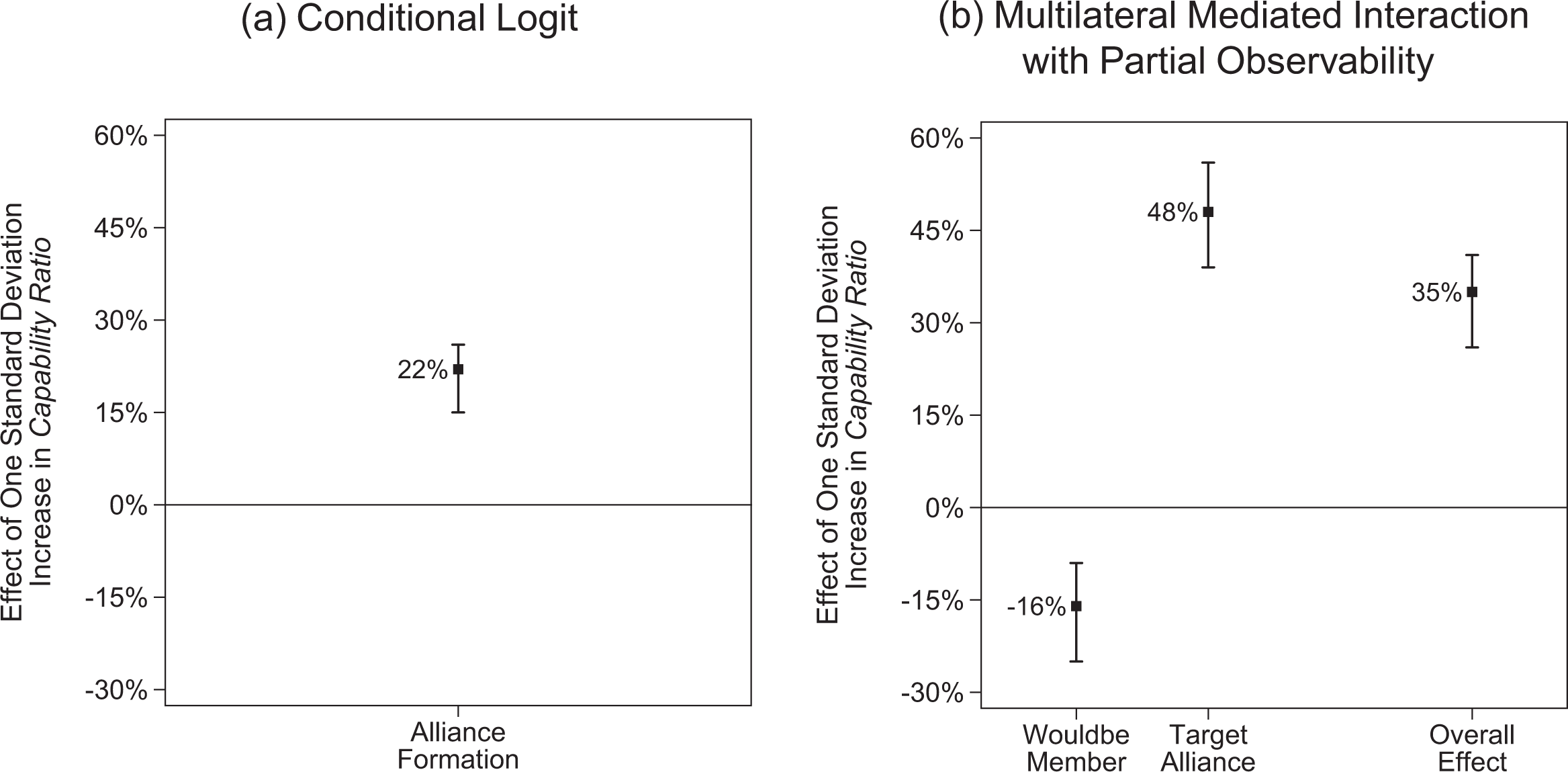
The substantive effect of military capabilities. (a) This figure illustrates the percentage change in the probability of alliance formation when capability ratio increases from its mean to 1 standard deviation above the mean, while all other variables are held at their means. (b) This figure graphs the substantive effect of capability ratio on the state’s and alliance’s incentives separately, as well as the overall effect. The solid square marks indicate the percentage change in probability. The solid vertical lines represent two-tailed 90 percent confidence intervals.
The CL model suggests that the counterfactual increase in a candidate state’s military strength increases the probability of alliance formation by 22 percent [15, 26] (Figure 2a). Much more substantive information can be gleaned from the MMIwPO plot. Given the same counterfactual scenario, the MMIwPO estimates indicate that the probability of the target alliance accepting a militarily strong state increases by 48 percent [39, 56]. Conversely, the probability that a candidate state chooses a weaker alliance decreases by 16 percent [−25, −9] (Figure 2b). Neither of these substantive quantities of interest can be calculated from the CL estimates. The overall (joint) probability of observing a new alliance increases by 35 percent [26, 41], 13 percentage points more than with the inappropriate univariate logit. By ignoring the multiway interaction underpinning an alliance formation scenario, the univariate logit is essentially mixing the effect of military capabilities on the choices of the would-be member and target alliance.
As noted above, the CL results indicate that democratic states are more likely to choose alliances with many democratic members. Yet the MMIwPO estimates suggest that it is the other way around. An alliance with a large share of democratic members is more likely to accept a democratic state, while regime similarity does not play a significant role in a candidate state’s decision to join. Evidence for this line of reasoning comes from the positive and statistically significant coefficient on joint democracy in the Target Alliance column, and the statistically insignificant coefficient on the same variable in the Would-Be Member column. Therefore, the finding of previous studies, where joint democracy is a strong indicator of alliance membership, appears to be driven by alliances’ ideological considerations, and only to a lesser degree of the candidate state.
Of course, it does not have to be the case that all factors that push a candidate state to seek membership in a given alliance make the target alliance less like to accept that state. As expected, the negative and significant coefficients on geographic distance in the Would-Be Member and Target Alliance columns indicate that an increase in the distance between the candidate and alliance members reduces the willingness of both players to cooperate. Lastly, MMIwPO estimates suggest that the MID records of both players affect the probability of alliance formation. In particular, in line with the theoretical expectations, a state is more likely to ally with countries that have the same enemies. This is indicated by the positive and statistically significant coefficient on common threat in the Would-Be Member column. Conversely, an alliance is less likely to accept a new member that has fought with states that are not enemies of its current members. This is to prevent the alliance being dragged into unwanted disputes. Evidence for this comes from the negative and statistically significant coefficient on additional threat in the Target Alliance column.
Conclusions
The conflict in the Eastern Ukraine has already claimed more than 30,000 casualties and left critical civilian infrastructure in ruin (Office of the United Nations High Commissioner for Human Rights 2017). What triggered these events was the Ukrainian executive’s abrupt decision to pull back from an already agreed cooperation with the EU. In the framework of the bilateral interaction between Ukraine and the EU, it is virtually impossible to explain Ukraine’s change of heart. The terms of cooperation, and therefore its value to the signatory parties, did not change in the two months that elapsed form the signing to dismissing the agreement. As a rational actor with consistent preferences, Ukraine should have had the same position on the agreement before and at the Vilnius summit. Reneging the agreement, though, was arguably rational if we acknowledge that for Ukraine, the EU was not the only alternative. Indeed, Ukraine had been simultaneously negotiating with Russia as well. While the absolute value of the EU collaboration did not change, its relative value compared to Russia’s counteroffer did. Thus, the conclusion of the Vilnius summit is the result of the multilateral negotiations between Ukraine on one side, and the EU and Russia on the other.
Extant empirical estimators are not well equipped to analyze multiactor interactions. As a result, the common practice is to employ univariate or bivariate models to analyze multilateral phenomena. These approaches are inappropriate, though, for both substantive and methodological reasons. Substantively, scholars are often interested in how the actors engaged in negotiations individually respond to changes in their environment. Univariate models can only provide insights into how factors affect the incentives of a single actor. Studies that employ bivariate estimators can account for the incentives of two actors, but they still ignore the characteristics and motivations of concerned third parties. Methodologically, analyzing multilateral processes as a set of either monadic or dyadic events biases the results (Croco and Teo 2005; Fordham and Poast 2016; Poast 2010; Signorino 1999).
In this article, I introduce a new MMIwPO model that is specifically designed to analyze multiactor negotiations. In this model, a player chooses whether to cooperate with any, or none, of several potential partners. For their part, each potential partner decides whether to reject or accept any requests for cooperation. To validate the new estimator, I conduct MC simulations that provide strong evidence for the superior performance of MMIwPO relative to the CL. First, likelihood-ratio tests indicate that employing the more complex model is warranted since MMIwPO fits the data significantly better. Second, MMIwPO consistently outperforms the CL in terms of minimizing the bias of estimated coefficients. Specifically, the CL estimates are always bias, but especially so when a factor simultaneously affects the incentives of more than one actor. Where this is the case, neither the direction nor magnitude of the bias can be inferred from the univariate analysis. Consequently, one cannot adjust the point and interval estimates to account for the bias. Since the new estimator can model the input of multiple actors into a unified, overarching decision-making process, the MMIwPO estimates are more consistent.
Lastly, the analysis on alliance formation also highlights the need for a more refined empirical approach. Unlike the CL, MMIwPO is able to distinguish among different types of alliance membership determinants. On the one hand, there are factors that have a similar effect on the candidate state and target alliance (e.g., geographic distance). On the other hand, some factors have different effects on the actors (e.g., joint democracy), with some having opposing effects (e.g., capability ratio). By mixing the determinants’ effect on several actors, existing studies essentially report a weighted average of the different effects. They do so by obscuring the exact influence on any one actor and leading in many cases to incorrect inferences. For example, the CL results suggest that the stronger a state is relative to the alliance members, the more likely it is to seek affiliation with that alliance. MMIwPO estimates, however, suggest that the positive effect from the univariate model is driven by the incentives of target alliances, which are more likely to accept a militarily powerful candidate. In fact, a militarily strong state is less likely to join a weak alliance since it has little to gain from such a commitment.
Supplemental Material
Supplemental Material, appendix - Negotiations in the Shadow of Outside Alternatives: An Estimation Strategy
Supplemental Material, appendix for Negotiations in the Shadow of Outside Alternatives: An Estimation Strategy by Marius Radean in Sociological Methods & Research
Footnotes
Author’s Note
The data and all computer code necessary to replicate the results and figures in this analysis will be made publicly available on the author’s homepage on publication.
Acknowledgments
The author would like to thank Matt Golder, Daina Chiba, Garrett Glasgow, Kristian Skrede Gleditsch, James Honaker, Thomas Plümper, Christopher Reenock, and David Siegel for their helpful comments on this project.
Declaration of Conflicting Interests
The author(s) declared no potential conflicts of interest with respect to the research, authorship, and/or publication of this article.
Funding
The author(s) received no financial support for the research, authorship, and/or publication of this article.
Supplemental Material
Supplemental material for this article is available online.
Notes
References
Supplementary Material
Please find the following supplemental material available below.
For Open Access articles published under a Creative Commons License, all supplemental material carries the same license as the article it is associated with.
For non-Open Access articles published, all supplemental material carries a non-exclusive license, and permission requests for re-use of supplemental material or any part of supplemental material shall be sent directly to the copyright owner as specified in the copyright notice associated with the article.
