



Abstract
Missing data in scientific research go hand in hand with assumptions about the nature of the missingness. When dealing with missing values, a set of beliefs has to be formulated about the extent to which the observed data may also hold for the missing parts of the data. It is vital that the validity of these missingness assumptions is verified, tested, and that assumptions are adjusted when necessary. In this article, we demonstrate how observed data structures could a priori indicate whether it is likely that our beliefs about the missingness can be trusted. To this end, we simulate complete data and generate missing values according several types of MCAR, MAR, and MNAR mechanisms. We demonstrate that in scenarios where the data correlations are either low or very substantial, strictly different mechanisms yield equivalent statistical inferences. In addition, we show that the choice of quantity of scientific interest together with the distribution of the nonresponse govern the validity of the missingness assumptions.
Introduction
The analysis of incomplete data forms a ubiquitous problem in scientific research, especially because any existence of missing data calls for a set of assumptions. In general, it is challenging to solve missing data problems, and although techniques like multiple imputation (MI) (Rubin 1987; Little and Rubin 2002) have proven to be very effective and intuitive, assumptions about the nature of the missingness have to be validly formulated.
Missing data assumptions describe our beliefs about the extent to which the observed data may also hold for the missing parts of the data. Specifically, we separate the class of models where the observed data alone would be sufficient for obtaining valid inference (i.e., Missing Completely At Random or Missing At Random; Rubin 1976) from those models that rely on information that has not been captured in the observed data (i.e., Missing Not At Random; Rubin 1976). Unfortunately, we can never fully distinguish between MAR and MNAR mechanisms based on the observed data alone. After all, “Every missing not at random model has a missing at random counterpart with equal fit” (Molenberghs et al. 2008:371).
Nevertheless, it is vital that the validity of missingness assumptions is verified, tested, and that assumptions are adjusted when necessary. Generally, we investigate how sensitive our inference is in the light of the assumptions we make by means of sensitivity analysis (Molenberghs et al. 2015:317-490). With δ adjustment, for instance, a fixed value δ is added to the imputed values. By repeating the imputation procedure for different values of δ and by comparing the statistical results, it is possible to a posteriori examine the robustness of statistical inferences under different missing data models (Van Buuren 2012:182-87).
In this article, we demonstrate how observed data structures could a priori indicate whether it is likely that our beliefs about the missingness can be trusted, could be trusted, or should be trusted. Knowing the sensitivity of an inference before actually performing the statistical analysis could enhance the way we deal with missing data. Although we cannot escape from posing beliefs about the missing data, the observed data can give us an indication whether our beliefs should be believed. The remainder of this article has the following structure. First, we will provide a more technical discussion of missing data assumptions. We will then outline our simulation study in the third section and present our findings in the fourth and fifth section. In the sixth section, we discuss implications of these findings.
Missingness Assumptions
Consider data matrix The distribution of

with

indicating that the missing data model is governed by the observed data. Although in this situation the response and nonresponse represent different parts of the population, a proper conditioning of the incomplete variables on the observed data will still result in valid statistical inferences. Therefore, Rubin (1976) called these kinds of missingness ignorable. With MNAR missingness, the probability of being missing also depends on the unobserved information:

As a consequence, the missing data are nonignorable, meaning that the observed data alone are not sufficient to infer about the population (Rubin 1976). In such cases, we have to conclude that the response and nonresponse represent not only different but also unique parts of the true data.
Even though the observed and unobserved data sets may represent different and unique parts of the true data, the degree to which they are connected may be of great influence on the legitimacy of any missing data method. It is for this reason that many authors advocate the inclusion of predictor variables in the imputation procedure (e.g., Rubin, Stern, and Vehovar 1995; Schafer 1997; Van Buuren 2012). Important work from Collins, Schafer, and Kam (2001) showed that the inclusion of a variable that correlates either with the incomplete variable or with the missingness indeed improves parameter estimation. With our research, we intent to add to existing knowledge by (1) presenting the trends in the behavior of missingness mechanisms and (2) focusing on assumptions about the missingness distributions. As a consequence, we provide a context for situations where MCAR, MAR, and MNAR mechanisms may be much more or much less comparable than one would expect based on theory.
Design of the Experiment
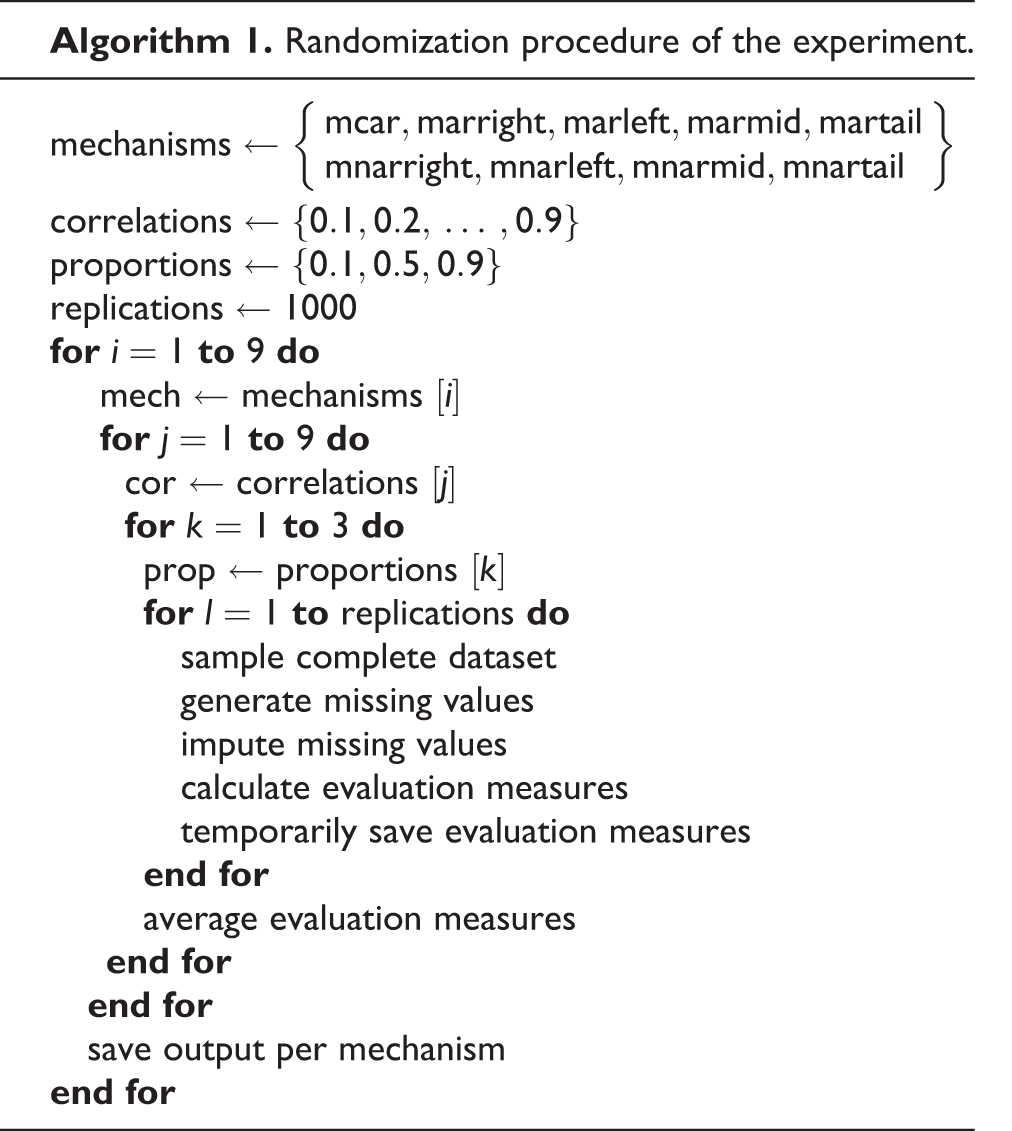
To demonstrate the relationship between the missingness, the observed data, and the true data model, we perform a model-based simulation in R (R Core Team 2017). The design of the simulation is summarized in Algorithm 1 and basically consists of four steps: data set sampling with changing data correlations (j = 1:9), generating missing values with varying missingness proportions (k = 1:3) and missingness mechanisms (i = 1:9), MI, and evaluation of statistical parameters. Each combination of i, j, and k is replicated 1,000 times (l = 1:1,000), making the simulation a Monte Carlo type of simulation with
Randomization procedure of the experiment.
For the data sampling, we draw N = 1,000 cases from a bivariate normal distribution with
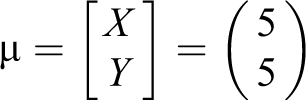
and covariance matrix

We vary the correlation between X and Y with ρ in
We induce missingness (i.e., amputation) in variable Y and evaluate MCAR, MAR, and MNAR missingness mechanisms. We subdivide the MAR and MNAR mechanisms into those that consider the incomplete variable’s left tail (LEFT), right tail (RIGHT), both tails (TAIL) or the distributional center (MID). When we induce MAR missingness, the probability for Y to be missing is a function of X. The four distribution functions (LEFT, RIGHT, MID, and TAIL) are demonstrated in Figure 1. In contrast, when we consider MNAR missingness, the true value of Y governs the probability for Y itself to be missing. Furthermore, we generate three kinds of missingness proportions: 0.1, 0.5, and 0.9. Note that these values indicate the sampled proportion of incomplete cases in Y. We leave X as an always observed covariate. For all conditions, the missing values are generated with multivariate amputation function
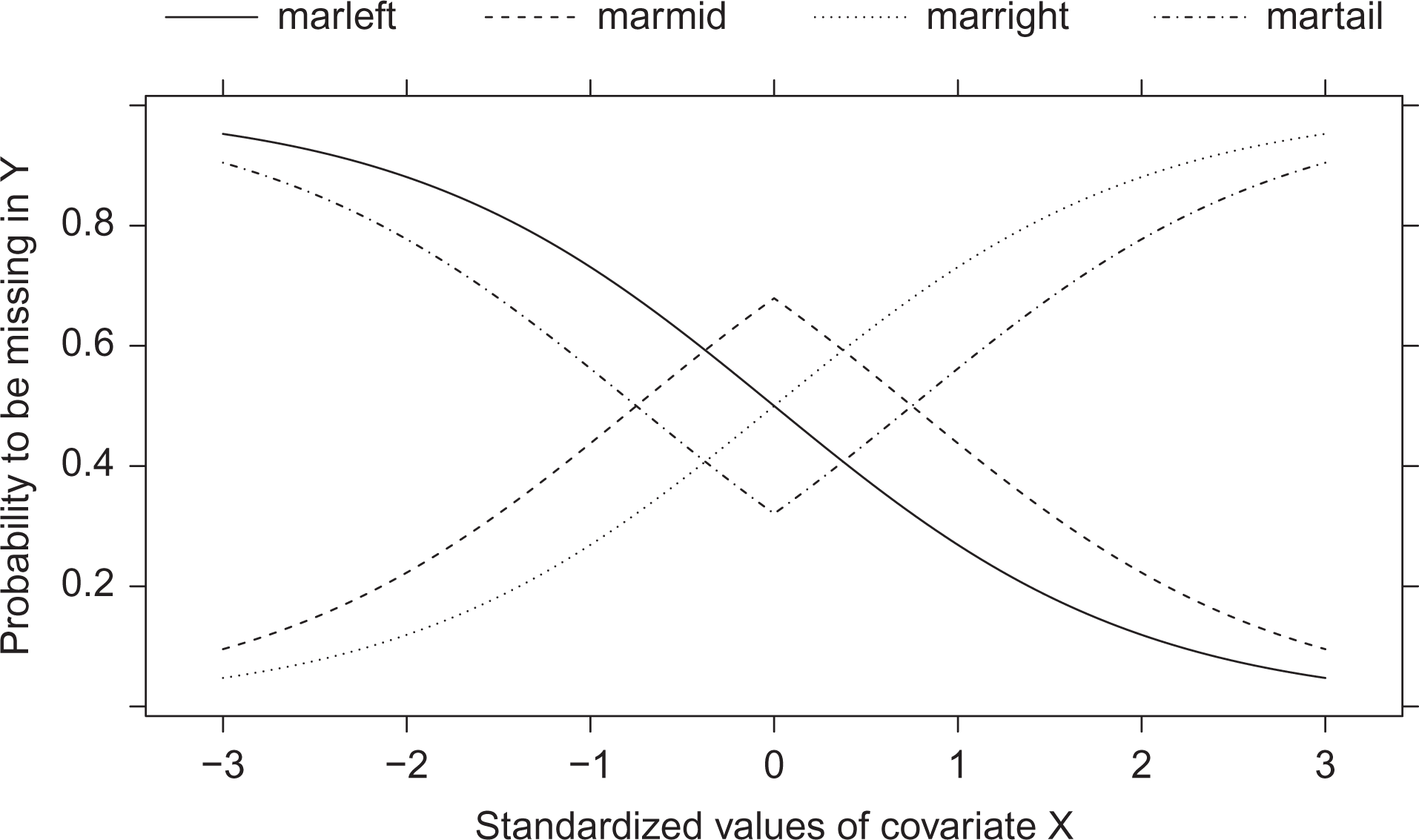
Four types of the logistic distribution function (Van Buuren 2012:64).
Every incomplete data set is imputed with
We focus our evaluation on three kinds of parameters: means, variances, and correlation. To investigate the first two, we use the bias, the coverage rate of the 95 percent confidence intervals and the width of that confidence interval of the expectation of
Results
Our results display various situations where the theoretical distinctions between missingness assumptions do not appropriately describe the actual effect of a missing data problem on statistical inference making. We will first discuss the behavior of estimates of the mean, variance, and correlation under CCA and then repeat the process for MI.
CCA
Mean
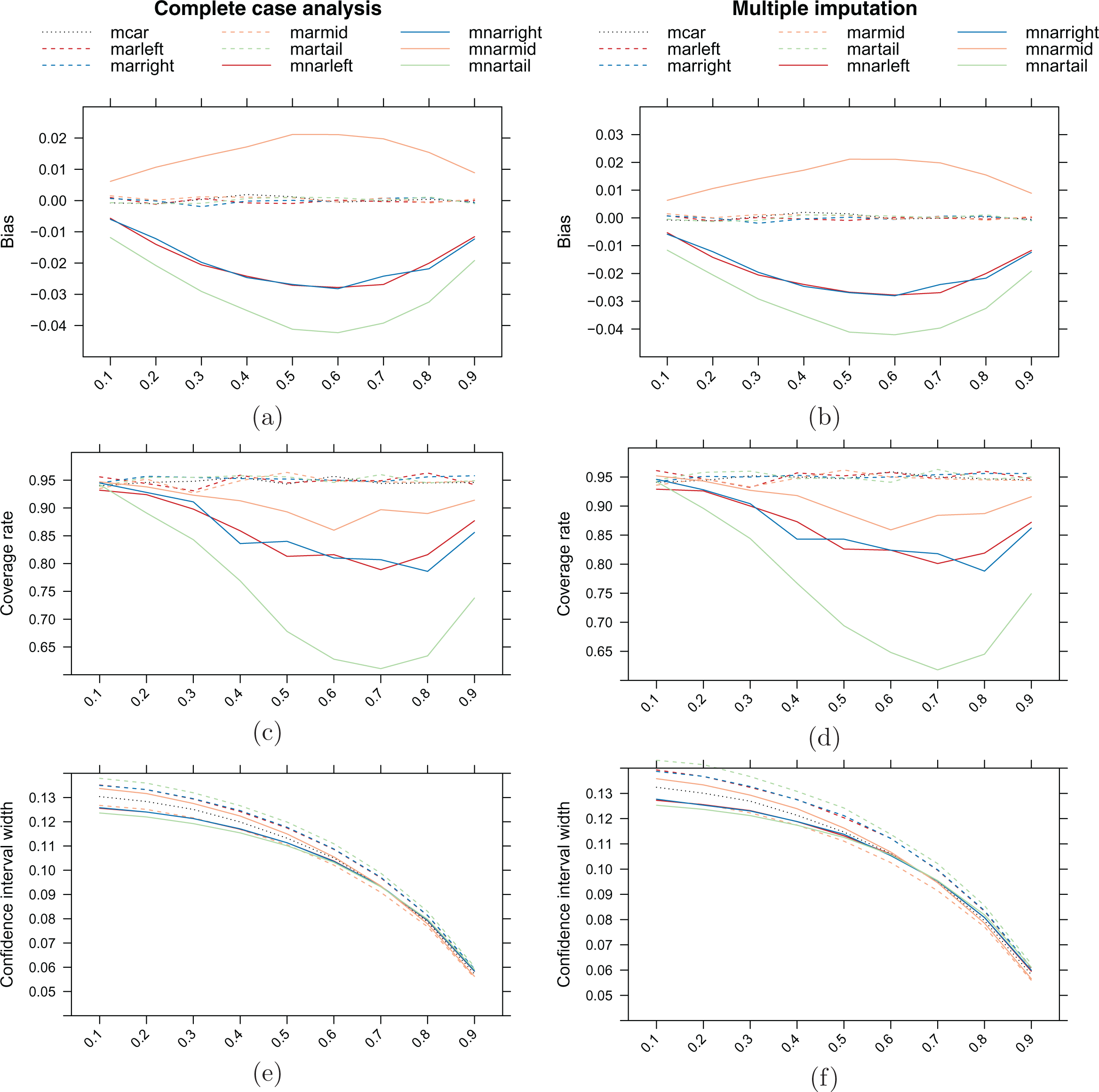
Our simulation results show that different missingness mechanisms yield similar statistical inferences. For instance, Figure 2a shows that for all MID and TAIL types of missingness, the estimates of
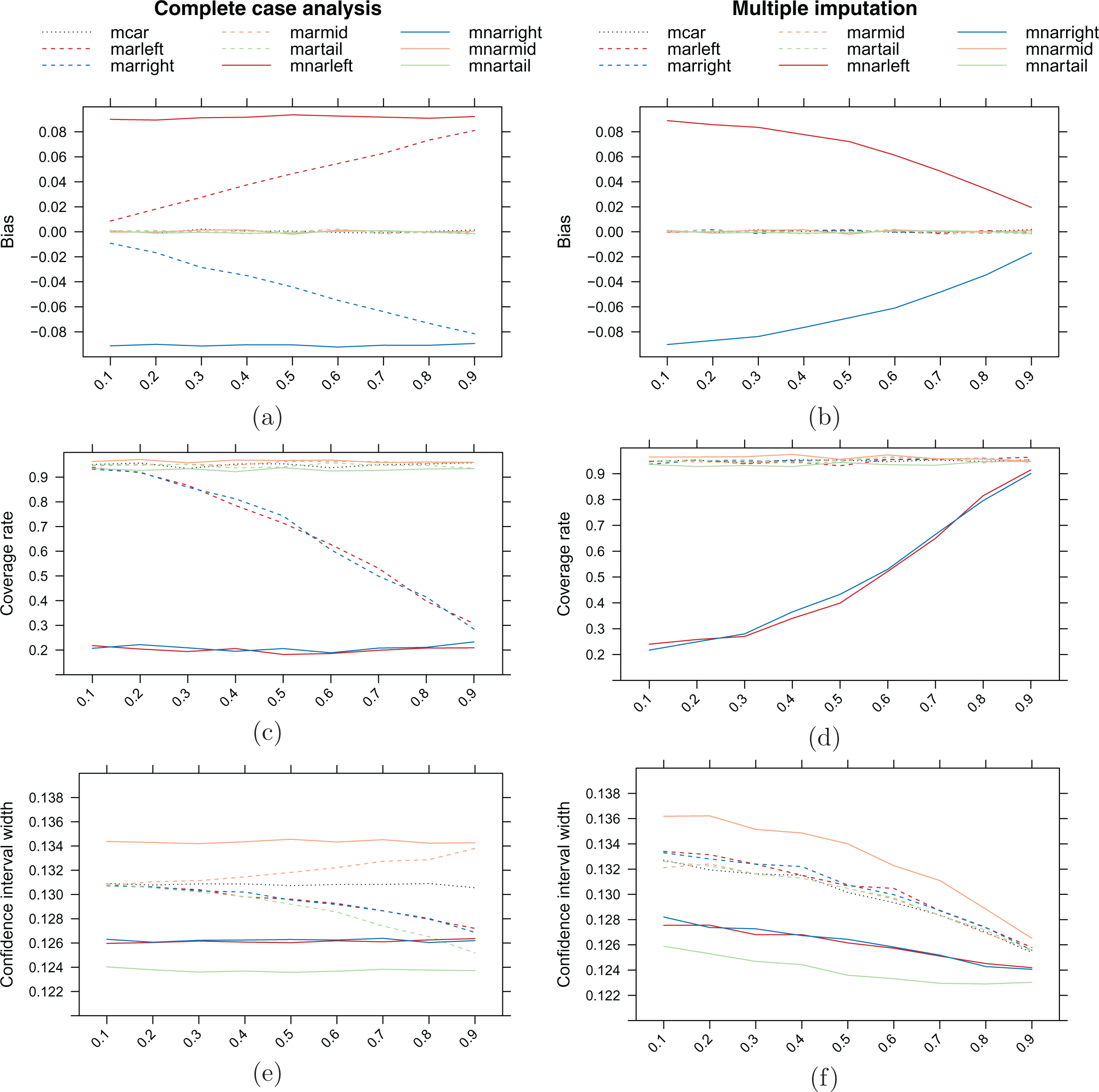
Coverage rate, average bias, and average confidence interval width of
When the missing data affect the symmetry of the true data distribution, we will obtain biased estimates of
The size of the true data correlation determines whether statistical inferences are similar despite of different underlying missingness mechanisms. Figure 2a and c shows that when the correlation between variables X and Y is low, bias in the estimates of
Variance
The observed distribution of Y determines the precision of an estimate of
Correlation
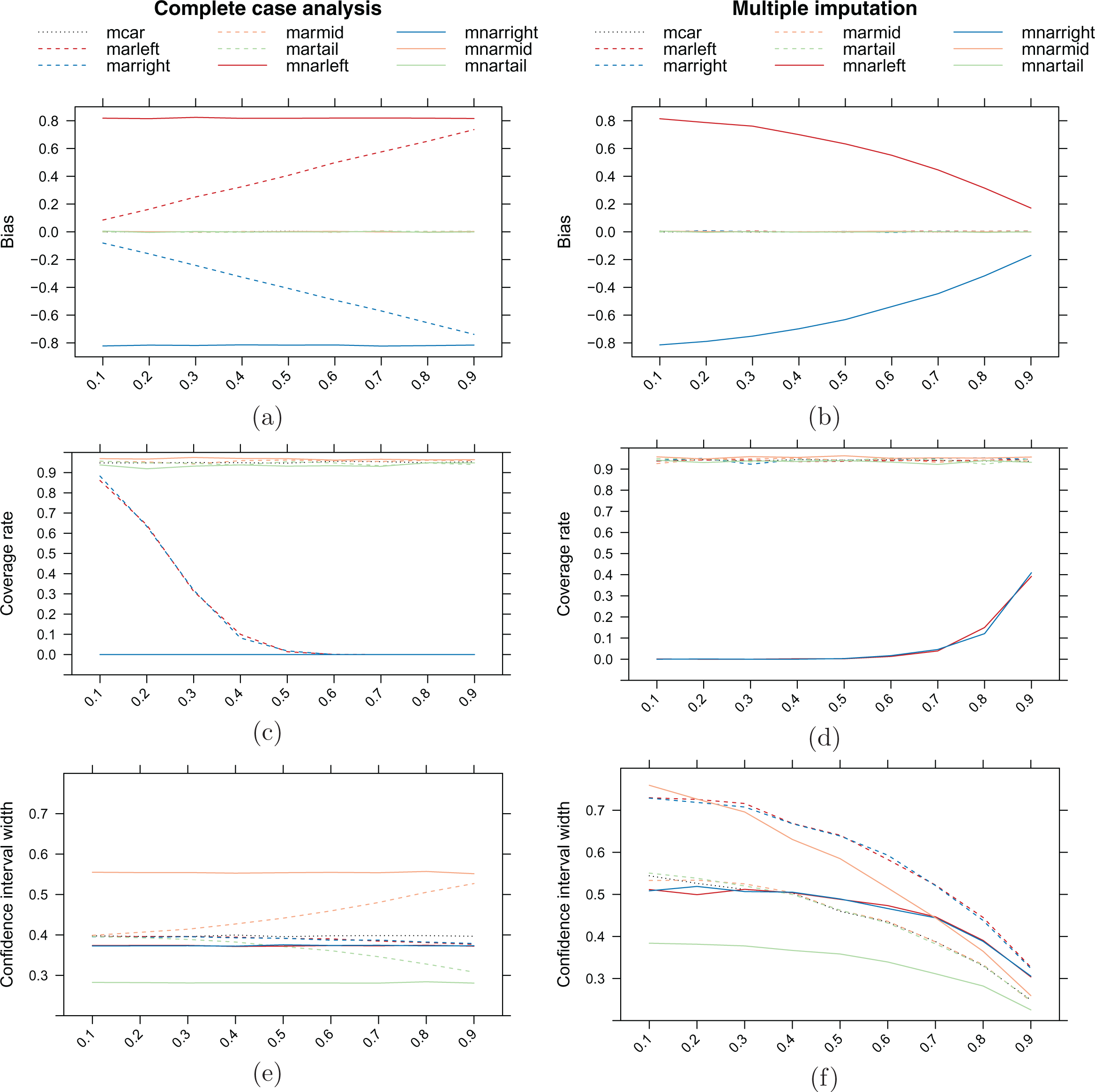
With CCA, estimates of correlation coefficient ρ are unaffected by the theoretical differences between MAR and MCAR missingness mechanisms. Figure 3a shows unbiased estimates of
Coverage rate, average bias, and average confidence interval width of
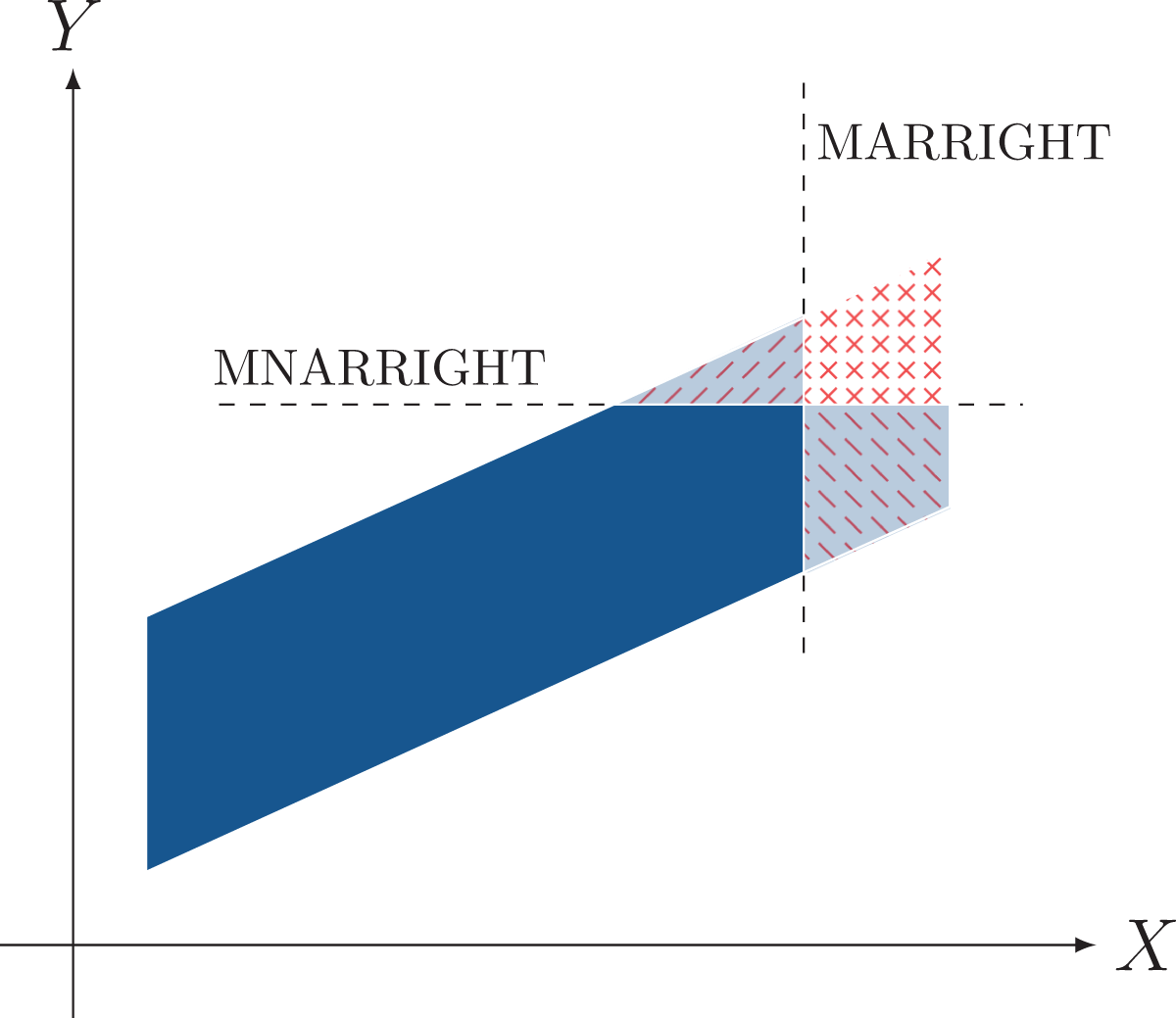
Schematic depiction of the relation between variables Y and X with missing values in Y. It is apparent that in this scenario, MARRIGHT will not influence the β coefficient. MNARRIGHT, on the other hand, has a direct influence on
With low and high true data correlations, CCA estimates of
The type of missingness affects the magnitude of possible bias and undercoverage of
MI
Mean
As expected, under MAR statistical inferences of
However, Figure 2b and d shows that in the situation of a theoretical MNAR mechanism, a high correlation enables MI to obtain valid statistical estimates of
Variance
In addition, high data correlations enable MI to thoroughly use the observed information to obtain not only valid but also efficient statistical estimates. At first, we see that with 10 percent missingness, MI increases the ciw from 0.131 (under CCA) to 0.133. This is due to between-imputation variance. However, after performing MI, a higher data correlation decreases the ciw toward 0.125 (Figure 2f). With 90 percent missingness, this effect is more pronounced with the ciw being reduced from 0.544 to 0.249 (Figure 5f).
Coverage rate, average bias, and average confidence interval width of
Correlation
For estimates of
When data correlations increase, MI is not able to decrease the bias or increase the coverage rates of
Proportion
We present the results for estimates of
However, an increased missingness proportion does have an effect on the size of possible bias, coverage, and variance measures. Although the trends in Figure 5 are comparable with Figure 2, a missingness proportion of 0.9 increases the absolute values. For instance, the observed bias after CCA increases with factor 10 (Figure 5a) and the ciw’s with factor 30 (Figure 5e). In addition, for RIGHT and LEFT missingness, the coverage rates drop way faster when more values are missing (Figure 5c) and even when the data correlation is 0.9, MI is no longer able to improve the coverage rates all the way to 95 percent (Figure 5d).
Key Findings
Mean: With low true data correlations, CCA estimates of Variance: Regardless of whether the underlying mechanism is MAR or MNAR, MID, and TAIL, missingness influences the variance of the observed data distribution. High data correlations enable MI to reduce the variance in estimates of Correlation: The estimated correlation coefficient is not affected by MAR and MCAR missingness. With low and high true data correlations, CCA estimates of
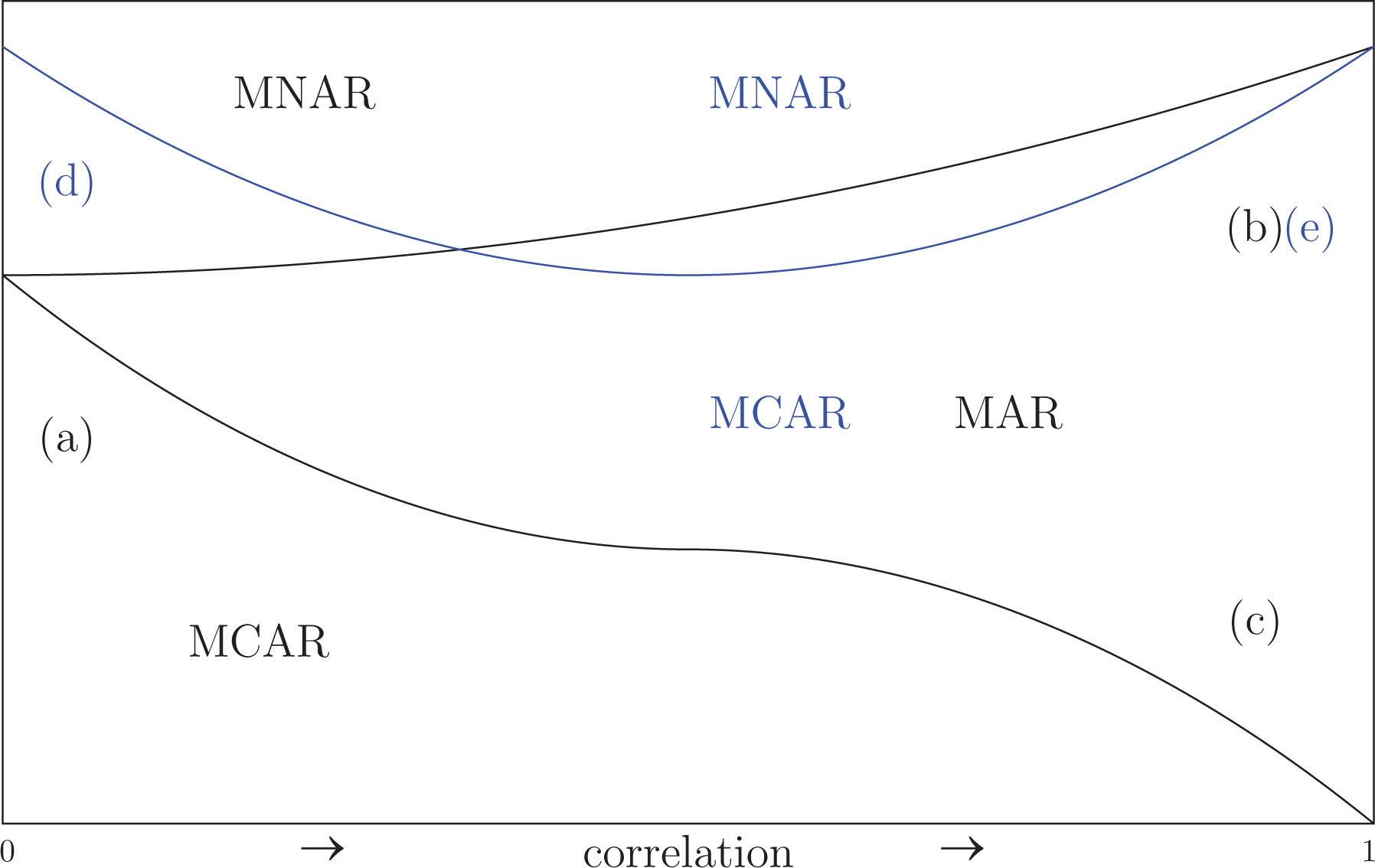
Graphical representation of the impact of data correlations on missingness assumptions. Black and blue lines illustrate estimates of
Discussion
In practice, applied researchers often conveniently assume MAR missingness and proceed with incomplete data methods. We demonstrate that simply assuming a mechanism in order to warrant an analysis may be severely limiting to the statistical inference that can be obtained. It is vital to validate the likelihood of the assumed mechanism, given the observed data structures. For example, when the variables of a data set are barely correlated, MAR and MCAR missingness may become indistinguishable. In such cases, assuming MAR to allow for the use of MI would limit statistical power. MI would merely increase the variance without the need for decreasing bias.
The reverse is also true: Assuming MNAR missingness on highly correlated data may be unnecessary as the essence of the missing data may be sufficiently covered by the observed information. The response and nonresponse are connected at the population level. Our findings confirm that with increased data relations, this link improves the performance of missing data methods. As a result, an applied researcher’s hope for obtaining valid MAR-based inference on MNAR data can be justified when their variables are highly correlated. It is needless to say we can “force” such a situation by including the right variables.
A comprehensive insight into the nature of missingness mechanisms is also important for evaluations of missing data methodology. Although it may seem obvious that any simulation study evaluating the performance of a missing data method should generate a legitimate (i.e., as intended) missing data problem, our results identify situations where a theoretical appropriate mechanism can have an unexpected, not so large impact on the data. When performing simulation studies, we strongly recommend researchers to perform CCA to investigate the effects of a generated missing data problem. When CCA returns biases close to zero, coverage rates close to 95 percent or very large ciws, it is wise to revisit the simulation conditions. After all, “A missing value treatment cannot be properly evaluated apart from the modeling, estimation or testing procedure in which it is embedded” (Schafer and Graham 2002:149).
We believe that our missingness assumptions are not merely a subjective nuisance that dictates whether or not we may proceed with the inferential statistics we value so dearly. Instead, we advocate the approach that our assumptions are an elegant, interwoven part of the system that gives us our inference. We encourage researchers to obtain deeper insights into the (overlapping) behavior of MAR and MNAR mechanisms. We expect that our findings generalize to larger data structures but to investigate whether the same phenomena can be observed for data sets with more variables or higher dimensions, an extension of our simulation to other settings would be necessary. Ultimately, the goal is to obtain valid statistical inferences and the set of beliefs we formulate are the only means to bridge the gap between what is observed and what is missing.
Supplemental Material
Supplemental Material, Figure7a - The Dance of the Mechanisms: How Observed Information Influences the Validity of Missingness Assumptions
Supplemental Material, Figure7a for The Dance of the Mechanisms: How Observed Information Influences the Validity of Missingness Assumptions by Rianne Margaretha Schouten and Gerko Vink in Sociological Methods & Research
Supplemental Material
Supplemental Material, Figure7b - The Dance of the Mechanisms: How Observed Information Influences the Validity of Missingness Assumptions
Supplemental Material, Figure7b for The Dance of the Mechanisms: How Observed Information Influences the Validity of Missingness Assumptions by Rianne Margaretha Schouten and Gerko Vink in Sociological Methods & Research
Supplemental Material
Supplemental Material, Figure7c - The Dance of the Mechanisms: How Observed Information Influences the Validity of Missingness Assumptions
Supplemental Material, Figure7c for The Dance of the Mechanisms: How Observed Information Influences the Validity of Missingness Assumptions by Rianne Margaretha Schouten and Gerko Vink in Sociological Methods & Research
Supplemental Material
Supplemental Material, Figure7d - The Dance of the Mechanisms: How Observed Information Influences the Validity of Missingness Assumptions
Supplemental Material, Figure7d for The Dance of the Mechanisms: How Observed Information Influences the Validity of Missingness Assumptions by Rianne Margaretha Schouten and Gerko Vink in Sociological Methods & Research
Supplemental Material
Supplemental Material, Figure7e - The Dance of the Mechanisms: How Observed Information Influences the Validity of Missingness Assumptions
Supplemental Material, Figure7e for The Dance of the Mechanisms: How Observed Information Influences the Validity of Missingness Assumptions by Rianne Margaretha Schouten and Gerko Vink in Sociological Methods & Research
Supplemental Material
Supplemental Material, Figure7f - The Dance of the Mechanisms: How Observed Information Influences the Validity of Missingness Assumptions
Supplemental Material, Figure7f for The Dance of the Mechanisms: How Observed Information Influences the Validity of Missingness Assumptions by Rianne Margaretha Schouten and Gerko Vink in Sociological Methods & Research
Supplemental Material
Supplemental Material, Figure8a - The Dance of the Mechanisms: How Observed Information Influences the Validity of Missingness Assumptions
Supplemental Material, Figure8a for The Dance of the Mechanisms: How Observed Information Influences the Validity of Missingness Assumptions by Rianne Margaretha Schouten and Gerko Vink in Sociological Methods & Research
Supplemental Material
Supplemental Material, Figure8b - The Dance of the Mechanisms: How Observed Information Influences the Validity of Missingness Assumptions
Supplemental Material, Figure8b for The Dance of the Mechanisms: How Observed Information Influences the Validity of Missingness Assumptions by Rianne Margaretha Schouten and Gerko Vink in Sociological Methods & Research
Supplemental Material
Supplemental Material, Figure8c - The Dance of the Mechanisms: How Observed Information Influences the Validity of Missingness Assumptions
Supplemental Material, Figure8c for The Dance of the Mechanisms: How Observed Information Influences the Validity of Missingness Assumptions by Rianne Margaretha Schouten and Gerko Vink in Sociological Methods & Research
Supplemental Material
Supplemental Material, Figure8d - The Dance of the Mechanisms: How Observed Information Influences the Validity of Missingness Assumptions
Supplemental Material, Figure8d for The Dance of the Mechanisms: How Observed Information Influences the Validity of Missingness Assumptions by Rianne Margaretha Schouten and Gerko Vink in Sociological Methods & Research
Supplemental Material
Supplemental Material, Figure8e - The Dance of the Mechanisms: How Observed Information Influences the Validity of Missingness Assumptions
Supplemental Material, Figure8e for The Dance of the Mechanisms: How Observed Information Influences the Validity of Missingness Assumptions by Rianne Margaretha Schouten and Gerko Vink in Sociological Methods & Research
Supplemental Material
Supplemental Material, Figure8f - The Dance of the Mechanisms: How Observed Information Influences the Validity of Missingness Assumptions
Supplemental Material, Figure8f for The Dance of the Mechanisms: How Observed Information Influences the Validity of Missingness Assumptions by Rianne Margaretha Schouten and Gerko Vink in Sociological Methods & Research
Supplemental Material
Supplemental Material, Figure9a - The Dance of the Mechanisms: How Observed Information Influences the Validity of Missingness Assumptions
Supplemental Material, Figure9a for The Dance of the Mechanisms: How Observed Information Influences the Validity of Missingness Assumptions by Rianne Margaretha Schouten and Gerko Vink in Sociological Methods & Research
Supplemental Material
Supplemental Material, Figure9b - The Dance of the Mechanisms: How Observed Information Influences the Validity of Missingness Assumptions
Supplemental Material, Figure9b for The Dance of the Mechanisms: How Observed Information Influences the Validity of Missingness Assumptions by Rianne Margaretha Schouten and Gerko Vink in Sociological Methods & Research
Supplemental Material
Supplemental Material, Figure9c - The Dance of the Mechanisms: How Observed Information Influences the Validity of Missingness Assumptions
Supplemental Material, Figure9c for The Dance of the Mechanisms: How Observed Information Influences the Validity of Missingness Assumptions by Rianne Margaretha Schouten and Gerko Vink in Sociological Methods & Research
Supplemental Material
Supplemental Material, Figure9d - The Dance of the Mechanisms: How Observed Information Influences the Validity of Missingness Assumptions
Supplemental Material, Figure9d for The Dance of the Mechanisms: How Observed Information Influences the Validity of Missingness Assumptions by Rianne Margaretha Schouten and Gerko Vink in Sociological Methods & Research
Supplemental Material
Supplemental Material, Figure9e - The Dance of the Mechanisms: How Observed Information Influences the Validity of Missingness Assumptions
Supplemental Material, Figure9e for The Dance of the Mechanisms: How Observed Information Influences the Validity of Missingness Assumptions by Rianne Margaretha Schouten and Gerko Vink in Sociological Methods & Research
Supplemental Material
Supplemental Material, Figure9f - The Dance of the Mechanisms: How Observed Information Influences the Validity of Missingness Assumptions
Supplemental Material, Figure9f for The Dance of the Mechanisms: How Observed Information Influences the Validity of Missingness Assumptions by Rianne Margaretha Schouten and Gerko Vink in Sociological Methods & Research
Supplemental Material
Supplemental Material, Pages_from_smr-17-0083 - The Dance of the Mechanisms: How Observed Information Influences the Validity of Missingness Assumptions
Supplemental Material, Pages_from_smr-17-0083 for The Dance of the Mechanisms: How Observed Information Influences the Validity of Missingness Assumptions by Rianne Margaretha Schouten and Gerko Vink in Sociological Methods & Research
Footnotes
Acknowledgments
The authors gratefully acknowledge Andrew Gelman for facilitating a variety of interesting research projects. This article is the outcome of an inspiring and pleasant visit to a beautiful city and a great team of researchers. The authors gratefully acknowledge Stef Van Buuren for reviewing a previous draft of this article.
Declaration of Conflicting Interests
The author(s) declared no potential conflicts of interest with respect to the research, authorship, and/or publication of this article.
Funding
The author(s) received no financial support for the research, authorship, and/or publication of this article.
Supplemental Material
Supplemental material for this article is available online.
References
Supplementary Material
Please find the following supplemental material available below.
For Open Access articles published under a Creative Commons License, all supplemental material carries the same license as the article it is associated with.
For non-Open Access articles published, all supplemental material carries a non-exclusive license, and permission requests for re-use of supplemental material or any part of supplemental material shall be sent directly to the copyright owner as specified in the copyright notice associated with the article.
