



Abstract
The article explores the role that subjective evidence of causality and associated counterfactuals and counterpotentials might play in the social sciences where comparative cases are scarce. This scarcity rules out statistical inference based upon frequencies and usually invites in-depth ethnographic studies. Thus, if causality is to be preserved in such situations, a conception of ethnographic causal inference is required. Ethnographic causality inverts the standard statistical concept of causal explanation in observational studies, whereby comparison and generalization, across a sample of cases, are both necessary prerequisites for any causal inference. Ethnographic causality allows, in contrast, for causal explanation prior to any subsequent comparison or generalization.
This article explores the role that subjective statements about causality and their associated subjective counterfactuals and counterpotentials may be allowed to play in the social sciences, where ethnographic techniques and the “social construction” of causality are appropriately invoked. The background to this exploration is the theory of Bayesian narratives (Abell 1987, 2009a, 2009b), where subjective statements may be used as evidential items (amongst others) in Bayesian causal inference. Such inferences are required when frequency-based statistical approaches are impossible because of limited numbers of comparative cases (units of analysis) and a singular ethnographic concept of causality must inevitably be deployed in each case. Any subsequent limited generalization, usually across a small number of cases, will place causal inference (explanation) as logically prior to both comparison and generalization. Ethnographic researchers usually suggest that “justified belief,” rather than “objective truth” (Cardano 2009), is generated in social interactions between the observed informant and the ethnographer. 1 The inquiry will be pursued with this in mind.
The concept of causality is, of course, itself controversial among ethnographers, many of whom seek to disavow the concept altogether, remaining content with “an understanding of the meaning of human actions” which is largely conceived as a descriptive exercise which rejects “why questions” (Small 2013). Nevertheless, Abend, Petrie, and Sauder (2013) find that many ethnographic studies do entertain some concept of causality though the precise method of establishing a causal inference from ethnographic data remains rather difficult to fathom. In addition, the extensive literature on qualitative, small-N case–based research has engaged with concepts of causality but almost invariably in a comparative perspective where
Here, we adopt what may be called a “mechanism approach” to causality, whereby human activity provides the causal connection (motor energy) between the causal and outcome/effect states (Goldthorpe 2001; Hedström 2005). We, thus, examine causal links (designated as an arrow: →) which take the general form
Nevertheless, there is an immediate parallel between the formulation
The extensive debates in various literatures about the nature of causal inference have often been limited to the context of a large-N frequency framework. Breaking with this tradition in the direction of what we may cautiously call singular causality is full of hazards. This may account for the fact that a small-N concept of causality, consistent with “uniqueness”
The article will proceed as follows. Firstly, the nature of subjective causal, counterfactual, and counterpotential statements is briefly reviewed. Secondly, a small illustrative (and only illustrative) empirical study is introduced. Thirdly, Bayesian narratives are briefly outlined. Fourthly, the process of Bayesian inference to credible beliefs is examined. Fifthly, the inference through credible beliefs to causal connections is outlined. Sixthly, the conception of meta-ethnography is introduced. Then, the illustrative empirical study is reintroduced and finally the article briefly concludes.
Subjective Causal, Counterfactual, and Counterpotential Statements
Assume an observer/ethnographer elicits statements from an actor about her or his completed action, namely doing (1) “I did (2) “I would not have done
Alternatively, the ethnographer might elicit information, from the actor about his or her future anticipated course of action as follows: (3) “If (4) “If
Both Xc
and Y may comprise of more or less complex descriptions, which are proffered in the actor’s own descriptive language (discourse) which we may assume will be derived from his or her own cultural heritage.
6
The statements (1)–(4) may also reflect the actor’s uncertainty and consequently be expressed in a probabilistic form. Furthermore, statements may also derive, not from the actor commissioning the action, but from alternative informants claiming information about the focal action, which will generate subjective statements along the lines of “because of Xc
he or she did
The key logical point is that subjective elicitation apparently surrenders information about both the cause and counterfactual for the same unit of analysis, namely the actor commissioning the action. In this respect, if credibility can be ascertained, there is a clear advantage of such data over much comparative statistical data in many observational studies where intra-unit comparisons are not possible; though Pearl’s (2009) do-calculus does provide a route to intra-unit counterfactuals.
The problem we face is: under what assumptions may an analyst, who might or might not be the ethnographer, allow elicited subjective statements to stand as credible evidence for a justified retro-predictive belief that: (5) Xc
caused the actor to do Xo
Or prediction that: (6) Xc
will cause the actor to do Xo
It is important to note that, from an ethnographic standpoint, the subjective evidence, namely the causal and counterfactual statements themselves, must explicitly be associated with a specified ethnographer. Ethnographic principles require an acknowledgment that the informant’s statements are generated by virtue of the social interaction of the informant and ethnographer, wherein the credibility of the informant and the informant’s statements come to be assessed by the ethnographer. Clearly, how and why ethnographers assign credibility is a complex issue which warrants further attention.
Several points of initial clarification should be made. Firstly, some ethnographers would immediately cavil at the inferences to causality between set (7) “I (she and he, we, etc.) could have not done Xo
(forborne to do (8) “I (she or he, we, etc.) could have done Xo
if not
Similarly, the future tense statements can also be accompanied by counterpotentials. We may assume that counterpotentials preserve the voluntary nature of human action whilst maintaining the possibility of an inference to causality. That is to say, though informants can speak of why actors did/will do
The attraction of the various subjective statements outlined above is that they can all apparently be acquired by an ethnographer relating to a specific action (forbearance). Thus, if they are mutually understood by an ethnographer and an informant and deemed as credible by the former, they open a route (albeit only probabilistic) to causal inference without the need to generalize across comparative units. That is to say, as we have noted above, causality can then, in principle, be justified in the absence of comparators and statistical covariation. This allows that single case studies may, if handled carefully, surrender causal information and causality (explanation) may then be generalized by comparing a number of cases. The procedure is only appropriate when the number of cases falls short of a statistical sample. Everything depends, however, upon the credibility afforded to the subjective statements. How should they be elicited and then treated as credible evidence for a justified causal inference?
Under what conditions may we assume the informant understands what the causes and objectives of his own and others actions are and is able to impart this understanding to the ethnographer in virtue of the elicitation of subjective statements? Certainly, if the vocabulary in which the elements of sets
If we switch to prediction rather than retrodiction, then things are not quite as bleak because the ethnographer can treat subjective statements as predictive and test this assumption if and when appropriate circumstances arise. Nevertheless, the conditions under which subjective causal, counterfactual, and counterpotential statements can be relied upon as sources of credible evidence are far from transparent. Furthermore, when multiple ethnographers are introduced alongside multiple informants into the mix, then the problems of comparing the likely varying elicited statements, with a view to compendious causal inference, clearly exacerbates the inferential problems. We hope to take these issues up in a subsequent paper.
An Illustrative Empirical Example: An Initial Look
We introduce here an illustrative empirical example which will be explored in more detail later in the article.
7
In a study of producer cooperatives in developing countries, explanations were sought as to why many failed, whereas very few prospered (Abell 1990). Attempts to find a statistical model to account for this asymmetric distribution, which was generalizable across cases proved elusive. To put it succinctly, each case appeared to be rather historically unique and a subsequent in-depth study of a single highly successful cooperative lead to the theory of Bayesian narratives (below). Here, we concentrate upon a single action, whereby the collective governing board appointed an external professional manager. A senior member of the governing body was asked the question, after a great deal of exploratory discussion, “why was an independent manager appointed?”
8
The answer (while improving the expressed English) was as follows: Because sales were dropping, the quality of the products was not competitive, and the problems of discipline were uncontrolled, a manager was appointed to improve the all-round performance whilst making the cooperative an attractive place to work.

It is important to recognize that this statement was mutually constructed in the interaction of the ethnographer/author and the informant and was endorsed by the informant as a correct and an acceptable causal explanation of the action taken and its outcome. The author/ethnographer was now faced with equation 1 assessing the credibility of this statement and equation 2 inferring causality.
Thus, the possible causal inference takes the form:

where the author of If falling sales, uncompetitive products and discipline problems had not been the case then we (the governing body) would not have appointed an independent manager
Bayesian Narratives
A narrative (Abell 1987, 2009b) comprises a time distributed a-cyclic directed “and-digraph” (and-DAG) constructed from multiple causal connections of the form
First, note that subjective statements examined above refer to both the complex conjunctions of events
Subjective evidence will be available for each action under investigation. The assembly of sets
The important point to note is that from an ethnographic standpoint the initial causal/counterfactual subjective statements are elicited as evidential material during the social interaction of the informants and the identified ethnographers. That is to say, the inferences are socially constructed creating posterior beliefs on the ethnographer’s behalf, given the perceived credibility of the evidential statements. The degree of credibility, once established by an ethnographer, will constitute a prior for an inference to the hypothesis that there is justified belief in the generative causal link between sets
Ethnographic practitioners are assiduous in recording (producing text) charting the details of such interactions and inferences. They would no doubt label this record, if pursued with due diligence, as charting the social construction of the belief (or disbelief) in the credibility of the informants statement and then to justified belief in the causal link.
We need eventually to place this procedure within the framework of Bayesian inference. First, however, the causal states which are members of sets
The members of the causal set, Xc
, and outcome set Y may, however, both vary across informants. Then to what extent is there agreement amongst the informants about the states/nodes in, respectively, both sets
The analysis, thus, enables answers to be given, in a systematic manner, as to whether a particular causal or outcome state is sufficiently endorsed by the informants to be included in, respectively, sets Xc and Y which are to be subjected to the Bayesian inference. 10
Bayesian Inference to Credible Beliefs
Consider the causal linkage between sets
Given



where

Thus, from e's prior odds and estimation of the likelihood ratio
If, however, we set the prior odds at unity, which some ethnographers appear, by implication so to do, then the likelihood ratio is numerically equal to the posterior odds.
13
In this situation, e has merely to estimate her or his likelihood ratio. Estimation of this nature might still appear rather demanding of the ethnographer. If, however, the estimate is reported alongside an explicit statement of
Ethnographers, at this juncture, might still cavil—wherein lies the benefit in making this probabilistic estimate rather than merely reporting
Let us stay with a single ethnographer e, but now introduce m conjunctive, subjective statements

The log odds of

where
Dropping the assumption that the evidential statements are independent, conditional on
Clearly, it would prove difficult for the ethnographer to estimate each of a string of
From Subjective Statements Through Credible Beliefs to Justified Belief in Causal Connections
If we now allow an inference, by a given ethnographer, from the subjectively provided evidence to a “justified belief” in the probability of the actual existence of the causally generated mechanism

where
Thus, as per the above, the ethnographer estimates the likelihood ratio at the aggregate level across all evidential statements. It important, however, to understand the logical structure of such an inference, particularly how it embodies the ethnographer’s credible beliefs which do not appear in the equation. We are interested in how credible beliefs in the available evidence do or do not license inference to the
It is convenient, however, given our above analysis to consider a single item of evidence s, rather than m items and to drop the designation of the ethnographer, e, thus reducing the complexity of the notation. We need to examine L in this situation (which is, of course, distinct from LS defined above). With this objective in mind:



With similar expressions for

And substituting (11) in (8), we get

Thus, our target,

The aggregate estimate by the ethnographer of the ratio L is, thus, logically constituted from constituent likelihood ratios. In a deep analysis, these could be estimated by the ethnographer to unpack L, but this would, of course, be a rather demanding and is an unlikely empirical procedure except perhaps when differing ethnographers reach inconsistent conclusions about L. Then, some unpacking may reveal wherein differences lie. The ethnographer’s estimate of the prior odds and likelihood ratio will of course depend upon the depth of the encounter with the informant and the estimate of his or her reliability, self-knowledge, and so on. Ethnographers may exhibit some reluctance to make estimates of this sort, but if they venture to draw conclusions about causal mechanism they may implicitly be doing so. If that is true, why not make it explicit for all to observe what they are doing?
Meta-Ethnography
The above outlined analysis may generally surrender multiple ethnographic estimates of the posterior odds for a given causal connection (i.e.,
The natural extension of the analysis, so far, is to adopt a Supra-Bayesian method (Clemens and Winkler 1999), whereby a meta-ethnographer treats all of the posterior odds of each of the primary ethnographers as providing ethnographic evidence, alongside any prior she herself might entertain, then makes an estimate of the likelihood ratios, and hence calculates her posterior odds. This will of course involve all the unwieldy complications encountered above in estimating both the independent or dependent likelihood ratios. It, therefore, seems an unlikely aggregation candidate.
A linear pooling of the odds ratios of all ethnographers with equal weightings which sum to 1 is probably more promising in this respect and where there is no reason to elevate one ethnographer above another. This then amounts to simple averaging of the posterior odds ratios across all the primary ethnographers. An alternative is a normalized geometric pooling also with exponent weights when, once again, no primary ethnographer is given priority over any others.
Ethnographers are scrupulously careful in comparing and contrasting (i.e., aggregating and separating) subjective reports in order to arrive at an estimation of “what is going on.” There is, however, as far as we can see, no available framework within which this procedure can be systematized. However, as we noted above, the Bayesian approach enables a common language of odds, whereby comparisons may be made. Theories of probabilistic or odds pooling usually require that any aggregation technique should surrender unanimity (i.e., if all agree, then this becomes the aggregate value), event-wise independence (i.e., the aggregate only depends on the individual values), and Bayesian externality (i.e., it does not matter whether odds are updated before or after aggregation). Should these properties be taken as guides, on the meta-ethnographer’s behalf, for causal inference where the basic evidence is subjective? Linear aggregation is unanimity preserving and event-wise independent though fails to be externally Bayesian. Geometric aggregation, on the other hand, is externally Bayesian and unanimity preserving, but not event-wise independent (Dietrich and Spiekermann 2013).
We might start with a situation where all the primary ethnographers are in possession of the same set of statements
The Illustrative Empirical Example—A Further Look
Returning now to the illustrative empirical example introduced above. Both subjective causal and counterfactual statements
Estimates of the Credibility of Statements by Informants.
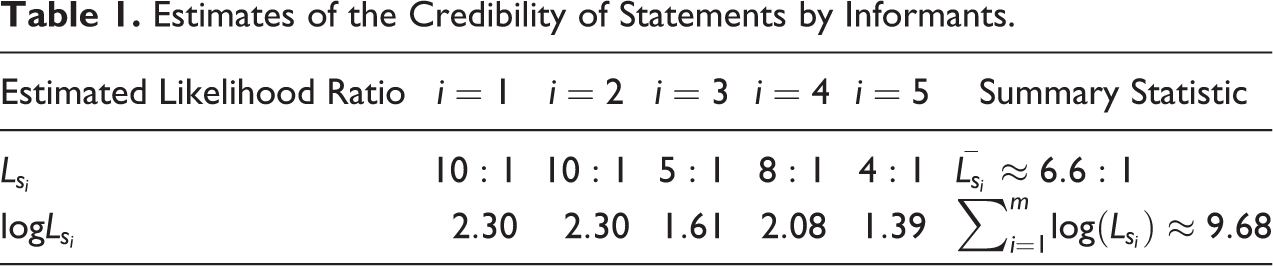
The derived likelihoods of the causal hypothesis that

attributable each of the five informants by the ethnographer are depicted in Table 2.
Justified Belief in a Causal Relation.

The credible evidence thus surrenders the odds that the causal link under investigation is correctly inferred at an average 6.6:1 across informants. Inspection of Tables 1 and 2 enables any audience of the research to appreciate how this overall support for the causal link is constituted (i.e., socially constructed) by the ethnographer and the informants. Recall that these calculations can also be placed alongside the text of the subjective statements. 17
Conclusion
We fully realize that many ethnographers will not find the contents of this article at all congenial. Placing subjective evidence about causality within a Bayesian framework runs counter to many of their precepts about remaining entirely faithful to the actors own account of what they are doing. However, if small-N studies are to aspire to reveal causal connections, then a systematic framework enabling comparison across informants and perhaps ethnographers must be found. Currently, these procedures remain difficult to extract from reported studies (Abend et al. 2013). The techniques we have outlined here achieve precisely this, through the use of Bayesian inference. Only in-depth applied work will show whether these sort of inference are intellectually revealing.
Footnotes
Declaration of Conflicting Interests
The author(s) declared no potential conflicts of interest with respect to the research, authorship, and/or publication of this article.
Funding
The author(s) received no financial support for the research, authorship, and/or publication of this article.
